The art of being an American is a balancing act at 250 years
The country will celebrate its 250th birthday Saturday, and it seems nobody quite knows how to feel about it. Being a thoughtful American in 2026 has become an art form unto itself — a balancing act two-and-a-half centuries in the making. Marking the anniversary of the signing of the Declaration of Independence requires the acceptance of a paradox so profound that it feels almost insurmountable: The great American experiment has failed; and it is also a triumph.
I’m writing this at near midnight on a muggy night in Pennsylvania — about 300 miles from Philadelphia, where in 1776 the Continental Congress adopted a document bearing one of the most famous and idealistic lines ever written: “We hold these truths to be self-evident, that all men are created equal, that they are endowed by their Creator with certain unalienable Rights, that among these are Life, Liberty and the pursuit of Happiness.”
Hundreds of years later, the course of human events has once again made it necessary for us to dissolve certain bonds, only the resulting revolution has been metaphorical and waged largely online. We have become a people pitted against one another in thought and in action. In the words we write on social media, the news we choose to consume on our siloed feeds, and the way we treat those who believe differently than we do.
How do we come together to celebrate the monumental achievement of this improbable democracy, which should be made stronger through our respectful disagreements and ability to compromise in search of a higher truth? It may be foolish to say we must lead with kindness when so much raw anger abounds, but that is all we can do. It is what we must do.
Art can help — the music, paintings, dances and plays that remind us in myriad ways that we are not alone. You’ll have access to plenty of such sustenance on this highly anticipated anniversary weekend. So if you are, like me, facing the fireworks with trepidation, find a way to lock into a favorite song, or read a poem that moves you, and the worry will pass. It always does.
I’m Arts editor Jessica Gelt, watching the fireflies. This is your arts and culture news for the week.
The week ahead: A curated calendar
SATURDAY

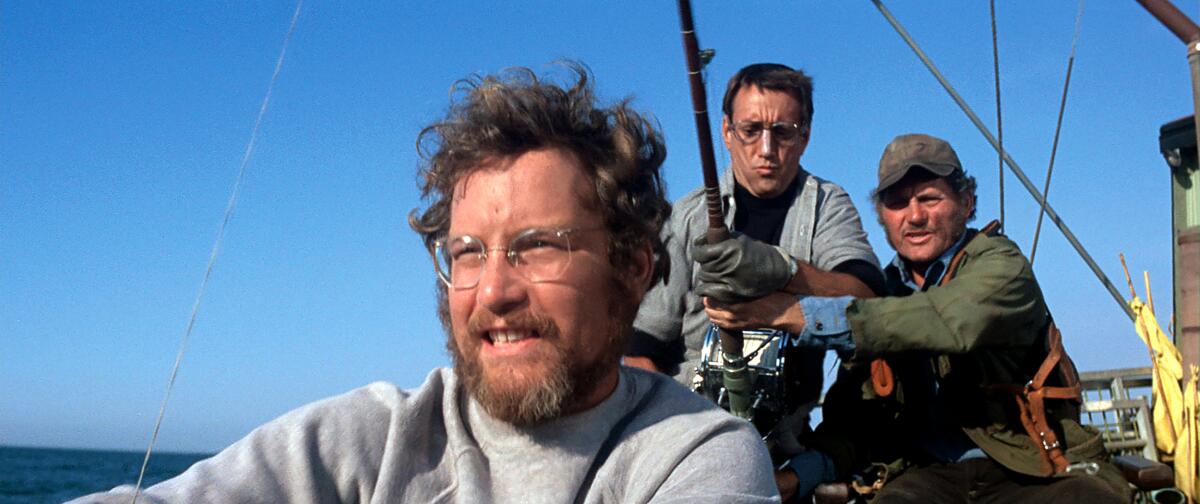
Richard Dreyfuss, left, Roy Scheider and Robert Shaw in the 1975 movie “Jaws.”
(Universal Pictures)
Jaws
Just when you thought it was safe to go back to the theater, a series of shark attacks are expected across the city Saturday afternoon as Steven Spielberg’s 1975 blockbuster screens at the Academy Museum’s David Geffen Theater (in 4K), the American Cinematheque’s Aero Theatre (in 35 mm) and Vidiots’ Eagle Theatre.
2:30 p.m. Saturday. Academy Museum, 6067 Wilshire Blvd. academymuseum.org; 3 p.m. Saturday. Aero Theatre, 1328 Montana Ave., Santa Monica. americancinematheque.com; 1 and 4:30 p.m. Vidiots Eagle Theater, 4884 Eagle Rock Blvd., Eagle Rock. vidiotsfoundation.org
TUESDAY
National Museum of the Aftermath screening series
Kevin Jerome Everson and Claudrena N. Harolds’ short film “Foosball: U. of Virginia Charlottesville, VA 1976” (2013), inspired by a photograph of two students playing a game, examines Black life at UVA; and Andrea Fraser’s feature documentary “This meeting is being recorded” (2022) gathers a group of a self-identifying white women to discuss unconscious racism and their own roles in white supremacy.
6 p.m. Oxy Arts, 4757 York Blvd. oxyarts.oxy.edu
WEDNESDAY

Brian Quijada, left, and Nygel D. Robinson in “Mexodus.”
(Thomas Mundell)
Mexodus
Direct from an award-winning off-Broadway run, this new musical created and performed by Brian Quijada and Nygel D. Robinson illuminates a lesser-known fork of the Underground Railroad, one that branched south across the Rio Grande.
Previews, 8 p.m. Wednesday, 7 p.m. Thursday, 8 p.m. July 10, 2 and 8 p.m. July 11; continues through Aug. 2. Pasadena Playhouse, 39 S. El Molino Ave. pasadenaplayhouse.org

New Swan Shakespeare Festival.
(New Swan Shakespeare Festival)
New Swan Shakespeare Festival
The annual summer-long event, featuring professional theater artists, UC Irvine alums, current graduate and undergraduate drama students and faculty, returns for another repertory season of classics under the stars at its intimate, 130-seat, portable, mini-Elizabethan space. “Romeo & Juliet,” directed by Rachael VanWormer, resets the tragic romance to the American Dust Bowl; “The Merry Wives of Windsor Cove,” adapted by Anna Fitzgerald & Eli Simon, with music by Zachary Dietz and directed by founding Artistic Director Eli Simon, brings the rollicking comedy to a 1950s SoCal surf town, powered by a live skiffle band.
“Romeo & Juliet,” 8 p.m. Tuesday and Thursday, and various dates through Aug. 29. “Merry Wives,” 8 p.m. Wednesday, and various dates through Aug. 30. UC Irvine campus, 4000 Campus Drive. newswanshakespeare.com
Wilkins Conducts Bernstein & Ellington
Thomas Wilkins guides the L.A. Philharmonic in a program of classical Americana featuring selections from Valerie Coleman, William Grant Still, a newly arranged song cycle from Shaina Taub’s Broadway hit “Suffs,” Leonard Bernstein and Duke Ellington.
8 p.m. Hollywood Bowl, 2301 N. Highland Ave. hollywoodbowl.com
Zoot Suit
Join writer-director Luis Valdez and star Edward James Olmos for a 45th anniversary screening of the film, an adaptation of Valdez’s groundbreaking play, the truly L.A. story of the 1942 Sleepy Lagoon case and Zoot Suit Riots. Audiences are encouraged to come in costume and arrive early for the “Pachuco Boogie!” Produced in partnership with the Los Angeles Latino International Film Festival, Self Help Graphics and Pachuco Car Club.
8 p.m. The Ford Ampitheatre, 2580 Cahuenga Blvd. East. theford.com
THURSDAY

Randal Goosby.
(L.A. Phil)
The Classical World Cup
Tito Muñoz conducts the L.A. Phil in a salute to “the beautiful game” (soccer to Americans) with works spanning the Americas by Alberto Ginastera, Samuel Barber (with Randal Goosby on violin), Silvestre Revueltas and Aaron Copland; plus the world premiere of “The Art of the Goal,” an original mixed-media concept film by director Josh Kahn and composer Adam Schoenberg. Commissioned by the L.A. Phil, the piece blends footage of elite training and match play featuring the Los Angeles Football Club with orchestral music.
8 p.m. Hollywood Bowl, 2301 N. Highland Ave. hollywoodbowl.com
The SoCal scene

(Matt Chase / For The Times)
Celebrations for the country’s 250th birthday have been muted thus far (at least compared to the bicentennial 50 years ago), but our Entertainment and Arts team noted the moment by examining the ways the artists we cover have interpreted the nation’s complex history. Times theater critic Charles McNulty wrote that a “cohort of playwrights, breathtakingly diverse demographically as well as aesthetically, has been rejuvenating American theater.” Contributor Shana Nys Dambrot looked to local museums and identified nine works of art “exploring and expounding upon, in celebration and critique, what it means and what it feels like to be an American.” Times classical music critic Mark Swed compared the artistic and institutional responses of 2026 to the past, lamenting that “None of this comes close to comparing with the attempted civic zest of 1976.” Check out the rest of the collection of stories and essays, including Mary McNamara’s column reminding us that even in troubled times 250 years is worth celebrating because “the Constitution was written ‘in order to form a more perfect union.’ Not ‘perfect,’ but ‘more perfect.’ As in better,” and a list of 10 essential movies that capture crucible moments in U.S. history; find out what Times pop music critic Mikael Wood calls the “quintessential American song,” and which books are being read in L.A. high schools and which classics remain relevant.

Carene Rose Mekertichyan , left, and Brent Charles in “Coriolanus” at the Griffith Park Free Shakespeare Festival.
(Grettel Cortes)
It’s summer and that means that outdoor theater is upon us and McNulty reviewed the Independent Shakespeare Co.’s Griffith Park Free Shakespeare Festival production of “Coriolanus.” “It’s hard to love ‘Coriolanus,’ but it’s equally hard not to be impressed by its ambition, originality and dramatic rigor,” wrote McNulty. This “production isn’t going to win awards for subtlety, but the storytelling is crisp and vivid. And even those unfamiliar with the tale — the vast majority of attendees, in all likelihood — should find it engrossing.”
It’s hard to believe that the ABBA jukebox musical “Mamma Mia!” premiered 25 years ago. Times staff writer Eloise Rollins-Fife went backstage at the Ahmanson Theatre to visit with the behind-the-scenes crew who put so much joy into the sequin-bedazzled extravaganza on display in the show’s anniversary tour — many of whom worked on the original production and tours.
Katie Simons profiled 99-year-old Sierra Madre resident Monson de Kansky, a onetime top ballerina who went to teach Parisian royalty, raise a family and still teaches ballet.
Hollywood set painters whose work in the Tinseltown dream machine often went overlooked and uncredited are getting their due in “Staging California in Early Hollywood” at the UC Irvine Langson Orange County Museum of Art in Costa Mesa. Times staff writer Julius Miller spoke with museum director Kathryn Kanjo and assistant curator Michaëla Mohrmann about the institution’s first exhibition since UC Irvine acquired OCMA last September and Kanjo’s appointment in December.
Enjoying this newsletter? Consider subscribing to the Los Angeles Times
Your support helps us deliver the news that matters most. Become a subscriber.
Culture news

Rosalie Tucker, executive director of Pieter Performance Space (standing left); Andrew Pearson of Bodies in Play (second from left); Lena Martin (second from right) and Mandolin Burns (right) of Crawlspace; Dani Burd of Indigo Dance Company (bottom left); and Adie San Diego (bottom right).
(Ariana Drehsler/For The Times)
The last few years have been rough for most arts institutions and many L.A. dance spaces have closed. Contributor Steven Vargas reported on how surviving dance companies and artists are forging ahead in the wake of COVID-19 pandemic and diminished funding.
The Centre Theatre Group announced that a world tour of the acclaimed stage adaptation of Hayao Miyazaki’s Academy Award-winning animated film “Spirited Away” will open the Ahmanson Theare’s 2027-28 season. “We are honored to bring the wonder of ‘Spirited Away’ to the Ahmanson Theatre for an exclusive US engagement, offering our community the gift of experiencing one of the most cherished stories of our time, reimagined for the stage in a once-in-a-generation theatrical experience,” said Douglas C. Baker, Center Theatre Group producing director, in a statement. The production, from Toho Co., will open at the National Theater in Taipei on Dec. 16, before continuing on a national tour of Japan from March-August 2027, followed by stops at the Princess of Wales Theatre, Toronto (May-August 2027), and the Ahmanson (September–October 2027). The tour will conclude with a return to the London Coliseum (March-July 2028), where it had its European premiere in 2024 following a sold-out tour of Japan in 2022. Casting will be announced at a later date.
The British theater lost two stalwarts this week. Penelope Keith, best known for the sitcoms “The Good Life,” which aired on PBS in the U.S. as “Good Neighbors,” and “To the Manor Born,” has died at age 86. Keith joined the Royal Shakespeare Co. in 1963, won a BAFTA Award in 1977 for “The Good Life” and continued her stage career into her 80s. The New York Times reported that Michael Byrne, a noted actor of stage and screen, also died this week at 86. Byrne created the role of the suspected torturer Dr. Miranda in the premiere production of Ariel Dorfman’s 1991 play “Death and the Maiden” in London. Other notable theater roles were with Siân Phillips in “Juliet and Her Romeo,” Polonius in “Hamlet,” Cassius in “Julius Caesar” and Prince Hal in “Henry IV.” The actor also appeared in films such as “Force 10 from Navarone,” “Indiana Jones and the Last Crusade,” “Braveheart,” “Gangs of New York” and “Harry Potter and the Deathly Hallows: Part 1.”
— Kevin Crust
And last but not least
If pyrotechnics (or drone shows!) are your thing and you’d like to celebrate the Fourth of July with a bang, Times staff writer Christopher Buchanan compiled 52 places and favorite spots to watch the festivities in Southern California.

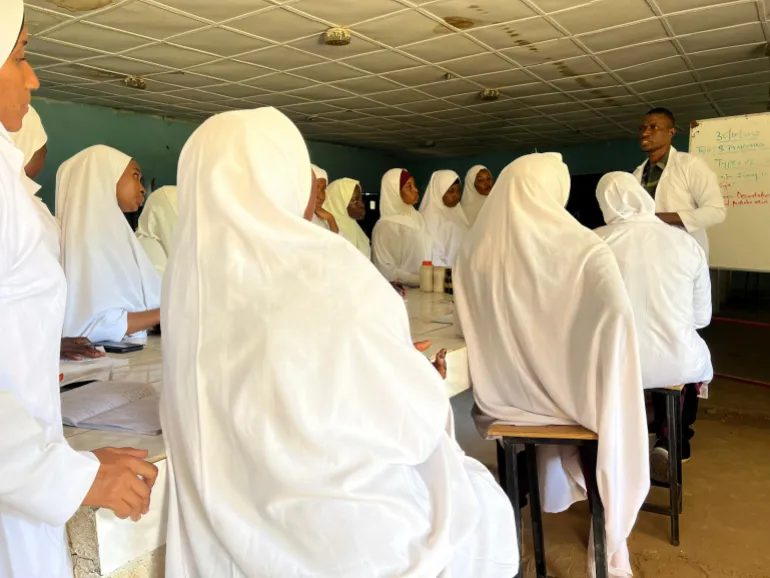
![UNICEF reports that more than half of girls in northern Nigeria are out of school, highlighting deep gender gaps in education. [Abdulaziz Bagwai /Al Jazeera]](https://i0.wp.com/occasionaldigest.com/wp-content/uploads/2026/06/1000872132-1-1780347186.jpg?w=640&ssl=1)
![A classroom session at the Women Centre for Continuing Education in northern Nigeria. [Abdulaziz Bagwai /Al Jazeera]](https://i0.wp.com/occasionaldigest.com/wp-content/uploads/2026/06/1000872131-1-1780347183.jpg?w=640&ssl=1)