Bab

Italy to deploy warships to protect shipping through Bab al-Mandeb | Global Energy Crisis News

Italy’s defence minister warns of severe economic fallout if Bab al-Mandeb becomes impassable, bypassing EU delays.

Italy will deploy warships to ensure safe passage for its commercial vessels through the Bab al-Mandeb strait, Defence Minister Guido Crosetto said, adding that Rome would not wait for a joint decision from the European Union.

“We have the capabilities to protect the passage,” Crosetto said, warning that if the waterway became impassable, the economic consequences would be severe.

Recommended Stories

list of 3 itemsend of list

The Italian defence minister said that Rome “must not allow bureaucratic delays in decision-making to exacerbate an already complex situation”.

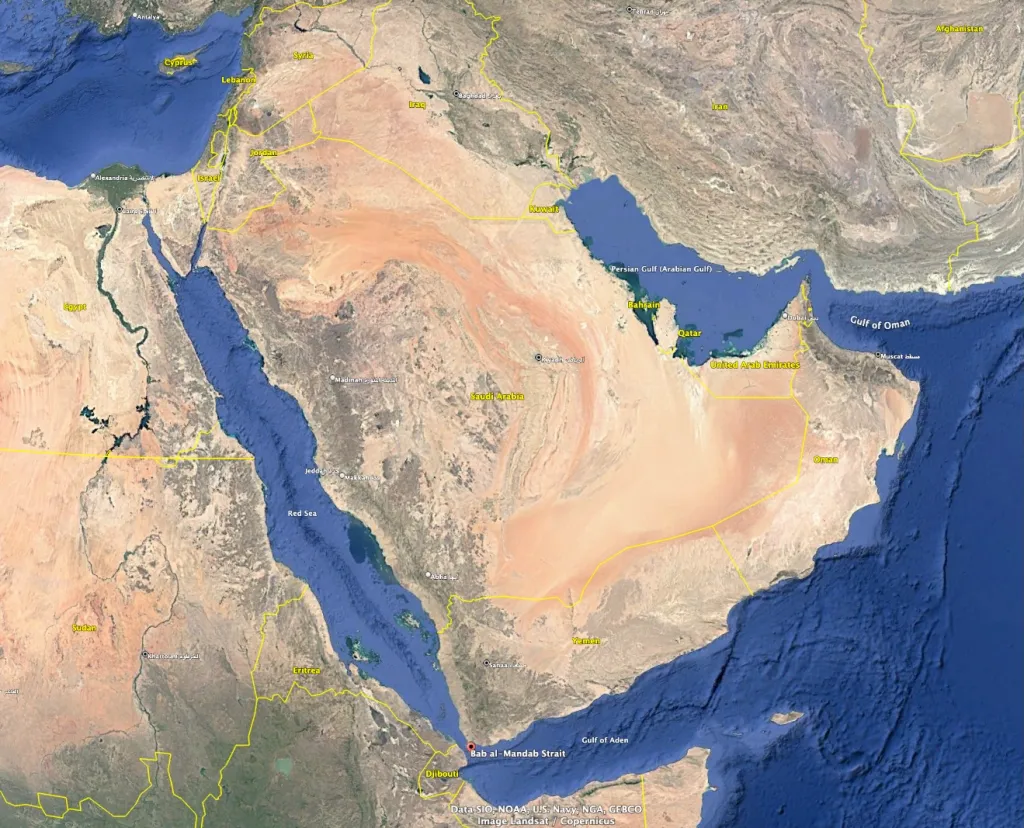
Bab al-Mandeb links the Red Sea to the Gulf of Aden, forming one of the world’s busiest shipping corridors between Europe and Asia and a critical route for oil, gas and container traffic heading to and from the Suez Canal.

Roughly 12 to 15 percent of global trade has historically passed through the narrow waterway, which separates Yemen from Djibouti and Eritrea on the African side and is only about 30km (19 miles) wide at its narrowest point.

The strait’s importance has grown sharply since Iran effectively seized control of the Strait of Hormuz earlier this year amid its war with the United States and Israel, choking off the world’s most important oil chokepoint and pushing much of the Gulf’s crude exports towards alternative routes.

Saudi Arabia, in particular, has increasingly relied on pipelines and Red Sea shipping to bypass Hormuz altogether, making the Bab al-Mandeb strait one of the last major arteries still open to Gulf oil reaching global markets.

Control of the strait has been contested for years, as Yemen’s government, Houthi rebels and, at times, forces in the region have held stretches of its coastline at different points since the war in Yemen began in 2015.

The significance of the strait has been hit dramatically in the past few weeks, when the Iran-backed Houthi movement launched a rapid offensive that brought the entirety of Yemen’s western Red Sea coast under its control, including several strategically located islands.

The advance has given the Houthis effectively unrestricted access to the waterway, a development seen as a major setback for international shipping, given the group’s history of attacking vessels it associates with the US or its allies in the region.

The US and the European Union have already carried out military operations aimed at better protecting merchant ships from Houthi attacks in the area, though those efforts have struggled to fully secure the route as fighting in Yemen has escalated.

Source link

‘They called us’: Has Trump abandoned Bab al-Mandeb to the Houthis? | Houthis

On September 12, 2026, United States President Donald Trump stood in Dublin alongside Irish Prime Minister Micheal Martin and said in a cool tone that the Houthis “called us, and they don’t want to fight us”, adding that the group was “allowing ships to pass” and that the situation would “work out very well”.

His remarks came just as Houthi forces had completed their takeover of the coastal town of Dhubab and Perim (Mayyun) Island, which divides the Bab al-Mandeb strait into two shipping channels, after seizing the strategic port of Mocha. This gave them a direct presence at the entrance to one of the world’s most important waterways.

Trump was speaking against the backdrop of a Houthi announcement that they would blockade Saudi oil supplies to Asia and Saudi commercial shipping, signalling the collapse of the traditional “security-for-oil” formula.

What is happening at Bab al-Mandeb is not an isolated event, but the latest in a long series of US retreats from security commitments that for decades underpinned the “security-for-oil” relationship between Washington and the Gulf states.

This is not a passing political position, but a profound shift in the regional security landscape: the United States is choosing not to intervene militarily against an armed group designated as terrorist that controls one of the world’s most important straits and whose actions go beyond the logic of conventional deterrence.

Trump’s remarks: Substance and strategic context

In Dublin, Trump said the Houthis had contacted the US administration seeking to avoid confrontation with Washington. He said they were “allowing most ships to pass” and that the problem was limited to “one country”, which he did not name – an apparent reference to Saudi Arabia – promising to “take care of fixing that”.

He also said the United States had “tight control” over the Strait of Hormuz and that about 25 ships were passing through it each day on average, despite maritime sources denying this.

On the ground, Trump’s remarks suggested that the Houthis remain wary of US military force and American deterrence, which has already put considerable pressure on their regional backer, Iran. They were therefore prepared to bargain, just as they accepted US conditions in 2025.

At the same time, Trump’s directives – as relayed by US military and civilian officials – revealed a clear hierarchy of priorities: Iran as the principal threat, securing the Strait of Hormuz as the vital artery for oil and gas flows, and avoiding another military front in Yemen.

This reflects a narrow strategic logic. From Washington’s perspective, Bab al-Mandeb is less vital to American oil interests than to flows towards China and other Asian markets that compete with the US economy. And because Trump believes the Houthis “are not targeting American ships”, direct intervention would, in his view, place an unjustified additional burden on US forces already exhausted by the Iranian front.

Trump’s position also cannot be separated from domestic politics. The US-Iran war has eroded his political support after he promised to keep the United States out of Middle Eastern wars.

According to The Los Angeles Times, Trump told Fox News that he “might not do it because of the elections”, referring to avoiding further military escalation before the congressional elections. Opening a new front in Yemen could further complicate matters for Republicans in closely contested House and Senate races.

Meanwhile, Saudi circles denied an Axios report claiming that Crown Prince Mohammed bin Salman had called Trump twice on the eve of the Houthi takeover of the coast on September 10, urging him to strike the Houthis, and that Trump had refused.

The sources pointed to Axios’s own July 29 report on Saudi Defence Minister Prince Khalid bin Salman’s visit to Washington, which said he had told the US vice president that the kingdom could manage the confrontation with the Houthis itself and did not need US military intervention. They regarded the two accounts as contradictions in the reporting of Axios’s Barak Ravid.

Observers in Riyadh see the restrained US position as part of a broader policy: the administration currently has no intention of taking direct military action against the Houthis. At the same time, Admiral Brad Cooper, commander of US Central Command, travelled to Riyadh for urgent coordination talks with Prince Mohammed, indicating that Washington is seeking to “intensify its support” for Saudi Arabia while avoiding direct military involvement – a formula well understood in Riyadh.

Trump sought to reassure Saudi concerns by describing the crown prince as a “good friend” and promising that “everything will work out very well”. But he offered no specific military commitment, and the White House announced no explicit guarantees to protect Saudi energy infrastructure or maritime routes.

This reluctance also follows a series of US decisions that have demonstrated a growing retreat from its security commitments in the Gulf. During his first term, Trump did not respond to the 2019 Aramco attack, for which the Houthis claimed responsibility but which was believed to have originated from Iraqi factions to the north. The attack temporarily knocked out half of Saudi oil supplies.

In February 2026, the United States joined Israel in attacking Iran without consulting its Gulf allies and has since faced growing difficulties defending them against Iranian attacks. US forces are now heavily preoccupied around the Strait of Hormuz, limiting their ability to respond to another front in Yemen.

Paradoxically, Washington, now bogged down in Hormuz, appears to need Saudi help in containing Iranian disruption at Bab al-Mandeb, rather than the other way round.

Since the war began on February 28, Riyadh has resisted all US pressure to become involved in a confrontation with Iran for two reasons. First, it believes such pressure carries an implicit aim of portraying the Saudi front as part of the Israeli front. Second, it was not consulted over the launch of the war and is not prepared to be worn down in a conflict serving Israeli objectives.

The erosion of the US umbrella and the fate of the ‘security-for-oil’ formula

Since the 1970s, the US-Gulf relationship has rested on a clear but implicit bargain: the United States provides a security umbrella protecting the Gulf states and energy routes, while the Gulf states ensure a steady flow of oil to the global economy at reasonable prices.

This was more than a bilateral understanding between Riyadh and Washington. Gulf security meant oil security, and oil security meant the security of the Western economy, making the bargain a pillar of the international energy system for decades.

Today, there are mounting signs that this formula is beginning to collapse.

First, strategic abandonment: Trump’s refusal to defend Bab al-Mandeb, and his response to the Houthis’ request that the US stay out of the conflict in return for allowing American ships to pass – effectively a political deal – marks a watershed. For the first time, the United States is clearly hesitating to defend energy security and a pivotal ally against a direct threat to global energy infrastructure. This is not temporary hesitation, but a redefinition of the US commitment.

Second, the redirection of priorities: Washington’s focus on the Strait of Hormuz and avoidance of a front in Yemen point to a new approach: not a comprehensive security umbrella, but selective protection of direct US interests. Hormuz matters because it carries Gulf oil to markets on which the US economy depends, while Bab al-Mandeb – from Trump’s perspective – primarily serves exports to China and Asia, interests Washington does not consider worth further military investment.

Third, military exhaustion: the US military is exhausted by the war with Iran and its stocks of advanced interceptor missiles have been depleted. This is structural rather than temporary, reflecting a growing inability to manage multiple fronts.

Fourth, domestic politics: the erosion of Trump’s political support because of the Iran war makes further military expansion politically costly. What was once a guarantee of Gulf security – US power – has become hostage to domestic electoral calculations.

Does this mean the end of the “security-for-oil” formula? Not necessarily. But it does point to a fundamental shift from a bilateral US-Gulf arrangement to a more complex, multilateral one.

The US umbrella has not disappeared, but it has contracted. The United States still maintains forces in the region and remains focused on the Strait of Hormuz, but its commitment is no longer comprehensive or unconditional.

Saudi strategic hedging

For years, Riyadh has been pursuing alternatives through strategic hedging. Its announcement of a 14-state multinational defensive maritime alliance – including Turkiye, Pakistan, Egypt, Sudan and Djibouti – is an attempt to fill the US security vacuum, while US or European naval forces are also deployed around the strait as part of similar Western coalitions.

Saudi Arabia is also strengthening its air and missile defences, developing its naval capabilities and deepening defence ties with countries including Turkiye and Pakistan. These efforts have included the “Strategic Mutual Defence Alliance” with Pakistan and the Mecca alliance with Turkiye and Pakistan in August 2026.

What we are witnessing is not the end of the US umbrella, but its shift from a “comprehensive guarantee” to “conditional and limited support”, forcing Gulf states to rethink their collective security.

The Saudi position on industrialised countries’ disregard for supply security

Saudi Arabia now faces one of its most serious security challenges: the Houthis control Bab al-Mandeb, are choking Saudi trade and have already launched drone and missile attacks towards Saudi territory.

Saudi oil exports to Asia fell from around 3.4 million barrels a day in June to just 128,000 in August, before partially recovering to 700,000 this month. Oil prices have meanwhile exceeded $107 a barrel, while the price of a gallon of petrol in the United States has risen by 35 percent.

The real danger is the simultaneous disruption of two maritime chokepoints: Hormuz, through which about 20 percent of global oil and gas supplies pass, is almost closed because of the US-Iran war, while Bab al-Mandeb, which accounts for 10-12 percent of global oil, is under Houthi control. Closing both could block about a quarter of global supplies.

Even without complete closure, the continuing threat creates a permanent “risk premium” on prices, according to economic analysts. Although Saudi Arabia benefits in the short term from higher prices, it is strategically harmed by instability because Vision 2030 depends on foreign investment, tourism and stability, not temporary wartime oil revenues.

Riyadh has long played a leading role in stabilising oil markets, frequently using its position as a swing producer to limit volatility. But amid the indifference of industrialised countries to supply security and the threats facing energy sources and routes, Saudi Arabia cannot put aside the dangers to its own security, sovereignty and people for countries that disregard the geopolitics of energy.

For this reason, Saudi Arabia has previously declared that it “will not bear responsibility for any disruptions or shortages in global oil supplies” resulting from Houthi attacks on its oil facilities.

This is more than a warning. It redefines the implicit social contract with its allies: Saudi Arabia is no longer prepared to act as guarantor of last resort for global energy security without something in return.

Its message is that the international community – particularly the major industrialised countries that benefit from oil flows – must share responsibility for protecting maritime routes, rather than leaving Riyadh to bear the cost alone.

‘Collective responsibility’ as a new security doctrine

The Saudi Ministry of Defence reinforced this approach in its statement on the proposed maritime alliance, stressing that “the security of international maritime routes is a collective responsibility that requires effective and sustainable international partnership”.

This is more than a diplomatic appeal. It amounts to a reformulation of the regional security contract: Saudi Arabia is not asking industrialised countries to defend Saudi interests, but to help protect their own interest in the continued flow of oil on which their economies depend.

In July 2026, Saudi Arabia announced a “Multinational Defensive Maritime Alliance” of 14 founding states: Saudi Arabia, Kuwait, Bahrain, Qatar, Pakistan, Turkiye, Egypt, Jordan, Yemen, Bangladesh, Nigeria, Sudan, Djibouti and Somalia.

At least 43 countries and organisations attended the founding meeting in Riyadh. The alliance may mark an important turning point, reflecting an implicit Saudi acknowledgement that the US umbrella is no longer sufficient and that Riyadh must build its own security capabilities with regional allies.

US exposure: A deeper strategic reading

Trump’s statements downplaying the Houthi takeover of Bab al-Mandeb and his refusal to intervene reflect not only a political decision, but a structural weakness in US deterrence.

The United States is unable to manage multiple fronts. Its concentration around the Strait of Hormuz limits its ability to respond in Yemen; fighting has depleted stocks of advanced interceptor missiles; and the unpopularity of the war and approaching congressional elections constrain its freedom of action.

From the perspective of countries in the region, the US military presence in the Gulf is no longer an unconditional security guarantee. The question of whether allies could be abandoned again is pushing decision-makers from Riyadh to Abu Dhabi, Kuwait and Doha to diversify their security and defence partnerships.

That means deeper defence ties with Turkiye and Pakistan, stronger air and missile defences and naval capabilities, maintaining open channels and seeking risk-reducing understandings with regional powers including Iran, and multinational maritime alliances to protect navigation.

But these alternatives have limits. Can any regional alliance fully compensate for the absence of a major power such as the United States when confronting threats on the scale of Iran and its proxies? US intelligence, logistical and interception capabilities have no regional equivalent, leaving a security gap that cannot quickly be filled.

The new regional order: Towards multipolarity

What we are witnessing is not merely a passing security crisis, but the emergence of a new regional order marked by the decline of unilateral US dominance. The United States is no longer the sole security power in the Gulf, as Saudi Arabia, Egypt, Turkiye and Iran gain weight and Gulf states diversify their partnerships and seek more collective regional security arrangements.

Trump’s response to the Houthi takeover of Bab al-Mandeb is therefore not simply a political position, but a sign of a tectonic shift in the regional security order. The “security-for-oil” formula that governed US-Gulf relations for decades has not formally ended, but it no longer provides the guarantees on which it was built. The US security umbrella remains, but it has become selective, conditional and subject to domestic US calculations unrelated to the interests of the Gulf states.

Saudi Arabia, caught between the hammer of the Houthis at Bab al-Mandeb and the anvil of Iran at the Strait of Hormuz, is pursuing a different approach: insisting that protection of maritime routes become a “collective responsibility” and that it should no longer bear alone the cost of protecting the interests of industrialised countries dependent on its oil.

This position – backed by the announcement of a multinational maritime alliance – marks the beginning of a redefinition of the regional security contract, although significant questions remain over whether ambition can be translated into capability.

Oil prices above $107 a barrel may be only an early sign of what lies ahead. If US exposure continues and regional understandings guaranteeing freedom of navigation remain out of reach, the world could face an energy crisis comparable to those of the 1970s, but without a US security umbrella ready to contain it.

Bab al-Mandeb is therefore more than a maritime strait. It reflects the end of one era and the beginning of another, in which Gulf security is no longer an American gift but a collective responsibility still searching for new arrangements.

Saudi Arabia, meanwhile, appears to favour a combination of deterrence and avoiding all-out war. Rather than sliding into open-ended attrition, it seeks to support national allies on the ground, enable the Yemeni state to restore its sovereignty, contain the logic of the militia and build a national doctrine that limits external penetration.

Yemen’s stability is no longer a purely Yemeni matter, but a first line of defence for the Red Sea and Bab al-Mandeb and for the cohesion of the Arab sphere, with Riyadh and Cairo remaining central pillars in confronting projects of disintegration and fragmentation.

Within this emerging order, the Saudi-Egyptian partnership is becoming a cornerstone of regional security. Crown Prince Mohammed bin Salman’s expected visit to Cairo and summit with President Abdel Fattah el-Sisi give practical expression to the principle of “collective responsibility”.

Riyadh and Cairo recognise that the security of the Red Sea and Bab al-Mandeb is not a local matter: it is vital to the Suez Canal and Egyptian economy, and forms strategic and security depth for Saudi Arabia.

By coordinating diplomatic and military action, supporting the full liberation of Yemen and containing the reach of the militias, the two countries are helping shape an autonomous regional security order intended to fill the vacuums left by retreating international powers, protect international navigation and confront shared threats from a position of parity and capacity.

The views expressed in this article are the author’s own and do not necessarily reflect Al Jazeera’s editorial stance.

Source link

Houthis’ Stranglehold On Strategic Bab Al-Mandab Strait Grows Stronger

The Iranian-backed Houthi rebels have captured Mokha – a key Red Sea port in southwestern Yemen near the Bab al-Mandab (BAM) Strait. There are also reports they seized two islands located in the Red Sea shipping lanes. These moves against the Saudi Arabian-backed forces that previously held these areas could further cement the Houthis’ control over the narrow chokepoint to the Gulf of Aden, where the group has already imposed a blockade on Saudi oil exports.

The Houthis’ drive to control the BAM has been emboldened by the U.S. being stretched thin in its ongoing fight against Iran. Combined with Tehran’s control of the Strait of Hormuz, this threatens to add to the Islamic Republic’s command over the flow of oil from the Middle East. It is a maximum pressure campaign on the U.S. and global markets, something we have predicted for years. Amid all this activity, the per-barrel price of Brent Crude is well over the $100 mark now.

The port of Mokha. (Google Earth)

The rapid advance on Mokha was planned and backed by Iran, according to the leader of Saudi-backed forces that retreated from Mokha, which is about 50 miles north of the BAM. It took place as Tehran has taken a more belligerent stance in the region that has seen it reportedly damage U.S. aircraft in a recent attack on Jordan earlier this week and get closer to striking U.S. Navy warships with ballistic missiles.

“The Joint Forces have formed a command center south of the city of Mokha, following Houthi breakthroughs across various combat axes under heavy fire, in which the Houthis used various types of weapons,” Deputy Chairman of the Presidential Leadership Council (PLC), Lt. Gen. Tareq Saleh, said in his acknowledgment that his forces lost the port. The PLC was created in 2022 to represent the internationally recognized government of Yemen.

“The armed forces on the West Coast — the National Resistance, the Giants [Brigades], and the Homeland Shield — in addition to units of the Taiz axis west of the governorate, have paid a heavy price, martyrs and wounded, over the past days as they confronted the Houthi attack, which was planned by Iran, supported by it, and carried out with the participation of its various proxies/tools.”

“Thanks to God, our armed forces were able to repel an enemy combat formation a short time ago in the province of Taiz, forcing it to withdraw,” Houthi spokesman Brig. Gen. Yahya Saree proclaimed. “This was achieved by targeting it with a number of locally manufactured surface-to-air missiles.”

(Houthi Telegram channel)

Videos have emerged showing Houthi forces inside Mokha and its airport and a large amount of equipment being seized.

Even before the capture of Mokha, the rebel group held the BAM under threat with its array of drones and missiles, some of which it launched from deeper in Yemen. In fact, the group became the first to fire anti-ship ballistic missiles (ASBM) at vessels during its campaign against Red Sea shipping.

©2023, The International Institute for Strategic Studies, originally published on https://iiss.org/online-analysis/military-balance/2024/01/houthi-anti-ship-missile-systems-getting-better-all-the-time/(reproduced with permission) (International Institute of Strategic Studies)

Mokha, however, provides a potential new surveillance and launching point for the Houthis to deploy mines as well as aerial drones and uncrewed surface vessels (USVs) they can use to attack shipping. As we have reported previously, the rebel group pioneered the operational use of some of these weapons.

The Houthis “are determined to control the ports in order to use booby-trapped boats from areas close to shipping lanes,” Col. Abdul Basit Al-Baher, a Yemeni army officer and military analyst, told Arab News last month as the rebels were pushing closer to the port.

You can see video and images of a Houthi USV that struck the Greek-owned ship Tutor in the Red Sea in 2024 below.

In addition to Mokha, the Houthis also reportedly captured two important islands that could also add to its control over shipping through the strait. However, TWZ cannot independently confirm this.

There are claims that the Houthis seized Perim Island, which sits right in the middle of the BAM. In 2021, satellite images we obtained showed completion of a new, approximately 6,150-foot-long runway on the island as well as hangars and other facilities. The installation was supposedly meant primarily to support drone operations and was built by the United Arab Emirates.

This strategically located island sits in the narrowest part of the BAM, less than two miles west of Yemen and about 13 miles east of Djibouti, giving the Houthis a commanding presence at the mouth of the Red Sea.

PHOTO © 2025 PLANET LABS INC. ALL RIGHTS RESERVED. REPRINTED BY PERMISSION)
(PHOTO © 2025 PLANET LABS INC. ALL RIGHTS RESERVED. REPRINTED BY PERMISSION)

Zuqar Island, which was also reportedly captured, sits in the middle of the Red Sea about 80 miles north of Perim Island. In the custody of the Yemeni government since 1998, it was being “used by government forces to track shipping traffic, monitor movements by Houthi rebels and stop weapons smuggling in the Red Sea,” according to The National.

Last year, images emerged of construction of a runway on the island.

(PHOTO © 2025 PLANET LABS INC. ALL RIGHTS RESERVED. REPRINTED BY PERMISSION)
This satellite image from 2025 shows the runway on Perim Island. (PHOTO © 2025 PLANET LABS INC. ALL RIGHTS RESERVED. REPRINTED BY PERMISSION)

It is unclear who built this island runway, though there have been indications that it could have been the United Arab Emirates once again.

Zuqar Island sits about 7 km east of the northbound shipping lane in the Red Sea. Control over these two islands could allow the Houthis to mirror the pattern Iran established in the Strait of Hormuz by directing traffic to pass through a narrow passage between Qeshm and Larak islands.

The Iranian transit scheme for the Strait of Hormuz. (Iranian government)

The conflict between Saudi Arabia and the Houthis grew out of a civil war in Yemen that erupted in 2014. It expanded a year later when a Saudi-led coalition joined forces with the government ousted by the Houthis and raged on until the parties reached a tenuous ceasefire in 2022. The Saudis held off on getting involved in the recent Red Sea conflict which saw the U.S. and coalition warships duking it out with the Houthis, and eventually led to a U.S.-led air campaign over Yemen. Tensions, however, reignited after that conflict ended when the Houthis joined the U.S.-Iran conflict on the side of their major supporter. In addition to the aforementioned blockade, the Houthis began striking Saudi refineries.

The Houthis already control the port of Hodeidah, about 100 miles to the north. Capturing Mokha and the two islands extends their reach even closer to the BAM. 

In the wake of the Houthi blockade imposed in July, traffic in the BAM fell by 15%, according to Lloyd’s List Intelligence.

“On average, 273 ships sailed through the chokepoint each week between 27 July and 23 August,” the organization reported. “The naval ban on Saudi Arabia came into effect on 20 July, and the weekly average in the run up date was 319. Still, traffic remains above volumes seen before the crisis in the Middle East Gulf that led to a flurry of activity in the Red Sea as Saudi oil was redirected to Yanbu.”

As we have explained in the past, Saudi Arabia has diverted millions of barrels of oil per day through pipelines to its Yanbu port on the Red Sea in an effort to minimize the energy shortages due to the hostilities near the Persian Gulf.

ANKARA, TURKIYE - JULY 29: An infographic titled "Red Sea tensions expose the vulnerability of alternative oil corridors to Strait of Hormuz" created in Ankara, Turkiye on July 29, 2026. (Photo by Yasin Demirci/Anadolu via Getty Images)
Saudi Arabia has increasingly sent oil to its port of Yanbu on the Red Sea. (Photo by Yasin Demirci/Anadolu via Getty Images) Anadolu

The biggest impact of the blockade, Lloyd’s List Intelligence notes, is that it is driving up the cost to deliver oil by forcing traffic north through the Suez Canal, “extending voyage times and tying up capacity. In the Middle East, rising use of Hormuz shuttle tankers and multiple STS transfers is creating delays and increasing vessel utilization. Combined, these rising inefficiencies have led to the third VLCC spot-rate spike since the beginning of the crisis in the Middle East Gulf.” 

The Houthi strikes on Saudi’s oil infrastructure, including a Houthi missile and drone attack against the Saudi Aramco refinery at Jazan on the Red Sea earlier this week, add a further dilemma for Riyadh, making it harder to get its product to points of shipment.

Video of of the aftermath of those strikes, which you can see below, emerged on social media.

All this is raising the specter of the U.S. having to get as involved as it did during the previous Houthi campaign against shipping that ended last September, which could pull resources away from Iranian-focused operations, if supporting such an operation is even possible at all at this point. The Navy, and other key elements of the U.S. military, is overstretched and worn down by continuous deployments for many months leading up to Venezuela and then Iran, and now six months after Operation Epic Fury.

U.S. forces in the Persian Gulf are under increasing pressure as tensions with Iran continue to simmer. On Tuesday, several U.S. Air Force jets were damaged in an Iranian missile barrage on Muwaffaq Salti Air Base in Jordan, according to CBS News. An A-10 Thunderbolt II close support jet lost a wing and about eight F-15E Strike Eagle multi-role fighters were slightly damaged and returned to service, the network noted.

There is also a report that Acting Navy Secretary Hung Cao said Iranian forces “blew the hell out of Bahrain” where the U.S. military has a number of key facilities, including the headquarters of the U.S. Fifth Fleet. The country has been the subject of frequent Iranian barrages since the U.S. and Israel first attacked on Feb. 28.

Cao’s assessment matches what we have seen and heard prior to his comments and raises anew the question of whether the U.S. will return to Bahrain and other bases in the region heavily attacked by Iran.

On the sea, Iranian missiles are getting closer to hitting U.S. Navy warships, the Wall Street Journal reported.

“At least three times in the past week, Iranian forces have launched missiles at American warships, including an aircraft carrier, taking direct aim at the U.S. Navy in a way it hasn’t done since the start of the war,” the newspaper noted. “The attempted strikes on warships have led to much closer calls than previous attempts, with Iran using maneuverable warheads, people familiar with the attacks said.”

Amid this activity, traffic through the Strait remains suppressed.

“Vessel transits via the Strait of Hormuz fell on Wednesday to seven from 12 ​the previous day, preliminary ship-tracking data showed on Thursday, with ‌levels also below the 10-day average of 14,” Reuters reported. “Out of these seven ships, four vessels exited and three entered, according to the data.”

However, an exact figure is hard to come by. Some vessels could be sailing through the ​waterway with their transponders turned off and would not be counted ​toward the totals, the outlet added.

Vessels transit the Hormuz Strait off the coast of Iran's southern port city of Bandar Abbas on September 7, 2026. Iran's top negotiator threatened on September 6 of a more forceful response to any further US attacks after Tehran targeted American warships in their latest round of clashes. The exchanges of fire, which began with US raids last week, come amid a deadlock in the six-month war between the two foes. (Photo by ATTA KENARE / AFP via Getty Images) /
Vessels transit the Hormuz Strait off the coast of Iran’s southern port city of Bandar Abbas on September 7, 2026. (Photo by ATTA KENARE / AFP) ATTA KENARE

As it is, oil prices are skyrocketing. As of noon Thursday, the per barrel price of Brent Crude exceeded $107, the highest price since July when it fell to just over $77 per barrel, according to OilPrice.com.

It will take some time before we get a better picture of how the Houthi seizure of the port of Mokha, and possibly Perim and Zuqar islands, will affect the global economy due to rising oil prices, either through reduced supply, increased cost of delivery or some combination of the two. With no end in sight to the U.S. conflict with Iran that helped to drive these actions, the Yemeni rebel group has incentives to inflict economic pain wherever it can.

Contact the author: howard@twz.com

Howard is a Senior Staff Writer for TWZ. He writes frequently about conflict, focusing heavily on the Middle East and Ukraine, and interviews with military and intelligence officials and industry leaders from around the globe. He lives near Tampa, Florida, home of U.S. Central Command, U.S. Special Operations Command.


Source link

Arab News | Why Bab Al-Mandab matters as Yemen fighting intensifies

DUBAI: Renewed fighting along Yemen’s Red Sea coast has put the strategic Bab Al-Mandab Strait back in focus, raising concerns over a key maritime route linking Europe and Asia.

The strait is a narrow passage between Yemen and the Horn of Africa that connects the Red Sea with the Gulf of Aden and the wider Indian Ocean.

For ships travelling between Asia and Europe, it forms part of the route linking the Indian Ocean to the Red Sea and the Suez Canal, making it one of the world’s most important maritime chokepoints.

Why is it so important?

Bab Al-Mandab is the southern gateway to the Red Sea. Ships travelling through the Suez Canal between Europe and Asia generally pass through the Red Sea and then Bab Al-Mandab before entering the Gulf of Aden.

The route has ships carrying oil, fuel and other commercial goods.

Oil flows through the strait fell sharply after Houthi attacks on shipping began disrupting Red Sea traffic.

The US Energy Information Administration said oil trade through Bab Al-Mandab averaged about 4 million barrels per day in the first eight months of 2024, compared with 8.7 million barrels per day in 2023.

Why does the latest fighting matter?

Yemen’s western coastline runs alongside the strait, making control of nearby territory strategically important.

The port city of Mokha lies north of Bab Al-Mandab, while Dhubab is close to its entrance. Any expansion of Houthi control along this stretch of coast could increase the group’s ability to threaten or monitor shipping through the waterway.

Reuters reported on Thursday that Houthi forces were moving toward Mokha and Dhubab as they sought greater control of Yemen’s Red Sea coast. Yemeni government military sources said this could give the Houthis significant leverage over Bab Al-Mandab.

The reports have not been independently verified, and they do not mean the Houthis control the strait. But any further Houthi advance toward the coast could increase the risk to commercial shipping.

The Houthis have previously targeted commercial vessels in and around the Red Sea, forcing many ships to avoid the route.

What happens if shipping is disrupted?

Ships can avoid Bab Al-Mandab and the Red Sea by sailing around the Cape of Good Hope in South Africa.

But that can add thousands of kilometers to some journeys, increasing sailing times, fuel consumption, insurance costs and freight rates.

The consequences can therefore extend well beyond Yemen, affecting the movement and cost of energy, manufactured goods and other products travelling between Asia, the Middle East and Europe.


Source link

Yemen envoy warns of wider war as Houthis threaten Bab al-Mandeb Strait | Conflict News

The war in Yemen is threatening to open a new front as the Iran-allied Houthi rebels are trying to advance along the Red Sea coast, through the mountain chains of Taiz province, edging closer to strategic ground that overlooks one of the world’s most vital maritime arteries.

For the internationally recognised Yemeni government, this is an offensive with global consequences.

Recommended Stories

list of 3 itemsend of list

In Wednesday’s interview with Al Jazeera, Yemen’s Ambassador to Qatar, Rajeh Badi, a former government spokesman, said that his government and its armed forces had not violated any truce since 2021.

The Houthis, he argued, are “the aggressors”. “What we are seeing now is a surprise Houthi offensive to seize strategic ground along the Red Sea, in order to allow Iran, through its Houthi proxy, to tighten its grip on maritime routes,” Badi said.

He added that the Houthis, who have advanced on al-Makha (Mocha) and al-Waziyah, and over large stretches of the mountain chain overlooking the Red Sea in Taiz province, “want commanding positions to launch more effective strikes on ships and disrupt navigation in the Red Sea”.

Badi said the Yemeni government responded by opening fronts in al-Jawf, Marib and al-Bayda, and that the consequences could extend far beyond Yemen.

[Al Jazeera]
[Al Jazeera]

“We are now facing a real threat that does not stop at Yemen’s borders,” he said. “It threatens the entire region and the world. If the Houthis manage to choke maritime traffic in the Red Sea, we will be looking at another Hormuz in these waters – with potentially even greater impact.”

The Red Sea and Bab al-Mandeb “represent a vital artery for global shipping, for both energy and food supplies”, he added.

A chokepoint that belongs to the world

Bab al-Mandeb connects the Red Sea to the Gulf of Aden. To the north, the Red Sea leads to the Suez Canal, while farther east, beyond the Arabian Sea, lies another critical chokepoint, the Strait of Hormuz. This geography is what gives Yemen’s conflict consequences far beyond its borders, as Saudi Arabia is already being drawn into the confrontation.

The Houthis have targeted Saudi territory, civilian infrastructure in the kingdom’s south and Saudi-linked vessels in the Red Sea.

Major-General Turki al-Maliki, spokesman of the Saudi-led coalition in Yemen, said the Houthis on Wednesday attacked Saudi cities of Khamis Mushait, Abha, and Jizan with ballistic missiles and drones. He did not elaborate on any casualties as a result of the attacks.

Badi, who has spoken to the media for the first time since taking up his post, said those attacks are designed to change the nature of the war.

“By targeting Saudi territory, civilian infrastructure in the kingdom’s south, and Saudi-linked vessels in the Red Sea, the Houthis are trying to drag Saudi Arabia into their war. Their calculation is simple: they want to rebrand this conflict as a Saudi-Yemeni war,” he said.

The ambassador assessed that “every time their militias suffer heavy losses inside Yemen at the hands of the Yemeni armed forces, they respond by firing missiles and drones at civilian sites in Saudi Arabia, in an attempt to inflame Yemeni public opinion and convince the outside world that Yemen is at war with Saudi Arabia”.

The conflict, he said, is fundamentally about Yemen’s state and its future. The Yemeni people are fighting to “reclaim their state, their republic, their dignity and their stability”.

This screen grab taken from undated video footage released on September 9, 2026 by Ansarullah Media Centre shows what the Houthi authorities said are attacks on Saudi-backed forces in Jawf province's frontlines.
Footage released by Houthi media claims to show attacks on Saudi-coalition forces on the front lines in al-Jawf province on September 9, 2026 [AFP]

Iran’s hidden hand

Behind Yemen’s fragmented front lines, a larger regional confrontation looms, and its architect, according to Badi, is Iran.

The official said that Tehran’s relationship with the Houthis is now impossible to hide. “Iranian officials openly boast about it, and Houthi leaders proudly talk about their ‘strategic’ ties with Tehran,” he said.

The Houthis are “one of Iran’s key regional arms – just like Hezbollah in Lebanon or the Popular Mobilisation Forces (PMF) in Iraq. Many of Tehran’s other proxies have come under pressure,” he added.

“Former Yemeni President Abd-Rabbu Mansour Hadi used to say that if Iran gains control over Bab al-Mandeb and the Strait of Hormuz, it will not need a nuclear weapon – its grip over these two chokepoints would be more powerful than any nuclear arsenal. Events have proved him right,” Badi recalled.

‘We have exhausted all peaceful avenues’

For Yemen’s government, the alternative to another war was supposed to be diplomacy.

Badi urged the world “to stand with us so we can rid ourselves of this scourge – a threat that no longer targets Yemenis alone”.

“We have exhausted all peaceful avenues. For more than 13 years, we have been engaging in dialogue rounds and signing agreements, whether inside Yemen or after the Houthis seized the capital, Sanaa,” he said.

Badi added that the Houthi rebels have effectively “buried peaceful options. Peace is simply not part of this movement’s culture or mindset. That is what ultimately forced us to take up arms”.

“The world must understand this difficult equation,” the ambassador concluded, that the Houthis are “an armed proxy, an extension of the Iranian Revolutionary Guard Corps. The Houthis do not represent us”.

Source link