await

Anthropic priced above $2 trillion as markets eagerly await IPO filing

Crypto traders are assigning Anthropic an implied valuation more than $1 trillion (€866bn) above its last funding-round price, before public investors have even seen its accounts.


ADVERTISEMENT


ADVERTISEMENT

The company behind Claude has filed its IPO paperwork confidentially and chosen Nasdaq for its initial public offering.

What remains is the public release of its S-1 filing, the official registration package that a US company submits to the Securities and Exchange Commission.

Until it arrives, the only live price on Anthropic comes from a corner of the crypto market where pre-IPO speculation runs rampant, and it currently sits far above anything the company has ever agreed with an investor.

The last agreed valuation was $965 billion (€836bn), set when a $65 billion (€56bn) Series H round closed at the end of May, led by Altimeter Capital, Dragoneer, Greenoaks and Sequoia.

That was already an extraordinary figure for a company founded in 2021 by Dario and Daniela Amodei, and it followed a valuation of $61.5 billion (€53.3bn) barely a year earlier, representing a nearly sixteenfold increase in roughly 12 months.

Revenue has moved almost as fast.

Anthropic’s annualised revenue run rate passed $65 billion (€56bn) by the end of July, driven by enterprise adoption of Claude.

The losses are also enormous, reportedly reaching close to $42 billion (€36.4bn) in 2025, reflecting the cost of training frontier models. Amazon has committed to investing as much as $33 billion (€28.6bn) in the company, while Anthropic has committed to spending more than $100 billion (€86.6bn) on AWS technologies over the coming decade.

Given these figures, investors are already aiming considerably higher than the valuation in the last round.

Reports have put the target IPO valuation at $2 trillion (€1.73tn), with Goldman Sachs, JPMorgan and Morgan Stanley leading an offering expected to raise more than $60 billion (€52bn).

The market that is already trading

Perpetual futures contracts tracking Anthropic’s pre-IPO valuation are currently trading on Hyperliquid, the largest decentralised derivatives venue, where the implied market capitalisation reached an all-time high of roughly $2.36 trillion (€2.05tn) and sits near $2.15 trillion (€1.86tn) at the time of writing.

That is about 2.2 times the Series H valuation.

Heng Yu Lee, partner at market maker DWF Labs, which is active in these instruments, rejects the suggestion that leverage rather than conviction is driving the premium.

“Whether it’s leveraged or not, everyone trading the pre-IPO market is genuine demand at the price that’s reflected,” he told Euronews, adding that “the premium is pricing in public information that’s available, such as expected revenue numbers and expected market demand for the stock.”

These contracts will also be the first instruments to react when the filing lands, trading around the clock while equity markets are shut.

“At a moment like the S-1 dropping, you typically see volume spike and prices fluctuate heavily as the market digests the information,” Lee explained.

However, the market remains small relative to what it is valuing.

“Currently, the market isn’t super deep, with just $6M in 24-hour volume and $31M in open interest on Hyperliquid,” Lee said, adding that liquidity should improve as the listing approaches, given that more investors are likely to pile in.

Lee is also candid about how much weight the number deserves.

“As of now, I wouldn’t rely too heavily on the absolute pricing as we have yet to have a public S-1,” he stated while clarifying that “the direction of how the prices move typically still accurately reflects the shifting sentiment towards the company as things develop.”

A crowded year for AI listings

Once Anthropic files publicly, it will cement 2026 as the year of AI IPOs.

It started with chipmaker Cerebras Systems, which designs wafer-scale processors pitched as an alternative to Nvidia’s. The firm listed on Nasdaq in May after two false starts, raising $5.55 billion (€4.76bn) at $185 a share, above its revised price range.

The stock opened 89% higher and closed its first day near $311, valuing the company at roughly $67 billion (€58bn) compared with the $23 billion (€20bn) it had been worth three months earlier.

Investor appetite for a credible Nvidia challenger proved fierce, though the enthusiasm cooled quickly after a disappointing first earnings report. Cerebras is currently trading at a valuation of around $43.7 billion (€37.8bn).

Then came SpaceX, which listed in June, raising more than $85 billion (€73.6bn) at a valuation that briefly touched $2.8 trillion (€2.4tn) before falling back to around $1.95 trillion (€1.69tn).

OpenAI was also slated to hold an IPO this year and had already filed confidentially, but has now stepped back entirely. The company has a private valuation of $852 billion (€738bn), set during a $122 billion (€105bn) round in March.

CEO Sam Altman told Fortune on Saturday that listing this year would be “ill-advised”, ruling out 2026 and declining to commit to 2027. He said the company had “a lot of stuff to do” on safety and alignment and that being private made that easier.

Altman’s comments arrived the same day that Anthropic CEO Dario Amodei published an essay titled “We Must Pace the Frontier”, arguing that AI companies should deliberately slow the rate at which they improve their most capable models.

Amodei proposed three steps: independent evaluators with employee-level access to frontier systems, coordination on safety standards among labs in democratic countries, and international agreements on the most dangerous categories of use.

Anthropic has already committed unilaterally to the first, and the endorsements came quickly, with Sam Altman saying he agreed on the need to pace the frontier and Elon Musk replying simply: “Dario is right”.

However, US President Donald Trump did not.

In his first public response to the three CEOs, Trump, speaking in Ireland on Sunday, dismissed the argument.

“We’re leading China in AI. We’re the most sophisticated country in the world, and frankly, I want to keep it that way, because whoever wins AI wins,” Trump said, describing some warnings as things “that won’t happen”.

Trump has since reiterated that argument in several social media posts.

Likewise, China’s foreign ministry called the warnings “fearmongering”.

Markets registered the exchange, with shares in SoftBank, Kioxia and SK Hynix falling sharply on Monday. Shares in the Japanese and South Korean companies fell more than 6% and 4.3%, respectively.

This leaves Anthropic in an awkward position as it approaches what could be the largest listing ever attempted in public markets.

The company is asking public investors to fund frontier AI development while its founder argues publicly that such development should proceed more slowly.

That is not necessarily a contradiction, since pacing is not stopping, and Anthropic has always argued that safety-focused labs should be at the frontier rather than ceding it.

However, it is a story the S-1 filing will have to tell convincingly, and the risk factors section will be read unusually closely.

Source link

Arab News | Host Germany beat Belgium 93-74 to storm into women’s FIBA World Cup semifinals, France await

BERLIN: Buoyed by partisan home fans, host Germany upset Belgium 93-74 to reach the semifinals of the women’s FIBA World Cup on Thursday.

Leonie Fiebich scored 17 points and had 10 rebounds to lead Germany to a showdown with France on Saturday. Nyara Sabally also had a double-double with 16 points and 12 rebounds.

“I can’t quite believe it yet,” forward Frieda Bühner said. “We’re among the best four teams in the world. I can’t believe it. It’s crazy.”

The players screamed and whooped in celebration. Germany had never reached the semifinals before.

“Everyone stepped up today and we did it from the first second to the very last,” said Alexandra Wilke, who scored 10 points.

Germany lost their opening game by 30 points to Spain, but bounced back with impressive wins over Japan and Mali before routing South Korea in a playoff to reach the quarterfinals.

Egged on by fervent commentary from the announcer, fans cheered, jumped and waved Germany flags at the Berlin Arena to help the home team keep their momentum going.

“It’s always really cool to play in front of such a crowd,” Sabally said. “I couldn’t have wished for more, especially in Germany. It’s really cool to see that there’s so much hype and the whole venue is caught up in it. It’s really, really cool.”

It’s the sixth straight World Cup at which the host have made the final four since China failed to make the semifinals in 2002.

Belgium, the European champion, were one of three teams that advanced through group play without a loss.

Emma Meesseman led Belgium with 29 points and added eight rebounds, but her team were unable to regain the lead after Bühner made it 20-19 toward the end of the first quarter.

Germany did not qualify for the World Cup since the unified country’s only previous appearance as host in 1998. East Germany’s women’s basketball team finished fourth at the 1967 tournament.

France rout China

Marine Johannès and Janelle Salaün led France to the semifinals for the first time by beating China 90-61 earlier.

Both Johannès and Salaün scored 15 points while Gabby Williams contributed 14 as the Olympic finalists put themselves in contention for a first World Cup medal since the inaugural tournament in 1953, when France finished third in the final round.

“It means a lot,” Williams said of reaching the semifinals for the first time. “We want to be one of the greatest teams ever to put on the French jersey. Obviously, we have a big goal this tournament, but it’s great to check this off the list.”

Chants of “Allez les Bleues” rang around the Berlin Arena before Williams opened the scoring, and the French supporters made sure they were heard for the rest of the game as their team dominated on the court below. France have been fluid and free-scoring, beating their four opponents so far by a combined 156 points.

The team set a tournament record for 3-pointers in a single game by netting 22 in their final group game on Monday. The French players connected on 14 of 37 attempts Thursday, with Johannès and Salaün scoring three triples each.

“We are lucky because we are a group that have known each other for a couple of years now,” Salaün said of France’s team spirit. “We went through a lot of things, the Olympics, training camp(s), so we just know each other and we know what we want. We have a goal and we want to do everything to get to this goal.”

Salaün had an ice pack bound to her right knee. France coach Jean Aime Toupane told The Associated Press it was just a precaution.

Zhang’s impact limited

The French defense limited the impact of China’s 7-foot-3 Zhang Ziyu, who had the attention of two French players any time she received the ball. The 19-year-old sensation was held scoreless over her 7 minutes, 18 seconds of play in the first half, though she contributed in defense with three blocks before halftime.

There was nothing Zhang could do to stop Johannès from scoring successive 3-pointers in the third quarter, when she also got on the scoreboard. Zhang finished the game with seven points, eight rebounds and seven turnovers.

Han Xu, who had a double-double in each of her four games at the tournament, again led China with 21 points and nine rebounds.

US never in danger

The United States, the four-time defending champion, routed Hungary 108-56 in the first quarterfinal with Napheesa Collier scoring 19 points to stretch their winning run in the tournament to 34 games since a semifinal loss to Russia in the 2006 semifinals.

The US await the winner of Spain-Australia in the last quarterfinal later.

Source link

Salvadorans anxiously await news on whether TPS protections will end

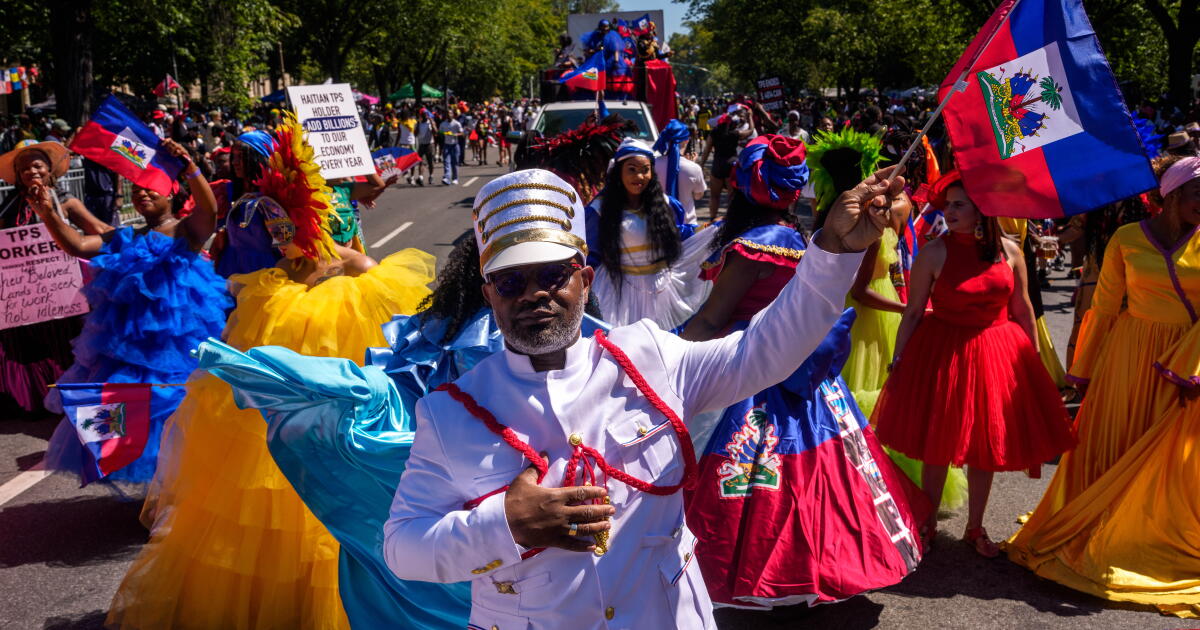
Thousands of longtime immigrants from El Salvador and their loved ones are anxiously awaiting word from the Trump administration about whether they will face the possibility of deportation if their temporary legal protections expire as scheduled Wednesday.

The Department of Homeland Security has not yet announced whether it will end or extend Temporary Protected Status for some 170,000 Salvadorans, including 36,000 in California. But federal officials have targeted for arrest other immigrant groups whose TPS expired.

Since their status ended in July, many Haitians have been outfitted with ankle monitors and some have already been sent back to the politically unstable country plagued by gang violence.

As federal officials have whittled down the countries that still qualify for Temporary Protected Status, Salvadorans make up the largest population of remaining beneficiaries.

Just over 100,000 people from Sudan, Ukraine and Lebanon still have TPS protections until later this year, the vast majority of them Ukrainians.

Under TPS, recipients are able to obtain permits allowing them to work legally in the country. More than 150,000 U.S. citizen children nationwide have Salvadoran parents with TPS.

Asked by The Times on Tuesday about the administration’s plans regarding TPS for Salvadorans, border advisor Tom Homan said he does not know and that the decision is up to Homeland Security Secretary Markwayne Mullin.

Later Tuesday, Homeland Security released a statement that left the long-term outlook for Salvadorans with TPS uncertain: “An announcement on El Salvador’s TPS will be made at the appropriate time. Until such announcement is made, Salvadoran individuals present in the U.S. under TPS retain protection.”

Homan, for his part, noted that El Salvador is a “much safer country” now, perhaps suggesting the conditions that prompted people to leave El Salvador had improved.

Addressing the administration’s handling of TPS in general, he said, “I’m glad they’re finally sticking to what the statute says — temporary means temporary.”

The looming deadline set off a wave of alarm among communities in Los Angeles and beyond.

Lorena Zepeda of Los Angeles spent most of Friday with tears in her eyes as she waited for news about the fate of the program that has spared her, for nearly half her lifetime, from being deported back to El Salvador.

“Even though my work permit has been temporary, my life here is not temporary,” said Zepeda, 57. “From the second I stepped foot in the U.S., I have lived. And, I want to continue to live here. I’ve set down my roots here.”

California has the highest concentration of Salvadoran TPS holders in the nation, with smaller concentrations in Texas, Maryland and New York, according to the immigrant advocacy organization FWD.us. Most work in construction, groundskeeping and in transportation, the organization said, and they pay an estimated $1.5 billion in combined taxes.

About 1.3 million people from 17 countries were enrolled in the program when President Trump returned to office last year. The Supreme Court ruled in June that Trump can, without judicial review, end temporary legal protections for hundreds of thousands of immigrants from Haiti and Syria, a decision that also cleared the way for further TPS terminations.

The administration has now ended TPS for more than 1 million immigrants from 13 countries.

Some terminations were announced at or after the expiration date. For instance, the administration announced the terminations for Nicaragua and Honduras three days after they were set to expire on July 8, 2025, but provided a 60-day extension.

A termination for citizens of El Salvador in particular stands to upend the lives of people with deep roots in the U.S. because they have had TPS for 25 years — the longest of any country. Trump administration officials and other conservatives have argued that the program has gone far beyond its original intent as a temporary means of reprieve.

Originally established in 1990 under the George H.W. Bush administration, TPS has been used in the years since under Democratic and Republican administrations alike. Congress authorized the emergency relief for immigrants whose countries had been racked by armed conflict or natural disasters and who could not safely return home.

Trump tried to terminate TPS for Salvadorans during his first term, but an appeal kept the protections in place until President Biden took office and reversed the decision. Biden then substantially expanded the number of immigrants who qualified for protections under the program.

For Zepeda, who came to the U.S. in the early 1990s, saving TPS has been a years-long pursuit.

Zepeda works as a community coordinator for the Los Angeles-based Central American Resource Center, or CARECEN, the largest Central American organization in the country that provides low-cost immigration legal services and policy advocacy. She has gone to Sacramento and Washington to persuade lawmakers to keep the program alive.

She began receiving calls Tuesday morning from frantic TPS holders asking whether they should still attend medical appointments or how they will pay their rent without work permits. Aging Salvadorans fear losing their retirement benefits, she said.

“We’ve marched. We’ve led hunger strikes. We’ve done it all…No matter what happens, the fight does not end,” Zepeda said. “We will continue pushing to find legal stability in this country.”

Castillo reported from Washington and Luna from Los Angeles. Staff writer Ana Ceballos contributed to this report.

Source link