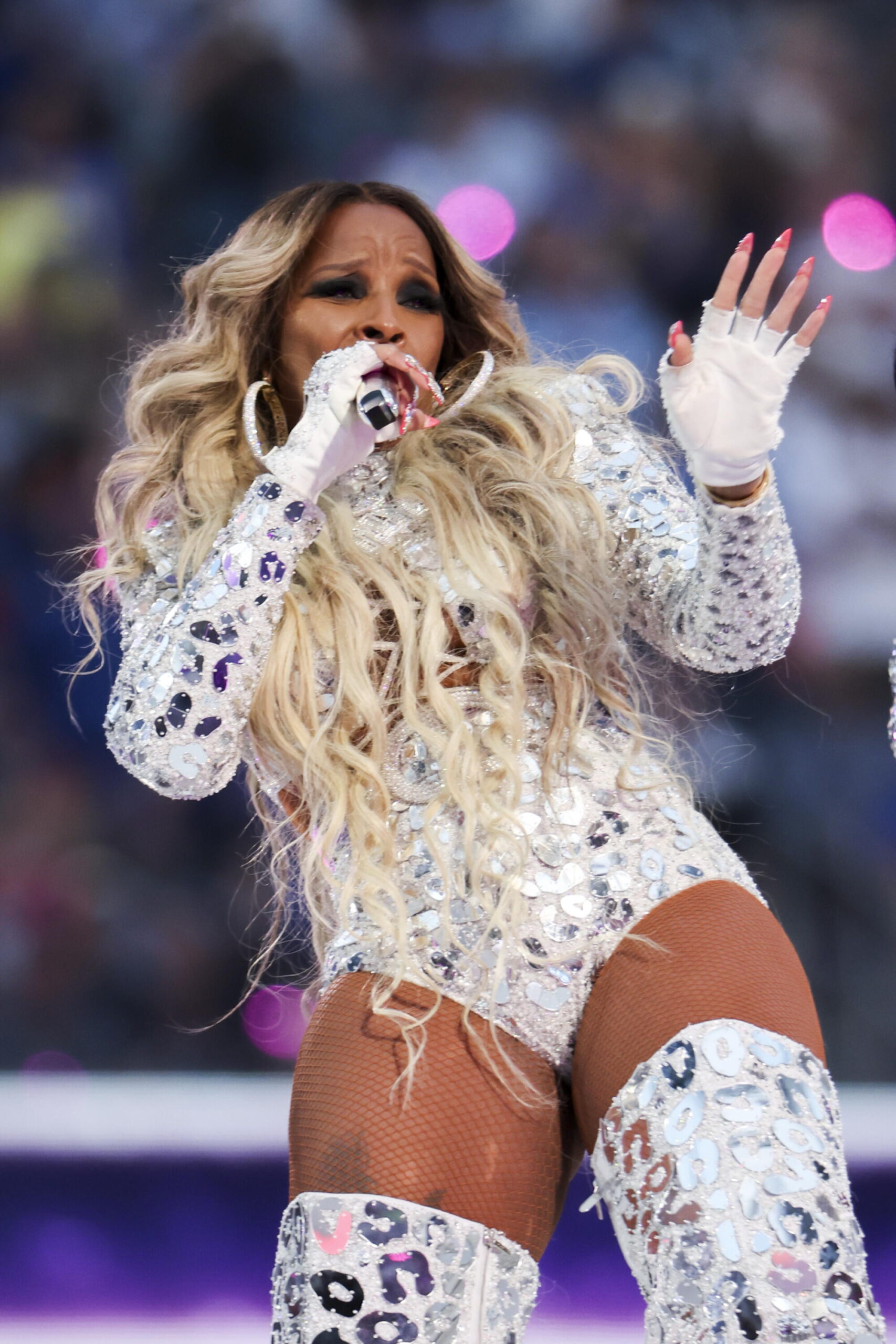
Mary J. Blige on playing Las Vegas and avoiding social media
LAS VEGAS — The Strip is broiling on a recent afternoon, but it’s cool and dark inside Mary J. Blige’s dressing room at the Park MGM.
As a humidifier moistens the dry desert air, the 55-year-old R&B star sits on a sofa wearing a brown jumpsuit and matching gaucho hat; through the walls we can hear Blige’s band sound-checking for her My Life, My Story residency, which launched in May and will pick up again Friday night for shows through Oct. 31.
In some ways, Las Vegas is a funny fit for the Queen of Hip-Hop Soul, who’s been transforming pain into music since her 1992 debut, “What’s the 411?” Yet her stay in this glittering showbiz mecca comes amid a season of flower-getting for Blige: Two years ago, she was inducted into the Rock & Roll Hall of Fame; two years before that, she played the Super Bowl halftime show and landed a nomination for album of the year at the Grammy Awards.
“It definitely feels like people are taking notice of the fact that Mary J. Blige is one of the most important performers in R&B history,” she says. “I opened up a lane that hasn’t been closed yet. Female after female after female after female continue to do what Mary J. Blige has done and still does.”
Who opened that lane with you?
Back in the ’90s, when we first came out, it was myself and SWV that were really, really strong. Then there was 702, then Jazmine Sullivan and SZA and Beyoncé, and now right down to Summer Walker, who’s singing her truth.
That’s how you define what you do.
I’m not a great singer because I can sing better than everyone — I’m a great singer because I sing from my heart. Bono gave me that jewel. When Hurricane Katrina happened, we were doing [U2’s] “One,” and Bono was like, “Don’t worry about singing on key — people aren’t moved by you singing on key. What makes you a great singer is how you make them feel.” Not all of us are like the eighth wonders of the world — Aretha Franklin or Chaka Khan or Whitney Houston. They have pitch-perfect and they have emotion.
I saw Chaka Khan the other night and was thinking about how, even now, you never know where her voice is about to go.
She’s Chaka Khan — there’s nothing else you could say, really.
Why’d you cover “Sweet Thing” on “What’s the 411?”
First of all, when I was growing up, my mother played “Sweet Thing” all the time — it was our favorite song. So when I got to Uptown Records, Andre Harrell, the CEO, he was like, “You should do ‘Sweet Thing.’” I was like, “I don’t wanna do ‘Sweet Thing’! Chaka Khan could really sing — I can’t sing like that.” But he said I could do it, so I went and did the song and they all went crazy over it. My fans who didn’t know Chaka Khan, they thought it was my song. Same with Rose Royce’s “I’m Going Down” — to this day, a lot of people don’t know that’s a remake. I was afraid of both those songs. But I wanted to sing “I’m Going Down” all my life because I heard the song when I was 5 years old from the “Car Wash” soundtrack.
Tell me about your routine in Vegas. You stay on the Strip or you have a house somewhere?
I have a house out here. I’m not staying here — this is a lot. So I go home after I finish my performance, and I get ready for my performance tomorrow: I rest, I drink water, I do whatever I need to do. Then it’s the same thing: I come here, go into glam, do my meet and greet.
Get the humidifier going.
I got a steamer that I actually pull on over my mouth. Then I do my warmups, relax, keep my mind clear of any nonsense.
How do you think about doing your thing in a town built on glitz?
Mary is not the slickest Vegas person. But you can let people see that you’ve evolved — that you wear gowns now.
Would 19-year-old Mary be surprised to see her future self in a gown?
Hundred percent. Nineteen-year-old Mary was all tomboy — all baggy everything. Right now, I barely want to wear a gown, this Mary right here. But I’ve actually grown to like some of it when it looks good.
Did you look at anyone else’s residency when you were putting yours together?
I saw two people’s shows, and I said, “That’s not it.”
Shows in Vegas tend to be on the shorter side. The casino wants people back out there gambling.
I got 90 minutes — it’s a lot of time. People are very happy, but they’re standing there like they want more. I’m like, “I did 90 minutes! I don’t know how much more y’all want from me.”
Silk Sonic’s residency here was a no-phones show, which Bruno Mars told me was his attempt to preserve the freedom to make mistakes. Does it bum you out as a performer to know that everything winds up on the internet?
I don’t care about that at all. Social media, it’s bull—. You know what’s gonna happen — you know they’re gonna say, “Oh, her jaw is swollen.” Whatever. As long as you live truthfully, what they’re recording doesn’t matter.
In a recent interview with Fat Joe and Jadakiss, you talked about keeping your romantic partner a “mystery man” to the world. I wondered how you came to the decision not to make everything available to the public.
Because for so many years it has all been available. What you know already is what you know — I’ll elaborate on that. But what you don’t know, you will never know. I think I’ve given a lot, and it’s important to have something for myself. Nowadays, people just take things and ruin it for you. So if you have something beautiful, hold onto it, keep it to yourself. You have to protect the person that you’re with as well, because they don’t deserve to get beat up for something someone else did. I protect the ones I love — I’m not having anybody speaking ill about my family or the man that I love. I’m too old for that. Early in my life, if social media was around in 1991, I’d have been on that s— all day, cursing and going nuts on people.

Mary J. Blige performs during halftime of Super Bowl LVI at Inglewood’s SoFi Stadium in 2022.
(Robert Gauthier / Los Angeles Times)
We were talking before about your accolades. Did the Rock Hall mean anything in particular to you?
It was important to me because those things don’t happen to us.
To Black women.
Yes. It happens to rock ’n’ roll stars every day, and they’re in their grave — there were people in their grave that they were honoring when I went. So when it happens to Mary J. Blige or Chaka Khan or Aretha Franklin, we have to honor that and raise it up. That’s a big deal.
Did Las Vegas feel like a place open to Black women?
I’m trying to think of what Black females I’ve seen do Vegas.
Mariah Carey was here. Toni Braxton had a show.
Yeah, but like me? But you know what I love? It’s time. And how I know it’s time is because my fans went up. When I made the announcement, they was going crazy — they still going crazy. I’m probably the first to open this door, and next it’ll be somebody else. You better believe they on their way. “Oh, Mary doing Vegas? I’m doing Vegas too.” That’s how it goes: “Mary did her hair blonde? I’m dying my hair blonde too.” That’s how my whole life has been, even actually before the music business.
Nosy question, but what’s an aspect of financial comfort that you especially enjoy?
Flying private — that’s the best one for me.
Getting to bypass the grind of travel.
That’s what I love about Vegas, because it’s not like tour. Tour, it’s a lot.
Are you soft now?
Probably a little spoiled.
Last one: Name an artist that meant a lot to you when you were young that might surprise people.
There were so many. I mean, Earth, Wind & Fire —
Everybody loves Earth, Wind & Fire.
But that “Way of the World” song — that really does something to me. We loved George Michael — George Michael was always one of our favorite artists. Duran Duran, come on. Oh, “Everybody Wants to Rule the World” — Tears for Fears. And Hall & Oates! [Sings] “Private eyes, they’re watching you.” Ambrosia. The Eagles. I could keep going.
I didn’t expect you to hit me with Ambrosia.
They were so soulful — I just got goosebumps. And Queen. That’s one of my favorite movies — “Bohemian Rhapsody.”
Who should play you in a movie about Mary J. Blige?
She wasn’t born yet.