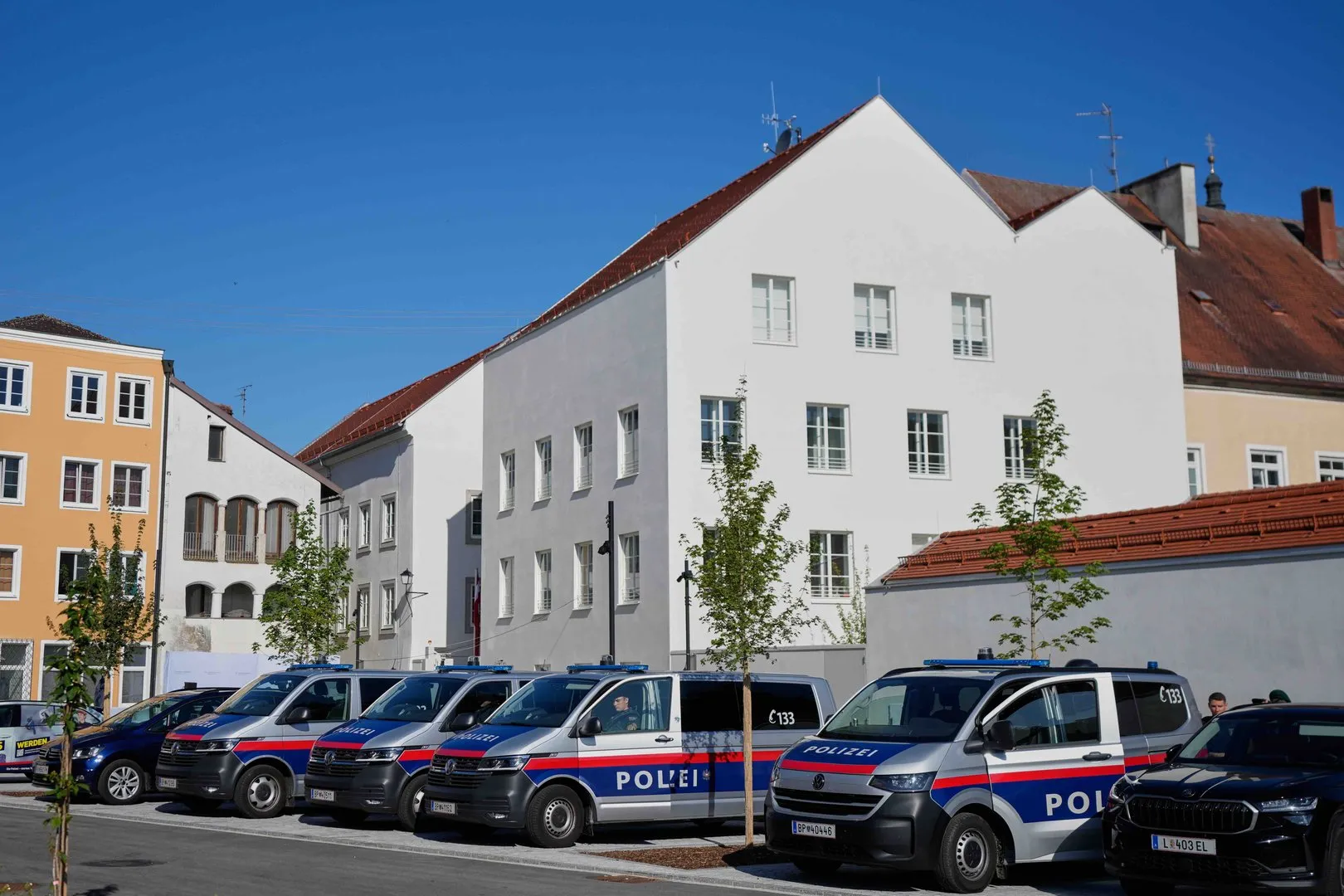
For decades, neo-Nazis and far-right extremists flocked to the Austrian home where Adolf Hitler was born to glorify the Nazi leader. Now, the building has been transformed into a police station following a $22.8-million renovation.
A tidy race to lead Audi home and finish just outside the points.
Nico Hulkenberg – 5.5/10
Solid enough but finishing behind Bortoleto takes the shine off it. He gained places from his lowly starting position, however.
Pierre Gasly – 5/10
Slipped down the order so a disappointing Sunday for Alpine who just looked short on pace.
Ollie Bearman – 4.5/10
A clean but anonymous afternoon for Bearman. Haas didn’t have much to fight with.
Franco Colapinto – 4.5/10
Not spectacular but a steady finish for Colapinto, who kept his Alpine out of trouble.
Esteban Ocon – 4/10
Finished behind team-mate Ollie Bearman again, which made for a poor return. Lost ground at the start and never looked like a points contender.
Alex Albon – 4/10
Williams had a tough race and Alex Albon finished two laps down. Unlike this team-mate Carlos Sainz, he at least got to the flag.
Fernando Alonso – 4.5/10
The final classified finisher. He gained places largely through others retiring, however his five-second penalty for speeding in the pit lane made this another race for Aston Martin to forget.
Lance Stroll – 3.5/10
Aston Martin driver retired after 45 laps, ending a difficult race from the back row.
Carlos Sainz – 4/10
Out after 23 laps when his car stopped on the pit straight. Led Williams once again in qualifying which is all that can be said.
Sergio Perez – 4/10
Only lasted a few laps for Cadillac. Out-qualified team-mate Valtteri Bottas but barely turned a wheel this weekend with several car issues in practice plaguing him during the race, too.
Valtteri Bottas – 3.5/10
The first retirement, after just two laps. There was almost no race to judge. Started behind his team-mate but Cadillac’s Sunday was over before it had begun.
George Russell’s victory over Max Verstappen further reduces teammate Kimi Antonelli’s lead in the drivers’ title race.
Published On 28 Jun 202628 Jun 2026
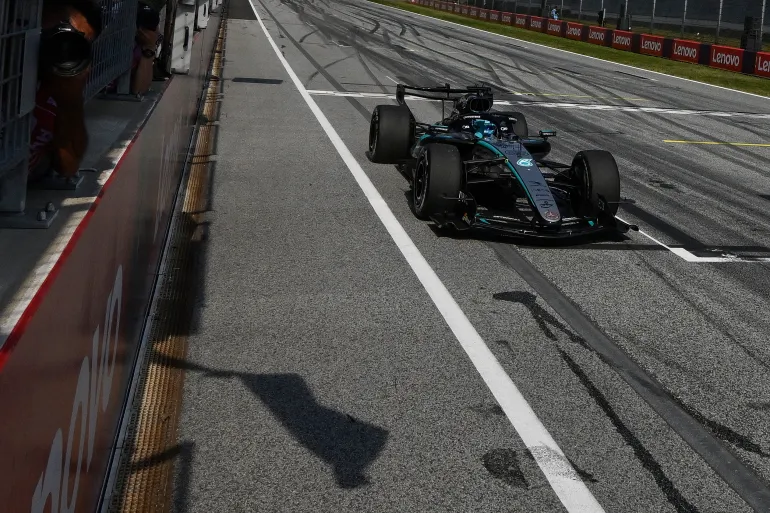
A thirsty George Russell won the Austrian Grand Prix from pole position on Sunday to trim Mercedes teammate Kimi Antonelli’s Formula One championship lead to 40 points.
Max Verstappen finished 1.6 seconds adrift, after crashing in qualifying and starting fifth, at his Red Bull team’s home circuit with Antonelli third and 0.3 behind after a thrilling chase to the line at scenic Spielberg.
Recommended Stories
list of 4 itemsend of list
The win was Russell’s second of the season, after he took the opener in Australia, his career seventh and Mercedes’ seventh in eight rounds so far.
Antonelli has 171 points to Russell’s 131 with Ferrari’s Lewis Hamilton, fifth on Sunday after running second and battling Verstappen wheel-to-wheel, dropping to third on 125.
In the constructors’ standings, Mercedes have 302 points to Ferrari’s 204.
“Incredible to be back on the top step. It’s been a little while, so I am definitely going to enjoy this one this evening,” said Russell, who can now head to his home British GP at Silverstone next weekend on a high.
He revealed over the radio after taking the chequered flag that his drinks system had failed during the race, the first of the season to be declared a “heat hazard”. “Nice race for it to do so, I’m a little bit thirsty,” he said.
Oscar Piastri was fourth for McLaren, ahead of Hamilton, with Isack Hadjar sixth for Red Bull.
Reigning champion Lando Norris, last year’s winner in Austria, was seventh with Ferrari’s Charles Leclerc eighth and Racing Bulls pair Liam Lawson and rookie Arvid Lindblad completing the top 10.
“I was having to push every single lap and when you push those boundaries there’s bound to be a small mistake or two,” said Russell.
“I knew how quick the guys were behind. Kimi has been extraordinarily quick this whole season, so every lap I was looking at the timing board.”
Russell wins the Austrian Grand Prix at the Red Bull Ring in Spielberg, June 28 [Darko Bandic/Pool via AFP]
Mercedes driver George Russell controversially stole pole position at the Austrian Grand Prix from Ferrari’s Charles Leclerc with the last lap of the session.
The result came amid late drama as Russell set his lap, beating Leclerc and Lewis Hamilton, despite passing yellow flags for a crash by Red Bull’s Max Verstappen at the penultimate corner.
Russell’s team-mate Kimi Antonelli, who was running just ahead of the Briton, also passed the Verstappen incident, but did not improve his time and will line up fourth.
McLaren’s Lando Norris and Oscar Piastri were sixth and seventh behind Verstappen, who kept fifth despite his crash.
Russell insisted he had slowed sufficiently for the Verstappen incident, and claimed there was just a single yellow flag showing, rather than the double waved yellows which might have been expected for such a situation.
“I had a big lift,” Russell said. “I went into the corner 0.5secs up and I came out 0.25secs up. It was great to get that lap.
“I just spoke with Toto [Wolff, team principal] and he said everything is fine with the yellow flag. Big 100m lift before the corner. So that’s good to hear.”
The late drama was caused by a big crash for Verstappen, who lost control going into the high-speed downhill right-hander and spun across the gravel into the barrier.
Weekly insights and analysis on the latest developments in military technology, strategy, and foreign policy.
Austria says that, for two days in a row, its fighters were sent to intercept U.S. military aircraft, at least two of which entered its airspace without authorization. According to the Austrian Ministry of Defense, the aircraft were U.S. Air Force PC-12 turboprops, almost certainly a reference to the U-28A Draco, which the Air Force Special Operations Command uses primarily for intelligence, surveillance, and reconnaissance (ISR).
On Sunday and Monday this week, the Austrian Air Force scrambled Eurofighter Typhoons in response to the alleged flights in the neutral country’s airspace. This was confirmed by Austrian Ministry of Defense spokesperson Michael Bauer on X.
Auslösung Priorität A und Einsatz von zwei Eurofighter auf Grund Überflug von zwei PC12 der US Air Force um 12:31 Uhr zum Zweck der Identifizierung. #Bundesheer
According to Bauer, the incident on May 10 saw the Austrian Air Force scramble two Eurofighters after a pair of “PC-12s” were detected flying without authorization in the Totes Gebirge region of Upper Austria. Once Austrian Eurofighters intercepted the aircraft, they are said to have turned back and returned to Munich, Germany.
The following day, at 12:31 p.m., two more Eurofighters scrambled in response to an overflight by two “PC-12s.” This was a so-called Priority A intercept, meaning the highest-priority response for the Quick Reaction Alert (QRA) force. On this occasion, however, Bauer said it was unclear whether the U.S. Air Force aircraft had the necessary clearances — in contrast to Sunday’s incident.
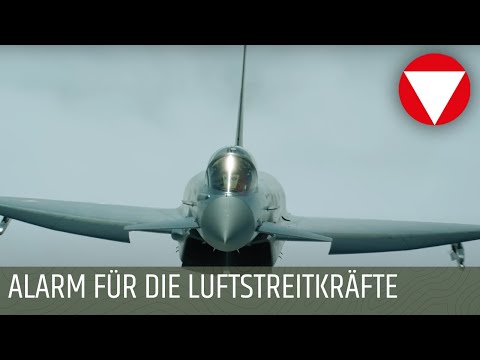
An official Austrian Ministry of Defense video shows a QRA scramble involving the Eurofighter:
Alarm für die Luftstreitkräfte
Austria retains clear guidance for the procedures of transiting its airspace, as detailed on this webpage.
“The matter is to be resolved through diplomatic channels,” Bauer added.
In general, there appears to have been something of a spike in U.S. military aircraft activity over the Alpine region in recent days.
According to reports in the Swiss media, a total of nine overflights by the U.S. Air Force have taken place over Switzerland over the past three days. All of these flights were authorized.
The U-28A is a militarized version of the Pilatus PC-12M single-engine turboprop and carries a variety of sensors, including electro-optical and signals intelligence (SIGINT) equipment. It can also perform light utility duties in a pinch, among other missions.
A U-28A Draco assigned to Air Force Special Operations Command over the Gulf of America on June 5, 2025. U.S. Air Force photo by Airman 1st Class Tori Haudenschild
Not all of the Draco aircraft share the same configuration, with different iterations appearing over the years. It is known that most of these aircraft have a sensor turret with electro-optical and infrared cameras, as well as SIGINT systems to geo-locate and monitor hostile communications and other emitters. There are also reports that some of the aircraft may have a synthetic aperture radar imaging capability.
AFSOC has also upgraded the U-28A to a configuration known publicly only as EQ+. This update includes a new sensor turret with a high-definition, multi-spectral imaging full-motion video camera, which also offers better standoff range, according to Pentagon budget documents. This allows the aircraft to fly at higher altitudes and operate further away from its target, reducing risks to the crew and allowing for more discreet surveillance.
The Draco also features an extensive communications and data-sharing suite. This allows them to transmit the information it gathers back to command centers for further exploitation or straight to personnel on the ground, all in near real-time. These capabilities give the Draco a robust overwatch capability for special operations forces on the ground.
A U.S. Air Force U-28 Draco takes off for a mission during U.S. Air Force Weapons School Integration (WSINT) at Nellis Air Force Base, Nevada, June 4, 2025. U.S. Air Force photo by William R. Lewis
In September 2024, the GAO confirmed to TWZ that it was conducting a classified review of SOCOM’s decision to divest the U-28As, as well as its King Air-based ISR aircraft, the latter of which are often referred to collectively as MC-12s.
Meanwhile, the Draco continues in service. Since its first combat deployment in June 2006, these unassuming aircraft have established themselves as an important component of U.S. counter-terrorism operations around the world.
For Austria, airspace policing is one of the core functions of its air force. Indeed, the country’s controversial Eurofighter fleet is dedicated to this mission, with no air-to-ground capability at all.
A pair of Austrian Air Force Eurofighter Typhoons. Eurofighter
Sitting outside of NATO puts Austria in a somewhat unusual position as regards U.S. overflights, although it should be noted that permissions were also denied by alliance members during Operation Epic Fury, the campaign against Iran.
While the Pentagon hasn’t officially disclosed the use of the U-28A in Epic Fury, it would not be surprising, especially considering its ability to operate from small airports and forward operating bases with limited infrastructure.
U.S. Air Force U-28A FARP Training
Meanwhile, there is also a precedent for unauthorized U.S. military overflights in Austrian airspace.
As we recounted in the past, in 2002, when the U.S. military was building up its forces in the Middle East ahead of a possible offensive against Saddam Hussein’s Iraq, the Air Force attempted to sneak two F-117A Nighthawks through Austrian airspace.
On that occasion, the U.S. Air Force filed a flight plan for a KC-10A Extender tanker to fly through Austrian airspace, something that was easier to gain clearance for, since it was unarmed. In fact, two F-117s were neatly tucked under the wings of the big tanker in close formation during the flight.
A KC-10 refuels an F-117. U.S. Air Force
Due to irregularities in the flight plan, two Austrian Air Force Saab Drakens were scrambled and soon identified the two F-117s.
Imagery of the intercept was presented by the Austrian Minister of Defense during a meeting of the National Security Council and was presented as part of a diplomatic protest lodged at the U.S. Embassy in Vienna.
Austrian Minister of Defense Herbert Scheiber presents the incriminating imagery during a meeting of the National Security Council. via X
A glance at the map reveals why the U.S. military regularly overflies Austria and Switzerland when routing from Germany to Italy or to the Middle East, to avoid long transits over France. Due to Austria’s geography, incursions typically only occur for a few minutes, especially where the flight time between German and Italian airspace is very short.
We have reached out to the U.S. Air Force for clarification on the incidents.
At the very least, the apparent incursions demonstrate that the U-28A remains very much in operational use and active around Europe, while underscoring the sometimes fraught nature of overflight agreements.
UPDATE: May 13, 7:00 AM EDT-
Austrian Ministry of Defense spokesperson Michael Bauer has provided more details of the Austrian Air Force scrambles that took place earlier this week.
According to Bauer, a flyover request was filed on May 10 for two U.S. Air Force PC-12s, flying from RAF Mildenhall, England, to Bucharest, Romania. Bauer continued:
“However, around 2:10 p.m., two other USAF aircraft approached Austrian airspace. At 2:21 p.m., an alarm scramble of Eurofighters was therefore triggered. The two USAF aircraft, however, turned away before entering Austrian airspace.”
On May 11, another U.S. Air Force flyover request was submitted and approved. As filed, two PC-12 aircraft flew over Austria. On this occasion, two Eurofighters monitored the flyover and verified that the flyover request matched the actual flight.
Ohne Eurofighter keine Luftraumüberwachung: Für 10. Mai lag ein Überflugsantrag für 2 Flugzeuge der Type PC12 der USAF von Mildenhall, GB nach Bukarest, RU vor. Um ca. 14.10 Uhr haben sich allerdings zwei andere Flugzeuge der USAF dem österreichischen Luftraum genähert. Um 14.21…
Meanwhile, Defense News has published the following statement provided by an official from U.S. European Command, relating to the May 10 incident:
“This flight took place after an administrative error in the overflight clearance paperwork was corrected. The United States continues to work closely with Austrian authorities on any questions regarding overflights and fully complies with Austrian laws and procedures.”