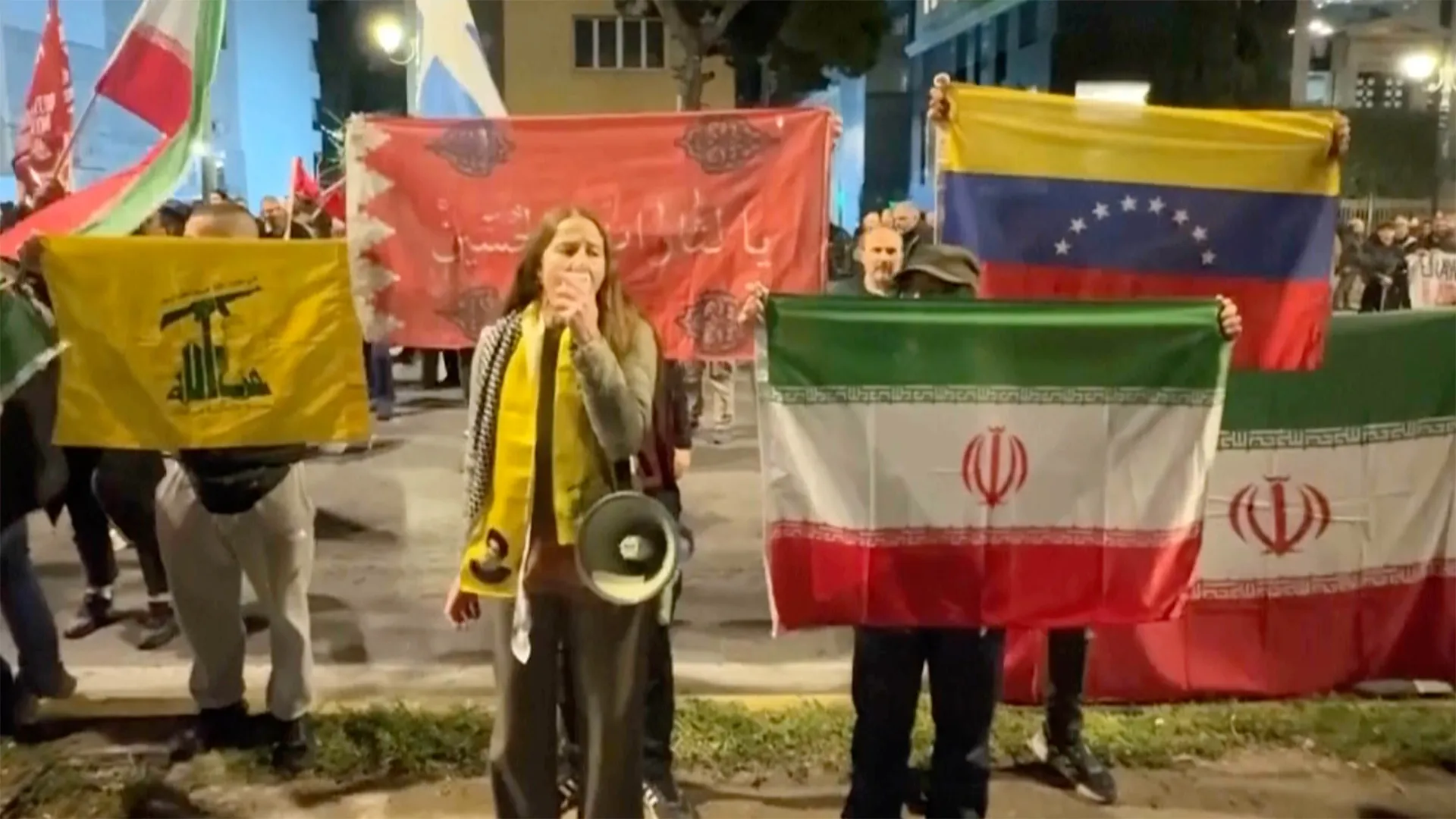
Protesters in Athens have marched to the US Embassy to condemn the US-Israeli attacks on Iran, joining protests held worldwide over the escalating conflict.
Weighing in at about 550 pounds, Woody, his largest hog (named by a grandson after the “Toy Story” icon) plays “like a puppy” in his free-range paddock, Staples told me, gobbling up the rye, clovers and winter peas that have grown knee-high under the Southern sun.
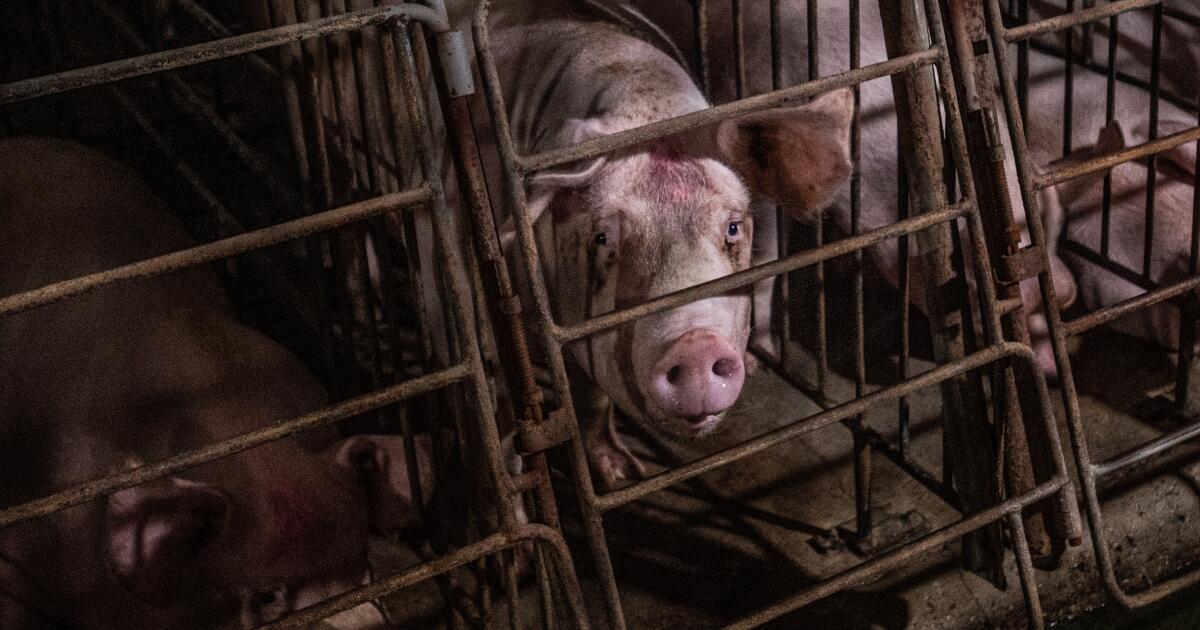
Swine life on Staples’ sustainable family farm is a jarring contrast to the existence of a pig on one of America’s “intensive” corporate-owned mega-farms, where some sows are confined to cages so small they literally can’t turn around or take more than a step or two in any direction.
“It’s not necessary and it hasn’t proven to be good science,” Staples, a self-described conservative Republican, said of Big Ag porcine lockups. “It’s also cruel.”
At issue is the Save Our Bacon Act, a sneak attack backed by foreign corporations currently hidden deep inside the farm bill. It would severely curb the ability of states to enact limits on animal confinement and maybe accidentally open the door for ending all kinds of state-level food safety laws.
The SOB Act, an apt nickname, would not only cripple small family farmers such as Staples (though its supporters claim it helps family farmers), it would negate the will of California voters, potentially introduce risk into the food chain, and turn greater power of our food supply over to China.
It would also limit consumer choice at a time when more Americans — from fans of far-right Health Secretary Robert F. Kennedy Jr. to far-left granola grandmas — are demanding a say in how their food is produced.
Let’s break that down.
What is the SOB Act?
For the vegetarian hard-liners out there, it is true that Woody himself will someday likely be bacon.
But, increasingly over the past decades, meat-friendly consumers have moved toward wanting animals to “live a really great life and have one bad day,” as Nate Beaulac, another conservative Oklahoma pork farmer, describes it.
In 2018, to further that aim, about 63% of California voters passed Proposition 12, which increased the space that breeding sows were required to have, from something about the size of a small car trunk to the size of a coat closet. We’re not talking rolling acres here — just enough room to turn around. Some of these sows are basically caged for the majority of their breeding life — years — and are about the size of a black bear.
But here was the real bite in Proposition 12: No pork from any state could be sold in California if it didn’t come from a farm that met the new standard.
Overnight, the corporate breeders were locked out of the Golden State market. They sued bigly, and lost bigly in 2023 at the Supreme Court, which upheld California’s right to impose the state standard.
The SOB Act would negate Proposition 12 (and a similar law in Massachusetts) and forbid states from making laws regarding animal confinement, according to an analysis by the Animal Law & Policy Program at Harvard Law.
That would emphatically overturn the will of the majority of California voters who want those standards.
But hey, Big Pork would make big bank.
“They want to limit American consumers’ ability to fight,” Beaulac told me. “They wanted to limit Americans’ ability to pursue any sort of change. And that is why me, not only as a farmer, but as an American and a capitalist, I’m strongly opposed to the Save Our Bacon Act, and in staunch support of Proposition 12.”
What Prop. 12 did
Beaulac was once a Californian himself, before heading to the Sooner State for college. He describes himself as a “Christian, capitalist, conservative environmentalist,” and a sustainable farmer who depends on consumers’ desire for healthy food to sell his pigs, chickens and cows.
Proposition 12, Beaulac said, “was a huge help to smaller farms, and the only people that it really hurt were the huge multinational conglomerates.”
“I mean very simply, we want the opportunity to compete,” he said.
Staples, Woody’s owner, who is also an expert in project management and environmental compliance from a previous career in the power industry, makes the case that the mega-farms can also come with mega-dangers.
“You have 100,000 pigs within two miles of each other, the chance of issues with a swine flu or natural disaster just increases,” he said. He points out that issues such as disease, groundwater contamination and waste disposal have already become problems for some large farms.
The flaws in the SOB Act don’t stop there.
The Harvard Law analysis points out that the loose language of the bill could have other consequences, maybe even gutting some state safety, labeling and cleanliness standards.
And some Republicans in Congress, including Californian Reps. David Valadao and Young Kim, oppose the measure and sent a letter to the Agriculture Committee late last year urging them to dump the act, pointing out that at least a quarter of Big Pork is owned by Chinese companies and does not represent American interests.
“Foreign-owned corporations — particularly those tied to adversarial nations — already hold a disturbing amount of control over U.S. agricultural assets,” the letter read, citing Chinese-owned Smithfield Foods, the largest pork producer in the United States.
The SOB Act “could further consolidate the influence of such foreign entities,” the letter‘s authors warned.
Armed with those arguments and others, Staples and Beaulac traveled to Washington recently to make their case against the SOB Act with lawmakers.
But, both men told me, they were met with a wall of lobbyists and money.
“It’s very eye-opening in terms of how many lobbyists are there every day,” Beaulac said. “The reality is Big Ag donates big money to the senators, and so when they need their bill to go through or they need a bill shut down, they’re going to have a lot more leeway than the small farmers.”
The lobbyists, Staples said, had the debate wrapped up tight long before the farmers even knocked the dirt off their boots and entered Congress.
“It was very obvious,” he said. “I was not prepared for what Big Ag had done, how they had prepared members of Congress to address the issues we wanted to address.”
Beaulac said he’s discouraged and fears the SOB Act will pass, but also isn’t giving up hope. He sees it as a bipartisan issue, and one he hopes for which people will stand up. This week, a social media post featuring a sad photo of a caged pig went viral, drawing attention across party lines.
“Blue, red. It doesn’t matter. People want healthy food,” Beaulac said. “They want to know how it’s raised. They genuinely care how they’re feeding their family, and it has nothing to do with who they vote for in November.”
P.S. Here’s a post by right-wing commentator Michael Cernovich on the SOB Act, just a taste of how much some of the MAGA folks don’t like this measure.
— Was this newsletter forwarded to you? Sign up here to get it in your inbox.
Multiple explosions have been reported across Iran’s capital, Tehran, and other cities as United States-Israeli attacks and Iranian retaliation continue.
As the conflict saw its 13th day on Thursday, Iran’s representative to the United Nations, Amir Saeid Iravani, said at least 1,348 civilians have been killed.
The humanitarian toll continues to mount with more than 17,000 injured in Iran since the US and Israel launched their war on February 28. UNICEF described the situation as “catastrophic”, noting that more than 1,100 children have been reported injured or killed.
The Office of the UN High Commissioner for Refugees (UNHCR) estimated that up to 3.2 million people have been displaced within Iran since the conflict began. “This figure is likely to continue rising as hostilities persist, marking a worrying escalation in humanitarian needs,” UNHCR said in a statement.
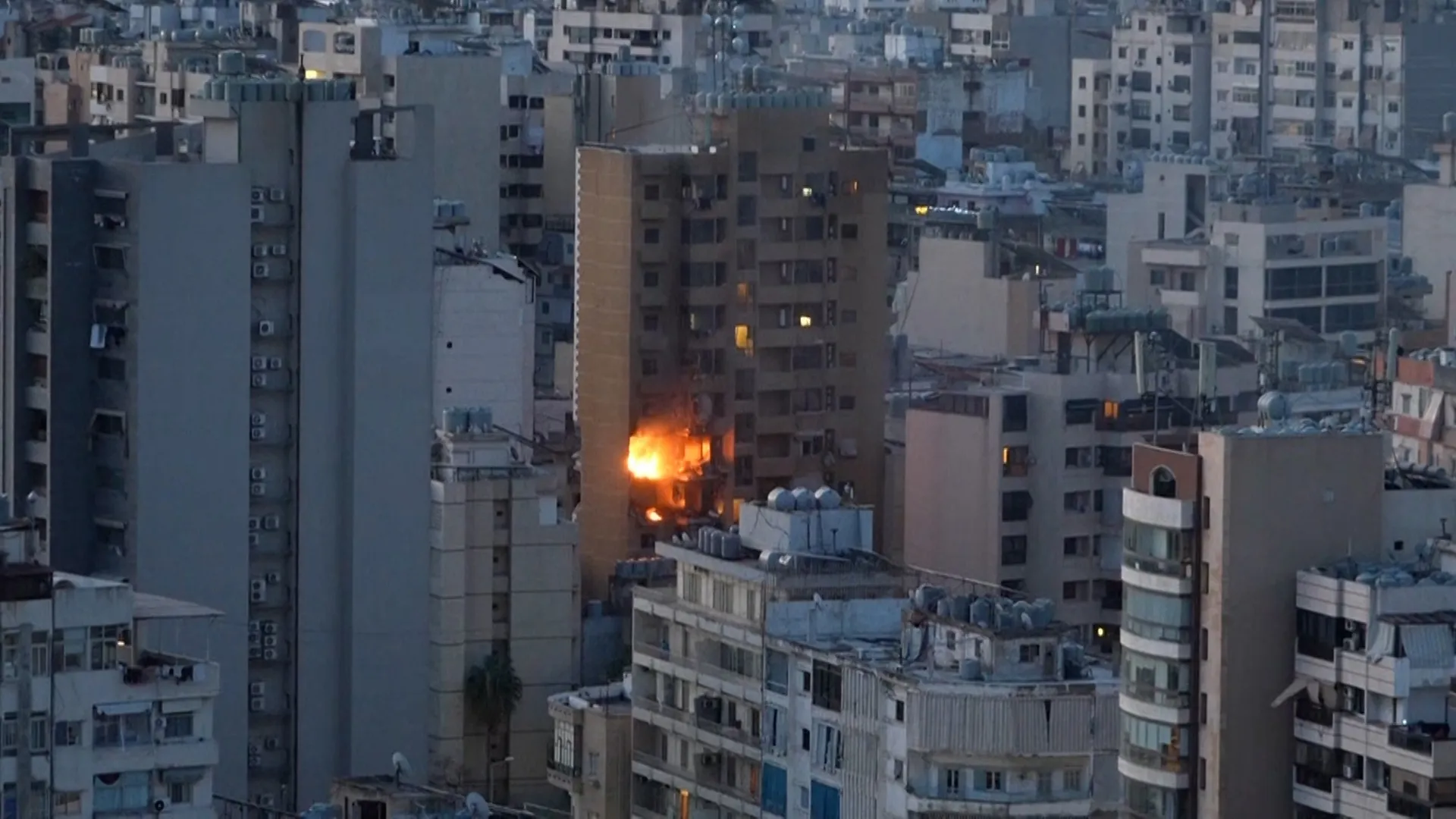
Meanwhile, in Lebanon, Israeli attacks since March 2 have killed at least 687 people, including 98 children, according to Information Minister Paul Morcos.
United Nations refugee agency says forced displacement likely to increase as US and Israel continue deadly strikes across Iran.
Published On 12 Mar 202612 Mar 2026
Share
More than three million people have been displaced in Iran since the United States and Israel launched a war against the country late last month, the United Nations says, as concerns mount over a worsening humanitarian crisis.
The UN High Commissioner for Refugees (UNHCR) said on Thursday that as many as 3.2 million people – representing between 600,000 and one million Iranian households – have been forcibly displaced since the war began on February 28.
Recommended Stories
list of 3 itemsend of list
“Most of them are reportedly fleeing from Tehran and other major urban areas towards the north of the country and rural areas to seek safety,” UNHCR official Ayaki Ito said in a statement.
“This figure is likely to continue rising as hostilities persist, marking a worrying escalation in humanitarian needs.”
The US and Israeli militaries have continued to bombard Iran despite mounting international condemnation and calls for de-escalation.
More than 1,300 people have been killed in US-Israeli attacks across the country to date, according to the latest figures from Iranian officials.
While the US and Israel have said they are targeting Iranian leaders as well as military and nuclear infrastructure, Iran says thousands of civilian sites, such as schools and hospitals, have been attacked.
Iran’s Deputy Health Minister Ali Jafarian told Al Jazeera on Thursday that medical teams have been responding to a growing number of casualties as strikes on urban areas have intensified in recent days.
“Most of these people are civilians,” Jafarian said, adding that more than 30 hospitals and health facilities have been damaged due to the attacks.
On Thursday, explosions were heard in several parts of the capital, Tehran, and other Iranian cities as the strikes continued.
Al Jazeera’s Tohid Asadi said rescuers were digging through mounds of rubble as several multistorey apartment buildings were heavily damaged in recent attacks on a hard-hit eastern neighbourhood of Tehran.
“We saw bodies taken out [of the rubble] … and the situation was far beyond what I can call disastrous,” Asadi said.
Iran has responded to the US-Israeli assault by launching a barrage of missiles and drones at US bases and other sites in countries across the wider Middle East region.
It has also shut down the Strait of Hormuz, a critical Gulf waterway through which about one-fifth of the world’s oil transits, raising serious concerns of disruptions to global energy supplies.
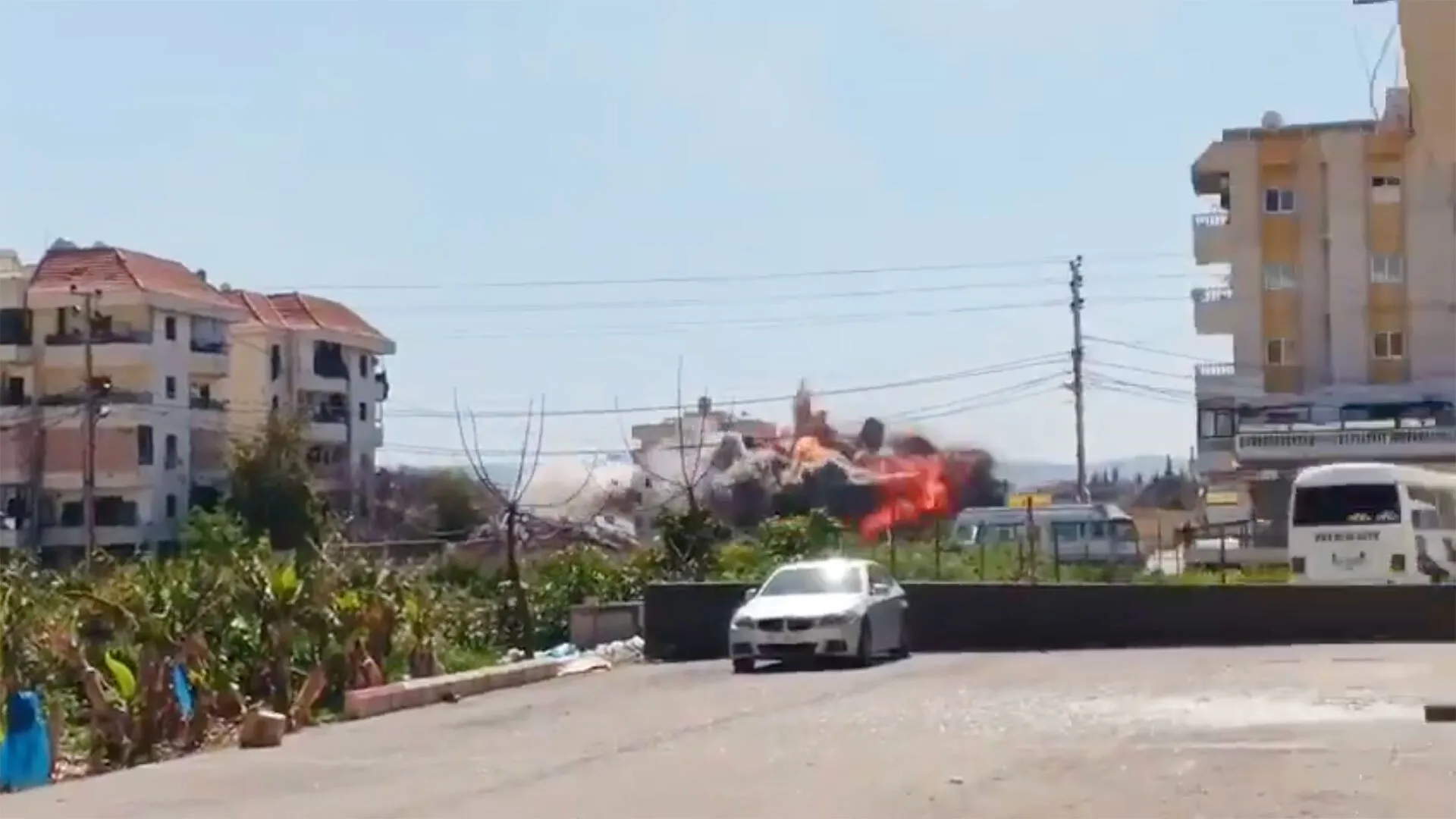
An Israeli air strike has heavily damaged a building in southern Lebanon’s Tyre district.
An Israeli air strike has heavily damaged a building in southern Lebanon’s Tyre district as Israeli forces continue to attack across the area. The army says it is targeting Hezbollah military infrastructure and has warned residents south of the Litani river to leave.
Tedros Adhanom Ghebreyesus says children, the elderly at particular risk after damage to Iranian petroleum facilities.
Published On 9 Mar 20269 Mar 2026
Share
The head of the World Health Organization has warned that recent Israeli attacks on oil facilities in Iran could have negative effects on public health, with Iranian children and the elderly among the most vulnerable.
Tedros Adhanom Ghebreyesus said in a statement on Monday that damage to Iranian petroleum facilities “risks contaminating food, water and air”.
Recommended Stories
list of 3 itemsend of list
Those hazards “can have severe health impacts especially on children, older people, and people with pre existing medical conditions”, Tedros warned in a post on X. “Rain laden with oil has been reported falling in parts of the country.”
The Iranian authorities said oil facilities in the capital, Tehran, and the nearby province of Alborz were targeted on Saturday in the United States-Israeli war against the country, the Fars news agency reported.
Israel said it struck “a number of fuel storage facilities in Tehran” that were used “to operate military infrastructure”.
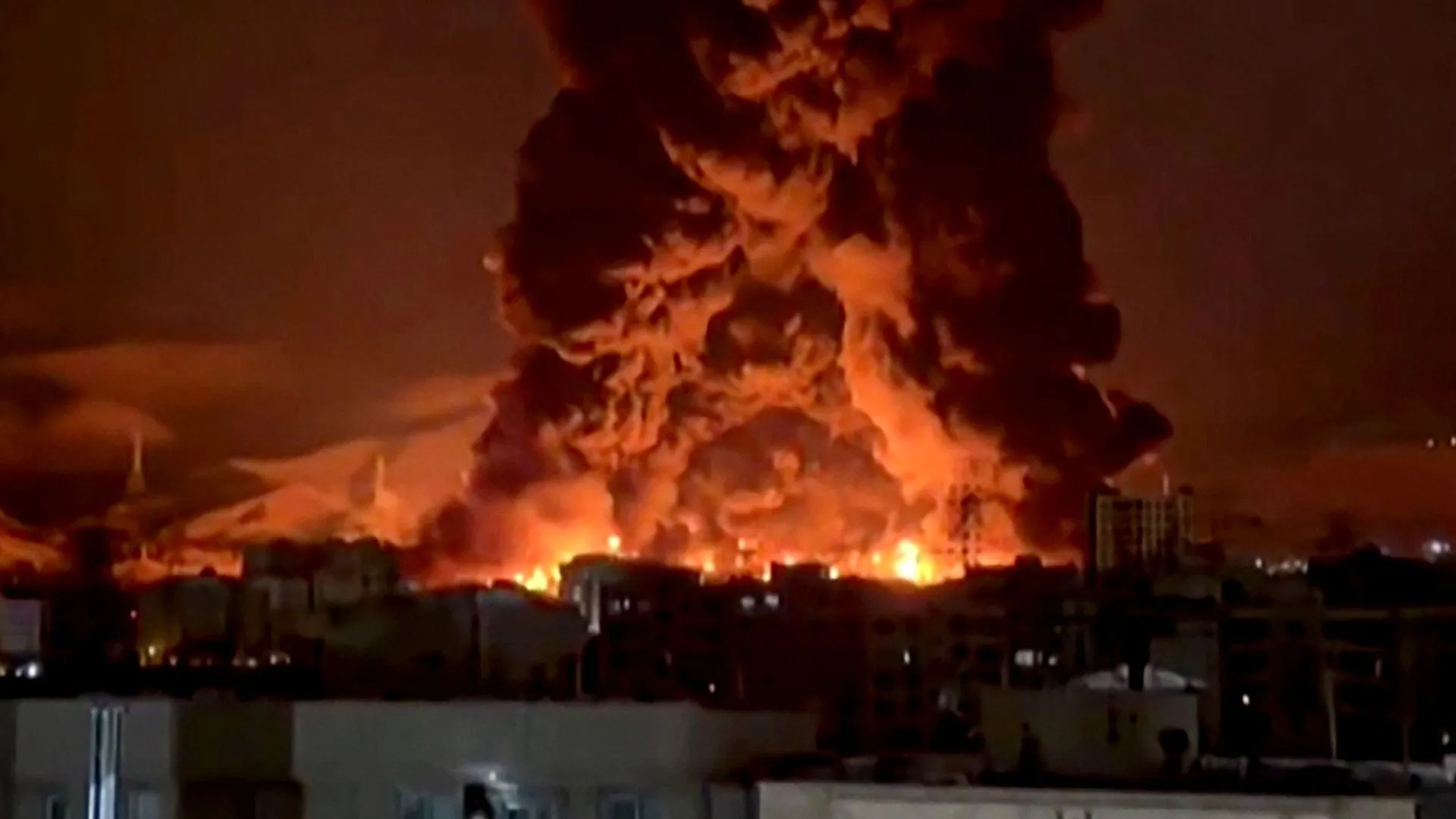
The strikes sent massive flames and clouds of thick, black smoke into the sky above Tehran, with Al Jazeera’s Tohid Asadi reporting that black raindrops fell early on Sunday morning.
The attacks on Iran’s energy infrastructure came as the US and Israeli governments had vowed to continue to bombard the country despite mounting international concern over the widening conflict.
Iran has retaliated to the US-Israeli strikes by launching missiles and drones at targets across the Middle East, including energy infrastructure in nearby Arab Gulf states.
Human rights groups have condemned both Iran and the US and Israel for targeting civilian infrastructure.
Agnes Callamard, the head of Amnesty International, said on Monday that “Israel should have taken all feasible precautions to avoid or minimize the risks to civilians when targeting oil refineries” in Iran.
“The incidental harm to civilians, including the release of toxic substance, appears to indicate that too little precautions were taken and that the incidental harm to civilians is disproportionate,” she wrote on X.
“The scenes of catastrophe described by Iranians after Tehran’s oil depots were bombed are yet another demonstration that ultimately, whatever they may say, the US and Israel’s attacks on Iran are harming first and foremost civilians, including children.”
Thick clouds of smoke rise over Tehran after the attacks on Iranian oil infrastructure, on March 8, 2026 [Majid Asgaripour/WANA via Reuters]
Israeli strikes on fuel depots and petroleum logistic sites in Tehran on Sunday saw apocalyptic images coming out of the Iranian capital, as the spilled oil ignited a river of fire, and thick black smoke blanketed the city of 10 million, leaving streets and vehicles covered with soot.
Israel and the United States claimed they were targeting Iranian military and government sites, but government officials and people say civilian structures such as schools, hospitals and major landmarks are increasingly coming under attack. At least 1,255 people have been killed in the strikes since February 28.
What Israeli and US military planners frame as a calculated degradation of state infrastructure is being described by local officials and environmental experts as an act of total warfare, and collective punishment.
Shina Ansari, head of Iran’s Department of Environment, described the systematic destruction of the oil depots as a blatant act of ecocide.
The attacks systematically targeted four major storage facilities and a distribution centre, including the Tehran refinery in the south and depots in Aghdasieh, Shahran, and Karaj. In the Shahran district, witnesses reported unrefined oil leaking directly into the streets as temperatures hovered around 13C (55F).
Ansari from Iran’s Department of Environment stated that the environment remains the silent victim of the war, noting that the incineration of vast fuel reserves has trapped the capital under a suffocating shroud of pollutants.
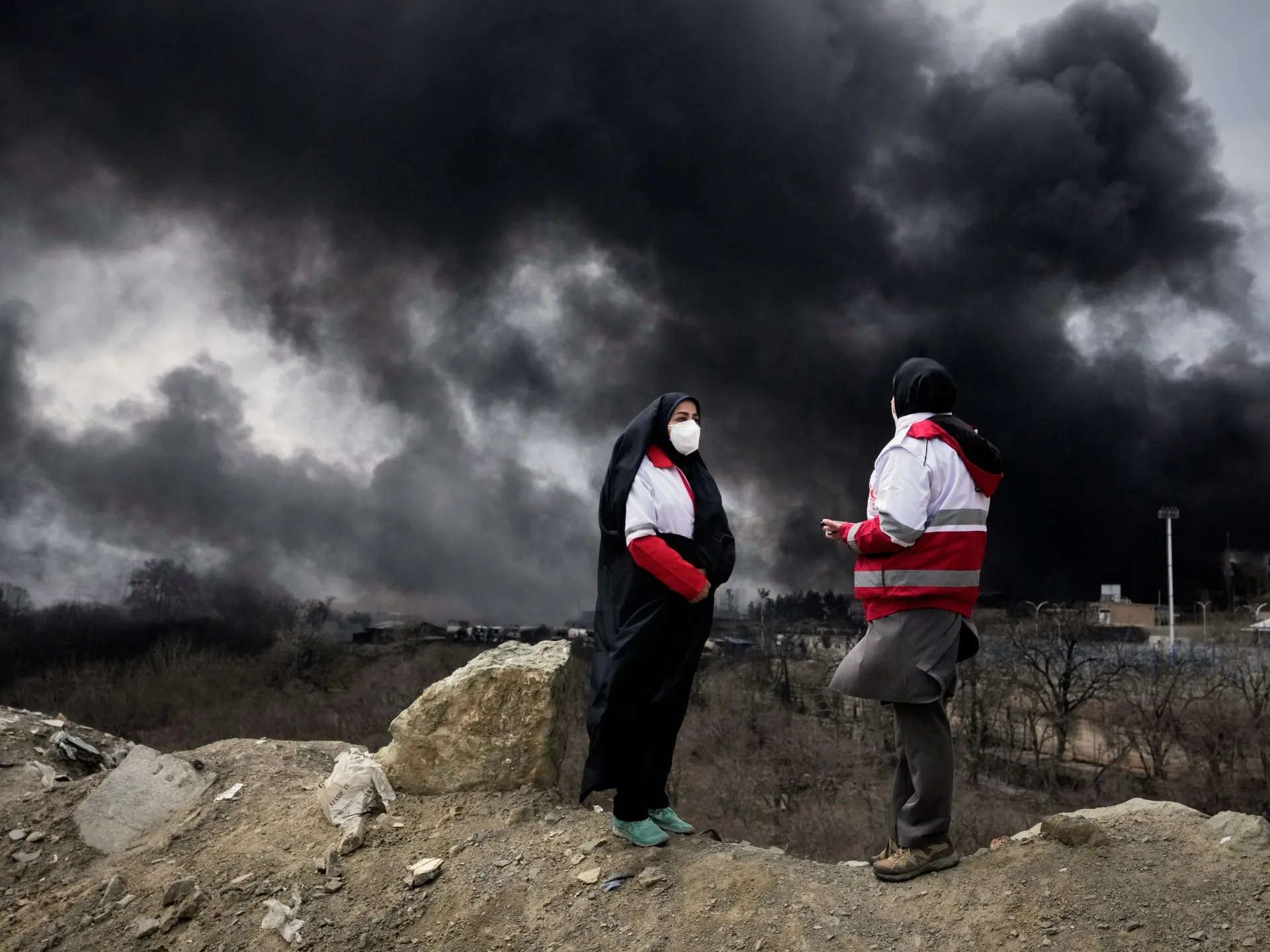
The medical and environmental fallout is immediate and severe. The Iranian Red Crescent Society warned that the smoke contains high concentrations of toxic hydrocarbons, sulphur, and nitrogen oxides. The organisation noted that any rainfall passing through these plumes becomes highly acidic, posing risks of skin burns and severe lung damage upon contact or inhalation.
Ali Jafarian, Iran’s deputy health minister, told Al Jazeera that this acid rain is already contaminating the soil and water supply. Jafarian added that the toxic air poses a life-threatening risk to the elderly, children, and those with pre-existing respiratory conditions, prompting authorities to advise residents to remain indoors.
The destruction has also forced the Iranian Ministry of Petroleum to slash daily fuel rations for civilians from 30 litres [8 gallons] to 20 litres [5 gallons]. At least four employees, including two tanker drivers, were killed in the depot strikes.
The strategic bombing myth
Major General Mamoun Abu Nowar, a retired Jordanian military analyst, told Al Jazeera that the primary objective of the strikes is to break the resilience of the Iranian people and paralyse the country’s logistics and economy.
“They are preparing the Iranian environment for an uprising against the regime,” Abu Nowar said, adding that the broader goal is to halt state operations and curb Tehran’s regional influence.
However, Abu Nowar raised urgent concerns about the specific munitions deployed, urging Iranian authorities to investigate the bomb fragments given the unusual density of the smoke and the resulting acid rain.
Some military strategists argue that striking an adversary’s vital infrastructure can paralyse the state from the inside out, bypassing the need to fight its military forces directly.
Modern warfare has increasingly relied on this strategic bombing via precision drones and missiles to destroy morale and incapacitate an adversary’s ability to wage war. For Israel, which is engaged in a genocidal war in Gaza and wider regional conflicts, targeting oil depots is viewed as a way to send a coercive message while avoiding a ground war.
However, Adel Shadid, a researcher in Israeli affairs, told Al Jazeera Arabic that the strategy is designed to make life hell for ordinary Iranians in hopes of sparking an uprising. Shadid noted a glaring contradiction in the rhetoric of Israeli Prime Minister Benjamin Netanyahu, who claims to support the Iranian people while overseeing the destruction of their basic means of survival.
Raphael S Cohen, director of the Strategy and Doctrine Program at the RAND Corporation, notes that such bombing campaigns consistently fail to achieve their primary goal of breaking a population’s will. Instead, Cohen argues, strategic bombing typically produces a rally-around-the-flag effect, unifying societies against a common foe rather than causing them to capitulate.
Historical echoes and retaliation
The reality of targeting oil infrastructure rarely aligns with sterile military theory, as history shows that such tactics reliably produce devastating, long-term environmental consequences.
During the 1991 Gulf War, the torching of Kuwaiti oil wells created a regional environmental catastrophe. Similarly, during the battle against ISIL (ISIS) in Iraq, the burning of the Qayyarah oil fields created a “Daesh Winter” that blocked out the sun for months.
The fires released vast quantities of toxic residues, including sulphur dioxide and polycyclic aromatic hydrocarbons, causing severe respiratory illnesses, soil acidification, and long-term carcinogenic risks for the local population.
Meanwhile, Mokhtar Haddad, director of the Al-Wefaq newspaper, told Al Jazeera Arabic that the targeting of energy hubs could trigger a global energy war.
According to Al Jazeera’s Sohaib al-Assa, reporting from Tehran, the Islamic Revolutionary Guard Corps (IRGC) has already retaliated by striking the Haifa oil refinery and targeting a US base in Kuwait, signalling that the conflict is no longer confined to military targets.
On Monday, Bahrain’s state-run oil company Bapco declared force majeure after waves of Iranian strikes targeted its energy installations. Iran has also been accused of also targeting energy facilities in other Gulf Cooperation Council (GCC) countries.
Weekly insights and analysis on the latest developments in military technology, strategy, and foreign policy.
As expected, Iran has repeatedly targeted prized missile defense radars across the Middle East in retaliation for the joint U.S.-Israeli air campaign that is ongoing. Iran’s attacks on high-value radars that enable the region’s missile defense capabilities appear to have succeeded on multiple occasions. The irony that lower-end long-range kamikaze drones are perhaps the biggest threat to extremely advanced radars capable of providing telemetry for intercepting targets traveling at hypersonic speeds, sometimes in space, is glaring. The losses of the radars and/or damage to their facilities should finally serve as a stark wake-up call regarding the vulnerability of these critical but largely static assets.
Based on the information at hand, it appears that Iran has been able to destroy one U.S. AN/TPY-2 radar in Jordan and damage the massive American-made AN/FPS-132 phased array radar in Qatar, prompting immediate concerns about available radar coverage to help respond to further barrages. There are strong indications that a number of other similar systems have been destroyed or damaged, as well.
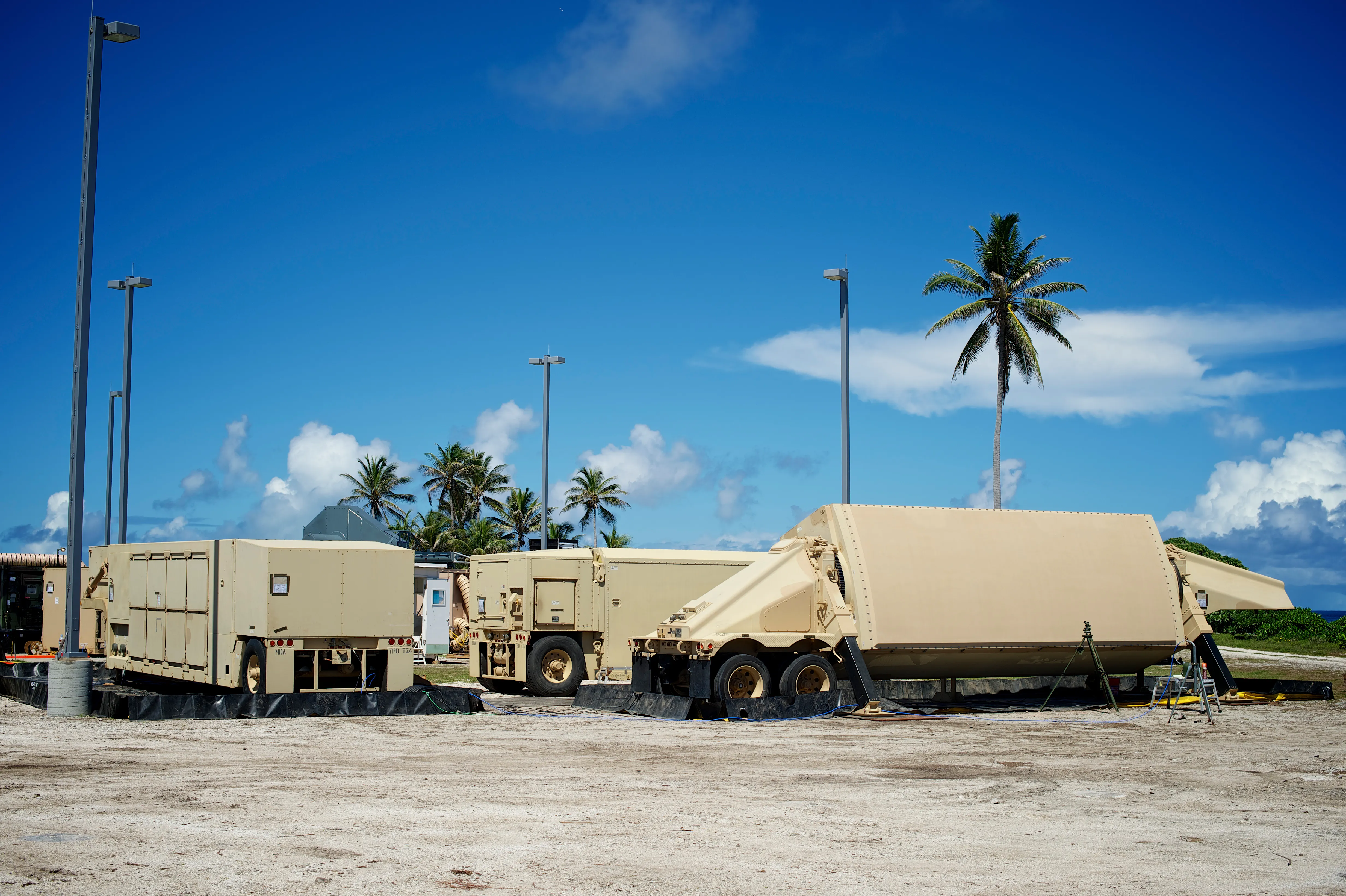
An Army Navy / Transportable Radar Surveillance (AN/TPY-2) positioned in the Kwajalein Atoll during the FTI-01 flight test. The AN/TPY-2 radar tracked the ballistic missile targets and provided data to missile defense systems to engage and intercept. (DoW) Missile Defense Agency
For some general context to start, Iran and/or its regional proxies have hit targets in a total of 12 countries since the start of the current conflict. Iranian retaliatory attacks utilizing ballistic and cruise missiles, as well as long-range kamikaze drones, have significantly declined in recent days, but are still being carried out. Countries in the region are so far claiming very high interception rates of incoming threats, but some missiles and drones are clearly making it to their targets.
Iran has attacked a wide array of different targets, military and non-military, but there has been a clear concerted effort to go after air and missile defense radars in the region as part of the retaliatory campaign. This is to be expected given that the loss of key radars, even temporarily, risks degrading further efforts to intercept Iranian missiles and drones, hence these weapons can succeed at a higher rate. Taking out missile defense radars at very high-value sites can leave those areas far more vulnerable to follow-on attacks, as well. Striking these radars also reduces their user’s general situational awareness in the region, and can even have strategic implications beyond the region, too.
It’s also worth noting that these radars are extremely expensive and take years to replace.
Iran’s attacks on radars so far
This past week, CNN obtained imagery from Planet Labs showing an AN/TPY-2 radar damaged, or even possibly destroyed, following an Iranian attack on Muwaffaq Salti Air Base in Jordan. Muwaffaq Salti has long been a major regional hub for U.S. operations, and is being very actively utilized in the current conflict. It has the greatest concentration of U.S. tactical aircraft in the region, and thus is an extremely important target, where even one ballistic missile landing on an apron could destroy multiple prized fighter aircraft and take the lives of U.S. service members.
NEW: The radar for a THAAD system was struck and apparently destroyed in Jordan while two other THAAD radar systems may have been hit in the UAE, satellite images show – w/ @ThomasBordeaux7https://t.co/qiuWVQgyda
— Gianluca Mezzofiore (@GianlucaMezzo) March 5, 2026
The Wall Street Journal reported yesterday that the U.S. military was rushing to replace the AN/TPY-2 at Muwaffaq Salti, lending credence to the assessment that damage from the Iranian attack was at least substantial. There is a picture, seen below, circulating on social media that is said to show the AN/TPY-2 at Muwaffaq Salti having been clearly knocked out, but it remains unverified and, in an age of increasingly impressive AI fakes, should be treated as such.
Photos have now confirmed the destruction of a AN/TPY-2 Forward Based X-band Transportable Radar operated by the U.S. Army, following an Iranian drone attack earlier this week targeting Muwaffaq Salti Air Base in Jordan. The AN/TPY-2 is the primary ground-based air surveillance… pic.twitter.com/54QyQCxNVW
The active electronically-scanned array AN/TPY-2 is primarily associated with the U.S. Terminal High Altitude Area Defense (THAAD) anti-ballistic missile system, but it also has a demonstrated ability to feed data to Patriot surface-to-air missile systems. THAAD is a key upper-tier defensive system deployed to the Middle East that is capable of swatting down Iran’s most capable missiles from the end of their midcourse stage of flight and through their terminal stage. AN/TPY-2 radars can also be deployed as standalone sensors in a larger integrated air defense network. The radar is trailer-mounted and technically road mobile, but is not designed to be used on the move or very rapidly relocated from one place to another.
A stock picture of an AN/TPY-2 radar. US Army
CNN has reported that additional Planet Labs imagery indicates that AN/TPY-2 and their infrastructure were also at least targeted and possibly damaged in Iranian attacks on THAAD batteries belonging to the United Arab Emirates (UAE), one at Al Ruwais and another at Al Sader, and another one in Saudi Arabia near Prince Sultan Air Base. The New York Times also obtained satellite imagery showing that the site at Al Ruwais had at least come under attack. The full extent of the damage at any of these sites remains unclear.
A compound was damaged on Al Dhafra Air Base, UAE. Sat dishes were visible at the site as recently as mid-June of last year. It is unclear if they were still there when strikes occurred, but Iran struck the same area again on Monday. pic.twitter.com/nRyb7c6Kj5
A satellite image taken on March 1 shows smoke rising from a radar site near the Prince Sultan Air Base in Saudi Arabia, where dozens of American planes are stationed.
At the site, a tent previously used to shelter a radar system for a nearby THAAD battery was badly charred and… pic.twitter.com/rSbEdtOvwf
— Gianluca Mezzofiore (@GianlucaMezzo) March 6, 2026
Satellite imagery from Planet Labs, obtained by the Middlebury Institute of International Studies at Monterey, has also confirmed that the very large, fully static AN/FPS-132 radar in Qatar was damaged in an Iranian attack on the first day of the conflict. At least one of the radar’s three arrays was hit, and there are also signs of a possible fire.
Confirmed the AN/FPS-132 phased array radar in Qatar was damaged by Iran, thanks to an incredible image from our friends @planet
Debris from the damaged face has fallen on the roof of the main building and there is water runoff from the firefighting effort pic.twitter.com/AxzteEug7P
There are multiple versions of the giant AN/FPS-132, all of which are fixed-site solid-state phased array radar systems primarily to provide early warning of incoming ballistic missile strikes. As noted, the one in Qatar has three faces, offering 360-degree coverage, but there are also variants with only two faces. The AN/FPS-132 is part of a larger group of broadly related strategic early warning types that are also in U.S. military service at multiple sites in the United States, as well as in Greenland. The Royal Air Force (RAF) in the United Kingdom operates another one of these radars at its RAF Fylingdales base.
A stock picture of a version of the AN/FPS-132 radar. USAF
Since the first day of the current conflict, claims have been circulating that Iran was able to at least damage a U.S. AN/TPS-59 active electronically-scanned array ballistic missile defense radar in Manama, Bahrain. This appears to be based on the video below, showing a kamikaze drone hitting a large spherical radome at Naval Support Activity (NSA) Bahrain, a U.S. Navy facility in the country that is home to the headquarters of the U.S. Fifth Fleet.
Footage of an Iranian attack drone slamming into the headquarters of the US Navy’s 5th Fleet at Naval Support Activity (NSA) Bahrain moments ago. pic.twitter.com/wHbje3eiiy
However, Planet Labs imagery that The New York Times subsequently obtained has been assessed to instead show damage to what are understood to be large satellite communications terminals at NSA Bahrain. Like larger radars, these terminals also often sit inside spherical radomes. There are clear signs that communications arrays like this have been a major target of Iranian retaliation strikes on bases across the Middle East, as well.
A tent surrounded by satellite dishes was destroyed at Al Udeid Air Base in Qatar. Some of the dishes were most likely damaged as well. Al Udeid is the regional headquarters for the US Central Command, and was similarly struck by Iran last June. pic.twitter.com/TyuqZWHUL3
Yesterday, Iran’s PressTV claimed that the Iranian Navy had launched a kamikaze drone attack targeting “strategic carbon-based radar installations at the Sdot Micha facility.” While TWZ cannot independently confirm whether such an attack was launched, let alone was successful, it does highlight continued Iranian targeting of key missile defense radars. Sdot Micha Air Base in Israel hosts Arrow-series anti-ballistic missile defense systems. Elta’s Green Pine, which is analogous in some very broad respects to AN/TPY-2, is the main radar associated with these anti-missile systems.
Costly losses of key capabilities
Concerns have been raised about the immediate impacts from the loss of the AN/TPY-2 and damage to the AN/FPS-132, given that Iranian retaliatory attacks have significantly slowed, but not stopped. There are claims now, said to have originated from a report from Channel 14 in Israel, that malfunctioning and/or damaged U.S. radars have caused delays in early warning alerts about incoming Iranian missiles. TWZ has been unable to find an original source for these assertions, and they remain very much unconfirmed at this time. Regardless, it is hard not to see how losses of these systems could cause at least some degradation in total coverage, even if other land based and sea-based systems (Aegis BMD) can help with filling in some coverage.
The United States, Israel, and Gulf Arab states do have other air and missile defense radars positioned in the Middle East, or that could otherwise help fill any resulting gaps. At the same time, there are only a small number of systems that are at all equivalent to the AN/TPY-2, let alone the AN/FPS-132. Only 16 AN/TPY-2s are understood to have been produced to date, in total, for all customers. The current cost of one of those radars is generally pegged at around $250 to $300 million. When the U.S. government approved the sale of the AN/FPS-132 radar, as well as various ancillary items and services, to Qatar in 2013, that entire package had an estimated value of $1.1 billion, or just over $2.1 billion today when adjusted for inflation. Any of these systems takes years to procure.
🇺🇸 PSA: Fast Facts on AN/TPY-2 (radar system used by THAAD)
16 produced to date, 13 US Army, 2 UAE, 1 KSA, 6 more pending for KSA, none on order for US Army.
8 deployed as part of US THAAD batteries, 5 Forward Based Mode (deployed/operated by US Army in Japan [2], Israel,… pic.twitter.com/bD7gHpA3ib
Furthermore, the U.S. military and its allies have spent years (and billions of dollars) building a regional missile defense shield, with AN/TPY-2s and the AN/FPS-132 in Qatar being core components thereof. Though Iran and its expanding ballistic missile arsenal have been the driving factors behind those efforts, the U.S. government also sees these assets as being a key element of its global missile defense architecture. As noted, the Qatari AN/FPS-132 provides 360-degree coverage that is not limited to scanning for threats emanating from Iran. Houthi militants in Yemen to the south, long backed by Iran, have amassed a substantial arsenal of ballistic missiles, as well as cruise missiles and long-range kamikaze drones, and have used it to attack Gulf Arab states in the past. As an aside, the UAE was the first to employ THAAD in combat back in 2022, using the system to knock down an incoming Houthi ballistic missile.
Though more than a decade old now, this 2015 graphic from the U.S. Missile Defense Agency still gives a good sense of how AN/TPY-2s, as well as AN/FPS-132s and related designs, form a global ballistic missile defense sensor ecosystem. US Missile Defense Agency
More serious ramifications
Strategic air and missile architectures, in general, exist in a world now where the threats they face are not limited to very-long-range standoff capabilities possessed only by peer or near-peer adversaries.
It used to be, generally, that you had to fire a ballistic missile or high-end cruise missile in an attempt to strike one of these systems. Now, long-range one-way-attack drones, as well as increasingly capable cruise and ballistic missiles, continue to proliferate steadily, including to smaller nation-state armed forces and even non-state actors. An attack could even come from a small drone with a C4 charge launched from a fishing trawler 10 miles away from one of these critical radar installations. The threat of these kinds of near-field attacks has largely been overlooked for years, even as the low-end drone threat has exploded and ‘democratized’ precision-guided weaponry, as they did not fit the established aerial threat matrix and the countermeasures used to repel those threats.
Though we have not seen it yet in the course of the current conflict with Iran, the threat of more localized attacks by smaller weaponized drones, in particular, is very real and only set to grow. This was definitely shown by Ukraine’s Operation Spiderweb’s unprecedented covert attacks on multiple airbases across Russia last year. Israel also employed near-field drone and missile attacks to destroy Iranian air defenses in the opening phases of the 12 Day War last June. These operations were massively successful and knocked out Iran’s most critical air defenses, allowing for long-range munitions to strike their targets unimpeded. TWZ had been calling attention to this issue for years beforehand, including back in 2019 after drones were reportedly spotted over the U.S. Army THAAD site, with its AN/TPY-2 radar, on Guam.
СБУ показала унікальні кадри спецоперації «Павутина», у результаті якої уражено 41 військовий літак стратегічної авіації рф
CBS News also reported this past week that quadcopter-type drones may have been surveilling the Shuaiba port in Kuwait before all-out hostilities erupted. Six U.S. service members were killed, and more were wounded, in an Iranian retaliatory attack on a U.S. logistics operations center at Shuaiba on March 1.
Iranian intelligence utilized various means to track service members after they left the base.
➡️ In anticipation of the offensive and expected retaliation to include strikes on Camp Arifjan, the Tactical Ops Center (TOC) was moved to the same facility at the port used during… https://t.co/R8VcPGIESm
Large, high-value, static and semi-static radars are fragile, to begin with. Domes and other structures can be built around them to help protect them from the elements, but they still need to allow for signals to be sent out and received. This inherently limits options for more physical hardening. Since these radars are typically fixed in place permanently or semi-permanently, their locations are also easier to determine and then target using a set of basic map coordinates. This is highlighted by how quickly news outlets have been able to locate these sites and then assess damage to them from commercially available satellite imagery.
The fragility of large radars also means that what might seem to be minor damage to the casual observer could actually be enough for a mission kill that takes the system offline, or at least degrades its functionality greatly, for a protracted period of time. Depending on the radar, it might not take a very large munition at all to cause a sufficient degree of damage. Just a small drone packing a grenade-sized explosive can punch a hole in one of these fragile arrays, putting it out of action for a very long period of time.
“With that said, America’s preeminent adversaries in the entire region would make taking out the THAAD battery on Guam a top priority during a conflict or even as part of a limited demonstration of force. Why barrage it with ballistic missiles or attempt a cruise missile launch from a forward-deployed submarine or even a clandestine commando raid when you can just fly a drone loaded with explosives into it? And no, you don’t need some high-end drone system to do this as real-world events have highlighted many times over. Drug cartels are now whacking their enemies with off-the-shelf drone-borne improvised explosive devices and even U.S. allies are actually manufacturing hobby-like drones just for this purpose. Somewhat more sophisticated types can be launched from longer distances and can even home in on radar or other RF emissions sources, like THAAD’s powerful AN/TPY-2 Radar and data-links, autonomously, beyond just striking a certain point on a map.”
“Simply put, ‘shooting the archer,’ in this case an advanced anti-ballistic missile system that protects America’s most strategic base in the entire region, via a relatively cheap drone is both an absurdly obvious and terrifyingly ironic tactic—the U.S. can shoot down ballistic missiles, but the critical systems used to do so remain extremely vulnerable to the lowliest of airborne threats—cheap drones.”
A THAAD launcher on Guam. US Army
The scale and scope of Iran’s retaliatory attacks so far, while clearly threatening, pale in comparison to what one would expect to see in a major high-end fight between the United States and China in the Pacific. The overall ramifications would also be more severe.
Beyond the more immediate impacts of losing this kind of strategic radar coverage, there are far larger implications. In some cases, these radars are designed to provide critical early warning and verification of incoming nuclear strikes, or other large-scale attacks by a major adversary, targeting a nation’s home soil. They are critical parts of the nuclear deterrent. As such, losing these sensors can have major downstream impacts on strategic decision-making cycles based on concerns about what suddenly is not being seen. Fewer radars also means fewer ways to double-check that a track is not a false positive in a scenario where the total available decision-making time could be seriously truncated, to begin with. These are concerns TWZ explicitly highlighted after Ukraine’s attack on the Armavir Radar Station in Russia in 2024.
It should be clear at this point that threats to strategic radar systems that Iran’s attacks in the past week have thrust into the public eye are not new. Similarly, this highlights how the United States, and others globally, remain behind the curve when it comes to establishing deeper, layered defenses to better protect these prized assets. This was already evidenced by Ukraine’s attack on the Armavir Radar Station in Russia in 2024.
US Army Green Berets, one armed with a Stinger shoulder-fired heat-seeking surface-to-air missile, or man-portable air defense system (MANPADS), seen in front of the AN/FPS-108Cobra Dane strategic early warning and tracking radar in Alaska during an exercise in 2021. NORTHCOM/NORAD
A view of the Pave Paws radar at Leshan, Taiwan. via fas.org
Even a layered defense posture might not be enough, especially in the face of a large volume and/or complex attack involving multiple types of missiles and/or drones. Those threats could also be coming from very different vectors at once, and fired from very disparate launch points on land, at sea, or in the air. Achieving overmatch against fixed defenses is also a glaring vulnerability. An enemy can calculate how many munitions, and what mix of munitions, are required to overwhelm known defenses at a key location. This is especially true for largely static defensive arrangements. Once critical terrestrial sensors are taken out, attacking other targets that were under the defensive umbrella they helped enable can become far easier.
New eyes in space
Perhaps the biggest takeaway here is that the combat actions by Iran this week provide heft to the arguments for migrating missile tracking capabilities outside of the atmosphere. While advanced and resilient missile tracking layers in space may not replace all their terrestrial counterparts, they would provide much-needed redundancy and augmentation of their capabilities.
The U.S. Air Force and U.S. Space Force are also very eager to move most, if not all, of the airborne target warning sensor layer into orbit, and to do the same when it comes to persistent tracking of targets on the ground and at sea. Relevant space-based capabilities are still years away from becoming a reality, at least at the required scale.
Shifting the focus to sensors in orbit is not without its own risks, either. U.S. officials regularly highlight ever-growing threats to assets in space, and are now openly talking about the need for satellites to be able to fight back, as you can read more about here. As part of its work on new space-based sensor infrastructure, the U.S. military has been investing heavily in new distributed constellations with large numbers of smaller satellites to increase resiliency to attacks.
Regardless, the Pentagon is very bullish in moving missile tracking into orbit, and doing so with more resilient constellations than with a handful of traditional satellites. Work is deeply underway in proving out this technology, which would enable the entire missile defense architecture globally. President Trump’s Golden Dome initiative will need this capability in order to accomplish its lofty goals. But accelerating the development and deployment of this kind of capability is very costly and we may see a major boost in funding for it after this war ends.
Overall, more details about the scope and scale of damage to radars and other assets from Iranian retaliatory attacks are likely to continue to emerge. What we’ve already seen points to a need for a further reassessment of the vulnerabilities of critical strategic air and missile defense radars and what is needed to adequately defend them, including moving them outside of the Earth’s atmosphere.
The president of the United Arab Emirates spoke for the first time on the widening war in the Middle East as Iran continues to strike Gulf countries hosting US military assets with drones and missiles.
“The UAE has thick skin and bitter flesh – we are no easy prey,” said Sheikh Mohamed bin Zayed Al Nahyan in comments aired by Abu Dhabi TV on Saturday as he visited wounded patients in a hospital.
Recommended Stories
list of 4 itemsend of list
He added the UAE is in “a period of war” but would “emerge stronger”.
In a social media post, Sheikh Mohamed said the UAE, which has seen attacks affecting hubs such as airports, tourist attractions, and the US consulate in Dubai, is prepared to confront “threats” against the “security and the protection of all citizens”.
One driver was killed when debris from an intercepted projectile slammed into his vehicle, Dubai’s Media Office said, describing the victim as Asian but providing no further details.
Sheikh Mohamed’s comments were aired as the region entered a second week of war sparked by a major US-Israeli attack on Iran.
Earlier, Iranian President Masoud Pezeshkian offered an apology to neighbouring nations for launching strikes on their countries housing US military bases. His comments were swiftly contradicted by Iranian judiciary chief Gholamhossein Mohseni Ejei, also a member of the interim leadership council.
“Evidence from Iran’s armed forces shows that the geography of some countries in the region is openly and covertly at the disposal of the enemy,” he said. “The heavy attacks on these targets will continue.”
Pezeshkian himself rolled back on his remarks that Gulf countries would not be targeted unless attacks originated from their territories, caveating that while his country emphasised “the preservation and continuation of friendly relations,” Iran still has an “inherent right” to defend itself against US-Israeli aggression.
Iran’s Foreign Minister Abbas Araghchi also clarified the leader’s comments on X, saying, “President Pezeshkian expressed openness to de-escalation within our region – provided that our neighbours’ airspace, territory, and waters are not used to attack the Iranian people.”
Iran retaliates after attack on water supplies
All the Gulf Cooperation Council (GCC) nations – Saudi Arabia, Qatar, the United Arab Emirates, Kuwait, Bahrain and Oman – have been targeted because of the presence of US assets within and around their borders.
In the Gulf, the deadly attacks have caused major disruption to flights, closure of airspace, and heavy knock-on impacts on oil-and-gas production reverberating across the world.
On Saturday, Iranian state media reported the country’s Islamic Revolutionary Guard Corps targeted US forces at Bahrain’s Jufair airbase in retaliation for an attack on a freshwater desalination plant on Qeshm Island.
Araghchi called the US attack on the plant a “dangerous move with grave consequences”, accusing the US of committing a “blatant and desperate crime”, which affected the water supply to 30 villages.
Iran’s parliament speaker, Mohammad Bagher Ghalibaf, later said the attack was carried out with support from one of the airbases in a southern neighbouring country, stressing nations will not enjoy peace as long as the US has bases in the region.
Harlan Ullman, a senior adviser with the Atlantic Council, told Al Jazeera that attacks on water supplies could bring “greater chaos” to the Gulf.
“About 95 percent of all water in the Gulf comes from desalination,” he said. “If Iran wants to target desalination and water installation plants, they can bring the Gulf to a halt.”
Other attacks on Gulf
The UAE, a US ally and home to US military installations, has been the most heavily targeted nation in the Gulf during the war.
The Emirati Ministry of Defence said on Saturday it was targeted with 16 ballistic missiles and more than 120 drones.
Hours after Pezeshkian’s apology, the IRGC said their drones struck a US air combat centre at al-Dhafra airbase near Abu Dhabi, capital of the UAE.
Later, an unidentified object was intercepted near Dubai airport, the world’s busiest for international traffic, forcing it to briefly suspend operations.
Iranian attacks also hit Abu Dhabi airport, the upmarket Palm Jumeirah development, and the Burj Al Arab luxury hotel over the past week, while drone debris caused a fire at the US consulate in Dubai.
Also on Saturday, Qatar’s armed forces intercepted a missile attack, according to the Ministry of Defence. No immediate details were released about possible damage or casualties.
In Saudi Arabia, the defence ministry said a ballistic missile landed in an uninhabited area after being launched towards Prince Sultan Air Base, southeast of Riyadh, which hosts US troops.
Kuwait also reported intercepting a drone while the country’s national oil company announced a “precautionary” cut to its production of crude because of Iranian attacks and threats to the Strait of Hormuz, a key transit point for Gulf hydrocarbons.
Iran to select new supreme leader
Posting on social media on Saturday, US President Donald Trump warned his country would hit Iran “very hard” and threatened to expand strikes to include new targets.
Speaking at an event hosting Latin American leaders in Miami, Florida, Trump said on Saturday his country’s forces sank 42 Iranian navy ships in three days.
Israel launched what its military described as a new wave of strikes on Tehran and Isfahan. The military said on Saturday that more than 80 fighter jets completed a wave of strikes on Iranian army sites, missile launchers and other targets.
In a statement, the army said targets hit in Iran included missile storage sites, ballistic missile launchers and military facilities linked to Iran’s security forces.
Among the attacks, it said it struck 16 aircraft at Tehran’s Mehrabad airport, which belonged to the Quds Force branch of Iran’s Revolutionary Guard overseeing its foreign operations.
The Israeli military reported missiles were fired from Iran at Israel on eight different occasions on Saturday, setting off air raid sirens in parts of the country and actioning air defences.
Iranian state media reported Saturday that the IRGC hit a Marshall Islands-flagged tanker in Hormuz.
Iran’s Assembly of Experts will be meeting in the next 24 hours to choose a new supreme leader, according to assembly member Ayatollah Mozafari.
Iran’s ambassador to the United Nations, Amir Saeid Iravani, has rejected Trump’s demands to have a say in selecting Iran’s new supreme leader.
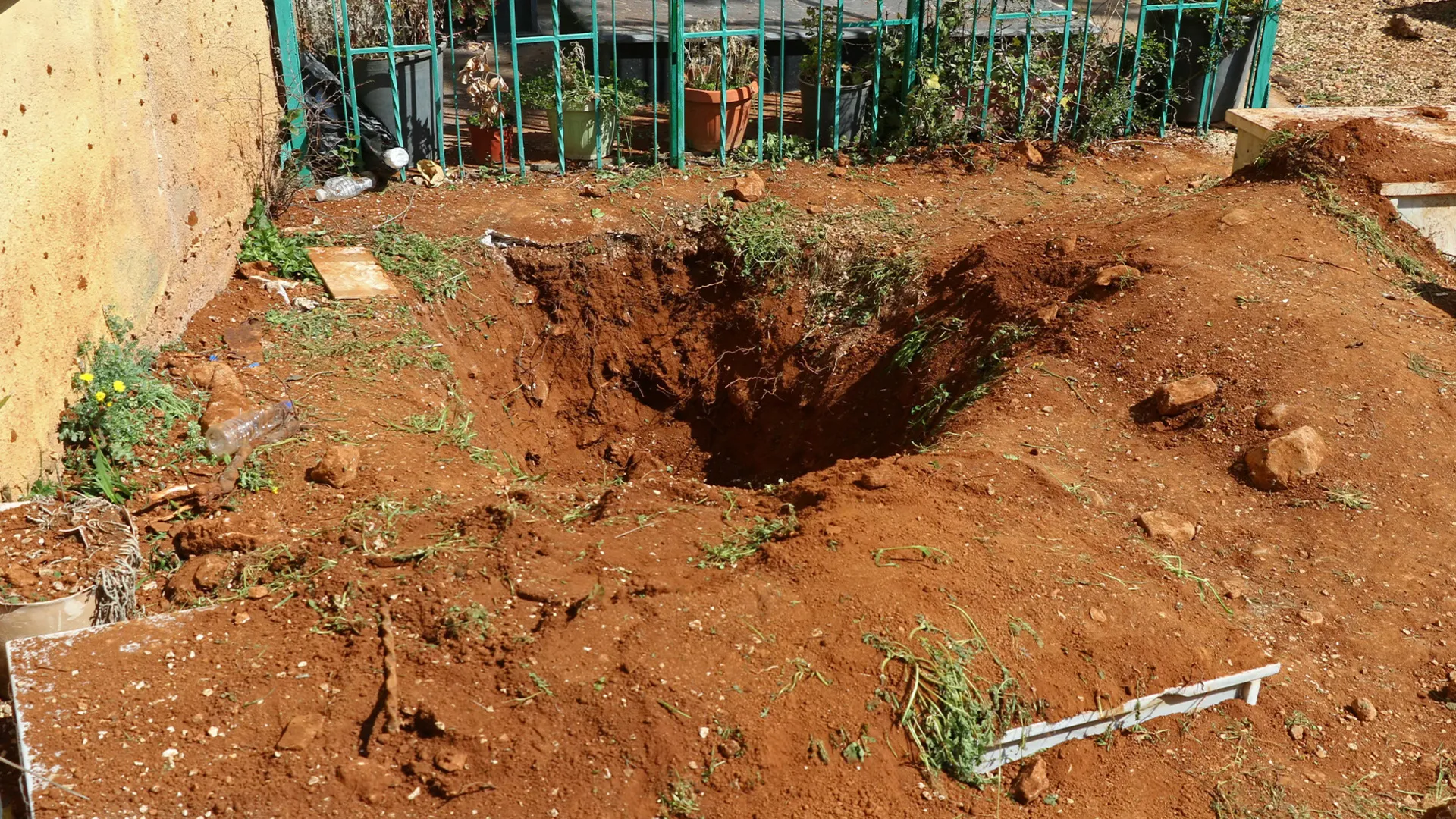
Israeli forces dug up graves during an airborne operation in eastern Lebanon, in search of the remains of a pilot who went missing nearly 40 years ago.