Terrorists attacked the Garahamojili military camp in Garaha, Hong Local Government Area of Adamawa State, in northeastern Nigeria, on Saturday, Feb. 21. Alison Hassan, a resident of the community, told HumAngle that the attack, which began around 11 p.m., lasted about an hour, as the terrorists engaged the soldiers in a fierce gun battle.
Although the Nigerian Army is yet to release an official statement regarding the attack or the number of casualties, residents say three soldiers were killed in the exchange, while several others were severely injured. HumAngle contacted Suleiman Yahaya Nguroje, the Adamawa State Police Command spokesperson, but he declined to comment on the situation.
Locals said that during the confrontation, a bullet landed inside a neighbouring house and struck a young woman. Chinapi Agara, a relative of the deceased, told HumAngle that she was the only civilian from the community to lose her life, as the terrorists were focused on the military base. “She was 20 years old. We buried her yesterday [Sunday, Feb. 22],” he said.
Chinapi also noted that the camp was set ablaze, forcing some of the soldiers to flee.
“The community wasn’t burnt, but the camp and three houses close to the camp were burnt, including two armoured tanks and their excavator,” Alison added.
According to Musa Simeon, a local vigilante, several attacks had been launched against the military base in the past, but none had been successful until Saturday’s incident. While locals are unsure of the terrorists’ identities, Musa said several armed groups have terrorised the area over the past decade. “Boko Haram, Islamic State – West Africa Province (ISWAP), and kidnappers, so we don’t know which one is responsible for now,” Musa said.
ISWAP reportedly released visual evidence and has claimed responsibility for the attack.
Several locals have lost their lives in the insurgency since it began in 2014. “We are close to the Borno border. Lots of communities like Kopure, Gabba, Lar and others have been completely displaced,” Chinapi added. Similarly, communities within Garaha have experienced a surge in kidnappings within the area in the last few years, forcing many to flee.
While calm has been restored in the area since Saturday’s incident, Alison noted that residents are deserting the area. “We are seriously in trouble because once it’s evening, people leave their houses to go and sleep somewhere. Some sleep in people’s houses inside town, and those of us who don’t have anywhere to go to sleep with our eyes open,” he said.
Residents who spoke to HumAngle called on the government to tighten security around the area as people are currently living in fear.
ISWAP claimed responsibility for attacking the Garahamojili military camp in northeastern Nigeria’s Adamawa State on February 21.
The attack resulted in the death of three soldiers and a civilian, causing panic and displacement among locals. During the assault, the camp and nearby houses were set ablaze, though the army has not yet confirmed casualties. While ISWAP released proof of their involvement, confusion remains about the perpetrators, with past aggressions involving groups like Boko Haram.
The incident escalated the existing turmoil in the region, marked by prolonged insurgency since 2014. Many communities around the Borno border have been displaced, and kidnappings in Garaha have surged, driving people away.
Though peace returned after the attack, fear persists, causing residents to flee nightly for safety, urging government intervention for enhanced security.
Weekly insights and analysis on the latest developments in military technology, strategy, and foreign policy.
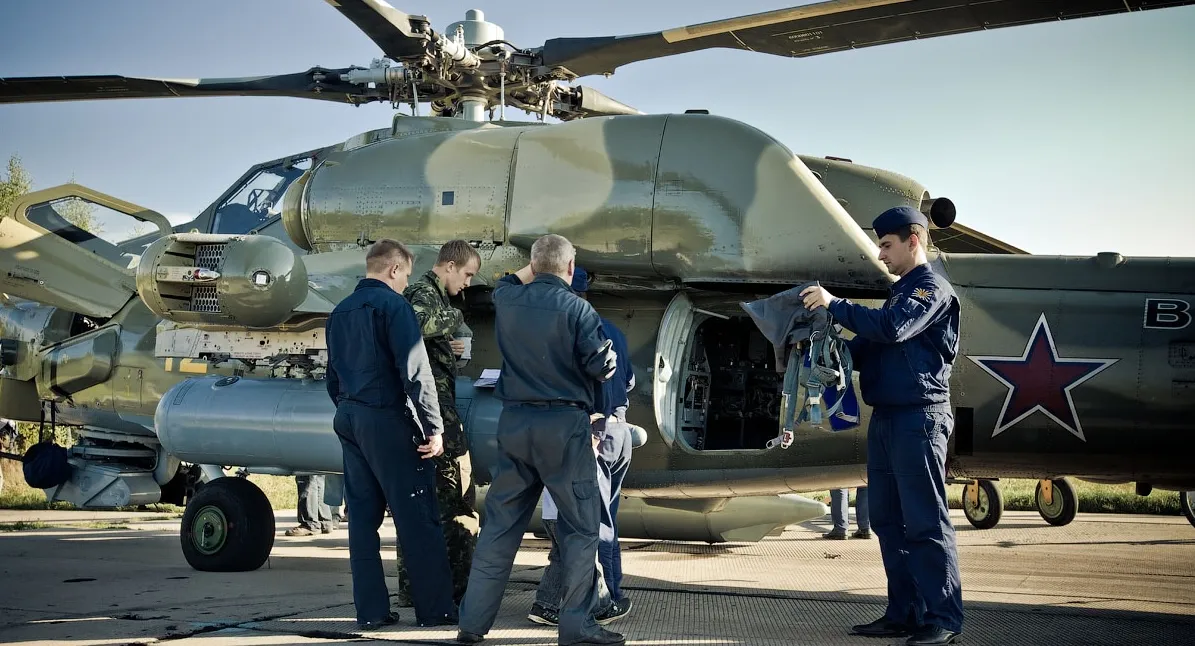
As well as being a key component of Russia’s attack helicopter force in the war in Ukraine, the Mi-28 Havoc has been in the news recently on account of its apparent delivery to Iran. Meanwhile, one lesser-known aspect of the Mi-28 is its ability to transport two or three passengers in a cramped fuselage compartment, a feature that is seen clearly in a recently published video of the rotorcraft.
The footage in question originates with the state-owned Russia Television and Radio channel and shows a Russian Aerospace Forces Mi-28NM — the latest domestic version of the gunship — undergoing pre-flight checks at a forward airstrip somewhere in the Ukrainian conflict zone. The video reportedly dates from this month.
At the start of the video, a technician is seen handling hoses that run into the helicopter’s port-side rear fuselage via an open door. Typically, such hoses are attached to dehumidifier units, which then blow warm, dry air through the aircraft to keep everything dry. This is especially important for sensitive avionics in cold weather, as on this snowy airfield. Once the helicopter is fully powered up, it should keep itself warm enough for moisture not to be a problem.
Perhaps the best available view of the Mi-28 rear-fuselage compartment, with the access door open. via X
What’s most interesting, however, is that the open door provides a rare look into this rear-fuselage compartment, which has the capacity to carry two or three people, or an equivalent load of cargo. Of course, this is in addition to the Mi-28’s two crew seated in tandem in the cockpit — the weapon system operator/navigator forward and the pilot to the rear.
The fuselage compartment, unique among in-service attack helicopters, was part of the Mi-28’s design when it was first schemed back in the second half of the 1970s. The Soviet Union had ordered Mil to design a new-generation combat helicopter, equivalent to the U.S. AH-64 Apache, but this feature was all its own.
The Mi-28’s configuration was broadly similar to the AH-64, but marked a significant move away from the philosophy enshrined in the previous Mi-24 Hind. As we have discussed in the past, the Mi-24 had been built around a passenger/cargo cabin — with space for a squad of infantry — although, as it was developed, it expanded its anti-armor capabilities, too.
A walkaround video of a privately owned Mi-24 in the United States. The passenger/cargo cabin is seen in detail from around the 11:30 mark:
Hind MI-24 Helicopter Walkaround Tour
In contrast, the Mi-28 was a tank-killer first and foremost, with no cabin, and better overall performance. However, there was internal space for a much smaller compartment and one that would be very useful for retrieving downed pilots from the battle area, especially for grabbing a pilot who went down within the same flight. Bearing in mind the expected aircraft losses on Europe’s Central Front — especially among low-flying helicopters — this made a lot of sense.
Other tasks could have included moving mechanics and tools to conduct limited repairs of other helicopters in an emergency. Potentially, it could even have been used for inserting and picking up infiltrators or saboteurs.
Having the option of using the Mi-28 as a kind of ad-hoc, or non-traditional combat search and rescue (CSAR) asset would also mean that the aircraft could operate on its own and on the fly if other air or ground assets were not available. Traditionally, CSAR helicopters have to operate with an armed escort. It’s unknown whether the passenger cabin has been used at all in the war in Ukraine, but the limited space, presence of avionics equipment, and complete lack of windows mean it’s only really suited to emergencies. For more typical CSAR missions in the Ukrainian theater, Mi-8 Hips and Mi-24s are typically used, with an escort of Mi-28 or Ka-52 Hokum attack helicopters.
A close-up view of the Mi-28 rear-fuselage compartment reveals how cramped it is, including the presence of avionics equipment. via X
As for other attack helicopter types attempting personnel recovery, the best-known incident is likely that involving two British Army Apache gunships in Afghanistan in January 2007. During that dramatic mission, four Royal Marines strapped themselves to the outside of two Apaches for an attempted combat rescue. Ultimately, they were only able to recover the body of their fallen comrade, Lance Cpl. Ford, who had already been killed.
The Italian Army, too, has explored the concept of using its A129 Mangusta attack helicopters for personnel rescue, strapping a pair of soldiers to the main landing gear struts. Meanwhile, the U.S. Army Special Operations Command operates MH-6M Little Birds with side-mounted planks to externally airlift special operators. A more elaborate modular system, used to transport small numbers of personnel, was schemed for the Bell 360 Invictus armed scout helicopter, as you can read about here.
A diagram depicting four individuals sitting on a modular seating system fitted in the weapons bay of a 360 Invictus helicopter. USPTO
It’s also worth pointing out another planned ‘survival’ feature of the Mi-28, namely its crew-escape system. Unlike the Ka-52, the Mi-28 doesn’t have ejection seats. Instead, the Zvezda/Tomilino Pamir-K crew seats have belts that tighten automatically when high-g loads are encountered. As originally envisaged, the crew escape system would work as follows: During any kind of catastrophic failure at altitude, the cockpit doors would be blown off, the stub wings would be jettisoned together with their loads, and an inflatable door-sill sleeve would be filled with air. This was to protect the crew from the protruding main landing gear and cannon and help them clear the helicopter, after which they would return to the ground by parachute. In theory, at least.
Ka-52 alligator and its unique K-37-800M ejection seats. Before the rocket in the ejection seat deploys, the rotor blades are blown away by explosive charges in the rotor disc and the canopy is jettisoned. pic.twitter.com/BzPP9SNXMZ
In practice, it seems the crew escape system never reached operational status on the Mi-28, likely due to the very limited window in which it would be of practical use.
According to the Oryx open-source tracking group, Russia has lost 19 Mi-28s since launching its full-scale invasion of Ukraine four years ago. This figure could be higher because Oryx only tabulates losses it can confirm visually. Russia began the conflict with a force of around 110 Mi-28s of all versions.
⚡️Video of the destruction of the Mi-28 of the 🇷🇺Russian Air Force using an 🇺🇦FPV drone. The first recorded case pic.twitter.com/LWosDeX2Ah
The Mi-28 has had a notably protracted history since it was first flown in prototype form in 1982. The original Havoc was abandoned by the early 1990s, and Mil pressed ahead with the radar-equipped, night-capable Mi-28N version. Deliveries of production Mi-28N helicopters to Russia began in 2008, and export versions have since been sold to Algeria, Iraq, Uganda, and, apparently, now also Iran.
For Russia, the basic version remains the Mi-28N, which also undertook combat operations in Syria starting in 2016.
Less common is the Mi-28UB (only 24 of which were produced), which received a mast-mounted radar, lacking on the Mi-28N, and dual controls. As for the latest Mi-28NM version — as seen in the video above — this also has the mast-mounted radar and other changes, including new missiles. As well as having been ordered in quantity for Russia, there are also plans to bring older Mi-28N aircraft up to Mi-28NM standard.
Video of the radar-equipped Mi-28UB during a live-fire exercise in the Krasnodar region, March 2020:
Russian Mi-28UB live fire exercise
For all the changes that the Mi-28 has undergone since it first appeared, its highly compact passenger compartment remains one of its most unusual features.
NEW YORK — JPMorgan Chase acknowledged for the first time that it closed the bank accounts of Donald Trump and several of his businesses in the aftermath of the Jan. 6, 2021, attacks on the U.S. Capitol, the latest development in a legal saga between the president and the nation’s biggest bank over the issue known as “debanking.”
The acknowledgment came in a court filing submitted this week in Trump’s lawsuit against the bank and its leader, Jamie Dimon. The president sued for $5 billion, alleging that his accounts were closed for political reasons, disrupting his business operations.
“In February 2021, JPMorgan informed Plaintiffs that certain accounts maintained with JPMorgan’s CB and PB would be closed,” JPMorgan’s former chief administrative officer Dan Wilkening wrote in the court filing. The “PB” and “CB” stands for JPMorgan’s private bank and commercial bank.
Until now, JPMorgan has never admitted it closed the president’s accounts in writing after Jan. 6. The bank would only speak hypothetically about when the bank closes accounts and its reasons for closing accounts, citing bank privacy laws.
A spokeswoman for the bank declined to comment beyond what the bank said in its legal filings.
Trump originally sued JPMorgan in Florida state court, where the president’s primary residence is now located. The filings this week are part of an effort by JPMorgan Chase to have the case moved from state to federal court and to have the jurisdiction of the case moved to New York, which is where the bank accounts were located and where Trump kept much of his business operations until recently.
Trump originally accused the bank of trade libel and violating state and federal unfair and deceptive trade practices.
In the original lawsuit, Trump said he tried to raise the issue personally with Dimon after the bank sent him notices that JPMorgan would close his accounts, and that Dimon assured Trump he would figure out what was happening. The lawsuit alleges Dimon failed to follow up with Trump.
Further, Trump’s lawyers allege that JPMorgan placed the president and his companies on a reputational “blacklist” that both JPMorgan and other banks use to keep clients from opening accounts with them in the future. The blacklist has yet to be defined by the president’s lawyers.
“If and when Plaintiffs explain what they mean by this ‘blacklist,’ JPMorgan will respond accordingly,” the bank’s lawyers said in a filing.
JPMorgan has previously said that although it regrets that Trump felt the need to sue the bank, the lawsuit has no merit.
The issue of debanking is at the center of the case. Debanking occurs when a bank closes the accounts of a customer or refuses to do business with a customer in the form of loans or other services. Once a relatively obscure issue in finance, debanking has become a politically charged issue in recent years, with conservative politicians arguing that banks have discriminated against them and their affiliated interests.
“In a devastating concession that proves President Trump’s entire claim, JPMorgan Chase admitted to unlawfully and intentionally de-banking President Trump, his family, and his businesses, causing overwhelming financial harm,” the president’s lawyers said in a statement. “President Trump is standing up for all those wrongly debanked by JPMorgan Chase and its cohorts, and will see this case to a just and proper conclusion.”
Debanking first became a national issue when conservatives accused the Obama administration of pressuring banks to stop extending services to gun stores and payday lenders under “Operation Choke Point.”
Trump and other conservative figures have alleged that banks cut them off from their accounts under the umbrella term of “reputational risk” after the Jan. 6, 2021, attack on the U.S. Capitol. Trump was impeached on a charge of inciting insurrection on Jan. 6, though not convicted in the Senate; and he was criminally indicted for his role in the riot and his attempt to overturn his 2020 election defeat, but that case was dismissed after he won the 2024 election.
Since Trump came back into office, the president’s banking regulators have moved to stop any banks from using “reputational risk” as a reason for denying service to customers.
This is not the first lawsuit Trump has filed against a big bank alleging that he was debanked. The Trump Organization sued credit card giant Capital One in March 2025 for similar reasons and allegations. The case is ongoing.