asks

Trump asks Supreme Court to let White House resume ballroom construction during appeal

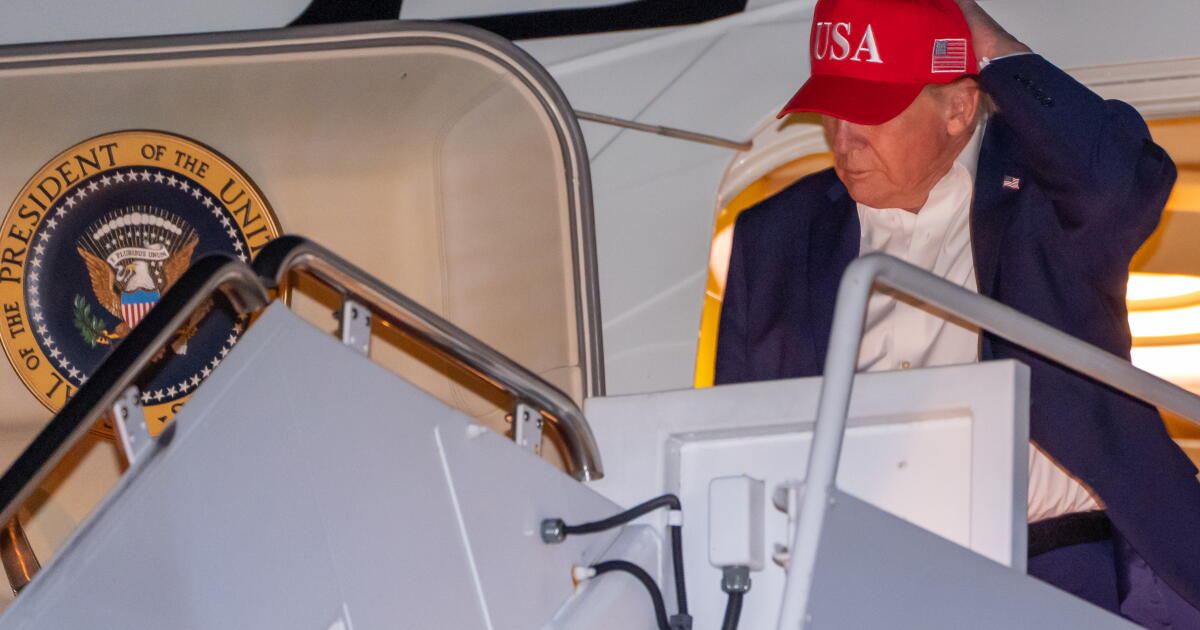
President Trump’s administration has asked the U.S. Supreme Court to allow the White House to resume construction on its $400 million ballroom project while it appeals a lower court’s order to halt the work.

Trump’s solicitor general on Friday petitioned the high court to suspend last week’s decision by a three-judge panel from the U.S. Court of Appeals for the District of Columbia Circuit.

The divided panel ruled last week Trump must stop the White House ballroom’s construction because Congress has not approved the project. The panel’s majority said Trump doesn’t have the unilateral authority to build a 90,000-square-foot ballroom where the White House’s East Wing stood before he ordered its demolition last fall.

The lower court suspended its own ruling for two weeks to give Trump’s Republican administration time to appeal to the Supreme Court. The solicitor general asked the Supreme Court to rule on its stay petition before the appeals court panel’s decision takes effect on Aug. 21.

“This case involves an extraordinary and unlawful injunction that will halt the ongoing construction of the integrated military complex, including a totally secure ballroom space, at the East Wing of the White House, which is vitally required by national security,” the solicitor general wrote.

The lower court’s 2-1 decision sided with historic preservationists who sued to stop construction of the ballroom.

The administration argues that the president, not Congress or the courts, has unimpeded authority to renovate the White House. The current state of the project, essentially an open construction site, makes it harder to protect the White House, the Justice Department contends.

The administration also says the National Trust for Historic Preservation does not have the legal right, or standing, to sue over the ballroom.

During an appeals court hearing in early June, an administration lawyer defended a broad view of presidential control over iconic public facilities.

The government could bulldoze the Statue of Liberty and the White House, Justice Department lawyer Yaakov Roth said in response to a hypothetical question, and the descendants of immigrants who came through Ellis Island and the enslaved people who built the White House would not have standing to sue.

Kunzelman writes for the Associated Press.

Source link

Trump again asks Supreme Court to save USPS mail ballot plan after second lower court loss

The Trump administration again on Wednesday asked the U.S. Supreme Court to intervene — and fast — to save President Trump’s plan for the U.S. Postal Service to place new nationwide limits on mail voting ahead of the November midterms.

It did so after a lower court judge blocked the Postal Service plan from moving forward for a second time on Tuesday.

Solicitor Gen. D. John Sauer wrote to the high court that if it does not act quickly to lift both of the lower court’s “erroneous” rulings blocking the plan, those orders “will effectively run out the clock on the government’s ability to implement” the changes in time for the November election, “thereby causing irreparable harm to the federal government, the public, and election integrity.”

Sauer’s latest argument was filed in an emergency case already before the Supreme Court, in which the Trump administration is challenging a June decision blocking the Postal Service’s rule changes by U.S. District Judge Indira Talwani.

Talwani, an appointee of President Obama, ruled in favor of California and 22 other states that had challenged the new rules as coming far too late in the election year to be implemented without causing significant disruptions and harming voters. That decision, which was upheld by an appellate court in July, had barred the new measures from being implemented in the states that sued, but not elsewhere.

However, Sauer filed his latest argument in response to a second ruling by Talwani in a separate case Tuesday, in which she sided with the League of Women Voters and other voting rights groups to block the Postal Service plans from moving forward nationwide.

“That it is now less than 90 days before the November 3, 2026 midterm elections underscores the critical need for an injunction to prevent Defendants from changing election rules on the eve of the election,” Talwani wrote.

The court battle follows an executive order Trump issued in March, in which he called on the Postal Service and the Department of Homeland Security to ensure “citizenship verification and integrity in federal elections” by compiling their own state-by-state lists of citizens who are eligible to vote and then using those lists to restrict who may vote by mail in each state.

The order said the Postal Service “shall not transmit mail-in or absentee ballots from any individual unless those individuals have been enrolled on a State-specific list.”

The order was immediately slammed by Democratic attorneys general and independent voting rights groups as a ploy by the Trump administration to get its hands on state voter rolls, which it has failed to secure in separate legal challenges, and severely limit mail voting, which Trump has without evidence alleged is a major source of voter fraud.

California Atty. Gen. Rob Bonta helped lead the states’ lawsuit challenging Trump’s order, and has praised Talwani’s orders blocking it from taking effect. Bonta has said the law is clear that states control elections, not the federal government, and that Trump’s order is an illegal and dangerous power grab ahead of a pivotal election in which the president’s party is poised to lose power.

A spokesperson for Bonta’s office said it was aware of Sauer’s filing and considering “next steps” Wednesday.

The Trump administration’s appeal to the Supreme Court is limited in scope, in that it hinges on a technical argument that the challenges to the new rules are premature — and that the Postal Service should be allowed to continue preparing for the new rules to be implemented while the legal battle over their legality continues.

Sauer reiterated that argument in his filing Wednesday, asking the high court to not only issue its order soon, but to make clear in it that not one but both of Talwani’s orders are premature.

He wrote that courts cannot block the implementation of an executive order “that merely instructs agencies to pursue a proposed policy in a manner that is consistent with law,” particularly before those agencies “actually take concrete actions that injure” the groups suing to block the order.

Therefore, Sauer wrote, it would be “prudent” for the high court to make clear that it was halting Talwani’s first order “based on the uncertainty concerning the government’s future actions, not anything specific to the individual plaintiffs” — or, in other words, on grounds that would apply to her second order, too.

He wrote that it was “critical” that the court “act promptly.”

The states have asked the high court to block Trump’s order, which they said would deny mail ballots to “many of the millions of voters who rely on mail voting — especially voters with disabilities and those in rural areas.”

The League of Women Voters hailed Talwani’s order Tuesday as a win for voters and for the U.S. Constitution, which it said makes clear the president does not have the authority to rewrite election rules.

“Millions of Americans, including seniors, military voters, voters with disabilities, rural voters, and citizens living overseas, rely on voting by mail to participate in our democracy,” said Marcia Johnson, the group’s chief of activation and justice. “Today’s decision reaffirms that the rules governing our democracy must be set by the Constitution and the law, not by executive overreach.”

When the high court will rule is unclear, though the emergency nature of the appeal calls for a prompt response.

Source link

Luke Doncic’s ex-fiancée asks court to dismiss child support request

Luka Doncic‘s former fiancée, Anamaria Goltes, requested Monday that the petition for child support she filed in March in Los Angeles Superior Court be dismissed, according to court documents obtained by The Times.

“I am withdrawing my Petition for Child Support with the specific intention of resolving this matter amicably and by a mutual agreement which is in the best interests of our children,” Goltes wrote in the filing.

The Lakers superstar proposed to Goltes, a fashion and fitness model, three years ago. They met as children in their native Slovenia and started dating as teenagers in 2016. Their daughters — Gabriela, 2, and Olivia, seven months — live with Goltes in Slovenia.

Doncic has spent the offseason in Slovenia and will host a four-day minicamp for the entire Lakers team later this month in his hometown of Ljubljana, which will include workouts, golf and sightseeing ahead of training camp. The guard — who led the NBA in scoring with an average of 33.5 points a game last season — even offered to pay the team’s travel costs.

Goltes, 28, sought child support and attorney fees from Doncic, 27, following an incident that occurred shortly after Olivia was born at Kranj Maternity Hospital on Dec. 6, 2025, in Slovenia. Doncic missed games against the Toronto Raptors and Boston Celtics to be present at the birth.

Goltes objected to Doncic’s desire to bring Gabriela back to the United States with him when he joined the Lakers in Philadelphia to play the 76ers on Dec. 7. Goltes called the police, but officers “did not detect any elements of a criminal offense or misdemeanor,” according to a report viewed by ESPN.

The couple broke off their engagement shortly thereafter. Goltes deleted photos of her and Doncic from her Instagram account and Doncic acknowledged that they had separated. He filed an injunction with a Slovenian court in February seeking immediate contact with his daughters, ESPN reported.

“I love my daughters more than anything, and I’ve been doing everything I can for them to be with me in the U.S. during the season, but that hasn’t been possible, so I recently made the tough decision to end my engagement,” Doncic said in March. “Everything I do is for my daughters’ happiness, and I will always fight to be with them and give them the best life I can.”

Doncic posted a photo on social media of Olivia wearing a pink sweater with a heart emoji covering her face. In his first game back, he inscribed a G and O with a heart on his shoes.

“I got to see my daughter again, my newborn,” he said upon his return. “Coming back, it was kind of hard to leave them behind. But it’s a job, so I got to do it.”


Source link

‘Are you broke?’ ask fans as Leigh-Anne Pinnock asks them for money to ‘follow her pregnancy’ despite raking in millions

LEIGH-ANNE Pinnock has come under fire for telling fans they can pay to ‘follow her pregnancy’ by signing up to a paywall site.

It comes despite the former Little Mix singer, who is currently expecting her third child with her footballer husband Andre Gray, having an estimated net worth of around £5.9 million.

Leigh-Anne Pinnock has created a subscription-only page behind a paywall where fans can follow her pregnancy journey Credit: Instagram
The star already shares twins with her husband Andre Gray and is expecting their third child Credit: Instagram

Taking to Instagram on Tuesday, Leigh-Anne explained to fans that she had set up a Patreon page where she will be sharing ‘pregnancy, bump updates, everyday life and all of the things in between’.

Fans can pay £5 per month to access the content.

Leigh-Anne, who already shares twins with Andre, wrote in her Patreon bio: “Hey It’s Leigh-Anne here!

“As some of you may know by now I’m pregnant with my third child and wanted to create a space for you all to get a deeper insight into my world, my pregnancy journey and general life as a mother, singer, wife and woman who’s trying her best.

PRICE-LESS REACTION

Katie Price leaves son Junior mortified as she talks her ‘hairy bits’


BIRTHDAY GIRL

Hannah Waddingham celebrates 52nd birthday on red carpet with new boyfriend

Leigh-Anne’s new page promises ‘pregnancy, bump updates, everyday life and all of the things in between’ Credit: Instagram
She and Andre have been together for over a decade Credit: Getty

“Excited to see where this journey takes us and can’t wait to show you all the things I get up to along the way.”

Patreon is a platform used by influencers and creators to share exclusive content.

Following the page’s release, some fans were confused as to why the multi-millionaire singer is charging for her content.

One fan branded the move ‘out of touch’ as they said: “Genuinely this is extremly weird for someone as big of a name to start a patreon to… show a pregnancy? Tbh it feels a bit out of touch for my taste.”

Another asked: “Are you broke?”

A third slammed: “Wow.. she really needs that money eh?”

However, some were on board with the idea and have already signed up.

“Just signed up to follow your journey, can’t wait to see what it all brings!,” wrote a fan.

Another defended: “The Patreon is strictly for the fans that want to follow her pregnancy journey a little more closer. She doesn’t have to show anything at all but she’s choosing to on her terms. That’s the difference from posting publicly.”

On her Patreon page, Leigh-Anne urged fans to keep the content she shares exclusively for there and not share it elsewhere online.

There is a free option on Patreon which allows you to watch some videos, but not the subscription-only posts.

Alongside her ultra-successful run with Little Mix, Leigh-Anne has had a booming solo career since 2023.

Her husband, Andre, has played for football clubs such as Brentford, Burnley, Watford and Port Vale.

Source link

Trump asks US Supreme Court to allow mail-in voting restrictions | Courts News

A lower court blocked the mail-in ballot restrictions, ruling Trump lacked authority to change state election rules.

The administration of United States President Donald Trump has asked the Supreme Court to allow it to move ahead with sweeping restrictions on mail-in voting ahead of November’s midterm elections, as it continues its push to reshape how federal elections are run.

In an emergency filing on Monday, the Justice Department asked the country’s highest court to pause a lower court ruling that blocked parts of Trump’s March executive order in 23 Democratic-led states and Washington, DC. The pause would remain in effect as the legal challenges play out, per the request.

Recommended Stories

list of 4 itemsend of list

The executive order directed federal agencies to help create state lists of eligible voters and required the US Postal Service to deliver mail ballots only to people on those lists. It also instructed the Justice Department to prioritise investigations into election officials accused of issuing ballots to ineligible voters.

US District Judge Indira Talwani blocked the order in June, ruling that Trump lacked the authority to unilaterally change how states administer federal elections. She noted that under the Constitution, states oversee voter-eligibility requirements.

Over the weekend, the First US Circuit Court of Appeals declined to pause that ruling, prompting the administration to take the issue to the Supreme Court.

In its request to the top court, the administration argued that the order amounted to “general policy guidance” rather than a directive dictating how states should administer elections.

Solicitor General John Sauer wrote: “The injunction is especially indefensible because the agencies are still deliberating over how (if at all) to implement the Order, yet the district court preemptively decided that whatever the agencies may choose to do will necessarily be unlawful.”

He urged the Supreme Court to act quickly as the new policy would have to be in place by August to be effective by the midterm election in November.

Trump has long claimed, without evidence, that widespread voter fraud undermined the 2020 presidential election and has repeatedly questioned the security of mail-in voting, despite studies showing that such fraud is rare.

He has promised to end the widespread use of mail ballots before the midterms, which will determine which party takes control of the US House of Representatives and Senate.

Voting rights advocates say restricting mail-in voting could disproportionately affect Democratic voters, who have historically been more likely than Republicans to cast their ballots by mail.

Source link

Kentucky Gov. Andy Beshear asks Sen. Mitch McConnell to give a public update on his condition

Kentucky Gov. Andy Beshear is directly asking Sen. Mitch McConnell, the state’s most powerful figure in Congress, to disclose more about his condition after three weeks of silence from the 84-year-old since he was hospitalized in Washington.

The letter released Wednesday from Beshear, a Democrat who is considered a potential presidential candidate in 2028, to the former Senate Republican leader says “Kentuckians have grown increasingly concerned about the current state of your health and well-being, and ability to hold office.”

McConnell, whose physical condition has visibly declined in recent years, was hospitalized June 14. He has not released a public statement, photos or videos since. Aides have disclosed nothing specific about his condition, other than to say last week that McConnell “continues to improve, and is working closely with his staff on Kentucky and Senate matters while the Senate is out of session.”

That lack of detail has fueled rampant speculation about his prognosis and whether he will return to the Senate when it reconvenes next week. The firestorm was enough that Republican Senate leaders made public statements Tuesday saying they had talked to McConnell and that he was alert and discussing current events.

McConnell is retiring at the end of his term in January, and the campaign to elect his successor already is underway. Kentucky’s Senate succession law, which Republican legislators have twice changed during Beshear’s tenure, does not give the governor a role in picking a temporary successor should McConnell’s seat become vacant before his term ends.

Under the latest change in 2024, Beshear would call a special election if the seat became vacant. The winner of that election could take office after the result is certified. The general election winner would be sworn in as part of the new Congress in January. But there are unresolved questions about the timing of a special election under the untested law, and the seat could remain vacant until January.

Beshear ended the letter by wishing McConnell “a safe and speedy recovery.”

A look at what an absence from the Senate or a vacancy could mean.

What happens if McConnell isn’t able to return?

There is not much, if anything, that Beshear, Kentucky lawmakers or the Senate could do if McConnell remains in office but is unable to perform his duties between now and when the current Congress expires in January.

Senate rules do not allow proxy voting. But there have been extended Senate absences before, and the chamber has continued its business with however many senators are in attendance. Republicans currently hold a 53-47 advantage. Without McConnell, that means a maximum of 52 Republican votes are available.

McConnell had been among the senators blocking war powers resolutions that seek to limit President Trump’s military options in Iran. Without him, the administration has less of a buffer. On the other hand, McConnell had already been among the Republicans refusing to support Trump’s sweeping elections law overhaul.

Why wouldn’t Beshear have a say in filling any vacancy?

The 17th Amendment to the U.S. Constitution calls for Senate vacancies to be filled by popular elections. But it allows state legislatures to empower governors to appoint an interim senator to serve through those campaigns. Most states have taken this option, according to the Congressional Research Service.

Kentucky law allowed interim appointments until 2021, when McConnell and other state GOP leaders persuaded the Republican-run Legislature to make a change. They did not want Beshear to shift the partisan balance in Washington if he got the opportunity. They called for a committee of the previous senator’s state party to select three people from whom the governor could choose an interim senator. In this case, that would mean Beshear picking which Republican would fill a vacancy. Several states have this system.

Kentucky lawmakers changed the law again in 2024 to require a special election. The only role for the governor is to call that election.

Beshear vetoed the 2021 and 2024 changes, but Republican lawmakers overrode him.

How would a special election work?

The 2024 law says Beshear “shall” issue a proclamation for a special vote but it does not say when he should make that proclamation or what the election date must be. Separate laws require certain minimum windows between a proclamation and the election date, but not necessarily a maximum window.

Some officials have argued that any vacancy after Aug. 3 would mean a special election concurrent with the general. They have even speculated that at some point, it would be impractical to have a special election at all given the regular election already taking place.

The Kentucky secretary of state’s office declined to speculate on a hypothetical time frame.

If a special election was needed, the simplest option would be to hold it at the same time as the regular general election.

For the full Senate term that begins in 2027, Republicans nominated U.S. Rep. Andy Barr, and the Democratic nominee is former state lawmaker Charles Booker. Concurrent elections would be separate, requiring new nominations by the parties, though they could choose Barr and Booker. Regardless, in this scenario, voters would be electing the immediate replacement and the full-term lawmaker on the same Election Day.

Multiple vacant House seats have been filled that way with little national attention.

Yes. The 2024 law has never been tested. If a vacancy occurred, there could be different interests between parties and even among Republicans about special election timing and whether to hold one at all. That could create any number of legal questions and disputes that have to be settled by the courts.

Beshear’s office did not immediately respond to an inquiry about how he interprets the law.

Barrow writes for the Associated Press.

Source link

Flavio Bolsonaro asks Trump to delay tariffs on Brazil until after election | Donald Trump News

President Lula accuses Jair Bolsonaro’s son, now a presidential hopeful, of helping triggered proposed US tariffs.

Brazilian presidential hopeful Flavio Bolsonaro, the son of former President Jair Bolsonaro, is asking the Trump administration to delay proposed tariffs on Brazilian goods until after October’s election, as he tries to counter allegations from President Luiz Inacio Lula da Silva that his family helped bring them about.

The Trump administration proposed the 25 percent tariffs in June, citing alleged trade violations including illegal deforestation and what it called unfair electronic payment practices, catching Brazil’s government by surprise. Lula had said relations were improving after a White House meeting with Trump in May.

Recommended Stories

list of 4 itemsend of list

The announcement came shortly after Bolsonaro met senior US officials in Washington, prompting accusations back home that he had invited US pressure on Brazil, with Lula accusing the right-wing senator of lobbying Washington to impose the tariffs.

He has since doubled down on those accusations, saying in a social media post last week, “the origin of all this was motivated by the Bolsonaro family itself” and that Bolsonaro’s request to delay the tariffs until after the election was “yet another act of treason against the Fatherland”.

Bolsonaro rejects the allegation, arguing instead that it’s Lula who would gain a political advantage if the tariffs were imposed.

“New US tariffs on Brazilian products would hand the current Brazilian government precisely the political victory it has been engineering,” Bolsonaro wrote in a submission to the Office of the US Trade Representative.

Brazilian officials have spent months trying to persuade Washington not to move ahead with the tariffs. But Bolsonaro says the government hasn’t gone far enough to find common ground with the US and is calling for a 180-day delay before any final decision is made.

“Brazil holds general elections in October 2026, and the political landscape that determines the viability of any negotiated resolution will be redefined within roughly ninety days,” he wrote.

So far, there is little sign his efforts are paying off. In a response to a letter Bolsonaro sent last month, Secretary of State Marco Rubio said US officials still had “substantial differences” with Brazil over the issues they say justify the proposed tariffs.

The dispute has left Brazilians split over who’s telling the truth. A Quaest poll published last month found 47 percent of Brazilians agreed with Lula’s claim that Bolsonaro had encouraged the United States to impose tariffs, while 35 percent agreed with Bolsonaro that he had tried to stop them.

Washington has until July 15 to decide whether to impose the tariffs which, if approved, would still exempt beef, coffee, rare earth minerals and aircraft parts. They would come on top of the tariffs Trump imposed last year over what he described as a “witch hunt” against Jair Bolsonaro, who was convicted months later.

Bolsonaro has made Brazil’s relationship with the United States a central part of his campaign, as Trump has taken a more active role in Latin American politics. That has included the capture of Venezuelan President Nicolas Maduro in Caracas and backing right-wing candidates across the region, including Abelardo De La Espriella, who narrowly won Colombia’s presidential election last month.

Source link

Dr Amir Khan asks does ‘anyone else have this’ after diagnosing himself

Dr Amir Khan has opened up about his own mental health, saying he has a “full-blown case”

A doctor has asked if “anyone else has this”, revealing he’s diagnosed himself with a form of anxiety. Doctor Amir Khan, who is known for his appearances on ITV, opened up about something called anticipatory anxiety.

In a video uploaded to social media platform Instagram, the medical professional shared more about his experience. Speaking to his more than one million followers, he said: “I’ve diagnosed myself with something called anticipatory anxiety and I need to know if anyone else has this.”

He explained how this phenomenon causes his brain to prepare for the “worst case scenario”, which in reality, doesn’t happen. “You know, when you’ve got like a meeting coming up or you’ve got an awkward conversation with someone you just don’t want to have,” Dr Amir said.

“It could be, I don’t know your boss at work, a friend, a family member, literally anyone – a meeting normally for me. Well then my brain decides we’re not just going to have one conversation in my head with these people, we’re gonna have 47, it just replays conversations in my head and what they’re going to go like.

Content cannot be displayed without consent

“I’ll imagine them saying something awful. So I prepare my perfect comeback, then they say something even worse in my head, so I then prepare for that.

“Then I imagine myself calmly standing my ground, walking away with dramatic dignity, probably to a soundtrack that only I can hear. By the time I’ve finished, I’ve won an argument that never actually happened.

“Then the real conversation comes along and they’re lovely, they’re polite, we agree on things. The meeting lasts like just six minutes, so then it’s just a chat. And I come away thinking, ‘Why on earth did I spend two days emotionally preparing for that?’

“Well, that is anticipatory anxiety, and I have a full-blown case of it all the time.” He said this occurs when your brain starts worrying about something before it’s happened and because your brain’s threat system is trying to protect you, it “often throws in a bit of catastrophizing as well”.

Dr Amir said: “It’s trying to help me it, believes that if it rehearses every possible disaster, I’ll be ready for anything. But in reality most of those disasters, just don’t happen.

“So all that’s really happened is I put myself through stress, once in my imagination and then once again in real life, except the real life version usually turns out absolutely fine.” He added: “Please tell me this isn’t just me.”

He was met by support in his comment section with one person saying: “Omg Amir this is me! I drive myself mad doing it. Glad I’m not alone. Thanks.”

Another commented: “Yes! Amir you most definitely are not alone, this is so me.” And one person replied: “I do this too, it can be exhausting.”

Anticipatory anxiety is a recognised form of anxiety. On its website, Anxiety UK says: “Anticipatory anxiety is where a person experiences increased levels of anxiety by thinking about an event or situation in the future.

“Rather than being a specific disorder in its own right, anticipatory anxiety is a symptom commonly found in a number of anxiety-related conditions, such as generalised anxiety. Anticipatory Anxiety can be extremely draining for people as it can last for months prior to an event.

“The worries people experience specifically focus on what they think might happen, often with catastrophic predictions about an event. The nature of negative predictions about the event will be the difference between an anxiety level that is incapacitating or merely uncomfortable.”

The NHS lists common symptoms of general anxiety as:

  • Feeling tired, restless or irritable
  • Feeling shaky or trembly, dizzy or sweating more
  • Being unable to concentrate or make decisions
  • Trouble sleeping
  • Worrying about the past or future, or thinking something bad will happen
  • Headaches, tummy aches or muscle pain
  • Dry mouth
  • Pins and needles
  • Noticing your heartbeat gets stronger, faster or irregular, or you get short of breath when you start feeling anxious

It says that if you cannot tell if shortness of breath is from anxiety or if you are worried about any other symptoms, you should see a GP.

Source link

TUI explains family seating ‘row rule’ after parent asks about £25 charge

Travel operator has spoken out on its family rules as Ryanair is facing an investigation over allegations it charges parents to sit alongside their children on flights

Holiday firm and airline TUI has outlined a crucial rule surrounding seat bookings – as the Competition and Markets Authority (CMA) opened an investigation into competitor Ryanair. Ryanair is facing scrutiny over its practice of charging parents to sit alongside their children on flights.

The competition watchdog, the Competition and Markets Authority (CMA), confirmed it will assess whether the approach is “in line with consumer law”. The airline branded the investigation as “bogus” and a “failed effort by the Starmer Government to pretend it cares about consumers”.

Ryanair mandates that parents flying with children aged between two and 11 must pay to reserve what it calls a mandatory family seat. Their children are subsequently assigned seats next to or close to them at no additional cost.

The charge for a mandatory family seat typically stands at around £8 each way, according to the CMA. As the story emerged, one TUI customer turned to X to question how it was possible that his wife was being charged to reserve a particular seat – and that their son might end up seated separately from her.

The person said: “@TUIUK tried to charge my wife 25 pound and said it may be the case that my five year old is sat on his own.”

TUI replied: “If your wife needs any assistance with her booking, please ask her to send us a direct message with the booking details so we can take a look for her.”

The individual then stated: “Don’t need assistance as it is booked, just frustrating she felt pressured to pay that when it isn’t the case that a five year old will be sat on his own.”

The TUI operative then clarified that they cannot guarantee the child will be seated directly beside the parent, explaining: “Please be reassured that children under 12 will always be seated with at least one adult from your booking, this may be directly next to them, across the aisle, or directly in front / behind, depending on the aircraft configuration and availability at check-in. Katy”.

The father responded: “So you would leave a 3 year old sat behind their parent?”.

According to TUI’s terms and conditions: “If you’re flying with TUI Airways and there’s a child under the age of 12 on your booking, we’ll make sure they’re seated with at least one adult in your party. If you’d like to make sure everyone sits together, we recommend reserving seats when you book, or adding them later in Manage My Booking.

“If you don’t use our Select Your Seat service, your seats will be automatically allocated when you check in online.”

Booking a TUI seat costs anywhere from £12 to over £90 per passenger, each way, depending on the destination, flight duration, and seat category. Standard seats are priced between £12 and £45, while upgrades such as Extra Legroom or Premium Seating carry higher charges.

Without paying, seats are assigned automatically at no cost during check-in. Following the previous query, TUI clarified: “Hi there, its lovely to hear from you. As katy explained a child can be seated row directly in front, behind, or across the aisle if under 12 years old and hasn’t purchased select your seats but the team on the flight will be on flight to assist fully. Laura.”

Ryanair is facing an investigation over allegations it charges parents to sit alongside their children on flights.

Children under two are required to sit on their parent’s lap on Ryanair flights. For other passengers, paying to reserve a seat remains optional.

The CMA confirmed it is examining whether Ryanair’s policy means “parents are being charged for the airline to meet its child safety and disability-related obligations as set out under aviation rules”.

Ryanair is “the only major airline flying out of the UK to impose this charge”, the watchdog stated.

Other airlines allow children to be seated next to a parent without requiring a paid adult reservation, or automatically assign seats together during the booking process, the CMA noted.

The probe will also look at whether Ryanair’s compulsory family seat charge is dripped during the booking process — when a company fails to show customers all unavoidable costs upfront.

The CMA stressed it is at the early stages of its investigation and has “reached no conclusions about whether Ryanair has broken the law”. Hayley Fletcher, senior director of consumer protection at the CMA, said: “Lots of families save up to afford a summer holiday and we know that extra charges can quickly bump up the price.

“Our investigation will consider Ryanair’s approach to family seat reservations and how the cost is presented to consumers, to determine whether they comply with consumer law.

“For the past year, we’ve told businesses to ensure their customers are shown the total price upfront – those who don’t face the very real possibility of action from the CMA.”

Rory Boland, editor of consumer magazine Which? Travel, said: “Ryanair doesn’t have to wait for the outcome of the CMA’s investigation. It could stop charging these unreasonable fees today and we would encourage them to do that.”

Ryanair issued a statement saying: “Ryanair’s family seating policy fully complies with all relevant laws and regulations, and saves families money when travelling on the UK’s lowest fare airline.”

The airline insisted it “does not charge any fee for children to sit beside their parent”, and “parents travelling with children pay for only one (adult) reserved seat”.

It went on to say: “This bogus CMA investigation is a failed effort by the Starmer Government to pretend it cares about consumers when it has failed to abolish APD (air passenger duty) which would immediately deliver lower fares for all consumers and growth for the UK aviation, tourism and wider economy.

“Ryanair looks forward to disproving these false CMA claims.”

The CMA is an independent non-ministerial Government department, funded by the Treasury.

Source link

Treasury Dept. asks banks to look for signs of illegal immigrant labor

June 5 (UPI) — The Treasury Department on Friday issued an advisory that financial institutions, including banks and casinos, to “be vigilant” against signs of unlawful employment of illegal immigrants.

The Department’s Financial Crimes Enforcement Network, called FinCEN, in the advisory calls on the institutions employ methods to detect schemes covering up the employment of people who are not authorized to work in the United States.

Treasury Secretary Scott Bessent said in a FinCEN press release that part of the Trump administration’s crackdown on illegal immigration includes “securing our financial system.”

“This administration will not allow illegal aliens to abuse financial institutions to steal billions of dollars from hardworking American taxpayers,” Bessent said.

In order for non-immigrants to work in the United States, employers are required to petition with U.S. Citizenship and Immigration Services for eligibility, before a prospective employee either applies to the State Department for a visa or enters the country through a port of entry, according to USCIS.

FinCEN said in the release that the hiring, concealing and exploiting of workers without visas can give employers advantages over other businesses, depress wages, facilitate identity theft and steal tax revenue from the United States.

The agencies additionally said that the hiring of these workers can also help fund and assist criminal enterprises that include drug trafficking and human trafficking.

The financial institutions are being asked to watch out for red flags of shell companies, identity theft, fraudulently used social security and worker identification numbers, shell companies and a raft of other detectable signs of fraud.

In addition to depository institutions such as banks, credit unions, money services businesses and securities and futures firms, FinCEN has aimed the advisory at casinos, the insurance industry, mortgage companies and brokers, and the precious metals and jewelry industries.

The Treasury Department said that more than $2.5 billion in suspicious activity reported by financial institutions was linked to payroll fraud schemes in 2025 alone, noting one multi-year scheme that cost the United States more than $38 million in tax revenue.

President Donald Trump discusses renovations to the Lincoln Reflecting Pool and makes an announcement on coal in the Oval Office at the White House on Thursday. Photo by Samuel Corum/UPI | License Photo

Source link

Obama asks for end to anti-Muslim sentiment

As a candidate, Barack Obama passionately defended the importance of religion in his life and in the nation’s politics. As president, Obama on Friday called for a renewal of religious tolerance and a cooling of tempers against Muslims as he tried to defuse the furor over plans to build an Islamic prayer center and mosque in New York and threats to burn copies of the Koran in Florida.

Obama, a Christian whose Muslim name inflames some of his fringe opponents, didn’t have to get involved in either dispute. But because of his responsibilities as president and commander-in-chief, Obama said he did.

“This country stands for the proposition that all men and women are created equal; that they have certain inalienable rights — one of those inalienable rights is to practice their religion freely,” Obama said.

“And what that means is that if you could build a church on a site, you could build a synagogue on a site, if you could build a Hindu temple on a site, then you should be able to build a mosque on the site.

Obama said he was aware that some of the 9/11 families were still in pain over the attacks, making a mosque nearby so sensitive.

“Tomorrow we as Americans are going to be joining them in prayer and remembrance,” the president said. “But I go back to what I said earlier: We are not at war against Islam. We are at war against terrorist organizations that have distorted Islam or falsely used the banner of Islam to engage in their destructive acts.

The Islamic prayer center and mosque would be built blocks from the World Trade Center, which was brought down two jetliners seized by Islamist terrorists. A third plane was intentionally crashed into the Pentagon, and another plane crashed in a field in Pennsylvania.

Obama began the news conference by saying that the ninth anniversary of the Sept. 11, 2001, terrorist attacks should be a day of remembrance and service. The mosque controversy has become linked to the furor over a Florida pastor’s decision to burn copies of the Koran to protest the 9/11 attacks.

“The idea that we would burn the sacred text of somebody else’s religion is contrary” to American principles, said Obama, who earlier this week called it a “stunt.” “My hope is that this individual prays on it and refrains from doing it,” he said.

Obama spoke of his duty as commander-in-chief to protect troops and U.S. interests around the world from Muslim anger over the planned Koran burning. Demonstrations have increased in Muslim countries, especially Afghanistan, where thousands have taken to the streets.

“This is a way of endangering our troops, our sons and daughters,” Obama said. “You don’t play games with that.”

How the threatened book burning by Pastor Terry Jones of the Dove World Outreach Center in Gainesville, Fla., took on world-class dimensions is subject to debate. Many, including some in the Obama administration, have blamed the media’s coverage for helping to elevate what is a small church with perhaps 50 members, into a global player.

“It is in the age of the Internet that something can cause us profound damage around the world, so we have to take it seriously,” Obama said.

In televised interviews, Jones has gone back and forth, saying he would suspend the burning so he can meet on Saturday in New York with Muslim leaders seeking to build the controversial mosque.

Imam Feisal Abdul Rauf, in charge of the New York effort, said he has no plans for any such meeting.

michael.muskal@latimes.com
Twitter.com/LATimesmuskal


Source link

Alabama asks Supreme Court to allow use of congressional map helping GOP, despite racial bias ruling

Alabama on Wednesday asked the Supreme Court to allow it to use a congressional map favoring Republicans in this year’s elections, despite a lower court’s ruling that the redistricting plan intentionally discriminates against Black people.

The state’s Republican leadership filed an emergency appeal with the justices a day after a three-judge court refused to let the state use a map it adopted three years ago that has a majority Black population in just one of its seven congressional districts.

The judges instead required Alabama to continue using a court-ordered map that was put in place for the 2024 elections that includes two districts where Black residents comprise a majority or close to it.

Atty. Gen. Steve Marshall told the court that the state did not intentionally discriminate against Black residents and should be allowed to hold elections this year under a map chosen by lawmakers, not judges.

The appeal is the latest development in the fallout from last month’s Supreme Court ruling that struck down a Black-majority district in Louisiana and weakened the federal Voting Rights Act. That ruling has led Republicans in several Southern states, including Alabama, to take steps to reshape voting districts with large minority populations that have elected Democrats.

The redistricting frenzy is part of a broader push by President Trump to try to hold on to Republicans’ slim House majority in the November elections.

The Alabama cases stretches back several years. The three-judge panel in 2023 ruled that a map drawn by Republican state lawmakers intentionally diluted the voting power of Black citizens. The court said the state, which is about 27% Black, should have two districts where Black voters are the majority or close to it. The court-selected map was used in 2024.

After the Supreme Court’s recent ruling in the Louisiana case, Alabama officials moved to implement the 2023 state-drawn map. The Supreme Court’s conservative majority agreed to lift the injunction that had blocked the map’s use and sent the case back to the three-judge panel for reconsideration in light of the Louisiana ruling.

In the meantime, voters cast ballots in Alabama’s May 19 primaries, and Republican Gov. Kay Ivey set new special primaries for Aug. 11 in four congressional districts affected by the map switch.

Upon further review, the judicial panel said it was standing behind its initial finding that there was “undisputed evidence” of intentional racial discrimination, a holding that was independent of and unaffected by the Supreme Court ruling on the Voting Rights Act.

It said the special congressional primaries should instead proceed under the previous court-approved districts.

The use of the court-ordered map led to the 2024 election of U.S. Rep. Shomari Figures, a Black Democrat. State Republicans are seeking to use a map that would give the GOP an opportunity to reclaim the south Alabama seat.

The state is asking for Supreme Court action by Monday as it makes preparations for the special vote in August.

Sherman writes for the Associated Press.

Source link

Disney asks FCC for equal time exemption for ‘The View’

May 22 (UPI) — The Federal Communications Commission on Friday opened public comment on a petition from the Disney-owned network ABC to declare its show The View as a “bona fide news interview program.”

Disney submitted the petition in early May on behalf of its television station KTRK-TV in Houston and its parent company ABC for the declaration in order to receive an exemption from laws requiring that non-news programming include equal time for representation of political candidates for office.

The equal time rule is part of the Communications Act of 1934, which created the FCC and regulations for the use of wire and radio, and later television, communications.

The rule is meant to ensure equal access to broadcast station facilities for all candidates for office — essentially, the same amount of air time — to prevent broadcasters from using the public airwaves to push one political candidate or party over another.

Disney and ABC’s request for an exemption to the rule, which are generally granted for news broadcasts, stems from years-long squabbling between President Donald Trump and various people who have hosted The View, which is a news and pop culture analysis program hosted by a panel of women.

“Is The View a ‘bona fide news interview program?” FCC Chairman Brendan Carr said in a post on X announcing the public comment period.

“Under FCC case law, tv shows do not qualify as ‘bona fide news’ if their decisions are based on partisan purposes, such as an intention to advance or harm an individual’s candidacy,” Carr said.

Disney compared the show to NBC’s Meet The Press and CBS’ Face The Nation, which feature interviews and roundtable analysis of political and news topics.

Carr, however, contends that The View does not meet the criteria of those shows as news programs, and so should be required to offer time to multiple candidates in a political race if they feature one of them.

In its May 7 petition to the FCC, Disney and ABC noted that the FCC’s actions could upend “settled law and practice,” as well as “chill critical protected speech both with respect to ‘The View’ and more broadly.”

The filing also notes that the show has “been broadcasting under a bona fide news exemption granted to it more than 20 years ago,” and that the exemption “remains valid.”

Kevin Warsh takes the oath of office as he is sworn-in as the new chairman of the Federal Reserve by Supreme Court Associate Justice Clarence Thomas in the East Room of the White House on Friday. Photo by Yuri Gripas/UPI | License Photo

Source link

Reality star Maura Higgins asks former Strictly Come Dancing pro to help her train for US version of show

REALITY star Maura Higgins has asked former Strictly Come Dancing pro Karen Hauer to help her train for the US version of the show.

The Love Islander will start filming for Dancing with the Stars in America in July.

Maura Higgins has asked a former Strictly Come Dancing pro for help training Credit: Getty
She asked former Strictly pro Karen Hauer to help her train for the US version of the show Credit: BBC

But she has already begun training in London with Karen, 44, who was axed from the BBC1 show this year.

An insider said: “Maura is a complete novice when it comes to dancing so Karen has kindly offered to show her the ropes and teach her the basics.

“Maura is determined not to be the first voted off so is giving it her all.

“She has her sights set on becoming a huge star in America.”

READ MORE ON MAURA HIGGINS

SHOW ME MAUR

Maura Higgins, Demi Moore & Heidi Klum dazzle on red carpet at Cannes


MAUR STYLE

Maura Higgins seen for the first time since quitting Love Island USA job

Maura is walking away from Love Island USA Credit: Getty
Karen was axed from Strictly this year Credit: BBC

Earlier this year Maura, 35, lost out in the final of the US version of The Traitors.

We revealed this week how Maura  is walking away from Love Island USA.

She revealed that she’s ready for a fresh start after three years.

Speaking to Vulture about whether fans would see her back on screens this summer, she said: “You won’t. I’ve done it for three years, and they’ll always be family to me, but I think it’s time to try something different.

“I’ve got amazing opportunities coming in the door.

“I think it’s time to say good-bye. But you know what? I won’t say forever.”

Source link