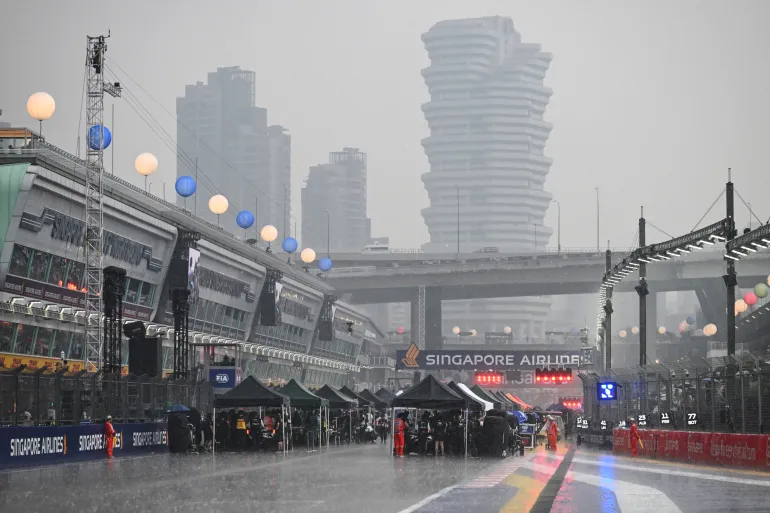
Max Verstappen’s sprint race win was Dutchman’s first of any kind in Singapore as he finished ahead of Lewis Hamilton.
Published On 10 Oct 202610 Oct 2026
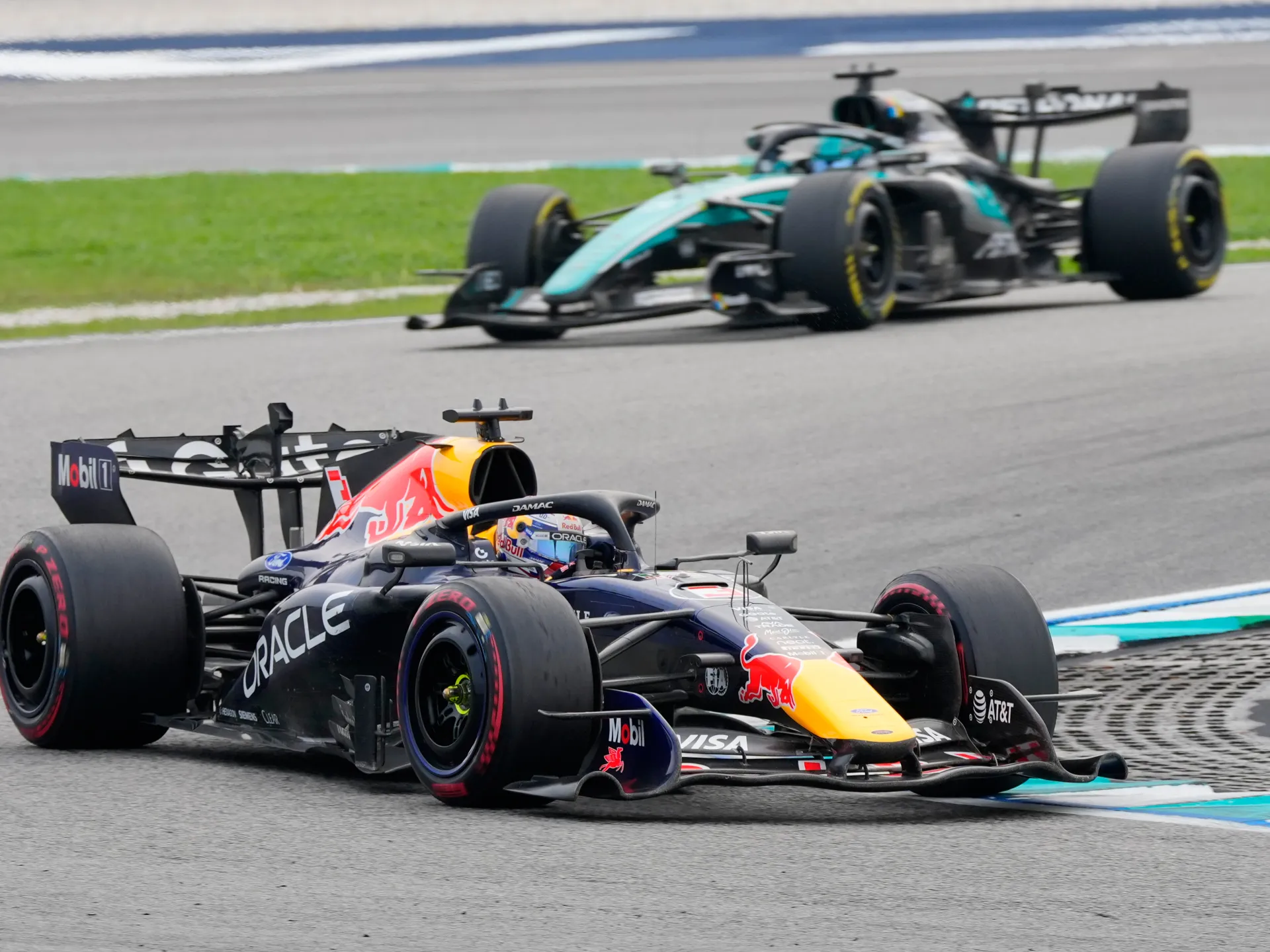
Red Bull’s Max Verstappen won a wet and wild Singapore Grand Prix sprint race on Saturday after George Russell crashed his Mercedes while leading at the end of the opening lap.
Four-time Formula One champion Verstappen held off Ferrari’s Lewis Hamilton to win by 2.50 seconds, with Charles Leclerc third as the McLarens of Lando Norris and Oscar Piastri touched and spun on the final lap while in fourth and fifth.
Recommended Stories
list of 4 itemsend of list
A heavy shower 10 minutes before the scheduled start meant a delay of 30 minutes.
All cars began on intermediate tyres, with some sectors of the Marina Bay Street Circuit much drier than others as the field embarked on two formation laps behind the safety car.
Rain falls on the grid before the Sprint ahead of the F1 Grand Prix of Singapore at Marina Bay Street Circuit on Saturday [Rudy Carezzevoli/Getty Images]
The eventual standing start saw Russell start on the front row alongside pole-sitter Verstappen and it was the Englishman who got away better.
His lead was short-lived as he lost control after touching a treacherous white line on the final bend of the opening lap. He slid sideways into the pit lane wall, bringing out a safety car.
It was another setback in a season of bad luck for Russell, who will start from the back of the grid in Sunday’s Grand Prix because of engine penalties.
“It was a miscalculation,” Russell told Sky Sports. “Came through the corner, had more battery deployment than I thought, pushed me a little bit wider than I hoped and went on to the white line.
“Silly mistake. Big consequences.”
It left Hamilton, who had a brilliant start from sixth on the grid, in second place, having leapfrogged Ferrari teammate Leclerc and the two McLarens.
The big beneficiary of Norris and Piastri’s “papaya spat” on the last lap was championship leader Kimi Antonelli, who inherited fourth place in his Mercedes having started seventh on the grid.
Fifth was RB’s Liam Lawson, sixth was the Haas of Oliver Bearman, seventh was Audi’s Nico Hulkenberg and Norris got going again to limp home in eighth and round out the points scorers.
Delisting comes days after Trump administration reportedly reopened talks with Myanmar’s government.
Published On 10 Oct 202610 Oct 2026
The United States has removed sanctions on the daughter of a Myanmar businessman accused of supporting the military-installed government.
The US Department of the Treasury removed Theint Win Htet from its sanctions list on Friday, according to its website, after she sued them in July.
Recommended Stories
list of 3 itemsend of list
The decision followed a Reuters news agency report that said US President Donald Trump’s administration has opened talks with Myanmar’s government, a break from years of US policy that sanctioned the generals responsible for a coup in 2021 against Myanmar’s democratically elected government.
In January 2024, the Treasury Department under former President Joe Biden’s administration targeted the Shwe Byain Phyu Group of Companies, which was founded by Theint Win Htet’s father, Thein Win Zaw, along with his family.
The department said the company supplied fuel to the military and owned at least 20 firms with close ties to the military leadership.
Theint Win Htet originally requested her removal in a lawsuit filed against the Biden administration. That case was dismissed last year. She then filed a second complaint in July, arguing that she has no role in her father’s business.
The sanctions had blocked her US credit cards, restricted her foreign bank accounts and forced her to abandon her master’s degree at Columbia University in New York. She now lives in Thailand with her mother, who was taken off the US sanctions list last year.
Theint Win Htet’s lawyer, Washington, DC-based sanctions specialist Erich Ferrari, filed a notice with the federal court in the US capital on Friday to voluntarily dismiss the lawsuit after her delisting.
‘Deplorable’
The group Justice For Myanmar has condemned the Treasury Department’s decision, saying Myanmar’s military is escalating attacks on civilians.
“It is deplorable that the US government continues to delist Myanmar cronies and their family members that provide funding for the junta’s terror,” the group said.
The Biden administration imposed sanctions on military officers and companies after the 2021 coup, which sparked a civil war that has killed about 100,000 people and displaced more than 3.5 million.
Washington lifted sanctions in July last year on several other Myanmar nationals and a company accused of aiding the military.
President Lai emphasises peace and freedom, vows not to tolerate aggression in Taiwan Strait.
Published On 10 Oct 202610 Oct 2026
Taiwan’s President Lai Ching-te has said the island “cherishes peace” and will “not give up our freedom” in a National Day speech outside the Presidential Office in Taipei.
Lai made the remarks on Saturday before thousands of people, including foreign diplomats.
Recommended Stories
list of 3 itemsend of list
“We are open to exchanges, but will not accept subordination,” he said. “Our aim by increasing investment in national defence is not to provoke; rather, it is to deter war.”
Taiwanese fighter jets and two Chinook helicopters carrying giant Taiwan flags flew over the capital ahead of the speech.
The holiday marks the 115th anniversary of a 1911 uprising that toppled China’s last imperial dynasty and led to the founding of the Republic of China.
Pressure from China
Taiwan’s 23 million people live under the constant threat of an attack by China, which insists the island is part of its territory, has never renounced the use of force to take it, and calls Lai a “separatist”.
Beijing has rebuffed his offers of talks.
Lai said China continued to “apply pressure through military and grey-zone activities in an attempt to alter the status quo across the Taiwan Strait”.
Grey-zone tactics are actions that stop short of open war. “Peace cannot rely solely on wishes, and tolerance cannot become a pretext for aggressors to encroach ever further,” he added.
Lai’s government has set aside a record 1.1 trillion New Taiwan dollars ($34.5bn) for defence in 2027, more than 3 percent of gross domestic product.
China held war games around the island shortly after Lai’s first National Day speech in 2024, but not last year. Its last drills near Taiwan were in late December, after news of an $11bn arms deal with Washington, the largest ever US weapons package for the island.
Lai said he welcomed talks between the United States and China, but insisted “there must be respect for the right of the people of Taiwan to exist”.
He urged democracies in the Indo-Pacific to join forces to preserve peace and stability in the region.
The US switched official diplomatic relations from Taipei to Beijing nearly 50 years ago but remains Taiwan’s most important security backer.
Officials in Washington and Taipei have repeatedly said US policy on Taiwan has not changed under President Donald Trump.
In May, after meeting Chinese President Xi Jinping in Beijing, Trump suggested arms sales to Taiwan could be a bargaining chip with China, which set off alarm across the world.
Taiwan is now waiting for Trump to sign off on $14bn worth of weapons, including the US-made Patriot air defence system.
The dispute dates back to China’s civil war, when the nationalist forces of Chiang Kai-shek retreated to Taiwan in 1949 after defeat by Mao Zedong’s communists.
The Republic of China remains the island’s formal name.
A young orangutan has been rescued from wildfires on Borneo Island in Indonesia. She suffered burns to her hands and feet and is now being treated in an animal hospital. Dozens of orangutans have been rescued from fires that have caused massive habitat destruction.
Australia play their first Test in South Africa since the 2018 ball-tampering scandal when they start a three-match series in Durban on Friday, with the visitors unlikely to face more than a few heckles over the incident that rocked the sport eight years ago.
The tourists’ efforts to roughen up the ball using sandpaper to aid reverse swing in Cape Town in March 2018 were caught on camera and led to a major reckoning for the game in Australia, with captain Steve Smith among those banned for their role in the subterfuge.
Recommended Stories
list of 4 itemsend of list
Al Jazeera Sport takes a closer look at the first Test battle in South Africa since the infamous series.
What is the context for the first return of series since ‘Sandpapergate’
South Africa have played Tests in Australia since ‘Sandpapergate’, and Australia have toured South Africa in the interim for limited-overs internationals.
The scandal has attracted little media focus in South Africa over recent weeks in comparison to the attention devoted to the incident in the Australian press.
After dethroning Australia last year in a thrilling World Test Championship (WTC) final at Lord’s to win a first major title, South Africa are focused on improving their chances of a return to the final at the end of the 2025–27 WTC cycle.
What shape are South Africa in for the visit of Australia?
The pitch at Kingsmead often proves a fickle track but should offer the spinners a chance to play a leading role in a change from South Africa’s usually seamer-friendly surfaces.
It is unusual for South Africa’s chances to be largely entrusted to their spin attack, but Simon Harmer and Keshav Maharaj wreaked havoc in India last November when they triumphed in their last two Test outings.
Spin was also a key factor for the home side as they beat Australia in the recent One-Day International series.
South Africa may therefore opt to rest frontline attack bowler Kagiso Rabada from the Test as he continues his comeback from a hamstring injury.
South Africa also have a choice to make over their number three batsman, with coach Shukri Conrad having several options including a potential first cap for 30-year-old Marques Ackerman.
How are Australia poised for their South Africa return?
Australia are also in need of a boost after a surprise home Test defeat by Bangladesh in August in their drawn series, and with an Ashes tour to England starting next June.
Injury to Australia all-rounder Cameron Green opens up a chance at number five for Cooper Connolly, or a fairytale return for 34-year-old Nic Maddinson after recovering from cancer.
Head hits back at former Australia players in defence of Test team
Australia opener Travis Head has taken to task former Test players turned critics whom he accused on Wednesday of “putting a bullet” through the current team.
Head did not single out any pundit directly, but his strong remarks at a news conference came the day after Matthew Hayden, one-time holder of the record for the most runs in a Test innings, accused selectors of “promoting the greatest pile of mediocrity that we’ve seen in a generation of cricket”.
The reference, made in a podcast, was about the recall of Maddinson, who has been out of Test cricket for nearly 10 years, but who joined the squad in South Africa after Josh Inglis fractured his finger and Cameron Green suffered a stomach injury.
“I think it’s unfairly judged a fair bit from a group of past players, pretty much that put the bullet through a lot of players, which I think is unfair,” Head said.
“But that’s what they’re paid to do. Some of them need a job, so they go after us, and that’s totally fine.
“This group is strong enough to deal with those sorts of things. That’s how it is. It’s unfortunate sometimes to have some of that feedback from a generation of players that we have huge respect for, but that’s the caper.”
Why have Australia selectors been accused of disrespecting cricket?
Hayden accused the selectors of “disrespecting first-class cricket”, asserting that batsmen should have an average of 45 runs or more before being considered for Test selection.
Head, however, praised Maddinson’s abilities and the benefits of choosing experienced players for Test cricket despite the 34-year-old replacement having a first-class average of 37.11.
“We need mature guys that know what they need to be doing,” Head said. “That revolves back to why we’ve been so good over a period of time, and why Australian cricket was so good back then in that era, because you’d bring in the Mike Husseys of the world, who are 30, who are tried and tested and know what they need to do.”
Former Australia captain Allan Border suggested that the 32-year-old Head would face his toughest test as an opener against the South African bowling attack and would perhaps be better batting at number five.
“I have laughed at a fair bit of it because if a traditional opening batter had pushed out the same sort of numbers in his first 20 innings, I think he’d be pretty safe and not talked about in the way that it has been talked about,” Head said. “It’s a lot of headline stuff.”
South African fans hold up a banner with reference to the sandpaper scandal during the fourth Test against Australia in 2018 [File: Gavin Barker/EPA]
Smith still traumatised by Sandpapergate
In the build-up to the series, Smith has admitted he is still traumatised by “Sandpapergate” – the series he oversaw as captain.
The prolific batter was sent home in disgrace, banned for a year and sacked as captain for his role in the ball-tampering scandal during the third Test in Cape Town eight years ago.
David Warner, considered the ringleader, was suspended for 12 months and stripped of all leadership roles, while Cameron Bancroft was slapped with a nine-month ban.
Smith said he still suffers flashbacks to a traumatic period of his life, haunted by memories of leaving Johannesburg airport, with cameras clicking furiously around him, and a harrowing Sydney news conference on his return when he broke down in tears.
“I’m not a big fan of cameras … I get anxious around cameras to be honest,” he told News Corp.
“That was a traumatic experience in my life, and when I hear the flash of a camera it makes me revisit that in a way.
“The 24-48 hours of being told by James Sutherland [then Cricket Australia chief executive] that I was getting banned for a year. That and going through the airport in Johannesburg getting absolutely mobbed, and then flying back and doing that press conference.
“I still have little flashbacks here and there of it.”
Smith bore the brunt of the scandal that is considered one of Australian sport’s darkest moments, but bounced back emphatically.
He smashed a superb century against England on his return and has gone from strength to strength, with 10,920 Test runs so far at an average of 56.
“It was certainly a difficult period, particularly the initial period a few days after,” he said.
“The mental state I was in was not great. That’s somewhere I’d like not to get to again, but I certainly learned from that and have been able to move forward with my life.
“I’ve tried to kind of erase a lot of 2018 and what happened,” he added.
“I can’t remember a lot about the series. I’ve tried to block most of it out of my memory bank.”
Smith has been back to South Africa for a white-ball series since 2018, but not for a Test, and he is bracing for hostile crowds.
But the 37-year-old is unperturbed, having negotiated multiple Ashes tours to England since 2018, where the Barmy Army abused him relentlessly.
“It’s something I’m kind of used to. I’ve copped a lot at times away from home at different venues across my career and it’s something that I take in my own stride,” he said.
“I use it as motivation to try and go out and do well and try and take a positive from it.”
South Korea signals cuts to military exemptions for gold medallists after backlash over athletes’ Asian Games comments.
Published On 7 Oct 20267 Oct 2026
South Korea’s sports minister says the government will review the military service exemption for gold-medal-winning athletes after public backlash to some controversial comments from winners at the Asian Games.
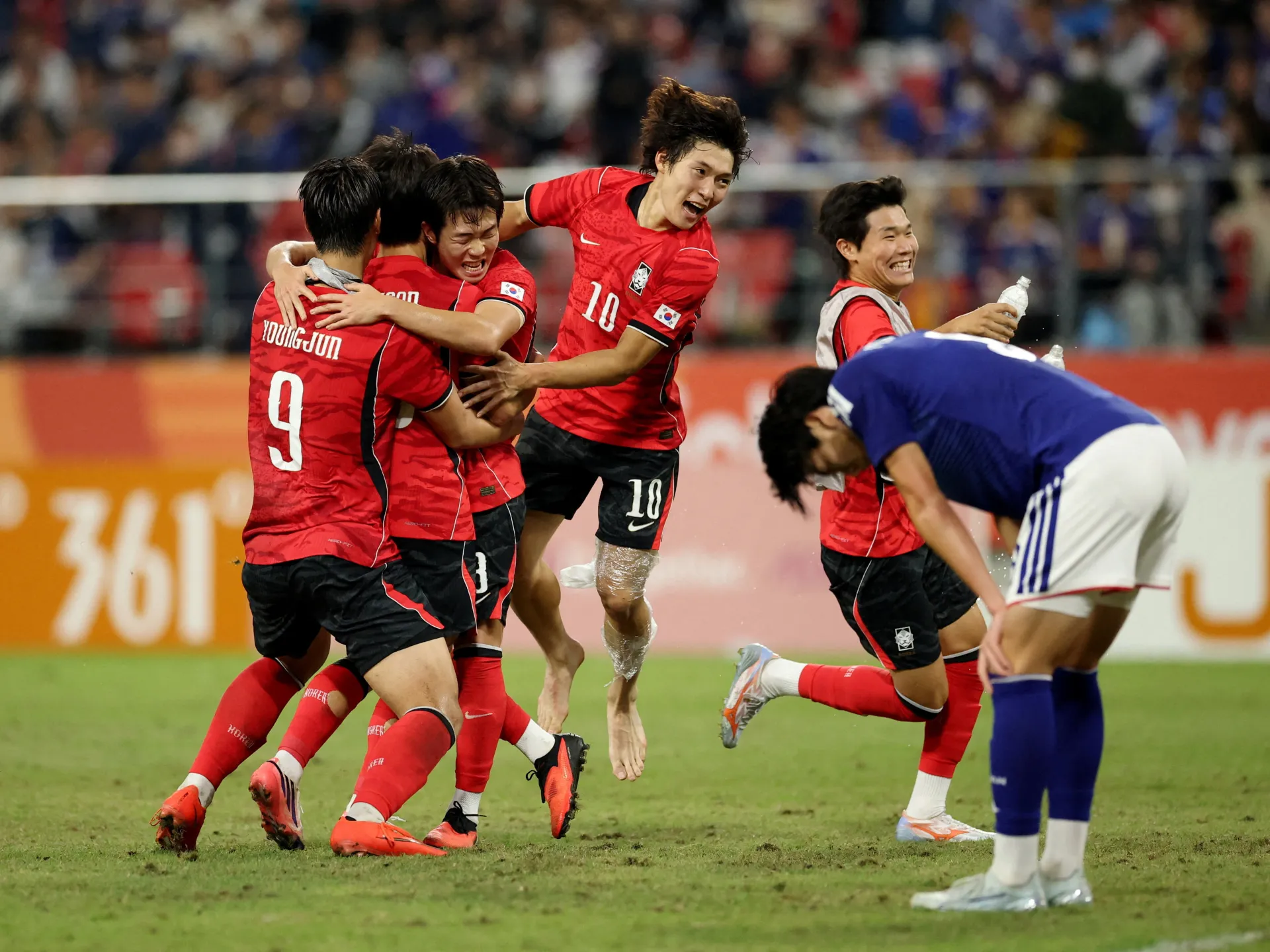
Three players from the men’s football team came under fire for comments following South Korea’s 1-0 win over Japan in the Asian Games final last weekend in Japan.
Recommended Stories
list of 4 itemsend of list
All three apologised, but a broader debate had already reignited over whether athletes should receive special treatment for sporting achievements, particularly as common citizens, as even members of BTS – the globally famous K-pop group – had to complete their mandatory service.
Al Jazeera Sport takes a closer look at the furore surrounding the comments at the Asian Games.
Culture, Sports and Tourism Minister Choi Hwi-young on Wednesday said the alternative military service exemption system for artists and athletes “will inevitably have to be scaled back”.
“It is true that the system has contributed to helping outstanding artists and athletes maintain and develop their abilities,” Choi told the National Assembly’s Culture, Sports and Tourism Committee.
“However, the values attached to fairness and public perceptions of military service have changed. I agree that the system should be comprehensively reviewed once again.”
What does military service look like in South Korea?
Most South Korean men must complete 18 to 21 months of military service by the age of 28.
Since 1973, however, Olympic medallists and Asian Games gold medallists have been able to replace the full term with a supplementary service, which consists of three weeks of basic training.
Three of the footballers, including Yang Min-hyuk, who assisted the winning goal against Japan, made comments that were viewed as insensitive.
“The medal and winning the championship weren’t important. I played the game with only one thing in mind – the reward of a military service exemption,” Yang, who joined Tottenham Hotspur in 2025 and is currently on loan at Belgian club Westerlo, said.
Newcastle United midfielder Park Seung-soo posted a photo on social media showing him wearing a cap associated with soldiers who have completed their service. In a post-match interview, captain Lee Gi-hyuk held up his gold medal and said, “I’m not going to the military.”
What has been said elsewhere in South Korea about the controversy?
A number of politicians, including Ahn Cheol-soo of the People Power Party, said it was time to change the system.
“Some players’ remarks after the match were outrageous,” Ahn posted on social media. “Even the captain bragged about not having to serve in the military. Are all the young people who enlist every year fools?”
Former lawmaker Yoo Seong-min said the flippant comments had provoked resentment and asked: “Is it really fair that BTS has to serve in the military while Asian Games gold medallists are exempt?”
In a Korea Herald editorial on Tuesday, the newspaper declared that the practice was outdated.
“South Korea now stands shoulder to shoulder with the world’s leading nations,” the newspaper said. “The days when finishing first in Asia could meaningfully enhance the country’s national prestige are long gone. It is time to reconsider.”
That was the message from Defence Ministry spokesperson Chung Binna during a press briefing in Seoul.
“Ultimately, we have plans to cut back or scrap the supplementary service, including one designed for artists and athletes,” Chung said.
What other athletes gained military-service exemptions?
The footballers were among many winners from the Asian Games who qualified for the military exemption.
Golfer Tom Kim won the men’s singles on Saturday after flying across the Pacific when the Presidents Cup competition ended so he could compete in Japan. Asked about the military exemption, he took the gold-medal approach.
“I’m more proud that I’m able to bring a medal for my country,” he said.
Sixteen South Korean baseball players are also exempt after defeating Japan 3-1 in the Asian Games final. So are three South Koreans who won gold in esports, an event at the Asian Games.
South Korea’s government has signalled that the current military service exemption reserved for gold-medal winning athletes could be abolished, after controversial comments made by winners at the Asian games caused public backlash.
Novac Djokovic won 102nd match of his career, while ATP 500 tournament victory was Carlos Alcaraz’s third of the year.
Published On 6 Oct 20266 Oct 2026
Novak Djokovic won the China Open after his opponent Alex de Minaur retired from the final with injury, while Spaniard Carlos Alcaraz retained his Japan Open crown to continue his resurgence after a lengthy wrist injury layoff.
The 39-year-old Serbian won the first set in the tie-break 7-6 (7-3) and was down a game in the second set when the Australian ended the match with retirement on Tuesday.
Recommended Stories
list of 4 itemsend of list
Djokovic extended an astonishing unbeaten streak in Beijing and winning the 102nd title of his career.
De Minaur left the court for a medical timeout after losing the first-set tie break but played on with his left thigh heavily bandaged. However, he had to stop after winning the first game of the second set, leaving him trailing 7-6(3) 0-1.
“I don’t feel great … I want to say sorry to all the amazing fans,” de Minaur said at the trophy presentation.
“I didn’t want to finish like this … hopefully see you next year,” added the 27-year-old fifth seed.
The win in China was Novak Djokovic’s 102nd of his career [Tingshu Wang/Reuters]
Alcaraz retains Japan Open crown
Alcaraz made another slow start before cruising past unseeded Czech Jiri Lehecka 7-6(4) 6-4 in the Japan Open final on Tuesday.
The ATP 500 tournament victory is Alcaraz’s third of the year after the Australian Open and Qatar Open, before the 23-year-old was sidelined by an injury for nearly five months and returned at the US Open in late August.
“I’m really happy to be able to lift a trophy again,” Alcaraz said. “It’s been a while and obviously it’s extra special after my injury and my comeback, in the second tournament that I’m playing.
“It was a really tough week and I didn’t play my best tennis and my best level but I did find good solutions and that’s what matters in the end.”
Alcaraz became the first man to go back-to-back in Tokyo since American Pete Sampras won the men’s title in both 1993 and 1994.
The world number three started shakily, dropping serve in the first game, but soon recovered and dialled up the intensity to break world number 19 Lehecka’s serve with a scorching backhand to level at 3-3.
More uncharacteristic errors from Alcaraz gave Lehecka hope in the tiebreak, but the Spaniard unleashed a sublime drop-shot en route to clinching the opening set to lay the platform for his 27th title overall.
Alcaraz says he ‘trusted’ himself
The seven-time Grand Slam champion took control midway through the second set, breaking to claim a 4-3 lead before sealing victory by forcing an error on match point and then celebrating wildly with his team courtside.
Alcaraz said his triumph helped erase the doubts that he faced during his injury break.
“A lot of negative thoughts come to your mind,” Alcaraz added: “If you’re going to come back healthy, if you’re going to come back the same as you were before, if I will be able to hit the ball normally without pain. I trusted myself and it worked out.”
Alcaraz will return to action at the Shanghai Masters where he will take on Argentina’s Juan Manuel Cerundolo or a qualifier first. The main draw of the ATP 1000 event begins on Wednesday.
Seoul has urged the North to remove any other mines planted on the southern side of the military demarcation line.
Published On 6 Oct 20266 Oct 2026
South Korea is weighing measures to force an apology from North Korea over a recent landmine blast that wounded three soldiers in the Demilitarized Zone (DMZ) between the two countries, a Defence Ministry spokesperson has said.
A joint South Korean-United Nations investigation concluded on Monday that two landmines that exploded last month in the DMZ were planted by North Korean forces about a year ago, prompting Seoul to demand an official apology.
Recommended Stories
list of 3 itemsend of list
“We are not ruling out any options or prejudging anything when it comes to additional measures,” Defence Ministry spokeswoman Chung Bin-na told reporters on Tuesday when asked if steps were being planned to force an apology from Pyongyang.
Chung did not offer specifics about what actions might be employed.
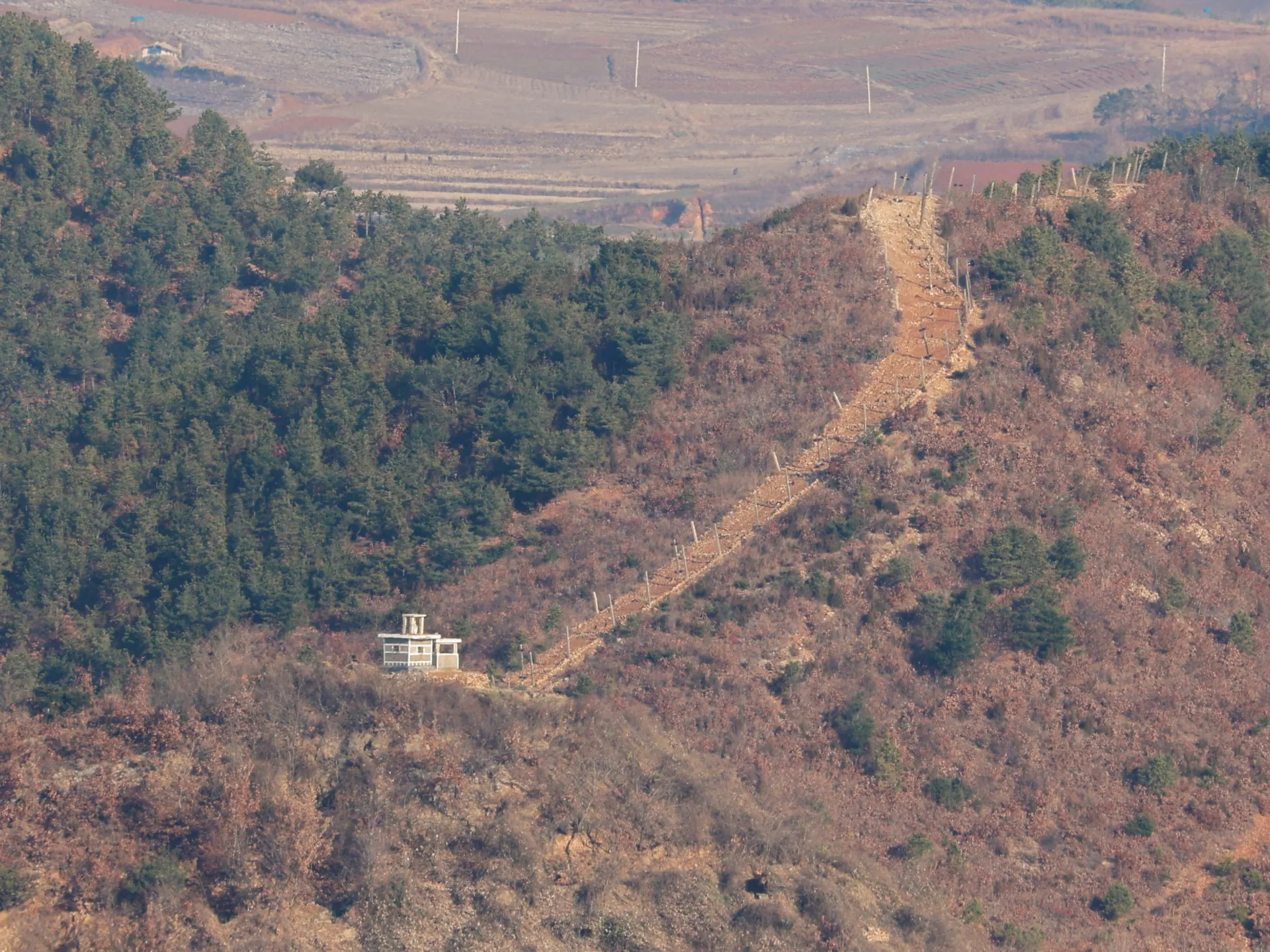
Seoul has also called on nuclear-armed North Korea to remove any other mines planted on the southern side of the military demarcation line (MDL) that runs through the DMZ, the heavily fortified frontier that has divided the Korean Peninsula since the 1953 Armistice Agreement.
Pyongyang has denied responsibility for the September 21 blast, with Kim Yo Jong, the powerful sister of North Korea’s leader, slamming the call for an apology as “despicable”.
Chung said Seoul is calling on Pyongyang to come to the table to discuss a misalignment of the MDL. Differing views of the border line are one factor contributing to tension in the area, she said.
The comments come a day after South Korea’s military carried out a mine-clearing operation south of the MDL. It pledged to continue with clearing operations in the area if Pyongyang fails to remove the remaining explosives. The United States-led UN Command (UNC) confirmed the mine placement violated the 1953 agreement.
Defence Minister Kang Shin-chul told the Yonhap news agency on Tuesday that the military’s “decisive” response was “unprecedented in history”.
“All responsibility lies with North Korea,” Kang told reporters, adding that armed forces would “respond decisively” to any actions threatening national security.
The escalation comes as Pyongyang rejected diplomatic overtures from Seoul. Unification Minister Chung Dong-young proposed on October 2 that both sides jointly resurvey the MDL, noting that only about 200 of 1,292 original boundary markers remain intact and that Seoul and the UNC differ on roughly 60 percent of border coordinates.
Kim Yo Jong rejected the proposal as a “wild dream”, declaring Pyongyang would define its sovereign boundary “by the use of force, not by means of negotiation”.
People are adopting pets over having babies, making the pet care industry grow. But why are people having fewer babies? Al Jazeera’s Yasmeen ElTahan explains.
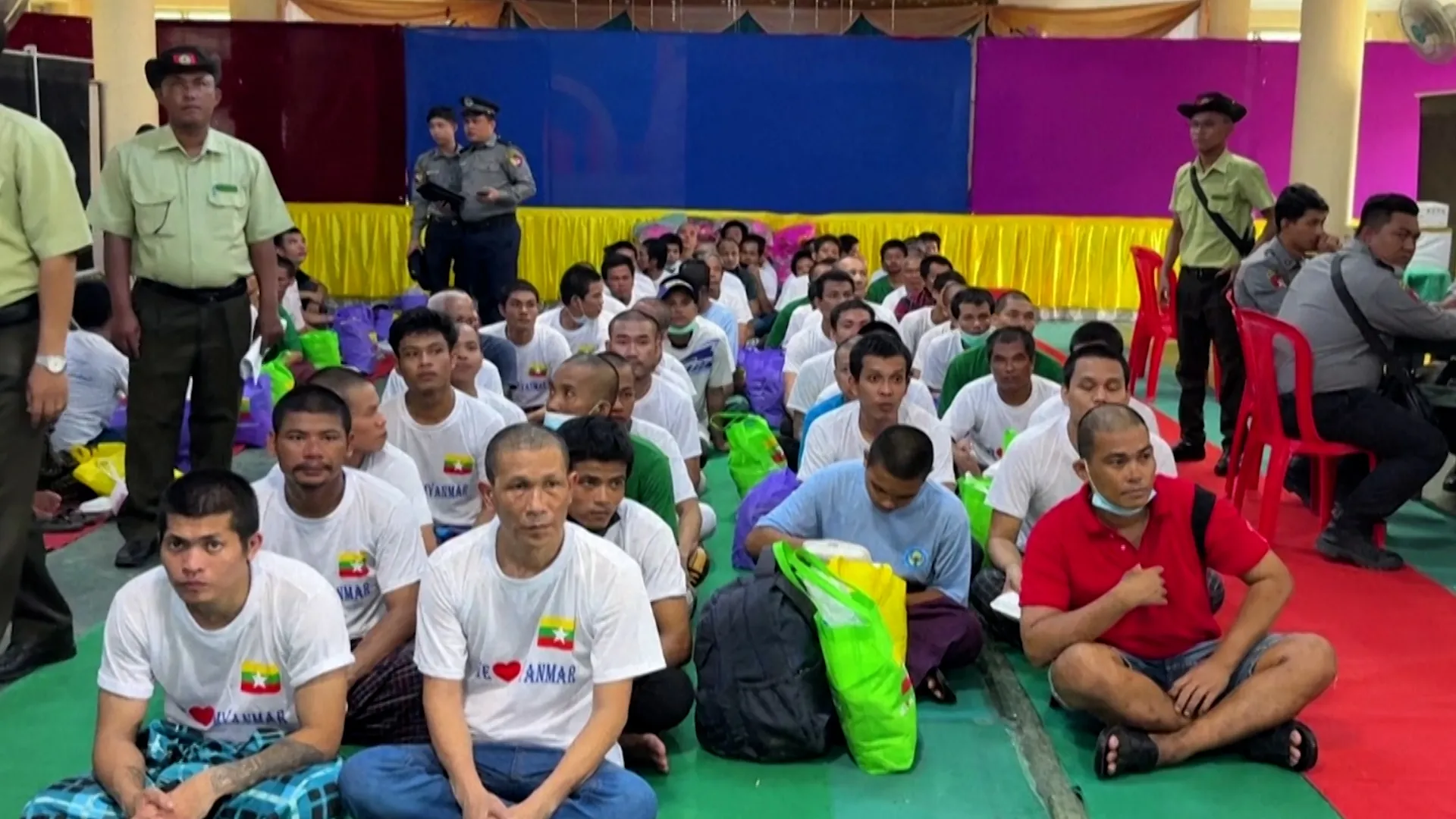
‘It’s very unfair to send us back to the place we fled from’, says Rohingya rights activist Nur Sadek. Nearly 1,500 Myanmar migrants, including Rohingya refugees, arrived in Myanmar as part of Malaysia’s repatriation push to return 5,000 migrants. The UN and rights groups say it’s unsafe for them to return.
The 20-year-old soldier denies the charge as protests held on Okinawa and in Tokyo.
Published On 5 Oct 20265 Oct 2026
Japan’s prime minister says the killing of a woman, allegedly by a US Marine stationed in Okinawa, is a “heinous crime”, and she has called on the United States to “thoroughly enforce discipline” amid growing outrage in Japan.
Sanae Takaichi told lawmakers on Monday that the government has urged the US to provide “full cooperation with the investigation” and called for “strict discipline among US military personnel”.
Recommended Stories
list of 4 itemsend of list
About 54,000 US military personnel, including 18,000 Marines, are stationed in Japan. The majority of these forces are based in Okinawa, a Japanese island that came under US administrative control at the end of World War II and was returned to Japan in 1972.
Crimes including rapes, assaults, hit-and-run and drink-driving incidents by US personnel have long sparked protests on the island.
The new case involves a 20-year-old Marine who was arrested on suspicion of killing a 39-year-old woman at a hotel in the city of Naha and stealing her wallet, police said on Sunday.
The Kyodo News agency, quoting police, reported that the woman’s body was found in a hotel room and she appeared to have been strangled.
The Marine was arrested by Japanese police on Sunday and sent to prosecutors on Monday, according to Kyodo News. He has denied the charges.
“The occurrence of such a heinous crime is extremely regrettable,” Takaichi said.
Chief Cabinet Secretary Minoru Kihara told reporters on Monday that Tokyo will “continue to urge the US side to thoroughly enforce discipline” among its soldiers in Japan.
Kihara, who is in charge of mitigating the impact of US forces in Okinawa, said Tokyo has protested to the US at “various levels”.
The incident has caused outrage across Japan, and the Japanese Ministries of Foreign Affairs and Defence have summoned the US ambassador and the commander of US forces in Japan.
According to Jiji Press, about 100 people held protests outside the Okinawa prefectural government building on Sunday and shouted: “How much longer do we have to bear all of this?”
Another 100 people participated in a rally in Naha on Sunday, Japanese media reported.
Okinawa native Sorane Sakihama, 24, who organised a similar rally in Tokyo on Sunday, said she cried upon learning about the woman’s death.
“We couldn’t protect her. That made me so angry and sad,” the university student told the AFP news agency, adding that she was planning to organise another protest in front of the US embassy on Tuesday evening.
“I want to ask them: What are these soldiers stationed here for? They might say they are here to protect lives or boost security. But how can they say that when a life was taken by one of their own?”
Since Okinawa was returned to Japan, about 6,000 US military personnel have been arrested in Japan, according to the Yomiuri Shimbun newspaper.
Drivers faced glitches at the race in Malaysia, where Lewis Hamilton had to stop and restart his car on the track.
Published On 5 Oct 20265 Oct 2026
Formula One’s governing body has promised a full investigation into a software bug that caused chaos and forced the start of the Bahrain Grand Prix in Malaysia to be aborted, with drivers feeling like they were in battery-powered cars made of Lego.
Ferrari’s seven-time world champion Lewis Hamilton and Red Bull’s four-time champion and eventual race winner Max Verstappen were among several affected by the glitch on a formation lap after torrential rain and a long delay at Malaysia’s steamy Sepang circuit on Sunday.
Recommended Stories
list of 4 itemsend of list
Verstappen compared the experience to a “Lego race” held at Silverstone before the British Grand Prix while Hamilton, the sport’s most successful driver of all time, had to stop his car on track and restart it in what he said was a career first.
The episode was the latest in a difficult first season for the new era of cars and engines, with drivers at the pinnacle of motorsport unhappy since the opening race with the power units’ increased electrical component and the need for energy management.
FIA said afterwards that “an unprecedented combination of low engine speed, low-grip conditions, wet-weather energy management settings and the Sepang circuit’s sector configuration led to an unintended loss of power for a number of cars”.
“As a result, the FIA technical department removed the energy limit constraint in the affected sectors through an updated software release distributed to all competitors during the race delay caused by heavy rain, enabling teams to make the necessary changes to the power unit before the start of the race.
“This issue had not been detected by the FIA or the teams during testing or during the laps to the grid. The FIA, together with the teams and power unit manufacturers, will undertake a full review of the issue.”
The FIA’s single-seater director Nikolas Tombazis told reporters the lack of preseason testing in wet conditions had played a part in the chaos.
“Some cars went very slowly, almost came to a standstill. There was a bit of a concertina effect between cars, and some cars almost stopped completely,” he said. “That bug prevented the power from being redeployed, and for the cars to start again.
“I think if we had had a bit more testing, we probably would have managed to catch it in time, and not have such a situation.”
Sepang was the first race weekend of the season with wet conditions, although the track dried during the race.
“Sometimes things fall through the net and people learn, and you do a better job next time,” Tombazis said.
Teenage athletes have headlined some of the biggest Asian Games triumphs, leading their countries to historic gold medals, breaking records and cementing their legacy as formidable forces in the field.
Far from being intimidated by competitors double or triple their age, these schoolchildren remained cool and unfazed as they cruised to gold at their Asian Games debut.
Recommended Stories
list of 4 itemsend of list
Many are already familiar with the pressure and expectations of the world stage and have dominated their sport all season.
Al Jazeera Sport looks at some of the stars who left their mark in Japan:
Yu Zidi, 13
China: Swimming
At just 13, Yu was named female Most Valuable Player (MVP), as she bagged three gold medals and broke as many Asian Games records in a fairytale debut.
The schoolgirl stormed to victory in the women’s 200m butterfly, 200m and 400m individual medley (IM) and had a comfortable lead over her competitors.
Her time of two minutes and 6.10 seconds (2:06.10) in the 200m IM stands as a world junior record and second-fastest time ever.
“I don’t think I am what people describe as a prodigy,” she said after being crowned MVP. “I will continue to train hard, push myself and work alongside young athletes across Asia to inspire more young people to love and take part in sports, especially swimming.”
Yu Zidi celebrates after winning the 400m Individual Medley [Atsushi Tomura/Getty Images]
Zhang Zhanshuo, 19
China: Swimming
Zhang held up seven fingers after his 400m freestyle win to count out his gold medals at the Games – the most at this edition, and more than what 27 of the 45 participating nations had in their medal tally at the conclusion of the event.
He set Games records in the 400m and 800m freestyle, an Asian record in the 200m, and helped power China to gold and Asian records in the men’s 4x100m and 4x200m freestyle relays.
But the 19-year-old has bigger victories in sight.
“The Asian Games is not the goal. I’m still aiming for the Olympics and competing with the best,” he said.
The teenager’s haul helped China sign off from swimming with 30 golds out of 41 medal events in the pool, with chief rival Japan a distant second with seven titles.
Zhang at the end of the men’s 400m freestyle [Andy Chua/Reuters]
Shin Ohashi, 17
Japan: Swimming
Ohashi broke the world record in the men’s 200m breaststroke (2:04.83) in front of a home crowd to become the first swimmer under the 2:05 mark.
The gold added to his title in the 100m breaststroke shared with China’s Dong Zhihao, bronze in the 50m breaststroke, and silver in the mixed and men’s 4x100m medley relays.
The teenager said he was surprised and honoured that Olympic champion Leon Marchand knew who he was, after the Frenchman described the 17-year-old as a “scary” prospect ahead of the 2028 Los Angeles Olympics.
“I respect him because I know just how strong he is. But if I want to win, he’s someone I know I’ll have to beat.”
Ohashi’s world record performance came just a week after the teenager recovered from COVID-19.
Shin Ohashi broke the world record in men’s 200m breaststroke [Atsushi Tomura/Getty Images]
Yan Ziyi, 18
China: Athletics
Yan was already javelin world number one and Asian record holder when she stepped onto the field for her Games debut – her first and only throw of 70.46 metres was enough for gold and a Games record.
It was the sixth-best of all time and well ahead of Olympic champion and home hero Haruka Kitaguchi’s 62.70m.
Yan is closing in on the world record of 72.28m set by Barbora Spotakova in 2008. In May, she hurled a world-leading, record-breaking 71.74m to open an unprecedented season.
Yan during the women’s javelin throw final [Mohd Rasfan/AFP]
Chen Yujie, 17
China: Athletics
Chen stormed to a new Games record in the women’s 100m en route to her first gold as she announced herself as the new sprint queen in Asia.
“I have no limits,” was her response when asked how much faster she hopes to run.
She followed up her podium finish with a silver in the 200m and gold in the women’s and mixed 4x100m relays.
Chen celebrates after winning the women’s 100m final [Mohd Rasfan/AFP]
Taiju Goto, 17
Japan: Athletics
Goto narrowly missed gold in the men’s 400m hurdles, but his 47.93s was enough for a world under-18 best time, Asian under-20 best time, and a new personal best.
The teen star has run sub-50 seconds eight times this season alone, an impressive feat for a 17-year-old. His Asian Games silver added to the World Under-20 one he bagged in August.
Bassem Hemeida of Qatar crosses the finish line to win the gold medal ahead of Japan’s Taiju Goto in the men’s 400m hurdles final [Yong Teck Lim/Getty Images]
Kumkum Mohod, 17
India: Archery
Mohod scripted history for India when she became the first Indian to win an individual recurve archery gold at the Games. The 17-year-old helped India to gold in the women’s team recurve, and partnered with Dhiraj Bommadevara for mixed team silver.
Mohod’s gold was no stroke of luck; she defeated South Korea’s reigning world champion and Olympic medallist Kang Chaeyoung in the quarterfinals before dominating China’s Zhu Jingyi in the semifinals.
“Ever since I’ve made it to the national team, I’ve been visualising this moment. I had visualised shooting an X, and that is exactly what happened,” she told reporters after the match, according to Indian media.
Kumkum Anil Mohod [Anushree Fadnavis/Reuters]
Anahat Singh, 18
India: Squash
World junior champion Anahat Singh has been India’s finest in the sport for several years now. Despite only being 18, Aichi-Nagoya was Singh’s second Asian Games outing after competing at Hangzhou 2023, where she won two bronze medals in the mixed doubles and women’s team events.
This time round, she won a silver in the women’s singles against world number five Sivasangari Subramaniam of Malaysia. However, her semifinal match against Japan’s Satomi Watanabe was what she called the “best win” of her career after producing a stellar comeback to defeat the world number six.
India’s Anahat Singh in action during the women’s singles gold medal match [Chalinee Thirasupa/Reuters]
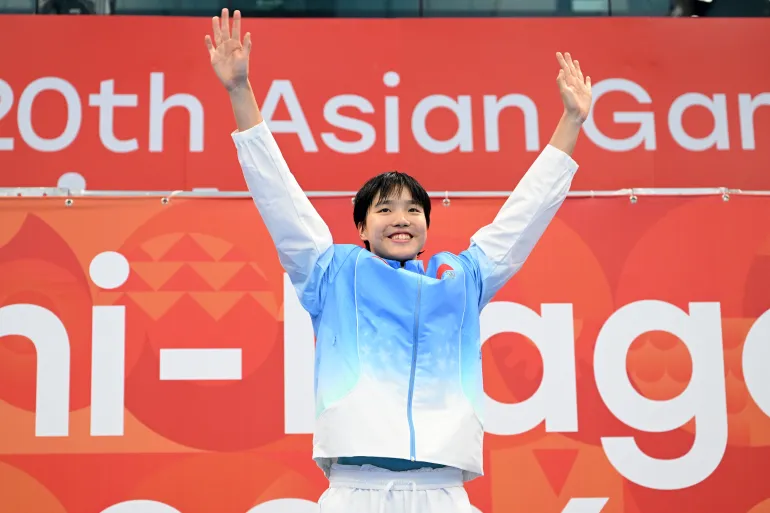
Yuki Kurihara, 11
Japan: e-sports
At just 11 years of age, e-sports prodigy Kurihara became the youngest gold medallist in Asian Games history when he won Puyo Puyo Champions.
“I’m really happy. The gold medal is really beautiful, shiny and heavy,” Kurihara said after his final, where he barely broke a sweat.
Kurihara started playing Puyo Puyo in his first year of primary school – where he still studies – and soon started competing and winning in tournaments. He obtained his pro licence in April this year and regularly beats adults, often triple his age.
Yuki Kurihara of Japan poses on the podium [Toru Hanai/Getty Images]
Ku Yong-yan, 12
Taipei: Skateboarding
Ku took silver in the men’s skateboarding park with 87.33 points, and was just one of several teenagers – in his case, a pre-teen – who medalled in skateboarding at the Games.
Japan’s Izuru Nagahara, 15, took gold in the event. China’s Zhu Yuanling, also 15, won gold in the women’s street skateboarding competition.
China’s Cao Shiqi finished fourth in women’s skateboarding park and was the youngest athlete in China’s delegation at the Games.
Ku Yong-yan in action during the men’s park final [Andrew Couldridge/Reuters]
Novak Djokovic to face Daniil Medvedev in the semifinals in Beijing after the Russian defeats Francisco Cerundolo.
Published On 5 Oct 20265 Oct 2026
Novak Djokovic has brushed aside ongoing injury-related struggles and produced a trademark comeback to defeat top seed Alexander Zverev 4-6, 6-4, 6-4 for a place in the China Open semifinals, extending his unbeaten record in the tournament.
Playing the ATP 500 event in Beijing for the first time since 2015, the six-time champion was pushed to the limit by reigning French Open and US Open champion Zverev, who delivered 19 aces in the match on Sunday.
Recommended Stories
list of 4 itemsend of list
Meeting for the first time in nearly 16 months, Djokovic struggled to contain the German’s power in the early stages as the 29-year-old Zverev claimed the opening set, but the Serb gradually worked his way into the match and refused to let his opponent pull away.
“I had a terrible start – two double faults at the beginning. It was quite cold, and honestly, I didn’t feel warmed up, but my fault,” Djokovic said.
“I gave him an early break, and then it was hard to come back in the first set.”
The contest was briefly interrupted by a moment of controversy when Zverev argued that the electronic advertising signage had gone dark during a rally and requested a video review after losing the point.
Replays showed a section of the signage had switched off although not as Zverev was missing the forehand. The chair umpire ordered the point to be replayed, prompting a frustrated exchange from Djokovic.
Zverev had a strong start in the match before being outplayed by Djokovic [Pedro Pardo/AFP]
‘Held my nerves’
The turning point came late in the second set when Djokovic broke at 5-4 to level the match, shifting the momentum in his favour after a tightly contested battle.
With little separating the pair in the third, the Serbian struck again at 5-4 on the Zverev serve, securing the decisive break to seal the victory in two hours and 35 minutes.
“I was trying to be aggressive and come to the net and change up the pace, not giving the same pattern,” Djokovic said.
“I am just glad that I held my nerves, played good shots at important moments, 5-4 in the second and third.”
The pair had not met since Roland Garros in 2025, where Djokovic won in four sets, and Sunday’s encounter again highlighted the Serb’s ability to deliver under pressure despite a season disrupted by physical issues.
With the victory, Djokovic moved a step closer to a seventh China Open title and an elusive first trophy of the year while denying Zverev another opportunity to strengthen his bid for the world number one ranking.
Djokovic will face Daniil Medvedev in the semifinals after the Russian defeated Francisco Cerundolo 7-6(4), 6-3 earlier.
Djokovic has been plagued by health issues that he has not disclosed, admitting that ‘this year has been a big, big struggle for me’ [AFP]
Rybakina withdraws from Wuhan after China Open exit
World number one Elena Rybakina withdrew from this month’s Wuhan Open due to a foot injury, tournament organisers said on Sunday, a day after the Kazakh suffered a shock defeat in her opening match at the China Open.
Rybakina, who lost to world number 118 Alina Charaeva in Beijing, said she would take time away from competition to recover.
“I’m very sorry to the fans who were looking forward to seeing me play,” Rybakina said in a story posted on the tournament’s Instagram account.
“I’ll take some time to rest and recover. Thank you for your understanding and continued support.”
The 27-year-old has been managing a lingering lower leg and foot problem that also forced her to retire from her Cincinnati quarterfinal against Iga Swiatek in August.
Despite the setback, Rybakina recovered in time for the US Open, where she claimed her third Grand Slam title, rose to world number one and became the first player to qualify for the season-ending WTA Finals.
Rybakina is next expected to compete this month in the Ningbo Open in China, where she will try to defend her title.
The Wuhan Open is scheduled to take place from October 12 to 18.
Australian police and intelligence join the list of those probing the incident.
Published On 4 Oct 20264 Oct 2026
Authorities have said they are investigating the links of the co-pilot of the Israel-bound Flydubai flight with Australia.
A multi-agency Australian police and intelligence team – the Victorian Joint Counter Terrorism Team – is carrying out the probe, a spokesperson said on Sunday.
Recommended Stories
list of 3 itemsend of list
Mystery surrounds the co-pilot, who is accused of attacking the captain with an axe and attempting to seize control of Flight FZ1073 from Dubai as it approached Israel, and how he was able to acquire his seat in the plane’s cockpit.
He had been barred from flying in his own country because of concerns that he had adopted “extremist” views, The Associated Press news agency cited sources as saying.
While al-Hammami reportedly spent part of his life in the United Arab Emirates, the Reuters news agency, citing sources briefed on the Australian investigation, reported that he studied at a university in the Australian city of Melbourne.
A third unnamed source told the agency that he studied at RMIT University, a public research university in Melbourne, about a decade ago.
The Financial Times also reported al-Hammami’s links to Australia. Citing two sources familiar with the Australian investigation, the FT said al-Hammami had allegedly visited what it described as “radical mosques and extremist websites” while in the country.
Disaster was averted after passengers and crew subdued the co-pilot and a reserve pilot took over its controls and completed an emergency landing in Saudi Arabia.
However, the case has raised questions about security in Israel, which has some of the world’s strictest aviation security measures.
The prosecutor general of the UAE, Hamad Saif al-Shamsi, has labelled the attack an attempted “terrorist act”.
Israeli Prime Minister Benjamin Netanyahu has said that Israel has longstanding arrangements with foreign airlines aimed at preventing pilots who are nationals of countries without diplomatic relations with Israel from flying there.
Netanyahu said a “loophole” appears to have allowed the Omani pilot to take part in the Flydubai flight, and that Israel would now strengthen its checks.
The UAE has not yet publicly established a motive or announced whether investigators believe al-Hammami acted alone.
UAE presidential adviser Anwar Gargash said on Saturday that the latest “terrorist” attack is a new warning that the region’s fight against “extremism” is not over.
Security threats prompt US and Australia to suspend diplomatic operations in Brazil before pivotal election day.
Published On 3 Oct 20263 Oct 2026
The United States has suspended consular services in Brazil, prompting Australia to close its embassy in the Brazilian capital, two days before Brazil’s presidential election on Sunday.
In a statement released on Thursday, the US embassy said it would suspend consular services starting on Friday and advised American citizens seeking assistance not to visit its embassy, consulates or other diplomatic facilities.
Recommended Stories
list of 3 itemsend of list
The statement cited security concerns but gave no further detail on the nature of the threat or any link to the election.
The US State Department said it was working closely with Brazilian counterparts to address the security concerns, adding that embassies and consulates routinely issue alerts about local threats and developments.
Australia’s ambassador to Brazil, Sophie Davies, said on social media that the Australian embassy would also close on Friday, citing the US alert, and advised Australians to avoid US diplomatic facilities.
Brazil’s federal police said they carried out preventive search and seizure warrants in Sao Paulo and the Federal District, the administrative region surrounding the capital, Brasilia, as part of an investigation into suspected plans that could threaten US diplomatic facilities.
Police said the operation followed cooperation with foreign intelligence agencies, but that investigators had found no evidence corroborating the initially reported threat, nor identified any suspects linked to criminal organisations.
An investigation was continuing after the seizure of communications equipment, according to the police.
The closures came two days before the Brazilian presidential election, which pits incumbent Luiz Inacio Lula da Silva, who is seeking re-election, against Senator Flavio Bolsonaro, son of former President Jair Bolsonaro. Jair Bolsonaro is serving a 27-year sentence for attempting a coup.
If neither candidate wins more than 50 percent of the vote on Sunday, a runoff will be held on October 25.
Edinho Silva, president of Lula’s Workers’ Party, called the closures “unprecedented”, saying: “It makes no sense at all. It’s one of Trump’s ways of trying to influence Brazilian public opinion.”
Lula’s allies have pointed to US tariffs and an effort by Washington to send officials to Brazil to “discuss electoral integrity” as evidence of foreign interference.
Brazilian intelligence officials briefed French and German delegations in Brasilia this month on what they described as US and Russian interference in the race.
US President Donald Trump has publicly praised Flavio Bolsonaro, a close ally, without formally endorsing him, saying he is “watching that election very closely”.
A ballistic missile is fired from the North Korean port city of Wonsan, South Korean military says.
Published On 2 Oct 20262 Oct 2026
South Korea’s military says North Korea has fired at least one ballistic missile towards the sea off its east coast.
South Korea’s Joint Chiefs of Staff said on Saturday morning that its northern neighbour fired a ballistic missile from the port city of Wonsan on the eastern shore of the Korean Peninsula.
Recommended Stories
list of 3 itemsend of list
The South Korean military raised an alert for further launches.
Japan issued an emergency alert on Saturday, saying: “North Korea has launched a suspected ballistic missile.”
The launch came a day after Kim Yo Jong, the powerful sister of North Korean leader Kim Jong Un, ridiculed South Korean demands for the North to apologise over landmine blasts that South Korea and the US-led United Nations Command said were caused by North Korean mines planted south of the Military Demarcation Line.
The blasts seriously injured three South Korean soldiers on a reconnaissance mission inside the 4km-wide (2.5-mile) border zone that stretches across the Korean Peninsula.
South Korea has also called on the North to halt recent efforts to fortify its border, including the installation of mines and anti-tank barriers.
Kim Yo Jong dismissed Seoul’s demands as “utterly pathetic”, saying the North intends to permanently cut ties with the South.
Saturday’s launch was the latest in a series of North Korean military displays in recent weeks, including tests of a purported hypersonic missile system, live-fire exercises and the commissioning of a new warship.
Taiwan’s Coast Guard used a water cannon to drive two Chinese fishing boats away from waters near the Dongsha Islands, citing concerns over unauthorised activity and asserting Taiwan’s jurisdiction in the area.
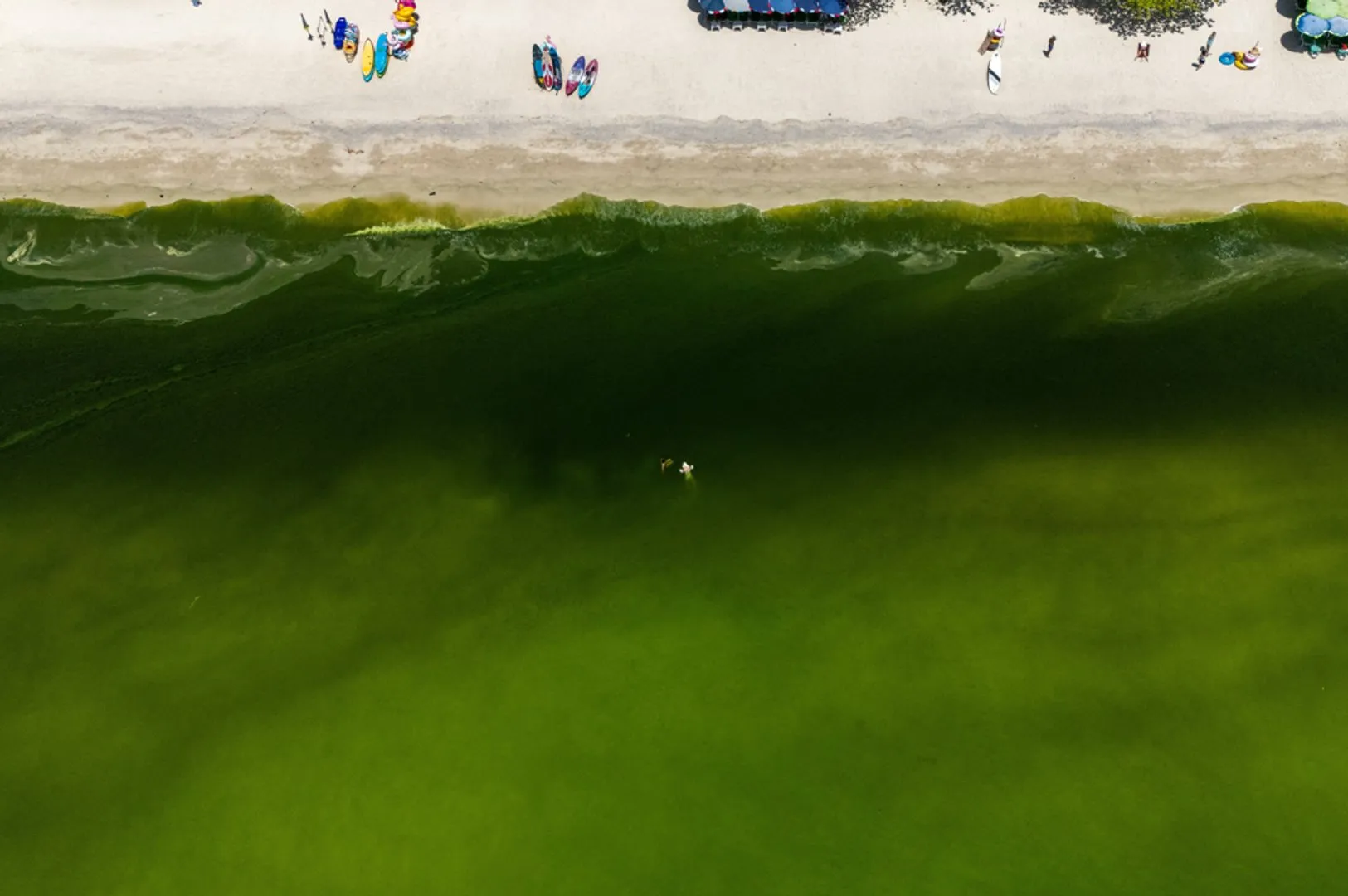
The water off Thailand’s Ko Lan island has turned a vibrant shade of green thanks to a plankton bloom, keeping many tourists out of the water. But scientists say the bigger concern may be what’s happening beneath the surface, where oxygen levels are falling.












![TOKONAME, JAPAN - SEPTEMBER 26: Gold medalist Yuki Kurihara of Japan poses on the podium at the medal ceremony for the Esports Puzzle [Puyo Puyo Champions] on day seven of the 20th Asian Games Aichi-Nagoya at Aichi Sky Expo on September 26, 2026 in Tokoname, Aichi, Japan. Kurihara becomes the youngest gold medalist at the Asian Games at the age of 11. (Photo by Toru Hanai/Getty Images)](https://i0.wp.com/www.aljazeera.com/wp-content/uploads/2026/10/getty_6ac2424a21-1791115850.jpg?w=640&ssl=1)