At least two areas of the country’s worst-affected Sumatra island are still unreachable, as authorities struggle to deliver aid.
Published On 30 Nov 202530 Nov 2025
Share
The death toll from devastating floods and landslides in Indonesia has risen to 442, according to a tally published by the national disaster agency, as desperate people hunt for food and water.
The National Disaster Management Agency (BNPB) on Sunday said 402 others were still missing as authorities raced to reach parts of hardest-hit Sumatra island, where thousands of people were stranded without critical supplies.
Recommended Stories
list of 4 itemsend of list
Another 402 people are missing in Indonesia’s three provinces of North Sumatra, West Sumatra and Aceh, according to the agency.
At least 600 people have died across Southeast Asia as heavy monsoon rains overwhelm swathes of Indonesia, Thailand and Malaysia. The deluges also triggered landslides, damaged roads, and downed communication lines.
People walk through mud and debris in Meureudu, in the Pidie Jaya district of Indonesia’s Aceh province [AFP]
The floods in Indonesia displaced thousands of people, with at least two cities on Sumatra island still unreachable on Sunday. Authorities said they deployed two warships from Jakarta to deliver aid.
“There are two cities that require full attention due to being isolated, namely Central Tapanuli and Sibolga,” BNPB head Suharyanto said in a statement.
The ships were expected in Sibolga on Monday, he said.
Desperate situation
The challenging weather conditions and the lack of heavy equipment also hampered rescue efforts.
Aid has been slow to reach the hardest-hit city of Sibolga and the Central Tapanuli district in North Sumatra.
Videos on social media show people scrambling past crumbling barricades, flooded roads and broken glass to get their hands on food, medicine and gas.
Some even waded through waist-deep floodwaters to reach damaged convenience stores.
The annual monsoon season, typically between June and September, often brings heavy rain, triggering landslides and flash floods.
A tropical storm has exacerbated conditions, and the flooding tolls in Indonesia and Thailand rank among the highest in those countries in recent years.
Climate change has affected storm patterns, including the duration and intensity of the season, leading to heavier rainfall, flash flooding and stronger wind gusts.
When fire alarms failed, this woman livestreamed her escape from the Hong Kong apartment inferno to warn other residents. The live-in nanny rescued her employer’s baby as she raced down 23 flights of stairs at the Wang Fuk Court complex, where at least 146 people lost their lives.
A huge fireball exploded at a waste facility in an Australian suburb in western Sydney, sending flames 100 metres into the sky. Authorities are investigating the fire’s cause, but say a chemical tank exploded in the blaze, sending concrete debris flying and causing damage to nearby buildings.
From deadly floods in Indonesia and Sri Lanka, to antigovernment protests in the Philippines and demonstrations in Italy to show solidarity with Gaza, here is a look at the week in photos.
Tens of thousands of anti-corruption protesters in the Philippines are calling for President Ferdinand Marcos Jr to resign. Al Jazeera’s Barnaby Lo explains the allegations from the Manila protest.
101 East investigates rampant alleged corruption in flood-control projects in one of Asia’s most typhoon-prone countries.
In the Philippines, a massive corruption scandal is triggering street protests and putting pressure on the government of Ferdinand Marcos Jr.
The population’s increasing exposure to typhoons, floods and rising sea-levels has seen the government allocate $9.5bn of taxpayer funds to more than 9,800 flood-control projects in the last three years.
But recent audits reveal widespread cases of structures being grossly incomplete or non-existent.
Multiple government officials are accused of pocketing huge kickbacks, funding lavish lifestyles.
101 East investigates how the most vulnerable are being flooded by corruption in the Philippines.
Hong Kong began a five-day mourning period on Saturday, after at least 128 people were killed in fires at a high-rise apartment complex. Officials held a three-minute silence as residents laid flowers near the towers. Authorities say around 200 people are still missing.
At least 128 people died and 200 remain missing after the towers housing 4,600 people were engulfed by flames.
Published On 29 Nov 202529 Nov 2025
Share
People in Hong Kong are mourning the deaths of at least 128 people who died in the region’s largest blaze in decades in an eight-apartment residential complex.
The flags outside the central government offices were lowered to half-mast on Saturday as Hong Kong leader John Lee, other officials and civil servants, all dressed in black, gathered to pay their respects to those lost at the Wang Fuk Court estate since the fire on Wednesday.
Recommended Stories
list of 3 itemsend of list
Condolence books have been set up at 18 points around the former British colony for the public to pay their respects, officials said.
At the site of the residential complex, families and mourners gathered to lay flowers.
By Friday, only 39 of the victims had been identified, leaving families with the morbid task of looking at the photographs of the deceased taken by rescue workers.
The number of victims could still dramatically rise as some 200 people remain missing, with authorities declaring the end of the search for survivors on Friday.
But identification work and search for remains continues, as Lee said the government is setting up a fund with 300 million Hong Kong dollars ($39m) in capital to help the residents.
The local community is also pitching in, with hundreds of volunteers mobilising to help the victims, including by distributing food and other essential items. Some of China’s biggest companies have pledged donations as well.
The Wang Fuk Court fire marks Hong Kong’s deadliest since 1948, when 176 people died in a warehouse blaze.
Officers from the Disaster Victim Identification Unit gather by the Wang Fuk Court estate [AFP]
At least 11 people have been arrested in connection with the tragedy, according to local authorities.
They include two directors and an engineering consultant of the firm identified by the government as doing maintenance on the towers for more than a year, who are accused of manslaughter for using unsafe materials.
The towers, located in the northern district of Tai Po, were undergoing renovations, with the highly flammable bamboo scaffolding and green mesh used to cover the building believed to be a major facilitator of the quick spread of the blaze.
Most of the victims were found in two towers in the complex, with seven of the eight towers suffering extensive damage, including from flammable foam boards used by the maintenance company to seal and protect windows.
The deadly incident has prompted comparisons with the blaze at the Grenfell Tower in London that killed 72 people in 2017, with the fire blamed on flammable cladding on the tower’s exterior, as well as on failings by the government and the construction industry.
“Our hearts go out to all those affected by the horrific fire in Hong Kong,” the Grenfell United survivors’ group said in a short statement on social media.
“To the families, friends and communities, we stand with you. You are not alone.”
Alexander Lukashenko’s visit comes shortly before military government holds national polls widely condemned as a sham.
Belarusian President Alexander Lukashenko has arrived in Myanmar on a goodwill visit seen as lending support to the Southeast Asian country’s military government in advance of a widely condemned national election set to be held next month.
Myanmar state media reported on Friday that Senior General Min Aung Hlaing, the country’s self-installed de facto leader, met Lukashenko at the Presidential Palace in the capital, Naypyidaw.
Recommended Stories
list of 3 itemsend of list
“This visit demonstrated Belarus’s goodwill and trust towards Myanmar and marked a historic occasion. It is the first time in 26 years of diplomatic relations that a Belarusian Head of State has visited Myanmar,” military run outlet The Global New Light of Myanmar reported.
Lukashenko’s arrival at a military airport in Naypyidaw on Thursday night saw him welcomed by senior figures from Myanmar’s military government, including Prime Minister Nyo Saw, with full state honours and cultural performers.
After former Cambodian Prime Minister Hun Sen, Lukashenko is only the second foreign leader to visit Myanmar since its military overthrew Aung San Suu Kyi’s democratically elected National League for Democracy (NLD) government in a coup on February 1, 2021.
The Belarusian leader’s visit also comes just a month before the military is set to host national elections that many domestic and international observers have condemned as a sham. His visit is widely viewed as lending support to the polls, due to be held in late December, and which the military government has touted as a return to normalcy.
Following Lukashenko’s meeting with Min Aung Hlaing on Friday, The Global New Light also confirmed that Belarus plans to “send an observation team to Myanmar” to monitor the polls.
The leaders also agreed that “collaboration will also be strengthened in military technologies and trade”, a day after the Myanmar-Belarus Development Cooperation Roadmap 2026–2028 was signed in Yangon.
Belarus state media quoted Minister of Foreign Affairs Maxim Ryzhenkov as saying that Myanmar has “significant potential in various industrial sectors”, while Belarus has “expertise and modern technologies in mechanical engineering”.
“Myanmar plans to mechanise its agriculture, and we in Belarus produce a complete lineup of machinery and equipment. As our president says, no topics are off limits for our cooperation,” Ryzhenkov said.
Belarus’s government is widely regarded as authoritarian, with Lukashenko serving as the former Soviet state’s first and only president since the office was established in 1994.
Along with major backers China and Russia, Belarus is one of the very few countries that have continued to engage with Myanmar’s military leaders since the coup.
A popular protest movement in the immediate aftermath of the coup has since morphed into a years-long civil war, further weakening the Myanmar military’s control over the fractured country, where ethnic armed groups have fought decades-long wars for independence.
Preparing for the polls, military government census takers in late 2024 were only able to count populations in 145 of Myanmar’s 330 townships – indicating the military now controls less than half the country.
Other recent estimates place the military’s control as low as 21 percent of the country’s territory. Ethnic armed groups and the anti-regime People’s Defence Force – which have pledged to boycott and violently disrupt the upcoming polls – control approximately double that amount of territory.
Amid geographic limitations and raging violence, as well as the Myanmar military’s March 2023 dissolution of Aung San Suu Kyi’s hugely popular NLD, critics have pointed to the absurdity of holding elections in such circumstances.
Preparing for the polls, military leaders carried out a mass amnesty on Thursday, pardoning or dropping charges against 8,665 people imprisoned for opposing army governance.
Authorities say 79 people remain missing and thousands of families have been displaced from their homes across Sumatra.
The death toll from floods and landslides on the western Indonesian island of Sumatra this week has risen to 174, a disaster official said, with about 80 more people still missing, as a punishing tropical storm system and heavy monsoon rains have battered the region.
“As of this afternoon, we have recorded that for the entire North Sumatra province, there have been 116 deaths and 42 people are still being searched for,” National Disaster Mitigation Agency (BNPB) chief Suharyanto announced on Friday.
Recommended Stories
list of 3 itemsend of list
He said another 35 were killed in the island’s Aceh province and another 23 in West Sumatra.
While the rain had stopped, 79 people were still missing and thousands of families were displaced, he added.
Residents in Sumatra’s Padang Pariaman region, where a total of 22 people died, had to cope with water levels at least 1 metre (3.3ft) high, and had still not been reached by search and rescue personnel on Friday.
In the town of Batang Toru, in northern Sumatra, residents on Friday buried seven unclaimed victims in a mass grave. The decomposing bodies, wrapped in black plastic, were lifted from the back of a truck onto a wide plot of land as onlookers covered their noses.
Communications remained down in some parts of the island, and authorities were working to restore power and clear roads blocked by landslide debris, said Abdul Muhari, spokesman for Indonesia’s national disaster mitigation agency.
Indonesia would continue to airlift aid and rescue personnel into stricken areas on Friday, he added.
In Indonesia’s West Sumatra province, 53-year-old Misniati described a terrifying battle against rising floodwaters to reach her husband at home.
She said that, returning from early morning prayers at a mosque, “I noticed the street was flooded.
“I tried to run back to my house to tell my husband, and the water was already reaching my waist,” she told the AFP news agency, adding that it was up to her chest by the time she reached home.
This aerial picture shows a bridge damaged by flash floods on a main road connecting Aceh and North Sumatra in Meureudu, Pidie Jaya district of Indonesia’s Aceh province on Friday [Chaideer Mahyuddin/AFP]
Flooding disasters elsewhere in Asia
Meanwhile, in Thailand, the government said 145 people had been killed by floods across eight southern provinces. It said a total of more than 3.5 million people had been affected.
In the southern city of Hat Yai, the hardest-hit part of Thailand, the rain had finally stopped on Friday, but residents were still ankle-deep in floodwaters, and many remained without electricity as they assessed the damage to their property over the last week.
Some residents said they were spared the worst of the floods but were still suffering from their effects.
In neighbouring Malaysia, where two people have been confirmed dead, tropical storm Senyar made landfall at about midnight and has since weakened.
Meteorological authorities are still bracing themselves for heavy rain and wind, and warned that rough seas could pose risks for small boats.
A total of 30,000 evacuees remain in shelters, down from more than 34,000 on Thursday.
Malaysia’s Ministry of Foreign Affairs said on Friday that it had already evacuated 1,459 Malaysian nationals stranded in more than 25 flood-hit hotels in Thailand, adding that it would work to rescue the remaining 300 still caught up in flood zones.
Takaichi’s suggestion earlier this month that Tokyo could intervene militarily if Taiwan is attacked has enraged Beijing.
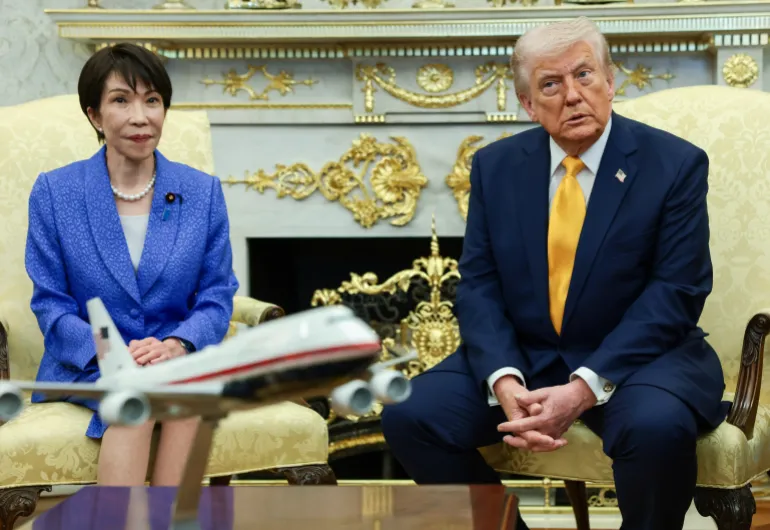
Japan has denied a report that said United States President Donald Trump had advised Prime Minister Sanae Takaichi not to provoke China over Taiwan’s sovereignty.
In a news briefing on Thursday, Japan’s top government spokesperson Minoru Kihara said “there is no such fact” about an article published in The Wall Street Journal claiming that Trump had made such a remark to the Japanese leader.
Recommended Stories
list of 3 itemsend of list
He declined to comment further on the details of the “diplomatic exchange”.
The row between Asia’s two biggest economies began after Takaichi had suggested earlier this month that Tokyo could intervene militarily in any attack on self-ruled Taiwan, which China claims as part of its territory.
Takaichi’s remark ignited anger in Beijing.
After the incident, Beijing’s Foreign Ministry said that Chinese leader Xi Jinping pressed the issue in a phone call with Trump on Monday, saying Taiwan’s return was an “integral part of the post-war international order”.
The WSJ reported on Thursday that, shortly after that phone call between the US and Chinese leaders, “Trump set up a call with Takaichi and advised her not to provoke Beijing on the question of the island’s sovereignty”. The report quoted unidentified Japanese officials and an American briefed on the call.
Takaichi said in her reporting of the call with Trump that they discussed the US president’s conversation with Xi, as well as bilateral relations.
“President Trump said we are very close friends, and he offered that I should feel free to call him anytime,” she said.
It summoned Tokyo’s ambassador and advised Chinese citizens against travelling to Japan.
As the diplomatic row escalated, the Chinese embassy in Tokyo issued a new warning to its citizens on Wednesday, saying there had been a surge in crime in Japan, and that Chinese citizens had reported “being insulted, beaten and injured for no reason”.
Japan’s Foreign Ministry denied any increase in crime, citing figures from the National Police Agency in response that showed the number of murders from January to October had halved compared with the same period in 2024.
Last week, Japanese media reported that China will again ban all imports of Japanese seafood as the diplomatic dispute between the two countries escalated.
Chinese Foreign Ministry spokesperson Guo Jiakun reiterated on Thursday a call for Japan to officially retract Takaichi’s comments.
“The Japanese side’s attempt to downplay, dodge, and cover up Prime Minister Takaichi’s seriously erroneous remarks by not raising them again is self-deception,” Guo told a regular news briefing.
Some officials worry that Trump may be prepared to soften support for Taiwan in pursuit of a trade accord with China, a move they fear will embolden Beijing and cause conflict in an increasingly militarised East Asia.
“For Trump, what matters most is US-China relations,” said Kazuhiro Maejima, a professor of US politics at Sophia University.
“Japan has always been treated as a tool or a card to manage that relationship,” Maejima told Reuters news agency.
Washington’s envoy to Tokyo has said the US supports Japan in the face of China’s “coercion”, but two senior ruling party lawmakers said they had hoped for more full-throated support from their top security ally in Washington, DC.
Bamboo scaffolding, a centuries-old technique that was traditionally ubiquitous in Hong Kong, is under scrutiny for its role in the city’s deadliest fire in more than a century.
At least 55 people have died, and hundreds are still missing since scaffolding at a housing estate in Tai Po district caught fire on Wednesday, according to the latest government figures.
Recommended Stories
list of 4 itemsend of list
Bamboo is cheap, lightweight, and strong enough to withstand the city’s many typhoons and tropical storms. Hundreds of bamboo poles can often be seen lashed together on the side of a modern office tower.
But could one of Hong Kong’s iconic symbols also have served as the kindling for one of its most horrific tragedies in decades?
How is bamboo scaffolding used?
Buildings or housing estates – like the one in Tai Po district – encased in bamboo during significant renovation projects are not a rare sight in the city-state. Sometimes, the scaffolding can remain up for a year or more.
Bamboo scaffolding is built by speciality workers known as “spiders”. They lash together bamboo poles to build intricate grid-like scaffolding that is then typically covered in additional netting to catch construction materials.
While the use of bamboo has faded in other parts of Asia, it has been hard to replace it completely in Hong Kong, even with options such as metal scaffolding, said experts.
“It’s light, cheap and fast to build with,” Ehsan Noroozinejad, a senior researcher and construction expert at Western Sydney University, Australia, told Al Jazeera. “Crews carry poles by hand, cut them on site, and wrap awkward facades without cranes. That speed and flexibility keep projects moving and costs down.”
Because it is “light and easy to cut”, bamboo scaffolding also fits the narrow living environment of Hong Kong, said Xinyan Huang, deputy director of the Research Centre for Fire Safety Engineering at Hong Kong Polytechnic University.
But there are other reasons, too, why bamboo is hard to replace.
“It [Hong Kong] has a long history, so it is a tradition, and it is not easy to change tradition,” Huang told Al Jazeera by email. “Any change in the construction industry will meet much resistance from current players.”
There are 4,000 bamboo scaffolding workers in the city, Hong Kong Free Press reported, citing union figures, although the industry is on the decline thanks to increased competition from metal scaffolding and an ageing cohort of workers.
A worker builds bamboo scaffolding in Hong Kong [File: Jerome Favre/EPA]
Is bamboo scaffolding dangerous?
Prior to the fire, most concerns around bamboo scaffolding have focused on worker safety.
There were 22 fatal workplace accidents involving bamboo scaffolding in Hong Kong between 2018 and 2024, according to government figures. Six accidents occurred while new scaffolding was being built, while the rest took place during repairs.
Besides the fact that bamboo is by its very nature combustible, it is also structurally weaker and less stable than steel, according to Huang. He told Al Jazeera that it should be phased out for larger projects.
“I think the bamboo scaffolding can be used for small-scale applications, such as installing an air conditioning unit and replacing a window of a room. However, the large-scale usage such as covering the entire building facade should be stopped. Perhaps, a maximum area of bamboo scaffolding can be defined in future regulation,” he said.
Workers set up bamboo scaffolding in preparation for removing the neon signs of a pawn shop in Sham Shui Po district in Hong Kong [File: Anthony Kwan/Getty Images]
What role did bamboo scaffolding play in the Tai Po fire?
The fire is the deadliest in Hong Kong in more than a century, since a blaze in 1918 at the Happy Valley Racecourse in British Hong Kong led to the deaths of more than 600 people.
Bamboo scaffolding played a big role in spreading the fire, according to experts like Anwar Orabi, a lecturer in fire safety engineering at the University of Queensland, although it was helped by other materials in the estate.
The fire broke out on the scaffolding of one of the estate’s towers on Wednesday, but the speed with which the fire spread took many observers by surprise. Orabi said the design of the scaffolding made it difficult to keep the blaze limited to just a few floors.
“In my point of view, the scaffolding presented a path for the fire to spread vertically which compromised compartmentation. The fire ‘climbed’ the scaffolding, and ignited the multiple fuel sources in people’s homes,” he told Al Jazeera by email.
“Fire can break windows by imposing a strong heat flux [flow of heat] which heats up the glass and breaks it. It is also possible that many people left their windows open resulting in ingress of the fire. This resulted in a multi-storey fire,” he said. Heat radiation and embers from one building helped spread the fire to the next, he said, ultimately engulfing seven towers.
Hong Kong officials also say substandard construction materials were another contributing factor. The South China Morning Post reported that the netting placed over the scaffolding did not adhere to the fire code, citing local officials.
Senior police superintendent Eileen Chung said highly flammable Styrofoam boards had also been placed in windows in the housing estate’s lifts, public broadcaster RTHK reported, helping the fire spread.
Two directors and one engineering consultant from the company behind the construction have been detained, Chung confirmed.
Hong Kong’s leader, John Lee Ka-chiu, has promised that all housing estates undergoing significant improvements will now be inspected.
“The government has immediately arranged for inspections of all housing estates across the city undergoing major repairs, to examine the safety of scaffolding and building materials,” he wrote on Facebook.
Up to 8,000 people across North Sumatra have been evacuated and roads remain blocked by landslide debris.
Floods and landslides brought about by torrential rain in Indonesia’s North Sumatra province have killed at least 34 people, authorities said, with rescue efforts hampered by what an official described as a “total cutoff” of roads and communications.
North Sumatra regional police spokesman Ferry Walintukan told Detik news website that aside from the confirmed deaths, at least 52 people remain missing as of Thursday.
Recommended Stories
list of 3 itemsend of list
A rare tropical cyclone blew across Indonesia’s Sumatra island, inundating the nearby Malacca Strait and causing floods and landslides, the country’s meteorological agency said on Wednesday, as large swaths of Southeast Asia grappled with deadly flooding.
Up to 8,000 people across North Sumatra have been evacuated, and roads remain blocked by landslide debris, with aid now being distributed via helicopters, Abdul Muhari, spokesperson for the country’s disaster mitigation agency, said on Thursday.
The regions of Sibolga and Central Tapanuli were among the hardest hit, Yuyun Karseno, an official at the agency’s North Sumatra division, told the Reuters news agency, adding that communications and power had been cut off.
“There is no more access, due to a total cutoff,” Yuyun said when asked about the rescue efforts. “Until now, we can’t communicate with folks in Sibolga and Central Tapanuli.”
Among the dead were one family in Central Tapanuli, Indonesia’s search and rescue agency said.
A video shared by radio channel Elshinta on its social media account showed a person carrying a baby in a plastic container on a roof in Central Tapanuli.
A man carries his child as he wades through floodwaters following heavy rain in a residential area of Darul Imarah on the outskirts of Banda Aceh on November 27, 2025 [Chaideer Mahyuddin/AFP]
Footage and photos shared by the agency show rapid currents of water overflowing across the region, leaving buildings destroyed in their wake, with rescuers using orange rafts to visit the flooded homes of residents.
Flooding and landslides also affected the provinces of West Sumatra and Aceh, authorities said. Indonesia’s official news agency Antara reported that 10 of the 23 cities and districts in Aceh have been submerged.
More flooding is expected in several other Sumatran provinces, including Aceh and Riau, over the next two days, the meteorological agency said, citing extreme weather.
On Thursday morning, a magnitude 6.6 earthquake hit the island of Simeulue off the coast of Sumatra in western Indonesia, according to the United States Geological Survey.
The quake, which struck Simeulue Island at 11:56am (04:56 GMT) at a depth of 25km (15.5 miles), prompted rain-soaked residents to rush outside. There were no immediate reports on casualties or a possible tsunami.
Meanwhile, more than 30 people were killed by floods in Thailand and Malaysia in recent days, with water levels high enough to submerge hospitals.
In Sri Lanka, floods and landslides triggered by heavy rains killed at least 31 people this week, with 14 others missing, authorities said on Thursday.
Arrest warrant issued for missing Thai mogul Anne Jakkaphong Jakrajutatip, as co-owner investigated in Mexico.
Published On 27 Nov 202527 Nov 2025
Share
The Miss Universe competition has been overshadowed by legal drama as its owners face charges of fraud in Thailand and an investigation into drugs and weapons trafficking in Mexico just days after the latest pageant concluded.
The Miss Universe Pageant, which once belonged to United States President Donald Trump, has been owned by Thai mogul Anne Jakkaphong Jakrajutatip and her company, JKN Global, since 2022.
Recommended Stories
list of 4 itemsend of list
Jakrajutatip is wanted in Thailand after she failed to attend a Bangkok court hearing this week over a 30 million baht ($930,000) legal dispute with an investor in JKN Global. The Bangkok South District Court said on Wednesday that it had issued an arrest warrant for Jakrajutatip, whose current whereabouts are unknown, according to Thai media.
Jakrajutatip and JKN Global have been facing major balance sheet problems since 2023, when the company began to default on payments to investors, according to the Associated Press news agency. The company filed for rehabilitation with a Thai bankruptcy court in 2024, and reportedly owes about3 billion baht ($92.63m), according to the Associated Press.
Earlier this year, Jakrajutatip and JKN Global were sanctioned by Thailand’s Securities and Exchange Commission (SEC) for publishing “false or misleading information” in the company’s financial statement, and were fined 4 million baht ($124,000).
The SEC statement said JKN Global did not fully disclose to investors that it signed an October 2023 agreement to sell 50 percent of its shares in the Miss Universe Pageant to Mexican businessman Raúl Rocha Cantu and his company, Legacy Holding Group USA Inc.
Jakrajutatip resigned from all positions in the company, but she is still a shareholder following the sanction, according to AP. She also did not attend the latest Miss Universe competition in Bangkok earlier this month.
Cantu is facing separate legal troubles in Mexico, where prosecutors said on Wednesday that he was under investigation for alleged arms, drug and fuel trafficking between Mexico and Guatemala, according to the AFP news agency.
Prosecutors charged 13 people in connection with the case, although Cantu has not been formally named yet, the AFP said.
The Miss Universe Pageant concluded on November 21 following a series of scandals throughout the competition season, including allegations that the competition was rigged.
Three websites used to create abuse imagery had received 100,000 monthly visits from Australians, watchdog says.
Published On 27 Nov 202527 Nov 2025
Share
Internet users in Australia have been blocked from accessing several websites that used artificial intelligence to create child sexual exploitation material, the country’s internet regulator has announced.
The three “nudify” sites withdrew from Australia following an official warning, eSafety Commissioner Julie Inman Grant said on Thursday.
Recommended Stories
list of 4 itemsend of list
Grant’s office said the sites had been receiving approximately 100,000 visits a month from Australians and featured in high-profile cases of AI-generated child sex abuse imagery involving Australian school students.
Grant said such “nudify” services, which allow users to make images of real people appear naked using AI, have had a “devastating” effect in Australian schools.
“We took enforcement action in September because this provider failed to put in safeguards to prevent its services being used to create child sexual exploitation material and were even marketing features like undressing ‘any girl,’ and with options for ‘schoolgirl’ image generation and features such as ‘sex mode,’” Grand said in a statement.
The development comes after Grant’s office issued a formal warning to the United Kingdom-based company behind the sites in September, threatening civil penalties of up to 49.5 million Australian dollars ($32.2m) if it did not introduce safeguards to prevent image-based abuse.
Grant said Hugging Face, a hosting platform for AI models, had separately also taken steps to comply with Australian law, including changing its terms of service to require account holders to take steps to minimise the risks of misuse involving their platforms.
Australia has been at the forefront of global efforts to prevent the online harm of children, banning social media for under-16s and cracking down on apps used for stalking and creating deepfake images.
The use of AI to create non-consensual sexually explicit images has been a growing concern amid the rapid proliferation of platforms capable of creating photo-realistic material at the click of a mouse.
In a survey carried out by the US-based advocacy group Thorn last year, 10 percent of respondents aged 13-20 reported knowing someone who had deepfake nude imagery created of them, while 6 percent said they had been a direct victim of such abuse.
At least 44 people have died after Hong Kong’s worst fire in 63 years tore through several high-rise buildings on Wednesday afternoon, officials said.
Firefighters are still fighting the blaze in the Tai Po neighbourhood, and trying to reach people who are trapped inside.
By early Thursday morning, officials said they had brought the fire in four buildings under control, but firefighters were still working on three others more than 16 hours after the blaze started.
Here is what to know:
What happened in Hong Kong?
An apartment complex in Hong Kong’s Tai Po neighbourhood caught fire at about 2:51pm (06:51 GMT) local time on Wednesday.
The fire began on the bamboo scaffolding outside one of the buildings. This type of scaffolding, made from bamboo poles used by workers during repairs, burns very easily. Once the scaffolding caught fire, the flames quickly spread up the structure and into the building, and then to nearby towers.
The blocks were also wrapped in green construction netting all the way to the rooftops due to ongoing renovation work, which also caught fire, helping it spread faster.
According to local media, the fire intensified rapidly: By 3:34pm (07:34 GMT), it had reached a level four alarm, and by 6:22pm (10:22 GMT), it had reached a level five alarm – the highest alert level in Hong Kong.
The blaze is Hong Kong’s deadliest fire since at least August 1962, when a fire in the city’s Sham Shui Po district killed 44 people. A fire at the Garley Building on Nathan Road in Kowloon killed 41 people and injured 81 others in November 1996.
Since Monday, Hong Kong has been under a heightened fire alert as dry weather conditions made the risk of fire extremely high.
Smoke rises while flames burn bamboo scaffolding on a building at Wang Fuk Court housing estate [Tyrone Siu/Reuters]
Where did the fire start?
The fire started at Wang Fuk Court, a housing estate in Hong Kong’s Tai Po district.
The complex, built in 1983, consists of eight high-rise buildings with a total of 1,984 flats. According to local media reports, seven of the buildings were affected by the fire. Of those, four have since been brought under control.
Tai Po is a suburb of Hong Kong near the border with mainland China, and is home to approximately 300,000 residents. It is part of the government’s subsidised home-ownership scheme.
Property records show that Wang Fuk Court has been undergoing major renovation work, costing about $42.43m.
Wang Fuk Court housing estate, in Tai Po, Hong Kong, November 26, 2025 [Tyrone Siu/Reuters]
How did the fire spread so quickly, and what caused it?
The fire spread very quickly because it started on the bamboo scaffolding around the building and spread to the green netting covering the structures.
Both the bamboo and the green netting burn easily, so once they caught fire, the flames shot up the outside of the tower and reached many floors.
Burning pieces then fell and set nearby buildings on fire within minutes. Wind and open areas from the renovation work likely made the flames grow even faster.
While the exact cause is still being investigated, officials say the flammable scaffolding, building materials, and the tall, closely packed towers all helped the fire get out of control.
A drone view shows flames and thick smoke rising from the Wang Fuk Court housing estate [Tyrone Siu/Reuters]
Police also said they found mesh and other protective materials on the outside of the buildings that did not appear to be fireproof, as well as styrofoam materials on the windows.
“We have reason to believe that those in charge at the company were grossly negligent, which led to this accident and caused the fire to spread uncontrollably, resulting in major casualties,” Eileen Chung, senior superintendent at the Hong Kong Police Force, said.
Officers have arrested two directors and an engineering consultant, aged between 52 and 68, of a construction company.
Chung said police arrested them in the Tai Po, Ngau Tau Kok, and San Po Kong districts at about 2am on Thursday (18:00 GMT, Wednesday).
A 71-year-old man named Wong reacts after claiming his wife was trapped in the fire inside Wang Fuk Court [Tyrone Siu/Reuters]
How many people died or are missing?
Authorities have confirmed the deaths of 44 people, including a firefighter. About 279 residents are still unaccounted for. As of 8am (00:00 GMT), at least 66 people had been admitted to hospital, the Hong Kong Hospital Authority told CNN. Of those, 17 were in critical condition, and 24 were listed as serious.
Four people died in hospital. About 900 people have sought shelter in community centres.
What is the latest on the ground?
It is now 9:42am (01:42 GMT) in Hong Kong, and according to local reports, firefighters are still fighting the blaze.
Earlier, the South China Morning Post reported that Derek Armstrong Chan, the deputy director of fire services, said extreme heat had prevented firefighters from accessing some upper-floor apartments. He added that crews would “keep trying” to reach them.
He also said that the “debris and scaffolding of the affected building are falling down, posing additional danger to our frontline personnel”.
Overnight, he said, it was dark, and that made the rescue and firefighting operation “more difficult”.
“In the hours of darkness, it will pose additional danger and difficulties to our operation, and up to this moment, the temperature inside the fire scene is still very high. So, we have difficulties proceeding to upper floors of two of the buildings.”
The Hong Kong Fire Services Department mobilised more than 1,200 fire and ambulance personnel to the site, officials said. Some in the area have returned to work and school.
A firefighter works at the scene [Tyrone Siu/Reuters]
Bangkok, Thailand – Stewed, seasoned with sugar and cloves, deep-fried or dished up in a zingy chilli mince – the diets of most Thais are incomplete without pork.
But a $3bn market – supplied nearly entirely by domestic pig farmers – may be about to face competition like never before from the giant hog farms of the world’s third-largest producer, the United States.
Recommended Stories
list of 4 itemsend of list
While the fine print of the Thai government’s preliminary trade deal with the US is yet to be revealed, some details have emerged.
Washington has a 10,000-item-long wish list of goods it wants to enter Thailand duty-free to reduce its $45.5bn trade deficit with the Southeast Asian country, an imbalance President Donald Trump says unfairly disadvantages US producers.
The list includes pork, corn, soya beans and some fruits.
Shortly after Trump met Thailand’s caretaker prime minister, Anutin Charnvirakul, on the sidelines of the Association of Southeast Asian Nations (ASEAN) summit in Malaysia last month, the White House revealed some of the many strings attached to its trade deal, which set the tariff rate for the kingdom’s exports to the US at 19 percent.
They include Thailand agreeing to “address and prevent barriers to US food and agricultural products in the Thai market”, according to the White House, and a commitment to “expediting access” for US meat and poultry products.
That has panicked Thailand’s pig farmers, who say the industry may not survive a flood of cheaper, subsidised US pork, which is fattened up on ractopamine, a livestock additive banned in many countries, including the kingdom.
The entrance of an outlet of the grocery chain on January 8, 2022 [Lauren DeCicca/Getty Images]
If US pork is allowed into Thailand without duties, nothing less than the kingdom’s food security is at stake, according to Worawut Siripun, deputy secretary-general of the Swine Raisers Association of Thailand.
“Producers will not be able to survive and will stop raising pigs. But the risks are not only for farms facing falling pig prices,” Worawut, who has about 10,000 pigs, told Al Jazeera.
“Those who grow feed crops are also affected, as well as animal feed traders, animal feed producers, and veterinary drug sellers. Everyone in the production cycle is impacted.”
Trump had made trade talks with Thailand contingent on Bangkok signing an extended ceasefire agreement with Cambodia.
But in the weeks since meeting Anutin, Thailand has suspended truce talks over alleged Cambodian breaches of the terms of the agreement.
While there are conflicting signals over whether tensions with Cambodia have put Thailand’s trade negotiations with its biggest export destination on the back burner, farmers and livestock companies are bracing for intensified competition.
Thailand’s pork industry has weathered challenges ranging from outbreaks of swine flu to illegal imports from China and Vietnam.
But it faces high costs, largely as a result of government price controls on corn and soya used to feed pigs and other livestock – a measure intended to protect the country’s crop farmers, a key voting bloc.
And like most of Thailand’s agricultural producers, the country’s pig farmers deal with slim margins.
Butchers chop up pork at the Bangkok Noi wholesale market on January 8, 2022 [Lauren DeCicca/Getty Images]
“Both imported and locally produced feed materials in Thailand are more expensive compared to the US, where feed is cheaper,” Worawut said.
Corn and other feed farmers are also bracing for tough times.
Thailand announced earlier this month that it would lift its annual corn import limit, from approximately 50,000 tonnes to 1 million tonnes, and scrap a 20 percent tariff to appease Washington.
Prime Minister Anutin is likely to dissolve parliament in the coming weeks and set a date for new elections.
He is angling to return to office in defiance of critics who say he has already given away too much to Washington before a comprehensive trade deal has been signed.
Trump officials have already announced a deal to gain preferential access to Thailand’s rare earths, the sale of billions of dollars of US-made aircraft and a promise by Bangkok not to tax US digital services companies.
Anutin’s bargaining position has been weakened by tough economic conditions.
A woman looks at a food stall selling roasted pork during a street festival in Bangkok, on December 28, 2019 [Mladen Antonov/AFP]
On Monday, the Office of the National Economic and Social Development Council trimmed its economic growth forecast for 2026 to 1.2 percent, down from an expected 2 percent expansion this year – by far the weakest performance among Southeast Asia’s leading economies.
With a third round of trade talks with the US under a cloud following the suspension of the Thailand-Cambodia peace deal, the main political opposition party has called on the government to pause the negotiations and consult with local stakeholders.
“This is a crucial moment,” said Weerayut Karnchuchat, deputy leader of the opposition People’s Party, Thailand’s largest in parliament.
“The minister of commerce has said negotiations will conclude by the end of 2025. That leaves around two months. The government should hold eight weeks of stakeholder hearings … especially groups directly affected, such as corn farmers.”
Thailand should take stock and assess if regional peers with full US trade deals – including Cambodia, Vietnam and Malaysia – are happy with the outcomes and “whether Thailand is offering too much”, he added.
For many midsized businesses, the return of Trump and his trade war has made for a difficult year, with demand depressed across countless supply chains exposed to the US.
Orders are retreating inside Thailand for everything from lightbulbs to electrical wires needed to run factories that export to the US.
Tipok Lertwattanaweerakul, a durian farmer and middleman, said he has seen his profit margins slashed.
Saudi Arabian buyers who sold durian to customers in the US had been Lertwattanaweerakul’s main source of business, but with the Arab country hit with a 10 percent tariff, “they are no longer purchasing from me at all,” he told Al Jazeera.
At least 13 people have been killed in a fire that has engulfed several high-rise apartment buildings in Hong Kong, authorities say, with some residents reported trapped inside.
Flames took hold in several apartment blocks of the Wang Fuk Court estate in Tai Po, a district in the northern part of the city, on Wednesday afternoon before engulfing other parts of the buildings.
Recommended Stories
list of 3 itemsend of list
Firefighters battled the blaze into the night as thick, black smoke billowed from the 31-storey towers and orange flames lit up the sky.
Nine people were declared dead at the scene and four sent to hospital were later confirmed dead, said the Fire Services Department, which upgraded the blaze to a level five alarm – the highest level – after nightfall.
At least 15 people were injured, and local media reported that some residents were believed to be trapped inside the buildings.
An onlooker takes photos as fire engulfs the buildings in Hong Kong’s Tai Po district [AFP]
Chan Derek Armstrong, deputy director of Hong Kong’s Fire Services Department, told reporters that the fire spread rapidly and authorities received numerous calls for help from residents.
“Debris and scaffolding of the affected buildings are falling down, so [that poses] additional danger to our frontline personnel,” he said, adding that the temperature inside the buildings remained very high.
“It’s quite difficult for us to enter the buildings and go upstairs to conduct firefighting and rescue operations,” he said.
‘People trapped inside’
“There’s nothing that can be done about the property. We can only hope that everyone, no matter old or young, can return safely,” a Tai Po resident surnamed So, 57, told the AFP news agency near the scene of the fire.
“It’s heartbreaking. We’re worried there are people trapped inside.”
Reporting from the scene of the blaze, journalist Laura Westbrook told Al Jazeera that when the fire started, it spread through the bamboo scaffolding to other blocks in the housing estate.
“As I’ve been standing here, I can smell the smoke and occasionally we hear these pops, as some of the debris falls to the ground,” Westbrook said.
Wang Fuk Court is one of many high-rise housing complexes in Hong Kong, a city that is one of the most densely populated areas in the world.
Harry Cheung, 66, who has lived at Block Two in one of the complexes for more than 40 years, said he heard “a very loud noise” at around 2:45pm local time (06:45 GMT) and saw a fire erupt in a nearby block.
“I immediately went back to pack up my things,” he told the Reuters news agency. “I don’t even know how I feel right now. I’m just thinking about where I’m going to sleep tonight because I probably won’t be able to go back home.”
Bamboo scaffolding
People gathered on a nearby overhead walkway, watching in dismay and taking pictures as smoke billowed from the buildings.
Some of the structures were clad in bamboo scaffolding, with social media posts from residents saying the units had been under renovation for around a year.
Frames of scaffolding were seen tumbling to the ground as firefighters battled the blaze, while scores of fire engines and ambulances lined the road below the development, witnesses told Reuters.
Firefighters deployed 128 fire trucks and 57 ambulances to the scene.
Authorities set up a casualty hotline and opened two temporary shelters in nearby community centres for evacuated residents. Sections of a nearby highway also were closed by the firefighting operation.
“Residents nearby are advised to stay indoors, close their doors and windows, and stay calm,” the Fire Services Department said. “Members of the public are also advised to avoid going to the area affected by the fire.”
Tai Po, located near the border with mainland China, is an established suburban district with a population of about 300,000 people. Records show the housing complex consisted of eight blocks with almost 2,000 apartments housing about 4,800 people.
China’s Foreign Ministry said Trump initiated call with Xi Jinping and that communication was crucial for developing stable US-China relations.
Published On 26 Nov 202526 Nov 2025
Share
Chinese President Xi Jinping has “more or less agreed” to increase purchases of goods from the United States, President Donald Trump said, a day after a phone call between the two leaders was described by Beijing as “positive, friendly and constructive”.
Speaking to reporters on board Air Force One on Tuesday evening, Trump said he asked the Chinese leader during the call to accelerate purchases from the US.
Recommended Stories
list of 4 itemsend of list
“I think we will be pleasantly surprised by the actions of President Xi,” Trump said.
“I asked him, I’d like you to buy it a little faster. I’d like you to buy more. And he’s more or less agreed to do that,” he said.
Trump’s upbeat forecast on trade with China comes after Beijing announced last month that it would resume purchases of US soya beans and would halt expanded curbs on rare earths exports to the US amid detente in the tariff war with Washington.
US Treasury Secretary Scott Bessent said that China had pledged to buy 12 million metric tonnes of soya beans from US farmers this year, but the Reuters news agency reports that the pace of Chinese purchases had been less than initially expected.
China has so far ordered nearly two million metric tonnes of US soya beans, according to data by the US Department of Agriculture, Reuters reports.
The call on Monday between Trump and Xi comes just weeks after the two leaders met in South Korea, where they agreed to a framework for a trade deal that has yet to be finalised.
“China and the United States once fought side by side against fascism and militarism, and should now work together to safeguard the outcomes of World War II,” Xi was quoted as telling Trump in the call, China’s official Xinhua news agency reports.
Xi also told Trump that “Taiwan’s return to China is an integral part of the post-war international order”.
China regards Taiwan as part of its territory and has not ruled out the use of force to unite the self-ruled, democratic island with the Chinese mainland.
The US has been traditionally opposed to China’s potential use of force to seize Taiwan and is obligated by a domestic law to provide sufficient military hardware to Taipei to deter any armed attack.
But Trump has maintained strategic ambiguity about whether he would commit US troops in case of a war in the Taiwan Strait, while his administration has urged Taiwan to increase its defence budget.
Trump made no mention of Xi’s comments on Taiwan in a later post on Truth Social, where he spoke of a “very good” call with the Chinese leader, which he said covered many topics, including Ukraine, Fentanyl and US farm products.
“Our relationship with China is extremely strong! This call was a follow up to our highly successful meeting in South Korea, three weeks ago. Since then, there has been significant progress on both sides in keeping our agreements current and accurate,” Trump said.
“Now we can set our sights on the big picture,” he said.
The US leader also said that he had accepted Xi’s invitation to visit Beijing in April, and had invited Xi for a state visit to the US later in the year.
China’s Ministry of Foreign Affairs said on Tuesday that Washington had initiated the call between Trump and Xi, which spokesperson Mao Ning called “positive, friendly and constructive”.
Mao also said that “communication between the two heads of state on issues of common concern is crucial for the stable development of China-US relations”.
Nine of the top 10 mega-cities are in Asia, with Bangladesh’s Dhaka projected to be the world’s largest city by 2050.
A new United Nations report has found that Indonesia’s capital Jakarta is the world’s largest city with 41.9 million people living there, followed by Dhaka in Bangladesh, which is home to 36.6 million.
A low-lying coastal city located in the west of the densely populated island of Java, Jakarta rose from second place to replace Tokyo, which had been named the world’s largest city in the UN’s most recent assessment published back in 2000.
Recommended Stories
list of 4 itemsend of list
The Japanese capital’s relatively steady population of 33.4 million saw it fall to third place behind Bangladesh’s densely populated capital, Dhaka, which jumped to second place from ninth and is now projected to become the world’s largest city by 2050.
The World Urbanization Prospects 2025 report from the United Nations Department of Economic and Social Affairs also found that the number of megacities – urban areas with more than 10 million inhabitants – has increased to 33, four times more than the eight megacities that existed worldwide in 1975.
Asia is home to 19 of the world’s 33 megacities, and nine out of the top 10. In addition to Jakarta, Dhaka and Tokyo, the other Asian cities in the top 10 are: New Delhi, India (30.2 million); Shanghai, China (29.6 million); Guangzhou, China (27.6 million); Manila, Philippines (24.7 million); Kolkata, India (22.5 million); and Seoul, South Korea (22.5 million).
With a population of 32 million people, Egypt’s Cairo is the only city in the top 10 that is outside Asia, according to the UN.
Sao Paulo in Brazil, with 18.9 million people, is the largest city in the Americas, while Lagos in Nigeria also grew rapidly, making it the largest city in sub-Saharan Africa.
People cross the second Buriganga bridge on rickshaws and motorcycles in Dhaka, Bangladesh, on October 23, 2025 [Monirul Alam/EPA]
Still growing
Dhaka’s rapid growth has partly been driven by people from rural areas moving to the capital, searching for opportunities or fleeing hometowns due to problems including flooding and rising sea levels, made worse by climate change.
Jakarta is also facing problems due to rising sea levels. It is estimated that up to one quarter of the city could be under water by 2050.
The problem is so serious that Indonesia’s government is building a new purpose-built capital city in Nusantara in Borneo island’s East Kalimantan province. Yet while the city’s officials and parliamentary buildings will have a new home, the UN estimates that 10 million more people will be living in Jakarta by 2050.
The city’s growing population will also have to contend with concerns over inequality and affordability, which saw thousands of people take to the streets of the Indonesian city earlier this year, reflecting rising anger over the conditions of low-income workers, including app-based motorcycle ride-share and delivery riders.
Meanwhile, according to the UN report, Iran’s capital Tehran, which is facing water rations because it is close to running out of water, currently has a population of nine million people.
The new assessment also saw changes as the UN adopted new measures to try to address inconsistencies in how different countries defined urbanisation.
The UN also said that in most cases its report reflected the size of individual cities, rather than two cities that have grown together, with a small number of exceptions.
The new definition defined a city as a “contiguous agglomeration” of one-kilometre-square grid cells with a density of at least 1,500 inhabitants per square kilometre and a total population of at least 50,000.