ONE in five early holiday bookers have been left out of pocket after seeing prices for their trip plummet as the departure date approaches.
Researchers explored whether travellers are more likely to identify with a traditional, take-charge Type A personality (54 per cent), or a laid-back Type B approach (31 per cent), when booking and enjoying a holiday.
Millions of travellers admit to cramming their holiday preparation into just a few daysCredit: SWNSPrices for a trip plummet close to departure timeCredit: Tom Maddick / SWNS
Type A travellers prefer to meticulously plan every detail of their trip well before setting off, while Type Bs would rather go with the flow and embrace the unexpected when away.
However, the study of 2,000 adults who have travelled abroad in the last three years found 20 per cent of Type As later spotted the exact flight or hotel they had spent weeks researching available for significantly less.
Sign up for the Travel newsletter
Thank you!
Another 10 per cent of these travellers have lost money trying to amend or cancel rigid bookings when their plans changed.
Yet 73 per cent of Type As believe booking a holiday just a week before departure feels too risky.
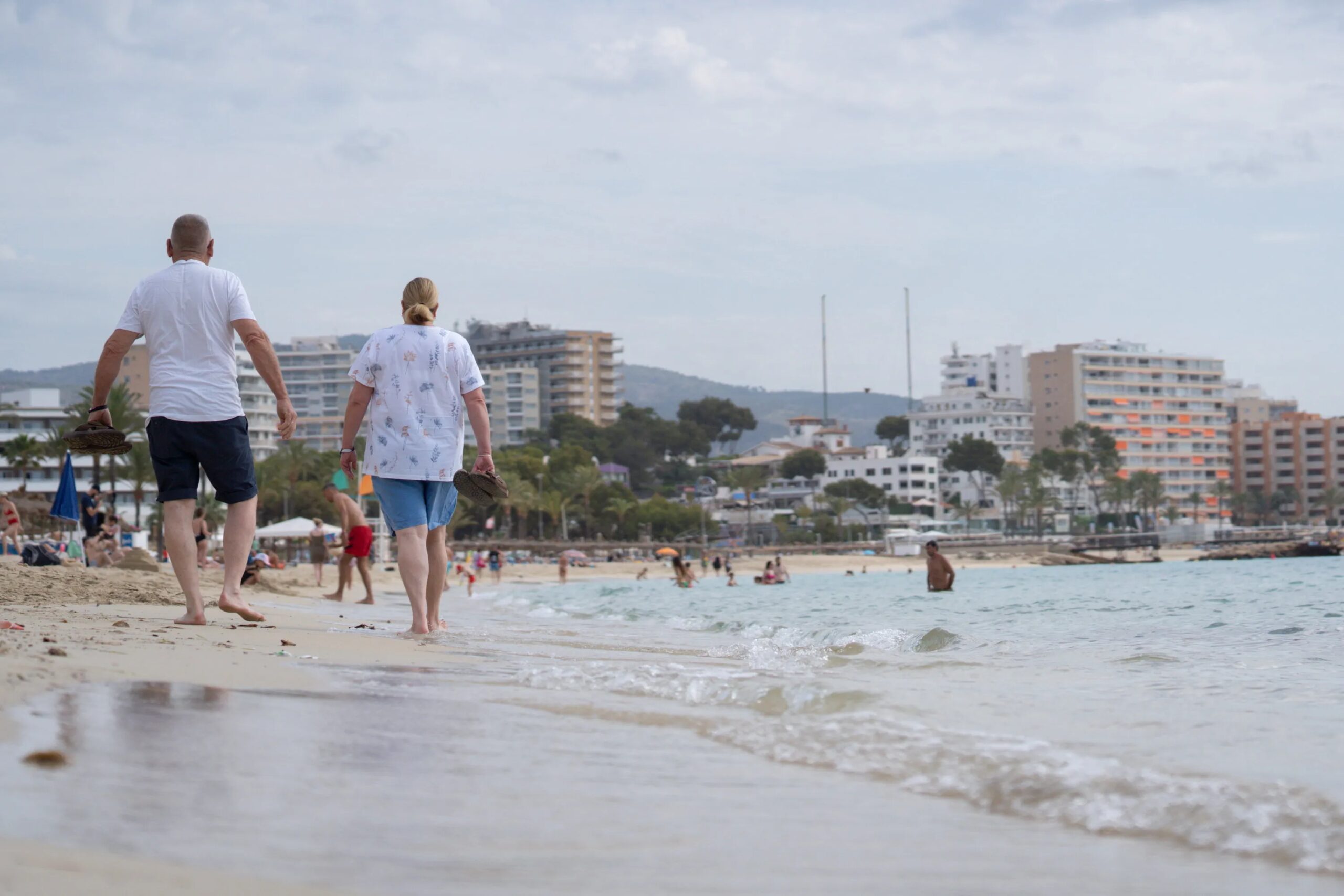
Beachgoers at Magaluf relax on the shoreCredit: SWNSSunseekers take a stroll in MallorcaCredit: SWNS
But 36 per cent of their Type B counterparts feel confident there is little risk of missing out on their dream destination, even without planning months in advance.
The research was commissioned by lastminute.com to mark the launch of its ‘Travel Bgents’ platform, a hub that rewards Type B bookers with extra discounts.
Zoë Fidler, from the holiday firm, said: “There’s a common misconception that Type B travellers are just unstructured non-planners who leave things to chance. In reality, they are the savviest bookers in the game.
“Type B travellers have simply realised that holding off on pressing ‘book’ is the smartest move you can make, knowing they can get what they want and at a great price.”
Yet a quarter (25 per cent) admitted they wish they could embrace this more spontaneous approach and have the confidence to book a trip without overthinking.
With 30 per cent of Type B travellers assured that they could change plans on a whim when leaving it late to lock in their trip.
It’s not just saving money and planning time as 42 per cent of Type B travellers agreed that spontaneous adventures while on holiday create lasting memories, whereas this was true for just 20 per cent of Type A travellers.
With Type B travellers revealed to be more likely to stumble across hidden gems (36 per cent v 28 per cent) or enjoy unexpected moments (42 per cent v 20 per cent).
Zoe Fidler, from lastminute.com, added: “By holding out for the right moment, Type B’s unlock premium trips at a fraction of the cost, without the over-planning.
“Leaving it to the last minute isn’t about compromising or settling for leftovers; it’s an intentional, high-reward strategy.”
A two-part docuseries about Melania Trump arrives later this year, the first lady revealed Wednesday. The new project follows the January release of director Brett Ratner’s documentary, which made $16.7 million worldwide at the box office and was universally panned by critics.
“It will come out this year, and it will be very different what is in the movie,” Trump told “Fox & Friends” ahead of her appearance to ring the New York Stock Exchange opening bell. “It’s more [like a] conversation one on one with me.”
Trump indicated that the docuseries will cover new ground.
“So when I was traveling and doing all of the filming, the director was asking me questions, and there’s some private questions that I will answer that people never heard before,” she said.
The Times has reached out to Amazon Studios for more information on the project, which does not appear in press materials, though Ratner teased the new “chapters” in an Aug. 11 Instagram post.
“Here we go again….” the director wrote. “The saga continues …. can’t wait to share with everyone around the world the next two chapters of MELANIA, THE DOCU SERIES!”
Ratner’s film followed the first lady in the 20 days leading up to President Trump’s 2025 inauguration, promising “exclusive footage capturing critical meetings, private conversations, and never-before-seen environments” as Melania “orchestrates inauguration plans, navigates the complexities of the White House transition, and moves her family back to the Nation’s Capital.”
Critics, however, found the cinematic experience lacking.
“I’m hesitant to call ‘Melania’ propaganda because I can’t imagine anyone watching this movie and thinking that Melania Trump comes off well,” Times film critic Amy Nicholson wrote in a February review. “If this vapid, airless, mindless time-waster had subversive designs of being a satire about the first lady of the United States, there’s not much it would have changed. Yet somehow, ‘Melania’ is exactly the film that the first lady wanted to make — her company was paid $40 million for the rights to this self-greenlit production — and no one around her warned that it was a very expensive bad idea.”
“Melania” was Ratner’s first film since six women accused him of sexual assault in 2017. In February 2026, The Times reported that the “Rush Hour” filmmaker appeared in the unsealed Epstein files in photos with unidentified women and the financier, who died by suicide in 2019 while awaiting trial on sex trafficking charges.
In addition to the initial $40 million Amazon MGM Studios paid to license the project, the marketing and promotion budget was reportedly another $35 million.
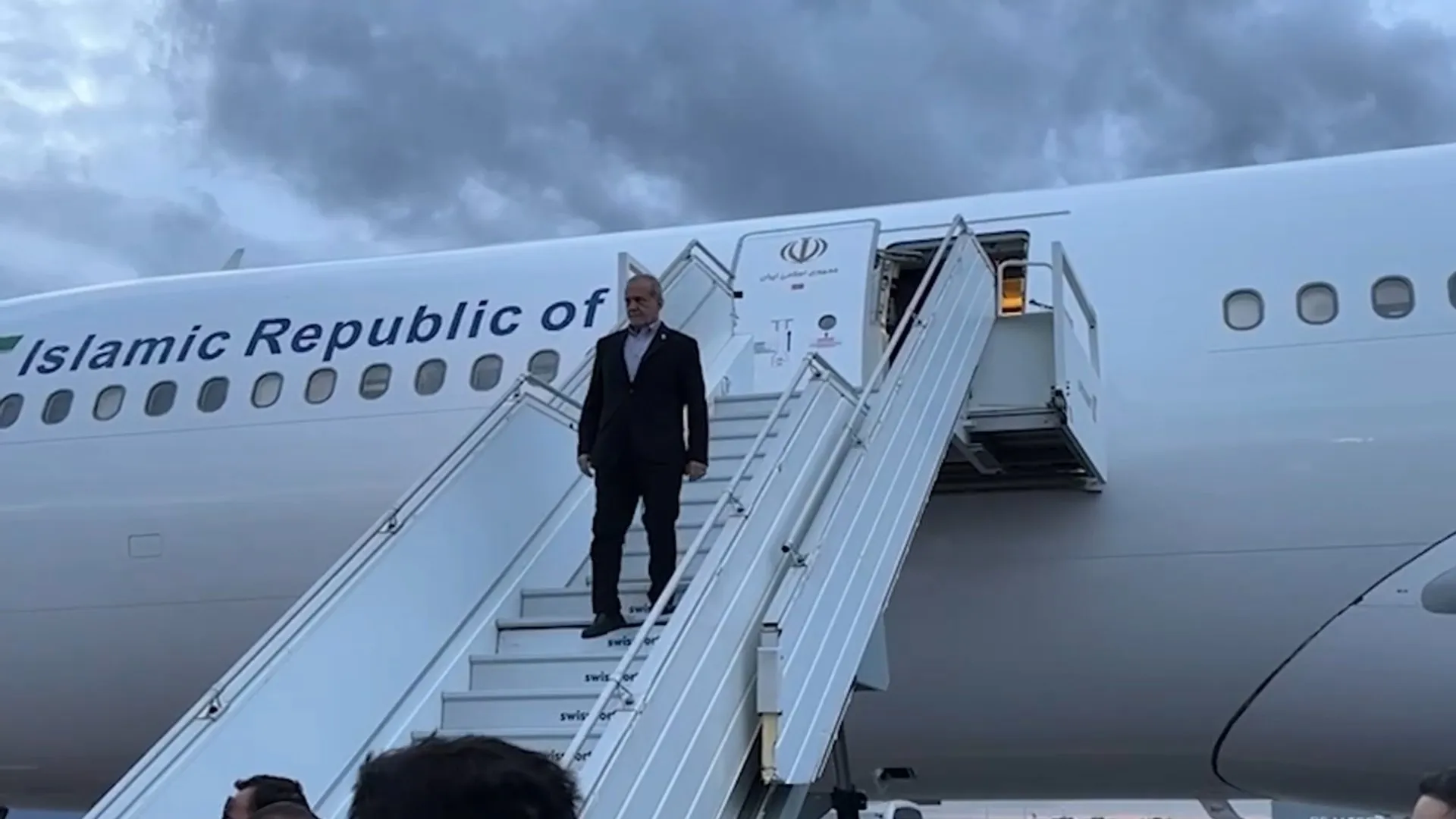
Iranian President Masoud Pezeshkian has arrived in New York as the US-Iran war continues. He’s due to address the UN General Assembly, where Iran is expected to press its case over the conflict and seek diplomacy aimed at easing tensions.
In Philippe Caland’s semi-autobiographical 2003 film “Hollywood Buddha,” his mother, Huguette Caland, plays herself. Wearing her signature white smock, inscribed with a flurry of painted swirls, circles, letters and cross-stitches, the Lebanese artist makes precise gray-blue lines on a canvas spread across her dining room table as her son laments a fickle movie industry.
Filmed in her Venice home, the scene, her three children agree, was true to life. Caland worked constantly: on stretched canvas, on fabric folded in her lap, on a children’s menu, on the wall of her kitchen, or the sleeve of her smock. Whatever was at hand.
“Of course it could be frustrating,” said her daughter Brigitte, an elegant, soft-spoken scholar of Semitic languages who has managed Caland’s estate since her death in 2019.
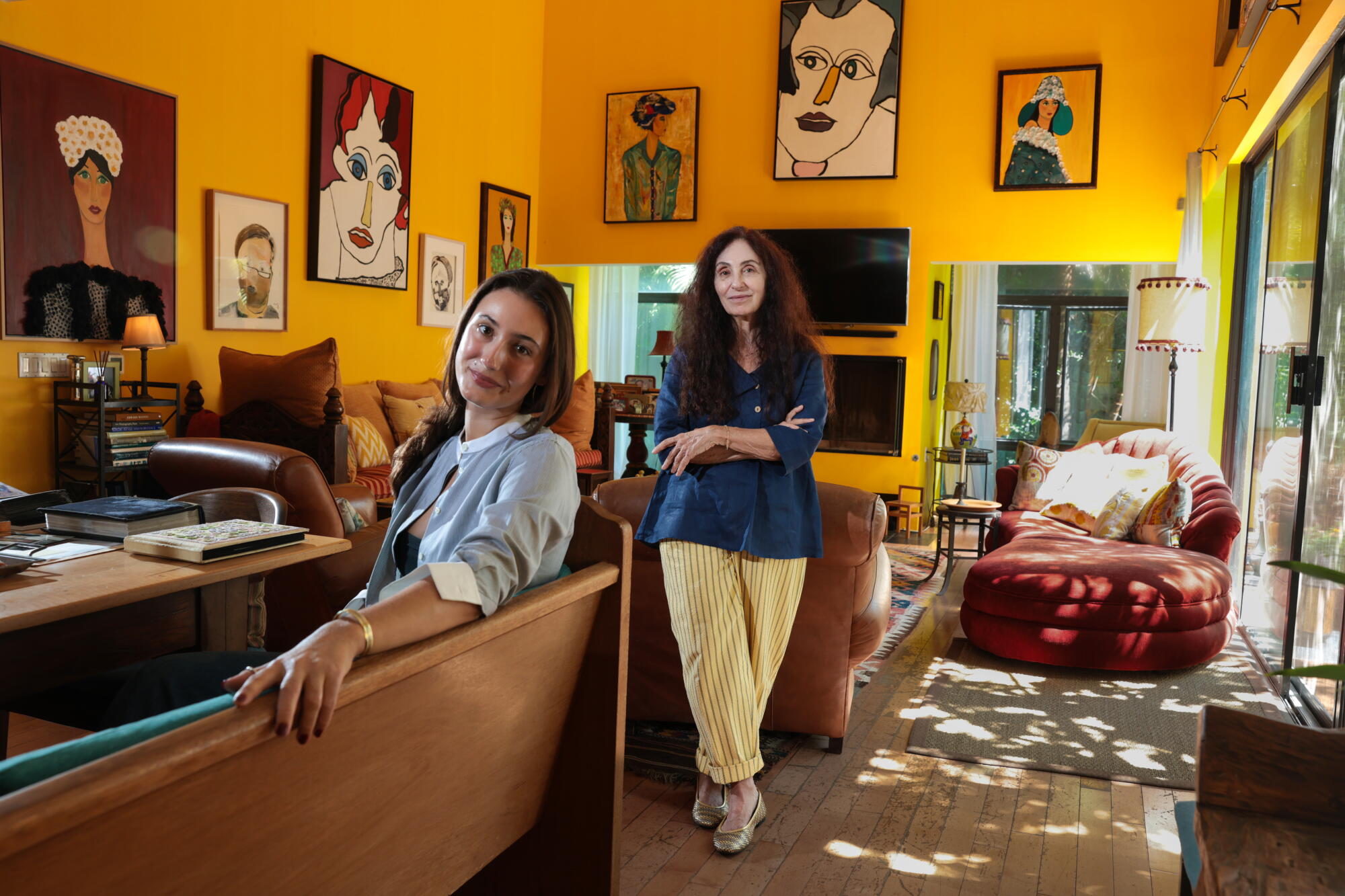
Brigitte Caland, right, and Charley Caland — the daughter and granddaughter of the Lebanese-born painter, sculptor and fashion designer Huguette Caland — stand in Caland’s former L.A. home and studio.
(Robert Gauthier / Los Angeles Times)
Sitting in that very home, which Caland had built in 1997, Brigitte recalled the many times her mother invited her over only to continue working as they talked. “I’d go to leave, and she’d put the canvas away, beg me to come back, and as soon as I did, she’d start painting again.” Still, from early on, Brigitte understood the compulsion as evidence of her mother’s resolve. “She had this incredible drive to create.”
“Huguette Caland: A Life in a Few Lines,” opening Sunday at the Hammer Museum, traces that relentless drive across nearly 150 paintings, drawings, sculptures, garments and tapestries. Organized by the Museo Nacional Centro de Arte Reina Sofía in Madrid in collaboration with the Deichtorhallen Hamburg, the show comes to Los Angeles as the largest Caland survey in the country to date. Spanning five decades and installed chronologically, it features work from the 26 years she spent immersed in Venice’s creative community even as her practice was largely ignored.
It was Caland’s generous hospitality and boisterous wit that made her custom château a gathering place for a vibrant Westside art circle. Ed Moses, who lived around the corner, visited several times a week; Larry Bell, Frank Gehry, Robert Wilhite and others joined her for long meals and even longer parties. Her work surrounded them, and her studio, the grandest space in the house, stood open just beyond the living room. Yet her guests remained uninterested. “No one,” Brigitte said, “would walk the 10 steps.”
Huguette Caland in Stone Doorway, France, 1970.
(Huguette Caland Estate)
Curator Hannah Feldman sees that tension as central to Caland’s California years. “Instead of supporting and bolstering her as a creative in their midst, she became their salon host,” she said. The lack of recognition, Feldman argues, reverberates through Caland’s heavily impastoed portraits of Moses and her enigmatic late abstractions such as the rectilinear paintings in the “Silent Letter Series.”
“To draw a line is a way to contain one’s emotion, one’s anger, one’s anguish,” wrote Caland of her challenging relations with fellow artists in “Sketchbook 2” (1990-91). “My lines tell the story of my life, of people encountered along the path, people I loved, and found and even lost.”
Caland is perhaps best known for her cheeky, erotic paintings of fulsome body parts and for a biography too often reduced to cliché: the libertine daughter of Lebanon’s first post-independence president who left her husband and children in Beirut to pursue an art career in a less repressed Paris.
Huguette Caland, “Self-Portrait in Smock,” 1992
(Huguette Caland Estate)
Feldman hopes the exhibition, which spans fine-line drawings of entangled lovers and radiant topographical tapestries, will complicate that familiar account. “There’s joy, and there’s sex,” she said, “but there’s also pathos, vulnerability. The search for autonomy is not an easy one; it comes with conflict, strife.”
Caland’s freedom was no doubt hard-won. She first picked up a brush as a married mother of three in her thirties, and only after her father’s death. In her first painting, alternately titled “Soleil rouge” and “Cancer” (Red Sun/Cancer) (1964), hazy concentric circles gather in a crimson orb at the center of the monochromatic plane. Simultaneously a tumor and a light source, the refulgent motif holds grief and release.
Soon after, Caland enrolled in art classes at the American University of Beirut, relinquished much of her constricting couture wardrobe, and adopted a uniform of loose, flowing kaftans, which she would later turn into works of art in their own right. Archival photographs show a glamorous Caland arriving at an event in a floor-length garment bearing painted breasts, a belly button and a triangle of curly pubic hair.
Huguette Caland, “Bribes de corps,” 1973
(Huguette Caland Estate)
Caland moved to France in 1970, leaving her children (then 15, 13 and 12) in Beirut with their father, a French-Lebanese lawyer named Paul Caland. In paintings from that decade, Caland’s imagery of bodies swell, split, meld and dissolve. In “Enleve ton doigt” (Remove Your Finger) (1971), lipstick-red lips receive a pale finger reaching out from a crush of fantastical profiles; two years later, in “Self-Portrait” (Bribes de corps), Caland dispersed a sensual body across a pale pink field interrupted at the lower edge by a slight, shadowed cleft — either buxom cleavage or buttocks.
The distance from her children produced another kind of line: text. Philippe recalled receiving illustrated letters almost every week, filled with drawings, doodles and notes of affection. Most of these were later destroyed when the family house was bombed during the Lebanese Civil War of 1975. “I always knew my mother loved me,” Philippe said. “The family was not torn apart. She took a break, and in the end made a home for us in Paris, where we all landed when the war was raging.”
After the death of her lover, Romanian sculptor George Apostu, whose rough-hewn wood sculptures still populate the house’s patio, Caland’s children encouraged yet another departure. Her eldest son, Pierre, a businessman and former Olympic swimmer, paid for a stay at a friend’s Venice bed-and-breakfast, all but forcing his grieving mother out of Paris and to sunny L.A. Her initial reluctance gave way to affection. The light, arid climate and mountains sloping into the sea reminded her of Lebanon. “She liked that California land sounded like Caland,” Brigitte said.
Huguette Caland works at her home and studio in Venice, date unknown.
(Huguette Caland Estate)
After making Venice her primary residence, Caland collaborated with architect Neil Kaufman on the design for her enclosed château. Its towering, mostly unbroken face and narrow swimming pool suggested a rampart and a moat, but behind the concrete exterior, Caland eliminated every door save the guest bathroom. Long vertical windows opened onto a courtyard shaded by a sprawling olive tree. Art crowded the steep stairwell; it accumulated on scattered plywood and Formica tables and unraveled across the kitchen in an intricate mural composed of tessellated marks that recall Byzantine mosaics and tatreez, a form of traditional Palestinian embroidery.
“There was no distinction for her,” Brigitte said, between the home and the studio, art and life. Caland once described her “very, very mixed media” as including “every single exchange, a look, a smile, a brief encounter.”
That original interior survives in “Hollywood Buddha” and archival photographs. Philippe now lives in the house with his family, and although the concrete exterior remains intact, the rooms and the courtyard have been remodeled around their own aesthetics and routines. Along with the technicolor mural, Caland’s singular sensibility persists in scattered drawings, a bouquet of her preferred 30-inch paintbrushes and a pair of stiff-backed pews. Her presence, too, is felt in the people who now inhabit the space, like her granddaughter Charley, 25, whose easy warmth recalls qualities long ascribed to the matriarch.
The former Venice home and studio of the Lebanese-born painter, sculptor and fashion designer Huguette Caland. The home is still occupied by Caland’s family and no longer looks how it did when she was alive, but her spirit lives on in small details.
(Robert Gauthier / Los Angeles Times)
When the Hammer selected Caland for “Made in L.A. 2016,” the honor brought some measure of the local attention that had long eluded her. “If you had to pick one critical turning point for her career,” Pierre said, “it was the inclusion of her work in that show.” For the family, the coming survey fulfills one of her long-held ambitions.
“She told me, ‘Live your life day by day and plan it on a thousand years,’” Philippe said. Only later did he understand that the advice described her own life. “Today, her work is here,” he added. “She continues with it.”
Huguette Caland, “Le grand bleu,” 2012.
(Huguette Caland Estate)
The final painting in the exhibition, an oceanic large-format canvas titled “Le Grand Bleu” (The Great Blue) (2012), once hung high above the central hearth in the Venice house. Surrounded by undulating circles, spots and stripes, red-roofed Lebanese abodes and white-masted schooners traverse an unsettled horizon line. From the dining table below, where a young Charley often helped her grandmother fill blank planes with delicate dots, Caland could look up and see how far her line had taken her.
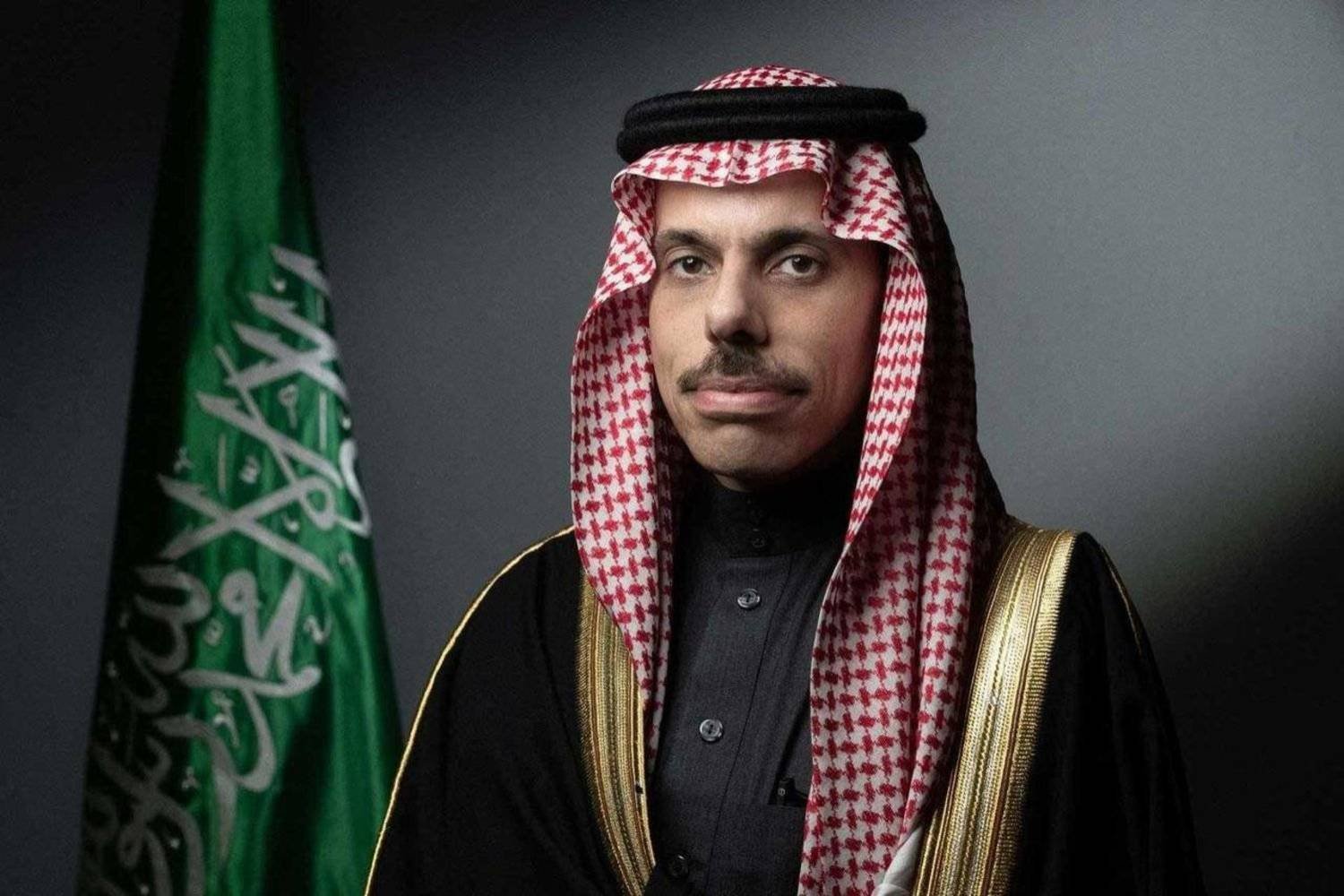
NEW DELHI: Saudi Foreign Minister Prince Faisal bin Farhan arrived in New Delhi on Saturday to represent Crown Prince and Prime Minister Mohammed bin Salman at the 2026 BRICS Summit.
Saudi Arabia is participating in the summit as an invited country, which is being held under the theme “Building Resilience, Innovation, Cooperation, and Sustainability.”
Prince Faisal is scheduled to take part in discussions on key international issues and ways to strengthen multilateral cooperation among BRICS members, partner countries and invited nations, the Saudi Press Agency reported.
The BRICS group comprises Brazil, China, Egypt, Ethiopia, India, Indonesia, Iran, Russia, South Africa and the United Arab Emirates.
RAIN has arrived and it seems summer is truly over, but that doesn’t mean you can’t get out in nature – especially if its indoors.
Around the UK are lots of attractions with indoor conservatories and glasshouses full of plants – and we’ve highlighted some of the best to explore this autumn.
The country’s largest indoor rainforest is in the Eden Project and it’s as warm as 35CCredit: Alamy Stock Photo
The Eden Project, Cornwall
Go big or go home, right? The Eden Project has two biomes one of which is home to the world’s largest indoor rainforest.
The Rainforest Biome can be as hot as 35C so make sure to wear layers if you visit this autumn and winter.
Sign up for the Travel newsletter
Thank you!
Inside are beautiful waterfalls, a canopy walkway, wobbly bridges, free-roaming partridges and over 1,000 varieties of plants.
The Mediterranean Biome is slightly cooler but can still get up to 25C with pretty flowers and plants from the Mediterranean, California and even Western Australia.
Make sure to follow the path to the olive trees, stop by the perfume garden for some scented plants and spot the sculptures hidden amongst the greenery.
You can book during events throughout the year too.
Across September 26-27 will be the Celebration of Stories Weekend where children’s authors will read stories from their books, along with workshops and family activities.
From November 20-January 2 will be its Christmas event. General tickets for adults start from £35.50 and tickets for children (5-15) start from £12.50.
Kew Gardens, London
Kew Gardens has some incredible plant displays that are insideCredit: Alamy
Kew Gardens is known for its incredible landscape gardens and lakes – but there’s plenty of it that’s indoors too.
One of its most impressive attractions that’s inside is Palm House which is an indoor rainforest full of endangered plants – some of which are even extinct in the wild.
The Princess of Wales Conservatory at Kew Gardens has 10 different zones with different climates including topical ones – so you can warm up inside.
Discover Venus flytraps, succulents and tropical orchids inside.
Other indoor attractions include Davies Alpine House where plants that thrive in cool, dry and windy conditions live.
There’s also Temperate House which is the world’s largest Victorian glasshouse with around 10,000 different plants from around the world.
If you want to find out more on Kew Gardens, check out Travel Reporter Cyann Fielding’s full guide on it, here.
General admission tickets start from £17 for adults – an offer for £10 tickets starts later this month. Tickets for children (between 4-15) start from £2.
The National Botanic Garden of Wales, Carmarthenshire
The National Botanic Garden of Wales is the biggest of its kind in the worldCredit: Tim Graham
In the heart of Carmarthenshire is the National Botanic Garden of Waleswhich has a claim to fame as being the largest single-span great glasshouse in the world.
It was even designed by Foster + Partners which are behind buildings like The Gherkin.
Inside the raindrop-shaped glasshouse are endangered plants from Mediterranean climate regions like the Canary Islands, Chile and South Africa.
Along with its various species of plants are rocky terraces and sandstone cliffs.
There are places for snacks too at the Caffi Botanica which serves up snacks, sandwiches, hot meals – some ingredients are even grown in the conservatory itself.
Tickets start from £16.49 for adults and £8.44 for children (between 2-17).
The Winter Garden, Sheffield
The Winter Garden in Sheffield is completely free to exploreCredit: Alamy Stock Photo
The Winter Garden in Sheffield is one of the largest temperate glasshouses to be built in the UK in the last 100 years.
The building is so big that it could actually fit 5,000 regular-sized greenhouses inside of it.
It’s full of greenery with over 2,500 plants from around the world inside of it and paths for a relaxing stroll inside.
There’s everything from tall trees to bamboo, bedding plants which change seasonally and flowers.
It might not be a place that you can spend a day in – but it’s attached to connected to the Millennium Gallery and the Peace Gardens which you can explore too.
It’s completely free to walk through The Winter Garden and it’s open Monday to Saturday between 8am-8pm, on Sunday it’s open from 10am to 5pm.
David Welch Winter Gardens, Aberdeen
These indoor gardens are found within Duthie Park in AberdeenCredit: Alamy Stock Photo
David Welch Winter Gardens is found inside Duthie Park in the Ferryhill area of Aberdeen.
The glasshouse was added to the park in the 1900s and is now one of the most visited indoor plant collections in Scotland.
Inside is Europe’s largest indoor plant collection where you can explore the enormous Temperate House.
There’s also the Corridor of Perfumes which is a fragrant zone within the glasshouse, Fern House, Victorian Corridor, Japanese Garden, Tropical House and Arid House.
If its not too cold outside, take a stroll around Duthie Park which has a bandstand, fountains and a boating pond too.
Entry to the David Welch Winter Gardens at Duthie Park is completely free.
The Barbican Conservatory, London
The Barbican Conservatory will close next year so try and pop in nowCredit: Alamy
This one might be slightly harder to visit – but it’s still worth mentioning as the Barbican Conservatory is the second biggest of its kind in London (behind the Princess of Wales Conservatory at Kew Gardens).
The conservatory is part of the Barbican Centre in central London and is full with over 1,500 species of tropical and subtropical plants, trees and even fish.
There’s very much limited time to visit though as the Barbican Conservatory will close to the public and undergo a major restoration in January 2027.
But if you want to see inside before its closure, tickets are released one month in advance online with a number day tickets released from 9.30am on the day that the conservatory opens – entry is completely free.
If you want to find out when new tickets are available, you can join the waiting list.
And if you want to take a rare piece of the Barbican Conservatory home with you, check out the plant adoption event happening later this year.
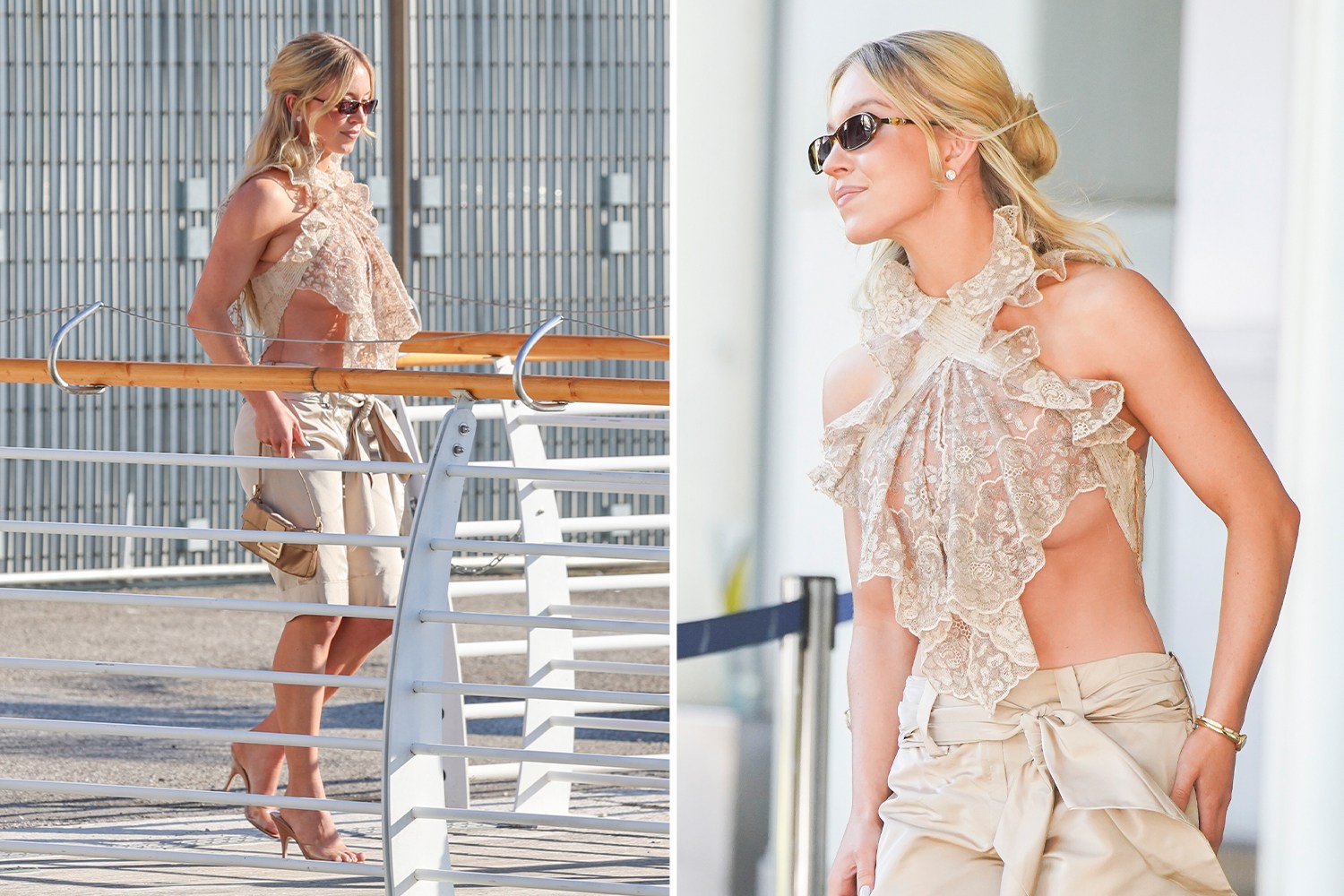
SYDNEY Sweeney has flashed her underboob in a very short lace crop top as she arrived to the Venice Film Festival.
The American actress, 28, is attending the city’s annual film festival in her role as an ambassador for Armani Beauty.
Sydney Sweeney has flashed her underboob in a very short lace crop top as she arrived to the Venice Film FestivalCredit: SplashThe American actress is attending the city’s annual film festival in her role as an ambassador for Armani BeautyCredit: Getty
The Housemaid star looked stunning in a gold lace handkerchief top which she paired with a pair of cream bermuda shorts.
But the cheeky star, who turns 29 in a few days, couldn’t help flash a bit of underboob under her gorgeous short top.
Sydney looked sensational as she made her way to the film festivalCredit: SplashSydney was seen kneeling at a fridge in just her undiesCredit: SyrnSydney is seen pulling down her underwear with a look of surprise on her faceCredit: SyrnSydney Sweeney with her boyfriend Scooter BraunCredit: Getty
She is also seen pulling down her underwear with a look of surprise on her face.
In one particularly raunchy scene, she slapped flour onto her backside and left hand prints all over bottom.
Most read in Entertainment
Sydney captioned the post: “celebrate my birthday month with my newest @syrn collection. coming september 1st.”
The actress went Instagram official with her new boyfriend Scooter Braun in April – as he gushed he’s a “lucky b******”.
Sydney confirmed the romance in a loved-up post, sending fans into a frenzy.
Meanwhile, Venice Film Festival’s red carpet events began last week with the premiere of British director Danny Boyle’s film Ink which is about the rise of media magnate Rupert Murdoch.
It closes on September 12, with Italian costume drama Dio Ride (God Laughs), written and directed by Giovanni Veronesi.