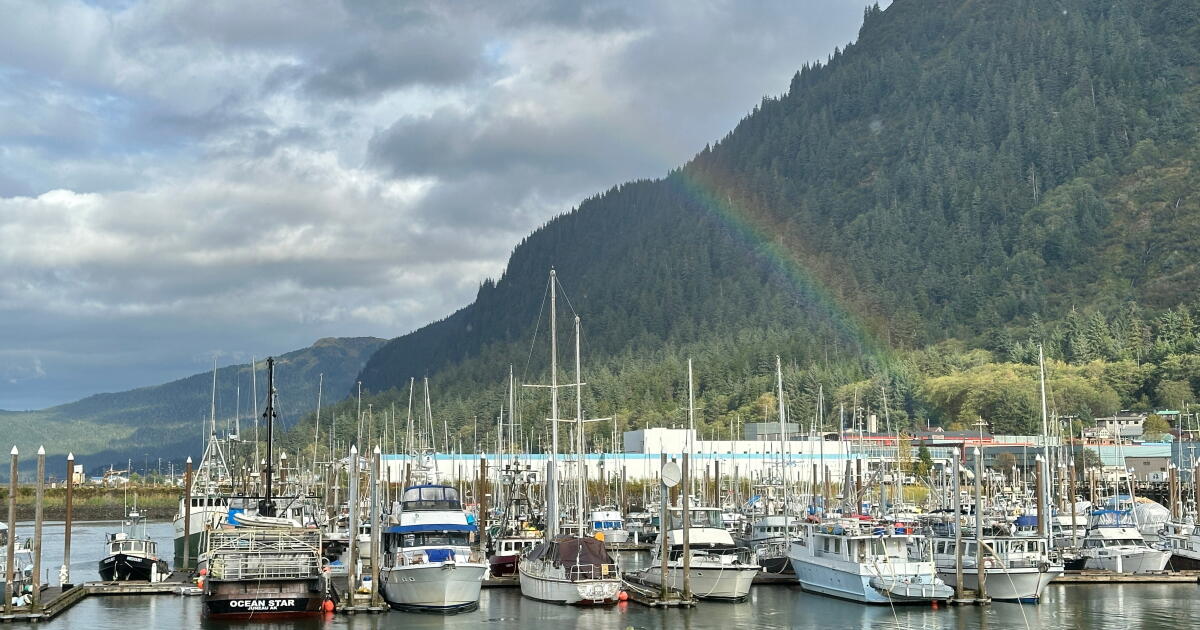


Nope, it’s not AI. It’s just a really big flag with bright lights, draped on Hoover Dam for the next several weeks.
As a display to mark the 250th anniversary of U.S. independence, the states of Nevada and Arizona and the federal Bureau of Reclamation teamed up to hang and illuminate an enormous American flag on the dam on Memorial Day.
The display, scheduled to be in place through July 4, is visible to anyone crossing between Arizona and Nevada on U.S. Route 93, which goes across the top of the dam. The flag is 150 feet tall and 300 feet long, spread on the south-facing side of the dam and lit by 550 LED lights (powered by dam-generated electricity).
A wider view of the illuminated U.S. flag at Hoover Dam.
(Michael Bittle)
It’s a spectacle that comes at a challenging moment for Hoover Dam, as experts warn that Lake Mead’s dwindling water levels could threaten the dam’s ability to generate hydropower. “Slap a flag on it, that’ll fix it,” suggested one of several Reddit commenters who were moved to snarkiness by the flag image.
The dam, a frequent day-trip destination from Las Vegas, stands 35 miles east of the Las Vegas Strip, about 295 miles northeast of Los Angeles. The site features a visitor center and overlook, and guided and self-guided tours.
Installation of the display involved dozens of riggers and two cranes. The flag, which is roughly the dimensions of a football field, has been previously used for celebrations at Indianapolis Colts and Las Vegas Raiders football games.
Within two days after it was hung, gusts of wind up to 50 mph prompted organizers to lower the flag last Wednesday as the National Weather Service declared a wind advisory for the area. Organizers raised the flag again late Friday.
Strong winds are not uncommon in the area. Organizers said weather “may periodically require the flag to be temporarily lowered.” Updates on the flag’s status can be found on the Hoover Dam Facebook page.
The Las Vegas Convention and Visitors Authority paid for the display. A spokeswoman said the cost, including flag, production, installation costs and six weeks of lighting, will be between $750,000 and $1 million.
The dam, a five-year construction job that was completed in 1936 during the depths of the Great Depression, is often hailed as one of the nation’s most impressive works of infrastructure. Though this is not the first time a flag has been draped on it, organizers have called the display “the most ambitious long-duration installation ever attempted at Hoover Dam.”
Route 66 has its tendrils throughout SoCal, and especially in the L.A. area, winding through Pasadena, West Hollywood and culminating in Santa Monica. But the most loving ode to Route 66 may in fact be at the Disneyland Resort, specifically at Disney California Adventure.
Stories, photos and travel recommendations from America’s Mother Road
Cars Land opened in 2012 as part of a reworking of the theme park and at long last gave it a striking land that could rival — and in many cases surpass — those of its next-door neighbor, Disneyland. Flanked by sun-scarred, reddish rocks that look lifted from Arizona, Cars Land is a marvel of a theme park land, with its backdrop mountain range ever so slightly nodding to the fins of classic Cadillacs from 1957 to 1962. That design element is a salute to the Cadillac Ranch in Amarillo, Texas, where 10 vintage Cadillacs are buried nose-first in the ground that to many resembles a 20th century Stonehenge.
Yet before the area was attached to the 2006 film, it was envisioned as a theme park destination dedicated to roadside attractions and trips along the so-called Mother Road. Cars Land is a make-believe area based on a fictional town from an animated film, but its roots are decidedly real.
Cadillac Ranch, an artwork made from 10 old cars by the Ant Farm artists’ collective in the 1970s, has become one of Amarillo’s top attractions. Visitors are invited to add their own spray-painted touches.
(Christopher Reynolds / Los Angeles Times)
The backdrop mountain range of Radiator Springs Racers is a nod to Cadillac Ranch. The peaks are designed to look like the tail fins of classic cars.
(Mark Boster / Los Angeles Times)
“We very much acknowledge that up front, that you’re walking down Route 66,” says Kathy Mangum, the retired Walt Disney Imagineer who served as the executive producer of Cars Land.
“But you’re also not walking down a part of Route 66 that exists anywhere,” Mangum continues. “There’s no part of Route 66 where you’re looking up at a Cadillac range surrounded by red rocks. It’s the spirit of Route 66. I wouldn’t even call it a ‘best-of.’ It’s just a little bit of this, a little bit of that, and combined it feels real.”
Tour guide Michael Wallis, left, and Walt Disney Imagineer Kevin Rafferty during a research trip at Cadillac Ranch in 2008.
(Kevin Rafferty)
Before those at Walt Disney Imagineering, the secretive arm of the company devoted to theme park experiences, were even aware that Pixar Animation Studios was working on the “Cars” film, an automotive-focused land was in the planning stages for Disney California Adventure. The park had opened in 2001 and had struggled in its early years to pull in crowds, with audiences zeroing in on a lack of Disneyland-style attractions and an absence of grandly designed vistas.
In an effort to rejuvenate the park, then-Imagineer Kevin Rafferty envisioned an area to be called Car Land — without the “s” — pulling heavily from his family’s road trips and Route 66-like roadside attractions and oddities. Among its standout attractions was to be one initially named Scoot 66, later changed to Road Trip, USA, a slow-moving ride that took guests on a cross-country journey through nature and roadside quirkiness, although its showcase scene would have been a trip trough a miniaturized Carlsbad Caverns, a bit of a detour from Route 66.
“It was kind of tongue-in-cheek,” says Rafferty, now retired, of the never-built ride. “You were going to be seeing all these roadside attractions that would draw you in, like giant bunnies.”
Mater’s Junkyard Jamboree brings the rusty, old tow truck character from the “Cars” movie to life in Cars Land at Disney California Adventure. (Mark Boster / Los Angeles Times)
An artwork in Seligman, Ariz., pays homage to the Disney-Pixar “Cars” movie, which was heavily inspired by the town. (Mark Lipczynski / For The Times)
Rafferty believed a place such as Car Land would be ripe for exploration in a Disney park, as it was to be set from the late 1950s to the early 1960s and tap into a collective nostalgia for a time when a vehicle meant the freedom to explore the open road. Cars Land today still has some of that ageless energy, boasting a vintage rock ’n’ roll soundtrack and a strip of a street filled with colorful neon, its lights, especially at night, beckoning guests to come closer.
“The reason why I thought it would fit into a Disney park, especially Disney California Adventure, is because cars are so much a part of the California story,” Rafferty says. “Cars are designed in California, even though they’re built elsewhere. There’s more custom shops in California. There’s more design studios in California. There’s more car clubs. And all the cars songs. ‘She’s so fine, my 409.’ It was all the Beach Boys and Jan and Dean.”
The neon signs of Radiator Springs. Flo’s V8 Cafe isn’t a direct match for any Route 66 diner, but it was inspired in spirit by the Midpoint Cafe in Adrian, Texas.
(Paul Hiffmeyer / Disneyland Resort)
Development on Rafferty’s Car Land idea would change course when Imagineering and Pixar eventually aligned. But it was also a shift that would more formally ground the area in the culture of Route 66, which heavily influenced the film. Both the filmmakers and, later, those with Imagineering, embarked on 10-day research trips along the road led by historian Michael Wallis, author of “Route 66: The Mother Road.” Those at Pixar, in fact, were so charmed by Wallis’ tours that the author was asked to voice the role of the film’s sheriff.
Wallis says he took the teams out in rented Cadillacs. “I like to stop every 300 yards,” Wallis says. “If I’m doing a road trip, I get into it. So we stopped to move box turtles off the road. I waded them into winter wheat to dance, to pick wild grapes. I introduced them to people that I guaran-damn-tee that they never would have met, the great characters of the road, and I showed them the man-made and natural sites of the road.”
Though the fictional “Cars” and Cars Land community of Radiator Springs has no single inspiration, it echoes the scenery and history of several small towns between Tulsa, Okla., and Kingman, Ariz., including Tucumcari, N.M., Seligman, Ariz., and Oatman, Ariz. And the single, graceful bridge that is centered upon the land’s backdrop mountain range closely resembles Pasadena’s own Colorado Street Bridge, although there’s no roaring waterfall next to the original.
Scenes from Route 66 in Seligman, Ariz. The town was one of the inspirations for the fictional “Cars” and Cars Land town of Radiator Springs.
(Mark Lipczynski / For The Times)
The centerpiece bridge of the Cars Land mountain range was modeled after a local landmark. (Paul Hiffmeyer / Disneyland Resort)
The Colorado Street Bridge in Pasadena, an inspiration for the Cars Land structure. (Adam Markovitz)
Elsewhere, Ramone’s House of Body Art connects with the U-Drop Inn, a 1936 Art Deco gas station in Shamrock, Texas, that now serves as a visitor center and cafe. The Cozy Cone Motel nods to the Wigwam motel chain, which once included seven locations from Kentucky to California. Two remain in business along Route 66: the Wigwam in San Bernardino and another in Holbrook, Ariz.
While Imagineers had visual references from the animated film, Mangum says the research trip was invaluable in lending authenticity to the park.
“We could walk into a building in Shamrock, Texas, that looks so much like what Ramone’s House of Body Art looks like and see that those tiles are made of raised terra-cotta,” Mangum says. “So we could get the actual texture. It’s a movie world, but it’s also a real world.”
Flo’s V8 Cafe isn’t a direct match with any Route 66 eatery, the Imagineers say, but was certainly influenced in spirit by the Midpoint Cafe in Adrian, Texas.
The Midpoint Cafe in Adrian, Texas, celebrates the halfway point on Route 66 between Chicago and Los Angeles.
(Christopher Reynolds / Los Angeles Times)
“We sampled all their pies and food and made copious notes on this stuff,” Rafferty says. “The two women who owned the Midpoint Cafe had what they said was their mother’s recipe for ‘ugly crust pies.’ We fell in love with ugly crust pies. I met with the head chef of Disneyland, who was a Frenchman at the time, and I said we wanted to serve ugly crust pies at Flo’s V8 Cafe. And he said, ‘No, no, no, nothing at Disneyland will be ugly.’”
No, but it may be influenced by abandoned buildings. Mangum says a key locale for the land was the deserted structures of Two Guns, Ariz. Gas station remains led to sketches that would inspire parts of the “Stanley’s Oasis” area of the Radiator Springs Racers queue, which Rafferty and company filled out with an oil service station and then a building composed of empty oil bottles. The story goes that Stanley’s Oasis is a roadside attraction settlement that led to the development of the town of Radiator Springs.
At the Cozy Cone Motel, a string of cone-shaped food stalls sell quick bites such as swirled soft-serve cones. (Stephanie Breijo / Los Angeles Times)
The Cozy Cone is based on the real-life Wigwam Motels. (Christopher Reynolds / Los Angeles Times)
“That kind of Route 66-inspired story was all made up,” Rafferty says. “It wasn’t in the film.” That backstory, however, would inform the 2012 short “Time Travel Mater.”
The enduring strength of the land, however, isn’t just due to the popularity of the animated properties that led to it. While Route 66 wasn’t magic for everyone — the history of the road is dotted with tales of extreme poverty and horrific racism — it’s become romanticized as a slice of Americana and stands as a jumping-off point to further delve into our past.
The land is, in a word, timeless. It’s also representative of the ideal of a working small town, the sort of place we forever long for. “It may not be the America of today,” Mangum says, “but in a way it is.”
Times staff writer Christopher Reynolds contributed to this report.
TWO retired RAF rescue helicopters have been transformed into luxury glamping pods.
The old aircraft have been given a new life after decades spent carrying out dramatic search-and-rescue missions across Britain.
Sign up for the Travel newsletter
Thank you!
Two RAF helicopters have been turned into glamping podsCredit: SWNSThe cockpit was cleverly transformed into a dining areaCredit: SWNS
The bright yellow Sea King helicopters are now parked at North Yorkshire Water Park, at Wykeham Lakes, near Scarborough.
ZE369 and XZ589 have had their specialist rescue interiors ripped out and replaced with cosy living spaces complete with a double bed, bunk beds and a mini kitchen with a microwave, kettle, toaster and fridge.
However, the aircraft hasn’t lost all of its original charm with some parts still preserved.
Parts of the cockpit, including the switches and controls, have been kept intact and reworked into a dining area.
Inside features bunk beds, a double bed and a small kitchenCredit: SWNSKitchen is equipped with a kettle, toaster, microwave, and fridgeCredit: SWNS
Guests enter through the original sliding helicopter door, which opens onto a gravel landing pad complete with a picnic bench.
The water park says the unusual stays are designed to offer couples and families a “unique” and “memorable” experience.
The pods only became available to book from May 1 with prices starting from around £130 a night.
The demand has already gone through the roof with the first four weeks sold out on Airbnb.
Guests will have plenty to do nearby too as the 250-acre waterpark offers inflatable aqua parks, kayaking, paddleboarding and open-water swimming.
James Whitehead, Operations Manager at North Yorkshire Water Park, said: “Both helicopters have an extraordinary history, having spent decades carrying out life-saving search and rescue missions across the UK.
“It was important to us that the original character and charm is preserved as much as possible while making them a cosy place to relax after a day of fun.”
The sands of Oceano Dunes — the only state park where visitors are usually allowed to drive on the beach — are unusually quiet right now.
Too quiet, many locals say, because off-road vehicles and beach camping have been temporarily banished from San Luis Obispo County’s Oceano Dunes State Vehicular Recreation Area since April 14.
Many others, however, are happy about the pause, saying it will be good for the western snowy plover, a threatened sea bird species.
This discord is part of a long-running battle between environmentalists and recreation advocates along this stretch of coastline a few miles south of Pismo Beach. The environmentalists won the most recent round when a federal judge ordered the dunes closed until state parks officials obtain a permit from U.S. Fish and Wildlife Service that allows occasional bird casualties.
State parks officials, who have canceled all camping reservations in the area through May 22, said they hope to reopen it by May 23. But that timetable depends on permit approval by the U.S. Fish and Wildlife Service, which did not immediately respond to a request for comment.
Camping reservations for May 23 and beyond are still active, according to Jon O’Brien, superintendent of the state parks system’s Oceano district.
(Myung J. Chun/Los Angeles Times)
Meanwhile, along Pier Street in Oceano, business is slow.
At Sun Buggy Fun Rentals, which has been catering to visiting families for more than 20 years, “we’ve had to lay a majority of our folks off,” said owner Randy Jordan. He said he’s counting on state parks officials “doing everything they can” to reopen the area on May 23.
At the Pier Street Deli y Mas, “It’s been really slow,” manager Chelsea Nava said. “Our employees are losing hours.”
In normal times, Nava said, 80% or more of her customers are from out of town, including “a lot of people from Bakersfield and Fresno, [who] come in for the dunes.”
“We aren’t quite sure” what to expect next, Nava said, noting that her family took over the deli in late 2024. “We were doing really great right before the closing,” she said.
The closure was ordered by U.S. District Court Judge Anne Hwang, who ruled April 9 that the state needs to do more to protect the western snowy plover, which is classified as threatened under the federal Endangered Species Act.
Under Hwang’s order, the closed area can reopen when the state files a long-awaited habitat conservation plan and gets an “incidental take” permit from U.S. Fish and Wildlife Service that allows some snowy plover deaths and injuries. Jon O’Brien, superintendent of the state parks system’s Oceano district, said he was confident that the state would obtain the approval and reopen the area almost immediately after May 22.
Camping reservations for May 23 and beyond “are still active,” O’Brien said. “So if you’ve got a camping reservation for May 24, you’re still got a reservation.”
Jim Suty, president of the Friends of Oceano Dunes, which favors recreational use of the area, said he’s hopeful that parks officials can open the area as promised. But even if they do, Suty said, plenty of damage has been done.
“People really need to appreciate that closing the park at this time did nothing to help the endangered species, and did everything to hurt the people,” Suty said, referring to visitors and local businesses that depend on them. “It’s very important to the vitality of the local community.”
“It’s maddening,” said David Hamilton, who lives in nearby Arroyo Grande and said he has been driving the dunes and watching sunsets with his wife for years. “There’s so much coastline and they can’t leave this small stretch open.”
The recreation area’s status has long been crucial to Oceano, an unincorporated community of about 7,000, located just to its north.
Though there are several neighboring small cities along the nearby coast, Oceano merchants say they don’t get much business from Grover Beach, Arroyo Grande or Pismo Beach, which includes more upscale hotels and restaurants with clifftop ocean views.
Oceano Dunes State Vehicular Recreation Area remains the only California State Park where vehicles may be driven on the beach.
(Myung J. Chun / Los Angeles Times)
The judge’s order covers roughly 800 acres of off-highway vehicle area south of Arroyo Grande Creek. Until April 14, O’Brien said, up to 350 campers per night (at $10 per vehicle) were allowed in the area, along with up to 1,720 off-highway and 1,800 street-legal vehicles per day, at $5 per vehicle.
The most recent court case was initiated in 2020 by the Tucson-based Center for Biological Diversity. Zeynep Graves, a senior attorney at the center, said in a statement that state officials “have let off-road vehicles tear through protected habitat at Oceano Dunes, injuring and killing snowy plovers, harassing roosting flocks, and degrading their habitat.”
However, state parks statistics show that the western snowy plover breeding population has grown from at least 32 breeding adults in 2002 to at least 281 in 2024, exceeding state targets since 2013.
In her ruling, Hwang found that California state parks had violated the federal Endangered Species Act by permitting too much activity near the birds without having obtained an “incidental take” permit.
State parks officials responded by saying the closure “will result in thousands of families losing their camping reservations and coastal recreational access, while cutting operational revenue that funds environmental conservation.”
During the closure, Pismo State Beach — which is just north of the off-highway recreation area and Arroyo Grande Creek — will allow a maximum of 1,000 street-legal vehicles per day (and no off-highway vehicles). Pismo State Beach’s two campgrounds (near the beach but not on it) remain open.
Oceano Dunes is the state’s only oceanfront off-highway vehicle recreation area. Drivers have been driving on the beach and dunes there since the early 20th century. The state acquired the land in 1974 and created the Oceano Dunes State Vehicular Recreation Area in 1982.
Through the years, state parks officials have gradually reduced acreage open to off-highway vehicles as recreation advocates and environmentalists have debated how much protection the birds need. Often, the battle has pitted the California Coastal Commission (seeking to curtail vehicle access) against leaders of California State Parks (seeking to continue vehicle access).
Apart from closures, Oceano Dunes recently faced another challenge. Because of CoVID-19 safety measures, the area locked its gates in 2020-21. During that time, rare shorebirds started nesting in areas usually reserved for off-roaders and their beach-riding vehicles. In 2021, the California Coastal Commission sought to permanently end off-road driving in the dunes but was later overruled by court rulings that the agency had overstepped its authority.
Throughout the debate, the area has remained popular. In 2022-23, the most recent fiscal year for which statistics are available, the area drew more than 908,000 visitors, including about 126,000 campers.
WASHINGTON — The Secret Service says a suspect who opened fire Monday on the National Mall did so after being confronted by officers.
Secret Service Deputy Director Matt Quinn said officers returned fire. A bystander was struck by the suspect, Quinn said.
Quinn said the motorcade of Vice President JD Vance transited through the area not long before the shooting, but there was no indication it was the target.
The incident happened Monday afternoon around 15th Street and Independence Avenue near the Washington Monument.
The Secret Service encouraged people to avoid the area as emergency crews responded to the shooting not far from the White House, where President Trump was holding a small-business event.
The White House was briefly locked down as authorities investigated the incident. The Secret Service ushered journalists who were outside into the briefing room, and Trump continued his event without interruption.
Vito Maggiolo, spokesman for the D.C. Fire and EMS Department, said emergency units took an adult male to a hospital and were treating what appeared to be a teenage male for minor injuries. He referred other questions to the police department.
The incident drew a large police presence, coming just over a week after a gunman tried to storm the White House Correspondents’ Assn. dinner with guns and knives. Cole Tomas Allen has been charged in that incident, in which a Secret Service officer was wounded.
The Redondo Beach Pier reopened Sunday afternoon, hours after police and city officials ordered its evacuation for reasons law enforcement has declined to disclose.
“Police Activity on the Pier. Anyone in the area of the pier is requested to evacuate safely,” the statement read. “Catalina [Avenue] between Torrance [Boulevard] and Beryl [Street] are closed. Please stay away from the pier area until further notice.”
The department issued an update on X at 11:57 a.m. saying that the pier would remain closed until further notice.
At 2:21 p.m., the department sent out another message through the city’s alert system saying that police activity had concluded and that pier and its surrounding area were once again open to the public.
Redondo Beach City Councilmember Brad Waller weighed in on the evacuation in the comments section of BeachLife’s initial postponement announcement on Facebook.
“There was a threat made to the pier, and the area was evacuated to allow the police and dogs to clear the area,” Waller wrote. “Police are still going over the pier area and have expanded to BeachLife. There was no threat made to BeachLife, but out of an abundance of caution, they want to ensure that the area is safe before thousands of people enter. The pier area and BeachLife space were searched, and nothing was found. BeachLife should be ready to open and proceed.”
The Times has reached out to the Redondo Beach Police Department for more information.
The evacuation came on the last day of the Redondo Beach-set BeachLife Festival, which was scheduled to open at noon and feature performances by My Morning Jacket, Peach Pit, Sheryl Crow and James Taylor.
In a social media announcement, organizers for the festival said the start of Sunday’s event would be delayed at least an hour.
“Safety comes first. In cooperation with our public safety professionals in the City, out of an abundance of caution, we have coordinated to temporarily delay doors until 1 p.m. due to ongoing police activity on the Redondo Pier near Torrance Boulevard,” BeachLife wrote in the statement.
In a subsequent post that went live at 1:43 p.m., the organization said it had been given the all-clear to open its doors to the public.
“Per the direction of local safety officials, we have been given the go ahead to safely open doors momentarily,” the statement said. “We appreciate the patience from our community and look forward to a wonderful of day of sun, fun, and great music.”
Not every crowd will gleefully applaud and cheer a known notorious villain. But the Disneyland faithful certainly will, as when Darth Vader set foot in the park’s Star Wars: Galaxy’s Edge on Wednesday morning and the audience erupted in approving hollers.
Kylo Ren has officially been evicted from the fictional “Star Wars” town of Black Spire Outpost. Vader has instead taken up residence, and he will appear multiple times daily in front of the land’s militaristic TIE fighter before stalking the area on the prowl for Luke Skywalker.
In Vader’s first two appearances Wednesday, he spoke of his quest to hunt down the young Jedi. He was flanked by two classic Stormtroopers, who had different dialogue in each showing — one time critiquing Black Spire Outpost and later talking of a run-in with a Jedi.
Vader isn’t the only new addition to the area. Leia, Han and Luke, the latter of whom previously appeared in the land for a limited time last year, are also now regularly appearing in Galaxy’s Edge.
Their presence marks a major shift in direction for the 14-acre theme park land. When Galaxy’s Edge opened in 2019, it was set at a fixed point in the “Star Wars” timeline, namely one in the middle of the latest films in the series.
This was done in part to promote the new cinematic works, but to also facilitate interaction, placing guests on an unknown adventure rather than one with a fixed outcome. It was a theme park experiment to see how much Disneyland attendees would lean in and role play.
But Disneyland wisely hasn’t completely pivoted on the Galaxy’s Edge mission. The characters appear out in the land and on a quest rather than simply standing and posing for photos.
Leia, for instance, spent the bulk of one appearance working with the furry Chewbacca to fix up the starship Millennium Falcon. Later, she joked around with Luke and asked young fans if they wanted to train to learn the ways of the Force.
Palestinians in central Gaza and the occupied West Bank have begun voting in municipal elections, the first local vote held since the start of Israel’s genocidal war on Gaza.
Polling stations opened at 7am (04:00 GMT) on Saturday for 70,000 eligible voters in Gaza’s Deir el-Balah area – the first electoral exercise in the besieged enclave in 20 years.
Recommended Stories
list of 4 itemsend of list
The vote in a single city in Gaza is largely symbolic, with officials calling it a “pilot”. Deir el-Balah was selected because it is one of the few areas in Gaza not destroyed by Israeli forces.
Nearly 1.5 million registered voters in the occupied West Bank are also voting to determine the makeup of the local councils overseeing water, roads and electricity.
The elections come amid a tightly restricted political landscape and deep public disillusionment, as the Palestinian Authority (PA) seeks to project reform and legitimacy amid growing public frustration over corruption, political stagnation and the absence of national elections since 2006.
A Palestinian woman casts her ballot at a polling station during municipal elections in the village of al-Badhan, north of Nablus, in the occupied West Bank [AFP]
Most electoral lists are backed by President Mahmoud Abbas’s Fatah movement or independent candidates, with no official participation from Hamas, which controls parts of Gaza.
Linking the occupied West Bank and Gaza
With much of Gaza decimated by more than two years of war, the Ramallah-based Central Elections Commission chose to hold its first vote in Deir el-Balah. It had to improvise because it was unable to conduct traditional voter registration.
“The main idea is to link the West Bank and Gaza politically as one system,” its spokesperson, Fareed Taamallah, said.
The commission has not coordinated directly with either Israel or Hamas ahead of the Deir el-Balah vote and has been unable to send materials like ballot papers, ballot boxes or ink into Gaza, he added.
Though Palestinian voter turnout has gradually decreased, it has been relatively high in past local elections by regional standards, according to commission figures, averaging between 50 and 60 percent.
Gaza’s first election in 20 years
Hamas won parliamentary elections in 2006 and seized control of Gaza from the Fatah-led PA a year later.
It did not put forth candidates for Saturday, but polling from the Palestinian Center for Policy and Survey Research indicates it remains the most popular Palestinian faction in both Gaza and the occupied West Bank.
Ramiz Alakbarov, the United Nations deputy special coordinator for the Middle East peace process, called the elections “an important opportunity for Palestinians to exercise their democratic rights during an exceptionally challenging period”.
Hamas controls half of Gaza, which Israeli forces partially withdrew from last year, including Deir el-Balah, but the coastal enclave is preparing to transition to a new governance structure under US President Donald Trump’s 20-point plan.
The plan established a Board of Peace composed of international envoys and a committee of unelected Palestinians, intended to operate under it.
Progress towards further phases, including disarming Hamas, reconstruction and a transfer of power, has stalled.
A polling official assists a Palestinian woman as she votes during the municipal council election, in Hebron, the occupied West Bank [Mussa Qawasma/Reuters]
Electoral reform
Palestinian President Mahmoud Abbas, 90, signed a decree last year to overhaul the electoral system in line with some demands from Western donors.
The reforms allow voting for individuals rather than party lists (slates), lowering the eligibility age to run and raising quotas for female candidates.
In January, another Abbas decree required candidates to accept the programme of the Palestine Liberation Organization, the group that leads the PA. The programme calls for the recognition of Israel and renouncing armed struggle, in effect, sidelining Hamas and other factions.
The slates in major West Bank cities are dominated by Fatah, the faction that leads the PA, and independents, some with ties to other factions. It marks the first time in six local elections that no other faction has officially put forward its own slates.
A Palestinian man shows his marked finger after casting his ballot at a polling station in the occupied West Bank city of el-Bireh [AFP]
In the occupied West Bank, the PA exercises limited autonomy, and local councils oversee services from rubbish collection to building permits.
Votes are being held in villages in Area C, which covers about 60 percent of the West Bank and remains under direct Israeli control. Full administrative control would have been handed to the PA according to the 1995 Oslo Accords.
Votes will also be held in municipalities that Israel’s military has occupied since it launched a ground invasion in the northern West Bank last year.
Campaign posters have been plastered across cities, though many – including Ramallah and Nablus – will not hold elections because too few candidates or slates registered.
The PA’s power has withered amid years without peace negotiations with Israel and the expansion of illegal Israeli settlements in the occupied West Bank.
US power couple Beyonce and Jay Z have abandoned their plans to purchase a home in the UKCredit: APThe couple are eyeing a 16th century estate with 10 bedrooms in France near Bordeaux insteadCredit:
Crazy In Love singer Beyoncé, 44, and Jay-Z, 56, are already huge fans of the famous wine region – with the 99 Problems rapper celebrating his birthday there in 2023.
Sources say the US pair are looking at a 16th century estate boasting 10 bedrooms and eight bathrooms, nestled in a commune.
Locals have told how the area is abuzz with talk of the A-listers joining their community – which is described as the French equivalent to the Cotswolds.
Businesses have reportedly been sworn to secrecy about the couple’s potential arrival.
One local said: “Everyone is talking about Beyonce and Jay-Z moving to the area.
“It’s all been shrouded in secrecy, with local businesses and tradespeople forced to sign non-disclosure agreements, but theirs are the names on everyone’s lips.”
Residents have reported a recent surge in private planes landing at the closest airport.
One source also told how a job description has gone on a local noticeboard for an experienced property manager working with VIP clients at an historic estate.
One of the requirements for the role is “absolute discretion”.
Don’t you ever wish you could explore one of L.A.’s most vibrant boulevards without a car? When the first phase of Metro’s extension to its D Line opens May 8, L.A.’s transit system will add what has long been a missing puzzle piece. A busy, traffic-snarled section of Wilshire Boulevard, home to world-class museums, restaurants and galleries, will at long last be significantly more accessible.
Ride and walk, for instance, to the newly reimagined Los Angeles County Museum of Art, and then stroll to the Original Farmers Market or the acclaimed République. Or take transit to a concert at the El Rey Theatre, then grab a pint at Tom Bergin’s. And do it all without stressing about valet or parking in a part of town where the latter is at a premium.
Though this initial phase of the D Line extension is only three stops, for residents and business owners in the community, it feels monumental.
“I’m so excited for Metro to open and for lots of people to hopefully come and peruse these streets,” says Christina Mullin, owner of Miracle Mile Toys & Gifts. Mullin, who also lives in the neighborhood, has seen the area disrupted by construction for the better part of a decade, and is hopeful the subway stops will bring in an influx of shoppers.
“It’s such a nice, walkable area,” Mullin says. “You can walk all of La Brea and all the way to theSycamore Kitchen. This will be very good for the city.”
And it seems to be generating much excitement, at least if Metro’s own marketing is any indication. A line of innuendo-filled “Ride the D” shirts went viral and then almostinstantaneously sold out. (Those looking for the shirts are likely out of luck, as a Metro spokesperson says the item was intended only as a limited-edition run.)
Here are some highlights of destinations along the new stations, which are located at Wilshire/La Brea, Wilshire/Fairfax, Wilshire/La Cienega and will collectively serve Koreatown, Miracle Mile, Hancock Park, Carthay Circle, the Fairfax District and Beverly Hills. All should be within about a 20- or 25 minute walk.
The second section of the D Line will continue west through Beverly Hills and Century City, and the third will extend to Westwood and UCLA. The full rail line, according to Metro, is expected to be open by the end of 2027.
WASHINGTON — Amid growing national security concerns, the FBI said Tuesday that it has launched a broad investigation in the deaths or disappearances of at least 10 scientists and staff connected to highly sensitive research, including four from the Los Angeles area.
“The FBI is spearheading the effort to look for connections into the missing and deceased scientists. We are working with the Department of Energy, Department of War, and with our state and state and local law enforcement partners to find answers,” the agency said in a statement.
The FBI’s announcement comes after the House Oversight Committee announced that it would investigate reports of the disappearance and deaths of the scientists, sending letters seeking information from the agencies involved in the federal inquiry as well as NASA, which owns the Jet Propulsion Laboratory in La Cañada Flintridge, where three of the missing or dead scientists worked.
“If the reports are accurate, these deaths and disappearances may represent a grave threat to U.S. national security and to U.S. personnel with access to scientific secrets,” Reps. James Comer (R-Ky.), chairman of the committee, and Eric Burlison (R-Mo.) wrote in the letters.
President Trump told reporters last week that he had been briefed on the missing and dead scientists, which he described as “pretty serious stuff.” He said at the time that he expected answers on whether the deaths were connected “in the next week and a half.”
Michael David Hicks, who studied comets and asteroids at JPL, was the first of the scientists who disappeared or died. He died on July 30, 2023, at the age of 59. No cause of death was disclosed.
A year later, JPL physicist Frank Maiwald died at 61, with no cause of death disclosed.
Two other Los Angeles scientists are part of the string of deaths and disappearances.
On June 22, 2025, Monica Jacinto Reza, a materials scientist at JPL, disappeared while on a hike near Mt. Waterman in the San Gabriel Mountains.
On Feb. 16, Caltech astrophysicist Carl Grillmair was fatally shot on the porch of his Llano home. The Los Angeles County Sheriff’s department arrested Freddy Snyder, 29, in connection with the shooting. Snyder had been arrested in December on suspicion of trespassing on Grillmair’s property.
There is no evidence at this point that the deaths and disappearances, which occurred over a span of four years, are connected.
A spokesperson for NASA, which owns JPL, said in a statement on X that the agency is “coordinating and cooperating with the relevant agencies in relation to the missing scientists.
“At this time, nothing related to NASA indicates a national security threat,” agency spokesperson Bethany Stevens wrote. “The agency is committed to transparency and will provide more information as able.”
Representatives from Caltech did not immediately respond to a request for comment.