Arabias

France Sending Forces To Help Defend Saudi Arabia’s Red Sea Oil Facilities

France is sending military assistance to Saudi Arabia to protect the Yanbu oil facilities as the Kingdom battles the Iran-backed Houthi rebels of Yemen. The move comes amid growing concerns about the remaining flow of oil from the region, which France, as well as the rest of Europe, relies upon heavily.

In a live television interview Thursday night Paris time, French President Emmanuel Macron said he was sending an unspecified number of troops and equipment to the Saudi Arabia to protect the Yanbu energy hub, located on the Red Sea.

“This is the agreement we have finalized ​with ⁠the Saudis,” Macron explained. “We are going to send ⁠military resources, that is to ​say, soldiers, radar systems and defense ⁠systems, to protect this site — ⁠not ​to get us involved in any conflicts, but to ⁠protect this site.”

The French leader did not elaborate on the exact equipment he would send, how many troops, or when they would arrive. Nor did he address what would happen if French personnel were killed or injured or equipment damaged or destroyed. We have reached out to the French Embassy for further details. Based on his mention of radars and seeing that the threat to Saudi oil infrastructure is almost entirely from aerial attacks from drones and missiles, these will likely be air defense forces.

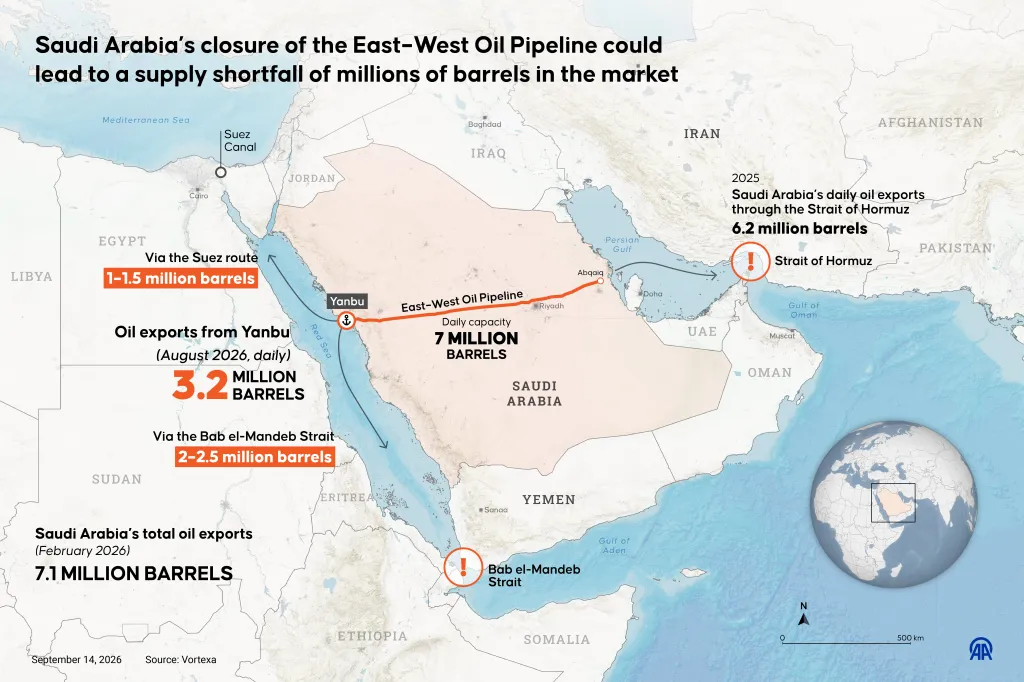
The decision was prompted by repeated Houthi missile and drone attacks as well as suspected strikes from Iranian-backed militias in Iraq on Saudi Arabia’s oil infrastructure. Yanbu in particular is a key installation. As we have explained in the past, Saudi Arabia has diverted millions of barrels of oil per day through pipelines to its Yanbu port on the Red Sea in an effort to minimize the energy shortages due to the hostilities around the Persian Gulf.

ANKARA, TURKIYE - SEPTEMBER 14: An infographic titled "Saudi Arabia's closure of the East-West Oil Pipeline could lead to a supply shortfall of millions of barrels in the market" created in Ankara, Turkiye on September 14, 2026. (Photo by Murat Usubali/Anadolu via Getty Images)
An infographic illustrating how Saudi Arabia has diverted oil from the Persian Gulf to the Red Sea. (Photo by Murat Usubali/Anadolu via Getty Images) Anadolu

Before Macron’s announcement on Thursday, the Houthis claimed they had carried out two more waves of attacks on Saudi targets, including one on the Saudi Aramco facility in Yanbu, “using a number of ballistic and cruise missiles, as well as drones.”

In addition, the Houthis claimed they struck Riyadh.

There was no immediate Saudi confirmation of an attack on the Saudi capital. Saudi civil defense did not issue an emergency alert for Riyadh on Thursday.

Earlier in the day, the Houthis said they struck “enemy command and control centers, operations rooms, weapon depots, missile launch platforms, and military sites belonging to Saudi-led enemy formations in Jizan,” a Red Sea port city.

“The Saudi-led military coalition in Yemen said on Thursday that it had shot down six ballistic missiles fired by the Iran-backed Houthi militia, in what appeared to be one of the largest cross-border attacks by the group since its conflict with Saudi Arabia [flared back up],” The New York Times reported.

The missiles were aimed at the Saudi cities of Taif and Yanbu, Maj. Gen. Turki al-Maliki, a spokesman for the Saudi-led coalition, claimed on X. “Escalations and violations by the terrorist Houthi militia will be dealt with firmly,” he stated, without specifying where the missiles were intercepted.

TWZ cannot independently verify any of these claims.

Today’s attacks are the latest in the escalating conflict between the Houthis and Saudi Arabia. Earlier this year, the Houthis imposed a blockade on the Bab al-Mandab Strait (BAM) and began striking Saudi ships in the southern part of the Red Sea as well as critical energy terminals on that body of water and Saudi refineries. Iranian proxies have also struck the vital East-West pipeline that carries oil to the Red Sea to bypass the Strait of Hormuz, where Iran vastly curtailed shipping after the launch of Operation Epic Fury. The East-West pipeline reportedly reopened after being shut down following a long-range drone attack.

The Saudi Arabian East-West pipeline after it was damaged by an attack. Satellite image ©2026 Vantor

The stark reality facing Macron is that if Saudi oil infrastructure and transport nodes near the Red Sea are destroyed or the pipeline that feeds it is shut down for months the last major oil lifeline from the region — and especially to Europe — will be closed off, sparking a deeper energy crisis.

Iran has already severely curtailed the flow of oil through the Strait of Hormuz since the U.S. and Israel attacked it on Feb. 28. The movement of oil has been further impeded by a U.S. blockade on Iranian ports. However, transits have been increasing as of late, thanks in large measure to U.S. military escorts that U.S. Central Command claims have allowed more than a billion barrels of crude to pass through the Strait of Hormuz. Still, the traffic is far below what it was before the war broke out.

Having both the Strait of Hormuz largely closed and energy exports out of the Red Sea shut down simultaneously is a nightmare scenario. By Thursday evening Eastern time, the per-barrel price of Brent crude oil shot up to nearly $107, according to OilPrice.com. It had fallen below $100 per barrel just two days earlier.

Given all this, the French president sought to offer reassurance about oil supplies, according to France 24.

“He said he had carried out ‘intense diplomatic activity,’ meeting in recent weeks with the leaders of Saudi Arabia, Iraq and Nigeria, all hydrocarbon suppliers, to ensure France keeps receiving the same volumes,” the publication noted.

“We have replenished gas stocks and also oil stocks” for the months ahead, the French president also said.

Macron’s decision follows one by the U.K.’s  Royal Air Force (RAF) on Tuesday to deploy one of its Voyager aerial refueling jets to help Saudi Arabia defend against Houthi attacks. As with the French move, it is a response to concerns about the flow of oil.

“Escalating tensions in the Gulf could have negative consequences here in the UK—such as rising prices, disruptions to energy supplies, and increased costs for British businesses,” the U.K. Defense Ministry (MoD) explained in announcing the deployment. “The Houthis pose a threat to stability in the Middle East; therefore, it is in the UK’s national interest—economically and in terms of security—that they do not succeed in their aims.”

“We unequivocally condemn Houthi attacks on Saudi Arabia, and our position is clear: both Saudi Arabia and the Yemeni government have the right to self-defense,” the ministry added. 

The jet will operate from a U.K. air base in Cyprus and will begin air-to-air refueling operations in the coming days, the BBC reported.

RAF sending voyager to defend against Houthi attacks.
A Royal Saudi Air Force Voyager aerial refueling jet. (Air Tanker)

The French and British deployments contrast decisions by the U.S. and other nations not to get involved with the Saudi-Houthi fight.

Last week, Trump turned down a direct plea from Saudi Crown Prince Mohammed bin Salman, the Kingdom’s de facto leader, to attack the Houthis. Meanwhile, Pakistan and Turkey, which signed the Mecca Joint Defense Agreement with Saudi Arabia, have yet to provide any direct military aid. The pact holds that an attack on one is considered an attack on all; however, it doesn’t stipulate exactly what actions should be taken.

The security situation in Yemen has drastically deteriorated since the launch of Epic Fury after the Houthis joined the U.S.-Iran conflict on the side of their major supporter.

The Houthis have been directly attacking Saudi Arabia over claims that the kingdom has imposed a blockade on them. Beyond that, the mostly dormant civil war between the Houthis and internationally recognized Yemeni government forces, backed by Saudi Arabia, reignited in the wake of operation Epic Fury. The Houthis have made large territorial gains in the renewed conflict, including capturing the port city of Mokha and two key islands in the Red Sea. This has strengthened the Houthi hold on the BAM. You can read more about that in our story here.

The civil war in Yemen erupted in 2014 and expanded a year later when a Saudi-led coalition joined forces with the government ousted by the Houthis. The fighting between Saudi-led forces and the Houthis largely abated after a tenuous ceasefire took hold in 2022. The Saudis held off on getting involved in the recent Red Sea conflict, which saw the U.S. and coalition warships duking it out with the Houthis and eventually led to a U.S.-led air campaign over Yemen. The United Kingdom was another significant player in that air campaign.

Meanwhile, exacerbating concerns about the flow of oil from the Red Sea, “a senior adviser to Iran’s supreme leader warned Thursday that Iranian forces and their Houthi allies in Yemen could respond to any new U.S. attacks by opening ‘a new front’ in its war with the U.S. by targeting energy supplies in the Red Sea,” CBS News reported.

The statements came after U.S. President Donald Trump on Wednesday once again threatened Iran.

“Will a deal be made with Iran that lets them rebuild and create a far greater country than it ever was before?” Trump asked rhetorically. “Or do I annihilate the Islamic Republic and do it quickly, never giving them a chance to kill and destroy people and countries again?”

Trump added that he believed he would make a peace deal with Iran after the upcoming U.S. midterm elections, which will decide the control of Congress.

As we noted yesterday, with gasoline and diesel price increases damaging the economy, the war and Trump’s handling of it have been unpopular with voters.

The fact that France is sending forces to Saudi Arabia is an ominous development and another indication that the current spate of unrest that began with Epic Fury does not appear to show any signs of ending anytime soon.

Contact the author: howard@twz.com 

Howard is a Senior Staff Writer for TWZ. He writes frequently about conflict, focusing heavily on the Middle East and Ukraine, and interviews with military and intelligence officials and industry leaders from around the globe. He lives near Tampa, Florida, home of U.S. Central Command, U.S. Special Operations Command.


Source link

Turkiye backs Saudi Arabia’s security amid escalating Houthi attacks: FM | GCC News

Fidan highlights Turkiye’s readiness to assist Saudi Arabia militarily, as Houthi attacks escalate in Yemen.

Turkish Foreign Minister Hakan Fidan has said that Saudi Arabia may have unmet military needs from the attacks by Yemen’s Houthi rebels and that Turkiye would consider how to support the kingdom as part of a trilateral defence pact.

Speaking to Turkish broadcaster NTV on Friday, Fidan said it was unacceptable for Saudi Arabia to be dragged into the US-Iran war, adding that Riyadh had no desire to join the conflict.

Recommended Stories

list of 3 itemsend of list

He added that proposals had been conveyed to all sides in an effort to end the fighting, without further elaborating.

The Iran-backed Houthi rebels and Saudi Arabia continue trading attacks in an escalating war in Yemen, as the Houthis press gains that have brought large stretches of the Red Sea coast, including the strategic Bab al-Mandeb Strait, under their control.

Pakistan has made a similar pledge to defend Saudi Arabia under the defence pact.

Lieutenant-General Ahmed Sharif Chaudhry, a spokesperson for Pakistan’s military, told Arab News on Thursday that Islamabad would defend Saudi Arabia “to any extent”, including “physically”, though he did not say whether Riyadh had asked for more Pakistani troops.

Pakistan’s Foreign Office has said no military response is currently under discussion under the pact, adding that Islamabad would act “when time comes”.

The trilateral agreement, known as the Mecca Joint Defence Agreement, was signed on August 7 in Mecca by Saudi Crown Prince Mohammed bin Salman, Turkish President Recep Tayyip Erdogan and Pakistani Prime Minister Shehbaz Sharif.

The three countries formally named the arrangement the Mecca Defence Alliance on August 31, after officials meeting in Istanbul agreed to set up a secretariat in Riyadh, to be headed initially by a Pakistani secretary-general.

Its founding principle is that an armed attack against any one of the three states will be treated as an attack against all three.

Fidan said at the time the alliance was built on “respecting the sovereignty of other states, territorial integrity and not intervening in internal affairs”, and remained open to other countries joining.

Analysts have questioned how much substance lies behind the pact so far, noting it lacks the integrated command structure and standing forces that underpin NATO.

Its institutional shape, including how the mutual defence clause would actually be triggered, remains unclear.

The trilateral pact was struck as Gulf states grow increasingly concerned about being pulled into the wider US-Iran war, which has continued for more than six months since Washington and Israel first struck Iran in February.

Source link

Arab News | Saudi Arabia’s TASI maintains level to close at 10,779

JEDDAH: Saudi Arabia’s Tadawul All Share Index held firm on Wednesday, losing just 1.66 points, or 0.02 percent, to close at 10,779.96 

As investors traded around 168 million shares worth nearly SR3.5 billion ($933 million), 113 stocks advanced and 147 declined. 

The Kingdom’s parallel market Nomu lost 2.77 points, or 0.01 percent, to close at 21,376.05, with 30 companies gaining and 33 declining. The MSCI Tadawul 30 Index also fell 0.08 points, or 0.01 percent, to close at 1,450.01. 

Market movers 

The main market’s top performer was Raydan Food Co., whose share price increased 10 percent to end the session at SR16.28, while Nofoth Food Products Co. recorded a 9.87 percent increase to close at SR6.57.

Ataa Educational Co. also increased 4.75 percent to end the day at SR42.76. 

On the losing side, Armah Sports Co. decreased 4.92 percent to close at SR67.60, while Flynas Co. declined 4.46 percent to end the session at SR42.02.

Sumou Real Estate Co. also declined 4.13 percent to close at SR25.08. 

Corporate disclosures 

Saudi Vitrified Clay Pipes Co. said Laffan Pipes Co., or Laffan Saudi, has been converted from a one-person limited liability company into an unlisted Saudi joint stock company with issued capital of SR45.5 million, according to a Tadawul filing. 

Laffan Pipes Factory Co. of Qatar has completed its admission as a shareholder through a capital increase against an in-kind contribution, giving it a 45 percent stake in Laffan Saudi, while SVCP retains the remaining 55 percent. 

Laffan Saudi’s issued capital comprises 45.5 million ordinary shares, each with a nominal value of SR1, and has been fully paid through in-kind contributions.  

The development follows an MoU signed between the two companies in February 2024 and a partnership agreement signed about six months later. 

SVCP’s shares declined 3.12 percent to close at SR17.99. 

In another disclosure, Umm Al-Qura for Development and Construction Co. said it signed an agreement to sell a 2,500-sq.-meter plot within Masar Destination in Makkah to Rawajeh Real Estate Co. for SR168.91 million. 

The boulevard-facing plot, located in Zone 2 of Masar Destination, has a book value of SR76.01 million. 

Umm Al-Qura, whose shares rose 2.50 percent to SR17.20, said the sale is part of its development strategy for Masar Destination, with the plot to be developed as a residential tower.

The transaction is expected to have a positive impact on liquidity and financial results, with proceeds to be used to finance working capital and ongoing projects. 

In a separate Tadawul filing, CATRION Catering Holding Co. said it signed an agreement with Air Arabia DMM Co. to provide inflight catering services under a five-year contract valued at an estimated SR200 million.  

Under the agreement, CATRION will provide inflight catering services, sell onboard food, beverages and other supplies, and provide logistics services to Air Arabia.  

The agreement was signed on Sept. 15 and is expected to have a financial impact beginning in the fourth quarter of 2026. 

CATRION, whose share price fell 0.74 percent to SR67.25, said the agreement is part of its strategy to sustain business, strengthen long-term partnerships with airline-sector clients, support growth, diversify revenue streams and enhance operational efficiency. 


Source link

Arab News | Citigroup tells Asharq Bloomberg: Investors are confident in Saudi Arabia’s ‘long-term’ economic story

RIYADH: David Livingstone, chief client officer at Citigroup, believes investor appetite for Saudi debt issuances reflects confidence in the Kingdom’s long-term story, while Gulf countries remain capable of maintaining their positive performance in debt markets despite higher yields and increased global supply.

Livingstone said in an interview with Nour Amache on the “East-West” program on Asharq Business with Bloomberg that the performance of Saudi sovereign issuances, as well as those of the Public Investment Fund, demonstrated the resilience of Saudi Arabia’s market and continued demand from international investors, despite the obstacles created by the Iran war this year.

Livingstone’s comments came after the Kingdom raised $3.25 billion through international sukuk in early September, attracting orders of around $16.5 billion, or more than five times the issuance size. Saudi Arabia tightened the pricing spread by about 30 basis points from the initial guidance.

The Citigroup head added that the pricing adjustment “demonstrates confidence in this long-term story,” placing it within the context of the transformations underway in the Kingdom under Vision 2030.

The comments came after Citigroup helped its clients in Saudi Arabia raise more than $40 billion since the beginning of the year. The bank also decided to increase its direct exposure limits to the Kingdom after it demonstrated “strong economic and financial resilience,” according to CEO Fahad Al-Deweesh.

Debt-market pressures

Higher global yields and increased government borrowing will give investors a wider range of choices in the bond market, Livingstone said, noting upward pressure on yields amid abundant debt supply in emerging markets, Europe, the UK and the US.

Despite this, he said that “Saudi Arabia, and Gulf countries as a whole, can continue this positive performance compared with the recent past.”

Yasir Al-Salman, chief financial officer at the Public Investment Fund, told Asharq Business with Bloomberg that international debt markets would remain the fund’s largest source of financing. The fund had around SR3.4 trillion ($906.1 billion) in assets under management after injecting about SR750 billion into the Saudi economy over five years.

Debt instrument pricing in the Kingdom is linked to US bond yields, which have recently been elevated. The yield on the 10-year US Treasury continued to rise for a fifth consecutive session on Sept. 14, exceeding 5 percent, its highest level since 2023.

Are investors affected by project reviews?

Asked about the effect of media reports concerning the postponement or reassessment of some projects in Saudi Arabia on foreign investor appetite, Livingstone said this did not change the fundamental basis of investor interest in the Kingdom. He said economic diversification remained “the attractive factor for investors,” as infrastructure development and projects connected to the economic transformation continued.

He added that the review was “justified” in light of the economic circumstances surrounding the projects being financed, with attention focused on their feasibility and sustainability.


Source link

Arab News | Saudi Arabia’s consumer spending holds steady at $4.2bn

RIYADH: Saudi Arabia’s consumer spending held steady at SR15.8 billion ($4.2 billion) in the week ending Sept. 5, even as education-related transactions pulled back following the previous week’s back-to-school surge, official data showed. 

The Kingdom’s point-of-sale transactions edged up 0.2 percent from the previous week, while the number of transactions rose 4.8 percent to 267.75 million, according to figures from the Saudi Central Bank, also known as SAMA.

The largely flat overall spending masked a sharp correction in education-related transactions, which fell 31 percent week on week to SR755.97 million, after climbing well above SR1 billion as the new academic year got underway. 

Talking to Arab News, economist Talat Hafiz said the pattern suggests that Saudi consumer demand is becoming broader, more normalized, and more resilient, rather than being driven mainly by seasonal spikes such as back-to-school spending. 

“The rise in transactions even as education spending normalizes indicates that households are continuing to spend across a wider range of goods and services,” he added.  

“Overall, this points to solid underlying household spending capacity heading into the last quarter of the year, particularly as inflation remains contained and employment and income conditions continue to support consumption,” said Hafiz. 

Sectoral spending 

According to SAMA, spending on food and beverages amounted to SR2.69 billion, representing a weekly increase of 3.9 percent. 

Transactions in restaurants and cafes stood at SR1.81 billion, up 1.9 percent, while spending on apparel, clothing and accessories totaled SR1.28 billion, down 9.6 percent. 

The transportation sector witnessed POS transactions worth SR1.15 billion, followed by spending at gas stations at SR1.1 billion. 

Across healthcare, the value of transactions stood at SR964.71 million, up 7.9 percent, while spending on professional businesses and services amounted to SR906.1 million, up 3.8 percent. 

Jewelry stood out as the week’s biggest gainer, with transactions surging 25.4 percent week on week to SR345.61 million, while books and stationery reversed course, falling 8.6 percent to SR182.49 million after the previous week’s back-to-school jump. 

Geographic breakdown 

Riyadh dominated POS transactions, with spending in the capital reaching SR5.53 billion, marking a 0.6 percent increase compared with the previous week, as the number of transactions climbed 5.6 percent to 88.2 million. 

Jeddah witnessed transactions amounting to SR2.14 billion, up 1.4 percent, while the total number of transactions stood at 29.68 million. 

In Dammam, consumer spending totaled SR762.42 million, roughly flat from the week before, followed by Makkah at SR614.20 million, down 1.9 percent, and Madinah at SR592.46 million, down 4.1 percent. 

Alkhobar recorded SR427.12 million in transactions, down 2.3 percent, while spending in Buraidah rose 2.9 percent to SR403.31 million.

Abha posted the sharpest citywide decline at 7.5 percent, with transactions falling to SR199.18 million. 


Source link

Arab News | Saudi Arabia’s historic Munikh Observatory showcases Najdi architectural ingenuity

RIYADH: Perched atop Mount Munikh west of Al-Majmaah, the historic Munikh Observatory offers a striking example of how traditional Najdi builders used natural terrain and local materials to defend settlements and monitor the surrounding landscape.

Rising about 25 meters above the mountain, the watchtower commands panoramic views of Al-Majmaah and the surrounding farms. Its elevated position once allowed guards to watch approaches to the settlement through narrow openings built into its thick walls.

Historical sources, including writings by Al-Hamdani, associate the name “Munikh” with an ancient town near the mountain. The observatory’s origins are traditionally dated to the 15th century, with the watchtower at the summit specifically dated to 820 AH, or 1417 CE.

What was once a military outpost overlooking a Najdi settlement has been transformed into a year-round cultural destination.

The site was traditionally known as a marqab, or observation post, and formed part of a broader defensive network surrounding the settlement. A stone wall once encircled Al-Majmaah, following the mountain’s natural ridges and incorporating three defensive bastions.

Much of the ancient outer wall was absorbed by modern urban development, but the section on Mount Munikh remains preserved. Its features include thick, tapering stone foundations and strategically placed firing slits designed for defense and surveillance.

The main structure consists of two cylindrical towers, one nested within the other, rising about 12 meters. Local stone was used for the lower sections, while the upper levels were built of mud brick. Tamarisk wood was used for ceilings and lintels, reflecting the builders’ reliance on materials readily available in the Najd environment.

Five projecting defensive balconies strengthened the structure, with four positioned to protect the flanks and another covering the main entrance. The towers are topped with traditional Najdi crenellations, while specialized openings allowed defenders to monitor and respond to threats.

Rising about 25 meters above the mountain, the watchtower commands panoramic views of Al-Majmaah and the surrounding farms

The observatory originally served as an early-warning post, with night-fire beacons used to signal approaching danger. Following the unification of the Kingdom, its vantage point was also used to monitor trade caravans, seasonal floods and pilgrim routes.

Mount Munikh occupies a strategic position in the historic Sudair region of the Najd plateau, about 180 kilometers northwest of Riyadh. Al-Majmaah was once known as “Baldat Munikh,” reflecting the mountain and its importance to the settlement.

The Heritage Commission has in recent years restored the observatory and sections of its fortified walls, adding visitor paths, stone staircases and lighting to improve access while preserving the site’s historic character.

Much of the ancient outer wall was absorbed by modern urban development, but the section on Mount Munikh remains preserved. (SPA)

A Visitor Center now provides an introduction to the history of Al-Majmaah, Mount Munikh and the watchtower. Bilingual interactive exhibits and guided stations offer visitors a closer look at the region’s architectural and defensive heritage.

What was once a military outpost overlooking a Najdi settlement has thus been transformed into a year-round cultural destination, linking Al-Majmaah’s modern visitors with the landscape and traditions that shaped its past.

Source link