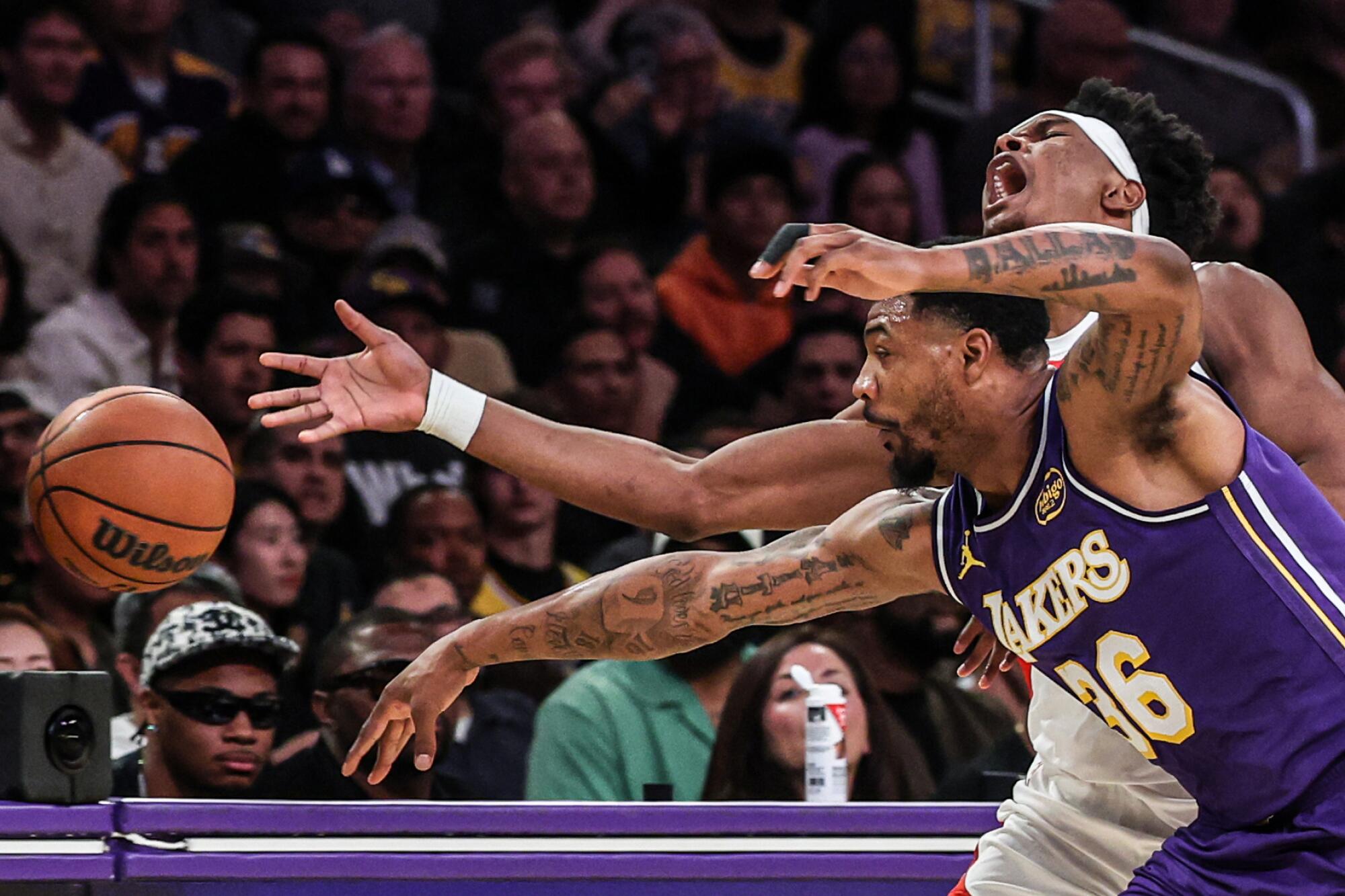
Nov. 12, 2025, in Oklahoma City Thunder 121, Lakers 92 Neither team was at full strength with James sidelined because of sciatica and the Thunder without Luguentz Dort and Jalen Williams. Oklahoma City still dominated behind an effortless 30-point, nine-assist night from Shai Gilgeous-Alexander. It was the largest defeat of the season for the Lakers until April.
Feb. 9, in Los Angeles Thunder 119, Lakers 110 Both teams were without their MVP candidates as Gilegous-Alexander sat because of a strained abdominal muscle and Doncic was sidelined by a hamstring injury. The Thunder proved their depth and chemistry by holding off the Lakers in the fourth quarter. This was one of just eight clutch-time losses for the Lakers during the regular season.
April 2, in Oklahoma City Thunder 139, Lakers 96 The nightmare score wasn’t as scary for the Lakers as seeing their two leading scorers injured in the same game. Reaves played through what was later diagnosed as a Grade 2 oblique muscle strain, and Doncic left in the third quarter with a Grade 2 left hamstring strain. The game was expected to be a major showdown between MVP candidates and a litmus test for the Lakers, who entered with 13 wins in their previous 14 games.
April 8, in Los Angeles Thunder 123, Lakers 87 The Lakers were without four starters and still reeling from the regular season-ending injuries suffered by Doncic and Reaves the previous week. Matching up with the Thunder again only exacerbated the emotional hangover. Redick tried to inject some energy into the group by benching veterans Rui Hachimura and Jarred Vanderbilt for small mistakes early, but the coach later admitted the tactic didn’t work.
History eluded. Embarrassment avoided. Belief restored.
The most secure legacy played with the most desperation. The most creaky veteran played with the most aggression. The winningest superstar played like he had everything to lose.
Wow. Gasp. LeBron!
So it went at Houston’s Toyota Center on Friday night when the Lakers, just two losses from becoming the first team in NBA history to blow a three-games-to-none lead, blew away the Rockets 98-78 to win their first-round series four games to two.
It was a night that prevented possibly the greatest meltdown in NBA history. It was a night that celebrated possibly the greatest player in NBA history.
“Started with LeBron,” Marcus Smart said. “The OG came out.”
When the shorthanded Lakers needed him most, their ageless 41-year wonder indeed showed up huge, James fighting down the lane, throwing in from deep, finding teammates like the sizzling Rui Hachimura and the surging Austin Reaves, leading with his entire massive being.
James wasn’t going to be on the wrong side of history. He wasn’t going to further stain his sterling 42-13 close-out record. He wasn’t going to let his final season end so early.
Wait a minute, this is not his final season? Not a chance. Bury any lingering doubt. After watching him dominate the youngest starting five in these playoffs Friday, it is impossible to imagine he’s going to call it quits.
He scored a game-high 28 points while enduring a team-high 37 minutes. He had eight assists, seven rebounds and only three turnovers. He even played defense, as the Lakers were a game-best plus-26 when he was on the court.
His night ended with him appropriately surrounded in the locker room by teammates who were bleating like goats. Because he’s the, well, you know.
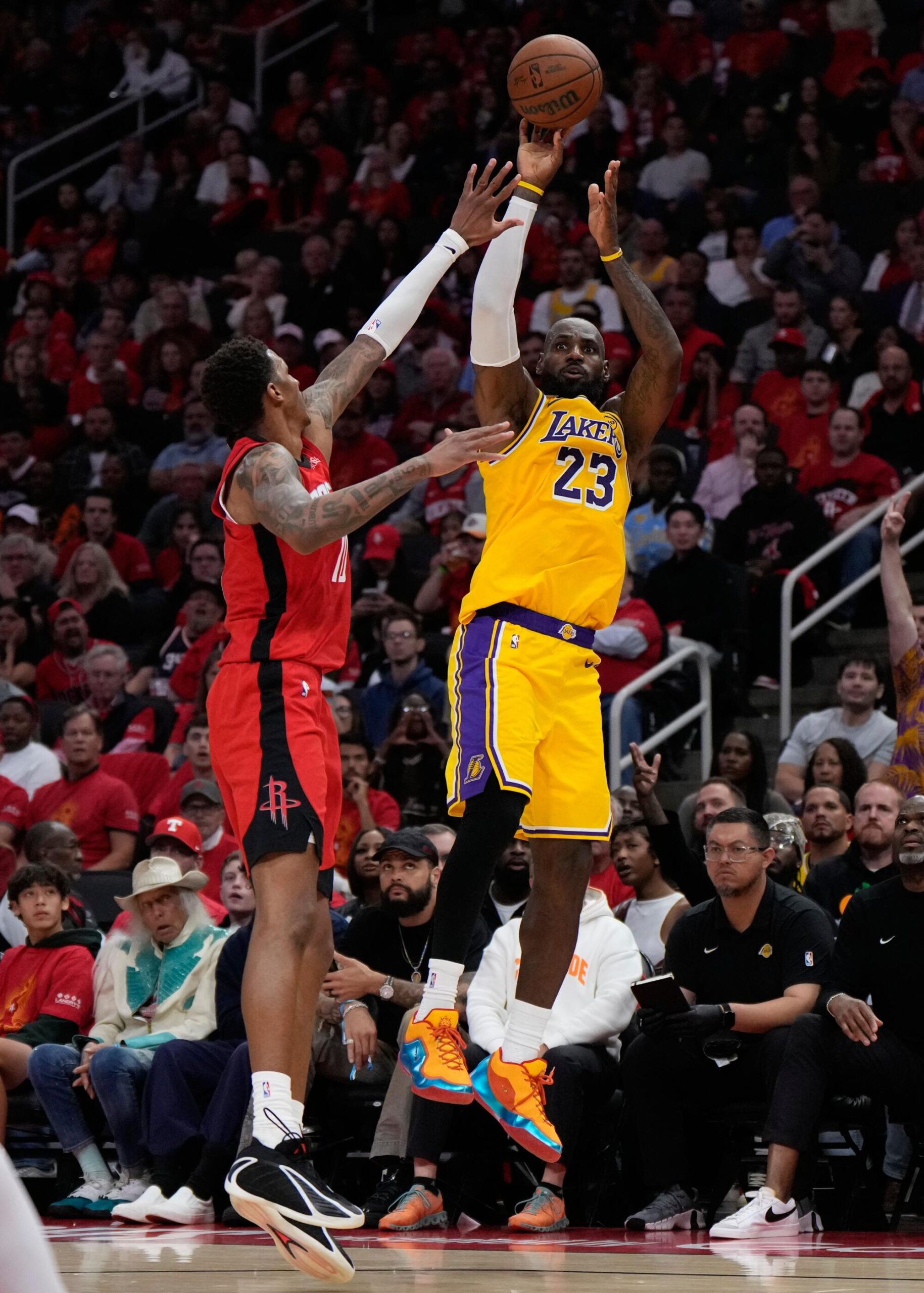
Lakers forward LeBron James shoots over Rockets forward Jabari Smith Jr. during the first half of Game 6.
(Ashley Landis / Associated Press)
“It speaks to his greatness,” Lakers coach JJ Redick said, and, yeah, somebody must be great if they can induce grown men to imitate farm animals. “To me he’s had the greatest career of any NBA player … for him to do it again and answer the bell again, it’s … baffling in some ways.”
From the frying pan to the fire, the Lakers now travel to Oklahoma City to face the defending champion Thunder in the Western Conference semifinals beginning Tuesday.
This could get real ugly, real quick.
The Lakers won’t have injured leading scorer Luka Doncic for the foreseeable future. They will be playing a Thunder team that drubbed them in the regular season, including a 43-point stomping just last month.
The Lakers don’t stand a chance. They’ll be lucky to avoid a sweep. They should quit while they’re ahead.
Which is exactly what everyone said about them before this Rockets series, before they took advantage of a Kevin Durant injury and Reaves’ return from injury, before they revealed a sense of focus and connection completely unexpected from this disjointed group.
Before James decided he wouldn’t let them lose.
“We had some obstacles obviously and I know they were without guys as well, but I thought we answered the call,” James said. “I thought we answered the challenge, and for them to allow me to lead them, that means a lot to me.”
Truly, lost in all the criticism over the last two Lakers losses was the truth that they never should have been in this position in the first place.
Consider this near miss one of James’ greatest postseason achievements. Consider his first playoff series win a huge endorsement for Redick as coach. Consider any positivity that comes from the Oklahoma City series as pure gravy.
Lakers forward LeBron James scores on an uncontested layup after blowing past the Rockets defense during the first half of Game 6.
(Ashley Landis / Associated Press)
“For us to be written off a few weeks ago and to win a playoff series is a big deal,” Redick said. “And it speaks to the character of our team and the leaders of our team that they didn’t let go of the rope.”
James led the Lakers to a five-point lead in the first quarter, then absolutely dominated with a 14-point second quarter in which he outscored the entire Rockets team and gave the Lakers an 18-point halftime lead that never was challenged.
See if you can follow along …
James hits a fallaway. Jake LaRavia races down for a layup. Smart draws a charge. James hits a three. James hits a spinning layup. LaRavia connects on a fastbreak jam. James sinks another layup.
For those breathlessly keeping score, the Lakers began that second quarter with a 9-0 run that, dating to the first quarter, was an incredible 21-2 smackdown. At one point the Rockets missed a dozen straight shots. At another point they were 0 for 15 in the quarter.
The Rockets momentarily stopped the bleeding with six consecutive points late in the half, but on James’ last-minute trey, the Lakers finished the quarter on a 7-0 run to take a 49-31 halftime lead.
”He just has this ability to set the tone for the entire group,” Redick said. “He did that again tonight and the guys responded.”
James scored on a jump shot just seconds into the third quarter and the rout continued. Houston, which made only six baskets in the quarter, mounted a bit of a surge late in it, but Smart ended any momentum by drawing his third charge of the night.
“I love charges,” Smart said. “They’re demoralizing.”
Redick angrily called a timeout with 6:28 remaining in the game after a defensive lapse with the Lakers leading by 19. James fittingly scored on a layup immediately after the timeout, and the game was formally finished.
The Lakers’ defense was astounding, holding the Rockets to 13 points below their season low. The Lakers’ rebounding was astonishing, nearly doubling the offensive rebounds of the NBA’s best offensive rebounding team.
The Lakers offensive collective also was cool, Hachimura hitting five of seven treys, Reaves scoring 15 points with three blocked shots, and Deandre Ayton finishing a fine series with 16 rebounds.
But this was about the OG, who noted that he is finally comfortable celebrating small victories and said, “I think we should be proud of the way we handled this.”
The individual performances in the Lakers’ ugly, but decisive, 98-78 series-clinching win over the Houston Rockets on Friday were almost too numerous for coach JJ Redick to focus on each one.
That collective spirit is also what makes him so confident heading into the Lakers’ first Western Conference semifinal appearance since 2023.
“For us to be written off a few weeks ago and to win a playoff series is a big deal,” Redick said after the Lakers polished off their first-round playoff series in six games. “And it just speaks to the character of our team and the leaders of our team. They didn’t let go of the rope.”
After winning a series in which they were underdogs for every game they won, the Lakers return to the scene of their lowest moment to face the Oklahoma City Thunder in the Western Conference semifinals beginning Tuesday.
The last time they were in Oklahoma City, the Lakers lost by 43 points. Their two best players sustained regular-season ending injuries, with news of Luka Doncic’s hamstring injury and Austin Reaves’ oblique strain coming on consecutive days after the loss. Still dazed from the emotional hangover, the Lakers lost their next two games.
“There was a lot of question marks,” Reaves said. “And just the way that we responded as a group, I think it just tells you a lot about the people that we have in our room. There’s no quit.”
The Lakers finished the regular season with three consecutive wins. They leapt out to a 3-0 series lead against Houston before letting doubt creep in again. After the Lakers squandered two chances to end the series, including a disappointing home loss Wednesday when Reaves returned from injury, critics wondered if the Lakers would really be the first team in NBA history to blow a 3-0 playoff lead.
James wouldn’t allow it.
The superstar forward dominated with 28 points on 10-of-25 shooting, seven rebounds and eight assists. He outscored the Rockets by himself in the second quarter 14-13 as the Lakers went on a 27-3 run to open a 19-point lead.
“We understand that he’s the guy that brings energy, but also we have to help him,” forward Rui Hachimura said, “especially you know, he’s old now.”
Hachimura didn’t try to suppress a smile.
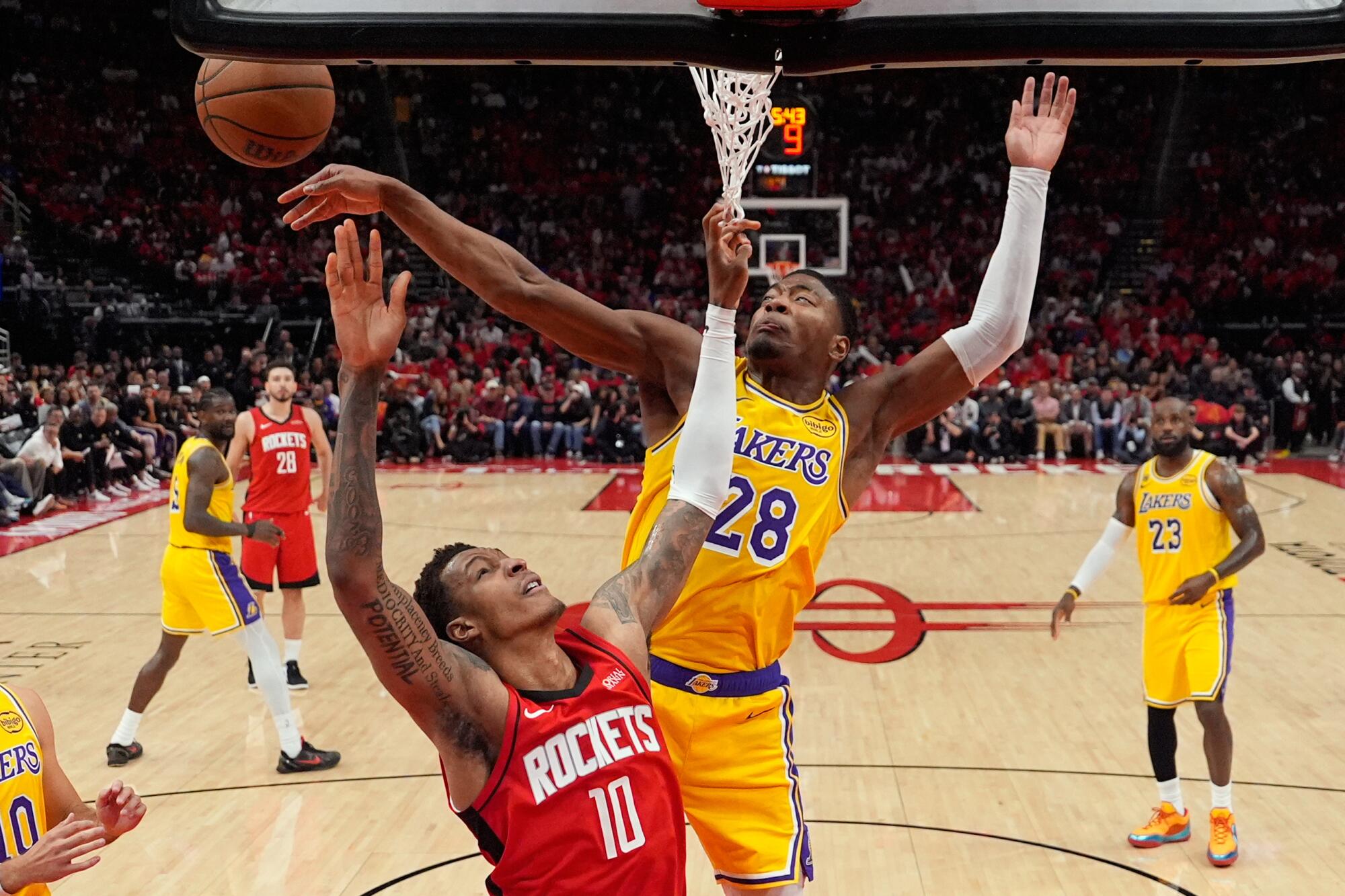
Lakers forward Rui Hachimura blocks a shot by Rockets forward Jabari Smith Jr. during the first half of Game 6.
(Ashley Landis / Associated Press)
The Japanese forward did his part with 21 points, including five three-pointers. Smart leapt for a jaw-dropping block against 6-foot-8 Tari Eason and drew three charges. Ayton had 16 rebounds, helping the Lakers outrebound the best rebounding team of a generation 54-45.
Ayton, often maligned for his inconsistent effort, has been a force in the postseason, averaging 11.8 points and 10.8 rebounds while often guarding Rockets All-Star Alperen Sengun one-on-one.
“He’s been saying it all year: ‘Wait till I get to the playoffs,’” Smart said of Ayton. “It’s a different side of him that fans haven’t seen, that we expect, that we know he can give. He knows it and he’s ready.”
In his second game back from injury, Reaves had 15 points on seven-of-14 shooting with three blocks. He missed all four of his three-point attempts, still searching for his shooting rhythm after a long layoff. But the way Reaves attacked his treatment and returned before the typical four- to six-week timeline was his own form of leadership, Redick said.
Reaves sometimes left his house at 7:30 a.m. and didn’t return until more than 12 hours later. He drove all over L.A. looking for different treatment options. He did everything short of following Doncic to Europe, Reaves joked.
Doncic’s status is still unknown for the beginning of the conference semifinals. He has yet to progress to live play on the court, although he recently started incorporating movement into his on-court drills instead of just stationary shooting. He is still out indefinitely.
Without the star point guard, the Lakers could confidently turn to James to steer them through choppy waters. He averaged 22.8 points, 7.2 rebounds and 8.3 assists in the first-round series. At one point during Friday’s game, Reaves approached him to just tell him his performance was “insane.”
“I don’t think you can say in words how special he was,” Reaves said, “not just tonight but this series, this year.”
In the locker room after the game when the Lakers prepared to break their last huddle, the lights suddenly clicked off. Players started bleating, serenading James with sounds deserving of the G.O.A.T. — greatest of all time.
Containers for export are stacked at a port in Pyeongtaek, around sixty kilometers south of Seoul, South Korea, 22 February 2026. Photo by YONHAP /EPA
May 1 (Asia Today) — South Korea’s exports rose 48% from a year earlier in April, staying above $80 billion for the second consecutive month, government data showed Friday.
Exports totaled $85.89 billion, the second-highest monthly figure on record after $86.6 billion in March, according to the Ministry of Trade, Industry and Energy.
The increase was driven by strong semiconductor shipments, which surged 173.5% to $31.9 billion on rising demand tied to artificial intelligence. Chip exports exceeded $30 billion for the second straight month and set an April record.
Daily average exports, adjusted for working days, rose 48% to $3.58 billion, staying above $3 billion for a third consecutive month.
Auto exports fell 5.5% to $6.17 billion due to logistics disruptions from the Middle East, U.S. tariff effects and expanded overseas production. Exports of electric and hybrid vehicles continued to grow.
Petroleum product exports rose 39.9% to $5.11 billion by value due to higher oil prices, though shipment volume dropped 36% because of export controls on gasoline, diesel and kerosene.
Petrochemical exports increased 7.8% to $4.09 billion, while shipment volume fell 20.9% as companies expanded domestic supply.
Computer exports jumped 515.8% to $4.08 billion, and wireless communication device exports rose 11.6% to $1.62 billion.
By destination, exports to China rose 62.5% to $17.7 billion, marking six straight months of gains. Shipments to the United States increased 54% to $16.33 billion, while exports to the Association of Southeast Asian Nations rose 64% to $15.41 billion.
Exports to the European Union increased 8.5% to $7.19 billion. Shipments to the Middle East fell 25.1% to $1.27 billion due to logistics disruptions.
Imports rose 16.7% to $62.11 billion. Energy imports increased 7.5% to $10.61 billion, while non-energy imports rose 18.8% to $51.51 billion.
South Korea posted a trade surplus of $23.77 billion in April, extending its surplus streak to 15 months.
The Lakers needed it, of course. The Lakers wanted it.
The Lakers are paying for it.
Because LeBron James hasn’t looked superhuman since playing those 45 minutes, including all five gutsy minutes of ovetime.
He hasn’t looked great.
Not even particularly good, not by his lofty standards.
And the Lakers need their not-quite-ageless wonder to be at least great to beat these Houston Rockets one more time. They need James’ best can-you-believe-he’s-41? act if they hope to close out this challenging best-of-seven first-round series without Luka Doncic.
The Lakers went up 3-0 largely thanks to James’ contributions.
After weeks of willingly playing third-wheel behind Doncic and Austin Reaves, James made it look like playing the alpha was like riding a bike in Game 1’s 107-98 victory: He got right on it and gave the Lakers 19 points, 13 assists and eight rebounds.
Then James had 28 points in the 101-94 victory in Game 2. And there was his monster effort in Game 3, when he had 29 points and 13 assists and, in overtime, a key steal and block in the Lakers’ 112-108 victory.
But James has been much more mortal in the two games since, and the Lakers have lost both.
With a chance to finish off the Rockets in Game 4 on Sunday at the Toyota Center, James had almost as many turnovers as points: eight and 10, respectively.
With a second chance to finish off the Rockets in Game 5 at Crypto.com Arena on Wednesday, despite a second day of rest, James had a jagged performance that looked like a lot of work in the Lakers’ 99-93 loss.
He had a game-high 25 points on nine-of-20 shooting, but he missed all six of his three-point attempts. He smoked layups. And missed three of his 10 free-throws, short on those attempts like he was on many of his misses Wednesday.
And while he had only two turnovers, they were the type to turn a tide, the type we’re not accustomed to witnessing from James. That type the Lakers can’t afford for him to make.
If he were a quarterback, he could have been called for intentional grounding, he overthrew Rui Hachimura by so much in the second quarter, when the Lakers were trying — and failing — to hang onto their early lead.
And then James got rhe ball ripped away from him by Reed Sheppard, the Rockets’ 21-year-old, allegedly 6-foot-2 guard, who raced up the court for a fast break dunk with 2:22 to play. That made it 92-85 and effectively doused the Lakers’ comeback.
“Just bang-bang plays,” James said at his locker, with a shrug. “Try to flush this one … we got to be better on Friday.”
The Lakers will have just two more shots at winning a series they weren’t supposed to before it started.
Their third attempt at closing out the Rockets comes quickly, when they play Game 6 on Friday at Houston. The Lakers will need something resembling the best version of James if they’re going to win and avoid the spectacle of a Game 7 showdown Sunday.
That would bring the Lakers to the brink of becoming the first team in NBA history to blow a 3-0 series lead. It would be an unavoidable blotch at the bottom of James’ 23-season resume that otherwise is highlighted by a 3-1 comeback against the Golden State Warriors in the 2016 NBA Finals.
But James and the Lakers aren’t thinking about that now — or about whatever chatter is coming out of the Rockets’ now-confident camp (on Tuesday, Jabari Smith Jr. told reporters “We’re obviously the better team.”)
“Ask one of them young guys that question,” James said, unmoved. “I’m too old for that.”
But not too old — the Lakers hope — to carry them to one more victory and save them from infamy.
Marcus Smart knows what it feels like to be on the other side. The last time the Lakers guard was in the playoffs, he was helping the Boston Celtics storm back from a three-game deficit in the Eastern Conference finals to force a near-historic Game 7.
Now he’s watched the Lakers’ seemingly insurmountable three-games-to-none series lead dwindle to 3-2 after a 99-93 loss to the Houston Rockets on Wednesday at Crypto.com Arena. Smart isn’t flinching.
Whether defending a three-game lead or coming back from one, Smart knows the mindset is the same.
“We really got to literally go out there and be ready to die,” Smart said Wednesday after the Lakers failed to close out the Rockets for the second consecutive game. “… When I was on the other end, that was our motto: be willing to run through a wall and sacrifice your body for the betterment of the team. And that’s what we’re going to do now.”
Lakers guard Marcus Smart knocks the ball away from Rockets guard Amen Thompson during Game 5 at Crypto.Com Arena on Wednesday.
(Robert Gauthier/Los Angeles Times)
NBA teams are 159-0 with a 3-0 lead in a best-of-seven playoff series. Only four have even pushed it to the decisive Game 7. Smart’s 2023 Boston Celtics, when they clawed back against the Miami Heat in the Eastern Conference Finals, lost Game 7 at home after star Jayson Tatum turned his ankle on the first play of the game.
Hoping to avoid joining the historic list, the Lakers get a third try at vanquishing the Rockets for good in Game 6 on Friday at 6:30 p.m. PDT at Houston’s Toyota Center.
“Once we get on that plane and head down to Houston, we got to forget about it and understand what we are going for,” said LeBron James, who had 25 points and seven assists Friday. “It’s going to be even harder. Every game is hard. It’s so hard to close out a team in the postseason, to win a series, and this is our first time doing it as a unit.”
The Lakers built a three-game lead in the series despite playing without leading scorers Luka Doncic (hamstring) and Austin Reaves in the first four games. Reaves returned from a Grade 2 left oblique muscle strain Friday, scoring 22 points on four-of-16 shooting with six assists, but his presence couldn’t stop the gradual decline of the Lakers offense.
The Lakers have failed to reach 100 points in each of the last two games. From shooting 53.9% from the field and 51.7% from three in the first 10 quarters of the series, they have shot just 44.6% from the field and 29.2% from three in the last 10, excluding overtime of Game 3.
Luke Kennard, a flamethrower who scored 50 points in the first two games, has scored just eight in the last two. He was scoreless from the field Wednesday, including two missed three-pointers. A 91.2% free-throw shooter, Kennard even missed a free throw.
On the other hand, Houston has found its rhythm. The Rockets made 38.7% of their shots in the first 10 quarters — Games 1 and 2 and the first half of Game 3 — and have shot 46.3% in the 10 quarters since, excluding the Game 3 overtime period. Their three-point shooting has jumped from 30.9% to 34.1%.
“We just got to make shots,” Smart said of the offense’s struggles. “… And we’re not giving ourselves a chance by turning the ball over, which we can’t get a shot up on the rim because of that.”
The Lakers had 15 turnovers that resulted in 18 Rockets points Wednesday. The game started slipping away in the second quarter when they had five turnovers with the Rockets scoring nine points off the miscues. The Lakers let their 11-point first-quarter lead turn into a four-point halftime deficit.
Smart, who was asked to handle more ball-handling responsibilities while Doncic and Reaves were injured, had six turnovers and just two assists Friday. He called them “unacceptable.”
Rockets center Alperen Sengun yells out for the ball while Lakers guard Marcus Smart pressures the ball hander during Game 5 at Crypto.com Arena on Wednesday.
(Robert Gauthier/Los Angeles Times)
“The turnovers come in all shapes and sizes, and it’s about limiting them,” Lakers coach JJ Redick said. “And you certainly have to give your guys freedom to make basketball plays. I would say in general though, turnovers of aggression are OK; turnovers of passivity are not.”
The Rockets only averaged 8.5 steals per game during the regular season, but had two players in the NBA’s top 10 in total steals with guards Reed Sheppard (sixth, 122 total steals) and Amen Thompson (eighth, 119). They had three and four steals, respectively, in Game 5.
A defensive play from Sheppard stifled the Lakers’ late comeback. The Lakers trimmed a 13-point lead to three in less than three minutes. The cheer from the sold-out crowd at Crypto.com Arena was deafening when James kissed a left handed layup off the glass to pull the Lakers to within one possession with 2:59 left.
Sheppard immediately responded with a midrange jumper then picked James’ pocket on the next Lakers possession, going coast-to-coast for a two-handed dunk that pushed the lead back to seven with 2:20 remaining.
The crowd went silent.
The Lakers had that same stunning effect on a road crowd already this series when they stormed back from a six-point deficit in less than 30 seconds in Game 3. The prospect of doing it again with even larger stakes brought an excited smirk to Smart’s face.
“We knew this was going to be a tough series,” Smart said. “I think everybody knew that, and it’s turning out to be exactly what we expected. And now the fun begins.”
In 1789, George Washington was inaugurated as the first president of the United States.
In 1803, the United States more than doubled its land area with the Louisiana Purchase. It obtained all French territory west of the Mississippi River for $15 million.
In 1812, Louisiana entered the union as the 18th U.S. state.
In 1927, Douglas Fairbanks and Mary Pickford became the first movie personalities to leave their footprints in concrete at Grauman’s Chinese Theater in Hollywood.
File Photo by Jim Ruymen/UPI
In 1939, Franklin D. Roosevelt became the first U.S. president to appear on television when he was shown on opening day at the New York World’s Fair.
In 1945, the burned body of Nazi dictator Adolf Hitler was found in a bunker in the ruins of Berlin.
In 1948, 21 countries of the Western Hemisphere formed the Organization of American States.
In 1967, Muhammad Ali was stripped of his world heavyweight boxing championship title after he refused to be drafted into the U.S. military.
In 1975, South Vietnam unconditionally surrendered to North Vietnam. The communists occupied Saigon and renamed it Ho Chi Minh City.
In 1997, Ellen DeGeneres’ character came out as gay on the popular sitcom Ellen, making it the first sitcom to feature a gay leading character. The local ABC affiliate in Birmingham, Ala., refused to air the episode so gay rights advocates arranged for a satellite downlink to beam the show.
In 1993, tennis star Monica Seles was stabbed and injured by a self-described fan of Steffi Graf during a break between games in a match against another player in Hamburg, Germany. Seles, who won nine grand-slam singles titles in her career, was out of competitive tennis for more than two years after the attack.
In 2006, rebel factions in Sudan rejected a peace agreement in the Darfur conflict. Officials estimated the fighting had killed at least 180,000 people and driven more than 2 million from their homes.
In 2012, Israel began construction of a wall that would be 23 feet high and less than a mile long on its border with Lebanon. Security officials said the concrete wall would protect residents in the Matulla area from sniper fire from nearby Lebanese villages.
In 2013, Queen Beatrix, the 75-year-old monarch of the Netherlands, signed a formal declaration abdicating in favor of her eldest son, Willem-Alexander, 46, who became the country’s first king in 123 years.
In 2019, Japanese Emperor Akihito, 85, formally abdicated his throne, becoming the nation’s first monarch to step down in 200 years. His son, Crown Prince Naruhito, ascended to the throne, starting the Reiwa era.
In 2022, country legend Naomi Judd, one half of duo the Judds, died at the age of 76.
Less than four weeks after suffering a Grade 2 left oblique muscle strain, Austin Reaves is closing in on a return with the Lakers in position to clinch a spot in the Western Conference semifinals.
Reaves will officially be a game-time decision before Wednesday’s potentially series-clinching Game 5 against the Houston Rockets at 7 p.m. at Crypto.com Arena. He was questionable for Games 3 and 4, warming up on the court before each game, but was ultimately ruled out.
The Lakers have a 3-1 lead in the best-of-seven series despite playing without Reaves and leading scorer Luka Doncic, who is out because of a Grad 2 left hamstring strain.
“JJ [Redick] specifically was like you have to be comfortable with your body and what you can do to go out there and help us be successful,” Reaves said of his coach in his first comments to reporters since suffering the injury on April 2. “And I want to get back out there as fast as I can. But like I said, I feel good and trending in the right direction and can’t wait to wake up tomorrow and attack another day.”
Reaves said he typically has a very high pain tolerance. Even though he finished the game against Oklahoma City on April 2, he wasn’t surprised the injury that left him grabbing at his left side repeatedly during the game turned out to be significant enough to sideline him for several weeks.
The game was especially painful for the Lakers, who also lost Doncic on the same night. Reaves’ regular-season ending injury news came a day after Doncic’s. The Lakers, then in third place in the Western Conference, came crashing down from a 15-2 record in March. They suddenly looked like sitting ducks in the playoff hunt.
At least only to those outside the locker room.
“Our confidence doesn’t waver as a team,” Reaves said. “Basically the message from that day forward was … that they were going to do everything as a team to give us an opportunity to come back and play. And they’ve done exactly what they said.”
The Lakers finished the regular season with three consecutive wins to hold onto home-court advantage as the fourth seed. They raced out to a 3-0 series lead against the Rockets, who staved off elimination with a blowout win in Game 4.
Doncic is progressing in his return, but still has not started playing one-on-one yet. Last weekend, he improved enough to incorporate movement into his on-court work instead of just standstill shooting.
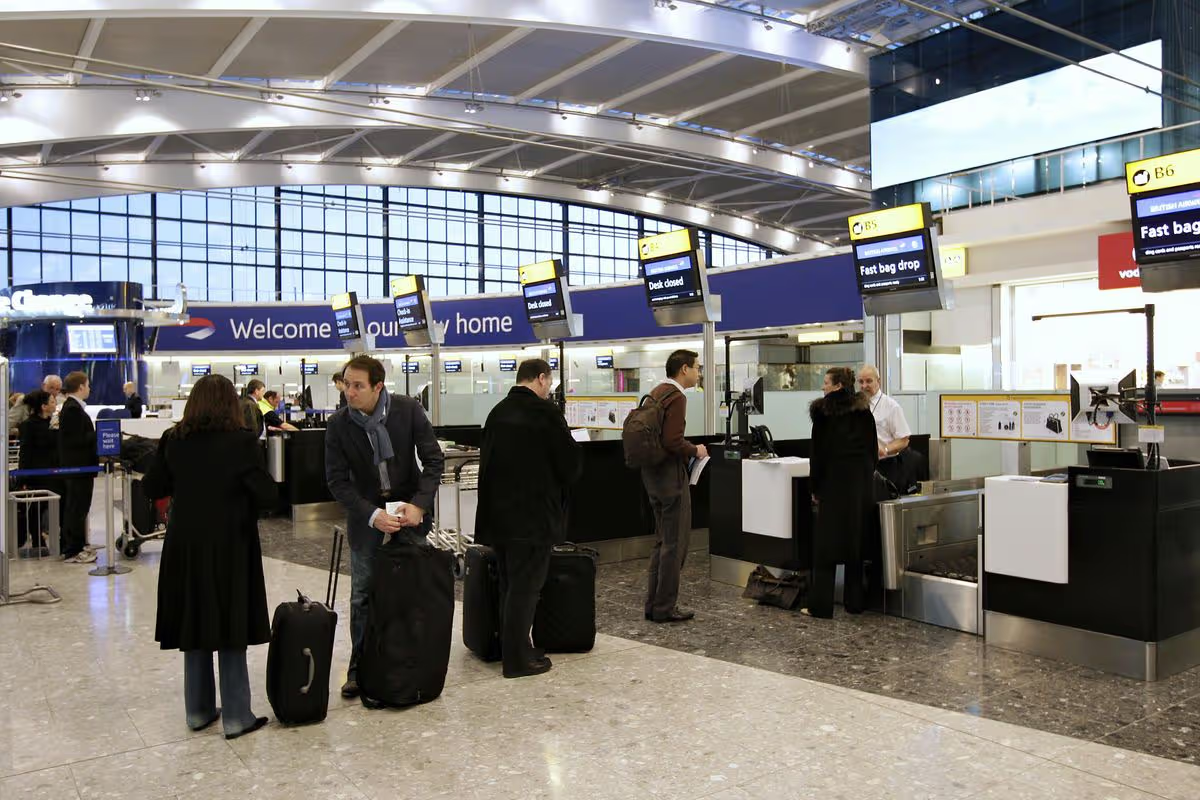
People planning holidays should check that their destionation has no new alerts or warnings
Some areas have a blanket warning, and others may have specific areas that should stay off-limits(Image: Craig Hastings via Getty)
The Foreign, Commonwealth and Development Office (FCDO) has significantly expanded its ‘red list’ in recent months due to regional escalations, particularly in the Middle East and Eastern Europe. It is important to be aware of which parts of the world pose a greater risk to tourists than others.
While it is not advisable to ignore the Foreign Office’s advice, doing so is likely to invalidate any insurance that travellers have obtained. In most cases, insurers will not cover people who knowingly go against FCDO advice and take risks. If you absolutely must travel to a high-risk area, you may need to look for specialised travel insurance companies that provide specific cover for such scenarios, according to ABTA.
As of April 28, 2026, the following list summarises the countries for which the Foreign Office has specific safety advice for travelling. In some cases, it issues a blanket alert urging people to reconsider visiting countries that are unsafe across all areas. Some areas have partial warnings in place. If people are visiting the area, check the Foreign Office website for the latest updates and warnings.
Countries where the Foreign Office currently advises against all travel:
Afghanistan
Belarus
Burkina Faso
Central African Republic (CAR)
Eritrea
Haiti
Iran
Iraq
Israel
Lebanon
Mali
Niger
Palestine (Occupied Palestinian Territories)
Russia
South Sudan
Sudan (most of the country)
Syria
Ukraine (most of the country)
Yemen
Countries where the Foreign Office advises against all but essential travel:
Bahrain
Cuba (entire island)
Ecuador (coastal provinces)
Egypt (significant parts: Western Desert, North South Sinai)
India (significant parts: Manipur, Pakistan border)
Weekly insights and analysis on the latest developments in military technology, strategy, and foreign policy.
Here’s TWZ’s weekly carrier tracker monitoring America’s flattop fleet, including deployed Carrier Strike Groups (CSG) and Amphibious Ready Groups (ARG), using publicly available open-source information. Check out last week’s map here.
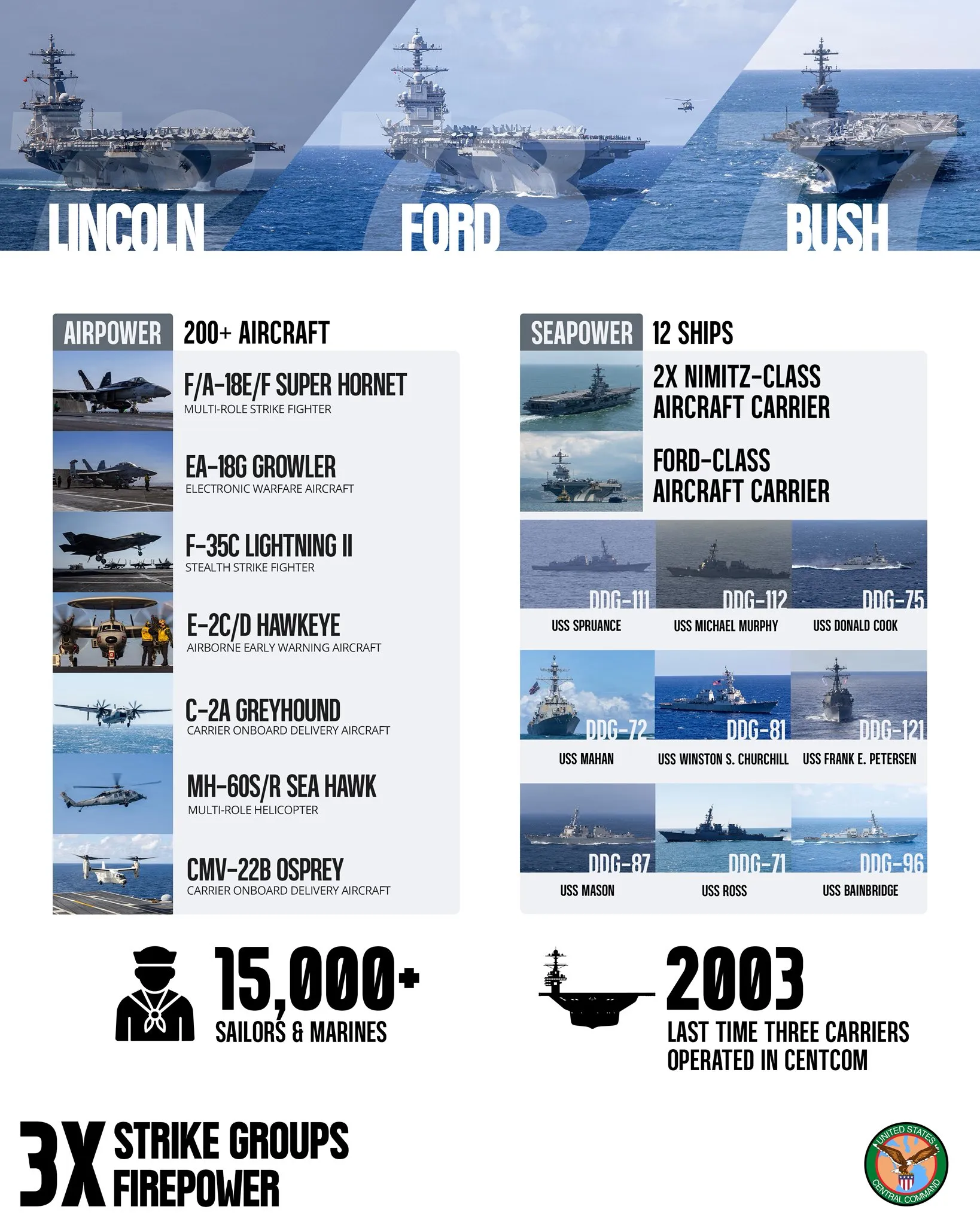
The George H.W. Bush CSG arrived in U.S. 5th Fleet’s area of responsibility last week, becoming the third U.S. aircraft carrier operating in the Middle East. According to U.S. Central Command (CENTCOM), this is the first time since the 2003 Iraq War that the U.S. has triple-carrier coverage in the region. Outside the Gulf of Oman, the Abraham Lincoln CSG and Tripoli ARG are operating in the Arabian Sea, supporting blockade measures. The Gerald R. Ford CSG remains on station in the northern Red Sea, satellite imagery shows.
Combined, the three flattops represent roughly 14 acres of sovereign U.S. territory that can be positioned anywhere around the world within weeks, and embark 27 squadrons of more than 200 aircraft. The nine guided-missile destroyers are equipped with 846 VLS tubes and loaded with a mix of offensive and defensive missiles. The undersea escorts – at least three, if not more, fast-attack subs – are not highlighted in the graphic below, but provide additional VLS capacity, among many other capabilities.
The Theodore Roosevelt CSG (TRCSG) is working up in U.S. 3rd Fleet AOR, a spokesperson told us. There are several notable aspects of the training, including integration with an Unmanned Surface Vessel Division (USVDIV) operating a medium USV (MDUSV) Seahawk, as well as the potential test of new Raytheon Coyote and Longbow Hellfire missile launchers, which TWZ first reported here. In February, Vice Adm. Brendan McLane told reporters that a medium drone would deploy alongside TRCSG later this year, Breaking Defense reported, and the Seahawk may be set to assume that role. There has been a flurry of naval drone activity off the California coast, including the NOMARS USX-1 Defiant, based on public AIS data from Marine Traffic. Roosevelt is at the leading edge of the Navy’s “tailored force pairing” concept – which could include integrating naval drones into CSG operations – and Seahawk appears to be the MDUSV selected to train and potentially deploy with the group.
USS Dwight D. Eisenhower (IKE) completed sea trials on April 24, the U.S. Navy announced, following a 15-month maintenance availability. “The extensive maintenance period included critical upgrades and repairs to the ship’s combat systems, propulsion plant, and habitability spaces, ensuring IKE’s ability to be fully mission capable and ready to support global maritime operations.” USS Carl Vinson is undergoing scheduled maintenance, according to photos released on April 21, while “remaining a combat-ready force dedicated to protecting and defending the United States.” USS Nimitz is participating in exercise Southern Seas, and was most recently off the coast of Chile. USS George Washington, forward-deployed to Japan and the only U.S. carrier stationed in the Indo-Pacific, is in port.
Seaman Apprentice Nicole SchweigertSeaman Apprentice Nicole SchweigertSeaman Apprentice Nicole SchweigertU.S. Navy Nimitz-class aircraft carrier USS Dwight D. Eisenhower (CVN 69) conducts a full power demonstration during Sea Trial in the Virginia Capes, Apr. 22, 2026. Eisenhower returned to sea and is now in the Basic Phase in the Optimized Fleet Response Plan. (U.S. Navy photo by Mass Communication Specialist Seaman Nicole Schweigert) Seaman Apprentice Nicole Schweigert
Four of America’s 11 carriers are currently in maintenance or have an availability scheduled this year. Three are deployed in the Middle East, one is forward-stationed in the Indo-Pacific, two are training, and one is at homeport. Delivery of the next Ford-class carrier, what will become the USS John F. Kennedy, is expected in 2027, unless there are additional delays or modifications to the program.
Note: Positions are general approximations.Non-deployed LHA/LHD amphibious warships are not shown.
Contact the author: ian.ellis-jones@teamrecurrent.io
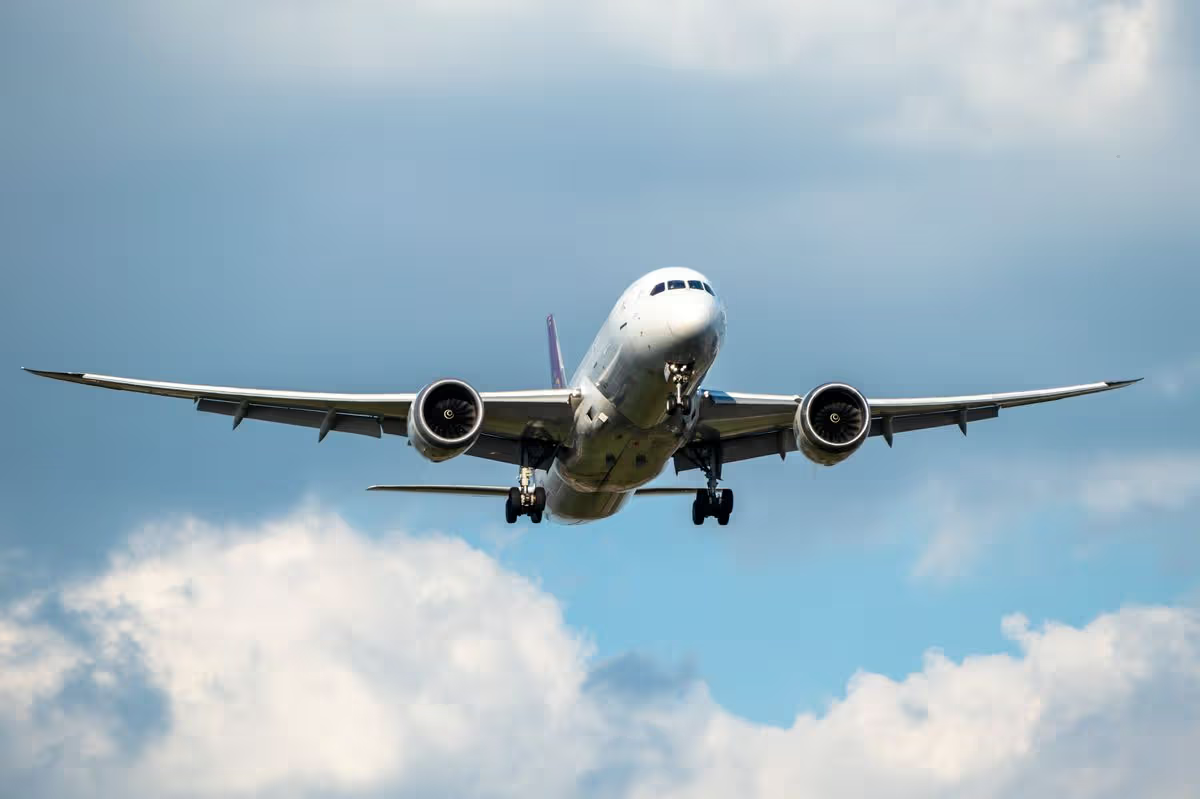
TUI, Jet2 and easyJet have all confirmed they will not add fuel surcharges to pre-booked or new package holidays and flights this summer
13:13, 26 Apr 2026Updated 13:13, 26 Apr 2026
TUI has confirmed it will not introduce fuel surcharges for passengers(Image: Getty Images)
Airline TUI has this afternoon released a statement for passengers worried about being slapped with surcharges on holidays they’ve already booked. The conflict in the Middle East has disrupted oil deliveries, raising the prospect of serious jet fuel shortages.
This has also caused fuel prices to skyrocket, leaving those who’ve already secured their holidays – and those preparing to – anxious they’ll be asked to stump up extra cash to offset the soaring costs facing airlines.
Jet2 and easyJet confirmed over the weekend that they will not be passing on any price increases to passengers via surcharges. Now, this afternoon, airline and tour operator TUI has announced it will not charge passengers additional fees.
Neil Swanson, Managing Director at TUI UKandI, said: “We understand that customers want both confidence and clarity when booking a holiday. Our teams are here to support people who are thinking about booking, and those who have already booked with TUI can be reassured that their holiday price is fixed, with no fuel surcharges added.”
easyJet has issued a fresh statement confirming the airline and tour operator will not add surcharges to any pre-booked flights and package holidays, or future bookings. The company said travellers can book their package holidays with confidence thanks to its Best Price Guarantee and Ultimate Flexibility policy: “easyJet and easyJet holidays has confirmed that it will not introduce surcharges on its flights or package holidays, giving customers complete peace of mind when booking.
“No surcharges will apply to any pre‐booked easyJet holiday packages or to any new bookings for summer 2026.easyJet currently sees no disruption to its jet fuel supply and all flights and package holidays continue to operate normally.” Garry Wilson, CEO of easyJet holidays, said: “We know that holidaymakers may have questions about what recent global events might mean for their travel plans this summer so we are giving our customers absolute peace of mind that no surcharges will be added to their flights or package holidays.”
“Our operations remain unaffected, so customers can be confident that not only will their holiday go ahead as planned, but there will be no surprise extra payments, and they can enjoy their brilliant holidays at unbeatable prices.”
Jet2 has confirmed it won’t be slapping surcharges on any pre-booked flights or holidays to cover increased costs, including those related to jet fuel. In an effort to calm growing anxieties, the Department for Transport yesterday issued direct guidance to passengers with bookings through carriers such as Jet2, Ryanair, Wizz, easyJet and British Airways. Jet2 has axed surcharge provisions across all its flights and holidays, despite the carrier never having previously imposed them. The policy applies to all flights and holidays booked through any channel, be it online, via the mobile app, contact centre or independent travel agent. It does not cover tourist taxes, which are payable at the resort during the stay and are settled directly with the accommodation provider.
Steve Heapy, CEO of Jet2 said: “Holidaymakers should have every right to book their hard-earned break in the sun, without worrying about being hit with additional costs, and they can have that complete assurance when they book a flight or holiday with Jet2. As a result of today’s announcement, customers booking with Jet2 know that they are locking in their price without additional cost surprises later and we strongly believe that is the right thing to do by them. Ahead of a busy summer this is yet more evidence of why, on top of our incredible holidays and award-winning customer service, nothing beats a Jet2holiday.”
The DfT said on Friday: “There is no current need for passengers to change their travel plans. UK airlines buy jet fuel in advance, and airports maintain stocks to support their resilience. The government is working closely with the aviation industry to monitor risks and minimise disruption to passengers.
“If your flight is cancelled, you have clear legal rights, including the right to a full refund or re-routing. Read this factsheet for the full picture on the current situation and what it means for you.”
Meanwhile, IAG – the parent company of British Airways, Aer Lingus and Spain’s Iberia – has referred to “pricing adjustments to reflect these higher fuel costs”. A spokesperson commented: “We are not seeing jet fuel supply interruptions, but fuel prices have risen sharply and, despite our hedging strategy, which gives some shorter-term mitigation, we are not immune to the impact.”
LOGAN, Utah — President Trump’s administration took the unusual step this week of sending a government plane to Cuba to return a 10-year-old from Utah who is at the center of a complicated and contentious custody fight involving the child’s gender identity.
The child’s parent, Rose Inessa-Ethington, a transgender woman, is accused of taking the child to Cuba without the permission of the biological mother. Federal and state authorities sought the return of the child after a family member expressed concern that Inessa-Ethington went to Havana to get the child gender transition surgery.
Inessa-Ethington, who had run a popular Utah political blog in the 2010s, was arrested along with her partner, Blue Inessa-Ethington, and charged in the U.S. with international parental kidnapping.
The couple traveled with the child to Canada ostensibly for a camping trip in late March with Blue’s 3-year-old child. However, the two adults turned off their phones after telling the older child’s mother they had arrived in Canada. They flew from Vancouver to Mexico and then to Cuba on April 1, according to a criminal complaint filed Monday in federal court in Utah.
The charges don’t say if the couple actually planned on getting the child gender-affirming surgery in Cuba or how they would get it because that surgery isn’t legal for children in Cuba.
The FBI said that Blue Inessa-Ethington withdrew $10,000 from her checking account before leaving. Agents also found at their home a note with instructions from a mental health therapist in Washington, D.C., “to send the therapist the $10,000.00 and instructions on gender affirming medical care for children.” That note didn’t mention Cuba.
The use of the Department of Justice plane in a parental kidnapping investigation comes after the Trump administration sought to block access to gender-affirming care for minors and pressured healthcare providers over the issue.
The Associated Press left telephone and email messages with the court-appointed attorneys who represented Blue and Rose Inessa-Ethington in Virginia. The defendants will be returned to Utah to face one count each of international parental kidnapping, according to court filings.
Search began after child wasn’t returned as scheduled
The search for the child began on April 3 when they were not returned to the mother in Utah as scheduled, court documents show.
The 10-year-old’s mother, who was divorced from Rose Inessa-Ethington and had shared custody of the child, filed a missing-person report with police in Logan, Utah, a college and dairy farming town about 70 miles north of Salt Lake City.
Logan City Police Chief Jeff Simmons said his department’s initial focus was on the custodial interference allegations in the case, and he said investigators did not learn until later about concerns over gender-affirming surgery.
Logan police spokesperson Sgt. Brandon Bevan said those concerns were raised by one family member. He declined to say who.
“They just had the concern about it, no actual physical evidence,” Bevan said.
A Utah state judge ordered the return of the 10-year-old to the child’s mother on April 13. Three days later, a federal magistrate judge issued an arrest warrant for the Inessa-Ethingtons. On the same day, Cuban law enforcement located the group. They were deported to the U.S. aboard the government plane Monday and arraigned in federal court in Richmond, Va.
The 10-year-old was returned to the child’s biological mother, First Assistant U.S. Atty. Melissa Holyoak in Utah indicated in a statement. Representatives of the FBI and U.S. attorneys office in Utah declined to say what happened to the 3-year-old child who had been with the group.
Parents engaged in custody dispute
The custody dispute between the parents does not appear to be a new development. An online fundraiser created five years go by Blue Inessa-Ethington titled “Help a Trans Mother Keep Custody of Her Child” raised $9,766.
“Last week, Rose’s ex relocated several counties away, negatively impacting Rose’s parent-time with the child,” she wrote on the fundraising page. She said the money would be used to seek a court order that would keep the child “safe and stable throughout this process.”
Anyone who has spent time with Rose knows “how much care and thought she puts into parenting her gender open child,” she wrote.
Family members said the child was assigned male at birth but identifies as a girl because of what they believed to be “manipulation” by Rose Inessa-Ethington, according to an April 16 affidavit from FBI Special Agent Jennifer Waterfield.
Gender-affirming care for minors has been limited
The Trump administration moved in December to cut off gender-affirming care for minors, prompting a third of states to sue.
It was the latest in a series of clashes between an administration that says transgender healthcare can be harmful to children and advocates who say it’s medically necessary.
Gender-affirming surgery is rare among U.S. children, research shows. Guidance from several major medical organizations calls for caution around surgery for minors and says decisions about treatments are case-by-case. Fewer than 1 in 1,000 U.S. adolescents receive gender-affirming medications, such as hormones or puberty blockers.
In Cuba, gender-affirming surgeries are banned for minors and performed only for adults through the public health system under strict supervision in designated public hospitals for Cuban citizens. They must be authorized by a medical commission after a comprehensive review of the patient’s file. That process often takes years because it requires a wide range of medical and psychological evaluations.
Brown, Boone and Schoenbaum write for the Associated Press. Brown reported from Billings, Mont., and Boone from Boise, Idaho. AP journalists Eric Tucker in Washington, Cristiana Mesquita in Havana and Devi Shastri in Milwaukee contributed to this report.
‘Unfortunately, it’s very likely that many people’s holidays will be affected, either by flight cancellations or very, very expensive tickets’
13:55, 22 Apr 2026Updated 14:53, 22 Apr 2026
Passengers have been told ‘it’s very likely that many people’s holidays will be affected’ by the European Union(Image: Getty Images)
The EU has issued a warning that Europe faces a “very serious crisis” as aviation fuel supplies begin to dwindle due to the conflict in Iran, and holidaymakers may need to alter their summer travel plans.
“Unfortunately, it’s very likely that many people’s holidays will be affected, either by flight cancellations or very, very expensive tickets,” Dan Jorgensen, the EU energy commissioner, told Sky News. “Even if we do everything we can do, if the jet fuel is not there, then it’s not there.”
Jorgensen added: “[Currently] it is primarily a crisis of prices and not yet a crisis of supply, but unfortunately we cannot be sure to prevent a crisis of supply, especially on jet fuel in the future, if the crisis continues.”
The International Energy Agency has cautioned that significant supply problems could emerge within the next five to six weeks.
Airlines are already implementing measures to curb demand: the Lufthansa Group, among Europe’s largest airline operators, has confirmed the scrapping of 20,000 flights over the coming months. Meanwhile, other carriers are hiking ticket prices on long-distance routes to offset rising fuel costs.
“If we had peace tomorrow and the Strait of Hormuz opens, I think we will manage without that happening, but I have to say that even in the best-case scenario, the price crisis will still last for quite some time,” Jorgensen warned.
“Gas infrastructure has been ruined to a degree that will take years to rebuild and this means for months and maybe years yet we will see much higher prices than we had before this crisis started.”
The head of Italy’s Civil Aviation Authority told Sky News that people should consider spending their summer holidays in their home countries.
“In the past petrol prices have reached and exceeded more than $100 without any significant side effects on air travel but this time, the psychological effect is having a destructive effect on passengers,” Pierluigi di Palma warned. “It is best to recommend holidays nearby, rediscovering beautiful places in our country. “For those who still want to risk taking a long trip, it’s a good idea to consider special insurance that can provide reassurance regarding a guaranteed refund in the event of a delayed or cancelled flight.”
The EU has unveiled a raft of measures aimed at curbing the impact of the energy crisis, including proposals to accelerate the rollout of renewable energy sources and incentives for households to install clean energy solutions such as heat pumps and solar panels. The bloc is also pushing member states to slash tax on electricity, in a bid to encourage more motorists to make the switch to electric vehicles.
A group representing British Airways, easyJet, Jet2, Loganair, Ryanair, TUI, UPS and Virgin Atlantic has given a stark warning to ministers about holidays this summer. According to ITV News, Airlines UK has told passengers, ‘you can forget your holidays’ according to Good Morning Host Susanna Reid.
The letter, which has gone to ministers and the Civil Aviation Authority, calls on the government and officials to change the rules to bring down passenger duty, allow more night flights, and also to scrap compensation for cancelled or delayed flights.
Presenter Susanna said: “You can forget about your summer holidays. That is the stark warning issued to some air passengers hoping to fly abroad this year. With the war in Iran doubling the price of jet fuel, airlines say they face having to increase fairs or cut flights altogether.”
Co host Ed Balls added: “UK operators are now calling on the government to bring in emergency measures. In a confidential letter seen by ITV News, they’re asking for help to protect fuel supplies, reduce taxes on tickets, and waive strict rules. on compensating passengers.”
ITV said airlines are urging the government to step in to protect business travel, holiday flights and freight operations from the economic fallout of the war in the Middle East. A confidential briefing document submitted to ministers and the aviation regulator, the Civil Aviation Authority, seen by ITV News, warns that if the disruption “continues or worsens,” airlines will be forced to cut flights and push up fares.
The document, from Airlines UK, which represents British Airways, easyJet, Jet2, Loganair, Ryanair, TUI, UPS and Virgin Atlantic, warns that jet fuel costs have doubled, with fuel accounting for around a third of airline operating costs.
Correspondent Nick Dixon said: “Airlines are now at the stage where they are monitoring their reserves of jet fuel very carefully, very closely. There’s no indication just yet of any immediate cancelled flights or fuel shortages, but the airlines clearly need a backup plan in the longer term. And they are pushing for that. Now, some of the airlines have already taken steps. Lufthansa, the European airline, has cancelled thousands of its short-haul flights in an effort to conserve jet fuel. EasyJet, Virgin Airlines, as well as others, have expressed a lot of concern about the coming weeks.
“Virgin Atlantic has cancelled one of its long-haul routes. EasyJet has said, really, beyond the next few weeks into mid-May, they’re not entirely clear on what they will do for jet. Let’s just take a look at what the airlines are asking from the government in this letter that you mentioned.”
In terms of the changes the airlines want, he said: “So firstly, they want to relieve or reduce air passenger duty to help bring down the cost of travel generally and holidays during this period. Allow for nighttime flights to keep things moving if the schedules are disrupted, and also to scrap compensation for cancelled or delayed flights caused by fuel shortages. All of that, of course, would have a huge impact. on passengers.
“What most passengers want to know is, will my holiday flight be affected? It may well be that if the airlines win concessions from the government, we start to see some tactical flight cancellations of what would otherwise be loss-making departures. Well, the Department for Transport has said that it’s continuing to work with fuel suppliers, with airlines, and international counterparts on our contingency emergency planning to ensure that people keep moving and businesses are supported while the conflict is ongoing. But it’s all quite vague really at the moment and very concerning for passenger passengers who have either spent hundreds if not thousands on flights or are looking to plan uh trips throughout the summer.”
In 1500, explorer Pedro Álvares Cabral arrived in South America, claiming what would later be known as Brazil for Portugal.
In 1889, about 20,000 homesteaders massed along the border of the Oklahoma Territory, awaiting the signal to start the Oklahoma land rush.
In 1914, U.S. forces took control of the Mexican port city of Veracruz during the fighting of the Mexican Revolution.
In 1915, during World War I, German forces became the first to use poison gas on the Western Front during the Second Battle of Ypres.
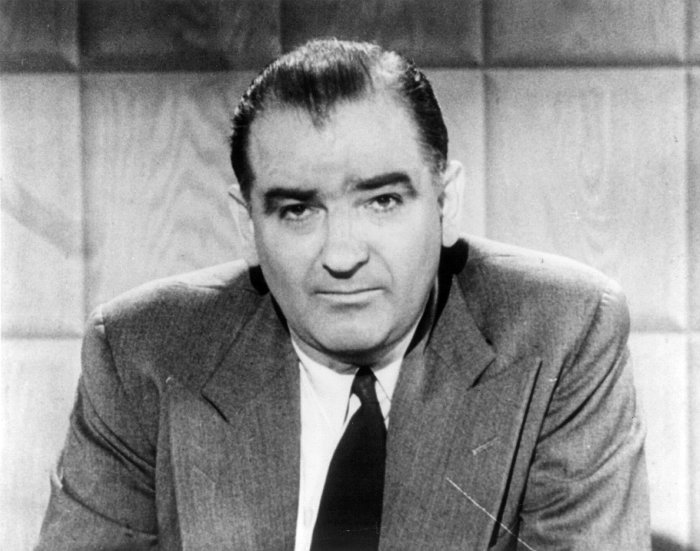
In 1954, the Army-McCarthy hearings began in which Sen. Joseph McCarthy, R-Wis., accused the Army go going soft on communism, while the Army said it was pressured to give a speedy commission to a McCarthy aide.
In 1972, Apollo 16 astronauts John Young and Charles Duke walked and rode on the surface of the moon for 7 hours, 23 minutes. Young, whose career with NASA began in 1962, would spend the next four decades as an astronaut, retiring in 2004 at the age of 74.
In 1997, a 126-day standoff at the Japanese Embassy in Lima ended after Peruvian commandos stormed the building and freed 72 hostages held by the Tupac Amaru Revolutionary Movement. All 14 rebels were killed.
In 2004, former NFL star Pat Tillman, who turned down a lucrative contract with the Arizona Cardinals to join the U.S. Army Rangers, was killed in Afghanistan. The U.S. military said later he was a victim of friendly fire.
In 2005, Zacarias Moussaoui, the only man charged in the United States in connection with the September 11, 2001, terror attacks, pleaded guilty and was sentenced to life in prison.
In 2006, Iraq’s Parliament ratified the selection of Nouri al-Maliki as prime minister, ending a four-month political deadlock.
In 2016, world leaders from 175 countries gathered in New York on Earth Day to sign the Paris Agreement, the first international accord that outlines steps to combat climate change and lower carbon levels by 2100.
In 2020, President Donald Trump signed an executive order to temporarily close U.S. borders to migrants during the COVID-19 pandemic.
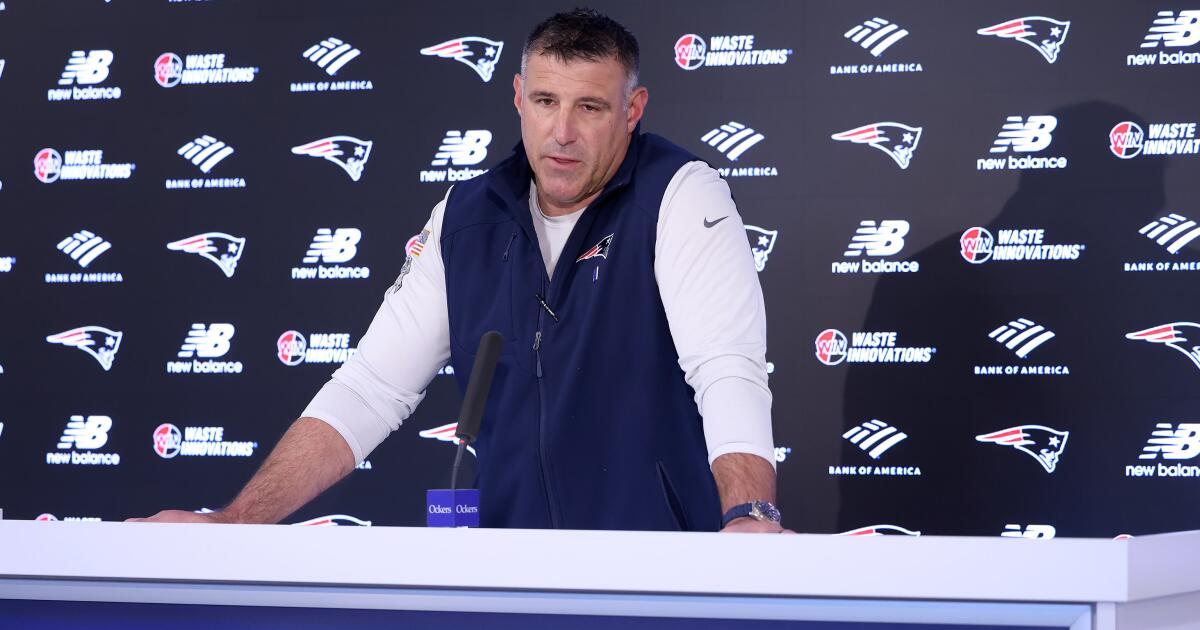
The New England Patriots coach knows that much of the chatter around his team in recent weeks has nothing to do with the reigning AFC champions’ offseason workouts or their plans for the NFL draft later this week.
Instead, it’s been about a “personal and private matter” that Vrabel decided to address at the top of his news conference Tuesday in Foxborough, Mass. Although he didn’t specify, the second-year Patriots coach seemed to be referring to photos recently published by the New York Post’s Page Six of him and Dianna Russini, who was at the time a reporter for the Athletic, interacting at an Arizona resort.
The photos appear to show Russini and Vrabel — both married to other people — holding hands, hugging and sitting in a hot tub and a swimming pool. In the April 7 article that accompanied the photos, Russini and Vrabel gave statements denying that anything inappropriate was happening between them.
In his first public comments since the article was published, Vrabel did not mention Russini or the photos. Instead, Vrabel spoke about how he has handled the situation and what his family, the team and the fan base can expect from him “going forward.”
“I’ve had some difficult conversations with people that I care about — my family, the organization, the coaches, the players,” Vrabel said. “Those have been positive and productive. We believe in order to be successful on and off the field, you have to make good decisions. That includes me; that starts with me.
“We never want our actions to negatively affect the team. We never want to be the cause of the distraction. These are comments and questions that I’ve answered for the team and with the team. We’ll keep those private and to ourselves.
“I care deeply about this football team and am excited to coach it. I also know that I’m going to attack each day with humility and focus. And what I can promise you is that my family, this organization, the team, the staff, the coaches, everybody, our fans, most importantly, will get the best version of me going forward.”
A Patriots spokesman said team officials have no plans to address the issue further. The NFL has indicated it is not investigating the matter.
In the Page Six article, Athletic executive editor Steven Ginsberg expressed full support for Russini and said the photos “are misleading and lack essential context.” Days later, however, the New York Times, owner of the Athletic, reported that the digital sports outlet would conduct an investigation.
On April 14, Russini submitted her letter of resignation to the Athletic, then posted it on X. In it, Russini states she has “no interest in submitting to a public inquiry that has already caused far more damage than I am willing to accept.”
“This media frenzy is hurtling forward without regard for the review process The Athletic is trying to complete,” Russini wrote. “It continues to escalate, fueled by repeated leaks. … Rather than allowing this to continue, I have decided to step aside now — before my current contract expires on June 30. I do so not because I accept the narrative that has been constructed around this episode, but because I refuse to lend it further oxygen or to let it define me or my career.”
Weekly insights and analysis on the latest developments in military technology, strategy, and foreign policy.
Here’s TWZ’s weekly carrier tracker monitoring America’s flattop fleet, including deployed Carrier Strike Groups (CSG) and Amphibious Ready Groups (ARG), using publicly available open-source information.
The Gerald R. Ford CSG transited the Suez Canal southbound on April 16, the Associated Press reported on Friday, once again entering the Red Sea and U.S. Central Command (CENTCOM) area of responsibility (AOR). The second CSG in the region, led by USS Abraham Lincoln, is operating in the northern Arabian Sea, enforcing the naval blockade of Iranian ports and coastal areas. The George H.W. Bush CSG is reportedly transiting around the Horn of Africa en route to the Middle East, according to USNI News, but TWZ has been unable to independently confirm via open sources. Following the arrival of USS George H.W. Bush, the U.S. will have three carriers positioned in the Middle East should the ceasefire fail and combat operations resume.
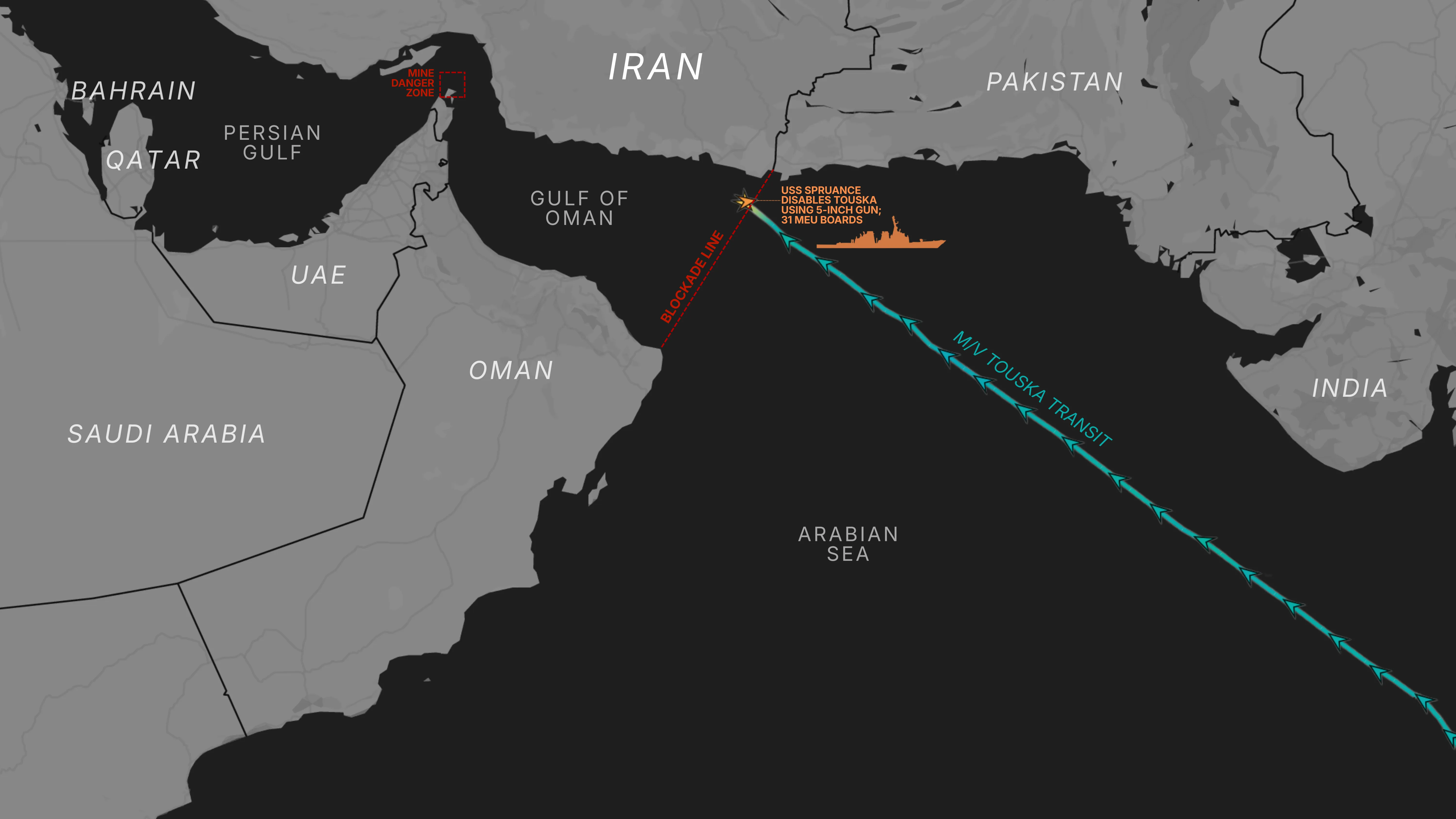
The Tripoli ARG is also supporting blockade measures, with the embarked 31st Marine Expeditionary Unit (MEU) boarding and seizing Iranian-flagged M/V Touska on April 19 after USS Spruance fired multiple 5-inch rounds, targeting the engine room and disabling the vessel’s propulsion. “American forces issued multiple warnings and informed the Iranian-flagged vessel it was in violation of the U.S. blockade. After Touska’s crew failed to comply with repeated warnings over a six-hour period, Spruance directed the vessel to evacuate its engine room.” The second ARG-MEU tasked to CENTCOM, the Boxer ARG-11th MEU, is currently transiting through U.S. Indo-Pacific Command at an undisclosed location.
At a press conference on Thursday, Chairman of the Joint Chiefs General Dan Caine and CENTCOM Commander Admiral Brad Cooper provided a detailed briefing on the opening hours of the blockade, which TWZ covered here, and shared unclassified slides of ship positions before and after implementation. Below is an animation visualizing the first 48 hours of the U.S. blockade, and confirmed Navy ships operating in the Arabian Sea and Indian Ocean at the time.
“Since the blockade’s commencement, U.S. forces have directed 25 commercial vessels to turn around or return to an Iranian port,” CENTCOM said in the release. “In addition to this blockade, the joint force, through operations and activities in other areas of responsibility, like the Pacific Area of Responsibility, under the command of Admiral Paparo, will actively pursue any Iranian-flagged vessel or any vessel attempting to provide material support to Iran,” Gen. Caine added.
Back stateside, the Theodore Roosevelt CSG departed San Diego on April 15, according to local ship spotters. A U.S. 3rd Fleet spokesperson told TWZ the CSG is underway conducting routine operations and integrated training in the 3rd Fleet AOR and “remains ready to respond to crisis or contingency at any time.” Elements of the group were recently outfitted with a new Raytheon Coyote counter-UAS 8-cell launcher, which could be tested during upcoming training periods.
Note: Positions are general approximations.Non-deployed LHA/LHD amphibious warships are not shown.
Contact the author: ian.ellis-jones@teamrecurrent.io
1 of 5 | On April 18, 1775, U.S. patriot Paul Revere began his famous ride through the Massachusetts countryside, crying out “The British are coming!” to rally the minutemen. File Image courtesy of the Library of Congress
April 18 (UPI) — On this date in history:
In 1506, the cornerstone was placed for St. Peter’s Basilica in Rome.
In 1775, U.S. patriot Paul Revere began his famous ride through the Massachusetts countryside, crying out “The British are coming!” to rally the minutemen.
In 1906, an earthquake estimated at magnitude-7.8 struck San Francisco, collapsing buildings and igniting fires that destroyed much of what remained of the city. Researchers and historians concluded that about 3,000 people died in the quake and its aftermath, and roughly 250,000 were left homeless.
In 1923, the original Yankee Stadium opened in New York. The stadium was demolished in 2010 after it was replaced a year prior by the new Yankee Stadium.
File Photo by Monika Graff/UPI
In 1942, Lt. Col. James Doolittle led a squadron of B-25 bombers in a surprise raid against Tokyo in response to the Japanese sneak attack on Pearl Harbor on Dec. 7, 1941.
In 1945, U.S. journalist Ernie Pyle, a popular World War II correspondent, was killed by Japanese machine-gun fire on the island of Ie Shima in the Pacific.
In 1949, the Republic of Ireland formally declared itself independent from Britain.
In 1968, McCulloch Oil Corp. paid $2.24 million to buy London Bridge, which was sinking into the Thames under the weight of 20th century traffic. The oil company rebuilt the bridge bloc by block over Lake Havasu in Arizona.
In 1980, Rhodesia became the independent African nation of Zimbabwe.
In 2014, an avalanche on what is known as a particularly dangerous route to the top of Mount Everest in the Himalayas killed 16 Sherpa guides.
In 2018, the first movie theaters in Saudi Arabia opened with a public screening of Black Panther.
In 2024, police arrested more than 100 protesters at Columbia University for refusing to leave a large pro-Palestinian encampment on campus. The incident sparked more protests at the school and other campuses across the country.
WASHINGTON — The Senate approved a short-term renewal until April 30 of a controversial surveillance program used by U.S. spy agencies, following a chaotic, post-midnight scramble in the House to keep the authority from expiring.
The measure cleared the Senate by voice vote, without a formal roll call, as Congress raced to meet a Monday deadline. It now heads to President Trump, who had pushed for a clean 18-month extension, for his signature.
GOP leaders in the House rushed lawmakers back into session late Thursday with a series of back-to-back votes that collapsed in dramatic failure, before they quickly pushed ahead the stopgap measure as they race to keep the surveillance program running past Monday’s expiration date.
First they unveiled a new plan that would have extended the program for five years, with revisions. Then they tried to salvage a shorter 18-month renewal that Trump had demanded and Speaker Mike Johnson had previously backed. Some 20 Republicans joined most Democrats in blocking its advance.
Shortly after 2 a.m. they quickly agreed to the 10-day extension, which was agreed to on a voice vote without a formal roll call. It next goes to the Senate, which is gaveling for a rare Friday session, as Congress races to keep the surveillance program running.
“We were very close tonight,” said Johnson after the late-night action.
But Democrats blasted the middle-of-the-night voting as amateur hour. “Are you kidding me? Who the hell is running this place?” said Rep. Jim McGovern, D-Mass., during a fiery floor debate.
At the center of the standoff that has stretched throughout the week is Section 702 of the Foreign Intelligence Surveillance Act, which permits the CIA, National Security Agency, FBI and other agencies to collect and analyze vast amounts of overseas communications without a warrant. In doing so, they can incidentally sweep up communications involving Americans who interact with foreign targets.
U.S. officials say the authority is critical to disrupting terrorist plots, cyber intrusions and foreign espionage.
Surveillance program fight is a debate over privacy and security
Its path to passage has teetered all week in a familiar fight, as lawmakers weigh civil liberties concerns against intelligence officials’ warnings about national security risks.
Opponents of the surveillance tool point to past misuses. FBI officials repeatedly violated their own standards when searching intelligence related to the Jan. 6, 2021, attack on the Capitol and racial justice protests in 2020, according to a 2024 court order.
Trump and his allies had lobbied aggressively all week for a clean renewal of the program, without changes.
A group of Republicans traveled to the White House on Tuesday, and on Wednesday CIA Director John Ratcliffe spoke directly with GOP lawmakers. House Majority Leader Steve Scalise said Thursday there had “been negotiations late into the night with the White House and some of our members.”
“I am asking Republicans to UNIFY, and vote together on the test vote to bring a clean Bill to the floor,” Trump wrote on Truth Social this week. “We need to stick together.”
The result of days of negotiations
Thursday’s proceedings came to a standstill as lawmakers retreated behind closed doors and Johnson reached for an agreement to resolve the standoff.
Shortly before midnight GOP leaders announced a new proposal, a five-year extension, with revisions. The changes were designed to win over skeptics of the surveillance program who have demanded greater oversight to protect Americans’ privacy.
Among the changes are new provisions to ensure that only FBI attorneys can authorize queries on U.S. persons, and to require the Office of the Director of National Intelligence to review such cases, said Rep. Austin Scott, R-Ga., during the debate.
But the final product, a 14-page amendment, did not go far enough for some holdouts in either party.
With Johnson controlling a slim majority, he has little room for dissent. As the Republicans fell short on both efforts before the short extension, a handful of Democrats stepped in to try to help them advance the longer extensions, but most Democrats were opposed.
“We just defeated Johnson’s efforts to sneak through a 5-year FISA authorization tonight,” said Democratic Rep, Ro Khanna of California. “Now, they will have to fight in daylight.”
Cappelletti and Mascaro write for the Associated Press.
“The Real Housewives of Miami” star Lisa Hochstein has been charged with a felony for allegedly spying on her ex-husband.
Hochstein, 43, and her former partner Jody Glidden, 52, were booked on felony charges of unlawfully intercepting oral statements from the Miami housewife’s ex-husband Leonard “Lenny” Hochstein.
Hochstein turned herself in at Miami-Dade’s Turner Guilford Knight Correctional Center on Wednesday morning, according to NBC Miami. The embattled star’s bond was initially set for $5,000, but she was released on her own recognizance later the same day. NBC spoke with Hochstein as she left the Miami-Dade jail and asked, “How was it in there?”
Hochstein’s attorney, Jayne Weintraub, walked alongside the reality star and intercepted questions, answering, “Five stars!”
Hochstein repeated, “Yes, five stars.”
Glidden, who also appeared on “Real Housewives,” was arrested April 12. He has since been released. Hochstein and Glidden have pleaded not guilty. Her arraignment is scheduled for April 20.
According to a March 17 arrest warrant obtained by People, Hochstein and Glidden allegedly placed a recording device in Leonard Hochstein’s Mercedes-Benz following an acrimonious split back in March 2023.
The outlet reported that Leonard Hochstein loaned his car to the “Real Housewives” star after she said she wanted to take it for a test drive because she was thinking of getting one for herself. When the car was returned, Leonard Hochstein allegedly found a suspicious device in the driver‘s side floorboard, covered with tape and hidden from view. The South Florida plastic surgeon contacted his lawyer, who then brought in experts who were able to pull recordings from the device.
A total of 98 recordings were recovered, according to the affidavit, and “one of the last recordings from before the vehicle was returned to the victim depicts Lisa Hochstein and Glidden holding a discussion and the distinct sound of a device such as the hidden recorder being wrestled into place.”
Hochstein can allegedly be heard saying “done.” The warrant also states that Glidden ordered two recording devices of the exact same make and model on Amazon three months prior.
The Hochsteins’ divorce played out on Season 5 of the Bravo reality series after Leonard Hochstein admitted he was in a relationship with another woman and planned to divorce Hochstein during a hot-mic moment that shocked audiences and Hochstein alike.
After the divorce was finalized last year, Hochstein told Entertainment Tonight, “I am very happy right now. It took a long time to get here, a lot of ups and downs, highs and lows, but I’m finally on the other side, and it feels so good.”
1 of 4 | Remains of a fertilizer plant and other buildings smolder after the plant exploded in West, Texas on April 17, 2013. File Photo by Larry W. Smith/EPA
April 17 (UPI) — On this date in history:
In 1421, the sea broke the dikes at Dort, Holland, drowning an estimated 100,000 people.
In 1521, the Roman Catholic Church excommunicated Martin Luther after he refused to admit to charges of heresy.
In 1790, U.S. statesman, printer, scientist and writer Benjamin Franklin died in Philadelphia at age 84.
In 1969, a jury found Sirhan B. Sirhan guilty of first-degree murder for the assassination of Sen. Robert F. Kennedy.
File Photo by Ron Bennett/UPI
In 1970, with the world anxiously watching on television, Apollo 13, a U.S. lunar spacecraft that sustained a severe malfunction on its journey to the moon, safely returned to Earth.
In 1989, the Polish labor union Solidarity was granted legal status after nearly a decade of struggle and suppression — clearing the way for the downfall of the country’s Communist Party.
In 1993, a federal jury convicted two Los Angeles police officers and acquitted two others of violating the civil rights of Rodney King during his 1991 arrest and beating.
In 2004, the Israeli army confirmed it had killed Abdel Aziz Rantisi, Hamas co-founder and its leader in Gaza, in a missile strike. Two others also died with Rantisi, who had opposed any compromise with Israel.
In 2012, U.S. investor Warren Buffett, one of the world’s wealthiest people, said he had been diagnosed with prostate cancer.
In 2018, former first lady Barbara Bush died at the age of 92 after refusing medical treatment for her failing health. Her husband, former President George H.W. Bush, died less than one year later.
In 2024, Russian missile strikes targeting the northern Ukrainian city of Chernihiv killed more than a dozen people and injured scores more.