WASHINGTON — The Trump administration’s activation of a long-dormant court to seek an Afghan woman’s deportation violates her constitutional rights, a defense lawyer argued Thursday at a hearing for the first case to be heard in the obscure court since its creation 30 years ago.
Attorney Matthew Farley urged the chief judge of the Alien Terrorist Removal Court to dismiss the case against Nazira Haji Zada and immediately release his client. Judge Joan Ericksen denied Farley’s requests but said Zada’s lawyers can renew them as the case proceeds in the nation’s capital.
“This entire scheme is in violation of due process and unconstitutional,” said Farley, an assistant federal public defender.
The court, established in 1996, had never received a petition until this month, when the Justice Department filed an application seeking Zada’s removal. The court has a specific authority to conduct deportation proceedings for individuals whom the Department of Justice classifies as “alien terrorists.”
FBI agents arrested her Tuesday at her Fort Worth home. She is not charged with any crimes.
An FBI memo dated July 15 said it “developed information” that she is an Islamic State supporter who had her children pledge their loyalty to the terrorist group. The memo says she “supported” a plot by relatives to carry out an ISIS-inspired attack in the United States.
Court filings identify her as the mother and mother-in-law of two Afghan men who were convicted in Oklahoma for their roles in the 2024 election day plot. Her son, Abdullah Haji Zada, was sentenced in November to 15 years in prison and court records show he previously agreed to be removed from the U.S. after his release.
Kunzelman and Tucker write for the Associated Press.
WASHINGTON — The Trump administration has filed a first-ever petition to a secretive and dormant court created 30 years ago to consider government requests to deport “alien terrorists” from the United States.
The Alien Terrorist Removal Court was established in 1996 but had never received a petition until Wednesday, when the Justice Department filed an application seeking the removal of an individual whose name is withheld from the single-page document posted on the court’s website.
The chief judge of the five-member court, Joan Ericksen, said in a written response to the petition that a hearing was held Thursday during which the court had “questions about the nexus that the government alleges between the actions of the respondent and the specific sections and subsections it invokes with respect to those actions.”
“The answers persuaded the Court that the Government could benefit from the opportunity for more thoughtful consideration,” wrote Ericksen, a federal judge in Minnesota.
She directed the Justice Department to provide more information by Wednesday.
The court’s authorities emerged from the Antiterrorism and Effective Death Penalty Act of 1996, which permits the attorney general to file under seal applications for the deportation of a suspected “alien terrorist.” If an application is granted, the court must hold a public hearing at which the government has the burden to prove that the individual satisfies that definition. Applications must be approved by the attorney general or deputy attorney general.
Federal law says that an individual could qualify as an “alien terrorist” by, among other factors, having “engaged in a terrorist activity,” endorsing or espousing terrorist activities and by belonging to a political or social group that encourages terrorist activity.
The court has been dormant since its creation, having received — until last week — no applications and conducting no hearings, according to a summary posted on the Federal Judicial Center website. It comprises five judges selected by Chief Justice John G. Roberts Jr.
The Trump administration has moved aggressively over the last year to carry out deportations, including invoking a 1798 wartime law, the Alien Enemies Act, to remove Venezuelan migrants who officials accuse of being part of a terrorist gang. During a hearing in that case last year, the Washington judge presiding over it, James Boasberg, indicated that the Alien Terrorist Removal Court would be the natural forum to consider a request for deportation on national security grounds.
“In fact, Congress has an answer for us, doesn’t it? Because they created the Alien Terrorist Removal Court,” he said. “So if there’s a national security concern with having these hearings … you can always go to the ATRC, which would be a first, but that’s what it’s there for, right?”
The petition was first reported by Court Watch, an independent news site.
SEATTLE — President Trump fired the new top U.S. prosecutor in Seattle on Wednesday less than an hour after the attorney was unanimously appointed by the federal judges in the district, highlighting tensions between the courts and the president over the powerful positions.
Roger Rogoff, a former judge and veteran state and federal prosecutor, was sworn in as U.S. attorney before 8 a.m. at the U.S. courthouse in downtown Seattle. In a phone interview, he said he then went to the U.S. Attorney’s Office and asked to meet with Charles Neil Floyd, whose 120-day interim term in the position ended in February.
As he waited in a lobby, Rogoff said, he received an email from the Trump administration informing him he’d been removed. He is consulting with other lawyers about suing over his firing, he said.
Presidents normally appoint U.S. attorneys, the top federal prosecutor in each judicial district. The positions require Senate confirmation, except in temporary appointments. When temporary appointments expire before a nominee is confirmed, the judges in a judicial district can name a U.S. attorney.
But under Trump, the Justice Department has sought to leave unconfirmed prosecutors in their positions indefinitely, often through novel personnel maneuvers.
“District court judges can appoint a temporary U.S. Attorney, and POTUS can fire them,” Acting U.S. Atty. Gen. Todd Blanche said in a social media post Wednesday. He added that the judges who appointed Rogoff “abandoned the time-honored process of consultation with the administration so that the selected U.S. Attorney is qualified to serve in the administration.”
Trump named Floyd, who previously served as an immigration judge, interim U.S. attorney last October but never forwarded his nomination to the Senate. When Floyd’s time as interim U.S. attorney expired, Trump simply shifted his title, a tactic the administration has also tried in other federal judicial districts: It named him first assistant U.S. attorney, while leaving the top post empty.
In May, a U.S. appeals court panel expressed skepticism that the maneuver was legal. The federal judges in the city decided to take applications for the position, and it appointed a bipartisan panel to review the applications.
On Wednesday morning the court — comprising 17 active and senior judges appointed by five presidents — issued its unanimous order naming Rogoff the U.S. attorney for western Washington.
Democratic Washington U.S. Sen. Patty Murray, who had opposed Floyd for the U.S. attorney job, blasted Rogoff’s quick firing.
“Throughout his career, he has demonstrated an outstanding commitment to public service, and he was appointed legally by the federal judges in the Western District of Washington,” the senator said in a written statement. “This administration doesn’t want to deal with advice and consent—they just want to install cronies to carry out a corrupt political agenda.”
In December, Alina Habbaresigned as the top federal prosecutor for New Jersey after an appeals court said she had been serving in the post unlawfully.
Lindsey Halligan, who pursued indictments against a pair of Trump’s adversaries, left her position as an acting U.S. attorney in Virginia after a judge concluded her appointment was unlawful and that indictments she brought against James and former FBI Director James Comey must be dismissed.
The judges there named James Hundley, who had handled criminal and civil cases for more than 30 years, but the administration fired him. It also fired a court-appointed U.S. attorney in northern New York.
Rogoff, who spent 20 years as a state prosecutor and six as a federal prosecutor before becoming a state judge, said he knew the administration might fire him immediately. But he said he had no qualms about the potential conflict he was walking into. Being U.S. attorney is “the best job there is” for a prosecutor, he said.
“I’m really proud of my career,” Rogoff said. “The fact that the judges of this district — most of whom I’ve spent my career appearing in front of, or trying cases against, or working with — believed that I was the right person to do this work is just really humbling and amazing.”
With the largest Olympic and Paralympic Games in history approaching, LA28 announced Monday it will open volunteer applications on July 14, the two-year mark before the Olympics officially begin.
LA28 is searching for 60,000 volunteers to work during an Olympics that will feature more than 11,000 athletes across 15 days of competition. Volunteer responsibilities range from welcoming and guiding spectators and athletes, to specialized roles, including medical care and language translation. While the majority of Games-time volunteer opportunities are in the L.A. area, volunteers are needed for every Olympic venue city: Oklahoma City will host softball and canoe slalom events, and soccer preliminaries will be held in New York, Columbus, Nashville, St. Louis, San José and San Diego.
Applicants can specify their preferred location, their special skills and whether they would like to volunteer for the Olympics or Paralympics.
The Olympics, which run from July 14-30, 2028, have a volunteer period from March to August. The Paralympics, which open on Aug. 15, 2028 and close on Aug. 27, needs volunteers from August to September. Games-time volunteers must be available to complete at least 10 nonconsecutive shifts of approximately eight hours each during each Games period and must be 18 years or older.
“Volunteers are the backbone of the Games,” LA28 chief executive officer Reynold Hoover said in a statement. “They are a friendly face who helps welcome the world, create memorable experiences and bring the Olympic and Paralympic spirit to life. Their passion and energy will help define LA28 for athletes, fans and communities across the region.”
LA28’s volunteer program started in 2025 with community-based opportunities. LA28 volunteers have already worked with local nonprofits on beach, street and trail cleanups, habitat restoration and fresh food packing. Volunteering in the community through the LA28 program is not required to earn a spot for the Games, but the experience can strengthen an applicant’s chance.
Updates about the LA28 volunteer program are available at la28.org/volunteer, where potential volunteers can register their interest to automatically receive more information about the Games-time application process when it opens.
Walt Disney Co.’s ABC has filed renewal applications with the Federal Communications Commission “under protest” after an order mandating a years-early review of the network’s eight television station licenses.
The criticism was part of the network’s applications for the FCC review, which were filed ahead of a deadline Thursday. In an objection to the early renewal, Disney’s New York station WABC called the FCC order “unlawful, arbitrary and unconstitutional” and said it was “legally indefensible.”
“The Commission had not demanded early renewal in over five decades,” the station wrote in its filing. “And it has never before demanded simultaneous license renewal applications from a group of stations commonly owned with a network as it has here. The order has no legitimate purpose.”
The licenses for the eight ABC-owned TV stations, including KABC in Los Angeles, were originally scheduled for renewal between 2028 and 2031.
The FCC order came shortly after ABC late-night host Jimmy Kimmel made a joke about First Lady Melania Trump looking like an “expectant widow” days before a gunman tried to breach the White House Correspondents’ Assn. gala last month that President Trump attended.
Trump has frequently threatened to have TV station licenses pulled when he is unhappy with their coverage, but the order is the first time the government has acted on his wishes, sparking anger from free speech advocates. The FCC has said the order is part of an investigation into whether Disney’s diversity and inclusion policies violate federal law and the agency’s rules against “unlawful discrimination.”
In its response, WABC said the “only plausible reason” to issue the order was to “punish the station for speech the government does not like.”
“The ultimate injury here is not to the station or its parent company. It is to the public,” WABC wrote. “When a broadcaster must weigh regulatory retaliation before making editorial decisions, the public loses access to journalism that is free from government influence.”
FCC Chairman Brendan Carr said in a statement Thursday that Disney filed its applications to renew its broadcast licenses only after the company was told its previous answers were “disingenuous, deficient and improper.”
“Contrary to Disney’s claim that the FCC called in their broadcast licenses for early renewal for no reason, the record shows something very different,” Carr said. “Broadcast licensees have a unique obligation to operate in the public interest. The FCC will follow the facts and law wherever they may lead.”
FCC Commissioner Anna M. Gomez, the panel’s only Democrat who has backed Disney in its fight, cheered the Burbank media and entertainment company’s filing, saying in a post on X that she was “glad to see them expose the FCC’s actions as nothing more than naked political retribution and an unlawful assault on free speech and a free press.”
Times staff writer Meg James contributed to this report.
CHONGQING, China — Three years ago, in the idyllic town of Woodside south of San Francisco, the United States and China held their first high-level talks on the dangers posed by artificial intelligence. President Xi Jinping and his longtime foreign minister appeared serious in their conviction that a channel should be a established between Beijing and Washington — a red phone for AI in case of emergencies.
They authorized a diplomatic effort that would begin in 2024 in Switzerland, only months before the U.S. presidential election. A large U.S. delegation arrived with high hopes that were abruptly dashed, according to four sources who attended the talks. The Chinese contingent dismissed American concerns over runaway AI as academic, almost theoretical, quickly turning the conversation to export controls seen in Beijing as yet another U.S. effort to hold China back.
“They naturally view any American diplomatic initiative involving limitations or restrictions of one flavor or another on a capability as being a trap,” Jake Sullivan, U.S. national security advisor under President Biden, said in an interview.
Despite the distrust — and Democrats losing the White House to Donald Trump — an accord was struck in November of that year in Peru, where both sides agreed to keep AI out of the command and control of nuclear weapons.
“It was a breaking of the seal that we could actually do something on AI,” Sullivan said. “In the transition, I told the incoming Trump team that they should really pick up that dialogue. But the Trump administration’s view was just far more laissez-faire, and they didn’t seem particularly interested in it.”
“That’s all changed in the past few weeks,” he added.
A Trump administration once eager to gun for technological supremacy is now, for the first time, reckoning with the power AI could unleash if left unchecked.
In a surprise reversal, quiet discussions have taken place ahead of President Trump’s state visit to China this week to explore reviving talks on an emergency channel, officials told The Times, prompted by shared alarm in Beijing and Washington over the debut of Mythos, Anthropic’s powerful new model.
One senior administration official told reporters Sunday that the White House was looking to create a channel of communication for AI like others that they have “in many areas that have intense focus with the U.S. and China.”
“I think what that channel of communication looks like, its formality and what that looks like, is yet to be determined,” the official said, “but we want to take this opportunity with the leaders meeting to open up a conversation. We should establish a channel of communication on that matter.”
Mythos’ capabilities are seen across the industry and government as those of an unprecedented cyberweapon, able to infiltrate and exploit digital communication systems — including government databases, financial institutions and healthcare programs — with untold consequences.
Whether an announcement will come to fruition this week is not yet clear. Any talks between the United States and China over AI regulations — designing some kind of arms control agreement governing the use of a technology that neither side fully understands or controls — will be fraught with suspicion, misunderstandings and risk, experts say.
“Right now, there is almost no support from U.S. policymakers to engage in formal discussions on AI governance with China,” said Aalok Mehta, director of the Wadhwani AI Center at the Center for Strategic and International Studies.
“The logic is that this is a winner-takes-all race,” Mehta said, “and that it’s imperative to accelerate AI progress to ensure that the United States wins that race.”
America in the lead
China would enter those discussions with a powerful argument, that U.S. leadership in AI — and the prevailing strategy of American AI companies — is propelling the world to a fraught frontier.
Every major U.S. player in the arena — OpenAI, Google, Anthropic, Microsoft and Meta Platforms — is racing to be the first to build a model capable of artificial general intelligence, or AGI, a threshold without a common definition, but that most agree will require a model to perform any intellectual human task.
The prevailing theory is that the first to achieve AGI will secure a prize that multiplies itself: a self-training, recursively improving intelligence, growing exponentially and leaving all competitors in its wake.
Chinese companies, by contrast, are following a state-sanctioned strategy focused on integrating AI into siloed industries and systems, training models to improve individual tasks and accelerate growth in a more tailored approach.
“The Chinese believe there is no single race, but multiple races,” said Scott Kennedy, senior advisor on Chinese business and economics at the Center for Strategic & International Studies. “The U.S. is focused on achieving AGI, while China is focused on diffusion and applications of AI into the rest of their economy — manufacturing, humanoid robotics, all aspects of the internet of things.”
China scholars, AI industry insiders and successive administrations have questioned Beijing’s strategic thinking and forthrightness.
“It’s so baked into the community here that AGI will have this transformative potential that people can’t believe China isn’t focused on this, as well,” said Matt Sheehan, a scholar of global technology issues at the Carnegie Endowment for International Peace with a focus on China. “It says it’s focused on applications, but is that a fake out for an AGI program hidden in the mountains somewhere?”
But most insiders believe that Beijing’s guidance to Chinese companies reveals its true intentions.
“They are not as AGI-pilled as the United States is, and I think that remains the case today,” Sullivan said, “so they regarded a lot of the conversation in the U.S. around extreme frontier risk — misalignment and loss of control — as a bit abstract, and not really as relevant to how they saw AI diffusing in China.”
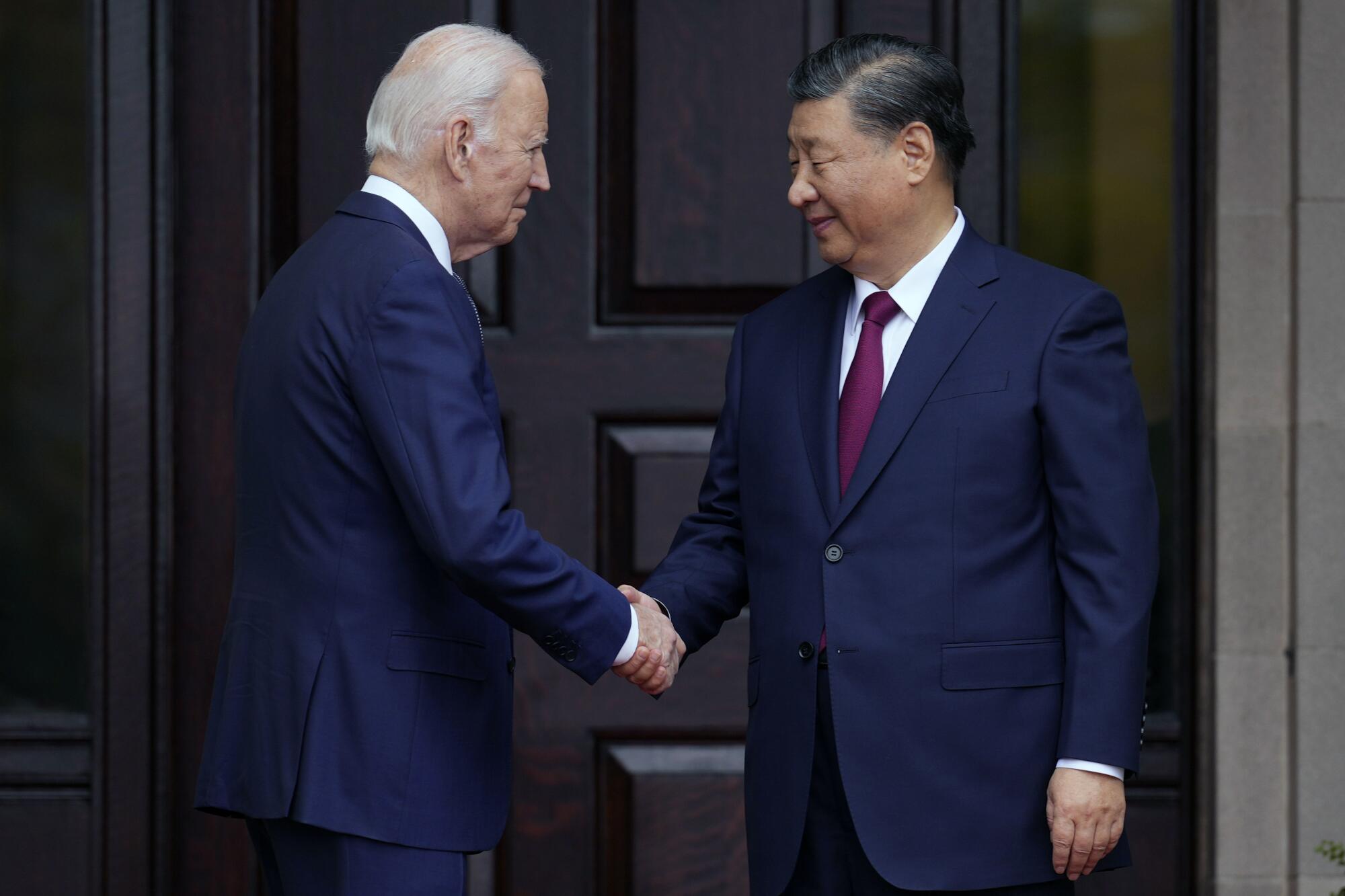
President Biden greets Chinese President Xi Jinping in Woodside, Calif., in 2023.
(Doug Mills / Pool Photo)
Although China’s progress has exceeded U.S. expectations — especially since DeepSeek released its model over a year ago — the state has focused computer power on specific applications rather than the broad strategy needed to develop more powerful models capable of advancing toward AGI.
“It’s not just chips. It’s money,” Sheehan added. “China’s leading companies are much more financially constrained than U.S. companies. There’s concern over a bubble here, but OpenAI is valued at something near $800 billion. Leading Chinese companies that have gone public are valued at $20 billion. There’s just an orders-of-magnitude gap in available financing.”
Still, some in the U.S. government fear China won’t need comparable computing power if it simply steals the technology wholesale.
Doing so isn’t simple. But last month, in a memo, the White House Office of Science and Technology Policy accused Chinese actors of “industrial-scale campaigns to distill U.S. frontier AI systems,” in effect replicating the performance of the most advanced existing models “at a fraction of the cost.” The memo did not accuse Beijing of endorsing the activity.
In the process, the memo added, carefully constructed security protocols are deliberately stripped away.
China’s negotiating advantage
Whatever its strategic calculus may be, China would enter talks with the Trump administration trailing in the race — while disagreeing on the nature of the finish line.
AGI, in theory, could reach a stage of recursive self-improvement that results in a loss of human understanding or control. But if it is only the Americans, and not the Chinese, seeking to reach that threshold, then who is responsible to stop it?
Daniel Remler, who led AI policy at the State Department during the Biden administration and took part in the Geneva talks, cast doubt on Chinese claims of disinterest in AGI and ignorance of its risks. China falling behind in the race is no strategic design, he said.
“Chinese technologists are close observers of the U.S. AI ecosystem, and sometimes they say what they think,” Remler said. “Many were impressed by the [Mythos] model to the point of despair. Leaders in China’s top AI labs have been vocal in recent months, even before Mythos, about how compute-constrained they are at the frontier. Some have said they may never catch their American competitors.”
Talks at this point in the race could follow a familiar pattern in the recent history of U.S.-China diplomacy, in which Beijing claims it is behind the United States in development, ultimately securing a handicap and greater concessions at the negotiating table.
In other competitive domains — such as with China’s entry into the World Trade Organization and in cybersecurity negotiations between Beijing and the Obama administration — agreements were ultimately reached that Washington believes in hindsight disadvantaged American companies.
The Trump administration, Remler added, “needs to approach AI diplomacy with China with clear-eyed expectations anchored to our own national interests.”
Silicon Valley itself is divided over regulating AI. Anthropic, which was founded on concerns that other AI companies were failing to take safety and alignment concerns seriously, raised alarms over Mythos, its own model, to the Trump administration, a moment that has prompted reflection at the White House on the best path forward.
Spooked after meeting with leaders from America’s top banks over their vulnerabilities, Treasury Secretary Scott Bessent internally advised U.S. government reviews of future model releases — a practice already underway in China, where the training parameters for models, known as “weights,” have been publicly released.
Even the suggestion of government oversight sparked backlash from Silicon Valley. Last week, the White House sent out a memo to reassure industry allies that submitting new models for federal review would be strictly voluntary.
If talks ultimately resume between Washington and Beijing on AI, experts believe the negotiations would be far more complex than those that resulted in arms control agreements governing nuclear weapons in the Cold War.
The superpowers would not only be discussing threats of instability to the global financial system, but also fears of proliferation — advanced AI tools getting into the hands of bad actors interested in using bio- or cyberweapons that could target both countries.
And they ultimately would have to decide whether to discuss regulating the integration of AI into the Chinese and U.S. militaries, an almost unfathomable goal between the world’s biggest adversaries, where trust is lowest and verification would be hardest.
Those in the industry who most fear what artificial superintelligence could bring have told the Trump administration that talks with China are an existential necessity.
Dario Amodei, the chief executive and co-founder of Anthropic, speaks at an event in New York in 2025.
(Michael M. Santiago / Getty Images)
But even within Anthropic, which has championed diplomacy, there are concerns that Beijing could exploit its current disadvantage to entangle American industry at the cusp of its crowning achievement.
Rather than pushing for a single sweeping agreement, industry insiders are advising the administration to pursue targeted deals with Beijing to mitigate specific risks, like the pact on nuclear command and control, two industry sources said.
In private, both Xi and Chinese Foreign Minister Wang Yi seemed to understand that the gravity of the emerging technology before them required some form of cooperation, Sullivan said.
“At a conceptual level, I believe they had a conviction on that and authorized it,” Sullivan said, “but I believe their level of urgency was considerably lower than ours, and saw this as a longer-term process that would play out over time.”
“Their level of urgency and their stake in it has gone up,” he added.