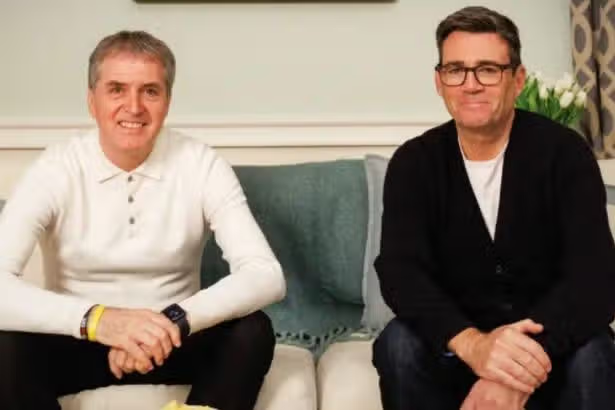

Andy Burnham

Andy Burnham says he’d hand more power to local governments if he becomes U.K. leader

Andy Burnham, likely the next U.K. prime minister, pledged Monday to give away a chunk of his power by handing greater autonomy to local leaders in a “circuit-breaker” for the sclerotic British state.

The former mayor of Greater Manchester also said he would move part of the prime minister’s office from London’s 10 Downing St. to northwest England as part of “the biggest rebalancing of power our country has seen.”

“Growth cannot be ordered from the top down. Instead, it can only be nurtured from the bottom up,” Burnham said in a speech aimed at bringing voters, Labour Party colleagues and financial markets up to speed with his economic vision.

Burnham is the strong favorite to replace Prime Minister Keir Starmer, who announced his resignation last week.

“If councils can’t fix potholes, what chance do they have of bringing forward major regeneration schemes to get growth going?” Burnham said. He set out a 10-year plan to get “good growth in every postcode,” in a country where wealth and power are concentrated in London and the south of England.

He said he would reverse almost two decades of low growth since the 2008 financial crisis through an approach dubbed “Manchesterism” — harnessing private and public money to invest in areas like transport, housing and infrastructure. He also pledged to create new industrial jobs and better educational opportunities, and to reform the U.K.’s inefficient and expensive privatized water and energy utilities.

Moving the new ‘No. 10 North’ to Manchester

During the speech at the People’s History Museum in the city where he spent nine years as mayor, Burnham said a new government office in Manchester – dubbed “No. 10 North” — would oversee regional development and become “the nerve center of a rewired Britain,” tasked with equalizing living standards across the country. Regional mayors would get more power over housing, welfare and education as part of his planned reforms.

Burnham’s rousing speech was short on specifics about where the government would find more money, and he didn’t take questions from journalists.

Burnham won praise for his role in revitalizing and regenerating Manchester, but he has not served in a U.K. government for almost two decades, and may struggle to replicate “Manchesterism” on a U.K.-wide scale.

The Institute for Public Policy Research, a left-leaning think tank, said Burnham is right to focus on “rebalancing Britain.”

“The U.K.’s concentration of power and opportunity in Westminster has held back growth, productivity and living standards for too long,” said IPPR Executive Director Harry Quilter-Pinner. “The real test now is delivery.”

Matthew Flinders, a politics professor at the University of Sheffield, said replicating Burnham’s Manchester approach on a national level would require “a fundamental shift” in the way politics is done in Britain.

“And at the heart of that would be moving from a very traditional, elitist, centralized model of politics toward something that is in many ways far more European, far more based on power-sharing in order to develop long-term policymaking capacity,” he said.

Burnham is likely to inherit Starmer’s challenges

Burnham will be aware that Starmer also announced a 10-year mission — the equivalent of two full terms in government —- to transform Britain soon after he was elected in a landslide in July 2024. Starmer is leaving after two years in office marred by missteps and judgment errors that eroded his standing with his party and the public.

Burnham won a special election for a seat in Parliament on June 18 and was sworn in as a lawmaker on June 22, the same day Starmer announced that he will resign as soon as a successor is chosen.

Burnham is so far the only contender in the Labour Party leadership contest. If no one challenges him, he will become prime minister by July 20.

While Burnham is considered more charismatic than the stolid Starmer, he will face many of the same political and economic challenges, including a sluggish economy, tattered public services and a cost-of-living squeeze. He will also be constrained by the platform the center-left Labour Party was elected on in 2024, with its pledges not to increase taxes on working people.

And like other NATO countries, the U.K. is under pressure to dramatically increase defense spending to counter a more aggressive Russia and less reliable United States.

The government’s long-awaited defense investment plan — which sparked the resignation of Defense Secretary John Healey on June 11 — is expected to be published before a NATO summit in Turkey on July 7 and 8. Starmer’s successor will be expected to stick to the commitments in the plan.

“Andy Burnham’s big idea is to shuffle power between politicians,” said opposition Conservative Party Chairman Kevin Hollinrake. “Not fix the welfare system. Not cut the taxes strangling working families and British business. Not fund the defense our country desperately needs.”

Grant and Lawless write for the Associated Press. Lawless reported from London. AP writer Brian Melley contributed to this report.

Source link

Britain’s Keir Starmer quits, Andy Burnham to run to replace him as PM

British Prime Minister Keir Starmer outside No. 10 Downing Street on Monday as he announces his resignation, pending the selection of a replacement. That will take between three and 10 weeks depending on whether there is more than one candidate. Photo by Neil Hall/EPA

June 22 (UPI) — Keir Starmer announced Monday that he was standing down as British Prime Minister, saying he had heard the message from his own party that he wasn’t the right person to lead them into the next general election.

“I will resign as leader of the Labour Party. I have spoken to His Majesty the King this morning to inform him of my decision,” he said in a televised address outside No. 10 Downing Street in London shortly after 9 a.m. local time.

Starmer said he had instructed the Labour Party National Executive to draw up a timetable to select his replacement with a 7-day nomination period starting on July 9 — which, provided there is more than one challenger — fires the starting gun on a race that would see a new leader and prime minister in place by Sept. 1 at the latest.

It could be much sooner if the party throws its support behind a single candidate.

Starmer said he would stay on as prime minister until the process was complete and vowed to do everything he could to “ensure an orderly hand-over of power.”

The move came hours before Andy Burnham, the politician tipped to replace him, was due to be sworn as a Member of Parliament on Monday afternoon after a decisive win in a by-election last week.

Burnham confirmed he would run to replace Starmer, pledging in a post on X there would be no interruption to the business of governing and vowing to deliver on “economic growth, cost of living, public services, housing and opportunities for the next generation,” if he became prime minister.

If the nomination period comes to a close with him as the lone candidate he could be handed the keys to Downing Street as early as July 17 — in a revolving door of leaders that would see him become the country’s seventh prime minister in a decade.

Two of them — Conservatives Liz Truss and Rishi Sunak — never had a mandate from the electorate having been appointed by the Conservative Party in the middle of parliamentary terms, which normally run five years maximum.

The opposition Conservative Party did not immediately comment on Starmer’s resignation but Nigel Farage’s Reform UK said a general election should be called.

“If Labour thinks it can shove another professional politician into No. 10, it has another thing coming. Reform demands an election, and we are ready to deliver radical change,” he wrote in a post on X.

The end came swiftly for Starmer following Manchester Mayor Burnham’s very strong showing in Thursday’s by-election for the parliamentary seat for the Greater Manchester constituency of Makerfield.

Until this morning Starmer, publicly, had vowed to fight any challenge — and as the incumbent gets an automatic bye to stand in any contest — but over the weekend senior figures in his administration persuaded him it was in the interest of the country, and in particular the party, to avoid a messy and potentially damaging fight.

However, Starmer’s problems can be traced back to within months of the landslide election victory he won in July 2024.

Rumblings within the party began after a poor showing in local elections in May 2025, losing a by-election in the “safe” Labour seat of Runcorn and Helsby and declining approval ratings in the polls.

Rebellions by his own MPs forcing policy U-turns, the Peter Mandelson debacle, and more losses at the ballot box, culminating in a disastrous defeat to Reform UK in “mid-term” local elections in May, saw growing numbers of MPs call for him to quit and defections from his cabinet.

Source link

Martin Lewis issues eight-word statement after Keir Starmer resignation

The Prime Minister announced he would be leaving his role

Martin Lewis has moved swiftly to rule himself out of any political role following Sir Keir Starmer’s resignation. Sir Keir confirmed earlier today that he will ‘resign as leader of the Labour Party‘.

The announcement follows a slump in poll ratings and Andy Burnham’s resounding win in the Makerfield by-election. In an emotional address outside Downing Street, Sir Keir announced his departure less than two years after sweeping to power in a landslide victory.

As has happened before, the news prompted widespread calls for money-saving expert Mr Lewis to be put forward as a potential Prime Minister. Fresh data from Focaldata indicates the 54 year old would prove an enormously popular pick amongst the British public, alongside the much-loved Sir David Attenborough.

However, in a post on social media, Mr Lewis firmly ruled himself out of the running by saying, ‘I don’t want to join any political party’. He said: “After a few “throw your hat in the ring!” messages…

1. I don’t want to join any political party

2. I’d rather wire my nipples to electrodes (& not in a good way)

“Tho the geekdom of this pop-culture politics piece is a mix of flattering, funny & scary.”

Content cannot be displayed without consent

The Focaldata research revealed that Sir Keir, Reform leader Nigel Farage, and Green Party leader Zack Polanski were amongst the least favoured candidates for PM. Kemi Badenoch was the sole major party leader to achieve a positive approval rating (+2), pointing to wider cross-party appeal.

It read: “Martin Lewis and David Attenborough, who would immediately surpass William Gladstone’s record for oldest serving Prime Minister, are the breakout leaders. They sit head and shoulders above everyone else with best-worst scores of +37 apiece, practically putting them in their own “national treasure status” sub-quadrant.

“Both command cross-party consensus, recording positive scores across every voting intention group. Stephen Fry, Big John, and Louis Theroux also have positive best-worst scores across every major party.

Piers Morgan, Jeremy Clarkson, and Gary Lineker, somewhat unsurprisingly, varied a lot from party to party. While Piers Morgan and Jeremy Clarkson are viewed positively by Conservative voters, Reform voters, and those intending not to vote, they are viewed negatively by parties on the left.

“Gary Lineker is almost the exact opposite, doing better among Green, and Labour voters although he is still viewed as a good candidate for PM by those saying they won’t vote.”

The survey presented 1,060 Brits with the names of 25 celebrities, TV personalities, politicians, and sports stars. These were then matched up against each other in groups of five, with participants asked in each round who they would most and least like to see as PM.

Source link

Voters hand Andy Burnham bye to challenge Starmer for premiership

Andy Burnham, the new Labour Member of Parliament for Makerfield surrounded by supporters on Friday as he celebrates winning the seat in Greater Manchester. Burnham, who has served as the region’s mayor since 2017, beat Reform UK candidate Robert Kenyon by more than 9,000 votes. Photo by Adam Vaughan/EPA

June 19 (UPI) — Greater Manchester Mayor Andy Burnham scored a convincing victory for the ruling Labour Party in a by-election for the parliamentary seat of Makerfield on Friday, winning more seats than all the other parties combined.

The two-time former nominee for the leadership of the party saw off Reform UK in Thursday’s poll with 24,927 votes — 55% of the vote — against Reform’s 15,696, with the official opposition Conservative’s candidate pushed into a distant fourth place with only 997 votes.

Burnham’s return to parliament to mount an anticipated bid to oust Prime Minister Keir Starmer with Burnham’s supporters saying the scale of his win confirmed he was the best person to lead the party — and by extension — the country.

In his victory speech in the early hours in the constituency, 20 miles west of Manchester and on the outskirts of Wigan, Burnham said the win could be a “turning point” for Britain.

“Everyone knows that politics isn’t working. Everyone can feel that the country isn’t where it should be. Tonight could, just could, be the turning point. From here on, I will give everything I have got to make it so. To ensure that the name Makerfield is forever synonymous with bringing about the change this country needs,” said Burnham.

Starmer congratulated Burnham, saying voters had chosen the party’s vision of “hope and optimism over division and hate” but vowed he would not “walk away” from the leadership.

He stressed that there was no contest for the leadership of the party currently and that he didn’t think it was a good idea because it would “plunge the country into chaos — but said that if Burnham initiated a challenge after he returns to Parliament next week, he would fight.

“If there is a contest, then yes. I will run. I will stand. I’m not going to walk away from that.”

Any challenger needs the backing of a quarter of MPs — around 81 — but the incumbent gets a bye and is automatically entered into the contest, should they wish to participate.

Former Health Secretary Wes Streeting, who quit the cabinet on May 14 — the same day the sitting Makerfield MP stood down to make way for Burnham — is also tipped to enter the race.

Other candidates such as former Defense Secretary Jon Healey could also emerge in the interim.

It is understood Burnham will not move against Starmer immediately and his preference, along with others in the party who no longer back Starmer, is that given some breathing space he will stand aside without a fight.

Starmer’s problems began in summer 2025, less than a year into his government’s five-year term following a landslide election victory, after a poor showing in local elections and losing a by-election in the “safe” Labour seat of Runcorn and Helsby.

Rebellions by his own MPs forcing policy U-turns, the Peter Mandelson debacle, and more losses at the ballot box, culminating in a cataclysmic defeat to Reform UK in “mid-term” local elections in May, saw growing numbers of MPs call for him to quit and defections from his cabinet.

First elected as an MP representing the Greater Manchester seat of Leigh in 2001, Burnham unsuccessfully fought two contests for the Labour leadership when the party was in opposition, losing to Ed Miliband in 2010 and Jeremy Corbyn in 2015, before quitting the House of Commons in 2017.

He currently has two years still to run of his four-year term as mayor of Greater Manchester. His resignation to take up his seat in Parliament triggers a mayoral election in Britain’s second largest metro area after London scheduled for July 30.

Troops in landing craft approach Omaha Beach on D-Day in Normandy, France, on June 6, 1944. D-Day was the largest seaborne invasion in history and turned the tide of World War II. Photo by UPI | License Photo

Source link