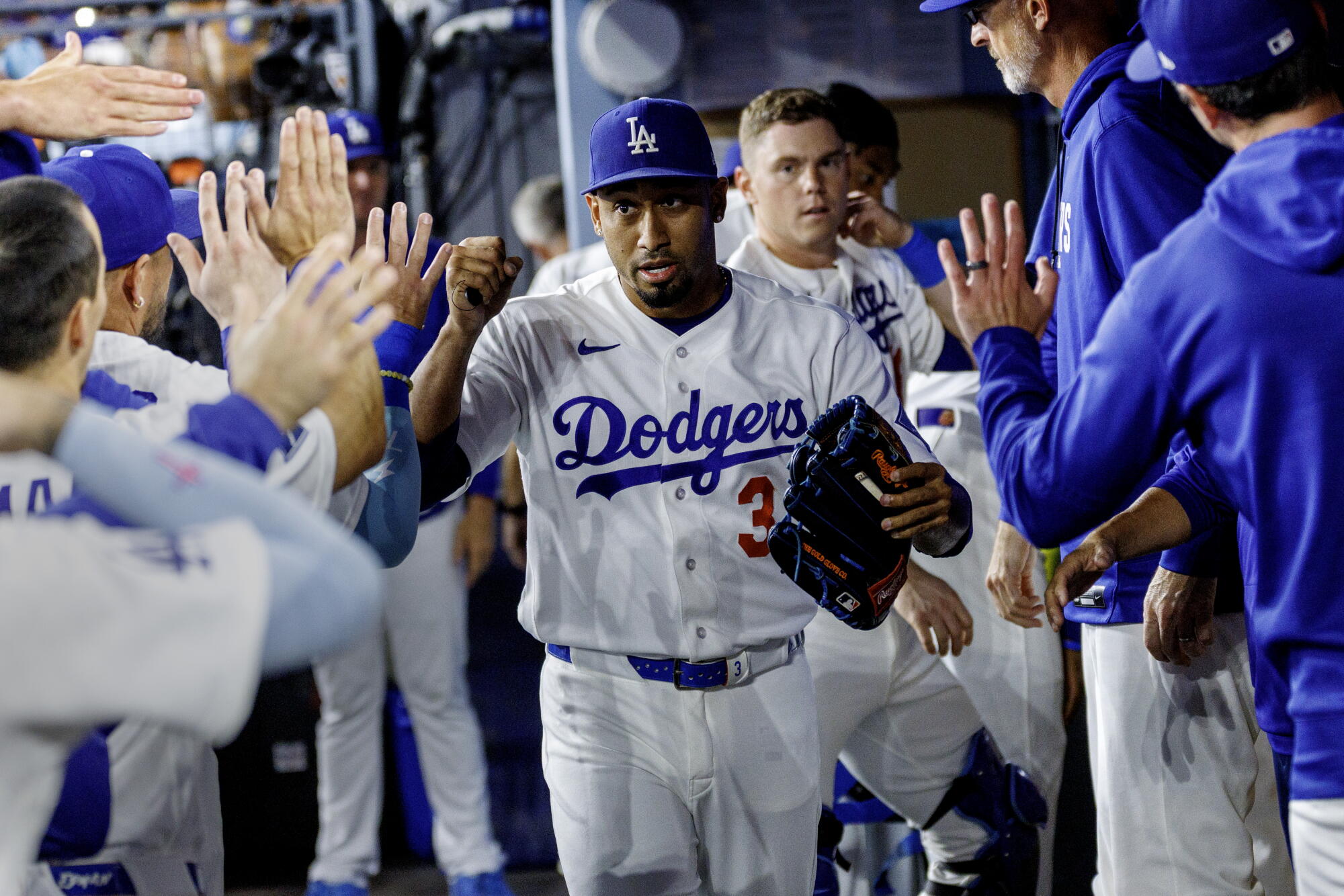
andrew friedman

For Dodgers, getting to playoffs is not good enough for Mark Walter. For Lakers?

Here’s a bit of Dodgers trivia for the bandwagon fans in our midst: Who was the manager before Dave Roberts?

That was 11 years ago. He is Don Mattingly, who returns to Dodger Stadium on Friday as manager of the Philadelphia Phillies.

The Phillies were 9-19 when they fired Rob Thomson and replaced him with Mattingly. They are 20-8 since then, a better record than the Dodgers have posted over the same span.

In Philadelphia, Mattingly got his chance because the Phillies were losing. In Los Angeles, Mattingly departed amid a run of winning.

For Mark Walter and what was then a new Dodgers ownership group, that was not enough. As Walter enters his first offseason as the Lakers’ controlling owner, it’s worth keeping that in mind.

“They have a hunger for victory that is the greatest I’ve ever seen, without exaggeration,” former Dodgers general manager Ned Colletti told me.

In two seasons with Rob Pelinka as president of basketball operations and JJ Redick as coach, the Lakers won division titles both times, failing to get out of the first round of the playoffs one year and failing to get out of the second round of the playoffs the next.

In 2013 and 2014, with Colletti as GM and Mattingly as manager in the first full seasons of Walter’s ownership, the Dodgers won division titles both times, failing to get out of the first round one year and failing to get out of the second round the other.

The Dodgers replaced Colletti with Andrew Friedman.

In 2015, the Dodgers won the division but failed to get out of the first round of the playoffs. Friedman offered Mattingly a short-term extension, and Mattingly opted for a long-term deal to manage the Miami Marlins.

After Walter and Co. took over the Dodgers, Mattingly told me Wednesday, there was one year he thought he might be fired: 2013, when the Dodgers started 30-42 and fell 9 1/2 games out of first place in mid-June. The Dodgers then reeled off 42 wins in 50 games and won the division by 11 games.

He appreciated that Walter, team president Stan Kasten and eventually Friedman did not simply bring in a new manager at their first chance.

“You get to evaluate and see,” Mattingly said, “and you have your vision for where you want it to go, and sustain it. That’s the thing they’ve been great at: sustaining it. It’s been year after year. You can’t really doubt what they’re doing.”

Kasten’s first move was not to fire Colletti, but to ask what ownership could provide for him so that he could do a better job. The owners quickly responded by funding the addition of impact players (Adrián González and Hanley Ramirez), extending the contract of a popular home-grown player (Andre Ethier), revitalizing the Dodgers’ Latin American talent pipeline (Yasiel Puig and Julio Urías), renovating the clubhouse and, at Mattingly’s suggestion, refreshing the family room.

“We started to be able to compete with a different mindset, which was invaluable,” Colletti said.

Similarly, with Friedman and former Dodgers general manager Farhan Zaidi as consultants, the Lakers have added two positions for assistant general managers, overhauled the scouting staff, created more room at team headquarters by relocating their G League affiliate to the Coachella Valley, and borrowed from the Dodgers’ playbook in modernizing medical and biomechanical facilities.

This summer could be critical in determining the future of the Lakers, including who runs them. Walter can spend all he wants, as he does with the Dodgers, but the luxury-tax penalties in the NBA are more severe than in baseball and could restrict the roster flexibility so coveted by the likes of Friedman and Zaidi. A star-studded roster beyond Luka Doncic — say, a trade for Giannis Antetokounmpo? — could require the Lakers to sacrifice the draft picks that also would limit roster flexibility.

The Lakers will have the resources. Walter will want to see the creativity and the championships — or, at least, the path to them. Ultimately, he will decide what he did with the Dodgers: Does he have the best people he can get running the team?

“You see many organizations that win, and then they take a step back,” Colletti said. “They feel like they have some goodwill in the bank, they don’t have to chase the biggest free agents, and they don’t need to re-invest in the team or the stadium.

“From my vantage point, all the way up and down that organization and especially at the ownership level, it’s almost like they’ve never won, and they’re hungry to get there. To be there and be unsatisfied — that quest to be as great as you can be — is one of the great indicators of the excellent ownership it is.”

In the meantime, any advice for Pelinka and Redick? Colletti let out a hearty laugh.

“Do your best,” he said, “and turn it up a notch.”

Source link

Can the Dodgers’ starting rotation hold up in wake of latest injuries?

Andrew Friedman got the last laugh last year, and another ring. At the trade deadline, you screamed he had to do SOMETHING BIG to get a left fielder and a closer. He did neither. The Dodgers rode a parade of starters to win Game 7 in Toronto, before they rode in a parade in L.A.

There are few things Friedman despises more than a deadline trade. The price in prospects is too high, the guarantees are too few.

Friedman might well face that same dilemma this year. We are two months from the trade deadline, and he just might need to trade for a starting pitcher by then.

Blake Snell undergoes elbow surgery Tuesday. Tyler Glasnow is back to square one in his recovery from back spasms. The Dodgers believe both will be back by the trade deadline, but you never really know for sure when an injured pitcher will return, and whether he will need some time thereafter to regain his sharpness.

There is something else Friedman despises: finishing second. It is not just about getting into the playoffs. It is about winning the National League West, with one of the two best records in the league, thus ensuring a first-round bye.

However, in a division race that was projected to be a runaway, the Dodgers find themselves in second place. With a 1-0 loss in San Diego Monday, the Padres leapfrogged the Dodgers for the lead in the NL West.

The Dodgers also figure to have a short time frame to determine whether they might need bullpen help at the trade deadline. The Dodgers have said closer Edwin Díaz is expected to return from elbow surgery sometime after the All-Star break, which would confine that time frame to two weeks, if that.

On Monday, Friedman said he was confident that the three key pitching injuries would not push him toward the July trade market.

“It’s more that the timing of the injuries would be way easier if they were spaced out,” Friedman said in a text message. “Obviously, injuries are part of the game and we can’t be shocked when it happens.

“It’s the overlapping nature that is tough in the moment, but that doesn’t really change July thoughts (at this point) or October outlook.”

In the third week of May, nothing is urgent.

The Dodgers are supplementing where they can, picking up three pitchers cut by their former clubs. The only one with name recognition: Eric Lauer, who posted a 6.69 earned-run average for the Toronto Blue Jays and complained about the team using an opener ahead of him.

The Dodgers can mix and match for awhile, but a team that prides itself on positioning its starters best for October success finds itself in an awkward position.

With Snell and Glasnow out, the Dodgers have little choice but to ask Shohei Ohtani, Justin Wrobleski, Emmet Sheehan and Roki Sasaki to take regular turns. No one but Yoshinobu Yamamoto has done that recently.

“You have to deal with the circumstances that are presented to you,” Dodgers manager Dave Roberts said. “We’re not pushing any of these guys right now. It could be a different conversation in September.

“Right now, they’ve got to take the baseball. In May, I don’t think it’s much cause for concern.”

Before the season, Fangraphs projected the Dodgers to win the NL West by 15 games, and to finish 17 games ahead of the fourth-place Padres. However, if what we see in the NL West right now is close to what we get all summer, that “different conversation in September” could involve not how to put a starter on a glide path toward October but whether that starter has exhausted himself to the point where he could not be counted on in an unexpected pennant race.

Ohtani is on pace to pitch 149 innings, a figure he last reached in 2022. He pitched 47 last year, none the year before.

Wrobleski is on pace to pitch 171 innings, 39 more than the professional high he set last season. He pitched 117 innings last year.

Sheehan is on pace to pitch 141 innings, 18 more than his professional high. He pitched 93 innings last season, none the year before.

Sasaki is on pace to pitch 137 innings, eight more than his professional high. He pitched 57 innings last season.

Maybe Lauer turns from a Dodger killer into a Dodger asset. Perhaps prospect River Ryan gets promoted into the starting rotation next month and sticks.

But July trades for starting pitchers need not be such a scary proposition. Friedman acquired Yu Darvish at the trade deadline in 2017 and Jack Flaherty at the trade deadline in 2024, and no one in Dodger Land is bemoaning the loss of Willie Calhoun, Trey Sweeney and Thayron Liranzo.

Source link