ancestor

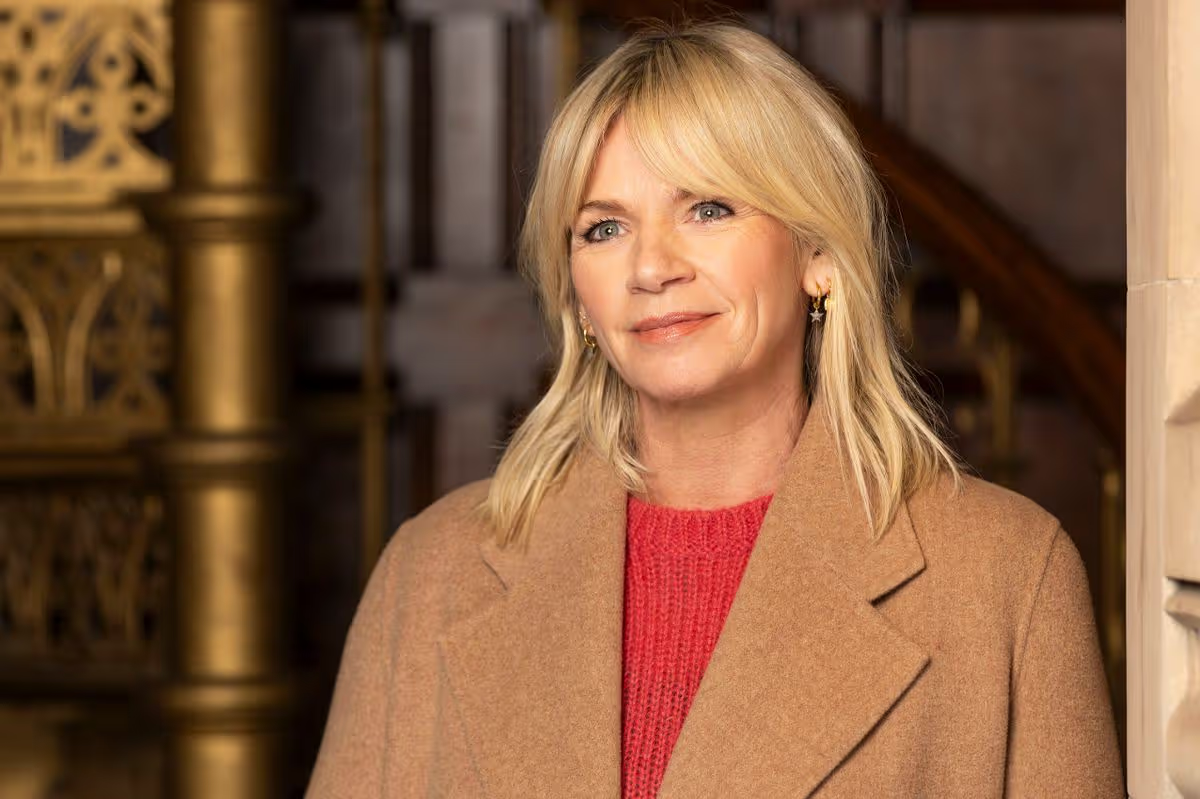
Zoe Ball in shock at ‘terrifying’ story of ancestor jailed at two years old in silent prison with no light

The BBC star finds it ‘heart-breaking’ that her great x3 grandfather had such a difficult start in life – and was later declared ‘destitute’.

Zoe Ball was famously the top-earning presenter at the BBC, earning a high of £1.4million a year as host of the Radio 2 Breakfast show back in 2021. But in the new series of Who Do You Think You Are?, the radio star discovers that her great x3 grandfather James Temby, a Cornish miner, was deported from Guernsey as a young father for being “destitute”.

He and other members of the family, who had travelled there to start a new life with the promise of work in the granite quarries, were ordered out after two years. And this came after he’d already had a particularly tough start in life – spending six weeks in Bodmin jail as an illegitimate two-year-old after his single mother Julia was locked up for six weeks in 1851 for an “assault” an another woman.

On hearing how the pair of them would have spent time in the pitch black at the Cornish reform prison, which restricted access to light in order to encourage better behaviour from inmates, Zoe is horrified. “It’s heart-breaking isn’t it?” she says.

READ MORE: Why Emily Atack is the new Barbara Windsor – inside Rivals’ raunchiest series yetREAD MORE: Emma Willis to go head to head with herself on TV this autumn if she signs for Strictly Come Dancing

Standing in the tiny, draughty cell – which could have been the very one where her ancestors were incarcerated – she also learns that the prison was silent, and so all speaking was banned, and that the inmates also had their heads shaved to prevent lice.

Zoe gasps: “That’s tough living isn’t it? It’s pretty devastating to think of a two-year old living in these conditions. Must have been terrifying for both of them.”

Jess Marlton, general manager of The Bodmin Jail which is now a hotel and museum, agrees: “Trying to keep a two-year-old quiet I should think was quite a challenge.” But she explained: “There was nowhere else for him to go and no other means to support him.”

Zoe stays the night in one of the converted cells and admits she had to “sleep with the light on”. Afterwards there is happier news when she discovers that James went on to marry her great x3 grandmother Mary Ann at the age of 19 and, despite the setback in Guernsey, he and his family fared better once they returned to England. They were initially sent to Plymouth in 1869 but by 1875 had moved 400 miles north to County Durham, which is where Zoe’s late mother Julia grew up.

James successfully secured work in the coal mines and they also ran a greengrocers shop. By the time he died 40 years later, at the age of 73, he was said to be held in the “highest esteem” by the local community. Shown a picture of the shop, based in Hunwick, Zoe says of Mary Ann: “There she is, she’s got her pinny on ready to work. It’s so wonderful to see their faces.” The couple had five children who all went on to marry.

Zoe – who’d speculated at the start of the film that she was descended from “a long line of wrong ’uns” – is thrilled to see that James was “respected in the end”. She admires the “strength and resilience” he showed in moving around to find work and support his family and feels she was actually “quite wrong” about the family history journey she’d expected to go on.

Zoe, 55, also tells the programme that she was brought up by her dad, former TV presenter Johnny Ball, from the age of two when her parents divorced, and didn’t have any contact with Julia for 14 years – which was “pretty tough”. Having fully reconciled with her mother in her later teenage years, she says that Julia’s death, in 2024, made her take a long hard look at her own life. “It really made me step back and reevaluate what’s important,” she explained. Speaking of her 15-year-old daughter, Nelly, she said “I really just want to be mum and be around for her, before she’s grown up and off into the big wide world like her brother.”

In the programme the former Radio 2 breakfast star also learns that her impoverished maternal grandmother was a serial fantasist who had “delusions of grandeur”and was sent to a mental hospital.

Margaret ‘Peggy’ Minto was committed for acute mania after being put on trial for shoplifting. Poor Peggy’s fantasies continued even while she was undergoing treatment, which included electroconvulsive therapy – an electric current passed through the brain.

Zoe’s only regret is that Julia did not live long enough to find out the fascinating details of their shared ancestry. “It’s been hard to do this without Mum,” she sighed. “I want to ring her up – I know she’d be really chuffed.”

– Zoe Ball’s episode of Who Do You Think You Are? airs on BBC1, May 26 at 9pm.

Like this story? For more of the latest showbiz news and gossip, follow Mirror Celebs on TikTok, Snapchat, Instagram, Twitter, Facebook, YouTube and Threads.


Source link

Underwater memorial to wrecked slave ship draws pilgrims seeking to connect with their roots

Ruthie Browning dove into the calm, blue water off Key West, Fla., expecting to see “a big, old rock with stuff growing all over it.”

She was on a pilgrimage with other Black divers and community members, visiting sacred sites including one where a British slave ship — the Henrietta Marie — sank 326 years ago.

The vessel had delivered 200 enslaved people from West Africa to Jamaica and was heading back to Britain in 1700 — near the peak of the trans-Atlantic slave trade — when it was swallowed up in the churning waters of New Ground Reef where the Atlantic Ocean meets the Gulf of Mexico.

A concrete marker at the site memorializes the people on that ship.

As Browning and her group prepared to dive in early May, the water was calm. The marker, 20 feet below, was visible from the glassy surface. “I thought I’d look at it, pay my respects and that’ll be that,” she said.

But something unexpected happened. Tears filled her eyes. She gently told herself: If you can be quiet, maybe they will speak.

Staring at the monument, which is now a small living reef covered in corals and sponges, she felt her ancestors’ words: “My daughter, we’re so glad you’re here.”

Overwhelmed, Browning lingered by the marker bearing the words: “Henrietta Marie. In memory and recognition of the courage, pain and suffering on enslaved African people. Speak her name and gently touch the souls of our ancestors.”

She felt submerged in gratitude.

“Without their stamina, their spirit and survival, I wouldn’t be here today. None of us would be here today,” she said.

Pilgrimages aren’t meant to be easy

For the pilgrims in Key West, the gathering was an act of devotion, a quest for connection with their roots and for spiritually nourishing generations to come. They had tried to dive to the marker last summer, but the water was too choppy.

“The ancestors were not smiling down on us then,” said Jay Haigler, master diving instructor with Underwater Adventure Seekers, the world’s oldest Black scuba diving club. “This year was different.”

Such a pilgrimage was never meant to be easy, said Michael Cottman, who has written two books about the Henrietta Marie and was part of the National Association of Black Scuba Divers that installed the marker in 1992.

Cottman believes the site contains “spiritual turbulence.”

“Even if it wasn’t carrying enslaved people, it embodies the oppression of our people,” he said.

The group organized an annual pilgrimage in the 1990s, but it didn’t continue. The latest trip was spurred by an underwater interview project proposed by Stanford University anthropologist Ayana Omilade Flewellen, who serves on the board of Diving With a Purpose, a Black scuba diving nonprofit dedicated to documenting slave shipwrecks.

The submerged interviews also helped her connect as a pilgrim, Flewellen said. “I felt a kind of tenderness in my heart.”

The spiritual experience helped her process a traumatic history rooted in death and suffering.

“It’s hard to attach your life with this history,” she said. “The only way I could do that was turn toward what the divers were experiencing on this pilgrimage. That’s where it all bloomed and blossomed.”

Ancient ritual at African refugee cemetery

The pilgrims also gathered on land. At Higgs Beach on the south side of Key West, they visited a memorial and burial ground for 297 African refugees who died in 1860 after being rescued by the U.S. Navy from three slave ships — Wildfire, William and Bogota. Over 1,400 refugees were housed by the government in a compound and provided food and medical care, said Corey Malcom, the Florida Keys History Center’s lead historian.

While many were sent back to Africa, hundreds died due to the horrific conditions on the ships, he said.

Largely forgotten for decades, the grave site was discovered by historians and geologists using ground-penetrating radar. In 2010, a large pit containing 100 more bodies was located at a community dog park across the street. The area is now fenced off, Malcom said.

On Saturday, pilgrims met at the cemetery and held an emotional libation ceremony, a sacred, ancient ritual rooted in Afro-Caribbean spiritual tradition. One by one, group members tearfully thanked their ancestors and poured white rum on the beach. The clear spirit is believed to act as a messenger, inviting ancestral souls for their blessings.

“To honor your ancestors and the road they’ve traveled is very, very important because we’re all connected,” said Addeliar Guy, one of the elders and an avid diver.

Underwater monument represents a living history

Joel Johnson trained for weeks for his first open-water dive at the Henrietta Marie site. Johnson, the president and CEO of the National Marine Sanctuary Foundation, said what surprised him as he approached the monument was the vibrancy surrounding it. Fish darted among the corals that swayed with the currents; shells rested on the sandy bottom.

Conservation and protecting these habitats also preserve the history below the waves, Johnson said.

“This was not a place of death, but a place of life,” he said. “I didn’t feel like I was grieving for my ancestors. I felt like I was in the stream of history, recognizing that I’m a part of that. It made me happy.”

While underwater, Michael Philip Davenport, president of Underwater Adventure Seekers, was inspired to create art showing ancestors emerging from the monument.

“Their spirituality is still in that space,” he said. “I was feeling their lives and their tragedy.”

Dr. Melody Garrett, an anesthesiologist, started training with Diving With a Purpose in 2011 and has gone on missions to find the Guerrero, a Spanish pirate ship that wrecked in 1827 while carrying 561 enslaved Africans.

“A pilgrimage like this is so important now more than ever because there is an effort to cover up, rewrite and change history,” she said. She cited the Trump administration’s moves to remove references to slavery and Black history at National Park Service sites and federal museums, labeling it as divisive “anti-American propaganda.”

For Garrett, seeing these pieces of history gives her a strong sense of identity as an American, as the nation prepares to celebrate its 250th birthday.

“Black people have been here since before this country’s inception, longer than many other people have,” she said. “This is our country.”

Exhibit displays shackles used in slave trade

Remnants of the Henrietta Marie’s wooden hull are embedded at the site under layers of sand. The shipwreck was discovered in 1972 by treasure hunter Mel Fisher, but it wasn’t until 1983 that hundreds of intact items were recovered. Only a few slave ships were found out of the 35,000 used to transport over 12 million enslaved Africans; most vessels were intentionally destroyed to hide the illicit trade.

The artifacts, which occupy an entire floor of the Mel Fisher Maritime Museum in Key West, include over 80 sets of iron shackles, many of them child-size.

When Kory Lamberts first walked over wooden planks in the exhibit, they unexpectedly creaked.

“It was visceral,” he said. “It took me to a place. It also tells me that these were young people — children. These are baby shackles. There’s no sugarcoating it. The truth really hits you.”

While in Key West, Lamberts — who runs a nonprofit to make aquatics more equitable — said he brought back fish from the Henrietta Marie site, which he imagines would have absorbed the DNA of the ancestors. The group ate that fish for dinner the night after the dives — like a sacrament.

“I don’t practice a faith, but isn’t this what people are doing every Sunday at church?” he asked. “I wasn’t just bonded with this site through the experience of being there, but at this molecular level with a full circle moment of connection with myself and my history.”

Bharath writes for the Associated Press.

Source link