Winning six Gold Glove awards gives Mookie Betts more than enough credibility to design and market his own leather. And that’s exactly what he is doing with LGND, a line of baseball gloves that he says are “built around versatility, craftsmanship and player-first innovation.”
Betts, of course, is the Dodgers shortstop whose Gold Gloves all came playing right field. He is one of the few players in MLB history to be named an All-Star as an infielder and outfielder. He’s been part of four World Series championship teams and named to eight All-Star squads.
“Every detail matters when you’re on the field, and your glove is one of the most important tools you have,” Betts said in a statement. “I started this with the intention to build something that reflected the way I play the game, which is with passion, preparation and attention to detail.”
Two glove collections named MOOK and MVRK designed for players at every stage of development are available at LGNDsports.com. They are not inexpensive, selling for $250 to $330.
The MOOK Series gloves are inspired by Betts’ experience playing infield and outfield, featuring his personal game-worn colorways, his signature stamp in the palm and a “50 Tri-Star” logo embroidered on the thumb.
The MVRK Series gloves feature a versatile design and distinct styling for those who play multiple positions.
Both models are constructed with premium Japanese kip leather and engineered to offer a lighter feel and fast break-in period. The LGND website features an interactive platform that allows players to design a glove that reflects their individual preferences.
“LGND is about giving young players a glove they can trust from the first time they put it on,” Betts said. “Whether you’re chasing a championship, working toward a college scholarship or just falling in love with baseball, I want these gloves to help young players perform at their best.”
Betts, 33, founded the company alongside lifelong friends Cameron Lewis, Brandon McPhail and Andrew Montgomery. The quartet competed together in high school in the Nashville area.
The Dodgers acquired Betts in a trade ahead of the 2020 season and have won three World Series title with him in the lineup, including the last two years. He spent the first six years of his career with the Boston Red Sox, winning the American League Most Valuable Player award after leading Boston to a World Series title in 2018.
After playing outfield almost exclusively for the first nine years of his career, Betts saw substantial time in the infield in 2023 and 2024 before becoming the Dodgers’ everyday shortstop last season. He led NL shortstops in total fielding runs above average in 2025 while making only seven errors in 148 games. This season he has made only three errors.
Dodgers left-hander Justin Wrobleski could have been content with his performance the first couple of months this season. After all, he’d come into the year fighting for a rotation spot, and he’d shown in that time that he was ready to be a full-time major-league starter.
That wasn’t enough.
While still holding on to his identity as a pitcher who goes right at hitters, Wrobleski tallied 20 strikeouts over his last two starts of the first half.
“We’re just doing a good job with the plan,” Wrobleski said last week, days before he was named a first-time All-Star. “I feel like I’m continuing to get better at knowing where to go with two strikes, knowing where to go versus a certain hitter with two strikes and just kind of reading the game.”
Wrobleski is the only Dodgers pitcher set to appear in Tuesday’s All-Star Game in Philadelphia. Yoshinobu Yamamoto and Shohei Ohtani pitched too close to the game, and Ohtani eventually pulled out of All-Star activities altogether in order to have his left knee drained on Sunday.
The story of how Wrobleski got there, in his first full season in the rotation after debuting two years ago, includes plenty of twists and turns.
“It’s a chronicle story in his young career, the down to up, but at the end of the day, he’s been a rock for us these first three months,” Dodgers pitching coach Mark Prior said in a conversation with The Times. “Was hoping he got in on the first set of announcements, but at the end of the day, he’s an All-Star, and he’s earned every bit of it.”
When Wrobleski wasn’t included on the initial National League All-Star roster, the Dodgers coaching staff went to work lobbying for him to be a replacement player. Manager Dave Roberts publicly made the case for Wrobleski and closer Tanner Scott whenever he had the chance.
Then, a week later, Wrobleski (10-2, 2.69 ERA) got the call after Cincinnati Reds right-hander Chase Burns bowed out because of tightness in his groin.
“He’s done so many intangible things that I think get lost in the shuffle of numbers and metrics,” Prior said of Wrobleski. “But he’s eaten innings, he’s provided length for us when we needed length. He went toe-to-toe with [Phillies three-time All-Star Zack] Wheeler. He went toe-to-toe with [José] Soriano when he was dealing with the Angels, kept us in ballgames.”
Admittedly, a year and a half ago, Prior wouldn’t have imagined Wrobleski would be an obvious All-Star pick this quickly.
The tipping point came when Wrobleski surrendered eight runs to the Washington Nationals in his first start last season. And it didn’t help that his last start of the previous season was a 10-run slog against the Arizona Diamondbacks.
“It was a long, raw, emotional sit-down with him,” Prior said. He said after the conversation with Roberts, assistant pitching coach Connor McGuiness and the rest of the staff, “we left with like, ‘Which way is this going to go?’”
But persistence has been a hallmark of Wrobleski’s career, dating to his college years, when he infamously bounced back from a car hitting him on a scooter and a baseball breaking his jaw. He also underwent Tommy John surgery two months before the Dodgers selected him in the 11th round of the 2021 MLB draft.
So, committing to a delivery change last season wasn’t all that intimidating.
Wrobleski returned to the majors in mostly a bullpen role. And his steadiness in those shorter outings culminated in a strong postseason run that included four scoreless appearances in the World Series.
“We talk about, who can you depend on to not let the moment get too big?” Prior said. “And I think Wrobo had proved that all the way through September, but clearly proved that the moment is not too big for him to continue to make pitches. And that was exciting to see too as a staff.”
Still, Wrobleski wasn’t guaranteed a rotation role this season. And Prior was frank about that over the offseason.
Wrobleski’s first outing of the season was in relief, but the Dodgers had earmarked him as their sixth starter for the second turn in the rotation.
In his first five starts, Wrobleski posted an eye-popping 0.56 earned-run average.
His swing-and-miss rate and strikeouts were down, but pitching to soft contact was getting him positive results. The most glaring example came against the St. Louis Cardinals in early May, when he threw six shutout innings without recording a punchout.
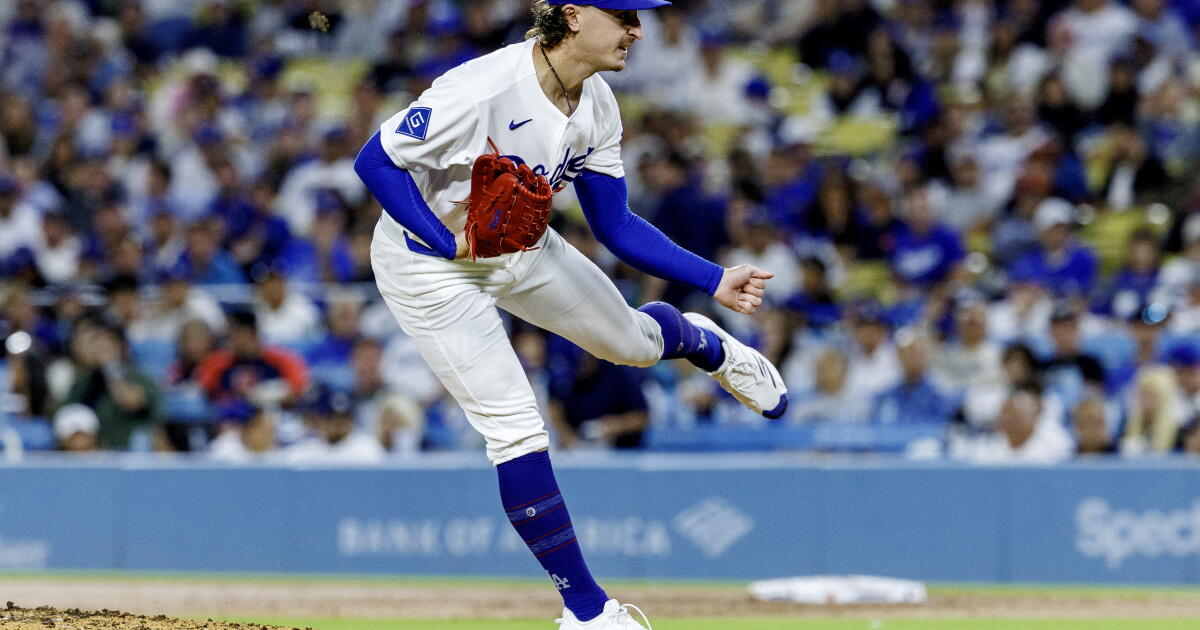
Dodgers left-hander Justin Wrobleski recorded 20 strikeouts in his last two starts before the All-Star Game.
(Eric Thayer / Los Angeles Times)
Wrobleski wasn’t going to coast on that early success, however. He kept fine-tuning his delivery and adjusting his pitch mix, right through a rough patch in late May and into a consistent June.
“He went from paring down his arsenal to kind of two pitches, to regrow his arsenal while he’s learning how to pitch at this level,” Prior said. “I think the big thing is now these guys have different looks.”
Wrobleski’s four-seam fastball and slider have done the heavy lifting. The rest of his secondary pitch mix has been a moving target.
He and the pitching coaches have talked through the most effective use of his curveball. He started integrating his sinker more consistently in late April, especially against left-handed hitters. He’s tinkered with different grips for his change-up, a pitch he started using more in mid-May. Three weeks ago, he introduced a sweeper. And in his last two starts, he threw that pitch 19 times.
“At the heart of it, though, is he never lets off the gas pedal,” Prior said. “He just gets the ball, he’s on the rubber, he puts the hitter on defense from the get-go before they’ve even seen a pitch. And that’s something that not everybody can do.”
So, despite the journey, when Wrobleski looks back at the pitcher he was a year and a half ago, he doesn’t see a complete overhaul.
“Same guy but different, I guess,” he said. “It’s crazy. I’ve had to go through a lot of small tweaks and changes. And it’s just all been about just having belief that I could continue to do it. And I knew that there were a lot of things that I could do just to get better, and I wasn’t as far away as maybe it seemed on the outside — or, as people thought it was.
“I felt like I was close that whole time, even though the results weren’t really there. It’s been cool to see the results come.”
Shohei Ohtani was the first Dodger to be named a 2026 All-Star, after leading the majors in Phase 1 voting for the All-Star game on July 14 in Philadelphia. Six other Dodgers were finalists through the fan ballot, giving them a chance to claim starting spots in Phase 2 of voting.
Ohtani locked down the starting DH spot for the National League squad, with 3,341,257 votes. The top vote-getters in each league bypass Phase 2. Second baseman Ernie Clement of the Toronto Blue Jays was the top vote-getter in the Amlerican League, with 3,232,932 votes.
Ohtani was the expected choice, despite a slow offensive start. His red-hot June boosted him up the leaderboards. He entered Thursday with the second-highest OPS in the National League (.963), barely trailing Mets outfielder Juan Soto (.965).
Pitchers aren’t chosen through the fan vote — hurlers and reserves have to wait for the player ballot (which includes votes from players, coaches and managers) and commissioners picks. But Ohtani has been just as impressive on the mound this year.
He has a 1.58 ERA, the fourth-best mark among NL pitchers who have thrown at least 50 innings this season.
Dodgers first baseman Freddie Freeman (2,666,008 votes), third baseman Max Muncy (2,890,181) and outfielder Andy Pages (2,158,664) also led their respective NL position groups in voting. Other Dodgers finalists, who advance to voting Phase 2, include catcher Will Smith (1,871,805), shortstop Mookie Betts (1,762,343 ) and outfielder Teoscar Hernandez (1,569,932).
The vote totals reset for Phase 2, which runs from next Monday through Thursday. The remainder of the All-Star starters are set to be announced on July 4 on Fox Sports.