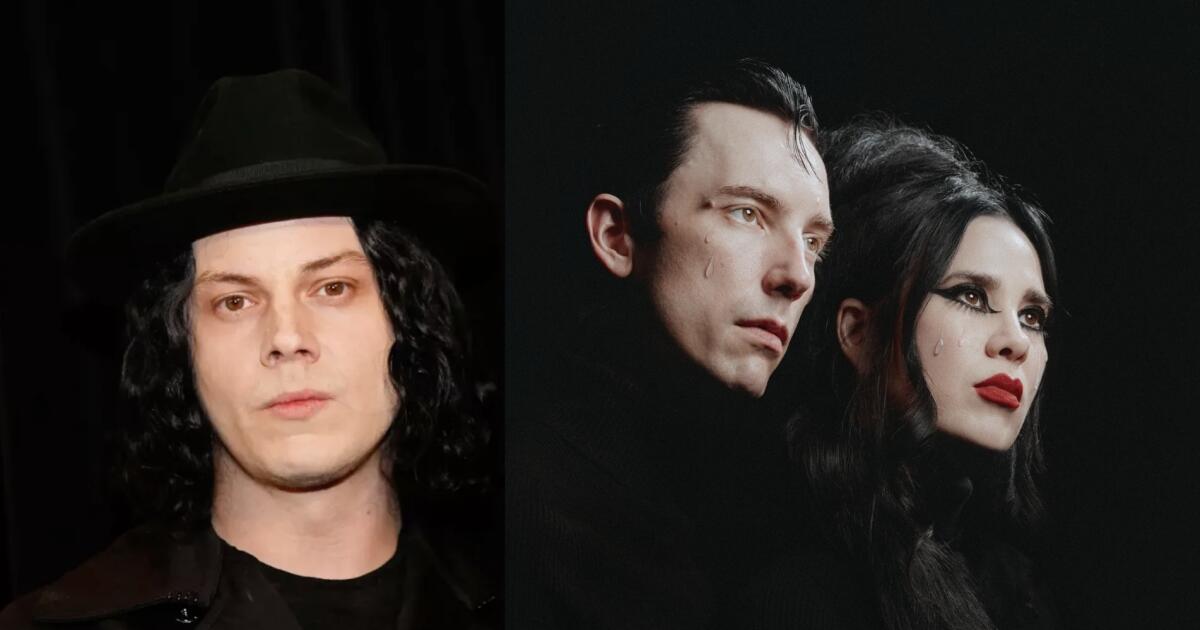
Jack White stepped in when Charley Crockett accidentally hired, then fired, a satanic doo-wop duo. Happens to everyone, right?
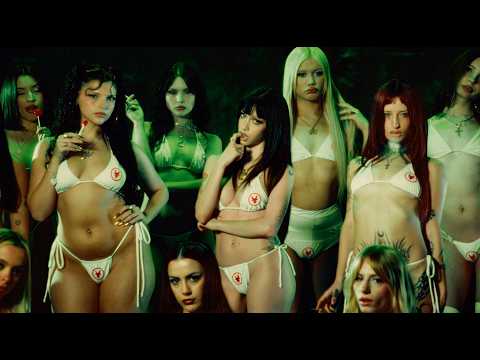
The outlaw country singer apparently thought the husband-and-wife duo known as Twin Temple were like Black Sabbath when he invited them to open two shows for him this week, a July 14 date in Troutdale, Ore., and another on July 18 in Paso Robles. With songs including “Satan’s a Woman,” “Lucifer, My Love,” “Let’s Have a Satanic Orgy” and “Burn Your Bible,” it’s anyone’s guess how Crockett missed the duo’s shtick.
“Today we were informed that Charley Crockett has decided to remove Twin Temple from his upcoming shows next week due to our Satanic imagery,” the musicians wrote on Instagram last week.
“Unfortunately, that means we will not be able to perform for you next week as planned. We are really disappointed as we were looking forward to getting back out and seeing you, and also what it meant as far as bringing different types of people and music lovers together. We are sorry to everyone who was planning to see us.
“We’re grateful for your support, not only of Twin Temple, but more importantly of artistic freedom. HAIL SATAN! 93/93”
Crockett, who dropped his 16th studio album, “Age of the Ram,” in April, posted his own since-deleted message on social media, writing, “Hail Satan? Not me Jack.”
Twin Temple, composed of married couple Alexandra and Zachary James, weren’t out of work for long. White, the former White Stripes frontman, who happened to be kicking off a world tour in support of his new album, “Frozen Charlotte,” caught wind of the debacle and stepped in.
“Twin Temple, Would you like to open my show in L.A. on September 29th at the Hollywood Palladium? Let me know,” White posted on Friday, adding, “Get in front of me Satan!”
The duo was quick to accept, commenting on White’s invite, “Unholy hell…. Sir Jack, you have no idea what this means to us. Lifelong fans- dead leaves on the dirty ground was one of the first songs I (Alex) ever learned on guitar. We were actually planning on coming to this show. It would be a most infernal pleasure to play the devils music with you.”
On Tuesday, Twin Temple announced their third record, “Doomed Lovers,” produced by Shooter Jennings (who also produced Crockett’s “Age of the Ram” and other recent albums). The album will drop Oct. 9 via their own Pentagrammaton Records. The duo told Rolling Stone on Tuesday that they were sad about the turn of events with Crockett but confirmed that their swanky Satan-loving doo-wop isn’t a sham.
“Satan’s the original outlaw, right? He’s a rebel angel,” Alexandra told the outlet. “He’s the one who questioned authority, fought for himself, refused to bow down or conform, and was like non serviam. That was a metaphor that resonated very strongly with me.”
She added, “It’s really fun to go shopping for a human skull and a Ronettes record in the same day, and we get to do that with our band.”
While Twin Temple has been booking shows and working on the album announcement, Crockett has continued to post about the drama from the road. “Well, now I know how it feels when they try to cancel you on the right AND the left,” he wrote on Facebook on Monday. “The thing is, I never subscribed. America can be a One Eyed Jack, but I’ve seen your other side.”
Last March, the L.A. Times had proclaimed that Nathy Peluso had found her musical language. Later that year, the Argentine singer decided to mix things up by releasing her 2025 EP, “Malportada.”
In a departure from her urbano and alternative leanings blended with notes of R&B, the six-song EP was a straightforward, traditional salsa offering that featured a collaboration with Venezuelan salsa hybrid band Rawayana on the title track.
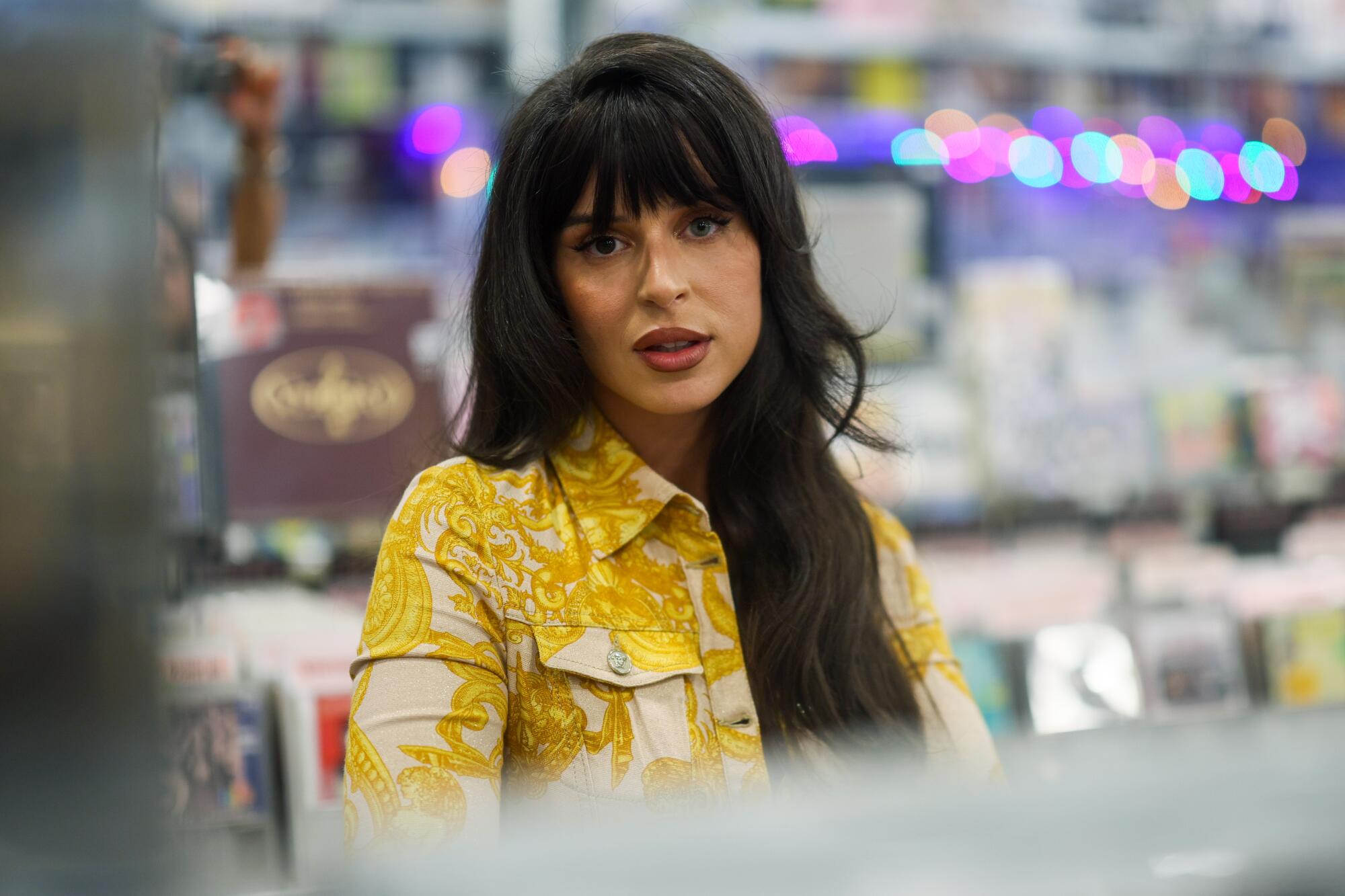
“My experience being a woman and making music has always been to talk about my freedom [and] how I feel,” she told The Times in a recent interview inside the famous Amoeba Music record store in Hollywood. “Salsa seems to me like a stage that invites one to express themselves fully, speak loudly, dance freely and feel powerful.”
Peluso had previously dabbled in the salsa genre with tracks like 2020’s “Puro Veneno,” 2021’s “Mafiosa” and the 2025 salsa erótica tune “Erotika,” but had never dedicated an entire project to the Caribbean musical styling.
“It’s [my] function in society,” Peluso previously told The Times in a 2025 interview when asked about the criticism of her salsa jams. “I’m not the kind of artist who’s complacent or politically correct. I don’t do anything with the intention of pleasing others. I chose the mission of bringing salsa back to the present because I’m passionate about it. If a genre gives me so many wonderful sensations, I want everybody else to feel them as well. As long as people argue, they will have to listen to the songs — and as a result, they will listen to salsa.”
Peluso’s gamble paid off — as “Malportada” was so well-received by critics, fans and the wider salsa community that she managed to get herself booked as the co-headliner for the Hollywood Bowl’s upcoming Salsa Spectacular on Wednesday.
Over the last few years, salsa music has enjoyed a bit of a renaissance — thanks in part to the success of Bad Bunny’s universally acclaimed album “Debí Tirar Más Fotos” — which featured the salsa fusion hits “Baile Inolvidable” and “Nuevayol” — and Rauw Alejandro’s 2024 LP “Cosa Nuestra.”
But for Peluso, her integration into the salsa world was a long time coming.
“I grew up listening to Gloria Estefan, I fell in love with [the 2000 album] ‘Alma Caribeña,’ I fell in love with the richness of that music,” said Peluso. “I’ve had a strong relationship with salsa music since I was young, even though I didn’t grew up in a place that was a cradle for that genre.”
Peluso was born in the Argentine city of Luján and lived there until she was 9, when her family moved to Spain, eventually settling in the southeastern city of Alicante.
In addition to Estefan, she cited inspiration from Nuyorican percussionist Ray Barretto, Puerto Rican salsa orchestra El Gran Combo de Puerto Rico and genre icons Héctor Lavoe and Willie Colón.
(Ronaldo Bolanos / Los Angeles Times)
“Throughout my career, I’ve always flirted with the genre,” Peluso said. “After doing the press for [the 2024 album] ‘Grasa’ there reached a point where I realized I was ready to make my salsa record, and it just happened to coincide with the current salsa boom.”
While paying respect to the musical tradition, Peluso also imbued her spin on the genre with some of the swaggering feminine energy often found in urbano music — as is evidenced in the “Malportada” track “A Caballo.”
“I grew up listening to a lot of masculine salsa and I thought it would be interesting to approach that type of energy from a woman’s perspective,” she explained. “[To take] all these stories of danger and sex and desire that the genre is known for, but give them a feminine spin.”
Peluso further bolstered her salsa bona fides when she teamed up with a pair of Caribbean music legends over the last year.
In September, she collaborated with her idol Estefan for a remix of the 1993 track “Chirriqui Chirri.” The duo performed the explosive song at the 2025 Latin Grammy Awards show. In February, Peluso jumped in the studio with Puerto Rican salsero Marc Anthony to record the original track “Como en el Idilio.”
“It was so awesome to sing with [Anthony] because he is one of the all-time legends we have in salsa who expanded the genre worldwide,” Peluso said. “It was a blessing to sing with Marc and Gloria in this moment of my career in which I’ve decided to represent salsa from my point of view.”
For her Hollywood Bowl gig, Peluso will be accompanied by the Colombian salsa collective Grupo Niche, a Grammy- and Latin Grammy-winning group that has been around since the late ’70s.
“I’ve admired Grupo Niche for years,” Peluso said. “We met at the Latin Grammys a few years ago and really hit it off. A little while back, when I was offered to do the Hollywood Bowl show alongside them, it was a no-brainer.”
But the biggest honor that Peluso is looking forward to is playing the hallowed stage of the Hollywood Bowl.
“It’s like playing in a palace for me,” she said of the historic venue. “The last time I was in L.A. for the ‘Grasa’ tour, I left wanting more. I knew I’d have to waiting until my next tour to try it, but I didn’t expect my next tour to come so quickly. It’s such a mythical place, it’s such a luxury.”
In 1975, 31-year-old Mick Jagger told People magazine that “I’d rather be dead than sing ‘Satisfaction’ at 45.” The Rolling Stones’ frontman is still very much alive, despite having performed that song in concert hundreds of times since then, most recently in 2024 during the band’s “Hackney Diamonds” tour. Jagger was 80 at the time.
“Time waits for no one,” as the Stones once sang, but apparently that doesn’t apply to the “World’s Greatest Rock and Roll Band.” To paraphrase the group’s first Top 10 U.S. hit in 1964, time is on their side. Yes, it is.
Consider the fates of the British Invasion superstars who emerged from England alongside the Stones in the 1960s. The Beatles broke up in 1970. The Kinks dissolved in 1996. The original Animals imploded in 1966. The Who called it quits in 1982 but has reunited repeatedly, including for its recent North American farewell tour.
And then there’s the indestructible, indefatigable Rolling Stones. With the partnership of Jagger and guitarist Keith Richards still front and center, the Stones will release their 27th studio album, “Foreign Tongues,” on Friday. Over the decades, they have produced classics such as “Exile on Main St.” and “Some Girls,” mediocrity like “Steel Wheels,” and abominations such as “Dirty Work.” We rank the group’s six-decade studio output from worst to first. All albums are the U.S. editions.
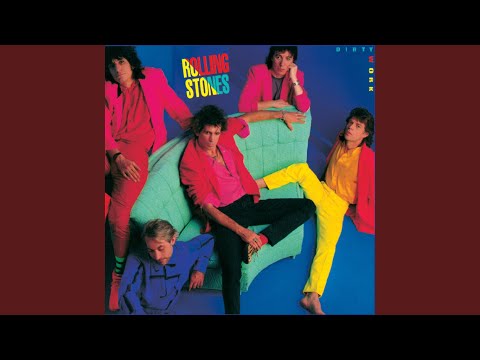
27. ‘Dirty Work’ (1986)
Never has an album cover so captured a band’s mood. “Dirty Work” features a photo of sullen, unsmiling Rolling Stones looking like they’d rather be anywhere else. The music reflects that disinterest. Apart from the cover of “Harlem Shuffle,” nothing here is memorable. It’s no surprise that the Stones nearly broke up during this period.
26. ‘Undercover’ (1983)
The follow-up to the brilliant “Tattoo You” landed with a thud. Although the song “Undercover of the Night” nicely melds a solid guitar riff with trenchant lyrics about political corruption and violence in South America, the rest of the album wilts.
25. ‘Bridges to Babylon’ (1997)
Another in a series of disappointing releases, “Bridges to Babylon” has one great song, “Saint of Me,” and lots of filler.
24. ‘Steel Wheels’ (1989)
Touted as a return to form, this album certainly outshines “Undercover” and “Dirty Work.” But that’s not saying much. With dated production and too many songs that make a good first impression but fail to stick, “Steel Wheels” has gathered moss over the years.
23. ‘Voodoo Lounge’ (1994)
Like its predecessor “Steel Wheels,” this is another attempt to recapture their classic sound. To an extent, the record succeeds. “You Got Me Rocking” sounds like a throwback to something on “Exile on Main St.,” while the ballad “Out of Tears” echoes “Angie.” With the exception of “Love Is Strong,” however, most of the songs here are little more than pleasant exercises in nostalgia.
22. ‘The Rolling Stones: England’s Newest Hitmakers’ (1964)
A solid debut, “England’s Newest Hitmakers” features covers of songs by Willie Dixon, Chuck Berry and Jimmy Reed, firmly grounding the group in its American blues and R&B influences. The sole Jagger/Richards original here, “Tell Me,” only hints at the duo’s future songwriting prowess.
21. ‘Black and Blue’ (1976)
After guitar virtuoso Mick Taylor’s departure from the Stones in late 1974, the band used “Black and Blue” to audition potential replacements. They settled on Ronnie Wood, a former member of the Faces who, ever since then, has engaged in the ancient art of guitar weaving with Keith Richards. Heavy on grooves and jams, this album sometimes feels unfocused and indulgent. The excellent ballads “Memory Motel” and “Fool to Cry” are essential.
20. ‘12X5’ (1964)
A step forward from their debut, “12X5” has the magnificent covers “Time Is on My Side” and “It’s All Over Now.” For those who like their Stones bluesy, early albums like this offer a cornucopia of treasures.
19. ‘Blue & Lonesome’ (2016)
Recorded in just three days, this album of blues covers sizzles. The Stones sound absolutely committed, with Jagger’s harmonica and vocals particularly strong.
18. ‘The Rolling Stones, Now!’ (1965)
On the band’s third U.S. album, the Stones rock harder and softer. Their version of Willie Dixon’s “Little Red Rooster” is a slow burn. The ballad “Heart of Stone,” one of their best early originals, made the Billboard Top 20.
17. ‘Foreign Tongues’ (2026)
The Stones have rarely sounded looser or more alive. Produced again by the classic-rocker whisperer Andrew Watt (Paul McCartney, Elton John, Pearl Jam), the band delivers a clutch of strong songs. In a just world, the single “In the Stars” would be a hit. “Back in Your Life,” fueled by some of Wood’s most sensitive and impassioned playing, is a stunner. At 14 songs and 62 minutes, the album would have benefited from trimming three or four of the more generic tunes. Still, it’s amazing that Jagger and Richards, both 82, and Wood, 79, have made such a fresh and vital record. Sometimes you can get what you want.
16. ‘A Bigger Bang’ (2005)
For the band’s first album of originals in eight years, the Stones remind you what makes them great. The first of their three late-career triumphs, “A Bigger Bang” brings attitude, funk, dirty rockers and dreamy ballads. The blazing “Rough Justice” and the slinky, sexy “Rain Fall Down” are topflight.
15. ‘Hackney Diamonds’ (2023)
Eighteen years passed between the release of “A Bigger Bang” and this album. It was worth the wait. “Hackney Diamonds” is another strong effort, with the banger “Angry” sounding urgent and, well, genuinely angry. The gospel-tinged “Sweet Sounds of Heaven,” featuring Lady Gaga, finds her and Jagger trading vocals and pushing each other to the stratosphere. It’s the best song the group has made since “Tattoo You’s” “Waiting on A Friend” and “Start Me Up” in 1981. The absence of late drummer Charlie Watts is felt, but Jagger and Richards prove that old geezers can still rock.
14. ‘Out of Our Heads’ (1965)
A very strong outing that includes originals “The Last Time,” “Play With Fire” and “Satisfaction,” one of the best rock songs ever written.
13. ‘It’s Only Rock ‘n Roll’ (1974)
Keith Richards’ deepening heroin problem meant Jagger had to carry more of the load himself. On this album, he acquits himself admirably. The anthemic title track positively swaggers. The poignant “Time Waits for No One” features one of Taylor’s most beautiful solos, a fitting coda to the end of his five-year career with the Stones. A fine album with several good songs and a couple great ones.
12. ‘December’s Children (And Everybody’s)’ (1965)
A hodgepodge of live cuts, outtakes, British LP tracks and singles, this album shows the Stones rapidly gaining confidence and playing with equal parts finesse and fire. Any album with “Get Off of My Cloud” and “As Tears Go By” is worth the price of admission.
11. ‘Their Satanic Majesties Request’ (1967)
Released months after “Sgt. Pepper’s Lonely Hearts Club Band,” this occasionally ill-advised foray into psychedelia pales in comparison to the Beatles’ masterpiece. That doesn’t mean it’s bad. In fact, the Stones never sounded as adventurous or experimental. When it works, as it does on “She’s a Rainbow” and “2000 Light Years From Home,” candy-colored bliss follows.
10. ‘Emotional Rescue’ (1980)
An underrated gem often overshadowed by its predecessor, “Some Girls,” and its successor, “Tattoo You,” “Emotional Rescue” finds the Stones in fine form at the dawn of a new decade. The rhythm section of bassist Bill Wyman and drummer Watts locks in, while Richards and Wood converse with their guitars as only they can. Jagger sounds energized on the rockers “Let Me Go” and “She’s So Cold” and sexy on the incredibly funky “Dance (Pt. 1).”
9. ‘Goats Head Soup’ (1973)
Considered a big letdown after the magisterial “Exile on Main St.,” this album has received a well-deserved critical reappraisal and aged like a fine wine. It’s not the Stones at their peak, but close enough. “Angie” is absolutely gorgeous, while “Star Star” captures the Stones at their most profane.
8. ‘Tattoo You’ (1981)
Needing new material for their 1981 tour, the Stones cobbled together “Tattoo You” from leftovers and half-finished songs dating back to “Goats Head Soup.” Jagger penned new lyrics, recorded new vocals, and presto — the band made its last classic. “Start Me Up,” the band’s best rocker since “Brown Sugar,” propelled the album to multiplatinum sales and shook stadiums around the world. It still does.
7. ‘Aftermath’ (1966)
The first Stones album composed entirely by Jagger and Richards, “Aftermath” represents a quantum leap forward or two. Brian Jones, before drugs and paranoia dimmed his creative spark, made some of his greatest contributions, elevating “Paint It Black” with his sitar and adding the indelible marimba riff to “Under My Thumb.” The Stones had finally lived up to all the hype.
6. ‘Between the Buttons’ (1967)
The American version kicks off with the one-two-three punch of “Let’s Spend the Night Together,” “Yesterday’s Papers” and “Ruby Tuesday” and doesn’t let up. Arguably the band’s poppiest album, it sounds like groovy Swinging London set to music.
5. ‘Some Girls’ (1978)
After the lackluster “Black and Blue” and the mixed critical reception of “It’s Only Rock ‘n Roll” and “Goats Head Soup,” some wondered if the Stones had lost their musical magic. They needn’t have worried. The band, hungry to prove the doubters wrong, made one of its strongest albums. With Wood now fully integrated into the group , punky, guitar-centric rockers like “Respectable,” “When the Whip Comes Down” and “Shattered” snarl. Jagger, entranced by the sounds coming out of New York’s discos at the time, contributed the No. 1 “Miss You.” Add “Beast of Burden” and the countryish “Far Away Eyes” to the mix and you have the ingredients for a stunning comeback.
4. ‘Beggars Banquet’ (1968)
The start of one of the strongest four-album runs in rock history, “Beggars Banquet” is a near-perfect listen from beginning to end. New producer Jimmy Miller helps strip the band down to its rawest, raunchiest essence on songs like “Sympathy for the Devil,” “Stray Cat Blues,” and “Street Fighting Man.” For the first time, the Stones had released an album on par with some of the Beatles’ best work. Indispensable.
3. ‘Sticky Fingers’ (1971)
Unbreakable love (“Wild Horses”); heartbreak (“I’ve Got the Blues”); slavery, interracial sex and heroin (“Brown Sugar”); addiction (“Sister Morphine”) — “Sticky Fingers” has it all, along with some of the most powerful music in the Stones’ catalog. If a Martian came to Earth and wanted to know what made the Stones special, a listen to “Sticky Fingers” would make it abundantly clear.
2. ‘Let It Bleed’ (1969)
By the end of the ’60s, the dream had faded. Vietnam, inner-city riots, and the assassinations of Robert F. Kennedy and Martin Luther King Jr. had cast a pall over the Day-Glo optimism of the Love Generation. The Rolling Stones were there to chronicle the impending hangover. “Gimme Shelter” reflected the growing dread of the times. It’s among the darkest, grittiest and most transcendent songs ever recorded, with Jagger singing about rape and murder over Richards’ shimmering guitar. In the powerhouse “Midnight Rambler,” Jagger takes on the persona of a killer, even name-checking the Boston Strangler. Dark stuff. Yet the superb “You Can’t Always Get What You Want,” replete with a gospel choir, the country stylings of “Let It Bleed” and “Love in Vain,” sung by Jagger with utter conviction, give the album incredible diversity and depth.
1. ‘Exile on Main St.’ (1972)
And then there was one. Recorded largely in the steamy, sweltering basement of Richards’ rented French villa, Nellecôte, “Exile” reeks of filth, decadence and decay. With Jagger’s vocals often buried deep in the muddy and murky mix, the album initially sounds like a druggy demo. But listen again. And again. Slowly, it reveals itself as quintessential Stones, a potent admixture of styles, sounds and soul. Richards tosses off one indelible riff after another, making “Rocks Off,” “Happy,” “Tumbling Dice” and “All Down the Line” rock and roll perfection. You like your Stones with a dash of Americana? “Sweet Virginia” might be the band’s best country rocker. Blues? Try “Ventilator Blues.” Gospel? “Shine a Light,” accented with Billy Preston’s piano and organ, transports listeners to a higher place. Other Stones records contain more classics and better production, but none holds together as well as a whole or comes as close to the sublime as this one.
Marc Ballon, a former Times, Forbes and Inc. Magazine reporter, teaches an advanced writing class at USC. He lives in Fullerton.
Here’s a terrible-seeming idea: The Rolling Stones should get started on their next album.
Like, now.
After taking nearly two decades to release 2023’s “Hackney Diamonds” — the band’s first set of original material since “A Bigger Bang” in 2005 — the Stones are back this week with a follow-up, “Foreign Tongues,” that took them less than 36 months to get out.
And it’s the better record in every way.
In the old days, of course, two and a half years was all they needed to make “Beggars Banquet,” “Let It Bleed” and “Sticky Fingers.” So let’s not get too carried away by the fact Mick Jagger, Keith Richards and Ronnie Wood are working as fast as they are in their late 70s and early 80s.
Yet to listen to the brisk and sportive “Foreign Tongues” is to hear a band clearly going on instinct rather than overthinking the music à la any number of veteran acts in legacy-maintenance mode. I don’t know if the result is the Stones’ best since 1978’s “Some Girls,” but it’s definitely the funniest, which is actually the more impressive achievement.
“Wake up in the morning and you wanna make me puke,” Jagger sneers in the punky “Hit Me in the Head” — exactly the kind of lyric you’d hope to hear from a band whose only possible reason for still being in the game is to have a gas-gas-gas.
Like “Hackney Diamonds” — and, for that matter, like Paul McCartney’s “The Boys of Dungeon Lane” (to name one recent overthinking-veteran LP) — “Foreign Tongues” was produced by 35-year-old Andrew Watt, who’s made a career of helping boomer icons put a little shine on their late-in-life efforts. And he’s helped the Stones convene an appealingly motley crew of collaborators here, including McCartney (who plays bass on “Covered in You”), the Cure’s Robert Smith (who contributes guitar to “Divine Intervention”), Steve Winwood (who plays piano and organ throughout the album) and Bruno Mars (who’s credited with, uh, cowbell in “Never Wanna Lose You”).
You also get a welcome appearance from the late Charlie Watts in a hard-thwacking performance recorded before his death in 2021. (Steve Jordan otherwise keeps time.)
But none of the stunt casting feels like the point of the album, which instead simply doles out a dozen tunes in the Stones’ various idioms — the bluesy stomp, the country-ish lope, the sleazy disco jam — plus a couple of covers in just over an hour. It’s frisky and lighthearted, even when Jagger is lamenting what he sees as the sorry state of his beloved America in “Ringing Hollow” and when Richards is croaking about love having put him on his knees in “Some of Us.”
And when they go goblin mode, they really lean in: “Mr. Charm” is a demented soul-rock rave-up about how boring money is — OK, Mick — in which Jagger drops a diss of the “mad mogul Mr. Musk” into a verse laying out the delights of staying home and doing anagrams.
In “Divine Intervention,” Jagger offers a colorful travelogue of trips through New York and Los Angeles — “I kept moving on to Silver Lake / To play guitar with a brand new friend of mine” — while Richards and Wood get their guitars slip-sliding all over the place. “Jealous Lover” is gorgeously trashy: a horny little strut that sounds like “Dirty Mind”-era Prince doing “Waiting on a Friend.” (Legitimately loony Mick vocal here.)
For God knows what reason, the Stones offer up a faithful rendition of Amy Winehouse’s “You Know I’m No Good” with Jagger on harmonica. And the album ends with a very ragged take on Chuck Berry’s “Beautiful Delilah,” obviously meant to remind you of how the two lifers at the core of the Stones came together more than half a century ago.
The memory is ancient; the thrill, somehow, is alive.
BRIT musician Calvin Hayes who co-founded 80s hit band Johnny Hates Jazz was tragically found dead at his home, aged 63 yesterday.
The talented keyboardist, drummer and heartthrob collapsed at his US property.
Calvin Hayes, seen here in 2008, has died at the age of 63Credit: GettyJohnny Hates Jazz, featuring Calvin Hayes, Clark Datchler and Mike Nocito perform live on German TV in July 1987Credit: Getty
The hit group achieved major international success with 1988 album Turn Back the Clock, which topped the UK charts.
They enjoyed a popular reunion in 2010.
Sign up for the Showbiz newsletter
Thank you!
The star’s dad was Mickie Most, a prominent British record producer who worked with major artists in the 60s and 70s including cult group Hot Chocolate.
Hayes also found fame working alongside pin-up Kim Wilde, who he dated.
He appeared as part of her promotional band and featured on the sleeve artwork of her self-titled debut album, released in 1981.
Kim recalled in a 1988 interview that she had known Hayes since recording Kids in America, noting they first got involved at a family party.
Pin-up Kim said: “We have fallen for each other totally. I can tell everybody that it’s the most wonderful feeling in the world.
“He is the greatest thing that has ever happened to me.
“I have never really liked talking about my love life but there have been so many rumours about me recently that I decided it was best to get it all out in the open.
“We always got on well, ever since he played drums in my first band seven years ago.
“And that’s why our love affair is stronger than most couples.
“We know that we have got a lot in common. I think that’s why we both know it will last.”
Hayes co-founded Johnny Hates Jazz in 1986 with singer Clark Datchler and bassist Mike Nocito.
The band self-produced their work and gained international recognition with their 1987 single Shattered Dreams, which reached the Top 10 in multiple countries including the US.
Turn Back the Clock achieved multi-platinum status and produced four consecutive UK Top 20 singles: I Don’t Want to Be a Hero, Turn Back the Clock and Heart of Gold alongside Shattered Dreams.
At the peak of their success after the first album, Datchler left the band.
Hayes and Nocito continued, recruiting Phil Thornalley as vocalist for the second album Tall Stories, though its release was delayed by a near-fatal car crash that kept Hayes in a body cast for nearly a year.
Johnny Hates Jazz appeared on Top of the Pops eight times between May 1987 and March 1988.
Hayes maintained a low profile in music for much of the 1990s and early 2000s.
They regrouped for a nostalgia arena tour.
The band performed multiple live shows across Europe and Southeast Asia during their comeback.
Hayes departed the group shortly after these performances for personal reasons.
Hayes and Wilde remained good friends since their initial collaboration in the early 1980s.
LEIGH-Anne Pinnock has confirmed she and husband Andre Gray are expecting their third child – and the signs were all there.
The former Little Mix singer, 34, has been busy promoting her debut solo album My Ego Told Me To, but it’s not just the new music that’s acted as a distraction for fans when it comes to her pregnancy.
Sign up for the Showbiz newsletter
Thank you!
Singer Leigh-Anne opted for a very oversized look during a recent trip to Los AngelesCredit: InstagramLeigh appeared to hide behind her daughters in a snap from their recent family holidayCredit: Instagram
Leigh-Anne took to Instagram last week to share snaps from a trip to Los Angeles, including one of her covering up in an oversized denim shirt and matching jeans.
She and Andre, 35, recently took their four-year-old daughters to Thailand and some of the holiday snaps suggest Leigh was hiding a bump.
In one photo she can be seen posing behind her girls in an olive green minidress.
Another stunning shot saw the proud mum and her daughters in the sea – with Leigh-Anne posing with her back to the camera.
Another photo from their trip to Thailand saw Leigh and her girls in the sea – with her back to the cameraCredit: InstagramTonight Leigh confirmed she and Andre are expecting their third childCredit: Instagram
The Don’t Say Love hitmaker and footballer Andre are fiercely protective of their children and have never shown their faces or revealed their names.
Earlier this year Leigh-Anne opened up on her decision to keep her daughters out of the public eye.
She told People: “I remember when they were born, I was going through this online hate thing and really seeing the toxicity of social media.
“I mean, I probably would’ve still decided to not show their faces anyway, but that just kind of confirmed it for me. I want them to be able to make that decision.
“I want them to be able to [choose] if they want to be famous or not, because once they’re out there, they’re out there.
Leigh-Anne and Andre tied the knot in 2023 in a beachfront ceremony in Jamaica.
One Wednesday evening in May, at the boutique hotel Dream Hollywood — located just off the Walk of Fame — a young hotel staff member shuffled over to her co-worker to discuss a special guest on the top floor. Together they exchanged whispers about an artist’s unknown whereabouts and whether or not they would catch him on his descent to the first floor.
The name “Tito Double P” slipped out, referring to the Mexican corrido singer who happened to be in town promoting his latest album, “Acomodo.”
I met the 28-year-old on the top floor, where he opted for a warm, friendly hug in lieu of a firm business handshake. We were quickly rushed into a side room to conduct his last interview of the evening.
Those who’ve followed Tito Double P’s musical journey since 2023 would likely describe him as a chaotic force, with weathered vocals, off-the-cuff ad libs, riotous pelvic thrusts and suggestive tongue expressions.
Come Sunday, he’ll bring the ruckus when he headlines Belico Fest in L.A.’s BMO Stadium. But when we spoke about his second solo album, “Acomodo,” the Nayarit-born, Sinaloa-raised singer, whose real name is Jesús Roberto Laija García, arrived polished, perfumed and poised.
“After this LP, don’t be surprised if you see different things from me,” said Laija García.
Released on May 28, the LP contains 23 corridos, which see Laija García strike the commanding tone of brazen CEO. In its focus track, “Me Vale V,” the singer firmly declares he is manifesting his dreams and not paying anyone else mind. Its lyrics reveal it all: “Ya van tres días que no paro, pero bien trabado” (I’ve been going nonstop for three days now, but I’m totally locked in).
But listeners also get a more vulnerable side of the músicana mexicana singer, who agonizes over heartbreak in “La Fama” — while simultaneously voicing his vice for women and boozy escapades. Throughout the record, the singer sprinkles in the catchphrase, “Bélico pero no tanto, mija,” which translates to “warlike, but not too much, my dear” — striking a balance between his hard-shelled exterior and inner tenderness, namely in the yearning jazzy corrido “Pase y Pase,” in which he pleads for a late-night booty call.
Most notably, “Acomodo” boasts no features whatsoever, a rarity in an industry where artist collaborations play a key role in bringing in bigger audiences (and bigger payouts).
“Many people called me to ask why they weren’t going to be on [the record],” he said. But the solo move marked a milestone achievement for Laija García, who had no designs of becoming an international musical marvel.
“I was never the child who sang, who played the guitar in school festivities or at family parties,” said Laija García in a calm tone — occasionally referring to his stage name in the third person.
The singer still can’t fathom his own success. He cut his teeth by penning career-defining songs for his famous cousin, Peso Pluma — including anthemic corridos like “El Belicon,” “Siempre Pendientes” and “AMG.” These standout ballads touted a rugged lifestyle with elements of organized crime, which aided his primo’s ascent to the mainstream.
Tito Double P released his second solo album “Acomodo.”
(Adan Ornelas Anta)
In the process of composing his cousin’s Grammy-winning 2023 album, “Génesis,” Laija García asked him if he could also release his own material. “Let’s go!” he recalled Peso Pluma saying. “Your first song will be a duet with me.”
The plan was to debut Tito Double P with “La People,” a fiery narcocorrido that details the inner life of a cartel’s tactical security guard, who narrowly escapes a police raid.
But Laija García’s rollout plan took a detour when an unmastered version of his track was leaked to TikTok in spring 2023 — a bouncy tune he later renamed “Dembow Belico,” which is characterized by a Dominican-style boom-chi-boom-chick rhythm and raw, spitfire lyrics. This party track introduced audiences to a version of Tito Double P that radiated a lighthearted madness — fueled by Skyy vodka and Old Parr whiskey, as per the song’s lyrics.
“I liked it, it was something new,” said Luis R. Conriquez, who called up the new singer to be a collaborator. “What makes him special is his voice, his sound. He’s his own person.”
Together with Conriquez and Joel De La P, “Dembow Belico” was released on June 5, 2023, and became Tito Double P’s official debut in the music world — even giving life to one of the most viral clips of Mexican boxer Canelo Alvarez, who can be seen awkwardly dancing to it.
“From there on, Tito Double P was another persona,” said Laija García. Throughout his lively retelling of the story, he added a series of sound effects to move the story line — among them, wacha, pum, pum, pum, gol. “More than anything, Tito Double P came across as a character, because that guy was totally crazy, he didn’t give a damn.”
“More than anything, Tito Double P came across as a character, because that guy was totally crazy, he didn’t give a damn,” said Jesús Roberto Laija García, better known as Tito Double P.
(Adan Ornelas Anta)
In real life, Laija García considers himself a timid, camera-shy guy. That’s why he chose an illustration for the cover of his 2024 debut album “Incómodo,” rather than a real-life image of himself; the LP title directly translates to “discomfort.”
“I was going to be one of those artists that [only] releases songs, because [I thought,] ‘How embarrassing would it be if I got up on stage?’” he mused. “But now, I dominate the stage from head to toe. And I don’t want to come down.”
The debut record also served as an experimental project for Tito Double P, whose hard-won swagger elevated every sound he toyed with — whether it was on the brass-heavy banda song “La 701” with Luis R Conriquez, the techno thump of “La Bandolera,” the heavy-hitting urban track “Linda” with Neton Vega and the guitar-powered ballad “Los Cuadros” ft. Peso Pluma).
Featuring collaborations with established acts, such as Natanael Cano, Junior H and Grupo Frontera, the album peaked at No. 11 on the Billboard 200 chart and helped the rising star distinguish himself from his high-profile cousin — who he toppled from the No. 1 spot on the Top Latin Albums chart, five weeks after his debut release.
Although Laija García hasn’t shied away from embracing that familial tie either; in May, both Tito Double P and Peso Pluma concluded their “Dinastía” tour following their joint 2025 album of the same name.
“I still see comments on TikTok where people are surprised that we are cousins,” remarked Laija García.
Now with “Acomodo” — which debuted at the top of both Spotify Top Albums USA and Top Global Charts across all genres — Tito Double P affirmed his rightful place in música mexicana upper echelons.
“That’s why it’s called ‘Acomodo,’ because everything is aligning itself as it should be,” he said.
As Tito Double P made his way to the lobby, a member of the Dream Hollywood valet — who likely bore witness to Hollywood A-listers and other luminaries — asked if he could take a picture with the singer. “Tito, Tito, a photo please!” asked the employee.
Laija García flashed a friendly smile. Thankfully for the attendant, Tito Double P is always camera-ready.
Donny Hathaway had already been expounding on the splendors and indignities of American life by the time he got to the Troubadour in West Hollywood in the last week of August 1971.
A classically trained pianist with a declamatory voice shaped by his years in the church, Hathaway closed Side 1 of his 1970 debut with an original called “Tryin’ Times” — “Maybe folks wouldn’t have to suffer,” he sang, “if there was more love for your brother” — and finished the LP with a stately rendition of Nina Simone’s “To Be Young, Gifted and Black.” Months after the album was released, he dropped a joy bomb of a holiday single, “This Christmas,” that unapologetically made space for a Black experience in the yuletide-industrial complex.
Donny Hathaway performs at Mister Kelly’s in Chicago in 1971.
(Val Mazzenga / Chicago Tribune / Tribune News Service via Getty Images)
Yet Hathaway captured something indelibly American during his week of shows at the Troubadour, which were recorded (along with a later gig at New York’s Bitter End) for the singer’s classic “Live” album that came out in February 1972. On an LP full of spine-tingling performances, the undeniable high point is Hathaway’s take on Carole King’s “You’ve Got a Friend” — a clear-eyed if optimistic portrait of resilience and cultural exchange.
King — who’d made her name in the 1960s as half of a prolific Brill Building songwriting duo with her husband, Gerry Goffin — wrote “You’ve Got a Friend” after leaving Goffin and moving to Los Angeles with her two young daughters. Here she remade herself as a low-key singer-songwriter dispensing wise yet unflashy tunes about love, home and family — part of a gentle resetting of pop’s mood after the turmoil of the previous decade.
Cut like the rest of the album at A&M Studios on La Brea Avenue, “You’ve Got a Friend” helped drive King’s 1971 “Tapestry” LP to sales of more than 10 million copies and to a boatload of trophies (including album, record and song of the year) at the Grammy Awards; the singer’s pal James Taylor, whom she’d performed with for the first time in late 1970 at the Troubadour, topped Billboard’s Hot 100 with his own cover of “Friend” featuring background vocals by Joni Mitchell.
On the advice of Atlantic Records’ Jerry Wexler, Hathaway also recorded “Friend” as a studio duet with Roberta Flack, a fellow Howard University alum; their take sat in the Top 20 of Billboard’s R&B chart as Hathaway began his run at the Troubadour — popular enough that the audience on “Live” erupts at the sound of Hathaway’s opening organ lick.
Carole King at A&M Studios in Los Angeles in 1970.
(Jim McCrary / Redferns via Getty Images)
Indeed, the crowd is really the thing in this live version of “You’ve Got a Friend.” Hathaway and his band — including guitarist Phil Upchurch, bassist Willie Weeks and 16-year-old Fred White (soon to be of Earth, Wind & Fire) on drums — are cooking, to be clear; the groove is funky and viscous, and Hathaway’s vocal is gorgeous, not least in his nimble ad-libs.
But it’s his interplay with the few hundred folks in the room that elevates the recording to a deeply moving piece of art.
For King (and Taylor), the song’s promise of unflagging support is an intimate one-to-one matter; their renditions use homey acoustic arrangements to create a picture of two people exchanging confidences. In Hathaway’s hands, “Friend” is about community: Before he even asks them to, the audience takes over for him on lead vocals in the song’s chorus, a congregation in all but name.
Given the proximity to the civil rights movement, it’s impossible to hear Hathaway’s “You’ve Got a Friend” as disconnected from the struggles of Black people. At the Troubadour (as in his and Flack’s duet), he nixes the song’s second verse to arrive more quickly at the bridge, in which he describes a cold world filled with those who’d “hurt you and try to desert you” — even “take your soul if you let them.”
As Emily J. Lordi notes in her 2016 book about “Donny Hathaway Live,” the crowd lays back during the bridge before rejoining Hathaway for the song’s second chorus; the decision, somehow spontaneous and collective at once, is an expert bit of record-making on the part of an audience that, according to legend, hadn’t been told the concert was being taped.
“From this perspective,” Lordi writes of Hathaway’s fans — some number of whom had surely availed themselves of the Troubadour’s bar, as she points out — “they are not stealing the show so much as they are holding him up, ensuring he won’t sing the duet alone.” Together, performer and audience are turning back (not that they necessarily had a choice) to the ugly truths that singer-songwriter music sometimes sought to move past.
In this way, Hathaway’s “Friend” becomes a reinvention of a reinvention — an act of moral imagination about as American as it gets.
This wasn’t the only instance of a Black soul singer interpreting a tune King had written as a single mom newly arrived in L.A.: In May 1972, the Isley Brothers released a sultry cover of “It’s Too Late”; a month after that, Aretha Franklin’s live “Amazing Grace” album mashed up “You’ve Got a Friend” with “Precious Lord, Take My Hand,” completing the gospel-ification that Hathaway had begun in a bastion of white rock culture temporarily remade as an African American church.
Yet in Hathaway’s “Friend” you can hear the whole story American music tells about identity and belonging (and about commercial ambition).
“This might be a record here,” Hathaway tells the crowd near the end of the song, and so it was — a document of adaptation, a testament to borrowing, a bulwark against pretty fictions.
Taylor Swift and Travis Kelce’s love story will reach new heights this week with a totally low-key two-day wedding bash at New York’s Madison Square Garden.
The billionaire pop titan and the NFL star, both 36, kicked off their wedding festivities Thursday afternoon with a rehearsal dinner at the famed sports arena. They have all but confirmed that they will then exchange their vows Friday in a grand MSG celebration with around 1,000 guests (including Swift’s celebrity friends and Kelce’s fellow sports stars) in attendance, at least according to numerous reports. The celebrity wedding will also reportedly feature heightened security around Madison Square Garden, performances by Stevie Nicks and Tim McGraw, and a red carpet outside the arena.
Representatives for Madison Square Garden, Swift and Kelce have not responded to The Times’ requests for comment.
Swift and Kelce’s relationship began nearly three years ago during the singer’s blockbuster Eras tour with a simple request and a friendship bracelet. Read on to revisit the roots of Swift and Kelce’s whirlwind romance turned generational love story, from the Kelce brothers’ “New Heights” podcast to a romantic garden engagement.
July 2023: Travis Kelce shoots his shot
Swift and Kelce’s romance can be traced back to summer 2023, when the Kansas City Chiefs tight end attended an Eras tour concert at Arrowhead Stadium, the Chiefs’ house. Kelce — a self-proclaimed Swiftie — told brother Jason Kelce in an episode of their “New Heights” podcast that he had a friendship bracelet with his phone number on it but didn’t get it to the singer. “I was a little … hurt I didn’t get to hand her one of the bracelets I made for her,” he said at the time. Eventually, the two got in touch.
September 2023: Taylor Swift shows up for her guy
Taylor Swift watches the Chiefs take on the Chicago Bears at Arrowhead Stadium in Kansas City, Mo., on Sept. 24, 2023.
(David Eulitt / Getty Images)
The then-rumored romance quickly became commentary fodder for NFL broadcasts (sometimes to sports fans’ chagrin) but took a turn when Swift seemingly accepted Kelce’s personal invitation to a home game. She was seen cheering for him in a private box alongside his mother, Donna Kelce. Soon enough, Swift became a staple in the Chiefs audience. In the following months, Swift and Kelce further solidified their relationship, making it paparazzi-official during an after-party for “Saturday Night Live” and on her Eras tour in November when the singer changed her “Karma” lyrics to reference her budding romance.
February 2024: Super Bowl LVIII (Taylor’s Version)
Chiefs tight end Travis Kelce and Taylor Swift smooch after Kansas City Chiefs defeated the San Francisco 49ers at the Super Bowl in Las Vegas in February 2024.
(John Locher / Associated Press)
Swift and Kelce’s love notably played out at Super Bowl LVIII, where the Chiefs faced the San Francisco 49ers. When the Chiefs won, the Grammy winner joined Kelce on the field, kissing and hugging him. A week before the big game, Swift announced her album, “Tortured Poets Department,” at the Grammy Awards. The album seemingly refers to Kelce in songs “The Alchemy” and “So High School.”
The pair continued going strong throughout 2024. As Swift‘s tour continued, Kelce joined his superstar girlfriend on stage in London. She also returned regularly to Arrowhead Stadium for Chiefs home games during the 2024-25 NFL season. Swift ended her Eras tour in December 2024 and hosted a private wrap party to celebrate her musical marathon. Of course, beau Kelce was in attendance.
August 2025: Baby, just say ‘yes!’
The following year was a relatively quieter one for the couple. Kelce and his Chiefs failed to beat the Philadelphia Eagles at Super Bowl LIX and Swift was in the midst of recovering from her tour and preparing for her newest album. But just when there seemed to be a lull in all things Taylor-Travis, the couple hit some major milestones.
First, Swift finally appeared on the Kelce brothers’ “New Heights” podcast. Remember, that’s where all of this started. The couple, of course, spoke about their whirlwind romance, but the main headline was that Swift would release her album “The Life of a Showgirl” later that fall. With songs “Redwood” and “Wish List,” it was pretty clear Kelce inspired Swift during the songwriting process.
Second, and more importantly, “Love Story” singer Swift announced on Instagram that she and Kelce were engaged. She shared photos from their dreamy garden proposal with the caption: “Your English teacher and your gym teacher are getting married.” Kelce popped the question with an elongated old mine cut cushion set within an engraved gold band. Speculation on the details of their nuptials, including date and location, were almost immediately underway.
Since their engagement, Kelce and Swift have appeared together at a handful of high-profile events including the iHeartRadio Music Awards in March, courtside at Rocket Arena in Cleveland during the 2026 NBA playoffs and the Songwriters Hall of Fame induction ceremony in June, which honored Swift.
For now, welcome to New York, soon-to-be Mr. and Mrs.
THE word “splat” has been on Ian Gillan’s mind for a few years now.
To him, it is a word to conjure with, one to fuel his wild flights of imagination.
Sign up for the Showbiz newsletter
Thank you!
When Deep Purple frontman Ian Gillan first considered Splat! as an album title, he thought it sounded ‘too terminal’ and may sound like the band’s final albumCredit: Olaf HeineThe band playing live in Japan earlier this yearCredit: DABOSS
To most of us, it summons visions of insects hitting windscreens or ripe tomatoes falling to the floor.
As you will discover, however, the Deep Purple singer and lyricist — he of the legendary full-throated holler — has given “splat” a much deeper meaning.
What if it represents the end of humanity as we know it?
Then, as he suggests with an “optimistic” spin on the notion, “What if we morph into something else that’s metaphysical?”
When Gillan first considered Splat! as an album title, he thought it sounded “too terminal”.
He says: “I knew how the interviews would go — ‘So this is your last record, right?’ ”
It soon becomes clear from talking to the hard rock survivor that Deep Purple, the last band standing in a so-called “unholy trinity” alongside Led Zeppelin and Black Sabbath, are very much alive and kicking.
When it came to writing themed lyrics for Purple’s 24th studio LP, Splat! screamed out from the pages of the notebook Gillan keeps to record his ideas.
Deep Purple is made up of Simon McBride, Ian Paice, Don Airey, Ian Gillan and Roger GloverCredit: Olaf HeineGillan performing with Deep Purple in 1971Credit: Getty
Now, in tall, spidery type, it adorns an album cover housing some of the band’s heaviest, most riff-driven, yet most concise music in years.
As Gillan attests, Splat! summons the devil-may-care spirit of iconic early albums Deep Purple In Rock and Machine Head — and songs like Child In Time, Smoke On The Water and Black Night.
“What I’m hearing now is the band as it was in ’69,” he says.
There’s no doubting that the current line-up of Gillan, founder member Ian Paice (drums), another stalwart in Roger Glover (bass), Don Airey (keyboard player since 2001) and recent recruit Simon McBride (guitar) has hit a purple patch.
“You can give all kinds of reasons, but, quite simply, I think it’s human chemistry,” says Gillan, who lives in Portugal and turned 80 last August.
“The songs are coming easy.
The band is cranking live.
When all the elements work well, they feed off each other.”
Gillan agrees Splat! summons the devil-may-care spirit of iconic early albums Deep Purple In Rock and Machine HeadCredit: GettyClassic Deep Purple lineup: Roger Glover, Ian Gillan, Ian Paice, Jon Lord and Ritchie Blackmore.Credit: Getty
He salutes Northern Irish guitarist McBride, who replaced Steve Morse in time for previous album =1, for adding a dynamic gut-punch to proceedings.
He agrees with me that the songs on Splat! don’t “outstay their welcome”, crediting legendary Canadian producer Bob Ezrin (Alice Cooper, Pink Floyd, Kiss) for “keeping the arrangements snappy”.
Gillan recalls how it used to be: “With the band having no leader — we never have really — it was often a case of sitting there and one of us would say, ‘Let’s make this bit longer, let’s put another section in there’.
“We might spend weeks arguing or debating an arrangement.
But Bob just comes in and says, ‘I’m not liking that’, and cuts it out.”
Gillan considers Purple to be “an instrumental band”, with the music always getting written first.
Then it’s time for him to step in with the lyrics and those still mighty vocals, delivered with all the theatricality you might expect from someone who took the part of Jesus on the original Jesus Christ Superstar album.
It’s fair to say that Splat!, also the name of the album’s emphatic closing track, represents one of Gillan’s most ambitious concepts, so let’s return to his thought process.
Frontman Ian Gillan in his 70s heydayCredit: GettyGillan is still rocking at 80Credit: Getty
“For some time now, I’ve been trying to make an album sound as if all the songs belong,” he says.
“There’s one exception on this record and I’m not happy about it,” he announces by way of a slight digression.
When I suggest that the track in question might be Third Call, which seems more to do with sex than metaphysics, Gillan replies: “Oh, how did you guess?
It should have been called Sore Thumb.
“I’ve done my own little album on my computer, replacing it with a song destined to be a B-side or bonus track called Hoot ’n’ Slither, which does fit.”
So, let’s hear about his mind-boggling concept, so big that it almost hurts the brain.
“I’ll probably find myself in pseud’s corner again,” he mutters with a smile, before launching into his explanation.
“I’ve been fascinated by the word eternity since I was eight.
I couldn’t understand how things could go on forever.
As a child, it didn’t seem possible to me.
“One summer night, I started thinking about the end of the road, the end of the country, beaches, the sea, the sky, the stars.
“I started panicking, so I built a brick wall around my universe, as many kids have, I’m sure.
“That was it, I was safe.
And then, a horrible thought occurred to me: ‘What’s behind the bricks?’ ”
Gillan says that “later in life”, Edwin Abbott’s classic novella Flatland, a satirical study of a two- dimensional world written in 1884, got him thinking about other dimensions, the afterlife and spiritual worlds.
Then he considered that the population of Earth had “virtually tripled” during his lifetime.
He continues: “For some years, this explosion has seemed unsustainable to me and that the only way to escape is not by flying through the solar system in tin cans.
“It has to be metaphysical.
I’m hopeful.
Perhaps we might become some sort of intelligent energy.”
Gillan draws my attention to the song The Only Horse In Town, one of the last recorded for Splat! and driven by Airey’s fulsome keys and McBride’s shimmering riffs.
It was inspired by a real-life encounter with someone close to death near Noble Street Studios in Toronto where Purple were doing a recording session.
“The snow came down and we saw there were these vagrants living under a blue tarp,” he says.
“The place looked like a rubbish dump.
“We offered them some hot food when we went out to get our takeaway for lunch — and they didn’t want it.
They just wanted dollars for crack.
“I thought of this one guy who probably had days to live.
I imagined his final hit.
“Then (in my mind) I stepped into his shoes and started walking across America until I got to the high plains of New Mexico and found this derelict film set.
“Along with a clapped-out old horse, this guy finds solace, a haven.
It fits very nicely with the overall pattern of the album.”
Next, we take a dive into more of the Splat! songs, starting with the three-minute opening blast, Arrogant Boy, about a bloke called Billy.
“The attitude in the music screamed frustration to me,” says Gillan.
“I had this idea of an ordinary guy down the pub who doesn’t give a monkey’s toss about what goes on at the higher levels of society.
He’s sick of the political pendulum.
“Everyone knows that nothing’s happened in the last fifty, sixty years.
We’ve built nothing.
We’ve done nothing.
We’ve gone backwards in almost everything.
The great institutions are useless piles of rubble.
“So Billy is sticking his head up out of a hole and saying, ‘Get on with it!’”
This brings us to the wild Diablo, recorded in Nashville and featuring guitar solos from none other than country rock star Keith Urban, whose studio the band were occupying.
Here, Gillan truly lets his imagination run riot.
“Diablo is a place where young people go for their rite of passage.
It’s dangerous and many don’t come back,” he says.
“This is the story of Dra-ma.
She pickles her knuckles and has 20 fights before beating up Guts McKenzie in the final.
She celebrates with a bucket of wine and falls into the glitter pool.
It’s all a bit surreal.”
You may think Gillan’s gone off on one but this ceaselessly entertaining character is also partial to a bit of humour.
The Rider is not about someone on a horse, but more about the notorious demands of rock stars when they go on tour.
He says: “I’m not going to mention his name, but he’s a very famous musician in a very famous band.
I was sitting having a beer with him and he said, ‘Someone got a fear of flying so we hired a psychologist.
The next week, there were four psychologists on the plane, one for each member of the band.
Then someone got a bad back so we got a physiotherapist.
The next week, there were four of them.’’
So what about his band’s riders?
“Deep Purple have never been extravagant,” he answers.
“When I was with Black Sabbath, it was a slightly different story, more funny than extravagant.
“I remember Geezer [Butler] complaining that the ham was round and the bread was square, that his sandwich was an incongruous mess which didn’t look right.
“My rider has always been very simple.
It’s bread and cheese, some tea bags — it has to be PG Tips — and a kettle.”
Elsewhere on Splat!, Jessica’s Bra has got to be one of the most eye-catching song titles of the year.
It was supposed to be Bar but, as Gillan admits: “I can’t see too well and make loads of typos these days.
“It’s a sort of Irish pub song.
I grew up in pubs with a beer in one hand, a fag in the other, and in fantastic company.
“My pals were drinking pals — I didn’t smoke a joint until I was 38.
We were pub guys who got locked in, behaved outrageously, but it stayed within the walls.
No harm done.”
Guilt Trippin’, with its gorgeous piano intro and outro and screaming vocals, is about “God and Charlie Darwin having a pint”.
Gillan says: “God is saying, ‘We’ve got to get the numbers right next time,’ but Darwin just goes, ‘Humpty, humpty’.
He doesn’t want to interfere!”
The Lunatic, inspired by the plight of George Orwell’s 1984 protagonist Winston Smith, summons a bout of indignation from Gillan.
“I can’t believe the prescient nature of that book, which was published in 1949,” he says.
“More recently, the NHS proscribed the word lunatic.
I take great offence at that.
Most of my friends are lunatics and always have been — and I happily follow the moon around.”
Through the song Scriblin’ Gib’rish, Gillan vents his spleen at those online matrixes where you have to identify motorbikes or traffic lights, “proving that I am a human being to a f***ing robot”.
Of note here is that he’s heading to UK theatres next spring for his Talking Gib’rish spoken-word tour, a departure from the arena-sized norm.
It’s an opportunity for him to regale audiences with stories from more than six decades in the business.
On a personal level, it’s clear that Gillan is pressing on despite the rigours of live performance and, as he reports, “failing eyesight”.
“Over the past few days, I’ve been taking a deep breath and looking at the future,” he says.
“A few years ago I was doing a talk and the theme was positive ageing.
I realised that when people retire, they stop making long-term plans — even if it’s small things to do with the house or garden.
“But I keep thinking some years ahead with projects, and don’t worry whether I complete them.
“That’s a self-creating energy, like nuclear energy.
It’s incredible.
So, I’m making long-term plans and to hell with it!”
If that’s the template for his mind, what about his body?
Alluding to his younger self — that skinny figure in tight flared jeans with a shaggy mane — he says: “Obviously, I used to be quite athletic when I was young, but I can’t pole vault anymore!
“Well into my sixties, I used to run upstairs two at a time, and now I run down ten at a time.
“So, you’ve got to have a laugh.
Otherwise, you’d sit down and cry.”
One thing is for certain, Ian Gillan and Deep Purple are NOT about to go Splat!
Deep Purple’s new album Splat! will be released in the UK on 3 JulyCredit: Supplied
In an era hallmarked by what experts call a “sexrecession,” Six Sex is a symbol of liberation.
The Argentine baddie fashions herself as a baby-voiced, bikini-clad fembot, beamed in from the clubs of Buenos Aires — and has become known for cheeky, instructive celebrations of desire. Her songs are designed to galvanize like-minded club rats into Dionysian revelry, or, in the case of the song “How to Make Your Ass Bigger,” squats.
To a certain subset of the Latine underground, she represents a pure-hearted hypersexuality. Yet, for the artist behind the persona, Francisca Agustina Cuello, this wasn’t always the intention.
“I don’t know if it was because I still had to keep my innocence or what, but I didn’t envision the project that way,” she said, calling from a hotel room in Barcelona. “That response sort of came about from the people, towards me. So, I said OK, I’m making it my own.”
In doing so, Cuello has churned out six thumping EPs as Six Sex, a campy character that she describes as a “fable” — a mix of “fantasía y hedonismo.”
That dynamic is taken to extremes on her debut album, “Ultra”, released June 6. It’s a dark and propulsive journey through decades of electronic dance music, best described by its own opening words portending “ultra terrorific fantasy.” (The phrase conjures up images of grandeur, but really, it evokes that “Blades of Glory” quote: “no one knows what it means, but it’s provocative.”)
“I feel like nothing I say is all that serious,” she said about her lyrics. “It’s a thing about my personality to be silly and goof around.”
“Ultra” centers Cuello’s winking, suggestive sense of humor. “Not Your Mom” features a conversation with a garbled, omnipotent voice akin to the parents in Charlie Brown; “FUchi!” features schoolyard taunts about “low dickie energy;” the album ends with “No More Porn,” a playful yet powerful subversion of sexual expectations.
“At the same time, for me, that acts as a filter,” she added with a laugh. “Weeding out the people who get scandalized by it, and identifying the people who get it and say: ‘Yas, yo también quiero tener cuatro novios.’”
Earlier this year, Cuello took the stage at Don Quixote, performing in front of a sold-out crowd for her Los Angeles debut. The smell of sweat permeated the air as she ripped through several of her hits — including collaborations with Reysha Rami and German producer MCR-T. Every single one of her signature ponytail flips sent the room into hysterics. The audience screamed every word at the top of their lungs; it was the loudest, most raucous show I’d been to in years.
Cuello took a breather in the middle of her world tour to chat with De Los over Zoom about all things Six Sex: her new record, her writing style and how it feels to connect with fans spun into febrile intensity.
This interview has been condensed for clarity and was translated from Spanish to English.
“[I’m] weeding out the people who get scandalized,” says Six Sex of her provocative music.
(Catalina Jacobo)
I was really taken by the “Ultra” album cover. You’re wearing a white bikini and in this “come to Jesus” pose. What was the goal? [laughs] It was hard, because I wanted the cover to represent what the entire journey of the album meant to me. I was looking for something strong and heavy in visual terms, because with “Ultra”, this is the first time I’ve finished a long, heavy project and I see the start of something. It’s like something new was unlocked. I found a new way to convey feelings, and a new way to create as well. It’s not like I just finished, and it is what it is. Rather, it is the beginning of something bigger.
Is there an element of separation at all between the artistry and you as a person? I think they’re pretty close. It’s as if Six Sex was sort of a fable, or like a hentai or comic [version of] my life. It’s also happened that things I wrote as a joke later became reality. But generally, I draw inspiration from things that actually happened to me.
Is it weird to put those intimate experiences on an album? No, not for me. Because I’m not speaking so seriously, I don’t feel exposed. Even though my persona and my character are very close to one another, I don’t have to prove anything to anyone. I’m not trying to make you believe in something. The songs stop being about me as soon as someone else listens to them. There are certain things we can all see ourselves represented in, and I think my music aims for that, too.
I want to ask about your performance style. I saw you live in Los Angeles and was really taken by the energy exchange between yourself and the crowd. How do you approach live performance? Nowadays, I’m in a balance between performance and being a human being that connects with people and can pause to look in the eyes of the audience to register how they feel. I like being in a showgirl role, and at the same time, knowing when to step out of it.
Sometimes I go up there after having a crappy day, thinking that I’m gonna screw it up. And when I get up there and connect with the people, everything flows in a perfect way.
Does the music transform when it’s performed live, versus on a record? A lot of your music seems designed to be played in the club. I think it’s very personal. For me, I’m a bit autistic; sometimes when I’m at a show, I get different sensations. It really depends on the person. I like seeing people’s reactions live when I start playing these songs for the first time. People were super hyped. They were enjoying them and jumping around a lot. It feels really fresh.
You reference ‘90s club classics all over “Ultra,” including by U.K. band the Prodigy on “Bitch Up.” How did these sounds come into your life? These sounds evoke a special kind of nostalgia for me. Even though I hadn’t been listening to them lately, they sounded like something I wanted to bring back to the table — songs my uncle used to listen to when I was really young. Like a CD [of] pirated songs that somehow ended up at my house, and at the time I was like, “Wow, what is this music?”
There’s an element of Six Sex that gives “fembot,” like a female, sexy robot. I’m curious if you feel that playing out in your work. [laughs] I didn’t know about the fembot thing. I don’t use Twitter. I [keep] a bubble… against some things that I don’t know. But I’ve always liked the idea that people have that perception of me, to some extent.
How do you feel about the rise of AI as a musician, especially considering your persona adopts that perception? I mean… I don’t have a formed opinion on the matter. I do think that, I don’t know, it’s all very relative. For one thing, I obviously feel like it strips away the human value, but at the same time, it’s also a tool for humans. So it’s kind of contradictory. I feel weird about it…. I don’t know.
Zooming out, I’ve noticed Argentina has been having a musical moment over the last few years between yourself, Ca7riel y Paco Amoroso, Juana Rozas… How do you feel Argentina being represented or even challenged in your music? I feel that culturally, Argentina is a very rich country. However, I do feel like, over generations, a paradigm was broken, and new sounds have been created that don’t necessarily abandon the roots of our music, but were created out of counterculture.
That same kind of counterculture is what makes Argentina be in such turmoil. It’s also the context of our country. Economic, political, social. The key Argentinian figures we refer to nowadays are constantly changing. And that allows you to listen to a variety of genres from Argentina, from people doing different things, and at the same time raising the flag and saying: “Yo soy argentino.” And we love that.
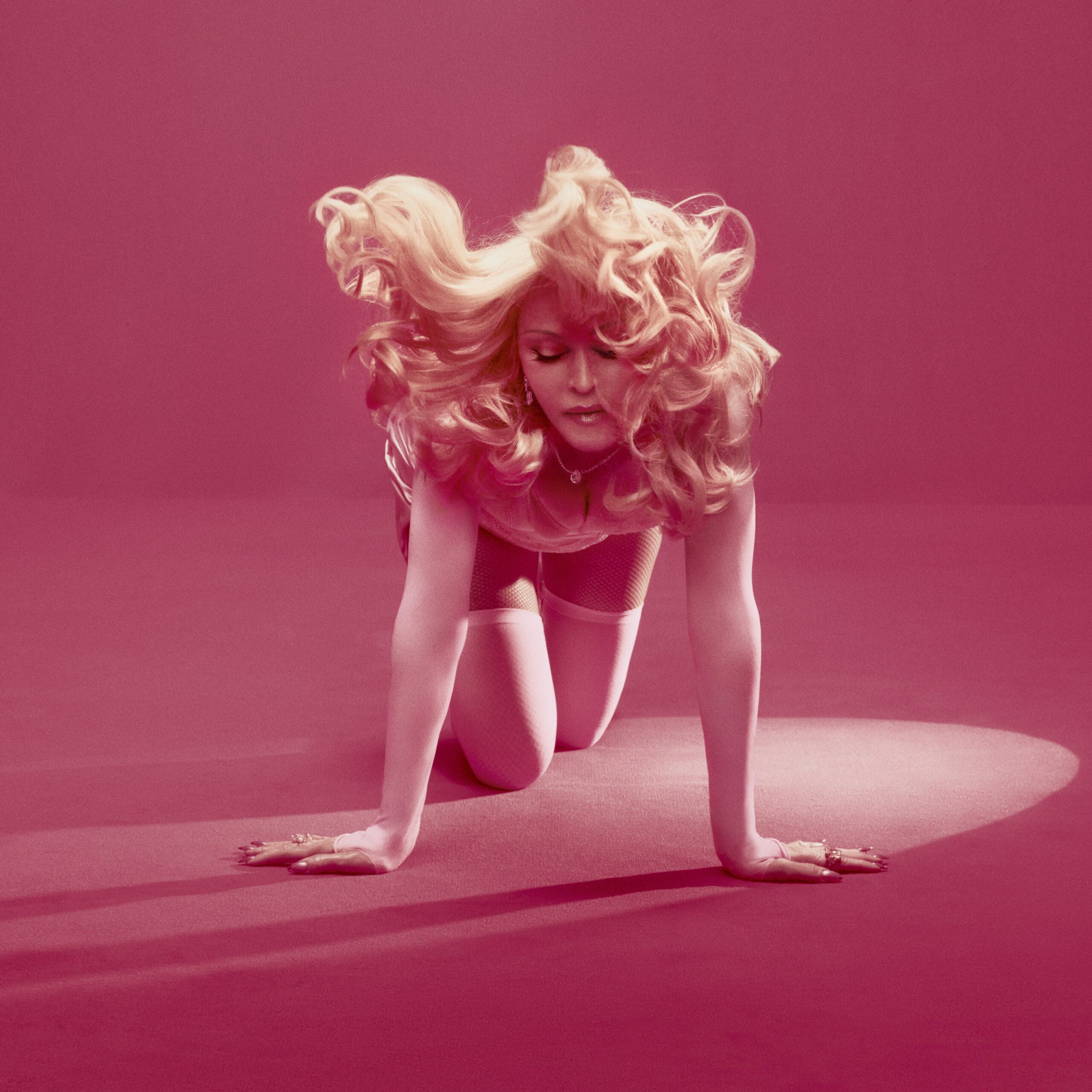
AS one of the most talked-about, celebrated and frequently derided pop stars of all time, returning with her first album in seven years is a high-stakes move for Madonna.
The Queen of Pop has never left it so long between albums in her 43-year career. And she has taken an even bigger risk by recording a follow-up to her much-lauded 2005 dance-pop opus, Confessions On A Dancefloor.
Madonna addresses everything from how she failed her eldest daughter Lourdes to her regrets over her relationship with her late brother in Confessions IICredit: UnknownMadonna with daughter Lourdes, who joins her on touching track The TestCredit: Laurent VU/SIPA/Shutterstock
But rather than playing it safe, Confessions II sees her doing just that — confessing.
She addresses everything from how she failed her eldest daughter Lourdes to her regrets over her relationship with her late brother, Christopher Ciccone.
And also, surprisingly, how her first husband, Sean Penn, 65, made her feel during their short-lived marriage.
The most venom-tongued track is titled Bizarre, in which she squarely attacks the Hollywood A-lister, who she was married to from 1985 to 1989.
She references the 1968 Shelby GT500 convertible she gave him as a wedding gift and his conviction for reckless driving in 1987.
And she also lays into how Penn was “threatened” by her and claims he resented her while they were together.
Madge sings: “Love is the strangest thing. Just when you think you’ve finally let go, it comes back to you.
“Movie star, deep blue eyes. In Hollywood, we’re a perfect prize.
“He drove way too fast, Shelby Cobra wasn’t meant to last.”
Earlier the lyrics had turned to anger, as she sings: “Roll out the carpet for us, but you don’t share it.
“All ’cause you’re threatened by me, you won’t admit it.
“The little things that you do don’t make me want you. Who knew love could be so bizarre?”
And in a later verse, she adds: “I know I left you behind and you resent me.
“A thousand reasons why you could never have me.
“The thought of being with you is so indecent. I guess you’ll never know my dirty little secret.”
Penn isn’t the only subject of her scorn, with Betrayal appearing to be about her stepmum Joan, who died in 2024 while the album was being made. Madonna did not attend her funeral.
Madonna as a toddler on her mum’s lap on Christmas DayCredit: Instagram/PLANET PHOTOSExes Sean Penn and Madonna reunite at an exhibition in New York in 2013Credit: Getty Images
The singer was five years old when she lost her mum — who she was named after — to breast cancer. Three years later, in 1966, her dad Silvio married Joan, who worked briefly for the family as a housekeeper.
In the opening verse of Betrayal, Madonna sings: “This is a story of betrayal. You couldn’t see your fall from grace.
“So take the hammer, hit the nail. You’ll never take my mother’s place.”
And later in the track, she adds: “You betrayed me, you enslaved me.”
Madonna’s most venom-tongued track is titled Bizarre, in which she squarely attacks PennCredit: Warner Records/Boy Toy via APThe superstar with brother Christopher at an awards afterparty in Beverly Hills in 1997Credit: Gary Friedman
But Madonna, 67, shows her softer side on The Test, which sees her and Lourdes, 29 — the eldest of her six kids — open up about their at-times difficult relationship.
On how her daughter was thrust into the limelight because of her own fame, Madonna sings: “Little star, I tried to put you on a pedestal, you didn’t ask for all the flashing lights.
“I didn’t think of how we could disturb, or how it hurt. I wish I knew the pain I caused.”
She continues: “Sometimes I think you wish I’d go away, but the shadow stays, and it’s OK to be yourself.”
Madge also appears to touch on her 2023 brush with death, when she was found unresponsive at her New York apartment and placed into a coma after suffering from an infection that led to sepsis.
Lourdes, 29, who Madonna had with fitness trainer Carlos Leon, was among those that rallied around her in hospital.
Madonna sings: “You made me whole when I was broken, too. I hope and pray I can do the same for you.”
Paying tribute to her mum, Lourdes sings: “You are my reason to be, what I want or look like, what I wear, all the clothes on my back, and what I attract.
Betrayal appears to be about her stepmum Joan, seen here with Madonna’s dad SilvioCredit: UnknownMadge’s Love Sensation appears to be a tribute to her boyfriend Akeem Morris, 30Credit: Unknown
“I trace the line of what you have sewn. Keep my own design. Make it a landscape. Make it alive.”
Elsewhere on the album Madonna makes peace with Christopher, who she was accused of “dropping” as her creative director in the early-2000s, and who later wrote a book titled Life With My Sister Madonna.
The once-close pair never fully repaired their relationship and he died of cancer at the age of 63, in October 2024 although she says he now visits her in her dreams.
On the song Fragile, she sings: “We shared a name, a home. We shared a fragile bond, now you’re gone.
“We laughed, we cried, we held each other’s hands. We had each other’s eyes and they belonged
“This is the time I hate the most, the words inside my heart
“I know you’re fragile ’cause you’ve been hurt, been let down.”
At the end of the track, she adds: “Late last night I was fast asleep, you came to me in a dream.
“You said don’t forget about me, don’t forget to be happy.
“So I hope you found a higher ground.”
The 16-track album clocks in at almost 64 minutes, and is a metaphor for a night out, starting with the heavy, pulsating beats of a club.
Then the final five songs represent the evening winding down, with Madonna spilling out her deepest feelings with the bravery and vulnerability that comes from a night of loud, messy partying.
When she reaches the last track L.E.S. Girl — about her life pre-fame on the Lower East Side of New York — you can hear traffic beeping, signalling she is finally on her way home as the morning rush hour starts.
It’s a neat arc for the ambitious album, which she once again made with English producer and songwriter Stuart Price, who she teamed up with on the first Confessions album.
But this record is much darker, heavier and grown-up.
And as well as being symbolic of a single night out, Madonna uses it to represent key parts of her life and the moments that have made her.
The most brilliantly bombastic highlight comes in Danceteria — named after the New York nightclub where she found her friends in the industry and where DJs played her music for the first time.
It’s a feel-good number with a Vogue-style rap and namechecks for everyone from her pal Debi Mazar to artist Jean-Michel Basquiat and even The B-52s.
Another highlight comes with Love Sensation, which appears to be a tribute to her boyfriend, Akeem Morris, 30.
She started dating the former football player in 2024, two years after ending a three-year romance with dancer Ahlamalik Williams, 31, and they now live together in London.
Madonna sings: “When I feel alone I always want to bring you near ’cause you bring a smile right here. You chase away my darkest hours.”
And in the chorus she continues: “Baby, come and get with me, there’s something that I gotta do.
“Baby, when you’re here with me, there’s nothing that we cannot do.”
So far in her career Madonna has sold 450million albums, and counting.
And with this project, she proves there is still plenty of passion, ambition and talent.
Undoubtedly it is her most cohesive and accomplished album since the original Confessions, 21 years ago.
And long may the Queen of Pop continue to reign.
LOVE, BETRAYAL AND ECSTASY ON SWEET 16
I Feel So Free: The opening track, released in April, is a throbbing song with breathy vocals and a sample of the 1989 Lil Louis acid house track French Kiss, complete with orgasm. It’s a statement of what’s to come as she says: “On the dancefloor, I feel so free.”
Good For The Soul: Heavy-sounding verses make way for a buoyant and optimistic pop chorus, all about how important letting your hair down is. It was written on her first session for the record.
One Step Away: Madonna dives headfirst into house music on this pulsating track about the release she feels in a nightclub. Over the beat, she utters: “The dance floor is not just a place, it’s a threshold. A ritualistic space where movement replaces language.”
Bring Your Love: The credibly cool lead single featuresSabrina Carpenter, uniting two generations of pop stars who are resolute in their determination not to be swayed by naysayers. In the chorus they say: “Bring your love ’cause you cannot shake me. Bring your love ’cause you’ll never break me.”
Danceteria: “Everyone here is a work of art,” Madonna sings on this wonderfully poppy single, inspired by the New York nightclub she went to as a youngster.
Read My Lips: Spanish guitar and a guest appearance from Colombian singer Feid give this a different feel, though there’s a Latin trap beat to keep the party going. It’s clear Madge isn’t happy on it, though, singing: “You cut me with your lies, ’cause you hurt me with your kiss.”
Everything: It opens with strings reminiscent of her 1992 track Deeper And Deeper, but evolves to have regular house music breakdowns fit for a packed Ibiza dancefloor. And she’s worked up, spitting: “It’s not OK, I don’t f*** with it.”
Love Sensation: Pop makes a return on this heart-warming crowd-pleaser. “There’s nothing that we cannot do,” she repeats as the track builds to euphoric choruses. This is destined to be a future single.
Love Without Words: An ode to partying, starts with the sound of smoke being pumped on to a dance floor. “Call it trance, call it house, call it love without words,” she sings.
Bizarre: Madonna teamed up with super-producer Martin Garrix for this revenge track about her ex Sean Penn. The melody, complemented by strings and hints of EDM production, is enough to have people throwing their hands in the air.
School: “I can make moves on the dance floor, I can make love on a man’s floor,” she breathlessly coos on this track, on which her vocals are heavily distorted. It’s one of the weaker songs.
Fragile: There’s a major change of pace with break beats and strings, as she sweetly sings about her late brother Christopher. Her voice truly takes centre stage here.
My Sins Are My Savior: She is joined by Belgian rapper Stromae on this dark and moody track, which wouldn’t sound out of place on 1992’s Erotica album. Reflecting on the criticism in her career, she sings: “I was not lost, I was just broken. They tried to take me down, they tried to take my crown.”
Betrayal: She teams up with producer Mirwais, who she first worked with in 2000, on this 90s-inspired track, featuring brass and piano over bleak and mournful vocals.
The Test: Madonna has said Lourdes approached her about working together to heal their rift, and it certainly sounds cathartic. Her daughter’s voice here is far smoother, but they blend exquisitely.
L.E.S GIRL: It’s the end of the night, Madonna is on her way home and she’s reflecting on when she was a “Lower East Side girl, lost in a fragile world.” It’s a tear- jerker, and triumphant look back at how far she has come. The perfect ending.
Sitting in the control room of their home studio known as the Centre of Mental Arts (COMA for short), Long Beach husband-and-wife duo Scott Montoya and Julia Kugel smile as they discuss new music they recorded for their band Soft Palms. Their new album, titled “In Echo,” has been in the works for over five years. The 10-song album, out Friday on Everloving Records, was inspired by their frustration about how they feel the world has devolved since 2020.
“The first record I was like, ‘I want to give the world a hug,’” Kugel says. “And then this one I was like, f— this world.”
For Kugel and Montoya, the album serves as the latest chapter of their creative and personal journey. The pair met in 2012 at a music festival in Dallas (“The most romantic city,” Kugel quips), while playing in the Atlanta-based band the Coathangers and Orange County’s the Growlers, respectively. They bonded over a shared disgust at gladiator shoes, and soon thereafter, were in a relationship.
By 2017, they were married and settled in Long Beach. Despite Kugel’s role in the Coathangers at the time (Montoya left the Growlers in 2016), the couple wanted to form a band. Previously, they recorded a pair of songs that constituted Kugel’s second solo seven-inch single. That experience made them comfortable knowing they could balance their professional and personal lives.
“He’s super easy to work with,” Kugel says of Montoya, who sits beside her, trying to hide a smile. She looks at him and continues, “he’s very talented and very patient.”
“When we were in our other bands, we used to meet up on tour,” Montoya, who also produces and engineers for other artists, says. ”You see the absolute worst of people on tour … so this is nothing.”
To kickstart Soft Palms, Kugel drew from a batch of songs she had previously written that had no home. Being able to record in their own studio allowed the pair to craft songs without feeling any pressure to meet a deadline.
By late 2019, the pair put the finishing touches on their self-titled debut. When the record was released in July 2020, the pandemic was still in full force. The pair were disappointed and upset by the state of the world, and after a few years of stewing, Kugel and Montoya got started on a second album.
Don’t be fooled by its breezy ’60s-analog vintage pop sound. Soft Palms are angry, and that informs the spirit of “In Echo.”
The pair points to “Radio” as the album’s bellwether. First released in 2025, the song rails against how, over the past handful of years, people have fought for the sake of fighting, with no end in sight.
More strikingly, on the biting “Nervous as Hell,” Montoya points to Fox News as “infecting everyone’s parents.”
“I did some digging because I couldn’t believe something that hateful existed,” he says of the network, specifically its landmark $787-million settlement with Dominion Voting Systems. “It turned it from this horrible thing into this s— business that has taken advantage of the elderly and destroyed families.”
That anger continues on the angsty rocker “The Wedding Song.” Kugel points to attending a wedding where a family member married a “total raging maniac,” and how they dealt with the buildup of delicately balancing being cordial yet firm.
“He [the family member] goes, ‘I just want you to show up and shut up!” she says. “I was like, ‘Well, firstly, f— you. Then secondly, this is a song — you just handed me gold.”
Since settling in Long Beach, for the last 10 years Kugel and Montoya took it upon themselves to help foster a positive, artistic community. It’s that mindset that pushed them to found and operate their 501(c)(3) nonprofit called Studios for Schools with the goal of providing recording equipment to underprivileged schools.
Their DIY work ethic in entertainment was also the driving force behind Happy Sundays, a free Long Beach-based music festival. Running for 10 years, the fest created a block party in the city’s Zaferia neighborhood that eventually expanded into a full weekend of shows across stages set up at local businesses to host a diverse lineup of veteran and up-and-coming area bands. Though the event was paused this year so they can focus on the new album and book, the couple plan to bring it back in 2027.
“It was like a statement in that way of like f— these giant prices, VIP experiences and all of that stuff,” Kugel says. “It’s the anti-music festival and a celebration of community.”
Keeping with that spirit, and drawing from the experiences of their two-decade careers, last month the pair released a book titled “How to Be Self-Reliant in the Music Business.” The genesis of this self-published guidebook occurred when the pair realized they were not receiving a portion of a royalty stream they were owed. They knew that if they were in the dark on the issues they thought they knew, others likely were as well.
“We decided to turn it into a book because we realized there’s so much stuff that few artists know about on their own,” Montoya says. “I want people to understand the scope of what they’re actually getting into, and the reality of their situations.”
“It’s a very thorough overview,” Kugel adds.
The book includes information beyond what one would find in Donald S. Passman’s longstanding industry bible “All You Need to Know About the Music Business.” With assistance from a lawyer friend and a CPA family member, the pair addresses topics ranging from backstage etiquette to managing social media to dealing with record labels and publishing companies. They hope that it will provide a blueprint for bands old and new to better navigate music’s notoriously choppy waters. Their accessible, snack-size chapters move fluidly as they explain the realities artists face in 2026.
Battling through the disappointment of the first part of the decade allowed Kugel and Montoya to find their creative way. Armed with this infusion of activity across various disciplines, the couple is inspired to continue to shake their way out of the past. Though focused on their impending U.S. and European tour, the duo promise that the next Soft Palms album won’t take as long and are mulling over their next music-industry book project. For now.
“It’s a lot to keep up with all of these projects,” Montoya says. “We work all day, every day. And it’s been cool to see signs that it’s paying off.”
Spanish painter Nieves González arrives in Los Angeles for her first U.S. solo exhibition having already experienced a taste of fame.
The 29-year-old caught the attention of the art and fashion worlds last year after being discovered on Instagram and commissioned to paint the cover of Lily Allen’s album “West End Girl.” Depicting the singer as a Baroque aristocrat clad in contemporary designer fashion, the portrait helped propel González onto an international stage.
Collectors have taken notice. The 13 paintings in “A Friendship Story,” opening Saturday at Richard Heller Gallery in Santa Monica, have already sold out, according to the gallery, with prices ranging from $4,000 to $20,000.
Share via
Elle magazine dubbed González “Fashion’s Favorite New Artist,” while exhibitions in Rome, Paris, Belfast and Bilbao, Spain, expanded her reputation across Europe.
González developed her classic yet defiantly modern approach while studying at the University of Seville, where Spanish masters such as Diego Velázquez and Francisco de Zurbarán painted in the naturalist Baroque tradition. Drawing liberally from fashion, art history and everyday life, she often dresses the subjects of her portraits in puffer jackets — garments she wears herself during the cold winters of Granada, Spain, where she lives. The material, she said, recalls the sculptural rendering of fabric in paintings by Zurbarán and Velázquez: the folds, the volumes, the high shine.
Nieves González often dresses her subjects in puffer jackets.
(Genaro Molina / Los Angeles Times)
“It works beautifully from a visual standpoint,” she said, speaking Spanish during an interview at Santa Monica’s Bergamot Station a few days before the exhibition opened. Wearing blue jeans and a pink button-down blouse, she echoed the pastel blues and pinks that appear throughout many of the works surrounding her.
“Fashion inspires me,” she said. “Just as 17th century artists drew inspiration from the fashion of their day — often creating paintings that served as catalogs of current styles — I do the same,” she said. “The goal is to not merely convey a specific message or ideology but to create a testament to a generation and the era in which we live.”
This fall, González’s painting “La Sfida” (2025) will appear in the Städel Museum’s exhibition “Mary Magdalene. Sin. Pray. Love” in Frankfurt, Germany, alongside works by Lady Gaga, Marlene Dumas and Auguste Rodin. The painting depicts Mary Magdalene with long, flowing hair, draped in a regal red garment and clutching a skull — a contemporary interpretation of one of Christianity’s most enduring figures.
“Nieves González is the youngest of these artists and, at the same time, probably the one who most closely follows in the tradition of the Old Masters,” curators Bastian Eclercy and Stefan Roller wrote in an email.
The Santa Monica exhibition marks an evolution from the paintings that established González’s reputation. Earlier works often centered on solitary women posed with the self-possession of royal portraits or religious icons. “A Friendship Story” focuses on relationships between pairs of women, exploring friendship, intimacy, support and shared experience.
For González, friendship is one of the most profound aspects of women’s lives and a subject she felt deserved greater attention in painting.
Victoria Rios, a curator who works with González, said the artist’s paintings “rewrite the narratives of the past, rewrite the history of martyrdom and place women at the center.”
“Nothing in her painting is arbitrary,” Rios said in an email. “Every formal decision is also an ethical one.”
“The horse elevates the art; symbolically, it carries connotations of elegance and nobility,” Nieves González said. “It seemed like a way to elevate the concept of friendship.”
(Genaro Molina / Los Angeles Times)
González frequently turns art historical conventions on their head. In “Salir a robar caballos: Go out to steal horses,” she replaces the archetypal portrait of a gallant man on horseback with two young women dressed in puffer and vinyl jackets, posed like contemporary Amazons atop rearing horses.
“The horse elevates the art; symbolically, it carries connotations of elegance and nobility,” González said. “It seemed like a way to elevate the concept of friendship. It also has an element of play, adventure and fun, since having fun is part of the bond too.”
The artist also sees her work through a feminist lens.
“We live in a patriarchal society, and so, unfortunately, I belong to the oppressed segment of that society, and my work relates to that,” she said. “It stems from a struggle, an understanding and a process of redefining concepts that we have historically established as normal, natural and habitual.”
“I am interested in portraying us as brave and powerful, sometimes even with an air of haughtiness,” she said.
Another painting, “Something’s crossed over me and I can’t go back” (2026), captures González’s fusion of historical and contemporary references. Two women dressed in green and pink fur cradle each other’s heads, reimagining medieval depictions of cephalophores — Christian martyrs who carry their severed heads while continuing to preach or pray.
The title comes from a pivotal line in the 1991 film “Thelma & Louise,” marking the turning point for Geena Davis’ character Thelma, fully committing to her ultimately fatal adventure with Susan Sarandon’s Louise.
Nieves González, “Holding You,” 2026 (oil on canvas).
(Genaro Molina / Los Angeles Times)
González builds each painting from what she calls a “Frankenstein” — a digital composite assembled from archival photographs, found images and reference material. The painting process then takes over. A mid-project visit to the Prado Museum in Madrid, for instance, might send her back to the digital sketch to pull in a compositional element from Velázquez before returning to the canvas. “The final result often ends up being completely different from what I initially envisioned,” she said.
Heller began representing González, whom he calls an “original voice,” last year after being introduced to her work by another painter.
Staging her first U.S. solo exhibition in Los Angeles rather than New York reflects what he sees as a more relaxed environment for an emerging artist, without the glare and expectations of the New York art world.
“L.A. feels a little less constrained,” Heller said. “It feels a little more free.”
González’s portrait of Allen is currently on view at London’s National Portrait Gallery, hanging in the same room as a self-portrait by David Hockney. She said while it “has been very significant in terms of media exposure,” exhibitions and professional opportunities were already in motion before the album cover brought wider attention.
“I’ve always said that what I want to do in life is make a living from painting,” she said.
Mission accomplished.
‘Nieves González: A Friendship Story’
Where: Richard Heller Gallery, 2525 Michigan Ave. #B-5A, Santa Monica
MYLES Smith reveals he was physically abused by his father in his heartbreaking debut album My Mess, My Heart, My Life.
The Luton-born star, who was raised by his mother Deborah, recalls his difficult childhood in emotional tracks My Mess and Grandma’s House.
Sign up for the Showbiz newsletter
Thank you!
Myles Smith’s debut album My Mess, My Heart, My Life, delivers a powerful and honest record inspired by pain and life’s struggleCredit: GettyHeaven is sure to become a live staple for Myles, who has more than proven he can go up against the greats when it comes to writing about love and lossCredit: Splash
Created over the past three years, as Myles’ career went stellar thanks to his 2024 runaway hit Stargazing, the star takes his fans back to his beginnings.
Lead track My Mess reduced me to tears as Myles regaled his relationship with his father against a backdrop of an upbeat, acoustic guitar.
He sings, “I was born into a fractured family, where a word can start a war.
“Lost my tongue, when I spoke my peace, yeah he grabbed my shirt and he bruised my cheek.
“Sad a man had to go toe to toe with a boy thirteen.”
Emotion-packed Grandma’s House, where Myles, 28, recalls finding his safe space as his mum Deborah worked to make ends meet, is packed with emotion and reflection.
On the track he sings: “Take me back to my Grandma’s place.
“I was 7 years old when I learnt how to cook, and 10 when I started to sing.
“Oh she’d bring me to church, and she’d cover my ears, when my Dad would scream horrible things.”
Myles’ signature acoustic guitar underpins every track, with Hate You untangling the realities of navigating love and Sertraline seeing Myles exploring mental health and complexities surrounding it.
This is an album for the brokenhearted and the hopeful, with the beautifully worded Lifetime and the dreamy vocals on Heaven – which is my favourite song on the record – seemingly bringing Myles’ the happy ending he’s been searching for.
Over the past two years, Myles has grown in prominence – winning the Brit Awards Rising Star gong as well as earning an Ivor Novello Award for Stargazing.
To date Myles has amassed over 4.7billion streams worldwide and is one of our country’s most exciting new stars.
Opening up about the record, Myles said the album was born out of “therapy notes, old memories, relationships, insecurities, heartbreaks, mistakes and all the moments that shaped me.”
The latter half of the album moves towards a positive note, with Nice To Meet You and Gold showing Myles coming out on the other side.
Myles said: “It was important to end the album, and particularly this project on a high.
“I feel like I always try to mirror my music with my live shows and my live shows are always about taking people on an emotional journey and then sending you home happy.
“It is that sense of hope which lingers on as Gold closes the album.
“Even though I may appear miserable for a lot of this album, I genuinely always walk with hope and I walk with joy at the end of the day.”
Heaven, mark my words, will become a live show staple for Myles, who with My Mess, My Heart, My Life has more than proven he can hold up against the greats when it comes to writing songs about love and loss.
★★★★★
Lotts of stars at V&A
It was all-white on the night for Pixie Lott at the V&A Museum’s summer partyCredit: GettyMaya Jama also chose white to impressCredit: GettyJessie Ware sang live at the bashCredit: Getty
It was all-white on the night for Maya Jama and Pixie Lott as they stood out in these dresses at the V&A Museum’s summer party.
They were joined at the bash by model Leomie Anderson, in an open white suit with gold jewellery, Ellie Goulding sporting a blazer dress, and Sir Mick Jagger with his fiancee Melanie Hamrick.
Once inside the museum, in London’s South Kensington, guests got the chance to schmooze around the exhibits, while Jessie Ware sang live in a sequin gown.
With tickets flying for her autumn tour, they were lucky to see her.
But access to the fundraiser, for those who did pay, cost £3,999. That is one expensive night out.
Ellie Goulding was sporting a blazer dressCredit: GettyModel Leomie Anderson wore an open white suit with gold jewelleryCredit: Getty
KAISER CHIEFS frontman Ricky Wilson will play Teen Angel in Grease: The Immersive Movie Musical.
The show is being put on by Secret Cinema from July to September at Evolution London in Battersea Park.
Singer Ricky Wilson will play Teen Angel in Grease: The Immersive Movie MusicalCredit: Getty
Ricky, left, said: “At school I was in Grease. I was not yet the pop sensation I am today and I only really wanted to do it because I fancied the girl who played Frenchie,
“I was Doody, so this is my chance to show everyone I should’ve got a bigger part.
“I don’t believe anyone from that production is now a professional singer – so in short, I win.”
Sian’s up for toy techover
Capital Breakfast’s Jordan North and Sian Welby, above, have landed roles in Toy Story 5Credit: Getty
You will hear some surprisingly familiar voices in Toy Story 5 if you head to the cinema this weekend – as Capital Breakfast’s Jordan North and Sian Welby have landed roles.
They voice a garden gnome and inflatable flamingo in the long-awaited Pixar sequel, and mum-of-one Sian has high hopes for its impact.
Speaking about the film, which is about tech replacing toys, Sian, right, said: “I do think it’s going to start a massive conversation about screen time.
“It made me want to smash every bit of tech in my house and just get out in the grass and play all the games that I did growing up.
“I think a lot of us are going to watch it and feel guilt. It’s sad we have to grow up so fast because there’s so much magic when you’re younger.”
Best-selling novel One Day is coming to the West End as a musical.
The David Nicholls love story – which has previously been adapted for both the big and small screen – will premiere at London’s Garrick Theatre on November 17, following shows in Edinburgh earlier this year.
Tissues and jazz hands at the ready.
MNEK is back in reverse
MNEK is releasing his first album for eight yearsCredit: Maja Smiejkowska
MNEK is returning with his first album in eight years.
The singer has today released the single Reverse!!, which samples Lethal Bizzle’s Pow! (Forward) and will be on his Bulldozer record this autumn.
Also out now is Jax Jones’ Pulling Me Back, Tiny Habits’ Anything He Was featuring Matty Healy from The 1975 and Grow Down by Luca George.
Ahead of his opening night in Jesus Christ Super-star in London, Sam Ryder has released What’s The Buzz.
And to support England’s World Cup efforts, Kerry Katona has re-recorded Atomic Kitten’s Whole Again as Home Again to raise cash for kids in care.
She said: “Even if you think it’s s***, please download it so we can give back.”
It’s Friday afternoon in North Hollywood and Ziggy Marley is perched on a stool inside his newly built Rebel Lion Studio, tucked in one of the neighborhood’s creative enclaves.
The nine-time Grammy winner is surrounded by a collection of lion figurines, guitars, traditional hand drums and a piano. Along the walls hang two replicas of backdrops his legendary father, Bob Marley, used on tour in the 1970s. The murals, depicting Rastafari icons and Haile Selassie I and Marcus Garvey, were featured in the 2024 biopic “Bob Marley: One Love.”
“These are what we used as the backdrop for the concert scenes. Them spiritual to me,” Marley says in patois as the smell of palo santo dances around the rehearsal space.
Music has been both an inheritance and lifelong pursuit for Marley. From sitting in studio sessions with his father as a child to building a five-decade career of his own, he has remained a curious student of the craft, one willing to challenge convention in search of a deeper meaning. That spirit is evident on “Brightside,” his ninth solo album, which was released on vinyl on April 18 (Record Store Day) and May 1 on streaming.
Rather than recording the eight-track project in 440 Hz, the standard tuning frequency for most modern music, he opted for 432 Hz, a tuning some musicians and theorists believe creates a warmer, more meditative listening experience. He also slowed down his songwriting process, giving each lyric room to carry its message of hope through turbulent times. The album, which may be his most personal yet, also features “Many Mourn for Bob,” the first song he has written directly about his late father.
“I think it shows the next stage that I probably am in,” says Marley, adding that he felt connected to his father on a spiritual level. “We took another step in the relationship, to another place that it’s never been before.”
Ziggy Marley is bringing his “Brightside” tour to the Hollywood Bowl on June 21 alongside reggae star Burning Spear.
(Dania Maxwell / For The Times)
He adds, “When I was doing the song, it kind of came to me like this song could’ve been my father’s song. It could’ve been a song that he wrote.”
The reflective nature of “Brightside” arrives at another pivotal time in Marley’s career. This year marks the 20th anniversary of “Love Is My Religion,” the Grammy-winning album that launched his solo career and crystallized a personal philosophy he still carries today. He is also set to release his sixth children’s book, “True to Myself,” in September.
As we wrap up our conversation, Marley has only a few minutes before Rebel Lion Studio shifts back into work mode. Within minutes, bandmates, background singers and production crew members begin funneling into the space, hauling in stacks of equipment as promotion and preparations continue the “Brightside” tour, which stops at the Hollywood Bowl on June 21.
This interview has been lightly edited for length and clarity.
You recorded your latest album, “Brightside,” here at Rebel Lion Studio, which you designed and built from the ground up. Can you take me back to the beginning of that process and why you wanted to do it?
I grew up around my father and my mother as growing musicians trying to succeed and there was one thing I kept hearing over and over throughout my life: independence. Their whole mission was to be independent. I saw them work and I saw my father build a studio. I saw him have a space where he can do more music and control his own time. That was a dream of mine for a long time, ever since I started doing music because usually we use other people’s studios. I couldn’t have this in my house. It’s too much. It’s a dream come true.
We’re surrounded by two beautiful murals. Is there a particular item that is personal to you?
The murals are replicas of my father’s backdrops that they used. The original artwork is by Neville Garrick, but he helped us re-create them for the Bob Marley movie. These are the murals we used as the backdrop for the concert scenes. They are spiritual to me cause that’s Haile Selassie and Marcus Garvey, two very important beings for us. Inspirational.
On “Brightside,” Ziggy Marley dedicated a song to his father, Bob Marley, for the first time in his career.
(Dania Maxwell / For The Times)
“Brightside” is your ninth solo album. What mindset were you in emotionally and spiritually when you started working on it?
I never thought about making an album, I was just writing songs. You just tap into things in your subconscious that are waiting to become music, I feel like. Then when the time comes for writing songs, the time comes. It’s like a season. Like you have blueberry or orange season. So there’s a season for me when I write songs. Then you say, “All right, let’s make an album then.” But you don’t think about an album before. It’s just an expression or a feeling just to make music, not for any reason but to make it. It happened over a period of years. Ideas and experiences that eventually come out. But closer to the time I [made] the album, I remember writing some of the later songs like “Why Let the World.” It was a song that I wrote because I was feeling down and everything that was happening in the world and the country. Just so much negativity and I just felt like I needed to take a break from it. To recharge yourself. We cannot fight every day. We need to take a break and then get back to it. I needed to teach myself to take some time. It was more of a mental thing than an emotional thing. Stuff I deal with my father, personal life and stuff with my spirituality and my faith. So there’s a lot of me in this record.
“Many Mourn for Bob” is the first song you’ve explicitly written about your father. Your brother, Stephen, is also on the vocals. What surprised you emotionally once that song was finished?
I’m not sure I thought about it like that. The experience of expressing that emotion, it’s a spiritual experience. I think it shows the next stage that I probably am in and even my relationship with my father on that spiritual level. It’s a different place. We took another step in the relationship, to another place that it’s never been before. When I was doing the song, it kind of came to me like this song could’ve been my father’s song. It could’ve been a song that he wrote. That’s how I felt about it. This is partly his song. It’s me and him making this song. This song is his song too.
How has your relationship with grief changed over the years?
It’s more of a comrade, understanding, empathy and having the maturity and the experience to understand what he went through as a man, as a human being. I think that’s what it is, really. A better understanding of what he went through, not the glory. The pain, the mental and emotional state. You’re more than just an idol. You’re more than just a legend. You’re more than just a father. To go deeper than that, so that’s the next level.
Yeah, the skit you used of him saying “I’m just a man from the ghetto” on the song really summarizes that.
That’s the real him. That’s him right there. Even in the tone of his voice, you can hear the real Robert coming out.
Another standout song from the album is “Racism Is a Killa.” One thing that you do well is having a heavy topic, but finding a way to still make it feel hopeful and joyful. Why was it important for you to approach the track this way rather than from a place of anger, heaviness or sounding preachy?
I think it started out preachy and angry, but over time, it kind of evolved and I kind of evolved too ‘cause my own evolution is represented in the music. And you know something, doing that song helped me evolve because I had to think about it differently without the anger. The song made me do that. Like how else can I approach this? It’s inspiration that causes these things. It’s not an intellectual thing. I didn’t do that intellectually. Like over time, something just started coming out of me. I never really thought about it before, but I can see it now.
In the video, which features your daughter, Zuri, you referred to the condition as “Racismosis” in the video and sang about how it can be cured.
It’s kind of like a sickness, a disease. It’s a virus. We can minimize the virus and stop the disease. It’s true. Racism is a killa. This virus can kill ya. Literally kill ya. Spirtually kill ya. Emotionally kill ya. Mentally kill ya. It kill ya in different ways. It kills the victim and it kills the person perpetrating it. It’s killing everyone, but we can cure it though. It starts with the children. I have a friend of mine who said, “Yo, my little son loves this song. He doesn’t want to stop. He says ‘Put on “Racism is a Killa.”’ So that’s where the antidote is starting. The minds of the children. The music with a conscious message gives them the right consciousness that they grow up with. That is how we take our time and lower the spread of the virus.
You recently released an alternate version for “Racism Is a Killa” with Big Boi. How did that collaboration come together and what excited you about working with him?
I’ve loved Big Boi and Outkast from a long time ago. He’s a legend and a strong voice. There’s different layers to it and I feel like Big Boi took it to that other layer. So yeah, we just love Big Boi and I’m going to jump on something he does. [Laughs]
I’d be remiss if I didn’t ask your approach for your album and how you swapped the typical 440 Hz for 432 Hz. Do you remember the first time you heard the music played back that way?
It’s a long journey because for most of my life in music, I’ve tried to be a student. I’ve tried to keep an open mind and learn more and more. With this album, there’s an inspirational side of music and that’s where I lean into most of the time, but as I grew up, I started to understand there’s also a science too. It’s also mathematics. The universe, it’s all mathematics and science, and I shouldn’t shun the science of music just because I think the inspiration is all it should be. I think a part of that was learning that for myself and opening up and saying, “Yo, let me put some science into this.” Frequency. What does frequency do to people? Frequency affects people. Frequency is a weapon. It’s a tool. I’m sure the army has some kind of frequency thing. So frequency is powerful. I wanted to try something different anyway. I want to be different. I want my frequency to be different from the majority of frequencies that’s being played out there, because it’s fun for me to be different.
When I was working on the demos, I was like “Let me try this 432 Hz thing” and I like how it feels for me personally, how I sing on the frequencies. It resonates differently and makes me feel different. We did it and it felt good, and we did it live, and from my point of view, I felt a different energy with the audience too. So all of those experiments led me to the final conclusion to say, “Yeah, let me do the record in 432.” It’s really nice vibes, which the world needs a different frequency. We can use it.
This year marks the 20th anniversary of “Love Is My Religion,” your first solo Grammy-winning album. When you think back to that era of your life, who was Ziggy back then?
A lot was changing because I moved to L.A. during that time.
You got married around that time too, right?
Yeah. I don’t really fight change. I just try to navigate them and figure them out cause sometimes change is hard. There was a lot of change living here, moving around, trying to find a place, music, but then it’s like we are continuously updating ourselves. I’m continually updating. You know how you update your OS. I’m updating my OS. My operating system is being updated throughout my experience in life. There’s always something else out there for me to evolve to. So during that period of my life, “Love Is My Religion” came to me when someone asked me, “What religion are you?” And I just said “Love is my religion.” I never thought about it before, never contemplated it, never even thought of those words together before in my life, and they just came out to me that day. So the album represents a time in my life when I realized there’s a spiritual awakening that I had. “Love Is My Religion” is a spiritual awakening. That’s my thing. That’s who I am. That’s why it’s a milestone.
“If you think you’re going to change this world with music and you’re trying to send a message out there, you have to speak to children,” Ziggy Marley says.
(Dania Maxwell / For The Times)
You’re kicking off the “Brightside” tour this month, which includes a stop at the Hollywood Bowl. What are you most excited about when it comes to bringing this album to people for the first time live?
I’m excited about playing the music. I think it’s about the music. These new songs, they vibrate very highly for me and I’m excited about experiencing and expressing that. And also kind of not doing it for the audience. I don’t want to do it for the audience. I want the audience to experience what I’m experiencing, what I’m expressing. I want them to feel me. I don’t want them to be like “Hey look at me.” [Laughs] There’s still connectivity going on, but I want them to feel the songs the real way. That’s what I’m excited about for people to feel it the way that I feel it.
You even posted the lyrics and told fans to get to practicing, so they can really understand the message.
Yeah. Just reading them for me, I really like the writing I did on this. I also took some time with this too. I was saying to someone that I developed a deeper relationship with the lyrics and the words than I did before. My relationship with the words here are very mature. I feel good about it. That’s why I want people to know the words because words are very important. Words are very important. If you know the words you get a deeper understanding of what I’m talking about and what I’m feeling.
After nearly 50 years of making music, Ziggy Marley built his own studio in North Hollywood called Rebel Lion Studio. He plans to turn it into a multipurpose creative space.
(Dania Maxwell / For The Times)
Look on the bright side is a phrase that people say often, but what do those words mean to you right now?
Sometimes we can get in a place [where] we can’t see the other side of things because we’re so caught up in that one place. Like the cliché, there’s two sides to a story, ya know? The universe is always yin and yang, but there’s always another side of things. But I feel like the way we are being programmed in a way through media and everything, it’s like there’s only one side. Everything is like this, there’s nothing else going on over there that we need to see, we only need to see this. This is all that’s going on in the world. There’s nothing good, there’s nothing nice, there’s no good people, there’s no love. So it’s a realization too. A realization that there’s the other side. Never get to that place where we think it’s just that side alone because we get so much of it. It’s a reminder, I think, for us like “Come on guys.” The thing about it too, sometimes you can feel like — even for me — some people say, “Hey look on the bright side,” some people find that like “Why are you happy? Why you so chirpy?” [Laughs]
That’s true.
I’m proud that I’m on the bright side. I’m living on the bright side, I don’t care. You don’t like me because I’m living on the bright side? You want me to be like you, you want me just live on the dark side with you, right? So it’s like a proudness of being positive and having that outlook in life, and not feeling like you have to [fall to] peer pressure. More positivity in life, not just the negativity. I’m confident in that too. So it’s kind of like that too, you know, like being proud, lifting up that side of me. Yeah, I’m happy to be living on the bright side.
The Recording Academy announced significant changes for the 2027 Grammys, introducing several new genre categories and updating eligibility rules for two of its top awards.
The rule changes will most prominently affect the new artist and album categories.
A change to allow for four submissions for new artist instead of three “establishes more specific language surrounding prominence,” the academy said in a statement. The change updates the famously confusing criteria for new artist, in which acts familiar to some fans for years can suddenly break through and earn new consideration for the category.
It’s likely to benefit an artist such as Ella Langley, who had previously submitted several times for new artist but finally had a commercial and critical breakthrough with her single “Choosin’ Texas” and LP “Dandelion.”
“We’ve heard from the music community that the way artists are being developed is changing, and the time it’s taking to find success or recognition can take longer than it once did. Artists are often releasing more music before they actually break through the consciousness of consumers or of our voters, and that evolution directly impacts this Category,” Recording Academy Chief Executive Harvey Mason Jr. said in a statement announcing the changes. The changes “reflect the reality that artist development looks different than it did even a few years ago.”
In the album category, new rules state that “the threshold of new recordings required on an eligible album is lowered from 75% to 66% to reduce the exclusion of entries that are widely recognized throughout the music industry as new albums.” Given the fast streaming-centric release cycle of new singles, remixes and live cuts, the rule changes reflect that a new album may have a significant amount material released earlier.
Additionally, the academy announced five new genre categories, most significantly a dedicated award for Asian pop — a late but welcome acknowledgment of the commercial reach, artistic accomplishments and deep fan culture of K-pop and other scenes in Japan, the Philippines and China.
Other new categories include Latin song, a songwriting-specific award for Latin music in an era when Bad Bunny and Karol G make some of pop’s most salient political and creative statements; distinct awards for R&B collaboration or duo/group performance and R&B solo performance; a new traditional pop vocal performance award; and the replacement of folk album with categories for contemporary folk album and traditional folk album.
Additionally, a new “ballot plus” option will allow for voting members working across genres to vote in more categories, and songwriting contributors to winning albums in most genre categories will receive Grammy statuettes and achievement certificates, as producers and engineers currently receive.
“These changes and expansions give even more people a place for their music to be respected, heard and evaluated. With more Categories, we can represent more music creators, artists, writers, and producers, and it gives us a great opportunity to be more inclusive,” Mason said in his statement. “Now more than ever, we have to keep pace because things are changing and evolving so quickly. These changes are a reflection of that fast-paced evolution.”
Olivia Rodrigo has officially begun her new era, and this time she invited her fans to experience it alongside her.
To celebrate the release of her latest album, “You Seem Pretty Sad for a Girl So in Love,” Rodrigo collaborated with American Express to re-create the set of her music video for “The Cure.” The pop-up event, which opened last Thursday and ran until Sunday at Mica Studios, featured props from the video, storyboards, exclusive merchandise and several photo ops for fans.
With a beating felt heart and lab beakers to pose with, the pop-up transformed an industrial studio space in the Arts District into a pastel-painted cardboard hospital. Ahead of the public opening, Rodrigo surprised a small group of AMEX cardholders and select fans.
“I have an album that’s coming out today in about one hour, which is crazy,” Rodrigo said, wearing a blue “Nurses Do It Better” baby tee. “I figured since we’re all here, maybe we should just listen to a few of them together? Would that be cool?”
A little over an hour before the album’s release, Rodrigo played four songs from the album as the room brewed with excitement. She began with “Maggots for Brains,” a song about being so infatuated you can’t focus when your partner is away. Although it was their first listen, the song’s catchy chorus already had fans dancing along.
Banner for Rodridgo’s pop-up event hands above Mica Studios
(American Express)
Rodrigo explained that her next song, “Purple,” paid homage to the aesthetics of her previous albums, “Guts” and “Sour.”
“Obviously, this is my first non-purple album, but I just had to shout out purple somehow,” Rodrigo joked. “This song started out as a love song and sort of devolved from there, so I’ll let you guys be the judge.”
Playing off the somber vibes of “Purple,” Rodrigo played “Less” next. The piano ballad follows the dissolution of a relationship as the couple grows apart.
“I’ve been going back and forth on what the saddest song on the record is, but I think this one might be it,” Rodrigo said.
In a room full of fans, the song struck an emotional chord with many of the listeners. To bring the mood back up, Rodrigo finished the night by playing her new single, “Stupid Song.”
“This next one is a happy one, and it actually has a music video that comes out tonight,” Rodrigo said. “I love this song so much. It’s basically about having such an intense crush on someone that it drives you totally f— insane. I feel like we’ve all been there at some point in our lives.”
Rodrigo was all smiles at her event celebrating her latest album steeped in heartbreak and romance.
(American Express)
After Rodrigo previewed her music, “The Cure” music video exhibition was opened up to the fans. The showcase ranged from interactive photo ops to gallery walls featuring behind-the-scenes photos from the video shoot and Rodrigo’s nurse costume on display. The video’s props, which were primarily designed using cardboard and felt, were displayed in glass cases for visitors to admire.
Dressed in fun fashion including light pink and polka-dot outfits, fans posed throughout the set, re-creating scenes from the music video as “The Cure” played overhead. Many had thrown on a piece of the Los Angeles-exclusive merchandise on sale at the pop-up, with shirts and hats reading “You Seem Pretty Sad for a Girl in Los Angeles.”
So while some fans teared up at her lyrics and others beamed with excitement, everyone was hyped to experience Rodrigo’s new album.
“I really hope you enjoy this little exhibition. It is so gorgeous, and I am so proud of it,” Rodrigo said. “Thank you guys for being here, and I really hope you love ‘You Seem Pretty Sad for a Girl So in Love’ as much as I do.”
There was a time in the beginning of Sublime’s recent revival when Jakob Nowell, the son of the band’s late singer Bradley Nowell, saw himself simply as a good son trying to help his adoptive uncles — drummer Bud Gaugh and bassist Eric Wilson — restart his dad’s iconic Long Beach trio. The goal wasn’t to take the place of his frontman father who died of an overdose in 1996. “I’ll never look at it as my band. Sublime is my dad’s band, and I’m helping out, that’s all,” he told The Times in 2024. Luckily, he was wrong.
The journey of finding his own voice through his father’s sly, shambolic poetry and reggae rock anthems, along with his determination on the road with Gaugh and Wilson through a barrage of festivals and tour dates helped him eventually step into his own as a songwriter and Gen Z rock star. It’s all been done with the mission to preserving his dad’s legacy and having fun while doing it. Now it feels as natural as the trio sitting together on the waterfront in LBC’s shoreline marina within earshot of the bellowing horn of the Queen Mary earlier this year as they were finishing the recording of “Until the Sun Explodes,” the first album under the Sublime moniker in 30 years.
Just like the band’s original recipe of shoving punk, dub reggae, hip-hop and ska into a blender, the new songs dutifully stick to the formula along with Jakob’s soulful caterwauls that sound scarily similar to his dad. But what emerges from the 21-song tracklist is the evolution of a trademark sound that gives a nod to the past while standing strong on its own, just like Jakob, despite coming to the interview on crutches while healing from a performance-related knee injury. The band members chatted with The Times about recapturing the effortless essence of their immortal beach-ready sound and looking forward to a second chance to chase an endless summer.
This interview was edited for length and clarity
It’s kind of a rare thing for all three of you guys to be in one place at the same time. What was it like working in the studio together to finish the new album?
Bud Gaugh: Magical. Things are just coming together. We showed up, Jake had an idea for another song, and he sent us a little demo and said “Hey, this is what I’ve been thinking about.” And then we get down to the studio [in San Pedro], and he’s like, “Oh yeah, so I had another idea,” and kind of changed it. We jumped in there [and by the end of our sessions, we had written] brand new songs to the list of songs that we already had.
The band’s revival has been a long time in the making. I remember when you guys had your first show together, a surprise gig a couple years ago as part of a benefit show for the Bad Brains frontman H.R. Do you feel you’ve come a long way since then?
Eric Wilson: I never thought the chemistry would be like it was with Bradley.
Jakob Nowell: Especially now that we’ve been playing together this long, the chemistry is very much there. We’re just comfortable and having fun. Jamming together is the best. We get in there to do a take for a song, and I’m always like “Let’s just do like three more!” It’s just that much fun, and that’s how it feels playing live too.
When did the idea for creating a new album come about?
Gaugh: It was pretty much just while we were playing shows, At first, the idea was that we were getting together to do this benefit for H.R. [at Teragram Ballroom in December 2023]. We went from “How’s this going to work?” and then [after the show] it was like, “Wow, this is something special. We should definitely go out and play some more shows, and get this music out there and get the opportunity to bring the music to the people in the purest form that we possibly could.” As we’re doing that, it’s like we’re seeing the reaction in the fans, and we were feeling it emotionally. We realized this is going to be bigger than we ever thought. That’s when we really decided where it was going to go.
Jakob Nowell, right, once thought Sublime was only his late father’s band; now, fronting the Long Beach trio, he’s leading a new chapter that still honors Bradley Nowell’s legacy.
(Allen J. Schaben / Los Angeles Times)
Were any of the songs on the new album mined from previously unreleased material or did you start fresh?
Nowell: There was that song we did with Stick Figure [“Feel Like That”], so I think that kind of inspired us. [We realized] “Oh s—, there really is some meat on the bone.” And then I had found some old recordings of stuff that were just like jams without even like vocals or whatever. Then it became just this thing during sound check or maybe in the middle of sets, we’d just start jamming these random progressions and stuff, and it kind of just evolved from there naturally.
The new songs that I’ve heard fit right in the vein of what people love about Sublime. What was it like putting some of those new songs in the setlist as you were building them?
Nowell: It was like magic. We were joking yesterday that sometimes we’ll play a new song for the first time just randomly and I’d see people try mouthing the lyrics and stuff and I’ll say “you’ve never even heard this before! I know you haven’t. We don’t even really know what the hell we’re saying.”
Gaugh: You frontin’! [Laughs]
Nowell: But [the new material] sounded like it was supposed to be there, so it was kind of a rad little test in a lot of ways. We almost don’t even have to think about it. That’s always going to be the guiding goal of any band trying to make fun music that’s relatable.
Wilson: What if you’re Slayer? That’s not true if you’re Slayer.
Jakob, it seems like you’ve gotten a lot more comfortable in the frontman role since joining the band. What’s it like just taking the lead, not just for the sake of your dad, but for the fans?
Nowell: Oh, dude, it’s the best. I don’t even have to think about it. We really feel like this is — we’re a band, you know?
Gaugh: It’s [Jakob’s] band too. Now it’s our band. It’s us.
Nowell: It feels like that whenever we’re hanging out, just doing stuff, or at the studio or at these shows. So, this upcoming year feels like a really rad adventure. We got all these different eras [of fans] — people who were in their 50s when [Sublime’s] first stuff dropped, who are still alive, and then their kids and their grandkids and great grandkids. Everybody finds a piece of the discography they can relate to. That’s what is most exciting. It’s not just one or two songs, people sing along to everything.
I was at Warped Tour in Long Beach last year when you guys played and —
Nowell: That was my favorite set!
To me that felt like it encapsulated what you were talking about with the multigenerational groups of fans that have enjoyed you guys and associate you with Long Beach.
Gaugh: It was like a homecoming for me. I remembered playing the Chili Cook off, you know, right over there in the same area [as Warped Tour], and it was just bringing me back 30 years. It’s so meaningful to be in our backyard playing our music again, right there. This is where it all started. It’s come full circle.
Nowell: It was like playing at a local bar in a cool way. I had this huge group of people up front, they were just talking and shouting and saying stuff, like f–ing with us and joking around. I was like “Damn this is great!”
How about you, Eric? How’d you feel playing Warped?
Wilson: [Mumbles] It was f–ing awesome.
Now that you’ve played all these festival shows, from Coachella to No Values, you’ve got your own festival going on. Can you talk a little bit about Sublime Fest and your Sublime Reef Madness Cruise and how you came up with it?
Nowell: We could put on a bunch of the bands we love, and some of our boys, like Vandals, and make it our own vibe.
Gaugh: You walk around Coachella and there’s so many different elements there. Wouldn’t it be neat if we could make like all this like a Long Beach element, a Sublime element. Looking at this thing, it’s like “Oh wow. So we can actually get some of our friends and set up like a tattoo booth, and have our idea of art and everything out there, and mix it all together — food, art, music — bringing all these different elements, and friends of ours that play music. We get to decide who’s going to share the stage with us, so it’s really neat. It’s like planning a high school party or something like that.
Nowell: The biggest backyard party ever seen.
You guys always had your own sound going on, what’s it like to see that the fans still want it?
Wilson: It took a lotta years to catch on, but it did.
Nowell: Yeah, the kids really want that, like ‘90s, Y2K kind of vibe. That was the last era of like cool authenticity and stuff. You can see it when young people make stuff to look retro … when things get so high fidelity, we’re almost losing a little element, so I think these festivals kind of seek to bring some of that back in a way that everybody can get into.
With “Until the Sun Explodes,” Sublime’s first album in three decades, Jakob Nowell, Bud Gaugh and Eric Wilson rediscover their studio chemistry, jamming new songs that feel instantly familiar onstage.
(Allen J. Schaben / Los Angeles Times)
You guys also have the timeless iconography of the Sublime sun logo. The title of the album is “Until the Sun Explodes.” Does that title have any particular meaning to you?
Nowell: It’s almost just another way of saying “forever,” like “Oh baby I’m gonna love you till the sun blows up.” That’s gonna happen in billions of years, if at all. The fact that [Sublime’s] lasted this long and has this many fans is evidence to me that we wanna be here forever. I think that’s what everybody wants for themselves.
Jake, you’ve taken steps to advance your own aspirations and music with your label, Sunburnt Records, how does that fit into where Sublime is right now?
I was inspired by the whole Skunk Records thing [Sublime’s first label], Evan Zinger with [his lifestyle brand] SRH, and just all the local brands I grew up with when I was a kid. So just trying to do a cool, chill local thing that has that vibe of putting on small shows and kind of getting to use this new notoriety to be like, man, I have so many friends in these small bands like Strange Case and Eight Ball, and other bands up and down Southern California. Let’s put on shows and sneak them on a Sunburnt Stage at [Sublime Fest] and if people really like that Sublime sound here’s a bunch of kids who are carrying the torch like Slightly Stoopid did when they started out. Mike Watt always said “start your own band!” So the more we can inspire people to do that and be some small part of that, it’s a dream come true.
Do you feel like this version of Sublime is something Brad would be proud of?
Gaugh: We all kind of brought our own element to the music orignally. So we just kind of followed that recipe. Jake’s his own person, he’s got his own influences, and we just kind of stick with that idea. Jake brings in his feelings, and Eric brings in his and we sat there and recorded this song, and then as we were recording it, we’re coming up with ideas. It’s like, “Oh wait, we should do this here, slow that down there, stop here,” it’s all a conglomeration of ideas, everyone does their part, brings in their own spices and we mix it in a pot like gumbo.
What to do after writing some of this century’s most devastating songs about the torment of breaking up? Write some of this century’s most devastating songs about the ecstasy of getting together.
With her first two albums — 2021’s Grammy-winning “Sour” and 2023’s triple-platinum “Guts” — Olivia Rodrigo proved herself to be perhaps the most gifted of the many chroniclers of Gen Z romance to emerge in Taylor Swift’s wake. She could convey the hot sting of betrayal, as in her smash debut single, “Drivers License”; she could channel the injustice of watching an ex somehow carry on, as in “Good 4 U”; she could deliver a sick burn like somebody handing out Halloween candy, as in “Get Him Back!” (Because it deserves remembering: “He had an ego and a temper and a wandering eye / He said he’s six-foot-two, and I’m like, ‘Dude, nice try.’”)
Share via
Yet on her thrilling third LP, “You Seem Pretty Sad for a Girl So in Love,” Rodrigo, 23, turns to the pleasure that comes before the pain — and, in a feat very few in pop music are ever able to pull off, ends up with a number of first-flush-of-love songs as potent as any breakup tune.
She opens the album with “Drop Dead,” in which she compares a guy in line for the bathroom at a bar to an “angel on the walls of Versailles” — an early sign of how high the emotional ceiling is here. In “Stupid Song” she cycles through a series of metaphors to describe her lovesickness — she’s a car without a brake, she’s a heart made of melting wax — before finding a simpler but infinitely more vivid way of getting her point across: “You should feel how I feel when somebody says your name.” (Chills.)
“Maggots for Brains” is a song about how useless she becomes “when my baby goes away,” and let’s just take a second to savor the fact that Rodrigo is putting that title into the world less than four years after she was still a working Disney kid. The album’s next tune, “U + Me = <3,” is its high point: a euphoric promise of devotion that sounds like Sixpence None the Richer reborn as a Midwestern emo band. It’s got two young lovers carving their names into car seat leather, and it’s got a girl trying to impress her boyfriend’s older sister with her cynical humor and her taste in yacht rock.
More important, it’s got these lines of pure poetry: “They say modern love’s a cruel endeavor / And to that I say, F— it, whatever.” Kurt Cobain would be proud.
Working with her longtime producer, Dan Nigro, Rodrigo has expanded her stylistic palette to accommodate these new emotions; “You Seem Pretty Sad” pulls in chiming folk-rock and synthed-up new wave and even has a gorgeous wine-bar piano ballad, “Less,” that might put the scare in Rodrigo’s pal Laufey.
The cover of Olivia Rodrigo’s new album.
(Geffen Records)
The album is structured to trace the arc of a relationship, which means that the second half dips into the heartbreak we’re used to getting from Rodrigo. But she’s writing about familiar scenarios with new wisdom, drawing sophisticated conclusions about why people in love do the things they do (and don’t do the things they don’t).
In “The Cure,” which rides a strummed acoustic-guitar pattern that strongly recalls Smashing Pumpkins’ “Disarm,” she realizes a boyfriend can’t fix what’s broken inside her; “Begged” examines the limits of one partner’s willingness to look past the failings of the other. After hearing these songs, the happier ones at the beginning of the album reveal bits of shadow that Rodrigo has built into them to presage what’s to come — to presage what always comes.
It’s fitting, then, that Robert Smith of the Cure — perhaps pop’s most jubilant gloommeister — hovers over this LP like a patron saint: nodded to in “The Cure,” of course, but also “Drop Dead,” where Rodrigo name-checks the Cure’s classic “Just Like Heaven.” Smith himself turns up in “What’s Wrong With Me” for a duet with Rodrigo in which the two learn to accept that love, in the end, might be what kills them.
“My head is spinning and my stomach is sick,” they sing, and neither sounds like they’d have it any other way.
“I’M still the same person as the 15-year-old me,” decides Blur guitarist Graham Coxon.
“Still a romantic idiot, still reasonably innocent — and I think that’s a healthy way to be,” he continues.
Sign up for the Showbiz newsletter
Thank you!
Blur’s Graham Coxon discusses his ‘lost’ solo album Castle Park, recorded in 2011 and named after his Colchester teenage stomping groundCredit: UnknownDamon Albarn and Graham at Wembley in 2023Credit: Getty
“I don’t want to be a cynical old bastard, so I’m lucky I still have a magical outlook on life.”
I’m talking to Coxon, 57, about his “lost” solo album, Castle Park, which is finally set to come blinking into the sunlight.
The product of sessions which took place in the winter of 2011, it is named after his teenage stomping ground in the centre of Colchester — an affirmation of that younger “same person” self.
In a wider sense, it serves as a nod to his Essex hometown — a city since 2022 — where he attended Stanway School, met Damon Albarn and where, in 1988, they formed Blur with Dave Rowntree and Alex James.
It was there, too, that his band leader and clarinet-playing dad introduced him to music, namely, “the Bs — Beethoven and The Beatles”.
The album cover resembles a classic picture postcard, divided into quarters and depicting scenes from the park with its vast Norman castle and an ornate Victorian bandstand.
Coxon says: “There were a few occasions when me and a group of friends would stay in the park rather too long, get locked in and have to climb over the fence.
“I remember being slightly inebriated and dancing around the bandstand — and then, of course, there was the statue.”
Graham is finally releasing his solo album Castle ParkCredit: James KellyThe guitarist performing with Blur at the Norwegian music festival Oyafestivalen 2023Credit: Alamy
He’s referring to the imposing bronze Angel Of Victory which stands atop the Colchester War Memorial at the southern entrance to Castle Park.
“I had some dangerous moments when I climbed up and gave that statue a kiss,” he admits. “I used to do it regularly — she was very beautiful.”
If that fearless act of youthful exuberance was an example of Coxon’s romantic nature, it’s clear that he carried it forward to the album that was shelved until now.
“It comes through,” he agrees, “even though there are songs about getting dumped.
“There’s a lot of processing my own romanticism on that album, but not in a heavy way.
“It’s reasonably light-hearted for the first half at least, even if it takes a tumble down to the most depressing song I’ve ever written [album closer All The Rage]. But that’s life, isn’t it?”
Looking back at ten tracks of “romance, break-ups, heartache and alienation”, he says: “When I was writing them, I was in a very problematic situation emotionally. Somehow, songs have a way of describing your situation more succinctly than whatever is going through your mind.”
In 2026, I’m happy to report that Coxon is in a much better place. It’s 10am when I’m connected via video call to the home he shares with partner and bandmate in The Waeve, Rose Elinor Dougall, and their daughter.
Blur with (L-R) Graham, Alex James, Damon Albarn and Dave Rowntree at the MTV Europe Music Awards in 1995Credit: GettyLooking back on his output, Coxon says: ‘I think it has had a lot to do with my development as a person’Credit: Unknown
“You’ve got me before my brains kick in,” he warns me, but he soon warms to the task of talking about his music outside of Blur.
Aside from the imminent release of Castle Park, this year sees reissues of Coxon’s back catalogue, beginning with his debut album The Sky Is Too High (1998) and its follow-up, The Golden D (2000).
He’s also working on the third Waeve album with Rose, which he describes as “a lot less hard-edged” than 2024’s City Lights.
“It’s more floaty and summery,” he reveals, before reaffirming his romantic credentials.
“Lyrically, there’s a lot more affection. Rose and I go through life together and, sometimes, saying things in lyrics is the nicest way to show affection away from our normal hectic lives.”
But it is his “lost” Castle Park, with lyricism and songcraft as assured as anything in his solo repertoire, that we are focusing on. So, how come the album joined a legendary list that includes The Who’s Lifehouse and The Beach Boys’ Smile by lying dormant for years?
Coxon casts his mind back to 2011 when he headed to The Pool studios in Bermondsey with Ben Hillier, co-producer of Blur’s 2003 album Think Tank (made without Graham except for one track) and engineer on The Golden D.
He says: “It was really odd because I recorded 20 songs and ten of them became A&E [released in 2012], which was based around improvised bass lines.
Aside from the imminent release of Castle Park, this year sees reissues of Coxon’s back catalogue, beginning with his debut album The Sky Is Too High…Credit: SuppliedThe Sky Is Too High follow-up, The Golden D (2000), is also being re-releasedCredit: Supplied
“The other ten were weirdly different — more trad indie, jingle-jangly, with a bit of Sixties influence.”
Those songs, you may have guessed, were earmarked for Castle Park.
Speaking of parks, Coxon had form thanks to Parklife, Blur’s immortal hit with lyrics by Damon Albarn and music by the whole band, not to mention a vocal masterclass from Phil Daniels.
Despite a widely held belief, the song wasn’t inspired by Castle Park but, as Albarn once explained, by London’s Hyde Park where he used “to watch people and pigeons”.
It seems as if the Britpop icons’ 2012 reunion, which included a momentous Hyde Park show to mark the end of the Olympics, is the chief reason why Coxon’s next album didn’t appear.
That rapturously received performance led to Blur’s run of festival shows in 2013 and a new album in 2015, The Magic Whip.
Then Coxon moved on to mastermind soundtracks for Channel Four comedy drama The End Of The F***ing World as well as embarking on a sci-fi music/graphic novel project in 2021 called Superstate.
In other words, while Castle Park gathered dust, Coxon kept himself busy.
He says: “I’m really not sure what happened. Maybe it was lack of confidence. Maybe I thought these songs weren’t fashionable and who would give a s**t?”
Over the years, however, his theory didn’t stand up as fans would repeatedly ask him to release Castle Park. “They even knew the name of the album.”
The clamour heightened when Coxon broke out some of the songs during live shows.
These include opening track Billy Says, a spiky three-minute slice of mod-pop, which finds him channelling his heroes, The Kinks and The Jam.
He says: “Ray Davies is the best songwriter we ever had, followed closely by Paul McCartney, and The Jam was a huge band for me. I thought that being a Jam fan elevated me as a person.”
Other tracks to receive a live airing were Alright, with its pithy putdowns of a love rival, a playful duet with Lucy Parnell called There’s A Little House, and gorgeous acoustic guitar-led Easy.
Of all the Castle Park songs, there’s one which Coxon is most proud of, the poised, richly atmospheric Isn’t It Funny.
“It came to me in the dream,” he says. “I had the chords and half of the chorus, I heard some words — and then I woke up. I thought, ‘My gosh, I need to make a quick note of this.’”
Isn’t It Funny contains the lines: “The sun made black her hair and the river her eyes. She needs no man, no sea, nor heather. She’ll change your mind and slip away.”
By way of explanation, Coxon says: “I realise that there’s always been this elusive feminine spirit or a goddess of nature in my work.
“I don’t write songs about this entity for my own excitement. They just come out.”
Then there’s the sublime Mélodie Pour Christine, a lyric-free classical piece for harp and strings with Lucy Parnell’s vocals serving as another instrument.
“That piece was important to me,” he says. “I devoted it to a French friend of mine — a wonderful person who I loved very much and is no longer with us.”
Another song that hits the mark is bleak All The Rage, which, he says, “communicates one’s despondency around the creative life — and that has got even worse 15 years later!”
If most of Castle Park is filled with distinctly English sensibilities, American influences arrive with a cover of When You Find Out by short-lived Seventies punk-pop trio The Nerves.
“It’s a great song, even Blondie would go, ‘Hey, this is a good one’. I just made it slightly less than perfect,” laughs Coxon.
Then there’s “an attempt at soul” with Forget Today which finds him employing his considerable saxophone skills and Ben Hillier providing Hammond organ. (Worth noting that Coxon played sax on Parklife.)
Dripping Soul ventures into territory occupied by Ennio Morricone’s spaghetti western soundtracks, “so it’s not exclusively weird south-east of England s**t”.
“I love westerns, particularly Sergio Leone films. A Fistful Of Dollars and all that,” says Coxon.
In the song, he is peering “beyond the veil” at the “souls of those cowboys who came from a place where life is cheap and death is taken for granted”.
With its galloping guitars, Coxon realised he couldn’t turn Dripping Soul into “a hanging out in Camden sort of thing”.
But he does believe that the house he shares with Rose in London is populated by the souls of dead people.
“I don’t even believe in ghosts, but I’ve seen them,” he reports. “So that’s a bit of a quandary.”
Coxon says he still likes to talk to dear departed loved ones: His mum, Christine, drummer Graham Fox, the Irish journalist who first wrote about Blur, Leo Finlay, and the head of Food Records, Andy Ross.
“I don’t really see them as gone,” he says. “I can still talk to them — they may have disappeared but they’re still fully alive in my mind.”
With that said, we return to 1998 when all those people were still with us — to the making of Coxon’s debut solo album The Sky Is Too High.
It was an unvarnished, largely acoustic affair featuring his own artwork and, as he explains: “It was recorded through really good gear but approach was quite raw.”
Sandwiched between Blur’s self-titled fifth album and its follow-up, 13, “It was done in a bit of a hurry — I wasn’t f***ing about.”
The project had begun when a neighbour asked Coxon to write a couple of songs for a film about Victorian bare-knuckle fighter Tom Sayers — setting wheels in motion that are still spinning.
He says: “That request turned into an addiction to writing songs and releasing them.”
So, how did his solo endeavours affect his relationship with his Blur bandmates. “They didn’t talk about it,” replies Coxon, “Though I did once catch Damon singing R U Lonely? He said, ‘That’s quite a catchy little tune’.
“Attempting to develop as a songwriter when Damon Albarn is your best mate is hard work. I mean, he’d already written some bloody good songs by then.”
Released in 2000, Coxon’s second effort, The Golden D, is very different — heavier, more abrasive and driven by searing electric guitars.
The mood changes with the funky Oochy Woochy, which tapped into Coxon’s fascination with Nineties’ fusion of hip-hop and jazz — a style developed by American rapper Guru called Jazzmatazz.
He says: “I’ve always liked that skinny beat stuff with James Brown loops or similar. Stuff like Public Enemy and 3rd Bass. Oochy Woochy is not a mickey take but a go at that.”
With physical releases of Coxon’s other albums still to come this year, there’s plenty more scope to revisit his solo journey.
Then, in November, he’s hitting the road for a UK tour, bringing the songs back to life still further.
Looking back on his output, Coxon says: “I think it has had a lot to do with my development as a person.
“You know, that anxiety-ridden creative weirdo who puts all this stuff out there.
“I guess that’s why I like Castle Park coming out — because now there are no secrets. You’ve got it all.”
GRAHAM COXON
Castle Park
4.5 STARS
Castle Park is out 19th JuneCredit: Supplied
Also released: The Sky Is Too High and The Golden D
In the debut episode of “The De Los Podcast,” hosts Fidel Martinez and Suzy Exposito spoke with the Latin Grammy-nominated singer and actor Leslie Grace about her long-awaited new music — plus some of the highlights and pain points throughout her film career.
Released in May, Grace’s bilingual record “Amor, ¿Quién Eres?” is the first album she’s released in over a decade. Suffused with what Exposito described as “tropical eleganza,” the album is a far cry from the Christian music Grace recorded in her teen years — and a marked shift from the Latin Grammy-nominated self-titled project she released in 2013. She touched on some of the personal developments required to reach the more sensual sonic landscape she explored in her latest release.
“The biggest learning has been how to protect my creative space, while I grow it and discover at the same time,” she told De Los.
The 31-year-old also discussed her work in the 2021 movie musical “In the Heights” — and the online backlash the film received due to the lack of other Afro-Latinos in the cast.
“The lack of representation within film [and] diversity within the Latin community is a conversation we haven’t touched on as much,” she said. “Only so many films [are] given a shot. There [are] certain ways that Latinos are portrayed that are very narrowed down in film. I think it’s a worthwhile conversation at any time. I’m glad that people started to talk about that, so [we] can get more stories.”
Reflecting further on her filmography, Grace talked about the canceled release of “Batgirl,” in which she played the titular role. The film, which was originally for a late 2022 debut on the HBO Max streaming service, was axed by its studio Warner Bros. for financial reasons.
“It was disappointing because we knew the film that we were making,” Grace said of the movie, which was in postproduction when it was scrapped. “I knew that it wasn’t a reflection of our work, because this is something that happens. But I think because of the context of the conversation around representation, and the way that films can be discarded, after a lot of work and time and money has gone into something … the creative community really felt for me.”
During that period, Grace said the support from other creatives helped her move forward. She has since starred in more independent films in recent years — including “In the Summers,” which won a grand jury prize at the Sundance Film Festival in 2024 — and the 2026 features “Stages” and “Campeón Gabacho,” which premiered at this year’s edition of South By Southwest.
“I really am grateful for every person that reached out to me and was like: ‘Hey, I’ve got you, whatever you need,’ or ‘This is wrong,’” Grace said. “When something happens to me, I focus on my experience and what I gained from it, that no one could really take away.”