The Recording Academy announced significant changes for the 2027 Grammys, introducing several new genre categories and updating eligibility rules for two of its top awards.
The rule changes will most prominently affect the new artist and album categories.
A change to allow for four submissions for new artist instead of three “establishes more specific language surrounding prominence,” the academy said in a statement. The change updates the famously confusing criteria for new artist, in which acts familiar to some fans for years can suddenly break through and earn new consideration for the category.
It’s likely to benefit an artist such as Ella Langley, who had previously submitted several times for new artist but finally had a commercial and critical breakthrough with her single “Choosin’ Texas” and LP “Dandelion.”
“We’ve heard from the music community that the way artists are being developed is changing, and the time it’s taking to find success or recognition can take longer than it once did. Artists are often releasing more music before they actually break through the consciousness of consumers or of our voters, and that evolution directly impacts this Category,” Recording Academy Chief Executive Harvey Mason Jr. said in a statement announcing the changes. The changes “reflect the reality that artist development looks different than it did even a few years ago.”
In the album category, new rules state that “the threshold of new recordings required on an eligible album is lowered from 75% to 66% to reduce the exclusion of entries that are widely recognized throughout the music industry as new albums.” Given the fast streaming-centric release cycle of new singles, remixes and live cuts, the rule changes reflect that a new album may have a significant amount material released earlier.
Additionally, the academy announced five new genre categories, most significantly a dedicated award for Asian pop — a late but welcome acknowledgment of the commercial reach, artistic accomplishments and deep fan culture of K-pop and other scenes in Japan, the Philippines and China.
Other new categories include Latin song, a songwriting-specific award for Latin music in an era when Bad Bunny and Karol G make some of pop’s most salient political and creative statements; distinct awards for R&B collaboration or duo/group performance and R&B solo performance; a new traditional pop vocal performance award; and the replacement of folk album with categories for contemporary folk album and traditional folk album.
Additionally, a new “ballot plus” option will allow for voting members working across genres to vote in more categories, and songwriting contributors to winning albums in most genre categories will receive Grammy statuettes and achievement certificates, as producers and engineers currently receive.
“These changes and expansions give even more people a place for their music to be respected, heard and evaluated. With more Categories, we can represent more music creators, artists, writers, and producers, and it gives us a great opportunity to be more inclusive,” Mason said in his statement. “Now more than ever, we have to keep pace because things are changing and evolving so quickly. These changes are a reflection of that fast-paced evolution.”
Olivia Rodrigo has officially begun her new era, and this time she invited her fans to experience it alongside her.
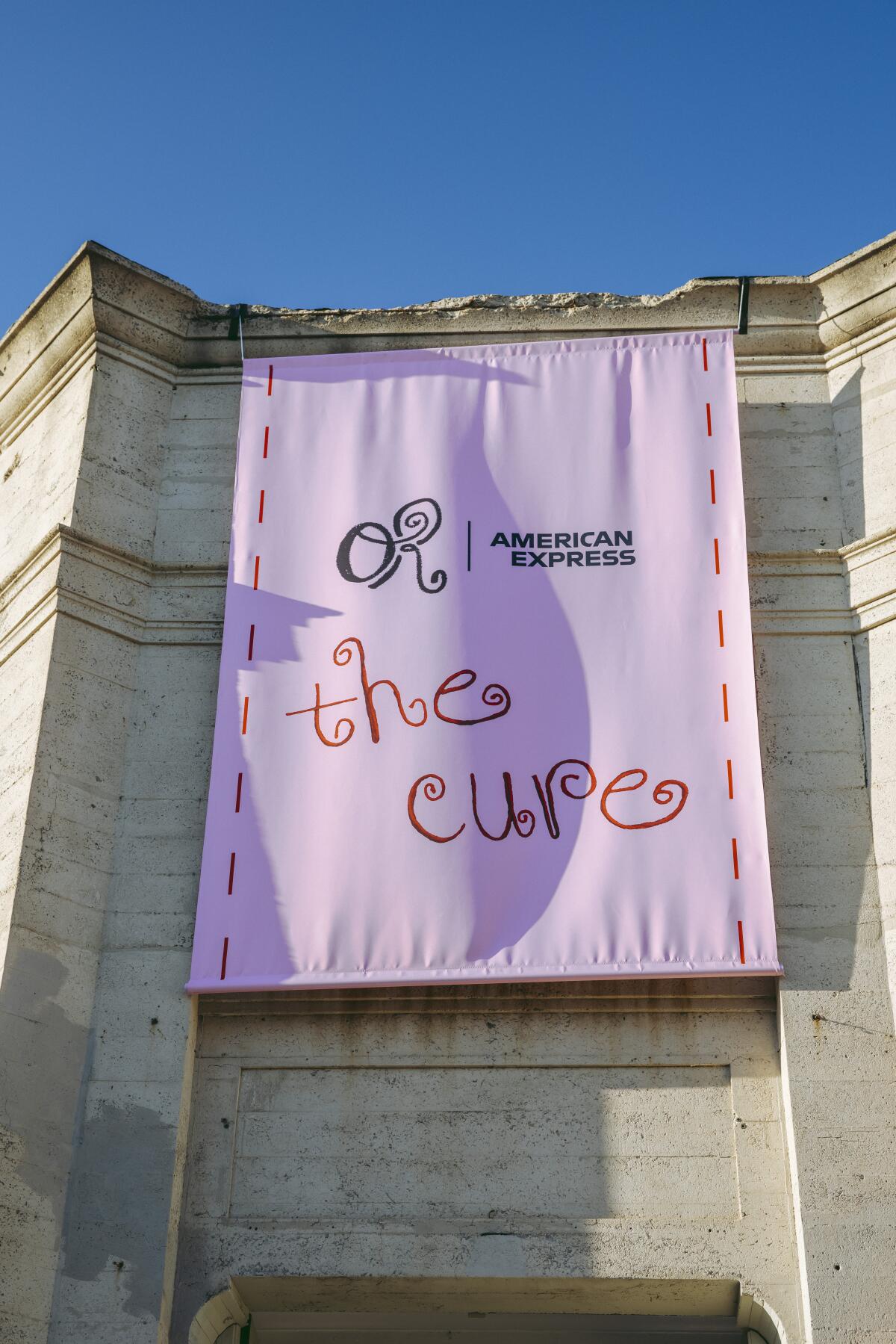
To celebrate the release of her latest album, “You Seem Pretty Sad for a Girl So in Love,” Rodrigo collaborated with American Express to re-create the set of her music video for “The Cure.” The pop-up event, which opened last Thursday and ran until Sunday at Mica Studios, featured props from the video, storyboards, exclusive merchandise and several photo ops for fans.
With a beating felt heart and lab beakers to pose with, the pop-up transformed an industrial studio space in the Arts District into a pastel-painted cardboard hospital. Ahead of the public opening, Rodrigo surprised a small group of AMEX cardholders and select fans.
“I have an album that’s coming out today in about one hour, which is crazy,” Rodrigo said, wearing a blue “Nurses Do It Better” baby tee. “I figured since we’re all here, maybe we should just listen to a few of them together? Would that be cool?”
A little over an hour before the album’s release, Rodrigo played four songs from the album as the room brewed with excitement. She began with “Maggots for Brains,” a song about being so infatuated you can’t focus when your partner is away. Although it was their first listen, the song’s catchy chorus already had fans dancing along.
Banner for Rodridgo’s pop-up event hands above Mica Studios
(American Express)
Rodrigo explained that her next song, “Purple,” paid homage to the aesthetics of her previous albums, “Guts” and “Sour.”
“Obviously, this is my first non-purple album, but I just had to shout out purple somehow,” Rodrigo joked. “This song started out as a love song and sort of devolved from there, so I’ll let you guys be the judge.”
Playing off the somber vibes of “Purple,” Rodrigo played “Less” next. The piano ballad follows the dissolution of a relationship as the couple grows apart.
“I’ve been going back and forth on what the saddest song on the record is, but I think this one might be it,” Rodrigo said.
In a room full of fans, the song struck an emotional chord with many of the listeners. To bring the mood back up, Rodrigo finished the night by playing her new single, “Stupid Song.”
“This next one is a happy one, and it actually has a music video that comes out tonight,” Rodrigo said. “I love this song so much. It’s basically about having such an intense crush on someone that it drives you totally f— insane. I feel like we’ve all been there at some point in our lives.”
Rodrigo was all smiles at her event celebrating her latest album steeped in heartbreak and romance.
(American Express)
After Rodrigo previewed her music, “The Cure” music video exhibition was opened up to the fans. The showcase ranged from interactive photo ops to gallery walls featuring behind-the-scenes photos from the video shoot and Rodrigo’s nurse costume on display. The video’s props, which were primarily designed using cardboard and felt, were displayed in glass cases for visitors to admire.
Dressed in fun fashion including light pink and polka-dot outfits, fans posed throughout the set, re-creating scenes from the music video as “The Cure” played overhead. Many had thrown on a piece of the Los Angeles-exclusive merchandise on sale at the pop-up, with shirts and hats reading “You Seem Pretty Sad for a Girl in Los Angeles.”
So while some fans teared up at her lyrics and others beamed with excitement, everyone was hyped to experience Rodrigo’s new album.
“I really hope you enjoy this little exhibition. It is so gorgeous, and I am so proud of it,” Rodrigo said. “Thank you guys for being here, and I really hope you love ‘You Seem Pretty Sad for a Girl So in Love’ as much as I do.”
There was a time in the beginning of Sublime’s recent revival when Jakob Nowell, the son of the band’s late singer Bradley Nowell, saw himself simply as a good son trying to help his adoptive uncles — drummer Bud Gaugh and bassist Eric Wilson — restart his dad’s iconic Long Beach trio. The goal wasn’t to take the place of his frontman father who died of an overdose in 1996. “I’ll never look at it as my band. Sublime is my dad’s band, and I’m helping out, that’s all,” he told The Times in 2024. Luckily, he was wrong.
The journey of finding his own voice through his father’s sly, shambolic poetry and reggae rock anthems, along with his determination on the road with Gaugh and Wilson through a barrage of festivals and tour dates helped him eventually step into his own as a songwriter and Gen Z rock star. It’s all been done with the mission to preserving his dad’s legacy and having fun while doing it. Now it feels as natural as the trio sitting together on the waterfront in LBC’s shoreline marina within earshot of the bellowing horn of the Queen Mary earlier this year as they were finishing the recording of “Until the Sun Explodes,” the first album under the Sublime moniker in 30 years.
Just like the band’s original recipe of shoving punk, dub reggae, hip-hop and ska into a blender, the new songs dutifully stick to the formula along with Jakob’s soulful caterwauls that sound scarily similar to his dad. But what emerges from the 21-song tracklist is the evolution of a trademark sound that gives a nod to the past while standing strong on its own, just like Jakob, despite coming to the interview on crutches while healing from a performance-related knee injury. The band members chatted with The Times about recapturing the effortless essence of their immortal beach-ready sound and looking forward to a second chance to chase an endless summer.
This interview was edited for length and clarity
It’s kind of a rare thing for all three of you guys to be in one place at the same time. What was it like working in the studio together to finish the new album?
Bud Gaugh: Magical. Things are just coming together. We showed up, Jake had an idea for another song, and he sent us a little demo and said “Hey, this is what I’ve been thinking about.” And then we get down to the studio [in San Pedro], and he’s like, “Oh yeah, so I had another idea,” and kind of changed it. We jumped in there [and by the end of our sessions, we had written] brand new songs to the list of songs that we already had.
The band’s revival has been a long time in the making. I remember when you guys had your first show together, a surprise gig a couple years ago as part of a benefit show for the Bad Brains frontman H.R. Do you feel you’ve come a long way since then?
Eric Wilson: I never thought the chemistry would be like it was with Bradley.
Jakob Nowell: Especially now that we’ve been playing together this long, the chemistry is very much there. We’re just comfortable and having fun. Jamming together is the best. We get in there to do a take for a song, and I’m always like “Let’s just do like three more!” It’s just that much fun, and that’s how it feels playing live too.
When did the idea for creating a new album come about?
Gaugh: It was pretty much just while we were playing shows, At first, the idea was that we were getting together to do this benefit for H.R. [at Teragram Ballroom in December 2023]. We went from “How’s this going to work?” and then [after the show] it was like, “Wow, this is something special. We should definitely go out and play some more shows, and get this music out there and get the opportunity to bring the music to the people in the purest form that we possibly could.” As we’re doing that, it’s like we’re seeing the reaction in the fans, and we were feeling it emotionally. We realized this is going to be bigger than we ever thought. That’s when we really decided where it was going to go.
Jakob Nowell, right, once thought Sublime was only his late father’s band; now, fronting the Long Beach trio, he’s leading a new chapter that still honors Bradley Nowell’s legacy.
(Allen J. Schaben / Los Angeles Times)
Were any of the songs on the new album mined from previously unreleased material or did you start fresh?
Nowell: There was that song we did with Stick Figure [“Feel Like That”], so I think that kind of inspired us. [We realized] “Oh s—, there really is some meat on the bone.” And then I had found some old recordings of stuff that were just like jams without even like vocals or whatever. Then it became just this thing during sound check or maybe in the middle of sets, we’d just start jamming these random progressions and stuff, and it kind of just evolved from there naturally.
The new songs that I’ve heard fit right in the vein of what people love about Sublime. What was it like putting some of those new songs in the setlist as you were building them?
Nowell: It was like magic. We were joking yesterday that sometimes we’ll play a new song for the first time just randomly and I’d see people try mouthing the lyrics and stuff and I’ll say “you’ve never even heard this before! I know you haven’t. We don’t even really know what the hell we’re saying.”
Gaugh: You frontin’! [Laughs]
Nowell: But [the new material] sounded like it was supposed to be there, so it was kind of a rad little test in a lot of ways. We almost don’t even have to think about it. That’s always going to be the guiding goal of any band trying to make fun music that’s relatable.
Wilson: What if you’re Slayer? That’s not true if you’re Slayer.
Jakob, it seems like you’ve gotten a lot more comfortable in the frontman role since joining the band. What’s it like just taking the lead, not just for the sake of your dad, but for the fans?
Nowell: Oh, dude, it’s the best. I don’t even have to think about it. We really feel like this is — we’re a band, you know?
Gaugh: It’s [Jakob’s] band too. Now it’s our band. It’s us.
Nowell: It feels like that whenever we’re hanging out, just doing stuff, or at the studio or at these shows. So, this upcoming year feels like a really rad adventure. We got all these different eras [of fans] — people who were in their 50s when [Sublime’s] first stuff dropped, who are still alive, and then their kids and their grandkids and great grandkids. Everybody finds a piece of the discography they can relate to. That’s what is most exciting. It’s not just one or two songs, people sing along to everything.
I was at Warped Tour in Long Beach last year when you guys played and —
Nowell: That was my favorite set!
To me that felt like it encapsulated what you were talking about with the multigenerational groups of fans that have enjoyed you guys and associate you with Long Beach.
Gaugh: It was like a homecoming for me. I remembered playing the Chili Cook off, you know, right over there in the same area [as Warped Tour], and it was just bringing me back 30 years. It’s so meaningful to be in our backyard playing our music again, right there. This is where it all started. It’s come full circle.
Nowell: It was like playing at a local bar in a cool way. I had this huge group of people up front, they were just talking and shouting and saying stuff, like f–ing with us and joking around. I was like “Damn this is great!”
How about you, Eric? How’d you feel playing Warped?
Wilson: [Mumbles] It was f–ing awesome.
Now that you’ve played all these festival shows, from Coachella to No Values, you’ve got your own festival going on. Can you talk a little bit about Sublime Fest and your Sublime Reef Madness Cruise and how you came up with it?
Nowell: We could put on a bunch of the bands we love, and some of our boys, like Vandals, and make it our own vibe.
Gaugh: You walk around Coachella and there’s so many different elements there. Wouldn’t it be neat if we could make like all this like a Long Beach element, a Sublime element. Looking at this thing, it’s like “Oh wow. So we can actually get some of our friends and set up like a tattoo booth, and have our idea of art and everything out there, and mix it all together — food, art, music — bringing all these different elements, and friends of ours that play music. We get to decide who’s going to share the stage with us, so it’s really neat. It’s like planning a high school party or something like that.
Nowell: The biggest backyard party ever seen.
You guys always had your own sound going on, what’s it like to see that the fans still want it?
Wilson: It took a lotta years to catch on, but it did.
Nowell: Yeah, the kids really want that, like ‘90s, Y2K kind of vibe. That was the last era of like cool authenticity and stuff. You can see it when young people make stuff to look retro … when things get so high fidelity, we’re almost losing a little element, so I think these festivals kind of seek to bring some of that back in a way that everybody can get into.
With “Until the Sun Explodes,” Sublime’s first album in three decades, Jakob Nowell, Bud Gaugh and Eric Wilson rediscover their studio chemistry, jamming new songs that feel instantly familiar onstage.
(Allen J. Schaben / Los Angeles Times)
You guys also have the timeless iconography of the Sublime sun logo. The title of the album is “Until the Sun Explodes.” Does that title have any particular meaning to you?
Nowell: It’s almost just another way of saying “forever,” like “Oh baby I’m gonna love you till the sun blows up.” That’s gonna happen in billions of years, if at all. The fact that [Sublime’s] lasted this long and has this many fans is evidence to me that we wanna be here forever. I think that’s what everybody wants for themselves.
Jake, you’ve taken steps to advance your own aspirations and music with your label, Sunburnt Records, how does that fit into where Sublime is right now?
I was inspired by the whole Skunk Records thing [Sublime’s first label], Evan Zinger with [his lifestyle brand] SRH, and just all the local brands I grew up with when I was a kid. So just trying to do a cool, chill local thing that has that vibe of putting on small shows and kind of getting to use this new notoriety to be like, man, I have so many friends in these small bands like Strange Case and Eight Ball, and other bands up and down Southern California. Let’s put on shows and sneak them on a Sunburnt Stage at [Sublime Fest] and if people really like that Sublime sound here’s a bunch of kids who are carrying the torch like Slightly Stoopid did when they started out. Mike Watt always said “start your own band!” So the more we can inspire people to do that and be some small part of that, it’s a dream come true.
Do you feel like this version of Sublime is something Brad would be proud of?
Gaugh: We all kind of brought our own element to the music orignally. So we just kind of followed that recipe. Jake’s his own person, he’s got his own influences, and we just kind of stick with that idea. Jake brings in his feelings, and Eric brings in his and we sat there and recorded this song, and then as we were recording it, we’re coming up with ideas. It’s like, “Oh wait, we should do this here, slow that down there, stop here,” it’s all a conglomeration of ideas, everyone does their part, brings in their own spices and we mix it in a pot like gumbo.
What to do after writing some of this century’s most devastating songs about the torment of breaking up? Write some of this century’s most devastating songs about the ecstasy of getting together.
With her first two albums — 2021’s Grammy-winning “Sour” and 2023’s triple-platinum “Guts” — Olivia Rodrigo proved herself to be perhaps the most gifted of the many chroniclers of Gen Z romance to emerge in Taylor Swift’s wake. She could convey the hot sting of betrayal, as in her smash debut single, “Drivers License”; she could channel the injustice of watching an ex somehow carry on, as in “Good 4 U”; she could deliver a sick burn like somebody handing out Halloween candy, as in “Get Him Back!” (Because it deserves remembering: “He had an ego and a temper and a wandering eye / He said he’s six-foot-two, and I’m like, ‘Dude, nice try.’”)
Share via
Yet on her thrilling third LP, “You Seem Pretty Sad for a Girl So in Love,” Rodrigo, 23, turns to the pleasure that comes before the pain — and, in a feat very few in pop music are ever able to pull off, ends up with a number of first-flush-of-love songs as potent as any breakup tune.
She opens the album with “Drop Dead,” in which she compares a guy in line for the bathroom at a bar to an “angel on the walls of Versailles” — an early sign of how high the emotional ceiling is here. In “Stupid Song” she cycles through a series of metaphors to describe her lovesickness — she’s a car without a brake, she’s a heart made of melting wax — before finding a simpler but infinitely more vivid way of getting her point across: “You should feel how I feel when somebody says your name.” (Chills.)
“Maggots for Brains” is a song about how useless she becomes “when my baby goes away,” and let’s just take a second to savor the fact that Rodrigo is putting that title into the world less than four years after she was still a working Disney kid. The album’s next tune, “U + Me = <3,” is its high point: a euphoric promise of devotion that sounds like Sixpence None the Richer reborn as a Midwestern emo band. It’s got two young lovers carving their names into car seat leather, and it’s got a girl trying to impress her boyfriend’s older sister with her cynical humor and her taste in yacht rock.
More important, it’s got these lines of pure poetry: “They say modern love’s a cruel endeavor / And to that I say, F— it, whatever.” Kurt Cobain would be proud.
Working with her longtime producer, Dan Nigro, Rodrigo has expanded her stylistic palette to accommodate these new emotions; “You Seem Pretty Sad” pulls in chiming folk-rock and synthed-up new wave and even has a gorgeous wine-bar piano ballad, “Less,” that might put the scare in Rodrigo’s pal Laufey.
The cover of Olivia Rodrigo’s new album.
(Geffen Records)
The album is structured to trace the arc of a relationship, which means that the second half dips into the heartbreak we’re used to getting from Rodrigo. But she’s writing about familiar scenarios with new wisdom, drawing sophisticated conclusions about why people in love do the things they do (and don’t do the things they don’t).
In “The Cure,” which rides a strummed acoustic-guitar pattern that strongly recalls Smashing Pumpkins’ “Disarm,” she realizes a boyfriend can’t fix what’s broken inside her; “Begged” examines the limits of one partner’s willingness to look past the failings of the other. After hearing these songs, the happier ones at the beginning of the album reveal bits of shadow that Rodrigo has built into them to presage what’s to come — to presage what always comes.
It’s fitting, then, that Robert Smith of the Cure — perhaps pop’s most jubilant gloommeister — hovers over this LP like a patron saint: nodded to in “The Cure,” of course, but also “Drop Dead,” where Rodrigo name-checks the Cure’s classic “Just Like Heaven.” Smith himself turns up in “What’s Wrong With Me” for a duet with Rodrigo in which the two learn to accept that love, in the end, might be what kills them.
“My head is spinning and my stomach is sick,” they sing, and neither sounds like they’d have it any other way.
“I’M still the same person as the 15-year-old me,” decides Blur guitarist Graham Coxon.
“Still a romantic idiot, still reasonably innocent — and I think that’s a healthy way to be,” he continues.
Sign up for the Showbiz newsletter
Thank you!
Blur’s Graham Coxon discusses his ‘lost’ solo album Castle Park, recorded in 2011 and named after his Colchester teenage stomping groundCredit: UnknownDamon Albarn and Graham at Wembley in 2023Credit: Getty
“I don’t want to be a cynical old bastard, so I’m lucky I still have a magical outlook on life.”
I’m talking to Coxon, 57, about his “lost” solo album, Castle Park, which is finally set to come blinking into the sunlight.
The product of sessions which took place in the winter of 2011, it is named after his teenage stomping ground in the centre of Colchester — an affirmation of that younger “same person” self.
In a wider sense, it serves as a nod to his Essex hometown — a city since 2022 — where he attended Stanway School, met Damon Albarn and where, in 1988, they formed Blur with Dave Rowntree and Alex James.
It was there, too, that his band leader and clarinet-playing dad introduced him to music, namely, “the Bs — Beethoven and The Beatles”.
The album cover resembles a classic picture postcard, divided into quarters and depicting scenes from the park with its vast Norman castle and an ornate Victorian bandstand.
Coxon says: “There were a few occasions when me and a group of friends would stay in the park rather too long, get locked in and have to climb over the fence.
“I remember being slightly inebriated and dancing around the bandstand — and then, of course, there was the statue.”
Graham is finally releasing his solo album Castle ParkCredit: James KellyThe guitarist performing with Blur at the Norwegian music festival Oyafestivalen 2023Credit: Alamy
He’s referring to the imposing bronze Angel Of Victory which stands atop the Colchester War Memorial at the southern entrance to Castle Park.
“I had some dangerous moments when I climbed up and gave that statue a kiss,” he admits. “I used to do it regularly — she was very beautiful.”
If that fearless act of youthful exuberance was an example of Coxon’s romantic nature, it’s clear that he carried it forward to the album that was shelved until now.
“It comes through,” he agrees, “even though there are songs about getting dumped.
“There’s a lot of processing my own romanticism on that album, but not in a heavy way.
“It’s reasonably light-hearted for the first half at least, even if it takes a tumble down to the most depressing song I’ve ever written [album closer All The Rage]. But that’s life, isn’t it?”
Looking back at ten tracks of “romance, break-ups, heartache and alienation”, he says: “When I was writing them, I was in a very problematic situation emotionally. Somehow, songs have a way of describing your situation more succinctly than whatever is going through your mind.”
In 2026, I’m happy to report that Coxon is in a much better place. It’s 10am when I’m connected via video call to the home he shares with partner and bandmate in The Waeve, Rose Elinor Dougall, and their daughter.
Blur with (L-R) Graham, Alex James, Damon Albarn and Dave Rowntree at the MTV Europe Music Awards in 1995Credit: GettyLooking back on his output, Coxon says: ‘I think it has had a lot to do with my development as a person’Credit: Unknown
“You’ve got me before my brains kick in,” he warns me, but he soon warms to the task of talking about his music outside of Blur.
Aside from the imminent release of Castle Park, this year sees reissues of Coxon’s back catalogue, beginning with his debut album The Sky Is Too High (1998) and its follow-up, The Golden D (2000).
He’s also working on the third Waeve album with Rose, which he describes as “a lot less hard-edged” than 2024’s City Lights.
“It’s more floaty and summery,” he reveals, before reaffirming his romantic credentials.
“Lyrically, there’s a lot more affection. Rose and I go through life together and, sometimes, saying things in lyrics is the nicest way to show affection away from our normal hectic lives.”
But it is his “lost” Castle Park, with lyricism and songcraft as assured as anything in his solo repertoire, that we are focusing on. So, how come the album joined a legendary list that includes The Who’s Lifehouse and The Beach Boys’ Smile by lying dormant for years?
Coxon casts his mind back to 2011 when he headed to The Pool studios in Bermondsey with Ben Hillier, co-producer of Blur’s 2003 album Think Tank (made without Graham except for one track) and engineer on The Golden D.
He says: “It was really odd because I recorded 20 songs and ten of them became A&E [released in 2012], which was based around improvised bass lines.
Aside from the imminent release of Castle Park, this year sees reissues of Coxon’s back catalogue, beginning with his debut album The Sky Is Too High…Credit: SuppliedThe Sky Is Too High follow-up, The Golden D (2000), is also being re-releasedCredit: Supplied
“The other ten were weirdly different — more trad indie, jingle-jangly, with a bit of Sixties influence.”
Those songs, you may have guessed, were earmarked for Castle Park.
Speaking of parks, Coxon had form thanks to Parklife, Blur’s immortal hit with lyrics by Damon Albarn and music by the whole band, not to mention a vocal masterclass from Phil Daniels.
Despite a widely held belief, the song wasn’t inspired by Castle Park but, as Albarn once explained, by London’s Hyde Park where he used “to watch people and pigeons”.
It seems as if the Britpop icons’ 2012 reunion, which included a momentous Hyde Park show to mark the end of the Olympics, is the chief reason why Coxon’s next album didn’t appear.
That rapturously received performance led to Blur’s run of festival shows in 2013 and a new album in 2015, The Magic Whip.
Then Coxon moved on to mastermind soundtracks for Channel Four comedy drama The End Of The F***ing World as well as embarking on a sci-fi music/graphic novel project in 2021 called Superstate.
In other words, while Castle Park gathered dust, Coxon kept himself busy.
He says: “I’m really not sure what happened. Maybe it was lack of confidence. Maybe I thought these songs weren’t fashionable and who would give a s**t?”
Over the years, however, his theory didn’t stand up as fans would repeatedly ask him to release Castle Park. “They even knew the name of the album.”
The clamour heightened when Coxon broke out some of the songs during live shows.
These include opening track Billy Says, a spiky three-minute slice of mod-pop, which finds him channelling his heroes, The Kinks and The Jam.
He says: “Ray Davies is the best songwriter we ever had, followed closely by Paul McCartney, and The Jam was a huge band for me. I thought that being a Jam fan elevated me as a person.”
Other tracks to receive a live airing were Alright, with its pithy putdowns of a love rival, a playful duet with Lucy Parnell called There’s A Little House, and gorgeous acoustic guitar-led Easy.
Of all the Castle Park songs, there’s one which Coxon is most proud of, the poised, richly atmospheric Isn’t It Funny.
“It came to me in the dream,” he says. “I had the chords and half of the chorus, I heard some words — and then I woke up. I thought, ‘My gosh, I need to make a quick note of this.’”
Isn’t It Funny contains the lines: “The sun made black her hair and the river her eyes. She needs no man, no sea, nor heather. She’ll change your mind and slip away.”
By way of explanation, Coxon says: “I realise that there’s always been this elusive feminine spirit or a goddess of nature in my work.
“I don’t write songs about this entity for my own excitement. They just come out.”
Then there’s the sublime Mélodie Pour Christine, a lyric-free classical piece for harp and strings with Lucy Parnell’s vocals serving as another instrument.
“That piece was important to me,” he says. “I devoted it to a French friend of mine — a wonderful person who I loved very much and is no longer with us.”
Another song that hits the mark is bleak All The Rage, which, he says, “communicates one’s despondency around the creative life — and that has got even worse 15 years later!”
If most of Castle Park is filled with distinctly English sensibilities, American influences arrive with a cover of When You Find Out by short-lived Seventies punk-pop trio The Nerves.
“It’s a great song, even Blondie would go, ‘Hey, this is a good one’. I just made it slightly less than perfect,” laughs Coxon.
Then there’s “an attempt at soul” with Forget Today which finds him employing his considerable saxophone skills and Ben Hillier providing Hammond organ. (Worth noting that Coxon played sax on Parklife.)
Dripping Soul ventures into territory occupied by Ennio Morricone’s spaghetti western soundtracks, “so it’s not exclusively weird south-east of England s**t”.
“I love westerns, particularly Sergio Leone films. A Fistful Of Dollars and all that,” says Coxon.
In the song, he is peering “beyond the veil” at the “souls of those cowboys who came from a place where life is cheap and death is taken for granted”.
With its galloping guitars, Coxon realised he couldn’t turn Dripping Soul into “a hanging out in Camden sort of thing”.
But he does believe that the house he shares with Rose in London is populated by the souls of dead people.
“I don’t even believe in ghosts, but I’ve seen them,” he reports. “So that’s a bit of a quandary.”
Coxon says he still likes to talk to dear departed loved ones: His mum, Christine, drummer Graham Fox, the Irish journalist who first wrote about Blur, Leo Finlay, and the head of Food Records, Andy Ross.
“I don’t really see them as gone,” he says. “I can still talk to them — they may have disappeared but they’re still fully alive in my mind.”
With that said, we return to 1998 when all those people were still with us — to the making of Coxon’s debut solo album The Sky Is Too High.
It was an unvarnished, largely acoustic affair featuring his own artwork and, as he explains: “It was recorded through really good gear but approach was quite raw.”
Sandwiched between Blur’s self-titled fifth album and its follow-up, 13, “It was done in a bit of a hurry — I wasn’t f***ing about.”
The project had begun when a neighbour asked Coxon to write a couple of songs for a film about Victorian bare-knuckle fighter Tom Sayers — setting wheels in motion that are still spinning.
He says: “That request turned into an addiction to writing songs and releasing them.”
So, how did his solo endeavours affect his relationship with his Blur bandmates. “They didn’t talk about it,” replies Coxon, “Though I did once catch Damon singing R U Lonely? He said, ‘That’s quite a catchy little tune’.
“Attempting to develop as a songwriter when Damon Albarn is your best mate is hard work. I mean, he’d already written some bloody good songs by then.”
Released in 2000, Coxon’s second effort, The Golden D, is very different — heavier, more abrasive and driven by searing electric guitars.
The mood changes with the funky Oochy Woochy, which tapped into Coxon’s fascination with Nineties’ fusion of hip-hop and jazz — a style developed by American rapper Guru called Jazzmatazz.
He says: “I’ve always liked that skinny beat stuff with James Brown loops or similar. Stuff like Public Enemy and 3rd Bass. Oochy Woochy is not a mickey take but a go at that.”
With physical releases of Coxon’s other albums still to come this year, there’s plenty more scope to revisit his solo journey.
Then, in November, he’s hitting the road for a UK tour, bringing the songs back to life still further.
Looking back on his output, Coxon says: “I think it has had a lot to do with my development as a person.
“You know, that anxiety-ridden creative weirdo who puts all this stuff out there.
“I guess that’s why I like Castle Park coming out — because now there are no secrets. You’ve got it all.”
GRAHAM COXON
Castle Park
4.5 STARS
Castle Park is out 19th JuneCredit: Supplied
Also released: The Sky Is Too High and The Golden D