Mindy Kaling’s ‘Not Suitable for Work’ is a vivid memory of her 20s
Mindy Kaling was in her early 30s when the first TV series she created, “The Mindy Project,” made its debut and set in motion her attempt at forging an identity as a prolific multi-hyphenate after “The Office,” where she was a writer and cast member for eight seasons. But if you ask her to reflect on that time of her life, she says, it’s a bit of a blur.
As she explained recently, “I remember it, but not all that distinctly. It was such a grind — waking up at 6 a.m. to be on camera, wrapping late. And I did that for 117 episodes.”
But ask her about her 20s, when she was living in New York City and trying to figure out how she could break into the industry as a comedy writer? “I remember incredibly vividly,” she says. “I’m like, did I feel things more intensely back then? I’m not sure. But that period of time … there was just so many highs and lows. And it felt cinematic to me.”
So she made a TV show about it.
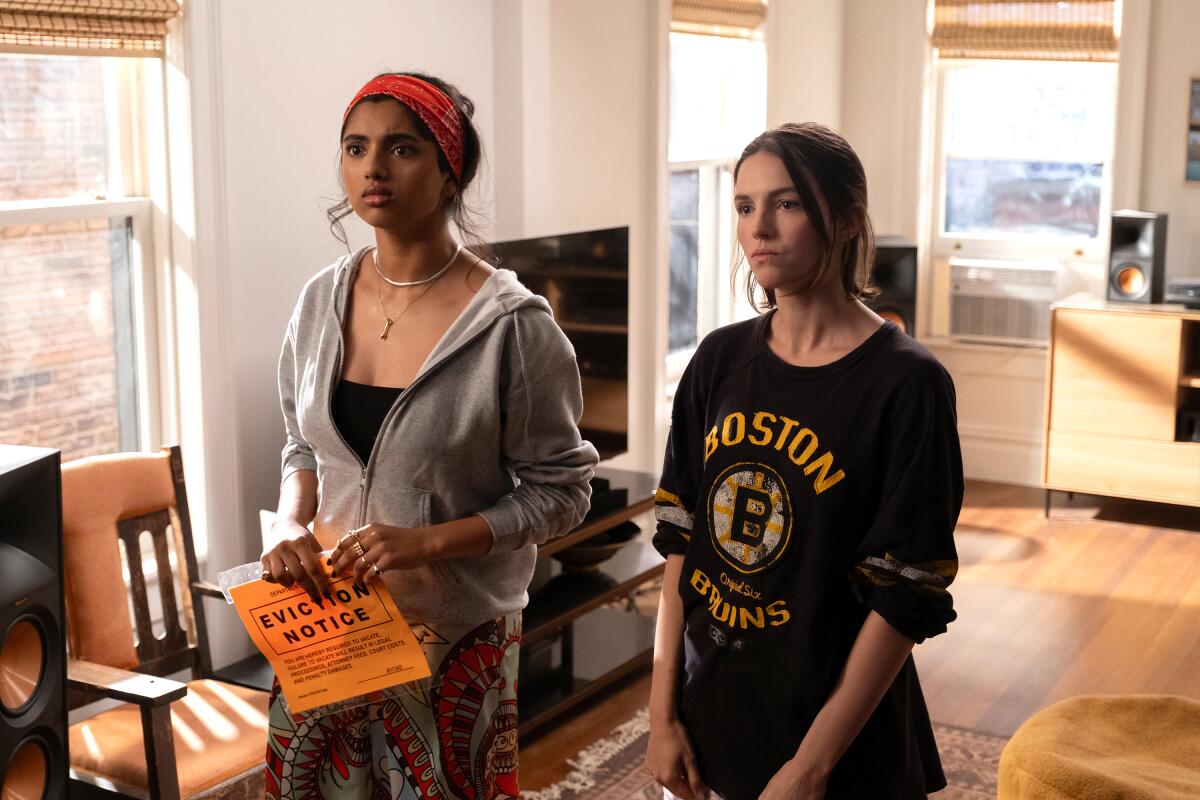
Premiering Tuesday with three episodes, “Not Suitable for Work” follows five ambitious 20-somethings living in Manhattan who are navigating the early stages of their careers while trying to have a semblance of a life and the heightened emotions they experience during this period. Kaling calls it the third chapter in her semi-autobiographical TV trilogy, which includes “Never Have I Ever,” about a first-generation Indian American teenager coping with her father’s death while trying to be popular (or at least not super uncool), and “The Sex Lives of College Girls,” about four young women who dorm together and boldly maneuver their new, uninhibited lives on campus.
In the new Hulu series, viewers are introduced to AJ Pascarelli (Ella Hunt), a hard-working and disciplined young woman who moves to town to start a high-pressure finance job, and her roommate Abhinaya “Abby” Chilukuri (Avantika), a savvy and fashion-obsessed assistant to a celebrity stylist. They live across the hall from Josh Teitelbaum (Jack Martin), an idealistic nepo baby of a media titan — he’ll lean into his privilege when it suits him while also trying to distance himself from it — with ambitions of making it in journalism. His two roommates are Kel Washington (Nicholas Duvernay), an insecure but earnest med student who would rather be acting, and Davis Beau Bradley Barrett III (Will Angus), a high-energy, bumbling financial analyst who works at the same corporate firm as AJ and is an undercover hopeless romantic. As one might expect, there are some messy entanglements within and outside the group.


1. Abby (Avantika), left, and AJ (Ella Hunt) move in together. 2. Across the hall live Davis (Will Angus), left, Josh (Jack Martin) and Kel (Nicholas Duvernay). (Gwen Capistran / Disney)
“I hope that young people will respond to the show, “ Kaling says. “We did so much research in it because at a certain point it is funny — I’m in my 40s, and I am often like, ‘I wonder if young people are suspicious about why I’m so obsessed with writing shows about young people.’”
So, why is she?
“Because I find it almost impossible to reflect on the current time I’m in,” she says. “It would be too painful to be too introspective about the time that I’m in. I need a real sense of distance to look back on it, especially since having kids. Once you have kids, it triggers these memories of your own childhood.”
Over video call from New York City, Kaling reflected on the series and her early years of trying to make it. These are edited excerpts from the conversation.
How did you land on the professions that your characters would be pursuing and what did you want to say about ambition at this stage of life?
I love people who have big wants, and sometimes the audience is like, “Maybe you want the wrong thing” and they [the characters] don’t quite know that yet. I love writing about the underdog. And with their particular professions, they’re all things that I had some interest in researching. I’ve always been fascinated by investment bankers. I went to Dartmouth, so I have a lot of friends who went into that, and I swear I’ve had my friends explain their job so many times to me, and I still didn’t totally understand it. We were lucky; a very famous investment bank very generously offered to let me come for a day and meet with young bankers. I also … write about the children of immigrants. I’m very, very interested in that story, and so we got to research what it’s like being the child of Nigerian immigrants. But every single character has a journey, or there’s an aspect of them that I feel like I really relate to, and that is in almost all my shows.
What was it like observing young people in the investment banking world?
They were wary — because they’re smart — of someone from Hollywood coming in to document what they were doing and asking questions. It helped that a lot of the guys liked “The Office” and a lot of the women liked “The Mindy Project” and “Sex Lives of College Girls” because they’re all kind of young. I think that made them trust me a little bit more. For the AJ and Davis characters, so much of what I researched when I was there fed into their plot line … almost all the characters have a boss they fear and idolize, and the way that first-year bankers feel about their managing directors is not dissimilar to the way I felt about Greg Daniels when I started at “The Office.” And the hours are actually not dissimilar.
There’s a moment early on where Jay Ellis’ character, Bill, who is a managing director at this fictional investment banking firm, is asked about work-life balance. I’m curious how you thought about that at the start of your career versus now.
I didn’t care at all about anything except my job for 16 years. It was my entire personality and purpose. When I was in my 20s, the only thing that mattered was being a good comedy writer and succeeding, and one day maybe being able to create my own shows. There was no balance. I didn’t want balance. I wanted to live and breathe comedy writing for my entire life. I hated the weekends, actually. And who wouldn’t? I was a friendless transplant in Los Angeles and I just wanted to get back to working at “The Office.” Every year I was there, I got more ambitious and I wanted to go off and create my own show and have a bigger part as an actor and everything.
It wasn’t until after I did that on “The Mindy Project” … that I just felt like, “OK, I get this. I want to now try being a mom.” Once I had my daughter, Katherine [at 37], it wasn’t that the balance changed, it was my first real, legitimate interest outside of work — that I cared about more than work.

“When I was in my 20s, the only thing that mattered was being a good comedy writer and succeeding, and one day maybe being able to create my own shows,” Kaling says. “There was no balance. I didn’t want balance.”
(Ebru Yildiz / For The Times)
After college, you moved to Brooklyn with two Dartmouth friends to pursue a career in comedy. You eventually got a full-time job as a production assistant on “Crossing Over with John Edward,” a program where people would receive psychic readings. Tell me about that time in your life.
I remember feeling like I had no access and that I didn’t have any place to put my ambition. It was so far away from anything I wanted to do — scripted comedy and reality television could not be further apart. It was a fascinating time because there were such highs and lows. There was the excitement of new crushes and having fun in a new city with two friends, but there was also the crushing disappointment of feeling like I was never gonna make it. I didn’t even have a path forward to making it, but I was lucky, because I lived with my two best friends. We would go to open mic nights, and we would go to restaurant week and see how the rich people in Manhattan were living. We would take the subway uptown to Central Park and walk along Fifth Avenue and like look at these amazing homes and just dream what it was like to be like a wealthy New Yorker who could buy everything that they read about on DailyCandy — now I’m really dating myself here, back when DailyCandy was a thing. But that’s what it was like, I just I felt a lot of extreme emotions.
How did you approach that job?
My boss was a producer and would approach the families and get their information, and then we would have to do research on them, but it was mostly because they would do a little clip package on the different families. I had to get them to sign releases to be on the show and get photographs of their deceased [loved ones] and them. I actually thought it was pretty interesting work. It just had nothing to do with comedy writing, and that job was not clearly going to lead anywhere toward comedy writing, and I came to New York because of “Saturday Night Live.” When I was working there is when my friend Brenda [Withers] … and I started writing this play “Matt & Ben” [a satirical play that imagines the story of Matt Damon and Ben Affleck before “Good Will Hunting” made them famous] in the time we had off. We started writing it, then I got that job as a PA, then the show went up at the Fringe Festival, and then it was going to go off off Broadway, and when it went off-off-Broadway, and I had a steady income, that’s when I quit my job there. I was only at “Crossing Over” for three or so months.
Greg Daniels attended a performance of “Matt & Ben” and it’s what led to you getting on “The Office” at 24. What was that first meeting like?
Back then, because the internet was so different, when I looked up Greg, besides his credits, you couldn’t find a lot of biographical information about him, or even a photo. I don’t think I even knew what he looked like. When I met him, I don’t think I had seen the British “Office” yet; I wasn’t cool. At that time, I had put so much pressure on this job. I only had two interviews — it was this and there was a show that ended up getting canceled while I was waiting to meet the showrunner. It was a pilot called “Nevermind Nirvana,” about an Indian man who married a white woman, and Ajay Sahgal was the writer. I was like, “Oh my God, if anyone is going to get hired to work on the show, it has to be me.” I was pretty excited about that meeting, but when I was sitting in the waiting room at the production offices to meet with Ajay, they told them they weren’t going to pick up the pilot, so I never even got to meet him, and they just told me I could leave.
I’d only had that interview, and then I met with Greg. This is my memory: it was a high-rise building in Century City, in the offices of “King of the Hill,” so there was a lot of like “King of the Hill” cutouts and stuff there. And he’s just a very thoughtful, quiet guy who doesn’t push conversation … I’m someone who’s pathologically chatty, and so talking to Greg, who is completely fine with there being pauses in conversation, and is just a confident grown-up, it was incredibly intimidating. I was very stressed out in our meeting, but I also was blown away by him.
That first season, you were also the only female writer on staff and the youngest —
B.J.[Novak] is a month younger than me. I want to correct that because he’ll read this and go, “Hey … !”
How did that play into how you felt in the room?
I haven’t really ever had imposter syndrome. And this is my probably my personality defect — I felt that even if I hadn’t seen anyone like me in these roles, that I was just going to be the first one, and I was going to work really hard and prove it to them. The staff was super competitive, but they were smart feminist guys. It was hierarchical and stressful, but it was not because of my fellow writers, except that I wanted to impress them. I felt nervous because I wanted to be contributing, but I don’t know why — I just loved the pilot so much that Greg had made, and I loved these characters, and this world — I was like, I can’t possibly lose my job, I love it too much. Which is probably really stupid, I didn’t ever think there’s a possibility that I could get fired here.

Phyllis (Phyllis Smith), Kelly (Mindy Kaling), Dwight (Rainn Wilson) and Michael (Steve Carell) in a scene from Season 2 of “The Office.”
(Paul Drinkwater / NBCUniversal via Getty Images)
We see how AJ wants to impress the boss and takes on more than she can chew and screws up some data before a big presentation. What was that first big mistake or misstep that you made in those early years that you still think about?
I remember Season 2 — because I just wanted to prove to Greg and to the cast and to the director, the cinematographer, and everyone that I was super invested — we were shooting “The Dundies” [episode]. I was an actor on the show as well, but I wasn’t acting in this scene, but it was my episode [that I wrote], and in between takes, John [Krasinski, who played Jim Halpert] and Jenna [Fischer, who played Pam Beesly] were just on set, and I remember going up to them and being like, “Guys, that take was so great!” And I walked away. Greg came up to me and was like, “You know, we really should let just the director talk to the cast between takes.” Greg, he’s my mentor, but he definitely, over the course of the eight years I lived there, had corrected me many times, as he should have, but that was one of the first times. I remember I was so embarrassed, but I didn’t understand it’s not the role of a story editor to be giving feedback to the cast between takes on a show.
The bosses on the show all have different styles and expectations that may seem demanding or annoying on the surface. How do they reflect where you’re at now?
No one trains you on how to be a good boss. And bad bosses are so prevalent. The entire premise of “The Office” hinges on this funny concept that terrible bosses exist. It wasn’t until I was on “The Mindy Project” that I was the employer for the first time. Every single year of that show, it was a battle getting a new season. One of the challenges of being a good boss is being able to put aside those personal, professional battles you’re fighting … but then also realizing that you’re a mentor to other people, and you have to start thinking about things that you never thought you needed to — overtime, maternity leave, respect in the workplace, the things that make the workplace enjoyable for everyone else who’s there working for you. And it’s not like that comes naturally.
The double blessing of having a good boss, which I did in Greg Daniels and Howard Klein [an executive producer on “The Office”], is that they modeled that for me. Even though I could not be more different than Greg. Even to this day, I’m realizing I have all the unique challenges of being a single mom, being the creator of these shows with crews and casts, but then also being able to be empathetic for all the people that work for me and making sure I make time to listen to them when they want to talk to me about an issue that they’re having; it’s a continual challenge that I’m hoping I’m getting better and better at [managing].
When Bill is asked about work-life balance, he’s also asked if he has inspirational words to impart. It’s very much about overworking and being productive. How do you tackle the question today?
I used to say “you have to write your own part.” And everyone would get annoyed because they’re like, “I’m not a writer.” I’ve had to really think about the question so I could be helpful. We all want a linear path to success. And if my career has taught me anything, it’s that the linear path just was not how I got my job. You know when you go on Google Maps and it shows you all the different paths — the fastest, one path with the toll road and one path that’s going to take seven minutes longer. I’ve only ever taken the one that’s seven minutes longer, or the toll; it’s never been the easy way. The sooner I got used to that, the better.
Before I let you go, in the show, one of the celebrity clients Abby is dealing with is Austin Blanchett, Cate Blanchett’s fictional nephew. Was it always going to be Cate? What other celebs were in the running?
It was Cate Blanchett’s nephew before we had Harry Richardson. When I worked on “Ocean’s Eight,” one of the biggest surprises on it was that Cate Blanchett was incredibly funny and did not take herself seriously at all. I suspect if anyone was going to think it was funny that in this fictional world of the show she had this useless nepo nephew that she had to help get jobs, it would be Cate. I hope she doesn’t sue me. I think she would think it was funny.