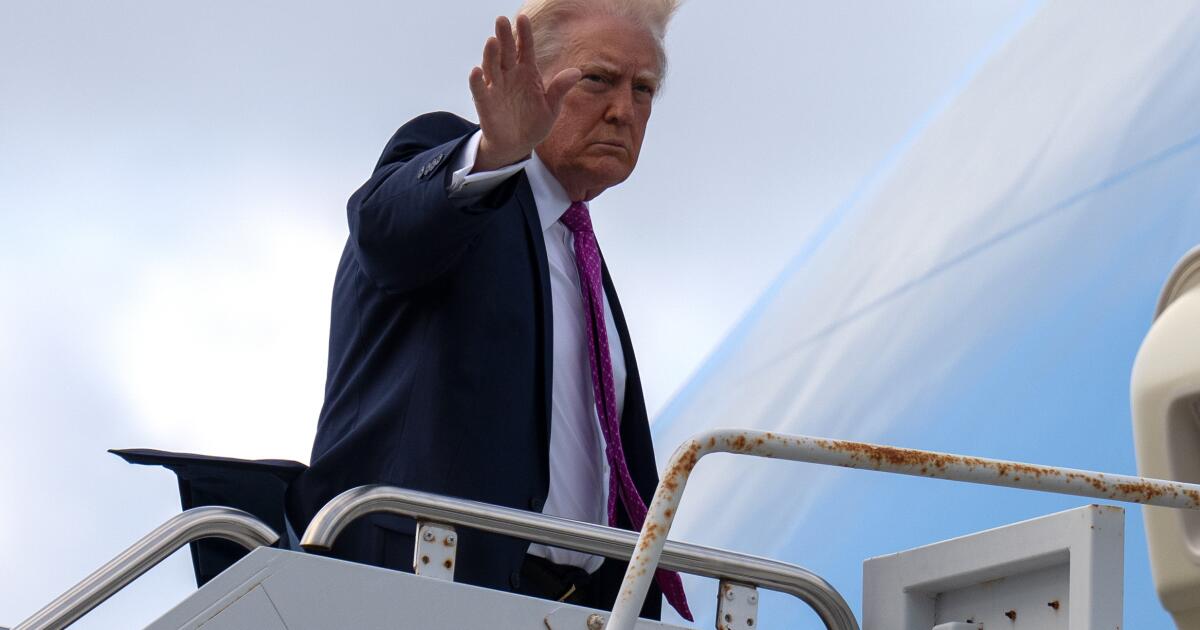
airport

Airport cleared to be renamed for Trump as he unveils design for skyscraper library

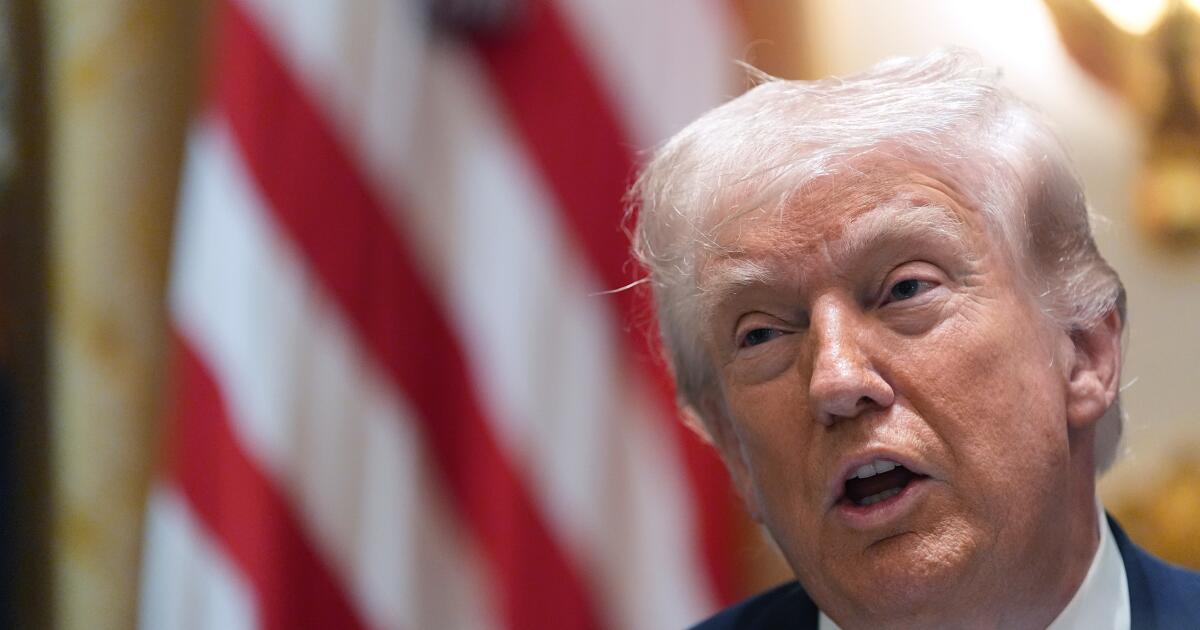
A Florida airport was cleared to be renamed after President Trump on Monday, hours before the president separately revealed plans for a Miami skyscraper planned to house his presidential library.

Florida Gov. Ron DeSantis signed a bill allowing Palm Beach International Airport to be renamed the President Donald J. Trump International Airport. The change is set to take place in July, formally rebranding the airport near Trump’s Mar-a-Lago estate.

Later Monday, Trump posted a video to social media that appears to show digital renderings for his presidential library. Set to dramatic music, the video unveils a piercing tower along the Miami skyline emblazoned with the signature “Trump” lettering seen on his other towers.

The video includes panning shots of the tower’s exterior and interior, with a presidential jet parked in the lobby alongside a gold escalator like the one Trump rode down while launching his presidential campaign in 2015. Other shots show a giant ballroom like the one he’s planning for the White House, a replica Oval Office, rooftop gardens and a large, gold statue of Trump.

A credit says the design comes from Bermello Ajamil, a Miami-based firm. Trump posted the video with no explanation beyond a link to a new website for the library. The website says, “coming soon,” with a link to donate money.

The White House did not immediately respond to questions about the plans.

Miami Dade College gave up a nearly three-acre plot of downtown real estate as a gift for the future library. A judge in December dismissed a complaint challenging the gift on grounds that the college’s board didn’t give sufficient public notice. The site is valued at more than $67 million.

Trump’s son Eric previously said the library will be “one of the most beautiful buildings ever built” and “an Icon on the Miami skyline.”

Since he returned to the White House, Trump has pressed to get his name on all manner of American institutions, including the U.S. Institute of Peace, the Kennedy Center for the Performing Arts and U.S. currency.

In Palm Beach, a stretch of road from the airport to Trump’s estate was recently renamed Donald J. Trump Boulevard.

Source link

Spain 13 airport strikes Tuesday update as aircraft take off ‘without luggage’

Passengers arrive to discover their posessions have been left behind as days of walkouts start at sites – full list

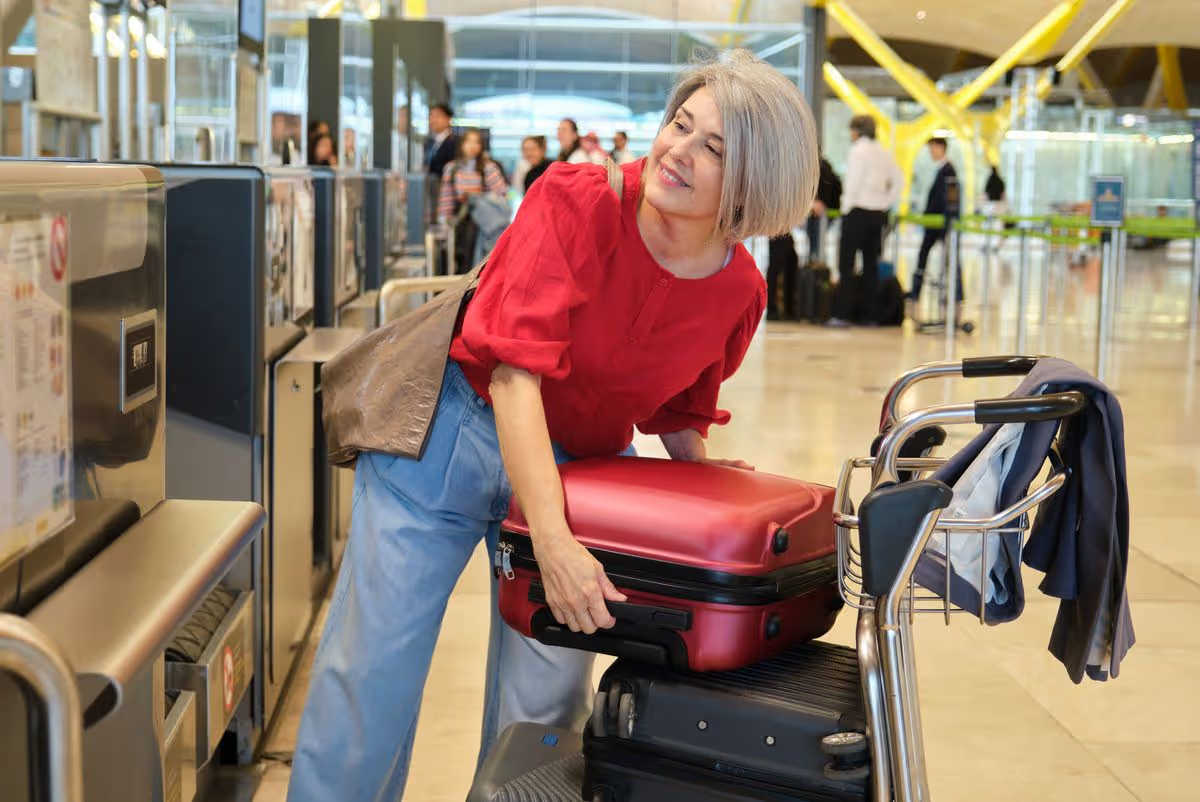
Passengers flying from 13 Spanish airports hit by strike action have landed to discover all their luggage has been left behind, local media has reported. Canarias said the first day of the strike by Groundforce workers, the ground handling operator that services Air Europa flights, resulted in continuous delays across all the airline’s flights and passengers arriving at Canary Island airports without their luggage, having had to leave it behind at their point of origin.

Alternating work stoppages are taking place between 5 and 7 am, 11 am and 5pm, and 10 pm and midnight, the first day of the strike affected 13 Spanish airports, three of them on the islands of Gran Canaria, Lanzarote, and Fuerteventura, where delays occurred throughout the day. These delays did not originate at the island airports but rather on flights arriving primarily from Madrid, Barcelona, and Bilbao, with delays approaching an hour.

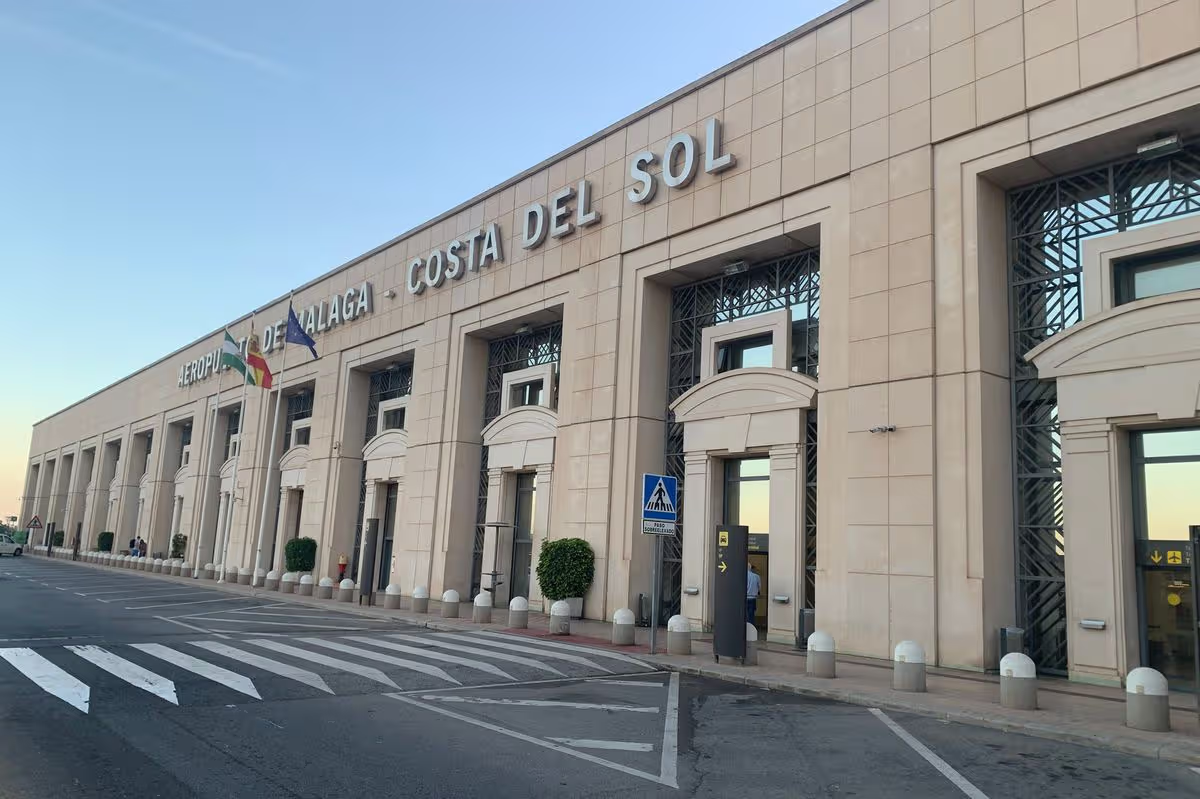
Airports impacted are Barcelona-El Prat, Madrid-Barajas, Ibiza, Palma de Mallorca, Gran Canaria, Tenerife, Fuerteventura, Bilbao, Lanzarote, Alicante, Valencia and Malaga. The Groundforce strike is scheduled for this Wednesday (April 1) and Good Friday (April 3), with the possibility of becoming indefinite.

Because the aircraft operate on a network, delays accumulated throughout the day, causing significant disruptions to flights departing from the three affected airports in the archipelago. At major airports on the Iberian Peninsula, such as Madrid, Barcelona, and Bilbao, planes departed without luggage in their holds throughout Monday, leaving many passengers arriving at their destinations without their belongings.

READ MORE: Spain 12 airports strike Monday update on flights delayed as lawyer says ‘get there 3 hours early’READ MORE: Spain airport strikes warning as Easter travellers face severe delays

It’s worth remembering that the most affected route is Madrid-Gran Canaria, on which Air Europa operates seven flights daily. According to Orlando Robledano, secretary of the aviation sector at the UGT union, the strike’s impact on Canary Island airports has been reduced due to the minimum services imposed by Groundforce on all Lanzarote Airport employees. Even members of the works council received this notification requiring them to comply with these minimum services, making it impossible to achieve the level of participation required for a strike of this nature.

This, coupled with the fact that domestic flights at Canary Island airports are protected and must be serviced regardless of delays, meant that the problems were less severe at the islands’ airports than at those on the mainland. Other affected airports include Alicante, Valencia, Palma de Mallorca, Ibiza, and Málaga.

Hosteltur reported that strikes at Canary Island airports during the peak days of Holy Week, between Maundy Thursday (April 2) and Easter Monday (April 6) may be called off as workers at Menzies—who provide check-in, boarding, and baggage services to airlines such as Norwegian, EasyJet, and British Airways—along with the works council and their union representatives from UGT, are close to reaching an agreement to call off the strike that was set to affect nearly 3,000 of the group’s employees in Spain, 600 of them in the Canary Islands.

At least six planes took off from Madrid-Barajas Airport on Monday without their passengers’ luggage due to an indefinite strike by the ground handling company Groundforce. On this first day of the strike, disruptions are being reported at all airports, although the most significant impacts are felt in Madrid and Barcelona, according to union sources, Telecinco reported.

Passengers report long queues and checked baggage left on the tarmac during the first day of the strike The indefinite strike by Groundforce ground staff began this Monday at Barcelona Airport, with protests taking place at three different times. The affected services are all those related to ground handling.

Long queues were reported at Barcelona’s El Prat Airport, where Alberto García said: “There have been some delays, and some planes have even departed with very little luggage. It was the protesters themselves who informed passengers that their bags would not arrive on time.

“The unions continue fighting for their objective and are demanding that the company comply with the wage agreements stipulated in the collective bargaining agreement.” At this time, many people have seen their flights significantly delayed or have had their luggage left behind.

In Madrid, people have had to wait for extended periods to check their luggage. Some report waiting for “four or five hours.”

Many planes, especially those arriving from Madrid, “are arriving without luggage, and the problems are spreading,” a UGT spokesperson told Europa Press, adding that “there is no guarantee that luggage will arrive.” The delays “affect not only direct flights but also many connecting flights, since passengers arrive without their luggage and therefore miss their next flight.”

Source link

Some wait times at airport bottlenecks are easing with TSA paychecks promised

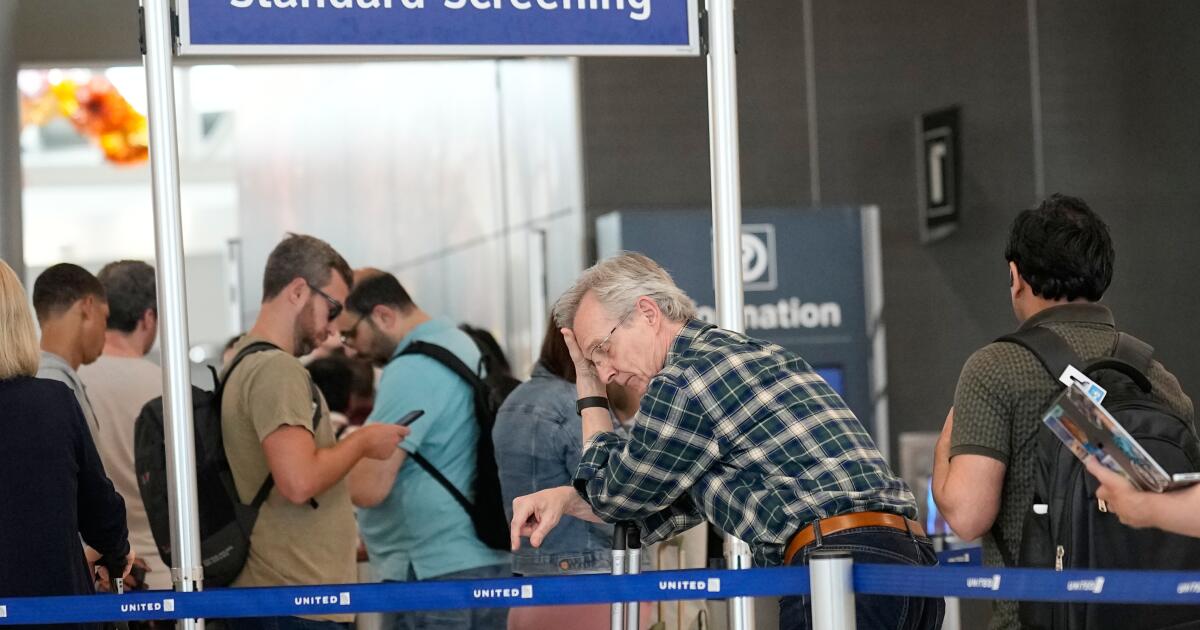
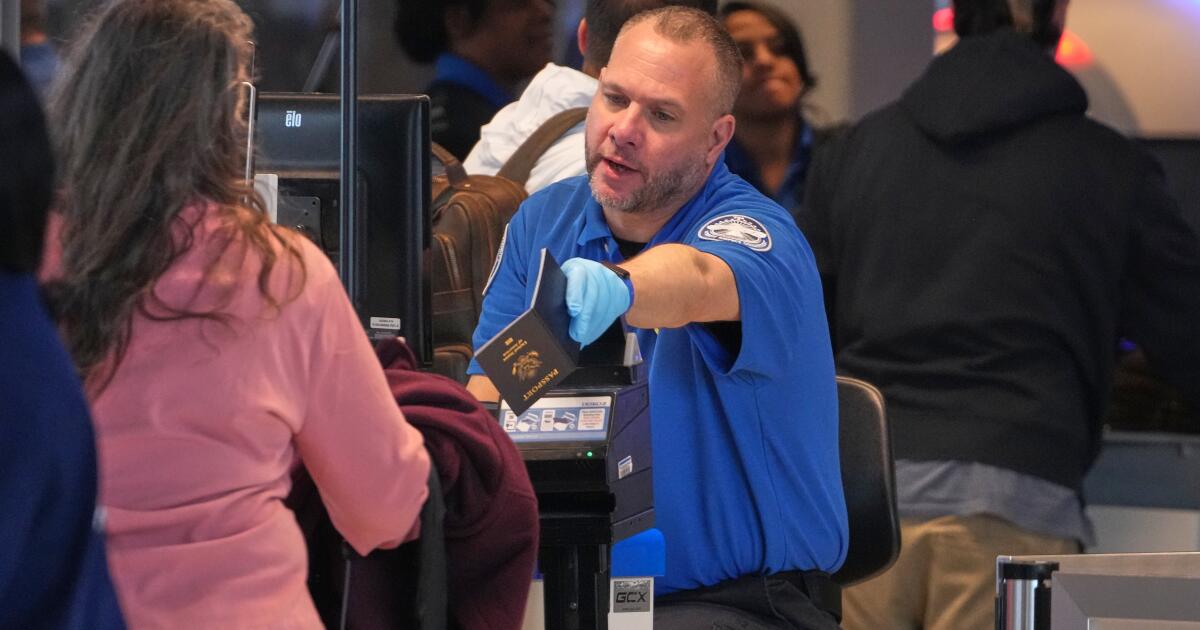
After weeks of chaos in U.S. airports, the Transportation Safety Administration said the first paychecks in weeks are being sent as early as Monday to its workers, giving the beleaguered aviation system a boost of optimism.

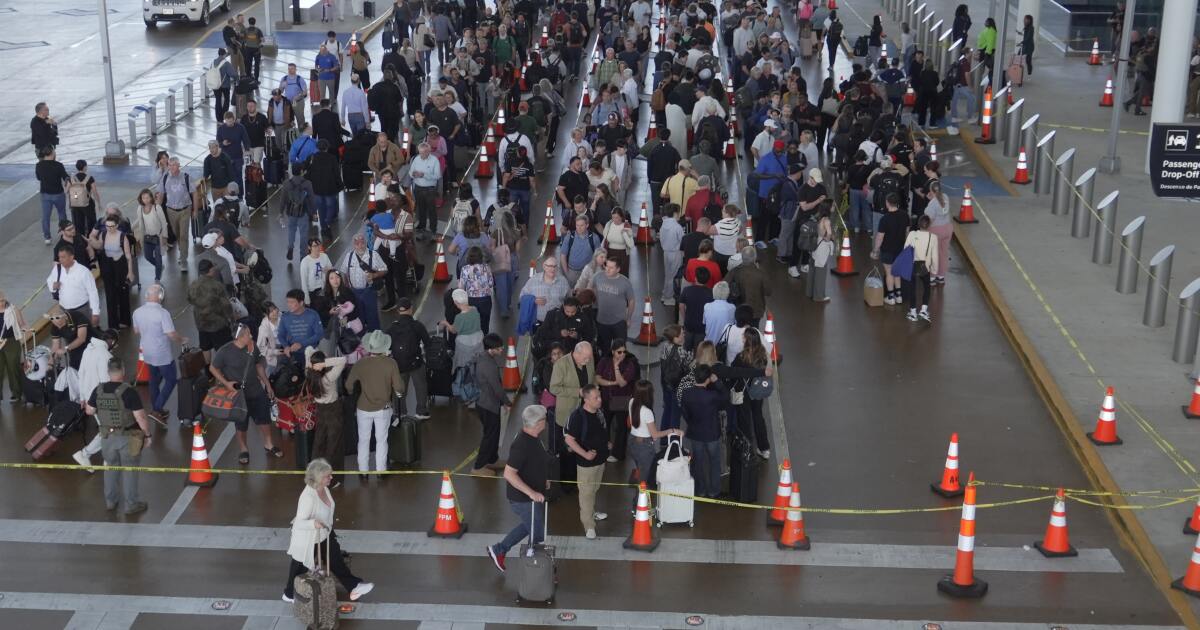
Wait times at some TSA security bottlenecks, such as the airport checkpoints in Atlanta and Houston, improved significantly Monday morning.

But how long it will take for long security lines to consistently return to normal — and how long federal immigration officers will stay in airports — remains unknown as the busy spring break travel season continues.

The DHS shutdown has resulted in not only travel delays but also warnings of airport closures as TSA workers missing paychecks stopped going to work. Those workers were just recovering financially since last fall’s extended government shutdown.

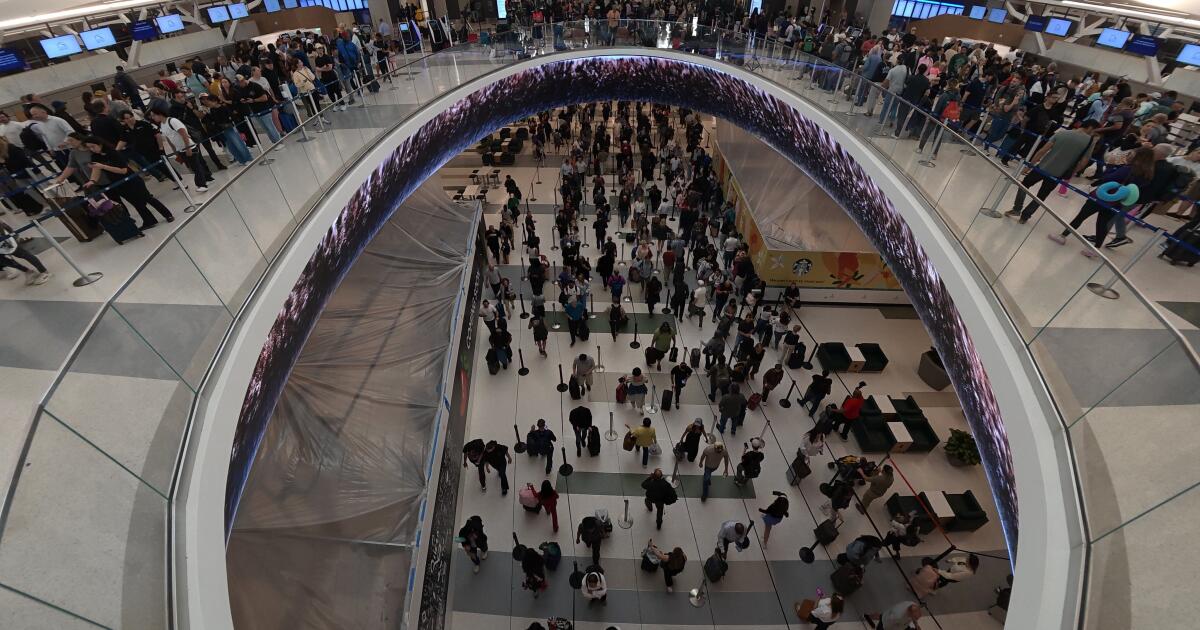
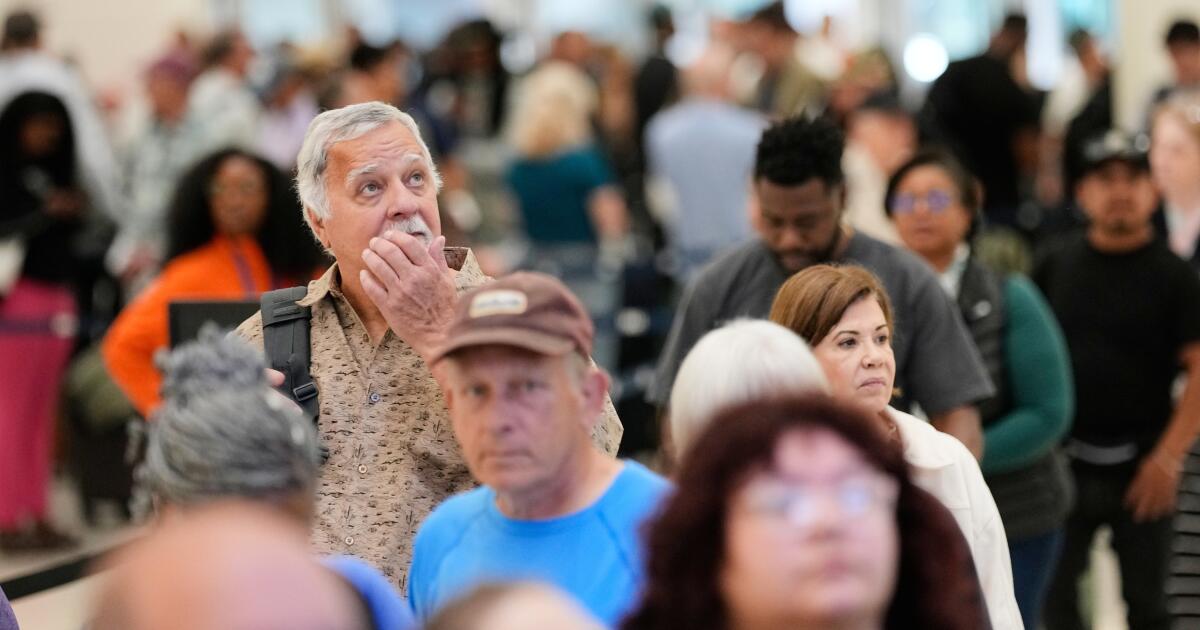
Wait times still pushed beyond two hours at New York’s LaGuardia Airport Monday morning. Baltimore-Washington International Airport had minimal wait-times Monday morning, but continued to advise travelers to arrive three hours before their scheduled departure.

President Trump on Friday ordered the Department of Homeland Security to pay TSA officers immediately to ease the lines plaguing airports. The move came after Trump rejected bipartisan congressional efforts to fund the TSA while negotiations continue with Democrats, who have refused to approve more funding without restraints on Trump’s immigration enforcement and mass deportation operations.

Democrats are demanding better identification for the officers, judicial warrants in some cases and for agents to refrain from conducting raids around schools, churches or other sensitive places. Republicans and the White House have been willing to negotiate on some points, but the sides have yet to reach a final agreement.

On Monday, there were few signs of progress on Capitol Hill, where the Senate held a short session without considering the House bill and resumed its two-week break. GOP Sen. John Hoeven of North Dakota said afterward that Senate Republicans are talking with Democrats and also the House as they try to find a way to funding DHS.

TSA employees had gone without pay since DHS funding lapsed in February. The department’s shutdown reached 44 days on Sunday, eclipsing the record 43-day shutdown last fall that affected all of the federal government.

The DHS shutdown has resulted in not only travel delays but also warnings of airport closures as TSA workers missing paychecks stopped going to work. Those workers had already endured the nation’s longest government shutdown last fall. Multiple airports experienced greater than 40% callout rates, and nearly 500 of the agency’s nearly 50,000 transportation security officers quit during the shutdown.

Trump deployed Immigration and Customs Enforcement agents to some airports a week ago to help with security as TSA callouts rose nationwide. How long they stay, White House border czar Tom Homan said, depends on how quickly TSA employees return to work. A TSA statement said the agency “has immediately begun the process of paying its workforce,” with paychecks arriving “as early as Monday.”

The overall absentee rate among TSA officers scheduled to work dipped slightly on Sunday, according to DHS. The highest were concentrated at major airports that have seen consistently elevated absences lately.

Those included BWI, both of Houston’s main airports; Louis Armstrong International Airport in New Orleans; Atlanta’s Hartsfield-Jackson International Airport; and John F. Kennedy International Airport in New York.

Funk and Seewer write for the Associated Press. AP reporters Rio Yamat in Las Vegas and Mary Clare Jalonick in Washington contributed to this report.

Source link

Airline launches first flights in two years from UK airport to one of the world’s best food destinations

AN AIRLINE has returned to a major UK airport for the first time in two years.

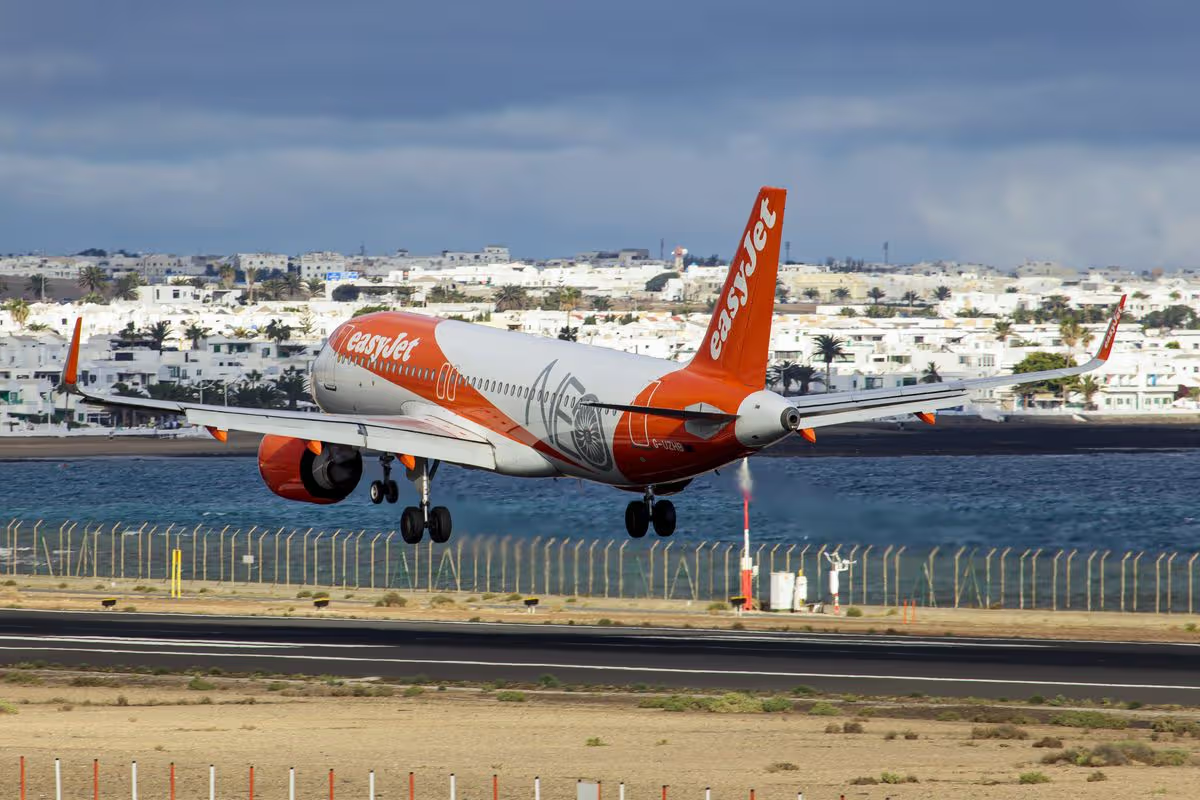
ITA Airways has returned to London Heathrow Airport after two years and has launched a route to Italy.

ITA Airways is launching two daily flights from London Heathrow to Rome, ItalyCredit: Alamy

The Italian airline is operating two flights a day between the UK and Rome, Italy after securing slots from Lufthansa.

The flights from London Heathrow will depart each day at 10:30am, landing at 2:10pm and the second flight will take off at 4:30pm and arrive at 8:10pm.

Flights from Rome to Heathrow will leave at 7:50am and arrive in London at 9:40am and then at 1:50pm, arriving at 3:40pm each day.

A one-way flight in April costs as little as £57.45 with the airline.

Read more on travel inspo

HOL YES

I’m a travel editor & mum-of-3… my favourite family holidays from just £3pp a night


BUNNY WELL SPENT

Cheapest Easter days out whatever the weather & FREE kids activities

Last year, Rome was named the world’s best food destination in Tripadvisor’s Travelers’ Choice Awards.

The awards recognise destinations with a high volume of “above-and-beyond reviews and opinions from the Tripadvisor community over a 12-month period”.

TripAdvisor stated: “In Rome, you can drink from a street fountain fed by an ancient aqueduct.

“Or see the same profile on a statue in the Capitoline Museum and the guy making your cappuccino.”

Italy might be well-known for being the home of pizza and pasta, but more specifically a number of great dishes originated from Rome.

For example, Cacio e Pepe, spaghetti carbonara and tray-baked pizza were all created in the city.

Earlier this year, Rome was also named the best city for ‘noctourism’ by Radical Storage.

The luggage storage platform assessed over 50 destinations across four categories including experiences (such as the number of night tours) and natural factors (light pollution levels).

Rome came out on top scoring 6.07 overall out of 10.

The Italian capital scored particularly well in the experience category (9.2 out of 10), offering an impressive 305 night tours.

ITA Airways used to operate flights from London Heathrow but suspended operations due to high costs.

The airline also did not own its Heathrow slots, instead it was leasing them from Etihad Airways for around £3.3million per year.

The airline hasn’t flown from Heathrow in two yearsCredit: Alamy
Rome was named the best city in the world for food last yearCredit: Alamy

Instead, the airline turned to focus on London City Airport and London Gatwick Airport.

The airline’s return to Heathrow Terminal 2 has been made possible through its partnership with the Lufthansa Group, which means the airline has been given slots at the airport by Lufthansa.

According to Travel Weekly, the airline said in a statement: “The resumption of flights from Europe’s busiest airport – the most connected airport in the world – was made possible thanks to the co-operation with Lufthansa, which made the necessary airport slots available to ITA Airways.

“Connections between the British capital and Milan Linate will continue to operate via London City Airport.”

ITA Airways chief executive Joerg Eberhart added: “Today we celebrate a major milestone: our company is back at Heathrow, the UK’s only hub airport and the most connected airport in the world.

“Returning to Heathrow will bring many advantages.

“Thanks to the characteristics of the airport, we will be able to operate flights with larger aircraft and greater capacity, increasing both passengers and revenues.”

In other flight news, a UK airport has revealed plans for its first long-haul flights in 15 years – with a massive £500million investment.

Plus, find out when flights are cheapest and what is the best day to book a flight, here.

And earlier this year, it was also named the best city for ‘noctourism’Credit: Getty

Source link

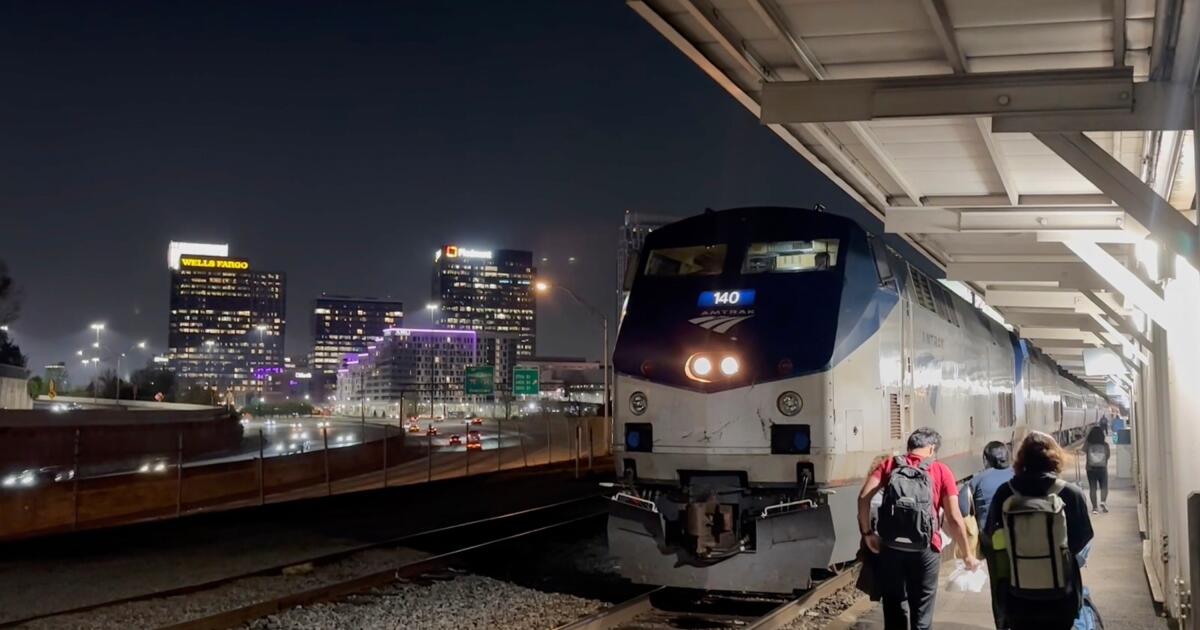
A view of America from a train as airports struggle during the shutdown

There’s something melodic about watching the sun rise over a rural stillness broken only by the rhythms of steel wheels on tracks. Or so we tell ourselves.

In this case, being aboard a train at all owed more to politics than poetry.

Congress and President Trump were mired in their latest budget stalemate, one rooted in his immigration crackdown and the tactics of federal forces he has sent to U.S. cities. But this impasse has upended a foundational constant of American life today: easy air travel.

In Atlanta, my hometown airport, cheerfully marketed as the world’s busiest, had descended into organized chaos. Unpaid federal employees called out from work, leaving a diminished security staff to screen travelers frustrated by hours-long waits in line. I wanted to get to Washington for the NCAA basketball tournament. So I eliminated the risk of a missed flight and booked the train overnight and into game day across a 650-mile route.

In this fraught moment in U.S. politics, I slowed down and thought about things we take for granted. Who ever ponders the conveniences of that 20th century innovation, the airplane, that makes 21st century hustle possible? We book and board. An unconscious, first-world flex of modernity. It’s even rarer to grapple with the inconvenience.

My decision had taken me further back, to the 19th century and another defining innovation: the long-distance train.

A 14½-hour weekend train ride is time aplenty to appreciate how completely politics, economics, social strife and fights over identity and belonging have always affected the order of our lives, including how, when and where we move around in these United States. But Amtrak’s Crescent also allowed me to see the expanse of our collective experience.

I traversed the urban, suburban and rural breadth of East Coast America. I learned how other travelers came aboard. And in that, I found the portrait of people, past and present, who refuse to be as paralyzed as some of their elected leaders.

Convenience on the railways

There is little glamour late night in a crowded Amtrak station. Children are up past bedtime and tended by frazzled parents. Older adults struggle with luggage and stairs.

Airports are not red-carpet affairs either, of course. But there is a certain cache to Delta’s Atlanta-Washington flights. They typically take about two hours gate to gate. They often are slotted at a midpoint gate of the concourse nearest the main terminal. That is almost certainly a nod to members of Congress who use it, but who have lost some airline perks during this extended partial shutdown — which as of Sunday is the longest government shutdown in U.S. history.

In normal circumstances I can get from my front porch to Capitol Hill or downtown in as little as 4½ hours. Security lines these days could at least double my overall air travel time.

The train is still longer, and time is money, we are taught. But certainty has value, too, even if it means an 11:29 p.m. departure. And at the Amtrak station, there were no standstill lines, no Transportation Security Administration agents, no ICE agents as stand-ins.

Passengers who arrived mere minutes before departure made it on board and found seats quickly — assigned in boarding order, not predetermined zones that yield jammed aisles. There’s no in-seat service or satellite TV. But even coach seats, the lowest Amtrak tier, are as spacious as airline first-class — and there is Wi-Fi, so it’s not the 19th century or even 20th century after all.

On board, I heard one crew member joke, “I’m no TSA agent.”

The pathways of history

As a boy in rural Alabama, I counted train cars and wondered where they were headed. I’ve since read diary entries and letters from my grandmother and her sisters recounting World War II-era weekend trips to Atlanta.

The South’s largest city has a historical hook too. Originally named “Terminus,” Atlanta developed in the antebellum era as a critical intersection of north-south and east-west rail routes. That is what drew Gen. William Tecumseh Sherman for one of the Civil War’s seminal campaigns that helped defeat the Confederacy.

A century after the Civil War, Delta chose Atlanta for its headquarters rather than Birmingham, Ala., which was the larger city as of the 1960 census. The company’s decision was tied up in tax breaks for the airline, named for its crop duster origins in the Mississippi Delta region. According to some interpretations, Delta’s decision was made easier because of the more overt racism of Alabama’s and Birmingham’s leaders as they defended Jim Crow — a code that, among other acts, allowed states to segregate the passenger trains that predated Amtrak.

On this night, I heard many languages and accents, notable given the role that immigrant labor played in building the U.S. rail system and especially striking now with immigration — legal and illegal — at the forefront in Washington, my destination. I saw faces that reflected U.S. pluralism, a different mix from what my grandmother and aunts would have seen a lifetime ago.

The array of voices celebrated the freedom and ease of rail travel. So did Agatha Grimes and her friends after they boarded in Greensboro, N.C., as part of a long weekend trip to celebrate her 62nd birthday.

“I got stuck in the Atlanta airport last week,” Grimes said, as her group laughed together in the dining car. “It’s just nuts.”

Beretta Nunnally, a self-described “train veteran” who organized their trip, said, “There’s no worry about parking. No checking bags. You come to the station, you get where you‘re going, and you come home.”

An era for planes, trains and automobiles

Still, that is not as easy in the United States as it once was.

Just as politics, economics and subsidies helped expand U.S. railroads, those factors diminished the network as auto manufacturers, oil companies, road builders and, finally, airline manufacturers and airlines commanded favor from politicians and attention from consumers.

Riding hours across rural areas, I noticed the junkyards where kudzu and chain-link fencing framed rows of rusted automobiles. I saw the farmland and equipment that helps feed cities and the rest of the nation. I awoke to see the night lights of office towers in Charlotte, N.C., and its NFL stadium. I saw vibrant county seats — and I thought of countless other towns like them that are not thriving as they sit disconnected from passenger rail and far from the Eisenhower-era interstate system that we crossed multiple times on our way.

In each setting, voters — conservatives, liberals, the extremes and betweens — have chosen their representatives, senators and a president who now set the nation’s course.

When I arrived in Washington, I paused to enjoy Union Station’s grand hall and its Beaux Arts appeal, and I lamented how much splendor has been lost because so many striking U.S. terminals have been razed. I stepped outside and looked up at the Capitol dome.

While I had slept, the Senate managed a bipartisan deal to fund all of the Department of Homeland Security except immigration enforcement. As I continued northward, House Republican leaders rejected it. The stalemate continued.

The president, however, took executive action to pay TSA workers, and their paychecks may resume within days, though long airport lines may continue awhile longer.

I was a weary traveler but renewed citizen. I had a game to get to. And the train rolled on.

Barrow writes for the Associated Press.

Source link

Spain airport strikes update as first action set to begin in less than 24 hours

Many of Spain’s major airports are set to be hit by strike action this week.

UK tourists hoping to travel to Spain for Easter sunshine should be aware that workers are set to strike at several of the country’s biggest airports.

The strikes affect ground-handling services at the airports of Barcelona, Madrid, Alicante, Palma, Ibiza, Málaga, the Canaries and more and the first of the action is set to start on Monday. The strikes are by Groundforce and Menzies workers and are a result of salary disagreements.

The Groundforce strikes had been due to start on Friday but they were delayed. However, it is believed they will now start on Monday, take place at set times of day in the mornings, afternoons and nights and continue indefinitely. Majorca Daily Bulletin reports that “there is as yet no indication as to whether there will be further suspensions of strike action”.

Menzies workers were due to have gone on strike this Saturday and Sunday. That was also suspended but 24-hour strikes from April 2 to 6 have not been called off.

Groundforce operates at Madrid-Barajas, Barcelona-El Prat, Palma de Mallorca, Alicante, Málaga, Gran Canaria, Valencia, Ibiza, Bilbao, Lanzarote and Fuerteventura. Menzies operates at Barcelona, Palma de Mallorca, Málaga, Alicante, Gran Canaria, Tenerife South and Tenerife North.

The Traveler website reports that “travellers heading to Spain over Easter face a challenging season, as walkouts by airport ground staff threaten queues, baggage delays and potential timetable disruption at some of the country’s busiest hubs”. It added that “reports indicate that the stoppages are partial rather than full shutdowns, typically concentrated in several time bands during mornings, midday and late evenings. This pattern mirrors earlier labour disputes at Madrid, where limited ground handling strikes created bottlenecks at baggage reclaim and during boarding, while flights continued to operate under minimum service rules.”

It added: “For most holidaymakers, the most visible impact of the strikes is likely to be queues and slower processing rather than mass cancellations.”

Travel and Tour World, a B2B travel publisher, says travellers “are being urged to check their flight status regularly and stay updated on the latest developments”.

Strikes not the only problem

The strike action coincides with the ongoing rollout of the EU’s new Entry/Exit System (EES) which could cause further delays. Under this system, which has been rolling out since October and is expected to be fully operational by April 10, all travellers from the UK and other non-EU countries have to be photographed and fingerprinted at EU airports and border points.

The Telegraph reports that the Home Office and travel organisations “are advising holidaymakers to allow extra time to arrive at their destinations on both entry and exit because of predicted queues of two to four hours at busier airports”. It adds: “Delays at airports on return journeys have already led to some holidaymakers missing their planes home, even though they arrived within the required two-hour limit.”

It reported how Tenerife airport has already seen “acute delays” with one recent traveller saying on Facebook that she had spent three hours queuing in passport control, writing: “Our flight left with 15 passengers on and ditched the rest of us here in Tenerife to fend for ourselves.”

Another traveller said she had been astonished to arrive at her airport departure gate in Paris recently to find a long queue. She said: “I had entirely forgotten about the additional security checks. Only one kiosk was open, with a queue of at least 30 people, and the clock was ticking down to our flight’s departure. As we stood there, another 40 individuals joined the queue behind us, yet still, only one kiosk was operational.

“The process was painfully slow. The queue barely seemed to budge, and more people continued to join behind us. From the snippets of conversations I caught, everyone appeared as taken aback – and stressed – as I was.

“Fortunately, my partner and I had started relatively close to the front, so we managed to reach the gate just in time. As for the people behind us, I have no clue.”

Source link

New airport rule comes into force but there’s 1 thing holidaymakers keep forgetting

Travellers are being caught out by new rules at certain UK airports, as people are reminded to check their airport’s regulations before flying to prevent upset and delays

As the cold, bleak winter drags on, many Brits are counting down the days until they can jet off on their summer holidays. But a major new airport rule change is catching some travellers off guard – and starting their trips with unnecessary stress when they realise they’ve got it wrong.

As of January, passengers flying from certain UK airports can now carry up to two litres of liquids in their hand luggage, replacing the long-standing 100ml limit, thanks to new CT scanners. In a statement, Heathrow Airport said: “Passengers travelling through all terminals at Heathrow no longer need to remove liquids or electronics from their hand luggage, or juggle plastic bags at security.

“The UK’s hub has become the largest airport in the world to fully roll out next-generation CT (computed tomography) security scanners – a move that promises faster queues, less stress and a smoother start to journeys for millions of travellers.”

UK airports that have ditched the 100ml rule

  • Belfast International
  • Belfast City
  • Birmingham
  • Bristol
  • Edinburgh
  • London Gatwick
  • London Heathrow

However, the change has not been rolled out across every airport – with many still sticking to the 100ml rule and requiring liquids to be removed and placed in clear plastic bags.

UK airports still enforcing the 100ml rule

  • Aberdeen
  • Bournemouth
  • Cardiff
  • East Midlands
  • Glasgow International
  • Glasgow Prestwick
  • Inverness
  • Isle of Man
  • Leeds Bradford
  • Liverpool
  • Luton
  • London City Airport
  • Manchester
  • Newcastle
  • Newquay
  • Norwich
  • Southampton
  • Southend
  • Stansted
  • Teesside

Exemptions still apply for essential medicines, baby food, and milk, as well as special dietary requirements.

Travellers are being urged to check their departure airport’s rules before flying – especially ahead of the busy Easter holidays – to avoid delays or having items confiscated at security.

Reacting to the change, one traveller flying from Gatwick Airport wrote on Reddit: “Makes the journey just that little bit less stressful. Leave everything in your bag – laptop too.”

Another added: “Edinburgh is the same, which is really handy.”

A third explained: “This is because a new generation of scanners is being rolled out that allows more liquids and means you don’t have to remove laptops – but only a few airports have them so far.”

However, not everyone is convinced.

One user said: “This change is useless until all major airports follow suit. It’s fine on the way out, but if your return airport still has the old rules, you end up throwing things away. It also causes confusion, especially when different London airports have different rules. It should be all or nothing.”

Another added: “I’ve been travelling with just carry-on for years now and wouldn’t go back. There’s something freeing about not carrying full-size toiletries when you only need a small amount.”

Source link

Kuwait airport hit by Iranian drone strikes | Conflict

NewsFeed

Thick, black smoke rose from Kuwait International Airport Saturday after suspected Iranian drone strikes damaged radar systems and fuel storage facilities, state media said. No fatalities were reported. The airport has been repeatedly targeted since the US-Israeli war on Iran erupted.

Source link

‘I work at an airport – you should never tie a ribbon to your luggage’

A ribbon may seem like the easy choice to help you find your bag among a sea of luggage, but one airport worker says there’s a reason why this hack isn’t recommended. Here’s what you can do instead.

If you were to rank the most stressful parts of flying, then finding your luggage at the carousel would no doubt come near the top.

You wait and wait for the luggage belt to start up, and once it does, there’s a huge rush of people grabbing their cases, many of which look strikingly similar. That’s why there are so many hacks out there to help you ensure your suitcase stands out from the dozens of others on the conveyor.

A common hack is to take a colourful piece of ribbon and tie it around a handle, which means when it’s coming down the belt, you can spot it among the other similarly coloured cases.

However, according to one airport worker, using this hack with ribbon, string, or any other dangly item could be a bad idea, and could even delay your luggage pickup even further.

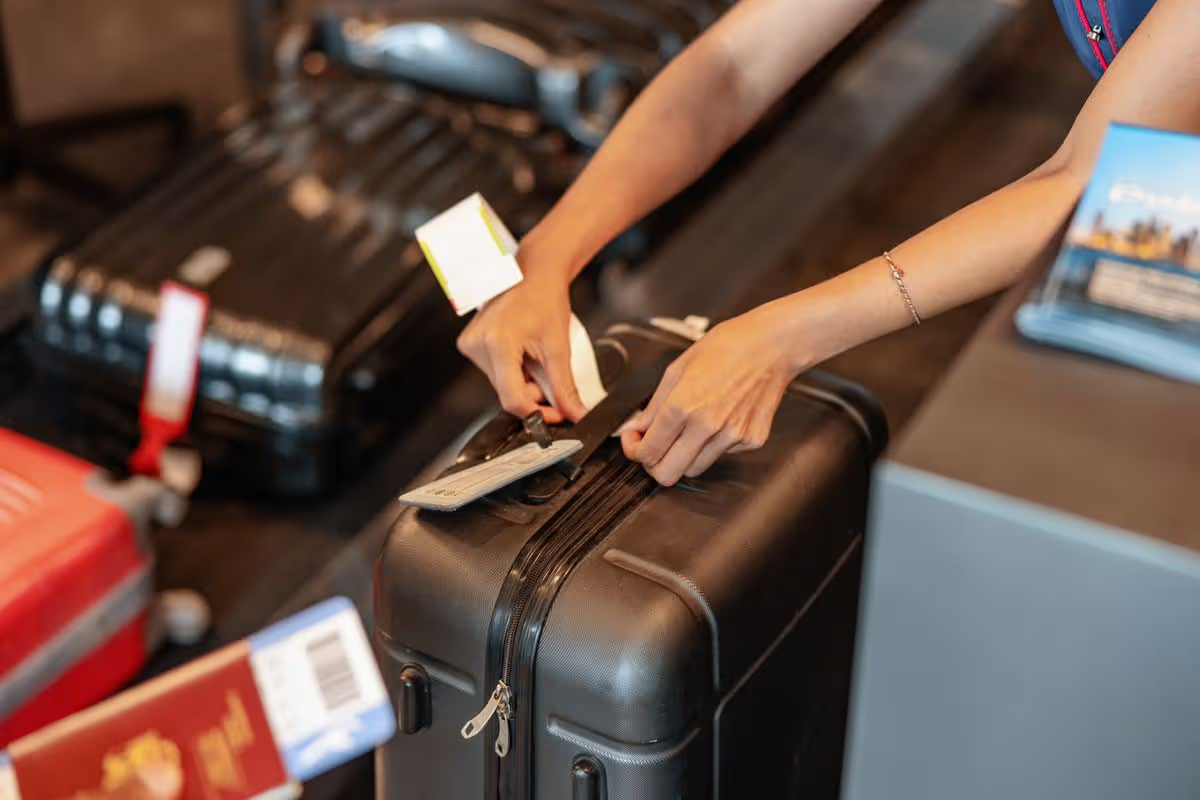
John, who works at Dublin Airport, previously spoke to RSVPLive about why travellers should avoid the hack, saying: “Ribbons that people tie onto their suitcases to help identify them can cause issues with the bag being scanned in the baggage hall.

“If the bag can’t be scanned automatically it can end up in manual processing, which could mean your bag doesn’t make it to the flight”.

As well as interfering with scanning systems, ribbons and other items can also get stuck in the conveyor belt’s machinery, which means the entire carousel could automatically come to a stop, delaying everybody’s bags.

Old airline stickers and tags from previous flights can also cause issues according to John. Machines may not know which barcode to scan, causing delays, or it could even mean your luggage is sent to the wrong destination.

If you want to personalise your case to make it stand out from the crowd, use a colourful luggage strap, add some coloured tape around a handle, or add a distinctive sticker so you can spot it on the carousel.

Luggage covers are another option for checked bags. These covers slip over your suitcase and are available in bright colours and prints, or even personalised options. As a bonus, these covers can help to protect the exterior of your case from damage when being handled. You can also opt for waterproof covers, so if your luggage is left on a trolley in the rain or is close to a leak, the contents won’t be damaged.

READ MORE: Latest Portugal travel advice for Brits after Foreign Office updateREAD MORE: Coastal city with azure waters less than 3 hours from UK has £13 flights and 21C in April

Airport workers have also warned that the colour of the case that you choose is important. Black suitcases are the most common choice for travellers, but they’re the most likely to be lost or stolen .

Finding a black suitcase can also be incredibly difficult. Many lost property offices will be full of suitcases of the exact same type and colour, making it less likely you’ll be reunited with your bag.

Have a story you want to share? Email us at webtravel@reachplc.com

Source link

Trump’s order to pay TSA officers: When will airport lines improve?

With spring break in full swing, airline passengers continued to wait it out at major U.S. airports after President Trump signed an executive order to pay Transportation Security Administration officers aimed at alleviating long security lines.

Trump’s executive order Friday instructed the Department of Homeland Security to pay TSA officers immediately, although it’s unclear when the impact of that move will start to be felt at airports.

The signing came at a busy travel time of the year, with spring breaks at school districts and colleges and the upcoming Passover and Easter holidays.

Betty Mitchell arrived at Philadelphia International Airport at 12:30 a.m. Saturday for a 5 a.m. flight to visit family, but she said the airline desk did not open until 3 a.m. Once it did, there was a sudden influx of passengers to squeeze into the TSA screening lines.

“All at once it became a madhouse,” Mitchell said.

She waited nearly three hours to get through TSA screening but missed her flight. She was able to board the next available one.

“It was crazy long lines,” she said. “Never have I seen it that long. If the airlines work with TSA in these [troubled] times, maybe it would help the public.”

What’s the current situation on the ground?

Some passengers with very early flights Saturday were luckier than Mitchell, reporting they had little problem getting through airport security lines. But that may have been an anomaly. Others at some of the busiest airports wrote on social media that security lines were growing exponentially longer by the hour.

“We have not previously experienced checkpoint wait times similar to what we are seeing this morning,” Baltimore/Washington International Thurgood Marshall Airport said in a post Saturday on X. Officials at the airport recommended travelers arrive four hours before their scheduled departure time.

When will TSA employees be paid?

Homeland Security Secretary Markwayne Mullin said TSA personnel could get paid as soon as Monday, a relief for workers who have gone without pay since Feb. 14.

While that is welcome news to many, it remains to be seen whether that promise materializes on schedule and if it brings an immediate end to snaking lines at airports.

Caleb Harmon-Marshall, a former TSA officer who runs a travel newsletter called Gate Access, said the staffing crisis won’t improve significantly until officers are confident they won’t be subjected to more skipped paychecks.

“If it’s only for a pay period, that’s not enough to bring them back,” Harmon-Marshall said. “It has to be an extended pay for them to come back or want to stay there.”

He estimates longer lines could linger for another week or two.

How soon will this help with airport delays?

It’s hard to tell. Airports that had passengers standing in screening lines that clogged check-in areas or showing up far too early for their flights will need to decide whether to reopen checkpoints or expedite service lanes they closed or consolidated due to inadequate staffing.

A few airports experienced daily TSA officer callout rates of 40%. Nationwide Thursday, more than 11.8% of the TSA employees on the schedule missed work, the most so far, the Department of Homeland Security said Friday.

Nearly 500 of the agency’s approximately 50,000 officers have quit since the partial shutdown started, the department said.

How do I monitor wait times before my flight?

Check airport conditions early and often, including official websites and social media accounts where airports share timely updates and guidance, according to experts.

Many airports Saturday urged passengers to allow at least four hours for both domestic and international screenings.

“Wait times can change quickly based on passenger volume and TSA staffing,” according to an advisory posted Saturday morning on the website of John F. Kennedy International Airport in New York.

Wait times listed on the MyTSA mobile app may not be accurate because TSA hasn’t been actively managing its sites during the shutdown. On third-party websites that track TSA lines, estimated wait times could be outdated during the shutdown if they rely on publicly available data, experts say.

Raby and Sedensky write for the Associated Press.

Source link

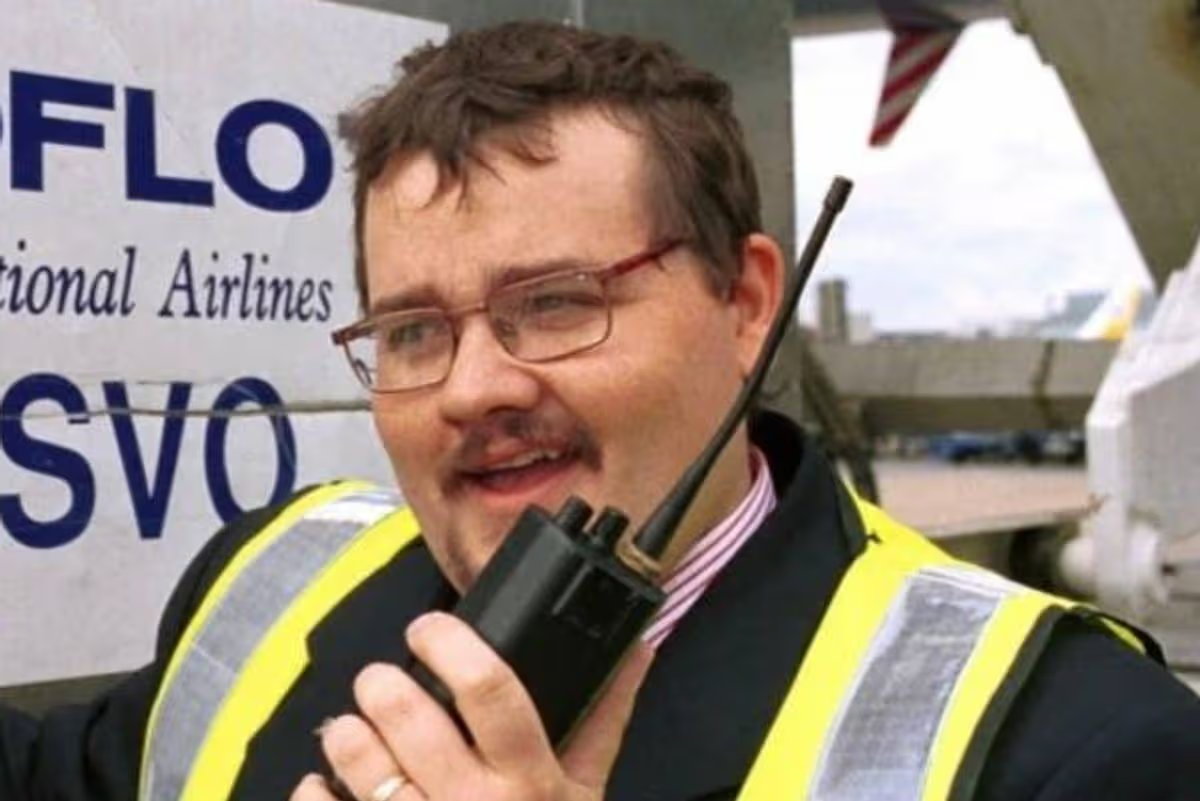
BBC Airport star Jeremy Spake unrecognisable 3 decades later after ‘bullying’ horror

Jeremy Spake became a firm favourite on the BBC series Airport, which first aired in 1996, and has since gone on to enjoy a successful media and aviation career before alleging workplace issues

Jeremy Spake, who was first catapulted into the limelight an astonishing 30 years ago on the BBC series Airport, is now almost unrecognisable. The programme, similar to ITV’s own successful Airline, gave viewers a behind-the-scenes look at the daily workings of Heathrow Airport and the aircraft departing from there. Now 56, Jeremy was featured on the show in 1996 during his stint as a ground services manager for Russian airline Aeroflot.

He swiftly became a viewer favourite during his time on the show, which subsequently paved the way for additional television opportunities. He went on to host Toughest Jobs in Britain, a documentary series that followed workers in some of the UK’s most challenging and physically demanding roles, as well as the medical programme City Hospital.

He also authored two books, titled Jeremy’s Airport and The Toughest Job in Britain. Jeremy’s Airport drew from his experiences working at Heathrow, guiding readers through a typical week on the job, while The Toughest Job in Britain saw him reflect on some of the incredibly tough jobs he tackled while presenting the show.

READ MORE: Emmerdale Gennie Walker star looks so different 14 years after exitREAD MORE: Noughties child star unrecognisable 14 years after disappearing from spotlight

While pursuing his media career, Jeremy was also steadily ascending the corporate ranks in his day job. Proficient in Russian, Jeremy eventually climbed to the position of services manager for Aeroflot before being promoted to Deputy Director of Isle of Man Airport.

Nevertheless, Jeremy chose to resign from his position at the Isle of Man airport, describing ‘bullying, harassment and mobbing on an almost industrial scale’ via his LinkedIn profile. Reports emerged in 2023 that he was pursuing legal action against the Isle of Man government for personal injuries, alleging damage to his mental wellbeing.

He subsequently fronted a six-episode documentary series aired on the BBC, The Airport: Back In The Skies. The fresh series witnessed Jeremy returning to his roots, reuniting with former colleagues, and examining closely how the sector was recovering following the coronavirus crisis.

Production for The Airport: Back In The Skies kicked off in October 2021, after approximately eighteen months of lockdown measures, travel restrictions, and vaccine passport requirements, while the airport was working to rebuild operations and restore full capacity.

Thankfully, Jeremy has never been one to stand on the sidelines and pitched in by helping to prepare a Boeing 737 for departure and lending a hand to holidaymakers stranded during the turmoil.

The television personality has also released his own audio book, Jeremy’s Airport Audio Book, which recounts the Airport narrative with extra commentary and fresh anecdotes that didn’t feature in the original BBC television programme. Adding another dimension to Jeremy’s repertoire, he now presents daily aviation updates on Instagram, for Air News Daily.

However, Jeremy now has a dramatically different look. His brown hair has disappeared as the star is now completely bald and he has swapped his smart goatee for a clean-shaven look. The website for the channel says: “Jeremy is a seasoned broadcaster and aviation professional with 40 years experience of working with some of the largest airlines and airports around the world and brings his unique insight to every show.”

READ MORE: Women swap Easter eggs for ‘better’ beauty box with items cheaper than Lindt bunny

Source link

UK airport reveals plans for first long-haul flights in 15 years

BRISTOL Airport has submitted plans to expand with thousands more flights and long-haul journeys.

Along with more passengers the terminal will be larger, there will be new shops, restaurants as well as an extended runway at the cost of £500million.

Bristol Airport has submitted new £500million expansion plans to the local councilCredit: Alamy
It has submitted new plans for a £500million investmentCredit: Farrans

New plans have been submitted to North Somerset Council for Bristol Airport to extend its runway which will allow for long-haul flights.

The proposal revealed the airport had plans to reach “world cities within Europe and beyond”.

This includes a limited number of new flights to North America, the Middle East and Asia.

By the late 2030s, the expansion is hoping to increase passenger numbers too from 12million to 15million.

GET IT BOOKED

The ‘cheap luxury’ beach resorts under 4 hours from UK with breaks from £75pp


HOT LIST

Where our travel experts will holiday this year – and how we found the best deals

The amount of travellers that pass through Bristol Airport is currently 10.8million.

The increased take-offs and landings mean that there could be up to 100,000 flight movements a year- up from 85,990.

On the busiest days, there could be as many as 35 aircraft movements.

Bristol Airport added: “The plans would see around £500 million invested in improvements at the airport and local infrastructure.

“These include extending the runway to accommodate larger aircraft and increasing capacity of the terminal that includes a number of improvements to enhance the customer experience, including more space, a wider choice of retail and restaurants and the ability to walk onto aircraft without getting on a bus.”

Along with the extended runway are plans for a larger terminal with more space for a bigger immigration hall, baggage handling facilities, shops and restaurants. 

Other improvements detailed in the plans include travelators, better public transport and the expansion of car hire facilities.

Chief executive Dave Lees said: “Our proposals deliver what customers have told us they want to see at their local airport. 

“We will open up opportunities to visit places further afield and for businesses to expand into new international markets.”

The plans reveal increased flights and a runway expansionCredit: Farrans

Bristol Airport originally revealed its masterplan to expand last year with the ambitious plans taking it up to 2040.

There are currently 14 airlines operating from Bristol Airport which go to 115 destinations including Alicante, MajorcaAmsterdam, Edinburgh, Tenerife and Barcelona.

In 2024, Amsterdam was the most popular destination, followed by Alicante and Majorca.

Bristol Airport once offered flights as far as New York, operated by now-closed Continental Airlines.

However, these were scrapped back in 2010, with the longest route from the airport now just under six hours to Cape Verde.

Plus, another major UK airport launches 12 new routes to popular destinations with eight new airlines.

And this affordable African city to get massive new £960million airport expansion with space for 20million passengers.

Bristol Airport is hoping to launch flights to long-haul destinationsCredit: Alamy

Source link

Spain airport strikes update for UK travellers over March and April dates

Talks broke down this week that would lead to widespread disruption for travellers over Easter to airports in places like Mallorca and the Canary Islands

UK tourists have been given a significant update over planned strike action at multiple airports in Spain. Talks broke down this week before officials announced that strikes would be held over several dates in March and April.

Airports set to be affected by the measures included Barcelona, Palma de Mallorca, , Gran Canaria, Málaga, Alicante, and Tenerife (South and North). Now an update has been reported in the Spanish press.

Two sets of strikes at Spanish airports have been partly cancelled, according to Spanish media reports. There had been concerns about extensive disruption at major airports throughout Spain owing to industrial action.

Larazon now reports that trade unions have postponed imminent strikes due to start today that would have seen staff at airport services operators Groundforce and Menzies walk out. The update comes after advances in wage negotiations – but strikes planned for later on have yet to be cancelled, according to local media.

Spanish reports say that trade unions have called off the first day of strike action at Groundforce, Air Europa’s ground handling company, and the first two days of the strike scheduled for this weekend at Menzies, another airport ground handling operator. This is according to sources from the UGT trade union speaking to Efe.

The partial and indefinite strikes planned Groundforce strikes were set to began this Friday. They would have coincided with the beginning of the Easter holiday exodus.

Ultimahora reports that the industrial action at Groundforce had been scheduled for the morning, afternoon and night shifts (from 5am to 7am, from 11am to 5pm, and from 10pm to midnight) with plans set to continue indefinitely. Additionally, the UGT has agreed to call off the first two days of industrial action at Menzies, planned for this Saturday and Sunday. In Menzies’ case, the strike had been called exclusively by UGT – the main union at the firm – for 28 and 29 March, and between 2 and 6 April.

The English language Majorca Daily Bulletin reports that 24-hour strikes for Menzies staff from April 2 to April 6 have not yet been scrapped. It also reported that there is no sign of further suspensions to the other planned strike action for Groundforce staff.

The strike notice at the ground handling operator covered all businesses within the group (Menzies Aviation Ibérica and Menzies Ground Services) and around 3,000 employees. The union had cautioned that, should no deal be struck with the company, the strikes would be rolled out to every weekend until the year’s end.

Groundforce operates at Madrid, Barcelona, Palma de Mallorca, Alicante, Málaga, Gran Canaria, Valencia, Ibiza, Bilbao, Lanzarote and Fuerteventura. Menzies operates at Barcelona, Palma de Mallorca, Málaga, Alicante, Gran Canaria, Tenerife South and Tenerife North.

Source link

Senate approves funding for TSA and most of Homeland Security, but not immigration enforcement

The Senate early Friday morning approved Homeland Security funds to pay Transportation Security Administration agents and most other agencies, but not the immigration enforcement operations at the heart of the budget impasse that has jammed airports, disrupted travel and imposed financial hardship on workers.

The deal, which the Senate approved unanimously without a roll call, next goes to the House, which is expected to consider it Friday.

“We can get at least a lot of the government opened up again and then we’ll go from there,” said Senate Majority Leader John Thune, R-S.D. “Obviously, we’ll still have some work ahead of us.”

With pressure mounting to resolve the 42-day stalemate over funding for the Department of Homeland Security, the endgame emerged in the final hours before TSA workers miss another paycheck Friday. President Donald Trump said he would sign an order to immediately pay the TSA agents, saying he wanted to quickly stop the “Chaos at the Airports.” The deal did not include any of the restraints Democrats have demanded as they sought to rein in Trump’s mass deportation agenda.

Senate Democratic Leader Chuck Schumer said the outcome could have been reached weeks ago, and vowed that his party would continue fighting to ensure Trump’s “rogue” immigration operation “does not get more funding without serious reform.”

What’s in and out of the funding package

Senators worked through the night on the deal that would fund much of the rest of the department, including the Federal Emergency Management Agency, the Coast Guard and TSA, but without funding for Immigration and Customs Enforcement. Customs was funded, but Border Protection was not.

The package puts no new limits on immigration enforcement, which has remained largely uninterrupted by the shutdown. The GOP’s big tax cuts bill that Trump signed into law last year funneled billions in extra funds to DHS, including $75 billion for ICE operations, ensuring the immigration officers are still being paid despite the lapse.

Next steps in the House, where Speaker Mike Johnson, R-La., holds a slim majority, are uncertain. Passage will almost certainly require bipartisan support, as lawmakers on the left and right flanks revolt.

Conservative Republicans have panned their own party’s proposals, demanding full funding for immigration operations. Many have vowed to ensure ICE has the resources it needs in the next budget package to carry out Trump’s agenda.

“We will fully fund ICE. That is what this fight is about,” Sen. Eric Schmitt, R-Mo., said as he tried to offer legislation to fund the agency. “The border is closing. The next task is deportation.”

On-again, off-again talks collapsed

Earlier Thursday, Thune announced he had given a “last and final” offer to the Democrats. But as the day dragged on, action stalled out.

Democrats argued the GOP proposals have not gone far enough at putting guardrails on officers from ICE, Customs and Border Protection, and other federal agencies who are engaged in the immigration sweeps, particularly after the deaths of two Americans protesting the actions in Minneapolis.

They want federal agents to wear identification, remove their face masks and refrain from conducting raids around schools, churches or other sensitive places. Democrats have also pushed for an end of administrative warrants, insisting that judges sign off before agents search people’s homes or private spaces — something new Homeland Security Secretary Markwayne Mullin has said he is open to considering.

Trump had largely left the issue to Congress, but warned he was ready to take action, threatening to send the National Guard to airports in addition to his deployment of ICE agents who are now checking travelers’ IDs.

The White House had floated the extraordinary move of invoking a national emergency to pay the TSA agents, a politically and legally fraught approach. Instead, Trump’s order would pay TSA agents using money from his 2025 tax bill, according to a senior administration official who spoke on condition of anonymity because they weren’t authorized to discuss it publicly.

If the Senate package is approved by the House and signed it into law, the action Trump announced to pay TSA agents may be temporary or unneeded.

Airport lines grow as TSA workers endure hardships

The funding shutdown has resulted in travel delays and even warnings of airport closures as TSA workers missing paychecks stop coming to work.

Multiple airports are experiencing greater than 40% callout rates of TSA workers and nearly 500 of the agency’s nearly 50,000 transportation security officers have quit during the shutdown. Nationwide on Wednesday, more than 11% of the TSA employees on the schedule missed work, according to DHS. That is more than 3,120 callouts.

Everett Kelley, the president of the American Federation of Government Employees, said the union is grateful the TSA workers will be paid, but said Congress must stay in session to pass a deal “that funds DHS, pays all DHS workers, and keeps these vital agencies running.”

At George Bush Intercontinental Airport in Houston, Melissa Gates said she would not make her flight to Baton Rouge, Louisiana, after waiting more than 2½ hours and still not reaching the security checkpoint. She said no other flights were available until Friday.

“I should have just driven, right?” Gates said. “Five hours would have been hilarious next to this.”

Associated Press writers Joey Cappelletti, Kevin Freking, Rebecca Santana, Collin Binkley and Ben Finley in Washington, Lekan Oyekanmi in Houston, Wyatte Grantham-Philips in New York, Rio Yamat in Las Vegas, Russ Bynum in Savannah, Georgia, and Gabriela Aoun Angueira in San Diego contributed to this report.

Mascaro and Jalonick write for the Associated Press.

Source link

Jet2 launches flights from major UK airport for the first time ever with plans for five more routes

POPULAR airline JET2 has launched its first flights from a major UK airport.

Jet2 flights to Tenerife and Alicante in Spain have taken off from London Gatwick, marking its first flights from the airport.

Jet2 has launched its first flights from London Gatwick AirportCredit: Alamy
Lebos is one of the destinations on the listCredit: Alamy

This summer, travellers can fly to 29 destinations with Jet2 from Gatwick, including the Canary Islands, Greece, Turkey, Portugal, Malta, Italy, Croatia, Bulgaria and Cyprus.

And the airline won’t stop at the end of the season either, as for the winter season it will fly to 14 winter sun destinations, ideal for Brits wanting to escape the cold.

Jet2 will also fly to five ski destinations and four Christmas market spots over the winter period.

Looking ahead to next year, even more routes will be added.

Read more on travel inspo

GO ON

All the little-known websites for cheap or FREE tickets to gigs, theatre & festivals


ALL IN

I found the best value all inclusive London hotel… just £55pp with free food & booze

The airline’s routes will rise from 29 to 34 destinations including flights to Lesbos – a large island in Greece – which will operate weekly.

Lesbos is Greece’s third largest island and boasts a lot of history as well as sprawling olive groves.

For those flying from Gatwick with Jet2, there will be six aircraft including the new Airbus A321neo aircraft.

Jet2’s arrival at the UK’s second largest airport comes after increased demand, especially with travellers from the South East of England and marks the airline’s 14th base.

Steve Heapy, CEO of Jet2.com and Jet2holidays, said: “Today is an incredibly exciting moment for Jet2, as we welcome our first customers at London Gatwick and wave off our inaugural flight.

“After years of demand to come to London Gatwick, we are delighted to be bringing our award-winning service, recognised 11 years in a row by Which? as its recommended travel provider, to the UK’s largest beach and city leisure destination airport.

He added: “Since going on sale, we have experienced phenomenal demand from customers and independent travel agents, and we are looking forward to a hugely successful future from our newest UK airport base.”

The arrival of Jet2 at London Gatwick Airport is the airport’s largest airline launch in more than a decade.

Pierre-Hugues Schmit, Chief Executive, London Gatwick said: “Today’s inaugural Jet2 flights mark an exciting moment for London Gatwick and for passengers across the region.

“The launch of 29 new routes and the creation of more than 300 jobs demonstrate the strength of demand for travel from our airport and the confidence airlines have in London Gatwick as a place to grow.”

According to The Independent, Jet2 has been trying to get slots at Gatwick Airport for years and it was only when slots were freed up that the airline could move in, first announcing this four months ago.

The first flight to Alicante took off todayCredit: Alamy

Full list of destination Jet2 will fly to in summer 2026 from London Gatwick Airport

HERE are all the destinations Jet2 will fly to from London Gatwick in summer 2026:

  • Fuerteventura, Spain
  • Gran Canaria, Spain
  • Lanzarote, Spain
  • Tenerife, Spain
  • Ibiza, Spain
  • Majorca, Spain
  • Menorca, Spain
  • Alicante, Spain
  • Girona, Spain
  • Malaga, Spain
  • Reus, Spain
  • Faro, Portugal
  • Antalya, Turkey
  • Corfu, Greece
  • Crete, Greece
  • Kalamata, Greece
  • Kefalonia, Greece
  • Kos, Greece
  • Halkidiki, Greece
  • Preveza, Greece
  • Rhodes, Greece
  • Skiathos, Greece
  • Zante, Greece
  • Malta
  • Naples, Italy
  • Verona, Italy
  • Paphos, Cyprus
  • Pula, Croatia
  • Bourgas, Bulgaria

In other flight news, easyJet has returned to a major UK airport after six years away and has announced 11 new routes.

Plus, how savvy Brits are bagging £449 return flights to Australia with clever £5 subscription service.

The airline is also adding five more routes next summerCredit: Alamy

Source link

Holiday warning for Brits as UK Foreign Office says ‘expect long queues’ at the airport due to new travel rules

THE UK Foreign Office has warned Brits heading abroad to be wary of longer-than-usual airport queues ahead of new travel rules being fully rolled out next month.

The new EES requirement has already resulted in lengthy wait times at airports and are predicted to only get worse across the next few weeks.

New EES machines are set to cause length delays at airportsCredit: Alamy
Non-EU citizens are required to register details before they flyCredit: Alamy

The Entry/Exit System (EES) is the new travel system replacing the need for a passport stamp by automatically checking when a person enters and exits an EU country.

Non‑EU residents have to register their details on their first visit to a Schengen area country.

This is done using the EES machines at airports and ferry terminals to log their fingerprints, facial images and scan passports.

With lots of Brits are still yet to register, and with an influx of families heading abroad over the upcoming Easter break – it’s anticipated that this will result in delays and queues at the EES machines.

GET IT BOOKED

The ‘cheap luxury’ beach resorts under 4 hours from UK with breaks from £75pp


ALL IN

The CHEAPEST all-inclusive holidays in May half term – from £259pp and kids go free

New advice on the government website reads: “Ahead of the Easter holidays, Brits are being advised to be aware of extra border checks – the EU’s Entry Exit System (EES) – and allow additional time at the border when travelling to the EU.”

It added: “EES checks should take only a few minutes per person, although longer waits at border control are possible, including for your journeys back to the UK.”

From April 10, EES will be fully operational with with every participating border crossing using the system.

Previously, there have been reports of delays of up to four hours with Brits lining up in the airport to use the EES machines.

Travel Reporter Alice Penwill queued for three hours through Lanzarote Airport.

Other airports that have seen long delays include Brussels, Lisbon and Prague.

Some passengers could be subject to further delays – especially those heading to Spain as ground staff are planning to strike at 12 airports across the country.

Travel Reporter Alice Penwill queued for three hours through Lanzarote Airport

Several Spanish unions are set to begin an indefinite strike too from today.

Walkouts are planned to take place on Mondays, Wednesdays and Fridays, across three time slots: from 5am to 7am, from 11am to 5pm and from 10pm to midnight.

Other baggage handling staff have planned 24-hour strikes on March 28-29 and April 2-6.

Airports that could be disrupted by these strikes include Madrid-Barajas, Málaga-Costa del Sol, Alicante-Elche, Palma de Mallorca, Barcelona-El Prat, Bilbao, Valencia and Bilbao.

It could disrupt also affect airports on popular Spanish islands too, like Gran Canaria, Tenerife Sur and Norte, Lanzarote, Fuerteventura and Ibiza.

Here are Sun Travel’s top tips on how to deal with EES travel chaos…

Here are our top tips on how to ease the travel chaos if you’re caught up in EES delays…

  1. Sit at the front
    First off is quite simple, book a seat at the front of the plane. If you want to get to border control before the rest of the passengers on your flight, then by being at the front, you’ll be able to get off first.
  2. Early flights
    When you’re booking, it might ease wait times if you go head out on one of the first flights of the day. There are generally fewer scheduled flights and they experience less disruption.
  3. Anticipate delays
    If you are taking a connecting flight, we’d advise to anticipate delays. Of course this varies from airport to airport, but some travellers might find it will take longer to get through because of the EES requirements. Similarly, if someone’s collecting you perhaps give them a bit more time – especially if they’re in one of the pick-up zones that costs money.
  4. Go for a bigger airport
    If you can go to a bigger airport and take a longer road transfer, it could be worth it At a larger airport there’s likely to be more EES machines than at one of the smaller ones For example, Assistant Travel Editor Sophie Swietochowski found there were plenty more of the machines in Spain‘s Alicante Airport than in Austria‘s Salzburg.
  5. Bring entertainment
    If you have children, or are generally just bored of queues (and who can blame you?) – think about entertainment It could be worth setting the kids up with an iPad or something that will keep them occupied. Bring a reserve of snacks because standing in line means no access to the airport’s cafes and shops.
  6. Get into the priority lane
    For those who are disabled and require assistance make sure to let the airline know in advance as you would usually. After landing, staff should escort you straight through to the front of border control queues. Many major airports offer priority family lanes at passport control for families with young children (usually under 12 years old).
  7. Use the plane facilities
    Quite simply, if you are going to be waiting in line for yours, then you want to be comfortable. So before landing, go to the toilet on the plane. If you’re queueing along corridors before heading into border control, then the chances are there won’t be access to toilets

For more on Easter breaks, here are 10 European getaways under £200 per person from beach resorts to cool cities.

And here are 10 of the most affordable English seaside towns for Easter holidays with £1 rides, £2 pints & mega cheap hotels.

The Foreign Office has warned Brits to expect delays ahead of their Easter travelsCredit: Alamy

Source link

I used new EU airport entry system and it left me worried for summer travellers

I thought I had all the time in the world, but it turns out I needed even more.

For over a year, I’ve been writing articles about the new Entry/Exit system introduced at European borders. This system, which mandates UK travellers to provide biometric data when entering or exiting the Schengen area, began its phased implementation in October 2025.

It’s expected to be fully operational across all airports by 10 April 2026. I’ve extensively covered the rollout and its potential to cause delays for travellers. However, when my partner and I flew back from Paris last month, it completely slipped my mind.

We were returning to London, and since we both prefer lounging in the airport rather than outside, we had some time to spare. We enjoyed a drink, a meal, and then decided it was time to meander towards our gate.

We had been awaiting the gate announcement, and as soon as it was made, we set off to locate it. Imagine my astonishment when we turned the corner to find a queue of people waiting for gate access.

I had entirely forgotten about the additional security checks. Even though I believed we had ample time, that time was now rapidly slipping away.

Only one kiosk was open, with a queue of at least 30 people, and the clock was ticking down to our flight’s departure. As we stood there, another 40 individuals joined the queue behind us, yet still, only one kiosk was operational.

Passengers were slowly allowed through, with groups permitted to approach the kiosk together to have their passports verified, fingers and faces scanned, before being sent on their way.

The process was painfully slow. The queue barely seemed to budge, and more people continued to join behind us. From the snippets of conversations I caught, everyone appeared as taken aback — and stressed — as I was.

I heard more than one person mutter something along the lines of “surely they won’t let us miss our flight?” Another responded: “I wouldn’t put it past them to be honest.”

Fortunately, my partner and I had started relatively close to the front, so we managed to reach the gate just in time. As for the people behind us, I have no clue.

This wasn’t even peak season, and it more than doubled the time it took to board our plane. We were flying at the end of February — very much the off-peak period. I can only envisage the chaos as the rollout completes across all of Europe, and summer travel commences.

Travelling during peak season is already stressful, and if my experience is anything to go by, it’s about to become even more so. All I can suggest is even if you think you have enough time at the airport, add more.

Source link

Trump says he will sign an emergency order to pay TSA agents

President Trump said Thursday he would sign an order instructing the Homeland Security secretary to immediately pay Transportation Security Administration agents as Congress struggled to reach a deal to end a budget impasse that has jammed airports and left workers without paychecks.

Trump announced his decision in a social media post saying he wanted to quickly stop the “Chaos at the Airports.”

“It is not an easy thing to do, but I am going to do it!” the president posted.

With pressure mounting, the White House had floated the extraordinary move of invoking a national emergency to pay TSA agents, while senators were reviewing a “last and final” offer from Republicans to Democrats to end the funding impasse at the Department of Homeland Security.

Details of the president’s plan were not immediately available, but a national emergency declaration would be politically fraught and almost certain to face legal challenges. Instead, the president may simply be shifting money from other sources.

Democrats have been refusing to fund Homeland Security as they seek changes to rein in Trump’s immigration enforcement operations. The Senate came to a standstill and senators, ready to leave town for their own spring break, had prepared to stay all night to reach a deal.

“The president is doing absolutely the right thing,” said Sen. John Barrasso (R-Wyo.), the GOP whip. “The TSA agents are going to be paid.”

Sen. Susan Collins (R-Maine), the chair of the Appropriations Committee, has said there is funding elsewhere that can be legally used to pay the TSA as well as the Coast Guard without declaring a national emergency.

The funding shutdown, now in its 41st day, has resulted in travel delays, missed paychecks and even warnings of airport closures. TSA workers are coming up on their second missed payday Friday, with thousands refusing to show up for work.

Multiple airports are experiencing greater than 40% callout rates of TSA workers and nearly 500 of its nearly 50,000 transportation security officers have now quit during the shutdown. Nationwide on Wednesday, more than 11% of the TSA employees on the schedule missed work, according to DHS. That is more than 3,120 callouts.

Trump, who has largely left the issue to Congress to resolve, had warned he was ready to take action, even threatening to send the National Guard to airports, in addition to his deployment of ICE agents who are now checking travelers’ IDs — a development drawing concerns. The White House has been considering a menu of options.

“They need to end this shutdown immediately or we’ll have to take drastic measures,” Trump said during a morning Cabinet meeting at the White House.

At George Bush Intercontinental Airport in Houston, Melissa Gates said she would not make her flight to Baton Rouge, Louisiana, after waiting more than 2½ hours and still not reaching the security checkpoint. She said no other flights were available until Friday.

“I should have just driven, right?” Gates said. “Five hours would have been hilarious next to this.”

A ‘last and final’ offer on the table

Earlier Thursday, Senate Majority Leader John Thune (R-S.D.) announced he had given the final offer to Democrats.

Thune did not disclose details of the new framework, but he said that it picked up on what had been the Republican offer over the weekend, before talks with the White House and Democrats had broken off.

“Enough is enough,” he said.

But as senators retreated to privately discuss the new plan, the action stalled out.

Democrats argue the GOP proposals have not gone far enough at putting guardrails on officers from ICE, Customs and Border Protection and other federal agencies that are engaged in the immigration sweeps, particularly after the deaths of two Americans protesting the actions in Minneapolis.

They want federal agents to wear identification, remove their face masks and refrain from conducting raids around schools, churches or other sensitive places. Democrats have also pushed for an end of administrative warrants, insisting that judges sign off before agents search people’s homes or private spaces.

Senate Democratic leader Chuck Schumer of New York said they needed to see real changes. “We’ve been talking about ICE reforms from day one,” he said.

Any deal will almost certainly need to involve a compromise as lawmakers on the left and right flanks revolt. Conservative Republicans have panned their own GOP proposals, demanding full funding for immigration operations and skeptical of the promise from leaders that they would address Trump’s proof-of-citizenship voting bill in a subsequent legislative package.

Republicans said after a private lunch meeting that there were other options to shift money than invoking the national emergency.

The GOP’s big tax cuts bill that Trump signed into law last year funneled billions to DHS, including $75 billion for ICE operations, ensuring the money is flowing for his immigration and deportation agenda even with the funding shutdown. ICE and other immigration officers are still being paid.

Republicans say the Trump administration has already made strides to meet Democrats’ demands, particularly after swearing in former Oklahoma Sen. Markwayne Mullin as the new homeland security secretary to replace Kristi Noem. He has given a nod to the need for the judicial warrants for searches.

Airport lines grow as TSA workers endure hardships

“This is a dire situation,” the acting TSA administrator, Ha Nguyen McNeill, testified at a House hearing Wednesday.

She described the multiple hardships facing unpaid TSA workers — piling-up bills and eviction notices, even plasma donations to make ends meet — and warned of potential airport closures if more employees refuse to come to work.

“At this point, we have to look at all options on the table,” she said.

McNeil also said TSA officers working at the nation’s airports had experienced a more than 500% increase in the frequency of assaults since the shutdown began.

“This is unacceptable,” McNeill said.

Source link

Missed paychecks and airport delays: Pressure mounts on Congress to end the funding shutdown

Pressure is mounting on Congress to end the funding shutdown that has resulted in travel disruptions, missed paychecks and even warnings of airport closures, but lawmakers have yet to resolve the underlying issue of reining in President Trump’s immigration enforcement operations.

Senators intend to vote Thursday on a Republican proposal that would fund the Transportation Security Administration and much of the Department of Homeland Security, except the enforcement and removal operations conducted by U.S. Immigration and Customs Enforcement. That plan is expected to fail.

Democrats argue it does not go far enough at putting guardrails on officers from ICE, Customs and Border Protection and other federal agencies who are engaged in the immigration sweeps, particularly after the deaths of two Americans protesting the actions in Minneapolis.

Trump, who has largely left the issue to Congress to resolve, threatened to send the National Guard to airports, in addition his deployment of ICE agents who are now checking travelers IDs — a development drawing concerns.

“They need to end this shutdown immediately or we’ll have to take drastic measures,” Trump said Thursday during a Cabinet meeting at the White House.

With Congress set to leave town by week’s end for its own spring break recess, calls are intensifying for an end to the 41-day stalemate that’s put the livelihoods of TSA officers at risk as they provide airport security without pay.

Multiple airports are experiencing greater than 40% callout rates of TSA workers and more than 480 of its nearly 50,000 transportation security officers have now quit during the shutdown. Nationwide, nearly 11% of TSA workers — more than 3,200 on a single day — missed work.

Trump stays out of the fray

The Republican president initially signed off on the plan the GOP senators brought to him late Monday. By Tuesday, he said he would not be happy with any deal.

Trump did not directly address the status of negotiations late Wednesday evening during an annual fundraising dinner for the House Republicans’ campaign committee as Speaker Mike Johnson, R-La., works to keep majority control of the chamber in the November elections.

But Trump criticized Democrats for refusing to settle their demands on immigration changes. On Thursday, he revived his campaign for senators to end the filibuster as a way to overpower opposition to GOP policies, something most Republican senators do not want to do.

The GOP’s big tax cuts bill that Trump signed into law last year funneled billions to DHS, including $75 billion for ICE operations, ensuring the money is flowing for his immigration and deportation agenda even with the funding shutdown. ICE and other immigration officers are still being paid.

The situation is partly of Trump’s making, a strategy the president put in place last fall when he cut a deal with Democrats to end a previous federal shutdown. At that time, Trump agreed to fund the federal government, except for DHS, which was then put on temporary funding that has expired.

A stopgap measure

The Republican offer added one new restraint on immigration officers, funding the use of body cameras that had previously been agreed to. It excluded other policies that Democrats have demanded, such as that federal agents wear identification, remove their face masks and refrain from conducting raids around schools, churches or other sensitive places.

Senate Democratic leader Chuck Schumer of New York said they needed to see real changes. “We’ve been talking about ICE reforms from day one,” he said.

Democrats had been in several days of talks with the White House, including with border czar Tom Homan, that appeared to be making progress toward a deal. The White House presented its own offer with several items Democrats had been demanding, including officer IDs and training.

But those negotiations broke down over the weekend.

Republicans say Democrats are putting the country at risk. They say the Trump administration has already made strides to meet Democrats’ demands and has shown a new approach to its immigration operations, swearing in Oklahoma Sen. Markwayne Mullin as the new homeland security secretary to replace Kristi Noem.

But conservative Republicans also panned the proposal, demanding full funding for immigration operations and skeptical of the promise from GOP leaders that they would address Trump’s proof-of-citizenship voting bill in a subsequent legislative package.

Senate Majority Leader John Thune, R-S.D., said late Wednesday that if Democrats put a “more realistic offer on the table, we’ll be back in business.”

Asked if Congress would consider a stopgap measure to temporarily fund the department, Thune said: “We’ll see.”

Airport lines grow as TSA workers endure hardships

Passengers are facing more four-hour waits to clear security at George Bush Intercontinental Airport in Houston.

The airport’s website said Thursday morning that travelers should expect to wait two hours, 30 minutes in the security line at one of its open terminals and four hours at the other.

Lines and wait times are expected to grow Thursday and Friday because of “significantly higher passenger traffic,” according to an update on the airport’s website.

“This is a dire situation,” the acting TSA administrator, Ha Nguyen McNeill, testified at a House hearing Wednesday.

She described the multiple hardships facing unpaid TSA workers — piling up bills and eviction notices, even plasma donations to make ends meet — and warned of potential airport closures if more employees refuse to come to work.

“At this point, we have to look at all options on the table,” she said. “And that does require us to, at some point, make very difficult choices as to which airports we might try to keep open and which ones we might have to shut down as our callout rates increase.”

She cited the growing financial strain on the TSA workforce.

“Some are sleeping in their cars, selling their blood and plasma, and taking on second jobs to make ends meet,” she said.

McNeil also said TSA officers working at the nation’s airports have experienced a more than 500% increase in the frequency of assaults since the shutdown began.

“This is unacceptable, and it will not be tolerated,” McNeill said.

Mascaro and Freking write for the Associated Press. AP writers Rebecca Santana and Ben Finley in Washington; Wyatte Grantham-Philips in New York; Rio Yamat in Las Vegas; Russ Bynum in Savannah, Ga., and Gabriela Aoun Angueira in San Diego contributed to this report.

Source link

Spain airport strikes update as three major UK tourist spots set for disruption – dates

Delays are expected at check-in, baggage handling and other services affecting UK holidaymakers

Major UK tourist hotspots are set to face disruption within days due to widespread strike action. The Canary Islands in Spain is getting ready as unions prepare to go on strike this and next month.

Airports across the Canary Islands are bracing themselves for industrial action by ground handling staff over the Easter period. Trade unions representing workers at Menzies and Groundforce have announced walkouts.

More than 1,500 employees throughout the islands are expected to take part, according to Spanish website Canarias7. Aviation hubs in the Canary Islands are making preparations for the ground handling strike announced for Easter week, which forms part of a nationwide protest.

Three major spots used by Brits are set to be affected, according to the website. Gran Canaria, Lanzarote, and Fuerteventura are all set for disruption.

The industrial action has been organised by staff at Menzies and Groundforce. Reports say the action will almost certainly lead to hold-ups in ground operations – including check-in, baggage processing and collection.

Menzies has a workforce over 600 and handles operations for carriers including Norwegian, British Airways, and EasyJet, among others. It operates at Gran Canaria, Tenerife North, and Tenerife South airports, as well as on the mainland at major airports such as Barcelona, Palma de Mallorca, Málaga and Alicante.

The UGT union-coordinated action will kick off this weekend (28th and 29th March), with further stoppages planned for 2nd, 3rd, 4th, 5th, and 6th April, during the peak travel period for Easter week. Groundforce is a Globalia group firm providing services to Air Europa. We reported earlier this week that the action is taking place over rights and working conditions for staff.

Unions say they are taking strike action over the implementation of pay scales among other things. Close to 900 employees across the Canary Islands – encompassing Gran Canaria, Lanzarote, and Fuerteventura – face disruption. The Groundforce industrial action is set to begin tomorrow, 27th March, with walkouts planned for Mondays, Wednesdays, and Fridays across staggered time slots: 5:00-7:00am; 11:00am-5:00pm; and 10:00pm-midnight.

On the Menzies action, Spanish media reports say that should no agreement be reached, the strikes will continue every Saturday and Sunday until 31 December, following the same timetable. That could lead to months of disruption.

Source link

Record airport wait times for passengers, but no deal to end shutdown

The Transportation Security Administration may have to shut down operations at some airports as travelers are experiencing record wait times, the agency’s acting head said Wednesday, as the latest offer to end a funding impasse and put restraints on President Trump’s mass deportation agenda met fierce resistance in Congress.

The TSA’s Ha Nguyen McNeill described the mounting hardships facing unpaid airport workers — bills and eviction notices piling up and even plasma donations to make ends meet — and warned that lawmakers must ensure “this never happens again.”

“This is a dire situation,” she testified at a House hearing, warning of potential airport closures. “At this point, we have to look at all options on the table. And that does require us to, at some point, make very difficult choices as to which airports we might try to keep open and which ones we might have to shut down as our callout rates increase.”

Yet on the 40th day of the standoff involving the Department of Homeland Security, there was no easy way out in sight. Neither Republican senators, who made the latest offer, nor Democrats, who are demanding more changes in immigration enforcement, appeared closer to a compromise.

Trump, who initially appeared to have given his nod to the deal, has declined to lend it his full support or put his political weight behind making sure it is approved.

Top officials at agencies under the Homeland Security umbrella spoke for more than three hours before the House Homeland Security Committee about the potential risks of security lapses unless the partial government shutdown comes to an end.

A deal teeters on collapse

Homeland Security has gone without routine funding since mid-February. Democrats are insisting on changes to the Trump administration’s immigration enforcement and mass deportation operations after the killings of two U.S. citizens in Minneapolis by federal officers during protests.

The latest proposal would fund most of Homeland Security except for the enforcement and removal operations of U.S. Immigration and Customs Enforcement that have been central to the debate. The plan would cover other aspects of ICE as well as Customs and Border Protection.

Although the offer added some new restraints on immigration officers, including the use of body cameras, it excluded other policies that Democrats have demanded.

Senate Democratic leader Chuck Schumer of New York said they needed to see real changes. House Democratic leader Hakeem Jeffries of New York pressed for “bold” changes at ICE.

Republican leaders said Democrats are putting the country at risk.

“They know this is crazy,” said House Speaker Mike Johnson (R-La.).

But conservative Republicans also panned the proposal, demanding full funding for immigration operations and skeptical of the promise from GOP leaders that they would address Trump’s proof-of-citizenship voting bill in a subsequent legislative package.

Airport lines grow as TSA workers endure hardships

McNeill, the acting TSA administrator, told lawmakers that multiple airports are experiencing greater than 40% callout rates and more than 480 transportation security officers have quit during the shutdown.

She cited the growing financial strain on the TSA workforce.

“Some are sleeping in their cars, selling their blood and plasma, and taking on second jobs to make ends meet, all while being expected to perform at the highest level when in uniform to protect the traveling public,” she said.

McNeil also said TSA officers working at the nation’s airports have experienced a more than 500% increase in the frequency of assaults since the shutdown began.

“This is unacceptable and it will not be tolerated,” she said.

The top executive overseeing Houston’s airport said security lines that left travelers waiting four hours or more could get longer if the political impasse was not soon settled.

Lines that twist and turn across multiple floors at George Bush Intercontinental Airport have been the result of TSA being able to staff only one-third to half the usual number of checkpoint lines, said Jim Szczesniak, aviation director for Houston’s airport system.

Trump’s decision to send ICE agents to the airports risks inflaming the situation, lawmakers have said. Video of federal officers detaining a crying woman at San Francisco International Airport drew outrage Monday from local officials, although it was unrelated to Trump’s order to deploy immigration officers.

FEMA also at risk

The Federal Emergency Management Agency’s Disaster Relief Fund is “rapidly depleting,” Victoria Barton, a FEMA external affairs official, told lawmakers.

FEMA is able to continue its disaster response and recovery work as long as that fund has money, and about 10,000 of its disaster workers continue to be paid through it.

Mascaro and Freking write for the Associated Press. AP writers Wyatte Grantham-Philips in New York, Rio Yamat in Las Vegas, Russ Bynum in Houston and Gabriela Aoun Angueira in San Diego contributed to this report.

Source link

Brits are missing flights after Spanish airport chaos caused by new biometric entry rules

NEW rules being rolled out across Europe are causing so much chaos at airports, that Brits are even missing their flights.

The new The Entry/Exit System (EES) has already been causing long wait times across Europe.

Reports say that even police have been called in to deal with angry holidaymakers in TenerifeCredit: Alamy
There have been reports of further travel chaos at Tenerife South due to EESCredit: Alamy

EES is replacing the need for a passport stamp by automatically checking when a person enters and exits an EU country.

Non-EU nationals – which includes Brits – are required to register their details like fingerprints, facial images and scan passports on their first visit to a Schengen area country.

But at Tenerife South, passengers say that only a handful of these EES machines are working with some rejecting fingerprints.

Passengers are even saying they’ve missed flights due to delays in getting through controls.

GET IT BOOKED

The ‘cheap luxury’ beach resorts under 4 hours from UK with breaks from £75pp


ALL IN

The CHEAPEST all-inclusive holidays in May half term – from £259pp and kids go free

Some Brits are warning to give as much as three hours before a flight just in case.

One Brit wrote on social media: “The key is to arrive three hours early so at least you are in the front of the queue when problems start.”

Another added: “Love Tenerife but HATE the airport.”

Police have reportedly been called in to the South Airport on several occasions to calm the crowds of angry passengers.

With bad weather and storms hitting the Canary Islands, those who miss flights are having to sleep inside the airport overnight before catching another plane home.

On one particular day, around 100 passengers were stranded there and many were unable to find overnight accommodation, so stayed in the terminal.

Passengers are blaming lack of staff and proper organisation for the chaos, with computers not working.

“Passport control is a disaster,” posted another Brit. “One person for thousands of travellers.”

Only 20 per cent of the biometric machines are working and officials admitted to the Spanish media that there were “computer failures.”

The chaos has been going on for months and tourism chiefs and hoteliers say the island’s reputation is being hit, compounded by the bad weather.

Since last week, the Canary Islands, including Tenerife, have also been struck with flash flooding and snow as a result of Storm Therese.

Even without bad weather, many airports have experienced delays caused by the new travel requirement of EES registration.

Due to their small size, airports on the Canary Islands have seen reports of long queues.

Travel Reporter Alice Penwill said she waited in line at Lanzarote Airport for three hours after landing – just to get through to EES and passport control.

And matters could only get worse with Spanish airport staff preparing to strike during March and April.

Ground staff are planning to strike at 12 airports across the country – including Tenerife South.

Other airports that could be affected include Madrid-Barajas, Málaga-Costa del Sol, Alicante-Elche, Barcelona-El Prat, Bilbao, Valencia and Bilbao.

And on the islands; Palma de Mallorca,  Gran Canaria, Tenerife Norte, Lanzarote, Fuerteventura and Ibiza.

For anyone heading to Tenerife – here are the top tips from someone who has been travelling there for a decade.

And here’s more on the Spanish island that feels more like Mars and flights are just £35.

Tenerife South has experienced long delays due to EES requirement and bad weatherCredit: Alamy

Source link