Jet2 boss Steve Heapy has issued an update to industry experts
Maria Ortega and Robert Rowlands Deputy editor, money and lifestyle, content hub
04:31, 22 Mar 2026
A Jet2 Boeing 737 lands at Newcastle Airport(Image: Getty)
Jet2’s boss has warned of a sharp drop in bookings to Cyprus and Turkey but said tourists could get special offers. CEO Steve Heapy said flights on these routes are becoming “empty” due to the uncertainty caused by the Middle East conflict.
The boss said demand is instead moving to destinations such as Spain and Italy. TTG reported that he spoke about the issue via video link at the airline’s annual conference in Cádiz in Spain.
He also warned hotel partners to not ‘get greedy’ in Spain and Italy and keep prices competitive. And he vowed to protect customers where that happened.
He said he expects holidays to Cyprus and Turkey to recover quickly once the war in Iran ends. “I think we should all be prepared for a fairly rapid end to the conflict and a fairly sharp recovery when that happens,” he said.
Heapy said: “Bookings to Cyprus and Turkey are drying up, cancellations are up and our aircraft are emptying.” He said Jet2 was working to cross-sell customers to western Mediterranean destinations where demand “seems to be OK”.
Heapy added that Cyprus remained a safe destination despite a drop in demand to the island, which has been targeted by Iran since America and Israel launched airstrikes on the Middle Eastern nation.
He said: “Cyprus is still far enough away that you can still travel. We’re doing what we can to understand what’s going on and how we can work our way through it.”
‘Special offers’ to lure more travellers to Cyprus and Turkey
He expects hotels in Cyprus and Turkey to introduce special offers in the weeks ahead to lure more tourists in. Speaking to travel agents at the conference, he said: “We’ll do what we can to work with you and fight to get through this the best we can,” he said. “Our job is to put our customers’ fears to one side and reassure them that these destinations are safe.
“We’re a very resilient industry. These events happen every couple of years, and I’ll do whatever I can to help all our of businesses navigate through this.”
TTG also reported that Phil Nuttall, CEO of Travel Village Group, said it is too early to offer a full assessment of the crisis’s impact. Yet he said possible price rises could create problems for many families.
Jet2’s head of overseas operations, Lee Davies, also said the operator was putting more resource into challenges arising from the conflict, TTG said. “We’ve had to adapt our service, especially across Turkey and Cyprus at the moment. We have our red team, we’ve increased our presence, we’re visiting hotels, reassuring customers.
“We’ve expanded our visiting times and ring-fenced our 24/7 team in the UK. We’re contingency planning in terms of disruption management, you always have to have a very solid plan behind the scenes ready to activate.”
He reportedly added: “You’ve got to understand why in their minds, wherever that destination is, that they possibly don’t want to travel.” He added that by helping customers now, even if they do not then travel, “they will come back”.
ANOTHER airline has announced it has axed all flights to Dubai due to the ongoing Iran crisis until at least mid-May.
Following suit of other airlines, Dutch-carrier KLM has extended its cancellation of flights to the United Arab Emirates city until spring 2026.
Sign up for the Travel newsletter
Thank you!
KLM is the latest European airline to extend cancellations of its Dubai flightsCredit: AlamyDubai has been affected by the ongoing crisis in the Middle EastCredit: Alamy
In a statement on its website, KLM said: “Due to the ongoing geopolitical unrest in the Middle East, KLM has decided to cancel all flights to and from Dubai, Riyadh and Dammam until 17 May.
“The safety of our passengers and crew is always our top priority. We understand that this decision has a significant impact on our travelers and are doing everything possible to keep them well informed.
“Passengers whose flights have been cancelled will be notified personally. They can change their flight or request a refund on the KLM website.”
The airline added that it would be closely monitoring the situation and would “remain in contact with the relevant authorities”.
The airline usually operates around 20 flights a week to Dubai so thousands of passengers are expected to be affected.
Virgin Atlantic has also altered its schedule and has ended its seasonal Dubai flights early.
Other airlines like Finnair, Lufthansa and Wizz Air have suspended flights until the end of March where they are likely to assess the ongoing situation.
Aegean Airlines has cancelled its Dubai flights until April 19.
And airBaltic has announced it won’t fly to Dubai until October 24.
Flight compensation rules
A look at your rights if a flight is delayed or cancelled, when your entitled to compensation and if your travel insurance can cover the costs.
What are my rights if my flight is cancelled or delayed?
Under UK law, airlines have to provide compensation if your flight arrives at its destination more than three hours late.
If you’re flying to or from the UK, your airline must let you choose a refund or an alternative flight.
You will be able to get your money back for the part of your ticket that you haven’t used yet.
So if you booked a return flight and the outbound leg is cancelled, you can get the full cost of the return ticket refunded.
But if travelling is essential, then your airline has to find you an alternative flight. This could even be with another airline.
When am I not entitled to compensation?
The airline doesn’t have to give you a refund if the flight was cancelled due to reasons beyond their control, such as extreme weather.
Disruptions caused by things like extreme weather, airport or air traffic control employee strikes or other ‘extraordinary circumstances’ are not eligible for compensation.
Some airlines may stretch the definition of “extraordinary circumstances” but you can challenge them through the aviation regulator the Civil Aviation Authority (CAA).
Will my insurance cover me if my flight is cancelled?
If you can’t claim compensation directly through the airline, your travel insurance may refund you.
Policies vary so you should check the small print, but a delay of eight to 12 hours will normally mean you qualify for some money from your insurer.
Remember to get written confirmation of your delay from the airport as your insurer will need proof.
If your flight is cancelled entirely, you’re unlikely to be covered by your insurance.
A MAJOR airline in Europe has cancelled 1,000 flights next month due to soaring fuel costs caused by the Iran crisis.
Scandinavian Airlines System (SAS) is the second airline to do so, following Air New Zealand.
Sign up for the Travel newsletter
Thank you!
SAS is the first European airline to cancel flights due to the soaring cost of jet fuelCredit: Alamy
While the majority will be shorter domestic routes, some other longer routes could also be affected.
The main flights affected are across Norway, Sweden and Denmark.
In a statement, the airline said: “Given the ongoing situation in the Middle East, including the sharp and sudden increase in global fuel prices, we are taking measures to strengthen our resilience.”
“One such measure is a limited number of short-term flight cancellations.”
The airline has also confirmed that they have increased flight prices, one of the first to do so in response to the conflict and alongside Qantas and Cathay Pacific.
SAS is the first major airline in Europe to axe flights because of of the cost of fuel going up.
Just like regular consumers at the gas station, airlines refueling in Los Angeles are being forced to adjust to higher prices at the pump.
Jet fuel prices have shot up, and experts say airfares are following suit.
With a busy summer travel season approaching, airlines are starting to pass the costs on to passengers through higher fares and fees.
“Whenever there’s a surge in oil prices, the airlines end up passing that to the consumers immediately,” said Diego Bufquin, director of hospitality management and entrepreneurship at Tulane University. “It doesn’t take a long time.”
Airlines have been struggling around the world since the U.S. and Israel began bombing Iran late last month. Flights have to take longer paths around war zones, and higher fuel costs eat into their already razor-thin profit margins.
Jet fuel prices account for about a third of airlines’ operating costs, so they “cannot afford to wait to upcharge their customers,” Bufquin said.
United Airlines Chief Executive Scott Kirby told CNBC that the spike in fuel prices will have a “meaningful” impact on the airline’s financial results.
Some airlines outside the U.S. have already added fuel surcharges to their ticket fees. Air India announced a phased increase in fuel surcharges on domestic and international routes last week. Hong Kong’s flag carrier Cathay Pacific announced it would charge extra on all fares to cover fuel costs starting Wednesday.
Airlines topping up at LAX and other regional airports are already being hit. Jet fuel prices in Los Angeles have jumped more than 40% since the conflict in the Middle East started.
Just like the price of gas for cars, jet fuel often costs considerably more in California than in other states.
California is largely detached from the rest of the fuel distribution system. With limited pipeline connectivity, it relies more on sea delivery from other states and countries. California also has higher taxes on jet fuel than many other states.
National average gas prices reached $3.71 per gallon on Tuesday, according to AAA. In California, the average Tuesday was $5.52 per gallon.
Still, spring and summer demand is likely to remain strong even if prices rise, said Alan Fyall, an associate dean of the University of Central Florida Rosen College of Hospitality Management.
“Fares are going up, but the demand is still there domestically,” Fyall said. “The only thing that really dampens demand is economic recession.”
Indeed, consumers have been booking earlier than usual to lock in lower prices for their summer travel, airlines said. Delta and American Airlines had some of their strongest-ever single-day sales in March.
“When prices did spike, we saw a spike in demand,” Alaska Airlines Inc. Chief Executive Ben Minicucci said this week, according to Bloomberg. “I think people got this initial, ‘Wow, if this thing is going to go crazy, I better book my fare now before fares go up.’”
Airlines and other industries will face tougher conditions if fuel prices remain high for a prolonged period, he added.
Airfares were already on the rise, according to the Consumer Price Index, which found that the airline fares index rose 1.4% in February compared to last year.
The impact will vary by airline, said Fyall. Many airlines hedge their fuel to negotiate a fixed price, and stock up on fuel while it’s less expensive.
“The airlines that manage their fuel-buying process very well, that hedge very well, tend to be able to offset the price charges quite well,” Fyall said.
Jet fuel prices are even more sensitive to economic forces than auto fuel prices, experts said.
It’s not yet clear if Californians will have to pay significantly higher airfares than their neighbors, but some in-state flight routes could become temporarily unavailable, according to Bufquin. As airlines look to save money, they could cut certain shorter, less profitable routes.
“Budget airlines like Spirit and flights from smaller California hubs like Burbank, San José and Fresno are at risk of being canceled,” Bufquin said.
Dubai Airport has seen substantial flight disruption as British Airways announces it will halt all flights into Dubai until June as Iranian attacks on airports across the region continue
19:18, 17 Mar 2026Updated 19:38, 17 Mar 2026
Passenger planes are parked at Dubai International Airport in Dubai (file photo)
British Airways (BA) has cancelled all flights into Dubai until June as Iran continues its attacks on the UAE.
BA confirmed that flights to Amman, Bahrain, Dubai and Tel Aviv were now cancelled up to and including May 31, and flights to Doha were cancelled until April 30, the airline said in a new update.
“[The cancellations are] due to the continuing uncertainty of the situation in the Middle East and airspace instability, and to provide more clarity to our customers,” a BA spokesperson said.
Ensure our latest headlines always appear at the top of your Google Search by making us a Preferred Source. Click here to activate or add us as your Preferred Source in your Google search settings.
In 2025, Dubai International Airport was the world’s busiest airport for international passengers, accommodating nearly 90 million travellers.
December 2025 alone saw around 8.7 million passengers, the busiest single month in the airport’s history, The Express reports.
The airport connects travellers to 291 destinations across 110 countries.
The UK Foreign Office currently advises caution or against all but essential travel to the UAE and other Gulf states due to regional tensions.
Those already in the UAE are advised to follow local authorities’ instructions, register your presence with the UK government and be prepared for sudden changes in the security situation.
Despite Dubai being on the UK Foreign Office’s “No go” list, many travellers were still choosing to take the risk and fly there, Travel journalist Simon Calder told BBC Radio Scotland’s Breakfast programme.
Icelandic low‑cost airline PLAY entered administration and ceased operations on September 29, 2025, with all flights cancelled and around 400 staff affected
16:35, 17 Mar 2026Updated 17:35, 17 Mar 2026
The Icelandic airline announced it was ceasing operations with immediate effect(Image: Andrew Teebay Liverpool Echo)
Hundreds of workers were made redundant after a low-cost carrier announced it had entered administration.
Icelandic airline PLAY, headquartered in Reykjavík, confirmed it had ceased operations and grounded all its flights last September. A statement on the carrier’s website at the time read: “Dear passenger, Fly PLAY hf. has ceased operations, and all flights have been cancelled.”
According to local media outlet RUV, the move resulted in 400 people facing redundancy, with the company “trying to pay staff their wages”. It is unclear whether the affected employees have received their full payments.
PLAY was established in July 2019, starting operations from its base at Keflavík International Airport, Reykjavik, in June 2021. The carrier initially served six European destinations: Alicante, Tenerife, London, Paris, Copenhagen and Berlin. PLAY also ran services between London and Reykjavik, although prior to the announcement there were no seats on sale after November 1.
Ensure our latest headlines always appear at the top of your Google Search by making us a Preferred Source. Click here to activate or add us as your Preferred Source in your Google search settings.
The board of PLAY said in a statement at the time: “The board of Fly Play hf. has decided to terminate operations, and all of the company’s flights have been cancelled. The company will work closely with authorities and employees to implement the necessary steps for winding down operations.
“There are many reasons behind this decision. The company’s performance has long fallen short of expectations, ticket sales have been poor in recent weeks and months following negative media coverage, and internal disagreements among some employees regarding strategic changes have further strained the situation.”
Information disclosed by the board concerned modifications that failed to produce the required outcomes. They added: “Last fall, Play introduced a new business model that initially inspired significant optimism.
“Unfortunately, it has now become clear that these changes cannot deliver the results needed to overcome the airline’s deep-seated financial troubles. In hindsight, these measures would have needed to be implemented much earlier.”
An spokesman said: “Due to the continuing uncertainty of the situation in the Middle East and airspace instability, and to provide more clarity to our customers, we’ve extended the temporary reduction in our flying schedule in the region.
“We’re keeping the situation under constant review and are directly in touch with affected customers to offer them a range of options.
“Since the situation in the Middle East began, we’ve helped thousands of customers return home and operated eight relief flights from Muscat in Oman.”
British Airways confirmed that they are operating more flights via other international hubs in replacement of Dubai, which is one of the world’s busiest airports.
This includes four more flights via Singapore and three more flights via Bangkok.
Passengers affected will be able to rebook with another airline, or move their travel to a different date.
Otherwise full refunds are being given to anyone with bookings up to May 31.
The ongoing Iran crisis is still causing chaos for travellers, not just those in the Middle East.
Virgin Atlantic has already ended its Dubai flights for the season early, which were due to conclude on March 28.
The popular airline has made the big announcement to relaunch the daily flights as part of its winter expansion, serving travellers and residents of both countries
07:05, 17 Mar 2026Updated 07:06, 17 Mar 2026
British Airways are launching new flights (Image: Mrkit99 via Getty Images)
British Airways have made a huge announcement that they are relaunching daily flights to a popular city for UK passengers – ahead of a couple of huge worldwide sporting events.
The airline will be returning to Melbourne after a 20-year hiatus.
Ensure our latest headlines always appear at the top of your Google Search by making us a Preferred Source. Click here to activate or add us as your Preferred Source in your Google search settings.
The flights will commence flights to Melbourne from January 9, 2027, launching in time for the Australian Open and the Melbourne Grand Prix. Flights will operate year-round from London Heathrow, via Kuala Lumpur, on a daily basis.
Passengers will be able to choose from First, World Traveller (economy), World Traveller Plus (premium economy), and Club World (business class) in both directions.
Return fares start from £1,130 (including taxes and carrier fees) and are on sale from today.
The UK airline halted all services from Melbourne Airport in March 2006 with other companies being relied on for people to make the London-Melbourne journey.
Melbourne Airport Chief Executive Officer Lorie Argus said the announcement underscored Melbourne’s place as Australia’s largest and best connected 24-hour gateway.
“We are thrilled to welcome British Airways back to Melbourne Airport and we’re incredibly excited about what this extra choice means for travellers and exporters,” she said.
“British Airways is one of the world’s most recognisable airlines and in its more than 100 years of flying has earned a well-deserved reputation for excellence and reliability.
“With the largest choice of airlines flying to the UK and Europe, 24-hour operations and the shortest minimum connection time of any Australian airport, Melbourne Airport is now the clear choice for Europeans heading to Australia or Australians looking to travel abroad.
“London is one of the world’s great global cities and a critical hub for business, tourism and education, while Melbourne was last week voted Time Out’s “best city in the world” as well as being home to the largest British expat community in Australia, so there will be no shortage of two-way demand.”
The move is part of a significant planned expansion to BA’s network for winter 2026, with the addition of Colombo in Sri Lanka as well.
WHITE SALMON, Wash. — Seth McBride’s life was forever changed on a snowy mountainside in British Columbia.
McBride was — and is — a thrill-seeker. Growing up in Juneau, Ala., with the untamed outdoors as his stomping ground, he loved to rock climb, mountain bike and, especially, strap on his skis and fly, soaring headlong off heart-pounding cliffs, crags and cornices.
A few months before his senior year in high school, McBride was at a terrain park at Whistler Blackcomb resort. He was 17. He launched a maneuver he’d completed many times before, a back flip off a steep jump. Only this time, he over-accelerated, over-rotated and came down on his neck. Right away he knew something was wrong.
“As soon as I landed,” McBride recalled more than 25 years later, “I lost all sensation in my legs and my lower back.”
The prognosis was grim; doctors told McBride he probably would never walk again, and he hasn’t.
But that’s scarcely slowed him down.
Views of the 47th president, from the ground up
Before they had kids, McBride and his wife biked 6,500 miles — McBride using a special, hand-cranked cycle — from Portland, Ore., to the southern tip of Argentina. He’s traveled the world as a wheelchair rugby player, winning gold, silver and bronze medals at Paralympic Games in Beijing, Rio de Janeiro and London.
McBride — adventurer, daredevil — appears unflappable. Until it comes to air travel.
It’s not the hassles and aggravation that most people put up with. Every trip requires McBride, 43, to undergo a special regimen, dehydrating himself so he won’t have to use the bathroom in flight. Every excursion includes the likelihood of being uncomfortably jostled or, worse, dropped as he’s being transferred to his seat. He can never be certain his wheelchair, his lifeline, won’t be damaged or missing once his plane lands.
“There are very few places or in my life that I feel less independent” than an airport, said McBride, who still plays competitive rugby at the club level. “None of the systems are set up for wheelchair users to be able to manage things on their own.”
Wheelchairs at Portland International Airport. The all-purpose equipment can’t serve the various needs of disabled travelers.
(Will Matsuda / For The Times)
For a time, as the Biden administration was winding down, it looked as though that was about to change somewhat. The federal government issued a set of regulations that would require airlines, among other things, to assume liability for damaged and delayed wheelchairs and improve training for staff working with passengers facing mobility issues.
But the Trump administration, which has made deregulation one of its highest imperatives, put those requirements on hold while a trade association and several major airlines sue to keep the changes from taking effect.
For McBride and others like him, it’s a disappointing setback that follows years of pressing Washington to make air transit just a bit more decent and humane.
“It sucks,” McBride said of the dignity-deflating status of a wheelchair traveler. “I know quite a few people who simply won’t fly anymore.”
Passengers forced to surrender their wheelchairs “must rely on airline staff and contractors to properly handle a wheelchair or scooter and return it in a timely manner in the condition it was received. Advocates have stressed … that, when an individual’s wheelchair or scooter is damaged by an airline, the individual’s mobility, health and freedom are impacted until the device can be returned, repaired or replaced.”
What’s more, “Advocates note that wheelchairs are often custom fitted to meet the needs and shapes of each user. Spending time in an ill-fitting chair can cause serious injury, such as pressure sores, and even death because of a subsequent infection.”
The Department of Transportation estimated that, in 2024, 1 of every 100 wheelchairs or scooters placed on a domestic flight was lost, damaged or delayed. Which may not seem like a terribly large number, unless you’re the person whose well-being, and even survival, depends on their wheelchair or scooter being at the ready and operational upon arrival.
Mia Ives-Rublee directs the Disability Justice Initiative at the Center for American Progress, a left-leaning think tank. She said airlines, which cater to luxury travelers and treat everyone else like sardines, have long put profit and expedience ahead of the needs of their disabled passengers.
“We’ve seen this tension continue to build as disabled people become more active and the world becomes more accessible. They want to travel, or have jobs that require travel,” said Ives-Rublee. While discrimination is plainly illegal, “Airlines aren’t doing enough to protect our devices,” which has the effect of making it “very difficult for disabled people to travel.”
Ives-Rublee has had nearly a half dozen wheelchairs broken by airlines in the last 20 years, which can be costly as well as life-threatening. A manually operated wheelchair can run as much as $2,000, Ives-Rublee said. A mechanized wheelchair can cost as much as a used car.
McBride mainly travels from Portland’s airport. “There are few places in my life” he feels less independent.
(Will Matsuda / For The Times)
(McBride said he’s suffered nicks and scrapes on his “everyday chair.” Worse, was the damage done to wheelchairs he uses in rugby competition, which “is obviously a big deal” when he’s traveling for a match.)
In their lawsuit opposing the rules change, airlines and their trade group said the Biden administration overstepped its authority and the new requirements were too burdensome. Strict liability for wheelchair damage also could expose air carriers to “unreasonable financial risk,” the suit claimed.
The wheelchair rules were supposed to take effect just before Biden left office. The Trump administration postponed them until March 2025, then pushed implementation to August 2025. Now, the Department of Transportation says it will issue a new rule this coming August, with a 60-day comment period to follow — meaning no change will come until at least 2027.
Ives-Rublee hasn’t much hope for relief.
“Given the nature of the administration right now, I doubt they’re putting much effort into protecting” the Biden-era regulations, she said
::
The last thing McBride wants is anyone feeling sorry for him. He’s no victim.
“It was something s— that happened to me,” he said of the accident that left him paralyzed. “But s— stuff happens to people all the time. What matters is how you move forward and what you can do with your life after that happens.”
McBride was seated at the kitchen table of his custom-built home, two miles above the Columbia River in rural Washington state. The house — one level, bright and airy, with concrete floors to smooth the path of his wheelchair — perches at the end of a steep dirt road. A forest in the backyard gives his children, ages 4 and 8, the same freedom to romp through nature he enjoyed growing up in Alaska. There’s also a climbing wall in his son’s bedroom.
Working remotely, McBride writes for New Mobility, a magazine for wheelchair users, and heads communications and marketing for the United Spinal Assn., a nonprofit advocacy group.
His politics run to the left side of the spectrum. (On a cold, drizzly morning, McBride wore a black Oregon Ducks hoodie, honoring his alma mater, the University of Oregon, and its home in liberal Eugene.) Yet while he’s no Trump fan, McBride doesn’t consider making life easier for wheelchair users to be a partisan issue. After all, he pointed out, it was a Republican president, George H. W. Bush, who signed into law the landmark Americans With Disabilities Act.
“We’ve made a lot of progress as a community working with Republicans, working with Democrats,” he said, as the sun made a brief appearance, illuminating the Douglas firs outside his door. “The basic issues of people being able to access the same services and the same experiences as everyone else shouldn’t be political. … It’s a safety thing.”
He’s not unalterably opposed to deregulation, per se.
“I think it’s a huge issue within systems when it’s overly complex for companies or people to do anything,” McBride said. “But lots of time regulations are there for a reason. It’s when private companies aren’t necessarily doing a good enough job protecting the safety or the rights of all people within a society.”
Given a chance to address Trump or the head of his Transportation Department, Sean Duffy, McBride would say this: Come, let’s take a plane ride.
“Go on a trip with my rugby team and see what it’s like when you have multiple wheelchair users on the same plane,” he said, “and how difficult it is and why we feel like regulations are needed so we can have a modicum of safety and dignity when we’re flying.”
The cost of accommodation might take away some from the airlines’ bottom line. But certain things can’t be priced in dollars and cents.
An airline captain with 35 years of experience shares his strategy for managing jet lag on long-haul flights cutting recovery time from days to just hours
Regular travellers will know the misery of jet lag(Image: TommasoT via Getty Images)
During the late 1970s, a new range of travel options opened for holidaymakers as transatlantic journeys became much more affordable. Yet whilst the monetary cost of long-haul travel has steadily declined, the toll it takes on the body has remained unchanged.
Jet lag stems from several contributing elements, including the oxygen-poor cabin environment on aeroplanes, but the primary culprit is an abrupt shift between time zones. The body’s internal clock cannot adapt swiftly enough, and it’s typical for long-distance passengers to experience sleep disturbances alongside digestive problems.
Flying eastwards can trigger particularly brutal jet lag, with over-60s generally suffering more severely than their younger counterparts. Veteran travellers often swear by solutions like melatonin or strong coffee, but naturally the best source of wisdom on combating jet lag comes from airline personnel themselves.
Alfonso de Bertodano, an airline captain with 35 years of experience, has a straightforward and proven strategy: “To avoid jet lag, if I’m going to be in a place for two or three days, I try to meet up with people who are eating lunch or dinner at their usual time. Otherwise, it will take you six days to get over it”.
Speaking to Mundo Deportivo, Alfonso continued: “The reality is that I try to change my schedule as little as possible. I arrive at my destination at 8pm, which is 2am in Spain, and I go straight to bed. I don’t go out for dinner, I don’t go out for a drink.”
Alfonso, an airline pilot who needs to be alert and refreshed for his job, shared: “I set myself a countdown of seven or eight hours and get up at whatever time it is, regardless of what time it is in that country.
“That way, I maintain my Spanish schedule. Because jet lag isn’t just about sleep. It’s about muscle tone, it’s about the digestive tract… It’s not the same to feed your body at 3 in the morning as it is to feed it at 10 or 11 at night.”
He emphasised that mingling with locals and adapting to their routine as swiftly as possible is the secret to overcoming jet lag. “The ideal thing is to be with people who are having breakfast, lunch or dinner at their usual time, and you’re with them maintaining neural activity, brain activity and muscle tone activity,” advised the pilot.
Alfonso further added: “You’ll adjust much more quickly than if you do it on your own. And when you return, it’s exactly the same. That’s why when you arrive, you might sleep for a little whilst, but I immediately set my alarm clock to wake myself up and get on with my daily life,” explained the aircraft commander.
“It’s tiring, but you get your body used to performing like that. In the end, you have to control your body because if you let your body control you, you’ll end up curing your jet lag, or getting over your jet lag, in six days instead of 24 or 48 hours.”
A SURGE in fuel prices due to the Middle East conflict has resulted in a major airline axing five per cent of its flights.
Air New Zealand announced that it will be cutting back on flights over the next two months.
Sign up for the Travel newsletter
Thank you!
Air New Zealand will be cutting back on its number of flights until MayCredit: AlamyThe crisis in the Middle East has resulted in the rising price of fuelCredit: Alamy
Chief Executive of Air New ZealandNikhil Ravishankar said the airline would see roughlya five per cent reduction in its services.
And that this would continue until the beginning of May 2026.
This reduction equates to around 1,100 flights which in turn will affect 44,000 passengers out of its 1.9million.
Talking to 1News Nikhil Ravishankar explained: “We’re focused on consolidating flights that are off-peak flying hours, for example, or where there is an alternative that we can re-accommodate customers.”
He later added that the, “interventions we’re putting in place are not only reasonable, but are what all airlines around the world are doing”.
Air New Zealand said that most of the passengers affected would be moved onto other flights.
The airline has not provided a list of affected flights, but some officials in New Zealand have revealed domestic routes have been altered.
Mayor Nadine Taylor said that Air New Zealand intends to reduce its routes from Marlborough to Wellington, with Auckland and Christchurch flights also affected
The airline detailed that fewer long-haul flights would be cut.
MR Ravishankar said: “People want to get to Europe still, and over the US airspace we can get them into Europe, and that’s what we’re focused on doing.”
The announcement comes shortly after Air New Zealand increased its prices in response to the rising cost of fuel.
Domestic flights were going up by $10 (£4.37) one way, short haul by $20 (£8.74), and long haul $90 (£39.35).
As a result, it’s not just Air New Zealand that has increased its ticket prices – other airlines like Qantas and Scandinavia’s SAS have done the same.
However, some airlines like Ryanair, easyJet, British Airways and Virgin Atlantic, are less affected because they have secured some of their fuel at fixed prices for a set amount of time.
Ryanair boss Michael O’Leary said the rise in jet fuel “won’t affect our costs and it won’t affect our low fares”.
A number of UK flights are included in this today, such as:
10:05am from London Heathrow to Frankfurt
11:05am from London Heathrow to Frankfurt
12:05pm from London Heathrow to Frankfurt
12:10pm from Manchester to Frankfurt
1:05pm from London Heathrow to Frankfurt
3:40pm from Edinburgh to Frankfurt
3:45pm from Manchester to Frankfurt
4pm from Birmingham to Frankfurt
4:05pm from London Heathrow to Frankfurt
6:05pm from London Heathrow to Frankfurt
8:05pm from London Heathrow to Frankfurt
A similar number are cancelled tomorrow as well, meaning thousands are affected travelling from the UK.
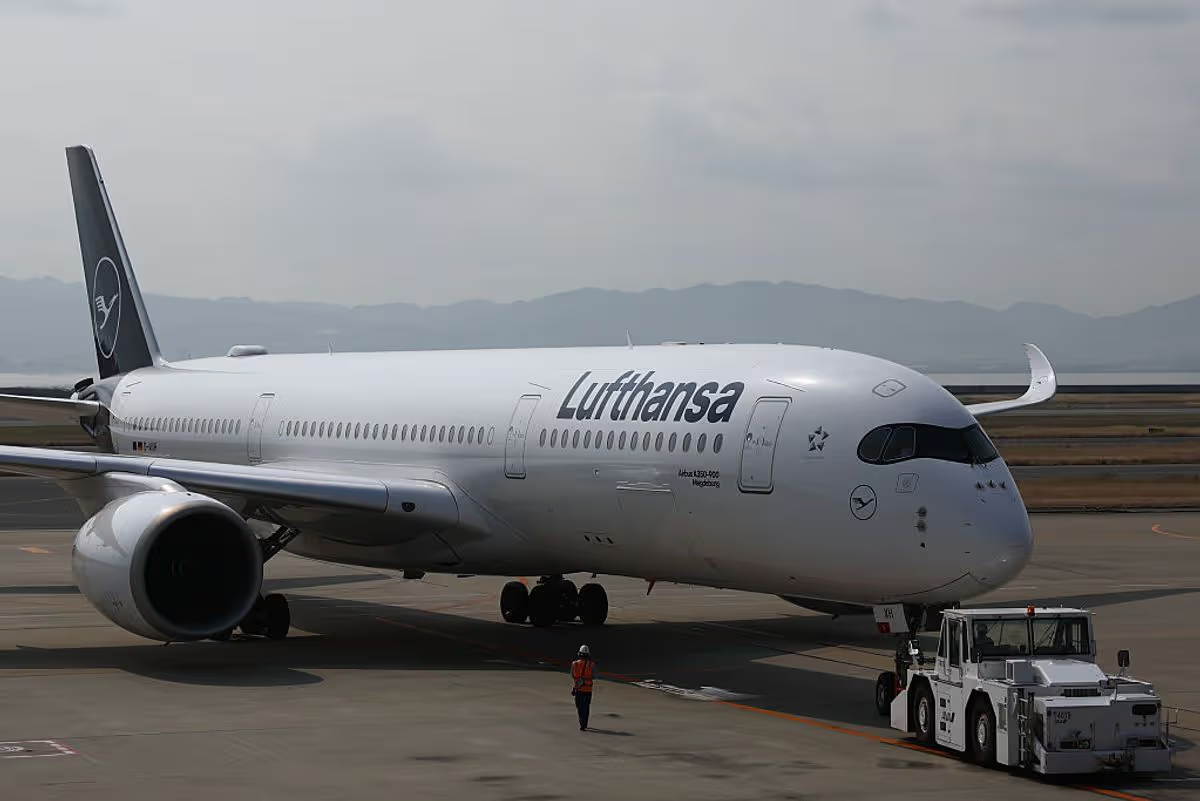
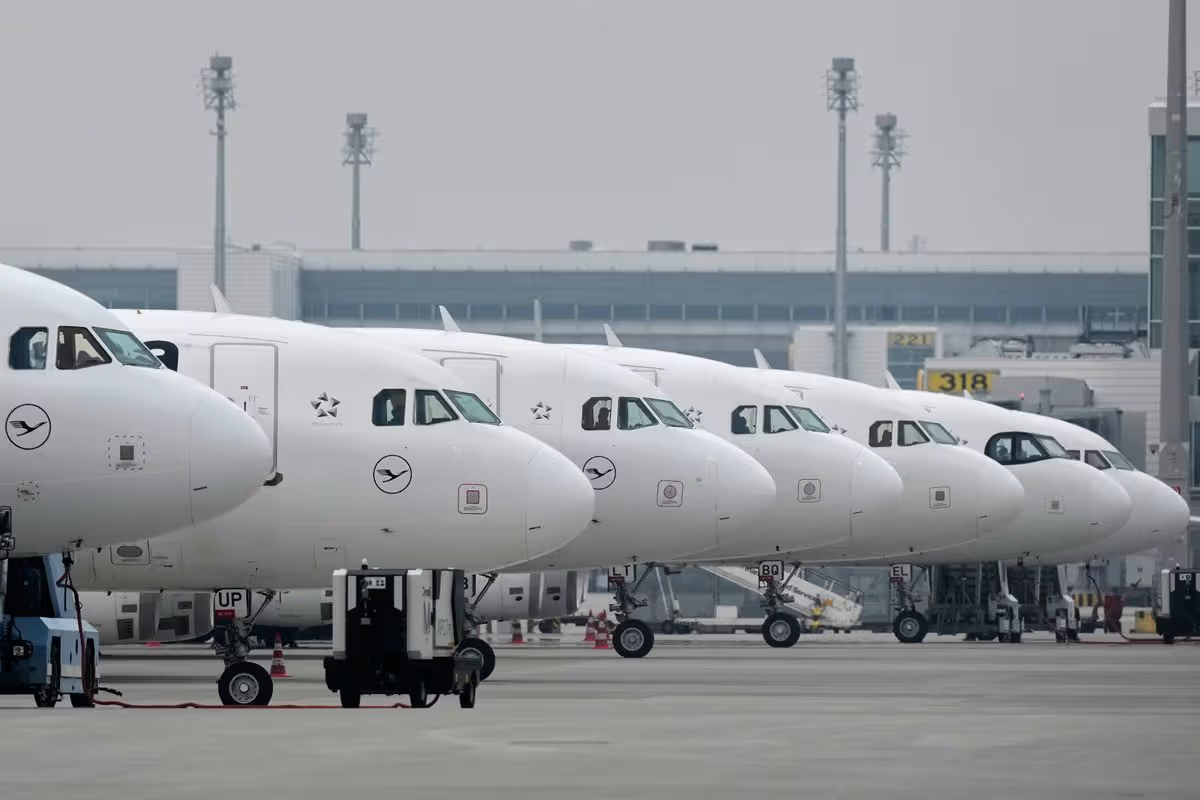
A statement from Lufthansa reads: “Lufthansa is working intensively to keep the impact on our passengers as low as possible and has published a special flight schedule for both strike days.
“According to this schedule, more than 50 percent of the originally planned flight program can be operated on Thursday and Friday.
“For long-haul connections, the share is as high as 60 percent.”
Passengers affected can request a refund or move their flight date for free up until March 23.