agreement

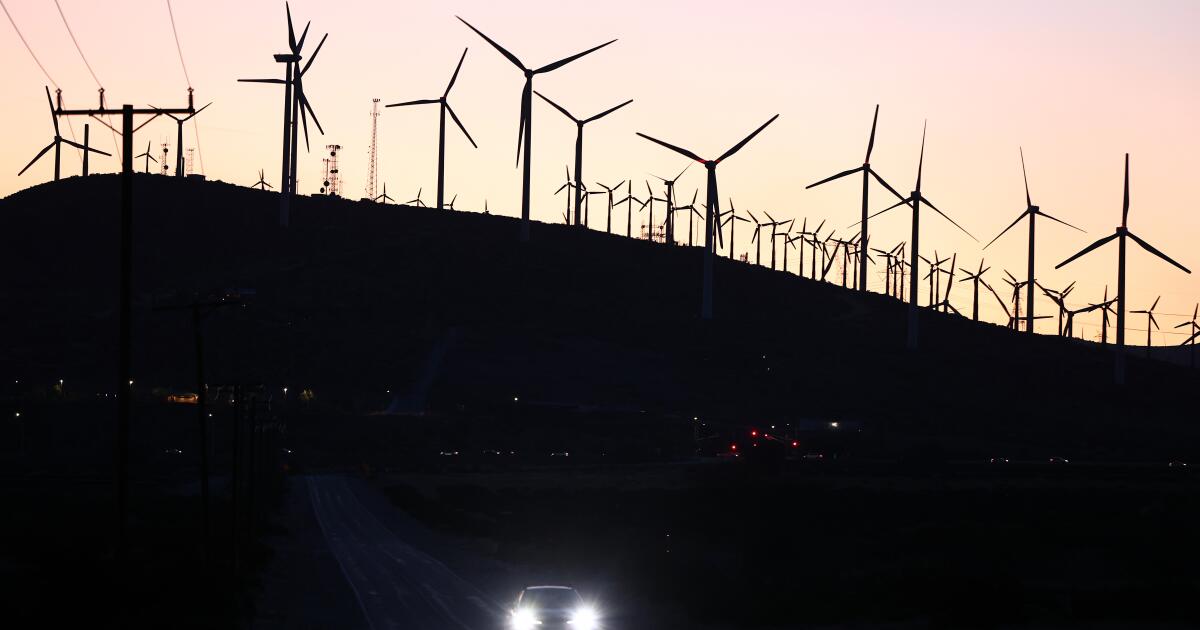
Hiltzik: Why does Trump hate wind power?

Trump is shelling out $2 billion of taxpayer money to kill wind power projects, but his hatred for the technology is based on myths

Picking the wildest fantasy promoted by President Trump as a basis for public policy is increasingly challenging — is it his yarn about schoolchildren being secretly abducted from their classrooms and given sex-changing operations? The notion that the vaccines given to children are like “a vat, like a big glass, of stuff pumped into their bodies?”

Here’s one that has disrupted the economics of renewable energy generation and will cost Americans billions of dollars: It’s Trump’s “completely weird war on wind power in the United States,” based on a sheaf of “fact-free arguments.”

That judgment comes from Steven Cohen, a climate policy expert at Columbia University, who points out that wind already accounts for 10.5% of U.S. energy generation, that it’s destined to continue growing — and that most of it is generated today in red states such as Texas, Oklahoma, Iowa and Kansas.

Fifty years from now, people are going to be amazed that we burned these rare, useful hydrocarbons for fuel, when the sun was just sitting up there providing an essentially infinite source of energy.

— Steven Cohen, Columbia University

There is no question that Trump’s weird war against wind is full blown. On the day of his second inauguration, he issued an executive order shutting down all new permits for offshore wind farms and ordered the Interior Department to review existing permits.

A federal judge in Massachusetts blocked the executive order in December, and his orders suspending work on existing offshore wind projects have been halted by other federal judges. The Trump administration has blocked or delayed as many as 165 wind projects on private land, citing “national security” concerns, according to the American Clean Power Assn.

Get the latest from Michael Hiltzik

Commentary on economics and more from a Pulitzer Prize winner.

Most recently, Trump has reached agreements with offshore wind firms in which the government will pay them a combined $2 billion to abandon their U.S. projects.

At some level, this crusade resembles Trump’s misguided effort to revive the American coal industry, which is on the glide path to inevitable extinction. In that case, Trump is waging an explicitly partisan and ideological battle. “We’re ending Joe Biden’s war on beautiful, clean coal,” he declared last April.

Trump’s anti-wind program is part of his campaign to dismantle U.S. renewables policy because of its roots in the Biden administration.

Additionally, multiple commentators conjecture that his hostility to wind originated in 2011, when he groused that an offshore wind farm would be visible from one of his golf courses in Scotland. He sued to thwart the “ugly” project, and lost.

But Trump has mustered other arguments against wind, on- and offshore, none of which holds water.

During a cabinet meeting in July 2025, he called wind “a very expensive form of energy.” In fact, on average it’s cheaper than natural gas, coal and nuclear generation. Perhaps more important, the cost has been coming down sharply as technology improves and the sector reaches critical mass: falling to eight cents from 21 cents per kilowatt-hour from 2010 to 2024 for offshore projects, and to 3.4 cents from 11.3 cents for land-based wind farms over the same period.

Trump blamed wind turbines for mass killing whales and birds. Neither assertion is correct.

The National Oceanic and Atmospheric Administration, a federal agency, says “there are no known links between large whale deaths and ongoing offshore wind activities.”

The Audubon Society reported in January that although wind turbines can present hazards to birds, “developers can effectively manage these risks without significantly increasing project costs.” The biggest risks to birds come from the climate: “Two-thirds of North American birds are at increasing risk of extinction from global temperature rise,” the society reported — a threat that wind power can ameliorate.

Trump spokeswoman Taylor Rogers didn’t respond to my questions about the derivation of his anti-wind stance, but told me by email only that “President Trump has been clear: hard-earned taxpayer dollars shouldn’t be wasted on unreliable and costly wind farms that pose serious threats to our national security. Instead, we should be strengthening and expanding our infrastructure that produces reliable, affordable, and secure energy like natural gas plants.”

That brings us to the recent deals with offshore wind developers. The largest single deal, signed in March, was with the French firm TotalEnergies, which is to receive approximately $1 billion from the federal government to abandon all of its U.S. offshore wind projects and invest instead in oil and gas projects, including a liquefied natural gas export facility in Texas.

In his March 23 announcement of the deal, Interior Secretary Doug Burgum called offshore wind “one of the most expensive, unreliable, environmentally disruptive, and subsidy-dependent schemes ever forced on American ratepayers and taxpayers.”

This is what Huck Finn would call a “stretcher,” given the decades of subsidies spooned out to the oil and gas industry, reaching more than $30 billion a year in federal and state tax credits, indulgent regulation of pollution and low-cost access to federal lands. Indeed, the investment firm Lazard recently reported that renewables, including wind, are a cost-competitive form of generation even without subsidies. (Lazard’s calculation is of the “levelized cost of energy,” meaning the average cost over a generating plant’s lifetime.)

TotalEnergies fell into lockstep with the Interior Department in its own announcement, explaining its willingness to renounce U.S. offshore wind power because “offshore wind developments in the United States, unlike those in Europe, are costly,” echoing the agency’s position that “the development of offshore wind projects is not in the country’s interest.” Never mind that one factor that makes U.S. offshore wind development costly compared with Europe is the Trump administration’s opposition.

The government subsequently reached an agreement to pay the French company Ocean Winds $885 million to walk away from two offshore wind projects, including one in the waters off California. Ocean Winds described the deal as one driven chiefly by economics, but hinted at pressure from the White House.

“We welcome the opportunity to engage constructively with the administration on this agreement and acknowledge the clarity they have provided with this decision and deal,” Michael Brown, the chief executive of Ocean Winds North America, said when the deal was announced last month. “Our priority remains disciplined capital allocation and delivering reliable energy solutions that create long-term value for ratepayers, partners, and shareholders.”

The TotalEnergies deal, which the government has described as a “refund” of money the firm paid for its offshore leades, raised the hackles of congressional Democrats, who assert that it violates the law and constitution in multiple ways.

“We will hold you accountable for this billion-dollar ripoff,” Reps. Jamie Raskin (D-Md.), ranking member of the House Judiciary Committee and Jared Huffman (D-San Rafael), ranking member of the House Committee on Natural Resources, warned TotalEnergies CEO Patrick Pouyanné in an April 29 letter.

Among other infirmities Raskin and Huffman alleged, the government’s national security rationale for canceling offshore wind leases looks “fabricated”; the payout violates the statutory formula for compensation for canceled leases; the money is to come from a fund designed only to pay court-ordered judgments and settlements of lawsuits, which don’t exist in this case; and includes a provision preventing the deal from being reviewed by a court.

The last of those provisions would have to be authorized by Congress, the letter states, asking for documents and a response from the company by Wednesday. Committee spokespersons weren’t available to say whether they received a response from TotalEnergies, and the company didn’t respond to my request for comment. I received no response from the Department of the Interior.

The California Energy Commission has opened an investigation into the Ocean Winds deal.

“The Trump Administration is recklessly spending billions of taxpayer dollars on backroom deals that would turn back the clock on innovation” CEC Chair David Hochschild said. “Taxpayer dollars should be used to build a sustainable energy future, not to pay to make projects disappear.”

What’s especially wasteful about Trump’s crusade against wind power is that it’s almost certain to be time-limited.

It’s hardly debatable that renewables such as solar and wind will be our principal sources of energy in the future; holding back the clock achieves nothing but injecting uncertainty into investment decisions that need to be made now, at a time when the price of oil is on the upswing thanks to Trump’s Iran adventure and Europe and China are racing to transition away from fossil fuels, while the U.S. remains becalmed by ideology.

“In the long run, fossil fuels will be used for petrochemicals and not for burning,” Cohen told me. “Fifty years from now, people are going to be amazed that we burned these rare, useful hydrocarbons for fuel, when the sun was just sitting up there providing an essentially infinite source of energy.”

Source link

US moves to release more oil stockpiles under IEA agreement | US-Israel war on Iran News

US Department of Energy moves to transfer 53.3 million barrels amid rising oil prices.

The United States has announced its latest release of emergency oil stockpiles in coordination with the International Energy Agency (IEA).

The US Department of Energy said on Monday that it had begun transferring 53.3 million barrels from the strategic petroleum reserve after awarding contracts to nine companies under its emergency exchange programme.

Recommended Stories

list of 4 itemsend of list

Trafigura Trading LLC, a Texas-based commodities trading company, was granted the biggest haul of nearly 13 million barrels, with Marathon Petroleum Corporation and ExxonMobil set to receive 12.4 million barrels and 11.4 million barrels, respectively.

Macquarie Commodities Trading US, Atlantic Trading & Marketing, BP Products North America, Energy Transfer Crude Marketing, Mercuria Energy America and Phillips 66 will receive between 1.05 million and 6.55 million barrels each, according to the Energy Department.

Under the department’s exchange scheme, participating firms are required to replenish the stockpile with new barrels at a later date.

“These actions continue to move oil swiftly into the market, address near-term supply needs, and ensure that the Strategic Petroleum Reserve remains strong through the return of premium barrels,” Kyle Haustveit, the head of the department’s Hydrocarbons and Geothermal Energy Office, said in a statement.

The transfer comes after US President Donald Trump’s administration agreed in March to release 172 million barrels of crude as part of the IEA’s coordination of the largest unloading of global stockpiles in history.

Oil prices have surged since the US and Israel launched their war on Iran in late February, with Tehran’s retaliatory blockade of the Strait of Hormuz paralysing one of the world’s most important trade routes.

Maritime traffic in the strait has ground to a halt amid Iranian threats against commercial shipping, disrupting about one-fifth of the global oil trade.

Oil prices continued to edge higher on Monday after Trump dismissed Iran’s latest peace proposal and warned that the ceasefire between the sides was “on life support”, dampening hopes for a quick resolution to the conflict.

Facing growing public discontent over rising fuel prices, Trump on Monday also pledged to waive the 18.4 cents-per-gallon federal tax on petrol, though taxation is the purview of the US Congress.

Futures for Brent crude, the international benchmark, were up about 1 percent in Asia on Tuesday morning, topping $105 a barrel.

Source link

Venezuela’s acting president defends country’s territory and rejects Trump’s 51st state remarks

Venezuela ’s acting President Delcy Rodríguez told journalists Monday that her country had no plans to become the 51st U.S. state after President Trump said he was “seriously considering” the move.

Rodríguez was speaking at the International Court of Justice in The Hague on the final day of hearings in a dispute between her country and neighboring Guyana over the massive mineral- and oil-rich Essequibo region.

“We will continue to defend our integrity, our sovereignty, our independence, our history,” said Rodríguez, who assumed power in January following a U.S. military operation that ousted then-President Nicolás Maduro. Venezuela is “not a colony, but a free country,” she added.

Speaking to Fox News earlier on Monday, Trump said he was “seriously considering making Venezuela the 51st U.S. state,” according to a post by Fox News’ co-anchor John Roberts on social media. The White House did not immediately respond to a request for comment on the matter.

Trump has made similar comments about Canada.

Rodríguez went on to say that Venezuelan and U.S. officials have been in touch and are working on “cooperation and understanding.”

Before addressing Trump’s comments, Rodríguez defended her country’s claim to Essequibo at the United Nations’ highest court, telling judges that political negotiations — not a judicial ruling — will resolve the century-old territorial dispute.

The 62,000-square-mile territory, which makes up two-thirds of Guyana, is rich in gold, diamonds, timber and other natural resources. It also sits near massive offshore oil deposits currently producing an average 900,000 barrels a day.

That output is close to Venezuela’s daily production of about 1 million barrels a day and has transformed one of the smallest countries in South America into a significant energy producer.

Venezuela has considered Essequibo its own since the Spanish colonial period, when the jungle region fell within its boundaries. But an 1899 decision by arbitrators from Britain, Russia and the United States drew the border along the Essequibo River largely in favor of Guyana.

Venezuela has argued that a 1966 agreement sealed in Geneva to resolve the dispute effectively nullified the 19th-century arbitration. In 2018, however, three years after ExxonMobil announced a significant oil discovery off the Essequibo coast, Guyana’s government went to the International Court of Justice and asked judges to uphold the 1899 ruling.

Tensions between the countries further flared in 2023, when Rodríguez’s predecessor, Maduro, threatened to annex the region by force after holding a referendum asking voters if Essequibo should be turned into a Venezuelan state. Maduro was captured Jan. 3 during a U.S. military operation in Venezuela’s capital, Caracas, and taken to New York to face drug trafficking charges. He has pleaded not guilty.

Rodríguez did not address the referendum in her remarks, but she told the court that the 1966 agreement is designed to allow negotiations between Venezuela and Guyana to resolve the territorial dispute. And she accused Guyana’s government of undermining the agreement with the “opportunistic” decision to ask the court to address the dispute.

“At a time when the mechanisms established in the Geneva agreement were still fully in force, Guyana unilaterally chose to shift the dispute from the negotiating arena to a judicial resolution,” she said. “This change was not accidental; it coincided with the discovery in 2015 of the oil field that would become world-renowned.”

When hearings opened last week, Guyana’s foreign minister, Hugh Hilton Todd, told the panel of international judges that the dispute “has been a blight on our existence as a sovereign state from the very beginning.” He said that 70% of Guyana’s territory is at stake.

The court is likely to take months to issue a final and legally binding ruling in the case.

Venezuela has warned that its participation in the hearings does not mean either consent to, or recognition of, the court’s jurisdiction.

Quell and Cano write for the Associated Press. Garcia Cano reported from Mexico City.

Source link

Writers Guild staff union reaches agreement with management

The union representing workers employed by the Writers Guild of America have reached an agreement on their first contract, ending a strike that lasted nearly three months.

The pending contract includes seniority and layoff protections, higher wages and outlines provisions for progressive discipline and a stepped grievance process, the Writers Guild Staff Union said in a statement Friday.

The union represents 116 members, who work in areas including legal, communications and residuals. They will vote on proposed contract in the coming days.

“Once ratified, the WGSU strike will end and Writers Guild staff will return to doing what we do best: defending the writers’ hard-fought gains and helping them build collective power,” the WGSU Bargaining Committee said in a statement.

WGA also said in a statement that they “are pleased to have reached a tentative agreement” with the union for its first collective bargaining agreement.

If ratified, members would see a minimum of 12% increases in pay for all Writers Guild staff over the course of the three year term. The salary floor would rise from $43,000 to $57,000. The staff would also see better protections against AI.

The strike began in February, weeks before the WGA was set to enter negotiations with the major studios, with the workers accusing their employer of bargaining in bad faith.

Over the last several months, tensions have been high between the two unions. In March, WGA had to cancel its Los Angeles-based award show, as it could “not ask our members or guests to cross a picket line.” The staffers also lost access to their healthcare in April, as they were no longer eligible.

Last month, Hollywood writers officially ratified their newest contract with the Alliance of Motion Picture and Television Producers, with more than 90% voting in favor of the deal. The union represents 11,000 members.

Source link

NFL, referees good to go with new collective bargaining agreement

There will be no replacement referees — and therefore, hopefully, no “Fail Mary” repeat — in the NFL this fall.

The league and the NFL Referees Assn. have avoided a work stoppage by agreeing on a new collective bargaining agreement that runs through the 2032 season.

The current deal was scheduled to expire May 31. The sides having been negotiating since the summer of 2024, and the NFL had begun the hiring process for replacement officials last month.

“This agreement is a testament to the joint commitment of the league and union to invest in and improve officiating,” NFL executive vice president of football operations Troy Vincent said in a statement. “It also speaks to the game officials’ relentless pursuit of improvement and officiating excellence. We look forward to working together for the betterment of the game.”

Terms of the agreement have not been released, but the Associated Press reported in March that the league had increased its offer to a 6.45% annual growth rate”growth rate” = increase? in compensation over a six-year labor deal.

“We see this new CBA as a partnership with the league that benefits our membership but also seeks to make our game better,” NFLRA president Carl Cheffers said in a statement. “It is good to get these negotiations behind us so we can focus on preparing for the 2026 season.”

No such agreement between the sides was reached during the 2012 offseason, leading to a lockout that lasted 110 days. It all culminated in Week 3 of that season with the notorious “Fail Mary” call at the end of the Green Bay Packers-Seattle Seahawks game on “Monday Night Football.”

With the Seahawks down by five in the closing seconds, quarterback Russell Wilson threw deep to receiver Golden Tate in the end zone. Green Bay defender M.D. Jennings appeared to come down with the ball first, with Tate attempting to wrestle the ball away.

Two officials stood above the players, with one signaling touchdown (meaning Tate caught the ball, Seattle wins) and the other signaling touchback (meaning Jennings caught the ball, Green Bay wins). The final call on the field was a touchdown, which stood after a lengthy review.

It got worse. The next day, the NFL released a statement saying the officials missed a pass interference call on Tate that would have negated the touchdown. A day after that, the NFL and the referees union announced a new collective bargaining agreement that brought the regular officials back for that weekend’s games.

The Associated Press contributed to this report.

Source link

Blake Lively and Justin Baldoni end legal fight ahead of trial

Blake Lively and Justin Baldoni have reached an agreement to resolve their legal dispute, bringing an abrupt end to a high-profile and increasingly contentious battle that had been set to go to trial in two weeks.

“The parties in the Blake Lively and Wayfarer Studios litigation have reached an agreement to resolve the matters,” lawyers for both sides said in a joint statement Monday in a case that has drawn outsized attention for more than a year.

“The end product — the movie ‘It Ends With Us’ — is a source of pride to all of us who worked to bring it to life. Raising awareness, and making a meaningful impact in the lives of domestic violence survivors — and all survivors — is a goal that we stand behind. We acknowledge the process presented challenges and recognize concerns raised by Ms. Lively deserved to be heard. We remain firmly committed to workplaces free of improprieties and unproductive environments. It is our sincere hope that this brings closure and allows all involved to move forward constructively and in peace, including a respectful environment online.”

The statement did not disclose the terms of the agreement.

The bitter dispute, which grew out of the production of the 2024 romantic drama “It Ends With Us,” had sprawled over months into a series of lawsuits, countersuits and public claims, with both sides offering sharply different accounts of what took place during and after filming.

Lively sued Baldoni, his production company Wayfarer Studios and others in December 2024, alleging sexual harassment, retaliation and other claims tied to her experience on the film. Baldoni denied the allegations and pushed back in court filings, arguing that the dispute had been mischaracterized.

Last month, U.S. District Judge Lewis Liman dismissed most of Lively’s claims, including her sexual harassment allegations, significantly narrowing the case ahead of a trial that had been scheduled to begin May 18 in New York.

The remaining claims, centered largely on alleged retaliation, had been expected to be the focus of the trial, which was likely to last two to three weeks and risked reputational damage to both parties.

It was not immediately clear whether the court had formally vacated the trial date.

Source link

Outlines of a deal emerge with major concessions to Iran

Upbeat claims from President Trump over an imminent peace deal to end the war with Iran were met with deep skepticism Friday across the Middle East, where Iranian and Israeli officials questioned the prospects for a lasting agreement that would satisfy all parties.

The outlines of an agreement began to emerge that would provide Iran with a major strategic victory — and a potential financial windfall — allowing the Islamic Republic to leverage its control over the Strait of Hormuz to exact significant concessions from the United States and its ally Israel as Trump presses for a swift end to the conflict.

In a series of social media posts and interviews with reporters, Trump announced that the strait was “fully open,” vowing Tehran would never again attempt to control it. But Iranian officials and state media said that conditions remained on passage through the waterway, including the imposition of tolls and coordination with the Islamic Revolutionary Guard Corps.

Iranian diplomats posted threats that its closure could resume at any time of their choosing, and warned that restrictions would return unless the United States agreed to lift a blockade of its ports. Trump had said Friday that the blockade would remain in place.

“The conditional and limited reopening of a portion of the Strait of Hormuz is solely an Iranian initiative, one that creates responsibility and serves to test the firm commitments of the opposing side,” said a top aide to Iran’s president, dismissing Trump’s statements on the contours of a deal as “baseless.”

“If they renege on their promises,” he added, “they will face dire consequences.”

In an overture to Iran, Trump said Israel would be “prohibited” from conducting additional military strikes in Lebanon, where the Israeli government of Prime Minister Benjamin Netanyahu seeks to prevent Hezbollah, an Iranian proxy militia, from rearming, a potential threat to communities in the Israeli north.

But in a speech delivered in Hebrew, Netanyahu would say only that Israel had agreed to a temporary ceasefire, while members of his Cabinet warned that Israel Defense Forces operations in southern Lebanon were not yet finished. A top ally of the prime minister at a right-wing Israeli news outlet warned that Trump was “surrendering” to Iran in the talks.

It was a day of public messaging from a president eager to end a war that has proved historically unpopular with the American public, and has driven a rise in gas prices that could weigh on his party entering this year’s midterm elections.

Yet, Republican allies of the president have begun warning him that an agreement skewed heavily in Tehran’s favor could carry political costs of its own.

Trump was forced to deny an Axios report Friday that his negotiating team had offered to release $20 billion in frozen Iranian assets in exchange for Tehran agreeing to hand over its fissile material, buried under rubble from a U.S. bombing raid last year.

That sum would amount to more than 10 times what President Obama released to Iran under a 2015 nuclear deal, called the Joint Comprehensive Plan of Action, that was the subject of fierce Republican criticism in the decade since.

“I have every confidence that President Trump will not allow Iran to be enriched by tens of billions of dollars for holding the world hostage and creating mayhem in the region,” said Sen. Lindsey Graham (R-S.C.), a strong supporter of the war. “No JCPOAs on President Trump’s watch.”

Still, Trump said in a round of interviews that a deal could be reached in a matter of days, ending less than two weeks of negotiations.

He claimed that Tehran had agreed to permanently end its enrichment of uranium — a development that, if true, would mark a dramatic reversal for the Islamic Republic from decades developing its nuclear program, and from just 10 days ago, when Iranian diplomats rejected a U.S. proposal of a 20-year pause on domestic enrichment in favor of a five-year moratorium.

He said Iran had agreed never to build nuclear weapons — a pledge Tehran has made repeatedly, including under the Nuclear Nonproliferation Treaty, in a religious decree from then-Supreme Leader Ayatollah Ali Khamenei, and in the 2015 agreement — while continuing nuclear activities viewed by the international community as exceeding civilian needs.

And he repeatedly stated that Iran had agreed to the removal of its enriched uranium from the country, either to the United States or to a third party. Iranian state media stated Friday afternoon that a proposal to remove the country’s highly enriched uranium had been “rejected.”

Iran’s agreement to allow safe passage for commercial vessels through the Strait of Hormuz is linked to a ceasefire in Lebanon that the Israeli Cabinet approved for only a 10-day period. Regardless of whether it holds or is extended, Israeli officials said their military would not retreat from its current positions in southern Lebanon — opening up Israeli forces to potential attack by Hezbollah militants unbound by a truce brokered by the Lebanese government.

The Lebanese people, Hezbollah officials said, have “the right to resist” Israeli occupation of their land. Whether the fighting resumes, the group added, “will be determined based on how developments unfold.”

An Iranian official threw cold water on the prospects of reaching a comprehensive peace deal in the coming days, telling Reuters that a temporary extension of the current ceasefire, set to expire Tuesday, would “create space for more talks on lifting sanctions on Iran and securing compensation for war damages.”

“In exchange, Iran will provide assurances to the international community about the peaceful nature of its nuclear program,” the official said, adding that “any other narrative about the ongoing talks is a misrepresentation of the situation.”

Trump told reporters Friday that the talks will continue through the weekend.

While Trump claimed there aren’t “too many significant differences” remaining, he said the United States would continue the blockade until negotiations are finalized and formalized.

“When the agreement is signed, the blockade ends,” the president told reporters in Phoenix.

Times staff writer Ana Ceballos contributed to this report.

Source link

Italy suspends long-standing defence agreement with Israel | Israel attacks Lebanon

NewsFeed

Italy has suspended the renewal of a 20-year-long defence agreement with Israel, following recent tensions between the two countries after the Italian government accused Israeli forces of firing warning shots at a convoy of Italian peacekeepers in Lebanon.

Source link