Venice Beach housing project was left for dead. Will Raman and Roy help revive it?
A Venice Beach parking lot slated for development could be an early test of Los Angeles Mayor-elect Nithya Raman’s and City Atty.-elect Marissa Roy’s commitment to affordable housing — and their willingness to buck neighbors and the local City Council member who has opposed the project.
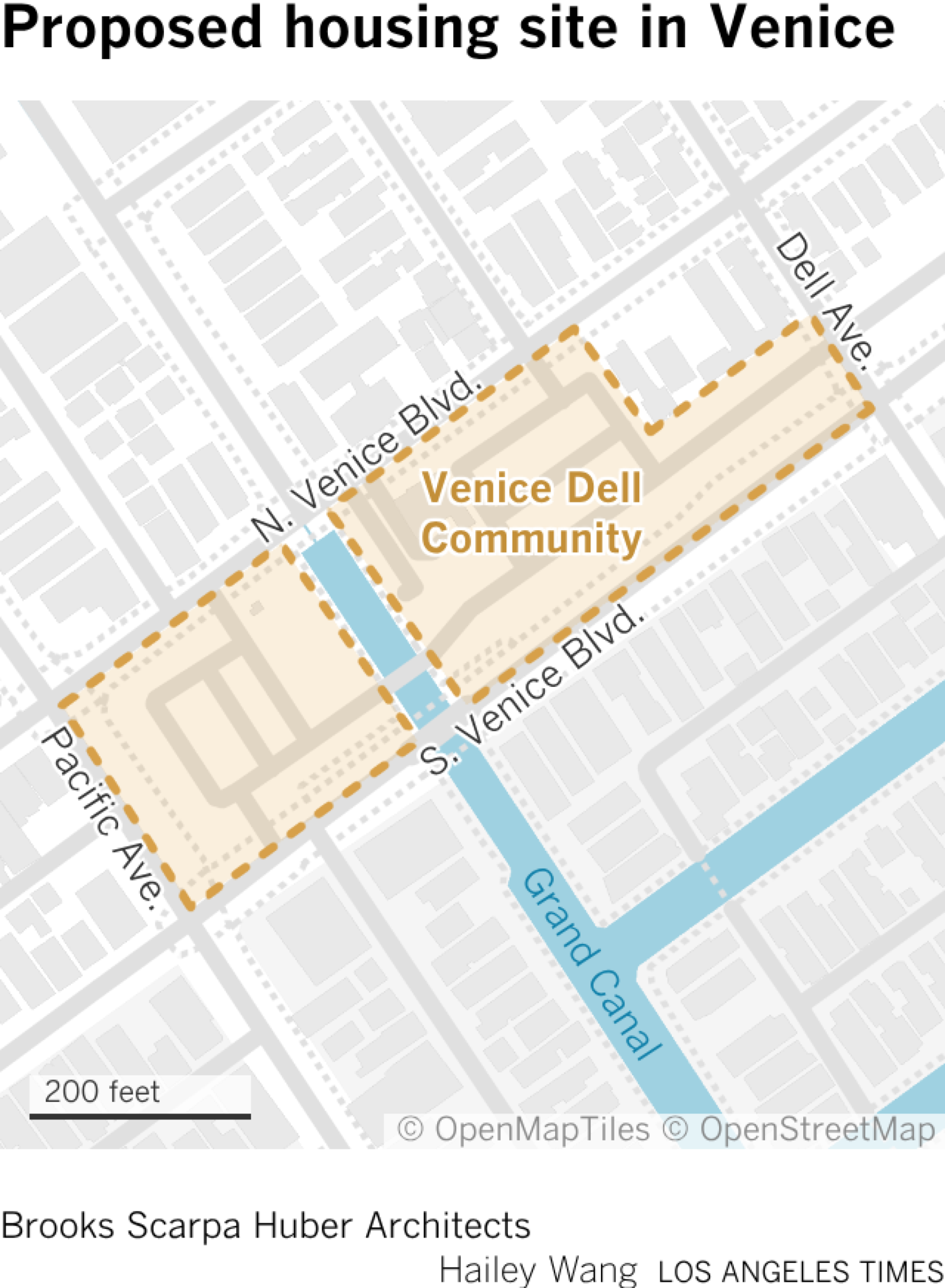
The proposed Venice Dell development on city parking lot 731 at 200 N. Venice Blvd. has divided affordable housing advocates and neighboring residents for the past decade. Plans call for building 120 units, of which 68 would be set aside for homeless people.
Supporters say the project will help address Venice’s chronic homelessness and a shortage of affordable housing on the high-priced Westside. Opponents say it’s out-of-scale for the neighborhood and, at just 800 feet from the beach, at risk of being flooded.
The project has been stalled for several years by litigation, bureaucratic roadblocks and the opposition of Los Angeles City Councilmember Traci Park, whose district includes Venice and who campaigned on a platform to quash Venice Dell.
But supporters think the logjam may break with the Nov. 3 election of Raman and Roy, as both have supported Venice Dell and criticized their predecessors for standing in its way.
“A change in elected officials is what initially held this project up. Now we are seeing an equal but opposite reaction with two elected officials who ran on the importance of building housing and they have prevailed,” said Azeen Khanmalek, executive director of the nonprofit Abundant Housing LA, which endorsed Raman and Roy in their races.
Allison Riley, the co-executive director of Venice Community Housing, one of the developers on the project, shares Khanmalek’s optimism.
“Their election is giving us a lot of hope that the project will be able to move forward,” she said.

The project dates back to 2016, when the City Council approved an agreement with Venice Community Housing and Hollywood Community Housing Corp. to build housing on the city-owned site.
Plans called for two four-story buildings straddling the Venice Grand Canal, replacing a four-unit apartment building and a 196-spot parking lot.
In the following years, the developers held more than a dozen community meetings about the project and the city Planning Department exempted it from an environmental review.
In June 2022, the city entered into a disposition and development agreement with the developers, a binding contract outlining the development of the project.
It was moving forward, but the political climate was shifting.
Opposition emerges
The project has long been opposed by the Venice Neighborhood Council, whose members say Venice Dell is too dense for the community — and that valuable land shouldn’t be surrendered at such low cost. The 2.65-acre parcel has been appraised as high as $34 million. Under the plan with the city, the developer would pay $1 per year for up to 99 years to use the lot.
“We’ve all been painted as NIMBYs and it’s just not true,” said Gary Pearl, vice president of the neighborhood council. “We’ve always looked for an answer for this.”
At the same time, the neighborhood group has also made it clear that it opposes the homeless housing component of this development. Venice already has a number of homeless service providers, the group has pointed out, and the addition of more homeless housing could lead to Venice becoming a “Skid Row West.”
“This crush of homeless services and housing has served as a magnet for more homelessness and crime to proliferate in this community disparately from others in the district,” the group wrote in a 2021 letter to the City Council.
Lisa Redmond, a member of the neighborhood council who supports Venice Dell, said the real reason some Venice residents oppose the project is because they don’t want affordable housing bringing down their property values.
“They don’t want it, period,” she said. “But there are a lot of people like me out there who want it. It’s just very vocal people that hate it.”

L.A. City Councilmember Traci Park, who has opposed the Venice Dell project.
(Brian van der Brug / Los Angeles Times)
‘I will squash this on Day One’
By the summer of 2022, council and citywide political races were in high gear.
In her campaign, Park promised to kill the Venice Dell project as she campaigned to replace Mike Bonin, who had shepherded the project through council.
“I will squash this on Day One,” Park said during the campaign. “It’s a waste of money. It’s wrong for the community. It’s a no-go. It’s done.”
Park, who won her seat in 2022, had a powerful ally.
Hydee Feldstein Soto became city attorney the same year and she too had expressed concerns about the Venice Dell project during her campaign, specifically saying that the city should reopen the competitive bidding process for the lot to other developers.
Litigation and roadblocks

Los Angeles City Atty. Hydee Feldstein Soto during her 2022 campaign.
(Genaro Molina / Los Angeles Times)
The city was sued multiple times by neighborhood groups over the project, including for exempting the developers from the environmental review process known as CEQA in 2022. That case was defeated under Feldstein Soto, despite her issues with the project.
In spring 2023, with litigation pending on the project, city staff stopped responding to representatives for the developers.
“Please note, if you get called by anyone related to Venice Dell. … DO NOT respond,” wrote Yaneli Ruiz, a staffer in the Los Angeles Housing Department, said in an email to other city workers on April 12, 2023, that was released to the developers in a public records act request.
“We should also forward this message to the Finance and Development team. … Their team may not be aware of the ‘gag order,’” responded Mariano Napa, another LAHD staffer.
The directive not to speak with the developers came from the city attorney’s office, which cited the pending litigation, according to Khanmalek, who worked in the mayor’s office at the time.
“I thought it was odd,” he said. “It’s not typical. There are projects, many projects, city-owned land or not, that people file CEQA lawsuits on and in my experience it had not been the case that city staff, whether in the mayor’s office or elsewhere, would be directed to stop any kind of work on moving the project forward.”
Feldstein Soto’s office doesn’t direct or instruct departments, said a spokesperson for the city attorney’s office in a statement.
The progressive nonprofit LA Forward sued the city in 2024, arguing that the city attorney’s directive was politically motivated. They claimed in the suit that her directive to cease communication with the developers was part of a plan by Park and Feldstein Soto to “covertly thwart” the Venice Dell project.

An architectural rendering of the proposed Venice Dell design.
(Courtesy of Venice Community Housing)
“Councilmember Park and the City Attorney seek to defeat the Project not by democratic means in the City Council, but to use their offices to tie the Project up in red tape outside of public view,” wrote attorneys for LA Forward in the lawsuit.
Feldstein Soto has denied that she used her position to stall the project.
Mayor Karen Bass, meanwhile, has said it was not her place to step in on the project and that the decision rested with the City Council.

A mural of developer Abbot Kinney as seen from Venice Beach parking lot 731, site of the proposed Venice Dell housing project at 200 N. Venice Blvd.
(Genaro Molina / Los Angeles Times)
After the city and developer prevailed in the CEQA litigation, there were a few more hurdles before the project could be built, including approval from the state’s Coastal Commission because of its proximity to the beach.
Then a new hurdle arose. The Board of Transportation Commissioners, an advisory and oversight body, scheduled a special meeting over whether to convey the parcel to the developer, after the city Transportation Department recommended against surrendering the parking lot for the Venice Dell project.
The DOT letter cited design and liability concerns, a $22-million price tag to the city to redevelop the parking lot, loss of hundreds of thousands of dollars in annual parking revenue during construction and reduced beach access as reasons for the board to reject the lot’s use.
The developer said it was the first time a city department had raised objections to the project. LA Forward claimed the Transportation Commission didn’t have any authority in the matter.
Even so, the commission voted in December 2024 against allowing the developers of the project to use the lot for the Venice Dell project. The council didn’t vote to overturn the decision and Feldstein Soto declared the project was dead.
Following the board’s vote, the developers of the project sued the city in March 2025, alleging the board’s vote was unlawful, “exceeding the scope of [its] legal authority.”
This year, a judge in the case agreed and ordered the Board of Transportation Commissioners to vacate its decision.
Feldstein Soto, in a statement, said that her position on the project had changed due to “material changes and developments” including the overruling of the board’s decision. She also noted that Gov. Gavin Newsom “reached out to the highest levels of the City to communicate the governor’s personal interest in moving the Venice Dell project forward.”
Changes at City Hall
Feldstein Soto and Park both faced challenges this year by supporters of the Venice Dell project.
Park prevailed in May, but Feldstein Soto was defeated in the primary and Roy is poised to take over the city attorney’s office in December.
Roy declined to be interviewed following her victory, but has previously said Feldstein Soto politicized her role and got in the way of a City Council-approved project.
Raman has also supported the project during her time on council. In one interview during her mayoral campaign, she called the stalling of projects like Venice Dell by the city “the most stark example” of Bass’ failure on housing in Los Angeles.
Raman’s transition spokesperson declined to comment on Venice Dell for this article.
Park, meanwhile, has turned to the future, and the potential development into affordable housing of a different Department of Transportation-owned lot in Venice, close by — lot 701.
Instead of affordable housing, Park wants to turn lot 731 into a “mobility hub” that would include parking, car share, bike share, micro-mobility, shuttle service and transit storage.
She has said she hopes for both lots to be developed and in use in time for the 2028 Olympics.
“The staggering public cost of [Venice Dell] is simply not justified by what it delivers,” Park said in a statement to The Times. “It remains fiscally indefensible for taxpayers and residents, especially in light of an alternative plan that delivers multiple policy goals at once: housing, coastal access, and mobility amenities.”
But Park will have to move her plans forward with a mayor and city attorney who support the old project.
“Having a different mayor and different city attorney with a difference perspective on this project gives it an opportunity to get back on track,” Bonin said.