afford

Sudan cannot afford to dismiss a chance for dialogue | Opinions

More than three years into the war between the Sudanese Armed Forces (SAF) and the Rapid Support Forces (RSF), Sudan is desperately in need of a political settlement. The fighting has caused immense suffering, and a military solution alone cannot rebuild the state or reunify its fractured society. Under such circumstances, any effort aimed at encouraging Sudanese-Sudanese dialogue deserves serious consideration rather than outright rejection.

In August, a self-appointed committee of 19 Sudanese public figures, chaired by Ahfad University President Qasim Badri, launched an initiative to prepare the ground for national dialogue inside Sudan. Its members had earlier met SAF chief General Abdel Fattah al-Burhan and called for legal restrictions on opposition politicians to be lifted. The authorities subsequently issued a decree to drop certain politically motivated charges against Sudanese abroad returning for dialogue and grant participants temporary legal protections. These are limited but important confidence-building measures.

The initiative has nevertheless faced strong opposition. The civilian coalition Sumoud, led by former Prime Minister Abdalla Hamdok, and Ta’sis, an alliance that includes the RSF, have opposed the proposed internal dialogue. They question its independence and warn that holding talks in army-controlled areas could legitimise al-Burhan’s authority and entrench the country’s divisions. These concerns are legitimate and deserve serious attention. But the committee says it is not seeking to negotiate Sudan’s future or determine the agenda of a national dialogue. Its role is to help create the conditions for Sudanese political actors to engage one another directly. The question is whether it can fulfil that role without allowing one side of the conflict to dominate the process. Dismissing the initiative before it has had an opportunity to demonstrate its value would be premature.

The country’s political actors and civil society organisations remain deeply divided, previous mediation efforts have faltered, and the war continues to make comprehensive political engagement increasingly difficult. The committee’s initiative is an attempt to break the deadlock. Efforts to prepare for political dialogue should not be postponed until the fighting stops. Securing a ceasefire and ensuring humanitarian access are urgent priorities, but preparations for political dialogue can proceed alongside efforts to achieve them.

The committee’s members were not elected, and they do not represent every political constituency. Yet the committee’s legitimacy cannot be judged solely by how it was created. It must also be judged by whether it can help bring a broader range of political actors into a national dialogue.

Good intentions alone cannot resolve concerns about credibility. Political dialogue can succeed only if participants believe the process is fair and independent. The legitimacy required to facilitate a political opening is not necessarily the same as that required to negotiate a national settlement. But even a preparatory initiative must earn the trust of those it seeks to bring together.

The committee’s meeting with al-Burhan was a practical necessity. As army chief and head of the Sovereignty Council, he was in a position to respond to the committee’s demands for legal protections. Engaging with al-Burhan does not in itself amount to an endorsement of his authority. But if the initiative becomes too closely associated with the army, other political actors may view it as an extension of al-Burhan’s political agenda rather than an independent facilitator. The committee must therefore demonstrate that its engagement extends beyond the military authorities and that it is prepared to work with political forces that oppose them.

The initiative was launched in Khartoum, which is under army control. This raises a genuine concern about whether a process beginning in territory controlled by one side of the war can attract the confidence of political forces across the country. A national dialogue cannot be confined to one geographical or political constituency. Entire regions have experienced different realities of war, governance, displacement and insecurity. The committee must find ways to reach those living outside army-controlled areas, including Sudanese displaced by the fighting, and ensure they can participate freely and without intimidation.

Sumoud and Ta’sis’s decision to reject the initiative does not automatically invalidate the process. Their concerns deserve consideration, but outright rejection at this early stage risks closing off an opportunity for political engagement. At the same time, their absence matters. Sudan’s crisis is too deep and complex to be addressed by any single political current. The committee cannot expect every stakeholder to endorse its initiative immediately, but it must create conditions that persuade reluctant actors to participate. If it fails to do so, the initiative itself will have failed.

The African Union Commission and the Arab League have also welcomed the initiative, providing an important measure of regional support. Their endorsement lends weight to the effort to revive Sudanese-led political dialogue, although external backing cannot substitute for the confidence of Sudan’s own political forces.

The committee’s initiative should therefore be judged without excessive optimism or automatic suspicion. The legal measures announced following its engagement with al-Burhan are an encouraging first step, but the real test lies ahead. Does it help remove legal and political obstacles facing opposition actors in practice, not just on paper? Can it win the confidence of those who have rejected it? Can it ensure that Sudanese across the country’s political and geographical divides have an opportunity to participate freely?

What is clear, however, is that Sudan’s crisis will ultimately require Sudanese actors with profoundly different visions of the country’s future to sit together and engage one another politically. No committee can do that on their behalf. No external actor can do it for them. At best, a preparatory initiative can help create the conditions under which such engagement becomes possible. The concerns raised by its critics should not be dismissed, but neither should they be grounds for rejecting the initiative before it has had an opportunity to address them. Those who have rejected it should remain open to reconsidering their position if the committee demonstrates that it can build an independent and inclusive process. If it succeeds, it will have rendered an important national service.

The views expressed in this article are the author’s own and do not necessarily reflect Al Jazeera’s editorial stance.

Source link

Monty Don says ‘I can’t afford it’ as BBC show exit may force him to let go of gardeners

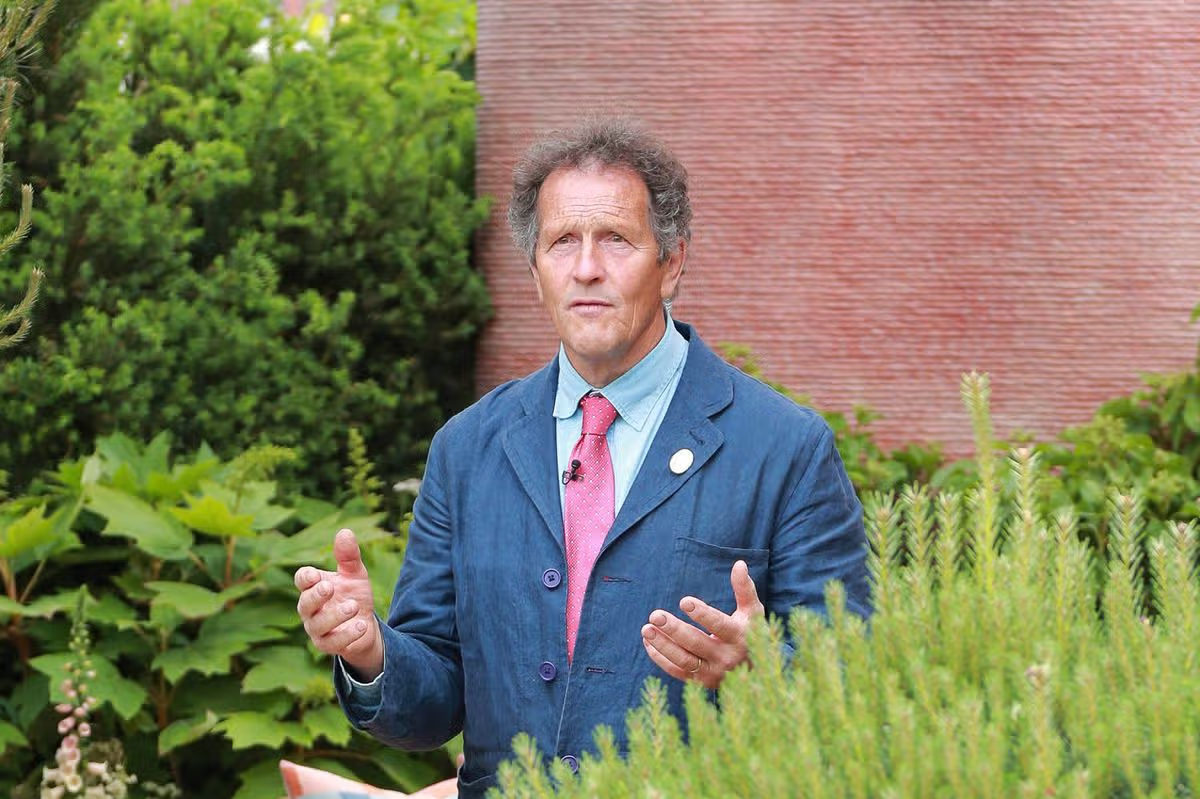
Appearing at an RHS event, Monty Don admitted he will have to find a new way to finance the maintenance of his two-acre garden at Longmeadow following his Gardeners’ World exit

Television legend Monty Don has admitted he may be forced into making a major change at Longmeadow following his departure from Gardeners’ World. Monty, 71, is leaving the show after over 20 years of leading the programme.

However, during a talk at the RHS Malvern autumn show, Monty revealed his soon-to-be former employer, the BBC, had been contributing to the salaries of two gardeners who have worked at Longmeadow since 2011.

Speaking at the RHS event, Monty said the reason for having the team was so the garden could always look “camera ready” if he was away filming in another country, or working on another project.

With his Gardeners’ World exit in mind, Monty, who has lived at Longmeadow in Herefordshire with his wife Sarah since 1991, has said there will come a moment where he will need an alternative plan to keep Longmeadow in shape.

He said: “The BBC pays a contribution towards their wages. Not enough, but they do pay something, which is great. Obviously that contribution is going to go.

“I will have to think of ways – I can’t afford it unless we earn money from it – so I am going to think of ways of earning something from the garden, but I can’t do that until the middle of next year at the earliest.”

Monty, who announced his intention to leave Gardeners’ World in an Instagram video, said he had decided to step away from the renowned show as he felt it was “the right time for a change”.

As well as paying tribute to the “superlative BBC team”, he added: “I look forward to continuing to work with and for the BBC on other projects, as well as following new avenues. And of course, I will still be gardening, dog by side, here at Longmeadow.”

Monty’s exit has subsequently led to speculation about who would replace him, with plenty of candidates from the existing Gardeners’ World team.

Months prior to Monty’s announcement, as questions continued to be asked about how long he would stay on the show, Frances Tophill, 36, was asked how she would feel about potentially replacing him.

Although she has been part of the team for over a decade, Frances ruled herself out of following in Monty’s footsteps, with the latter taking over from Alan Titchmarsh in 2003.

Speaking to the Sunday Times, Frances admitted to having little interest as she saw her main job as being a gardener rather than a presenter.

She said: “I have a huge respect for Monty – it is such a generous thing to give your garden space to the nation and he does it so well. I hope he never leaves….Broadcasting is not my day job, my day job is being a gardener.”

Frances’ comments came after she got a taste of what life as the main presenter would be like when she found herself surrounded by people in a garden centre after deputising for Monty during one episode in 2023. She added: “That’s when I got a glimpse of what being Monty must be like… I don’t want that.”

Source link