WASHINGTON — Several of the nation’s largest voter engagement and racial justice organizations are facing steep funding shortfalls and staffing cutbacks just as voting is getting underway in an election that will determine control of Congress for the final two years of President Trump’s term.
The shortfalls are setting off alarms among Democratic strategists, who are betting on high turnout and robust voter protection efforts to boost the party’s chances this fall. They are worried that many grassroots groups will not be able to mount effective registration and get-out-the-vote efforts, much less protect against the possibility of election interference from the administration given Trump’s efforts to restrict voting access and assert federal control over the election.
America Votes, a coordinating hub for more than 400 progressive groups, has fallen “well below” the level of funding it had during the 2022 midterms, the group’s executive director, Daria Dawson, said in a statement to the Associated Press. America Votes has acted as a nerve center for the voter mobilization efforts of groups such as the NAACP, Planned Parenthood, the League of Conservation Voters, the AFL-CIO and SEIU labor unions, as well as local groups focused on racial justice, climate and civil liberties.
“There is still time to reach voters and bring them into this election, but we are no longer talking about a future opportunity,” Dawson said. “The window to engage them is open now, and it is narrowing every day.”
Racial justice activists feel betrayed
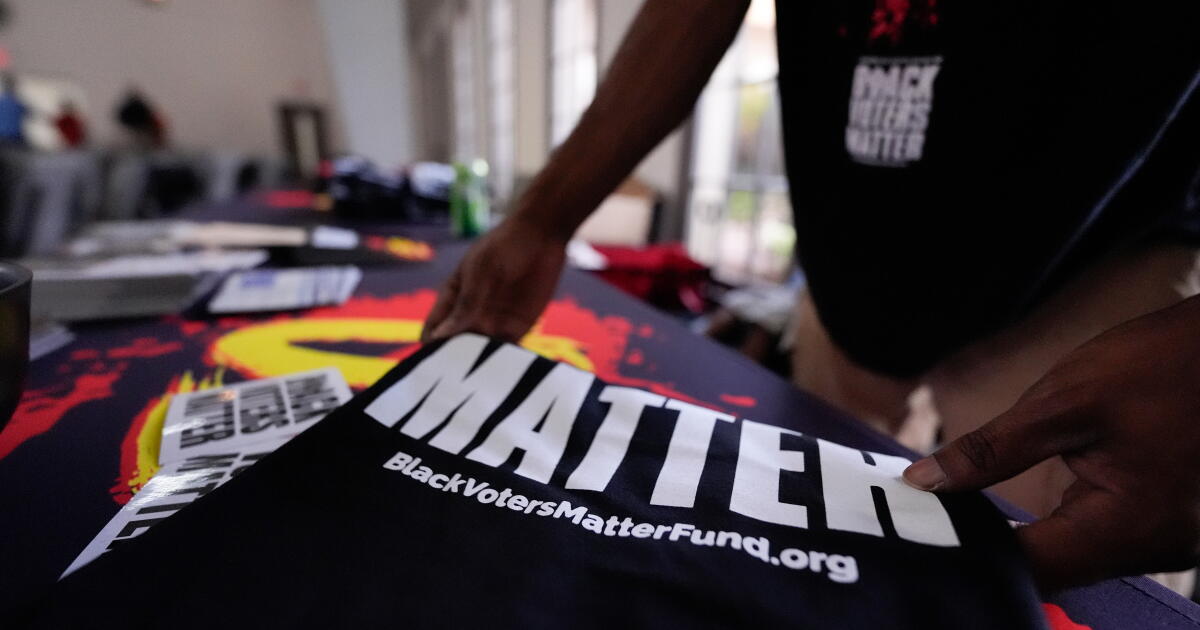
Wealthy donors and philanthropic groups have reduced their support of many liberal causes since the 2024 presidential election. That pullback has been especially stark for voting groups geared toward engaging communities of color.
While multiple organizers said some funders had expressed an interest in adopting different strategies, racial justice organizers have felt that as a betrayal.
A retreat in donor support is “handcuffing our ability to persuade our communities to vote in a year where there is no Voting Rights Act,” said Esosa Osa, a veteran Democratic strategist and founder of Onyx Impact, a research group focused on combating misinformation in Black communities.
A Supreme Court ruling this year knocked out one of the last remaining pillars of that landmark 1965 law, essentially gutting it.
“We are watching surrender, not strategy,” Osa said.
A July memo that circulated among major Democratic fundraisers warned that “the organizations that registered and persuaded millions of voters to participate in the 2018 and 2022 midterms are drastically underfunded. They have raised nearly 40% less than they had at this point in those cycles.”
It further warned that funding voter mobilization groups was especially critical “given that the Democratic brand is underperforming on generic ballot tests relative to historical comparisons and the president’s approval ratings.”
The shortfalls have led organizations focused on engaging and mobilizing key voting groups to scale back operations and staffing over the last year. That has included programs aimed at registering and mobilizing lower-propensity voters, voters of color, and rural and younger voters.
The Democratic National Committee, which has faced its own funding challenges, has consolidated voter engagement efforts this year partly in response to the ecosystem’s past shortcomings. The DNC in a statement said it was making “historic investments” in its organizing but did not address the weaknesses among allied groups.
“We are expanding our voter protection infrastructure to defend Americans’ sacred right to vote, hold Trump and Republicans accountable in court, and register and mobilize voters across the country,” said Angelo Fernández Hernández, a DNC spokesperson.
‘Being Black … again has become a bad word’
The reasons for the troubled funding landscape are varied and at times unclear, according to nearly two dozen fundraisers and organizers who spoke with the AP. Some donors, still disappointed with the Democratic Party and some of its allies following the 2024 presidential election, have closed their pocketbooks to liberal causes entirely.
While a small group of liberal megadonors has continued to bankroll progressive causes, most focus their support on liberal legal organizations that have taken the Trump administration to court, rather than political or voter engagement groups.
Others, including major philanthropic institutions, have pulled back out of fear of retribution that giving to political or racial justice causes could draw the administration’s ire. Organizers who have engaged with potential donors said the administration’s targeting of political opponents and diversity initiatives seems to have put a chill on fundraising for their causes.
Tameka Ramsey-Brown, founding director of the Michigan Coalition on Black Civic Participation, said multiple donors since the 2024 election had asked whether her group could remove the word “Black” from its name or find financial conduits to mask the source of donations for fear of retribution from the administration.
“Just being Black in this country again has become a bad word, and it has made it that much more difficult just to raise money because funders don’t want the added pressure and stress or attacks on them by funding us,” she said.
Smaller budgets, shifting strategies
Many of the nonprofit groups that traditionally have conducted the registration, voter education and organizing say they are trying to adapt to their new, leaner reality.
Vamos a Votar, an initiative of the largest civil rights and advocacy groups focused on Latino communities, has had to readjust its ambitions this year due to a lack of investment from funders.
“This is shaping up to be a cycle where investments haven’t gone to the Black and brown communities that will ultimately decide this election,” said Juan Proaño, chief executive of the League of United Latin American Citizens, a member of the initiative.
In a September pitch circulated among donors, the coalition said it aimed to invest $27.5 million in voter engagement and persuasion efforts this year, but still required $5.4 million from donors to fund voter turnout efforts across 10 states and 17 House districts. Even that investment reflected reduced ambitions from previous pitches to donors early this year.
“It has been extremely disappointing to see that progressive donors are not meeting the moment,” said Héctor Sánchez Barba, head of Mi Familia Vota, one of the affiliated organizations. “We are not waiting. We are always on the front lines for our democracy and our communities.”
To counter the funding cutbacks, some groups have begun relying more heavily on artificial intelligence to provide voter registration guides, share information in multiple languages and track potential election issues. Some groups have increased their partnerships with ride-sharing companies to provide free rides to polling places instead of bus shuttles.
With fewer in-person organizers, some groups are also focusing on social media and partnering with liberal content creators to boost their messages.
“In my more than 30 years of organizing, it has never been this bad to raise money to support Black causes of any kind,” said Melanie Campbell, president and chief executive of the National Coalition on Black Civic Participation, a nonpartisan civil rights group.
“We’re going to do the work, our state affiliates are doing all that is possible. … But the bottom line is that those who believe that democracy matters should make sure they fund the work.”
Brown writes for the Associated Press.