The Sports Report: Dodgers one win away from advancing to NLCS
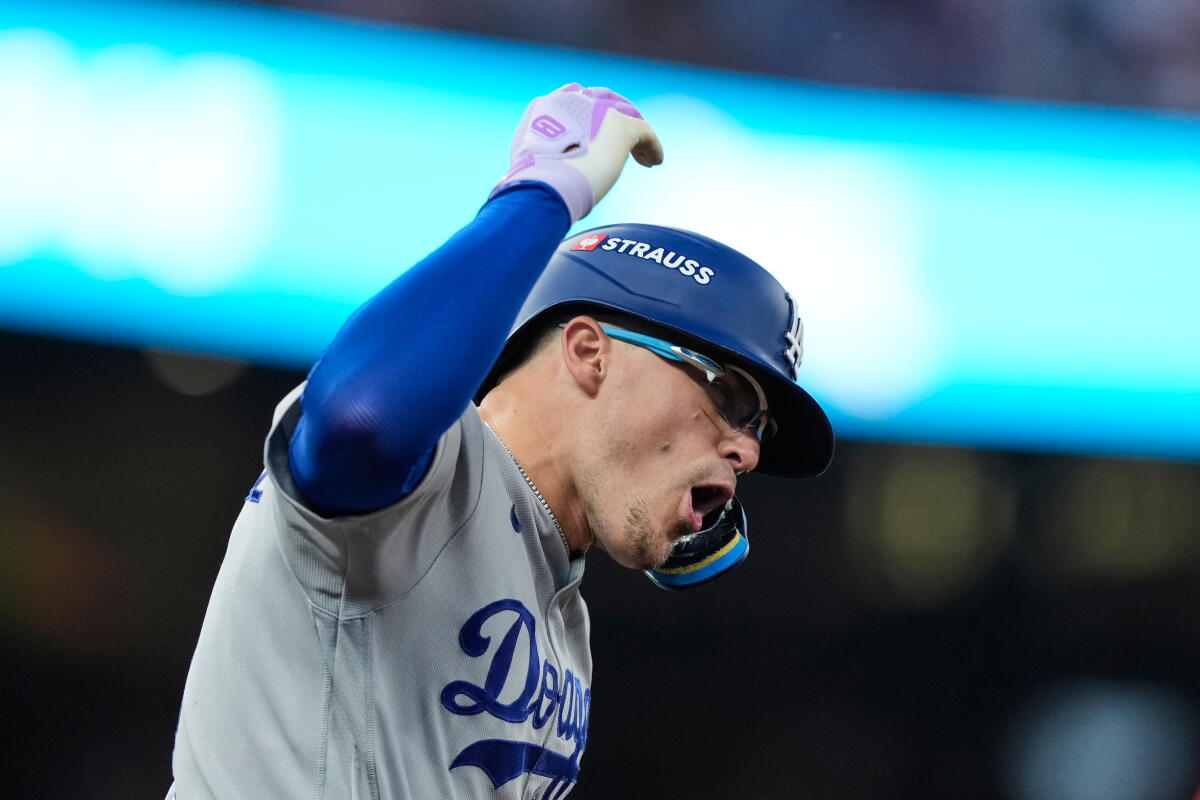
From Maddie Lee: The Dodgers’ first few innings Tuesday night were riddled with strikeouts and missed opportunities. But the work they did racking up Atlanta Braves ace Chris Sale‘s pitch count culminated in Kiké Hernández’s big fourth-inning moment in Game 3 of the National League Division Series.
“I felt hitting at the bottom of the lineup, my responsibility was to not chase him around, not give in to what he was trying to get me to do, which was roll over and hit into a double play,” Hernández said after the Dodgers’ 3-1 win against the Braves. “So my mentality was to grind out the at-bat, try to get a good pitch to hit. If not, just be patient so I could turn the lineup over to Mookie [Betts] at the top.”
Hernández let Sale’s first pitch, a changeup in and off the plate, go for a ball. Then, he recognized the pitch again, heading toward the inner third of the plate. And Hernández demolished it, taking three slow steps out of the batter’s box before dropping the bat.
Hernández has too many big postseason moments — a three-homer game against the Cubs in Game 5 of the 2017 NL Championship Series, for example — for a single homer in a non-elimination game to rank at the top. It was his 17th career postseason home run, which accounts for 11% of his home runs over 13 years in the majors, putting him in a category of his own.
It was, however, the biggest offensive moment of the Dodgers’ postseason so far. As the series teetered, in a matchup of rotation aces, all tied up and in Atlanta for the first time, he got his first at-bats of the 2026 postseason and immediately delivered.
“We played tonight like an elimination game,” manager Dave Roberts said. “Collectively it was probably one of our better performances, certainly with the [opposing] starter, as far as 1 through 9.”
Dodgers in control against Braves

Kiké Hernández celebrates after hitting a two-run home run in the fourth inning of the Dodgers’ 3-1 win over the Atlanta Braves in Game 3 of the NLDS at Truist Park on Tuesday.
(Brynn Anderson / Associated Press)
From Bill Plaschke: Scared straight.
Faced with a reality check, the Dodgers got real. Confronted with the end, the Dodgers are just getting started.
Stepping warily into Atlanta’s Truist Park with their five-game division series tied at one game apiece and Braves’ ace Chris Sale waiting for them on the mound Tuesday, the Dodgers marched out three hours later on the verge of another champagne shower.
Yoshinobu Yamamoto was brilliant, showing everyone that they were focusing on the wrong ace.
The Dodger bats were reborn, showing everyone that they still know how to hit in October.
And, yes, the Dodgers finally have a closer, Edwin Díaz entering the ninth and allowing a leadoff double to Ozzie Albies before retiring the next three hitters for the biggest save of his brief Dodgers career.
Shaikin: Yoshinobu Yamamoto’s playoff dominance impresses everyone, especially Tarik Skubal
Swanson: The Braves let Freddie Freeman go. Now he’s making them pay in the NLDS
Remembering Fred Claire

General manager Fred Claire, left, celebrates the Dodgers’ 1988 World Series win over the Oakland Athletics with manager Tommy Lasorda.
(Bill Beattie / Associated Press)
From Bill Plaschke: The Dodgers were spiraling.
Their general manager had been fired for racist comments. Their famous manager had loudly lost his touch.
They had not won a full-season championship in more than two decades. They were just a blip on a Los Angeles sports landscape dominated by Showtime.
The Dodgers were plunging into a purgatory of irrelevance from which seemingly nobody could save them.
A sportswriter saved them.
Fred Claire saved them.
The most forgotten hero in Dodger history stepped out of the shadows in 1987 as their instant general manager and created the miraculous monster that came to be in 1988.
Kirk Gibson’s home run? He contrived it. Tommy Lasorda’s Hall of Fame career? He enabled it. The infamous championship Stunt Men? He formed it.
The resuscitation of a Dodger brand during what was quite possibly its darkest moment? It all started with Fred Claire, the longtime Dodger executive who died Monday in his Pasadena home on his 91st birthday.
Fred Claire, former Dodgers GM whose team won the ’88 World Series, dies
Bob Chesney urges UCLA to ignore hype

UCLA coach Bob Chesney reacts during a win over San Diego State at the Rose Bowl on Sept. 12.
(Griffin C. Hooper / Getty Images)
From Connor Dullinger: No. 21.
Look at it once.
And do not talk or worry about it again.
That is what UCLAcoach Bob Chesney told his team when he showed them their Associated Press Top 25 ranking during Sunday’s team meeting, reminding the Bruins what their priorities are as they come off their bye week and prepare for a showdown in Eugene, Ore., against the No. 13 Ducks.
“If you pay attention to this number it will go away,” Chesney said. “If you pay attention to what you did to get that number, and only focus on that and improve that, maybe the number even gets better. Who knows as time goes on, but that can’t be anything we talk about or worry about, and that’s why I wanted to bring it up one time and that was the end of it.”
The commitment to the process remains Chesney’s top priority as his team stares down its biggest test of the season to date.
Kings fall in home opener

Kings goaltender Darcy Kuemper makes a glove save during the first period against the Florida Panthers on Tuesday.
(Mark J. Terrill / Associated Press)
From Kevin Baxter: Before the first home game of their upcoming 60th anniversary year Tuesday, the Kings honored their past by unveiling a modest Hall of Fame on the concourse of Crypto.com Arena.
An hour later, this season’s Kings took the ice and made some history of their own, though not the kind they had hoped for, falling to the Florida Panthers 2-1 to open a season with three consecutive losses for the first time since 2020.
For Peter Laviolette, the history was even more unwanted since the team’s 0-2-1 start makes him the first Kings coach to go winless in his first three games since Robbie Ftorek in 1987.
Laviolette was a 23-year-old defenseman with the U.S. national team then. He would go on to win 934 NHL games as a coach, the most ever for an American, but he has yet to add to that total with the Kings. It didn’t help that two of the first three games with his new franchise came against Colorado and Florida, popular picks to finish the season in the Stanley Cup Final.
Adou Thiero stands out for Lakers

Lakers forward Adou Thiero looks to pass around Golden State forward Yaxel Lendeborg during the Lakers’ 124-98 preseason loss Tuesday.
(Ezra Shaw / Getty Images)
From Thuc Nhi Nguyen: This was never going to be a game for the Lakers to remember. But with nearly half of the roster sidelined because of injuries or resting, Adou Thiero at least tried to inject some life into a sleepy preseason back-to-back.
Thiero’s towering one-handed dunk over two Golden State defenders provided a highlight in the Lakers’ otherwise forgettable 124-98 preseason loss to the Warriors at Chase Center on Tuesday. The Lakers leaned on their depth to get through their second short-handed preseason game in as many nights.
Guard Quentin Grimes, the only player starting a second consecutive game for the Lakers, had 12 points and three assists. Forward Sandro Mamukelashvili started at center and had 15 points and a trio of three-pointers. Thiero, getting a rare starting moment, scored seven points and grabbed four rebounds while Bronny James had four points and five assists in a starting role.
MLB postseason schedule
DIVISION SERIES
National League
No. 2 Dodgers vs. No. 3 Atlanta
at Dodgers 5, Atlanta 3 (box score)
Atlanta 3, at Dodgers 2 (box score)
Dodgers 3, at Atlanta 1 (box score)
Wednesday at Atlanta, 3 p.m., FOX/FS1/FOX Deportes/FOX One
*Friday at Dodgers, 5 p.m., FOX/FS1/FOX Deportes/FOX One
No. 1 Milwaukee vs. No. 4 San Diego
at Milwaukee 3, San Diego 2 (box score)
at Milwaukee 4, San Diego 3 (box score)
at San Diego 4, Milwaukee 3 (box score)
Wednesday at San Diego, 7 p.m., FOX/FS1/FOX Deportes/FOX One
*Friday at Milwaukee, 1:30 p.m., FOX/FS1/FOX Deportes/FOX One
American League
No. 1 Tampa Bay vs. No. 4 New York
at Tampa Bay 1, New York Yankees 0 (box score)
at Tampa Bay 5, New York Yankees 2 (box score)
Wednesday at New York, 5 p.m., TBS/truTV/UniMas/HBO Max
*Thursday at New York, 5 p.m., TBS/truTV/UniMas/HBO Max
*Saturday, Oct. 10 at Tampa Bay, 5 p.m., TBS/truTV/UniMas/HBO Max
No. 2 Cleveland vs. No. 6 Chicago White Sox
Chicago White Sox 3, at Cleveland 0 (box score)
Chicago White Sox 4, at Cleveland 3 (box score)
Wednesday at Chicago, 1 p.m., TBS/truTV/UniMas/HBO Max
*Thursday at Chicago, 2 p.m., TBS/truTV/UniMas/HBO Max
*Saturday, Oct. 10 at Cleveland, 2 p.m., TBS/truTV/UniMas/HBO Max
* if necessary
NLCS starts Sunday, Oct. 11
ALCS starts Monday, Oct. 12
World Series starts Friday, Oct. 23
This Day in Sports History
1904 — Jack Chesbro registers his 41st victory of the season as New York defeats Boston 3-2.
1916 — Georgia Tech, coached by John Heisman, beats Cumberland 222-0 in the most lopsided college football game in history.
1933 — Baseball World Series: NY Giants beat Washington Senators, 4-3 at Griffith Stadium to clinch 4 games to 1 series victory.
1935 — Baseball World Series: Detroit Tigers beat Chicago Cubs, 4-3 at Navin Field for 4 games to 2 series win; Tigers win first championship in 5 WS appearances.
1945 — The Green Bay Packers score 41 points in the first quarter in a 57-21 win against the Detroit Lions.
1950 — Baseball World Series: New York Yankees beat Philadelphia Phillies, 5-2 at Yankee Stadium to sweep series, 4-0 for 13th WS title in team history; MVP: NY 2B Jerry Coleman.
1952 — Baseball World Series: NY Yankees beat Brooklyn Dodgers, 4-2 at Ebbets Field in Game 7 to tie own record 4th straight WS; MVP: NY 1B Johnny Mize.
1962 — Judy Kimball wins the LPGA championship with a four-stroke victory over Shirley Spork.
1967 — Tulsa wide receivers Ricky Eber and Harry Wood have the best day by a receiving duo in college football history. Eber has 20 receptions for 322 yards and three touchdowns, while Wood grabs 13 passes for 318 yards and three scores in Tulsa’s 58-0 win over Idaho State.
1970 — Willie Shoemaker wins his 6,033rd race to pass Johnny Longden as the winningest jockey. His first race was won on April 20, 1949.
1984 — Walter Payton breaks Jim Brown’s career rushing mark of 12,312 yards and Brown’s career mark of 58 100-yard rushing games in a 20-7 victory over New Orleans. Payton breaks the record on Chicago’s second play from scrimmage in the second half.
1985 — Lynette Woodard, captain of the women’s basketball team that won the gold medal at the 1984 Olympics, is chosen to be the first woman to play for the Harlem Globetrotters.
1995 — Coach Eddie Robinson gets his 400th victory as Grambling beats Mississippi Valley State 42-6.
2000 — Zamir Amin of Menlo College sets an NCAA all-divisions record, passing for 731 yards in the Division III school’s 37-32 loss to Cal Lutheran. Amin, 39-of-66 with four TDs and three interceptions, breaks the mark of 716 set by David Klingler of Division I-A Houston against Arizona State on Dec. 2, 1990.
2001 — San Diego’s Rickey Henderson becomes the 25th player with 3,000 hits with a bloop double in a 14-5 loss to Colorado.
2001 — Barry Bonds wraps up his record-breaking season with his 73rd homer and shatters the slugging percentage record that Babe Ruth had owned for 81 years. He finishes with a slugging percentage of .863, easily surpassing the mark of .847 that Ruth set in 1920.
2006 — Denis Hopovac’s fifth field goal of the game, in an NCAA record-tying seventh overtime, gives North Texas a 25-22 victory over Florida International. The other two seven-overtime games involved Arkansas — against Mississippi in 2001 and Kentucky in 2003.
2011 — Minnesota Lynx beat the Atlanta Dream 73-67 to complete a three-game sweep of the WNBA championship series.
2012 — Drew Brees finishes 29 for 45 for 370 yards with four TD passes and an interception in New Orleans’ 31-24 win over San Diego. Brees breaks the NFL record by throwing a touchdown pass in his 48th straight game. His 40-yard pass to Devery Henderson eclipses the mark of 47 consecutive games set by Johnny Unitas from 1956-60.
2017 — Jarvion Franklin runs in from the 12 to give Western Michigan a 71-68 victory over Buffalo in a record-tying seven overtimes with a record-breaking 139 total points.
2017 — Backup Khalil Tate rushes for 327 yards, an FBS record for a quarterback, and accounts for five touchdowns to help Arizona hold off Colorado 45-42.
2017 — Alex Ovechkin scores four goals to become the first player in 100 years with back-to-back hat tricks to open a season, and the Washington Capitals beat the Montreal Canadiens 6-1.
Compiled by the Associated Press
Until next time…
That concludes today’s newsletter. If you have any feedback, ideas for improvement or things you’d like to see, email me at houston.mitchell@latimes.com. To get this newsletter in your inbox, click here.