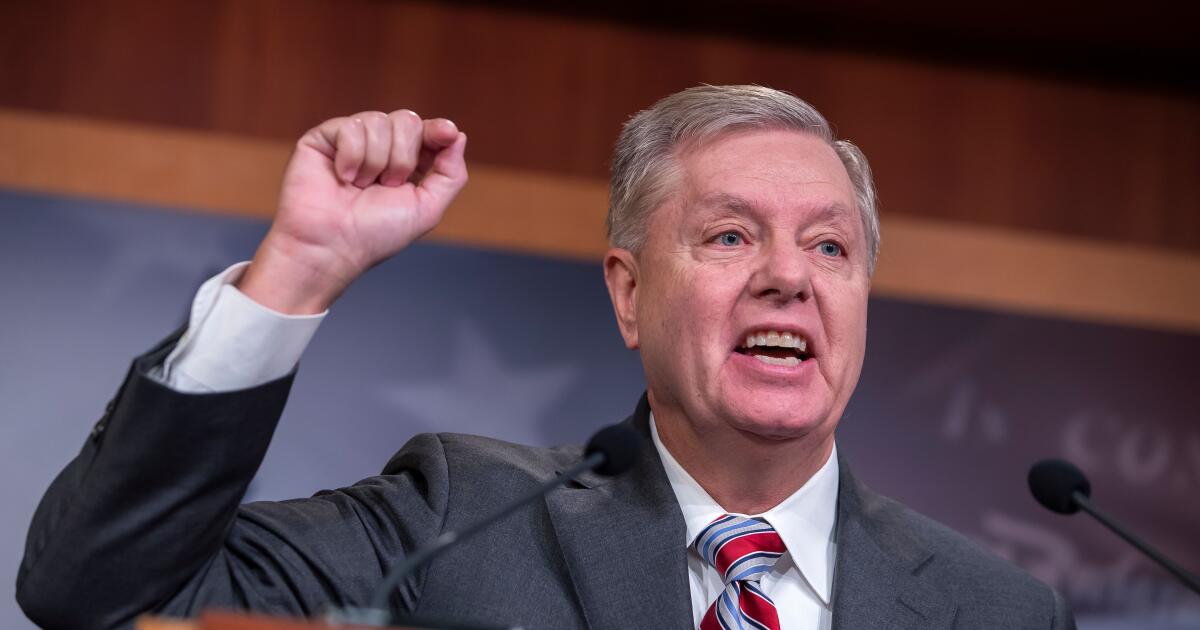
Sen. Lindsey Graham dies at 71
WASHINGTON — Sen. Lindsey Graham, one of President Trump’s closest allies in Congress who traveled the globe to advocate for a more aggressive U.S. foreign policy, has died after a “brief and sudden illness,” his office said. He was 71.
The statement posted on social media late Saturday did not provide any additional details about the South Carolina Republican, a former Air Force lawyer, and said his family “appreciates prayers at this time and asks for privacy during this incredibly difficult period.”
“Senator Lindsey Graham, one of the greatest people and Senators I have ever known, is dead!” Trump posted on social media early Sunday. “He was always working, and was a true American Patriot. Lindsey will be greatly missed!!! DETAILS AND ARRANGEMENTS TO FOLLOW. So sad!”
Senate Majority Leader John Thune (R-S.D.) said, “My heart is heavy this morning to learn of the passing of my friend and colleague.”
Thune described Graham as “a strong advocate for the United States and a strong ally to freedom-loving countries across the globe. He believed in the might of America to achieve good in the world and dedicated his life to advancing that cause.”
Graham was one of the most influential figures in Washington on foreign policy, and he advised Trump on matters such as Iran and Russia. The senator had just returned from Ukraine and announced an agreement Friday with the Trump administration to move forward on a package of Russia sanctions. He had been scheduled to appear Sunday morning on NBC’s “Meet the Press.”
As chairman of the Senate Budget Committee, Graham had a central role during Trump’s second term as Republicans pushed major legislation on party-line votes while holding a narrow 53-47 majority in the chamber.
Under South Carolina law, Republican Gov. Henry McMaster will appoint a temporary replacement for Graham, who was seeking a fifth term in November.
Graham was close with Trump
Graham, who was elected to the Senate in 2002 after serving in the House, long promoted a policy of robust U.S. military interventionism and strong national defense that in later years would put him at odds with the growing isolationist wing of the Republican Party.
More recently, Graham had become well-known for his close ties with Trump, whom the senator briefly ran against for the party’s presidential nomination in 2016.
Their relationship would begin on a rough note, with Graham calling the New York businessman and TV reality show figure “unfit for office.” Graham also used profanity to describe him after Trump made disparaging comments about Arizona Republican Sen. John McCain, Graham’s best friend in the Senate and a Vietnam War veteran. McCain and Graham, along with Sen. Joe Lieberman, a Democrat turned independent from Connecticut, were known as the “Three Amigos” and frequently traveled together to push their hawkish foreign policy views around the globe.
During a campaign rally in South Carolina, Trump read out Graham’s personal cellphone number and continued to belittle him throughout the 2016 campaign as Graham made it clear he would not support Trump even though he was the GOP nominee.
But Graham shifted significantly once Trump won the White House. He emerged as one of Trump’s top allies — speaking with him frequently and becoming a regular presence on the golf course alongside the president — even as McCain remained a critic and foe of Trump.
In a 2018 interview with the Associated Press, Graham explained his pivot by saying McCain taught him that the country must move forward after elections and that meant “you have an obligation” to help the president. McCain ran twice for the White House.
“And I’ve tried to be helpful where I could because I think he needs all the help he can get,” Graham said of Trump. “You can be a better critic when people understand that you’re trying to help them be successful.”
Graham appeared to break with Trump after the Jan. 6, 2021, attack on the Capitol, saying before the delayed congressional vote to certify Joe Biden’s election victory over Trump, “Count me out. Enough is enough.” But the senator returned to the fold and remained close with the president during his second term.
Foreign policy was a focus
Graham had been in Ukraine to meet with Ukrainian President Volodymyr Zelensky, who said that the senator visited his country 10 times during the years since Russia’s full-scale invasion.
“Lindsey was a true defender of freedom and the values that make our world safer,” Zelensky said.
Graham’s travels made him a familiar face to dozens of world leaders.
Israeli Prime Minister Benjamin Netanyahu mourned Graham’s death, calling him “a great friend of Israel” and “a cherished friend of mine.”
Netanyahu said Graham understood that the security of Israel and the United States was inseparable and devoted his life to defending America, strengthening the U.S.-Israel alliance and standing up for the free world.
“Israel has lost one of its greatest friends. America has lost a great patriot. I have lost a beloved friend,” Netanyahu said.
Chairman of key committees
As chairman of the Senate Budget Committee, Graham oversaw a process called reconciliation, a Senate procedure that allowed Republicans to pass significant policies such as last year’s tax law without the threat of a Democratic filibuster.
He had previously led the Judiciary Committee when Republicans confirmed Amy Coney Barrett to the Supreme Court in late 2020, and was in line to regain that gavel if the party kept control of the Senate after this year’s midterm elections.
“In 2027, I’ll be Chairman of the Senate Judiciary Committee once again,” Graham posted on X on June 30. “And I’ll wake up every single day with one goal: confirming as many conservative judges as possible.”
Graham was a key player in the Senate’s efforts to craft a massive immigration overhaul in 2013 as a member of a bipartisan group that wrote a sweeping measure that would have altered virtually every part of U.S. immigration law. It passed the Senate with 68 votes but was never taken up by the House, so it did not become law.
But Graham’s views on immigration, particularly an endorsement of a path to citizenship for people in the U.S. without legal status, put him at odds with some Republican factions.
He sometimes faced primary challenges in his home state of South Carolina, but he won the nomination outright in June.
The senator addressed the president in his victory speech last month, saying, “I’m going to help you change this world and change this country.”
Special election
Graham won 57% of the GOP vote in the primary and was up against Democrat Annie Andrews, a pediatrician, and several minor party and independent candidates in November.
After McMaster appoints a replacement, South Carolina law requires a special primary for voters to select a new nominee within weeks of a vacancy. The general election winner will take office January, beginning a full six-year term.
McMaster’s office did not immediately return messages seeking comment on who would take Graham’s seat or when the machinations for the primary would begin. State party officials said early Sunday they would release more information when they could.
The sparse statement by Graham’s office, which did not explain his death, comes during a stretch of concern about a lack of transparency about lawmakers’ health.
Rep. Tom Kean Jr. (R-N.J.) was absent without explanation for months before returning to Congress and disclosing that he had been diagnosed with depression.
Kentucky Sen. Mitch McConnell, the former longtime Republican leader, was hospitalized weeks ago for undisclosed health reasons.
McMaster said in a statement that Graham was “irreplaceable.”
“The fiercest of fighters for South Carolina and America — and a loyal and steadfast friend,” McMaster said. He added: “We shall not see his likes again.”
Graham was not married and did not have children. His closest living relative is sister Darline Graham Nordone, whom he helped raise after both their parents died.
Weissert writes for the Associated Press. AP writers Mary Clare Jalonick and Christopher Megerian in Washington, Meg Kinnard in Columbia, S.C., Brian P. D. Hannon in Bangkok and Geir Moulson in Berlin contributed to this report.