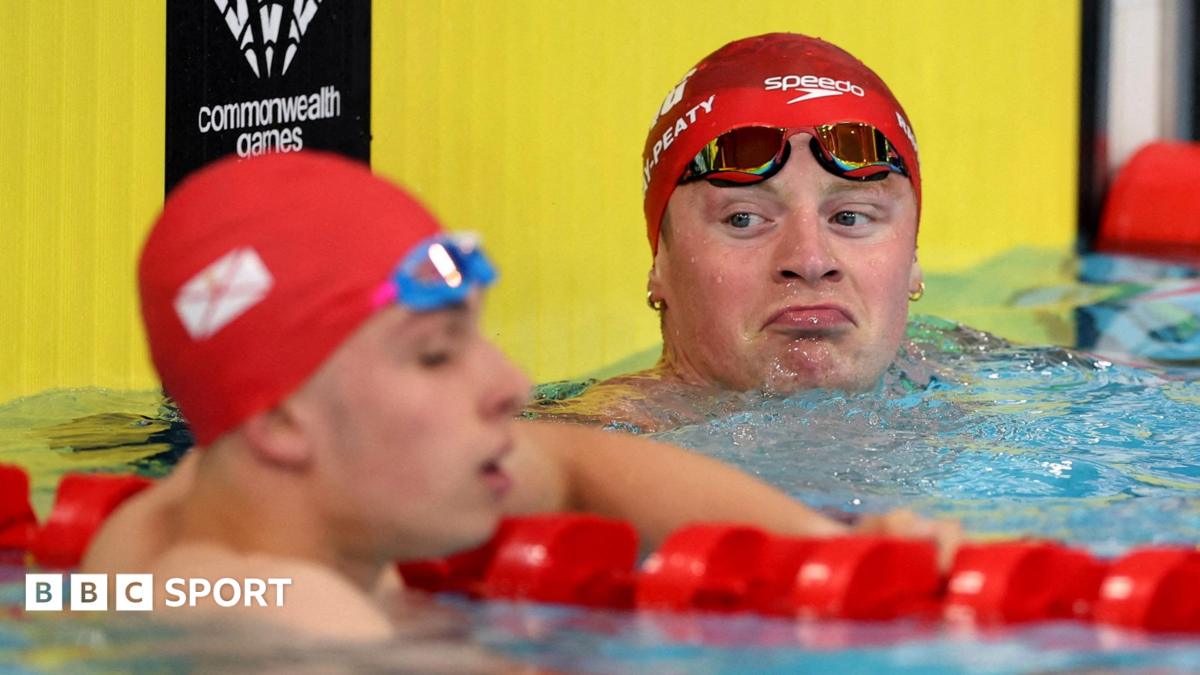
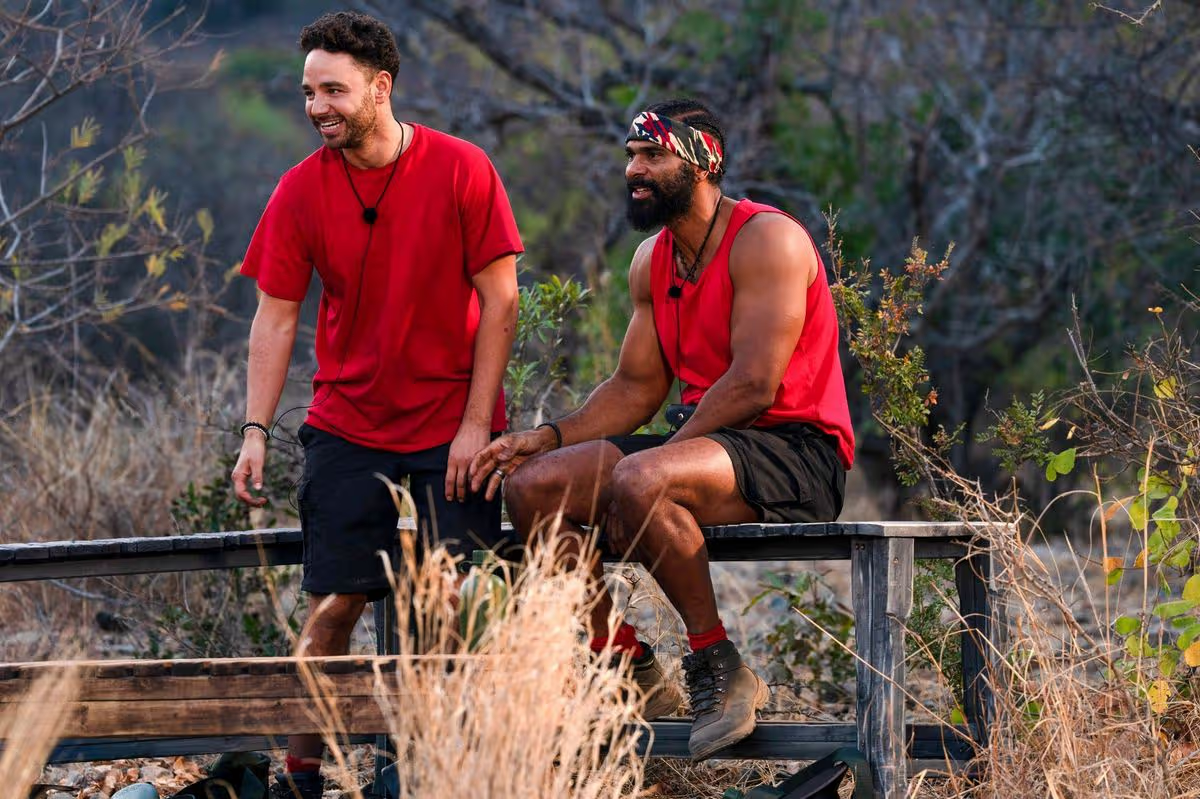
Adam Ramsay-Peaty becomes the latest to face the latter situation on Saturday – in the 100m breaststroke final at Glasgow’s Commonwealth Games, shortly after 21:00 BST.
The greatest breaststroker the world has seen is on his own journey – one which he hopes ends with a third individual gold at the Los Angeles Olympics in two years’ time.
Manoeuvring into his slipstream is 18-year-old Filip Nowacki.
Master meet apprentice.
Not only has Nowacki started to pick off Ramsay-Peaty’s age-group records, he is part of the 31-year-old’s AP Race stable – the programme set up to develop the next generation.
Ramsay-Peaty has spoken of wanting to mentor and pass on advice to his young pretender. Last year, Nowacki repaid him by breaking his 100m breaststroke junior British record.
Ramsay-Peaty, who is chasing a 33rd major gold of a glittering career, appeared in no mood to hand over the baton in Friday’s semi-finals.
There is uncertainty around a broken finger suffered in June but, side by side in lanes four and five, Ramsay-Peaty built an early lead and held off the youngster in the second length. Nowacki was close but never quite close enough.
“I saw his front wave, but at the same time that is what I train for,” Ramsay-Peaty said.
“I know I am a sprinter. I know I can go out fast.”
Nowacki, who competes for Jersey here having learned to swim under the tutelage of Nathan Jegou on the Channel Island, is arguably best in the 200m event – a distance Ramsay-Peaty does not race.
In this shorter contest, it is the youngster who should stay stronger for longer.
And when they spoke afterwards alongside each other, Ramsay-Peaty, all chest and tattooed muscle, towered over his young rival – so much so you would be forgiven for thinking the pair compete in different sports.
Nowacki appeared wary of Ramsay-Peaty but there is a cheeky confidence within.
“Course I do,” he laughed when asked if he believes he can win.
“No, I wish, I’m gonna give it my best shot” was his quick addition.
Nowacki was not long out of armbands when Ramsay-Peaty won gold in this same pool at the 2014 Commonwealth Games.
That was his emergence on to the global stage and two years later the Englishman won his first Olympic title in Rio de Janeiro. Nowacki was only eight years old.
“Adam is a true role model in the sport,” Nowacki said.
“I grew up watching him race at Rio, Tokyo and Paris.
“To race him and not be a random competitor but give him a race is special to me.”
The pair should compete as Team GB team-mates in LA but are also racing for their own personal ambitions on Saturday.
Despite winning an emotional silver at the Olympics in Paris two years ago, Ramsay-Peaty has not stood atop a major podium since the Birmingham Commonwealth Games in 2022.
In that meet he won the 50m crown but lost his 100m title to James Wilby. A “self-destructive spiral” amid issues with his mental health, which led to him considering his future in the sport, soon followed.
If Nowacki wins a medal it would be Jersey’s first at the Commonwealth Games for 36 years. They have only ever won one gold medal.
Australia’s Sam Williamson, who won the first semi-final, will also have something to say.
“It is going to be a good scrap, especially down that last 25m, and I do love a good scrap,” Ramsay-Peaty said.
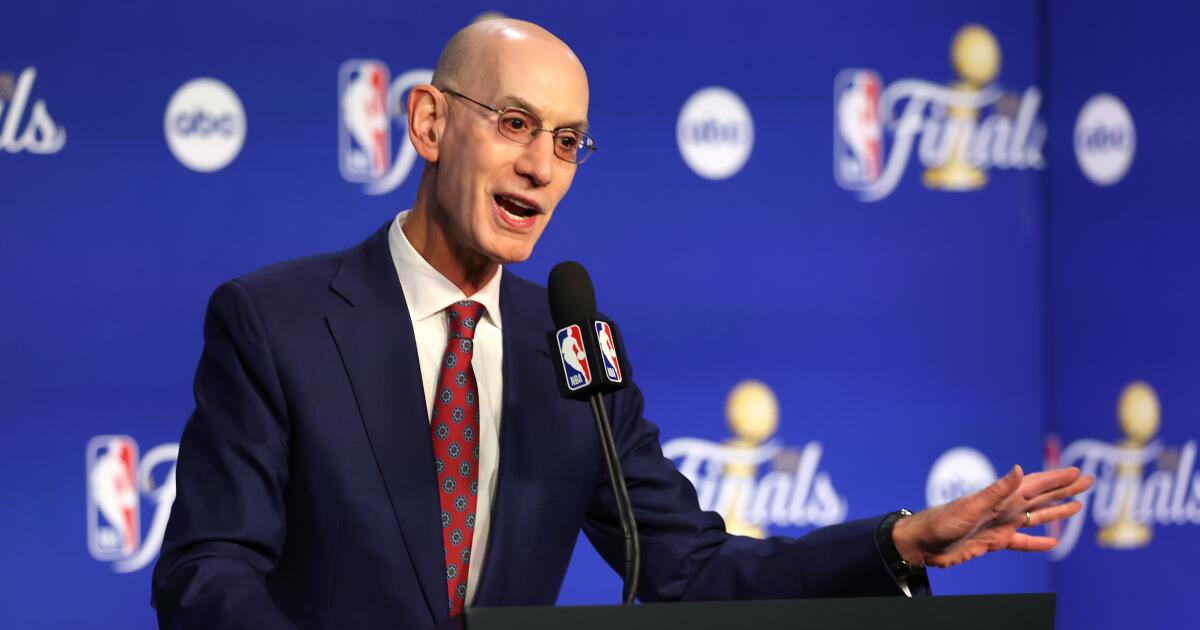
LAS VEGAS — NBA commissioner Adam Silver reiterated Tuesday night after the Board of Governors meeting that the investigation into whether the Clippers circumvented the salary cap by funneling money to Kawhi Leonard for an endorsement deal he allegedly never fulfilled still is not completed.
Silver said his “timeline remains this summer” to make his findings known after high-powered New York law firm Wachtell, Lipton, Rosen & Katz wraps up its investigation and presents the findings to the NBA.
The investigation centers on a $28-million endorsement deal to Leonard from a company called Aspiration that Clippers owner Steve Ballmer invested $60 million into.
With the investigation being about 11 months old, Silver was asked about a timeline for the NBA to announce the results.
“As you know, I am not conducting the investigation, nor is the league office,” Silver said. “It’s being conducted by the Wachtell law firm, independent of the league. Of course, as I have said previously, we all have an interest in wrapping this up and as I most recently said in an interview, that I’m hopeful that it will wrap up this summer so that will continue to be the goal here.”
The Clippers traded Leonard to the Raptors for Brandon Ingram, Gradey Dick, two first-round picks, a pick swap and two second-round picks. Leonard, who spent the last seven seasons with the Clippers, led the Raptors to the NBA championship in 2019. The Raptors then decided to put the trade on hold until the investigation is over.
“And I just want to clarify, so everyone understands, the league did not pause the trade,” Silver said. “The parties that did the trade made the decision not to go forward given that the investigation would remain open and the possible impact on Kawhi or his contract was yet to be known and so they chose not to live with that uncertainty. But, that was well-known before the trade was proposed and I didn’t think there was any reason for people to believe that the status of Kawhi Leonard would change merely because he was traded. The investigation needs to run its course.”
The Clippers have consistently denied any wrongdoing regarding the investigation.
Because of the probable length of the report, Silver was asked about reading such a voluminous amount of information and if things would be resolved before the start of next season.
Silver also didn’t talk about whether Leonard is being investigated for any other side deals.
“I don’t know specifically what will be in the report,” Silver said. “To the best of my information, the report is not done. I do get regular updates from our general counsel, who is Rick Buchanan, and he deals with on a weekly basis on who they are talking to and what they are finding on a preliminary basis. But my understanding is that Wachtell is now in the process of going through the information they’ve gathered and drawing conclusions from that information. And I think, yes, it is realistic to think that this can be wrapped up, and I would say needs to be wrapped up before the beginning of next season.”
The story of Dan Tana’s, in many ways, is the story of Los Angeles.
In 1980, Dan Tana’s burst into flames. At the time, the Tana family was vacationing on a remote Yugoslav island when a telegram arrived: “The restaurant burned down. Call me, Pearl,” recalls Katerina Tana, one of Dan Tana’s daughters.
On the Shelf
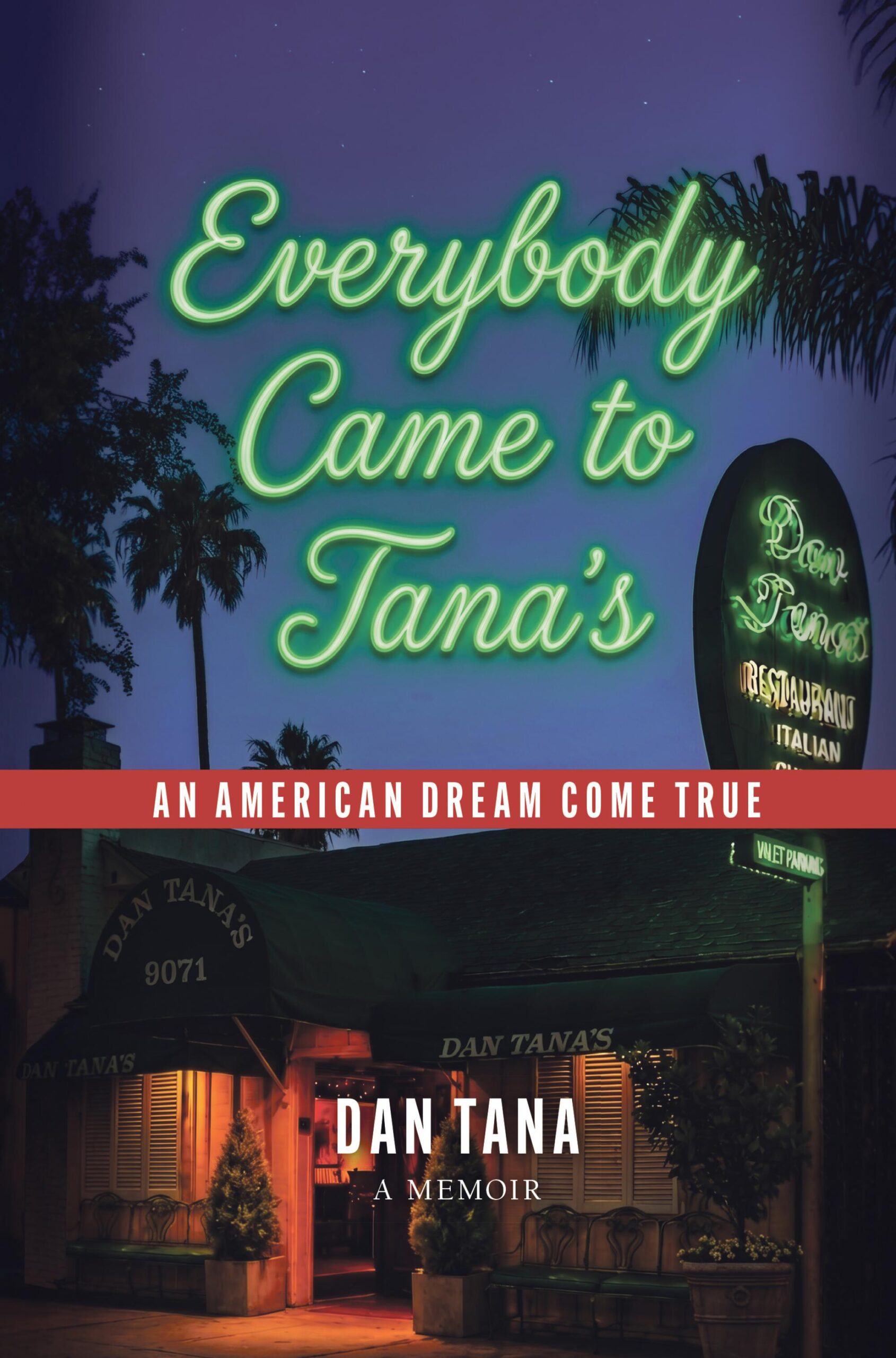
Everybody Came to Tana’s: An American Dream Come True
By Dan Tana Radius Book Group: 384 pages, $30
If you buy books linked on our site, The Times may earn a commission from Bookshop.org, whose fees support independent bookstores.
Dan Tana flew back to Los Angeles, expecting charred remains. Instead, he found handwritten signs taped to the restaurant’s door: “Rebuild it. This is our home. Don’t change a thing,” recounts Katerina.
News of the fire reached musician Linda Ronstadt, who swore that Dan Tana’s served the best plate of spaghetti in the world. The rock star became the immigrant-run restaurant’s unlikely patron saint, calling on her relationship with then-Gov. Jerry Brown to help clear the way for its reopening. Just six weeks after the fire, Dan Tana’s welcomed customers again, even without a roof.
“They open up the restaurant with no roof on it. There’s no air conditioning unit. It was the hottest day,” says Katerina.
Oddly, the fire ushered in a new era for Dan Tana’s — a rebirth, even. Like Los Angeles, the restaurant endured by reinventing itself. “In a weird way, he rebuilt better than he ever could have, because if the restaurant hadn’t burned down, it might not have lasted this long,” Katerina says.
Stories like these fill the pages of “Everybody Came to Tana’s,” the late restaurateur’s memoir, which chronicles the outlandish journey that carried a young immigrant from communist then-Yugoslavia to the helm of one of Los Angeles’ most adored dining institutions. Dan Tana died last year at age 90, but his legacy lives on — inside the restaurant and now in his own words.
On a summer afternoon, his daughters, Gabrielle and Katerina, sit at the Sunset Marquis bar, recounting their father’s remarkable life — particularly his championing of soccer and his contributions to the sport. With the World Cup now unfolding across Los Angeles, the sisters say they can’t help but feel his presence. “One of his big wishes was to be here for this year’s World Cup. That’s why I know he’s here,” Gabrielle Tana says. “He was very instrumental in L.A. getting the World Cup. Our father was constantly helping connect people,” says Katerina.
In the final years of his life, Tana became determined to tell that story, working with writers in Serbia and eventually a ghostwriter, Todd Gold, who requested no credit; the resulting memoir feels wholly told in Tana’s voice. “Our father, for years, was talking about how he wanted to tell his story,” says Gabrielle. “He was always pinching himself about the life that he had — the stories, the adventures, and his luck.”
Tana had an unusual path to becoming the restaurant owner of the renowned Hollywood red-sauce hideout. Born in present-day Serbia, Tana’s early life was marked by political oppression under Communist rule. His father, a restaurateur, spent years as a political prisoner.
Gabrielle and Katerina Tana with their dad at Dan Tana’s, circa 2001.
(Suzette Van Bylevelt)
“When you live in a country where political powers are constantly in play, when you own a restaurant, you’re the person who’s hosting somebody who’s having a dangerous conversation,” explains Katerina. From an early age, Dan Tana’s mother made Dan promise not to end up in the restaurant business.
Instead, Dan Tana became a soccer star, touring Europe with Red Star Belgrade before eventually escaping to Belgium — a decision that would set him on the unbelievable path to Canada and then Los Angeles, where he would serve a stint managing a nightclub called Peppermint West and even launch a modest acting career with the help of Natalie Wood.
The chapters follow the restaurant’s improbable success, offering extraordinary anecdotes, such as how a Yugoslavian immigrant happened to open a red-booth, comfort-food Italian restaurant. The answer? Hiring Mussolini’s private chef. “It was one of two chef options that he was given by his partners: Dan Reeves and Clarence Dan Martin, who funded the soccer league. [Dan Reeves] also bought the restaurant,” says Katerina.
Beyond dispatches from his red-and-white-checkered tablecloth joint and name-dropping, Dan Tana’s memoir outlines his significant contributions to soccer. Throughout his life, he maintained deep ties to the international soccer community, supporting Red Star Belgrade long after he retired from the sport. “He became an evangelist for the game because he thought it was a game that this country would appreciate,” says Katerina. “Football was always the biggest love of his life.”
Craig Susser, left in black, has been greeting patrons at Dan Tana’s for decades.
(Stephen Osman / Los Angeles Times)
Last November, when England faced off with Serbia for the World Cup qualifying games, the stadium held a moment of silence for Dan Tana’s passing. “There were people within the game who really wanted to acknowledge his contribution to the game,” says Katerina.
“A good restaurant has a good bar, and a good bar has ghosts,” reads the introduction. For Dan Tana’s, as far as ghosts go, they comprise a who’s who of Hollywood royalty. Johnny Carson once called it his favorite restaurant. Elizabeth Taylor, Richard Burton, Marilyn Monroe and other A-list stars were known to haunt the bar.
Even with its reputation as a watering hole for Hollywood’s biggest names, Dan Tana refused to pander to celebrities. “Everybody was treated the same. He never wanted the restaurant to be full of celebrities. He wanted to make sure that there were doctors, lawyers and teachers,” Gabrielle says. “He was almost a democratic socialist in that way.”
A revealing anecdote from the early pages of the book: Tana turned away Barbara Sinatra’s offer to buy out the restaurant for a night for Frank Sinatra’s birthday at $25,000. Tana refused. It wouldn’t be fair to his regulars. Frank Sinatra never set foot in the restaurant again.
Sonja Perencevic and Dan Tana attend the restaurant’s 50th anniversary party in Los Angeles in 2014.
(Alberto E. Rodriguez / Getty Images)
In many ways, Tana was one of Hollywood’s quiet power brokers, earning influence through humility and respect rather than status. In 1972, mysterious mafia members came into the restaurant to ask Tana to procure early-screening tickets for “The Godfather.” Naturally, Tana obliged. The mafia returned to report they loved the now-classic film.
The proximity to the Troubadour also made the restaurant a hangout for up-and-coming names in rock music. “He fed so many of those musicians. He wouldn’t charge them. These were kids that had nothing,” says Gabrielle. She recounts a night when musicians from the Troubadour celebrated the end of the Vietnam War at Dan Tana’s; the event went undocumented, lost to history.
Rock stars aside, the place is a writer’s joint too. Eve Babitz — who was a close friend of 93-year-old Deanne Mencher, who still makes the cheesecakes at Dan Tana’s — was known for socializing at the restaurant. “If you got hungry, you had to walk over to Dan Tana’s. Tana’s was delicious and evil — all that garlic,” Babitz once wrote in her semi-autobiographical novel, “L.A. Woman.” Screenwriters, journalists and famed L.A. writers Joan Didion and John Gregory Dunne were also known to frequent the restaurant.
In fact, Gabrielle and Katerina attribute the restaurant’s early colossal success to a Los Angeles Times review. It was 1966, and the restaurant was struggling. Art Ryon, a columnist at The Times, happened to stop at the restaurant before a screening at the Writers Guild of America and ordered mushrooms. “The L.A. Times made the restaurant,” Katerina says. “The next day there’s a line around the block, and my father has no idea what happened.” Tana was informed that he received a rave five-star review in The Times. Success soon followed.
Chicken Parmesan from Dan Tana’s.
(Jakob Layman)
The next generation of Hollywood — including comedy stars like Adam Sandler, Ben Stiller and Chris Rock — has continued the tradition. “SNL” cast member James Austin Johnson expresses his fondness for the restaurant. He discovered the restaurant after hearing Ed Begley Jr. rhapsodize about it. “The first intrigue is finding out who Dan Tana is,” says Johnson. “It has a West Hollywood mystique, like Chateau Marmont — like when Hollywood, the place and the business were all the same.”
Johnson loves restaurants that feel preserved in time. “It’s the idea that you can build something right the first time and then preserve it, so that people can be a part of your good idea when it happens,” says Austin Johnson.
Gabrielle and Katerina credit the enduring appeal of Dan Tana’s to its persistent lack of pretentiousness. The atmosphere evokes a Sinatra-era simplicity. “I think celebrities felt safe. They weren’t photographed, and they would be left alone,” says Gabrielle. The restaurant has kept its dim pink lights, which Gabrielle notes, “made everybody look good.”
The food has also remained consistent, with large portions and comfort food. “It’s not fancy, but it’s the best chicken Parmesan,” says Gabrielle. Over the decades, Dan Tana was approached about expanding the restaurant and opening second locations. He always refused, the restaurant’s humility always mirroring the man behind it. The restaurant, which felt like an anomaly, could not be replicated. “He always said: if I knew what I did right, I would do it again,” says Katerina.
Dan Tana’s originality continues to capture the city’s attention, its legacy now preserved in a memoir and carried on by its new owners, Mihajlo and Sonja Perenčević, who were friends of Dan Tana. Within its pages, the reader becomes one of Dan Tana’s beloved ghosts. “In a town that’s always trying to be something that’s not, it’s not trying to be anything,” says Katerina. “Dan Tana’s is longevity in the midst of ephemera.”
Connors is a culture journalist in L.A. She covers books, food, entertainment and offbeat Los Angeles. She’s currently at work on a book of essays about tourism in all its forms.
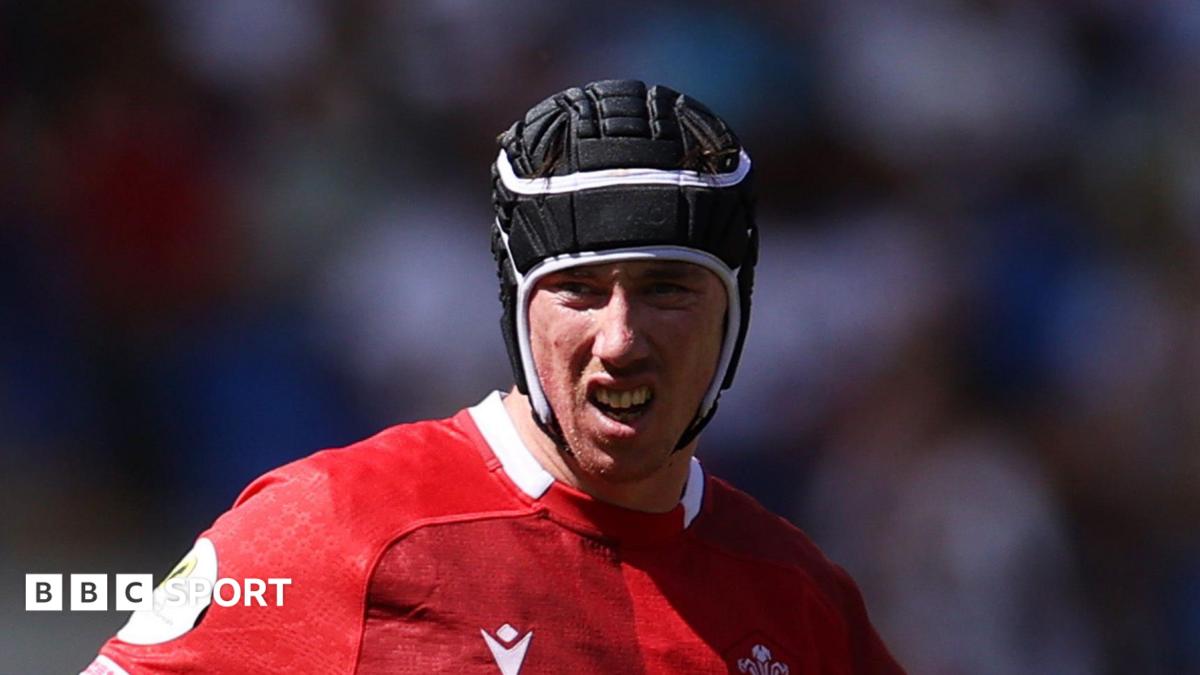
Beard will complete a long season after the final two Wales matches against Argentina and South Africa in Durban next weekend.
The former Ospreys lock had only just linked up with the Wales squad a couple of days before the Fiji game, following a mammoth first season with French club Montpellier, which included a Challenge Cup success and losing the Top 14 final to Toulouse.
“I have personally loved it and it was probably the best decision I’ve made rugby wise so far for myself and my family,” said Beard.
“It was a tough decision at first, leaving the Ospreys after being there since I was 14.
“But it was probably something, if I didn’t join Montpellier, I might have regretted at the end of my career.”
While playing in France is a tough challenge, it is also a rewarding one said Beard.
“It’s a physical league and you’ve got to play 30 games a season,” he added.
“But just the support and passion, everything they do out in the Top 14 is a different level to what I’ve experienced before.
“So it’s been an amazing move for myself and my family.”
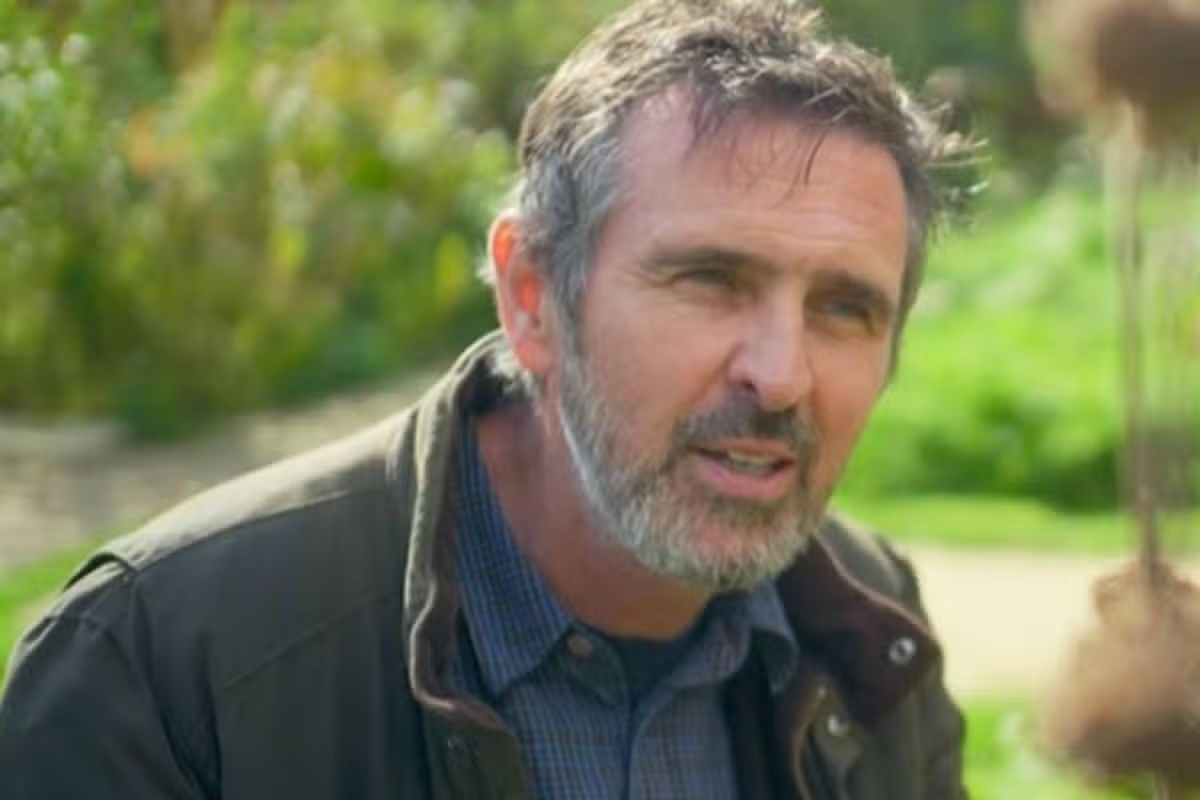
Gardeners’ World star Adam Frost has been a familiar face on the BBC show for years, but there is one garden design request he simply can’t bring himself to carry out.
09:23, 06 Jul 2026Updated 09:24, 06 Jul 2026
He made his feeling towards giant outdoor chess pieces known(Image: BBC)
Adam Frost has disclosed he knocked back one individual’s gardening request.
Making an appearance on the most recent instalment of Sunday Brunch (July 5), he chatted with Tim Lovejoy and Simon Rimmer regarding his new podcast alongside Caitlin Moran.
Yet during their chat, Tim pointed out that Adam harbours a loathing for outdoor chess boards, with the BBC presenter confirming this.
He responded: “The massive, plastic chess sets. You go to a hotel, or even people put them in their garden!”
“They pave a huge area, and they have these plastic chess pieces that slowly change colour. Really, kids just use them to attack each other.
“If you want to play chess in your garden, buy a board, a set, take it out into the garden around a table with a nice drink. Civilised. Don’t do that plastic, no.”
While Tim suggested it’s an ‘immersive experience’ having the pieces exceptionally oversized, Adam was swift to dismiss this, reports the Express.
He continued: “That’s not immersive! How is that immersive? No. It’s a complete and utter waste of space.”
When swimmer Mark Foster queried whether it might resemble a form of artwork in a garden, Adam appeared utterly bewildered by the notion.
The Gardeners’ World presenter went on: “I can remember, first doing a landscape job very early on when I had a small landscape company and someone wanted me to lay a checkerboard paving pattern in their back garden.
“I refused, very politely. I just couldn’t do it. It’s just a no.”
This follows Adam’s candid reflections on the bittersweet nature of relocating, which took place towards the end of last year.
The BBC presenter recently returned to his previous home, which has since been taken over by a new couple.
Adam described the conflicting feelings that come with leaving behind a cherished garden as he said: ” I walked around with them [the new couple] and they are absolutely loving it.
“And I think that’s a great thing to hold on to, is the fact that maybe you’ve just left somebody else a whole load of joy.”
Sunday Brunch airs on Sundays on Channel 4 from 10am.
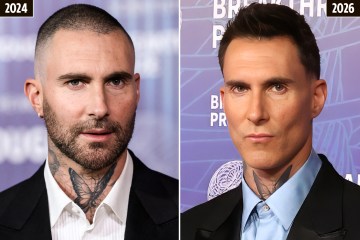
Maroon 5 singer Adam Levine got emotional on stage at BST Hyde ParkCredit: The SunThe 47-year-old fought back tearsCredit: The Sun
Adam told the crowd at BST Hyde Park, which is sponsored by Vodafone: “This band playing Hyde Park was one of his dreams for us. And we’re making it true now and it’s un-f***ing-believable.
“It’s bittersweet because he’s not here tonight. So, this of course goes out to Jordan, our friend. My friend since I was born.
“I think that some of these songs mean something different to every single person that appreciates them.
“I know that you’re all thinking of someone and all that energy, it kind of comes together, especially on a beautiful night.
“Take a look around you guys, it’s unbelievable. Look at all this, it’s crazy.”
Jordan guided the band since its launch in 1994 until his sudden death from a pulmonary thromboembolism, a blood clot in the lungs, almost nine years ago.
Memories, which was released in 2019, includes the lyrics, “here’s to the ones that we got, cheers to the wish you were here, but you’re not” and “toast to the ones here today, toast to the ones that we lost on the way”.
Speaking previously about his childhood friend and long-time manager, Adam said: “It was a tragedy foisted upon us and far and away one of the saddest moments of our lives, and personally of mine.
“This is a kid I’ve known since we were in diapers. He was one of the most important people in my life from a very early age.”
He closed out the rendition of Memories by pointing to the sky in honour of Jordan.
Adam’s emotional speech on behalf of the six-piece band was met with cheers.
It was a fitting moment during the nostalgic evening, which saw Maroon 5 perform their greatest old-time hits including Sunday Morning and She Will Be Loved.
One Republic,Jess Glynneand Ella Eyre had earlier performed throughout the day.
The lead singer of Maroon 5 made his late manager’s dream come trueCredit: GettyAdam’s the lead singer of the six-piece pop rock bandCredit: Getty
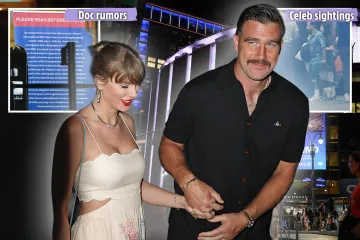
Taylor Swift and Travis Kelce are finally married.
After 16 full-length albums, a batch of brutal breakups, and a record-breaking world tour, Taylor, 36, has officially locked down her prince charming.
Sign up for the Showbiz newsletter
Thank you!
Taylor Swift and Travis Kelce have finally tied the knotCredit: GettyScreens outside of Madison Square Garden read “JUST&T MARRIED!” on FridayCredit: ReutersTaylor’s distinct gray SUV was seen near Madison Square Garden around 6:30pm on FridayCredit: Felipe Ramales for the U.S. SunAdam Sandler officiated Taylor and Travis’ wedding and was spotted by The U.S. Sun on Thursday at MSG ahead of the rehearsal dinnerCredit: Felipe Ramales for the U.S. Sun
Some stars spotted include Ed Sheeran, Karlie Kloss, Dakota Johnson,Bradley Cooper,Zoe Kravitz,Erin Andrews,Matthew Stafford andGraham Norton.
Soon after the couple exchanged vows, Dior revealed that the bride and groom’s looks were created by Jonathan Anderson, Creative Director of Dior Women’s, Men’s and Haute Couture Collections in close collaboration with the bride and groom.
This was the designer’s first couture wedding dress for a world-renowned celebrity.
The newlyweds had custom shoes made by Christian Louboutin and Taylor wore Cartier jewelry.
Most read in Entertainment
The designer brand also confirmed that the couple did not have any bridesmaids or groomsmen.
Instead, Taylor’s brother Austin Swift served as her Man of Honor, and Travis’ brother, former Philadelphia Eagles star Jason Kelce, was his Best Man.
“The ceremony joined both families together and was officiated by friend Adam Sandler,” the press release read.
Adam Sandler, his wife and daughters were spotted at MSG on ThursdayCredit: Felipe Ramales for the U.S. SunTaylor’s childhood best friend, Abigail Anderson, was seen leaving a hotel ahead of the wedding on Friday, leaving fans wondering if this was a bridesmaid dress revealCredit: GC ImagesLaura Kruk, the soon-to-be wife of New York Giants wide receiver Juju Smith-Schuster, was seen in the same dress, but it was later confirmed Taylor had no bridesmaidsCredit: Felipe Ramales for the U.S. SunTaylor and Travis wore custom Dior outfits and custom shoes made by Christian Louboutin at the weddingCredit: Getty
Taylor’s childhood best friend,Abigail Anderson,and Laura Kruk, the soon-to-be wife ofNew YorkGiants wide receiverJuju Smith-Schuster, stepped out in the same $795 gown with a floral corset-style bodice and a contrasting brown satin skirt, leaving fans suspecting the bridesmaids dressed had been revealed.
But it now appears to be a moment of matching as Dior confirmed the popstar had no bridesmaids.
The skies of New York City opened up soon after it was announced the couple was officially married, with people outside of MSG running to get away from the pouring rain.
Rumors had been circulating in the days leading up to the big ceremony that the couple had already wed in a private ceremony.
Travis Kelce’s close friend Ross Travis was seen making his way to the wedding on Friday afternoonCredit: Felipe Ramales for the U.S. SunTaylor’s aunt Joan Bender Rice and uncle Don Blalock were also seen heading out to the weddingCredit: Felipe Ramales for the U.S. Sun
But, Rick, one of Taylor’s relatives, exclusively told The U.S. Sun outside the Ritz Carlton in NYC on Friday, “The ceremony is today.”
“All the rumors are nonsense. Taylor and Travis haven’t got married. They are taking their vows today.”
The Kansas City Chiefs tight end popped the question after two years of dating in a private, at-home proposal surrounded by hundreds of flowers.
Their wedding comes after months of speculation from fans as to when and where the Swift-Kelce wedding would be held.
Taylor’s brother Austin Swift(pictured in 2014) served as her Man of Honor at the weddingCredit: GettyTravis’s brother Jason Kelce, a former NFL player with the Philadelphia Eagles, took on the role as the Best ManCredit: GettyTaylor Swift fan were seen outside of Madison Square Garden hoping to catch a glimpse of the wedding on FridayCredit: EPAA young Swiftie was seen near Madison Square Garden with handmade signs referencing Taylor’s song lyricsCredit: Reuters
The couple ultimately chose to tie the knot at Madison Square Garden with a rumored 1,000 guests in attendance.
An entertainment executive said the multi-day extravaganza would kick off with an intimate affair at MSG on July 2, according to a bombshell report from the New York Times.
The private event would then be followed by a much larger ceremony in the same venue on July 3.
Some of Kelce’s Kansas City Chiefs Teammates were reported to have booked blocks of rooms at the Marriott Marquis in Times Square as well.
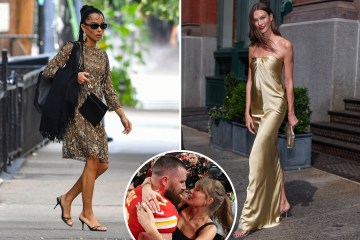
Karlie Kloss was spotted heading to the wedding in a gold dress with a matching gold clutchCredit: GettyJack Antonoff, a singer-songwriter who recently worked with Taylor on The Tortured Poets Department album, attended the weddingCredit: TheImageDirect.comSinger Camila Cabello was seen in a lace gown as she left the West Village to head to Madison Square GardenCredit: GettyBradley Cooper was seen heading to the ceremony in a black suit and black bow tieCredit: BackGrid
A permit had reportedly been filed to shut down the streets surrounding the Garden from July 2 through July 4 – a major holiday weekend – and there had been no public events booked at the venue from June 29 through July 6.
Amtrak police were also reportedly warned well in advance of the impending celebrity nuptials.
In the months leading up to their nuptials, it was reported that Swift had actually been planning to completely transform her $32 million mansion in Rhode Island for the fairytale wedding.
Fans also believed the seaside ceremony would be held on June 13 – a reference to the Out of the Woods singer’s lucky number 13.
A source close to Swift told The U.S. Sun that she had planned to create a new garden at her home as the couple reportedly planned to drop $1.2 million on flowers alone.
Swift apparently began planting her preferred flowers in the new garden “months in advance,” gravitating toward red roses, hydrangeas, orchids and peonies.
“She wants the entire celebration to feel like a wave of flowers, with arrangements of white, purple, and pink orchids, plus blue, white, and pink hydrangeas, and peonies in pink, white, and red tones,” the source claimed.
“Taylor dreams of being fully surrounded by flowers, with lush floral bushes everywhere, making her teenage dream of marrying in a sea of flowers come true.”
Florals aside, The U.S. Sun previously revealed that the couple was planning to drop $8 million alone on security for the event.
The insider told The U.S. Sun that Swift had planned to create a “multi-day celebration” from Friday to Sunday for her wedding weekend, making it a “unique, unforgettable memory they’ll cherish for the rest of their lives.”
In terms of security, Madison Square Garden is ideal for the global superstar, as the venue features no windows, a large capacity and guaranteed privacy from rabid fans and paparazzi desperate for a glimpse at the high-profile couple.
Leading up to the wedding, neither Swift nor her NFL heartthrob had publicly discussed their wedding plans – leaving it all up to speculation.
More to follow… For the latest news on this story, keep checking back at The U.S. Sun, your go-to destination for the best celebrity news, sports news, real-life stories, jaw-dropping pictures, and must-see videos.
A-LIST celebrities have begun to arrive for Taylor Swift’s rumored rehearsal dinner on Thursday ahead of her lavish wedding.
Taylor and Kansas City Chiefstight endTravis Kelce are expected to tie the knot at Madison Square Gardenon Friday in front of around 1,000 guests.
Sign up for the Showbiz newsletter
Thank you!
Adam Sandler was seen arriving at Madison Square Garden on Thursday afternoonCredit: Felipe Ramales for the U.S. SunTravis Kelce and Taylor Swift are reportedly getting married on Friday at Madison Square Garden in New York CityCredit: GettySelena Gomez shared a video of herself in a car reportedly heading to Taylor Swift’s rehearsal dinnerCredit: Instagram / selenagomezTaylor’s close friend and main musical collaborator Jack Antonoff was also spotted in New York CityCredit: TheImageDirect.com
A few celebrities were spotted in New York ahead of the couple’s big day, where roughly 100 guests are expected to attend the rehearsal dinner on Thursday evening.
The comedian was dressed in his signature casual style, wearing shorts, a baggy shirt and sneakers and appeared to be joined by his wife, Jackie, and their daughters, Sadie and Sunny.
Travis joined the big screen alongside Adam in the sequel to the classic film Happy Gilmore and invited the movie star to his podcast, New Heights, which he hosts with his brother Jason Kelce.
On the podcast, Adam talked about taking his two daughters to the Eras Tour concert film premiere.
“What a girl … She means so much to our house,” Adam said of Taylor.
Selena Gomez shared a video on her Instagram story on Thursday of her in a floral lace black dress applying one of her Rare Beauty lip products, possibly on her way to the rehearsal dinner, although it has not yet been confirmed.
She paired the dress with a pair of Flicker earrings,featuring 1.92 carats of pear-cut diamonds totaling $29,000 and an $11,000 Flicker ring, according to Page Six.
Most read in Entertainment
Selena and Taylor met in 2008 and were first spotted together stepping out to dinner with Nick and Joe Jonas, whom they were respectively dating at the time.
In a 2020 interview withWSJ Magazine,the duo opened up about their friendship, which Taylor compared to “sisterhood.”
“I knew from when I met her I would always have her back. In my life, I have the ability to forgive people who have hurt me. But I don’t know if I can forgive someone who hurts her,” Taylor said of Selena.
Jack Antonoff, Taylor’s close friend and main musical collaborator who recently worked on The Tortured Poets Department, was also spotted in New York City, dressed in a white-collared shirt and dark blazer.
His sister Rachel was also spotted in New York City, dressed in a long pink frilly gown and a red purse.
San Francisco 49ers tight end George Kittle and his wife Claire were spotted in New York City ahead of the wedding.
Jack Antonoff’s sister Rachel was also spotted in New York City ahead of the reported rehearsal dinnerCredit: TheImageDirect.comAdam Sandler’s wife and kids appeared to arrive with him at Madison Square GardenCredit: Felipe Ramales for the U.S. SunSan Francisco 49ers tight end George Kittle and his wife Claire were seen in New York CityCredit: Katy Forrester for the U.S. SunTaylor’s distinct gray SUV was seen outside Madison Square Garden but the bride-to-be has yet to be spottedCredit: Felipe Ramales for the U.S. Sun
The fellow NFL player will apparently not be attending the rehearsal dinner, but will attend the wedding, which he told ExtraTVhe plans to give Travis an old coin despite the couple saying “absolutely no gifts.”
Supermodel Gigi Hadid and actor Bradley Cooper were seen heading to the rehearsal dinner, with Bradley in a formal suit and vest, in photos obtained by Page Six.
The main wedding ceremony is expected to take place on Friday, although it remains unclear if it will be a legal wedding or a lavish celebration as rumors circulate that the pair are already married.
Travis’ longtime friend Reggie “Regrunt” King and his wife, Sarah, are also expected to attend in addition to several people in sports media, like sports commentator Charissa Thompson and sports reporter Erin Andrews along with her husband, former NHL player Jarret Stoll.
Celebrities close to Taylor have been spotted around New York City, including Suki Waterhouse, who opened for one of Taylor’s Eras Tour shows in London.
A tent was seen being set up outside of Madison Square Garden ahead of the rumored weddingCredit: Jessica Finn for the U.S. SunA catering truck from Sartiano’s, one of Taylor’s reported favorite New York restaurants, was seen outside of MSGCredit: BackGridPink curtains were hung up inside Madison Square GardenCredit: Jessica Finn for the U.S. SunTaylor Swift’s bodyguard was seen outside Madison Square Garden appearing to direct carsCredit: Felipe Ramales for the U.S. Sun
Suki told Variety in an interview published in May that she will be attending and hopes to gather inspiration for her wedding to her fiancé Robert Pattinson.
“I’m gonna go to Taylor’s wedding, and maybe I’ll get some inspiration It will be amazing,” she said.
Graham Norton, an Irish comedian and actor who made a cameo in Taylor’s music video for her song Opalite, touched down at John F. Kennedy International Airport alongside his husband Jono McLeod.
Taylor’s pal, English actress Phoebe Waller-Bridge, was also seen in New York City with her family ahead of the celebration.
Taylor and Travis’ full guest list has not yet been revealed, but some eagle-eyed fans speculated singer Katy Perrymay not be in attendance as she is set to perform in the UK on their rumored wedding day.
Some other famous faces are expected not to be attending, such as Blake Lively,Ryan Reynolds,Charli XCX andMatty Healy following past fallouts.
ADAM Thomas has revealed that he was ROBBED in a local corner shop by the owner.
The actor, who appeared on the latest I’m A Celebrity All Stars, explained that he was charged £100 for a couple of bags of sweets.
Sign up for the Showbiz newsletter
Thank you!
Adam Thomas revealed the shock moment he was ROBBED in local supermarketCredit: At Home With The Thomas BrosThe actor said the owner of the shop charged him £100 for a few bags of sweetsCredit: Shutterstock Editorial
Adam was left stunned when he confronted the shopkeeper, who told him he didn’t think the soap star “needed the money” after his latest stint on the ITV jungle show, where he received a sizeable fee for his appearance.
The Emmerdale star said he spotted the error on the card reader after he had already paid for it.
Speaking on At Home with the Thomas Bros podcast, Adam said: “I got robbed the other day!’
“Listen right, so I went to my local off-licence, I was buying some sweets for the kids, and I went to pay for it, and I paid for it, and then I looked at the card machine, and it said £100, and I was like ”bro what are you doing?”
Adam had a tough time in the jungle after he admitted he felt ‘bullied’ by some campmatesCredit: Shutterstock EditorialThe Waterloo Road star said he had finally moved on from his I’m A Celeb feud dramaCredit: ITV
He went: ”Come on you don’t need it!” and I was like ‘what do you mean I don’t need it?’”
Adam went on to say that the owner told him: ”You’ve just come off the jungle man, you don’t need it’.”
He continued: “I looked him dead in the eyes, and don’t get me wrong I had a banter with this guy, we have a little bit of a laugh back and forth and everything. I was just a bit caught off guard.
“That’s what I think, he’s getting his money back. But I was like ‘bro you can’t do that’.
‘He said ‘oh come on man, you don’t need, I need some money, I need some.’
“I said ‘I listen, I like you and everything, but don’t take the p**s out of me’.”
The Waterloo Road star revealed that the owner finally paid him back and apologised for it.
“Weeks passed and everything, and I sort of forgot about it, and I was walking through my village again, and I went in there, and he was like ‘bro where have you been? You’ve not been back, I’ve been wanting to give you the money, come in, come in, come in,’ and he was so apologetic.
“Like counting the money out, and he was giving it to me, and he was like, ‘I’m so sorry, like I was just doing it as a joke. I didn’t really mean to offend you or anything like that.”
“And I felt really bad, and at one point I was gonna go ‘you know what, keep the money, it’s not about the money.”
“And anyway, he gave me my money back, and then I ended up giving him the bacon roll, and the croissant.”
Last month, Adam said he had finally moved on from his I’m A Celeb feud drama, saying “a weight has been lifted” from his shoulders.
On a recent episode of their podcast, Adam’s brother Scott noted: “Ever since all this jungle stuff, you’ve become a proper man, mate, you’ve got a different presence. You’ve god a new strength, mate, about you.
“Even the way you talk, everything.”
Admitting he agreed, Adam responded: “I don’t know, I feel like, for months, I just feel like there was a big dark cloud over me.
“It was for a while until after the final. And then, literally, about a week and a half after the final, I was like, ‘Oh my god, it’s gone’.”
As Scott, Adam and brother Ryan continued to discuss the tough time, the jungle winner admitted he was finally feeling back to his best.
“I just feel like a big weight has been lifted.
“Even when I did the podcast when I first came out, it was straight after as well so I was resenting it a lot, I was angry a lot, I was sad.
“But now I can see the light between the trees a little bit. I just feel like, you know what? It was what it was, it was meant to be, that was my journey and I feel like a better man for it.”
Following the chaotic I’m A Celeb live final, which saw boxer David and former footballer Jimmy stand against Adam, the actor broke down on tears on his podcast with Ryan and Scott.
At the time, he said: “I’m just tired, I want it all to go away and just be forgotten about.
“The sad truth is that everyone will go on with their lives but for me, this will be in for me the rest of my life”.
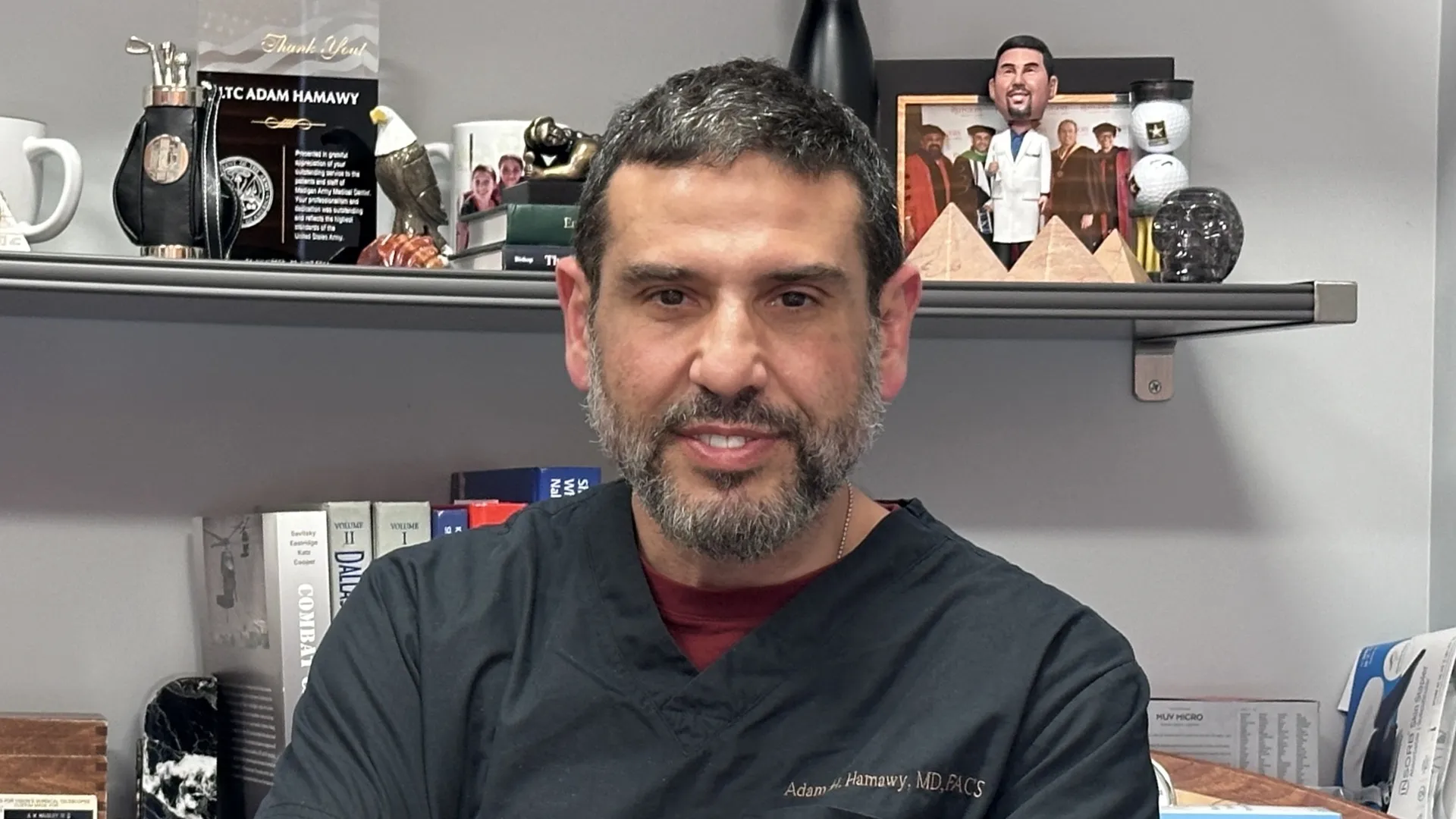
A former US Army combat surgeon who volunteered at Gaza hospital has a Democratic primary in New Jersey. Here’s what you need to know about Adam Hamawy.
Ant McPartlin and Dec Donnelly have had their say on the I’m A Celebrity live final, which descended into chaos when Adam Thomas was crowned champion
10:14, 30 Apr 2026Updated 10:14, 30 Apr 2026
The final descended into chaos(Image: Jonathan Hordle/ITV/Shutterstock)
Ant McPartlin and Dec Donnelly have waded in on the I’m A Celebrity pay row after Jimmy Bullard raged about losing his fee for wanting to quit the show.
Ex footballer Jimmy had said he wanted full pay and that was why he decided to call out ‘I’m a celebrity get me out of here’ during a trial rather than in camp sparking a huge row with Adam Thomas. Jimmy said for his own reasons – thought to be his father’s health – he wanted to go home, but because of his contract, he would have to lose a trial rather than ask to leave early.
During an extraordinary moment in the final, Jimmy said: “Listen, Adam and all of you can be upset with me and I absolutely threw him under the bus, I get it and I’ll wear that.
“But what I don’t stand on, is someone being abusive, aggressive and intimidating, I don’t stand on that.” He then called on Ant and Dec to have their say on what happened.
Speaking for the first time in their podcast about the live fallout, Ant and Dec appeared to side with Adam as they suggested he was used as ‘collateral damage’ in Jimmy’s plan.
“Jimmy used Adam as collateral damage,” said Ant. “We tried to be professional and keep it on track. It was a real shame – we were supposed to hear from every person.
“The whole thing was weird to me,” he added. “Which is why I said quite firmly on the night said I disagree.”
Asked on the night why he quit, Jimmy said: “There were a lot of heavy reasons, which I don’t want to go into now. Also, [I told Ollie], can you talk me through my contract? Because my contract’s pro-rata. Let me give you an example, if I go home and call Adam back with me, I get full pay. That money’s big for me and my family.
“If I go home, stay in, and go back and pull the plug, I get a small percentage of that. I made my mind up in that lightbulb moment – I have to go home. Then all hell breaks loose. You can all be upset. I threw him under the bus. I absolutely get it. I’ll wear that. But what I don’t stand on is someone being abusive, aggressive or intimidating. I don’t stand on it. You didn’t show none of that. None of the C-words. You didn’t.”
The pair also clarified what happened between them and David and Jimmy in the car park, which was snapped by paparazzi.
“It was certainly talk about TV, I wouldn’t call it great but anyway we had a laugh and we were cool and then I’ve walked off and seen Jimmy Bullard and I just shook his hand and I was like ‘look after yourself’ and he was like ‘yeah, yeah cheers, cheers, cheers’. So there was no confrontation. I wasn’t flanked by two security guards as it said in the paper.”
Setting the record straight Ant insisted there was no argument in the car park, with Dec adding: “I saw David Haye and he said ‘what about that then, hope you get some good ratings for that one.'”
Ant also added: “I just felt it was a shame the crowning moment of I’m A Celebrity South Africa couldn’t have been more celebratory. If anything, remember it for Craig Charles having a bath in the washing up bowl – that’s how I would remember it.”
Adam Thomas has claimed David Haye lied to him while they were in I’m A Celebrity… Get Me Out Of Here! South Africa camp, leaving the actor at a complete loss for words
Daniel Bird Assistant Celebrity and Entertainment Editor
22:37, 29 Apr 2026
Adam Thomas has opened up about a conversation with David Haye(Image: YouTube/AtHomeWithTheThomasBros)
Adam Thomas has claimed David Haye lied during their time on I’m A Celeb. The Waterloo Road star was crowned the winner of I’m A Celebrity… South Africa last week during a tense live final.
Throughout the series, former boxer Haye came under fire for comments he made, including branding his girlfriend, Sian, an “ugly duckling”. He said: “She’s like tall, blue eyes. She’s lovely. She’s got the personality of a proper ugly bird.” He added that “ugly girls” need to have “a personality and banter,” to overlook “the fact that they’re not aesthetically amazing”.
Elsewhere, when Adam, who suffers from psoriatic arthritis, stated he didn’t feel physically able to take part in a trial, Haye branded him “useless,” adding he didn’t “give a s**t”. While the pre-recorded show was airing, Adam explained that he felt “broken” in the camp and considered leaving.
Adam has now spoken out on his podcast, claiming that David lied to him in an attempt to rile him up. Despite his struggles in the camp, Adam never spoke to anybody about his feelings. “I didn’t talk about it to anyone,” he told his brothers, Scott and Ryan on At Home With The Thomas Bros.
He went on to say: “It wasn’t until I was with David, and I came back from this trial, and he was goading me about fainting, that’s when I finally had the courage to go, ‘Listen, shut up now, enough is enough’.
“He got pulled to the Bush Telegraph, and then he came out and he sat me down and said, ‘They’re worried about your mental health. They’ve told me to stop now. Have you been crying about me in there?’
“So that was when I realised, I was like, ‘So, they know, they know what’s been going on’, and that upset me more. Because it’s the fact that I’ve never once talked about [David] or mentioned what [David’s] done to me in here to them.”
Adam later confronted the producers of the show to ask why they would disclose such information to David, who confirmed that there had been no conversation about Adam’s mental health. “I asked David when I got out and he said ‘Yeah, I just made it all up,'” Adam said.
He fumed: “I was like, ‘Wow, you really fu***ng manipulated the s*** out of me!'” Following the dramatic final, Ant and Dec broke their silence tonight, branding it “weird”.
In the preview to their podcast Hanging Out with Ant & Dec, the duo joked about the chaos from the event, with Ant joking, “If you didn’t see it, I bet you read about it!”
“It was quite the night!” said Dec, promising to explain the “ins and outs” of the event. Ant replied: “It was a weird night of TV,” adding that there were “walk-outs” Highlighting the main topics of the upcoming podcast episode, the pair promised to discuss Jimmy Bullard as Dec said: “The first question was to Jimmy about why did you call I’m a Celebrity, Get Me Out of Here.”
Ant added in response: “On the night I said I disagreed with him,” likely speaking about Jimmy Bullard, whom Ant publicly disagreed with when Jimmy asked him to confirm that Adam was aggressive on the show.
Adam Thomas has revealed David Haye reached out to him following his I’m A Celebrity win, but admits he fired back a blunt response as he opens up on his tough journey in camp
07:39, 29 Apr 2026Updated 07:42, 29 Apr 2026
Adam Thomas and David Haye(Image: ITV/Shutterstock)
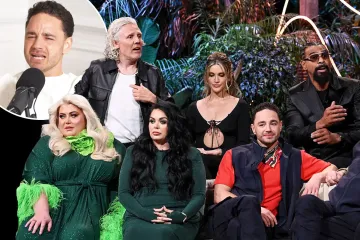
Days after the chaotic final, Adam Thomas has candidly opened up on his time in the I’m A Celebrity camp and explained exactly what went on between him and ex-boxer David Haye. The duo were embroiled in a bullying row on the ITV show and soap star Adam has now had his say.
The actor said he feels ‘dead inside and numb’ and claimed he wouldn’t have appeared on the show again even if he was paid ‘£10million’ , saying the ordeal has ‘eaten away at his soul.’ Adam said he felt the colour ‘drain from his face’ when Ant and Dec announced him as the winner as his worst nightmare came true.
While David is reportedly planning to sue the broadcaster for their portrayal of him in camp, Adam admits he believes the footage showed was the truth. He also revealed that David, who insists his alleged ‘bullying’ was nothing but ‘banter’ reached out to him over the weekend.
Speaking on his The Thomas Bro’s podcast with brothers Scott and Ryan Thomas, Adam said: Adam went on: “The most disturbing is that I look at David and even after the show and after everything he did, you know he sent me a voice note and was like ‘oh mate, what a great show that was. I’m so happy you won. Congratulations.'”
And he revealed the blunt message he sent his former campmate back. “I just sent him a message back just saying, you know ‘I think this is where we draw the line and I hope that you find happiness bro, but I’m done.'”
Adam said: “The relationship with me and David is even after the camp, even after he told me [out of camp] ‘you’re the nicest guy I’ve ever met and I just wanted to break you’, like, it’s cool. He apologised. I moved on.
“You know, we had voice messages back and forth and we’d just been bantering and having a laugh. I’d just put it all to bed. I think for David and some of the campmates that have come out and been on the live show and everything, I feel like it’s just a show for them. It’s entertainment. It’s fun. For me, it’s not about entertainment. I’m not playing a character or here for anyone else’s agenda. I’m just here to have a laugh and have fun and enjoy this experience.”
The actor said he felt he was “exploited” in the live show. “I think you can see at the end of it, I felt like I was just in the mist of it all and it wasn’t even about me.”
In camp, David was slammed for branding Adam “useless” after he declined to participate in a trial due to a medical condition. Meanwhile, Adam and Jimmy clashed when Jimmy withdrew from a trial, leaving Adam at risk of being sent home early.
Despite the show being filmed months in advance, things hadn’t eased between the trio. On Friday, as Adam was crowned, Haye reportedly goaded the star saying: “You’re not a worthy winner,” before Adam fumed: “This is bullying.”
Gemma Collins stuck up for Adam after his win, calling out David and Jimmy’s actions. Sharing a snap of the star wearing his crown, Gemma fumed: “What a show up!!! Absolutely disgusted with Jimmy and David’s behaviour, the biggest show up in TV history!!! What an embarrassment! To all the took part in the show it was a discredit to the production crew, cast, Ant and Dec biggest disrespect ever!
“Last night was meant to be a celebration instead it was very upsetting!! X Let’s hope Adam will find some energy to absorb his victory!”