Will the Houthi attacks activate the Mecca Pact? | Houthis
Yemen’s Houthi rebels have captured Mocha port and now threaten to control the main waterway of the Bab al-Mandeb strait. They have also attacked several cities in Saudi Arabia, wounding about 70 people, including women and children.
The repeated attacks against Saudi energy, civil, and defence facilities, combined with the maritime blockage by Iran and its Yemeni partner the Houthis, directly raise the question of the Mecca Pact’s operationalisation between Saudi Arabia, Turkiye, and Pakistan.
The Houthi attacks on Saudi Arabia can activate the mutual defence agreement. If that happens, what could a Pakistani and Turkish intervention look like?
The answer to this question necessitates some crucial background first.
The US – the main security partner of the Gulf states – has signalled for a while now that it expects regional countries to take primary responsibility for their own defence and deterrence, with US help remaining critical but limited.
That posture is already visible on the ground. Since the start of the US-Israel war on Iran, the US has not been able to provide comprehensive defence for its regional partners. On several occasions, it has even failed to stop attacks on its own bases in the Gulf.
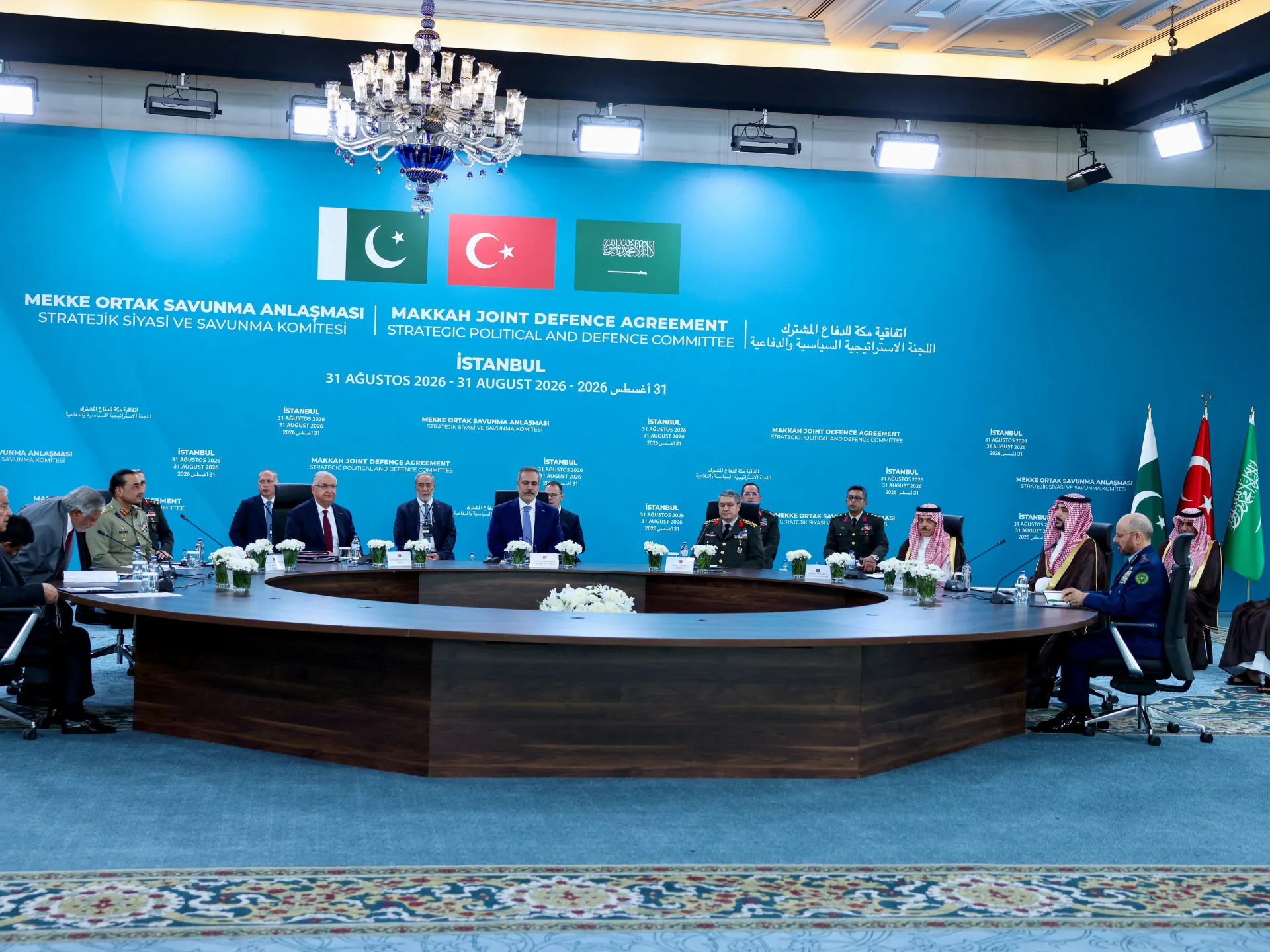
With US presence receding and Washington emphasising regional burden-sharing, Gulf states have had to look into a new defence architecture. In September 2025, Saudi Arabia and Pakistan signed their first mutual defence agreement, which expanded in August this year to include Turkiye and became the Mecca Joint Defence Agreement.
The three countries have since established a joint secretariat, with its headquarters in Riyadh, with Pakistan taking the chairmanship for an initial three-year term.
The pact remains in a gestation period. It does not publicly identify the thresholds or scenarios under which a member would move to direct military intervention. Its organisational and institutional structure, including rules of engagement, mechanisms of consultation, and collective defence and deterrence, are yet to be formally developed.
Now, back to the question of how the pact will be operational if a member state is attacked.
Earlier this week, Pakistan’s Defence Minister Khawaja Asif said that an unprovoked aggression against Saudi Arabia, or a spillover of the Yemen conflict into the kingdom, would make the Mecca Joint Defence Agreement operational, adding that “there should be no doubt in this.”
Asif, however, did not share specific details on what shape that operationalisation would take. Last month, Turkiye’s Foreign Minister Hakan Fidan clarified that the Mecca Pact would work the same way as NATO: If a member state is attacked, it must actively request and define the specific type of help it needs.
NATO’s Article 4 allows for a member to call alliance consultations and exchange of information. Article 5 requires mutual assistance from allies, but it leaves each state to decide the nature of that assistance.
In 2012, after Syria shot down a Turkish warplane, Ankara invoked Article 4 for consultation and requested specific defence assistance. Instead of demanding direct military intervention, the Turkish government explicitly asked for Patriot missile defence batteries. NATO approved the request and deployed the systems to protect Turkish airspace.
In this context, if the Mecca Pact is to be operationalised, it would have to be Saudi Arabia that defines the type of military assistance and involvement that it needs. If, for example, Riyadh makes an actual request for Pakistani direct military intervention, beyond materiel and intelligence support, Islamabad would be obliged to comply. But the request, and the scale of the response, would still likely need to be defined and agreed in a consultation meeting.
For now, none of this has been tested as Riyadh has not invoked the pact with either Pakistan or Turkiye.
In the meantime, diplomatic efforts have intensified, with Pakistani Field Marshal Asim Munir and Saudi Foreign Minister Prince Faisal bin Farhan Al Saud talking to Iranian Foreign Minister Abbas Araghchi.
Islamabad has also publicly urged Iran to rein in the Houthis from attacking Saudi Arabia and threatening the Bab al-Mandeb, and has reminded Tehran of Pakistan’s commitment to Riyadh’s defence through the pact. Ankara would likely play its own part in diplomatically restraining the Houthis and Iran.
If diplomacy fails and Houthi attacks on Saudi Arabia or the Bab al-Mandeb continue, Turkiye and Pakistan would likely expand the air and technological support they already provide. Islamabad already has an air squadron of about 16 JF-17 Thunder multirole aircraft, defence systems, and thousands of troops deployed in Saudi Arabia.
But a direct military operation by Pakistani forces inside Yemen remains unlikely at the moment. Given the disastrous and lasting impacts of its participation in the Afghan war against the Soviet Union on behalf of the US, Pakistan would be far more wary of joining a war against Iran and its allies, for fear of spillover into its western border provinces’ economy, domestic security, sectarian balance, and societal harmony. Pakistani leaders would find it hard to build domestic consensus for direct attacks on the Houthis or a fight with Iran.
The likely scenario is that Pakistan would increase joint diplomatic pressure on Iran to restrain the Houthis, further augment its support for Saudi defence, and push for a multinational naval coalition to secure the Bab al-Mandeb. Adopting this restraint would still keep the essence of the Mecca Pact intact, while putting more weight behind regional de-escalation.
The new security architecture that agreements like the Mecca Pact are setting up will take years to mature. Until the mechanisms and rules of collective response develop, Pakistan’s existing bilateral defence relationships with Saudi Arabia and other Arab partners will continue to focus on defence needs.
The views expressed in this article are the author’s own and do not necessarily reflect Al Jazeera’s editorial stance.