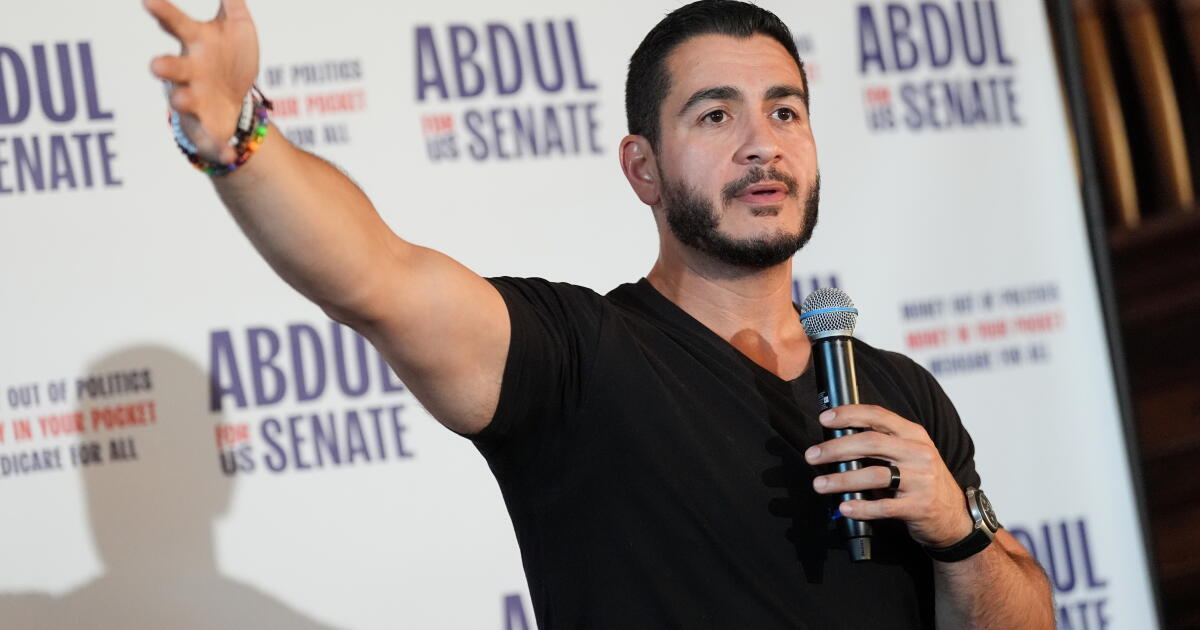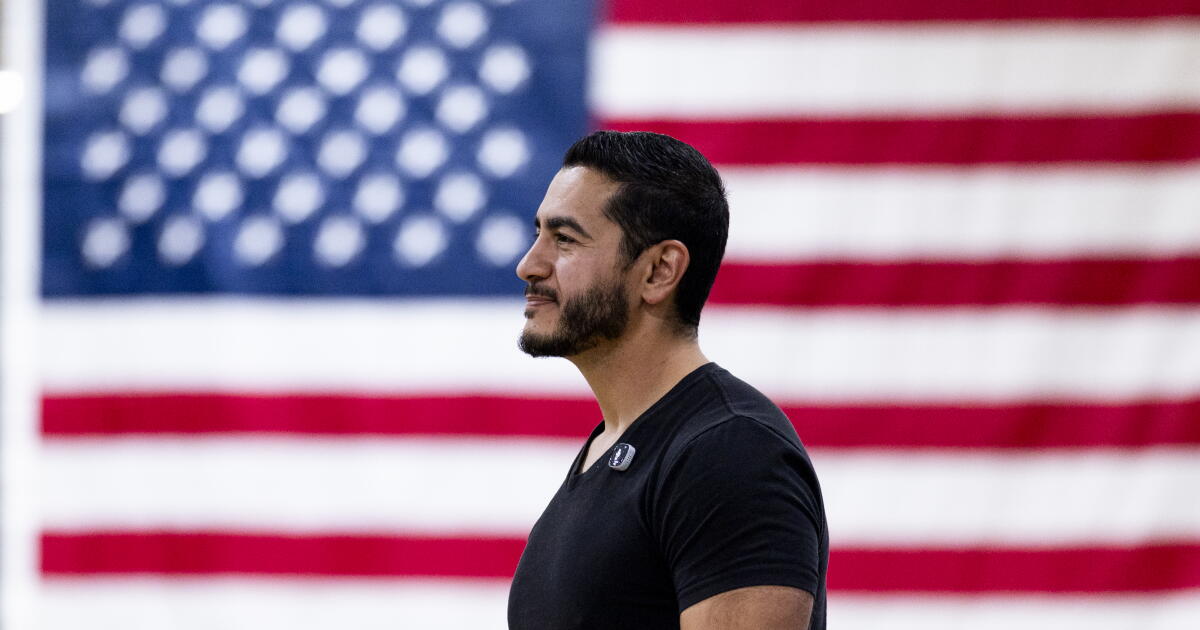
abdul el-sayed

Muslims have always had to prove our Americanness. Enter Abdul El-Sayed

Michigan’s Democratic candidate for the U.S. Senate, Abdul El-Sayed, is many things to many people.

He represents change, part of a new generation of outspoken leaders who aren’t afraid to challenge the status quo.

He represents possibility: As the son of Egyptian immigrants, his trajectory is the American dream realized.

And he represents a threat to those who fear that his Muslim faith means he can’t possibly love America. El-Sayed is a handy bogeyman for Republican politicians who seek to scare their constituents into voting for them instead of the foreboding Arab name on the ballot.

But for people like me — American Muslims, or anyone with roots in the Middle East, North Africa, South Asia or other Muslim-majority regions — El-Sayed embodies the exhausting experience of having to explain yourself over, and over, and over …

We know what’s truly going on when someone discovers our lineage, then apropos of nothing asks, “How do you feel about the Oct. 7 Hamas attack?” In previous eras it was, “What are your thoughts about 9/11? The Iranian hostage crisis? The PLO?”

Regardless of the decade, the underlying question was the same: How American are you, really?

For generations, the insinuation has been that your loyalty lies somewhere else and that you have a predisposed soft spot for groups such as ISIS or Al Qaeda. Beneath that Taylor Swift-loving exterior, there must be a Bin Laden fighting to get out.

It was disappointing but hardly surprising when El-Sayed was asked at a recent town hall in Caro, Mich., if he would “disavow the Muslim Brotherhood.”

The questioner, who identified himself only as Tommy, was referring to a century-old Islamist movement with branches that have been designated as terrorist organizations by various countries and U.S. administrations.

It’s worth noting that El-Sayed was born and raised in Detroit, not Egypt or Jordan. He attended the University of Michigan medical school, not a radical madrassa, and received a Rhodes Scholarship to Oriel College, Oxford, where he completed a doctor of philosophy in public health (not bomb making).

El-Sayed answered the question without hesitation. “Sure, yeah, absolutely,” he said, then swiftly turned the tables and began interrogating the motives of his interrogator.

“You’re asking the question because implicitly, you assume that I’ll have dual loyalties, right?” El-Sayed said. “You assume that I wouldn’t disavow, or that I’ll have some higher order allegiance than to the Constitution, correct? Tommy, is that what you imply?”

The candidate spent four to five minutes laying bare the political motives behind what was clearly designed to be a “gotcha” moment.

His opponent in next month’s election, former Rep. Mike Rogers, has claimed without evidence that the Muslim Brotherhood funds El-Sayed’s campaign and that his family members have terrorist links. The attacks are on brand with a wider Republican strategy around sinking El-Sayed. Fearing a blue tsunami might flip the crucial swing state, Rogers and his allies have leaned heavily into Islamophobic attacks against the progressive Democrat.

It’s a campaign tactic endorsed at the highest levels. President Trump has referred to El-Sayed as a “radical jihadist” and claimed he is associated with the Muslim Brotherhood, mispronounced his name, infused it with nonsensical babble and called him “Muhammad Al-Fayad.” Trump has defended his racism by stating: “I’m the president. I can call him whatever the hell I want.”

El-Sayed preferred to talk about another president while addressing Tommy’s question at the town hall. He recalled that John F. Kennedy faced similar scrutiny during his 1960 presidential campaign when asked whether his Catholic faith would make him loyal to the pope and Vatican rather than the U.S.

“His answer, famously, was that he was not running to be a Catholic president,” El-Sayed said. “He was running to be president that happened to be Catholic. I’m not running to be a Muslim senator. I’m running for the U.S. Senate and happen to be Muslim.”

The standoff between El-Sayed and Tommy (who has since been outed as Thomas Teepell, the son of a Republican strategist and a former staffer to Republican Sen. Josh Hawley) has gone viral and is now being referred to as a 2026 election Rorschach test because both the right and left believe they prevailed.

It’s unclear to me how anyone might see El-Sayed’s evisceration of Teepell’s means-to-an-end question as a victory for the right. Perhaps it comes from eight years of watching Barack Obama weather insidious and overt racist attacks with the patience of a Shaolin monk. El-Sayed reacted, therefore they won?

On the left, El-Sayed’s articulate defense was widely applauded, but there were still criticisms that he may have come off as condescending. Liberal podcasters and influencers opined that El-Sayed should have just let it slide — for the 1,000th time.

Such an easy solution when it comes from those outside the sphere of suspicion.

But the reason we’re even having this conversation is because El-Sayed is challenging the norm. His rise to a formidable candidate who is willing to publicly dismantle loaded questions like Tommy’s represents progress wrought by successive generations of immigrants who’ve had to explain themselves ad nauseam.

Our parents and grandparents went out of their way to avoid those kinds of questions by taming their accents, changing their hard-to-pronounce names or eating their “ethnic” lunches outside the break room. The hope was that they’d melt into the proverbial pot with as little friction as possible.

My father, who emigrated from Iraq, did what all his Arab friends did here in L.A. — fit in. They used Brylcreem to tame their thick hair, listened to Johnny Cash and used terms like “guys and gals” as if they’d just stepped out of an Elvis movie.

As the next generation, I made it a point to openly embrace what my dad often downplayed — that we are Arab and Muslim. But given the post-9/11 climate, it came buffered with calming disclaimers: We are not a threat. Al Qaeda does not speak for Islam. And dolma is delicious, dammit.

El-Sayed’s refusal to brush off questions aligning him with terrorists may or may not cost him the election, but it’s a victory for all of us who’ve been defusing suspicion since we were kids.

The clip from the town hall ends with El-Sayed asking Thomas if he’s a Christian who has tried to live by Christian doctrine. Thomas affirmed. Then El-Sayed asked, “Do you disavow any attempt to read any religious doctrine into the laws of our country?” Thomas responded, “I do not.”

El-Sayed replied, “I think it’s you who needs to understand the Constitution, not me.”


Source link

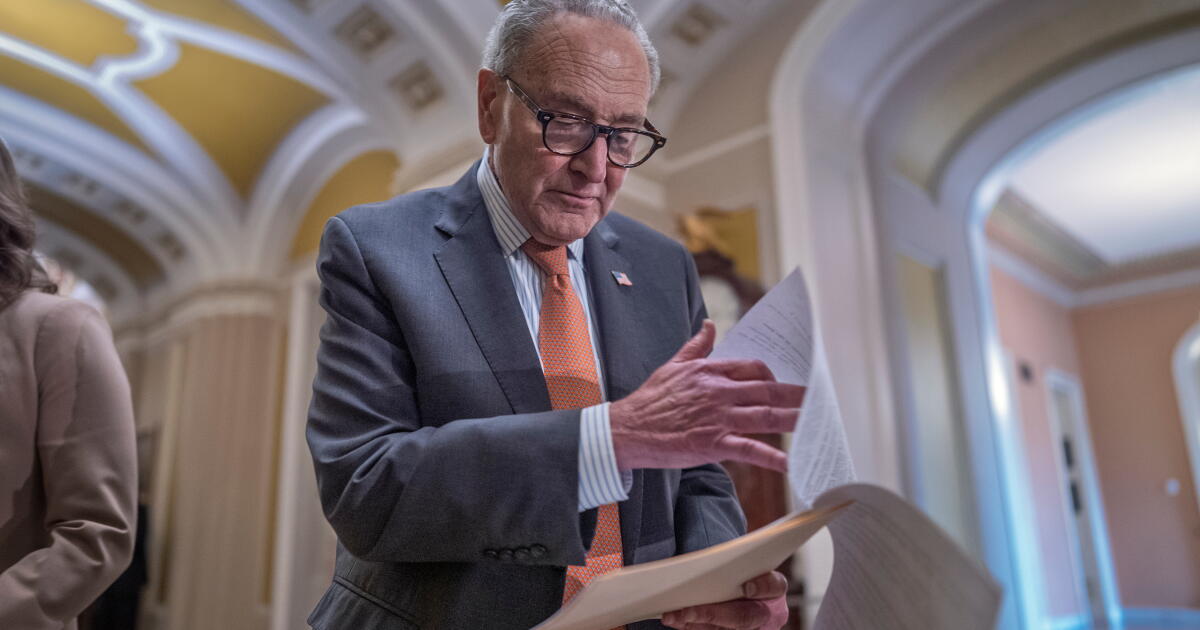
Chuck Schumer has broad support from his caucus, but midterms could decide his future as leader

Chuck Schumer has won and lost Senate majorities since becoming Democratic leader a decade ago. But this year’s midterm elections could be his most important yet, with some in the party having said he needs to step down and make way for a new generation.

Schumer, who has directly or indirectly overseen his party’s Senate campaign arm in almost every election cycle over the last 20 years, has regained trust within his caucus, for now, as Democrats are hopeful of making gains in the midterm elections despite a difficult map that favors Republicans.

Allies of the New York Democrat say it’s a significant turnaround from last year, when the party was still reeling from major election losses. A low point came in the spring of 2025, when the party’s base erupted at Schumer for voting to keep President Trump’s government open.

Interviews with more than a dozen Democratic senators in recent weeks indicate that Schumer has recovered his political standing with many in his caucus. If Democrats gain seats in the election, colleagues expect him to easily win enough support in the closed-door leadership election, likely the week after Election Day.

Should they win a majority, a feat once seen as improbable, another term as leader would be nearly assured, many said. Both parties pick their Senate leaders by secret ballot, so no senator has to reveal their vote.

Still, nothing is guaranteed. While no Democrat has stepped up to challenge Schumer, that could quickly change if his party suffers an unexpected level of losses. And several Democratic candidates around the country have said publicly that they won’t vote for Schumer or have remained noncommittal.

Interviewed by The Associated Press earlier this month, Schumer stated unequivocally that he’s running for another term as leader. He said he believes Democrats have won more favor with voters over the last year and have a shot at winning the majority after fighting Trump’s tariffs, forcing more than a dozen votes to end the war in Iran and focusing on affordability, corruption and healthcare.

“I think our caucus is strong, it’s united,” Schumer said. “A year ago, everyone said it was out of reach. Today, we have a broader map, strong candidates, a clear contrast.”

Sen. Sheldon Whitehouse, D-R.I., said that “Senate seats in some ruby red states seem to be in play” because of candidates Schumer recruited.

Oregon Sen. Ron Wyden, a Democrat who has served with Schumer for almost 30 years, said that “if you had told us in 2025 that we’d be in the home stretch with a really good shot of taking the majority, it would have been like, ‘You’ve got to be kidding me.’ You can’t argue with results.”

And if Democrats don’t win additional seats? “I’m not thinking about that,” Wyden said.

Some senators won’t commit to supporting Schumer

While Schumer appears to be in a good position at the moment, many Democratic senators won’t say publicly whether they will support him — particularly those in the most progressive wing of the party.

“It’s a little bit too early to speculate on that right now,” said Sen. Bernie Sanders, a Vermont independent who caucuses with Democrats.

Massachusetts Sen. Elizabeth Warren said she is focused on November’s elections. “We’ll know a lot more after the midterms,” she said.

Freshman Sen. Elissa Slotkin of Michigan has called for a “new generation” of leaders across the party.

“It’s not a secret that Democrats still haven’t totally found their footing after Trump,” Slotkin said in a recent interview, adding that “we have to see what the results of the election are.”

It’s unclear if anyone else wants the job

Even if there are losses in Senate races, it’s unclear if any other Democrat wants the burden of being leader. Many are instead eyeing runs for the White House in 2028.

Speculation about a challenge to Schumer has centered on Sens. Chris Van Hollen of Maryland, Chris Murphy of Connecticut and Brian Schatz of Hawaii, who has already said he’s running for the No. 2 leadership spot to replace retiring Illinois Sen. Dick Durbin.

Asked about Schumer, Van Hollen said he doesn’t want to discuss it yet.

“Look, I think everybody wants to get through this election, and then we’ll go from there,” Van Hollen said in an interview before the Senate left Washington to campaign.

Several Senate candidates around the country have either said they won’t vote for Schumer if they are elected or remained noncommittal, including Troy Jackson in Maine, Adam Hamilton in Kansas and Abdul El-Sayed in Michigan.

At the same time, the Senate Majority PAC, which is closely aligned with Schumer, has put millions of dollars into those campaigns and others. Schumer backed El-Sayed’s primary opponent, but the two met in Washington last month.

El-Sayed said after the meeting that the party is united and “we’re having really productive conversations about what it takes to win.”

Schumer has kept his caucus close

Several of the Democratic senators who insisted on anonymity to share their views agreed that Schumer is likely to win another term as leader. There have been very few discussions about a change, said one, partially because Schumer has stayed close to almost everyone in his caucus, keeping them on speed dial in his famous flip phone. Another senator said that they aren’t aware of Schumer asking for any commitments just yet.

At the same time, some said they would like to see Schumer, who is up for reelection in 2028, announce that this is his last term as leader and commit to helping transition to a successor. A commitment like that could end the conversation, one senator said.

Another senator said that a commitment from Schumer about the future isn’t as important — what will matter is if they win in November.

All of the senators agreed that there are no obvious contenders right now to challenge him, but that could change quickly if Democrats lose Senate seats in November.

Schumer has turned the tables since 2025

Attitudes within the Democratic caucus have improved since last year, when the base revolted against Schumer for the March vote to keep the Republican president’s government open. Progressive groups like MoveOn called for him to step down, arguing that Democrats needed to fight harder against Trump and Republicans.

Schumer regained some favor with Democrats inside and outside the Capitol during a prolonged government shutdown a year ago and as he has repeatedly blocked Trump’s nominees and Republican legislation.

But while the calls to resign or step aside have waned, many are still agitating for change.

“Our priority right now is organizing and making sure we elect a new generation laser-focused on affordability and fighting corruption,” said Joel Payne, a national spokesman for MoveOn.

Referring to the 2025 calls for Schumer to step aside, Payne said the group’s members have “already rendered a judgment on Schumer’s tenure and made clear they’re eager for new leadership that energizes the party base.”

It’s unclear, though, whether calls from the progressive wing of the party will influence the secret ballot vote, in which Schumer needs only a majority to win.

Sen. Ben Ray Lujan, D-N.M., dismissed the talk about Schumer’s future.

“It’s hard to lose if no one else is challenging you,” he said.

Jalonick writes for the Associated Press. AP writers Steven Sloan, Seung Min Kim and Joey Cappelletti contributed to this report.

Source link

Abdul El-Sayed embraces role as GOP foil, while defending progressive agenda

Abdul El-Sayed, holding a microphone and wearing his signature V-neck black T-shirt, slowly shook his head as a woman at his town hall described how she burned through her savings after undergoing emergency brain surgery.

“I’m really sorry for your experience, and I hope that you’re on the mend,” said El-Sayed, the Democratic nominee for U.S. Senate in Michigan, after outlining proposals for guaranteed healthcare and paid leave.

Later that night, while talking to reporters in the basement below the theater, his tone was far different. El-Sayed called his Republican opponent, Mike Rogers, a “coward” and said President Trump was “afraid” to visit the state, and he dismissed as “dumb” a question about whether Iran or Israel posed a greater threat to the United States.

The exchanges captured two sides of a candidate who is the central figure in one of the nation’s most consequential Senate races. El-Sayed would be the country’s first Muslim senator, and he’s crisscrossing the state to counter a Republican effort, fueled by tens of millions of dollars, to portray him as a dangerous radical. But he has also embraced his confrontational side by mocking and taunting Trump and Rogers.

“If they want to make me the main character in the midterms, I’m not shying away from it,” El-Sayed said in an interview. “Run against me. See how well that works out for you.”

El-Sayed’s resolute confidence rubbed some Democrats the wrong way during a divisive primary against Rep. Haley Stevens. The former public health official has shown little interest in toning it down, defending his progressive agenda and adversarial approach toward Republicans, emboldening supporters who believe he’s the right candidate for an angry electorate that has lost faith in the political establishment.

But his doubters fear he’ll cost Democrats control of the Senate by failing to unite his party’s disparate factions ahead of November.

“If you want their votes, you have to make nice with those people, and he’s not really doing that,” said Michigan political strategist Adrian Hemond, who supported Stevens. “Maybe he doesn’t have to. The entire theory of this candidacy has been he can remake what the electorate looks like.”

A Republican target

Even though Michigan backed Trump twice in his three presidential campaigns, no Republican has won a Senate race in the state since 1994.

The political landscape is no friendlier this year. Trump started an unpopular war with Iran, leading to higher gas prices and related inflation. Rogers has opted for a low-key campaign with fewer public events than El-Sayed as he tries to make the race all about his Democratic opponent.

As of Saturday, Republicans had outspent Democrats by $78 million to $63 million in the Michigan Senate race, according to AdImpact, which tracks political advertising. Around $40 million in Republican spending has gone toward negative advertisements, compared with around $20 million from Democrats.

The ads portray El-Sayed as “dangerously radical” and “too extreme,” highlighting his past calls to defund the police and relax immigration enforcement. Others tie him to Hasan Piker, a popular online streamer with whom El-Sayed has appeared and who has drawn criticism for past comments, including saying that “America deserved 9/11.”

On Friday, Rogers appeared alongside Louisiana Sen. John Kennedy, who told reporters that El-Sayed “sleeps in a Bin Laden jersey.” Rogers laughed.

Vice President JD Vance has called El-Sayed “evil.” In one social media post, Trump shared a photo of himself with First Lady Melania Trump alongside a photo of El-Sayed and his wife, who wears a hijab, with the caption: “Two VERY DIFFERENT America’s.”

Late Wednesday, Trump referred to El-Sayed as “Mohammed” and said he “goes back to the days of the Jihad.”

El-Sayed has hardly backed down. At the campaign stop in Port Huron, he taunted Trump and invited him to visit Michigan, suggesting Rogers and other Republicans were afraid the president would hurt their chances.

“Donald, if you’re watching, don’t wuss out, man,” El-Sayed said.

And he responded to Kennedy’s attack by suggesting the Republican is in the Ku Klux Klan.

“That’s rich coming from someone who wears his bed sheets out at night,” El-Sayed posted on social media.

A personal touch with voters

Before the Port Huron town hall, El-Sayed worked his way down a line of people who couldn’t fit inside the theater, shaking hands, taking photos and stopping for conversations.

Jeff Petrucella and his wife, Alice, traveled from Macomb County to see El-Sayed. They described themselves as politically “middle of the road” and said they had voted Republican in the past.

“I’m pretty done with the Republicans right now,” Jeff said.

Alice said she was “looking for a change that is better for my granddaughters,” pointing to El-Sayed’s support for Medicare for All. Nor was she put off by his more confrontational appearances on Fox News.

“I think he expresses himself well. You can tell he’s a well-spoken, educated man,” she said.

Pat Kreiner was among those who waited nearly an hour to see El-Sayed. Her children had persuaded her to support him in the Democratic primary.

“My son said to me, ‘I have been living with this trickle-down economy since the day I was born,’” Kreiner said. “‘It doesn’t work for me.’”

Kreiner also expressed anger about Trump’s trade war with Canada, just across the river from Port Huron.

“We are heartsick about our neighbors,” she said. “They used to come over a lot. We don’t see them now.”

Visiting smaller towns such as Port Huron has become central to El-Sayed’s campaign, with his team recently saying he’s held more than 500 events in over 100 cities across the state.

“Go everywhere. Talk to everyone. That’s what we do,” El-Sayed said in an interview.

The personal approach has not erased all the skepticism surrounding El-Sayed, including within his party.

His criticism of Israel and association with Piker have raised concerns among some Jewish Democrats. El-Sayed has held a series of private gatherings with undecided Jewish voters as he works to win their support.

He has also sought to strengthen his standing with Black voters. In the Democratic primary, Stevens drew more support in Wayne County, home to Detroit and its large Black population.

Ahead of Thursday’s debate, El-Sayed attended two events with Black leaders before stopping at a Black barbershop, where he moved from chair to chair talking with customers. He stopped at one point to speak with a pregnant woman, congratulating her and asking when her baby was due.

“November 8th? Make sure you vote early, huh?” the candidate joked.

A race about more than just Michigan

While El-Sayed has spent much of his campaign trying to win over Michigan voters, his candidacy has taken on significance far beyond the state. Republicans have made him a symbol of what they say is an increasingly radical Democratic Party, while progressives see his campaign as a chance to prove their politics can win in a closely divided state.

At a New York City fundraiser on Oct. 5, Rep. Alexandria Ocasio-Cortez cast his campaign as a test for progressives nationwide.

“If Abdul can win in Michigan, anybody can win anywhere,” said the New York Democrat, a potential presidential candidate.

Ocasio-Cortez plans to campaign with El-Sayed in Michigan this week, followed by former President Obama on Oct. 24.

The national stakes have also drawn renewed opposition. United Democracy Project, a super PAC affiliated with the pro-Israel group AIPAC, disclosed an initial $94,000 expenditure against El-Sayed on Friday, after spending nearly $30 million to oppose him in the Democratic primary.

And El-Sayed, while maintaining that the election should focus on Michigan voters and their economic struggles, has also embraced the larger implications of his candidacy.

“I am grateful for your support,” he told the audience at the New York fundraiser, according to remarks obtained by the Associated Press. He said he had two goals: “pick up a U.S. Senate seat” and “change the nature of our politics for the better.”

Cappelletti writes for the Associated Press.

Source link