A HOLIDAY park with glamping pods and lodges could be built on an old torpedo site in Scotland.
The former testing area for missiles has been derelict for 40 years, but could soon be completely transformed and become a go-to staycation spot.
Sign up for the Travel newsletter
Thank you!
An abandoned torpedo site could be completely transformedCredit: Friends of Loch Lomond and The TrossachsA holiday park with glamping pods and lodges could be built on the siteCredit: Framed Estates
Follow The Sun’s award-winning travel team on Instagram and Tiktok for top holiday tips and inspiration @thesuntravel.
On the shores of Loch Long in Argyll & Bute is an old Ministry of Defence site that was used been 1912 and 1986.
It was predominantly used during World War Two, and as many as 12,000 torpedoes were fired down Loch Long.
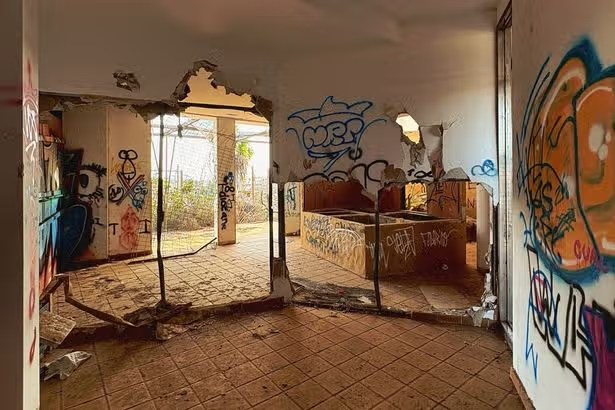
Since its closure 40 years ago, the site in Arrochar has been abandoned and left derelict.
A planning application to redevelop the area was first submitted in 2023.
Three years on, Loch Lomond & The Trossachs National Park Authority has approved a mixed-use tourism development by Ardnagal Estates.
Former proposals for the site included 14 holiday homes, 34 holiday lodges, and a 34-bedroom budget hotel.
Also included in the initial plans was a cafe, shop, a 40-bed bunkhouse, six motorhome pitches and 20 glamping pods as well as parking, composting toilets and shower block.
Another proposed feature was to revitalise the pier so that the public and community could access the loch.
Leisure on the site would include a play park that will add “family-friendly amenity for residents and visitors”.
Proposed plans are for a holiday park to be built on the former siteCredit: Framed Estates
Previous plans were to build a 130-bedroom hotel although it isn’t clear if this is part of the current plans.
Claire Chapman, the park authority’s planning and access committee chairwoman, said: “The approval of this long-standing derelict site’s redevelopment is a significant step forward in addressing what has been a blight on both the local community and the environment.
“The site has been identified in both the existing local development plan, which guides new development in the National Park, and in the community’s local place plan.”
Closed since 2014, the airport was briefly brought back into use as a lorry park during the pandemic, but the reopening plans have hit a snag after the local council raised concerns
Manston Airport hasn’t been a working airport since 2014(Image: Getty)
An abandoned airport boasting the UK’s 11th-longest civilian runway has hit a significant obstacle ahead of its long-anticipated reopening. Plans to restore Manston Airport, near Ramsgate in Kent, back to full operation have been in motion since 2019, with the project anticipated to cost somewhere between £500m and £750m.
The site has stood idle since 2014 but was given a new lease of life during the Covid-19 pandemic as a lorry park. Current owner RiverOak Strategic Partners Ltd (RSP) is aiming to relaunch the airport as a global air freight hub, alongside offering commercial flights by 2029.
In March, RSP launched a public consultation on the proposals. Its director, Tony Freudmann, invited people to “provide any feedback they might have to help shape our plans”.
At that point, the firm anticipated construction work beginning early next year. However, in May, Ramsgate Town Council announced it would raise concerns over proposed changes to flight paths and airspace as part of the Stage 3 consultation.
Shuttered since 2014, the site was temporarily repurposed as a lorry park during the Covid-19 pandemic. RSP acquired Manston in 2019, with the Development Consent Order (DCO) granting approval for the reopening signed off in 2020.
This faced legal challenges, though an updated DCO was approved in 2022. Ramsgate Town Council contended that the proposed flight paths would result in aircraft passing over heavily populated areas of Ramsgate at low altitudes.
It was noted in the proposals that the airport could see up to 14,000 air traffic movements a year by 2038—about 38 flights a day. The council highlighted the potential impact this could have on residents.
RTC highlighted potential adverse health consequences stemming from noise exposure, as outlined in the proposal. These include disrupted sleep, a heightened risk of strokes and heart attacks, loss of amenity and possible links to dementia.
In fact, the applicant’s own plans put the potential cost of noise-related health conditions at more than £20.8 million over 10 years. RTC said it had further concerns, too.
It argued that the size of the intended operations is much larger in scale compared to past levels. RTC also suggested that there was a lack of evidence regarding secured funds or operators.
Also, it claimed demand had not been independently verified. In addition, the council didn’t believe that the consultation was enough for the size of the proposal, citing a limited number of engagement events.
RTC chairperson Cllr Steve Albon told The Isle of Thanet News: “Ramsgate Town Council recognises the importance of this issue to residents and is committed to ensuring that local concerns are clearly and professionally represented.
“The council will continue to engage with relevant authorities and stakeholders to try to ensure that any decisions relating to Manston Airport fully consider the impact on Ramsgate’s community.”
AN abandoned English train station has been revamped with a £50,000 upgrade.
After years of disrepair, the 19th century station has now transformed into a luxury retreat that is opento the public.
Sign up for the Travel newsletter
Thank you!
Rowden Mill Station in North Herefordshire has been transformed in a £50,000 renovationCredit: SWNSOwners Cecilia Chavez-Brandon and Paul Kirwan have kept the authentic 1950s feelCredit: SWNS
Rowden Mill Station in North Herefordshire has been renovated into a vintage-inspired hotel, offering the perfect retreat for keen trainspotters.
Cecilia Chavez-Brandon and husband Paul Kirwan took on this dream renovation project in 2017, paying £395,000 for the 2.7 acre site that had been abandoned since the 1950s.
The site was primarily used for moving injured soldiers to field hospitals during the war and transporting livestock, losing its appeal as cars became more popular in the 1950s.
Inside were original buildings and a set of train tracks, which they have modernised into an experience that transports visitors back to the 1950s and 1960s.
To add to the vintage feel, they bought an 18ft inspection saloon coach, coated with British Railway livery for historic railway fans.
Cecilia told SWNS: “It was not until the 1980s that the former owners found the station and bought it from the farmers.
“They built the rail track back. We arrived after they had been here 32 years and helped modernise it.
“They restored the station building and the parcel office and converted it into accommodation rather than a station.
“The booking office is now the kitchen, the waiting room is now the lounge. The gentleman’s toilet is now a full bathroom.
“The parcel office is a separate building and we converted it and put central heating in and new carpets. We turned that into a full studio with an ensuite.”
A steady stream of visitors can look around the renovated station, which has transformed ladies’ waiting areas into main bedrooms and carriages into accommodations.
Tourists can pay £260 per night to enjoy a luxurious stay overlooking the countryside in their renovated coaches fitted with an en suite and heating.
Visitors can pay £260 per night to stay in renovated train coachesCredit: SWNSThe location is an ideal spot for trainspotting enthusiasts who enjoy a countryside retreatCredit: SWNS
The main station building also has accommodation at £430 for two nights, or the Parcel Office studio at £220 for two nights.
Cecilia said: “We have a parcel office with a studio for two on the main platform. For anyone staying here, it’s like waking up in a railway station from the 1950s and 60s.”
The couple also bought an original 20-tonne brake van back in 2018 to create another luxury accommodation for the site.
Maintaining this beloved location has become a career for the couple: “We didn’t really start out as railway buffs but you obviously become one. It’s like going down a rabbit hole.
“You end up being a whole network of railway people and it’s really something amazing.
“The very first guest arrived in September 2017 and they came with books and were clear railway buffs and knew more about the branch line than we did at the time.
“In terms of guests we obviously have the railway buffs, even children with technical knowledge. We have station masters and train drivers – we get quite a range of fans.
“The whole site is great. It’s so peaceful, with gorgeous views and our other passion is nature. We’ve got our own meadows, hedgerows and wildlife ponds.”
A small boat believed to be part of the Global Sumud Flotilla that was carrying aid for Gaza has washed ashore in Alexandria, Egypt. Activists were intercepted and detained by Israeli forces in international waters in the Mediterranean Sea last week.
This remote island was once a thriving town – but now all that remains are ruins.
The remnants of the village(Image: Getty)
Hidden away in a far-flung Scottish archipelago lie the remains of a once-bustling settlement, deserted by all who called it home. The island of Hirta in the Outer Hebrides was occupied for 2,000 years, but during the 1930s, its final inhabitants evacuated due to health concerns.
It’s so isolated that it’s often omitted from maps altogether and can only be reached by boat – weather permitting.
It’s one of 40 islands in the St Kilda archipelago and now hosts the world’s largest gannet colony alongside some of the biggest puffin populations. During its inhabited years, islanders depended heavily on these seabirds – not merely for sustenance but for commerce.
They traded every component of the birds from feather to flesh.
Today, the population has vanished but a handful of military structures remain scattered across the island, overshadowing the crumbling stone cottages that once housed the community.
The structures line what was formerly Hirta’s main thoroughfare – now occupied solely by sheep, reports the Express.
Existence there was extraordinarily harsh, with severe weather conditions and scarce resources available.
To stay warm throughout the lengthy winters, inhabitants would bring livestock inside their basic stone dwellings and allow the waste from cattle and sheep to serve as insulation.
At its height in 1851, Hirta was inhabited by 112 people but this number rapidly dwindled over subsequent years.
Medical provision on the island had always been severely restricted, and as visitors began arriving on the isolated outpost as tourists, they introduced unfamiliar illnesses that the islanders were poorly prepared to combat.
During the 1930s, following the death of a young woman from appendicitis and pneumonia — conditions that might have been treatable on the mainland — the inhabitants of Hirta took the difficult decision to abandon the island.
The residents were evacuated by vessel in August that year and transported to mainland Scotland.
Following their local custom, islanders left a plate of oats and an open bible in every dwelling before stepping aboard the ship.
The final surviving former inhabitant of St Kilda, who was eight years old when the island was evacuated, passed away in 2016.
A NEW Wetherspoons – set to be one of the biggest in the capital – will open in a historic West End building.
The first-ever Wetherspoons in the capital’s Theatreland will open in the London Trocadero, at 30 Shaftesbury Avenue.
Sign up for the Travel newsletter
Thank you!
The new Wetherspoons in London is set to be one of the biggest in the cityCredit: JD WetherspoonIt will be inside the Trocadero building, which gave Piccadilly Circus its nameCredit: JD Wetherspoon
Follow The Sun’s award-winning travel team on Instagram and Tiktok for top holiday tips and inspiration@thesuntravel.
Named Piccadilly Hall, the boozer will take its name from the historic 17th century Piccadilly Hall mansion, which once occupied part of the Trocadero site and gave Piccadilly Circus its name.
Inside, the pub will be inspired by the history of the Trocadero and surrounding theatre district, but an opening date is yet to be announced.
One feature will include a glass hanger, with a detailing that references the piccadill collar, which was created in the area and led to the name ‘Piccadilly’.
It is also set to be one of the largest Wetherspoons in central London, spanning 334.5-square-metres.
It will be open seven days a week, from 7am to midnight and of course serve all you’d expect from a Spoons, including full English breakfasts and cheap pints.
Details inside relate to the history of the areaCredit: JD Wetherspoon
The Trocadero originally opened in 1896 as a restaurant and then in the 1990s, it became the home of SegaWorld – an indoor theme park, thought to be the world’s largest, spread across seven floors.
Already in the Trocadero building is Zedwell Hotel Piccadilly Circus and the new Wetherspoons will be located directly underneath the hotel, with direct access between the two.
Those staying at the hotel will be able to join the Zedwell & More guest membership programme, which allows guests to get exclusive discounts and offers across shops, restaurants and tourist experiences across London.
Tim Martin, Founder and Chairman at JD Wetherspoon, said: “The West End is one of the world’s great hospitality destinations, attracting millions of visitors each year, and we believe this site is exceptionally well suited to the Wetherspoon model of offering good-quality food and drink at reasonable prices in well-managed and historically interesting buildings.
“The scale of Piccadilly Hall, together with its connection to the wider Zedwell hotel network, makes this one of the most significant openings for Wetherspoon in London for many years.”
Follow The Sun’s award-winning travel team on Instagram and Tiktok for top holiday tips and inspiration @thesuntravel.
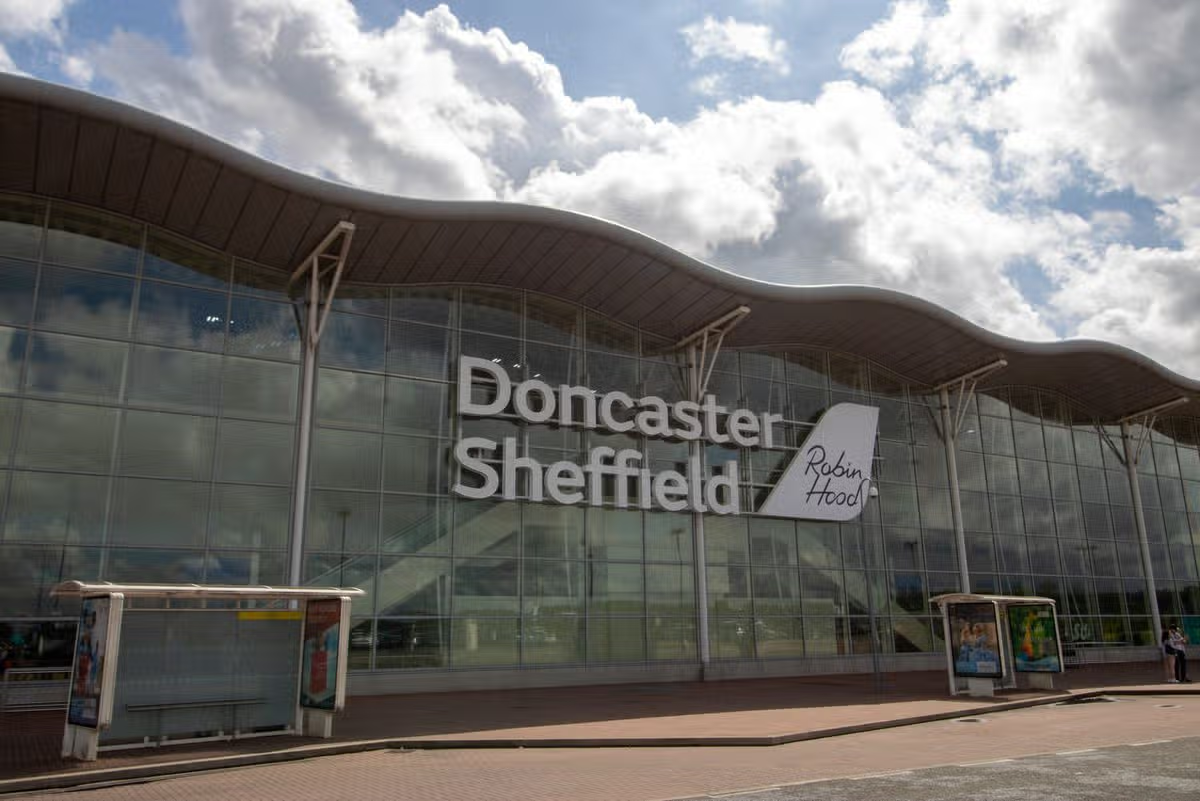
Sun Travel spoke to Christian Foster, Director of FlyDoncaster – the company in charge of the reopening of the airport.
He shared his thoughts on new routes for holidaymakers, rail links and what visitors can expect from the shops and restaurants inside the airport.
The regional airport in the north of England provided a gateway to Europe for those living in and around Doncaster up until four years ago, after it was deemed ‘not financially viable’, and closed.
Christian Foster, Director of FlyDoncaster – the company set up to manage the airport – told us: “It would be nice if we could immediately open with the flick of a switch, but it’s not that simple.
“There were around 2,700 people working around the site when it was last open, and we need to recruit again.
“Right now, we’ve been appointing key roles in the leadership team, and we’re also in a number of commercial negotiations with different airlines.”
When it comes to opening up to passengers, Christian says there’s high-ambition for the airport.
He said: “It does feel like the world has changed post-Covid, whereas people were focused two weeks in Spain or Greece, nowadays we’re seeing a lot of people keen to take city breaks.”
New designs show-off a potential new look for the airportCredit: City Of Doncaster / Mayor Ros Jones
He continued: “We’d love to fly to places like Croatia, and other destinations that are a bit more quirky like Azerbaijan.”
The airport has one of the longest runways in Europe at 2,893 meters meaning it could also potentially take bigger jets for long-haul routes.
Christian said: “We’re keen to look at emerging places to visit as well, like India.
“And Pakistan is one of our largest ethnic populations in the UK, so could we ensure greater connections there?
“But of course, we won’t forget about the bucket and spade holidays either.”
There aren’t just big plans for the planes either – plenty of thought is being put into the experience between check in and boarding gate.
Images reveal a lounge area and lots of seating in the main terminalCredit: City Of Doncaster / Mayor Ros Jones
Christian revealed that they are keen to give the airport a sense of the region by having independent vendors on-site.
He told us: “When people go through a terminal, they tend to look for Costa Coffee, Starbucks or World Duty Free.
“What we’ve created is a corridor for the local supply chain – whether that’s actually fixed base or pop-up market stores is yet to be decided.
“But the idea is that individuals will get a sense of some of the great produce to show off the region, for example, rhubarb from Wakefield, then butterscotch from Doncaster.
“We want to have food and beverage outlets, where you can have, not only the national or international feel, but a local one too.”
With the airport being closed to travellers, it gives a chance for it to be redesigned and Christian confirms that there will be a change in its layout.
One alteration is to the layout of security lanes and system which were “not located in the best place”.
These will be moved to make the passenger experience “slicker” and “swifter”.
There are special arrangements being made for those with disabilities too and Christian said that the team is determined to make the airport one of the “UK’s most-friendly” for everyone.
Since its closure four years ago, airports have had a change in rules as well as technology, for example, the scrapping of 100ml liquids.
Christian said: “The easy answer to that one, is yes.
“We recognise that the world has moved on since 2022, and we are investing in brand-new technology.”
Previously, the best way to get to the airport was by car as the parking was right outside and families could walk straight through.
This layout is set to be retained for ease – but there could also be new rail links giving travellers from further afield the chance to hop on a train to the airport.
Christian said: “There’s a railway that runs to the north of the site, but we’re also keen to look at connections on the East Coast Mainline.
“It comes through Doncaster already and is in close proximity to the site, so for the airport, it would be a game-changer.”
Wizz Air previously served the airport – but no airlines have been confirmed for 2028Credit: Getty
Around the airport, developments are happening too – in one case a five-star hotel is being built on the outskirts.
Christian described the Bawtry Park Hotel in nearby Austerfield as a “Dubai-style” resort with a golf course and spa.
The reopening of the airport has been met with positivity by many in the local area who, since its closure, have had to travel to the likes of Manchester and Leeds Bradford.
Christian explained: “130,000 people signed a petition to retain the airport which is rare because most people go the other way.
“But for locals, once they land, they can be in, out and home in 15-20 minutes, it’s a complete game changer, isn’t it?”
The long-forgotten adventure park was once ‘always busy’ and loved by thousands and Brits are recalling childhood memories from time spent there — now it’s completely unrecognisable.
12:23, 14 May 2026Updated 12:26, 14 May 2026
Do you remember visiting this beloved attraction?(Image: Wikimedia Commons)
Some places are built to spark immeasurable joy and excitement within humans and it’s safe to say theme parks rank fairly high on that list. Many theme parks around the world have given individuals core memories they hold on to dearly, even decades later, with cherished visits to funfairs forming the building blocks of countless childhoods.
One such theme park existed in the UK, specifically in Cornwall, and people who visited the funfair in its heyday recall having some of the best moments of their lives there. It’s a pity then, that this beloved theme park now lies forgotten, completely unrecognisable in its current form, a mere shell of its former glory.
Dobwalls Adventure Park in Cornwall’s Liskeard was a family-run theme park established in the 1970s which brought incalculable joy to thousands.
Founded by John Southern, the funfair commenced operations in 1970 and held the title of being Cornwall’s top visitor attraction for years.
The theme park’s highlights were its two miniature railway locomotive networks, which were complemented by recreational grounds and large play areas, both indoors and outdoors, as well as an art gallery and stunning woodland walks.
John established himself as a pioneer in tourism after he transformed his modest pig farm into one of the South West’s most loved (and earliest established) attractions.
Dobwalls Adventure Park’s hallowed grounds saw locomotives chugging along its two-mile tracks for over 35 years, and the funfair quickly established itself as a school-favourite destination for days out.
With one admission ticket, visitors could enjoy the Krazee Kavern play barn, take unlimited rides on the locomotives in the park, step into the Rocky Ridge water and sand play area, have fun with Mr Blobby, wander through the locomotive shed, and take in the wonders of the Steam Back in Time exhibition.
The steam and diesel trains however, remained the funfair’s star attractions through the decades.
There was a choice of two tracks for visitors to indulge — the Rio Grande and the Union Pacific Railroad.
The Rio Grande line became operational in 1970 itself, and famously featured a four per cent or 1:25 gradient, earning it the title of the world’s steepest ascent on any passenger-carrying miniature railway.
Tunnels and steep climbs only added to its undeniable charm, with the line weaving in and out of a forest in a bid to recreate the Colorado railroads.
The Rio Grande’s success spread like wildfire, leading to the addition of the Pacific track in 1979, which closely resembled the Union Pacific Sherman Hill line in Wyoming, USA, and had a ruling gradient of 1.51 per cent (1:66).
Whisking into canyons and over bridges and trestles, the locomotive lines gave visitors the kind of thrill one could only dream of in those days.
The adventure park’s theme itself was modelled on successful American funfairs, complete with ‘cowboys and Indians’.
Unfortunately, the beloved theme park began to see a decline in numbers and popularity, facing stiff competition from newer, bigger and better funfairs that were coming up across the UK.
Older cherished attractions like the Go Kart track also became defunct and added to the park’s decline.
By the end of 2006, the theme park began closing down its railway lines, and by June 2007, it was announced that Dobwalls Adventure Park’s redevelopment projects had been stalled, and the funfair would not be reopening in its original form.
All of the adventure park’s locomotives were put up for sale, and by early 2008, eight of them had been sold to a man in Dorset and were to be run at Dorset’s Plowman’s Railroad near Ferndown.
The locomotives have since been exported all the way over to Australia, with some users on social media claiming to have seen them in the Land Down Under.
The 22-acre site upon which Dobwalls once sat proudly was put up for sale in 2012 with a guide price of £400,000 in a sealed bid auction.
Now, Charteroak runs a popular holiday cottages accommodation, Southern Halt, from the site where the adventure park once functioned.
Abandoned but never forgotten
Scores of Brits still remember their time at Dobwalls Adventure Park, with several social media users taking to Facebook to reminisce over the theme park’s glory days and recall the countless cherished memories they made at the famous South West funfair.
In a post on the public group 7 1/4″ Railways, one Facebook user recalled: “It was always busy when we went. I remember my 1st visit and all the steam locos were in steam.”
While another visitor emotionally shared: “Loved my visit there as a kid in the summer of 1982. Fascinating place to visit. Never had that many holidays in Cornwall.
“Intended to return around ten years later to try and take some photos of the trains in operation, but found that much of the routes had been built over, so never bothered in the end. Just watched the Big Boy depart from outside the fence!”
Another user wrote, “Was a fantastic place when I visited in the mid 1980’s,” while one fondly recalled, “Only managed one visit but enjoyed every minute.”
One visitor who hoped to take their grandkids to the funfair wrote: “We went there many times when holidaying in Devon and Cornwall. Bought the t-shirts and other memorabilia. I had hoped to take my grandchildren there, but sadly that’s now not to be.”
Some even shared seeing the beloved locomotives in Australia, with one individual writing, “Saw one of the big diesels at Diamond Valley Railroad near Melbourne about 10 years ago,” while another shared, “Quite a few of them are in Victoria Australia.”
One user fondly wrote, “This was a fantastic place spent a lot of time in Cornwall and visited a lot,” while another shared, “Went there every year for probably ten years when we were going to vacation to Cornwall.”
A BRAND new lido could be coming to one of the UK’s most beautiful cities under new plans.
A formal bid has been made to transform an old leisure centre into a prime swim spot in the city of Winchester.
Sign up for the Travel newsletter
Thank you!
The lido could be built on the site of a former leisure centreCredit: Friends of River Park
Follow The Sun’s award-winning travel team on Instagram and Tiktok for top holiday tips and inspiration @thesuntravel.
Winchester’s River Park Leisure Centre, which closed in 2021, would instead have an outdoor swimmingpool, as well as lido a splash pad and food and drink stands.
The lido designs have been created by Design Engine Architects, with previous projects including university campuses and private homes across the UK.
The bid has been put to Winchester City Council by Sea Lanes which runs the lido in nearby Brighton and Hilsea Lido in Portsmouth.
Harry Smith, director of Sea Lanes, said: “We submitted our bid as part of the consultation for the site. We worked with the (Winchester Lido) community group, which really supported the bid.
“We’re really excited to bring a lido to Winchester. I think the decision will be soon, if it’s still on track, and then we will be working with the city if we get the opportunity to pursue the project.
New renders have revealed the design for Winchester’s potential lidoCredit: Design Engine Architects
“There’s huge community support for the lido. We have worked with the community group, which contacted us about the site. It is something that has been bubbling around for a while.”
The plan has been met with positivity from locals.
On a Facebook post announcing the news, one said: “Absolutely stunning! Can’t wait to hear more about it!”
Another wrote: “Hard to imagine how this would not be good for everyone in Winchester. Wonderful first visual.”
The site of the River Park Leisure Centre has been marked for the lidoCredit: Alamy
A third added: “I swam in Hilsea Lido the other day – fantastic. This would be great.”
There was previously an open-air swimming lido in Winchester on Worthy Lane, which opened in the 1930s and closed in the late 1970s – since then, Winchester hasn’t had a lido.
Nearby Hilsea Lido had been closed since 2022 but reopened on May 2 after a £7.6million revamp.
New showers and toilets, including a Changing Places toilet, and a sauna were added as part of the upgrades.
Formerly a saltwater pool, the 220-foot lido now uses unheated chlorinated fresh water.
The lido served as a training centre for the Team GB diving team ahead of the 1936 and 1952 Olympics, and it also featured as a filming location for The Who’s 1975 film Tommy.
Nestled in Yorkshire it is one of the most extensive deserted medieval settlements and a fascinating medieval historical site open for the public to freely explore
The village has been deserted for centuries(Image: SteveAllenPhoto via Getty Images)
Visitors flock from all corners of the country to witness what’s considered the UK’s ‘best preserved’ medieval village.
Wharram Percy has stood empty for hundreds of years and now provides a captivating destination for ramblers and heritage lovers.
Tucked away in North Yorkshire, Wharram Percy represents one of Britain’s largest abandoned medieval communities and certainly the most celebrated.
The site is open for the public to explore freely, uncovering the remains of ancient dwellings, a church, and the surviving fragments of a manor house.
Perfectly positioned between sought-after landmarks Scarborough Castle and York’s Clifford’s Tower, it serves as an ideal pit stop for those journeying between these two destinations, reports Yorkshire Live.
Save on the best holiday cottages in Yorkshire
This article contains affiliate links, we will receive a commission on any sales we generate from it. Learn more
Famous for its dramatic landscapes, historic cities, hearty food, and rich cultural heritage Yorkshire is just waiting to be explored. Sykes Cottages has a large number of properties to choose from with prices from £31 per night.
While admission to the village is free, there’s a £2 parking fee.
Throughout an extraordinary six-decade span, archaeologists have repeatedly uncovered fresh insights into Wharram Percy’s past.
Their discoveries have revealed why the location was originally abandoned and how its residents existed in earlier eras.
Situated on the rim of a Yorkshire valley, this extraordinary community was home to settlements for as long as six centuries before being deserted following the 1500s.
Scholars indicate that even now, traces of former habitations remain visible across the terrain, alongside the more significant ruins that draw inquisitive visitors.
The background is intricate, yet specialists believe the initial community stretches back to approximately 50 BC.
The land was later transformed for agricultural purposes, yet remained abandoned throughout the 5th century, before ultimately evolving into a Middle Saxon settlement.
It’s important to mention that accessing the village involves approximately a 3/4 mile trek from the car park to the main site, which is often both steep and muddy.
The location contains uneven ground throughout, which can present difficulties for some guests and is mostly unsuitable for wheelchairs or pushchairs.
One TripAdvisor reviewer said: “Parking on the Heritage car park off the B1248 prepare for a trek to the village.”
They continued to describe it as a “sharp gravelled decline” and a “daunting” journey that is unsuitable for those with limited mobility, as the route passes through farmland.
After their visit, one excited guest commended their experience, remarking: “Lovely walk from the car park to the site, but people with mobility issues may struggle. It’s a fascinating historical site that has been really well managed.
“Only a few visitors when we visited, which added to the peace and tranquillity of the place. Loved it!”
Another guest commented: “This lovely deserted mediaeval village is truly fascinating! The history is incredible, and it was wonderful to wander around and explore. We really lucked out and had beautiful weather, so we got to sit on the grass by the pond and soak it all in.”
AFTER countless delays and setbacks, an abandoned lido is finally re-opening after a year of regeneration work.
The newly-refurbished splash park in Cambridgeshire has reached its final development stages after construction began last year.
Sign up for the Travel newsletter
Thank you!
St Neots in Cambridgeshire will be welcoming a state-of-the-art splash parkCredit: St Neots Aquatic and Leisure CIO
St Neots Splash Park will be located on Huntingdon Road in the medieval Cambridgeshire town, near to the popular Priory Park.
This space will replace the sealed up site of the historic St Neots Lido, which attracted swimmers for over 40 years.
Since its closure back in 2003, the space has been left abandoned, despite its appealing location.
The advancement of the project was triggered by a successful Independent Professional Playground Safety Inspection, and commencement date for the final commissioning schedule.
This work will be followed by a “soft opening” of the park, which has been confirmed for May 2, just in time for the bank holiday.
Details for the formal opening of the splash park are not confirmed, but are expected to be announced soon.
Attractions will include a leaping water arch, aqua tent, and moreCredit: St Neots Aquatic and Leisure CIOSt Neots Town is located on the River Great Ouse in CambridgeshireCredit: Alamy
The park’s construction has been no small feat, costing nearly £800,000 to build and requiring a £600,000 council grant.
Now, the site boasts a range of interactive features, including a leaping water arch, a hydro blast and an aqua tent, which forms a dome of water for children to play underneath.
It is also decorated with an appealing range of bright colours and LED lighting, activated using floor mounted buttons.
A spokesperson for St Neots Aquatic and Leisure said the opening will be “giving local families the first opportunity to enjoy this new inclusive outdoor play space”.
Violent clashes between fans and police caused the abandonment of a match between the top two sides in Paraguay on Sunday.
Hundreds of spectators escaped onto the pitch as police fired rubber bullets and tear gas into the stands at the Superclasico, played between Olimpia and Cerro Porteno, both based in capital city Asuncion.
According to witnesses, the trouble began when firecrackers were detonated in the section of the Defensores del Chaco Stadium which was allocated to Cerro Porteno supporters.
The police detained around 100 people, and while it was not immediately clear whether any fans had been injured, security forces reported that at least six officers were hurt, with one in a serious condition.
David Torales, a spokesperson for a local hospital, said the “officers sustained head injuries, lacerations, including possible stab wounds, and other injuries”.