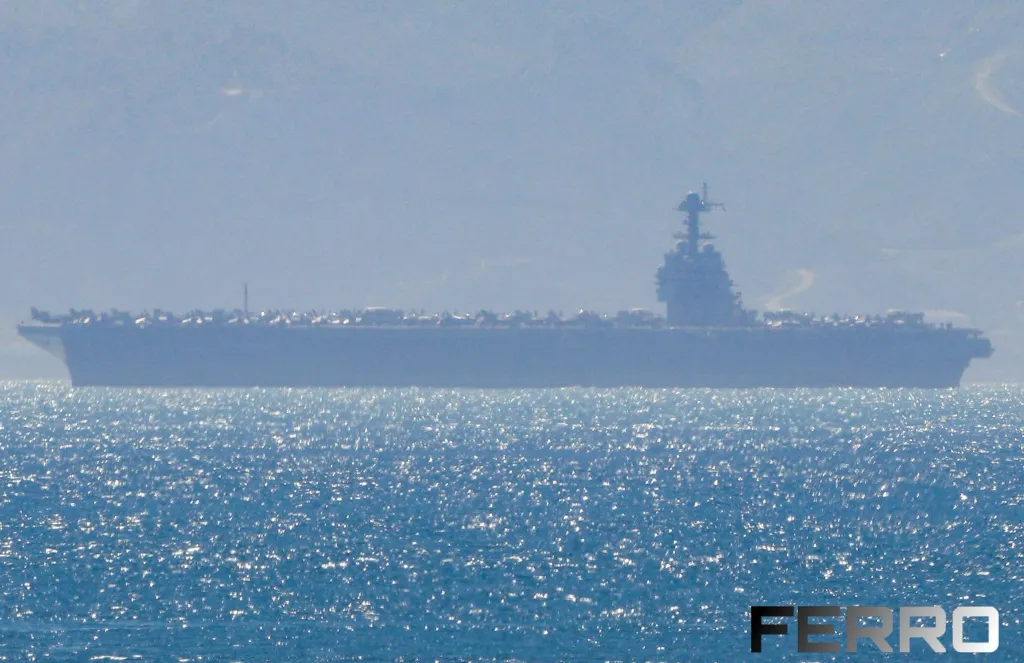
The aircraft carrier USS Gerald R. Ford, its embarked airwing and elements of its carrier strike group (CSG) are now in the western Mediterranean. The Ford and the USS Mahan, one of its Arleigh Burke class guided missile destroyer escorts, transited the Strait of Gibraltar around 1 p.m. local time (7 a.m. Eastern), eyewitnesses told The War Zone. The Ford passed through the Strait from the Atlantic after leaving the Caribbean, where it took part in the mission to capture Venezuelan dictator Nicolas Maduro.
This marks the Ford‘s return to the Mediterranean since leaving its homeport of Norfolk on June 24, 2025. The Ford‘s deployment was extended for a second time to join a growing list of U.S. military assets in the Middle East, including the Lincoln Carrier Strike Group, as President Donald Trump considers an attack on Iran. You can read more about how the extension affects the ship and its crew in our story here.
Daniel Ferro, (@Gibdan1 on X), shared photos of the ships with us.


Another eyewitness, who runs the @maritimegraphy X account, provided to us videos of the ships crossing as well as a U.S. Navy P-8 Poseidon maritime patrol jet flying overhead. The P-8 is packed with sensors and they often provide overwatch for CSGs to detect potential threats on and under the water’s surface.
Both ship spotters said the U.S. Navy vessels were accompanied by at least one Spanish Navy Santa Maria class frigate. The Pentagon declined comment.

Ford Carrier Strike Groups Enters The Med On Feb. 20th, 2026
As noted earlier, the Ford CSG will eventually be joining the Lincoln CSG, already deployed to the Middle East, as well other Navy ships and scores of tactical jets, surveillance planes, tankers, airborne early warning and control aircraft, as well as additional air defense assets. The Ford‘s current location puts it about 2,500 miles east of the Israeli coast, meaning it could take a few more days to arrive there if that is indeed its intended station, as one report states. While patrolling there would help Israel defend against incoming barrages, the ship’s air wing would have to fly across Israel or Lebanon, Syria or Jordan, and Iraq, to reach Iranian territory.
In addition to the tactical jets already in theater or in bases in Europe preparing to fly there, reports have emerged that the U.S. has pulled F-35 Lighting II stealth fighters and other assets and troops out of NATO’s Cold Response exercise scheduled to take place in Norway next month. This move is another part of the U.S. buildup in the Middle East, according to Norwegian defense officials.
NATO declined comment and the Pentagon did not immediately respond to our query.
The influx of aviation assets has packed U.S. facilities in the Middle East and elsewhere. For instance, satellite images show 18 F-15E Strike Eagles, 18 F-35A Lightning II stealth fighters, 12 F-16 Fighting Falcons, six E/A-18G Growler electronic warfare jets and two MQ-9 Reaper drones visible at Muwaffaq Salti Air Base in Jordan alone. This does not include all the aircraft that cannot be seen under shelters and sun shades. Every designated spot for a tactical jet that is visible from space is now full at the packed installation.
Lajes Air Field in the Azores has also seen a big uptick of aircraft. There were at least 11 KC-46 Pegasus aerial refueling tankers, 12 F-16 Fighting Falcons and a C-17 Globemaster II cargo jet there as of yesterday. This includes a KC-46 that had an aborted takeoff last month. The tankers at the island airfield are a critical component of the air bridge between the U.S. and Europe and the Middle East that enables the rapid buildup we have been seeing unfold.
Satellite imagery also shows an increase of refueling tanker activity at Prince Sultan Air Base in Saudi Arabia, while a continuous decrease at Al Udeid Air Base in Qatar, the largest U.S. military installation in the Middle East. The closer the base is to Iran, the more vulnerable it is to large scale barrages or ballistic missiles, cruise missiles and drones. Al Udeid sits right on the Persian Gulf. As we have previously noted, both Jordan and Saudi Arabia have both said they would not allow U.S. forces to use their territory or airspace for an attack against Iran. Whether that pledge sticks is doubtful.
Friday morning, Trump was asked if he is considering a “limited strike” against Iran if it does not agree to a deal to curtail its nuclear weapons ambitions. He replied in the affirmative. The president did not provide details of what that could entail or when it might be launched.
Reuters reported that advanced U.S. military planning includes options for targeting individuals, and possibly pursuing regime change.
Meanwhile, previous reporting suggested the U.S. leader was considering a weeks-long campaign against Iranian leadership, nuclear infrastructure, missile launch sites and associated industry, and other military installations and command and control nodes. His intentions at the moment remain unclear.
Though Trump is pushing for Iran to end its nuclear program, Iran’s Foreign Minister Seyed Abbas Araghchi denied that the U.S. has demanded zero uranium enrichment. He added that Iran has not offered the suspension of its uranium enrichment during the nuclear negotiations.
In a letter to the U.N., the Iranian delegation to the U.N. issued a warning that if attacked, “all bases, facilities and assets of the hostile force in the region would constitute legitimate targets in the context of Iran’s defensive response.”
The U.S. “would bear full and direct responsibility for any unpredictable and uncontrolled consequences,” the letter added.
The Iranian letter also addressed a social media posting Trump made earlier this week, urging the British to allow the use of the Indian Ocean island of Diego Garcia in case it was needed for a strike against Iran. The U.K. has so far denied that, which you can read more about in our story here.
“Given the volatile situation and the persistent movement and build-up of military equipment and assets by the United States,” the Iranian letter continued, “such a belligerent statement by the president of the United States must not be treated as mere rhetoric; it signals a real risk of military aggression, the consequences of which would be catastrophic for the region and would constitute a grave threat to international peace and security.”
Amid the negotiations and dueling rhetoric, Iran continues to prepare for an attack. New imagery shows that a concrete structure, covered by soil, was placed over the Parchin nuclear site to protect it against potential airstrikes.
As for Israel, which is anticipated to take part in any action against Iran, officials say the security status remains unchanged.
“The IDF is monitoring regional developments and is attentive to public discourse on Iran,” Brig. Gen. Efi Defrin, an IDF spokesman, said Friday. “The IDF is on alert for defense. There is no change in instructions. Please follow the IDF Spokesperson and Home Front Command announcements only through official channels.”
A high-ranking IDF official told us that Israel is preparing for an attack on Iran that could come quickly.
“On the streets, there are no visible signs of anything unusual in the context of an imminent attack. However, within the defense and military establishment, the level of readiness is extremely high, and it appears that preparations are underway for a potential large-scale strike, possibly as soon as this coming weekend,” said the official, speaking on condition of anonymity to discuss operational details.
“It appears that the situation is approaching a critical point,” he explained. “There is also a possibility that Iran, if it concludes it has little to lose, could attempt a preemptive surprise attack of its own.”
We have seen various videos of military equipment being dispersed around Iran in recent days.
With the Ford now in the Mediterranean, the U.S. is now coming closer to culminating its build-up that could support a sustained air campaign against Iran if Trump makes the call to do so.
Contact the author: howard@thewarzone.com