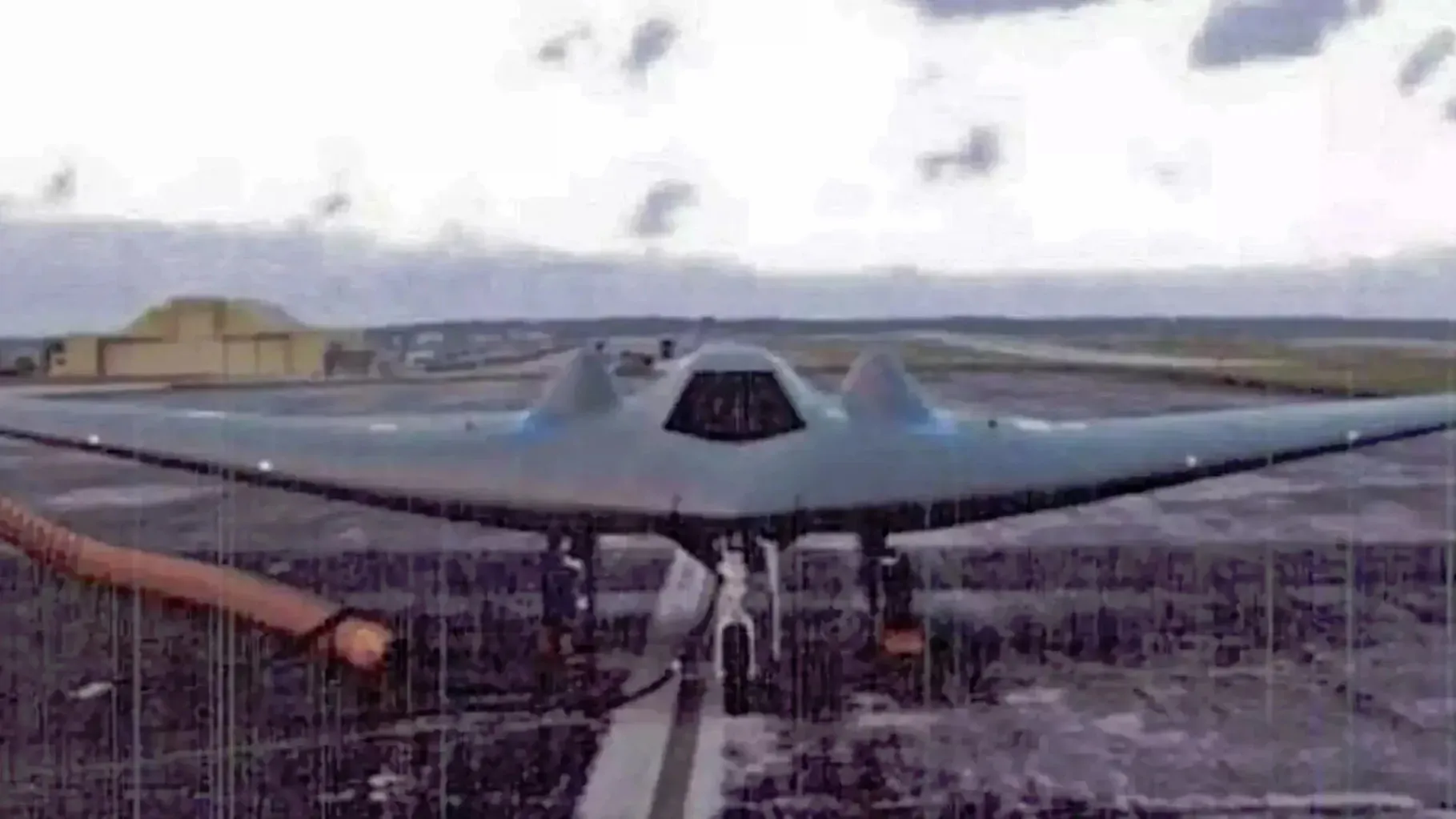
At least one, and possibly two, of the U.S. Air Force’s secretive RQ-170 Sentinel stealth drones appear to have taken part in last night’s operation to capture Venezuelan dictator Nicolas Maduro and his wife. Spotting an RQ-170 in the context of a real-world mission is very rare, but it would not be unexpected in this case. The RQ-170 was designed by Lockheed’s Skunk Works exactly for this application, to provide persistent surveillance of high-value targets deep inside contested environments, including in support of special operations missions just like the one overnight in Venezuela.
Readers can get caught up on what is known about the U.S. mission overnight in Venezuela, nicknamed Operation Absolute Resolve, with our ongoing coverage here.
A local spotter in Puerto Rico captured video said to show the RQ-170 returning to the former Naval Station Roosevelt Roads earlier this morning, as seen in the social media post below. The same spotter also filmed clips of other aircraft arriving at the base today, and has been otherwise visually monitoring air traffic there for some time now. This facility, also known as Jose Aponte de la Torre Airport, has been a major hub for expanded U.S. military operations in and around the Caribbean since September 2025. This is just one focal point in a much larger buildup of American air, naval, and ground assets in the region over the last five months.
It’s also worth noting here that, back in December, Air Forces Southern (AFSOUTH) had posted pictures on social media highlighting a visit by Air Combat Command (ACC) head Gen. Adrian Spain to its 612th Air Operations Center at Davis-Monthan Air Force Base in Arizona. AFSOUTH is the U.S. Air Force’s top command for operations in and around much of Latin America. One of those images included an individual wearing a name patch with an RQ-170 silhouette, as well as the shoulder sleeve insignia of the 432nd Wing. The posts and pictures contained therein were subsequently taken down. The 30th and 44th Reconnaissance Squadrons, both assigned to the 432nd Wing at Creech Air Force Base in Nevada, are the only units the Air Force has acknowledged publicly as operating RQ-170s. Many had taken this as a sign that Sentinels might be flying operational missions in and around the Caribbean.
The Air Force officially acknowledged the RQ-170’s existence more than a decade and a half ago, but continues to be exceptionally tight-lipped about the Sentinel fleet, which is said to number between 20 and 30 of the drones in total. However, what is known about its operational activities to date fully aligns with the operation in Venezuela last night.
The RQ-170 is now a 20-year-old design, at least, and is not a cutting-edge, very-low-observable aircraft. At the same time, it still offers a stealthy tool for persistent intelligence, surveillance, and reconnaissance (ISR) missions that many opponents are less likely to detect even when flying deeply inside their airspace. The drones are thought to be able to carry a variety of sensors, including an active electronically-scanned array radar with synthetic aperture imaging and ground-moving target indicator capabilities, a sensor ball with electro-optical and infrared video cameras, and/or electronic/signals intelligence suites.
With that array of capabilities in hand, RQ-170s would have provided a valuable way to discreetly track Maduro’s movements and otherwise establish his ‘patterns of life,’ as well as those of the forces guarding him, for an extended period of time in the lead-up to the actual launch of the operation to capture him. During the mission itself, having one of the drones orbiting overhead would have provided an indispensable source of real-time information, including to help spot threats that might unexpectedly appear. Those same feeds would also have given senior leaders, including President Donald Trump, a way to watch the operation as it happened.
“I was able to watch it in real time, and I watched every aspect of it.” Trump had said in a phone interview with Fox News earlier today.
The Sentinel fleet was used in exactly this way before and during the raid that led to the death of Al Qaeda founder Osama Bin Laden in a compound in Abbottabad, Pakistan, in 2011. Other aspects of the planning for the Venezuela mission also reportedly mirrored the playbook used ahead of the Bin Laden operation, including the construction of a full-scale replica of Maduro’s safe house and the infiltration of a CIA advance team to gain additional insights into his daily routine.
Past use of RQ-170s over Iran to keep tabs on its nuclear program is another general example of its ability to persistently surveil key sites even in denied areas, though one of the drones was notably lost in that country in 2011. Sentinels are also likely to have conducted flights at least very near North Korean airspace while operating from South Korea. The drones have also been at least deployed elsewhere in the Pacific in the past, and may have been sent into the Black Sea region to collect intelligence on Russian forces on the heavily-defended occupied Crimean Peninsula between 2022 and 2023.
With all this in mind, RQ-170s could also have surveilled Venezuelan military bases and other sites that U.S. forces struck as part of the operation overnight, and helped with post-strike assessments. The Air Force has disclosed having at least conducted tests in the past of the Sentinel in the bomb damage assessment role in combination with B-2 bombers.
During a press conference today, Chairman of the Joint Chiefs of Staff U.S. Air Force Gen. Dan “Razin” Caine also stressed the degree to which Venezuela’s air defenses played in planning for the mission last night, which also could have played a role in the decision to employ the RQ-170. Though Venezuela’s capabilities and capacity in this regard were limited – and are likely far more so now following the U.S. strikes – they still presented risks that had to have been taken into account. This is something TWZ had already explored in detail in the past.
“As the force began to approach Caracas, the Joint Air Component began dismantling and disabling the air defense systems in Venezuela, employing weapons to ensure the safe passage of the helicopters into the target area,” Caine explained. “The goal of our air component is, was, and always will be to protect the helicopters and the ground force and get them to the target and get them home.”
Caine’s comments here are further underscored by the use of F-22 Raptors, arguably the most survivable manned tactical jet known to be in the U.S. inventory today. A dozen Raptors also landed at the former Naval Station Roosevelt Roads this morning following sorties over or around Venezuela. It isn’t clear if the F-22s flew direct from their base in the U.S. or staged in Puerto Rico shortly before the strikes commenced. The F-22 owes its very existence, at least in part, to fears about the dangers posed by the extensive array of air defense systems in service in Syria in the immediate post-Cold War period, as you can learn more about here.
In addition to F-22s, the aerial elements of the U.S. force package employed during the operation last night included “F-35s, F[/A]-18s, EA-18s, E-2s, B-1 bombers, and other support aircraft, as well as numerous remotely piloted drones,” according to Caine. Suppression and destruction of enemy air defenses (SEAD/DEAD) would have been a key mission set for the stealth F-35s, too. F-22s and F-35s played a similar role during strikes on Iranian nuclear sites earlier this year, nicknamed Operation Midnight Hammer. It is likely that RQ-170s also played a role in that operation as well, providing direct overhead coverage of the strikes and intel for post mission bomb damage assessments.
TWZ also previously highlighted the particularly important role EA-18G Growlers could play in kinetic action against Venezuela after a squadron of those jets arrived in Puerto Rico last month. Growlers had already been in the region by that point as part of the air wing aboard the supercarrier USS Gerald R. Ford. At least one EC-130H Compass Call aircraft, which offers additional electronic warfare capabilities, was also recently deployed to Puerto Rico.
Many questions remain about how Venezuela’s air defense network responded, or didn’t, to the U.S. operation overnight. One U.S. helicopter is known to have been damaged by unspecified ground fire during the mission, but remained flyable. No other aircraft are known to have sustained damage at this time.
What we do have now is clear evidence that at least one RQ-170 took part in last night’s operation in Venezuela.
Contact the author: joe@twz.com