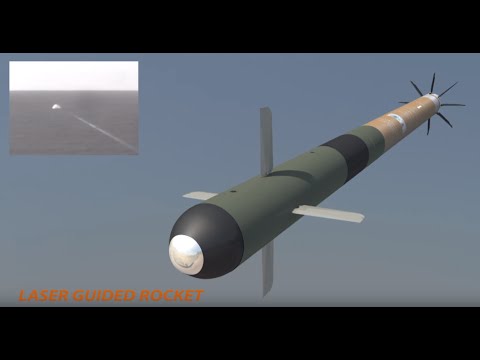
France has conducted live-fire tests of laser-guided rockets from its Rafale fighter, adding a low-cost anti-drone capability to the jet. Following the United States and the United Kingdom, this reflects a broader trend in modern air warfare, as air forces increasingly recognize that they need layered, cost-effective intercept options rather than relying exclusively on expensive missiles.
Today, the Directorate General of Armaments (DGA), the French government defense procurement and technology agency, announced the successful integration of the 68mm laser-guided rockets on the Rafale. The tests began in February. The DGA added that the integration work was conducted together with the French Air and Space Force’s Centre d’expertise aérienne militaire (CEAM, the French aerospace research and test center), supported by Dassault Aviation and Thales. The program is known as Lutte antidrone sur avion de combat (LADAC, or anti-drone capability for combat aircraft).
While LADAC is initially intended for French Rafales, flown by the air force and navy, it could also be provided to export Rafale customers, and potentially other combat jets.
Last October, the Chief of Staff of the French Air and Space Force, Gen. Jérôme Bellanger, told a parliamentary hearing that there was a need to provide laser-guided rockets for the Rafale and/or the Mirage 2000D RMV, to counter long-range one-way attack drones, such as the Iranian Shahed-136 and the Russian Geran series.
“Regarding airborne anti-drone operations, it is not sustainable to use MICA air-to-air missiles costing over a million euros to shoot down a drone worth a few thousand dollars,” Bellanger said. “We must develop our own low-cost firing capabilities or adapt our gun fire-control systems,” he added.
The Chief of Staff of the Air Force suggested that off-the-shelf solutions would most likely be used.
In the event, a primarily French solution has been adopted.
This involves 68mm rockets with laser guidance, loaded in 12-round Thales Telson JF12 rocket pods. These are used in conjunction with the Rafale’s RBE2 radar, which has undergone modifications for the role, as well as the Talios pod, used for target tracking and laser designation.

TELSON : INDUCTION ROCKET SYSTEM
The rocket itself is understood to be the Aculeus-LG, which has a stated range of 3.7 miles.
Development of the LADAC capability was begun last December 31 as a matter of urgency.
By the end of February, French Rafales were protecting the airspace of the United Arab Emirates against Iranian drone attacks during Operation Epic Fury. In the process, they fired several dozen MICA IR/EM missiles in only a few weeks.
In April, the French parliament was informed that a study was underway to equip the Rafale with rocket pods. The same month, unofficial imagery appeared showing a dedicated test Rafale carrying a pair of JF12 pods while flying from Istres-Le Tubé Air Base, home of the DGA.
As of April, it was suggested that the capability could be ready to be fielded this summer. This target will be achieved, with the LADAC capability rolled out to French Air and Space Force Rafales by the end of the month.
At this point, it’s unclear if the Rafales will also have their onboard 30mm cannons specifically modified for anti-drone work, as Bellanger had previously suggested. This would involve adaptation of the gun fire-control system to mitigate the risk posed by debris from the destroyed drones. As we have discussed many times in the past, firing a fighter’s gun against a small, low, and slow-moving target is inherently dangerous, due to a combination of speed and engagement dynamics, the risk of collision, shrapnel and other debris, plus the increased chances of collateral damage on the ground.

Le canon du #Rafale : le #30M791
The U.S. military took the lead in integrating laser-guided rockets on combat aircraft for anti-drone purposes.
The laser-guided 70mm Advanced Precision Kill Weapon System (APKWS) rocket with air-to-air capability has now been cleared for use by U.S. Air Force F-15E Strike Eagle, F-16C, and A-10 combat jets, and other types, like the U.S. Navy’s F/A-18E/F Super Hornet, are expected to receive it too.
In 2019, TWZ was first to report that the U.S. Air Force had begun to look at using APKWS as an air-to-air weapon against drones and cruise missiles, when it conducted a test of the weapon in that role from an F-16C. The first reports of the capability being used in combat came in 2024, when U.S. Air Force F-16s began using the rockets to shoot down drones launched by Iranian-backed Houthi militants in Iran, as TWZ was again first to report.

F-16C Viper Shoots Down Target Drone With Laser-Guided Rocket
Since then, U.S. Air Force F-15Es and F-16s have repeatedly called upon the rockets to deal with Iranian drone and missile attacks in the Middle East. In particular, the rocket-armed fighters were very actively involved in defending Israel from Iranian drones and missiles. The same encounters saw F-15E crews running out of missiles when faced by large barrages of drones and missiles, a problem that laser-guided rockets can help address.
The Eurofighter Typhoon became the next aircraft to add the air-to-air optimized variant of the laser-guided APKWS rocket to its armament options.
At the Paris Air Show in June 2025, Eurofighter CEO Jorge Tamarit Degenhardt confirmed that the counter-drone mission was of growing importance for Typhoon customers and that he “needs to now have that conversation” with Germany, Italy, Spain, and the United Kingdom — the four Eurofighter partner nations that are responsible for developing, building, and sustaining the aircraft.
The U.K. Royal Air Force announced in May of this year that its Typhoons were now equipped with APKWS, “significantly enhancing their ability to counter emerging threats during operations in the Middle East.”

Laser-guided rockets of all kinds offer some significant benefits for the counter-drone role, compared with traditional air-to-air missiles. Their performance parameters make them especially suitable for bringing down relatively steady flying, non-reactionary, low-performance targets, including drones and subsonic cruise missiles.
They also bring a major increase in ‘magazine depth,’ with each pod carrying several rounds, taking up a weapons pylon that would otherwise normally be loaded with just one air-to-air missile.
Above all, however, the requirement for these weapons has been driven by the huge mismatch in cost between the target and air-to-air missiles that would otherwise be used for the role. In a French context, a single MICA round reportedly costs around $2 million, significantly more than the latest variants of the AIM-120 Advanced Medium-Range Air-to-Air Missile (AMRAAM), which cost around $1 million each.
Meanwhile, a Shahed drone might come with a unit cost of around $50,000, as we have discussed in the past.

The cost of the Aculeus-LG is unclear, but is likely in the same region as the equivalent APKWS. Here, the laser guidance section costs between $15,000 and $20,000, with only a few thousand dollars more needed to provide the rocket motor and warhead.
It seems all but certain that the French Rafales will not be the only ones to get the new weapon.
There is a large Rafale operating community in the Middle East, with Qatar already flying them and the United Arab Emirates due to receive them soon. Both of these and others could benefit from these capabilities. Since these rockets were also eyed for the Mirage 2000 in the past, Ukrainian Mirages could also be a candidate for integration; the Ukrainian Air Force already uses APKWS on its F-16s.
With future conflicts likely to feature large salvos of one-way attack drones and cruise missiles, this type of capability is likely to become a more regular feature on modern combat aircraft.
Contact the author: thomas@thewarzone.com