When Catherine Bello received a text message from the World Food Programme (WFP) in August 2025, she was excited. She had been anticipating it ever since she applied for the Anticipatory Action Response (AAR), a WFP programme that provides “multipurpose cash assistance” to reduce the humanitarian impact of flooding in vulnerable communities.
Catherine lives in the Jimeta-Yola metropolis, an area in Adamawa State, northeastern Nigeria, that has experienced repeated flooding. A mother of four, she is a retired public-school teacher who now sells kunun zaki (Hausa for corn juice) to make ends meet.
She had hoped that the ₦208,184 AAR support would help her expand her business and save more to support her family.
However, that excitement faded when she arrived in Yola for data capture.
Officials asked Catherine to provide her National Identification Number (NIN) for verification. To her shock, the system flagged a mismatch. The name on the beneficiary list appeared as “Bello O. Catherine”, while her NIN record read “Catherine Bello”.
“It was the same NIN I gave them while filling the form,” she says. “They told me the name they saw didn’t match, so I couldn’t be captured.”
A missing middle-name initial was enough to exclude her from receiving assistance. Instead, she was advised to reconcile her records with the National Identity Management Commission (NIMC).
Across Nigeria, thousands of people, like Catherine, are locked out of essential services because of missing initials, misspelt names, and minor inconsistencies that trigger verification failures.
Nigeria’s digital identity system was built to include and connect millions of citizens to welfare, banking, education, and other opportunities. But for a growing number of Nigerians, the same system is becoming a barrier to accessing those services.
Identity as the backbone
Nigeria’s emerging digital public infrastructure (DPI) rests on three foundational pillars: digital identity (NIN); digital payments and financial inclusion (Bank Verification Number (BVN) and the Nigeria Inter-Bank Settlement System (NIBSS)); data exchange; and verification infrastructure.
At the centre of this system is the NIN, managed by NIMC. By late 2025, Nigeria had issued about 127 million NINs, roughly 60 per cent of the population, but millions remain unregistered or mismatched. Under the World Bank–supported Identification for Development programme, Nigeria aims to scale capacity to 250 million records and reach 85 per cent population coverage by 2027.
Digital identity is no longer optional. It is now increasingly required for SIM card registration, bank account linkage (NIN–BVN integration), social protection enrolment, scholarship applications, and access to tax and government services.
In theory, this integration promises efficiency, transparency, and inclusion. In practice, data inconsistencies, limited interoperability, and infrastructure gaps expose citizens to the risk of exclusion.
Experts warn that when people lack a valid digital ID, they can literally be locked out of basic services. Dennis Amachree, a national security analyst and former Assistant Director at the Department of State Security, notes that the rural-urban divide and the lack of enrolment infrastructure leave many, especially the elderly and rural populations, without the documentation they need to fully participate in banking, travel, and government services.
Meanwhile, the World Bank notes that Nigeria still has “a considerable gap” in identity coverage, especially among women, persons with disabilities, and other vulnerable groups. The global financial body observed that the lack of any recognised ID “prevents individuals from accessing critical government services, participating in the digital economy, and financial inclusion”.
For instance, Catherine’s hope of benefiting from the welfare package was dashed; a tiny database error translated into lost hopes.
SIM-NIN linkage – Security births exclusion
Alpha Daniel, a trader in Jimeta Modern Market, faced a different but related problem.
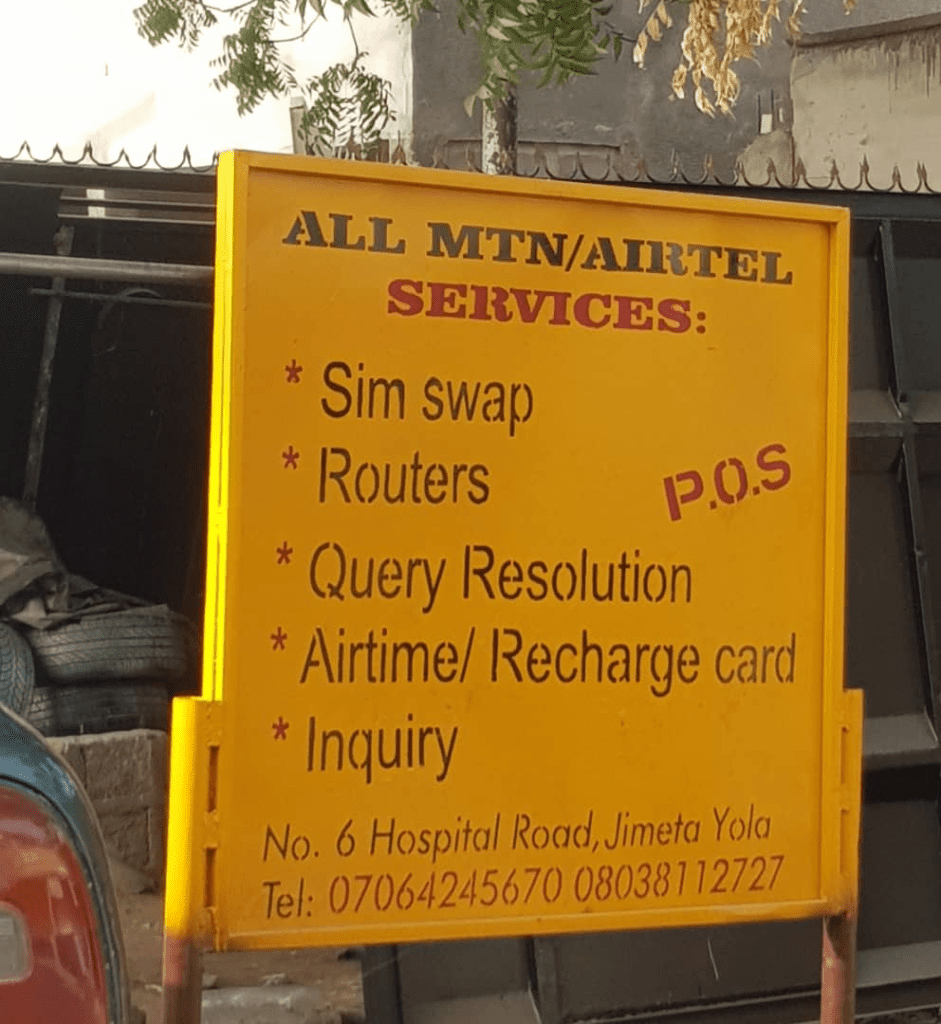
In 2024, the Nigerian Communications Commission, the country’s telecom regulator, demanded that all mobile phones be linked to NIN or risk being shut off. In September of the same year, millions of Nigerians woke up to find their SIM cards blocked. Alpha was one of them.
“I did everything right,” he says. “I went to the MTN shop, gave them my NIN, but after two tries, my line was still blocked.”
This was a familiar pattern. By mid-2024, telecoms reported that 13.5 million lines were barred for NIN non-compliance (8.6 million on MTN, 4.8 million on Airtel). By August 2024, Nigeria had linked 153 million SIMs to NIN (96 per cent of active lines). But that last 4 per cent represented some 6–7 million SIM connections that could no longer send or receive calls. Many complained that even after they finally registered or re-registered, their lines remained locked.
As one subscriber with Airtel put it, “Painfully, I have done this linkage at least twice, but still the line was barred”.
The government’s goal was to reduce phone-based fraud and make the digital economy safer, but for many Nigerians, losing a phone line means losing opportunities and even contact with relatives.

Ruth James, a graduate of Modibbo Adama University, Yola, had a scholarship application derailed when Nigeria’s ID system struck again. In early 2024, Ruth logged onto the Petroleum Technology Development Trust Fund (PTDF) scholarship portal and entered her details. The portal displayed a “NIN validation failed” message and locked her out.
“I filled out the form perfectly,” she says. “Then it said my NIN verification failed. I kept trying different browsers, but nothing worked. There was a help icon for failed verification on the portal. I clicked and sent several emails, but there was no response.” In the end, Ruth missed the deadline and lost a chance at much-needed financial aid.
Many federal programmes, from scholarship funds to youth training schemes, now require NIN verification. Online forums are filled with frustrated applicants: Jobs Inform noted dozens of “Not eligible” errors from a NIN mismatch or “verification failed” during registration.
These stories show how minor technical issues in Nigeria’s ID system can translate to a lack of access to education, banking, and social support, all of which are increasingly tied to digital identity.
Government policies and infrastructure gaps
The Nigerian government is aware of these issues. In 2024 and 2025, it rolled out several projects to strengthen Nigeria’s DPI, the foundational systems that underpin services. For example, the revised National Digital Identity Policy for SIM Card Registration explicitly ties SIM-NIN linkage to curb fraud.
The authorities also launched a NINAuth smartphone app in late 2025, which President Bola Tinubu hailed as “a milestone in our nation’s digital public infrastructure journey”. Tinubu has repeatedly emphasised that a “credible and inclusive National Identity Management System is fundamental to our national development goals”. In practice, the NINAuth app is meant to simplify identity checks for banks, hospitals, and government agencies, thereby reducing the need to manually look up each person’s NIN. However, the platform has not seen widespread adoption.
On the data side, Nigeria enacted a new Data Protection Act in June 2023, replacing the previous regulation. The new law imposes stricter rules (including special protections for children and a “duty of care” on data controllers). It was also a condition for the World Bank–supported Digital ID4D project.
These efforts are already yielding results: linking NIN with financial systems (NIN/BVN linkage) coincided with a jump in financial inclusion from 56 per cent in 2020 to 65 per cent by 2023. However, digital experts note that Nigeria’s DPI remains fragmented. Many government platforms and private services do not fully share data, forcing citizens to repeatedly verify their identity. Network outages and limited registration centres (especially in rural areas) still slow down NIN enrollment.
Worse, some Nigerians distrust the system after reports of lax data security. Khadijah El-Usman, a Senior Programme Officer for Anglophone West Africa at Paradigm Initiative, a digital rights group, warn that “the NIMC’s role is to secure this data. They have failed to do so”, referring to recent incidents where NIN data were allegedly sold on private websites.
Turning challenges into opportunities
Experts in digital governance say Nigeria must turn these challenges into opportunities for reform. Vincent Olatunji, National Commissioner and CEO of the Nigeria Data Protection Commission (NDPC), stresses that effective identity management must be built on harmonised policies, secure technologies, and inclusive systems to strengthen national digital trust. “Effective identity management requires harmonised policies, secure technologies, and inclusive systems,” he noted, linking strong governance with citizens’ confidence in digital IDs.
Likewise, Iremise Fidel-Anyanna, Head of Application Security, Governance, and Security Operations at the Nigeria Inter-Bank Settlement System (NIBSS), warns that “data privacy is the foundation of digital trust,” noting that privacy and security are essential to citizens’ willingness and ability to participate in digital services.
Chy Ameh, a digital identity expert based in Abuja, stresses the need for stronger privacy and trust protections, arguing that “to ensure the privacy and security of individual personal information, implement robust data protection measures such as strong encryption, secure authentication, consent and control over personal data, compliance with regulations, and regular audits” to distribute responsibility between both government and private actors.
Several other experts also highlight infrastructure bottlenecks and low public awareness: “Network glitches, poor connectivity, and limited registration centres impede effective ID rollout,” they note. In addressing this, experts urge large-scale outreach and education programmes to help people understand how and why to register for a NIN.
In simple terms, these experts say Nigeria needs to make digital ID registration easier by opening more NIMC centres in underserved areas and reducing unnecessary bureaucracy. There should also be clear public information campaigns, in local languages, to explain what the NIN is and why it matters. To build trust, the government must fully enforce data protection laws and ensure people’s personal information is safe.
Finally, better coordination among the government, banks, and telecom companies is needed so that systems work together smoothly and people do not have to repeat the same processes.
Best practices and cautionary tales
Globally, there are lessons for Nigeria. India’s Aadhaar programme, the world’s largest biometric ID system, now covers about 95 per cent of India’s population. Aadhaar made government transfers and SIM registration much smoother, but not without controversy; it has faced numerous legal challenges over data privacy and mandatory linking. Nigeria can learn from India’s experience by building strong privacy safeguards before demanding universal linkage.
In Kenya, the Huduma Namba initiative aimed to create a single ID for all services, but was suspended by the courts in 2020. Privacy advocates there won a ruling saying that collecting biometric data (even GPS or DNA) without adequate legal protection was unconstitutional. Kenya’s case shows that inclusion programmes can backfire if citizens fear their data will be mishandled. Nigeria’s reforms, such as the new Data Protection Act and the planned changes to the NIMC Act, seem aimed at avoiding such mistakes.
In Estonia, nearly 100 per cent of adults have a government-issued electronic ID card, and all state services are accessible online. This allows citizens to vote, pay taxes, and use healthcare portals seamlessly. Achieving this took decades of investment in both technology and public trust. For Nigeria, such a level of integration is a distant goal, but it shows what’s possible if the digital ID becomes reliable and user-friendly.
Bridging the divide
Catherine, Alpha, and Ruth all share a sense of being stranded by a system that was supposed to help them. Their stories reveal that digital infrastructure failures can be as damaging as physical ones. As President Tinubu himself put it, Nigeria must “eliminate unnecessary bottlenecks and ensure that every Nigerian has access to essential services without the frustration of bureaucratic delays”.
To avoid leaving people like Catherine on the sidelines, experts say the government needs to act on multiple fronts: fix the glitches, protect people’s data, and make the system easy to use. Only then can Nigeria’s grand digital ID ambitions translate into real help for its people.
This report is produced under the DPI Africa Journalism Fellowship Programme of the Media Foundation for West Africa and Co-Develop.