


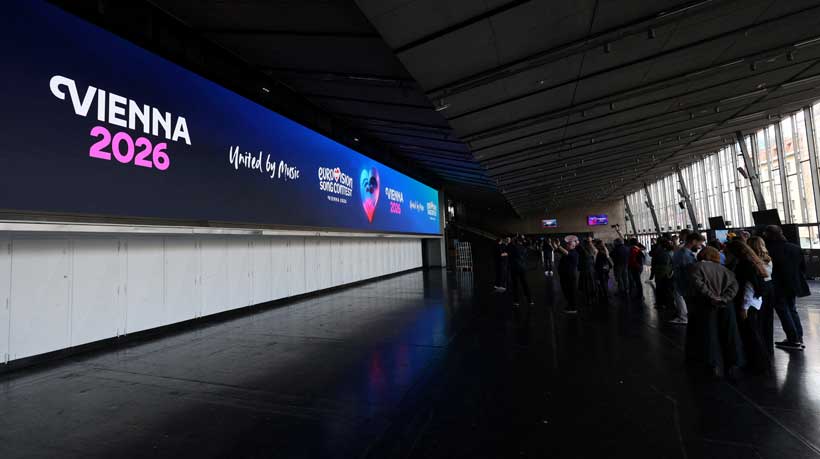
The Eurovision likes to sell itself as a glittering exercise in European unity, colorful, loud, proudly diverse, and (officially) above politics. Yet anyone who has watched the contest with both eyes open knows that “apolitical” has always been more of a brand promise than a lived reality. In late 2025, that gap widened into a full-blown crisis, as a number of broadcasters reported across outlets that Spain, Ireland, Slovenia, the Netherlands, and Iceland signaled they would not take part in Eurovision 2026 after the European Broadcasting Union (EBU) decided not to exclude Israel amid the ongoing war in Gaza, Palestine.
This episode is not simply “politics invading culture.” It reflects a shift in how legitimacy is demanded and contested in Europe’s cultural diplomacy, particularly when public broadcasters operate under constant online scrutiny. A constructivist lens helps explain why withdrawal can become socially “appropriate” not only because of interests, but because identities, norms, and public expectations set the boundaries of acceptable action.
Eurovision’s political DNA
Eurovision was launched in 1956 as a post-war cultural bridge. Its origin story is important: a shared stage was meant to build familiarity, and familiarity was meant to soften rivalry. That heritage still shapes the contest’s self-image. But Eurovision has long functioned as a stage where politics appears in coded ways through voting patterns, representation debates, and symbolic messaging.
In 2026, the argument is no longer coded. The EBU’s insistence that Eurovision must remain apolitical is being tested by publics who increasingly expect cultural institutions to reflect basic humanitarian values. This tension has been building for years, but the Palestine crisis and the EBU’s decisions have turned it into a legitimacy problem, not merely a public relations headache.
Why withdrawal became “appropriate”
Constructivism in international relations focuses on how identities and norms shape behavior. States and national institutions do not act only from material interests; they also act from what is socially acceptable, what fits their self-image, and the expectations of their audiences.
Three dynamics stand out.
Identity signalling, domestically and externally
For several withdrawing countries, participation carried an identity cost. Public broadcasters—especially those that see themselves as guardians of civic values—operate within national narratives about solidarity, rights, and moral responsibility. Remaining in the contest while public debate framed Israel’s participation as incompatible with humanitarian concerns risked looking like complicity or indifference. Withdrawal, by contrast, functioned as a signal: this is who we are, and this is the line we will not cross.
Importantly, this signalling was not addressed only to external audiences. It was also addressed inward towards domestic publics, artists, and civil society networks. In many European societies, those constituencies are no longer passive consumers of cultural events; they are active participants in the reputational economy surrounding public institutions.
Norm cascades and moral momentum
Once a few broadcasters moved towards withdrawal, the decision quickly gained social momentum. This is what Finnemore and Sikkink described as a “norm cascade”: when a norm shifts from being optional to being expected, and the reputational cost of non-compliance rises. In practical terms, it can start to feel safer to leave than to stay—because staying invites condemnation, while leaving can be framed as moral coherence.
This is also why the dispute escalated so quickly. A single broadcaster withdrawing is a story. Multiple broadcasters withdrawing is a pattern, and patterns trigger moral comparisons. The question changes from “Why did they leave?” to “Why are you still staying?”
The ‘apolitical’ norm is under strain because it looks selective.
The apolitical claim does not collapse simply because people become more emotional. It collapses when it appears inconsistent. Critics repeatedly pointed to Russia’s exclusion in 2022 after the invasion of Ukraine and asked why a different standard was being applied now. The EBU, for its part, has emphasized the contest’s non-political ethos and introduced new rules aimed at insulating Eurovision from government influence.
But in the public sphere, the argument is not purely procedural. It is moral and comparative: if Eurovision can act decisively in one case, why not in another?
Constructivism predicts that institutions struggle when the norms they rely on no longer align with the moral intuitions of their audiences. That is exactly what this crisis reveals.
Digital activism as a legitimacy engine
If this controversy had happened twenty years ago, it would likely have moved more slowly, mediated by newspapers and official statements. Today it unfolds in a real-time digital public sphere where narratives travel quickly across borders and reputational costs escalate fast. Online mobilization—through petitions, artist statements, and hashtag campaigns—helped turn Eurovision into a symbolic battleground, pressuring broadcasters to respond to highly visible moral claims.
Two effects matter most. First, digital dynamics accelerate moral consolidation, which means once “selective neutrality” becomes a dominant frame, hesitation itself is read as a political stance. Second, institutions face continuous visibility. Decisions are no longer a single event but an ongoing justification process, renewed by viral moments and high-profile protest actions linked to Israel’s inclusion.
For cultural diplomacy, this shifts the logic of soft power from image-making towards moral credibility under public scrutiny.
Withdrawal as cultural diplomacy
Withdrawal from Eurovision is, in a strict sense, symbolic. But symbolism is precisely what cultural diplomacy trades in. The act of leaving, particularly when done by public broadcasters, served three strategic functions.
First, moral signalling, which meansbroadcasters and states communicated alignment with humanitarian values and a refusal to normalize perceived injustice.
The second one is reputation management. In a digital environment, silence can be more costly than action. Withdrawal can reduce domestic backlash and preserve trust in public institutions.
Last, this is ethical positioning as soft power. The logic of soft power is shifting from colorful branding to ethical coherence. A state may gain credibility not by appearing “fun,” but by appearing consistent with its professed values.
These functions help explain why the controversy is bigger than Eurovision. What is being tested is the idea that cultural platforms can remain insulated from global crises. Many audiences no longer accept that separation.
The EBU’s dilemma: rules, legitimacy, and consistency
The EBU now sits at the center of competing demands. On one side is the institutional need for predictability: rules that keep Eurovision from becoming an arena for state-to-state confrontation. On the other side is the public demand for moral consistency: rules that do not appear selective or politically convenient.
The EBU’s recent approach of avoiding an immediate exclusion decision while adjusting rules—may be defensible from a governance perspective.
Yet governance solutions do not automatically restore legitimacy, because legitimacy is also emotional and relational. It depends on whether audiences believe the institution is acting in good faith and applying standards fairly.
This is where cultural diplomacy meets a hard truth: neutrality is not simply declared; it is earned. And in the digital age, it is re-earned continuously.
What this means for Europe’s cultural diplomacy
Three implications stand out.
First, moral expectation is becoming structural. European publics increasingly demand moral coherence not only from governments but from cultural institutions as well. Cultural diplomacy is being asked to carry ethical weight.
Second, “European values” are being operationalized. They are no longer abstract slogans. They are used as benchmarks to judge institutions and to accuse them of hypocrisy when they fall short.
Third, public opinion has become a strategic force, not background noise. Digital mobilization can shape state behavior indirectly by pressuring broadcasters, artists, and institutions that sit at the heart of national identity.
Policy takeaways
If the EBU seeks to protect Eurovision’s legitimacy without turning it into a geopolitical tribunal, three steps would help. First, it should clarify participation principles by defining what “neutrality” means operationally and what thresholds trigger institutional action. Second, it should build a credible consistency mechanism, as audiences will continue comparing cases and demanding transparent reasoning. Third, the EBU should treat the digital sphere as part of governance: proactive engagement and rapid clarification now shape institutional survival as much as formal rule-making.
Conclusion
Eurovision 2026 is not simply a cultural controversy with political noise attached. It is a case study in how identity, norms, and digital activism are reshaping Europe’s cultural diplomacy. Constructivism helps explain why withdrawal became not only possible but, for some, necessary: it aligned state-linked institutions with the moral expectations of their publics.
Eurovision was built to bridge Europe after war. Ironically, its newest crisis shows that unity today is conditional: audiences increasingly expect cultural institutions to be transparent, consistent, and ethically credible, especially when global suffering is impossible to ignore.