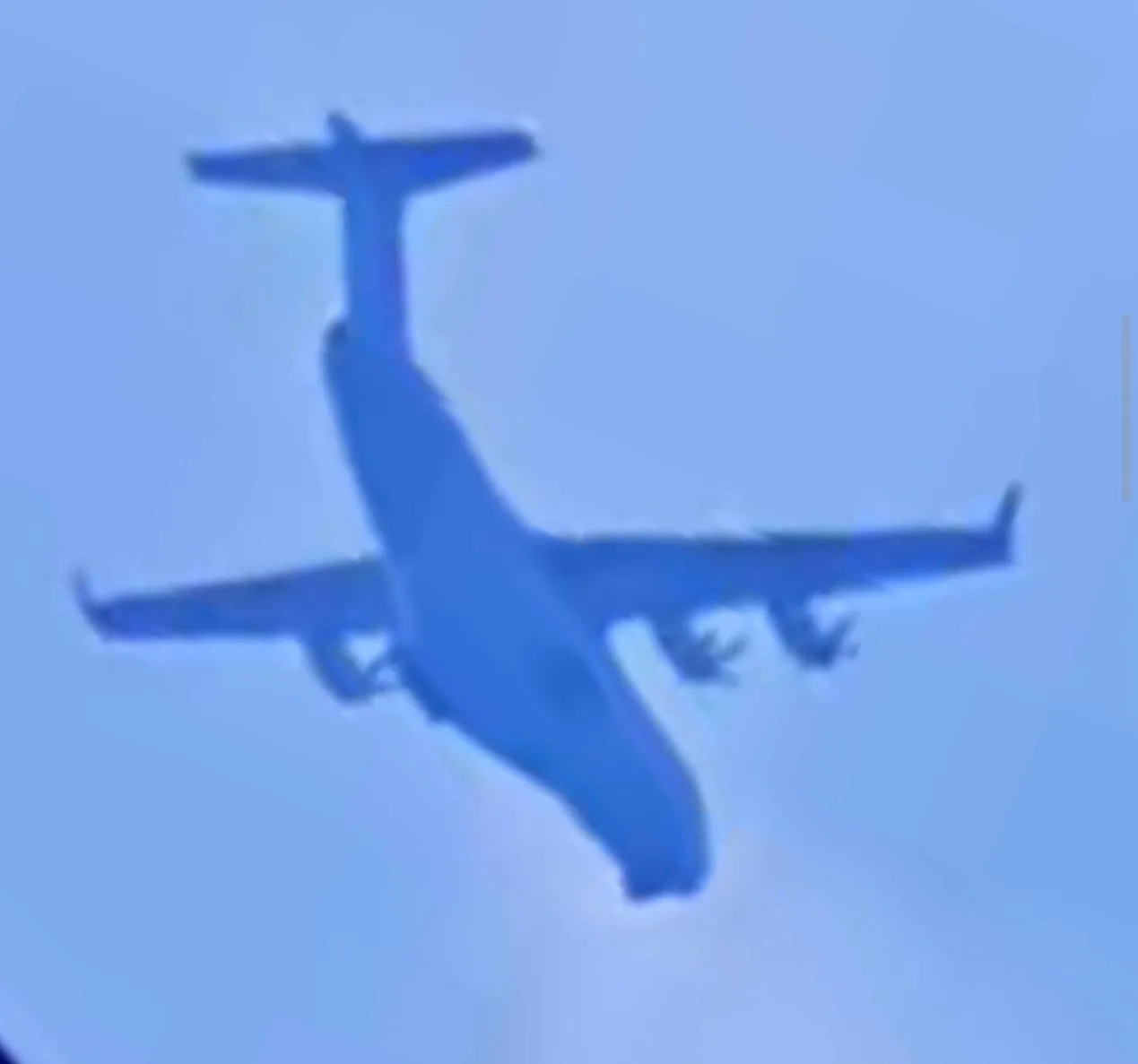
The latest Chinese military aircraft to appear in flight test is a tactical transport aircraft, known, unofficially for now, as the Y-30. Not perhaps as headline-grabbing as China’s string of new crewed and uncrewed combat aircraft designs, the transport is nonetheless highly significant, reflecting the People’s Liberation Army’s growing ambitions to be able to conduct out-of-area operations, including from unprepared airfields.
A product of the Shaanxi Aircraft Corporation, the Y-30 (the alternative Y-15 designation has also been proposed) is expected to be a partial replacement for the same company’s Y-9 four-turboprop transport. Video and photos of the new aircraft began to circulate on social media for the first time today. The aircraft is reportedly flying from the Xi’an Aircraft Corporation (XAC) airfield in the city of Xi’an in central China, with XAC having been absorbed by Shaanxi.

While a new Chinese medium/heavy airlifter had been anticipated for some time, there was speculation that it would be powered by a pair of turbofan engines: The result would have been something like a scaled-down Y-20, with a shorter fuselage and a new wing, somewhat similar in concept to the Kawasaki C-2. In the event, the so-called Y-30 is powered by four turboprops, meaning it looks much more like the Airbus A400M, although it would appear to be in a different class to the European transport.
Other features in common with the A400M include the wide fuselage, offering useful internal volume, especially compared to the Y-9, a rear loading ramp, and heavy-duty landing gear, which should make it suitable for operating out of short, poorly prepared landing strips. Like the Airbus transport, the Y-30 has a T-tail empennage, but its high-lift wing is not swept. The wingtips of the Chinese design additionally feature winglets, which improve fuel efficiency by reducing drag and increasing lift. There is a suggestion that the aircraft might also have asymmetric fuselage-side sponsons, a feature of the C-17 that you can read about here; on the other hand, this may just be a feature of the AI-enhanced version of one of the images.


The Y-30 is reportedly powered by either WJ-10 or WJ-16 turboprops, which are said to develop 6,800 horsepower or 5,140 horsepower each, respectively. While the A400M’s engines drive distinctive eight-bladed ‘scimitar’ propellers, the Y-30, at least at this stage, has more conventional six-bladed props.
Both the WJ-10 and WJ-16 are notably less powerful than the 11,000-horsepower Europrop TP400-D6 engines used in the A400M, suggesting an aircraft that is smaller overall and with a more limited load capacity, closer to the C-130J Hercules. This would make sense, since the A400M, as you can read about here, was designed as a gap-filler between the C-130 at the smaller end of the transport segment, and the larger C-17 Globemaster III at the other end.
With China already building the Y-20 as a broad equivalent to the C-17, the Y-30 is likely intended to be more of an equivalent to the C-130/Y-9, probably slightly larger than the Hercules, rather than being a ‘mid-market’ transport like the A400M.
Unconfirmed accounts suggest the Y-30 will have a payload capacity of around 30 metric tonnes (around 66,000 pounds), which compares with around 145,000 pounds for the Y-20, 82,000 pounds for the A400M, 55,000 pounds for the Y-9, and 47,000 pounds for the C-130J-30.

In keeping with its test status, the Y-30 seen in the imagery available so far features a long air-data boom on the nose. This boom is used to obtain data on air pressure, temperature, and airflow direction, etc., vital for flight-testing. There is no sign of an aerial refueling probe, although this may well be added in the future, as was the case with certain variants of the Y-9.
In fact, the Y-30 first appeared in model form at the Zhuhai Airshow, back in 2014, after which the project went quiet.

Currently, according to Western estimates, the People’s Liberation Army Air Force (PLAAF) operates around 24 Y-9s in a transport role, together with 80 of the older Y-8 four-turboprop transports.
The PLAAF is rapidly introducing the Y-20, which is expected to eventually replace the roughly 26 Soviet-designed Il-76 Candid transports that remain in use. Indeed, by now, Y-20 numbers already eclipse those of the hard-worked Il-76.

Meanwhile, should the Y-30 prove successful, it will presumably supplant the Y-9 and allow the retirement of the aging Y-8 fleet.
While the Y-20 offers truly strategic range to support PLA operations (and humanitarian missions) around the globe, a modern turboprop-powered transport like the Y-30 would be especially well-suited to operations from more dispersed and even austere bases. For example, the new airlifter could fly troops and equipment in and out of China’s island outposts, as well as conduct airdropping as part of any future effort to retake Taiwan; it would also be of notable value during a conflict involving India.


As well as its core transport role, it might be expected that the Y-30 could eventually be adapted for special missions, as has been the case with the Y-8 and Y-9. Between them, dozens of electronic warfare, maritime patrol, and airborne early warning and control (AEW&C) aircraft have been produced for the PLA on these airframes, in numerous different sub-variants. On the other hand, with the Y-9 now well-proven as a special missions platform, it could be the case that continued production of this type will fulfill these niche roles, while the Y-30 production run is dedicated to transports.
It is worth noting that the PLAAF’s ability to conduct airborne assault operations is a relatively recent addition to its core missions. It was only in the 1990s that the Airborne Corps was transformed into a division, and its overall strength was boosted. At the same time, the first Il-76 transports were delivered, but for a long time these remained the extent of the PLAAF’s rapid-reaction transport force. Paratroopers operating as part of a combined-arms force are also a relatively new addition and part of the PLA’s wider modernization.

In terms of airlift capacity, the Y-20 has more recently spearheaded this continued transformation, and the Y-30 looks set to continue the process.
Like other Chinese designs, the Y-30 also has the major advantage of being immune to the tight export restrictions that typically apply to Western designs in the same class. Beijing would be likely to grant export licenses for the transport to countries that might be prohibited from buying a Western design, something that was the case with the Y-9, exported to Myanmar and Namibia, for example. Meanwhile, other markets could also provide an opportunity for the Y-30, as China becomes a more relevant competitor to the West across the military aviation segment.
Overall, the appearance of the Y-30 tops off a remarkable year for China’s military aircraft industries. The last 12 months have also seen the flying debuts, at least in the public realm, of two new combat jets, various collaborative combat aircraft (CCA)-type drones, at least three flying-wing type drones, a ‘drone mothership,’ an advanced jet trainer, a new AEW&C platform, as well as crewed and uncrewed tiltrotors, and coaxial helicopter concepts.
Given the rate at which new Chinese aircraft designs are appearing, it would be wise not to bet against further revelations before this year is out.
Contact the author: thomas@thewarzone.com