Explore new cultures, find the best travel deals, and make informed decisions with our trusted travel news. Let your wanderlust thrive as you stay connected with the ever-changing world of travel.
Located on the Atlantic coast, the country has a subtropical climate with distinct dry and rainy seasons, with average high temperatures in March reaching 34C
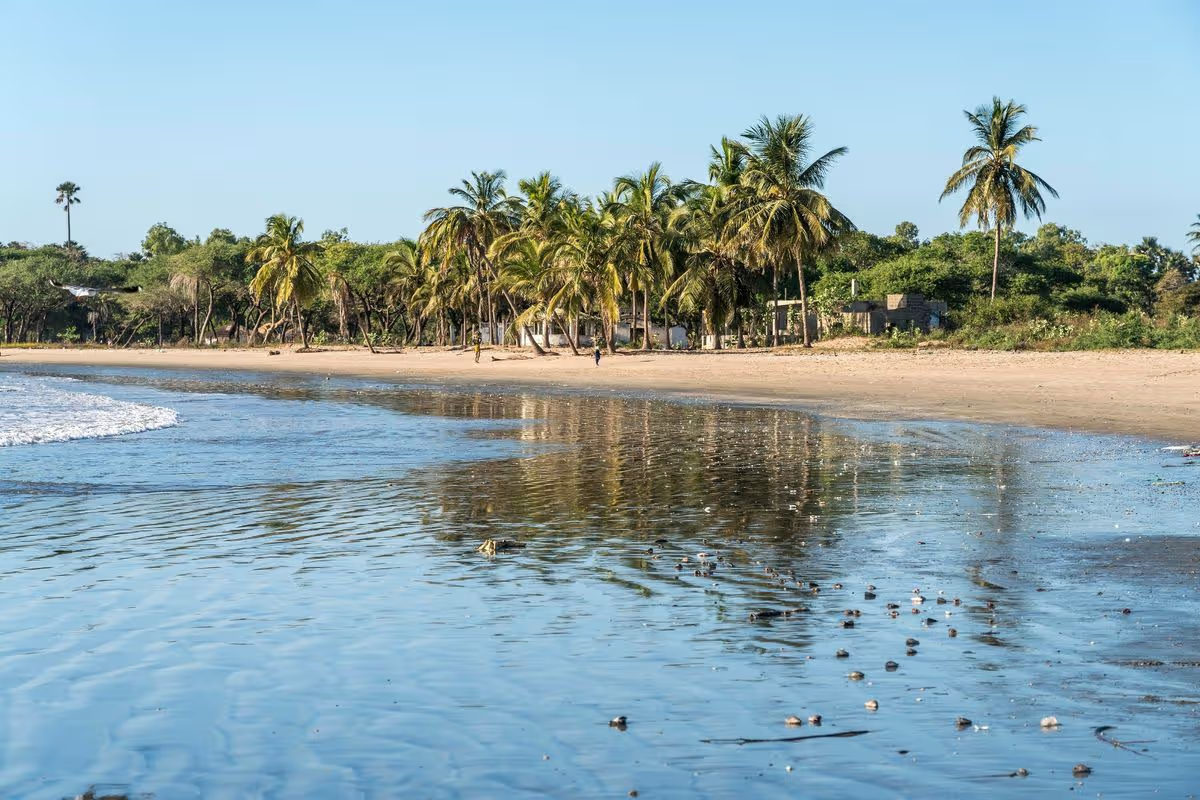
The country plays host to 50 miles of coastline that boasts white-sand beaches(Image: Getty Images/imageBROKER RF)
A breathtaking destination boasting 34C temperatures in March and direct flights from Britain offers travellers 50 miles of spectacular coastline featuring white-sand beaches. Dubbed ‘The Smiling Coast of Africa’, the Republic of The Gambia – or simply The Gambia – is so called after The Gambia River, which forms the core of the country’s geography.
It’s also mainland Africa’s smallest country and is celebrated for its friendly inhabitants. Situated along the Atlantic shoreline, The Gambia enjoys a subtropical climate characterised by distinctive dry and wet seasons.
In the capital, Banjul, average peak temperatures during March climb to 34C, whilst the ocean reaches an agreeable 26C. British holidaymakers travelling to Gambia can select from 17 airlines, according to Booking.com..
TUI operates holiday packages to The Gambia featuring flights from London Gatwick and Manchester Airport to Banjul International Airport, the nation’s capital. The journey from Britain takes approximately six and a half hours.
Despite measuring just 31 miles at its widest point, The Gambia features 50 miles of shoreline blessed with white-sand beaches, with standout locations including the coastal areas of Kotu and Kololi.
Surrounded entirely by the West African state of Senegal, The Gambia’s official language is English and has experienced “long spells of stability” since gaining independence from nearly 150 years of British colonial governance in 1965, according to the BBC.
A haven for nature enthusiasts, The Gambia is home to hippos, chimpanzees, crocodiles, and more than 600 species of birds. The nation also features nine distinct tribes, with the Mandinka forming the largest.
YouTuber Waleed Maoed, who recently visited The Gambia, documented his experience with locals in a video about the nation: “Honestly, it has been a great day in Gambia, home of the Smiling Coast.
“People here are awesome. Very welcoming. I definitely recommend visiting this country. This country is pretty cool.” He noted that despite having travelled to “many places” across Africa, Gambians had proven “super kind”.
The Gambia is a predominantly flat, low-lying strip of land split by the Gambia River, and, in what will come as a relief to those of us who struggle with jet lag, it operates on the same timezone as the UK.
Notable attractions include the River Gambia National Park, Kotu Beach, Kachikally Crocodile Pool, Albert Market and the historical Kunta Kinteh Island (previously called James Island).
Regarding traditional food, white rice accompanied by fiery sauces proves popular, according to The Gambian Experience, with the peanut-based Domoda stew serving as the national dish.
Additional specialities include spiced meat snack afra, meat-and-rice dish benachin, okra stew, palm wine, a bread variety called tapalapa, non-alcoholic wonjo juice, and chicken yassa.
Back in March 2013, Didi Danso penned a piece in the Mirror documenting a journey to The Gambia: “Stepping off the plane, warm air blasted me in the face. Temperatures are usually around 30C – one of the main reasons for its popularity with winter and spring sun-seekers.
“In the airport and beyond, people greeted me with a smiling face. This was so infectious that by the end of each day, my cheeks ached from smiling back.
“My first stop was the beautiful Kombo Beach Hotel in Kotu resort, where a light and airy room with a private balcony offered views of the ocean and beaches.
“Waking up to the sound of the sea was a delightful way to start the day. It convinced me to take a walk on the beautiful Bakau Beach – something I’d recommend to all.”
Over the holiday period, I travelled to explore what this upcoming seaside town had to offer
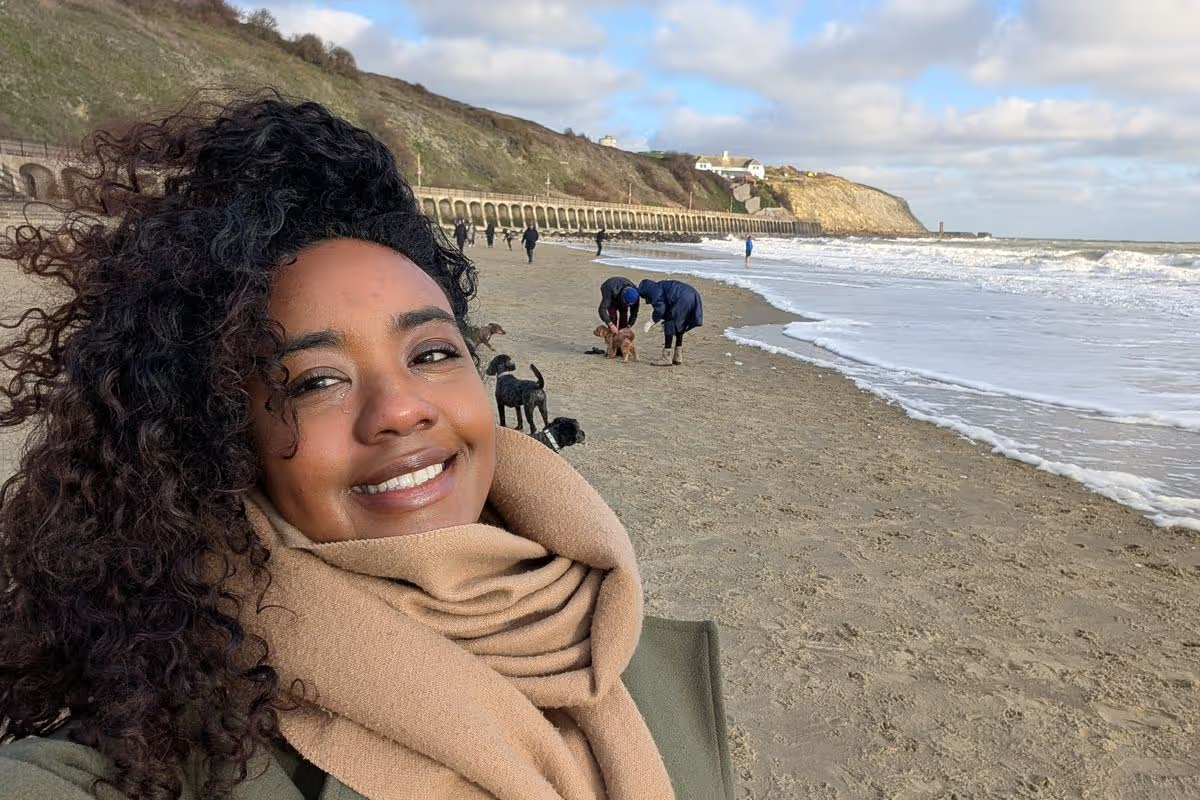
I visited an up-and-coming UK seaside town (Image: Shania King-Soyza)
Nestled along the British coastline, one “emerging” seaside destination is discreetly transforming itself into the perfect coastal getaway. Boasting over 50 independent retailers dotting its charming streets, it presents a welcome change from identical high streets dominated by familiar chain stores.
The town’s artistic flair complements its historical appeal. From mouth-watering bakeries, trendy bars and eateries to unusual boutiques, each street corner feels distinctly local and brimming with character. Here’s what I uncovered during my visit to the sandy coastal town of Folkestone in Kent.
The beach
Folkestone features six beaches, but the one that captivated me most was the sheltered Sunny Sands. This spot was utterly stunning and serene. My highlight was perched on the brick wall above, observing the freezing turquoise waves rolling in.
Numerous visitors had their amiable dogs wandering freely, bounding across the sand and along the shoreline, and it was such a liberating scene to observe. The temperature was bitterly cold, and the breeze was battering my face, but it was worthwhile spending every moment there in tranquillity.
There was something oddly meditative about the sea, particularly in Folkestone. Well-known seaside destinations like Brighton don’t quite deliver that same sense of calm and peacefulness.
High street full of Independent shops
I thoroughly enjoyed discovering the town, with its undulating hills offering views reminiscent of the South of France, complete with palm trees and vibrant buildings. Yet what truly captured my heart was witnessing what the locals had to offer.
Folkestone boasts a thriving high street packed with a variety of local independent businesses, from clothing boutiques and game shops to traditional pubs and cafés. This area is known as the Creative Quarter, “a true symbol of the regeneration of the town,” said Folkstone and Hythe.
The town is surprisingly artistic and wonderfully eccentric. The quarter is said to hold an “inspiring community of designers, filmmakers, musicians, web developers and artists around the 115 studios and offices and over 50 shops, as well as around 80 flats, making the area a playground for creative and digital businesses.”
I ended up departing with second-hand bags and jewellery, anime and comic book merchandise (who would have thought?), along with charming trinkets to adorn my room.
The unique railway
Sitting at the heart of the harbour is an elongated, disused railway station, which proved both intriguing and thoroughly enjoyable to stroll across. According to Folkestone Harbour Seafront, the station platforms form part of the restoration of the Harbour Arm and its heritage structures.
The former Folkestone Harbour station launched in 1850, with a steep branch line descending from the main station to the harbour, connecting trains with ferries to Boulogne and Calais.
Following the abolition of duty-free shopping in 1999, the ferry operation from Folkestone ceased in September 2000, eliminating the primary purpose for the harbour branch line’s existence.
The arrival of the nearby Channel Tunnel also diminished the requirement for the conventional ferry-to-train connection, resulting in the line being formally closed in 2014. The station was subsequently cordoned off and deteriorated.
Nevertheless, the station was later restored and reopened in spring 2018. The platforms, where passengers once waited for trains, are now sheltered areas to relax, sit, and enjoy the scenery.
Discussing the transformation of the station, a spokesperson for the company said: “When the Folkestone Harbour & Seafront Development Company took possession of the harbour buildings, it was clear that very little of the original 1850 station structure remained.
“Even though the physical structure lacked authenticity, we realised that the existence of a station on the Harbour Arm had been integral to the successful development of Folkestone. It was interlaced with layers of history, making it an important piece of the town’s story.”
London-inspired attractions
After we strolled along the platform, we followed the signpost, which directed us to the “Goods Yard.” There, we discovered what resembled a compact version of London’s Boxpark.
This came as a welcome discovery, as throughout most of our stay, we’d been mingling with locals who appeared to be pensioners, but the Goods Yard attracted predominantly younger people, teenagers and families.
Similar to London, the venue featured a large screen showing family-friendly films and was surrounded by numerous restaurants and drinking establishments.
The dining options include Little Rock and Rocksalt, which provide locally caught seafood alongside coastal panoramas. Fresh fish cuisine can also be found at Chummys.
According to FolkeLife, Plamil Foods manufactures plant-based milks and vegan chocolate, whilst El Cortador delivers Spanish tapas. For beverages, craft beer is available at Brewing Brothers, whereas the Potting Shed provides vibrant atmospheres.
My top dining recommendation
During my time there, the finest experience I had was undoubtedly the cuisine. Beyond the harbour area, my preferred dining destination is the Blackmarket on Tontine Street.
This neighbourhood establishment serves mouth-watering burgers, chicken wings and alcoholic drinks, occasionally hosting live musical performances.
The interior design was remarkable, showcasing an eclectic collection of photographs, art pieces, text, banners, and emblems. It’s incredibly contemporary, yet accommodates visitors of every age and character.
I selected a burger topped with blue cheese, chorizo and crispy onions, which I still fantasise about today. I polished off the soy honey garlic-glazed wings within moments.
While chatting with proprietor Nathan Roberts, he explained they source locally, partnering with one of the town’s few remaining butchers. The menu gets refreshed every couple of months, guaranteeing fresh offerings on each return trip.
Discussing Folkestone’s prospects, Nathan commented: “It’s definitely somewhere to watch, there’s a lot going on, a lot of moves being made. I’d say in the next 10 years, Folkestone will be on the map, especially for people in the city. It’s going to be somewhere to keep an eye on; it’s only going to get better around here.”
Met Office names Glenshiel Forest the UK’s wettest place below 200m with 3,778mm of rain a year – but the Scottish beauty spot offers red deer, historic battlefields and breathtaking mountain views
This article contains affiliate links, we will receive a commission on any sales we generate from it. Learn more
Milo Boyd spent his formative years being rained on
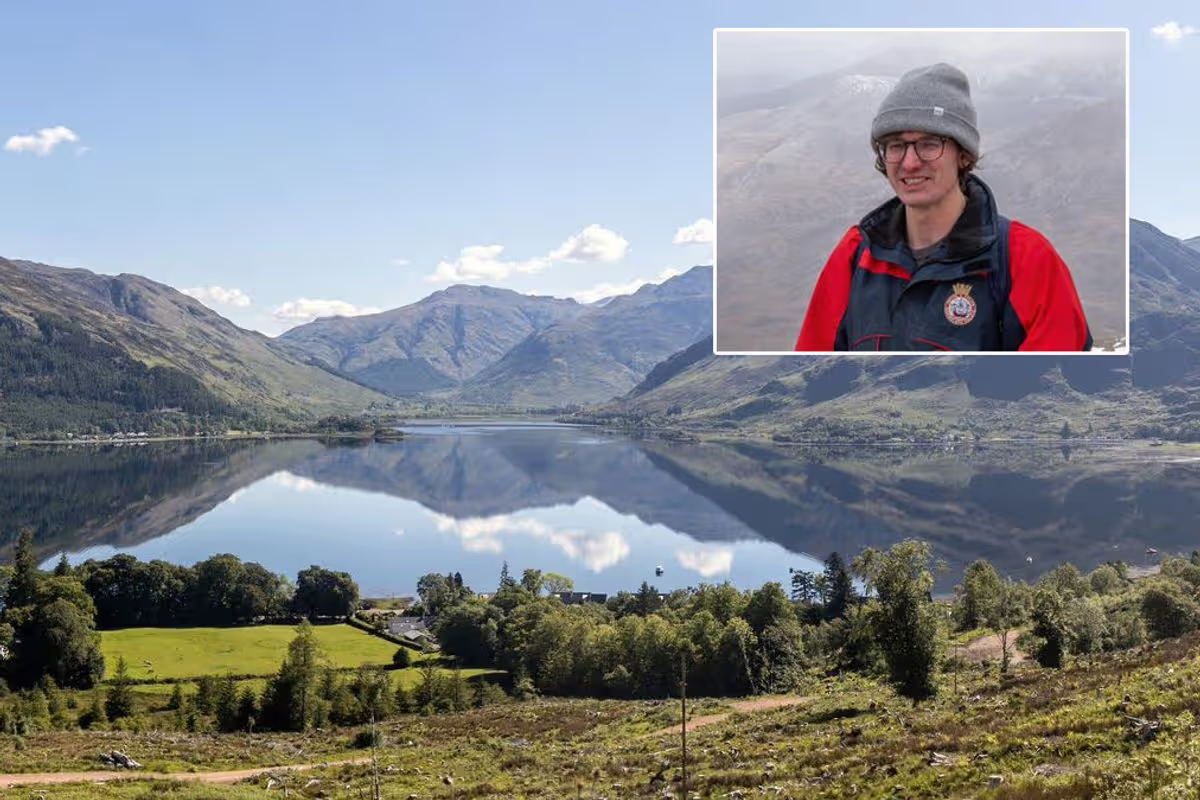
Britain’s wettest location also happens to be one of its most stunning destinations.
It has been a truly miserable winter. Cornwall and County Down recorded their wettest January on record, while Northern Ireland saw its wettest January is 149 years. Across the UK, 26 stations set new monthly records for highest January rainfall. Daily records also fell. Plymouth recorded its wettest January day in 104 years. And February has been no better so far. As of February 9, southern England had seen 72% of its monthly average.
In the midst of such sogginess, the prospect of venturing towards a region notorious for precipitation might not sound particularly appealing. However, in my view, the nation’s rainfall champion deserves a visit regardless of the season.
My initial trip to Glenshiel Forest in Ross and Cromarty, Scotland, occurred when I was four years old, during a family getaway to the neighbouring village of Glenelg. Those familiar with Scotland’s western coastline throughout the year will recognise how weather systems shift with astonishing speed compared to elsewhere in Britain.
Sunshine and azure skies can transform into torrential downpours within moments, sending everyone scrambling for waterproofs.
Glenshiel Forest takes this phenomenon to extraordinary heights. Rainfall batters the foliage and trees lining the nine-mile glen with remarkable intensity, only to abruptly cease as clouds disperse above the surrounding peaks, before resuming their assault once more.
Due to their intensity and frequency, the Met Office has designated Glenshiel Forest as Britain’s dampest location below 200m elevation, recording 3,778mm of precipitation annually. This dwarfs London’s approximately 500ml yearly average, making Glenshiel Forest roughly seven times wetter. It’s also roughly four times wetter than the UK as a whole.
But don’t let that deter you from pulling on your wellies, slipping into some galoshes and paying a visit to the Scottish forest. The area has been largely untouched by human activity, giving it a wonderfully remote and pristine feel. Red deer roam freely among native tree species such as common alder, downy birch, sessile oak and rowan.
History buffs will be captivated by the area’s rich past. “There’s a powerful sense of history in Glen Shiel, with steep mountains rushing upwards from an historic battlefield where British government forces and an alliance of Jacobite and Spanish troops fought in 1719,” notes the Woodland Trust.
“You can also access a mountain path to the Five Sisters of Kintail ‘ a classic ridgewalk with three Munros (mountains over 3000 feet / 914 metres).”
For 15 years, I spent my Easter holidays in the nearby village of Glenelg, which is most easily reached by traversing the stunning 339m tall Ratagan Pass – the only route into the sea-loch side settlement for several months of the year when the iconic Glenelg-Skye turntable ferry isn’t in operation.
The vista from the summit of the Ratagan, gazing down upon Glenshiel’s drenched woodlands in one direction and Glenelg in the other, is utterly unforgettable once witnessed. Few thrills can match cresting the hill after navigating the treacherously narrow, serpentine roads and beholding the village’s whitewashed cottages dotted along a loch’s shore, its waters remarkably azure, set against the backdrop of Skye’s mountains and the landscape beyond.
Perhaps the only thing that surpasses it – and another reason my family kept making pilgrimages to this remote corner of Britain year after year until the bungalow we considered our holiday retreat eventually crumbled into complete disrepair – is the panorama from the Glenelg Inn’s garden. Should you ever venture to the area, savour a pint from the local brewery whilst seated at the Inn’s picnic tables, taking in the spectacular scenery – at least until the heavens open.
For those who’d rather not brave the elements and venture into the sodden outdoors, Sykes Cottages has numerous properties available that are perfect for settling in and shutting out the dreary world beyond.
One particularly appealing option is Silver Birch Lodge, a six-person cottage that can be yours for less than £100 a night. Travel a little further north and you’ll get to the spacious Old Distillery Lodge, which sits in the stunning Caingorns National Park.
As rainy as parts of Scotland can be, they pale in comparison to the world’s soggiest area. Mawsynram is a town unlike any other. Nestled amidst the lush green forests of the Khasi Hills in the far east of India above Bangladesh, it is a beautiful area but an absolutely soaking one. Mawsynram receives about 11,873 mm of rainfall annually, which is close to 11 times more than the 1,109mm that falls on famously sodden Glasgow.
Jyotiprasad Oza is a lifelong resident of the town who makes a living leading groups of curious holidaymakers around with TourHQ. People come from far and wide to experience what life is like in the rainiest place on Earth, with visitors regularly making the trip from the US and UK.
“We get about 10,000 tourists a year. During rainy time people like to visit because it’s very heavy rainfall, especially June to September,” Jyotiprasad told the Mirror just as the rain clouds – somewhat predictably – began to open above him.
The rain in Mawsynram is not like the rain in most places. When it starts sometimes it doesn’t stop for days on end. Often residents will dash inside when the heavens open, only to find that there has been no let up for a week straight. And it isn’t just the duration that makes it stand apart.
In one single June day last decade 1,003mm of rain fell on the town – twice as much as London receives in a single year. The impacts on Mawsynram of such intense rainfall can be quite devastating.
“During the time of heavy rainfall, it is impossible to go outside. We can’t do our daily walk. We are not supposed to go outside during the rainy time. Sometimes children can’t go to school during the rain. It is quite dangerous,” Jyotiprasad explained.
JUST one hour into our safari, we’ve hit the jackpot!
“Look, you can just make out its outline,” our guide Dinuka shouts, as he passes his binoculars to me and my boyfriend Andy.
Sign up for the Travel newsletter
Thank you!
Winging it at the Gal Oya Valley National ParkCredit: Getty Images/Collection Mix: SubSpill the tea at the Tea & Experience FactoryCredit: Supplied by hotel
Standing on a grass bank surrounded by water, a majestic elephant comes into focus.
As we approach to get a better look, I feel like I’ve just stepped into a David Attenborough documentary.
This reservoir in Sri Lanka’s Gal Oya Valley National Park is home to an abundance of wildlife – we also spot crocodiles basking in the water, a herd of buffalo, eagles and a host of other birds.
With only four tourist boats allowed out on the water at a time, it feels very much like the nature in this national park is being protected.
And from colonial cities to mountainous tea plantations, vast jungles and sandy beaches, everywhere we turn on this stunning island, there’s wonder to behold.
Valley High
We begin our trip in Kandy, Sri Lanka’s second-largest city and home to nearly 1.5 million people, plus a riot of cars, buses, tuk-tuks and scooters.
Mountbatten Bungalow, a 15-minute drive away from the bustle, was the hillside hideaway of Lord Louis Mountbatten during WW2 and is steeped in history.
Explore Kandy’s Temple Of The Sacred ToothCredit: G&M Therin-Weise/roberthardingSri Lanka’s wildlife is elephant-astic!Credit: Alamy Stock Photo
It’s also an oasis of calm, with vistas of rolling hills, space for just 26 guests, Victorian trinkets and a swanky infinity pool overlooking the valley.
High tea, £12, is served on the deck and it’s the most beautiful place I’ve ever eaten a cucumber sandwich.
Double rooms here cost from £143 B&B.
Our driver, Nuwan, recommends the nearby Temple Of The Sacred Tooth Relic, as a must-see, and we’re so glad we take his advice.
A UNESCO World Heritage Site, it’s well worth the £5 entry fee as we look on in awe at the intricate Kandyan architecture and one of the holiest shrines in Buddhism, which houses the canine tooth of Gautama Buddha (Sridaladamaligawa.lk).
Tranquili-tea
Meanwhile, sitting amid marvellous mountains a two-hour drive away, the Tea & Experience Factory is a hotel unlike any I’ve stayed in before.
With the clouds rolling in, the surroundings are hauntingly atmospheric and, as the name suggests, this is a former tea factory built in the 1800s.
Mountbatten Bungalow is a haven of calmCredit: Pradeep GamageGo off-grid in a luxe glamping tentCredit: Pradeep Gamage
This stylish sleepover still has a small working factory showing how tea is produced, and from picking the leaves to seeing them being ground down in the various machines still in operation, it’s fascinating to find out how our daily cuppa is created.
The hotel also offers free guided waterfall treks with plenty of gorgeous photo stops in the lush landscape.
Double rooms cost from £114 B&B.
Jungle is Massive
Our favourite stop is still to come.
Three days spent at Wild Glamping Gal Oya is nothing short of a dream, and is where we spot the Sri Lankan elephant on our boat safari, which costs £85 per person.
It may not roar, but Lion Rock is majesticCredit: Getty Images/iStockphoto
Tents here have air-con, electrical sockets, huge comfy beds and alfresco bathrooms with waterfall showers.
A swimming pool sits in the middle of the camp with a breathtaking mountain backdrop – and with no phone reception, we fully embrace off-grid living.
The Veddas, one of Sri Lanka’s last remaining indigenous groups, work closely with the camp.
The first-known aboriginal people of the country, they were once forest dwellers, foraging, hunting and living in the jungle and caves.
These days, they make up less than 1% of Sri Lanka’s population and are a dying community who wish to teach others about how they live.
Gunabandilaaththo has a very simple life and shows us the ways in which his ancestors used to live, from mud huts to rustling up a traditional meal.
It’s an eye-opening two hours, £30 per couple, and a real honour to learn about his culture.
That night, we indulge in a Sri Lankan lamb curry and rice, £8, with creamy green beans, dal and coconut sambal, and chat about all we’ve learned.
Our last stop takes us to Amba Yaalu, set on the tranquil banks of the Kandalama Lake and the country’s first hotel fully managed and staffed by women.
Sitting next to a mango farm, rooms here look out over a glorious reservoir and the ancient Pidurangala Rock, which from some angles, resembles a person lying down.
Fashion Editor Abby McHale in Sri LankaCredit: Supplied by Abby McHale
Each room comes with an outdoor Jacuzzi bath to take in the views while soaking in bubbles.
Stays here cost from £121 B&B.
Sigiriya (also known as Lion Rock), is half an hour’s drive away and famous for its 200m-high granite column topped with the ruins of a 5th-century royal palace.
It’s a two-hour steep climb, but the views at the top are worth it.
Once back down on more solid ground, it’s the perfect time to reward ourselves with a Lion Beer, £2.50, from a street vendor and watch as the sun sets on an adventure just as golden.
Some British nationals could face problems at the border when the change begins on February 25, 2026
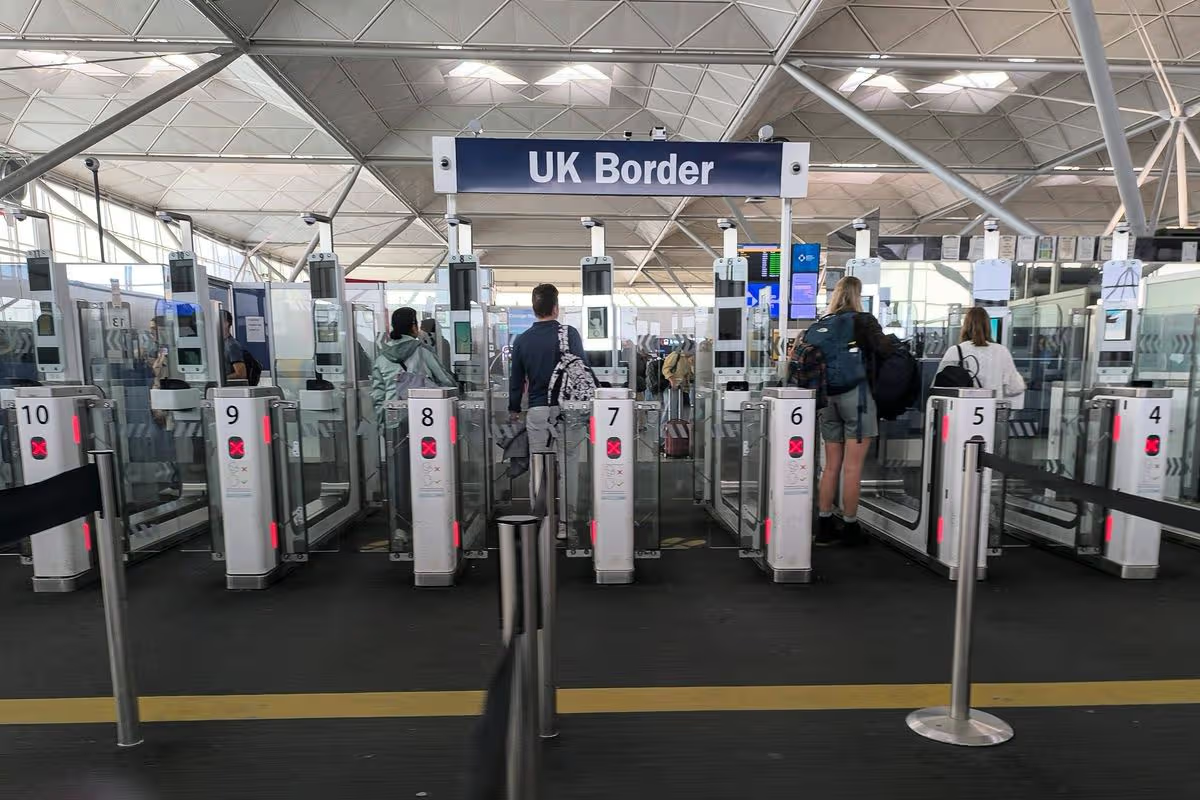
The new rules begin this Wednesday, February 25(Image: NurPhoto, NurPhoto via Getty Images)
A cluster of UK citizens are bracing themselves for the prospect of obtaining a new passport or shelling out hundreds of pounds due to an impending border change set to kick in on Wednesday. Dual British nationals, including children, could be denied entry into the UK unless they hold a British passport, under fresh regulations slated to come into force later this month.
An estimated 1.2 million dual British citizens are scattered across the globe. From February 25, 2026, those journeying to the UK will need an Electronic Travel Authorisation (ETA). Travellers without an ETA will be prohibited from boarding their flight, ferry or train.
British and Irish citizens, which includes dual nationals, are exempt from this requirement but must adhere to other stipulations. To travel to the UK, dual nationals will now require a valid British passport.
Alternatively, they can fork out £589 for a certificate of entitlement to attach to their second nationality passport. In the past, dual nationals were able to enter the UK using their non-British passport at no cost.
Dual nationals attempting to gain entry to the UK solely with a foreign passport may face hurdles. Although British citizens have a legal right to reside in the UK, travellers could be subjected to extra scrutiny while their status is verified. They might also be barred from boarding if they fail to prove their right of entry.
The Government rolled out these regulations last year, but numerous dual nationals have argued the changes arrived with insufficient warning and inadequate communication. Anxiety is growing that getaways or work journeys could face disruption if people don’t obtain a passport or certificate of entitlement quickly enough.
Why have ETAs been introduced?
ETAs have been brought in as part of wider plans for a “more streamlined, digital immigration system” which the Government expects will be faster and more secure for the millions crossing the UK border each year. It’s a digital travel authorisation – not a visa or levy, simply granting someone permission to travel to the UK.
Government officials maintain that introducing ETAs mirrors the approach numerous other countries have taken for border security, such as the US and Australia.
At present, an ETA costs £16 and permits multiple journeys to the UK for stays of up to six months at a time across a two-year period. There are plans to raise the charge to £20 down the line.
A Home Office spokesperson said: “From February 25, 2026, all dual British citizens will need to present either a valid British passport or certificate of entitlement when travelling to the UK. Without one, carriers cannot verify they are a British citizen, which may lead to delays or refused boarding.
“Public information advising dual nationals to carry the correct documentation has been available since October 2024 and a substantive communications campaign about the introduction of ETA has been running since 2023. This requirement applies to all British citizens regardless of other nationality and is the same approach taken by other countries, including the United States, Canada and Australia.”
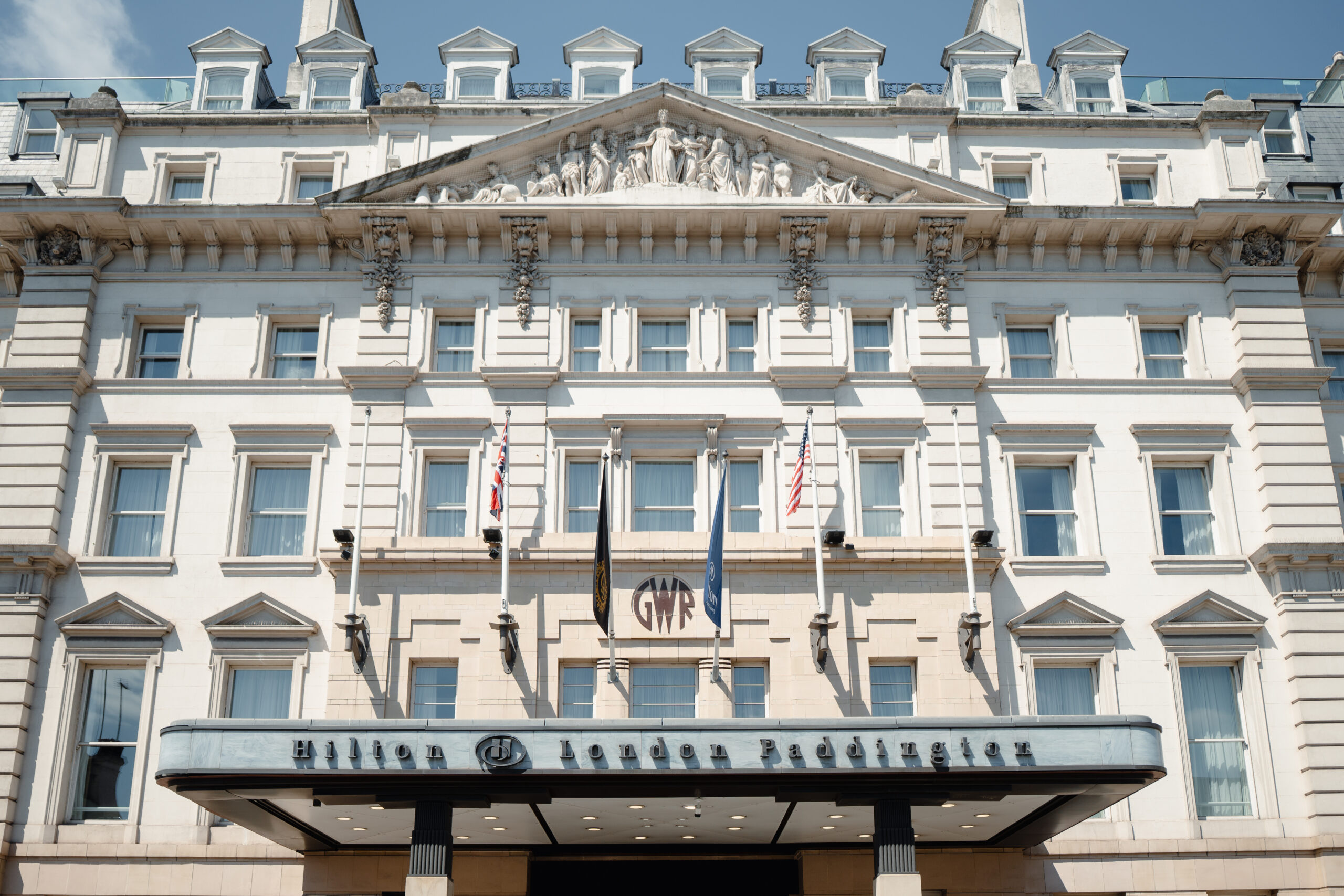
DESIGNED by one of the UK’s most famous civil engineer, Hilton London Paddington is both well connected and grand.
Here’s everything you need to know.
Sign up for the Travel newsletter
Thank you!
Hilton London Paddington dates back more than 170 yearsThe bar and restaurant was recently updatedCredit: Paul Rogers
Where is the Hilton London Paddington?
I can see why they call it London’s best connected hotel, being adjoining to London Paddington Station.
Along with trains to destinations such as Plymouth and Oxford, from here there are five London Underground routes, as well as a fast 15-minute train to London Heathrow.
What is the hotel like?
The grand hotel dates back to 1854, originally called the Great Western Royal Hotel by HRH Prince Albert.
It was designed by Isambard Kingdom Brunel, an English civil engineer behind Great Western Railway, the Clifton Suspension Bridge, and London Paddington Station, as well as the hotel.
Travel experts reveal the three types of items you should avoid packing in your cabin bag when flying with budget airlines like Ryanair and easyJet
If you’re clever about how you pack you can save money(Image: Dmitri Zelenevski via Getty Images)
Travellers who choose to fly with budget carriers such as Ryanair and easyJet can take advantage of remarkably low fares if they travel with hand luggage only. However, these airlines, like numerous other low-cost operators, require passengers to pay additional fees for larger cabin bags or checked luggage.
Should you turn up at the airport with more than your permitted luggage allowance, you could be stung with substantial excess charges. Matthew Corrigan, CEO of Trtl Travel, recommends that one of the most effective ways to maximise your luggage allowance and sidestep extra costs is to pack cleverly.
He said: “Airlines such as Ryanair, British Airways, easyJet and Jet2 are cracking down on hand luggage passengers.”
In recent years, numerous airlines have tightened restrictions on the amount of hand luggage passengers can bring aboard. For example, Ryanair now only permits passengers to bring one small item of luggage per person free of charge.
Matthew said: “One of the main downsides of travelling with only a carry-on bag is significantly less space for your belongings.
“Whilst this may seem like a deal-breaker, there are some simple ways to maximise the space in your hand luggage.”
According to the specialist, this means leaving certain everyday essentials behind that could be taking up considerable space or adding unnecessary weight.
Travel guru Matthew has some shrewd advice to banish your packing headaches for good. He suggests: “Avoid packing items that will be provided by the accommodation – such as hairdryers, towels, and toiletries. Only bring items you know you’ll use, and try to share phone chargers and other technology wherever possible.”
Before you start packing those bulky bottles of shampoo or a hefty hairdryer, check with your hotel first; there’s a good chance they’ve got you covered. And let’s face it, you can pick up toiletries at your destination if needed.
Heading somewhere chilly? Matthew’s tip: wear your coat and chunky knits on the plane instead of cramming them into your bags.
Walk through departures in your winter wear, he says, because after all, you can throw your coat over your arm if you warm up. Plus, it won’t count against your cabin baggage allowance and you’ll avoid the shivers mid-flight.
He added: “It’s best to wear large items such as jumpers and coats onto the plane rather than packing them. This frees up space and ensures you don’t get cold during the flight.”
THE birch trees either side of us become a blur as we speed through the snowy woodland, our sled being masterfully pulled by a pack of energetic dogs.
Looking up, I spot a sheet of vibrant green and fiery pink spread across the night sky.
Sign up for the Travel newsletter
Thank you!
Aurora Borealis across a Norwegian fjordCredit: GettyPool and tubs on the deckCredit: SuppliedThe city of Tromso, where we took the mountain cable car to the top of snow-clad Storsteinen, 1,382ft above sea level.Credit: Getty
It had always been a dream of mine to experience the elusive Northern Lights.
February is one of the best times of year to see the natural phenomenon in Norway, although you stand a pretty good chance at any point from late September to April.
My partner Gemma and I were travelling with Ambassador Cruise Line, which has affordable sailings from the UK, removing the need for a flight.
Our home for the next couple of weeks, Ambition, was a modern 1,200-passenger vessel that oozes glamour with plenty of polished wood and brass, and a cosy, relaxed ambience.
Cabins are luxurious, spotless and well-appointed — refreshed each day by doting “butlers”.
Everyone on board has a complimentary dining place in either the light and airy Buckingham restaurant or smaller, more intimate Holyrood, both of which serve high-quality food with plenty of options for vegetarians like Gemma.
There is also the buffet-style Borough Market which serves delicious meals from early to late.
Plus there is speciality dining such as the fabulous Saffron, an Indian restaurant which left Gemma in raptures about the veggie selection platter.
The highlight for me, however, was the Chef’s Table experience where we were treated to a fascinating tour of the ship’s galleys before executive chef Cleo Murzello showcased his culinary skills in nine sensational courses paired with wines.
Just be prepared that you won’t feel able to move from your seat afterwards!
When we weren’t exploring the fjords, on board entertainment kept us busy every day with games — we couldn’t keep away from the high-prize £3-a-play bingo — West-End worthy theatre performances and fascinating talks including how to photograph the Aurora Borealis.
With seven bars, six restaurants, a shopping galleria, library, games room and incredible spa there’s always something going on.
Then there’s the shore experiences with everything from snowshoeing and rib-boat riding to ice bars visits and cable car trips available.
On our first morning in Norway, we woke to see low rocky islands sliding past as we got our first glimpse of the fjords — the long sea inlets between majestic mountains.
Alesund is one of Norway’s most beautiful towns. The best way to see it is to climb the 418 steps to its hillside view point and reward yourself with a svele pancake from the cafe at the top.
Setting sale on the AmbitionCredit: ARTAWAN.GDEOur dog-sledding trip brought what we’d been waiting forCredit: Getty
Then wander around the shops filled with the Norwegian obsession of trolls and slippers, then the gorgeous harbour.
Next morning, after crossing into the Arctic Circle, Ambition glided between snow-covered peaks up Straumsfjorden to the city of Tromso.
Here we took the mountain cable car to the top of snow-clad Storsteinen, 1,382ft above sea level.
The views were spectacular — as was the high-altitude beer at the summit cafe.
But it wasn’t until our evening dog-sledding adventure that we finally got what we came for.
As darkness fell the night sky began to bubble and split.
From behind the dark mass of mountains, a collection of dancing green fingers reached upward and outwards, curling and filling the sky.
It couldn’t have been a more perfect setting as the panting huskies ploughed through the snow.
More excitement was to come, though.
Cruise stops include the frozen port of Alta, in the Finnmark area of northern Norway, home of the Sami people.
Those keen to learn about the culture can book tours which include a visit to a village and reindeer sledding.
Instead, we headed to Alta Museum to take in some of the 6,000 amazing rock paintings dating from 4,200BC, discovered in 1973.
If ice snow experiences are more your thing, try the port of Narvik, home to a breathtaking Arctic train ride and polar wildlife park.
Or there’s the city of Bergen, where you can pick up souvenirs from local shops that line the cobbled streets.
I may have returned home with a pair of troll slippers but it’s the memory of Northern Lights that I’ll be cherishing for years to come.
Even the pictures on my phone don’t do it justice.
Norwegians have an obsession with trollsCredit: Getty
GO: NORTHERN LIGHTS CRUISE
SAILING THERE: A 17-night Norway’s Land Of The Northern Lights cruise on board Ambition is from £1,709pp, departing Bristol Royal Portbury on October 16, based on two sharing an inside cabin.
Ports of call include Andalsnes, Alesund, Tromso, Alta, Hammerfest, Harstad, Leknes in Lofoten Islands, Narvik and Bodo.
A HISTORIC UK pub has reopened after a £1.8million renovation.
The Hoop and Grapes pub in Farringdon, London has reopened after a huge refurb – and all the buildings around it are modern skyscrapers.
Sign up for the Travel newsletter
Thank you!
The Hoop & Grapes pub has reopened following a £1,800,000 refurbCredit: Shepherd NeameThe pub has been closed since 2019Credit: Shepherd Neame
The Grade-II listed pub has been closed since 2019 as the surrounding area was redeveloped.
Restored by Britain’s oldest brewer Shepherd Neame, the refurbished pub still celebrates its history, whilst also adding vibrant and modern elements.
The pub was originally built in 1721 on land that used to be a part of St Bride’s Church burial ground and is thought to have been a wine merchant’s home.
And the boozer is well known for being the site of illicit ‘Fleet Marriages’.
These were weddings that took place illegally in the late 17th century and often involved couples wanting to marry fast, for example when a woman was pregnant.
To bring the story to life, the pub has added a swing sign which depicts an 18th-century wedding scene.
There are also hand-painted signs on the outside of the pub that add to the historic front facade.
The boozer also once held a special license to operate from 2am to 5am for printers and market workers.
Across five floors, the building offers three different experiences.
On the ground floor is where visitors will find a traditional London pub with a courtyard garden.
On the first floor, there is then a comfortable seating area.
And the top floor is a more intimate piano room, ideal for private events.
The menu features dishes with locally sourced ingredients and seasonal produce.
There are buffet feast boards as well, such as a beef burger sliders platter for £50 or a pork and sage Scotch eggs board for £45.
New signage depicts how ‘Fleet Weddings’ used to take place at the pubCredit: Shepherd NeameVisitors can have a range of beers and ales as well as buffet boardsCredit: Shepherd Neame
When it comes to having a tipple, the pub boasts Shepherd Neame’s award-winning Kentish ales and lagers, English wines and cocktails.
According to the pub’s website, “the name ‘Hoop & Grapes’ likely refers to the metal hoops used to hold barrels together, and the grape-derived wines that will have been the daily business of this 18th century building even before it became a public house.
“However, a possible alternative reading of the name is that ‘Hoop’ could be a corruption of the word ‘Hops’ and the name might simply refer to the availability of both beers and wines within.”
One visitor said: “Best pub in the ‘City’ in my opinion.”
“YOU, with me.” The pilot pointed at the cockpit of the two-seat-wide propeller plane and I obediently clambered in.
The tiny aircraft rattled along the runway, and I took a deep breath, only to let out a gasp after take-off as I looked down.
Sign up for the Travel newsletter
Thank you!
Meads Bay has been named in global top 50 beachesCredit: SuppliedFrangipani Beach Resort will give you a chance to visit Little BayCredit: SuppliedMy lavish ocean-view room at Zemi Beach House, set right on the sandCredit: Supplied
The crystalline Caribbean sea glittered below us, and as far as the eye could see the waters were peppered with sandy cays and islands — one of which was to be my home for the next few days.
Anguilla is just a 45-minute flight from the more-visited Antigua — and despite the island being so small that it only needs six traffic lights, it’s home to not one, but two of the best beaches in the world.
One of these is the breathtaking Shoal Bay, which I got to marvel at from my lavish ocean-view room at Zemi Beach House, set right on the sand.
You won’t see any cruise ships, jet skis or thumping beach clubs here.
This unspoiled stretch of pristine sand is lined with swaying palm trees on one side and soft, turquoise waves on the other, both a welcome presence in the 30C heat.
The upscale hotel has an elegant open-plan layout, two infinity pools (including one that’s child-free), a walkaround bar service and a spa, which sits inside a 300-year-old authentic Thai house, transported and reconstructed piece by piece.
Lounging in the spa’s quiet zone post-massage as I listened to the sounds of the island with an iced drink, I understood why Anguilla prides itself on the slogan “Tranquility wrapped in blue”.
An entire holiday could easily be spent without leaving Zemi — after all, it also has its own tennis court, gym, boutique, bars and restaurants.
But Anguilla’s magic is not confined to the famous Shoal Bay.
Orange-flowered flamboyant trees (flamboyant by name and by nature) and colourful bungalows lined the roads as an enthusiastic local named Kelvis guided us round his home island. A short drive brought us to The Arch, a doorway-shaped rock formation over the ocean that wouldn’t look out of place in the Algarve.
Elvis beach bar is a favourite watering hole among the localsCredit: Supplied
Years of footfall by tourists wanting THE Instagram shot have made walking onto it now unsafe, but I was more than happy to forgo that and simply take in the vista, something I also did at the impressive Sandy Ground viewing platform.
Inland, we admired the striking architecture of the island’s Catholic church and visited Wallblake House, Anguilla’s only surviving plantation building, which now serves as a museum.
There was one spot, however, that Kelvis couldn’t take us: Little Bay. The smallest of Anguilla’s 33 beaches, this cove is only accessible by hanging onto a rope and climbing down a cliff face, or via the water.
None of us fancied going home with crutches and a cast, so we kayaked from the nearby Crocus Bay in transparent boats which allowed us to spot a couple of sea turtles underwater as we paddled.
If kayaking isn’t your thing, don’t fret — a stay at the Frangipani Beach Resort will give you a chance to visit Little Bay on their very own catamaran, the FrangiCat.
The pastel pink resort sits on Meads Bay — Anguilla’s other world-class beach that made the global top 50 — and has an intimate atmosphere without compromising on luxury in its enormous suites.
We spent the second half of our trip at Frangipani gazing out to sea from the quiet shore while petting the resort dog, Sunny, and sipping on generous rum punches.
And there is certainly no shortage of rum in Anguilla. A tasting session with Glo’s Flavoured Rums allowed us to try the locally crafted spirit on the beach while Gloria’s (Glo’s) own daughters talked us through the range of tropical options.
I’ve never been much of a rum fan, but sampling banana, sorrel, guava berry, cinnamon and ten more flavours had me asking “Why is the rum gone?” faster than you could say “Jack Sparrow”.
Luckily, lining your stomach on this island is just as exciting for the taste buds.
Modest beach shacks serve up the freshest grilled seafood with rice and peas, plantain and Johnny cakes, a delicious fried bread.
The skewered mahi-mahi at Madeariman, the spicy lobster at Mango’s Seaside Grill and the barbecued shrimp tacos at Da’Vida Beach Club are must-trys for a sit-down meal with a view, though many Anguillians will just fire up their own roadside BBQs to enjoy the catch of the day.
Rendezvous at Tasty’s is also excellent. The restaurant runs on “Caribbean time” so don’t expect your crayfish in a hurry, but it’s an excuse to spend time sipping a Carib beer on the dreamy Rendezvous Bay.
On our final evening, Kelvis suggested we head to Elvis beach bar, a favourite watering hole among the locals.
The owner was, of course, Elvis — who one minute was serving drinks from the boat-shaped bar and the next was on stage with the band singing some Bob Marley.
Swinging in a hammock as the words to Three Little Birds echoed around me, I could tell that, like its rum, this island was going to stay with me for a good while.
The Sun’s Naria on a plane over the islandCredit: Supplied
GO: ANGUILLA
GETTING THERE: British Airways flies from Gatwick to Antigua from £476 return. See britishairways.com. Island transfers between Antigua and Anguilla are available with Trans Anguilla Airways from $400 return. See transanguilla.com.
STAYING THERE: Ocean-view rooms at Zemi Beach House start at £220pp, per night, based on two sharing. See zemibeach.com. Prices at Frangipani Beach Resort start at £141pp, per night. See frangipaniresort.com.
OUT AND ABOUT: Frangipani Beach Resort offers catamaran day trips from £73pp including drinks. SeaBleu provides kayak rentals for the same price. See @seableu.ai on Instagram.
MORE INFO: More experiences, including rum tastings, can be organised through the Anguilla Tourist Board. See ivisitanguilla.com.
FANCY swapping the springtime showers for scorching temperatures, sandy beaches and a fruity cocktail? Of course you do.
But if all that sounds like it might break the bank, then The Sun’s travel team is here to help. Going abroad for some sun this March or April doesn’t have to be expensive or involve a long flight. Here, we take a look at some bargain options for you and your family.
You could stay at a stylish resort by Cala D’or Bay this Easter for just £210ppCredit: Alamy
Some mid-haul destinations are truly the sweet spots for warm temperatures and affordable prices in spring.
Plus, being all-inclusive means there’s no need to worry about splurging on random snacks or meals whilst you’re away.
With that in mind, we’ve rounded up some of the most affordable all-inclusive sun holidays out there, ready to book for Easter 2026 – and you won’t believe what’s included in some of these amazing packages.
Catty Cats Garden Hotel, Side, Turkey
This colourful hotel is just as fun as it sounds, with three swimming pools and several water slides to entertain the whole family.
If zipping down slides wasn’t enough to tire out the children, they can enjoy the kids club and mini discos, whilst adults can unwind in the on-site spa, with its steam room and Turkish bath.
Choose between a standard, large or family room, all of which are spacious options. Plus, the family room feels more like an apartment, as it comes with a handy kitchenette too. Great for cooking up cheaper meal options.
And if you choose to venture out into Side, history lovers will have a field day soaking up the sights of the Roman amphitheatre and Temple of Apollo.
Plus temperatures in Side can reach 24°C in April, meaning you can swap the downpours back home for an Easter break spent sunbathing.
On the Beach offer a 7-night stay from 10 April including return flights from London Luton from £212pp.
The Catty Cats Garden Hotel in Side, Turkey is a fantastic choice for familiesCredit: On The Beach
El Mouradi Club Kantaoui, Tunisia
This hotel is situated on Tunisia’s Port el Kantaoui, where a vibrant marina features upmarket shopping, cafes, and restaurants.
This pretty port is also home to plenty of beach bars and nightclubs, making it a lively spot to visit in the evenings.
The El Mouradi Club Kantaoui hotel has 456 rooms, each of which has a large comfy bed, air con and many come with a private terrace or balcony.
There are also four restaurants to pick from, including a pizzeria and a beachside dining option.
Cool off in one of two large outdoor pools, or take a swim in the sea – it’s right on the hotel’s doorstep.
Loveholidays offer a 5-night stay from 26 March including return flights from Edinburgh from £259pp.
Port El Kantaoui is one of Tunisia’s most stylish beach resorts and has a luxurious marinaCredit: Alamy
El Pueblo Tamlelt, Agadir, Morocco
Just a 15-minute hop from the airport, El Pueblo Tamlelt is tucked away in 11 acres of lush, tropical gardens in Agadir.
This Moroccan gem sits right on the southern coast, where you can spend your days lazing on the crescent-shaped beach or taking in the views from the fascinating Agadir Oufella Ruins.
With year-round sunshine and a prime location near the coastal city‘s vibrant centre, it’s the ideal pick for a spot of sun that’s easy to reach.
And with temperatures reaching 23C during the day, you can explore all the coastal resort has to offer with the warmth of the sun on your back.
Loveholidays offer a 5-night stay from 29 March including return flights from Glasgow from £239pp.
Agadir has high temperatures during the spring months, making it perfect for an Easter getawayCredit: Alamy
Broncemar Beach Suites, Fuerteventura
These bright white, stylish apartments are laid out as a small village, centred around three swimming pools and two hot tubs.
These spacious apartments boast large beds, kitchenettes, living areas and balconies, plus there are bars, restaurants and shops to make use of during your stay.
Just a few minutes’ walk will take you to Caleta de Fuste Beach, where you can lie back on soft sands or search for sea creatures in crystal-clear rock pools.
Alternatively, stroll into the fishing town of Caleta de Fuste to stroll its picturesque marina and dip in and out of independent shops.
And with this Canary Island’s climate reaching 23C in April, you can finally trade those wellies for some flip flops.
Jet2holidays offer a 5-night stay from 10 April including return flights from London Stansted from £587pp.
Plus, you can currently save an extra £100pp off all holidays before June using code EXTRA100 at checkout.
Fuerteventura, in the Canary Islands, has long been a favourite with BritsCredit: Getty
Gavimar Cala Gran Costa Del Sur Hotel & Resort, Majorca
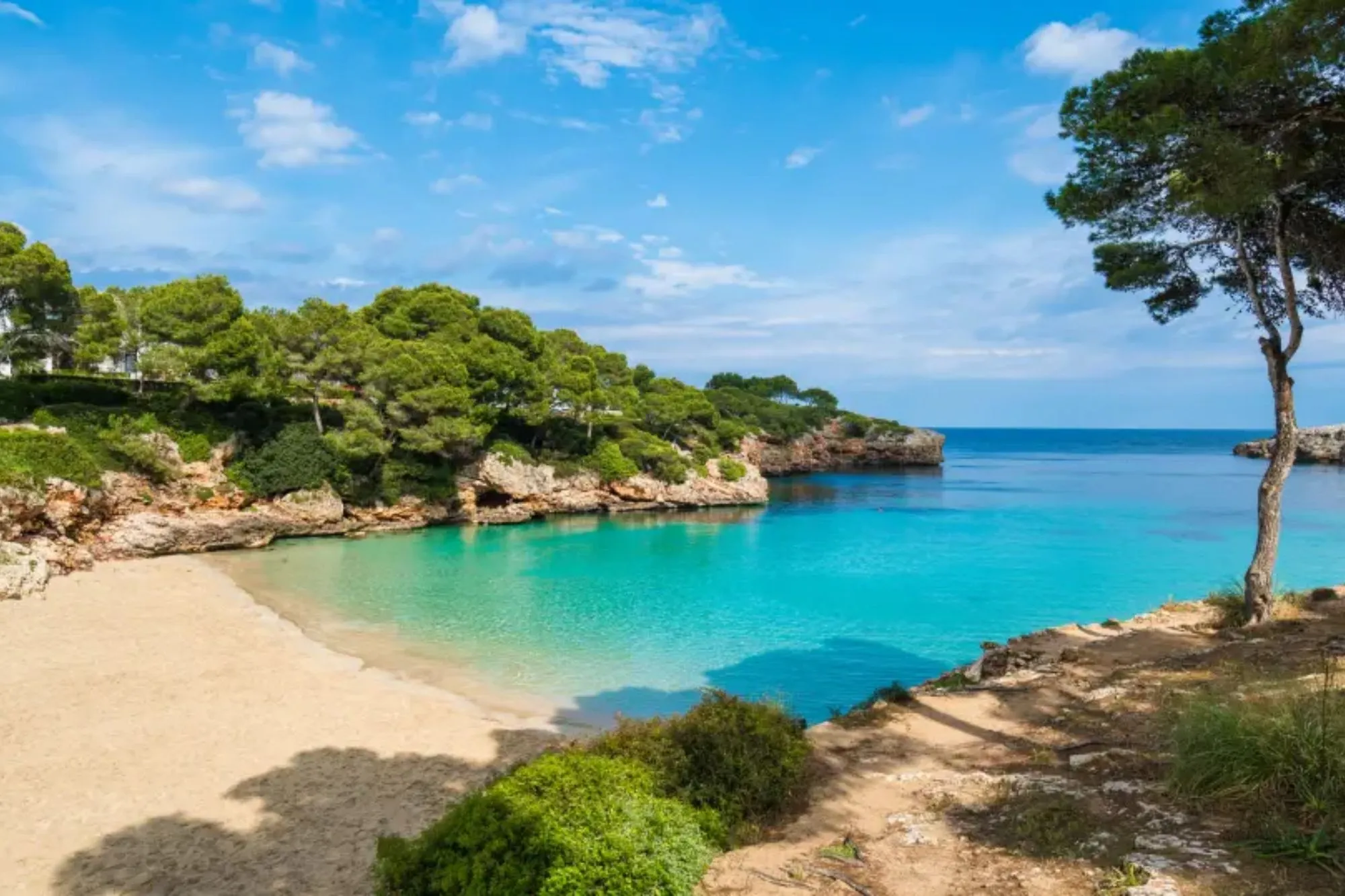
This hotel sits on Majorca‘s Cala Gran Beach, where shallow turquoise waters are backed by hills of Mediterranean pine trees.
Cala Gran is the largest beach in Cala d’Or, a beautiful cove just a short drive away from the coastal town centre, with its trinket shops and relaxed bars.
The hotel itself has all the activities and entertainment you’d expect, including bingo and live music – as well as some unique extras like mini golf and archery.
Loveholidays offer a 4-night stay from 29 March including return flights from Exeter from £179pp.
The 4-star Broncemar Beach Suites are close to the clear waters of Caleta de Fuste BeachCredit: Jet2Holidays
Maxeria Blue Didyma, Bodrum, Turkey
Holidaying at this super affordable five-star all-inclusive will leave you wondering how you’ve managed to bag such a bargain.
This modern hotel has entertainment and activities galore, including a mini cinema, arcade room, basketball and volleyball courts.
You can really make the most of the food in this all-inclusive package, grabbing late-night treats from the main restaurant or desserts from the resort’s very own patisserie.
Throw in a giant waterpark and beach just a stone’s throw away, and you’ve got yourself a bargain family resort nearing perfection.
Loveholidays offer a 7-night stay from 27 March including return flights from London Stansted from £344pp.
The Maxeria Blue Didyma in Bodrum has its own 24-hour snack bar and patisserieCredit: On The Beach
Htop Olympic, Costa Brava, Spain
This Calella hotel is the perfect base for a cheap and cheerful sun holiday, with comfy air-conditioned rooms just a few minutes’ walk from the bustling bars of Costa Brava.
Make use of three delicious meals a day with this all-inclusive package, where you can enjoy a varied buffet stocked with plenty of family favourites like fresh salads, grilled meats and chips.
Choose to make use of the hotel gym, pool and daytime entertainment activities, or head out to a range of affordable bars, shops and restaurants within walking distance.
On the Beach offer a 7-night stay from 27 March including return flights from London Luton from £297pp.
Costa Brava is a short flight from the UK, making it a popular tourist destination for BritsCredit: Getty
Mitsis Messonghi, Corfu
This Corfu resort was built for families and is buzzing with a whole host of entertainment and activities.
With four adult pools, three kids pools, a mini waterpark and a beach on your doorstep, there’s plenty of spots for you to stretch out on a sun lounger and for the kids to splash around.
When it comes to rooms, choose anything from a standard room all the way up to a beachfront superior bungalow, which swaps a standard balcony with a beachfront terrace.
Dining also goes down well, with a beachfront restaurant serving family favourites and a main buffet restaurant offering rainbow salads and international cuisine.
And as the day winds down to a close, the party starts with mini discos, Greek dancing, lively quiz nights and karaoke.
Loveholidays offer a 5-night stay from 29 March including return flights from East Midlands from £289pp.
Take a visit to the old town of Kerkyra in Corfu to explore its colourful cobbled streetsCredit: Getty
El Mouradi El Menzah, Hammamet, Tunisia
This four-star all-inclusive option in Tunisia’s Hammamet doesn’t disappoint, with multiple pools, an extensive buffet restaurant and its own private beach.
Plus, day temperatures in April sit in the 20s, with 9 hours of glorious Tunisian sunshine per day.
This resort is an ideal option for families, with a dedicated kids pool, kids club, sports and crafts options, as well as evening discos to keep children entertained.
Head out to the water to try your hand at kayaking, windsurfing or jet-skiing.
Or if you prefer to completely chill out, there’s a spa with a sauna and hammam to make use of, as well as a range of beauty treatments and massages.
Loveholidays offer a 5-night stay from 28 March including return flights from Glasgow from £369pp.
Mitsis Messonghi is a family-friendly hotel option with a mini waterpark on the resortCredit: Loveholidays
Bellevue Club, Alcúdia, Majorca
There are more pools than days of the week at the Bellevue Club in Alcudia.
With 11 swimming pools, a 24-hour bar and a garden theatre offering evening entertainment, you’ll hardly want to leave this resort once you arrive.
There’s seven tennis and squash courts plus a gym here, too – just in case you’ve still got some energy after all that swimming.
Nearby, there’s the family-friendly Alcudia Beach as well as the historic old town and promenade of Port D’Alcudia to explore.
The weather in April is pleasant and mild, reaching temperatures of 21C – perfect for playing out in the sun without getting too hot and bothered.
On the Beach offer a 7-night stay from 29 March including return flights from Exeter from £251pp.
Alcudia in Mallorca, Spain, has perfect temperatures for those who don’t like getting too hot and botheredCredit: Alamy
Hotel Palia Don Pedro, Costa Del Silencio, Tenerife
Club Palia Don Pedro is a top choice for families, with plenty of activities as well as spacious family suites available.
Rent a bike, try your hand at tennis, or simply get set up for a day’s relaxation on a couple of comfortable poolside loungers.
Plus, this hotel is situated 20 minutes from Playa de las Americas, meaning you’re in a quiet, scenic spot away from large resorts, with the option to taxi to the strip if you do fancy a busier day out.
Temperatures sit at a warm 22C, with bright, sunny days and cooler, comfortable nights.
First Choice offer a 7-night stay from 29 March including return flights from Glasgow Prestwick from £351pp.
Tenerife is a great destination for sunshine and activitiesCredit: Getty
RR Club Amarilis, Praia Da Rocha, Algarve, Portugal
The RR Club Amarilis aparthotel sits on the Algarve’s Praia da Rocha, a large and lively beach framed by dramatic limestone cliffs.
If you want to soak up the exciting holiday atmosphere, there’s a variety of affordable bars, restaurants and nightclubs within walking distance of this comfortable base.
Or for a more peaceful Portugal trip, simply explore the expanse of rugged coastline by foot or bike, as this hotel offers bicycle rental.
This hotel certainly isn’t short of sporting facilities, with a pool, gym, tennis courts, fitness classes and even a diving station offered within the complex.
First Choice offer a 7-night stay from 29 March including return flights from Newcastle from £420pp.
The cliffs of Portugal’s Praia da Rocha overlook a soft sand beach with turquoise watersCredit: Getty – Contributor
Blue Bay Beach Resort, Rhodes, Greece
Lalyssos in Rhodes is a traditional Greek resort town with plenty of charming tavernas to dip into and a beautiful mixed sand and pebble beach.
The four-star Blue Bay Beach Resort sits a stone’s throw away from this beach, and has its own pools, splash park and water slides.
There’s also a hotel spa and sauna to unwind in, offering massages and beauty treatments at an additional cost.
Here you’re only a 15-minute drive away from Rhodes Old Town, where UNESCO-listed medieval streets wind through castle-like architecture.
Make sure to check out the Street of the Knights, one of the best-preserved medieval streets in Europe.
Loveholidays offer a 5-night stay from 29 March including return flights from Bristol from £289pp.
Blue Bay Beach Resort in Rhodes comes with some seriously stunning views over the MedCredit: On The Beach
Magic Cristal Park, Benidorm, Spain
For a Benidorm holiday more luxurious than the norm, try a stay at Magic Cristal Park.
This hotel is packed with entertainment from day to night, which ranges from an arcade room and three kids’ clubs to evening karaoke and performances.
There’s also plenty of perks, such as a kids stay free policy – but by far the best of which is their “ultra all inclusive” package.
This includes premium drinks, a beachfront brunch and even excursions for guests staying over four nights.
Excursion options include the Medieval Magic Robin Hood Challenge, Princesses and Knights show, and a trip to see a Magic Show.
Plus, if you’re staying at least seven nights, you’ll even get entry to Terra Natura Animal Park and Aqua Natura Water Park included.
On the Beach offer a 7-night stay from 28 March including return flights from Newcastle from £311pp.
Benidorm is just a short trip away for an Easter breakCredit: Alamy
Xafira Deluxe Resort & Spa, Antalya, Turkey
The Xafira Deluxe Resort & Spa is stunning to look at – and you’ll feel a bit like royalty staying here, too.
Spend days hopping between a heated indoor pool, spa, outdoor pool and waterpark, or simply walk down to the beach to enjoy the 22C Easter sun.
The main buffet restaurant serves up a banging breakfast as well as a range of international foods at lunch and dinner, whilst a la carte options include Italian, BBQ and seafood restaurants.
There are also seven bars to try out, so you’re never far from a refreshing cocktail.
Choose to sip your drink at the beach, by the pool or in the nightclub at the disco bar.
On the Beach offer a 7-night stay from 10 April including return flights from London Luton from £218pp.
Antalya is a stunning holiday destination with year round sunshineCredit: Getty
When it comes to travelling on a long-haul flight, many people turn to comfort items such as neck pillows, blankets and eye masks, but one frequent flyer says most are making a major mistake
Many people can often make the same flight mistake (stock image)
Before setting off on a long-haul flights, most travellers know to wear comfortable clothes to make their journey more easy and relaxing. Beyond this, many passengers also bring along comfort items like neck pillows, blankets and eye masks.
Yet, according to traveller @epthelatino, countless people are making a same mistake with their neck pillows when it comes to flights – and it’s costing them precious sleep. In his clip, he suggests that most long haul flight passengers position their neck pillows with the opening at the front, which fails to adequately support the neck when the head drops forward.
Instead, he says they should rotate it so the gap sits at the back, which he says enables you to rest your head in various positions whilst maintaining proper support.
Reacting to his clip, one viewer said: “I think the inventor should make a doughnut pillow instead.” Another viewer added: “You are doing it all wrong – try sideways.”
A third commented: “I wear my neck pillow sideways. It’s more comfortable… thank me later.” One more person said: “Ooooh! Okay. That’s why it’s called a neck pillow.”
Whilst another added: “I’ve used it this way – it’s way better than how it was meant to be used.”
Content cannot be displayed without consent
Offering their perspective, the experts at Travel Sentry stated: “Once you have chosen the right pillow, it’s crucial to place it correctly for maximum comfort.
“Many people make the mistake of placing the pillow behind their head, which can cause their head to fall forward, leading to neck pain.
“Instead, place the pillow on your shoulder and lean your head towards it. This position will support your neck and keep your head from falling forward.”
They suggest that getting to grips with a neck pillow properly “takes practice”, noting: “Like any skill, mastering the art of travel pillow comfort takes practice.
“Don’t get discouraged if you don’t get it right on your first try. Keep experimenting with different positions and adjustments until you find what works best for you.
“With time, you will become a pro at using a travel pillow and enjoy a comfortable journey every time.”
However, if you’re still finding it difficult to settle in, travellers are advised to explore additional comfort aids.
They continued: “If you have trouble finding a comfortable position with just a travel pillow, you can use additional support.
“For example, use a blanket or scarf to support your lower back. Alternatively, place a small pillow or a rolled-up jacket under your knees to relieve pressure on your lower back.”
BARCELONA is a fun city to visit, but have you heard about its cool neighbour?
El Poblenou sits just outside Barcelona in Spain but has far fewer crowds.
Sign up for the Travel newsletter
Thank you!
The neighbourhood has its own Rambla, a pedestrian-friendly street modelled on the famous one in the Old CityCredit: AlamyPoblenoui is nicknamed the Catalan ManchesterCredit: AlamyThe former factories resemble those in the UK city (pictured)Credit: Alamy
And according to Meet Barcelona, the area is known as ‘Catalan Manchester‘ what with the industrial factories that remain.
The name emerged at the start of the 20th century, when textile factories and engineering plants filled the area and played a vital part in Barcelona‘s industrialisation.
During the 60s and 70s, the local government decided that having an industrial area so close to the city wasn’t the best and moved it further away.
Many of the factories became empty until a revamp plan called ’22@’ revitalised the area to what it is today.
When it comes to visiting today, the trendy neighbourhood has fewer of the factories it once used to – though chimneys still litter the skyline – and instead lots of cosy cafes and vibrant tapas bars.
The neighbourhood even has its own Rambla, a pedestrian-friendly street modelled on the famous one in the Old City.
Much quieter than the one in central Barcelona, it stretches from Diagonal Mar shopping centre to Avinguda Diagonal to the seaside.
This is where you will then find Platja de la Nova Mar Bella – a popular Mediterranean beach.
The beach stretches for 420 metres and boasts golden sand.
In fact, it was revitalised for the 1992 Olympic Games and is today known for its calm, shallow waters.
If you happen to be in the neighbourhood during the first weekend of the month, then head to Palo Alto Market where you will find an array of street food as well as fashion and homeware stalls.
Spread across three galleries, the market also has outdoor stages with live music throughout the day.
There’s also Can Framis Museum, which is home to an array of Catalan artworks from the 1960s to present day.
Though it might seem morbid, you can also explore Cementiri de Poblenou, which is a sprawling cemetery with artistic tombs including a winged skeleton that is known as the ‘Kiss of Death’.
Many people head to Cementiri de Poblenou, which is a sprawling cemetery with artistic tombs including a winged skeleton that is known as the ‘Kiss of Death’Credit: AlamyThe cemetery is known for having lots of sculptures and statuesCredit: AlamyIt still has an amazing beach you can go toCredit: Alamy
If you happen to be in the area during the first part of July, you will be able to visit La Fira del Poblenou – also known as Poblenou Craft Beer Festival – which is a three-day festival with 45 to 50 brewers, street food stalls and live music.
Ciutadella Park then sits just outside the neighbourhood, which is a park that opened back in the late 1800s and features a zoo, boating lake, museums and walking trails inside.
Flights to Barcelona cost as little as £13 each way in April.
To get from the airport to the neighbourhood, it’s a 20 minute drive or 50 minutes on public transport.
AS an ignorant southerner, I barely believed the idyllic world I had seen on TV of Cumbria’s lakes, valleys and mountains could truly exist here in Britain.
And even as I gazed across the shimmering Ullswater lake, with the sun setting over the trees, I had to pinch myself.
Sign up for the Travel newsletter
Thank you!
I barely believed the idyllic world I had seen on TV of Cumbria’s lakes, valleys and mountains could truly exist here in BritainCredit: GettyDave took his family to the Lake DistrictCredit: Supplied
I was so mesmerised I even tried to get the kids (aged five and seven) to stop fighting with sticks to take in the view with me. It didn’t work.
Even if it was a slightly different holiday to the one we’d taken in 2017BK (Before Kids), the 328-mile journey from East Sussex to the Lake District sure was worth it.
The drive even felt like part of the adventure, travelling in Skoda’s fully electric 2025 Elroq SportLine 85, complete with heated seats.
We only needed to stop to charge once, which gave us a welcome coffee and toilet break.
Known as England’s official “Book Town”, thanks to the high number of book shops here, its Emmerdale-esque scenery inspired my first attempt to get my children to “just look at the views”.
But like all later efforts to get them to marvel at, arguably, Britain’s greatest natural landscapes, it failed miserably.
I was told by my son that “I don’t really do views, I prefer doing things, like knee slides”.
The drive even felt like part of the adventure, travelling in Skoda’s fully electric 2025 Elroq SportLine 85, complete with heated seatsCredit: Skoda
Fair enough, and luckily for him there was plenty to keep him and his sister happy other than the scenery.
There’s lots for adults too, not least the food.
Cumbria claims to have the most Michelin stars outside of London, but my partner and I left the fine dining for a trip without youngsters.
Cumbria claims to have the most Michelin stars outside of London, but my partner and I left the fine dining for a trip without youngsters.
Instead, we spoiled ourselves in top-notch pubs, enjoying delicious, hearty grub.
Our local, The Dalesman, dished up beautiful pies by a roaring fire.
A delicious pie at the Punch Bowl InnCredit: suppliedWe enjoyed fireside meals at the The DalesmanCredit: supplied
And the nearby Black Bull cooked up a stupendous full English and the biggest bacon sandwich I’ve ever seen, setting us up nicely for a day exploring.
Choosing where to eat is almost as important as picking which lake or waterfall to visit.
But while the Elroq features a smart windscreen display and huge navigation screen, I didn’t find cruising around narrow country lanes on a dark night that much fun.
They didn’t waste a penny on tarmac when they built the roads.
So we were lucky the 17th century Punch Bowl Inn in Crosthwaite was nearby and that its renowned cheese souffle lived up to the billing.
We also made use of the brilliant local produce by raiding the nearby Meat Hook butchers for fire-side steak and sausages at home.
While our electric Skoda may be the future of travel, we still enjoyed heading back in time with an unmissable trip on the steam train from Haverthwaite to Lakeside.
It is a great way to see some of the area and we combined it with a boat ride up the mighty Lake Windermere to Bowness where, once again, the views are jaw-dropping.
Bustling Bowness boasts a huge choice of pubs and shops, but we spent the afternoon in the magical, and reasonably priced, World Of Beatrix Potter Attraction.
As well as a Peter Rabbit cafe selling home-made cakes and afternoon tea, there is a free activity trail and interactive videos showing yet more cracking Lake District views, except on a screen.
The kids loved completing the puzzles about Peter Rabbit, Jemima Puddle-Duck and Co.
And while that kept their little minds entertained, the best way to burn off energy was climbing through the trees and adventure playgrounds of Brookhole on Windermere.
There, you can brave tree-top adventures in Zip World, try axe-throwing or take a boat out on the lake, among other activities.
We left there with the kids suitably exhausted and ready for an eight-hour drive home.
Luckily, they slept the entire way, tucked up in the back of the car, while I soaked up the last of those views.
GO: Lake District
GETTING THERE: The all-electric Skoda Elroq SportLine 85 starts from £41,610 or £412.67 per month.
This is not where you would expect an article about one of the Mediterranean’s most beautiful islands to start. It’s the tail end of winter, 2021. Kensal Green Cemetery in west London: the imperial mausolea canted and crumbling, low clouds dissolving into rain. We are still in that strange phase of the pandemic when we are masked, newly aware of our bodies and the space around them. We are here to bury Nikos, a man who for me, for many, was the incarnation of Corfu.
I had spent my 20s trying to find the perfect Greek island, hopping from the well-trodden (Mykonos, Santorini, Cephalonia) to the more obscure (Kythira, Symi, Meganisi). None quite matched the vision I had dreamed into being as a child, when I segued from Robert Graves to Mary Renault, then to Lawrence Durrell and John Fowles. Greece was an idea before it was a place: freedom and deep thought, a constellation of sand, salt and thyme.
Then, on a whim, I accepted an invitation to play cricket in Corfu.
I knew little about the island at the time – not about its strategic history, nor how that position had shaped a culture that is at once Greek, Venetian and British. I hadn’t yet walked the Liston, the elegant colonnaded arcade that might be Venice or Trieste, Bologna or Perugia were it not for the cricket pitch laid out in front of it. The pitch is surrounded by a car park; its groundsmen battle heat, salt spray, digging children and fouling dogs. Yet it remains the only cricket pitch in the world I know that’s set within a Unesco world heritage site. Taking guard there, you look up to the Old Fortress for solidity, and to the Palace of St Michael and St George for elegance and flair.
The cricket pitch next to the elegant arcade in Corfu Town. Photograph: Ernestos Vitouladitis/Alamy
I went out with the Lord’s Taverners, a UK sports charity team. We were a motley bunch: a couple of former internationals – Andy Caddick and Chris Cowdrey – some actors, entertainers and a handful of writers, including me. The Corfiots, it turned out, were very good at cricket. The Greek national team is drawn almost entirely from the island. We were soundly beaten, then consoled by warmth, generosity and a run of excellent dinners in the Old Town.
It was over one of those dinners – at the Pergola – that I met Nikos Louvros and his wife, Annabelle, our hosts and the founders of Cricket Corfu. Nikos was rambunctiously Greek, full of wild energy; Annabelle was English in that particular way that falls deeply for Greece and builds a life around it. I recognised the impulse. By the end of the meal of lamb, ouzo and excellent local wine, we had planned our future together: we would launch a literary festival.
Festival co-founders Annabelle and Nikos Louvros
Over the subsequent years, that vision has taken glorious shape. Corfu literary festival began modestly: at our first, in 2017, there were as many speakers on stage as there were people in the audience. I remember Nikos’s hope, irritation and finally, characteristically, laughter as invited guests failed to show up. But there was never any sense it would stop. With Nikos beside you, everything seemed possible.
Slowly, buoyed by local support, the festival grew into something far larger than we had imagined. We’ve had Stephen Fry and Sebastian Faulks, Bettany Hughes and Natalie Haynes, Matt Haig and Tom Holland. They came and spoke, they stayed at the heavenly Kontokali Bay hotel, or in the villas and apartments of Ionian Estates, and they fell in love with Corfu as I had. Many have come back to speak several times.
Nikos lived for this – for showing others the beauty and drama of the island on which he was born, then left and returned to. He is gone now, but the festival endures. This September, it will return, larger and more magical than ever, with Homer’s Odyssey at its heart – a fitting subject for an island where the mythic and the everyday still fold into each other with ease.
This is what I learned from Nikos, and from Corfu, over the years: swim early, before the day warms and when the water still has a faint bite. Swim after lunch, when the sea feels silky. Swim at dusk, when the surface holds the day’s heat and the light becomes thick and slow. Corfu is large enough and varied enough that you can build an entire itinerary around water and never feel you are repeating yourself.
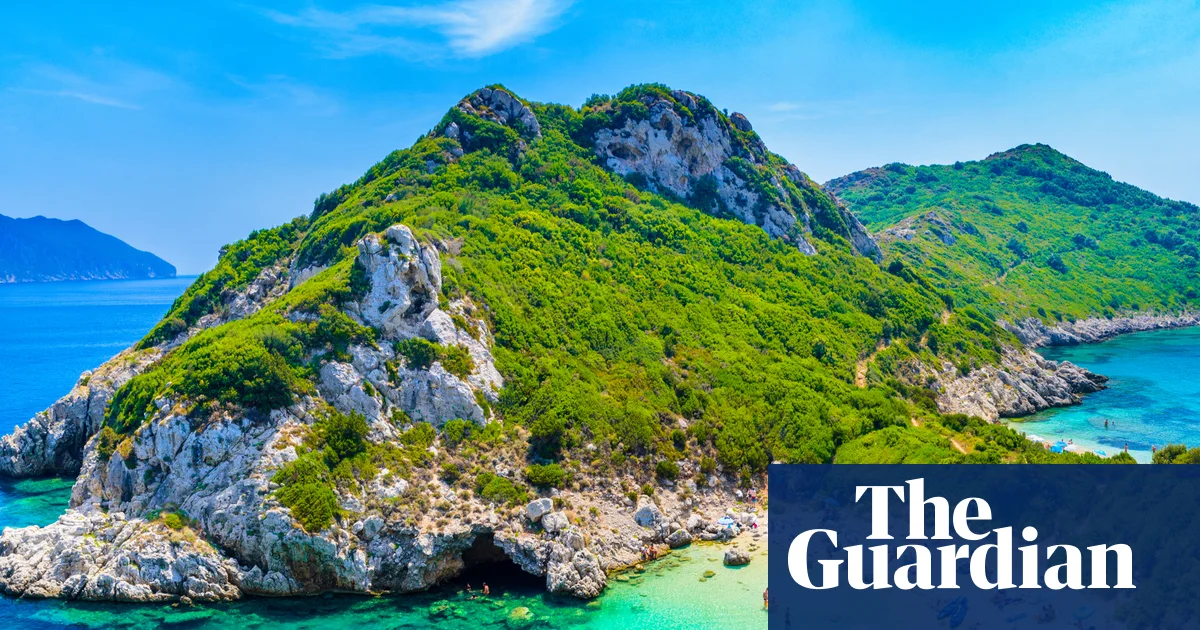
On the west coast, Myrtiotissa remains the beach that feels closest to a private miracle. Set in a steep green cradle, it is an initiation to reach it. Not unreasonably, Durrell called it “perhaps the most beautiful beach in the world”.
Paleokastritsa beach. Photograph: Carmen Gabriela Filip/Alamy
Paleokastritsa possesses a different kind of beauty. The monastery above the bay looks down over a scatter of coves where the water is so clear you can see the rocks far below, like a second landscape suspended in blue.
Then there is the north-east, which has calmer waters, protected coves, a more intimate coastline. Agni Bay is a gentle curve of shoreline made for long lunches. Agni Taverna sits close enough to the water that you can leave your table, swim and return still tasting salt. Eat fish, eat simply, let time loosen its grip. If you can, arrive by boat: the north-east coast has a tradition of taking water taxis between bays, and there is something unmistakably Corfiot about stepping straight from deck to lunch.
A surprise – especially if your image of Greek islands is Cycladic sparseness – is how green Corfu is. The interior rises and folds like a small country. Olive groves run for miles; cypresses spike the skyline. Drive up into the villages above Paleokastritsa and you reach Lakones, perched high enough to make the island feel suddenly vast. At Boulis, the food is good, but it’s the terrace view you come for, the sense of stepping straight into the blue horizon.
Corfu’s cuisine is not what you usually think of as Greek: shaped by Venetian influence, by centuries of contact with Italy and by produce from the island’s land and sea. Pastitsadais a beef stew with pasta; sofrito is beef or veal slices braised in a sauce of white wine, vinegar, garlic and parsley; bourdeto is fish stew.
In Corfu Town, make time for a night at Salto – contemporary but grounded, with excellent ingredients and a superb wine list. Then go for ice-cream at Papagiorgios. Walk the Old Town with a cone in hand, the stone still warm, and you feel part of a long tradition of summer nights.
In 2020, in a brief, improbable lull between Covid lockdowns, we held the festival as if it were an act of defiance against the gods. The world was half closed; plans changed by the hour. Yet, for a few days, the island opened its arms and let us in. Chairs were spaced out, masks slipped on and off, hand sanitisers were perched on every table – and still there was laughter, ideas, beauty. Things that made us feel human.
Myrtiotissa beach. Photograph: Hemis/Alamy
One morning, Nikos appeared with a boat. He had a gift for that – arriving as if from nowhere, already halfway into the next idea. “Come,” he said. A dozen of us climbed aboard and pulled away from the town, leaving behind the anxious news cycle and the low-level fear of that year. We ran along the north-east coast, cutting the engine in inlets you would never find from land: slivers of shingle, limestone shelves, beaches no bigger than sofas. Each time we stopped, we swam as if trying to slough the year off our skin. I felt like freedom, something snatched from darkness.
That was the last festival Nikos attended. He died of Covid the following January – on my birthday.
When I think of Nikos now, I think of that day on the water: of joy under pressure, of how precious it becomes. When he died, the island felt altered – not less beautiful, but more charged, as if the light carried grief in waves. Yet, Corfu also teaches something: that love for a place can outlive the person who brought you there, and become a way of honouring them.
I have tried to do that in my own way, too. My novel A Stranger in Corfu is dedicated to Nikos. It grew out of this island – its layered past, its atmosphere of secrecy and hospitality, the sense that stories cling to the land. The novel is, at heart, a love letter: an attempt to pay proper attention to a place that has given me more than I can easily name.
Go to Corfu and do not hurry. Swim often. Drive into the hills. Eat as if time were a gift. Let the island reveal itself at its own pace – slowly, then all at once.
And if, one day, someone appears with a boat and an idea, say yes.
A Stranger in Corfu by Alex Preston is published by Canongate (£18.99). To support the Guardian buy a copy at guardianbookshop.com. Delivery charges may apply.The 2026 Corfu literary festival runs from 21-27 September
Scott Manson documented his epic six-leg journey from Glasgow to mainland Europe’s southernmost point for his YouTube channel Planes, Trains, Everything – but faced endless setbacks
Scott in Lyon(Image: Planes, Trains, Everything/YouTube)
A YouTuber who embarked on an epic three-night, four-day odyssey from Glasgow to mainland Europe’s southernmost point was left gobsmacked upon arrival – only to discover the gates were locked.
Scott Manson, who presents the travel channel Planes, Trains, Everything, chronicled the mammoth six-leg expedition for his audience, billing it from the start as an extraordinary undertaking.
“I’m traveling from Glasgow to the southern tip of mainland Europe. Now, this is going to be a long, long journey. It’s going to take three nights and four days. There are six transportation legs. The first leg is Avanti West Coast down to London.”
His itinerary saw him travel from Glasgow to London Euston, then traverse the capital to St Pancras International for the Eurostar to Paris. From the French capital he pressed southward to Lyon, onwards to Barcelona, and subsequently to Madrid before boarding a long-distance coach to Algeciras.
A concluding local bus journey and stroll delivered him to Tarifa, widely acknowledged as mainland Europe’s southernmost extremity, reports Glasgow Live.
However, the expedition was anything but smooth sailing.
Scott disclosed the trip “nearly went totally belly up” following a catastrophic high-speed rail collision in Spain earlier this year. Referencing the tragedy, he explained: “One high-speed train jumped the tracks, landed on the opposite side, and was hit by a train heading in the opposite direction. Forty-five people were killed. Absolutely horrendous.”
Worried his connection might be axed, he consulted the Renfe website.
While tickets remained available initially, the evening before departing the UK he received an email stating: “Unfortunately, your train’s canceled. We apologize for the inconvenience.”
This left him frantically seeking an alternative for the vital Madrid to Algeciras stretch. Flying via Gibraltar was contemplated but ruled out as impractical and potentially costly, necessitating multiple connections and a border crossing.
Instead, he managed to book a nine-hour daytime coach – twice the duration of the train journey.
“It’s going to be horrendous, but it needs to be done,” he remarked, noting the alteration also delayed his arrival until 8pm, compelling him to postpone filming at his final destination.
The complications continued mounting. The Avanti service from Glasgow ran late, necessitating what he characterised as a hurried sprint across London.
His Eurostar seat was relocated to a “windowless window seat.” The Barcelona to Madrid train ran behind schedule.
Madrid’s weather turned “atrocious.” And the replacement train southbound was cancelled entirely.
Following all that, the ultimate disappointment awaited at Tarifa. Upon reaching the Spanish municipality, Scott headed towards Isla de Las Palomas, an island at the southern tip of Punta de Tarifa – the southernmost point of the Iberian Peninsula.
However, to Scott’s dismay, the area was cordoned off and accessible solely through guided tours. “Well, you spend three nights and four days travelling to the southernmost tip of the European mainland, and it’s shut,” he said.
“At least I’m not the only one who arrived thinking the place would be open. There are two Chinese tourists there. I can’t complain—they’ve travelled further than I have to get here—but I think it caught quite a few people off guard.”
He suggested strong winds might have rendered the exposed headland too dangerous. “But yeah, that’s as far as we can get.”
Despite the setback, Scott stayed positive. “For as long as I can recall making these YouTube videos, I’ve always felt there was a force pushing back, trying to stop me from completing videos. This was a prime example.”
Nevertheless, he maintained the experience was worthwhile. “But I am so glad I did this journey. I’m so glad you guys came along with me as well. I’ll see you next time.”
Tropical weather, luxury accommodation and relaxing rituals make this island the perfect babymoon destination to visit when pregnant, says travel editor Laura Mulley
We think we’ve found the perfect babymoon destination(Image: Le Meridien Ile Maurice, Laura Mulley)
Looking for a holiday destination for one last trip as a two before our baby arrived, we found our options surprisingly limited. We didn’t want to chance potential bad weather in Europe off-season, and with the risk of mosquito-borne virus Zika – which is particularly dangerous to pregnant women – ruling out most of the Caribbean and Asia, there was a clear frontrunner that ticked all of our boxes: Mauritius.
Emirates proved to be the best airline to fly with from our nearest airport – Manchester – with the most flight options available – and the staff were exceptionally helpful at making a six-months-pregnant woman feel as comfortable as possible during the journey.
Once we landed, our aim was simple: to enjoy all the things we’d probably struggle to do once our baby arrived, on what would potentially be our last relaxing holiday for a while. And it certainly delivered.
Our first stop was the huge, open, colourful Le Méridien Ile Maurice on the island’s northwest coast. One of Mauritius’s leading family hotels (perfect for showing us what to expect from our future holidays), its hidden gem is its adults-only section, Nirvana, at the end of the kilometre-long beach, which has its own rooms, reception, restaurant, beach area and infinity pool scattered with squishy floating beanbags.
Our Hideaway Suite here was truly one of the biggest we’d ever seen, with a massive distance between the patio doors at the front to the heated plunge pool out the back. Guests get access to a ‘butler’ via WhatsApp, and lots of thoughtful touches from the friendly staff make staying here feel extra-special, from the complimentary cocktail (or mocktail) by the pool at sundown to the petal-strewn bath we found waiting for us after dinner. One night there was even a pregnancy pillow laid out on the bed, something we hadn’t requested but made our stay even more comfortable.
The food at Le Méridien
There are four restaurants at Le Méridien, and it’s worth making your way around them all: Nomad’s buffet is popular with families, Waves serves Mediterranean-style fish and grilled dishes, Kumin gives guests a taste of Mauritius’s strong Indian influence, and – our favourite – Nirvana’s Jade does excellent Asian cuisine, including sushi and teppanyaki (take breakfast here too if you want to savour the child-free moments for as long as possible). All are included in half-board and all-inclusive packages, although booking is recommended for the à la carte restaurants.
What to do at Le Méridien
Keen to enjoy as many grown-up activities as possible, we took part in sunset yoga on the beach, took kayaks and pedalos out into the lagoon’s clear waters, and enjoyed treatments in Le Méridien’s spa, including a heavenly head massage using warm coconut oil, and the perfect pre-natal full body massage. The therapists here are all incredibly skilled – you’ll really feel the benefits.
St Regis Le Morne
The second half of our trip was spent at sister hotel St. Regis Le Morne, formally the JW Marriott, and which joined the historic St. Regis hotel group – founded by American tycoon and Titanic victim John Jacob Astor IV – following a major renovation last year.
On the island’s southwest point, this is a quieter, more secluded part of the country, and St. Regis sits under the shadow of Mauritius’ iconic Le Morne mountain surrounded by miles of beautiful beaches and shallow waters.
Although we spotted plenty of multi-generational families here too, St. Regis definitely has a more elegant and luxurious air to it. With a colonial-style design and elegant rooms set amongst lush vegetation and trickling water features, it has a slight ‘White Lotus season three’ vibe.
There’s a huge pool here, but we found that most couples chose to spend their days on the loungers under palm leaf-umbrellas that line the beach, which are peaceful, always available, and serviced by bar staff at the touch of a button.
The food at St Regis Le Morne
Out of St. Regis’s five restaurants, our favourites were INDYA, serving a modern take on Indian cuisine with the friendliest service, and Japanese Atkuso, where the chef veered from the menu to whip up some of the best maki rolls we’d ever tried to cater to our vegetarian diets. Each restaurant also does its own signature cocktails and ‘mindful mocktails’ with certain health benefits.
What to do at St Regis Le Morne
St. Regis is proud of its history and heritage, and a key feature are its three ‘rituals’, found in all its properties around the world, and all – pleasingly for our purpose – highly unsuitable for children: Bloody Marys, sabrage and afternoon tea.
In homage to the first ever spicy tomato juice cocktail as we know it, reportedly invented at the St. Regis New York in the 1920s, our charismatic bartender Vymal demonstrated how to make this hotel’s own version, the L’Île Mary, using Mauritian rum infused with curry leaves and topped with turmeric foam. The self-appointed Bloody Mary connoisseur out of the two of us declared it to be one of the best he’d ever tasted.
Next up was learning sabrage – the art of opening a bottle of champagne with the swish of a sword, and supposedly how Napoleon liked to celebrate his victories. Although initially unconfident, following expert instruction we were thrilled to deftly remove the top of our bottle of fizz in one smooth swipe.
Afternoon tea was a more genteel affair, and is a reference to Lady Astor’s daily habit of gathering family and friends around in the afternoons to share wisdom. Here it involves Mauritian tea and viennoiserie from the hotel’s kitchen, taken under swaying palm trees on the beach – just heavenly, and the perfect last few moments of calm before we became a three.
How much does it cost?
Rooms at Le Méridien Ile Maurice start from £220 per night on a B&B basis based on double occupancy. Rooms at St. Regis Le Morne start from £585 per night based on double occupancy (two night minimum stay required). Returns flights from Manchester to Mauritius were with Emirates start from £775.
This charming village has been dubbed an ‘unspoilt gem’ by visitors and is home to an award-winning bakery that’s been serving up delicious baked goods for over 120 years
The village is celebrated as a traveller’s haven(Image: Getty)
Some corners of the world seem to have been shaped with exceptional care and affection – and this pristine Cornwall coastal village is undoubtedly among them.
Nestled along the North Cornwall coastline approximately 10 miles southwest of Newquay, this historically significant and remarkably unspoiled coastal settlement offers breathtaking vistas, vibrant community character, and prize-winning cuisine and beverages.
Concealed within an immaculate section of the Cornish shore, this tiny village represents a gem positioned within both a designated Area of Outstanding Natural Beauty and a World Heritage Site.
This waterside settlement thrives courtesy of its robust local community, which supports an array of independent retailers and enterprises, including one of Britain’s most ancient bakeries still trading from its founding location.
Save on the best holiday cottages in Cornwall
This article contains affiliate links, we will receive a commission on any sales we generate from it. Learn more
Famous for its rugged coastline, golden beaches, picture-perfect villages and rich maritime heritage, Cornwall is one of the most-visited corner of the UK. Sykes Cottages has a large number of holiday homes to choose from, with prices from £36 per night.
Boasting beautiful, canine-friendly shores, exceptional public houses and dining establishments, and access routes to some of Cornwall’s most dramatic coastal paths and walks, it’s little wonder this village is hailed as a traveller’s paradise, reports Cornwall Live.
Prize-winning bakery with unique pastries
The celebrated St Agnes Bakery has been trading from its original site in St Agnes for more than 120 years – having initially welcomed patrons back in 1905.
Famed for producing the most delectable traditional Cornish recipes daily, St Agnes Bakery stands as one of the village’s finest attractions.
Their renowned Cornish Pasty has secured Gold Standard status, whilst the distinctive ‘Giant Sausage Roll’ was created and gained popularity within the bakery’s modest premises.
Buttery flaky buns, delectable Cornish cakes, and freshly baked loaves also feature amongst St Agnes Bakery’s bestselling items.
St Agnes Bakery has collected numerous prestigious accolades – from World Pastry Awards to National Bakery Awards, each testament to the quality of its exceptional offerings.
The bakery’s owners said: “The joy of baking is deeply rooted in both our own childhood memories and experiences. Since taking over the bakery it has been our aim to bake all our breads, cakes, Cornish pasties and giant sausage rolls using time-honoured methods, tried and tested recipes and only the highest quality of ingredients, just like our own mothers showed us.”
St Agnes Bakery procures the majority of its ingredients locally from Cornwall, with most suppliers and producers based near St Agnes.
A fascinating heritage and plenty of attractions
The prize-winning bakery isn’t the only draw St Agnes has to offer. This charming seaside village, with its winding lanes and delightful independent shops, proves irresistible to holidaymakers.
Its narrow streets brim with Cornish character, establishing St Agnes as a treasured destination for visitors. St Agnes boasts several stunning beaches for visitors to discover, including Trevaunance Cove, Chapel Porth, and Porthtowan – all hugely popular spots for surfing enthusiasts, swimmers, and those simply wanting to soak up the sun.
The surrounding coastal area is steeped in captivating history, particularly its mining heritage, exemplified by sites such as the derelict 19th-century tin mine Wheal Coates.
The village possesses a fascinating past and industrial legacy rooted in tin and copper mining, which dominated Cornwall’s economy during the 18th and 19th centuries. Today, remnants of this mining history, including engine houses and mine shafts, still punctuate the landscape.
Despite ranking amongst Cornwall’s larger coastal villages, St Agnes maintains a charming and unspoilt character. One of its most celebrated landmarks is St Agnes Beacon – an elevated vantage point offering panoramic views of the spectacular countryside and historically serving as a watchtower.
The adjacent St Agnes Head is similarly cherished by both residents and tourists, providing magnificent views across the dramatic Cornish coastline.
This enchanting seaside village has frequently been hailed as an ‘underrated gem’ by those who visit, delivering spectacular coastal scenery featuring dramatic cliffs, sandy beaches, and picture-perfect rural countryside.
It’s also the home of The Peterville Inn, an award-winning establishment which previously claimed the coveted ‘Pub of the Year’ title at the VisitEngland Awards for Excellence in 2024. Chapel Porth Beach stands out as another essential spot in St Agnes, with the Chapel Porth to St Agnes Circular Walk coming highly recommended.
Visits to the St Agnes Museum and Perranporth Airfield are also strongly suggested for those seeking enjoyable pursuits, whilst the St Agnes to Trevellas Porth Circular Walk proves a treat for walking enthusiasts.
Admirers of Winston Graham’s bestselling Poldark novels (and its dashing hero Ross Poldark) will be thrilled to learn that the writer lived just moments from St Agnes and has famously revealed he found inspiration in this picturesque village, calling it ‘Poldark Country’.
Despite its modest proportions, St Agnes brims with delightful attractions, making it an essential destination if you’re after a brilliant experience amidst breathtaking scenery.
The popular beauty spot with Victorian-era bathing area was left damaged after huge waves battered the area.
It’s a beautiful spot, but the surrounding steps and sunbathing area have eroded away after relentless storms(Image: Katie Oborn )
Swimmers in Plymouth have been warned to stay out of the water at one of Britain’s most beloved beauty spots in the self-proclaimed Ocean City — a caution that follows the battering the south west endured from Storm Ingrid in January 2026. The Victorian-era steps at Plymouth Hoe’s Tinside Beach were left severely damaged by towering waves in January, though the outdoor Tinside Lido, which underwent renovation last year, has escaped unscathed.
Local year-round swimmers, however, are now speaking out, arguing that the destruction has laid bare “what an eyesore” the small beach and its surroundings have become — and they’re calling on authorities to invest in restoring Tinside Beach as a “fabulous asset” for Plymouth once more.
A visit to the much-loved spot on Saturday, February 14, uncovered “no swimming ” signs installed by Plymouth City Council, alerting visitors to “sharp spikes and debris” as well as “dangerous and uneven surfaces”.
The beach has long been a cherished gathering place for locals who brave the elements throughout the year, with many citing its significant contribution to their mental wellbeing alongside the wider benefits of wild swimming.
Yet in the wake of the storms that obliterated the concrete steps and several railings, swimmers have reported that getting into the water “safely” has become incredibly difficult. Numerous locals have also expressed worries that, even before the storm wreaked havoc, the vicinity had already become “rundown”, despite still attracting holidaymakers throughout the summer season, , reports the Express.
Melanie Green shared with me: “There’s a lot of all-year-round swimmers that know what should be used to do a ‘quality’ job with regards to repairs now needed.
“Plymouth City Council, please have a meeting with us all and make the Hoe steps and seafront look great again. This is where tourists come to visit. Invest in it.”
The dawn swimmers at Tinside Beach form a friendly community. Chuckles, cheerful banter and even homemade cakes are exchanged amongst the group whenever birthdays or milestone moments occur.
However, the Victorian-era steps at Tinside are in “desperate need of repair”, making it difficult to congregate – and one habitual swimmer observed that regular maintenance “would save money in the long run”.
The council has confirmed it “cares about the Hoe and foreshore” and is “sad to see the damage the recent storms have caused.”
A Plymouth City Council spokesperson further explained that “our surveyors and contractors are reviewing repair options for the Tinside steps and we will look to mobilise repairs as soon as practically possible”.
Last summer witnessed the reopening of the restored outdoor Tinside Lido beside Tinside Beach. The redevelopment was funded through the National Lottery Heritage Fund, Youth Investment Fund, Levelling Up Fund, and Plymouth City Council.
With this in mind, local swimmer Rena Truscott remarked: “I wish the council would have a complete rehaul and properly fix the waterfront, starting with Tinside (beach and steps).
“I feel investment is desperately needed now, not just to make the best of a fabulous asset for Plymouth but to ensure it remains safe and an ongoing legacy for the benefit of all.
“The Tinside Lido (renovation completed in 2025) now looks amazing and I’m sure it draws attention and hopefully tourists and revenue back to the Hoe. However, this now highlights what an eyesore the surrounding area is. Despite this, it remains popular all year round.”
Debra Romagnuolo voiced similar worries, stating: “Tinside steps are in desperate need of repair. Not just a quick fix. It needs good quality workmanship, not something that literally lasts a few weeks like the railings. It is in a sorry state.”
During my visit, chunks of concrete from the storm damage were visible strewn across the shoreline and seabed near the steps.
Warning notices have been put up advising people not to enter the water in this location, as large concrete blocks remain underwater and, depending on the tide, may not always be easily spotted.
A Plymouth City Council spokesperson commented: “We care about the Hoe and foreshore and are sad to see the damage the recent storms have caused, not just here in Plymouth but in so many other coastal villages, towns and cities.
“We are very much at the mercy of the elements but work hard to direct as much resource as possible towards protecting and reinforcing our historic waterfront so it can continue to be enjoyed for generations to come.
“Recent and ongoing works include repairs to West Hoe Pier and the Admirals Hard slipway, as well as the steps into the water at Commercial Wharf.”
Plymouth City Council added in their statement: “Our surveyors and contractors are reviewing repair options for the Tinside steps and we will look to mobilise repairs as soon as practically possible, once the weather is more in our favour.
“We are also working with marine and foreshore technical advisors and contractors on condition surveys of the wider foreshore. The findings from these surveys will be used to produce an action plan of monitoring, further investigations and prioritised repair works, for which we can then seek funding.
“Refurbishment works at Tinside Lido last year transformed underused areas of the Grade II-listed Art Deco building, safeguarding it for future generations whilst creating new opportunities for people to connect with Plymouth Sound.
“Its careful preservation and transformation will ensure Tinside continues to be a much-loved feature of Plymouth’s waterfront whilst supporting the health, wellbeing and aspirations of young people in Britain’s Ocean City.”
The Hoffman Kiln near Settle in the Yorkshire Dales is a moss-covered derelict kiln hidden in woodlands, though the site is currently undergoing development with limited access
The site was left abandoned for years (Image: Alexander W Helin via Getty Images)
For those looking for an extraordinary walking adventure, this trail delivers something truly unique and proves ideal for youngsters who relish uncovering secret treasures along the way.
Nestled within the forests on the outskirts of Settle in Yorkshire lies Hoffman Kiln, an abandoned kiln that once served as an insulated furnace for burning raw materials.
Today, it resembles an subterranean grotto constructed from brickwork and blanketed in moss, lending the location an unsettling verdant atmosphere.
Its past remains somewhat enigmatic to locals, though additional points of interest dot the vicinity, designated as part of the ‘Craven Limeworks trail’.
The kiln formed part of what was previously an industrial complex, where Yorkshire workers toiled in appalling conditions before nature eventually reclaimed the site, leaving it abandoned.
Save on the best holiday cottages in Yorkshire
This article contains affiliate links, we will receive a commission on any sales we generate from it. Learn more
Famous for its dramatic landscapes, historic cities, hearty food, and rich cultural heritage Yorkshire is just waiting to be explored. Sykes Cottages has a large number of properties to choose from with prices from £31 per night.
Historical background
The nineteenth century witnessed the establishment of the railway route connecting Settle to Carlisle, which subsequently generated fresh industrial prospects for the region.
The railway regularly transported coal inbound to process the limestone extracted from the scar, then carried away the completed product.
Enormous quantities of stone were once processed here, yet now it lies concealed. The kiln was previously operated by labourers whose responsibility involved shovelling burnt lime onto wagons positioned mere feet away in the sidings.
Describing the harsh working conditions, Senior Historic Environment Officer Miles Johnson explained: “It’s quite pleasant space to be in now but whilst it was in use it was probably absolutely grim. Lime is really nasty, caustic stuff to work with.
“The lime burners who worked in here had to cover every inch of their body with rags and clothing to try to keep the lime dust out. When lime dust meets moisture or water it reacts and generates a lot of heat.
“So if you’ve got lime dust on your body, and you’re shovelling and starting to sweat, then you’d start to blister and burn quite quickly.”
Exploration today
Proposals to develop the land housing the kiln have been under consideration for some time. Back in 2021, it emerged that Craven District Council’s planning application had received approval, with the site now earmarked for commercial development.
Prior to construction commencing, one visitor wrote on TripAdvisor: “Really loved my visit. I was amazed by how big the site is, considering it isn’t promoted very well. There is lots to explore, and the information boards are very helpful.
“The car park for the site is also quite large, so there is plenty of room. It felt quite exciting to be exploring the vast Hoffmann kiln by torchlight, and I was very pleased to see that it hadn’t been littered or abused.”
Yet more recently, visitors have suggested that the feeling of discovering a secret, unspoilt location has vanished, with construction work now progressing at full pace. A later review states: “These unusual kilns are well worth a visit.
“However, as other reviewers have mentioned, at the moment the area is a building site. There is access to the Hoffman kiln, but you need to cross the building site and walk along beside the railway.”
To find the kiln, you can use the postcode BD24 9NU, where you’ll find it just off the main road between Langcliffe and Stainforth.
This picturesque fishing village in Waterford has everything needed for a tranquil getaway, yet it’s often overlooked by those visiting Ireland’s coast
It’s home to plenty of lively pubs and restaurants (Image: Walter Bibikow via Getty Images)
Compact and picturesque, this Waterford fishing village offers everything required for a peaceful retreat, yet it frequently goes unnoticed by visitors exploring Ireland‘s coastline.
Nestled discreetly on the western edge of Waterford Harbour lies the charming village of Dunmore East, where there’s far more to discover than initially apparent.
Boasting up to six hidden beach coves and numerous scenic walking routes, visitors can fully embrace the splendour of the Irish seaboard.
While it’s thought people have lived in the village since pre-Iron Age times, the area truly flourished during the 1800s when it evolved into a holiday destination.
Playing a significant role in the fishing trade, featuring a delightful beach, a working harbour and an extensive selection of restaurants, it remains an excellent escape from everyday life, even now.
Beaches
Waterford itself boasts up to 147 km of coastline, with Dunmore East comprising part of that stretch, hosting up to six coves throughout the village alone.
These provide ideal locations for snorkelling and swimming, with two principal beaches proving most favoured amongst visitors – Councillors Beach and Lawlors Beach.
Best UK holiday cottage deals
This article contains affiliate links, we will receive a commission on any sales we generate from it. Learn more
Sykes Cottages offers a wide range of handpicked holiday homes across the UK and Ireland, from cosy countryside retreats to stunning coastal escapes. Prices start from £27 per night
Lawlor’s is situated directly in the village centre, whilst Councillors is a south-facing shore overlooking dramatic cliffs. One recent visitor posted a Google review, describing it as a “beautiful beach with stunning cliff views”, while another remarked it was “popular for a reason”.
They added: “The most popular beach in Dunmore, which can lead to it becoming crowded at times; however, it is popular for a reason.
“It is the largest beach here, so there is adequate space for everyone. It is sandy rather than rocky, and it is located in an area with very safe water, and lifeguards are on duty often.”
Walks
The standout trail in the vicinity, and arguably throughout the whole of Waterford, is the Dunmore East Cliff Walk, spanning 5km along the shoreline. During the 1830s, the path served as a commuter route for labourers travelling between Portally and Ballymacaw.
It’s a route suitable for all fitness levels and ages, typically taking around two hours to complete, whilst showcasing breathtaking scenery and abundant wildlife throughout.
Particularly noteworthy are the sweeping coastal vistas, including views of Hook Head Lighthouse – one of the world’s oldest functioning lighthouses.
One walker described their experience on TripAdvisor, noting: “An absolutely gorgeous and easy walk along the cliffs above the sea. Stunning vistas, pretty flowers, pastures of sheep and cows. We took a lot of photos! The path is well marked and easy enough for a basic level of fitness.”
For something slightly different, there’s also the Dunmore East Woods walk, guiding you through an impressive 42-acre woodland expanse teeming with wildlife. Visitors can complete a circular route of the grounds or opt to discover one of the four distinct zones within it.
Restaurants
Dining in Dunmore East is an absolute must for genuine food enthusiasts, with numerous establishments offering locally caught seafood that diners consistently praise. A considerable number of these eateries also feature stunning coastal panoramas to complement your meal.
According to TripAdvisor ratings, the village’s top culinary destination is Azzurro, a family-operated restaurant and bar. They primarily offer Mediterranean fare, which patrons have labelled “top class”.
One delighted customer wrote: “This restaurant is top class. Pizzas to die for as well as heavenly desserts. Peroni on draught and fab coffee also. Pleasant and efficient staff. Can’t recommend highly enough.”
For highly-rated seafood in Dunmore East, The Strand Inn Seafood Restaurant sits directly on the waterfront, commanding views across the bay. A previous visitor shared: “Really exceptional service and a great energy in the restaurant and bar.
“Amazing views, sea air, great chowder. The front of house is very helpful, and I can’t recommend it more. It feels like a five-star hotel.”
Additional favourites amongst both locals and visitors include the Bay Café and Harper’s Point, perfect for a swift coffee or midday meal. A recent patron described the Bay café as “uniquely beautiful and quaint”, with many stumbling upon it during their seaside strolls.
A pilot has explained the real reason passengers need to switch their phones to airplane mode during flights, and it’s not just a formality
Travellers told what happens if you ignore a safety procedure(Image: Getty)
Flying remains one of the safest ways to travel, largely due to meticulously crafted safety protocols. Whilst some procedures might appear mundane or superfluous, each serves a vital purpose in safeguarding passengers and crew alike.
However, a pilot (@PerchPoint) has taken to TikTok to clarify whether one specific procedure genuinely needs following. Whether through absent-mindedness or simply not knowing better, switching your phone to aeroplane mode matters – and it’s not “a conspiracy theory,” the pilot cautions.
But what actually occurs if you don’t bother? In the video, the pilot explained: “This is just a friendly PSA, that the airplane mode button is not a conspiracy.
“If you forget to put your phone on airplane mode, no, it’s not the end of the world, the plane will not fall out of the sky, and it won’t even mess with the systems on board.”
However, does this mean passengers can disregard the procedure? “If you have an aircraft with 70, 80, or 150 people on board and even three or four people’s phones start to try and make a connection to a radio tower for an incoming phone call, it sends out radio waves.
Content cannot be displayed without consent
“There’s a potential that those radio waves can interfere with the headsets that the pilots are using.”
He proceeded to describe his own encounter with this interference whilst attempting to land safely, noting there was an irritating noise in the headset that “sounded like a mosquito.”
The pilot explained: “No, it’s not the end of the world, but it’s pretty annoying when you’re trying to copy down instructions and it sounds like a wasp or something flying around you. So if you’re ever curious why you need to put on airplane mode, that’s why.”
According to Travel and Leisure, it goes beyond mere irritation. Pilots frequently operate with restricted visibility, meaning they depend heavily on information relayed from ground control, particularly during takeoff and landing – the phases when most aviation incidents take place.
Consequently, it’s vital that they remain focused and their communication isn’t compromised.
Rule or courtesy?
Per Federal Aviation Administration (FAA) regulations, all passengers must enable airplane mode during flight to avoid potential signal interference.
It’s also a straightforward gesture of consideration that contributes to a seamless journey for all passengers, according to Booking.com.
“When smartphones and devices were first introduced, it was found that cell phones that aren’t in flight mode can overload the networks on the ground, especially during takeoff and landing, as phones try to connect to multiple towers at once.
“How much phones affect aviation technology hasn’t been studied in-depth, but pilots say they can hear background noise and interference from phones while flying, especially when they’re landing, and mobile phones begin to make contact with towers again.
“So, while your phone may work at times during flight, do you really want to distract your pilot while they’re speaking with air traffic control to execute a safe landing?”
Why are flight crew permitted to use devices?
According to Lovely Planet, pilots and flight attendants are seen with devices right in the cockpit, which gives them access to digital charts and documents.
However, unlike passenger devices, this equipment has undergone rigorous testing to guarantee it won’t disrupt the aircraft’s systems.