TOP NEWS

From breaking news to significant developments in politics, business, technology, entertainment, and more, we deliver the stories that shape our global landscape.

U.K. arrests 4 Iranians on suspicion of assisting Iranian intelligence

March 6 (UPI) — Counter-terrorism police in London arrested four Iranian men early Friday on suspicion of conducting surveillance for Iranian intelligence of individuals and locations linked to the Jewish community in the capital.

The suspects, one Iranian and three dual British-Iranian nationals aged between 22 and 55, were detained shortly after 1 a.m. local time in raids on addresses in north London and Watford, just north of the city, under the National Security Act, Metropolitan Police said in a news release.

Searches of at least three addresses in the north London borough of Barnet were still underway, said the Met.

Six other suspects, all males aged between 20 and 49, were arrested at one of the locations raided in London on suspicion of assisting an offender and assaulting police.

“Today’s arrests are part of a long-running investigation and part of our ongoing work to disrupt malign activity where we suspect it,” said Commander Helen Flanagan, Head of Counter Terrorism Policing for London.

“We understand the public may be concerned, in particular the Jewish community, and as always, I would ask them to remain vigilant and if they see or hear anything that concerns them, then to contact us,” she added.

The arrests come as the latest development in a long history of covert activity by the Iranian regime on British soil, mostly targeting dissidents, exiled Iranian news organizations providing independent coverage to people inside Iran and the Iranian diaspora, and groups opposing the regime.

“Iran is the biggest state sponsor of terrorism globally and sadly, that is in effect in our own society as well,” British Deputy Prime Minister David Lammy told ITV television on Friday morning.

“Our intelligence services and counter-terrorism police have thwarted lots of action over the last few years,” he added.

On Saturday, in his announcement that Britain was joining the U.S-Israeli offensive against Iran in a “defensive” role, Prime Minister Keir Starmer condemned Iranian aggression against Britain’s Middle East allies, saying the United Kingdom had long been a target.

“Even in the United Kingdom, the Iranian regime poses a direct threat to dissidents and to the Jewish community. Over the last year alone, they have backed more than 20 potentially lethal attacks on U.K. soil.”

In May, three Iranian men were charged over allegedly conducting surveillance and reconnaissance of U.K.-based journalists working for the Iran International news outlet to enable “serious violence” to be committed against them.

Mostafa Sepahvand, 39, Farhad Javadi Manesh, 44, and Shapoor Qalehali Khani Noori, 55, of London, are accused of “engaging in conduct likely to assist a foreign intelligence service” under the National Security Act.

A plea hearing is scheduled for Sept. 26 and a provisional trial date set for Oct. 5.

Iran International, a Persian-language satellite TV channel and multilingual digital news operation established in 2017, puts out highly critical coverage of the Iranian government which has banned it as a terrorist organization.

British media and U.S. academics have previously reported links between Iran International and backers at the most senior level in Saudi Arabia, which Iran International denies.

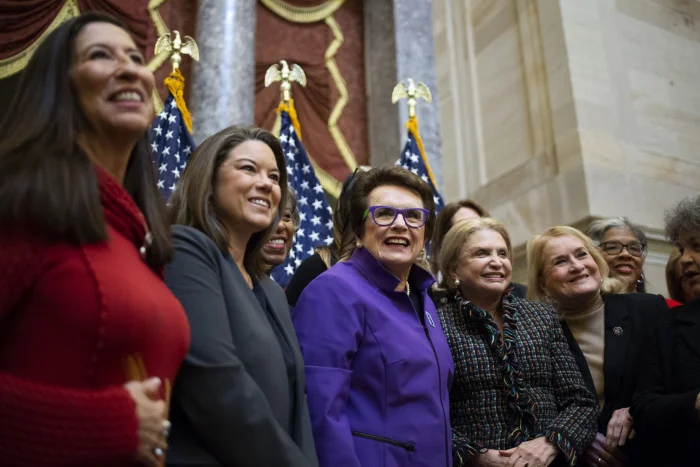
Founder of the Women’s Tennis Association and tennis great Billie Jean King (C) smiles with representatives after speaking during an annual Women’s History Month event in celebration of the 50th anniversary of Title IX in Statuary Hall at the U.S .Capitol in Washington on March 9, 2022. Women’s History Month is celebrated every March. Photo by Bonnie Cash/UPI | License Photo

Source link

Woman spends three days evening out eyeliner

A WOMAN preparing for a night out has entered the third day of applying and redoing her winged eyeliner.

Lauren, not her real name, began applying makeup to her eyelids three days ago, and has remained in an endless loop of carefully drawing on her eyeliner, wiping it away and trying again ever since.

She said: “I know from experience that putting on eyeliner can take a while, so I gave myself plenty of time. Unfortunately I’ve overrun by 71 hours.

“In theory it shouldn’t take too long. Once I’ve mapped out the wings with a couple of flicks, it’s simply a case of joining them together. As you can see from where I’ve punched the wall out of frustration though, the reality is more complicated.

“To get that perfect cat-eye look, you need the steady hands of a heart surgeon. But by day two I was getting cramp and losing my grip on the brush. Sure, I could ask my housemate to draw them on in seconds, but that would be admitting defeat.

“It’ll be worth the effort though once I’ve evened them out. We’re going to a dingy underground bar where nobody will be able to notice my eyeliner anyway. Can’t wait.”

Friend Hannah, not her real name, said: “Shit, sounds like Lauren’s nearly ready. I’m still plucking my eyebrows, but if I hurry I’ll only be fashionably late by 48 hours.”

What is the PrSM missile that the US used for the first time in Iran? | Israel-Iran conflict News

The United States used Precision Strike Missiles (PrSMs) for the first time during its ongoing war with Iran, US Central Command (CENTCOM) said on Wednesday.

The war entered its seventh day on Friday, with attacks continuing across Iran and other countries in the Middle East.

CENTCOM stated in an X post that PrSMs provide an “unrivaled deep strike capability”.

“I just could not be prouder of our men and women in uniform leveraging innovation to create dilemmas for the enemy,” the post quoted Admiral Brad Cooper, head of CENTCOM.

It is unclear where these PrSMs were launched from, or which specific targets they hit in Iran.

So what is the PrSM, and why is it significant that it has been used by the US for the first time?

What are Precision Strike Missiles?

PrSMs are described as long-range precision strike missiles by their developer, the Maryland, US-headquartered defence firm Lockheed Martin, which delivered the first PrSMs to the US Army in December 2023.

PrSMs can hit targets ranging from 60km (37 miles) to more than 499km (310 miles) away, according to Lockheed Martin.

The company’s website adds that PrSMs are compatible with the MLRS M270 and HIMARS family of launchers, both also developed by Lockheed and used by both the United Kingdom and US armies.

MLRS stands for multiple-launch rocket systems, used to launch missiles. The UK sent a number to Ukraine in 2022. HIMARS stands for High Mobility Artillery Rocket System. In 2022, the US sent a number to Ukraine, as well.

M-142 HIMARS is a high-tech, lightweight rocket launcher that is wheel-mounted, giving it more agility and manoeuvrability on the battlefield. Each unit can carry six GPS-guided rockets, or larger missiles like Army Tactical Missile Systems (ATACMs) and PrSMs, which can be reloaded in about a minute with only a small crew.

Lockheed Martin adds that PrSMs can be rapidly developed. “We are ready to produce and deliver to meet the US Army’s accelerated timeline for this long-range precision fires priority,” the website says.

PrSMs feature “open systems architecture”, which means that it is easier to plug in new components, upgrade parts, or work with equipment from other companies. Similarly, they are “modular and easily adaptable”, enabling components to be switched around.

They also feature “IM energetic payload”, or Insensitive Munitions energetic payload, which makes explosions safer, the producer says. This means the warhead is made from explosives that are less likely to blow up accidentally if hit by fire, shrapnel or by accident, but still explode properly when triggered as intended.

What is different about the PrSMs?

PrSMs will ultimately replace the ATACMs currently being fired from the HIMARS launchers, significantly increasing their range from 300km (186 miles) to more than 499km (310 miles), without changing the vehicle carrying the missile.

PrSMs also offer double the “missile load” of ATACMs. While a HIMARS launcher is able to carry one ATACMS missile in its pod, it can carry two PrSMs per pod.

Does the PrSM give the US a strategic advantage?

CENTCOM confirmed that PrSMs have been used in the US and Israel’s attacks on Iran, codenamed Operation Epic Fury and launched on February 28.

CENTCOM posted a video of the PrSMs being launched from M142 High Mobility Artillery Rocket Systems in an open desert terrain.

PrSMs do give the US military a boost for its pre-existing long-range capabilities.

Gulf countries such as Kuwait, Saudi Arabia, Bahrain, Qatar, the United Arab Emirates and Oman, specifically the Musandam Peninsula, which have military bases hosting US assets and troops, have at least some territory within 400km (250 miles) of Iran.

The US is using PrSMs in conjunction with other long-range missiles such as Low-Cost Unmanned Combat Attack System (LUCAS) one-way drones, MQ-9 Reaper drones, ATACMs and Tomahawk Cruise Missiles.

The range for LUCAS one-way drones is about 800km (500 miles), while the range for ATACMs is about 300km (186 miles) and the range for Tomahawk cruise missiles is about 1,600km (1,000 miles).

Why is the introduction of the PrSM significant?

The range of this missile is significant as it is likely that it would not have been permitted under the Intermediate-Range Nuclear Forces (INF) Treaty with Russia, which the Trump administration withdrew the US from in 2019. This is because it can exceed the maximum 500km (310-mile) range the treaty imposed on certain land-launched missiles.

The treaty was signed in 1987 by US and Soviet Union leaders Ronald Reagan and Mikhail Gorbachev. It sought to eliminate the presence of land-based nuclear missiles and medium-range arsenals between 500km and 5,500km (310 and 3500 miles) from Europe.

The US suspension of the treaty allowed Washington to resume development of its own medium-range, land-based arsenal.

Following the US suspension, Russia invited the US to reciprocate in a unilateral moratorium on the deployment of ground-launched intermediate-range missiles instead. While Washington initially rejected the offer, in 2022, it said it would be willing to discuss this.

In August last year, the Russian Ministry of Foreign Affairs announced Russia’s withdrawal from this moratorium, however, saying the US had “made significant progress” and “openly declared plans to deploy US ground-launched INF-range missiles in various regions”. INF stands for intermediate-range nuclear forces.

The statement added that such actions by Western countries posed a “direct threat” to Moscow’s security.

Source link

Nigeria: ‘Renewed Hope’ or ‘Hopelessness’? | Mehdi Hasan and Daniel Bwala | TV Shows

Nigeria’s Bola Tinubu was elected on promises to tackle the nation’s widespread violence and address two of its root causes: Poverty and corruption. But with the country going to the polls next year, has he delivered on his “Renewed Hope” agenda?

Mehdi Hasan goes head-to-head with Daniel Bwala, Tinubu’s once staunch critic-turned-Special Adviser on Media and Policy Communications, on the administration’s record in office and where he stands on his past accusations against his current boss.

Joining the discussion are:
Ayisha Osori – Director, Open Society Foundations Ideas/Workshop Lab
Aanu Adeoye – Journalist, Financial Times
Tunde Doherty – UK chairman, All Progressives Congress

Source link

FM Cho affirms captured N. Korean soldiers in Ukraine will not be sent back to Russia

Foreign Minister Cho Hyun attends a National Assembly session in Seoul on Friday. Cho said that Ukraine assured him that captured North Korean soldiers would not be sent to Russia. Photo by Yonhap

Foreign Minister Cho Hyun said Friday that Ukraine has assured him that two North Korean soldiers captured while fighting alongside Russia will not be repatriated to Moscow.

Cho made the remarks during a parliamentary session, responding to a lawmaker’s question regarding the captives who remain in Ukrainian custody since they were captured during combat on Russia’s side in the front-line Kursk region in January last year.

Earlier this month, Rep. Yu Yong-weon of the main opposition People Power Party said after visiting Ukraine that Russia had included the two soldiers on its list of prisoners it demanded be released in a prisoner-of-war (POW) exchange.

“I have received confirmation from my Ukrainian counterpart that the soldiers will not be repatriated (to Russia),” Cho said. “There is no need to worry about the possibility of them being sent back to North Korea or Russia.”

Asked to confirm whether the soldiers were on the POW exchange list, Cho avoided giving a straight answer, indicating that Ukraine would not share such details with Seoul.

Cho stressed that disclosing any details about the soldiers could jeopardize their safety, adding that the foreign ministry is making every effort to ensure their safety and bring them to South Korea in accordance with the Constitution.

Through media interviews, the soldiers have expressed their intention to come to South Korea rather than being sent back to the North.

Yu has called for sending a presidential envoy to Ukraine to discuss their defection, saying their repatriation to Pyongyang cannot be ruled out.

Copyright (c) Yonhap News Agency prohibits its content from being redistributed or reprinted without consent, and forbids the content from being learned and used by artificial intelligence systems.

Source link

S. Korea to receive over 6 mln barrels of crude oil from UAE: Cheong Wa Dae

Presidential Chief of Staff Kang Hoon-sik speaks during a briefing at Cheong Wa Dae in central Seoul on Friday. The presidential office said South Korea will receive more than 6 million barrels of crude oil from the UAE. Photo by Yonhap

South Korea will receive more than 6 million barrels of crude oil from the United Arab Emirates (UAE), Cheong Wa Dae said Friday, amid concerns over energy prices due to the escalating conflict in the Middle East.

Kang Hoon-sik, the presidential chief of staff, announced the plan to purchase crude oil from the Gulf state in a briefing as the U.S.-Israeli attack on Iran and Tehran’s retaliatory strikes in the region have sparked fears of an energy crisis.

“At the instructions of President Lee Jae Myung, we have made consultations over measures to introduce crude oil and as a result, an emergency introduction of more than 6 million barrels has been confirmed,” he said, noting the move is expected to help stabilize oil prices.

Kang stressed the need for the emergency measure, noting that 70 percent of crude oil supplied to South Korea passes through the Strait of Hormuz, which has effectively been shut down due to the conflict.

Two South Korean oil tankers will be sent to a UAE port that does not require passage through the strait to receive 4 million barrels of crude oil, he said, adding the UAE pledged to provide 2 million barrels from a joint reserve stored in South Korea.

The total amount is equivalent to more than two times the supply used by South Korea a day, he said.

Meanwhile, Kang said a passenger flight carrying South Korean nationals has left Dubai and is scheduled to arrive at Incheon International Airport, just west of Seoul, at 7:30 p.m. Friday, following talks with the UAE on measures for their safe return.

Commercial flights from Abu Dhabi are expected to resume Saturday, while a chartered Korean Air flight will also be dispatched, he said, noting that he held talks with Khaldoon Khalifa Al Mubarak, chairman of Abu Dhabi’s Executive Affairs Authority.

“Currently, 18,000 South Koreans are in 14 Middle East nations, and some 4,900 of them are short-term travelers,” he said. “Among the short-term travelers, 3,500 of them are currently staying in the UAE and Qatar, and waiting to return home.”

“We will continue consultations with the UAE to bring all of our citizens back home as soon as possible.”

Copyright (c) Yonhap News Agency prohibits its content from being redistributed or reprinted without consent, and forbids the content from being learned and used by artificial intelligence systems.

Source link

South Korea calls for Korean War ‘peace declaration’ with North

SEOUL, March 6 (UPI) — South Korea’s Unification Ministry called Friday for pursuing a declaration formally ending the Korean War, describing it as a step toward restarting dialogue with North Korea and easing tensions on the Korean Peninsula.

The ministry outlined the proposal in a policy report presented to the National Assembly’s foreign affairs and unification committee and shared with reporters, as part of President Lee Jae Myung’s broader effort to stabilize inter-Korean relations after years of heightened tensions.

Seoul “will promote a ‘peace declaration’ reflecting the political will to end the Korean War and initiate discussions on establishing a peace regime, including the signing of a peace treaty,” the report said.

North and South Korea remain technically at war because the 1950-53 Korean War ended with an armistice rather than a peace agreement.

The ministry said the declaration could serve as an initial step toward transforming the armistice system into a lasting peace framework and helping institutionalize what it described as a policy of “peaceful coexistence” between the two Koreas.

The report comes amid mixed signals from North Korea following its recent Workers’ Party congress, where leader Kim Jong Un said there was “no reason” Pyongyang could not improve relations with the United States if Washington abandons what he called its hostile policy.

Kim maintained his dismissive stance toward South Korea, however, calling it “the most hostile entity.” The Lee administration has pursued a series of confidence-building steps aimed at lowering tensions — efforts Kim described as “a clumsy deceptive farce.”

Lee has said South Korea aims to act as a “pacemaker” for renewed diplomacy between Washington and Pyongyang, working with regional partners to create conditions for dialogue between the United States and North Korea.

The ministry’s report noted that U.S. President Donald Trump has expressed willingness to address the unresolved wartime status of the Korean Peninsula and said Washington has reaffirmed its openness to talks with Pyongyang without preconditions.

Seoul said it will also seek the appointment of a U.S. special envoy for North Korea and expand coordination with neighboring countries to encourage the North to return to negotiations.

Despite those efforts, tensions could rise again soon.

South Korea and the United States are scheduled to begin their large-scale springtime military exercise, Freedom Shield, on Monday. Pyongyang routinely condemns the allies’ joint drills as rehearsals for an invasion, and the report noted that North Korea may respond with statements or military provocations.

Source link

China lowers GDP growth target to 4.5-5% amid economic slowdown

Delegates attend the opening session of the Fourth Session of China’s 14th National People’s Congress at the Great Hall of the People in Beijing on March 5, 2026, as China sets its 2026 GDP growth target at 4.5% to 5%. Graphic by Asia Today and translated by UPI

March 5 (Asia Today) — China has lowered its economic growth target to between 4.5% and 5% for 2026, marking the lowest level in about 35 years as the country grapples with deflation, weak domestic demand and mounting external pressures.

Chinese Premier Li Qiang announced the target Wednesday in a government work report at the opening of the Fourth Session of the 14th National People’s Congress in Beijing.

The new range represents a modest reduction from the government’s previous goal of growth of “around 5%,” which had been maintained for the past three years. The change signals that Chinese leaders acknowledge mounting economic challenges.

One of the biggest concerns is the prolonged downturn in the country’s real estate sector, which analysts estimate accounts for roughly a quarter of China’s gross domestic product. The continued slump has contributed to weakening consumer spending.

Youth unemployment, U.S. tariffs and technology restrictions and broader global uncertainty have also weighed on the outlook, making even the lower end of the target difficult to achieve.

Despite the slowdown, Beijing signaled plans to support the economy through fiscal stimulus. Authorities plan to issue 1.3 trillion yuan in ultra-long-term special government bonds to finance major infrastructure projects and consumption subsidies.

The government also plans to issue an additional 300 billion yuan in special bonds to strengthen the capital base of state-owned commercial banks.

China’s defense budget will rise 7% this year to 1.9096 trillion yuan, slightly lower than the 7.2% increases recorded annually over the past three years.

The continued growth in military spending underscores Beijing’s commitment to modernizing its armed forces ahead of the centennial of the People’s Liberation Army in 2027.

Li also outlined long-term goals tied to the country’s upcoming 15th Five-Year Plan for 2026-2030, saying China aims to maintain steady economic expansion and double per capita GDP by 2035 compared with 2020 levels.

The premier said China will increase research and development spending by more than 7% annually during the plan period.

In foreign policy remarks, Li said China “firmly opposes hegemony and power politics,” a phrase widely interpreted as criticism of the United States.

However, the tone of the criticism was relatively restrained. Observers in Beijing say the cautious language may reflect efforts to ensure a smooth visit later this month by U.S. President Donald Trump for talks with Chinese President Xi Jinping.

— Reported by Asia Today; translated by UPI

© Asia Today. Unauthorized reproduction or redistribution prohibited.

Original Korean report: https://www.asiatoday.co.kr/kn/view.php?key=20260305010001413

Source link

US says Iran missile attacks down 90% after strikes from B-2 bombers | Israel-Iran conflict

NewsFeed

The head of US Central Command says B-2 bombers have dropped dozens of 2,000-pound bombs on buried Iranian ballistic missile launchers, contributing to a 90% drop in missile attacks. The commander added an Iranian “drone carrier ship” is currently on fire after being hit.

Source link

SK Broadband turns to AI data centers as pay TV loses subscribers

A graphic shows SK Broadband’s declining pay TV subscribers and rising AI data center revenue, alongside an overview of the planned Ulsan AI data center equipped with about 60,000 GPUs and a first phase of 40 megawatts scheduled for 2027. Graphic by Asia Today and translated by UPI

March 5 (Asia Today) — South Korea’s pay television industry is struggling to maintain growth as streaming services reshape the media landscape, pushing operators to seek new revenue sources such as artificial intelligence data centers.

SK Broadband, one of the country’s largest pay TV providers, lost about 150,000 subscribers last year as consumers increasingly shift to over-the-top streaming platforms.

The company has responded by pursuing a two-track strategy of industry cooperation and expansion into new technology businesses.

Earlier this year SK Broadband joined rivals KT and LG Uplus to establish a 40 billion won ($30 million) IPTV strategy fund as part of the government’s K-content media investment initiative.

The fund will support production of film and television content while helping secure programming for pay TV platforms and boost video-on-demand sales, a key revenue source for operators.

SK Broadband generated 4.53 trillion won ($3.4 billion) in total revenue last year, with pay TV accounting for more than 40% of the total.

However the industry has been hit by accelerating “cord cutting,” a trend in which viewers cancel traditional television services in favor of online streaming platforms.

The company reported 9.45 million pay TV subscribers last year, including 6.72 million IPTV users and 2.73 million cable TV subscribers. That represented a decline of roughly 158,000 customers from the previous year.

Pay TV revenue also fell by about 15 billion won ($11 million).

To strengthen cooperation within the industry, the three telecom companies also plan to launch VOD gift certificates that can be used across platforms regardless of service provider.

The initiative is intended to improve consumer access to pay TV services and expand distribution channels to corporate clients.

SK Broadband has also integrated the artificial intelligence agent A.dot into its IPTV platform B tv to provide personalized content recommendations. The company said the service has recorded more than 100 million uses.

At the same time SK Broadband is expanding its business-to-business services through data centers.

The company operates nine data centers nationwide and generated more than 1.4 trillion won ($1.05 billion) in related B2B revenue last year.

It is also building a large-scale AI data center in Ulsan with its parent company SK Telecom. The first phase is expected to begin operations next year.

By 2030 the company expects AI data centers alone to generate about 1 trillion won ($750 million) in annual revenue.

Last year revenue from AI data center operations rose 35% to 519.9 billion won ($390 million).

SK Broadband and SK Telecom have pledged to invest 3.4 trillion won ($2.55 billion) in AI data centers through 2028.

Industry officials say the company’s push into higher-margin technology businesses could help offset declining pay TV subscriptions.

— Reported by Asia Today; translated by UPI

© Asia Today. Unauthorized reproduction or redistribution prohibited.

Original Korean report: https://www.asiatoday.co.kr/kn/view.php?key=20260305010001413

Source link

U.S., Venezuela to re-establish diplomatic relations

The U.S. Department of State announced that the United States and Venezuela are re-establishing diplomatic and consular ties as Venezuela’s acting President Delcy Rodriguez, right, and U.S. Secretary of the Interior Doug Burgum concluded two days of meetings on cooperation in the energy and mining sectors. Photo by Miguel Gutierrez/EPA

March 5 (UPI) — The United States and Venezuela will re-establish diplomatic and consular relations just over two months after former Venezuelan President Nicolas Maduro was deposed from power.

The U.S. Department of State made the announcement on Thursday evening after high-ranking U.S. officials met with their counterparts in Venezuela to negotiate greater access to oil, critical minerals and gold.

“This step will facilitate our joint efforts to promote stability, support economic recovery and advance political reconciliation in Venezuela,” the State Department said in a statement.

“Our engagement is focused on helping the Venezuelan people move forward through a phased process that creates the conditions for a peaceful transition to a democratically elected government,” officials said in the statement.

U.S. Secretary of the Interior Doug Burgum met with interim Venezuelan President Delcy Rodriguez, who was installed as the country’s leader after the U.S. military captured Maduro and brought him to the United States to face charges that include narco-trafficking.

Burgum and Rodriguez were discussing oil and critical mineral opportunities, in addition to finalizing an American-brokered deal with a Singapore-based company to mine and buy $100 million in gold, The New York Times reported.

Rodriguez said after Burgum’s two-day visit that her government has “full willingness to build a joint work agenda based on respect and mutual benefits,” specifically with regard to energy and other business cooperation, Axios reported.

President Donald Trump speaks during a roundtable on the Ratepayer Protection Pledge inside the Indian Treaty Room of the Eisenhower Executive Office Building near the White House on Wednesday. Technology firms that sign the pledge will commit to ensuring artificial intelligence infrastructure does not raise utility bills for households and small businesses. Photo by Bonnie Cash/UPI | License Photo

Source link

Korean game firms boost dividends, cancel shares to reward investors

A graphic compares shareholder return policies among major South Korean game companies including Krafton, Netmarble, Com2us and Neowiz, highlighting dividend increases and treasury share cancellations as firms seek to boost investor confidence. Graphic by Asia Today and translated by UPI

March 5 (Asia Today) — South Korea’s major game companies are rolling out more aggressive shareholder return plans, raising dividends and canceling shares as they try to strengthen investor confidence amid uncertainty over new title launches.

The gaming sector often sees sharp swings in earnings depending on whether new releases succeed. Analysts say clearer long-term payout policies can help stabilize market expectations and could support higher valuations if performance improves.

Krafton said it will spend more than 1 trillion won ($675 million) on shareholder returns through 2028, about 44% more than its previous three-year plan of 693 billion won ($468 million).

The company also plans to pay cash dividends totaling 300 billion won ($203 million) over three years, or 100 billion won ($68 million) a year. It said the payout will be structured as a capital reduction dividend for small shareholders, which can reduce tax burdens under Korean rules.

Krafton also said it will buy back more than 700 billion won ($473 million) of its own shares and cancel all of them, a move aimed at improving capital efficiency.

Netmarble said it will pay 71.8 billion won ($48.5 million) in cash dividends, or 876 won per share, roughly equal to about 30% of controlling shareholder net profit. It also plans to cancel 4.7% of shares it already holds.

Netmarble set a longer-term target of lifting its shareholder return ratio to about 40% by 2028.

Mid-sized publishers are also stepping up returns. Com2uS canceled 5.1% of shares it held earlier this year and approved a 14.8 billion won ($10.0 million) cash dividend. The company said five executives, including CEO Nam Jae-kwan, also purchased a combined 13,210 shares.

Neowiz said it plans to return 20% of consolidated operating profit to shareholders under a mid- to long-term policy. Based on 2025 results, that would amount to about 12 billion won ($8.1 million), delivered through a mix of share buybacks, share cancellations and dividends.

— Reported by Asia Today; translated by UPI

© Asia Today. Unauthorized reproduction or redistribution prohibited.

Original Korean report: https://www.asiatoday.co.kr/kn/view.php?key=20260306010001594

Source link

Lawmaker says South Korea missile system proved combat success

Rep. Yoo Yong-won of South Korea’s People Power Party speaks about the performance of the Cheongung-II missile defense system during recent Middle East missile attacks. Photo by Asia Today

March 5 (Asia Today) — A South Korean lawmaker said Wednesday that the country’s Cheongung-II surface-to-air missile system demonstrated high effectiveness in real combat conditions in the Middle East, citing reports of a 96% interception rate during recent missile attacks on the United Arab Emirates.

Rep. Yoo Yong-won of the conservative People Power Party, who serves on the National Assembly’s Defense Committee, said the result showed the strength of South Korea’s defense technology.

“The fact that Cheongung-II achieved an interception rate exceeding 90% in an intense real-world combat environment in the Middle East is a great victory for South Korea’s defense science and technology,” Yoo said.

According to information Yoo said he confirmed with sources familiar with the United Arab Emirates air defense operations, two Cheongung-II missile batteries deployed in the UAE fired more than 60 interceptor missiles during recent attacks.

About 96% of those missiles successfully intercepted their targets, the sources said.

Cheongung-II is a medium-range surface-to-air interceptor missile system developed by South Korea to defend against aircraft and ballistic missile threats.

Yoo said the reported interception rate was notable even compared with leading Western air defense systems.

“A 96% real combat interception rate is a figure that even the U.S. Patriot system would find difficult to achieve,” he said, referring to the Patriot Advanced Capability-3 system widely used in missile defense operations.

The lawmaker said the performance of the Cheongung-II system could strengthen confidence in South Korea’s Korean Air and Missile Defense architecture, which is designed to counter potential missile threats from North Korea.

“The Cheongung-II deployed by the UAE is the same model currently operated by the South Korean military,” Yoo said. “Its success in neutralizing Iranian missile attacks increases the credibility of our missile defense system.”

The remarks come amid escalating tensions in the Middle East following U.S. and Israeli airstrikes on Iran and subsequent missile retaliation across the region.

The United Arab Emirates reportedly used a multi-layered air defense network during the attacks, combining U.S.-made THAAD and Patriot systems with South Korea’s Cheongung-II and Israeli air defense systems including Arrow and Barak-8.

Despite large-scale missile and drone attacks, the UAE is reported to have achieved an overall interception rate exceeding 90%, limiting damage.

Yoo said South Korea’s parliament would support further development and exports of the missile system.

“We will provide strong legislative and policy support so that Cheongung-II, whose performance has been proven in real operations, can expand exports across the Middle East and global defense markets,” he said.

— Reported by Asia Today; translated by UPI

© Asia Today. Unauthorized reproduction or redistribution prohibited.

Original Korean report: https://www.asiatoday.co.kr/kn/view.php?key=20260305010001399

Source link

Robert F. Kennedy Jr. pushes increased nutrition education for doctors

Secretary of Health and Human Services Robert F. Kennedy Jr. on Thursday announced an initiative to increase the number of nutrition-related credit hours that doctors are required to have in medical school, along with 53 schools that have already agreed to participate. Photo by Annabelle Gordon/UPI | License Photo

March 5 (UPI) — Secretary of Health and Human Services Robert F. Kennedy Jr. announced on Thursday that the department will be pushing for increased nutrition education in medicine.

Kennedy made the announcement after having communicated with dozens of medical schools in the last couple of months to increase what doctors learn about human nutrition.

Fifty-three medical schools have agreed to start requiring that every medical student complete 40 hours of comprehensive nutrition education or an equivalent this fall, the HHS chief said at a presentation of the initiative.

The push for increased nutrition education follows Kennedy’s announcement in January of new dietary guidelines and a new food pyramid aimed improving Americans’ diets.

Kennedy called the initiative a “transformative program that will reshape the way that we train doctors in this country.”

“Chronic disease is bankrupting our health system and poor nutrition sits at the center of that crisis,” Kennedy said in a news release.

Surveys have found that medical students receive as little as 1.2 hours of formal nutrition education per year, three-fourths of U.S. medical schools do not require education courses and about 14% of residency programs require nutrition courses, according to HHS.

The 53 medicals, across 31 states, that have made agreements with the Trump administration will also be eligible for federal funding to

The administration also will now require U.S. Public Health Service officers to take a minimum number of continuing nutrition education hours as part of their overall continuing education requirements, HHS said.

Since the late 1960s, doctors and health experts have noted that nutrition education does not rank high enough in medical education, NBC News reported.

Among the topics that Kennedy and HHS have suggested be considered for school curricula — a list of 71 has been circulated as the department works with medical schools to join the initiative — include nutrient deficiencies, food allergies, dietary supplements, wearable devices, composting and food safety, The New York Times reported.

President Donald Trump speaks during a roundtable on the Ratepayer Protection Pledge inside the Indian Treaty Room of the Eisenhower Executive Office Building near the White House on Wednesday. Technology firms that sign the pledge will commit to ensuring artificial intelligence infrastructure does not raise utility bills for households and small businesses. Photo by Bonnie Cash/UPI | License Photo

Source link

Trump voices support for possible Kurdish offensive in Iran | Donald Trump News

US president says he’d be ‘all for’ Kurdish ground assault on Iran amid reports that Washington is egging on rebellion.

Donald Trump has expressed public support for a possible Kurdish offensive against Iran as the United States pushes to destabilise the Iranian governing system internally.

“I think it’s wonderful that they want to do that, I’d be all for it,” the US president told the Reuters news agency on Thursday when asked about the prospects of a Kurdish rebellion in Iran.

Recommended Stories

list of 3 itemsend of list

Several US media outlets have reported that Trump called leaders in the semi-autonomous Kurdish region of Iraq to enable Iranian Kurdish groups launch a ground offensive inside Iran.

In his comments on Thursday, Trump declined to say whether the US would provide air support for Kurdish rebels.

The White House had confirmed that the US president contacted Kurdish leaders in Iraq but denied that Trump agreed to a plan to push for an armed uprising by the Kurds in Iran.

“The president has held many calls with partners, allies and leaders in the region, in the Middle East,” Karoline Leavitt told reporters on Wednesday.

“He did speak to Kurdish leaders with respect to our base that we have in northern Iraq.”

US assets in Erbil in the Kurdish region of Iraq have come under repeated Iranian drone and missile attacks since the war started.

Iran is home to millions of Kurds, mostly living in the west of the country.

Kurds represent a sizable ethnic minority in Iraq, Syria and Turkiye, as well.

Earlier this week, Mustafa Hijri, head of the Democratic Party of Iranian Kurdistan (PDKI), a prominent Kurdish opposition group, called for desertion from the Iranian army and Islamic Revolutionary Guard Corps (IRGC).

“I call upon all aware and freedom-seeking soldiers and personnel across Iran, and especially in Kurdistan, to abandon the barracks and military centres of the IRGC, the army, and other military forces of the regime, to refuse their assigned duties, and to return to the embrace of their families,” Hijri wrote on X.

“This action is important both for preserving their lives in the face of these attacks and as a sign of turning their backs on the regime’s military and repressive forces.”

On several occasions in recent decades, Washington has urged Kurdish groups seeking autonomy to rebel against governments it viewed as hostile in the region, only to cut off support to them or fail to come to their aid when the political situation changes.

Some critics have warned that stoking ethnic tensions in Iran could lead to a civil war that could further destabilise the entire region.

On Wednesday, Iran’s Press TV reported that the IRGC launched missiles and drones at the headquarters of “anti-Iran terrorist groups in the Iraqi Kurdistan region”.

The Kurdistan Regional Government (KRG) in Iraq has condemned the Iranian attacks on the region while also “categorically denying reports of playing a role in an offensive against Iran.

“At the same time, the Kurdistan Regional Government and the political parties within it are not part of any campaign to expand the war and tensions in the region,” the KRG said in a statement. “On the contrary, we call for peace and stability in the region.”

But with government troops showing no signs of defection despite thousands of US and Israeli strikes, the Trump administration has struggled to find a prominent friendly force on the ground in Iran.

Despite the US president’s repeated calls for Iranians to rise up against their government, there have been no significant protests since the war began on Saturday.

Source link

Trump replaces DHS chief Kristi Noem with Okla. Sen. Markwayne Mullin

March 5 (UPI) — President Donald Trump has removed Secretary of the Department of Homeland Security Kristi Noem and appointed Sen. Markwayne Mullin, R-Okla., Thursday after she was aggressively grilled by a Senate committee the day before.

Trump announced the change on Truth Social, along with a new job for Noem, naming her “Special Envoy for The Shield of the Americas, our new Security Initiative in the Western Hemisphere we are announcing on Saturday in Doral, Florida. I thank Kristi for her service at ‘Homeland.'”

He praised Noem for her “numerous and spectacular results” in the announcement.

“I am pleased to announce that the Highly Respected United States Senator from the Great State of Oklahoma, Markwayne Mullin, will become the United States Secretary of Homeland Security (DHS), effective March 31, 2026,” he said.

Mullin has been a Senator since 2023 and served in the House from 2013-2023. He is a member of the Cherokee Nation.

Noem faced a combative Senate Judiciary Committee on Wednesday, as they pressed her for answers on several issues the department has been plagued with in the past year.

Sen. Thom Tillis, R-N.C., called her leadership a “disaster” and told her she should resign.

“What we’ve seen is innocent people getting detained that turn out are American citizens,” Tillis said in a heated exchange.

“The fact that you can’t admit to a mistake, which looks like, under investigation, is gonna prove that Ms. [Renee] Good and Mr. [Alex] Pretti probably should not have been shot in the face and in the back. Law enforcement needs to learn from that. You don’t protect them by not looking after the facts.”

Sen. John Kennedy, R-La., pressed Noem about DHS ads that she starred in, spending $200 million.

The ads were made by a Republican consulting firm that was allegedly created just before submitting bids for the work.

The company is reportedly connected to the husband of Noem’s former spokesperson, though she denied any part in choosing the firm and called the ads “extremely effective.”

“Well they were effective in your name recognition,” Kennedy said. “It troubles me. A fifth to a quarter of a billion dollars of taxpayer money when we’re scratching over every penny and we’re fighting over rescission packages. I just can’t agree.”

Noem told the Senate panel that Trump had authorized the ads.

Kennedy told reporters Thursday that he got a call from the president about her testimony, The New York Times reported.

“Put it this way: His recollection and her recollection are different.”

Mullin told The Times that he has not had time to call Noem, whom he said is a friend.

“She was tasked with a very difficult job,” he said. “I think she has done the best that she could do under the circumstances.”

But he said he believed that there are opportunities to “build off things that didn’t quite go as planned.”

Sen. Chris Coons, D-Del., said he would wait and see if Mullin will be an improvement at DHS but told The Times, “It will be hard to be a downgrade.”

The Department of Homeland Security is in its third week of a shutdown, with Congress expected to vote later Thursday on a funding package.

President Donald Trump speaks during a roundtable on the Ratepayer Protection Pledge inside the Indian Treaty Room of the Eisenhower Executive Office Building near the White House on Wednesday. Technology firms that sign the pledge will commit to ensuring artificial intelligence infrastructure does not raise utility bills for households and small businesses. Photo by Bonnie Cash/UPI | License Photo

Source link

Trump administration doubles down on military action in Latin America | Donald Trump News

The United States-Israeli war with Iran continues to rage, as Washington pledges to send more troops and military assets to the Middle East and Tehran widens its retaliatory strikes across the region.

But on Thursday, top officials under US President Donald Trump shifted focus to another military front: Latin America.

Recommended Stories

list of 3 itemsend of list

Since taking office for a second term, Trump has indicated he plans to exert US dominance over the entire Western Hemisphere. His push for control has coincided with military operations against alleged criminal networks across the region.

At Thursday’s inaugural “Americas Counter Cartel Conference”, speakers such as White House security adviser Stephen Miller assured reporters that Latin America would remain a top military priority for the US, regardless of events in the Middle East.

“We are not going to cede an inch of territory in this hemisphere to our enemies or adversaries,” Miller said, adding the US was “using hard power, military power, lethal force, to protect and defend the American homeland”.

Miller further maintained there is no “criminal justice solution” to drug cartels, which he likened to armed groups like al-Qaeda and ISIL (ISIS).

Organised crime, he concluded, “can only be defeated with military power”.

Since Trump took office last year, his administration has applied what experts describe as a “global war on terror” approach to Latin America, including by labelling drug cartels “foreign terrorist organisations”.

Figures like Miller, a key architect behind Trump’s hardline immigration policies, have championed the president’s militaristic approach, even as critics warn it raises human rights and legal concerns.

Last September, for instance, the administration began striking alleged drug-smuggling boats in the Caribbean and eastern Pacific Ocean, in what rights groups have decried as extrajudicial killings.

And in early January, the US launched an extraordinary operation to abduct Venezuelan leader Nicolas Maduro. It has since pursued a pressure campaign against Cuba designed to weaken its communist government.

Just this week, on Wednesday, the Pentagon announced it had launched joint operations with Ecuador’s military “against Designated Terrorist Organizations” in the South American country.

The announcement indicated a new front for US military actions in the region, which officials have said could include land operations.

But the broadening scope of Trump’s military involvement in Latin America, combined with the nascent war with Iran, has raised questions about the US’s ability to sustain such intense military activity.

Prepared to ‘go on offence alone’

The “Americas Counter Cartel Conference” came as Latin American leaders arrived in South Florida to attend a regional summit hosted by Trump at his Mar-a-Lago estate.

Attendees included officials from the Trump-allied conservative governments in Argentina, Honduras and the Dominican Republic.

But despite support from several regional governments, Secretary of Defence Pete Hegseth nevertheless told the audience that the US was “prepared to take on” Latin America’s cartels and “go on the offence alone, if necessary”.

“However, it is our preference — and it is the goal of this conference — that, in the interest of this neighbourhood, we all do it together,” Hegseth added.

The secretary also praised Trump’s take on the 1823 Monroe Doctrine, which sought to establish a US sphere of influence, separate from Europe, in the Western Hemisphere. Administration officials have dubbed Trump’s parallel approach the “Donroe doctrine”.

Hegseth framed the administration’s attacks on alleged drug-smuggling boats as a keystone of Trump’s effort to maintain regional influence.

The US military has carried out at least 44 aerial strikes on vessels in the Caribbean Sea and eastern Pacific Ocean, resulting in an estimated 150 known deaths.

The identities of the victims have not been released, with several family members saying fishermen and informal workers were among those targeted.

The Pentagon chief said the approach was meant to “establish deterrence”.

“If the consequence was simply to be arrested and then released, well, that’s a consequence they’d already priced in a long time ago,” Hegseth said.

He then pointed to a “few weeks” in February in which there were no strikes on alleged drug boats.

The pause in attacks, he said, was evidence of the strategy’s success. But that break notably came as the US surged assets to the Middle East.

Emphasis on ‘heritage’

Neither Hegseth nor Miller specifically referred to the war with Iran, but the pair touched on themes that have been present in the administration’s messaging on the war.

Trump, for example, said Iran’s government “waged war against civilisation itself”. There have been reports, meanwhile, that US military officials have referenced the biblical “end times” as a religious underpinning for the war.

Those remarks have reflected what critics consider Trump’s embrace of Christian nationalism and his view of the Americas as a European-derived “civilisation” threatened by outside forces.

At Thursday’s conference, Miller himself referenced violence in European history as justification for the modern-day military actions in Latin America.

There were periods in European history throughout the 18th and 19th centuries during which “ruthless means were used to get rid of the people who were raping and murdering and defying established systems of order and justice,” Miller said.

He also echoed Trump’s allegation that Europe was facing “civilisational erasure” as a result of left-wing leadership and immigration.

“The reason why many Western countries are struggling today is they’ve forgotten the eternal truth and wisdoms they once followed,” Miller said.

Hegseth, meanwhile, described all the countries at Thursday’s meeting as “offsprings of Western civilisation”.

Representatives in attendance, he said, faced a test “whether our nations will be and remain Western nations with distinct characteristics, Christian nations under God, proud of our shared heritage with strong borders and prosperous people ruled not by violence and chaos but by law”.

He added that foreign “incursions” represent “existential questions” for the region, seemingly referencing the growing influence of China as an economic and political partner in the Americas.

Source link

India beat England to reach T20 World Cup final as Sanju stars again | ICC Men’s T20 World Cup News

Sanju Samson hit 89 for India as they posted 253-6 and beat England by 7 runs in second semifinal of cricket’s 2026 T20 World Cup.

Defending champions India edged one of the all-time great T20 World Cup matches to beat England by seven runs in their semifinal in Mumbai.

Sanju Samson appeared to put the tournament co-hosts in a near-unassailable position with a total of 253-6 on Thursday, but a century for Jacob Bethell put England on the verge of a historic run chase.

Recommended Stories

list of 4 itemsend of list

Having found themselves 64-3 inside the powerplay, England were looking down the barrel of a heavy defeat at Wankhede Stadium.

A cameo of 17 from 5 balls by Tom Banton ignited the chase, however, and Will Jacks’s 35 from 20 aided matter in a partnership of 77 in 6.3 overs with Bethell.

When the latter fell – run out in the final over – with 105 from 48 balls, the game was up and India were on their way to the final as England finished on 246-7

Suryakumar Yadav’s side will now seek a record third T20 World Cup title when they take on New Zealand on Sunday.

Earlier, England decided to field upon winning the toss, but saw Samson’s scintillating 89 off 42 balls lay the platform for India to pile up a massive total.

The in-form opener, who made 97 not out against the West Indies in the previous match, hit seven sixes and eight fours to thrill a raucous home crowd.

The hosts flayed England’s attack to all parts of the ground, hitting 19 sixes and 18 fours, meaning Harry Brook’s side needed a T20 World Cup record chase of 254 to reach the final.

Samson signalled his intent with a four and six off Jofra Archer’s first over after Brook won the toss and decided to bowl.

Jacks took the second over and struck a blow for England when Abhishek Sharma (9) lifted the off-spinner to Phil Salt at deep mid-wicket.

Samson was given a life on 15 when Brook dropped a simple chance at mid-off off Archer.

It proved a costly mistake as, helped by some ill-disciplined bowling, Samson raced to his half-century off 26 balls with another huge six as Liam Dawson’s first over was pummelled for 19 runs.

Ishan Kishan put on 97 from 48 balls with Samson for the second wicket before the left-hander holed out to Jacks off Adil Rashid in the 10th over to make it 117-2.

Samson powered on until Jacks returned to have him caught by Salt in the deep in the 14th over, at which point India were 160-3.

Shivam Dube continued the onslaught with 43 off 25 balls with four sixes before being run out by Brook’s direct hit.

Hardik Pandya hit 27 off 12 balls late on and Tilak Varma 21 off seven balls to take India past the 250 mark.

Jacks was the pick of the England bowlers with 2-40 but the wayward Archer was plundered, taking 1-61 off his four overs.

New Zealand beat South Africa in a comprehensive victory on Wednesday and await in Sunday’s final in Ahmedabad.

Source link

Argentine industrial groups break silence, call for respect from Milei

Argentinian President Javier Milei speaks during the opening of the 144th Ordinary Session of the National Congress in Buenos Aires on Sunday. Milei addressed the nation on key initiatives for his administration. Photo by Ignacio Roncoroni/EPA

March 5 (UPI) — Argentina’s main business organizations issued an unusual public warning to President Javier Milei’s government, calling for “respect” for the private sector and warning about the difficult situation facing the country’s industrial base.

The statements followed remarks by Milei during the opening of the legislative year in Congress, when the president sharply criticized industrial business leaders and accused them of benefiting for years from a protectionist and corrupt economic system.

The reactions came mainly from the Argentine Industrial Union, known by its Spanish acronym UIA, and the Argentine Business Association, or AEA, two of the most influential groups representing the country’s private sector.

Under the premise that “without industry there is no nation,” the UIA defended the productive sector in a statement responding to the president’s comments and expressed concern about the situation of factories across several provinces.

“In this stage of transformation, we want to be clear: respect is a basic condition for development. Respect for those who produce, invest and create jobs across the country. Respect is the starting point to rebuild the confidence Argentina needs, both domestically and internationally,” the organization said, according to a report by Argentine newspaper Perfil.

The UIA also said business leaders should not be blamed for economic distortions accumulated over decades and called for clear rules to guide the transition toward a more open economic model.

Industrial representatives warned that many companies, especially small and medium-sized firms, are facing a difficult period marked by falling consumer demand, heavy tax pressure and financial constraints.

The group said Argentina’s industrial sector produces about 19% of the country’s gross domestic product and contributes 27% of national tax revenue. It also generates 19% of formal employment, with about 1.2 million workers, and supports another 2.4 million indirect formal jobs throughout the production chain.

The AEA, which represents owners of some of the country’s largest companies, adopted a more moderate tone.

The organization acknowledged progress by Milei’s administration in stabilizing the economy, but said relations between the state and the private sector must be based on respect and cooperation to facilitate new investment.

Despite the critical tone, the business statements avoided a direct confrontation with the government and stressed the need for cooperation, digital outlet Infobae reported. Both organizations said economic stabilization must be accompanied by policies that encourage productive investment and support the industrial sector.

Although much of Argentina’s business community initially supported Milei’s economic reforms, the episode marks one of the first public criticisms by major companies since he took office.

A growing number of factory closures and a slowdown in industrial activity have begun to trigger concerns within the private sector.

Source link

Nine-country Interpol operation rescues 65 children, arrests 60

Interpol’s Operation Eclipse, conducted between February 2025 and January, focused on dismantling networks linked to producing and distributing child sexual abuse material, with the primary goal of identifying victims and reopening cases that had remained unsolved for years. File Photo by Wallace Woon/EPA

March 5 (UPI) — An international police operation coordinated by Interpol led to 60 suspects accused of sexual crimes against minors arrested and 65 child victims rescued after a yearlong investigation in nine Central American, North American and Caribbean countries, the agency said.

Operation Eclipse, conducted between February 2025 and January, focused on dismantling networks linked to producing and distributing child sexual abuse material, with the primary goal of identifying victims and reopening cases that had remained unsolved for years.

Most of the victims were between 5 and 13 years old, and about 80% were girls, Interpol said.

“Investigating old cases not only serves to deliver justice and protect victims, but also to prevent further harm,” said Cyril Gout, acting executive director of Police Services at Interpol.

“Operation Eclipse demonstrates that, thanks to international cooperation and specialized expertise, it is possible to uncover abuse committed even years ago and bring those responsible to justice.”

The countries that participated in the operation were Belize, Costa Rica, El Salvador, Guatemala, Honduras, Mexico, Nicaragua, Panama and the Dominican Republic.

Some victims had appeared for more than a decade in international archives that collect child sexual exploitation material without having been identified.

Investigators said the alleged perpetrators had different levels of relationship with the victims, including relatives, friends, neighbors, educators, online predators and foreign tourists, showing that sexual offenders do not fit a single profile.

The operation received support from the United Nations Office on Drugs and Crime and the Child Rescue Coalition. Police and judicial authorities across the region synchronized investigations, conducted targeted interventions and gathered evidence in multiple countries.

Interpol said it provided technical support, real-time information sharing and strategic guidance.

One of the most notable cases occurred in Panama, where authorities resolved an investigation in which a victim had remained unidentified for more than 10 years in Interpol’s international database. The identification, the agency said, allowed investigators to gather key evidence for the judicial process and also led to the location of another victim.

Interpol also maintains the International Child Sexual Exploitation Database, which is used by investigators in more than 70 countries to analyze and compare images and videos of child abuse.

The system allows authorities to establish connections between victims, offenders and locations through digital analysis software, helping identify related cases across different countries and preventing duplicate investigations.

According to the organization, the database contains 4.9 million images and videos and has helped identify more than 42,300 victims worldwide.

A joint study by Interpol and global network ECPAT International also found that more than 60% of the unidentified victims in that material are prepubescent minors, including babies and young children, while 65% are girls and 92% of the visible offenders are men.

Interpol provided several cases of the background of victims.

In the Dominican Republic, two minors ages 10 and 13 were allegedly abused by their mother and a transnational sexual offender who lived with them. Both suspects were arrested during the operation.

In Costa Rica, one of the suspects initially posed as an online celebrity to contact his victim. He later used child-grooming tactics, sextortion and threats against the victim’s family to maintain control over her.

A bilateral meeting between Panama and the Dominican Republic led to identifying two suspects wanted by Panamanian authorities for sexual crimes. Both were located in Dominican territory, leading to the start of extradition procedures.

As part of the operation, participating countries also reviewed 57 existing international notices related to individuals believed to live within their borders. These included Red Notices, issued for suspects wanted internationally, and Blue Notices, intended to gather additional information about a person’s identity or location during an investigation.

So far, 12 of those people have been located and detained, while efforts continue to locate and extradite other suspects, Interpol said.

Authorities also said that 45 suspected child sex offenders remain wanted in the countries that participated in the operation.

Source link

While US encourages Kurds to attack Iran, history serves darker warning | History

“Covert action should not be confused with missionary work,” former United States Secretary of State Henry Kissinger declared after the sudden abandonment of Iraqi Kurds to their fate against the Iraqi government in 1975.

Half a century later, this doctrine of geopolitical expediency echoes across the Middle East. As the US and Israel encourage Kurdish militias to serve as a ground force against Iran’s central government, knowing their aspiration for “regime change” needs a ground force, history offers a severe warning.

Recommended Stories

list of 3 itemsend of list

From the mountains of Iraq in 1991 to the plains of Syria just weeks ago, Washington’s track record of using Kurdish fighters as disposable proxies suggests the current push for an Iranian Kurdish rebellion is fraught with risk.

Amid a rapidly escalating military confrontation that has seen US-Israeli air strikes assassinate top Iranian leaders, including Supreme Leader Ali Khamenei, Washington is seeking to open a new front.

Some US media reports claimed that thousands of Iranian Kurds have crossed from Iraq to launch a ground operation in northwestern Iran. That has not been verified. The US Central Intelligence Agency (CIA) has reportedly supplied these forces with light weapons as part of a covert programme to destabilise the country.

To facilitate this, US President Donald Trump reportedly held calls with Iraqi Kurdish leaders Masoud Barzani and Bafel Talabani as well as Iranian Kurdish leader Mustafa Hijri. While the White House and Kurdish officials in Erbil denied these reports, regional analysts remained wary.

The government of northern Iraq’s semiautonomous Kurdish region on Thursday denied involvement in any plans to arm Kurdish groups and send them into Iran.

Its president, Nechirvan Barzani, said it “must not become part of any conflict or military escalation that harms the lives and security of our fellow citizens”.

“Protecting the territorial integrity of the Kurdistan Region and our constitutional achievements can only be achieved through the unity, cohesion and shared national responsibility of all political forces and components in Kurdistan,” he added.

Mahmoud Allouch, a regional affairs expert, told Al Jazeera that the current strategy is aimed not simply at an immediate government overthrow but at “dismantling Iran” by inciting separatist movements as a prelude to its collapse. “The US and Israel want to produce a separatist armed Kurdish case in Iran similar to the Kurdish case that America imposed in Syria,” Allouch warned.

Added to this volatile mix is Turkiye and how it would react to any Kurdish uprising in the region. The Kurdistan Workers’ Party (PKK) began steps towards disarmament last summer, closing a chapter on a four-decade armed campaign against the Turkish state in a conflict that has killed more than 40,000 people. Any armed advances by Iranian Kurds could rankle Ankara.

A legacy of betrayal and unintended gains

For the Kurds, acting as the tip of the American spear has historically ended in disaster. In the 1970s, the US and Iran heavily armed Iraqi Kurdish rebels to bleed the government in Baghdad. Yet, once the shah of Iran secured a territorial concession from Iraq in 1975, he cut off the Kurds overnight with Washington’s approval. He himself was deposed in a revolution four years later.

This scenario repeated itself with devastating consequences in 1991. After then-US President George HW Bush encouraged Iraqis – both the Kurdish and Shia communities persecuted under Saddam Hussein – to rise up, the US military stood by as loyalist forces regrouped and used helicopter gunships to indiscriminately slaughter tens of thousands of civilians and rebels.

However, David Romano, a Middle East politics expert at Missouri State University, countered in a statement on his Facebook page that the aftermath of the 1991 catastrophe eventually forced the US to launch Operation Provide Comfort and a no-fly zone, which laid the groundwork for the semiautonomous Kurdish region in Iraq. “At important junctures, the Kurds have done exceedingly well as a result of cooperation with the US,” Romano wrote although he noted the opposite was true in 1975.

The Syrian quagmire

The dark irony of Washington asking Iranian Kurds to take up arms today is compounded by the recent collapse of Kurdish autonomy in neighbouring Syria. For years, the Kurdish-led Syrian Democratic Forces (SDF) served as the primary US proxy against ISIL (ISIS) and led the way to vanquishing the armed group in 2019 after years of fighting and suffering.

Yet in January, a little more than a year after the overthrow of Bashar al-Assad, the Trump administration backed Syria’s new central government in Damascus, essentially ending support for the SDF and Kurdish autonomy.

The US envoy to Syria, Thomas Barrack, declared that the original purpose of the SDF had largely expired. Within weeks, the SDF lost 80 percent of the territory it had bled for. For the Kurds across the region watching these events unfold, the implications were profound: The US is no longer perceived as a reliable partner or supporter of minorities.

Allouch highlighted this as a primary reason for Kurdish hesitation concerning Iran today, noting that Kurdish leaders are “bleeding from yesterday’s stab” in Syria.

File photo of Syrian Kurdish refugees sitting in a truck after crossing the Turkish-Syrian border near the southeastern town of Suruc in Sanliurfa province
Syrian Kurdish refugees arrive in Turkiye after crossing the border near the southeastern town of Suruc in Sanliurfa province on October 16, 2014, during an ISIL advance [Murad Sezer/Reuters]

Calculated rejections and the Iranian gamble

The US and Israel are seeking “boots on the ground” to avoid deploying their own forces. But in Erbil, the capital of the Kurdistan Regional Government in Iraq, the leadership understands the severe blowback. Barzani recently emphasised to the Iranian foreign minister that the region “will not be a party to the conflicts”.

Analysts suggested that Barzani remains angered by the US dismissal of a 2017 independence referendum for the region. Romano noted that because Baghdad vociferously rejected attacking Iran, Erbil has a perfect justification to decline Washington’s requests after decades of being told by the US to remain integrated within Iraq.

The calculus is different for Iranian Kurds, known as Rojhelati. Betrayed by the Soviet Union in 1946, they have acutely suffered under successive Iranian governments and may view this as their “first and only opportunity” to change their status.

However, Allouch warned that without a solid US military commitment, which Trump has shown no desire to provide, this move could be “suicidal” against a fierce Iranian military response.

The regional veto

Pushing Iranian Kurds into an open conflict remains a highly volatile endeavour that has triggered an immediate reaction from Turkiye. Allouch told Al Jazeera that Ankara will coordinate with the Iranian government to crush any uprising.

“The US and the international powers realise that they cannot, in the end, impose a reality that contradicts the interests of the ‘Regional Quartet’ – Turkiye, Syria, Iran and Iraq,” Allouch said. He argued that this regional bloc applies far more pressure regarding the Kurdish issue than shifts in international policies.

Ultimately, the Kurds have consistently paid the price of changing geopolitics. As Washington seeks a cost-free rebellion with no ground deployment or losses of its own soldiers in Iran, the Kurds will weigh seductive American promises against the blood-soaked lessons of 1975, 1991 and 2026.

Source link