From breaking news to significant developments in politics, business, technology, entertainment, and more, we deliver the stories that shape our global landscape.
Jan. 14 (UPI) — The Trump administration has paused immigrant visa-processing services for citizens of 75 nations due to a likelihood that they will need public support.
The decision does not affect tourist, business, student, temporary work, exchange visitor, medical treatment, and crew and transit visas, officials said.
The State Department issued a memo on Wednesday saying it indefinitely will pause the immigrant visa processing Jan. 21 while assessing how the processing is done.
“The State Department will pause immigrant visa processing from 75 countries whose migrants take welfare from the American people at unacceptable rates,” the department said in a post on X.
“The freeze will remain active until the U.S. can ensure that new immigrants will not extract wealth from the American people.”
The visa-processing pause comes a day after Department of Homeland Services Sec. Kristin Noem said conditions in Somalia have improved to such an extent that the country no longer qualifies for temporary protected status, which ends for Somalian migrants March 17.
“Allowing Somali nationals to remain temporarily in the United States is contrary to our national interests,” Noem said. “We are putting Americans first.”
Somali nationals who voluntarily leave the United States will be given a free plane ticket and $1,000.
The State Department also paused the processing of asylum cases by U.S. Citizenship and Immigration Services and halted green card and citizenship applications for citizens of 19 initial nations, most of which are located in Africa.
The processing changes come amid reports of widespread fraud in Minnesota and other states in which federal and state programs are targeted, often by members of ethnic communities from specific countries, such as Somalia.
The Trump administration has said many migrants are draining taxpayer dollars and state and federal resources, including those engaged in fraud.
The administration has targeted Minnesota with increased immigration law enforcement and federal investigations of alleged fraud via 14 state-run aid programs for child care, child nutrition, autism, housing assistance and more.
Somalians, some of whom are U.S. citizens, account for 82 of 92 defendants in active investigations in Minnesota, according to the U.S. attorney’s office for that state.
The Department of Justice also is investigating claims of fraud in Ohio, California and other states.
The investigations and halting visa processing likely will cause many immigrant families to hesitate when considering filing for public assistance, Migration Policy Institute Associate Director Julia Gelatt said on Wednesday.
The State Department said the 75 nations subject to the visa-processing halt are: Afghanistan, Albania, Algeria, Antigua and Barbuda, Armenia, Azerbaijan, Bahamas, Bangladesh, Barbados, Belarus, Belize, Bhutan, Bosnia, Brazil, Burma, Cambodia and Cameroon.
Also, Liberia, Libya, Macedonia, Moldova, Mongolia, Montenegro, Morocco, Nepal, Nicaragua, Nigeria, Pakistan, Republic of the Congo, Russia, Rwanda, Saint Kitts and Nevis, Saint Lucia, Saint Vincent and the Grenadines, Senegal, Sierra Leone, Somalia, South Sudan, Sudan, Syria, Tanzania, Thailand, Togo, Tunisia, Uganda, Uruguay, Uzbekistan and Yemen.
Jan. 14 (UPI) — A medical issue with one astronaut prompted NASA to evacuate four Crew-11 members from the International Space Station for the first time in the space station’s history.
The medical issue is not an emergency, but NASA officials decided to evacuate the four Crew-11 members, who departed the ISS on Wednesday afternoon and are returning to Earth.
Crew-11 is made up of astronauts Zena Cardman and Michael Fincke, Russian cosmonaut Oleg Platonov and Kimiya Yui of Japan.
“It is not an emergency de-orbit, even though we always retain that capability and NASA and our partners train for that routinely,” NASA Administrator Jared Isaacman told media on Thursday.
“The capability to diagnose and treat this properly does not live on the International Space Station,” Isaacman said.
NASA officials did not identify the affected crew member or the medical condition prompting the evacuation, but they said the individual is in stable condition.
The matter arose when a medical issue reported on Jan. 7 forced NASA to delay a planned spacewalk on Thursday that involved the affected astronaut.
Cardman and Fincke were scheduled to do the postponed spacewalk, which narrows the medical condition to one of those two.
NASA chief medical officer Dr. James Polk said the medical issue involves microgravity and is not caused by an injury or an operational issue.
The limited ability to diagnose the medical condition required the evacuation, and the affected astronaut is expected to recover.
While the medical evacuation is the first in the history of the ISS, Polk said statistical analysis suggested such issues should arise about every three years aboard the orbiting science lab.
The departure of the four Crew-11 members leaves the ISS with a skeleton crew of three until replacements are deployed.
Those three are astronaut Christopher Williams and cosmonauts Sergey Kud-Sverchkov and Sergei Mikayev, who arrived at the ISS on Nov. 27 after being conveyed by a Russian Soyuz spacecraft.
The SpaceX Crew Dragon capsule Endeavor carried the four to the ISS on Aug. 1, and their six-month deployment was nearing its end when they were ordered to return to Earth.
“We’re always going to do the right thing for our astronauts, but it’s recognizing it’s the end of the mission right now,” Isaacman said of the medical evacuation.
“They’ve achieved almost all of their mission objectives,” he added. “Crew-12 is going to launch in a matter of weeks, anyway.”
Isaacman said the spaceship is ready and the weather is ideal, making it an “opportune time” to bring them home.
Three detained British activists who spent weeks refusing food have ended their hunger strike, citing a report that a United Kingdom-based subsidiary of a major Israeli weapons company was denied a UK government contract.
The Prisoners for Palestine group said in a statement on Wednesday that hunger-strikers Kamran Ahmed, Heba Muraisi and Lewie Chiaramello ended their strike after one of their “key” demands was achieved.
“Our prisoners hunger strike will be remembered as a landmark moment of pure defiance; an embarrassment for the British state,” the group said.
Several people affiliated with the proscribed group Palestine Action had refused food in UK prisons since November in protest of their detention and the British government’s support for Israel as it wages a genocidal war against Palestinians in Gaza.
Kampala, Uganda – It’s the eve of Uganda’s highly contested presidential election, and the country is partially shut down.
The national communications authority has suspended public internet access, the sale and registration of new SIM cards, and outbound roaming services.
Recommended Stories
list of 3 itemsend of list
On the streets of the capital city, the move has triggered anger and frustration — especially among young people who rely heavily on the internet for work, communication, and opportunity.
Marvin Masole says he mostly uses WhatsApp to communicate and to do business.
The 27-year-old university graduate has tried repeatedly to find a job — and failed.
Frustrated, he is now looking for opportunities abroad.
“Many of us use WhatsApp. Without internet, we are stuck,” he tells Al Jazeera.
“There are people out there earning money online. I feel if we had a youthful president, he would not have authorised the shutdown. He is marginalising us.”
Masole is gathered with friends at a food stall in downtown Kampala. The group share a famous “Rolex” – a chapati rolled with egg – a popular street delicacy in Uganda.
The oldest person among them is 37 years old. Most are in their 20s.
This mirrors the national average – more than 70 percent of the country is under the age of 35.
But for decades, this youthfulness has not been reflected in the upper echelons of power.
For all their lives, Masole and his friends have known only one president — Yoweri Museveni, now 81, who is seeking a seventh term after nearly four decades in power.
Opposition supporters in Uganda attend a campaign rally at Aga Khan Grounds in Kampala, Uganda, Monday, January 12, 2026 [Samson Otieno/AP]
Tension and uncertainty
More than 21.6 million voters have registered for Thursday’s election.
But for many young Ugandans, the disconnect between them and Museveni’s policies feels both generational and political. They are educated, digitally connected, and facing high unemployment — and many say their voices do not translate into power.
But for other young Ugandans, the generational divide between them and the president does not translate into an ideological one.
Scovia Tusabimana strongly supports the president and his policies. She believes his leadership has benefitted the country.
“I was five years old when Museveni came to power. I’m an orphan. I couldn’t afford school,” she tells Al Jazeera.
“The president introduced universal primary education. He has built roads and hospitals.”
When asked about the internet shutdown and reports of campaign violence against the opposition and its supporters in the run-up to the polls, she says: “I’m not happy with the way things have been going, but I believe there is a reason why.”
Masole says that in an ideal world, he would want to see a peaceful and harmonious transfer of power after the vote.
Yet Uganda has not experienced a peaceful handover since independence in 1962.
For years, elections in Uganda have been clouded by uncertainty and tension.
During the last polls in 2021, election-related violence and a crackdown by security forces left more than 50 people dead, according to rights groups.
Before and since then, Museveni’s government has been accused of fiercely cracking down on its critics.
In recent months, opposition politicians and activists have faced escalating harassment, including arbitrary arrests and detentions on what they describe as politically motivated charges.
Civil society organisations are also under growing pressure, facing tighter regulations and increased surveillance aimed at limiting their ability to influence and comment on the political process.
During campaigning for this year’s election, leading opposition candidate Bobi Wine also warned that the state plans to arrest him again.
This comes as political analysts and observers predict that Museveni is almost guaranteed to win another term – a victory his competitors will likely say was rigged.
Crowds of supporters gather outside the home of Bobi Wine as he prepares to depart for the National Unity Platform’s final campaign rally ahead of Uganda’s 2026 general elections, on January 13, 2026, in Kampala, Uganda [Michel Lunanga/Getty Images]
‘I dream of a country with good hospitals’
Out on the streets of Kampala, many people say they want to vote — but worry about what comes after the ballot is cast.
Okiya Abdul, a former teacher, says he wants a peaceful outcome. But he insists that the will of the people must be respected.
Frustration and disillusionment run deep, particularly among first-time voters who are questioning whether the ballot can still deliver change.
Sam Muzaale owns the food stall in downtown Kampala.
A former security guard, he worked his way up selling Rolex chapatis. He now employs several people. And for the first time, he plans to vote.
“I dream of a country with good hospitals and enough medicine, schools with teachers, and lower taxes — because taxes keep going up,” he tells Al Jazeera.
Masole, still frustrated by the internet shutdown and lack of opportunities, says he is unsure what the coming days will bring.
“The president knows how to use the military and police to bring peace. He knows how to restore order. I think he will find a way to stabilise the situation,” he says.
“What I fear is what will be done to bring back that stability.”
It is a concern shared by many Ugandans — a desire for peace and harmony, alongside anxiety about the cost of maintaining it.
Ukrainian President Volodymyr Zelensky visits with Ukrainian soldiers during a visit to the Donetsk region of Ukraine in December 2022. Ukrainian Defense Minister Mykhailo Fedorov said 2 million Ukrainians are wanted for dodging the country’s draft in addition to the 200,000 who have gone AWOL. File Photo courtesy of Ukrainian Presidential Press Office | License Photo
Jan. 14 (UPI) —Ukraine‘s chief of defense estimate Wednesday that 200,000 soldiers have gone absent without official leave during an address to parliament.
Defense Minister Mykhailo Fedorov said another 2 million Ukrainians are wanted for dodging the country’s draft in addition to the 200,000 who have gone AWOL.
The update from Fedorov comes as the four-year anniversary of Russia’s invasion of Ukraine approaches in February.
“I don’t want to be a populist — I want to be a realist,” Fedorov said. “The Ministry of Defense is coming into my hands with a [$6.7 million] shortfall, two million Ukrainians who are wanted and 200,000 who are AWOL.”
The Ukrainian media outlet Ukrainska Pravda reported that Ukraine’s Office of the Prosecutor General has opened nearly 290,000 criminal cases for troops who have abandoned their military units. More than 235,000 of those cases were marked for AWOL while more than 50,000 were for desertion.
Fedorov’s address to his nation’s parliament is the first time a Ukrainian official has quantified the scale of the problem it is facing with low morale and military desertions.
All Ukrainian men between 18 and 60 years old are required to register for military duty. Men 25 to 60 are eligible to be called into action under Ukrainian law.
Men who are eligible for duty between 23 and 60 are barred from leaving the country, yet tens of thousands have done so.
Fedorov is the former deputy prime minister of Ukraine and former minister of digital transformation. As minister of digital transformation, he oversaw Ukraine’s adoption and use of drones in combat.
The internationally recognised government of Yemen, known as the Presidential Leadership Council (PLC), says its forces have recaptured two strategic southern provinces, reversing a month-long takeover by the separatist Southern Transitional Council (STC).
In early December 2025, the STC, a UAE-backed secessionist force, seized the two oil-rich provinces of Hadramout and al-Mahra, which border Saudi Arabia, in a campaign that Riyadh described as a red line for its national security.
Recommended Stories
list of 3 itemsend of list
Saudi Arabia, which backs the PLC, responded with a series of air strikes on STC positions, including an attack on the southern Mukalla port, targeting what it described as United Arab Emirates (UAE) weapons shipments to the STC.
The PLC and STC have long been allies in the fight against the Iran-aligned Houthi rebels, who captured Yemen’s capital Sanaa in 2014. Recent clashes have intensified instability in the war-ravaged nation and heightened tensions between Saudi Arabia and the UAE.
In this visual explainer, Al Jazeera unpacks the various groups fighting for control in Yemen, detailing who controls what on the ground and what this means for the humanitarian situation of the country’s 42 million people.
Who are the key players in Yemen?
There are three key players in Yemen: The Saudi-backed PLC, the Emirati-backed STC and the Iranian-backed Houthis.
(Al Jazeera)
Presidential Leadership Council (PLC)
The PLC is Yemen’s internationally recognised, Saudi-backed governing body, based in Aden.
The group has been led by Rashad al-Alimi since 2022, after former President Abd-Rabbu Mansour Hadi formally transferred his powers to the new eight-member body, which was established to unify the various factions fighting the Houthis.
The council is composed of a mix of northern and southern political and military leaders. While it included the STC at its founding in 2022 to unite anti-Houthi forces, that alliance collapsed on January 7, 2026, when the PLC expelled the STC leadership following their attempt to seize the country’s eastern oil provinces.
The PLC’s mandate is to manage Yemen’s political, security and military affairs during a transitional period and to steer negotiations towards a permanent ceasefire.
Rashad al-Alimi, chairman of the Presidential Leadership Council of Yemen, on September 14, 2022 [File: Omer Messinger/Getty Images]
Southern Transitional Council (STC)
The UAE-backed STC has undergone major changes over the past few weeks, leaving its future uncertain.
The group, which initially supported Yemen’s internationally recognised government against the Houthi rebels in northern Yemen, is seeking an independent state in southern Yemen, much like South Yemen before the unification of the country in 1990, under former President Ali Abdullah Saleh.
On January 7, Yemen’s internationally recognised government announced that the STC’s leader, Aidarous al-Zubaidi, had committed treason and was dismissed from the Presidential Leadership Council.
Instead of attending a meeting in Riyadh, al-Zubaidi dramatically fled the country on January 8, reportedly heading to the UAE through Somaliland.
On January 9, a delegation of STC members in Riyadh announced the group’s disbandment. However, an STC official in Yemen rejected this announcement, telling Al Jazeera that the delegation members in Riyadh were “coerced” into making the statement.
Saudi Arabia is planning to host a conference of the main political factions from the south to shape the future of Yemen.
The president of Yemen’s Southern Transitional Council, Aidarous al-Zubaidi, on September 22, 2023 [File: Ted Shaffrey/AP Photo]
Houthis
Ansar Allah, commonly referred to as the Houthis, is an armed group trained and backed by Iran, and holds a considerable area in the north and west of the country, including the capital, Sanaa.
The Houthis emerged in the 1990s but rose to international prominence in 2014, when the group rebelled against Yemen’s government, forcing it to step down.
The group then spent years, with Iran’s backing, fighting a military coalition led by Saudi Arabia, which has largely been frozen since a United Nations-brokered truce in April 2022.
The Houthis control several strategic locations along the Red Sea, including the key port of Hodeidah, giving them leverage over the Bab al-Mandab Strait, which is vital to global shipping.
In November 2023, the Houthis began targeting civilian and military vessels in the Red Sea suspected of having Israeli ties, a campaign aimed at pressuring Israel to halt its genocidal war in Gaza, which began on October 7, 2023. They also launched multiple missile and drone assaults against Israel, with several strikes reportedly hitting their intended targets.
Who controls what on the ground?
The Houthis control the northwestern regions of Yemen, including the capital Sanaa, while the Yemeni government controls most of the rest of the country. The map below highlights who controls what in Yemen based on data from the Sana’a Center for Strategic Studies, an independent think tank focused on Yemen and its surrounding region.
The government claims to have control of Aden and other parts of southern Yemen, but STC forces remain in some areas. The government has also declared that all anti-Houthi military forces, including the National Resistance Forces, will now be integrated into the Yemeni military, but that process has not yet begun.
(Al Jazeera)
Yemen’s humanitarian situation
Yemen still suffers one of the worst humanitarian emergencies in the world, with acute malnutrition, food shortages, and infrastructure collapse affecting millions.
A decade of conflict, economic crisis and lack of social services and ability to work has pushed millions of children into acute malnutrition and scores of diseases, according to the UN Children’s Fund (UNICEF).
Despite the fragile truce in 2022, which has reduced civilian deaths, access to the most vulnerable has been limited.
According to the United Nations, at least 17 million people, about half of Yemen’s population of 42 million, face acute food shortages.
In May 2025, the UN reported that 4.95 million people are facing Phase 3, crisis-level food insecurity, which includes 1.5 million people facing emergency-level food insecurity, Phase 4.
There are about 11 million children in need of humanitarian assistance, and nearly 20 million people in desperate need of help, along with nearly 4.8 million people displaced from their homes since 2015.
Jan. 14 (UPI) — Netflix is considering raising its offer for Warner Bros. Discovery to a cash offer, making the vote to accept it come months earlier, reports said.
The amended offer would allow WBD shareholders to vote sooner because stock deals require more disclosures and documentation. As of now, the vote would be in spring or summer. If the deal becomes all cash, as Bloomberg reported first, it could happen as early as late February, CNBC reported.
The deal is valued at $27.75 per WBD share. The deal’s equity value would be at $72 billion, with a total enterprise value of about $82.7 billion.
In October, Warner Bros. announced it was open to offers after getting several unsolicited ones. On Dec. 5, after a bidding war between Netflix and Paramount Skydance, Warner Bros. said it was accepting Netflix’s offer.
A week later, Paramount launched a hostile bid to buy WBD. The WBD board told shareholders not to accept the Paramount bid because it didn’t have the backing of Oracle creator Larry Ellison, father of Paramount CEO David Ellison. On Dec. 22, Paramount told WBD shareholders that it has Larry Ellison’s backing of $40 billion in equity.
Earlier this week, Paramount sued Warner Bros. Discovery, demanding information about its sale process and pending deal with Netflix, CNBC reported.
Supporters of Ugandan President Yoweri Museveni canvas for votes in Kampala, Uganda, Tuesday. Eight presidential candidates, including Museveni and Bobi Wine, are vying for the presidency in Uganda. Museveni seeks a seventh term after four decades in power. Photo by Isaac Kasamani/EPA
Jan. 14 (UPI) — Communications authorities blocked Internet service throughout the country ahead of its national elections to prevent “weaponization of the Internet.”
President Yoweri Museveni, 81, is seeking his seventh term after ruling the country since 1986. He is expected to beat his main challenger, Bobi Wine, a pop singer with a young following.
Nyombi Thembo, head of the Uganda Communications Commission, said people “wanted to start using the Internet to promote hate speech,” and that he didn’t know when it would be back, The New York Times reported.
Museveni’s critics say cutting the Internet was a way to prevent a protest organization if Wine loses Thursday’s election.
Wine, 43, whose real name is Robert Kyagulanyi, accused the electoral commission of vote rigging in an interview with The Times. He said he was running as a protest vote.
“I told the people of Uganda, they see me beaten, they see me cry, they’ll see me broken, but they’ll never see me give up,” he told The Times. He was beaten and detained when he ran for president in 2021.
Earlier this month, the UCC said reports of an Internet blackout were “mere rumors,” the BBC reported. It said the commission’s job was to secure uninterrupted connectivity. In the 2021 election, there were widespread protests in which dozens were killed. The Internet was out for a week.
The UCC’s letter to mobile phone companies said: “This temporary suspension is a precautionary intervention to ensure peace, protect national stability and prevent the misuse of communication platforms during a sensitive national exercise,” the BBC reported.
After years of being at the forefront of developments in Yemen – and the wider region – the Houthis have been watching recent events from the sidelines.
The Yemeni rebel group, which is backed and funded by Iran, has controlled the capital Sanaa and much of the country’s northwest since 2014. Many see it as being in part successful for the past decade because its opponents have been so divided.
Recommended Stories
list of 3 itemsend of list
The Yemeni government has been weak, unable to rule all of the areas that were nominally under its control, let alone retake territory from the Houthis.
But an ongoing Saudi-backed campaign against the separatist Southern Transitional Council (STC) now sees the government claiming control of all territory not under Houthi domination.
For the first time in years, the government, led by President Rashad al-Alimi, is exuding confidence. Al-Alimi has announced the formation of a Supreme Military Committee (SMC) that will integrate all the disparate anti-Houthi forces into the Yemeni military.
(Al Jazeera)
In a speech on Saturday, al-Alimi said that the SMC would “prepare for the next phase if the militias refuse peaceful solutions”, in a clear threat to the Houthis.
The Houthis appear to have recognised the threat, with several high-ranking officials expressing the need to be prepared to fight.
Survival is victory
The Houthis currently feel emboldened in their ability to withstand attacks, having become an influential regional player with their strikes on shipping in the Red Sea and Israel.
They have also held out against attacks from the United States, the United Kingdom and Israel since 2023, and prior to that, the Saudi-led coalition that backs the Yemeni government.
The Houthis see their very survival as a victory. Emerging from the mountains of Yemen’s far north, they have come back from near total defeat against the Yemeni military in the late 2000s to their current position as the de facto authority in Yemen’s most populous regions.
Fired by religious zeal and devotion to a leader, Abdel-Malik al-Houthi, who they believe to be divinely appointed, the group still thinks they are in a strong position, even if the Yemeni government is showing signs of life.
The central issue that prevented a peace deal in Yemen – the belief on both sides that total victory is achievable – remains.
For the Houthis, the Yemeni government is a mere puppet in the hands of Saudi Arabia and the West, and not worth talking to.
Instead, they are of the opinion that real negotiations can only be had with Riyadh, and are firm that the end result will be their continued presence in Sanaa.
The Houthis also think that previous attacks against Saudi Arabia have eventually led to negotiations, with missile attacks on targets like an oil storage facility in Jeddah in 2022 damaging the kingdom’s image as a safe and business-friendly country.
The Houthis, therefore, know that they retain a threat towards Saudi Arabia and the Gulf – a threat that may prevent a full-throated campaign to retake Sanaa. That means the Houthis have no need to make any rash moves, and are instead able to wait and observe the fallout from events in southern and eastern Yemen.
Houthi gamble
And yet, Saudi Arabia’s willingness in December to openly militarily confront the allies of the United Arab Emirates (UAE) in Yemen may indicate a change of mentality in Riyadh.
The STC launched an offensive against Saudi-backed government troops in December, seeking an independent state in the south.
Their advance aimed to control broad swaths of southern Yemen, including the Hadramout and Mahra provinces, in defiance of warnings from Riyadh. Hadramout borders Saudi Arabia, while Mahra is close to the border.
The conflict between the Houthis and their opponents has been largely frozen since a ceasefire in 2022. During that time, negotiations between the Houthis and Saudi Arabia have taken place periodically, indicating an openness from the latter to close the chapter of its involvement in Yemen’s war.
Do the Houthis now think they are at risk of renewed attack from the Yemeni government and Saudi Arabia? Or do they feel confident that they are strong enough to deter any such attack?
A reorganised and united anti-Houthi force would be a much greater threat than the Houthis have faced since at least 2018. Then, the Houthis almost lost their most important port – Hodeidah on the Red Sea coast – before international pressure stopped the anti-Houthi advance.
Hodeidah seems to be the most obvious choice for the Yemeni government if it does decide to move militarily against the Houthis. It is easier to fight the Houthis on the coastal plain than it is in the mountains, and the international community may be less willing to step in to stop an attack after the Houthis’ conduct in the Red Sea.
Losing the port city would also be a vital blow to the Houthis economically, particularly with the group’s main backer, Iran, going through its own economic problems, and likely unable to provide the same level of support as it has previously.
The Houthis face a dilemma. Do they attack first, or do they hope that they have established enough of a deterrence to stop any Saudi-backed moves against them?
Yemen’s frozen conflict may be about to thaw – and the Houthis, increasingly alone in the region, will have to gamble on what their move will be soon.
Cars light the way in an almost totally blacked-out downtown Kyiv on Tuesday night as the Ukrainian capital is gripped by severe power outages from Russian drone and missile strikes targeting its energy infrastructure that have intensified in recent days. Photo by Maxym Marusenko/EPA
Jan. 14 (UPI) — Ukrainian air defenses were in action around Kyiv on Wednesday morning as Russian forces launched another mass drone attack targeting the city’s already ravaged power and heating infrastructure with multiple explosions heard downtown.
Deputy Energy Minister Mykola Kolisnyk said Tuesday that Russia was “going all in” to take out Ukraine‘s energy infrastructure after mass attacks targeting power and gas facilities overnight Monday and Jan. 9.
The state-run electricity network operator Ukrenergo said earlier that 70% of Kyiv had no electricity following Monday’s attack.
Senior Ukrainian officials from President Ukrainian Volodymyr Zelensky on down, have said the attacks on Kyiv and other major cities have no military value but are part of a concerted effort by Moscow to “break” the will of Ukrainians by depriving them of the ability to keep warm during the harsh Ukrainian winter.
The overnight temperature in Kyiv dipped to -2 degrees Frahrenhreit.
The situation led Klitschko to appeal on Friday to residents with someplace else to go to get out of Kyiv temporarily to relieve pressure on emergency services and hospitals, as well as engineering crews scrambling to repair energy infrastructure and keep what remains working.
One couple with a 1-year-old child told the BBC they were preparing to leave for the home of the wife’s parents outside Kyiv on Friday because they were struggling to stay warm and the intermittent power supply meant they were unable to charge their batteries sufficiently.
State-run Ukrainian Railways has begun providing static trains for people with no power at home to get some respite. Dubbed “Invincibility Trains,” the trains spend their days sitting at suburban station platforms with their engines idling, providing heat and water for residents.
As she watched her son play with toys donated by international charities, a woman told the BBC that the train was a safe space to escape to from her 17th-floor apartment, which was without electricity or water and where the elevator was out.
Supporters of ousted Venezuela’s President Nicolas Maduro carry his portrait during a rally outside the National Assembly in Caracas, Venezuela on Monday. Photo by Jonathan Lanza/UPI | License Photo

President Lee Jae Myung (L) and Japanese Prime Minister Sanae Takaichi play drums together during an informal meeting that followed their summit talks in Nara, Japan, on Tuesday. Pool photo by Yonhap
President Lee Jae Myung on Wednesday wrapped up his two-day visit to Japan that raised prospects for closer economic cooperation with Tokyo as well as efforts to test remains of Korean forced laborers.
Lee held summit talks with Prime Minister Sanae Takaichi in Nara on Tuesday, their second meeting in just over two months, as the two countries face mounting challenges ranging from a volatile trade environment to a complex international order.
This week’s summit came after Lee held summit talks with Chinese President Xi Jinping in Beijing early last week amid heightened tension between Beijing and Tokyo over Takaichi’s remarks on Taiwan.
China recently imposed restrictions on exports of dual-use items to Japan, raising concerns that it could choke off supplies of rare earth minerals critical to high-tech manufacturing.
Against this backdrop, Lee and Takaichi agreed to move bilateral relations forward through “future-oriented cooperation” in areas including supply chains, artificial intelligence (AI), culture and society.
They also made what Lee described as “small but meaningful progress” on historical issues, agreeing to conduct DNA analysis on remains discovered last August at the Chosei undersea coal mine in Japan’s Yamaguchi Prefecture, where a 1942 flood killed 183 people, including 136 Korean forced laborers.
The issue of the Chosei coal mine was the first item raised by Takaichi during Tuesday’s talks, National Security Adviser Wi Sung-lack said, noting the two leaders agreed to “strengthen humanitarian cooperation related to historical issues.”
The Nara summit signaled a deliberate effort to institutionalize top-level engagement, dubbed “shuttle diplomacy,” as Seoul and Tokyo — key U.S. allies in Asia — navigate diplomacy amid rising regional tensions and supply chain risks.
Concerns had persisted that ties could deteriorate under Takaichi, a conservative leader known for her hawkish views on history, but Lee’s second visit to Japan since August last year has raised cautious optimism that the two sides can find common ground while broadening economic cooperation.
During the summit talks, South Korea reaffirmed its bid to join the 12-member Comprehensive and Progressive Agreement for Trans-Pacific Partnership (CPTPP), Wi said.
While past efforts to join the multilateral trade pact led by Tokyo were stymied by South Korea’s ban on seafood imports from eight Japanese prefectures following the 2011 Fukushima nuclear disaster, the latest top-level discussions raised cautious hope for progress in upcoming consultations.
Supply chain stability was also a key topic, with the two leaders sharing a consensus on the need to cooperate in establishing stable supply chains, although Wi did not specify whether Beijing’s export controls were directly discussed.
Amid tensions between Beijing and Tokyo, Lee avoided taking sides and instead emphasized the need for Seoul, Tokyo and Beijing to identify common ground for cooperation in Northeast Asia.
The talks also sketched out cooperation beyond trade, with the two sides agreeing to launch working-level consultations on AI and intellectual property rights and to strengthen joint responses to transnational crimes such as online scams.
Takaichi said she would work closely with Lee to promote regional stability and supply chain security, expressing hope that the visit would further elevate bilateral ties.
Security coordination featured prominently as well.
“The two countries reaffirmed their commitment to the complete denuclearization of the Korean Peninsula and the establishment of lasting peace, and agreed to continue close coordination on North Korea policy,” Lee said, adding that both sides share the importance of trilateral cooperation among Seoul, Washington and Tokyo.
In the summit that came days after Lee posed selfies together with Xi, optics were deliberately warm.
Lee and Takaichi exchanged gifts, played drums together to K-pop songs and visited an ancient temple in Nara, a carefully choreographed display of rapport.
Copyright (c) Yonhap News Agency prohibits its content from being redistributed or reprinted without consent, and forbids the content from being learned and used by artificial intelligence systems.
Jan. 13 (UPI) — President Donald Trump on Tuesday said he plans to freeze federal funds to so-called sanctuary cities amid his administration’s intensifying immigration crackdown, a move expected to be met with litigation.
“Starting Feb. 1, we’re not making any payments to sanctuary cities or states having sanctuary cities because they do everything to protect criminals at the expense of American citizens and it breeds fraud and crime and all of the other problems that come,” Trump said Tuesday during a speech at the Detroit Economic Club.
“So we’re not making any payments to anybody that supports sanctuary cities.
Asked later Tuesday by reporters for details about what funding would be cut, Trump said: “You’ll see. It’ll be significant.”
Sanctuary cities are those with policies that support immigrant populations, in particular limiting state and local police cooperation with federal immigration law enforcement. According to the American Immigration Council, the policies promote trust between local law enforcement and communities with notable immigrant populations.
Trump has targeted sanctuary cities since his first administration over their refusal to comply with his strict immigration policies. His attempts to limit federal funds then were largely blocked by the courts.
Since returning to the White House for his second term, he has renewed his attacks.
In April, he directed Attorney General Pamela Bondi to compile a list of sanctuary jurisdictions for punishment, which she produced in August naming 18 cities, 13 states and four counties that are generally considered to be Democratic-run.
The Trump administration has brought lawsuits against a handful of them, including New York City, Los Angeles and Chicago, among others.
“Punishing states and cities that refuse to participate in the federal government’s inhumane and cruel attacks on immigrants is simply a playground bullying tactic,” Mrad Awadeh, president and CEO of the New York Immigration Coalition, said in a statement.
“We expect New York City and other sanctuary jurisdictions to call this bully’s bluff by litigating this egregious violation of our City and State’s 10th Amendment rights and the federal government’s responsibility to provide essential services to all counties, cities and states.”
New York City Mayor Zohran Mamdani said he will not negotiate the city’s policies.
“Our values and our laws are not bargaining chips,” he said on social media. “We will always defend New Yorkers, even in the face of federal threats to withhold funding.”
Chicago Mayor Brandon Johnson was more direct: “See you in court, @realDonald Trump,” he said on X.
Businesspeople with investments in now-suspended inter-Korean projects on Wednesday called on the government to lift its unilateral sanctions imposed in 2010 that ban joint businesses with North Korea.
Ten organizations with interests in inter-Korean projects, including associations of investors in the once-thriving Kaesong Industrial Complex and the Mount Kumgang tourist zone, made the call at a press conference.
The businessmen were referring to far-reaching suspensions of joint economic projects with North Korea announced on May 24, 2010, under the former conservative Lee Myung-bak administration following the North’s deadly torpedoing of the South Korean Navy frigate Cheonan in March that year.
Under the action, Seoul suspended trade, investment and all assistance programs with North Korea, except for humanitarian aid.
“The May 24 measures dealt a fatal blow to companies involved in inter-Korean economic projects and blocked all economic lifelines,” an association official said.
“The government should open up the passage for the private sector and companies to do business legally at a time when dialogue between the South and North governments is difficult,” the official added.
The businessmen pointed to North Korea’s increasing economic projects with China and Russia, saying they also plan to engage in direct or indirect business with the North once the sanctions are lifted.
The call came as the unification ministry plans to consider lifting the 2010 sanctions as part of an effort to ease tensions with North Korea and resume dialogue.
Even if the sanctions are lifted, it would likely be only symbolic as international sanctions by the United Nations Security Council effectively prohibit doing business with Pyongyang.
Copyright (c) Yonhap News Agency prohibits its content from being redistributed or reprinted without consent, and forbids the content from being learned and used by artificial intelligence systems.
Jan. 14 (UPI) — Saks Global, the luxury retail parent company of Neiman Marcus, Bergdorf Goodman and Saks Fifth Avenue, announced late Tuesday that it has filed for bankruptcy.
The high-end retail conglomerate announced its Chapter 11 bankruptcy protection filing in the Southern District of Texas in a statement.
The announcement comes 17 months after Saks Global was created with HBC, Saks Fifth Avenue’s parent company, acquiring the Neiman Marcus Group for $2.65 billion.
Saks Global said its bankruptcy filing comes with the support of “key financial stakeholders” and is part of plans “to facilitate its ongoing transformation.”
Coinciding with its bankruptcy, Saks Global announced what it called “a transformative financial transaction” of a $1.75 billion financing commitment to “strengthen the company’s balance sheet and position it for a strong and stable future while it continues to provide customers with unparalleled multi-brand luxury shopping experiences.”
Of the secured funds, $1.5 billion was from an ad hoc group of Saks Global’s senior secured bondholders and $240 million in incremental liquidity from its asset-based lenders.
Though dependent on the court’s approval, the $1 billion of debtor-in-possession financing from the ad hoc group “will provide ample liquidity to fund Saks Global’s operations and turnaround initiatives,” the conglomerate said.
With the announcement, Richard Baker, executive chairman and CEO of Saks Global, was stepping down, effective Tuesday, and was to be replaced by Geoffroy van Raemdonck, who served as CEO of Neiman Marcus Group before it was acquired in the 2024 deal.
“This is a defining moment for Saks Global, and the path ahead presents a meaningful opportunity to strengthen the foundation of our business and position it for the future,” van Raemdonck said in a statement.
“I look forward to serving as CEO and continuing to transform the company so that Saks Global continues to play a central role in shaping the future of luxury retail.”
Iranian authorities have been increasingly clear that they believe foreign countries are behind the unrest sweeping the country – and are involved in fomenting unrest on the ground.
On Monday, President Masoud Pezeshkian shifted focus away from Iran’s stuttering economy and suppression of dissent and towards his country’s longstanding geopolitical adversaries, Israel and the United States.
Recommended Stories
list of 4 itemsend of list
Speaking on state broadcaster IRIB, Pezeshkian claimed that “the same people that struck this country” during Israel’s 12-day war last June were now “trying to escalate these unrests with regard to the economic discussion”.
“They have trained some people inside and outside the country; they have brought in some terrorists from outside,” he said, alleging that those responsible had attacked a bazaar in the northern city of Rasht and set “mosques on fire”.
The prospect of direct foreign intervention in support of Iran’s protesters appears to be growing daily, with US President Donald Trump repeatedly signalling a readiness to attack.
In Israel, far-right Heritage Minister Amichai Eliyahu told Army Radio last week, “When we attacked in Iran during ‘Rising Lion’ [Israel’s June attack on Iran], we were on its soil and knew how to lay the groundwork for a strike. I can assure you that we have some of our people operating there right now,” stopping short of claiming that Israeli agents were seeking regime change.
Writing on social media earlier this month, former US Secretary of State Mike Pompeo, who is also a former director of the CIA, did acknowledge the presence of Israeli agents operating on the ground in Iran, wishing “Happy New Year to every Iranian in the streets. Also to every Mossad agent walking beside them.”
Israel’s enemy
Despite its wars with Syria, Yemen, Lebanon and the genocide it has unleashed on Gaza, it is Iran that looms largest in the minds of many Israelis as the most deadly of the many enemies they face.
Israeli Prime Minister Benjamin Netanyahu has repeatedly claimed that Tehran stands on the brink of developing nuclear weapons and is responsible for backing Israel’s opponents across the region.
“I don’t know if it’s Netanyahu pushing it or the whole of society,” Israeli political scientist Ori Goldberg said. “Israelis are desperate for any sign of a … masterplan in which they … will unite against any foe threatening their destruction.”
Israel has a history of covert operations in Iran.
Previous Israeli operations have targeted Iran’s nuclear and missile programmes and embedded agents and weapons systems inside Iranian territory.
Israeli intelligence has also exploited its presence within Iran to conduct a series of high-profile assassinations of nuclear scientists and politicians, including the Palestinian group Hamas’s political leader Ismail Haniyeh, who was killed while attending Pezeshkian’s inauguration ceremony in July 2024.
Members of the Iranian police attend a pro-government rally in Tehran, Iran [Stringer/WANA (West Asia News Agency)]
Israel is also widely acknowledged to have infiltrated deep into Iran and its security networks in the weeks before the June war. At that time, Israel was not only able to target scientists and officials involved in the country’s nuclear programme for assassination, but also to assemble and launch drones from within Iranian territory.
“My assumption is that the Mossad is active in Tehran behind the scenes,” said Ahron Bregman, who teaches at King’s College London and has written extensively on Israeli intelligence operations. “Israeli officials are unusually quiet. [There are] clear instructions not to talk [and] not to be seen to be involved in any way.”
“I assume there are Israeli agents on the ground, reporting back on the situation from the streets, particularly now that the internet in Iran is down,” he continued. “Operationally, it is easier to do things on the ground as it is so chaotic now.”
In the eyes of many analysts, Iran’s internal cohesion has been fundamentally undermined by the long-running series of protests and unrest, which has allowed for the infiltration of foreign security services.
Exacerbating those fissures has been the toxic mixture of crippling sanctions, corruption and the deaths of protesters.
“I’d be very surprised if Israeli agents were not active within Iran right now,” defence analyst Hamze Attar said. “They’re going to be doing everything they can to make sure these protests continue and escalate.”
“Principally, they’re going to try to provide the demonstrators with what they need most: exposure,” Attar continued. “People have come to expect violence from the Iranian regime. What [the protesters] need is to know it’s not for nothing. That’s what Israel and the US will be focusing on: providing the internet access that will allow people to share footage of what’s happening to them. The protesters will know where [what countries that support] is coming from, but right now – in the midst of the chaos – they’re very unlikely to care.”
London, United Kingdom – Juliet Stevenson, one of Britain’s most recognisable actors who is widely regarded as a national treasure, has taken on a new role over the past two years.
She has become a leading voice for Palestinians, marching at rallies, making speeches, signing protest letters, writing columns and producing films – using every opportunity to spell out the brutality of Israel’s atrocities on Gaza and the occupied West Bank.
Recommended Stories
list of 4 itemsend of list
Last week, alongside dozens of other cultural icons such as Judi Dench, Meera Syal and Sienna Miller, Stevenson wrote to the founder of Mumsnet, a popular online forum where mothers discuss a range of issues from childcare and parental leave to transgenderism, politics and global wars.
Left to right, top row: Dame Judi Dench, Dame Joanna Lumley, Dame Vanessa Redgrave, Dame Meera Syal Left to right, bottom row: Annie Lennox, Sienna Miller, Jessie Buckley, Juliet Stevenson – All women are among more than 100 cultural figures urging Mumsnet to show moral support for parents in Palestine [Getty Images]
The famous mothers want Justine Roberts, the founder, to pressure the United Kingdom’s government to demand that Israel allow maternity clinics stuck in Egypt into Gaza and give access to NGOs trying to deliver aid – especially items essential to women and girls, such as menstrual and hygiene supplies.
Mumsnet has said Roberts will meet with the group.
Al Jazeera spoke with Stevenson about why she believes British mothers should offer moral support to Palestinian parents, the roots of her activism, and her determination to keep speaking up despite the risks it carries to careers.
Al Jazeera: Why are you appealing to Mumsnet?
Juliet Stevenson: Mumsnet has about nine million users monthly in this country. So I am told that it has the ear of the government, because that’s a good chunk of the electorate. And the community of mothers on Mumsnet crosses divisions of class, faith, ethnicity.
This campaign is about mothers for mothers. The situation being endured by mothers in Gaza is unimaginably brutal and horrific.
We want to galvanise the mums of Great Britain to speak up for the mums of Gaza through their communities, one of which – and probably the most powerful – is Mumsnet. Many people express the desire and need to do something in relation to the suffering they see in Gaza and across the occupied territories, but they don’t know what or how. This campaign is something they can join with if they want to.
Al Jazeera: As a mother yourself, how has it felt watching the genocide unfold?
Stevenson: Honestly, unspeakable. Sometimes I feel beside myself.
Everybody in the world loves their children in the same way. Palestinian parents love their children just as much as we do. How can our politicians sit back and watch what these parents are enduring? And watch the unimaginable suffering being inflicted on children?
There are more child amputees now in Gaza than in any other time or place in history. There are many children who have lost all their family, young children without parents or family left. There are parents who have no children left. There are pregnant mothers who are starving, giving birth to premature and very underweight babies who struggle to survive. Most of Gaza’s healthcare system has been destroyed, and where hospitals are still functioning, they do so with a chronic lack of equipment and medicines. There are minimal resources for maternal and neonatal care. The infant mortality rate has leapt up by 75 percent, and miscarriages by 300 percent.
Any mother in the world seeing this situation would be haunted and horrified, I think. I would hope so.
Al Jazeera: For many years, you’ve protested for the rights of Palestinians. What’s behind your activism, something that, as we have seen, comes with risk to careers?
Stevenson: I learned about the situation of the Palestinian people many years ago. It struck me from the very first as a narrative of extreme injustice. My husband is Jewish and his mum, my beloved mother-in-law, was a refugee from Hitler’s Vienna [Austria was annexed by the Nazis in 1938 and liberated in 1945].
Juliet Stevenson attends a pro-Palestinian protest outside 10 Downing Street, a demonstration featuring the banging of pots and pans to honour the Palestinians shot while queuing for food in Gaza, in London, Britain, July 25, 2025 [Isabel Infantes/Reuters]
I fully understand what the Holocaust left in its wake, and the need for the Jewish people to feel secure and safe – and never again to be vulnerable to the appalling ravages of anti-Semitism. But as many, many Jews are now saying, what the Israeli government is doing now, what has been perpetrated on the Palestinian people since 1948, was never a just or wise solution. The UK is deeply implicated in those historical events.
I read Edward Said and other Palestinian writers, and I read Israeli writers … I’m concerned with the safety and security of Israeli citizens, too. The brutality lashed out against Gaza and the occupied territories serves nobody in the region.
As for careers, my career – I honestly feel that if people don’t want to work with me because they don’t like what I’m saying about this, then I don’t think I want to work with them. And if they’re going to punish me for my belief system, then I probably don’t belong there. And most importantly, I don’t think my career is more important than the lives of Palestinian children. I really, really don’t.
And when I come to the end of my life, whenever that is, I want to be able to look back at my life and say I hope I did the right thing at the right time.
Of course, I want to go on working as an actor; I love the work. And I need my platform and my profile to be able to be effective – that’s important, too. But I haven’t yet felt that I’ve been penalised for activism – I’ve never worked as hard or as much as I did last year. So I’m optimistic that there are enough people in the industry who don’t want to punish me for this, and who feel the same.
Al Jazeera: How do you characterise the muted response to the genocide in Gaza from usually outspoken characters in the arts or feminists who speak up about oppression in other regions of the world?
Stevenson: I’m painfully disappointed by the silence in my industry, by the silence everywhere. I’m dismayed by how people are allowing the bullying into silence to be effective – by their yielding to that power. At this point in the genocide, silence is not a passive act. It’s active – it’s a decision to collude.
We look back at Germany at the time of the Holocaust, and we harshly judge those who didn’t speak out against that barbarism, and we admire those who did. But what about the current genocide? Why do we so often look back at history and assess it in that way, but we don’t bring those judgements to bear on the world we’re living in now?
I do wish more leading figures in the arts, and more arts and cultural institutions, would engage with what is happening in Palestine and use their voices and influence. It’s our job, isn’t it, to reflect the human condition, human experience? If we’re not doing that in relation to the genocide, then I don’t know what we are doing, really.
Al Jazeera: Several British actors over the years, yourself included and Vanessa Redgrave, have criticised Israeli policy that disregards Palestinian rights. Has the space for speaking up become more restrictive in recent years?
Stevenson: I’d like to acknowledge Vanessa’s astonishing legacy of always speaking out and always fighting for human rights. She’s been a really inspiring person in our industry doing that. And I would also like to acknowledge the voice and the actions of many young people in my industry now – not famous or with high profile, but who are really engaged and tirelessly support the Stop the War movement, and who call for humanity and action. It takes bravery – as it does in Hollywood, where a few have stood up and spoken out. I’m so grateful that they found the courage. … But most people have not.
There was a great wave of public support that grew during last summer. My great fear now is that it’s subsiding again – the illusion of the so-called “ceasefire” has taken hold – when in fact there has been no ceasefire [and] much of the mainstream media colludes. There is, in addition, so much distraction in the news because of world events elsewhere … and then of course there is the power of Israel’s propaganda machine, which is immense and far-reaching.
Al Jazeera: What propels you to keep going?
Stevenson: It’s vitally important to keep Palestine conscious in people’s minds – to sustain its presence in the media. To keep the movement for peace and justice alive and energised.
My values have shifted, my community of friendships has partly shifted, my work and general interests have shifted. Much has changed for me in relation to this. A lot of the people I spend time with now are people who are in this community, and who will not give up hope. My mantra in life is one that I adopted when I was very young – “Despair is a luxury we cannot afford.”
Al Jazeera: Does your family join your activism?
Stevenson: My husband Hugh [Brody], though not religious, feels his Jewish identity very deeply. Our children identify as Jewish. And we have many Jewish friends, but all of them are appalled by what’s happening. Most of them would adhere strongly to those who are saying “Not in my name”.
Juliet Stevenson pictured with her husband, the writer and anthropologist Hugh Brody [Courtesy: Juliet Stevenson
This insistence by the government of Israel that to criticise Israel is anti-Semitic, this eliding of criticism of Israel with anti-Semitism, is not only ludicrous – what government in the world is beyond criticism? – but it’s very, very dangerous for Jewish people. Because if you say that criticism of Israel is anti-Semitic, then it means that all Jews are somehow implicated in what Israel’s doing. Which is palpably very far from the truth – and feeds the real and abhorrent currents of genuine anti-Semitism in the world.
Hugh is a writer and an anthropologist, less inclined to be collective. But for a while now, he has gone on the Saturday marches and walked with the Holocaust group. He has committed to that community.
I am relieved and very strengthened by that and by the support of our children. It would be very painful and difficult if we were not of like mind in this.
Note: This interview was lightly edited for brevity.
A chart shows South Korean small business owners’ views of the business environment in 2025. graphic by Asia Today and translated by UPI
Jan. 13 (Asia Today) — About 42.7% of South Korean small business owners expect the business environment to worsen this year, with most saying they need financial support, an industry group said Tuesday.
The Small Business Association said its “2026 New Year business conditions survey” found 53.3% of respondents rated their business environment in 2025 as poor, while 33.6% said it was average and 13.0% said it was good.
Respondents cited weaker domestic demand and reduced consumption as the top factor behind poor conditions, at 77.4%. Other reasons included higher financial costs tied to interest rates and rising debt, at 33.4%, increased raw material and supply costs, at 28.3%, and labor cost burdens and staffing difficulties, at 26.4%.
On business performance, 69.2% described results in 2024 as poor, down 15.9 percentage points from the previous year, the association said.
For 2025, the largest share of respondents, 20.5%, projected average monthly operating profit between 1 million won and less than 2 million won ($760-$1,520). Another 17.9% expected 0 to less than 1 million won ($0-$760) and 17.1% expected 2 million to less than 3 million won ($1,520-$2,280). Overall, 58.2% reported expected monthly operating profit below 3 million won ($2,280), including those posting losses.
By sector, the share earning less than 3 million won was highest in hair and beauty, at 67.7%. The figure was also high among businesses with no employees, at 69.9%, compared with firms that had workers.
For this year’s outlook, 29.7% said conditions would remain about the same, while 27.6% expected improvement. Wholesale and retail showed the highest expectation of deterioration, at 45.8%, and businesses operating for seven years or more also posted a high pessimism rate, at 46.9%.
Respondents said the most burdensome cost item this year would be financial costs such as interest, at 48.7%, followed by labor costs, at 38.1%, raw material costs, at 36.7%, and rent, at 33.5%.
On hiring, 57.3% said they plan to maintain current staffing levels, while 22.8% were undecided. Some 11.8% said they expect to reduce headcount and 8.0% plan to expand. Manufacturing showed a higher plan to add workers than other sectors, while firms with three to four employees more often anticipated cutting staff.
For funding conditions, 69.1% said access to financing is difficult. The most common concerns were high interest burdens, at 59.4%, insufficient loan limits, at 49.7%, and complicated administrative procedures, at 28.8%.
Looking ahead, respondents said the biggest risk to operations is weak domestic demand tied to low growth, at 77.7%. Other pressures included consumer price increases linked to exchange rates and import costs, at 36.7%, and minimum wage hikes, at 31.9%.
When asked what support is most needed, 71.9% chose financial support. Tax support followed at 39.0%, with marketing and sales channel support at 22.9% and efforts to reduce excessive or overlapping regulations by industry at 19.0%, the association said.
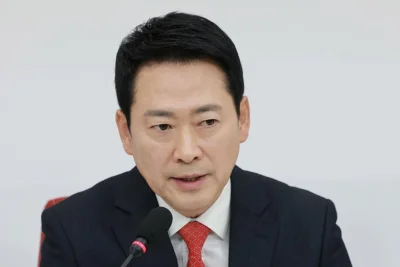
People Power Party leader Jang Dong-hyuk and lawmakers tear up protest placards during a party meeting at the National Assembly in Seoul on Tuesday. Photo by Asia Today

Jan. 13 (Asia Today) — South Korea’s People Power Party has shown little sign of regaining support despite an apology and a reform package tied to the Dec. 3 emergency decree, with polls showing the gap widening between the conservative party and the ruling Democratic Party of Korea.
Political observers said Tuesday that public sentiment appears to be moving in favor of President Lee Jae-myung and the Democratic Party, while the People Power Party has stagnated or slipped in successive surveys.
In a poll commissioned by the Energy Economy Newspaper and conducted by Realmeter from Sunday through Thursday among 2,530 voters nationwide age 18 and older, party support stood at 47.8% for the Democratic Party and 33.5% for the People Power Party. The Democratic Party rose 2.1 percentage points from the prior week, while the People Power Party fell 2.0 points, the poll found.
Analysts cited what they called a “Yoon Suk-yeol factor” as a key reason the conservative party has struggled to draw a positive response. While People Power Party leader Jang Dong-hyuk’s reform plan included an apology over the martial law declaration, critics said it did not clearly address how the party would define its relationship with former President Yoon Suk-yeol.
They said the plan offered no direct message on accountability, political separation or future ties beyond expressing regret and leaving past issues to the courts and “history’s judgment.”
Some observers also questioned whether Jang’s personal reform push has enough political impact to shift voter views. The measures he announced last week focused on an apology over martial law, a youth-centered party vision and a proposed party name change, but did not spell out what the party would abandon or where it would draw clear lines.
Political commentator Park Sang-byeong said an apology alone is not the same as taking responsibility, adding that he saw no visible political decision-making behind the message.
The bipartisan bill would bar funding for any move to occupy or annex the territory of a NATO member state.
US senators have introduced a bill aimed at preventing President Donald Trump from seizing NATO territory, including the self-governing Danish island of Greenland.
The bipartisan NATO Unity Protection Act introduced on Tuesday would bar the Department of Defense and Department of State from using funds to “blockade, occupy, annex or otherwise assert control” over the territory of any NATO member state.
Recommended Stories
list of 4 itemsend of list
The bill, authored by Democrat Jeanne Shaheen and Republican Lisa Murkowski, comes amid growing concerns over Trump’s repeated insistence that Greenland, a semi-autonomous territory of Denmark, must be brought under Washington’s control, using force if necessary.
“This bipartisan legislation makes clear that US taxpayer dollars cannot be used for actions that would fracture NATO and violate our own commitments to NATO,” said Shaheen, who represents the state of New Hampshire, in a statement.
“This bill sends a clear message that recent rhetoric around Greenland deeply undermines America’s own national security interests and faces bipartisan opposition in Congress,” the Democratic senator said.
Murkowski, a rare Republican critic of Trump who represents Alaska, said the 32-member NATO security alliance was the “strongest line of defence” against efforts to undermine global peace and stability.
“The mere notion that America would use our vast resources against our allies is deeply troubling and must be wholly rejected by Congress in statute,” Murkowski said.
Trump’s threats to take control of Greenland have alarmed Washington’s European allies and prompted warnings about the end of NATO, which is built on the principle that an armed attack against any one member is considered an attack against all.
Trump, who claims that control of the vast Arctic territory is crucial to US national security, has brushed aside concerns about splitting the alliance, which has been a cornerstone of the Western-led security order since the end of World War II.
Trump has also claimed that China or Russia would take control of Greenland, which is home to vast reserves of fossil fuels and critical minerals, if the US does not.
“I’d love to make a deal with them. It’s easier,” Trump said on Sunday of his plans for the territory.
“But one way or the other, we’re going to have Greenland.”
In a rebuke to Trump, Danish Prime Minister Mette Frederiksen and Greenland’s prime minister, Jens-Frederik Nielsen, on Tuesday offered some of their most forceful comments yet in defence of Copenhagen’s sovereignty over the territory.
“If we have to choose between the United States and Denmark here and now, we choose Denmark,” Nielsen said at a joint news conference in Copenhagen.
“We choose NATO. We choose the Kingdom of Denmark. We choose the EU,” he said.
Danish Minister for Foreign Affairs Lars Lokke Rasmussen and his counterpart in Greenland, Vivian Motzfeldt, are on Wednesday set to meet with US Secretary of State Marco Rubio and US Vice President JD Vance in Washington, DC, for talks on the escalating crisis.
A bipartisan delegation of US lawmakers, including Democratic Senator Chris Coons and Republican Senator Thom Tillis, is set to arrive in Denmark on Friday for talks with local officials.
The vast majority of Greenland’s 57,000 residents have expressed opposition to US control of the territory, according to polling.
In a survey commissioned by the Danish paper Berlingske last year, 85 percent of residents said they did not wish to join the US, with just 6 percent in favour.
Jan. 13 (UPI) — The New York City Council employee detained by federal immigration agents during a routine court appearance on Monday was illegally in the country, according to the Department of Homeland Security, which on Tuesday painted a drastically different portrait of the employee than the one presented by city officials a day earlier.
The detention of the man, identified by DHS as Rafael Andres Rubio Bohorquez, drew near immediate anger from New York City Council Speaker Julie Menin, who on Monday described the employee’s arrest as an example of the Trump administration’s government overreach.
She said the immigrant from Venezuela was legally able to work in the United States until October. She said that in January he signed an attestation that he has never been arrested. Rep. Dan Goldman, D-N.Y., said there was nothing about the employee that warranted his arrest other than that he is an immigrate from Venezuela.
The DHS on Tuesday refuted the characterization of Rubio Bohorquez, calling him a “criminal illegal alien” who overstayed his B-2 tourist visa in 2017, that required him to leave the country by Oct. 22 of that year.
The federal department also said he was previously arrested for assault in New York. No information about the alleged crime, nor if it led to a conviction, was made public.
“A criminal illegal alien with no authorization to work in the U.S. being employed by the New York City Council is shocking,” Assistant DHS Secretary Tricia McLaughlin said in a statement. “This takes sanctuary city to a whole new level.”
Goldman on Tuesday accused the DHS of lying. He said Rubio Bohorquez was authorized to work in the United States, as he was granted Temporary Protected Status. He also said Rubio Bohorquez cleared the standard background check conducted for all City Council employees.
TPS is an immigration program designed to prevent the deportation of immigrants to countries experiencing crises, such as armed conflict. It can be granted regardless of prior visa overstays. President Donald Trump has moved to terminate TPS protections for several countries, including Venezuela. TPS protections granted to Venezuelans are to expire in October.
“Department of Homeland Security spokesperson ‘Tricia from Ohio’ is back to doing what she does best: gaslighting the American people,” Goldman said in a statement. “Her statement that the staffer ‘had no legal right to be in the United States’ is a bald-faced lie. In truth, the NYC Council employee was lawfully in the United States and properly authorized to work here.”
He called on DHS Secretary Kristi Noem to ask Trump about the importance of due process and the concept of innocent until proven guilty.
“An arrest is simply not a basis for deportation,” he said.
Trump was convicted last year in New York on 34 felony charges for falsifying business records to hide an alleged affair from the public in the run-up to the 2016 election. He has denied wrongdoing in the case. He was also facing several other criminal cases concerning alleged attempts to overturn his 2020 election loss when he was re-elected president in 2024.
The New York Legal Assistance Group filed a habeas petition Monday night concerning Rubio Bohorquez. On Tuesday, Menin and Goldman said in a joint statement that it was preventing the Department of Homeland Security from removing Rubio Bohorquez from New York State until his petition is resolved.
They have yet to be able to contact Rubio Bohorquez, she said Tuesday, but they were working to contact his legal counsel.
These are the key developments from day 1,420 of Russia’s war on Ukraine.
Published On 14 Jan 202614 Jan 2026
Share
Here is where things stand on Wednesday, January 14:
Fighting
A Russian missile and drone attack on a postal company terminal in Ukraine’s northeastern city of Kharkiv killed four people and wounded six, Kharkiv Governor Oleh Syniehubov said on the Telegram messaging app.
Kharkiv Mayor Ihor Terekhov said that a Russian long-range drone also struck a medical facility for children, causing a fire.
Ukraine’s Deputy Minister of Energy Mykola Kolisnyk said that continued Russian shelling on Tuesday caused an “even greater shortage” of electricity in Kyiv and that “almost 500 high-rise buildings are still without heat”.
The Ministry of Defence in Moscow said Russian forces had launched a “massive strike against energy facilities used by the Ukrainian Armed Forces”, according to Russia’s TASS news agency.
The ministry also reported that Russian forces shot down 207 Ukrainian drones and 11 guided missiles in a 24-hour period, according to TASS.
TASS also said that some supermarkets were closed in Kyiv due to the power outages. However, Kolisnyk said these reports were false.
Ukraine’s Security Service (SBU) said Ukrainian Navy forces struck a Russian drone factory in Taganrog, in Russia’s Rostov region, causing a fire and “a series of loud explosions”.
Rostov Governor Yury Slyusar wrote on Telegram that a woman’s body was found in a building after it was shelled by Ukrainian forces in Taganrog.
A Ukrainian drone attack killed a man in Shebekino city in Russia’s Belgorod region, the regional civil task force reported on Telegram.
Another Ukrainian drone attack killed a 45-year-old woman in the Russian-occupied Ukrainian region of Luhansk, the Russian-installed regional government reported on Telegram.
Ukraine’s DeepState military blog said that Russian forces advanced near Lozova in Kharkiv and Stepnohirsk in the Zaporizhia region.
Black Sea attacks
Drones struck two oil tankers in the Black Sea on Tuesday, including one chartered by US oil giant Chevron, the companies involved said, as they sailed towards a terminal on the Russian coast.
“All crew are safe, and the vessel remains stable. It is proceeding to a safe port, and we are coordinating with the ship operator and relevant authorities,” Chevron said of the damaged chartered tanker.
Reuters reported that both ships were en route to Russia’s Yuzhnaya Ozereyevka terminal, a loading point for about 80 percent of Kazakh oil destined for international markets, as well as some Russian crude oil, according to multiple unnamed sources.
Кazakhstan’s Ministry of Energy had said earlier on Tuesday that it reduced oil shipments through the Caspian Pipeline Consortium (CPC) marine terminal in December because of drone attacks and adverse Black Sea weather conditions.
Politics and Diplomacy
Ukrainian President Volodymyr Zelenskyy has nominated Mykhailo Fedorov, Ukraine’s first vice prime minister, for the post of defence minister, MP Yaroslav Zhelezniak wrote on Telegram.
Ukrainian lawmakers on Tuesday voted against naming outgoing Defence Minister Denys Shmyhal as energy minister after Zelenskyy proposed him for the position.
Regional Security
Germany indicted two Ukrainians linked to an alleged plot, on behalf of Russian spy services, to detonate packages while they were being transported across Europe, prosecutors said on Tuesday.
Russia said it had summoned Poland’s ambassador to protest over the detention of a Russian archaeologist and demand that he be immediately released instead of extradited to Ukraine.