TODAY

Discover the latest happenings and stay in the know with our up-to-date today news coverage. From breaking stories and current events to trending topics and insightful analysis, we bring you the most relevant and captivating news of the day.

Iran’s IRGC says spokesman Ali Mohammad Naini killed in US-Israeli attack | US-Israel war on Iran News

Israeli and US air attacks pound Iran as assassination campaign of country’s leadership continues.

Iran’s Islamic Revolutionary Guard Corps spokesperson has been killed in overnight strikes carried out jointly by the United States and Israel, the IRGC reported, the latest in a mounting toll of senior officials assassinated since the war began.

Ali Mohammad Naini, a 68-year-old brigadier general who took up the IRGC spokesman role in 2024, “was martyred in the criminal cowardly terrorist attack by the American-Zionist side at dawn”, the IRGC said in a statement on Friday.

Recommended Stories

list of 3 itemsend of list

His death came just hours after he appeared on national television to insist that Iran retained full capacity to manufacture missiles, even under wartime conditions.

“Our missile industry deserves a perfect score … and there is no concern in this regard, because even under wartime conditions we continue missile production,” Naini was quoted by the Fars news agency as saying.

On Thursday, Israeli Prime Minister Benjamin Netanyahu said that “Iran no longer has the capacity to enrich uranium and manufacture ballistic missiles”.


The Israeli army said on Friday that it was carrying out strikes across eastern Tehran, as the country marks the Persian New Year, Nowruz, which this year coincides with Eid al-Fitr.

Al Jazeera’s Mohamed Vall, reporting from Tehran, described the mood in the capital as “hushed”, with none of the customary festivities visible on the streets.

Naini’s killing is the latest in a string of high-profile assassinations that have gutted Iran’s establishment in under three weeks.

Supreme Leader Ayatollah Ali Khamenei was killed in the opening hours of the joint military campaign. He has since been replaced by his son, Mojtaba Khamenei.

Earlier this week, Ali Larijani, secretary of Iran’s Supreme National Security Council and one of the most influential figures in Iran’s establishment, was killed in a strike along with his son and several aides.

The head of the Basij paramilitary forces, Brigadier General Gholamreza Soleimani, and Intelligence Minister Esmail Khatib were also confirmed dead within the same 48-hour period.

US Defense Secretary Pete Hegseth made little effort to conceal Washington’s glee, saying on Thursday that “the last job anyone in the world wants right now” is a senior leadership role in the IRGC or Basij.

However, other US officials appeared to suggest that Washington and Israel’s aims in Israel were not aligned.

Director of National Intelligence Tulsi Gabbard told the House Intelligence Committee this week that US and Israeli objectives “are different”, adding that while Israel had been “focused on disabling the Iranian leadership,” Trump’s goals were to destroy Iran’s ballistic missile capabilities “and their navy”.

Israeli Prime Minister Netanyahu has cast the killings as a means of opening a path for Iranians to reclaim their country, saying on Wednesday the campaign against the country’s leadership “will not happen all at once” but that persistence would give Iranians “a chance to take their fate into their own hands”.

Foreign Minister Abbas Araghchi said the US and Israel had still failed to grasp that Iran’s political structure does not rest on any single person.

“The presence or absence of a single individual does not affect this structure,” he said.

Source link

We ask you: Is it unfair to ask Royal Mail to deliver letters?

ROYAL Mail bosses are to be called to Parliament to answer for their failure to deliver letters on time, but are we imposing unfair expectations on them?

William McKay, conveyancer: “Notice how it’s always the privatised businesses who come in for all this criticism. That’s victimisation, pure and simple.”

Wayne Hayes, psychiatric nurse: “I don’t see the issue with only receiving post once a week. In the Kevin Costner film The Postman they get it years late, and that was a post-apocalyptic society just like ours.”

Joanna Kramer, full-time mother: “Postmen used to have time to give you a good seeing to over the kitchen table. Now I barely have time to toss him off at the door.”

Jordan Gardner, tanning salon manager: “Royal Mail have blamed weather and illness for the problem. Well those are both new things which have never happened before so give them a break.”

Helen Archer, camgirl: “It’s all junk mail anyway! By which I mean I correspond with multiple older gentlemen who post me regular dick pics.”

Slovenia heads to polls with diverging views on Israel in focus | Elections News

Slovenia heads to the polls on Sunday in a closely contested race between incumbent Prime Minister Robert Golob and right-wing former Prime Minister Janez Jansa.

Opinion polls currently suggest no clear winner between Golob’s Freedom Movement (GS) and Jansa’s Slovenian Democratic Party (SDS), with the outcome likely to hinge on smaller parties and coalition-building.

Recommended Stories

list of 4 itemsend of list

Jansa has served three times as prime minister, between 2004-2008, 2012-2013 and 2020-2022.

Golob’s domestic agenda has been broadly reform-driven and welfare-focused, with a mix of social policy, green transition, and institutional reforms, something Jansa has promised to reverse by introducing tax breaks for businesses and cutting funding for welfare programs.

The election will also decide which direction the Alpine nation, which gained independence in 1991, will take on foreign policy, especially given the wildly divergent views on Israel and Palestine.

Slovenia’s government has been an outspoken critic of Israel’s war; in contrast, Jansa is a staunch supporter of Israel.

Slovenia Israel
Slovenian then Prime Minister Janez Jansa and Israeli Prime Minister Benjamin Netanyahu met in Jerusalem on December 8, 2020 [Ohad Zwigenberg/Pool via Reuters]

Diverging views on Israel-Palestine

For a small nation – roughly the size of New Jersey in the United States – home to two million people, the Israel-Palestine conflict has played a significant role in its politics.

Slovenia’s current government has openly criticised Israel’s actions in Gaza and the occupied West Bank, even introducing a ban on imports of goods produced in the occupied Palestinian territory.

In May 2024, the country recognised Palestinian statehood, raising a Palestinian flag alongside the flags of Slovenia and the European Union in front of a government building in downtown Ljubljana.

A Palestinian flag flies next to a Slovenian and a European Union flag, at the government building in Ljubljana, Slovenia
A Palestinian flag flies next to a Slovenian and an EU flag, at the government building in Ljubljana, Slovenia, May 30, 2024 [Borut Zivulovic/Reuters]

In May 2025, Slovenia’s President Natasa Pirc Musar told the European Parliament that the EU needed to take stronger action against Israel, condemning “the genocide” in Gaza.

Later in the year, it banned far-right Israeli cabinet ministers Itamar Ben-Gvir and Bezalel Smotrich from entering the country and became the first country in the EU to ban all weapons trade with Israel over its genocidal war on Gaza.

It has also backed Slovenian International Criminal Court (ICC) Judge Beti Hohler, after she was sanctioned by the US for her role in issuing arrest warrants for Israeli Prime Minister Benjamin Netanyahu and former Defense Minister Yoav Gallant.

In a letter sent to the EU heads of state on March 13, Golob and Musar warned that Europe’s refusal to condemn the sanctions indicated that “concern for economic consequences has taken precedence over a principled defence of judicial independence and international justice … at a moment when armed conflicts rage, when international law is being violated, when the victims of the gravest crimes look to the ICC as their last hope for justice.”

Slovenia Israel
Palestinian Foreign Minister Varsen Aghabekian Shahin meets with Slovenia’s Prime Minister Robert Golob, at the Office of the Prime Minister of the Republic of Slovenia, in Ljubljana, Slovenia, August 25, 2025 [Borut Zivulovic/Reuters]

Nika Kovac, a Slovenian sociologist and cofounder of the 8th of March Institute, a nongovernmental organisation focused on human rights, told Al Jazeera that support for Palestine is in part rooted in the fact that Slovenia is “a very young country”, which means “there is … solidarity with countries that want to be independent, and they cannot be.”

However, the country’s approach to Palestinian rights could shift if pro-Israel Jansa were to be elected.

Jansa has been a close ally to Israeli Prime Minister Benjamin Netanyahu and lambasted Slovenia’s decision to recognise the state of Palestine, with a statement from his party claiming it was tantamount to “supporting the terrorist organisation Hamas”.

FILE PHOTO: A person votes during the early voting ahead of national elections, in Ljubljana, Slovenia March 17, 2026. REUTERS/Borut Zivulovic/File Photo
A woman votes during the early voting before national elections, in Ljubljana, Slovenia, March 17, 2026 [Borut Zivulovic/Reuters]

Accusations of ‘foreign information manipulation’

In the lead-up to the election, a series of covertly recorded conversations was published online, featuring a Slovenian lobbyist, a lawyer, a former minister and a manager.

The videos purportedly show the individuals discussing ways to influence decision-makers in Golob’s coalition to expedite procedures and secure contracts.

On Tuesday, Golob accused “foreign services” of interfering in Slovenia’s elections, after a report by the 8th of March Institute and investigative journalists claimed that representatives of the Israeli private spy firm Black Cube had visited the country in December and Jansa’s headquarters in the weeks leading up to the leaks.

On Wednesday, Slovenia’s Intelligence and Security Agency confirmed the arrival of Black Cube representatives in Slovenia and presented a report on foreign interference in elections, which the agency’s director said was alleged to have been carried out at the behest of people in Slovenia.

The State Secretary for National and International Security in the Office of the Prime Minister of the Republic of Slovenia, Vojko Volk, made a statement following the announcement, saying, “According to information available to date, representatives of Black Cube have stayed in Slovenia on four occasions over the past six months.”

On Thursday, Golob sent a letter to European Commission President Ursula von der Leyen notifying her of “alarming information regarding what appears to constitute a grave instance of foreign information manipulation and interference currently unfolding in the Republic of Slovenia”.

French President Emmanuel Macron told reporters on Thursday that Golob “was the victim of clear-cut interference” by “third countries”.

“Today, in every election in Europe, there is interference that disrupts electoral processes,” Macron said.

Jansa has admitted to meeting with a Black Cube representative but denied any wrongdoing.

Source link

Eid celebrations dimmed by war and displacement across Middle East | US-Israel war on Iran News

Beirut, Lebanon and Gaza City, Palestine – Along Beirut’s downtown waterfront, Alaa is looking for somewhere to rest his head.

The Syrian refugee, originally from the occupied Golan Heights, is now homeless. He explained that he had already spent the day wandering around the Lebanese capital trying to find shelter.

Recommended Stories

list of 3 itemsend of list

He used to live in Dahiyeh – the southern suburbs of Beirut that have been pummelled by Israeli attacks, which have now killed more than 1,000 across Lebanon.

Now, he’s just looking for somewhere he can be safe. And in that context, Eid al-Fitr, the Muslim festival that began on Friday, is far from his mind.

When asked if he had any plans for Eid, he replied in the negative. Instead, his focus was on getting a tent.

“I got rejected from staying in a school, then I went to sleep on the corniche,” Alaa said. “Then people from the municipality told me to come here to downtown Beirut’s waterfront.”

Alaa wasn’t able to find a tent and is sleeping in the open air for now. But others in the area have, transforming a downtown more famous for its expensive restaurants and bars into a tent city for those displaced by the fighting. Across Lebanon, more than a million people have been displaced.

Lebanese are uncertain when this war will end, particularly as they have barely recovered from the conflict with Israel that ran between October 2023 and November 2024.

It makes celebrations difficult – a common theme across the countries affected by the current conflict.

In Iran, now in its third week of US-Israeli attacks – with no sign of an immediate end and an economic crisis that preceded the conflict, people are struggling to afford any of the items typically bought during the holiday season.

And it is potentially dangerous for people to shop at places like Tehran’s grand bazaar, which has been damaged by the bombing.

The religious element of Eid adds an extra sensitivity for antigovernment Iranians, some of whom now see any sign of religiosity as support for the Islamic Republic. The fact that Nowruz – the Persian New Year – falls on Friday this year means that some in the antigovernment camp will be focused on that celebration instead, and eschewing any events to mark Eid.

Struggling in Gaza

Many Palestinians in Gaza want to celebrate Eid, but the enclave’s economic crisis, brought on by Israel’s genocidal war, makes it difficult.

Israeli restrictions on the entry of goods into Gaza, which have increased since the war against Iran started, have driven up prices further, including the cost of children’s toys.

Khaled Deeb, a 62-year-old living in a partially destroyed home in Gaza City, had ventured into the central Remal market, curious to see how expensive fruit and vegetables had gotten in the run-up to Eid.

“From the outside, the Eid atmosphere looks lively and vibrant,” Khaled said, pointing to the crowded market. “But financially, things are extremely bad. People have all left their homes and are now living in tents and displacement. Everyone has lost everything during the war.”

Khaled says he can’t afford the fruit and vegetables, and will have to go without. Only “kings” could buy them, he said, not “poor and exhausted people” like him.

What makes it worse is his memory of what things were like before the war, when he owned a supermarket.

“During Eid, I would give my daughters and sisters gifts of more than 3,000 shekels ($950) when visiting them, not to mention preparing the house, buying Eid clothes for my children, and sweets and chocolates to welcome the holiday,” Khaled said. None of that is going to happen this Eid, even with a ceasefire in Gaza.

His sentiment was echoed by Shireen Shreim, a mother of three.

“Our joy in Eid is incomplete,” she said, as she wandered through the market. “We have come out of two years of war with immense hardship, only to face a life where even the most basic necessities are unavailable.”

And with Israel showing few signs that it is willing to stop violently attacking Palestinians, as well as other countries in the region, Shireen has no idea when Gaza will ever be rebuilt.

“I live in an apartment with completely hollowed-out walls,” she explained. “My husband and I put up tarps and wood, and we are continuing our lives. We are much better off than others.”

“Every time I return home, I feel sad,” she added. “As you can see, people are living in nylon and cloth tents in the streets, without any humane shelter. How will these people celebrate Eid?”

Back in Beirut, Karim Safieddine, a political researcher and organiser, is stoic. He said he would be celebrating Eid with his extended family, despite the difficult circumstances.

“Although we have been displaced by the war, we believe that consolidating these family bonds and creating a sense of communal solidarity is the first and foremost condition to survive this war,” Karim said.

“Without solidarity, we won’t be able to build a society, a country,” he said. “I think that’s a starting point for many people attempting to really create a sense of forward-looking vision for a country under bombs, without any form of toxic positivity, of course.”

Source link

Israel Claims Destruction Of ‘Iran Force One’

The Israeli Air Force (IAF) claims that it destroyed the Iranian government’s Airbus A340 in a strike on Mehrabad International Airport in Tehran. Last summer, the aircraft had been part of an exodus of Iranian state-operated airliners to Oman, but its apparent demise now underscores the intensity of the current airstrikes against Iran, which have been systematically removing aircraft of all types from the Iranian inventory.

חיל-האוויר השמיד את מטוסו של מנהיג משטר הטרור האיראני בשדה התעופה ״מהאראבד״ שבטהרן – המטוס שימש את עלי ח׳אמנהאי, מנהיג משטר הטרור האיראני, בכירים נוספים ממשטר הטרור וגורמים בצבא איראן, לקידום רכש צבאי ולניהול קשרים עם מדינות הציר באמצעות טיסות פנים וחוץ.

השמדת המטוס פוגעת… pic.twitter.com/lOtRRIHTff

— Israeli Air Force (@IAFsite) March 16, 2026

In a statement on X, the IAF described the A340-300 as “the plane of the leader of the Iranian terror regime” and a “strategic asset,” and said that its destruction “impairs the ability to coordinate between the leadership of the Iranian terror regime and Axis countries, in building military power, and in the regime’s rehabilitation capability.” The IAF posted a library photo showing the A340, which it says was also used by “additional senior officials from the terror regime, and elements in the Iranian military, to advance military procurement and manage relations with Axis countries through domestic and international flights.”

The fact that any airlift-capable aircraft, whether military or civilian by design, can be used to move materiel to Iranian proxies has long been a problem for Israel. With the IAF destroying its airlift fleet, Iran will find it harder to connect with proxies, providing support, as well as engaging in a variety of other nefarious activities.

At this stage, it should be noted that the destruction of the A340 has not yet been independently verified. TWZ has approached various commercial providers of satellite imagery for confirmation.

Video allegedly taken during the strike on the VIP Iranian A340 Airbus in Mehrabad airport geolocates the strike at the western hangars complex which is close to the AA defenses and has access to the open southern runway.
Rough Point of Impact (POI) #geoposted 35.69465,51.271681 pic.twitter.com/zFBPfCZnPa

— OSGINT (@posted_news) March 16, 2026

Previous satellite imagery showed the A340 parked in different dispersed areas around the airport, including among derelict airframes. This was almost certainly an effort to complicate targeting.

A satellite image of Mehrabad showing the runway blocked with parked buses and helicopters, rendering it unusable:

The runway at Tehran’s Mehrabad Airport has been blocked with parked buses and helicopters, apparently to make it unusable and prevent further strikes or aircraft operations.

Satellite imagery from March 7 also shows visible damage at the airport following heavy bombing during… pic.twitter.com/GyG8NB2LCo

— Visegrád 24 (@visegrad24) March 12, 2026

The A340 in question has the Iranian civil registration EP-IGA and is the largest aircraft in Iran’s modest government transport fleet. Widely described as ‘Iran Force One,’ in reference to the U.S. president’s Air Force One, the A340 has been used by the Iranian state for a variety of long-haul missions, making use of its widebody capacity and intercontinental range. In general, the A340 has been a fairly popular choice as a government transport, with VIP A340s having been operated by Egypt, France, Jordan, Libya, Qatar, and Saudi Arabia, among others.

Iran – Government A340-313 with Iran President on board Landing at Karachi Airport


In practice, Iran’s supreme leader only left the country occasionally, with the A340 primarily being used to move other high-ranking officials on diplomatic visits. For example, it was used to transport Iranian President Masoud Pezeshkian to the United States for the main annual United Nations General Assembly meeting in 2024.

Islamic Republic of Iran Air Force (IRIAF) used the Airbus A340-313X aircraft (Serial 5-8405, registration EP-IGA) to carry the Iranian President Masoud Pezeshkian to the New York’s John F. Kennedy Airport.

This aircraft (MSN:257) was part of the fleet of Air Canada (C-GDVV),… pic.twitter.com/ILWzTpcUW8

— FL360aero (@fl360aero) September 23, 2024

The A340, which was operated by the Islamic Republic of Iran Air Force (IRIAF), despite its civilian-style livery, had a complicated history. It was first delivered to Air Canada in 1999, before flying under the colors of Air Jamaica, Turkish Airlines, AirBlue, and Asian Express. By 2015, it was owned by Tehran-based Meraj Airlines, which leased it to the Iranian government. It spent a period with Dena Airways, a passenger charter carrier based out of Mehrabad, but by 2018, it belonged to the Iranian government and was registered as EP-IGA.

צה”ל מודיע שהשמיד הלילה את מטוסו של המנהיג העליון של איראן שחנה בשדה התעופה מהאראבד בטהרן. נראה שמדובר במטוס האיירבוס A340 עם הרישום EP-IGA pic.twitter.com/fG5wR3lEwp

— איתי בלומנטל 🇮🇱 Itay Blumental (@ItayBlumental) March 16, 2026

Serving alongside the A340 in the Iranian government’s transport fleet were at least one Airbus A321-200 and a pair of BAe Avro RJ85 regional jets. Their fates remain uncertain at this stage.

Mehrabad has been hit particularly hard by U.S.-Israeli airstrikes, with targeted aircraft including the unique KC-747 aircraft operated by the IRIAF. The tanker version of the 747 was not flown anywhere else in the world, and Iran had just one flying example. You can read all about the aircraft in this past article

Smoke rises after a reported Israeli strike on Mehrabad on March 3:

In June 2025, during the previous conflict with Israel, the A340 made an unusual flight to the Oman capital, Muscat. The widebody touched down there together with a pair of Airbus A321s, leading to speculation that they were transporting a delegation from Iran to try to negotiate an end to the fighting before the United States became involved.

Since Iran and Oman had strong diplomatic ties, with the Omanis often serving as an intermediary between the regime in Tehran and the West, this certainly seems a likely explanation.

שלושה מטוסים ממשלתיים של איראן המריאו בשעה האחרונה מדרום המדינה ונחתו במסקט בירת עומאן. אחד מהם הוא המטוס הנשיאותי, אשר שימש עד לאחרונה את הנשיא מסעוד פזשכיאן. מטרת הטיסה לא ברורה: האם הגיעו לשיחות תיווך בעומאן, או שמא מולטו מן המדינה ועליהם נוסעים. pic.twitter.com/GRGYEfnnmB

— avi scharf (@avischarf) June 18, 2025

Other options that we discussed at the time included the evacuation of individuals seeking to escape the current conflict. This became particularly urgent after Israel began striking Tehran, as well as other locations across western Iran, with virtual impunity.

There’s also the very strong possibility that the Iranian government moved these aircraft for their own protection from the Israeli strikes on Iranian air bases, including Mehrabad, where IRIAF F-14 Tomcat fighters were also targeted.

Regardless of the purpose, by the end of June, the United States was not only fending off Iranian attacks but had also bombed three key Iranian nuclear sites in Operation Midnight Hammer.

While the A340 made its way back to Tehran after the Twelve-Day War, its apparent destruction in an Israeli airstrike means that it won’t be able to repeat any such missions, and it is now little more than a symbol of the intensity of the U.S.-Israeli campaign to wipe out the Islamic Republic of Iran Air Force fleet alongside other key military capabilities.

Contact the author: thomas@thewarzone.com

Thomas is a defense writer and editor with over 20 years of experience covering military aerospace topics and conflicts. He’s written a number of books, edited many more, and has contributed to many of the world’s leading aviation publications. Before joining The War Zone in 2020, he was the editor of AirForces Monthly.


Source link

Iran war: What is happening on day 21 of US-Israel attacks? | US-Israel war on Iran News

Tehran has warned of zero restraint if energy facilities are attacked again, while Netanyahu signals that there could be a ‘ground component’ to the war.

Iran has warned it will show “zero restraint” if its energy facilities are attacked again, a day after Israel struck the South Pars gasfield and Tehran attacked energy sites across the Gulf.

In the United States, President Donald Trump raised controversy during a meeting with Japan’s Prime Minister Sanae Takaichi by invoking the 1941 bombing of Pearl Harbour while defending the element of surprise in the Iran attack.

Meanwhile, as the conflict intensifies, concerns over supply disruptions have pushed global oil and gas prices higher, with sharp increases reported across the United Kingdom and Europe.

In Iran

  • Escalation: After Israel struck Iran’s South Pars gasfield, Tehran hit targets in Haifa, Israel, and Ras Laffan, Qatar, warning of “zero restraint” if its energy facilities are attacked again and claiming Iran has only used a “fraction” of its firepower so far.
  • Widespread regional missile strikes: Iran’s Islamic Revolutionary Guard Corps (IRGC) announced a new wave of missile and drone attacks on US bases and central and southern Israel, including Tel Aviv, Haifa, and Jerusalem.
  • Humanitarian toll:  The Iranian Red Crescent Society reported that more than 18,000 civilians have been injured and 204 children have been killed in Iran since the war began on February 28. In all, more than 1,400 people have been killed in Iran.
  • US airbase in Germany: Iran said it had asked Germany to clarify the role of the Ramstein Air Base in the war. “The role of Ramstein is not officially clear for us,” Tehran’s ambassador to Germany, Majid Nili, said. The Ramstein Air Base matters because it is one of the US military’s most important hubs and a key link in operations in the Middle East.
  • Macron eyes UN action on Hormuz: French President Emmanuel Macron said he will consult United Nations Security Council members on a framework to secure navigation in the Strait of Hormuz, a vital global chokepoint through which about 20 percent of the world’s oil and gas flows – once fighting subsides.

INTERACTIVE - Joint US-Israeli strikes and Iran's attacks - MARCH 19, 2026 copy-1773920176

In the Gulf

  • Gulf attacks: UAE and Kuwaiti air defences were responding to missile attacks on Friday, authorities in the Gulf states said. Saudi Arabia’s Ministry of Defense said it had intercepted and destroyed 10 drones in the country’s east and another in the north.
  • UAE arrests: Authorities detained at least five members of a “terrorist network” linked to Iran and Hezbollah that allegedly used business fronts to infiltrate the economy as part of a coordinated external plan, the official WAM news agency reported.
  • Qatar – Ras Laffan attack: Iran hit Qatar’s key LNG facility, cutting about 17 percent of output for as long as five years, the CEO of QatarEnergy has said. With Qatar supplying 20 percent of global LNG, disruptions are expected, with force majeure likely on some contracts to Belgium, Italy, South Korea, and China. Diplomatically, Qatar’s prime minister and Turkiye’s foreign minister held a joint news conference condemning the act of sabotage as a “dangerous escalation” by Iran. On Thursday, Qatar’s defence forces again reported ballistic missile attacks.
  • Missile and drone interceptions in Bahrain: Bahrain’s Defence Force reported shooting down five incoming missiles recently, bringing its total interceptions to 139 missiles and 238 drones since the start of the conflict more than two weeks ago.

INTERACTIVE - DEATH TOLL - tracker - war - US Israel and Iran attacks - March 19, 2026-1773925057

In the US

  • ‘Pearl Harbour’ remarks: Trump defended not informing allies about the US strikes on Iran, saying “we wanted surprise.” He then turned to Japanese Prime Minister Sanae Takaichi, who was visiting the White House and was seated next to him, and invoked the 1941 bombing of Pearl Harbour, saying, “Who knows better about surprise than Japan? Why didn’t you tell me about Pearl Harbour, OK? Right?”
  • Diplomatic shockwaves: Analyst Mireya Solis called Trump’s Pearl Harbour remark to Japan’s PM “unusual – a shock” that brings up a bitter rivalry rather than emphasising shared allied bonds.
  • US war objectives unchanged: Defense Secretary Pete Hegseth said US goals remain the same since February 28 – targeting Iran’s missile systems, military industry and navy, and preventing a nuclear weapon, with no set end date.
  • No US ground troops: Trump said he was not sending US ground troops to Iran, telling reporters: “If I were, I certainly wouldn’t tell you. But I’m not putting troops.” However, Trump has frequently changed his position on whether he is open to deploying boots on the ground in Iran.
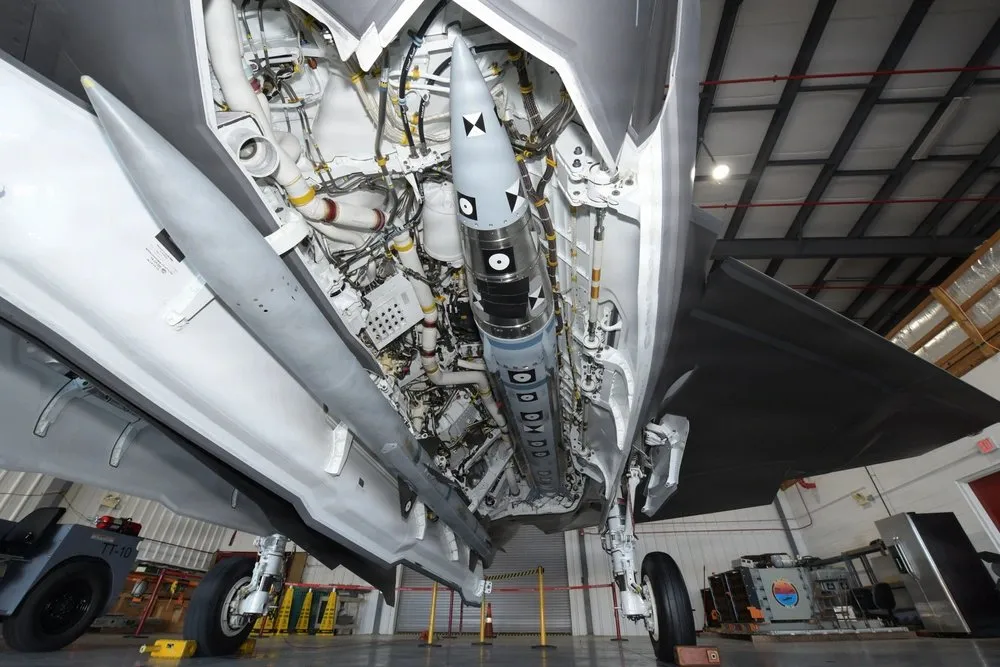
  • F-35 incident: A US F-35 fighter jet made an emergency landing at a Middle East airbase after a combat mission over Iran. The aircraft landed safely and the pilot is stable, while US officials investigate reports it may have been struck by Iranian fire. If that is the case, it would be the first US jet struck by Iran during the current war.

In Israel

  • Explosions over Jerusalem: Israel’s military said it had identified three rounds of missile fire in the hour and a half preceding midnight, and another a few hours later.
  • Netanyahu says Iran ‘decimated’: Israeli Prime Minister Benjamin Netanyahu said at a news conference he saw “this war ending a lot faster than people think … We are winning and Iran is being decimated.”
  • Trump and Netanyahu: Netanyahu also denied that Israel “dragged” the US into the war, asking, “Does anyone really think that someone can tell President Trump what to do?”
  • Israel ‘acted alone’: The PM also said Israel acted on its own when it struck an Iranian gasfield. “President Trump asked us to hold off on future attacks and we’re holding out.”
  • Netanyahu signals possible ground phase: “It is often said that you can’t win, you can’t do revolutions from the air. That is true. You can’t do it only from the air. You can do a lot of things from the air, and we’re doing, but there has to be a ground component as well,” the Israeli prime minister said in his remarks.
  • Next stage questions: Al Jazeera’s Rob McBride described Netanyahu’s comments about a possible ground component as “intriguing”, suggesting a potential next stage while raising questions about how it would unfold. Netanyahu’s remarks were also seen as an attempt to reassure Israelis that the nearly three-week war has been worthwhile.
  • Core objectives: Netanyahu also reiterated goals of dismantling Iran’s nuclear programme, degrading its ballistic missile capabilities, and shaping conditions for a future without the “current regime”.
  • Regional framing: “In a wider sense, he was also claiming that with their American allies, they were reshaping the Middle East altogether, and that the balance of power and the dynamics within that – that Israel, he said, had never been stronger, while Iran, he claimed, had never been weaker,” McBride said.

In Lebanon

  • Severe humanitarian crisis and displacements:  Since Israeli attacks on Lebanon escalated on March 2, the death toll in the country has surpassed 1,000 people, with at least 2,584 wounded. Furthermore, residents in towns such as Machghara and Sahmar in the Bekaa Valley reported receiving threatening phone calls from foreign numbers urging them to evacuate.
  • Ongoing clashes and military actions: Fierce fighting continues in southern Lebanon, where the Israeli army has expanded its ground troop presence. Hezbollah has claimed responsibility for multiple attacks, including firing missiles at Israeli soldiers and vehicles in the southern Lebanese towns of al-Aadaissah, Meiss el-Jabal, and Maroun al-Ras.
  • Diplomatic efforts for a truce: Amidst the heavy fighting, Lebanese President Joseph Aoun has renewed calls for a truce and the opening of negotiations with Israel to end the war.

Oil and gas

  • Global economic effect: The Ras Laffan strike cut about 17 percent of LNG capacity, with losses near $20bn a year and an estimated 9 percent annual hit to Qatar’s gross domestic product, according to Al Jazeera’s Dmitry Medvedenko, who was reporting from Doha.
  • Soaring global prices: Concerns over these supply disruptions have triggered a surge in global oil and gas prices. Gas prices have risen sharply across the UK and Europe. The ripple effects are being felt in developing nations as well; for instance, fuel prices in Zimbabwe recently topped $2 per litre for the first time as a direct result of the conflict’s effect on oil and gas exports.
  • International pushback and warnings: Due to the escalating energy crisis, the European Council has urgently called for a moratorium on strikes against energy and water facilities.
  • US may ‘unsanction’ Iranian crude: US Treasury Secretary Scott Bessent said Washington might “unsanction” Iranian oil that is already being shipped to ease oil prices. In comments to Fox Business, Bessent also said the US government could release more oil from its strategic reserves.

Source link

Eid under siege: Little to celebrate in Gaza as Israel tightens chokehold | Opinions

As attention shifts to the Iran war, tighter restrictions on Gaza are driving shortages, price hikes and growing suffering, turning a time of celebration into one of anxiety for millions.

While the world’s attention is fixed on the Iran war, Israel has quietly tightened its chokehold on Gaza, further restricting the flow of goods and aid. As Eid al-Fitr begins, a time meant to be marked by joy and family gatherings, millions in Gaza are struggling under deepening shortages and rising hardship. What should be a moment of celebration has instead become one of anxiety, as the worsening crisis strips Eid of even its simplest pleasures.

The economic crisis is not merely a case of ordinary inflation or a temporary shortage of goods, but the result of a complex interplay between the Israeli occupation, local market dynamics, and broader regional and international strategies. Israel has repeatedly taken advantage of external tensions, such as those involving Iran or Lebanon, to justify tightening restrictions on the movement of goods through crossings while intensifying military pressure on Gaza. This leaves residents directly exposed to soaring prices and shortages of essential commodities.

Even when goods are available in the markets, some traders have taken advantage of the crisis to make excessive profits by raising prices unjustifiably. Tomatoes, for example, which used to be 3 shekels ($0.97) before the recent events, now cost 20 shekels ($6.48). Essential canned goods have increased at similar rates. Cooking gas now costs 80 shekels ($25.92) for an 8kg cylinder, meaning that a family may need about 640 shekels ($207.37) per month just to secure cooking gas. Electricity prices have also increased from 18 shekels ($5.83) per unit to 25 shekels ($8.10), while the cost of living for families who often rely on alternatives such as kerosene stoves (babur) for cooking instead of wood has risen sharply.

Price hikes do not stop here. Meat has become prohibitively expensive, essential medicines are increasingly inaccessible at reasonable prices, and even the simplest Eid traditions are now out of reach for many. This price manipulation reflects how some traders exploit the economic fragility and psychological pressure faced by residents, intensifying feelings of injustice and frustration among the population.

The ongoing war, repeated violations of ceasefire arrangements, and Israel’s broader strategy of using external conflicts as justification for military pressure have turned the narrative of “continuous security threats from Gaza” into a recurring pretext for closing crossings or using them as a tool of control. In this way, Gaza has increasingly become entangled in wider regional tensions and military calculations.

Under these circumstances, Eid al-Fitr in Gaza has become a symbol of daily hardship. Families are forced to choose between basic necessities and the traditions of the holiday. Meat, vegetables and cooking gas have become luxuries for many, while the majority struggle simply to secure the essentials of daily life.

Even when supplies exist, the monopolisation of goods and unjustified price hikes make the local market fragile and expose the weakness of Gaza’s economic structure. Every attempt to stabilise prices or increase supply faces strict restrictions linked to the blockade, creating opportunities for traders to secure quick profits at the expense of ordinary civilians.

In the end, Gaza’s crisis is not merely an economic issue; it reflects a complex intersection of occupation, blockade, commercial exploitation, and regional and international policies that have left the territory marginalised.

Eid al-Fitr, once a symbol of joy, has become a reminder of a lost celebration, but also a call for the international community to take meaningful action: to ensure the flow of humanitarian aid, protect civilians from exploitation and prevent human suffering from being turned into an opportunity for profit.

Source link

Iran women’s football team feted in Tehran after asylum battle at Asian Cup | Football News

Iran’s national football team returned to their war-torn nation after several of the players sought asylum in Australia.

Iranian authorities on Thursday gave the national women’s football team a hero’s welcome after their return from Australia, where some had made and then withdrawn asylum claims, amid accusations Iran had pressured their families.

Six players and one backroom staff member who travelled to Australia for the Women’s Asian Cup sought asylum earlier this month after they prompted criticism from hardliners in Iran for failing to sing the national anthem before their first match.

Recommended Stories

list of 4 itemsend of list

Five of them later changed their minds and returned home along with the rest of the team, including captain Zahra Ghanbari, with their fate prompting international concern amid the US-Israel war on Iran.

Activists have accused Iranian authorities of pressuring the women’s families, including summoning their parents for interrogation, while Tehran has alleged that Australia sought to force the athletes to defect.

Several thousand people, many holding Iranian flags, turned out for the welcome ceremony on Thursday evening in Valiasr Square in central Tehran, where other pro-government rallies have taken place in recent weeks, state TV images showed.

“My Choice. My Homeland,” read a slogan on a giant billboard on the square that showed the players in their national kit and mandatory hijabs saluting the Iranian flag.

Flanked by team members, Iranian football federation President Mehdi Taj said on stage, “What is certain is that these athletes are loyal to the homeland, flag, leader and revolution.”

Iranian government spokeswoman Fatemeh Mohajerani, one of the most high-profile women in Iranian politics, told the team members: “All Iranians were waiting for you; welcome to Iran.”

Iran footballers react.
Members of Iran’s women’s national football team in Tehran on March 19 [Alaa Al Marjani/Reuters]

‘Threatening their families’

As onlookers cheered the players, giant AI-generated images of the women were projected on a screen showing them pledging loyalty to the Iranian flag against a background of Iranian national landmarks.

Two squad members have remained in Australia, but the remainder of the team, including the five other women who initially applied for asylum, arrived in Iran on Wednesday after a long journey home via Malaysia, Oman and Turkiye.

Activists have accused Iranian authorities of pressuring these five women into changing their minds through intelligence agents putting pressure on their families at home.

“The regime in Iran started threatening their families and basically took their families hostage. Because of that, they were forced to withdraw their asylum and go back to Iran,” Shiva Amini, a former Iranian national football player, who now lives in exile and campaigns on women’s rights, wrote on social media.

But Farideh Shojaei, an Iranian football official who travelled to Australia, said the players had been offered “houses, cars, money, promises of contracts with professional clubs, as well as humanitarian visas”.

“Fortunately, the members of our team valued their national identity above all else and turned these offers down,” she told Iranian media.

Before their opening game, the Iranian team fell silent as the national anthem played, although they later sang it in subsequent matches. An Iranian state TV presenter branded the players “wartime traitors”.

A central feature of the welcome ceremony in Tehran was singing the national anthem of the Islamic Republic, with players and officials joining in.

Iran players on bus.
Members of Iran’s women’s football team arrive by bus at the Gurbulak border crossing on the Turkish-Iranian border on March 18, 2026 [Ali Ihsan Ozturk/AFP]

Source link

A-10 Warthogs Are Prowling For Iranian Boats In The Strait Of Hormuz

Venerable A-10 Warthog attack jets are helping dismantle Iran’s Navy. Though the A-10 is most commonly associated with missions over land, the jets have a long-standing, if often obscure, maritime role. Moreover, Warthog pilots have been training for decades for the specific scenario of hunting Iran’s fleets of fast boats in and around the highly strategic Strait of Hormuz. All of this comes as the U.S. military works to find ways to reopen the critical waterway to normal maritime commerce, which has ground to a virtual halt in the face of Iranian attacks on shipping and its declaration that the strait is closed.

Chairman of the Joint Chiefs of Staff U.S. Air Force Gen. Dan “Razin” Caine discussed the A-10’s contribution to the current conflict with Iran at a Pentagon press conference this morning. The U.S. military has previously disclosed the basic fact that Warthogs have been supporting what is dubbed Operation Epic Fury. A-10s have previously been seen attacking Iranian-backed militias in Iraq. The A-10 is very much in the twilight of its career, with the Air Force hoping to have the type retired for good by the end of the decade, if not sooner.

An A-10 seen linking up with a tanker while flying a mission in support of Operation Epic Fury. CENTCOM

“The A-10 Warthog is now in the fight across the southern flank [of Iran] and is hunting and killing fast attack watercraft in the Strait of Hormuz,” Caine said.

Caine also said that AH-64 Apache attack helicopters are now operating in a similar manner as the A-10, but did not say specifically that they were being used against maritime targets. He did note that U.S. allies in the region have been using their own AH-64s to help shoot down incoming Iranian drones, something that has been observed already in the course of the current conflict. Israel has long used Apaches in the counter-drone role, and TWZ has been closely tracking work to expand the helicopter’s capabilities in this regard, including by the U.S. Army.

“We continue to hunt and kill [Iranian] afloat assets, including more than 120 vessels and 44 mine layers,” the Chairman also said, speaking more broadly. The total destruction of Iran’s naval forces is one of the core stated goals of Operation Epic Fury.

When it comes to the A-10, as noted, despite years of the aircraft being referred to as a ‘single mission’ platform geared solely to close air support missions in support of ground forces, it has long had a maritime role. Just weeks before the current conflict erupted, the U.S. military underscored this reality by releasing pictures showing Warthogs training together with the USS Santa Barbara, a U.S. Navy Independence class Littoral Combat Ship (LCS) in the Persian Gulf.

As we wrote at that time:

“The irony here is that the A-10’s continued use in the Middle East goes against a prevailing narrative that the Warthog needs to go because its utility is limited on the modern battlefield. This argument is not without merit, but it assumes that every tactical air asset in the inventory needs to be able to fight on the front lines on day one of a conflict with a peer-adversary, and that there are not many other tasks needing to be done beyond firing the shots at the ‘tip of the spear’ during such a conflict. It’s also worth noting that the A-10 remains the least expensive tactical jet to operate in the USAF’s stable.”

“Regardless of the A-10’s impending fate, its ability to deliver rapid, highly precise attacks on small, fast-moving targets, and its ability to loiter for extended periods while soaking up small arms fire, means that its talents can be applied directly to the maritime domain. This is especially true when it comes to countering small boats that can pose a big danger to much larger ships. Such asymmetric dangers are only amplified for ships operating in tight, complex littoral environments, where threats can emerge quickly and attack in large packs, leaving even the most powerful warship’s defenses overwhelmed.”

An A-10 flies past the Independence class LCS USS Santa Barbara during an exercise in the Persian Gulf in early February 2026. USN

This particular exercise also underscored the danger posed by Iranian naval mines, and how A-10s could help protect ships tasked to clear them. The Santa Barbara is one of three Independence class LCSs configured for minesweeping duties that had been forward deployed in the Middle East last year to fill gaps left by the decommissioning of a quartet of Avenger class mine hunters. Those ships have become a separate topic of discussion after two of them, the USS Tulsa and USS Santa Barbara, emerged thousands of miles away to the east, first in Malaysia and now in Singapore. Why the Navy sent those ships not just out of harm’s way in the Middle East in the run-up to the current conflict, but then to an entirely different theater remains largely unexplained.

In general, threats posed by small boats, especially operating in swarms, are not new. This is also an area where Iran’s Islamic Revolutionary Guard Corps has invested heavily for decades, as TWZ has explored in the past. U.S. officials have previously declared the Iranian Navy to have been rendered combat ineffective, but many of the more than 120 ships it has targeted so far have been larger vessels. Iran has hundreds of fast boats, some of which are armed with short-range anti-ship missiles, as well as artillery rockets and other weapons. They can also be used to lay naval mines. These fleets are inherently harder to find and fix, and do not need large ports to operate from. The A-10’s attributes, including its long loiter time, make it a key tool for interdicting these threats.

All of this is now further magnified by the expanding use of explosive-laden drone boats. Though kamikaze uncrewed surface vessels are now firmly in the public consciousness as a result of their use in the conflict in Ukraine, Iran and its regional proxies pioneered their use in Middle Eastern waterways years beforehand. This is a capability that Iran has now brought to bear in its efforts to keep the Strait of Hormuz closed to regular maritime traffic.

In terms of air defense threats around the Strait of Hormuz, this likely comes mainly from shoulder-fired surface-to-air missiles, or man-portable air defense systems (MANPADS), at this point in the conflict. Despite concerns voiced about their survivability over the years, A-10s are capable of fighting in that kind of threat ecosystem.

U.S. Central Command has previously released pictures showing Warthogs flying in support of Epic Fury carrying loadouts that include 70mm APKWS II laser-guided rockets and AGM-65 Maverick air-to-surface missiles, as well as AIM-9M Sidewinder air-to-air missiles. The A-10s also have their iconic built-in 30mm GAU-8/A Avenger cannons. APKWS IIs, AGM-65s, and the GAU-8/A are all weapons that can be effectively employed against targets at sea, including small boats, along with various threats on land.

An A-10 carrying a mixture of APKWS II rockets, AGM-65 Maverick missiles, and AIM-9M Sidewinders seen during a sortie in support of Operation Epic Fury. CENTCOM

These are also just the A-10 loadouts that have been shared publicly. The Warthogs can carry a wide array of other precision-guided munitions that could be employed against Iranian boats sitting in port or on the move in and around the Strait of Hormuz, as well as other targets.

As an aside, when A-10s carry AIM-9Ms, it is typically for self-defense, but the Warthogs could also possibly use those missiles to engage Iranian one-way attack drones if the opportunity were to arise. A-10s are also capable of employing air-to-air optimized versions of the APKWS II rocket against drones, as you can read more about here.

Chairman Caine’s confirmation this morning that A-10s are flying missions over and around the Strait of Hormuz also comes amid a clear uptick in overall U.S. operations in this particular area.

“As reported by U.S. Central Command yesterday, the U.S. military dropped 5,000-pound penetrator weapons into underground storage facilities storing coastal defense cruise missiles and other support equipment,” Caine also said. “These [bunker-buster] weapons are bespokely designed to get through concrete and or rocks and function after penetrating those barriers.”

The Chairman did not name the bombs in question, which have previously been reported to have been new GBU-72/B types, as you can learn more about here.

“We continue to hunt and kill mine storage facilities and naval ammunition depots,” Caine added.

It is possible that the A-10’s role in the littorals along Iran’s southern coast could expand in the coming weeks. Reuters reported yesterday that the U.S. military is considering a range of new options for trying to reopen the Strait of Hormuz, including a possible ground incursion to temporarily occupy parts of the Iranian shoreline. A potential mission to seize control of Iran’s highly strategic Kharg Island in the Persian Gulf has also been raised. A group of Navy amphibious warfare ships laden with Marines is already reportedly on its way to the Middle East. U.S. Navy warships escorting convoys of commercial vessels through the strait is another possibility, but American officials have downplayed the prospect of that starting any time soon. Any of these courses of action entails significant risks.

U.S. President Donald Trump has notably gone back and forth in recent days about a desire for a broader international mission to help get commercial ships flowing again through the strait. After being publicly rebuffed by several allies and partners, Trump said the United States no longer required any help.

“I wonder what would happen if we ‘finished off’ what’s left of the Iranian Terror State, and let the Countries that use it, we don’t, be responsible for the so called ‘Straight?’ [sic],” Trump then wrote yesterday in a post on his Truth Social site. “That would get some of our non-responsive ‘Allies’ in gear, and fast!!!”

Trump: “I wonder what would happen if we ‘finished off’ what’s left of the Iranian Terror State, and let the Countries that use it, we don’t, be responsible for the so called ‘Straight?’ That would get some of our non-responsive ‘Allies’ in gear, and fast!!! President DJT” pic.twitter.com/pwbF1lYELS

— Aaron Rupar (@atrupar) March 18, 2026

In the meantime, we know that A-10s are now actively on the hunt for Iranian maritime threats around the Strait of Hormuz as part of what could be one of the Warthog’s last major combat deployments ever.

Contact the author: joe@twz.com

Joseph has been a member of The War Zone team since early 2017. Prior to that, he was an Associate Editor at War Is Boring, and his byline has appeared in other publications, including Small Arms Review, Small Arms Defense Journal, Reuters, We Are the Mighty, and Task & Purpose.


Source link

Former CENTCOM Commander’s Candid Take On The Situation In The Strait Of Hormuz

Few people know the Middle East as well as Joseph Votel. From March 2016 to March 2019, the retired Army general served as the commander of U.S. Central Command, overseeing American military operations in the region. A big part of that job was planning for contingencies like what would become Operation Epic Fury, and especially how they would affect the massively strategic waterway that joins the Persian Gulf and the Gulf of Oman — the tumultuous Strait of Hormuz. This waterway, in which about 20% of the world’s oil passes, is currently shutdown by Iran.

In the first part of our wide-ranging exclusive interview with Votel, we focus on what is happening in the Strait. The author transited the Strait with Votel, now a Distinguished Military Fellow at the Middle East Institute, in 2016 and got a first-hand look as Iranian ships shadowed the USS New Orleans.

The outgoing commander of U.S. Central Command, U.S. Army Gen. Joseph L. Votel, is seen at his retirement ceremony, Tampa, Florida, March 28, 2019. Votel retired after 39 years of military service. U.S. Army Chief of Staff Gen. Mark A. Milley hosted the event; attendees included U.S. Acting Secretary of Defense Patrick M. Shanahan. (DoD photo by Lisa Ferdinando)
The outgoing commander of U.S. Central Command, U.S. Army Gen. Joseph L. Votel, is seen at his retirement ceremony, Tampa, Florida, March 28, 2019. (DoD photo by Lisa Ferdinando) Chief Petty Officer Lisa Ferdinando

Some of the questions and answers have been lightly edited for clarity.

Q: How surprised were you that the Iranians closed the Strait of Hormuz, attacked shipping and Arab nations?

A: I’m not particularly surprised. I expected that they would attack some of the Gulf partners, but I did not think they would go after civilian targets. I thought they would go after military installations, particularly our military installations in most countries, but going after things like hotels and civilian airports, things like that, I think was, was not expected. I was a little surprised that they would do that. I think we certainly expected them to respond to it and of course, trying to shut down the Strait of Hormuz, I think was very expected.

Q: Did you expect that?

A: Oh yeah.

Q: Why?

A: Because it’s their principal advantage. They control that terrain. They have the advantage over the Strait of Hormuz. They know it’s a critical choke point. They know it’s a pain point for many, and they knew it would cause the discussion that it’s causing right now.

Strait of Hormuz (Google Earth)

Q: How much pain do you think the Arab allies can sustain during this fight?

A: Well, I think they’re actually proving pretty resilient right now and they’re doing a good job defending themselves. Some of [the missiles and drones] are getting through, but it hasn’t been catastrophic in terms of that. Obviously, some damage… That’s not good. But they’re doing a pretty good job of defending themselves. 

And I think as you have seen from some of the open source reporting today, some of the Arab countries are beginning to run out of patience here, Saudi Arabia, the Emirates, of course, and we may see them lash back out. But they are also watching very carefully what the United States is doing, along with the Israelis, and they see that we are striking back very, very hard at the Iranians. So I think that that helps them to be a little bit more patient. We haven’t stepped away from this. We’re still very, very engaged, and I think that allows them to be a little bit more patient as we work through this.

TOPSHOT - Smoke rises from the direction of an energy installation in the Gulf emirate of Fujairah on March 14, 2026. Smoke could be seen rising from the direction of a major UAE energy installation on March 14, in what appeared to be the latest strike targeting the Gulf's petroleum facilities hours after the US struck Iran's Kharg Island. (Photo by AFP via Getty Images) /
Smoke rises from the direction of an energy installation in the Gulf emirate of Fujairah on March 14, 2026. Smoke could be seen rising from the direction of a major UAE energy installation on March 14, in what appeared to be the latest strike targeting the Gulf’s petroleum facilities hours after the US struck Iran’s Kharg Island. (Photo by AFP) –

Q: How feasible or not is a mission to escort ships in the Strait and de-mine it? What are the challenges and dangers of that?

A: Well, first of all, it’s very feasible. The United States Navy has a history of doing this kind of stuff, and they have, for the most part, all the resources that are required for this. 

I think the most important thing to appreciate before we really kind of get into the Strait of Hormuz here, is to appreciate what’s preparatory to doing all that. We really have to kind of finish this campaign that’s already been started. That is focused on reducing the Iranian capabilities to a very significant degree. And that’s what’s happening right now.

I think we need to appreciate that CENTCOM is executing a war plan here that’s going to take some weeks to destroy the military capability, and then they will be in a position – they’ll set the condition, so to speak – so they can actually go and reopen the Strait of Hormuz, and then direct and escort tankers through there. 

Then Gen. Joseph Votel, commander of U.S. Central Command, addressing sailors aboard the San Antonio class amphibious transport dock ship USS New Orleans transiting the Strait of Hormuz in 2016. (Howard Altman photo)

For the most part, we have all the resources that we need for that. As I mentioned, it might be helpful to get some additional resources from our international partners. And I’m not sure that’s going to happen based on some of the politics around all that and how we engaged and not engaged them in the lead up to this. But the United States Navy and Marine Corps and other joint services are, I think, are fully prepared to do that.

Q: Have the engagements we’ve had with foreign nations been helpful or hurtful or the ability to draw in assistance for any escort effort?

A: Well, we’ve had a pretty adversarial discussion going on, particularly with our European allies for at least the last 12 to 14 months with them. We haven’t really sent a positive signal. And the whole thing about Greenland and getting everybody fired up over that, and pushing that kind of thing, I think really gave some pause to them. 

And of course, you know, there’s continuous rhetoric coming from across the administration towards this, and in the lead up to this, we apparently didn’t do any kind of consultation with any of our partners that we expected would be impacted by this, or whose resources we thought we would need.

WATCH: German Defence Minister Boris Pistorius:

We did not start this war.

What does the world expect, what does Donald Trump expect from a handful or two handfuls of European frigates to achieve there in the Strait of Hormuz, which the powerful American Navy cannot manage… https://t.co/lO4WR2zly3 pic.twitter.com/MWwu3U4xyS

— Clash Report (@clashreport) March 16, 2026

Now, coming back after things have been joined and they haven’t been consulted, I think makes it really, really hard for us to get them involved. And I think it makes it hard for those international partners to sign on with this readily, very, very readily, without a lot of debate and understanding what they’re getting into. So we really didn’t set the conditions very well for if we thought we needed international support on this. 

And we usually do. I mean, that’s a normal thing that we do. We generally always try to fight as a coalition, because it gives us credibility. It gives us additional resources. And it kind of helps share the burden a little bit, and it makes everybody feel like they’re part of the solution to this. But in this case – with the exception of Israel – we pretty much chose to go it alone.

Q: We talked about the importance of keeping the Strait open while we were transiting it when you commanded CENTCOM. What’s your worst case scenario for the Strait now, given the current situation?

A: I think the worst case now would be if we’ve found positive evidence of the Strait being mined… That would really extend out the time [for opening the Strait]. We probably have to assume that there are mines in there right now. But a serious mining effort by Iran could really complicate and slow things down. 

Mine clearing is very deliberate. It’s very slow. It’s very frustrating. It’s that way if you’re doing it on land, and it’s that certainly if you’re doing it at sea. So to me, I think that kind of represents the most challenging thing that we would have to deal with. I mean, we can get [combat air patrols] Air CAPs up over this. We seem to be doing a good job going after missiles and drones and shore-based systems. We’ve destroyed a lot of the Iranian Navy and the IRGC Navy, and we can continue to ping on [Fast Attack Craft] FACs and [Fast Inshore Attack Craft ] FIACS – things like that that they might send in there. 

U.S. Navy MH-53E Sea Dragon pilots with Helicopter Mine Countermeasures Squadron (HM) 15 conduct deck landing qualifications on the flight deck of the USS Lewis B. Puller (ESB 3) in the Arabian Gulf, May 11, 2019. The Lewis B. Puller is an afloat forward staging-base variant of the mobile landing platform and is designed to provide dedicated support for air-mine countermeasures and special warfare missions around the globe. (U.S. Marine Corps photo by Sgt. Desiree King/Released) 

But the mines, I think, are a really, really hard issue. And when we think about one of these big tankers, so they are just really vulnerable, they’re thin-hulled, getting into this very narrow traffic scheme that’s there – two miles wide, right in the middle of the Strait and then hitting a mine and being disabled on the spot. Not only will we have a mine problem, we have a disabled ship problem and an ecological disaster, and a whole bunch of other things there. So in my view, I think the worst case situation kind of looks like a deliberate mining effort by the Iranians.

Q: Can the Gulf allies protect the Strait on their own? Some have expressed fear that the U.S. could end Epic Fury before the Strait is secured.

A: I don’t know. I don’t think so. They are a little dated in some of their capabilities. There hasn’t been a huge investment in the resources that would be necessary for keeping the Strait open in an armed conflict scenario. You need destroyers. You need a bunch of them. You need to be able to maintain several air CAPS up over it. You need to have extensive ISR. You need to have boarding parties. You need to have all the other stuff, like mine sweepers.

In a follow-up to our recent story about a pair of U.S. Navy Independence class Littoral Combat Ships (LCS) configured for minesweeping appearing in the Pacific, those vessels have now moved further east from Malaysia to Singapore.
A stock picture of the Independence class LCS USS Tulsa, which is configured for minesweeping duties, sailing in the Strait of Malacca in 2021. USN

And I don’t know that they have that. They may have all the pieces and parts of it across some of the Gulf countries, although I doubt they have the number of frigates that would be needed. But then bringing that together, they don’t necessarily have a great history of coming together for these kinds of things and combining these capabilities under a unified command other than the United States. I think it would be a challenge for the Gulf partners to be able to do that.

In our next segment, Votel talks about the highly strategic Kharg Island and how recovering uranium in Iran would be a more massive effort than most people think, among other topics.

Contact the author: howard@thewarzone.com

Howard is a Senior Staff Writer for The War Zone, and a former Senior Managing Editor for Military Times. Prior to this, he covered military affairs for the Tampa Bay Times as a Senior Writer. Howard’s work has appeared in various publications including Yahoo News, RealClearDefense, and Air Force Times.


Source link

Friday 20 March Novruz in Azerbaijan

This is an ancient holiday, which can be traced back 5,000 years to the Sumerians and the Babylonians civilisations. The first records of Novruz as a spring holiday date back to 505 BC.

Like a lot of spring festivals, this idea of purification and starting again is key. Indeed, before Novruz, activities based on renewal like spring cleaning, planting trees, make new clothes and painting eggs are popular.

On the day before Novruz, the graves of relatives are visited and tended, then the whole family will gather around the table to enjoy traditional dishes. The table will be decorated with a khoncha with Samani (wheat that was planted on water Tuesday) placed in the centre and candles and painted eggs representing the number of family members around it. The feast will consist of at least seven dishes.

While Azerbaijan was part of the Soviet Union, the celebration of Novruz was given unofficial status and even prohibited. although during the Soviet period. Since the collapse of the Soviet Union, Novruz has surged in popularity and has now regained its position as the key holiday in Azerbaijan.

Novruz (Novruz Bayrami) is the most important holiday in Azerbaijan. It celebrates the Persian New Year, and the beginning of Spring. Novruz means ‘New Day’.

Mexican military says 11 killed in raid targeting Sinaloa cartel leader | Crime News

Omar Oswaldo Torres, the leader of the Los Mayos faction of the Sinaloa criminal network, was detained in the raid.

Mexican authorities have revealed that 11 people were killed during a raid that resulted in the capture of Omar Oswaldo Torres, the leader of a faction of the Sinaloa Cartel.

In a social media post on Thursday, the Mexican Navy said the raid took place in Culiacan, part of the state of Sinaloa in northern Mexico.

Recommended Stories

list of 3 itemsend of list

It alleged that its personnel were attacked at the site of the raid and returned fire, killing 11 “assailants”. Their identities have yet to be released to the public.

“High-powered weapons and tactical equipment were seized at the scene,” the navy said in a statement.

The navy added that a woman identified as Torres’s daughter was also present during the operation, but she was released to her family due to a lack of connection to criminal activities.

Torres, known by the nickname “El Patas”, is the leader of the Los Mayos faction of the Sinaloa Cartel.

In recent years, Los Mayos have been in a fight with another faction, Los Chapitos. Each side is named for a different Sinaloa Cartel leader: Joaquin “El Chapo” Guzman and Ismael “El Mayo” Zambada, both of whom have been arrested and imprisoned in the United States.

Thursday’s raid comes as governments across Latin America seek to deliver US President Donald Trump tangible results in the fight against crime and drug trafficking.

Just this week, the Mexican government participated in a law enforcement operation with Ecuador and Colombia to arrest Angel Esteban Aguilar, the leader of the Los Lobos crime group.

A separate Mexican military operation in the state of Jalisco last month led to the death of Nemesio Oseguera, also known as “El Mencho”, the leader of the Jalisco New Generation Cartel.

Criminal groups responded with a burst of violence, including the erection of roadblocks and attacks on security force outposts across Mexico.

Critics have questioned the efficacy of the more militarised methods Trump has pressured Latin American leaders to use against cartel leaders.

Capturing or killing cartel leaders is sometimes referred to as a “decapitation strategy”, and the method is designed to weaken the structure of criminal networks.

But experts warn that the “decapitation strategy” risks increasing violence over the long term, as new conflicts emerge to fill the leadership vacuum.

Many also point out that such militarised approaches fail to address the root causes of crime, among them corruption and poverty.

Still, Trump has labelled groups like the Sinaloa Cartel “foreign terrorist organisations”, and has indicated he would consider taking military action on Mexican soil against such groups, despite concerns that such actions would violate Mexican sovereignty.

Trump told a summit of Latin American leaders earlier this month that he considered Mexico to be the “epicentre” of cartel violence.

“We have to eradicate them,” Trump said of the cartels. “We have to knock the hell out of them because they’re getting worse. They’re taking over their country. The cartels are running Mexico. We can’t have that.”

Mexican officials, meanwhile, have called on the US to stem the flow of illicit weapons into Mexico, to little avail.

Last year, the Supreme Court struck down a lawsuit from the Mexican government accusing US gun manufacturers of negligence, given that their products end up arming criminal networks in the Latin American country.

Source link

Senegal and Morocco tied by religion and trade but divided by AFCON fallout | Africa Cup of Nations News

When governing body offficials the Africa Cup of Nations title to Morocco, overturning Senegal’s victory two months after the chaotic final, football fans were stunned.

The impact of the decision could spread beyond sport and weaken the bond between the nations.

Recommended Stories

list of 4 itemsend of list

While Moroccan fans took to the streets to celebrate their team’s belated success, the decision by the Confederation of African Football (CAF) was met with disbelief in Senegal, with fans and authorities calling the decision “unjust”.

Senegal’s government on Wednesday said it will pursue “all appropriate legal avenues” to overturn the decision and called for an international investigation into “suspected corruption” within African football’s governing body.

The Senegal Football Federation (FSF) then announced on Thursday that it had instructed lawyers, apparently carrying through its threat to take the matter to the Court of Arbitration for Sport (CAS). Such a move could lead to a yearlong legal battle before a ruling.

CAF’s appeals board on Tuesday ruled that Senegal forfeited the final by leaving the field of play without the referee’s authorisation, and it awarded Morocco a default 3-0 win.

The game was delayed for 14 minutes as most of the Senegalese players and staff returned to their dressing room, while Senegal fans battled stewards behind one of the goals in protest against a controversial penalty call for Morocco after Senegal had a goal ruled out.

The players returned, Morocco missed the penalty, and Senegal won the match 1-0 in extra time.

What are the bonds that tie Morocco and Senegal?

Morocco and Senegal have long shared close ties built on religion, trade and culture. Tijaniyyah, a Sufi Muslim order, is widely followed in both countries. Moroccan banks and companies heavily invest in Senegal’s finance and agriculture sectors. Cultural exchanges include student programs, migration and joint festivals.

But the tensions surrounding the final and CAF’s appeals court decision to overturn Senegal’s victory have put a strain on the relationship between the two countries.

Last month, 18 Senegal fans who were arrested on charges of hooliganism at the final were given prison terms of up to a year by a Moroccan court. The Senegalese government has expressed solidarity with the Senegalese supporters.

Seydina Issa Laye Diop, president of the Senegalese national team’s fan group called “12th Gainde”, told The Associated Press on Thursday that the incidents should not damage the relationship between Senegal and Morocco.

“However, there are limits: if this continues, it could somewhat affect the pride of the Senegalese people,” Diop said. “If the goal is to preserve friendship, then it must be nurtured. Small gestures can have a big impact. These are things we can move past, especially since, during the trial, no solid argument has justified the continued detention of these supporters.”

Mariama Ndeye, a student in Senegal’s capital Dakar, said the decision has negatively affected her view of Moroccans.

“When everything goes well, they call us their brothers. But when things don’t go their way, they start being nasty,” Ndeye said.

People read newspapers reporting on the Confederation of African Football decision stripping the Senegal national football team of their Africa Cup of Nations title and awarding it to Morocco national football team in Dakar, Senegal
The newspapers reporting the fallout from CAF’s AFCON decision are seen on display in Dakar, Senegal [Misper Apawu/AP]

Politics and sport are rarely separated as Senegal and Morocco find out

On Wednesday, Morocco’s embassy in Dakar called on Moroccans in Senegal to “demonstrate restraint, vigilance, and a sense of responsibility.”

“It is important to recall that, in all circumstances, it is only a match, the outcome of which should never justify any form of escalation or excessive remarks between brotherly peoples,” the embassy said.

While the dispute has remained centred around the football match, bad feelings have spread more generally.

In Casablanca, home appliances business owner Ismail Fnani said he felt like other African countries were rooting against Morocco during the final.

“Honestly, my views toward Senegalese and sub-Saharan Africans changed after this,” he said. “We used to feel sympathy and help them because they were migrants who had struggled to get here. Where there was once sympathy and compassion, now I will treat them as they have treated us.”

Mohamed el-Arabi, who works in a grocery shop in Casablanca, said he did not celebrate the decision awarding Morocco the title.

“We would have preferred it to stay with Senegal because it doesn’t feel right otherwise,” El Arabi said.

“People here have started hating Senegalese. They no longer provide them with help. We used to be like brothers, especially since they are Muslims like us, but that is no longer the case,” he added.

The Senegalese government’s allegation of “suspected corruption” at CAF followed anger at perceived favouritism towards Morocco, which is a 2030 World Cup co-host and has invested heavily to become a football superpower.

On Wednesday, CAF President Patrice Motsepe defended the body against perceptions of favouritism towards Morocco.

“Not a single country in Africa will be treated in a manner that is more preferential, or more advantageous, or more favourable than any other country on the African continent,” Motsepe said in a video published on the CAF website.

Source link

Venezuelan Defense Minister Replaced amid Rodríguez Cabinet Overhaul

Acting President Delcy Rodríguez (right) thanked Padrino López (left) for his service as defense minister. (AFP)

Caracas, March 19, 2026 (venezuelanalysis.com) – Venezuelan Acting President Delcy Rodríguez tapped Gustavo González López as the country’s new defense minister on Wednesday, replacing Vladimir Padrino López after more than a decade in the post.

“We thank General Vladimir Padrino López for his loyalty and for having been the first soldier in the defense of our country for so many years,” Rodríguez wrote on social media. In response, Padrino thanked the acting president and stated that “serving the Homeland” had been his “highest honor.”

Padrino had served as defense minister since October 2014. The four-star general staved off a number of US-backed coup attempts, including the May 2020 “Operation Gideon” failed mercenary invasion. 

In 2025, the Biden administration announced a $15 million bounty for information leading to Padrino’s capture as part of a “narcoterrorism” indictment against several Venezuelan leaders, including President Nicolás Maduro. However, US officials have not presented evidence tying Venezuelan high-ranking officials to narcotics activities. 

Padrino’s removal follows the January 3 US military strikes against Venezuela that saw special forces kidnap Maduro and First Lady Cilia Flores. Despite months of defense exercises in the face of escalating US threats, Venezuelan forces, particularly air defenses, were quickly neutralized by US bombing and electromagnetic warfare on January 3.

The Venezuelan armed forces have yet to offer a complete account of the operation, including a definitive list of casualties that are said to surpass 100. Padrino condemned the US attacks and pointed to Washington’s military superiority, arguing that it would have been “suicidal” for Venezuelan air force jets to take off and engage with the enemy.

The 60-year-old Gustavo González López previously held posts as interior minister and director of intelligence services and has been under US sanctions since 2015. A career military officer, he briefly studied at the School of the Americas in the early 1990s. 

Following the January 3 attacks, González was chosen by Rodríguez to lead the presidential guard. He was pictured alongside the acting president during a visit to Caracas from CIA Director John Ratcliffe on January 16. General Henry Navas will replace González as Commander of the Presidential Guard of Honor.

Rodríguez announced several other cabinet changes on Wednesday. She had previously replaced the industry, oil, tourism, healthcare, communications, and eco-socialism ministers as well.

Jorge Márquez and Rolando Alcalá will take over the housing and electricity portfolios, respectively. Furthermore, Supreme Court magistrate Carlos Alexis Castillo will serve as labor minister amid rising demands for minimum wage increases and labor rights, replacing veteran official Eduardo Piñate.

Former Caracas mayor Jacqueline Faría was likewise appointed as the new transport minister, replacing Aníbal Coronado after two months in the post. Faría’s appointment followed a public transportation strike in Caracas as private bus operators push to increase single-ride fares to 120 bolívars, roughly US $0.25 at the present exchange rate.

Wednesday’s cabinet changes also included Raúl Cazal becoming culture minister, replacing Ernesto Villegas, who had held the post since 2017. Villegas is one of the candidates shortlisted by the Venezuelan National Assembly for the vacant ombudsman post.

Finally, Rodríguez picked academic Ana María Sanjuan as minister of higher education, replacing Ricardo Sánchez. A trained psychologist and professor at the Central University of Venezuela (UCV), Sanjuan had participated in political dialogue initiatives as a representative of moderate opposition sectors.

Edited by Lucas Koerner in Fusagasugá, Colombia.


Source link

India Joining One Of Europe’s Fighter Programs Is Anything But Easy

As part of its seemingly never-ending search for new fighters, the Indian Ministry of Defense says it wants to team up with one of the two rival European next-generation combat aircraft programs. Faced by the twin challenges of China and Pakistan’s modernizing air arms, Indian defense officials are now looking at sixth-generation fighters, although buying into either of these programs would be fraught with difficulties.

The development was revealed in a report on 2026 defense budget plans tabled in India’s parliament yesterday. Such a move would provide an alternative to India’s domestically developed next-generation fighter, the Advanced Medium Combat Aircraft (AMCA), which looks entirely unlikely to meet its timeline.

BREAKING ⚠️

India will join either the Tempest or FCAS 6th generation fighter programs, Indian MoD tells Parliamentary Standing Committee on Defence pic.twitter.com/EC9N4d8zSS

— Livefist (@livefist) March 18, 2026

The two European efforts identified by the IAF are the British-led Global Combat Air Program (GCAP), the centerpiece of which is the Tempest next-generation stealth fighter, and the pan-European Future Combat Air System (FCAS) program, at the heart of which will be the crewed New Generation Fighter (NGF). Both are expected to be in service by 2035, although that target is questionable in both cases.

As well as the United Kingdom, Italy, and Japan have joined the GCAP program, and other potential partners have been mentioned. Meanwhile, the pan-European FCAS program is led by France and Germany, with Belgium and Spain on board as junior partners. This may well change, however, with the program riddled by infighting.

The budget report states that the Indian Ministry of Defense has told the parliament’s Standing Committee on Defense that the Indian Air Force (IAF) wants to join one of these programs “right away.”

The result of such a partnership, the defense ministry contends, would help the IAF “ensure that they do not lag behind in achieving the target for advanced aircraft.”

First of all, it’s worth noting that the IAF badly needs new fighter equipment and has for some time. Multiple efforts to procure interim combat aircraft have either collapsed entirely or failed to deliver in terms of the required numbers.

As we described at the end of last year, the Indian government has said that the IAF needs at least 42 squadrons of combat aircraft. Currently, it has just 29, meaning the service is operating its smallest combat force since it went to war with China in 1962. This problem has been exacerbated by the retirement of the veteran MiG-21 Fishbed.

The upgraded MiG-21 Bison was the last version of the iconic Fishbed in Indian Air Force service. Indian Air Force

Meanwhile, the Tejas Light Combat Aircraft program, which should have provided a successor to the MiG-21, has been mired by delays.

An initial-production version of the Tejas Mk 1 during air combat maneuvers. Indian Ministry of Defense

In the background, India faces the dual threats of China and Pakistan.

On the one hand, China is ramping up its military development programs to a breathtaking degree, with combat aircraft at the forefront. Most spectacular has been the emergence of the tailless J-XDS and J-36 tactical jets, and ever sub-variations of them, as well as a navalized stealth fighter for its new carrier. Already well established are the J-20 stealth fighter, while development of the land-based J-35A continues.

Shenyang Aircraft Corporation’s (SAC) J-XDS, also referred to unofficially as the J-50. via X

The question of how the IAF shapes up against the Pakistan Air Force (PAF) has long underpinned its status and planning. After the brief conflict last year, both services claimed success with contradictory reports from official channels and rampant speculation across social media.

More importantly, the PAF continues to develop its homegrown JF-17 Thunder fighter and appears to be lining up more advanced Chinese-made combat aircraft, specifically the stealthy FC-31, alongside acquiring highly capable air-launched weapons from the same source.

Pakistani Air Force personnel stand guard in front of fourteen Dual-seat JF-17B multi-role aircraft rolled out at a ceremony which coincided with the launch of JF-17 Block-III aircraft at the Pakistan Aeronautical Complex in Kamra, west of the capital Islamabad on December 30, 2020. (Photo by Aamir QURESHI / AFP) (Photo by AAMIR QURESHI/AFP via Getty Images)
Pakistan Air Force personnel in front of 14 dual-seat JF-17B fighters rolled out at a ceremony which coincided with the launch of JF-17 Block III aircraft at the Pakistan Aeronautical Complex in Kamra, in December 2020. Photo by AAMIR QURESHI/AFP via Getty Images AAMIR QURESHI

All of this piles on the pressure to modernize the IAF’s aging combat fleet.

At one point, the IAF appeared set on a fifth-generation fighter.

The twin-engine AMCA is planned to feature low-observable characteristics and — in later versions — a supercruise capability, among other advanced features. Bearing in mind that construction is yet to begin, the possibility of putting this aircraft production by 2035, as has been suggested, seems entirely far-fetched. The saga of the Tejas program, in particular, must cast doubt on the future of the AMCA, at least in terms of meeting schedules.

A full-scale model of India's Advanced Medium Combat Aircraft (AMCA) aircraft is displayed during the 15th edition of Aero India 2025 at Yelahanka Air Force Station in Bengaluru on February 14, 2025. (Photo by Idrees MOHAMMED / AFP) (Photo by IDREES MOHAMMED/AFP via Getty Images)
A full-scale model of the Advanced Medium Combat Aircraft (AMCA) is displayed during the 15th edition of Aero India 2025 at Yelahanka Air Force Station in Bengaluru in February 2025. Photo by Idrees MOHAMMED / AFP IDREES MOHAMMED

In the meantime, both the United States and Russia have pitched alternative fifth-generation fighters to India.

Last year, in something of a surprise announcement, U.S. President Donald Trump offered the F-35 to India, while Russia has long sought India as a customer for its Su-57 Felon. As long ago as 2003, the Prospective Multirole Fighter (PMF) was planned as an India-specific version of the Su-57, before New Delhi exited the program, as you can read about here.

A Russian Sukhoi Su-57 (L) and U.S. Air Force's F-35 fifth-generation fighter aircrafts are pictured at the tarmac during Aero India 2025, a military aviation exhibition at the Yelahanka Air Force Station in Bengaluru on February 11, 2025. Air traffic is booming in India, even though only a tiny fraction of its people fly each year, and manufacturers are seeking lucrative deals at the flagship Aero India exhibition from February 10. (Photo by Arun SANKAR / AFP) (Photo by ARUN SANKAR/AFP via Getty Images)
A Russian Su-57 (left) and a U.S. Air Force F-35A during Aero India 2025, a military aviation exhibition at the Yelahanka Air Force Station in Bengaluru. Photo by Arun SANKAR / AFP ARUN SANKAR

The budget report indicates that the Indian Ministry of Defense would like to at least have the option of leapfrogging fifth-generation fighters like the AMCA, F-35, and Su-57, and move directly to the sixth generation.

In terms of keeping pace with China and Pakistan, that is an understandable aspiration.

On the other hand, joining either GCAP or the FCAS program would bring challenges of its own.

At this point, GCAP — involving the United Kingdom, Italy, and Japan — might look more promising. Compared to FCAS, the relationship between the three partners is relatively peaceful. There has been talk of Saudi Arabia possibly joining in some capacity, and, more recently, Poland has been reported as being interested in buying the aircraft, too.

But the possibility of India participating more directly in GCAP/Tempest is somewhat remote, since workshare arrangements have already been agreed between the three partners. The IAF would likely be forced to buy the aircraft off the shelf.

The latest concept configuration for the Tempest reveals a design tailored for long-range performance combined with a significant payload capacity. Leonardo

And that is if the British-led program survives the considerable challenges, both technical and political, that lie ahead.

After all, the process of creating an all-new fighter, especially one incorporating stealth technologies, brings very lengthy development times and high costs. The prospect of the Tempest entering service long after 2035 is likely, and the IAF needs new fighters sooner rather than later.

The same goes for the FCAS program, of course.

With FCAS, however, the chances of the program actually making it as far as operational hardware currently seem much slimmer.

For months now, there have been reports of significant rifts between France and Germany on the course that FCAS should take, especially when it comes to workshare, which has yet to be resolved.

French and German officials have repeatedly tried to get the program back on track, in the face of a bitter standoff between the two primes, France’s Dassault Aviation and Germany’s Airbus Defense and Space.

Concept artwork of the NGF fighter that is the centerpiece of the pan-European FCAS. Dassault Aviation

Most recently, it has been reported that France and Germany will have one more go at finding common ground on the program in April.

In the meantime, Germany has raised the possibility of taking its own path to developing a future combat aircraft, something it hasn’t done for decades, and which France has campaigned against.

Whatever happens next month, India’s joining FCAS would be a big risk. Some Indian media reports have suggested that, as a Dassault customer (for the Rafale multirole fighter), India might be able to take Germany’s place in the FCAS program, although it’s equally unclear whether it would be able to negotiate the kind of workshare deal it might want.

An Indian Air Force Rafale. Dassault Aviation

In the best-case scenario, it might be able to buy a much-delayed aircraft that is not necessarily tailored to its own requirements. In the worst case, the program may fall apart entirely and force the various partners to start again from scratch or look for alternatives.

If there is a way for India to enter GCAP or FCAS, that could bring a huge financial windfall for either program. This is what each program needs more than anything else, while increased production rates would mean lower unit costs, preventing the program from entering a death spiral should it mature.

Then there is the future of the AMCA to consider. If India genuinely wants to push ahead with a fifth-generation fighter, which can be developed according to its own particular needs, and over which it retains sovereignty, this program will need to be urgently kick-started. It seems unlikely that it would be possible if India had one foot in either the GCAP or FCAS camps.

There is also the wild card of how an advanced uncrewed aircraft could affect these developments. India is already starting to work on such programs, and drones could make up some of the Indian fighter shortfall. This is especially the case for high-end Collaborative Combat Aircraft (CCAs) and uncrewed combat aerial vehicles (UCAVs), to achieve a higher combat mass.

Finally, it needs to be acknowledged that it is the Indian Ministry of Defense — acting upon the IAF’s wishes — that wants to join GCAP or FCAS, not necessarily a reflection of what the government wants. As one long-standing Indian defense observer told TWZ, “the standing committee has no teeth.” Until the government signs off on it, the Indian Air Force joining an existing sixth-generation fighter program remains just an aspiration.

Contact the author: thomas@thewarzone.com

Thomas is a defense writer and editor with over 20 years of experience covering military aerospace topics and conflicts. He’s written a number of books, edited many more, and has contributed to many of the world’s leading aviation publications. Before joining The War Zone in 2020, he was the editor of AirForces Monthly.


Source link

USAF F-35 Makes Emergency Landing After Allegedly Being Hit by Iranian Fire

A U.S. Air Force F-35A fighter was forced to divert from a combat mission over Iran and make an emergency landing at an undisclosed U.S. airbase in the Middle East, the Pentagon has confirmed to TWZ. At this stage, details of the incident are very scarce, but there are meanwhile unconfirmed reports, and a video, suggesting that the jet was struck by Iranian fire. The video in question, if true, indicates a system was used that we have repeatedly highlighted as a top threat to allied aircraft, including stealthy ones, operating over Iran.

Capt. Tim Hawkins, a spokesperson for U.S. Central Command, told TWZ that the F-35 was “flying a combat mission over Iran” when it was forced to make an emergency landing.

A U.S. Air Force F-35 Lightning II flies a presence patrol over the U.S. Central Command area of responsibility, March 26, 2025. The rapid deployment of fifth-generation aircraft to the region further exemplifies the U.S. and Coalition's ability to adjust force postures to counter any adversary act or threat of aggression. (U.S. Air Force photo by Staff Sgt. Jackson Manske)
A U.S. Air Force F-35A over the U.S. Central Command area of responsibility. U.S. Air Force photo by Staff Sgt. Jackson Manske Staff Sgt. Jackson Manske

“The aircraft landed safely, and the pilot is in stable condition,” Hawkins added. “This incident is under investigation.”

The U.S. Air Force has deployed F-35As from multiple units in support of Operation Epic Fury, while carrier-capable F-35C versions from the U.S. Marine Corps have been operating from the supercarrier USS Abraham Lincoln. Hawkins confirmed to us that a U.S. Air Force jet was involved.

The Israeli Air Force additionally operates a version of the jet, the F-35I Adir, which has also been used in combat against Iran.

According to a report from CNN, which cites two unnamed sources familiar with the matter, it is thought that the F-35 may have been hit by Iranian fire.

Hawkins declined to comment to TWZ about whether the aircraft was hit by hostile fire.

There have been reports that the Islamic Revolutionary Guard Corps (IRGC) released the video below, which claims to show the F-35 being hit over Iran, as seen through a forward-looking infrared (FLIR) system, but this cannot be independently verified.

Iran’s IRGC released a footage reportedly showing U.S. F-35 jet being hit over Iran.

Note that we can’t independently confirm the authenticity of the footage. pic.twitter.com/9N0ePd2LLf

— Clash Report (@clashreport) March 19, 2026

As far as we know, there have been no previous confirmed incidents of U.S. aircraft having been struck by Iranian air defenses since the conflict began at the end of last month. Three U.S. Air Force F-15E Strike Eagles were lost, but these fell to Kuwaiti friendly fire in an incident that remains puzzling. At the same time, some kind of friendly-fire incident cannot be ruled out on this occasion, too.

A U.S. Air Force F-15E flying an Epic Fury mission. U.S. Central Command

Meanwhile, a U.S. Air Force KC-135 Stratotanker that was taking part in Epic Fury crashed in Iraq, for reasons that remain unclear.

As we have discussed in our previous reporting, the skies of the Middle East are far from completely safe for U.S. and Israeli air operations.

An Israeli Air Force fighter was “almost shot down” over Iran, early on in the conflict, The Times of Israel has reported, citing the Israel Defense Forces (IDF).

According to the IDF, an attempt was made to shoot down the jet, and it was “close to being hit.”

The Israeli military further claims that the attempted shootdown “failed due to the alertness and professionalism of the pilot,” the military says, adding that the sortie “was completed successfully.”

For all the defense-suppression missions that have been flown, Iran still possesses road-mobile air defenses as well as more exotic types that can pop up virtually anywhere and give aircrews very little time to react. These systems can be easily hidden and will remain a threat on the battlefield long after static air defenses are destroyed. Beyond that, there are man-portable air defense systems (MANPADS), which, while less of a menace in terms of outright performance and engagement envelopes, are impossible to entirely remove from the battlespace.

The reality is that, even for the F-35, there are risks, especially as the air campaign moves more toward direct attacks, bringing aircraft closer to potential threats. While the U.S. has claimed air supremacy over Iran, it certainly does not yet possess it across the entire country.

Declarations of air superiority are relative. Iran has road mobile air defenses that can hide and pop up out of nowhere. They have exotic stuff like loitering SAMs too. Moving fighters in for direct attacks doesn’t mean they can operate freely without threat, especially in some…

— Tyler Rogoway (@Aviation_Intel) March 5, 2026

As we pointed out in our recent analysis:

Moving to a direct attack-focused campaign comes with new risks. This is especially true when it comes to facing road-mobile air defenses and more exotic types that can pop up virtually anywhere and give aircrews very little time to react. These systems can be hidden pretty much anywhere and will be present on the battlefield long after fixed air defenses are completely destroyed. Electro-optical and infrared (EO/IR) surface-to-air missile systems are especially vexing, as U.S. fourth-generation fighter aircraft would have no idea they were being attacked until they are struck, unless they visibly see the missile launch and head their way. These aircraft lack missile approach warning systems. The F-22 and F-35 benefit from different versions of this capability. EO/IR SAM systems are also not affected by radiofrequency jamming, unless they use a radar for initial targeting.

Speaking today, Gen. Dan ​Caine, ​the ⁠chairman of the Joint ​Chiefs of ​Staff, ⁠told reporters: “We’re flying further to the east now and penetrating deeper into Iranian airspace to hunt and kill one-way attack drone garrisons, destroying Iran’s ability to project power outside of its borders.”

Flying further east in Iran brings more threats, compared to the more-sanitized airspace in the west.

Again, as we warned in the past:

Underestimating Iran’s ability to target and destroy coalition aircraft would be a perilous move. Even the improvised systems cobbled together by Iranian-backed Houthi militants in Yemen, as well as their hodgepodge of other air defenses, have taken their toll on advanced fighter aircraft operated by Gulf Arab states and challenged even the most advanced fighters in the U.S. inventory. Iran’s capabilities, even in a deeply degraded state, far exceed those of the Houthis.

U.S.-operated F-35s have, at times, run the gauntlet against the relatively primitive air defense threat offered by the Iran-backed Houthi militia in Iran.

Last year, a U.S. official told TWZ that one of the stealth fighters had to take evasive maneuvers to avoid being hit by Houthi surface-to-air missiles. “They got close enough that the [F-35] had to maneuver,” the official said. Meanwhile, an Air Force F-16 pilot was awarded the Silver Star Medal after dodging multiple surface-to-air missiles during operations against the Houthi rebels. 

In fact, as you can read about here, the particular nature of Houthi air defenses appears to have prompted an increase in the use of stealthy aircraft like the F-35, in turn, exposing them to unconventional threats. If the same thing may now have happened in Iran, it should hardly come as a surprise.

Provided that the published video of the claimed shootdown is the real deal, that would point to the real possibility that the jet was targeted by a passive sensor, the same kind we repeatedly warned about. The footage looks very similar to that showing Houthi air defense equipment of this kind in action. As we noted in our analysis posted earlier in this story, passive systems can give off no radio emissions, making them especially hazardous to aircrew.

🇾🇪🇺🇸 | The Houthis show footage from the shootdown of another U.S. Air Force MQ-9 Reaper UCAV.

If I’m not mistaken, that would be the 20th MQ-9 downed by the Houthis from Yemen. pic.twitter.com/SCwRVLSs7s

— Status-6 (War & Military News) (@Archer83Able) April 18, 2025

It should be recalled that, at this point, we are still awaiting confirmation on exactly what led the F-35A to declare an emergency. TWZ continues to reach out to CENTCOM for more details about the incident.

We will continue to update this developing story.

Contact the author: thomas@thewarzone.com

Thomas is a defense writer and editor with over 20 years of experience covering military aerospace topics and conflicts. He’s written a number of books, edited many more, and has contributed to many of the world’s leading aviation publications. Before joining The War Zone in 2020, he was the editor of AirForces Monthly.


Howard is a Senior Staff Writer for The War Zone, and a former Senior Managing Editor for Military Times. Prior to this, he covered military affairs for the Tampa Bay Times as a Senior Writer. Howard’s work has appeared in various publications including Yahoo News, RealClearDefense, and Air Force Times.


Source link

Rwanda, DRC Renew Commitment to Execute Washington Peace Accord

The Democratic Republic of Congo (DRC) and Rwanda have agreed on specific measures to expedite the implementation of the Washington peace accords. This agreement was reached during meetings held in Washington on March 17 and 18. 

A joint declaration released by both countries and the United States on March 18 outlines these developments. The two parties have outlined a series of coordinated actions aimed at “defusing the tensions” and “pushing forward the situation on the ground”. 

The measures include a mutual agreement to respect the sovereignty and territorial integrity of each country, as well as the disengagement of Rwandan forces and the lifting of defensive measures in certain zones of eastern DRC. The authorities in Kinshasa are making some reinforced yet limited attempts to neutralise the Democratic Forces for the Liberation of Rwanda (FDLR) rebels.

The protection of civilians was reaffirmed as a priority. Both DRC and Rwanda reiterated their commitment to achieving lasting peace in the Great Lakes Region within the context of the Washington Accords.

This announcement comes amid persistent tensions in the eastern DRC. The Kinshasa authorities on Monday praised the sanctions imposed by the United States on the Rwandan Defence Forces (RDF) and several members of their officers accused of “direct involvement” on the side of the M23 rebels.

According to the Congolese government, these American measures constitute “a clear signal” in favour of the respect of the DRC’s sovereignty and the effective implementation of engagements taken within the context of the Washington Accords. It also insisted on the necessity for “coherence between diplomatic engagements and the operational realities on the ground”.

The government expressed its recognition of the United States’ role in the peace efforts and called for pursuing initiatives to ensure the respect of commitments and the re-establishment of a durable peace in the region.

The Democratic Republic of Congo and Rwanda have agreed on measures to implement the Washington peace accords, aiming to reduce tensions and improve the situation in eastern DRC.

Key actions include respecting each country’s sovereignty, Rwandan forces’ disengagement, and the protection of civilians. This agreement was supported by a joint declaration with the United States on March 18. Amid ongoing tensions, the DRC lauded U.S. sanctions against the Rwandan Defence Forces and officers accused of siding with M23 rebels, interpreting this as a commitment to respecting DRC’s sovereignty.

The Congolese government emphasized the importance of diplomatic coherence and applauded the U.S. role in peace efforts, urging further initiatives towards achieving lasting peace in the region.

Source link