TODAY

Discover the latest happenings and stay in the know with our up-to-date today news coverage. From breaking stories and current events to trending topics and insightful analysis, we bring you the most relevant and captivating news of the day.

Venezuela’s Rodríguez Hosts World Bank Delegation as Trump Allies Eye Investment Opportunities

The acting Rodríguez administration received a World Bank delegation and will hold talks with the IMF later this month. (Presidential Press)

Caracas, May 19, 2026 (venezuelanalysis.com) – Venezuelan Acting President Delcy Rodríguez held a meeting with a World Bank delegation at Miraflores Palace on Friday.

In a statement, Caracas described the summit as “cordial and constructive,” with both parties “exploring possible collaboration in matters of technical assistance.”

“The Venezuelan government and the World Bank agreed on the need to deepen dialogue and agreed to work together to establish concrete areas for technical collaboration for the benefit of the Venezuelan people,” the communiqué read.

Rodríguez was flanked by Economy Vice President Calixto Ortega and Finance Minister Anabel Pereira. The World Bank delegation was led by Susana Cordeiro Guerra, the US-based organization’s vice president for Latin America and the Caribbean.

The Rodríguez administration recently reestablished ties with both the World Bank and the International Monetary Fund following a seven-year hiatus due to Washington’s non-recognition of Venezuelan authorities. However, relations with the two institutions had been frozen several years prior. Former President Hugo Chávez disengaged Venezuela from the multilateral bodies in 2007, calling them “weapons of US imperialism,” though the country remained a formal member.

Since the January 3 US attacks and kidnapping of President Nicolás Maduro, Caracas has fast-tracked diplomatic rapprochement with the Trump administration, which recognized Rodríguez as Venezuela’s “sole leader” in March. The Venezuelan government has launched a series of pro-business reforms and struck agreements with Western energy and mining corporations.

On May 13, Venezuela’s acting president announced the launch of a debt restructuring process as part of efforts to return the Caribbean nation to global financial markets. Venezuelan authorities plan to present a macroeconomic framework and debt sustainability analysis to stakeholders next month.

Venezuela’s foreign debt is estimated as high as US $170 billion, from a combination of defaulted bonds and loans with accrued interest, as well as international arbitration awards. US financial sanctions from 2017 severely exacerbated Venezuela’s economic crisis and blocked the country from fulfilling its debt obligations.

The acting Rodríguez administration has vowed that the country’s priority is to access $5 billion in IMF Special Drawing Rights and that there are “no plans” to contract IMF loans. Venezuela’s Central Bank President Luis Pérez recently announced that a delegation will head to Washington to meet with IMF officials by the end of May.

Trump billionaire allies move in

Caracas’ opening to Western conglomerates has seen multiple Trump officials visit the country alongside business executives to discuss investment opportunities.

Erebor Bank, backed by far-right tech mogul and close Trump ally Peter Thiel, has reportedly pitched its services to Venezuelan officials to restore the country’s access to the US financial system. According to Bloomberg, Erebor co-founder Jacob Hirshman has made several trips to Caracas in recent weeks and met with Central Bank authorities and private bank executives.

Hirshman reportedly told Venezuelan authorities that he counts on US government support. For its part, Erebor confirmed that it held “preliminary conversations about correspondent banking and related financial services” with Venezuelan counterparts. 

Erebor is a digital-only bank registered in Ohio that received its US banking charter in February.

The lure of lucrative investment prospects has also attracted smaller players such as Yorkville Advisors, a New Jersey-based financial firm with ties to Trump’s family, which plans to raise $200 million for acquiring assets in Venezuela.

The company created a special purpose acquisition company (SPAC) and stated that businesses in Venezuela will require “substantial capital investment […] to capitalize on improving macroeconomic conditions.”

In April, Acting President Rodríguez installed a commission to evaluate the “strategic” value of Venezuelan state assets and their possible privatization. Venezuelan private sector companies have begun raising funds ahead of potential sell-offs.

Caracas’ pro-business overtures have also caught the eye of US billionaire investor Fred Ehrsam. The co-founder of crypto exchange Coinbase has likewise made multiple visits to Venezuela in recent weeks to explore “investments ranging from oil and gas to fintech and digital payments,” according to Bloomberg.

Ehrsam held discussions with Venezuelan government officials and reportedly argued that the present moment was ripe for investment as Venezuelan assets remained “deeply undervalued.”

Edited by Lucas Koerner in Caracas.

Source link

US to let DR Congo football team in for World Cup despite Ebola restrictions | World Cup 2026 News

The US has banned non-Americans who have visited DR Congo, Uganda or South Sudan in the last 21 days from entry.

The United States will ensure that the Democratic Republic of the Congo’s (DRC) football team can enter the country to play in the World Cup, making an exemption to an Ebola-related entry ban, according to a senior Department of State official.

“We expect the DRC team to be able to attend the World Cup,” the official said on condition of anonymity.

Recommended Stories

list of 4 itemsend of list

The US has banned non-Americans who have been in the DRC, Uganda or South Sudan in the previous 21 days from visiting the country due to a deadly outbreak of Ebola.

The US official said the DRC team, the only one among the three countries to have qualified for football’s premier event, had already been training in Europe, so they may not have been subject to the ban in any case.

But if they had, in fact, been in the DRC over the last 21 days, they would be subject to the sort of strict screening required for returning US citizens.

“We’re working to get them into the same protocol for testing in isolation that American citizens returning and permanent residents would be,” the official said.

The official said the exemption would not apply to everyday fans from the DRC looking to come to cheer on the team.

The DRC begin their World Cup campaign in Texas against Portugal on June 17.

Source link

Russia’s New Two-Seat Su-57 Felon Takes Its First Flight

Newly emerged imagery of the two-seat version of Russia’s Sukhoi Su-57 Felon fighter offers the clearest look yet of the aircraft, which only broke cover over the weekend. The imagery, which was released through official Russian industry channels, shows the dual-seat version of the Su-57 making what was reportedly its first flight at an airfield in Russia. You can get up to date with our previous reporting on the two-seat Su-57D version here.

According to the United Aircraft Corporation (UAC), the first flight of the Su-57D was conducted in the hands of Sergei Bogdan, chief test pilot at the Sukhoi Design Bureau. The flight proceeded as planned in accordance with the flight mission parameters, UAC said.

Russia’s United Aircraft Corporation has flown a two-seat Su-57 prototype for the first time. The variant is designed for pilot training and as a command platform for coordinating manned and unmanned operations. https://t.co/mTtdRvarMo pic.twitter.com/NjPgQzpyTP

— Open Source Intel (@Osint613) May 19, 2026

“Flight tests have begun on the prototype of the Su-57, a fifth-generation two-seater fighter.  This aircraft, developed independently by our aircraft manufacturers, will, in addition to its unique combat characteristics, also possess the capabilities of a combat trainer and a command and control aircraft,” said Denis Manturov, First Deputy Prime Minister of Russia.

“We are continuing our work on improving and expanding the capabilities of our most advanced fifth-generation aircraft complex. I am confident that the two-seater version of the aircraft will significantly contribute to its success in foreign markets,” added Vadim Badeha, CEO of UAC.

Imagery has emerged that appears to show a previously unknown two-seat version of the Sukhoi Su-57 Felon, Russia’s most modern and capable fighter. Provided the available photo is legitimate, and there is nothing obvious to suggest otherwise, at this point, the Russian development would parallel China’s work on a two-seat version of the stealthy J-20.
UAC
UAC

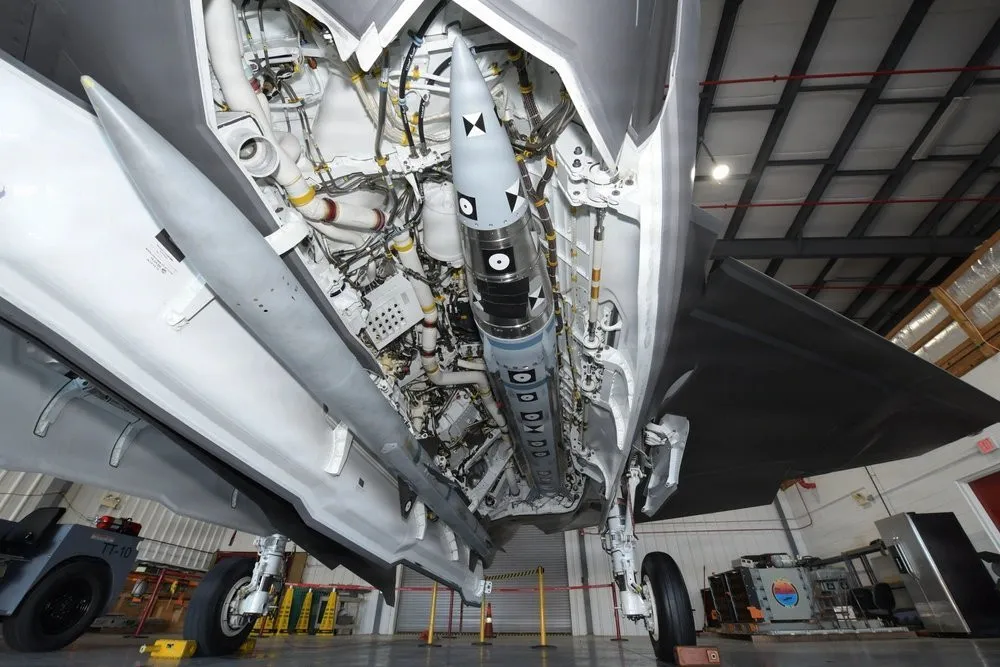
We now have a much better view of the two-seater, which we can compare with the standard single-seat Su-57 already in Russian service. The new aircraft features an elongated cockpit canopy with a steep elevated position for a second crew member behind the pilot. While the definitive role of the new version remains unclear, many observers believe the aircraft represents Sukhoi’s attempt to transform the Felon into a command-and-control platform to operate as part of a future crewed-uncrewed teaming concept, a concept of operations the Felon is already participating in developing.

A good view of the single-seat Su-57 (foreground) and two-seat Su-57D. UAC

The first image emerged through the Fighterbomber Telegram channel, a source closely associated with Russian Aerospace Forces personnel. According to the claims accompanying that first photo, it showed the aircraft during taxi tests, an important stage before any flight trials.

UAC
UAC

The appearance of the twin-seat Su-57D places Russia in a very exclusive club. At present, China is the only other nation publicly associated with a two-seat fifth-generation fighter program through its Chengdu J-20S variant, an aircraft also widely acknowledged to be associated with crewed-uncrewed teaming for the growing family of Chinese uncrewed combat air vehicles (UCAVs) and fighter-like loyal wingman drones.

A composite image that compares the two-seat J-20S with improved single-seat J-20A, and the original single-seat J-20:

The extra crew station could dramatically reduce pilot workload during high-intensity missions involving the control of formations of drones, but also in missions such as electronic warfare and strike coordination. Of course, the aircraft could also be used as a combat trainer.

UAC

The second crew member may eventually direct formations of Sukhoi S-70 Okhotnik-B UCAVs. Russia has already experimented with linking the Okhotnik drone to existing single-seat Su-57 prototypes during previous testing campaigns.

Первый совместный полет БЛА «Охотник» и истребителя Су-57 thumbnail

Первый совместный полет БЛА «Охотник» и истребителя Су-57


The emergence of the aircraft is also intriguing in the context of the abandoned Indo-Russian FGFA program, an effort once intended to create a customized export version of the Su-57 for India. One of New Delhi’s longstanding requests involved a two-seat configuration, but negotiations collapsed years ago amid disagreements over technology transfer, performance concerns, and design priorities. Ironically, the very concept India once sought may now finally be materializing.

UAC

There will be various other changes beyond the cockpit redesign. Accommodating a second seat will likely have required some internal rearrangement involving avionics bays, fuel storage, and mission systems. The changes to the outer mold-line of the jet will also have a negative impact on the aircraft’s low-observability (stealthy) characteristics and performance.

The Su-57 program has long faced a degree of (sometimes unfair) skepticism in the West due to limited production numbers, sanctions pressure, limited combat employment, and persistent questions surrounding the overall level of stealth performance. Nonetheless, Russia continues to push upgrades for the aircraft. In recent years, imagery has also surfaced showing experimental low-observable engine nozzles and revised propulsion systems intended to improve maneuverability and survivability.

UAC

Despite the intrigue surrounding the new imagery, many uncertainties remain. There is still no indication of whether the aircraft is intended primarily for Russian use or export customers, or if the program has any kind of formal Russian state backing. However, a comment on Telegram from Rostec says that the Su-57D “was developed by specialists at UAC on their own initiative.”

The project may be aimed largely at attracting more international buyers for the Su-57, which has so far struggled to find export interest amid intensifying global competition in the stealth fighter market, and Russia’s pariah status since its invasion of Ukraine.

For now, the newly surfaced imagery provides a very interesting glimpse into a previously unknown program. However, the emergence of the two-seat Su-57D at the very least signals a major evolution in Russia’s fighter ambitions.

Contact the author: thomas@thewarzone.com

Thomas is a defense writer and editor with over 20 years of experience covering military aerospace topics and conflicts. He’s written a number of books, edited many more, and has contributed to many of the world’s leading aviation publications. Before joining The War Zone in 2020, he was the editor of AirForces Monthly.


Source link

Sweden Chooses Unusual French Design For Its New Frigates

Sweden has chosen its future surface combatant, the Luleå class, its largest in decades, in the shape of the French FDI frigate. The unusual design, with its inverted bow, won out against rival warships from the United Kingdom (a vessel based on the Type 31 frigate) and Spain (the all-new ALFA 4000 frigate).

The announcement was made today on the deck of the stealthy Visby class corvette Härnösand. The Visby class is currently the largest surface combatant used by the Swedish Navy, but it will be dwarfed by the Luleå class. While the Visby class has a displacement of 705 tons and a length of 238 feet 6 inches, the French design has a displacement of 4,390 tons and is 400 feet 3 inches long.

We are very honoured by the choice of the Swedish Ministry of Defence to select the #FDI to provide the Royal Swedish Navy with 4 latest-generation 1st rank frigates.

We are proud and committed to contributing further to the security of Europe.#StrongerTogether pic.twitter.com/2XqY2fUFqk

— Naval Group (@navalgroup) May 19, 2026

According to reports, the Defense Materiel Administration (FMV), Sweden’s defense procurement organization, chose the French design primarily based on its advanced integrated combat systems and the maturity of the design. As you can read about here, the first example for the French Navy began sea trials in late 2024.

15.09.2025 : Départ de la FDI Amiral Ronarc'h de Lorient thumbnail

15.09.2025 : Départ de la FDI Amiral Ronarc’h de Lorient


Thirdly, Sweden factored the speed of delivery into the equation. This last point reflects the urgency of the requirement, as the country looks to rebuild its naval power since joining NATO and against the resurgent Russian threat.

While Sweden had long been looking for a next-generation warship to follow on from the Visby class, it originally envisaged a more modest design, with four air defense corvettes based on the Visby design. Since then, the Russian full-scale invasion of Ukraine and Sweden’s joining NATO have changed the security landscape dramatically.

An earlier artist’s impression of an unsuccessful, smaller Saab/Babcock offering for the Luleå class design. Saab

When it first pitched its FDI frigate for the program, France had offered to supply Sweden with the first fully equipped warship in 2030, a notably bold timeline. Unlike the rival offers, Naval Group is already building the FDI warships — meaning Frégate de Défense et d’Intervention, or Defense and Intervention Frigate — at its yard in Lorient. Sweden expects to receive one vessel per year starting in 2030.

Despite choosing an off-the-shelf foreign design, there will be industrial benefits for Sweden, with local defense contractors, in particular, Saab, involved in kitting out the warships.

Swedish Prime Minister Ulf Kristersson today heralded the selection of the new warship as “tripling the Swedish [ground- and surface-based] air defenses.” The frigates were always expected to focus heavily on anti-air warfare capabilities, something that’s of growing interest to the Swedish Navy and the importance of which has been underscored by recent conflicts.

Sweden's Minister of Defence Paal Jonson, Sweden's Prime Minister Ulf Kristersson and Sweden's chief of Defence Staff and Supreme Commandant Michael Claesson deliver a press conference aboard the Visby-class corvette HMS Haernoesand in Stockholm, Sweden, on May 19, 2026. Sweden is moving forward with the French Naval Group as the armed forces prepare to acquire their largest and most expensive warships in decades. Sweden is set to purchase four FDI-type frigates. (Photo by Lars SCHRODER / TT News Agency / AFP via Getty Images) / Sweden OUT
Swedish Minister of Defence Pål Jonsson, Swedish Prime Minister Ulf Kristersson, and Swedish Chief of Defence Staff and Supreme Commandant Michael Claesson deliver a press conference aboard the Visby class corvette HMS Haernoesand in Stockholm, Sweden, on May 19, 2026. Photo by Lars SCHRODER / TT News Agency / AFP) / Sweden OUT

For Sweden in particular, a new frigate with enhanced anti-air warfare capabilities will be better able to protect itself, other vessels, and even shore areas or islands, against threats from the air. The overwhelming numbers of crewed aircraft, drones, and missiles that Russia could potentially put up in a conflict involving Sweden have been a significant concern even before the country joined NATO.

The Luleå class will swap out some of the original French combat systems found in the baseline FDI frigate and replace these with locally made equipment.

However, for its critical air defense role, Swedish Minister of Defence Pål Jonsson confirmed that the Luleå class will be armed with two types of missiles from the pan-European MBDA. The first of these is the Aster 30, which, as we have described in the past, is the primary anti-air weapon of the French FDI. In its baseline form, the FDI hull can accommodate 16 Aster missiles in a pair of eight-cell launchers — later vessels will be able to carry 32 by doubling the number of launchers.

A computer-generated image of an Aster 30 launch from the FDI frigate Amiral CabanierFrench Navy

The Aster 30 is able to engage targets at more than 75 miles. Recent improvements to the Aster 30 include enhancing its capabilities against anti-ship ballistic missiles (ASBMs), a relatively new type of threat.

Aster 30 will be complemented by the CAMM-ER, the extended-range version of the Common Anti-air Modular Missile that is being added to the five Visby class corvettes, to expand their anti-air warfare capabilities. The CAMM-ER surface-to-air missile can engage a wide variety of threats out to a range of around 25 miles.

An artist’s impression shows the baseline CAMM being launched from a Visby class corvette. MBDA

In terms of anti-ship missiles, the Swedish boats will carry the locally made RBS 15 instead of the MM40 Exocet on the French ships.

Polish Navy demonstrates the excellence of RBS15 thumbnail

Polish Navy demonstrates the excellence of RBS15


As well as an onboard helicopter, anti-submarine firepower will be entrusted to the Swedish Torped 47 instead of the MU90. This new, lightweight torpedo has recently been tested by the Swedish Navy, being fired from a corvette, and during live-fire exercises from a submarine, as seen in the video below.

Torped 47 - den nya lätta thumbnail

Torped 47 – den nya lätta


With its long track record of naval artillery, Sweden will provide the Bofors 57mm instead of the OTO 76mm, while the Bofors 40 Mk 4 will be used as the close-in weapon system (CIWS) in place of the 21-tube RIM-116 Rolling Airframe Missile (RAM). The Bofors 40 Mk 4 can fire Bofors 3P (Pre-fragmented, Programmable, Proximity-fused) ammunition, which can be programmed in six different modes to provide
optimised effect against different targets, including airbursts against aerial drones.

BAE Systems Bofors 3P Counter UAS ammunition thumbnail

BAE Systems Bofors 3P Counter UAS ammunition


Smaller-caliber guns will be fitted in the form of the Saab Trackfire 12.7mm remote weapon stations (RWS), replacing the Lionfish 20 or Narwhal 20mm.

At this stage, it appears that the French-made SETIS combat management system will be retained on the Swedish warships and not replaced with a local equivalent, such as the Saab 9LV. However, the Sea Giraffe 1X radar, from the same firm, will reportedly be included in the sensor array. This would displace the original Thales Sea Fire radar found in the baseline FDI design and would extend air defense surveillance out to a significant range.

• Bofors 57mm instead of OTO 76mm
• Torped 47 instead of MU90
• RBS15 instead of MM40
• Bofors 40 Mk4 for CIWS instead of 21-tube RAM
• Trackfire 12.7mm RWS instead of LIONFISH 20 or NARWHAL 20mm
• ASTER 30 & CAMM-ER instead of ASTER 30 & 15 https://t.co/IjS0cBGgZ6

— Naval Analyses (@D__Mitch) May 19, 2026

Choosing an existing French design means that Sweden will be able to share some of the costs of the program with other operators. As well as France, Greece is ordering the FDI design, and other potential customers include Sweden’s neighbor, Denmark. At the same time, operating common or very similar warship designs enhances interoperability, especially during joint operations.

The decision also further cements the military relationship between France and Sweden. Welcoming the Swedish choice, President of France Emmanuel Macron today wrote on X that it reflected the burgeoning defense partnership, which has also seen France select the Saab GlobalEye airborne early warning and control (AEW&C) to replace its E-3F Sentry Airborne Warning & Control System (AWACS) fleet, as well as Swedish participation in advanced deterrence. The latter refers to the forward deployment of nuclear-capable French Rafale fighters to Sweden, as European NATO members look at bolstering their deterrence capabilities independent of the United States.

La Suède a fait le choix de la frégate de défense et d’intervention de Naval Group pour moderniser sa marine.

Je remercie la Suède et je mesure la confiance faite à la France.

Après le choix fait par la France de se doter du Global Eye de Saab pour renouveler sa flotte d’avions…

— Emmanuel Macron (@EmmanuelMacron) May 19, 2026

For the Swedish Navy, the primary area of operation has been the Baltic theater, an area of resurgent strategic relevance, as the host to regular and sometimes hostile Russian military activity, maritimeairborne, and also increasingly in the ‘gray zone’ or hybrid warfare.

Once the new Luleå class frigates arrive, starting in 2030, according to plans, the improved capabilities of these powerful vessels will not only bolster Swedish Navy operations in its traditional Baltic area of operations but also out into the wider North Atlantic region, reflecting Sweden’s developing military ambitions as it becomes a more established NATO member.

Contact the author: thomas@thewarzone.com

Thomas is a defense writer and editor with over 20 years of experience covering military aerospace topics and conflicts. He’s written a number of books, edited many more, and has contributed to many of the world’s leading aviation publications. Before joining The War Zone in 2020, he was the editor of AirForces Monthly.


Source link

Flood Sweeps Through Cameroon’s Economic Capital City

Tragic flooding has swept through communities in Douala, Cameroon’s economic capital. On  Monday, May 18, the disastrous incident caused a five-year-old child to drown as heavy torrential rains led to severe flooding in the country’s economic hub. 

The child was swept away in the Banya-Sable area, located in Douala’s 5th district.

“Trapped by the rapidly rising waters, the child was carried off by a strong current. The body was recovered a short time later and taken by the parents to the Ad Lucem hospital, where the death was confirmed,” said Nana Paul Sabin, an eyewitness.

The flooding affected the 5th, 4th, 3rd, and 2nd administrative districts, as well as residential and administrative areas such as Bonapriso and Bonanjo in Douala’s 1st district.

“The floods caused significant disruptions and blockages in traffic, and in certain locations, the water levels rose alarmingly due to drainage issues,” a resident from Douala’s 3rd district stated.

In response, the Douala Urban Council issued a statement urging residents to exercise caution in their daily activities. The council advised individuals in high-risk areas to limit non-essential travel, avoid flood currents, stay clear of unstable structures, and be especially vigilant with children.

“The Douala Urban Council also emphasises the importance of keeping drainage pathways clear and encourages civic responsibility to help preserve lives,” the communiqué read. 

It also noted that technical teams have been deployed to address the aftermath of the heavy rainfall.

“Let us stay alert, united, and responsible,” the statement concluded.

Severe flooding in Douala, Cameroon’s economic capital, resulted in the tragic drowning of a five-year-old. Heavy torrential rains led to significant inundation across multiple districts, causing traffic disruptions and raising concerns over drainage systems.

The Douala Urban Council has advised caution, urging residents to avoid floodwaters and unstable structures, particularly in high-risk areas. Efforts are underway with technical teams addressing the flooding aftermath while emphasizing civic responsibility to maintain drainage paths and enhance safety.

Source link

B-1B’s Future Armament According To Its Test Pilot

In this episode of TWZ: Special Access, Jamie Hunter talks with Lt Col “Evil” Marcus, a B-1B Lancer test pilot assigned to Air Force Reserve Command at Edwards AFB, California, about how the B-1B’s armament is morphing to meet the challenges of facing off against a peer threat. This includes reactivating its external pylons, which have been gone since it lost its nuclear mission decades ago, as well as the introduction of hypersonic missiles to its menu of available weapons options.

Check out the video:

B-1B Lancer's Future Weapons According To Its Test Pilot thumbnail

B-1B Lancer’s Future Weapons According To Its Test Pilot


Contact the editor: Tyler@twz.com

Tyler’s passion is the study of military technology, strategy, and foreign policy and he has fostered a dominant voice on those topics in the defense media space. He was the creator of the hugely popular defense site Foxtrot Alpha before developing The War Zone.


Source link

Flight to Argentina: How significant is it for Israel’s LatAm outreach? | Politics News

Israel and Argentina have launched a direct flight starting in November as the two countries boost their ties under Argentina’s far-right President Javier Milei and Israeli Prime Minister Benjamin Netanyahu.

The twice-a-week flight comes as Israel is aggressively pushing to cement its geopolitical footprint in Latin America amid its growing international isolation and its entrenched image as an occupying power.

Recommended Stories

list of 3 itemsend of list

On May 7, Israel’s national carrier, El Al, opened bookings for a direct flight between Tel Aviv and Buenos Aires covering a distance of 12,000 kilometres (7,460 miles) – the longest route in the airline’s history.

However, the 16.5-hour journey is driven by political ambitions rather than mere commercial viability.

During a celebratory event in occupied East Jerusalem last month, Israeli Prime Minister Netanyahu welcomed Argentina’s Milei to hail the “first direct flight” between the two nations.

The event showcased a striking political alignment, further highlighted by the presence of US Ambassador Mike Huckabee, who jokingly promised to buy the first ticket and described the two leaders as US “President Donald Trump’s biggest friends”.

The route aims to translate the “Isaac Accords” – a Latin American framework inspired by the “Abraham Accords” – into tangible reality. Morocco and Sudan established diplomatic ties with Israel as part of the Abraham Accords signed under President Trump’s first term.

Championed behind the scenes by Rabbi Axel Wahnish, Argentina’s ambassador to Israel, the framework aims to establish strategic cooperation in security, counterterrorism, and artificial intelligence with Latin American nations, including Ecuador, Costa Rica and Paraguay.

Trading tech for legitimacy

Israel is acutely aware that its status as an occupying power, exacerbated by the genocidal war on Gaza, has severely damaged its international standing. To secure recognition and bypass boycotts, particularly from an increasingly critical Europe, Israel is leveraging its advanced military and surveillance technologies.

Ihab Jabarin, an analyst specialising in Israeli affairs, told Al Jazeera that Israel’s strategy has shifted.

“Israel’s moral image has completely eroded,” Jabarin said. “The logic now is: ‘you may not like us, but you need us.’ Israel is offering its expertise in cybersecurity, AI systems like Lavender, border management, and drones – technologies tested on Palestinian bodies and land – to countries grappling with internal conflicts and organised crime,” he told Al Jazeera.

Jabarin noted that Israel uses infrastructure – whether ports, underwater cables, or civilian aviation – as tools for national security and influence. “This flight is not just about transporting passengers; it is a permanent corridor for security and tech businessmen,” he explained.

This strategy of using technology and security to buy diplomatic loyalty mirrors Israel’s approach in Africa. It has forged close ties with Ethiopia, Kenya and Chad. Last December, Israel became the first country in the world to recognise Somaliland, a breakaway region of Somalia.

It has used smaller island states like Micronesia in the Asia Pacific to secure favourable votes at the United Nations and break its international isolation.

“Israel is trying to create a global network of interests that forces countries to weigh their relationship with Israel against their stance on the Palestinian cause,” Jabarin added. “It wants to make the world unable to live without it.”

The Milei-Netanyahu chemistry

The driving force behind this Latin American link is the ideological bond between Netanyahu and Milei. While left-wing leaders in the region, such as Brazil’s Luiz Inacio Lula da Silva, have severed ties or strongly condemned Israel’s actions in Gaza, Milei has embraced the Israeli narrative unconditionally.

For Milei, who declared himself the most Zionist president in the world in March, the alliance offers rapid positioning in the Middle East, closer ties to Washington lobbies, and a stance against Latin America’s traditional left. For Netanyahu, Milei offers unconditional emotional and symbolic support that Israel has largely lost in Europe.

“Netanyahu understands the value of a symbolic ally,” Jabarin said. “He needs leaders who can be marketed as proof that Israel can still forge ideological alliances, not just pragmatic ones. Argentina, under Milei, has become Israel’s most important ‘island of influence’.”

A ‘safe haven’ from war crime probes

The direct flight also serves a highly practical security purpose for Israel. With mounting legal challenges and arrest warrants targeting Israeli soldiers and officials in Europe over alleged war crimes in Gaza, the Tel Aviv-Buenos Aires route offers a crucial bypass.

On Tuesday, Israel’s far-right Finance Minister ⁠Bezalel Smotrich said he was informed that the ⁠International Criminal ⁠Court (ICC) ⁠had ⁠requested a warrant for his arrest. Prime Minister Netanyahu is also sought by the ICC for war crimes committed in Gaza.

Currently, travellers between the two countries rely on 21 to 33-hour transit flights through European hubs like Madrid or Paris.

Diego Ruzzarin, a Brazilian writer and analyst, argued that the project aims to secure hassle-free travel for Israelis, particularly military personnel, sparing them from international security interrogations or the risk of arrest in Europe.

Jabarin echoed this assessment, noting that the fear of legal pursuit in Europe is a significant concern within the Israeli establishment.

“The direct flight bypasses any potential legal harassment in Europe,” he said. “Latin America is now appearing in Israeli calculations as a more politically flexible space compared to rights-focused Europe.”

Economic risks and domestic pushback

Despite its strategic value, the flight faces significant logistical and economic hurdles. Because Israeli planes are banned from the airspace of several African nations, including Libya, the flights must take a costly detour over the Mediterranean and the Atlantic.

To mitigate the economic risks of the long-haul route, the Israeli government has taken the unusual step of granting El Al a 20-million-shekel ($5.4m) subsidy, spread over three years.

The success of the route will heavily depend on Argentina’s Jewish community – the largest in Latin America, estimated at up to 300,000. According to Sabre data, roughly 55,300 people travelled between the two countries in 2025, a 37 percent increase from 2024, but still below the 71,200 recorded in 2019.

The project has sparked domestic criticism in both countries. In Israel, the transport ministry reportedly warned that pulling Boeing 787 Dreamliners from highly profitable US routes to service Buenos Aires could drive up ticket prices for Israelis travelling to North America.

In Argentina, left-wing congresswoman Myriam Bregman accused Milei’s government of dragging the country into an “imperialist war” without congressional approval, warning of a constitutional overreach.

Furthermore, the influx of Israeli tourists, many of whom are recently discharged soldiers, has caused friction in southern Argentina. Local residents and activists have blamed Israeli tourists for devastating fires in the Patagonia nature reserves due to negligence, the most recent being a massive blaze in January 2026 that destroyed 77,000 hectares (190,000 acres) and led to the arrest of an Israeli tourist.

For Israelis, however, an El Al flight to Buenos Aires carries profound historical symbolism. In May 1960, the Mossad used an official El Al flight to smuggle captured former Nazi official Adolf Eichmann out of Argentina to face trial and execution in Israel.

Source link

Why has FIFA not signed a World Cup broadcast deal in India? | World Cup 2026 News

New Delhi, India — When Argentina’s Gonzalo Montiel converted a penalty to seal his country’s third FIFA World Cup title in December 2022 in Qatar, Lionel Messi fan Vishwas Banerjee celebrated the Albiceleste’s triumph with abandon in Bangalore, a football-crazy city in southeastern India.

Unable to hold back his excitement, Banerjee screamed and tossed his shirt away as he watched the match on a big screen at a street crossing close to midnight.

“It was one of the best nights, watching Messi lift the World Cup,” he told Al Jazeera.

“Everyone went crazy. We danced on the streets,” Banerjee said, reminiscing about the excitement felt more than 3,000 kilometres (1,900 miles) away in an otherwise cricket-mad country.

While Messi is expected to make his World Cup swan song at the upcoming tournament in North America, football fans in India, the world’s most populous nation, are set to miss out on watching the biggest sporting event.

With just over three weeks to the tournament’s kickoff in Mexico, organisers FIFA have not found any buyers for broadcasting its most coveted product in India.

Here’s what we know about the World Cup broadcast rights crisis in the South Asian nation:

How many people watch the FIFA World Cup in India?

When the World Cup was played in Qatar nearly four years ago, India trailed only China in overall engagement figures, with more than 745 million fans following the action across all media platforms in the country, according to figures released by FIFA.

In television viewing numbers, India was among the top 10 countries – ahead of World Cup participants Germany, France and England – with nearly 84 million viewers.

Digital viewership numbers were also significant in India. For the final alone, an unprecedented 32 million viewers tuned in on Reliance’s JioCinema – a subscription video-on-demand over-the-top streaming service – as the tournament clocked 40 billion minutes of watch time on the platform.

Reliance’s Jio paid $60m for tournament rights in 2022, while Sony Sports secured broadcasting rights for the 2014 and 2018 FIFA World Cups, as well as the Euro 2016 championship, for around $90m in 2013.

So when FIFA began selling media rights for the 2026 tournament and the 2027 Women’s Cup, it expected plenty of takers for an estimated price of $100m.

But with 23 days until the tournament and the asking price reportedly slashed significantly, FIFA is still struggling to find buyers in one of its biggest markets.

Why are there no buyers for the World Cup 2026 in India?

Experts say the kickoff times for the majority of the matches are the biggest concern for Indian broadcasters.

With the tournament being staged in the United States, Canada and Mexico, many games will be played at odd hours for the Indian audience, with a 10-12 hour time difference between the host cities and the South Asian nation.

Only 14 out of the total 104 World Cup games will begin before midnight for fans in India.

The final will be held in New Jersey on July 19, beginning at 12:30am in India (19:00 GMT). By comparison, 98.4 percent of matches at the 2018 World Cup started before midnight, and 82.5 percent at the following edition in Qatar.

Karan Taurani, executive vice president at investment firm Elara Capital, sees TV as a “struggling” medium in India.

“When you have these kinds of sporting events, effectively it is mostly digital that is monetising and raising big money,” Taurani told Al Jazeera. “That is a big reason why no one’s showing interest in the FIFA World Cup.”

Taurani explained that cricket leads the sports economy market in India.

“Only a small fraction of people who watch the Indian Premier League [IPL] will watch the FIFA World Cup,” he said, adding that an even smaller fraction tune in past midnight to watch a match.

For broadcasters and advertisers, Taurani explained, these factors shrink the target audience.

He also pointed out that a recent ban by the Indian government on fantasy real-money betting apps had reduced the macro form of money in the sports entertainment industry.

The World Cup begins 10 days after cricket’s IPL 2026 final, one of the most-watched sports events in India and one where major prime-time advertisers focus the majority of their annual sports spending.

The price of football streaming in India has been going down anyway. The English Premier League rights, which were sold for $145m for three seasons between 2013 and 2016, went for $65m for 2025-28. There are no major takers for La Liga matches in India.

FIFA appears increasingly concerned that weak broadcaster interest in India could dent both revenues and its long-term ambition to grow football in one of the world’s largest media markets.

Indian supporters of Argentina celebrate after Argentina won FIFA World Cup final match against France in Qatar, in Kolkata, India, Monday, Dec. 19, 2022. (AP Photo/Bikas Das)
Indian supporters of Argentina celebrate after the Argentina vs France World Cup 2022 final as they watch Lionel Messi during the match at a screening in Kolkata, India [File: Bikas Das/AP]

In the capital New Delhi, the high court is hearing a plea on the lack of a tournament broadcast deal and has sought responses from India’s information and broadcasting ministry and Doordarshan, India’s state-owned public television broadcaster.

“Without timely judicial intervention by this court, the petitioner and millions of Indian citizens will be irreparably deprived of their fundamental rights with no adequate alternative remedy,” the petitioner, a lawyer and football fan, has said in the plea.

He claims that missing out on the tournament violates the constitutional protections of freedom of speech.

“It is important to note that by denying access to the information in question or by not taking necessary steps to broadcast the FIFA World Cup, the respondents have directly infringed the petitioner’s fundamental right to acquire and receive information, which is an integral part of freedom of speech and expression under the constitution,” the petitioner argued in the plea.

India
A boy plays next to a mural of Brazil’s footballer Neymar in Kolkata, India [File: Rupak De Chowdhuri/Reuters]

With China’s state broadcaster signing a late World Cup deal with FIFA last week, there’s still hope and time for football fans in India. However, if no deal is signed, all eyes will turn to Doordarshan, which last beamed the tournament in 1998.

The continuing uncertainty is chipping away at the excitement of the football World Cup. “I’m heartbroken that we will not have any reliable way to watch the World Cup this year,” said Banerjee, the Messi fan from Kolkata.

“But we will tune to pirated streams anyway,” he added. “No one can stop that.”

INTERACTIVE-Football FIFA World Cup 2026 group stage schedule-1776670775
(Al Jazeera)

Source link

Death Toll Rises to 118 in Fresh Ebola Outbreak in Eastern DRC

The recent Ebola outbreak in the eastern Democratic Republic of Congo (DRC) has resulted in a rising death toll, reaching 118 fatalities on Monday, May 18, which is a significant jump from the 80 deaths recorded just two days earlier. This outbreak is the 17th recorded Ebola virus epidemic in the DRC and has been described as a matter of international emergency by the World Health Organisation (WHO).

Patrick Muyaya, the DRC government spokesperson, announced that two additional health zones have been identified as impacted by the virus. These include Nyankunde in the Irumu territory of Ituri province. A suspected case has also emerged in Goma, the chief town of North Kivu.

The outbreak is now affecting multiple geographic areas, including Mongwalu, Rwampara, Bunia, Nyankunde in Ituri, as well as Butembo-Katwa and Goma in North Kivu. 

Butembo, a commercial town in North Kivu, was severely impacted during the Ebola Zaire strain outbreak from 2018 to 2020. Goma, which has been under the control of the M23 rebels since early 2025, serves as a significant regional transit hub on the border with Rwanda and Uganda.

The Bundibugyo Ebola strain, noted as the 17th epidemic in the DRC, was declared on May 15. Complete sequencing of the viral genome confirms that it is a genetically distinct variant from previous Bundibugyo outbreaks in 2007 and 2012, originating directly from an animal reserve, according to Jean-Jacques Muyembe, director of the DRC National Institute of Biomedical Research.

On May 17, after the WHO declared the epidemic an international public health emergency, the British organisation Oxfam also estimated that the global number of infections currently stands at 400.

The recent Ebola outbreak in the eastern Democratic Republic of Congo (DRC) has seen a significant rise in fatalities, reaching 118 deaths. It marks the 17th epidemic in the region and has been declared an international emergency by the World Health Organisation.

The outbreak affects several areas, including Nyankunde, Goma, Mongwalu, Rwampara, and Bunia. The outbreak was declared on May 15, involving a genetically distinct Bundibugyo strain.

According to WHO, the global infection count is around 400, indicating a need for coordinated health measures.

Source link

Xi Jinping seeks to strengthen ties with Putin during China visit | Politics

NewsFeed

China’s Xi Jinping is hosting Russian President Vladimir Putin, just days after welcoming Donald Trump to Beijing. The Chinese leader is set to discuss energy security and trade, while balancing access to European markets, as Al Jazeera’s Katrina Yu explains.

Source link

C-5 Galaxies Now Slated To Keep Flying Until 2050 As Readiness Plummets To 37 Percent

The U.S. Air Force says it does not expect the last of its huge C-5M Galaxy cargo planes to be replaced by a Next-Generation Airlift (NGAL) platform until Fiscal Year 2050. This is roughly five years later than the retirement schedule for the C-5M fleet that the service had laid out last year. NGAL is also expected to supplant the C-17A Globemaster III, but the plan is for those aircraft to keep flying through 2075. The C-5s are a vital part of the Air Force’s current strategic airlift force, but they have a long history of being hard to maintain despite major upgrades in the past.

The latest sunset timeline for the Galaxy and details about the near-term plans for NGAL are contained in the Air Force’s 2027 Fiscal Year budget request. The service currently has 52 C-5Ms in its inventory, all of which were upgraded from older B and C variants, the last of which were built in 1989. Service through 2050 means the youngest examples will be 61 years old at the time of their retirement. The Air Force also just recently disclosed that the C-5 fleet’s mission capable rate has slumped to 37 percent. The Air Force also has 222 C-17As, the last of which it acquired in 2013. Neither the C-5 nor the C-17 is still in production today.

A US Air Force C-5M Galaxy, at left, shares the ramp with a C-17A Globemaster III, at right. USAF

The C-5M is the largest airlifter in U.S. military service today, and one of the biggest in operational use anywhere globally. In addition to just being able to accommodate much larger payload mass and volume compared to the C-17A, it has the benefit of being able to load cargo and personnel from the nose and tail ends, and do so simultaneously. The Galaxy offers a unique capability within the U.S. military for moving outsized and unusual payloads by air, including satellites and other space-related items. The services of the C-5 remain in high demand, as highlighted by support provided for ongoing operations against Iran, as well as during the build-up to that conflict, along with other contingencies around the Middle East in the past few years.

“In accordance with [the] Air Force’s strategic direction, C-5 Modernization Efforts funding supports Next-Gen Airlift (NGAL) Analysis of Alternatives (AoA) and Concept Development efforts,” per the service’s Fiscal Year 2027 budget documents. “NGAL is projected to fully replace the C-5M fleet tentatively in FY 2050 and maintain the Strat Air [sic] program floor of 223 C-17 aircraft and 52 C-5 aircraft per the FY 2013 National Defense Authorization Act (NDAA).”

A C-5 somewhere in the Middle East in 2024. USAF

The Air Force is asking for $8.9 million to support the NGAL AoA and related concept development work through the C-5 Modernization Efforts line in Fiscal Year 2027. This is on top of $200,000 in funding received for NGAL in this part of the budget in the 2027 Fiscal Year. The AoA process offers a means to assess potential options and further refine requirements for new weapon systems and other capabilities.

“NGAL efforts will include but [are] not limited to operational analysis, concept development, and acquisition strategy framework to prepare for Milestone A approval and entry into the Technology Maturation and Risk Reduction (TMRR) phase of a major defense acquisition program,” the budget documents further note.

As mentioned, the Air Force released a strategic airlift strategy document last year that envisioned the C-5Ms being replaced by the mid-2040s.

“With an accelerated NGAL Analysis of Alternatives (AoA) in FY27 [Fiscal Year 2027] and an uninterrupted acquisition process with consistent funding, the first NGAL aircraft could be produced as early as FY38,” the Airlift Recapitalization Strategy document, dated November 18, 2025, said. “It is estimated the NGAL program will reach Initial Operational Capability (IOC) in FY41.”

“One NGAL aircraft will replace one C-5M aircraft until the entire C-5M fleet is retired. Then, the C-17A fleet will be replaced by NGAL at a one-for-one swap,” the document added. “Uninterrupted inter-theater airlift capacity is paramount for global operations during fleet recapitalization. Current recapitalization projections require C-5M viability until 2045 and C-17A viability through 2075.”

A trio of Air Force C-5Ms. USAF

“We’re working forward on the NGAL to combine the view of the C-5 and the C-17 fleet, and figure out what the next strategic airlifter needs to be,” Air Force Lt. Gen. Rebecca Sonkiss had also told TWZ and other outlets at a roundtable on the sidelines of the Air & Space Forces Association’s (AFA) annual Warfare Symposium in February. “That conversation in my book can’t happen enough, or can’t happen fast enough, candidly.”

Sonkiss is Deputy Commander of Air Mobility Command (AMC). She has been serving as the interim commander of AMC since her predecessor, Gen. John Lamontagne, became Vice Chief of Staff of the Air Force in January.

As mentioned, the Air Force’s C-5s are key strategic airlift assets, but are also aging and increasingly difficult to sustain. Keeping the Galaxy fleet flying has already presented significant challenges for years now.

A US Army AH-64 Apache attack helicopter is seen tucked away inside a C-5, underscoring the aircraft’s ability to accommodate oversized cargoes and its overall payload capacity. USAF

“I’m a year and a half out of the conversation. The last data point I got was from U.S. Transportation Command (TRANSCOM) commander Gen. [Randall] Reed‘s congressional testimony, where he said that the mission reliability rate, I believe, had fallen to 46%,” retired Air Force Gen. Michael “Mini” Minihan, who last served as commander of AMC, told TWZ in an interview in February. “So, if that’s true, then it’s still an enormous concern. I don’t know any part of your life where you tolerate a critical capability operating less than half the time when you need it. So C-5s are an enormous concern for me.”

At a hearing before the House Appropriations Committee in April, Air Force Chief of Staff Gen. Kenneth S. Wilsbach told members of Congress that the C-5’s mission capable rate had fallen to 37 percent, further underscoring these difficulties.

A C-5 seen stripped of its paint and undergoing heavy maintenance. USAF

“It has to be,” Lt. Gen. Sonkiss had said at the roundtable in February when asked if it was reasonable to expect the C-5 to remain viable even to 2045.

“Define risk. I’m not trying to be pejorative in here, but what risk would you like me to talk about?” she added when asked about the risks this might entail. “There’s a financial risk to having to sustain an older aircraft. And we’ve shown in the Air Force that we’re capable of doing that. The C-5, we’ve invested a lot of money to keep it on board, and it is, and there is no other aircraft that can provide the capacity that the C-5 does.”

“We’ve shown time and time again that when that aircraft [the C-5] is asked to perform, it does. And so we’ll continue to invest,” she continued. “What I would like to see us do, though, is move forward from having to pour that much money into something old to the pathway to a modernized fleet.”

Especially given Sonkiss’ comments here about the C-5’s unique attributes, questions have also already been raised about the viability of a common replacement for that aircraft and the C-17A. The Globemaster III is also an essential and heavily demanded component of the U.S. strategic airlift force today, but is a very different aircraft with its own distinct capabilities. In particular, the C-17 offers significant short and rough field performance that enables it to bring heavy payloads very far forward for an aircraft of its size, even in the absence of improved runways. It was designed from the outset to transport combat-ready ground units, including tanks and other heavy armor, to landing zones at or at least near the front lines, as well as drop paratroopers into those same areas.

Watch This C-17 Making A Gigantic Dust Cloud – Dry Lake Bed Takeoff thumbnail

Watch This C-17 Making A Gigantic Dust Cloud – Dry Lake Bed Takeoff


There is also the matter of an ever-expanding threat ecosystem, which the Air Force expects to include anti-air missiles with ranges of up to 1,000 miles by 2050. This will pose increasing challenges to advanced aircraft, let alone non-stealthy and slower-flying types. Key supporting assets, like airlifters and aerial refueling tankers, would also be top targets during any conflict, and even more so in a high-end fight, such as one against China in the Pacific.

One company, Radia, is actively pitching a new airlifter that is bigger than the C-17 and the C-5, and is being designed with a high degree of operational flexibility in mind, to meet the Air Force’s NGAL needs. Development of that aircraft, called Windrunner, originally started with a focus on carrying oversized components for wind turbines, and its projected range is shorter than that of either the Galaxy or Globemaster III. Overall, Windrunner is still in a very aspirational stage, as you can read more about here.

The world’s largest plane is being built to carry wind turbines thumbnail

The world’s largest plane is being built to carry wind turbines


Lockheed Martin and Boeing, among others, have also been publicly showing various concepts for advanced transports and tankers in recent years. This includes stealthy types and blended wing body designs. A BWB aircraft could also offer a more limited degree of low-observability (stealthiness) together with significant internal payload capacity.

A wind tunnel model of a design concept for an advanced cargo aircraft (or aerial refueling tanker) that the Air Force explored as part of a project called Speed Agile in the late 2000s and early 2010s. USAF
A rendering of the blended wing body demonstrator aircraft now in development for the Air Force. USAF

“I think there are options out there when it comes to large-volume aircraft that exist, that are being worked now, that can help us get capability quickly,” former AMC commander Minihan said in his interview with TWZ earlier this year. “And then I think there are concepts out there, like the commercialization of the C-5 fleet, that need to be taken seriously as well and apply commercial standards, commercial supply chain to increase the readiness of it. And between a combination of those two, I think that you can sustain what America needs to project large volume lift.”

There has also been significant overlap in work on future airlift concepts and potential designs for next-generation aerial refueling tankers, something the Air Force has also been hoping to get into service in the 2040s timeframe. The Air Force’s proposed Fiscal Year 2027 budget shifts work on future aerial refueling capabilities from what had been called the Next Generation Air-refueling System (NGAS) to a new effort dubbed Advanced Tanker Systems.

“We are shifting to what’s called Advanced Tanker Systems,” Air Force Maj. Gen. Frank Verdugo, Deputy Assistant Secretary of the Air Force for Budget, had said during a briefing on the rollout of the service’s latest request last month. “It’s looking to offer more options than just NGAS, and to make sure that our future advanced tanker systems are more resilient and can operate in contested environments.”

What this means for when the Air Force might see a next-generation tanker enter service, and how that might factor into NGAL, is unclear. The service’s current aerial refueling plans include more purchases of KC-46s in the coming years, which will increase the total objective fleet size. Older KC-135s are still expected to remain in service for years to come.

The Air Force’s future airlift strategy also clearly has yet to fully solidify, with the C-5s now set to remain in service into Fiscal Year 2050.

Contact the author: joe@twz.com

Joseph has been a member of The War Zone team since early 2017. Prior to that, he was an Associate Editor at War Is Boring, and his byline has appeared in other publications, including Small Arms Review, Small Arms Defense Journal, Reuters, We Are the Mighty, and Task & Purpose.


Source link

MQ-9 Reaper Fires Laser-Guided Rockets In Tests

The MQ-9 Reaper has become the latest platform to test-fire laser-guided 70mm Advanced Precision Kill Weapon System (APKWS) rockets. The trials, conducted with the U.S. Air Force, involved an MQ-9 employing the APKWS in its original air-to-ground capacity, as well as against aerial targets. While giving MQ-9’s standard APKWS capability against ground targets seems relatively straight forward, putting the air-to-air optimized variant of the rocket on the MQ-9 would open up another option for the counter-uncrewed air system (C-UAS) mission, which has only gained in importance since the war with Iran.

General Atomics Aeronautical Systems, Inc. (GA-ASI), the manufacturer of the MQ-9, confirmed today that it had conducted recent flight tests of an Air Force MQ-9A armed with APKWS at the Nevada Test and Training Range (NTTR).

The MQ-9 Reaper flies a training mission over the Nevada Test and Training Range, Jan. 14, 2020. The 432nd Wing/432nd Air Expeditionary Wing flies local sorties at Creech Air Force Base, Nevada to prepare aircrew for launch and recovery roles overseas. (U.S. Air Force photo by Airman 1st Class William Rio Rosado)
An Air Force MQ-9 Reaper flies a training mission over the Nevada Test and Training Range, January 14, 2020. U.S. Air Force photo by Airman 1st Class William Rio Rosado Staff Sgt. William Rosado

According to the company, “the demonstration featured multiple types and variations of shot profiles, including aerial targets. All shots were executed flawlessly by the MQ-9A crews using laser-guided rockets and a specialized launcher.”

The utility of APKWS against ground targets for the MQ-9 family of drones is abundantly clear. It provides an extremely precise, relatively low-collateral option that can also drastically expand the drone’s magazine depth. Standard APKWS can be used against a large number of ground and surface targets, from lightly armored vehicles to troops under shallow cover.

Redefining Precision with the APKWS® Laser-Guided Rocket thumbnail

Redefining Precision with the APKWS® Laser-Guided Rocket


Then there is the air-to-air application. In U.S. military service, the laser-guided air-to-air rocket is known as AGR-20F, a variant of the APKWS II, specifically, also known as the Fixed Wing, Air Launched, Counter-Unmanned Aircraft Systems Ordnance (FALCO). In its press release, GA-ASI refers to the rocket simply as APKWS. FALCO includes the modified laser-guidance and control section and a proximity fuze that is ideal for taking down smaller aerial targets. FALCO-equipped rockets can also be used against soft ground targets, like standard vehicles and fast boats.

A U.S. Army Soldier assigned to the 12th Combat Aviation Brigade load an Advanced Precision Kill Weapon System (APKWS) training round for a live-fire exercise, Sept. 23, 2021, Grafenwoehr Training Area, Germany. The APKWS is the newest laser-guided rocket system utilized by the 12th CAB stationed throughout Europe. (U.S. Army photo by Pfc. Jesus Menchaca)
A U.S. Army soldier loads an Advanced Precision Kill Weapon System (APKWS) training round for a live-fire exercise at the Grafenwoehr Training Area, Germany, on September 23, 2021. U.S. Army photo by Pfc. Jesus Menchaca Cpl. Jesus Menchaca

The test campaign was, in part, a response to “real-time technological adaptation requirements,” GA-ASI explained. The urgent need for C-UAS capabilities saw the trials accelerated, reducing the time between planning, integration, and flight test.

“We recognize the value that a system like APKWS brings to the MQ-9 aircraft as a tool to counter one-way attack drones,” said GA-ASI President David R. Alexander. “APKWS can increase the number of weapons the MQ-9A is able to carry, as well as being able to carry new, lower-cost weapons. More than anything, this integration effort underscores how government and industry can collaborate to rapidly test and make new capabilities available to warfighters.”

Exactly how many APKWS a single MQ-9 can carry is unclear, but the standard pods used for these weapons are loaded with seven rounds, as seen loaded on the MQ-9A involved in the live-fire trials. Nineteen-round rocket pods are also a possibility. The MQ-9 in its standard configuration has seven hardpoints, with six main underwing pylons usually utilized for weapons.

A Mojave STOL drone depicted carrying a load of laser-guided rockets in 19-round pods. General Atomics capture

The potential of the MQ-9, or MQ-9 variants, to carry APKWS for the C-UAS role is something that GA-ASI brought up last month.

In particular, the Mojave short takeoff and landing (STOL) drone was earmarked for C-UAS, as part of a broader mission scope for the aircraft.

“We’ve shown APKWS mounted to Mojave in a static display at some of the recent U.S. Army shows where Mojave STOL was present,” General Atomics spokesperson C. Mark Brinkley told TWZ in April. “Integrating new weapons is a multi-part process. Fit tests, weight considerations, captive carry for airworthiness, software, [and] actual live-fire.”

“For Mojave STOL and other GA-ASI aircraft, we’re inside that process now with APKWS,” he added. “It’s flying and firing soon, [in] weeks, not months.”

Meanwhile, GA-ASI presented a CGI video showing the Mojave STOL undertaking the rocket-armed drone-hunter mission “somewhere in the Western Pacific.” In this scenario, the Mojave STOL used an EagleEye multi-mode radar, as well as its infrared sensor in the turret under its nose, to spot and track a pair of kamikaze drones clearly modeled on the Iranian-designed Shahed-136 pattern.

Mojave STOL: Real. Rugged. Ready Today. thumbnail

Mojave STOL: Real. Rugged. Ready Today.


The drone is then depicted warning a forward U.S. outpost about incoming uncrewed aerial threats through a satellite link. From a ruggedized laptop on the ground, an operator directs that the kamikaze drones be neutralized. A Mojave equipped with two 19-shot rocket pods then moves in and destroys them. The aircraft is later shown being rearmed at a very austere jungle airstrip.

The incoming Shahed-136-like kamikaze drones seen in the recent Mojave STOL video. General Atomics capture

It is noteworthy that, prior to APKWS, MQ-9s and related drones have demonstrated, during testing, their ability to destroy airborne targets using various other weapons, including AIM-9X and Hellfire missiles.

Meanwhile, APKWS has emerged as an increasingly popular choice in the air-to-air C-UAS role since U.S. Air Force F-16s began employing the rockets this way in combat against Houthi drones in 2024. TWZ was first to report on this development. The total number of U.S. military and foreign aircraft platforms cleared to use a variant of the rocket specifically optimized for air-to-air use continues to grow.

There are advantages and disadvantages to using a drone like the MQ-9 or Mojave STOL as a drone-hunter.

Drones of this kind have questionable survivability in high-end operations. The latest conflict with Iran has underscored the vulnerability of the Reaper, in particular.

On the other hand, TWZ has previously highlighted how a drone like the Mojave could be used to provide more localized force protection, including against uncrewed aerial threats, at forward outposts and rear areas in the context of a larger conflict.

The attributes of the Mojave STOL — including its short- and rough-field capabilities — make it especially relevant for a future conflict in the Pacific. Here, it would be able to push its C-UAS and other capabilities far forward, including to island outposts. As for the MQ-9, as used in the live-fire trials, this aircraft is not rough-field-optimized like the Mojave STOL, but can still operate from forward areas with semi-prepared airstrips.

A Mojave STOL drone arrives at a jungle airstrip with cargo in pods under its wings. General Atomics capture

At the same time, the capabilities inherent in the Mojave STOL mean it can also operate from aircraft carriers and big-deck assault ships, opening up the possibility of rocket-armed examples setting up counter-drone screens in maritime scenarios.

When it comes to the air-to-air APKWS, this weapon is well-suited to slower-flying and less dynamic targets. Compared to traditional air-to-air missiles, it comes with a much lower cost-per-engagement and offers greater magazine depth, as you can read about here.

In terms of finding targets, drones like the MQ-9 and Mojave STOL have limited situational awareness compared to traditional air-to-air platforms. They can be fitted with onboard radar with air-to-air modes, which could serve as a primary detection sensor. So, too, could infrared search and track (IRST) sensors, which have been tested extensively on other GA-ASI drones. Thereafter, the MQ-9’s MTS electro-optical/infrared (EO/IR) turret would provide target ID and engagement functions. Taking advantage of tactical networks could also provide the drone with critical initial telemetry to aid in the IR/EO sensor’s lock-up.

A General Atomics Avenger drone carrying a Lockheed Martin Legion IRST pod during a flight test. GA-ASI

It’s also worth noting that drones like the MQ-9 or Mojave STOL are not anywhere near as quick to respond to incoming drone threats, and especially run down multiple incoming hostiles in a short period of time, as fighters. On the other hand, they are able to loiter for far longer at a fraction of the cost, providing resilient combat air patrols. They could also perform strike and intelligence, surveillance, and reconnaissance (ISR) support while on station.

For its part, the MQ-9 offers these capabilities coupled with a higher performance and a more extreme endurance over the Mojave STOL. With hundreds of MQ-9s available, many could be armed with APKWS and tasked to provide anti-drone screening against lower-volume raids across large areas.

The Mojave STOL demonstrator was seen previously with Minigun pods and other stores under its wings. General Atomics

Indeed, it could be well imagined how APKWS-armed MQ-9s could have played a valuable role in this context during the conflict with Iran earlier this year, protecting allied Arab gulf states and U.S. installations from incoming one-way attack munitions. An MQ-9 picket line of sorts could have been set up over the Gulf, for instance, thinning incoming drones waves. Or these aircraft could have been perched to the east of major bases, providing a final airborne layer counter-drone defense.

With the MQ-9 and the related MQ-1C Gray Eagle being widely operated by the U.S. military and a number of export customers, the ability to transform these aircraft into rocket-armed drone hunters could be of high interest indeed.

Contact the author: thomas@thewarzone.com

Thomas is a defense writer and editor with over 20 years of experience covering military aerospace topics and conflicts. He’s written a number of books, edited many more, and has contributed to many of the world’s leading aviation publications. Before joining The War Zone in 2020, he was the editor of AirForces Monthly.


Tyler’s passion is the study of military technology, strategy, and foreign policy and he has fostered a dominant voice on those topics in the defense media space. He was the creator of the hugely popular defense site Foxtrot Alpha before developing The War Zone.


Source link

Iran Demands Reparations and United States Troop Withdrawal in New Peace Proposal

Iran has publicly outlined key elements of its latest peace proposal to the United States, demanding reparations for war damage, the withdrawal of United States forces from areas near Iran, and the lifting of economic sanctions as part of any broader agreement.

According to comments from Iranian Deputy Foreign Minister Kazem Gharibabadi, the proposal also calls for the release of frozen Iranian assets, an end to restrictions affecting Iranian trade and shipping, and a halt to hostilities across regional conflict zones including Lebanon.

The proposal emerged after United States President Donald Trump announced that he had paused a planned military strike against Iran to allow additional time for negotiations regarding Tehran’s nuclear programme and regional security issues.

Iran Pushes for Broader Regional Settlement

Tehran’s proposal reflects an effort to expand negotiations beyond nuclear issues into wider geopolitical and security concerns across the Middle East.

Iran appears to be seeking a comprehensive arrangement that addresses not only sanctions and military pressure but also the broader regional balance of power involving Lebanon, the Gulf region, and United States military deployments.

The demand for reparations is particularly significant because it frames the recent conflict as an act requiring compensation for damage caused by joint United States and Israeli military operations.

Iranian officials also continue insisting that economic sanctions and frozen overseas assets remain central obstacles to any sustainable agreement.

United States Signals Openness but Maintains Pressure

Trump stated that there was a strong possibility of reaching a deal that would prevent Iran from obtaining nuclear weapons while avoiding renewed military escalation.

However, Washington has not publicly confirmed any major concessions in negotiations. Reports suggesting the United States may release a portion of frozen Iranian funds or allow limited peaceful nuclear activity under international supervision remain unverified by American officials.

At the same time, United States officials continue denying claims that sanctions on Iranian oil exports would be fully waived during negotiations.

The situation reflects a complex diplomatic balancing act in which Washington seeks to maintain leverage while preventing a wider regional conflict that could destabilise global energy markets and military alliances.

Regional Powers Push for De Escalation

Regional governments including Qatar, Saudi Arabia, and United Arab Emirates reportedly urged Trump to delay military action in hopes that negotiations could succeed.

The involvement of regional mediators highlights growing concern across the Gulf about the economic and security consequences of another large scale conflict involving Iran.

The Strait of Hormuz remains especially important because it serves as one of the world’s most critical shipping routes for oil and energy exports. Any escalation threatening maritime trade could have severe consequences for global energy prices and economic stability.

Meanwhile, Pakistan has reportedly continued acting as a communication channel between Tehran and Washington after previously hosting peace talks between the two sides.

Ongoing Tensions Despite Ceasefire

Although a ceasefire has largely held since the suspension of major hostilities earlier this year, tensions remain extremely high across the region.

Iran and its regional allies continue facing accusations of supporting drone activity and proxy operations targeting Gulf states and Israeli interests. At the same time, Iran maintains that it has survived military pressure without abandoning its nuclear capabilities, missile programmes, or regional alliances.

Israeli Prime Minister Benjamin Netanyahu and Trump previously justified military operations as necessary to weaken Iran’s nuclear programme and reduce its influence through allied militias across the Middle East.

However, analysts note that Iran still retains significant strategic capabilities despite extensive military strikes and economic sanctions.

Analysis

Iran’s latest proposal demonstrates that Tehran is attempting to negotiate from a position of resilience rather than surrender.

By demanding reparations, sanctions relief, and troop withdrawals, Iran is signalling that it expects recognition of its regional influence and strategic endurance despite months of conflict and economic pressure. The proposal also reflects Tehran’s broader objective of reducing the long term military presence of the United States near its borders.

For Washington, the negotiations present a difficult challenge. The United States wants to prevent Iran from advancing toward nuclear weapons capability while avoiding another prolonged regional war that could damage global markets, strain military resources, and increase political pressure at home.

The talks are also shaped by wider geopolitical realities. Gulf states increasingly prioritise regional stability and economic security, making them more supportive of diplomacy than direct military confrontation. Rising energy prices and fears of shipping disruptions further increase international pressure for a negotiated outcome.

At the same time, deep mistrust continues to define relations between both sides. The United States remains sceptical of Iran’s regional ambitions, while Tehran sees sanctions and military deployments as tools of long term containment.

Ultimately, the negotiations reveal a broader struggle over the future balance of power in the Middle East. Even if temporary agreements are reached, the underlying strategic rivalry between Iran, the United States, and Israel is unlikely to disappear in the near future.

With information from Reuters.

Source link

Los Angeles World Cup stadium workers threaten strike over ICE deployment | World Cup 2026 News

Workers represented by a local union say ICE presence would create a climate of fear during the FIFA World Cup 2026.

Workers at the SoFi Stadium in Los Angeles have decided to go on strike if federal immigration enforcement agents are deployed at the venue when it hosts FIFA World Cup matches in June and July.

The UNITE HERE Local 11 – a labour union representing some 2,000 hospitality employees – on Monday demanded federal guarantees that Immigration and Customs Enforcement (ICE) would not be used during the matches scheduled at the stadium.

The venue, which will be known as the Los Angeles Stadium during the tournament, will host eight World Cup games, including the opening fixture for the United States on June 12.

Workers at the world’s most expensive sports arena say the ICE presence would create a climate of fear for themselves and for fans.

“ICE should have no role in these games,” said Isaac Martinez, a stadium cook, at a protest outside the venue.

“We do not want to live in fear coming to work, or fear being detained going home.”

“If we do not reach an agreement, my colleagues and I are ready to strike,” Martinez added, speaking on behalf of a workforce composed largely of food and beverage concession staff.

SoFi Stadium workers, belonging to union Local 11, picket outside of the FIFA Los Angeles World Cup 2026 Host Committee headquarters on May Day, Friday, May 1, 2026, in Los Angeles. (AP Photo/Jae C. Hong)
SoFi Stadium workers protest in Los Angeles on May Day [Jae C Hong/AP]

ICE has led the charge in President Donald Trump’s immigration crackdown.

Human rights groups have condemned the agency for its conduct during raids in several US cities, including Los Angeles last year.

In early 2026, ICE agents fatally shot two American protesters in Minneapolis.

Workers on Monday also raised alarms over FIFA’s accreditation process, which requires employees to submit personal data before the tournament, which runs from June 11 to July 19 across the US, Canada and Mexico.

“We ask FIFA not to share our information with ICE agencies, foreign countries, or intelligence services,” worker Yolanda Fierro said.

Protesters carrying plastic balls and signs reading “Kick ICE Out of the World Cup” drew support from Tom Steyer, a Democratic candidate in California’s gubernatorial race.

ICE’s mandate is border control, the financier-turned-politician said.

“Can anyone explain what that has to do with the World Cup? Nothing,” Steyer said.

“How is it possible that this is the agency that is going to be here when we know in fact they’re an absolute threat, a lawless threat, to workers in California?”

Source link

Wembanyama scores 41 as Spurs upset Thunder in Game 1 thriller | Basketball

Victor Wembanyama outduelled Shai Gilgeous-Alexander to lead the San Antonio Spurs to an epic 122-115 double-overtime triumph over the Oklahoma City Thunder in game one of the NBA Western Conference finals.

Wembanyama scored 41 points and pulled down 24 rebounds in the thrilling game on Monday. He forced the second overtime with a dazzling three-pointer and delivered nine of the Spurs’ 14 points in the second overtime as San Antonio handed the defending champions their first defeat of these playoffs.

“It was, like, sheer willpower,” 22-year-old Wembanyama told broadcaster NBC after the game.

The French star played 49 minutes, producing a pair of dunks and a crucial block late in the second overtime to seal the victory.

With the triumph at Oklahoma City’s Paycom Center, the Spurs stole home-court advantage in the best-of-seven series that will send the winners to the NBA Finals.

OKLAHOMA CITY, OK - MAY 18: Stephon Castle #5 and Victor Wembanyama #1 of the San Antonio Spurs celebrate after the game against the Oklahoma City Thunder during Game One of the NBA Western Conference Finals on May 18, 2026 at Paycom Center in Oklahoma City, Oklahoma. NOTE TO USER: User expressly acknowledges and agrees that, by downloading and or using this photograph, User is consenting to the terms and conditions of the Getty Images License Agreement. Mandatory Copyright Notice: Copyright 2026 NBAE Jesse D. Garrabrant/NBAE via Getty Images/AFP (Photo by Jesse D. Garrabrant / NBAE / Getty Images / Getty Images via AFP)
Stephon Castle and Victor Wembanyama celebrate after the game [Jesse D Garrabrant/Getty Images via AFP]

Gilgeous-Alexander’s MVP motivates Wembanyama

Wembanyama admitted the sight of Thunder star Gilgeous-Alexander receiving his second straight Most Valuable Player trophy before the game made the clash more personal “for sure”.

He earned Defensive Player of the Year honours but finished third in the MVP voting announced on Sunday.

Spurs coach Mitch Johnson said the sight of Gilgeous-Alexander lifting the MVP award “100 percent” motivated his star.

“He’s competitive,” Johnson said. “If you’re a competitor and you see another competitor get rewarded with what you want.”

But Wembanyama said the main message of the night was that the young Spurs “are ready to go in any environment, in any place, against anybody”.

“And even though we’ve still got a lot to learn, our effort should be over anybody else’s and tonight we were relentless.”

Rookie Dylan Harper, starting in place of injured De’Aaron Fox, scored 24 points and snagged seven steals for San Antonio. Stephon Castle added 17 points and 11 assists as the Spurs extended their season dominance of the Thunder.

Oklahoma City, trying to become the first team to repeat as champions since Golden State in 2017 and 2018, piled up a league-best 64 regular-season wins but dropped four of five contests against the Spurs, who won 62 regular-season games to return to the playoffs for the first time since 2019.

Gilgeous-Alexander was limited to 24 points, shaking off a sluggish start to key the Thunder’s bid to rally from a 10-point fourth-quarter deficit.

OKLAHOMA CITY, OK - MAY 18: Shai Gilgeous-Alexander #2 of the Oklahoma City Thunder shoots the ball during the game against the San Antonio Spurs during the Western Conference Finals of the 2026 NBA Playoffs on May 18 2026 at Paycom Center in Oklahoma City, Oklahoma. NOTE TO USER: User expressly acknowledges and agrees that, by downloading and or using this photograph, User is consenting to the terms and conditions of the Getty Images License Agreement. Mandatory Copyright Notice: Copyright 2026 NBAE Morgan Givens/NBAE via Getty Images/AFP (Photo by Morgan Givens / NBAE / Getty Images / Getty Images via AFP)
Shai Gilgeous-Alexander scored 24 points for the Oklahoma City Thunder [Morgan Givens/Getty Images via AFP]

‘Wasn’t able to bring my best game’

Alex Caruso scored 31 points to lead the Thunder and Jalen Williams returned from a six-game injury absence to score 26.

Oklahoma City trailed by 10 in the fourth quarter, but the Thunder clawed back, and it was knotted at 99-99 with 33.2 seconds left when Wembanyama spun in for a basket that put San Antonio up 101-99.

Gilgeous-Alexander then tied it up with a layup and Chet Holmgren blocked Wembanyama’s potential game-winner at the buzzer.

Gilgeous-Alexander’s dunk put the Thunder up 108-105 with 57.6 seconds left in the first overtime.

But Wembanyama drilled a transition three-pointer to tie it, and they went to the second extra session.

“I know what my teammates are capable of, what we’re capable of as a team when we bring it,” Gilgeous-Alexander said. “It’s just unfortunate I wasn’t able to bring my best game tonight.

“But that’s how it goes sometimes … you’ve got to roll with the punches, don’t get discouraged and stay true to who you are.”

The Thunder, who swept the Phoenix Suns and LeBron James’s Los Angeles Lakers in the first two rounds, will try to bounce back when they host game two on Wednesday before the series shifts to San Antonio for games three and four on Friday and Saturday.

The series winners will face either the New York Knicks or the Cleveland Cavaliers in the NBA Finals.

Source link

A Rising China, an Established America, and the Thucydides Trap

When the ancient Greek historian Thucydides chronicled the Peloponnesian War, he did not write only about the clash between Athens and Sparta. He documented the fate of the small city-states caught between them in 431BC. Corcyra and Potidaea, neutral territories with no grand strategy of their own, were crushed, annexed, or forced into allegiance as the two great powers dragged the entire Greek world into conflict.

Thucydides famously wrote that it was the rise of Athens and the fear that this instilled in Sparta that made war inevitable. Yet for the smaller states, there was no trap to escape. There was only destruction when great powers fought. This forgotten truth frames the most dangerous bilateral relationship on earth today.

When President Xi Jinping invoked the Thucydides Trap during his May 2026 summit with President Donald Trump in Beijing, he framed it as a question between two great powers asking whether China and the US can rise above the so-called Thucydides Trap and create a new framework for major-power relations. The concept was popularized by Harvard political scientist Graham Allison, who identified sixteen historical cases over the past five hundred years where a rising power challenged an established one, with twelve ending in war. Allison’s framework casts China as the rising Athens and the US as the established Sparta. It centers on whether these two great powers can avoid destroying each other, while leaving less examined what happens to the smaller states caught in between. At the summit, President Xi warned that if mishandled the two countries could clash or even enter into conflict, leading the entire China-US relationship into a highly dangerous scenario. He emphasized that the Taiwan issue is the most critical matter in their bilateral relation, implicitly acknowledging that miscalculation could materialize the very trap he warned against.

The competition between the US and China has grown far beyond trade into something that locks other countries into its orbit. What started as a tariff dispute has become overlapping conflicts across technology, finance, energy, and data governance, each one reinforcing the others and closing off neutral ground. This creates a situation close to a legal Catch-22 where China’s Ministry of Commerce used its blocking statute for the first time in May 2026 against US sanctions and put multinational companies in a position where following Washington’s extraterritorial rules meant breaking Beijing’s laws and following Beijing’s rules meant breaking Washington’s. This is not a byproduct of the competition but is becoming the competition itself.

US bans on advanced semiconductors and AI chips combined with Chinese limits on gallium, germanium, and rare earths along with rival payment systems like China’s Cross-Border Interbank Payment System (CIPS), which provides cross-border payment services to more than 5,000 banking institutions across 190 countries and regions as an alternative to Western banking rails and clashing visions of internet sovereignty have built up into a tightly connected system where doing business globally increasingly means either choosing a side or paying escalating costs for staying neutral, with the heaviest pressure in tech and finance while other domains retain more space for hedging. These costs hit hardest not the US or China but the countries and firms that have no power over either. China-US trade, technology, and regulatory pressures have repeatedly spilled over into third countries, and Southeast Asia has often been caught in the middle. Vietnam has faced US scrutiny over goods assembled with Chinese-linked inputs, Cambodia experienced significant trade diversion during the 2018 US-China trade war, Malaysia came under pressure to tighten controls on semiconductor shipments, and Singapore has had to navigate the compliance burdens created by competing US and Chinese rules.

More broadly, small states across the globe must navigate between two major powers, leaning toward China for economic reasons and toward the US for security reasons. ASEAN has long relied on non-alignment and hedging to preserve, and of course expand, room to maneuver if possible, but intensifying US-China competition is narrowing that room. Some states have turned rivalry into opportunity. Vietnam has attracted manufacturing shifts and foreign investment as companies diversify supply chains away from China. India, Gulf states, and others actively play both sides or carve strategic niches, extracting economic benefits while maintaining security partnerships. Yet these adaptive strategies have limits, and the space for maneuvering narrows as competition intensifies, leaving smaller states with growing pressure, higher compliance costs, and reduced autonomy.

The relationship between China and the US remains the world’s most dangerous bilateral relationship not because President Xi and President Trump might make war on each other but because small countries worldwide will be the first casualties when that war comes or even when competition intensifies. The real Thucydides Trap is not whether America and China can avoid war with each other but whether small states can survive the rivalry even if both of them somehow manage peaceful coexistence. As fence sitting becomes tense and the legal arms race traps countries in impossible dilemmas, more countries face choices that progressively erode the strategic autonomy they have long relied on. Thucydides wrote about the Peloponnesian War with eyes on all participants including the allies of Athens and Sparta who became victims of the trap. The lesson from ancient Greece is very clear that when great powers fight the weak do not survive, and the stories of Corcyra and Potidaea matter just as much as the struggle between Athens and Sparta.

When Athens and Sparta finally went to war, the first thing that died was the freedom of everyone caught between them. The US and China may or may not escape their trap but regional powers, developing nations, and many other small countries already know themselves to be inside it.

Source link

A packed race for governor: What to know about Oregon’s primary elections | Elections News

In the northwest corner of the United States, Oregon has fostered a reputation as a left-wing stronghold. Since the 1980s, the Beaver State has consistently elected Democrats in most of its statewide races.

But even in a comfortably blue state like Oregon, the fight to hold onto political power can be competitive.

Recommended Stories

list of 3 itemsend of list

On Tuesday, the state will hold its latest primary races, with each of the major parties picking its nominees for November’s midterm elections.

But a packed field of roughly 25 contenders, both Democrats and Republicans, is jockeying to replace Tina Kotek as she seeks a second term as governor.

Tuesday’s vote could also serve as an economic bellwether. Voters will weigh in on a referendum that could repeal a state fuel tax, as the US-Israel war on Iran heaps strain on consumers at the gas pump.

Who is running? And which races have attracted the most attention? We tackle those questions and more in this brief explainer.

What time do polls open?

Polls will open on Tuesday at 7am Pacific US time (15:00 GMT) and close at 8pm (4:00 GMT).

Governor of Oregon Tina Kotek speaks during a press conference after U.S. federal agents shot two people in Portland, Oregon, U.S., January 8, 2026. REUTERS/John Rudoff
Oregon Governor Tina Kotek is seeking re-election in 2026 [File: John Rudoff/Reuters]

Who is running for governor?

Incumbent Governor Kotek is making a bid for a second four-year term. But she is fielding competition from dozens of other candidates, including nine Democrats.

Going into the Democratic primary, Kotek is the frontrunner. Her challengers include a children’s book author, the leader of an Indigenous nonprofit and an inventor who hopes to address water shortages.

Even more contenders are angling for the Republican gubernatorial nomination.

Among them is State Senator Christine Drazan, who ran against Kotek in 2022. Drazan has been critical of President Donald Trump’s tariff policies but supportive of his tough stance on immigration.

Also on the Republican ballot is former NBA player Chris Dudley, who was the Republican gubernatorial candidate in 2010. He had the smallest losing margin of any Republican candidate in decades.

State Representative Ed Diehl, meanwhile, is hoping to capitalise on the momentum he gained after leading the charge to block Kotek’s gas tax and fee increase package.

What are the opinion polls saying about the governor’s race?

Polls show Drazan leading the race to receive the Republican nomination, with 35 percent support.

Kotek is likely to grab an easy victory in the Democratic primary, with none of her opponents polling close behind.

What about the Senate race?

Another Democratic incumbent attempting to hold onto his seat is US Senator Jeff Merkley.

The 69-year-old, who began his career working on affordable housing, is running for a fourth consecutive six-year term. He first took office in 2009.

But while the senator faces eight rivals on the campaign trail – one Democrat and seven Republicans – his seat is considered relatively safe.

He is expected to win the Democratic primary on Tuesday and become the frontrunner for November’s general election.

Senator Jeff Merkley (D-OR) speaks as Senate Democrat leaders hold a press conference following their weekly policy lunch on Capitol Hill in Washington, D.C., U.S., April 21, 2026. REUTERS/Annabelle Gordon
Jeff Merkley is defending what is considered a safe seat for Democrats in the US Senate [File: Annabelle Gordon/Reuters]

What other positions are up for grabs?

All six of Oregon’s members of the US House of Representatives are running for re-election and will face the primary process on Tuesday.

Five are Democrats. One, Cliff Bentz, is a Republican, and he represents Oregon’s second congressional district, a sprawling area encompassing the entire eastern half of the state.

Also on Tuesday, voters will choose their party representatives in races for the state Senate and House.

The election will also determine a nonpartisan commissioner to lead the state Bureau of Labor and Industries.

Why does this race matter?

Oregon is a closed primary state, meaning that voters choose nominees only for the party they are registered under.

Given the state’s left-wing bent, the winners of the statewide Democratic primaries will likely emerge as frontrunners in November’s midterm races.

Still, there is room for surprise. According to state voter rolls, less than 25 percent of Oregonians are registered Republicans. But only 32 percent are registered Democrats, with the largest proportion of voters identifying as “non-affiliated” with any party.

Primary races in right-leaning areas like Oregon’s second congressional district could signify how closely the state’s Republican politicians want to align with President Trump.

Voters will also have a chance to vote on the referendum that could repeal the gas tax increase on Tuesday’s ballot.

Democrats in the state legislature raised Oregon’s gas tax to pay for roads and supplement the state’s transportation budget.

But as the US-Israel war on Iran causes gas prices to skyrocket, Republicans have used the referendum to appeal to voters on the cost of living. Gas is now averaging about 80 cents more in Oregon.

In addition, there are nearly 100 local measures sprinkled on ballots across the state, tailored to different counties. Many will focus on funding local fire departments, schools and libraries.

When are results expected?

Preliminary results are expected on Tuesday evening, shortly after polls close at 8pm local time.

But ballots will continue to arrive after election day, as mail-in votes and provisional ballots are counted, and some races may not be officially called until days later.

Source link

Venezuela ‘Deports’ Former Minister, Diplomatic Envoy Alex Saab to US

Maduro alongside Saab following the latter’s release in December 2023. (AFP)

Caracas, May 17, 2026 (venezuelanalysis.com) – The Venezuelan government turned over former minister and diplomatic envoy Alex Saab to the US to face charges on Saturday.

The executive led by Acting President Delcy Rodríguez announced the “deportation of Colombian citizen Alex Saab Morán” through a statement issued by the Administrative Service for Identification, Migration, and Immigration (SAIME).

The statement said the measure was adopted “taking into consideration that [Saab] is implicated in various crimes in the United States of America, as is publicly known and widely reported.”

According to local media reports, Saab was transferred under custody from the El Helicoide detention center in Caracas to Simón Bolívar International Airport in Maiquetía, where a US government airplane was waiting for him. The operation reportedly involved agents from the FBI and the CIA, under the supervision of the US Justice and State Departments.

EFE confirmed Saab’s arrival at Opa-locka Airport in Miami-Dade County at 9:15 p.m. local time, escorted by Drug Enforcement Agency (DEA) personnel. Footage of his arrival showed him placing his fingerprints on a biometric scanner upon entering the airport terminal. 

US authorities have yet to issue a public statement on Saab’s detention. The charges against Saab reportedly include criminal conspiracy, money laundering, and bribery of Venezuelan officials. According to the indictment filed in the Southern District Court of Florida, he is accused of having falsified documents and used intermediaries to facilitate international transfers of public funds.

Rumors of Saab’s detention in Caracas, allegedly at Washington’s request, began to circulate in February, with Venezuelan authorities offering no confirmation or denial on his status and whereabouts.

Saab after arriving in Miami on Saturday night. (Archive)

A Colombian-born businessman who later received Venezuelan citizenship, Saab was previously detained on US charges in 2020, during a plane refueling stop in Cape Verde while on a trip to Tehran to negotiate food and fuel imports amid shortages in Venezuela. He was charged with conspiracy to commit money laundering.

Saab’s arrest and subsequent forced departure to US soil saw the Nicolás Maduro administration launch a significant effort to denounce the “kidnapping” of a government diplomatic envoy and demand his release. The “Free Alex Saab” campaign saw Venezuelan authorities and international solidarity movements organize multiple demonstrations and digital campaigns demanding the envoy’s liberation from US custody.

In 2021, Venezuelan National Assembly President and lead negotiator Jorge Rodríguez suspended a dialogue process with the Venezuelan opposition in Mexico following what he described as “the brutal aggression against Saab’s diplomatic status,” insisting at the time that Venezuela would exhaust “all available legal and diplomatic resources” to secure his release.

The Maduro government secured Saab’s return in December 2023, with US President Joe Biden granting him a presidential pardon, as part of a prisoner exchange. Venezuelan authorities released 10 US citizens, including two former Green Berets who had taken part in a failed mercenary incursion. The Venezuelan government hailed Saab’s release as a “victory of truth and dignity.”

He was appointed president of the International Center for Productive Investment (CIIP) in January 2024 and minister of industry in October 2024. Acting President Delcy Rodríguez replaced him in both posts in January, three weeks after the US military strikes and kidnapping of President Maduro and First Lady Cilia Flores.

Saab’s wife, Camilla Fabri, was likewise removed from her government responsibilities as communications vice-minister and head of the “Return to the Homeland” migrant return program.

During his prior detention, Saab’s legal team argued that the Barranquilla-born businessman had acquired Venezuelan nationality and was entitled to diplomatic immunity as a government special envoy. His Venezuelan citizenship allowed him not only to serve as minister, but also to vote in the 2024 presidential elections. Under Article 69 of Venezuela’s Constitution, Venezuelan citizens cannot be extradited.

However, the SAIME communiqué refers to Saab exclusively as a Colombian citizen, without explaining the legal procedure for his removal from the country. Likewise, the statement frames the move as a “deportation” rather than an extradition, although Saab was immediately flown to US territory. At the time of writing, there has been no judicial sentence publicly issued to approve the surrender of the former minister to US authorities.

Edited by Ricardo Vaz in Caracas.


Source link

Ukraine’s Homegrown Glide Bomb Breaks Cover

Ukraine has provided imagery of its first homegrown glide bomb, which it says is now ready for combat. Developments by both sides in the Ukraine conflict underscore the fact that standoff munitions of all kinds are in particularly high demand, to counter the increasing density and lethality of enemy air defenses.

According to the Ukrainian Minister of Defense, Mykhailo Fedorov, the development of the weapon — the name of which hasn’t been revealed — took 17 months. A product of Brave1, the defense tech arm of the Ukrainian government, the weapon is said to carry a 250-kilogram (551-pound) warhead, to which is attached a wing kit and some kind of guidance system, the nature of which has not been disclosed.

The first Ukrainian glide bomb from @BRAVE1ua is ready for combat deployment. Development took 17 months. The warhead weighs 250 kg. The Ukrainian glide bomb features a unique design created specifically for the realities of modern warfare.

Pilots are currently rehearsing… pic.twitter.com/Pnr15iTG9L

— Mykhailo Fedorov (@FedorovMykhailo) May 18, 2026

In a statement today, Brave1 said the glide bomb “has completed all required trials,” and has now been declared ready for combat. The weapon is said to be able to hit targets “dozens of kilometers behind enemy lines.”

Ukraine had no guided aerial bomb. Now it does.

DG Industry, a Brave1 participant, has completed all required trials and declared the weapon ready for combat after 17 month of development. The bomb carries a 250 kg warhead, hits targets dozens of kilometers behind enemy lines,… pic.twitter.com/EXP0PiLOHl

— BRAVE1 (@BRAVE1ua) May 18, 2026

With the Ukrainian Ministry of Defense having placed a first order, pilots are now said to be training with the weapon, meaning that combat deployment is “imminent.”

Ukrainian authorities claim that the weapon was designed from scratch and was “not copied from Western or Soviet systems.”

A close-up of the Ukrainian glide bomb (painted red for testing) in flight. Ukrainian Ministry of Defense screencap

An accompanying video shows the release of the weapon from a Ukrainian Air Force Su-24 Fencer swing-wing attack jet. The bomb is then seen with its range-extending wings deployed; interestingly, these are seen extended immediately after release. Otherwise, the weapon also features notably large cruciform tailfins. The apparent lugs seen under the body of the munitions suggest that, like Russian glide bombs, the weapon ‘topples over’ to assume the correct profile before the wings deploy.

A Russian UMPK glide bomb strapped on a Su-34. Russian Ministry of Defense

We have reached out to Brave1 for more details on the glide bomb.

It is also worth noting that a previous video, from August 2024, showed another type of air-launched munition, apparently also homegrown, being released from a Ukrainian Su-24, as you can read about here.

A full view of the Su-24 carrying the mystery munition that appeared in 2024. @UkrAirForce/Telegram capture

👀👀👀

A Ukrainian Sukhoi Su-24M bomber spotted with (I believe) previously unseen munition installed under its wing.

According to the original source, the video is dated to August 2024. The description says: “A bomber conducts a test flight to test a new guided aerial bomb.”… pic.twitter.com/LZsX5I4PxM

— Status-6 (War & Military News) (@Archer83Able) September 6, 2024

Again, we have reached out to Brave1 to better understand if there is any relationship between these weapons. However, the development of the new weapon officially began in December of 2024, several months after the mystery munition appeared.

As for the Ukrainian Air Force, the new glide bomb should provide an important addition to Western-supplied weapons in this class.

Ukraine already employs the Joint Direct Attack Munition-Extended Range (JDAM-ER) and AASM-250 Hammer bomb supplied by the United States and France, respectively. The Ukrainian Air Force also makes extensive use of the U.S.-supplied Small Diameter Bomb (SDB), which also has pop-out wings.

A Ukrainian MiG-29 carrying a JDAM-ER glide bomb. This one carries a slogan commemorating the birthday of the then Ukrainian Armed Forces commander-in-chief, Valerii Zaluzhnyi. Ukrainian Air Force

At the same time, the new weapon helps Ukraine match similar weapons that are proliferating in the Russian inventory. The Russian Aerospace Forces have, for several years now, been making extensive use of increasingly larger dumb bombs fitted with add-on precision guidance kits. Russia has also been working to refine its glide bombs, making them more effective than the original, fairly crude designs.

Based on Ukraine’s experience with its expanding roster of longer-range kamikaze drones and glide bombs currently in service with both sites, a satellite navigation-assisted inertial guidance system would be used to direct the glide bomb to a specific set of coordinates. Additional seekers are possible, but not probable at this time.

It is not clear if the new Ukrainian weapon has any kind of powerplant. Ukraine has already been employing multiple types of jet-powered kamikaze drones. More importantly, Ukraine’s French-supplied Hammer precision-guided bombs also feature a rocket booster. This feature is of unique utility for Ukraine, which often slings its glide bombs via pop-up launch profiles from low level executed by its fighter and attack aircraft. This is due to the extremely heavy air defenses near the front lines. Even without a motor, however, the weapon provides an important capability and one that is increasingly important as stocks of Western-supplied munitions are eroded or their supply is otherwise interrupted.

A video compilation provides a look at the French-made Hammer munition being used by Ukrainian Su-25 attack jets, including low-level toss bombing:

ЖАБА. ЗСУ Су-25 . З Новим роком , друзі ! thumbnail

ЖАБА. ЗСУ Су-25 . З Новим роком , друзі !


We will likely have to wait to see the weapon in action before establishing whether it can be launched from platforms other than the Su-24, although this would seem almost guaranteed.

While Ukraine’s Su-24s are the country’s launch platforms for stealthy Storm Shadow and SCALP-EG air-launched cruise missiles provided by the United Kingdom and France, its MiG-29 Fulcrums and Su-27 Flankers have been the primary carriers for other Western-supplied air-launched precision air-to-ground munitions like the JDAM-ER, SDB, and Hammer bombs, as well as AGM-88 High-speed Anti-Radiation Missiles (HARM). The size of the weapon would allow it to be carried by any of these platforms, as well as Su-25 Frogfoot attack jets, which also deliver Hammers.

A video of the moment of release of two French-supplied AASM-250 Hammer guided bombs from a Ukrainian MiG-29 fighter jet.

The pilot of this particular airframe, 27-year-old Captain Oleksandr Myhulia, perished while performing a combat mission on August 12, 2024.… pic.twitter.com/yNEbbaFUPt

— Status-6 (War & Military News) (@Archer83Able) August 14, 2024

Whatever the launch platforms and the new weapon’s exact capabilities, its biggest advantage is that it offers a domestic source of air-launched precision-guided munitions with some kind of standoff range. The longer-range Storm Shadows and SCALP-EGs were provided only in relatively limited quantities to Ukraine. They can only be launched by the Su-24 and are reserved for more strategic targets.

A Ukrainian Su-24 carrying a SCALP-EG cruise missile. Ukrainian Ministry of Defense

Meanwhile, the JDAM-ER has never been in widespread use with the U.S. military or other foreign armed forces, so the quantities available are questionable.

An inert JDAM-ER in flight after release. Royal Australian Air Force

To help meet the shortfall, the U.S. Air Force launched a project to develop a new, relatively low-cost precision-guided air-launched standoff munition focused primarily on meeting Ukrainian demands for weapons of this kind. In August of last year, it was reported that Washington had approved the transfer of thousands of these Extended Range Attack Munitions (ERAM) to Ukraine. As well as the Rusty Dagger from Zone 5 Technologies, CoAspire developed the Rapidly Adaptable Affordable Cruise Missile (RAACM) under the ERAM program. 

However, evidence of these weapons being employed by Ukraine has yet to emerge.

A full, unedited view of the Rusty Dagger Extended Range Attack Munition live-fire test on Jan. 22, 2025, at Eglin Air Force Base, Florida. via U.S. Air Force

There is also the fact that a domestically developed standoff weapon can be used without restriction against any kind of target. Previously, longer-ranged Western-supplied weapons have come with restrictions on their employment. As a result, Ukrainian officials have repeatedly and publicly called for more flexibility in striking targets inside Russia proper. This became especially critical during the Ukrainian incursion into the latter country’s Kursk region.

The apparent rapid pace of development of Ukraine’s first homegrown glide bomb suggests that this is an urgent requirement and one that may well have been driven by problems in the availability of equivalent Western munitions. With that in mind, combined with claims that the weapon is now ready for combat, we may not have to wait too long for evidence of it being used in action.

Contact the author: thomas@thewarzone.com

Thomas is a defense writer and editor with over 20 years of experience covering military aerospace topics and conflicts. He’s written a number of books, edited many more, and has contributed to many of the world’s leading aviation publications. Before joining The War Zone in 2020, he was the editor of AirForces Monthly.


Source link