Stay informed about the latest developments in politics with our comprehensive political news coverage. Get updates on elections, government policies, international relations, and the voices shaping the political landscape.
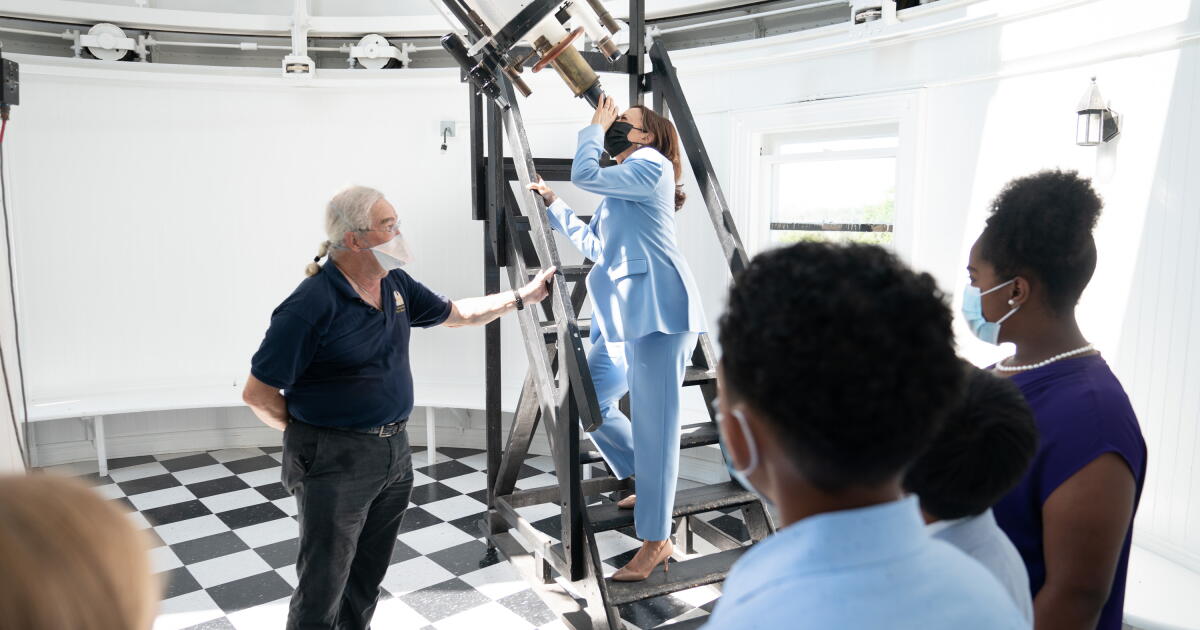
WASHINGTON — It should have been the safest of political appearances — a group of kids gushing about their love of science and space exploration with Vice President Kamala Harris.
But for Harris, it became a controversy.
The children, it turned out, were paid actors. And the video, filmed on location at the White House and the vice president’s official residence at the Naval Observatory, was promoted on NASA’s YouTube Channel and Harris’ Twitter account last week without making that clear.
The fallout over the video, produced for YouTube’s original programming platform, is the second in recent weeks where a seemingly innocuous appearance by Harris has become modestly troublesome.
Late last month, Harris generated more serious consternation and criticism from pro-Israel Democrats and media for not pushing back when a student at a classroom encounter at George Mason University in Virginia accused Israel of “ethnic genocide.” Harris spent the next several days clarifying her longstanding support for Israel and reaching out to pro-Israel organizations, including the Anti-Defamation League.
Such stumbles have been featured extensively in conservative media, where Harris is a regular target. But they also reinforce concerns among Democrats that Harris has not yet found her political footing since taking office amid high expectations. The presumed front-runner to succeed President Biden on the Democratic ticket in 2024 or 2028, Harris recently enlisted two veteran Democrats to help stabilize her communications efforts.
Harris’ office and NASA would not discuss the decision-making process that led to her participation in the YouTube Original or the administration’s marketing of the special, which was produced by a Canada-based company called Sinking Ship Entertainment.
I love the idea of exploring the unknown. There’s so much out there that we still have to learn. As the chair of the National Space Council, I’m eager to get our young people interested in STEM and space exploration. Watch “Get Curious” at https://t.co/d7UDjdh8NGpic.twitter.com/UYvZzsNgId
Harris’s office did not select the children who participated in the YouTube Originals special, a White House official said. A YouTube spokesperson said that “the casting process for this show was no different from typical unscripted kids’ shows across other networks and streaming platforms.”
The special debuted during World Space Week. It features NASA astronaut Shane Kimbrough giving five children the clues for a scavenger hunt that takes them to the U.S. Naval Observatory, where they not-so casually run into Harris, who welcomes them onto the porch of the vice presidential residence.
While sitting in a white chair alongside the children, Harris reminisces about going to the lab with her scientist mother during her childhood and says she is excited to chair the National Space Council. She offers advice to the children about showing their true selves.
“Never let anybody tell you who you are,” she tells them. “You tell them who you are.”
Like many online productions, the special has the feel of something between a kids’-oriented news segment and a scripted show. The children, who introduce themselves with their hometowns, act surprised and excited as they meet the real-life astronaut and the vice president.
Earlier this week, one of the children who appeared in the video described in detail his audition process to KSBW TV in Salinas, which sparked mockery online and news coverage. Harris’ appearance drew especially sharp critiques in conservative news outlets. Fox News, in its coverage, has tried to draw a comparison to the criticism unleashed on former President Trump after his 2015 campaign launch in which he paid people to act like supporters.
Appearing as a guest on Fox News host Tucker Carlson’s show, commentator Candace Owens falsely told viewers that Harris paid children to appear in the special.
White House officials have a long history of appearing as themselves in scripted shows, often with children. First Lady Nancy Reagan promoted her anti-drug message on the popular 1980s sitcom “Diff’rent Strokes,” and then-President Obama participated in a televised sketch alongside comedy duo Keegan-Michael Key and Jordan Peele during the White House Correspondents’ Dinner.
The difference this time was that the show’s format was ambiguous, and its presentation and promotion by Harris and NASA led commentators to believe it had been produced by the government.
Communications consultants said the vice president’s staff should have more thoroughly vetted the program and ensured it was clearly labeled as a reality show with paid actors when the U.S. government promoted it.
Ultimately, Harris’ staff let her down, they said.
“The vice president and the president can’t do their own vetting on things like this,” said Kevin Madden, who served in senior communications roles for Mitt Romney’s 2008 and 2012 campaigns.
Madden added that Harris should not have participated in the program with paid actors, especially “in an era where there is a very high quotient of fake news and misinformation, you have to expect this kind of scrutiny.”
“The criticism [here] becomes warranted,” he said.
WASHINGTON — The Justice Department is demanding testimony before a Florida grand jury in an investigation aiming to establish an intelligence community conspiracy against President Trump, according to multiple people familiar with the matter.
New subpoenas being issued to former government officials represent an escalation in the yearlong investigation as the Justice Department pursues a loosely defined theory that members of the intelligence community who scrutinized Trump over the last decade, including over Russian interference in the 2016 election, conspired against him and violated his rights.
Investigators in recent days contacted some defense lawyers for witnesses advising them of forthcoming grand jury subpoenas. It was not clear how many, as of Tuesday, had received a subpoena or were still waiting to receive one, and the identities of the witnesses receiving subpoenas were also not immediately clear. The people who confirmed the subpoenas spoke on condition of anonymity to discuss a secretive grand jury investigation.
The investigation has focused in large part on the Trump-Russia probe
The contours of the conspiracy investigation aren’t fully known, but agents and prosecutors over the last several months have focused intensely on one of Trump’s chief grievances: the U.S. government response to Russian interference in 2016 and an intelligence community assessment that Moscow meddled on Trump’s behalf at the direction of Russian President Vladimir Putin.
Trump, who spent much of his first term shadowed by an investigation into whether his campaign colluded with Russia to sway the outcome of the election, has for years lashed out at the intelligence community finding and cast it as a “deep state” conspiracy to undermine the legitimacy of his win.
Investigators searching for potential crimes in connection with the intelligence community response have conducted numerous voluntary interviews, but the subpoenas prepared for witnesses in recent days represent an apparent effort to lock down sworn testimony before a grand jury.
It remains unclear whether anyone will be charged or for what offense, though lawyers for former CIA Director John Brennan have said they have been informed that he is a target as investigators examine whether he falsely testified to Congress — something he has repeatedly denied. The Justice Department last spring subpoenaed witnesses before a Washington grand jury as part of an investigation into Brennan but swiftly withdrew the subpoenas in favor of voluntary interviews.
The investigation is being run out of Florida, with the Justice Department in April bringing back into government service a top prosecutor from the Reagan administration, Joe diGenova, to serve as a counselor to the attorney general and help lead a team of agents and prosecutors.
DiGenova, who had previously asked then-Atty. Gen. Pam Bondi to appoint him to the job and has openly and repeatedly claimed Trump was the victim of an intelligence community conspiracy, declined to comment Wednesday when reached by the Associated Press.
In an indication of the wide-ranging nature of the investigation, the AP reported last month that DiGenova’s team has sought interviews with law enforcement officials involved in the 2022 FBI search of Trump’s Mar-a-Lago property in Palm Beach, Fla., which recovered a trove of classified documents.
Concerns from defense lawyers about a ‘favored’ judge
Investigators have set up shop in Fort Pierce, Fla., the home court of U.S. District Judge Aileen Cannon, the Trump-appointed jurist who repeatedly appeared skeptical of the classified documents case against him and ultimately dismissed it after concluding that the prosecutor who filed the charges was illegally appointed.
Lawyers for Brennan last year asked the chief judge of the federal court in Florida to prevent the investigation from being steered to Cannon, whom they described as a “favored” Trump judge. They have since sued the Trump administration, demanding a court order requiring prosecutors to preserve records from the investigation so that Brennan could challenge any potential prosecution of him as vindictive.
Trump came to office in 2017 under scrutiny from the intelligence and law enforcement community about whether his successful campaign had colluded with Russia, which stole politically damaging Democratic emails and orchestrated their release through WikiLeaks as part of a wide-ranging interference scheme.
The FBI and Justice Department investigated but found insufficient evidence to prove a criminal conspiracy between Russia and the Trump campaign, though investigators did find the campaign eagerly hoped to benefit from Moscow’s help.
Subsequent investigations by an inspector general and Justice Department prosecutors identified errors by agents who conducted the Russia probe but found no evidence of criminal wrongdoing by senior law enforcement officials or an anti-Trump conspiracy like what prosecutors are now hoping to prove.
Deeply frustrated by those outcomes, Trump has amplified his demands for retribution, which the Justice Department heeded last year by directing that prosecutors utilize a grand jury. Last year, Bondi directed prosecutors to put evidence before a grand jury after the release of documents aimed at calling into question the legitimacy of the Trump-Russia inquiry.
Canada’s tariffs, which came into force just after midnight, cover roughly $20 billion in U.S. goods and impose duties of as much as 50% on products, from steel and aluminum to farm equipment, clothing and electronics. The list also reaches into the everyday commerce that binds the two economies, including cheese, seafood and cosmetics.
It was the latest sign that relations between the two neighbors have reached their lowest point in decades, after Trump dismissed Canada as the 51st American state, moved to rename Lake Ontario and mocked its armed forces.
Ottawa’s latest measures are a response to tariffs imposed by President Trump last month on Canadian exports. The two governments had appeared close to a trade deal just a month ago. But talks broke down in dramatic fashion, leaving both sides aggrieved and accusing the other of negotiating in bad faith.
In a post Tuesday, Trump said Canada “has been ripping us off for years” and threatened to respond by removing access for Canadian businesses to key American markets.
“What many do not realize is that the Canadian Government, including Canadian Provinces, have banned American Small Businesses and Companies from selling into their Government Procurement Markets,” Trump wrote. “This is the case even though Canada gets broad access into the massive American Government Procurement Market, including those of our States.
“That is not reciprocity, it is a Canadian Trade Scam. From now on, NO RECIPROCITY — NO ACCESS!” he continued. “I am hereby directing the [General Services Administration], working with the [U.S. Trade Representative], to take all necessary steps to REMOVE Canadian-origin products from GSA’s Multiple Award Schedules unless Canada restores full and fair reciprocity for American Farmers and Companies.”
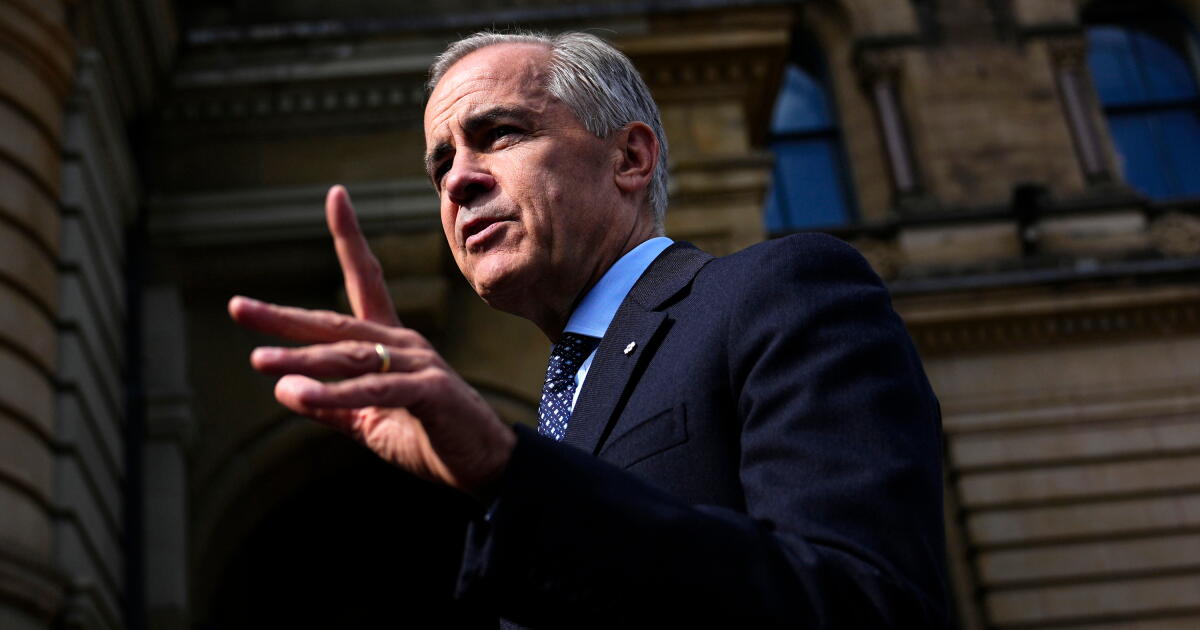
Canada’s prime minister, Mark Carney, has characterized the confrontation as more than a dispute over tariffs, arguing that demands by a bullying Trump administration threaten Canada’s economic independence.
In a video released Tuesday, Carney argued that in the past, the United States has tried to use tariffs to “break us,” only to have Canada’s economy grow stronger and more diversified. He urged Canadians to buy Canadian and break economic dependency from the United States.
“This won’t be easy, and I won’t pretend otherwise,” Carney said. “But Canadians have faced difficult stretches before, and what has carried us through has never ever been any one measure. It’s always been Canadians looking out for each other.”
Trump, meanwhile, has pressed Canada to make concessions on trade and has warned of further tariffs, including potentially higher duties on Canadian automobiles. He also threatened to ban the sale of aircraft from Canada’s Bombardier unless its products are manufactured in the United States.
“If they want our Market, they must build here, and stop treating America like a ‘piggybank,’” Trump wrote on Truth Social on Monday. “BUY AMERICAN. FLY ON AMERICAN AIRLINERS. ENJOY AMERICAN LIQUOR AND BEVERAGES. SAIL ON LAKE AMERICA. AMERICA FIRST!”
Earlier Monday, Trump posted an image showing Mexico, Canada, Central America, Greenland and Caribbean nations with the colors of the American flag. He also posted a caricature of him and Carney playing hockey in which Trump tells him: “Get up, Governor.”
Both sides stand to lose in a trade war poised to hurt businesses large and small across the world’s longest international border.
A prolonged economic conflict poses long-term risks for Canada, which faces price hikes and investment losses from the United States, by far its largest trading partner.
But Americans may also confront higher costs at a time when inflation is already a stubborn problem for the Trump administration. And the trade war may be felt most in northern border states set to hold midterm elections that could swing control of the U.S. Senate, becoming yet another political challenge for embattled Republican lawmakers.
In Maine, Republican Sen. Susan Collins, who is seeking reelection, has called Trump’s tariffs “a mistake.” In Michigan, Democratic Senate nominee Abdul El-Sayed released a video Tuesday highlighting everyday goods that have risen more than 30% over the last year, including Tide Pods, toilet paper and Tim Hortons coffee, as the trade conflict and war in Iran drive up costs.
American alcohol has also been the target of boycotts imposed by several Canadian provinces since March 2025 in response to earlier tariffs on Canadian goods by Trump.
The boycotts since then have erased roughly $360 million in revenue for the U.S. wine industry, according to a Wine Institute report, which represents California wineries. Canada makes up more than 35% of the export market for U.S. wine, more than the EU, U.K. and China markets combined.
For some California winemakers, the impact was even greater. One Sonoma winery referenced in the report said Canada made up about 85% of its international sales. Multiple wineries have had to lay off employees because of hits to their business.
“It’s had a tremendous negative impact,” said Julie Berge, vice president of communications at the Wine Institute.
Wine is not the only California business that has taken a hit — tourism has also seen a sharp decline in arrivals from Canada. In 2025, visitors from the country dropped by 20%.
Canada also targeted the agriculture, electronics and transportation equipment industries with its tariffs announced Tuesday, all of which have a presence in California.
Soon after the World Cup brought positive international attention and tourists to the United States, Trump escalated trade tensions with Canada.
“You went from this really high, exciting moment for the U.S. in terms of international attention, to the next week, it’s negative again,” Deborah Friedland, a hospitality consultant at financial services firm Eisner Advisory Group, told the Associated Press. “It’s one step forward and two steps back.”
Times staff writers Wilner and Ceballos reported from Washington and Duneja from Los Angeles.
WASHINGTON — The Supreme Court on Tuesday rebuffed an appeal from Missouri officials who wanted to use new congressional districts backed by President Trump in the November election, a defeat for Republicans who had hoped the new map could help them hold onto their slim House majority.
The justices let stand a decision by Missouri’s top court, which said the new districts were automatically suspended by a citizen petition demanding a statewide vote.
The ruling marks a rare setback for Republicans in a nationwide redistricting battle that Trump urged Republicans to launch last year.
Missouri’s new districts were used in the August primaries. But the Missouri Supreme Court ruled in September that the state must revert to districts adopted after the last census.
Republican state Atty. Gen. Catherine Hanaway, who appealed, had argued it would violate federal rights to switch districts for voters between the primary and general elections. She also said it would cause confusion.
Missouri currently is represented in the U.S. House by six Republicans and two Democrats who were elected under districts that Republican state officials approved in 2022.
But at Trump’s urging, Missouri Gov. Mike Kehoe called the Legislature into a special session last year to redraw congressional boundaries to their advantage ahead of the midterms.
The revised map targeted the 5th Congressional District, held by longtime Democratic Rep. Emanuel Cleaver of Kansas City. It reassigned portions of Kansas City to two neighboring districts represented by Republicans and stretched the remainder of Cleaver’s district far eastward into rural Republican areas.
Cleaver was unopposed in the Democratic primary. State Sen. Rick Brattin won the Republican primary in the reshaped district.
On the same day as the primary, Republican Secretary of State Denny Hoskins rejected a petition with thousands of signatures seeking to force a November referendum on the map. Hoskins asserted that Missouri’s Constitution doesn’t allow a referendum on congressional redistricting. A lower court agreed, but the state Supreme Court reversed Hoskins’ decision.
The state’s top court said the new districts were retroactively frozen in December, when the petition signatures were submitted, and thus never became law. Hoskins on Tuesday assigned the redistricting referendum as Proposition A on the November ballot, in compliance with the state court order.
The Missouri Constitution does not specifically say that a referendum can be used for congressional redistricting. But the state Supreme Court said a constitutional provision allowing a referendum on “any act” of the Legislature encompasses congressional redistricting legislation.
Missouri was the second Republican-led state, after Texas, to respond to Trump’s call last year to redraw congressional districts. Several other states followed. All told, Republicans had hoped to win as many as 16 additional seats from new House maps enacted in eight states — Texas, Missouri, North Carolina, Ohio, Florida, Tennessee, Louisiana and Alabama. Democrats, whose counterattack faced several setbacks, think they could win up to six additional seats from new districts in California and Utah.
It remains to be seen whether the redistricting works as intended for Republicans. The president’s party historically has lost congressional seats in the midterms, and Trump’s poor approval ratings could provide an extra hurdle for Republican candidates.
Whitehurst and Lieb write for the Associated Press.
WASHINGTON — Work on the White House North Portico appears to be nearing completion before Chinese President Xi Jinping’s state visit to the United States in late September.
Scaffolding was being taken down Tuesday after workers over Labor Day weekend removed a shroud that had obscured the work. The Executive Mansion’s front columns had been covered since July. The work, ordered by President Trump, began in June.
The portico was first completed in 1830 during Andrew Jackson’s presidency. Administration officials said previously that stonework and plaster on the structure were being refurbished because of routine damage from age and weather exposure.
Trump has said he noticed it was in “deplorable condition” before insisting on repairs. The work is part of the president’s sweeping overhaul of the White House and other federal property in the nation’s capital — with most of his more ambitious moves drawing lawsuits and criticism from preservationists.
Trump said last week that workers finished construction of a helipad on the South Lawn.
His signature project, a White House ballroom and underground bunker, continues as legal fights play out. Multiple lawsuits were filed after Trump demolished the East Wing before going through the usual regulatory steps for major work on historic federal buildings in Washington. The massive project will add more square footage than what the existing White House footprint comprises.
That means Trump must host Xi’s state dinner, scheduled for Sept. 24, in existing spaces and in a construction zone — a circumstance that will afford the president a new opportunity to extol his ballroom project.
Barrow and Martin write for the Associated Press. Barrow reported from Atlanta.
Dana Williamson, California Gov. Gavin Newsom’s onetime chief of staff, is seeking to delay her criminal sentencing date for political corruption because of health issues, according to documents filed last week in federal court.
Williamson’s attorney McGregor Scott, asked the court to delay her Sept. 17 sentencing and seal documents related to her health condition.
Scott submitted documents that reference a Sept. 4 surgery that Williamson underwent, medical records, and a text message from Williamson’s mother about the surgery.
Williamson underwent a liver transplant earlier this year, prompting a judge to delay a February hearing in her case.
A spokesperson for the U.S. attorney’s office for the Eastern District of California didn’t immediately respond to a request for comment about the requested sentencing delay.
Williamson, a veteran political consultant who also formerly worked for former Govs. Jerry Brown and Gray Davis, admitted she took part in a scheme from 2022 to 2024 to skim campaign funds from then-U.S. Health and Human Services Secretary Xavier Becerra, now a leading candidate for governor, and divert the money to Becerra’s then-chief of staff.
She also admitted in her plea deal to filing a false tax form in 2024 and lying to FBI agents that same year.
Beyond lying to the FBI about the scheme involving Becerra, Williamson misled federal authorities on another topic, the plea agreement stated.
She lied to FBI agents when asked about the state’s lawsuit against video game company Activision Blizzard Inc., details contained in the November indictment against Williamson and other public records show.
WASHINGTON — Nearly a quarter century after a day “etched forever into the memories of Americans,” President Trump honored the victims of the Sept. 11, 2001, attacks on Tuesday by vowing to “never forget.”
The event at the Ellipse was spearheaded by the Tunnel to Towers Foundation and showcased a massive, 21-foot, nearly 17,000-pound steel beam recovered from the South Tower of the World Trade Center in New York, which had traveled for months across the country as part of the Steel Across America tour.
The steel beam will make its way through New York in a procession on Friday by retracing the steps of fallen New York City firefighter Stephen Siller. Trump’s presence at the event on Tuesday just outside the White House began a week of commemorations that will culminate in several events on Friday, including one at the Pentagon that Trump will attend.
“This battered piece of steel here today on the Ellipse is a reminder that America is blessed with a strength no fire can consume, no evil can conquer and no terror can destroy,” Trump said.
Trump noted that the Sept. 11 attacks were one of few moments in history that “divide time into really what came before” and after.
His remarks briefly dipped into the political, as Trump warned of people turning a “communistic way” — a reference to his frequent attacks on Democrats as more democratic socialists gain influence in the party.
During his remarks, Trump paid particular tribute to two men who died in the attacks: Jeffrey Palazzo, a New York City firefighter, and Welles Crowther, a young equities trader who became known as the “man in the red bandanna” after rescuing several people in the attacks.
Trump said the U.S. Coast Guard will commission a new fast-response cutter this weekend in New York in honor of Palazzo, a Coast Guard reservist who was working out of Staten Island’s Rescue Squad 5 when he responded to the attacks 25 years ago.
And the president recognized Crowther, also a volunteer firefighter, by awarding him the Presidential Medal of Freedom.
Crowther’s mother, Alison, and sister, Paige, accepted the award, which is considered the nation’s highest civilian honor.
In attendance were a smattering of top Cabinet officials and members of Congress, including Republican Reps. Mike Lawler of New York and Dan Meuser, whose Pennsylvania district is near Shanksville, where Flight 93 crashed on Sept. 11, 2001.
Trump praised at length Commerce Secretary Howard Lutnick, who was chairman and CEO of Cantor Fitzgerald, a financial firm that had been housed at the World Trade Center. Lutnick lost his younger brother, Gary, as well as more than 650 employees in the attacks.
“He’s done an amazing job,” Trump said of Lutnick. “He’s rebuilt Cantor Fitzgerald, and he’s given much of the profits to some of the families or the families of people who perished.”
About 150 first responders from New York, as well as some from Washington and Pennsylvania, were in attendance, Trump said.
“This steel beam represents the best of our country,” said Frank Siller, the foundation’s chairman and CEO who is the brother of Stephen Siller. “It’s important to recognize that the heroism that was exhibited that fateful day was nothing short of incredible.”
Kim writes for the Associated Press. AP writer Will Weissert contributed to this report.
WASHINGTON — Republicans appeared to have a firm grip on the Senate heading into the final two years of President Trump’s term. But with less than two months until Election Day, control of the chamber is now up for grabs.
Democrats have found themselves competing in states that once seemed beyond their reach as Trump’s slipping approval ratings and voters’ dissatisfaction with the economy create a difficult political environment for Republicans. But races Democrats once counted on winning have also become more complicated.
It’s a battle that’s expected to exceed $3.4 billion in spending across all races during the midterm campaign. The implications are huge for Trump’s agenda and his ability to fill administration jobs and open court seats for the remainder of his term, as the Senate is empowered to confirm or block presidential nominees.
Republicans say it’s unlikely for everything to break in Democrats’ favor, but they acknowledge they’re facing a difficult landscape. Senate Majority Leader John Thune told South Dakota’s KELOLAND News last week that he does “worry” about losing the chamber.
“I’m a realist,” Thune said. “I don’t ever try and sugarcoat things. I think it’s a competitive environment right now.”
Democrats face a scrambled path to the majority
Democrats need to net four seats to win the majority. The original path had been to hold Michigan, Georgia and New Hampshire while winning back Republican-held seats in Alaska, Maine, North Carolina and Ohio. But things have changed.
“We now have multiple paths for the majority,” Senate Democratic Leader Chuck Schumer said last month. “We found new states — Iowa, Texas — which people a year ago weren’t even paying attention to.”
Some of the states where Democrats were feeling most optimistic at the start of the election cycle, such as Michigan and Maine, have grown murkier.
In Michigan, where there’s an open seat this fall, no GOP candidate has won a Senate race since 1994. But Democrats are struggling to unite behind nominee Abdul El-Sayed. The favorite of progressives narrowly defeated moderate U.S. Rep. Haley Stevens in the August primary, and feelings remain raw from a bruising contest that saw nearly $70 million spent against El-Sayed.
Republicans believe Mike Rogers, who lost the 2024 Senate race by fewer than 20,000 votes, has an improved shot against El-Sayed. The Senate Leadership Fund — Senate Republicans’ spending PAC — added $6 million to its Michigan advertising investment after El-Sayed won, bringing their total spending to $51 million, the third-highest total.
Democrats also saw a prime opportunity to finally defeat five-term Republican Sen. Susan Collins in Maine, where Democratic Vice President Kamala Harris won more votes than Trump in 2024.
Progressive Graham Platner easily won the nomination in June, but he left the race the next month over a sexual assault allegation that he denies. Democratic delegates in late July chose Troy Jackson, a lesser-known former state legislative leader, to replace him.
Jackson has been forced to play catch-up. Collins and aligned super PACs have spent almost $80 million so far, according to the ad-tracking firm AdImpact, while Jackson and Democratic-aligned groups have spent and reserved close to $45 million since he became the nominee.
As one path narrowed for Democrats, others widened
Democrats increasingly see a real possibility in Texas, a state that has been an elusive goal for decades, and other GOP-led states including Iowa, Alaska and Ohio.
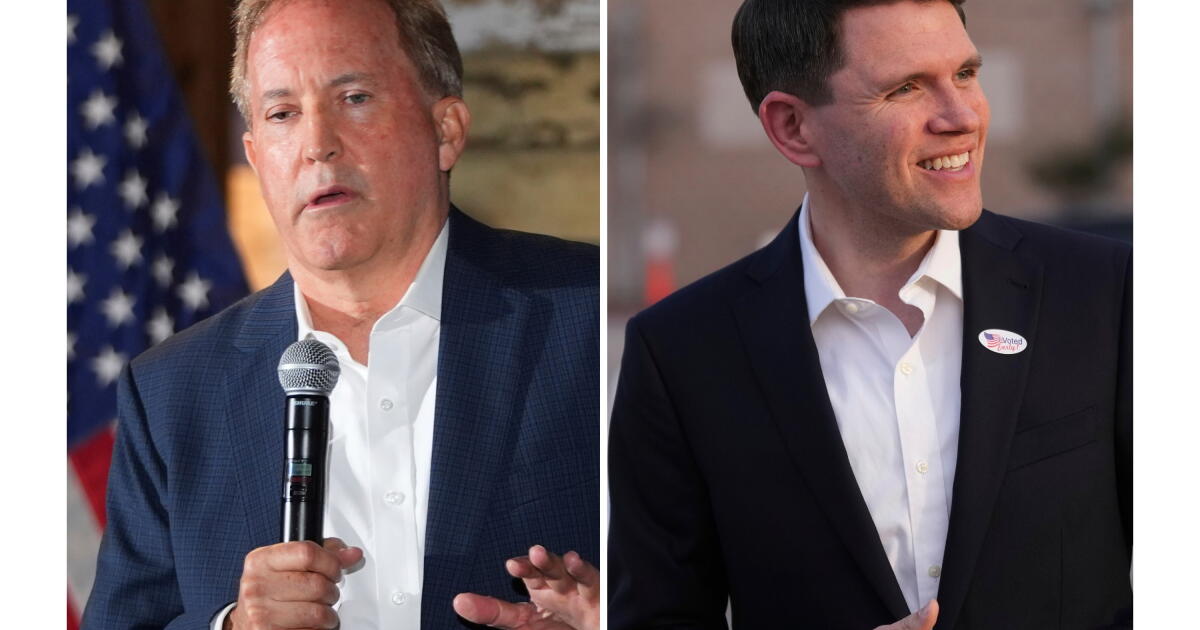
In Texas, Democrat James Talarico faces state Attorney General Ken Paxton, who ousted four-term incumbent Republican Sen. John Cornyn to win the GOP nomination. Senate GOP leadership backed Cornyn, seeing him as the stronger general election candidate.
Paxton has been shadowed for decades by legal and ethical questions, including indictments for securities fraud, though he was not convicted.
Talarico and allied groups have spent nearly $30 million on advertising since the May runoff, compared to less than $3 million by pro-Paxton groups. The political fund associated with Trump last week spent $10 million on TV and digital ads to help Paxton — the first major general election investment by MAGA Inc. for the midterms. Senate GOP leaders had petitioned Trump’s political team to spend some of the more than $400 million it had last month to help Paxton.
Democrats have also upped their spending in Alaska, Iowa, Ohio and North Carolina, all states currently held by Republicans. The GOP, meanwhile, is feeling more optimistic about New Hampshire as well as Michigan, while spending more to defend seats in Iowa and Alaska.
The expanded map has upped the anticipated total spending this cycle. AdImpact in June projected $3.4 billion in advertising spending on Senate races, a significant increase from the $2.8 billion the ad spending firm projected in the fall of 2025.
Why more states are in play than expected
Democrats’ path has widened in part because of Trump’s slumping job approval, notably on handling the economy, which was at 32% according to an AP-NORC poll in July — down from 40% in March 2025, shortly after he took office.
Trump’s trade policies and the war in Iran, with its corresponding inflated fuel costs, have added to the economic uncertainty for voters less than two months before Election Day.
“Things still cost too much. And so we’ve got to work on that issue,” Republican Rep. Jim Jordan of Ohio told The Associated Press. “We understand that and we know that’s real.”
Ohio Sen. Jon Husted heard the concern firsthand at a roundtable last month. Husted is looking to fend off a comeback from former Sen. Sherrod Brown in another key matchup for both parties.
During the discussion on housing, one attendee told Husted that costs were “skyrocketing” in part because of uncertainty around tariffs.
“Uncertainty is the killer to this economy,” said Dean Windham, a real estate developer who previously ran for office as a Republican.
Some Republican Senate candidates have defended Trump’s policies while confronting concerns about their economic impact.
In Michigan, where Trump’s tariffs on Canada have become a central issue, Rogers has backed the president’s approach while leaving room for disagreement.
“President Trump is right to put America First — and tariffs are necessary, but are not a one-size-fits-all solution,” Rogers said in a recent statement.
Republicans believe the math still favors them
Even if Democrats hold every seat they currently control, they would need to flip at least two seats in states Trump carried by double digits in 2024 to win the majority.
Republicans are betting that those underlying advantages will matter more as Election Day approaches — particularly as Trump and the party turn their attention toward mobilizing voters who helped return him to the White House.
Trump told reporters last week that he will “be making a lot of stops” in the last 30 days before the election.
This week, Republicans will hold a midterm convention in Texas, where Trump is set to speak and top Senate candidates including Rogers and Husted are expected to attend.
But Republicans acknowledge they have work to do.
“Politics is local,” Republican Sen. Mike Rounds of South Dakota said. He pointed to Trump’s decision to import beef, which he said made farmers and ranchers “feel just like the administration pulled the rug right off from underneath” them.
“They’re hurt,” Rounds said. “They feel like they’ve been let down.”
Cappelletti, Beaumont and Jalonick write for the Associated Press. Beaumont reported from Des Moines, Iowa.
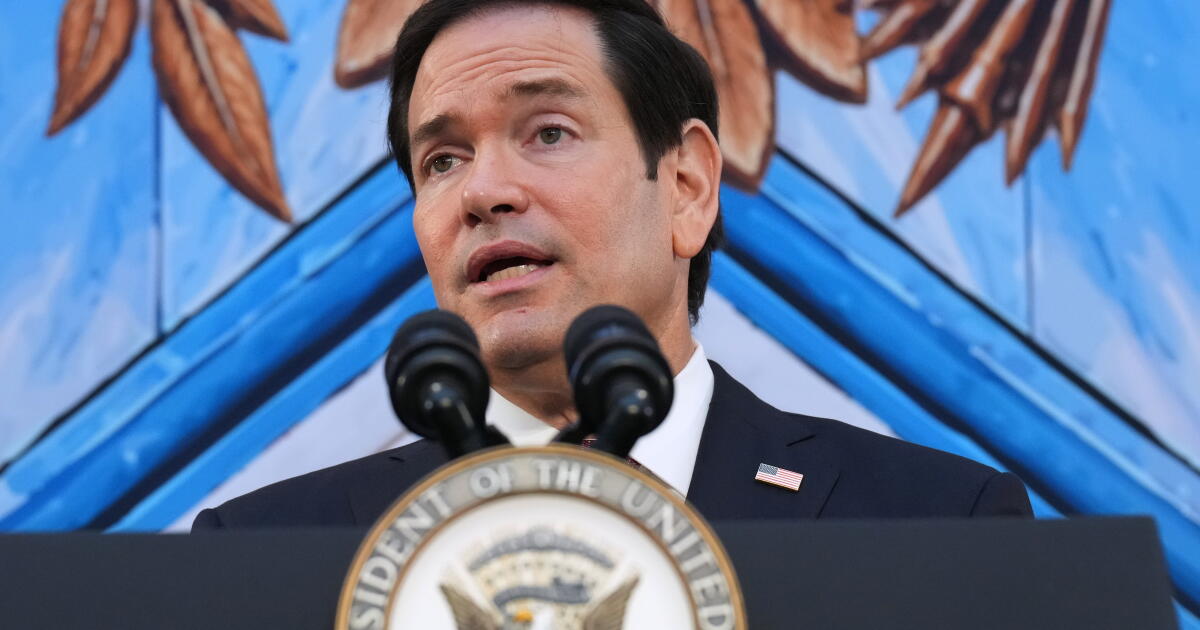
MIAMI — Secretary of State Marco Rubio begins a three-nation tour of Latin America on Tuesday, visiting U.S.-aligned conservative leaders as the Trump administration steps up military operations to combat drug trafficking and seeks further inroads in the Western Hemisphere aimed at improving America’s energy standing and combating illegal migration.
Just a week after sealing a massive oil deal with Venezuelan leaders after a U.S. military operation in January deposed then-leader Nicolás Maduro, Rubio was traveling to neighboring Colombia to meet President Abelardo de la Espriella. Colombia’s new leader has embraced President Trump’s policies on issues ranging from drugs to immigration and energy.
De la Espriella is one of a new generation of right-wing conservatives to win election and show support for Trump’s muscular approach to a region that had tilted leftward in recent decades.
In announcing the trip last week, which also will take Rubio to Ecuador and Peru, the State Department said Rubio and all three leaders would be discussing “enhanced cooperation in the shared fight against narcoterrorism, which threatens our hemisphere.”
Rubio visits as Latin American allies help expanded efforts to fight drug trafficking
The trip comes a day after U.S. forces intercepted and sank another Ecuadorian vessel that Washington accuses of links to the criminal group Los Choneros.
It was the latest action by the U.S. against boats and vessels in Latin America that it says are involved in drug trafficking. Expanded operations in the Caribbean Sea and eastern Pacific Ocean began a year ago, coinciding with an extreme crackdown on migrants in the U.S. illegally, many of them from Latin America.
The vessel sunk Monday was the fifth targeted by U.S. forces in the region in less than two weeks — in most cases with the cooperation or at least tacit support of the conservative leaders with whom Rubio will meet.
But unlike strikes on alleged drug-trafficking boats in Latin American waters that began in September 2025, those on board the vessel were removed and transferred to Ecuadorian authorities. It appears to be a shift after a series of strikes on boats over the year have killed at least 227 people, which the Trump administration accuses of being “narcoterrorists” but without providing evidence.
The U.S. military carried out at least two of those deadly strikes last month before starting to intercept floating refueling stations that it says support illicit drug trafficking operations at sea.
Colombia’s president vows to crack down on drug trafficking and immigration
Colombian Foreign Minister Omar Bula said in a video released Tuesday that Rubio’s visit marks the beginning of “rebuilding a strategic alliance with the United States, our main partner in the region.” He affirmed that Colombia will focus on discussing security, which includes combating drug trafficking, trade, and the defense of “shared values.”
De la Espriella has promised to take a hard line against drug traffickers and pledges to deport thousands of migrants who are in Colombia without residence permits, mainly Venezuelans, as he tries to make significant changes to the nation’s immigration policies that he says will reduce crime.
After taking office last month, De la Espriella brought Colombia into the Americas Counter Cartels Coalition and strengthened long-standing security cooperation with the United States, following strained relations during the 2022-2026 administration of progressive Gustavo Petro.
In just a month in office, De la Espriella has carried out at least three bombings against illegal armed groups and increased military operations. However, several minors have died during the bombings, which has drawn criticism from opposition leaders.
As part of his security strategy, he has focused his efforts on showcasing the results of military operations. However, there was criticism from the opposition and the state-run Ombudsman’s Office after De la Espriella displayed the bodies of alleged criminals wrapped in white bags on the ground alongside seized ammunition.
After winning the election, De la Espriella identified several leaders of Colombia’s illegal armed groups as “military targets.” Last week, he announced that the first of these, Naín Andrés Pérez Toncel, alias “Bendito Menor,” one of the leaders of the Self-Defense Forces of the Sierra Nevada, an illegal armed group in the north of the country, had been killed by police.
Nicknamed “El Tigre,” or The Tiger, the president has shifted the country’s security policy, closing the peace negotiations initiated by Petro during his administration, which he considers a failed effort that only increased violence in Colombia.
Colombia grapples with illegal armed groups vying for control of territories strategically important for drug trafficking and illegal mining, despite the fact that a decade ago the state signed a historic peace agreement with the FARC rebel group.
After meeting De la Espriella in Barranquilla on the Caribbean, where he will sign a civil nuclear cooperation deal and a critical minerals agreement, Rubio will make a brief stop in Quito.
He will meet Ecuadorian President Daniel Noboa whose government has steadily increased counternarcotics operations conducted with the U.S. military.
Rubio will round out the visit with a stop in Lima, Peru, where he will meet new President Keiko Fujimori — the daughter of former leader Alberto Fujimori — as the government also has taken a rightward turn.
Lee and Suárez write for the Associated Press. Suarez reported from Bogota, Colombia.
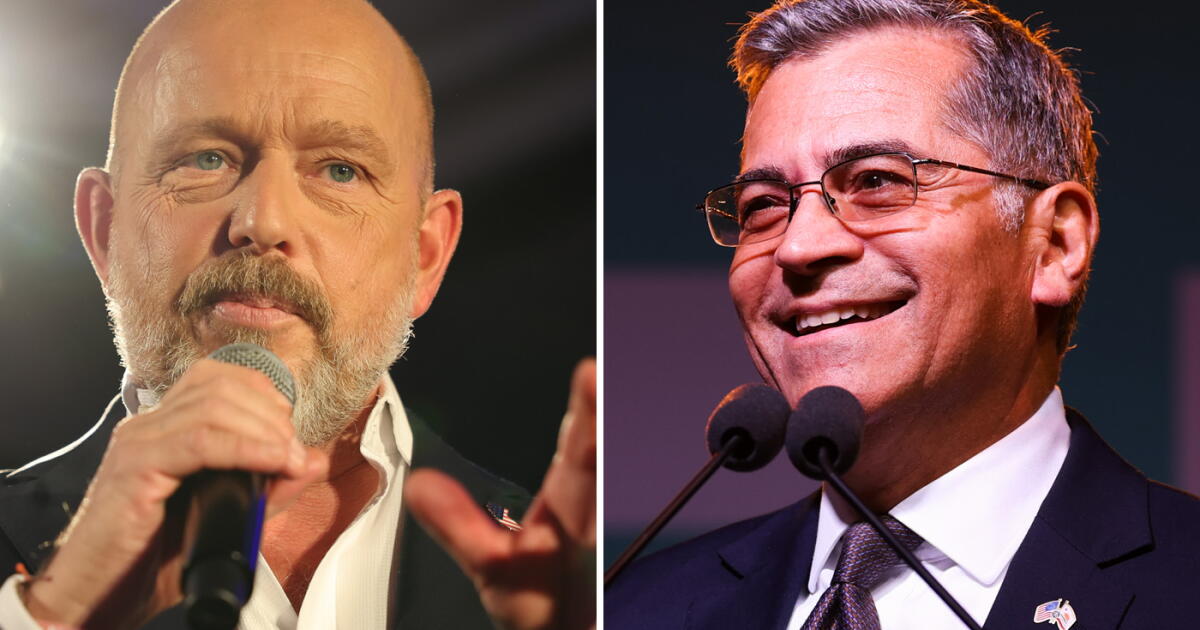
Days before California voters receive their mail-in ballots, gubernatorial candidates Xavier Becerra, a Democrat, and Steve Hilton, a Republican, will debate in a nationally televised face-off.
On Sept. 30 at CNN’s Burbank studio, the two candidates hoping to succeed termed-out Gov. Gavin Newson are expected to spar over sharply divergent visions for the future of the state. California’s next leader is expected to face pressing fiscal issues, as well as continued battle with the Trump administration.
Given California’s deep Democratic tilt, there was a question whether the two men would debate.
“We will have debates, and between now and Nov. 3, we will continue to go out there and meet with folks to make sure they have an opportunity to see the candidates,” Becerra told reporters after greeting business owners, community leaders and voters in a walking tour of Little Tokyo in downtown Los Angeles. “Voters need to have good information. We’ll make sure they have it, and there will be debates.”
The following day, Hilton said he was skeptical of Becerra’s promise.
“I don’t believe him unless he commits to an actual debate. Invitations are on the table for dates and places,” Hilton said. “Why can’t he just accept them? I think he’s lying. I don’t think he wants to do debates because he doesn’t want to debate his record.”
September’s hour-long debate, taking place shortly before county elections officials begin mailing ballots to all the state’s registered voters, will be moderated by the cable network’s anchors Dana Bash and Jake Tapper.
It is the most attention a California gubernatorial contest has drawn since 2010, when “Today” show host Matt Lauer and NBC News Political Director Chuck Todd moderated nationally televised clashes.
That is perhaps unsurprising given how sharply the California electorate has swung left, with no Republican winning a statewide contest since 2006. Two did that year.
While there will not be a studio audience, the debate will air on CNN, CNN International, CNN en Español, CNN.com and related TV and mobile apps for subscribers.
Times staff writer Nicole Nixon contributed to this report.
SACRAMENTO — Democrat Xavier Becerra defended the death penalty while serving as California’s attorney general, a punishment his office actively sought in the case of a gunman convicted of an Orange County mass shooting, but as the front-running candidate for governor he has vowed to block executions if elected in November.
Becerra said he will extend the blanket reprieve for all death row inmates that Gov. Gavin Newsom enacted by executive order in 2019, saying he supported “moving our state away from a costly, flawed system that disproportionately impacts Black and brown communities and too often gets it wrong.”
Those comments have reassured anti-death penalty advocates wary of Becerra, who has stated throughout his career that capital punishment should be an option for victims seeking justice. He reiterated that stance just a decade ago during his confirmation hearing for attorney general, though he also expressed concerns about the unjust application of the punishment.
“I support the death penalty, but I hate the way it’s being executed,” Becerra told state lawmakers in 2017.
“If you commit some heinous crime where you have taken the life of someone else, and you knew that there was a death penalty in place in that place where you committed that crime, then you should face the punishment for what you’ve done,” he explained. “It doesn’t give me pleasure to say that, but I simply do believe there’s a simple justice in that.”
Becerra’s challenger in the Nov. 3 election, former Fox News commentator Steve Hilton, opposes the death penalty but said he would rescind Newsom’s moratorium because it defies the will of voters.
Becerra has said he is concerned by how death sentences historically have been applied, including a highly disproportionate number of condemned inmates who are Black or Latino men and cases in which they later have been exonerated of crimes.
He repeated similar positions last year during a gubernatorial forum in Los Angeles.
“I do not believe every Californian has gotten a fair verdict in these fights,” he said in response to a question about extending Newsom’s moratorium. “But here is what I will tell you: We have to be aggressive in going after crime, especially the most heinous crime. … I will make sure that we have a judiciary system and a prosecution system that takes into account that we must show fairness.”
Though California has not performed an execution since 2006, prosecutors in some areas of the state continue to seek and win death sentences. As of early August, there were 565 condemned inmates in California prisons, according to the state Department of Corrections and Rehabilitation.
Newsom’s moratorium stops the state from carrying out those sentences.
In California, county district attorneys are responsible for prosecuting the vast majority of accused murderers when they go to trial and also deciding whether to seek the death penalty. The office of the state attorney general is responsible for defending death penalty convictions on appeal.
Becerra sought the death penalty in a murder case his office prosecuted early in his tenure, though unsuccessfully. Scott Dekraai, who was convicted of killing his ex-wife and seven others in a shooting at a Seal Beach beauty salon, was sentenced to life in prison without the possibility of parole after a prosecution scandal involving his case.
Some death penalty opponents criticized Becerra for fighting to uphold the death sentence of Robert Lewis Jr., who was deemed by the California Supreme Court in 2018 to have an intellectual disability thatmade him ineligible for execution.
“I find that reprehensible,” said Mike Farrell, president of Death Penalty Focus, an advocacy group. A longtimeanti-death penalty activist, Farrell is better-known for starring as B.J. Hunnicutt in the TV show “M*A*S*H.”
“It may not have been his idea, but he was part of that process,” he said of Becerra.
Others said Becerra cannot be blamed for doing his job. Former Vice President Kamala Harris faced the same dilemma when she served as state attorney general, as does Rob Bonta, who currently holds the office.
“The AG is in a different position because it’s just inherent in their role to defend convictions and sentences,” said Natasha Minsker of the California Anti-Death Penalty Coalition. “For example, Kamala Harris is very strongly personally opposed to the death penalty and still, while she was AG, the office defended hundreds of death sentences. Same with Rob Bonta. He’s very clearly personally against the death penalty, and his office continues to defend death sentences.”
Hilton, his Republican opponent in the race, holds starkly different views.
“If you’re arguing that taking a life is such a serious crime, then I don’t think responding by taking a life actually makes that argument,” he said in an interview last month.
But he said California voters spoke clearly by voting twice — in 2012 and 2016 — against ballot measures that would have repealed the death penalty. “I don’t think it’s OK for a governor to just substitute their personal opinion on an issue where the voters had an explicit and direct say,” he said.
“I strongly believe in holding people accountable for what they do,” Hilton said. “But my sort of fundamental belief is that if we’re saying it’s wrong to kill someone, then the state shouldn’t be doing it, either.”
Hilton also would roll back Democratic-led reforms that have shortened many inmates’ prison sentences by allowing them to seek parole sooner.
End or extend? It’s not that simple
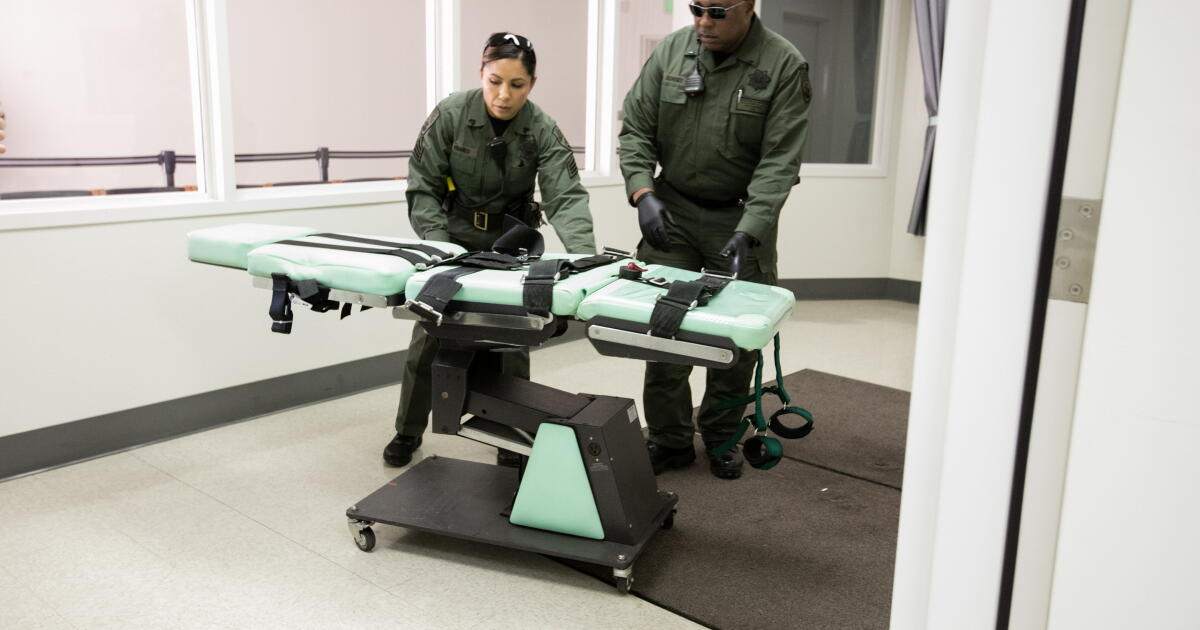
Even if a governor rescinds the moratorium, resuming executions would be a long and complicated process because the state has no approved protocol or facilities to carry out death sentences.
Newsom ordered the dismantling of San Quentin’s death row and execution chamber. Even before he took office, the state’s use of lethal injection drugs was part of a long-running and now-dormant legal battle. And a dwindling number of attorneys who specialize in death penalty cases meant 70% of condemned inmates did not have a lawyer at the end of last year, according to a state report.
California’s death penalty also faces a new legal challenge from groups arguing that capital punishment cases have been administered in a way that is racially discriminatory. In May, the California Supreme Court ordered the attorney general’s office to respond to the arguments and assigned the case to a superior court.
The shifts in California’s criminal justice system are reflected in legal battles waged by the pro-death penalty Criminal Justice Legal Foundation, a nonprofit that supports victims of crime and their families in court.
“We used to do a lot of work in the capital punishment area because that was the area where justice and the sentences were under the greatest attack,” said Kent Scheidegger, the group’s legal director.
But as California’s Democratic-controlled Legislature, governor and, at times, voters adopted measures aimed at reducing the prison population, Scheidegger said the foundation’s efforts increasingly are focused on preserving “the finality of sentences.”
Many capital cases were negotiated as “plea bargains to life without parole on the express promise that this will provide the finality that the victims need most,” he said. “Life without possibility of parole, until recently, meant life without possibility of parole. And now we’ve got one action after another coming out of the government to break down that finality and give people sentenced to life without parole opportunities to get out.”
The group has challenged attempts to expand early release for violent offenders under 2016’s Proposition 57 and new regulations that would allow people sentenced to life without the possibility of parole to seek release.
Twenty-seven states allow the death penalty, but governors in four of them — California, Ohio, Oregon and Pennsylvania — have paused executions.
Slow shifts in public opinion
Attitudes about capital punishment have shifted over time. A 2025 Gallup poll showed 52% of Americans favor the death penalty for people convicted of murder, down from its peak of 80% in 1994.
In a 2023 survey by the Public Policy Institute of California, 62% of adults in the state said they “strongly favor” or “somewhat favor” the death penalty in murder cases. When asked which punishment they prefer for a first-degree murder case, 55% said life without parole and 43% chose the death penalty. More than three-quarters believe there “is some risk that an innocent person will be put to death.”
Despite the changing opinions, Minsker, of the California Anti-Death Penalty Coalition, said there’s little appetite for another repeal attempt because of how expensive ballot measure campaigns have become.
“I am personally one of the strongest proponents of ending the death penalty, and I am not sure I would spend $30 million on that right now, given all the other needs that California has,” said Minsker, a former attorney for the American Civil Liberties Union who ran the unsuccessful 2012 death penalty repeal measure.
Putting an anti-death penalty measure on the statewide ballot also could have put Newsom in an precarious political position. If it failed, Californians would be sending a stinging rebuke to the Democratic governor’s executive decision to grant a blanket reprieve to all condemned inmates.
Minsker is leading a group of criminal justice advocates, faith organizations, prosecutors, murder victim family members and others urging Newsom to commute every death sentence in California before he leaves office.
But advocates are unsure whether Newsom, who is considering a run for president in 2028, would risk the backlash a mass commutation would probably bring. The California Supreme Court also must review executive clemency actions for inmates with more than one felony charge.
Commuting all death sentences to life in prison “would be the coup de grâce,” Farrell said. “However, politically, I’m sure those who are advising him are urging him to have caution in that regard.”
Now, that 2024 law could be expanded to encompass the city’s fast-food industry, whose precarious workforce — largely women from immigrant communities — has long raised concerns over unstable schedules that they say make it difficult to plan their finances, child care, medical appointments and other obligations.
The L.A. City Council’s economic development and jobs committee late last month approved the ordinance, which also would establish a mandatory six-hour paid training to educate workers on minimum wage laws and other labor protections. It goes to the full council for a vote on Tuesday.
The proposal is backed by a statewide union of fast-food workers — established in 2024 — that is affiliated with the Service Employees International Union, which for years has helped organize fast-food employee walkouts over wage theft, safety and pay.
The California Fast Food Workers Union‘s organizing director, Maria Maldonado, said workers often are unaware of their rights regarding heat exposure and other risky conditions common in kitchens. The training, she said, would show them they have recourse and city support for reporting employers when conditions are unsafe.
“If you know there is support to enforce the law, we are going to see a difference in the industry,” Maldonado said.
City Councilmember Hugo Soto-Martinez first introduced the ordinance in 2024.
Although worker-friendly proposals usually are ultimately backed by the L.A. City Council, the process often is lengthy, with business interests lobbying against such measures.
The California Restaurant Assn. wrote in a letter to the council that the ordinance would greatly increase costs in a state that already is expensive to operate in and that it unfairly singles out an industry that has long served as a successful pathway to business ownership for minority entrepreneurs.
In the letter, business groups took issue with third parties administering worker training, arguing that labor groups could use them to prime the workforce for union campaigns.
The ordinance would “not only duplicate existing law but also force neighborhood restaurants to pay thousands of dollars so groups with ulterior motives can hold team members as a captive audience,” the letter said.
The group also argued that training would create third-party access to workers’ data even as many immigrant workers are fearful of heightened immigration enforcement, noting that the training might “require employers to disclose sensitive information to outside entities, creating serious privacy risks.”
A report commissioned by McDonald’s, compiled by the firm Beacon Economics and Pepperdine University, surveyed some 1,200 workers in L.A. County and found that a majority, about 70.6%, opposed the proposed paid training, while 29.4% said they would want such training, the survey said.
California’s fast-food industry employs more than 750,000 people and is a growing sector, according to state data. The state fast-food union has argued that local and state protections are crucial.
Thousands of union workers, their family members and supporters marched through the streets of industrial Wilmington on Monday, taking part in a Labor Day parade whose festive mood overshadowed their serious concerns about the future.
Jesse Munoz, a 63-year-old longshoreman, who belongs to International Longshore and Warehouse Union Local 13, talked of how automation has eliminated more than 2,000 jobs over the last 15 years or so and worries that foreign-owned companies will do more to shrink the workforce and worsen working conditions.
“The concern is the future,” Munoz said. “I have a son that’s on a list to become a casual worker, which is a worker that will accumulate his hours, and then hopefully within time become a regular member of the union. But the future is not as promising as we would like it to be.”
“If you eliminate the workforce, you eliminate taxes. You eliminate pensions,” he said.
International Longshore and Warehouse Union members throw candy to onlookers at Monday’s Labor Day parade.
(Kayla Bartkowski / Los Angeles Times)
The Wilmington rally joined Labor Day events throughout the nation Monday, a holiday that also marks a prime campaign opportunity for candidates in midterm elections and other political races.
The first U.S. Labor Day celebration took place in New York City on Sept. 5, 1882, with 10,000 marchers. In 1894, President Cleveland signed a congressional act establishing the first Monday of September as a legal holiday, which has become known for promotional sales as well as a day off for many.
The holiday has particular resonance in Southern California, where the labor movement remains large in numbers and powerful in political influence. Across the nation, that’s far from a given.
The number of workers represented by unions rose by 463,000 in 2025, according to data collected by the pro-labor American Prospect, and national density — meaning the number of U.S. workers who are unionized — edged from 9.9% to 10.0%. However, private-sector union density stayed at 5.9%, meaning the numerical gain came chiefly from government employment.
Munoz said he has a message for President Trump, who has used steep tariffs on foreign-made goods in an attempt to return more manufacturing to the United States, leading to price increases domestically.
“Stop those tariffs and stop this automation,” Munoz said. “Just get the people back to work. Help the economy build itself up again with the workers, not with politicians.”
Giovanna Mendez, right, hugs her sibling’s elementary school teacher during the Labor Day parade in Wilmington.
(Kayla Bartkowski / Los Angeles Times)
While the Wilmington crowd was heavily Democratic, one longshoreman in his early 60s showed it was possible to be pro-labor and pro-Trump.
“We’re a lot better than when [President] Biden was in, way better,” said the worker, who also spoke of his union as “wonderful.”
Jordan Gonzales, a 20-year longshoreman, expressed worries about the future of trade work.
“A lot of people would rather be in the office and in the AC,” said Gonzales. “We’ve lost our workers that are outside of an office.”
He was enjoying a hearty free breakfast at a union hall and looking forward to his 12-year-old’s marching band performance in the parade, where she played a glockenspiel.
Participating school bands included San Pedro High, Banning High, Harry Bridges Middle, Port of Los Angeles High and Garfield High.
Delegations from many unions marched with their local chapters and a procession of restored and souped-up cars completed the picture. L.A. Mayor Bass was front and center behind the banner of the shore workers.
Politicians at work on Labor Day
In the pre-parade free breakfast inside the Longshoremen’s & Warehousemen’s Memorial Assn. cavernous meeting hall, a parade of elected and aspiring politicians introduced themselves, straining to be heard and noticed in brief remarks over a sometimes inattentive din.
Xavier Becerra, the Democratic candidate for California governor spoke briefly, thanking union members for their daily labors and campaign support.
“None of us should forget where we came from,” Becerra said. “Let us work hard,” he said, referring to election day. “November 3rd belongs to us just the way Labor Day belongs to us.”
Also on hand were both Los Angeles mayoral candidates: incumbent Bass and challenger Nithya Raman.
1
2
1.L.A. Mayor Karen Bass speaks to security during the Labor Day parade in Wilmington.2.L.A. mayoral candidate Nithya Raman greets parade watchers.(Photographs by Kayla Bartkowski / Los Angeles Times)
Bass praised the city and union movement for positive strides “even in the midst of Donald Trump, who has done everything he can do against working people, including invading our city, but we are back, and we stay united, and we’re going to continue to do that,” she said. “L.A. is a labor city, and I am there with you 100%.”
Labor leaders also are almost 100% behind her in terms of endorsements. One exception is the Western States Regional Council of Carpenters, which endorsed Raman. The union represents about 65,000 members across 10 states.
“We need more housing in L.A.,” said Doug Hicks, the union’s vice president and director of organizing. “How many cranes are there in downtown Los Angeles today?”
In her brief breakfast remarks, Raman, an L.A. City councilmember, said that “automation, AI, are taking away jobs all over this country, and it is up to us to step up and fight back, and that is why I’m here to stand alongside the workers of this country.”
Master carpenter Joseph W., who did not want to give his last name, declined to speak about endorsements, focusing instead on the challenges of workers.
“We build the houses, but we can’t buy them,” he said. In 1977, his dad bought a house in Norwalk in 1977 for less than $50,000. Now that property is worth close to a million dollars.
“That’s 20 times what my dad paid for it,” said Joseph, who is 55 and rents his own home. “I don’t make 20 times what my dad got paid.”
The younger workers included members of ILWU Local 56, the “ship scalers” union, which cleans up hazardous materials and provides environmental remediation both in the ports and beyond. Its members were involved in wildfire cleanups and removing waste from the hazardous Lineage warehouse fire in Boyle Heights in June.
Two members of the Western States Regional Council of Carpenters bump fists after Monday’s Labor Day parade.
(Kayla Bartkowski / Los Angeles Times)
Evan Briseno, 18, would like to move on to safer work before his health is potentially affected. But fellow union member Francisco, 21 — who declined to give his last name, wants to move up in the trade, while noting that some areas are so dangerous that every patch of skin needs to be covered.
Neither follows politics, but they’re both concerned with workplace safety issues.
Other unions included Teamsters, Service Employees International, SAG-AFTRA (for performers) and teachers — along with their students.
Mark Ramos wore multiple hats as chair of the Los Angeles County Democratic Party and president of the United Food and Commercial Workers International Union Western States Council and UFCW Local 1428.
Ramos said one current union battle is to make self-serve checkout lines manageable for the workers who must supervise them.
WASHINGTON — A sporadic global trade war led by President Trump is fueling inflation across the U.S. economy, elevating prices on everyday goods, as the war with Iran sends the price of gas on a roller coaster.
Aggressive tax cuts have pushed the national debt past $40 trillion, driving a growing crisis in the bond market. And an unprecedented immigration crackdown is disrupting the labor supply in agriculture, construction, hospitality and food processing, raising prices even further.
Approaching the halfway point of Trump’s second term, a president who won reelection based on a promise to turn the economy around now faces a reckoning in the midterm elections centered largely on his economic record.
Trump’s economic agenda has emerged as an increasingly awkward liability for Republicans heading into the November elections, leaving lawmakers to defend policies that have delivered political pain at home, even as the White House argues they will pay off in the long run.
Polling on Trump’s handling of the economy has remained in precariously low territory throughout the summer, entering Labor Day weekend with less than a third of Americans supporting his job performance on their most pressing concerns. One recent poll, from the University of Massachusetts Amherst, found that only 22% perceive the economy in a good or fair state.
Shoppers at Lincoln Heights Certified Farmers Market in Los Angeles on Wednesday.
(Jason Armond / Los Angeles Times)
And Americans’ confidence in the economy is unlikely to improve much ahead of election day, Nov. 3, in part because bad economic news has shown to sink confidence fast. Good news takes much longer to win people back, experts said.
“Voters’ opinion of the economy has mostly hardened,” said Aaron Klein, chair of economic studies at the Brookings Institution. “People vote the economy of the spring and summer, not November.”
Good news has been harder to come by.
Heading into the holiday weekend, Trump dismissed communities opposed to data-center construction as “backwards and poor.” A rapidly escalating trade dispute with Canada threatens Republican gains in battlegrounds along the northern border that could determine control of the Senate.
Sean Zabriskie, center, helps his son Connor, 7, try on hockey pants at The Ice Box Hockey shop in Harbor City. The trade war between the U.S. and Canada is affecting products like hockey gear, most of which is made in Canada and imported to the U.S.
(Genaro Molina / Los Angeles Times)
And fresh polling found that more than 90% of Americans believe corruption is rampant in Trump’s government, even as the president spends hundreds of millions of dollars on vanity projects across the capital.
Susan Collins, the incumbent Republican senator from Maine seeking another term in a strategically critical race, chastised the Trump administration for its latest trade spat with Ottawa as “making the job harder” of securing reelection.
“There’s just nothing good you can say about them,” Collins said of the tariffs.
Trump has pushed back on criticisms of his record, declaring the country has “the greatest economy we’ve ever had” and touting what he calls a manufacturing boom, all while distancing himself from potential midterm losses.
“I’m not affected by the election,” Trump told reporters last week. “I’m not running. But my party’s running, and I’m going to help my party.”
But Rep. Mike Johnson, a Louisiana Republican and speaker of the House, said last week that the midterms would serve as a referendum on Trump’s presidency.
Rep. Aisha Wahab (D-Hayward) and Speaker of the House Mike Johnson (R-La. ) arrive for a ceremonial swearing-in at the Capitol in Washington, D.C., on Sept. 2.
(Andrew Harnik / Getty Images)
“Even though his name isn’t in the midterm, his legacy is,” Johnson said. “The America First priorities and principles are. His administration is.”
Several embattled incumbents fear that’s the case and are distancing themselves from the president. Several Republican lawmakers — including Reps. Tom Barrett of Michigan and Zach Nunn of Iowa — plan on skipping a midterm GOP convention called by Trump for this week in Texas.
Joanne Hsu, director of the University of Michigan’s Survey of Consumers, said that gas prices were a chief frustration among Americans, and found that consumer sentiment soured rapidly once it became clear the conflict in Iran would not be short-lived.
“Consumers are absolutely not feeling great about the economy right now, and the factors that are underpinning their frustrations with the economy at this time are factors that are pretty tough to turn around on short notice,” Hsu said.
Even if the Iran conflict reached a resolution, confidence in the economy is likely to change only when the prices are reflected at the gas station, she said.
“When it comes to the views of the economy, it’s really about what’s happening to my wallet,” Hsu said.
During a White House press media briefing on Thursday,Vice President JD Vance acknowledged the Iran war has led gas prices to rise and that he does not know when Americans can expect those prices to go down.
Vice President JD Vance talks to reporters during a news briefing at the White House on Sept. 3.
(Chip Somodevilla / Getty Images)
“The reason gas prices are so high now is because the Iranians are shooting at commercial shipping,” Vance said. “Gas, frankly, could have been much, much higher were it not for our efforts. But I am not going to make a promise about when it is going to return to $3.”
The day after Vance spoke, diesel hit a record all-time high of $5.85 a gallon. In California, it sold for as much as $7.71.
Yet Trump has tried to downplay the economic pressure the war in Iran is placing on Americans, in particular as the Strait of Hormuz — a vital shipping corridor for oil and gas — remains under threat by Iranian troops.
Diesel prices over $7 a gallon are displayed at a gas station in Los Angeles on Aug. 21.
(Justin Sullivan / Getty Images)
“We have the Strait of Hormuz in extremely good shape,” Trump said, adding that the U.S. Navy has escorted ships through the channel. “A lot of oil is coming out. That’s why you haven’t seen the price of oil going the way they thought it might have to go.”
Trump on Monday also touted an agreement with the Venezuelan government to develop a vast amount of the South American country’s oil reserves. Asked how he sees the deal affecting American consumers, Trump said: “Ultimately prices are going to come down.”
One of the Arts of War statues, newly covered in gold leaf, is visible at Arlington Memorial Bridge near the Lincoln Memorial in Washington, D.C.
(Andrew Harnik / Getty Images)
“Now, will it happen before the election? I can’t tell you that. But I think people are very smart,” he said.
For some Americans, the economic pressures are a key driver ahead of the midterm elections.
Monica Escalante, a home care provider who is a member of the United Domestic Workers union, said she started feeling the pinch on her wallet after Trump imposed sweeping tariffs on a number of products she buys at the grocery store. Gas, she noticed, became harder to cover after the Iran war started.
Escalante, who lives in Bakersfield, said she also has to drive her client to the grocery store, and that mileage reimbursements are not enough to cover her costs.
“It’s really hard when I don’t have the money for gas, and she doesn’t have the money for gas. Then it is like: What do we do?” she said. “It is either she’s borrowing or I’m trying to figure out how I can get gas in my tank.”
WASHINGTON — President Trump has locked in a deal to develop Venezuela’s vast oil resources, an arrangement the White House says will bring a country battered by years of economic collapse to a “place where elections are possible.”
But the agreement — backed by acting President Delcy Rodríguez, a holdover from the Nicolás Maduro government that Washington deems “illegitimate” — is raising new uncertainty about how entrenched the unelected government may become.
In January, when the U.S. military captured Maduro, Trump did not say how long a democratic transition would take but said Rodríguez was “gracious” and “essentially willing to do what we think is necessary.”
Asked by The Times on Wednesday what was stopping him from demanding Venezuela set a firm election date, Trump was blunt: “I just don’t think they are ready yet.”
“It’s very new. We took them out of a dictatorship and we’re getting along great with the government,” Trump said. But he said an election would happen “soon.”
U.S. Secretary of Energy Chris Wright walks alongside Venezuela’s interim president, Delcy Rodríguez, after a news conference on the deal to develop 17 oil fields in the country.
(Jesus Vargas / Getty Images)
Under the deal, the U.S. government is partnering with an oil producer to create a new company, North American Blue Energy Partners, to develop 17 fields with a proven potential of 65 billion barrels. NABEP will have rights to the fields for 100 years.
For many Venezuelans, the lack of urgency around elections — set against a deal that gives the United States majority control over roughly a third of the country’s oil reserves — is starting to feel like a broken promise.
“They tell us we have to wait two years, maybe more, while in the meantime they do business with a government that wasn’t elected, that was imposed on us, and that we don’t want,” Carlos Pérez, a 23-year-old automotive mechanics student, told The Times.
Antonio Marchetti, a 45-year-old plumber and electrician, said that while he sees the removal of Maduro as a “good thing,” the oil deal makes it seem as though Trump’s plans were those of a “cowboy, the invader John Wayne,” all along.
“We were expecting elections,” Marchetti said. “This pact with Trump entrenched the dictatorship that he himself declared war on. But to get rid of Maduro, he left the rest and did business with them. It disgusts me.”
A man holds a sign that reads in Spanish, “Yankee out, murderers” during a protest in Caracas on Aug. 29 against President Trump’s deal giving the United States a stake in Venezuela’s oil reserves.
(Pedro Mattey / Associated Press)
The frustrations go beyond Venezuela. In Washington, Republican lawmakers have praised the oil deal, while calling Rodríguez an “interim dictator” who cannot be trusted.
María Corina Machado, the exiled leader of the Venezuelan opposition and a recipient of the Nobel Peace Prize, on Thursday raised her own worries about what the oil deal means for the future of Venezuela.
In a video message, Machado stopped short of criticizing Trump’s oil deal, but acknowledged concerns about a pact negotiated with an “illegitimate” government.
“Venezuelans know that there can be no development without strong institutions and a government elected by popular vote,” she said. “That is the only real guarantee of success and stability for any large-scale investment.”
A plan in the works
Trump administration officials have characterized the deal as an economic lifeline that will eventually stabilize a country and prepare it for free and fair elections.
Secretary of State Marco Rubio said last week that the United States is facilitating talks between Venezuela’s interim government and Dinorah Figuera, an opposition figure leading Venezuela’s 2015 National Assembly, the last democratically elected legislature recognized by the United States.
Machado has been left out of those talks. They are expected to resume in mid-September.
Rubio says that for any election to be “credible,” the voting system will require an overhaul and political parties will need time to organize. Steps also must be taken to ensure the country has a free press.
Echoing Rubio’s comments, the White House said Friday that Trump wants elections held at the “right time,” but that his top priority is to bring Venezuela “back from the dead and rebuild the country after it was incompetently ruled by a nasty dictatorship.”
U.S. Energy Secretary Chris Wright meets with Venezuelan acting President Delcy Rodríguez at Miraflores presidential palace in Caracas on Sept. 2.
(Pedro Mattey / Ap Photo/pedro Mattey)
On Wednesday, while Energy Secretary Chris Wright visited Caracas, Rodríguez declined to set a firm date for an election, but added, “I have worked tirelessly to ensure that Venezuela is ready and prepared when the time comes for its electoral process, which will take place — have no doubt about that: There will be an electoral process.”
The open-ended approach to holding an election, however, has drawn criticism from former Trump administration officials, who argue the lack of a timeline essentially lets Rodríguez govern indefinitely.
“Here’s my fear: It makes us Delcy’s partner, and gives the president a reason to want her to remain in power,” Elliott Abrams, who served as U.S. special envoy to Venezuela during Trump’s first term, told The Times.
He contended that the White House so far appears to prefer a pliant interlocutor, and Rodríguez, he says, will do “whatever Trump tells her to do.”
If an election is to take place in Venezuela, a nine-month runway for preparation is likely to be expected, Abrams said.
People shop for produce at a market in Maracaibo, the heart of Venezuela’s oil industry. .
(Ariana Cubillos / Associated Press)
In Washington, some Republican lawmakers have continued to call for elections in Venezuela, arguing that Rodríguez cannot be trusted.
“The only way we will have a prosperous Venezuela is with the end of the murderous regime and the return of democracy,” Rep. Carlos A. Gimenez (R-Fla.) wrote on social media. He also called Rodríguez an “interim dictator.”
In an interview with NBC News’ “Meet the Press,” Sen. Ted Cruz (R-Texas) said he does not necessarily think elections should happen before the oil agreement is finalized, but he said they “need to proceed rapidly.”
“I believe they should proceed no later than midway through next year,” he said.
Sen. Rick Scott (R-Fla.) said he is working with Trump and Rubio to ensure “free, fair and transparent elections as soon as possible.” He did not, however, say what would constitute “soon.”
Mixed views on economic hope
In the Lake Maracaibo region, an area that would see renewed investments under the oil agreement, Junior Araujo — a 47-year-old oil worker — sees a “wonderful opportunity to be reborn.”
Araujo, the father of three, is in desperate need of a better economic outlook. He works 120 hours a week and earns only $20. For his family, food alone usually costs about $150 a week.
“We have to get creative and find new ways to make ends meet through side jobs like selling clothes and making yogurt,” he said. “That’s our real financial situation.”
Venezuelans watch oil tankers anchored in Lake Maracaibo on Sept. 4. Much of the country’s oil industry is centered in the Maracaibo region.
(Humberto Matheus/Sipa USA via Associated Press)
For Araujo, the hope for a better economy does not take away his frustrations with the government.
“We’re neither happy nor dancing here, all our benefits have been taken away from us,” he said. “Our main problem is the current government; we need to restore our institutions.”
Nazareth Lezama, a 35-year-old teacher, also sees the oil deal as an economic opportunity but remains concerned that the current government may not have negotiated the best price or conditions for Venezuela. She added this has happened in the past.
“We must be clear that this regime destroyed the oil industry,” she said, adding that Venezuelans “need elections to choose leaders based on merit.”
Marchetti, the plumber from Caracas, says the oil deal is a “100-year chain” on Venezuelans imposed by Trump. He said it has become the “last straw” for him, and he has decided to leave Venezuela and emigrate to Europe.
“With all the pain in my heart, I will leave everything behind. I have a European passport; it won’t be easy to start a life from scratch, but there is no hope left here,” he said.
He does not know where he will land yet. But he knows he needs to leave Venezuela.
“This ship is sinking,” he said.
Times staff writer Ceballos reported from Washington. Special correspondent Mogollón reported from Caracas.
SACRAMENTO — It was unprecedented and stunning: California’s governor and top two legislative leaders negotiated a compromise on a big bill — and one house rebelled, refusing to bring it to a vote.
The issue: who gets hit the hardest financially when a for-profit utility’s electrical equipment ignites a blaze. The utility’s investors? Its ratepayers? The insurers? Their premium payers?
At stake, depending on who you talk to, is whether the electricity providers can afford to stay in business and keep our lights on. Will some utility — Southern California Edison, Pacific Gas & Electric or San Diego Gas & Election — be forced into bankruptcy when the next powerline-caused wildfire explodes?
Alternatively, there’s another unacceptable potential outcome: Property insurance companies completely stop issuing policies — not just in obvious fire-prone areas, but in tree-lined urban neighborhoods — and basically pull out of California. Or their premiums become flat-out unaffordable.
You’re reading the L.A. Times Politics newsletter
George Skelton and other analysts cover the insights, legislation, players and politics you need to know. In your inbox Monday and Thursday mornings.
By continuing, you agree to our Terms of Service, which include arbitration and a class action waiver. You agree that we and our third-party vendors may collect and use your information, including through cookies, pixels and similar technologies, for the purposes set forth in our Privacy Policy such as personalizing your experience and ads.
Politically, the wildfire legislation’s flameout called into question Gov. Gavin Newsom’s seeming weakness as a lame duck chief executive who will be termed-out of office in January.
Newsom stuck out his neck and took it on the chin from fellow Democrats — showing that even with lopsided one-party rule, unity and success aren’t always guaranteed.
But the episode also raised doubts about Assembly Speaker Robert Rivas’ leadership capability. The Hollister Democrat signed off on the deal with Newsom and Senate President Pro Tem Monique Limon (D-Santa Barbara), but reneged at the last minute under pressure from the Assembly Democratic Caucus. They killed the bill without a floor vote.
I’m in my seventh decade of covering California governors and legislatures and never have seen — or heard of — anything like this: a legislative leader backing out of a deal agreed to with the governor and the other house’s leader.
But in truth, Newsom didn’t really like the agreement much anyway. He was on the utilities’ side, and they were out-lobbied by the insurers and ratepayers.
“I know we all hate utilities, so no one wants to defend a utility. But you’ve got to deal with reality. This thing’s not going to get better on its own,” Newsom told reporters at the Capitol on the night before the deal collapsed, referring to the utilities’ worsening financial liability.
Personally, I think it’s an overreach to conclude that Newsom’s power has been severely weakened — or that Rivas necessarily showed lack of leadership. One can question their reasons for doing what they did, but that doesn’t mean it was because of political debility.
“Newsom’s still a powerful lame duck because he could be a presidential nominee,” Republican consultant Rob Stutzman says.
“One of the better things he has done all year is taking on this issue. It would have been very easy for him to just pass it on to the next governor.”
Leaving aside whether this governor could become a president, there are hundreds of bills piling up on his desk that he must sign or veto by Sept. 30. That gives him tremendous clout. It’s good politics — and human nature — for a governor to lean more favorably toward a measure if it’s authored by a legislator who has voted with him.
Plus, one of the Legislature’s last acts last week was to send Newsom a bloated supplemental budget bill containing more than $3 billion in spending, including countless stacks of pork sought by lawmakers for their districts. Newsom easily and gleefully could discard any or all of it.
So Newsom has awesome power, lame duck or not.
But he’s vulnerable to criticism for his style. He has had an annoying habit of waiting until the very end of a legislative session to spring a hefty proposal on the lawmakers. It’s called “jamming.”
In the past, this pressure tactic mostly worked, although it ticked off lawmakers. This time Assembly members rebelled.
It’s not clear whether his jamming is mainly strategy, or just lack of focus and a tendency to push too many projects at once. Or is he preoccupied with positioning himself to run for president in 2028? Probably all of the above.
“If we had more time, we could have had a different outcome,” Rivas told me.
With only a few days remaining in the legislative session, Newsom initially proposed an ambitious plan that would have shifted more cost for utility-sparked wildfires to property insurers, sharply raising premiums across California. Utilities would have gotten some relief.
It became a titanic fight between two powerful special interests. And insurers — teamed with consumer advocates — triumphed, forcing Newsom to back down.
After hard bargaining, the governor and legislative leaders finally agreed on a post-midnight deal to help wildfire victims receive compensation more quickly — a so-called fast-pay program — and to step up fire preventative efforts.
But utilities’ financial risks weren’t significantly reduced, and they quickly mounted an opposition campaign. That resulted in Assembly Democrats scuttling all of it on the session’s last day.
“It’s unfortunate that [bill] was not given a vote,” Limon said, adding that the Senate was prepared to pass it.
“I don’t want us to do the easy stuff and call it a day,” Rivas told me. “I wanted to see real utility accountability. This bill did not go nearly far enough.”
It went a fair distance, however, in helping future fire victims get their insurance payouts faster. And it probably should have been passed.
Half a loaf. Bird in hand. Incremental change. Next year more incrementalism. Ultimately it can add to massive reform.
Some problems are just too tough to resolve in one sitting.
WASHINGTON — An armed assailant charged toward the Democratic candidate for Ohio governor, Amy Acton, on Sunday during a campaign stop at the Canfield Fair, injuring several people before he was stopped by troopers, the Ohio State Highway Patrol said.
The Highway Patrol said in a statement that a man it identified as Patrick Havas, 38, forced his way through a crowd, knocking over members of the audience as he moved toward Acton, the state’s former public health director. He had a taser and two pistols, the statement said.
The Mahoning County Sheriff’s Office said two handguns and a set of brass knuckles were recovered after his arrest, and “no weapons were ever brandished or even removed from their holsters.”
Havas was taken to the county jail and booked on charges of disorderly conduct and two counts of assault, the Highway Patrol statement said, adding that no other details were available pending an investigation. Online court records didn’t yet list the case, and it wasn’t clear as of Sunday night whether Havas has an attorney.
Republican Gov. Mike DeWine said in a statement that the man “tried to forcefully push himself” toward Acton as she was speaking at the fair in Canfield, in northeastern Ohio.
“Violence or the threat of violence at political or public events is always unacceptable,” DeWine added.
The attack is the latest act of political violence to roil the United States. The Ohio gubernatorial contest is one of the most high-profile races this year as the campaigns enter the final six weeks of campaigning before the election in November.
Acton is facing Republican Vivek Ramaswamy, who has parlayed his national name recognition from his 2024 presidential run, tech industry connections and alliance with President Trump into a record fundraising haul that he is tapping for advertising spots. He is using campaign rallies and advertising to criticize Acton.
Ramaswamy’s campaign called Sunday’s attack unacceptable.
“Candidates should be able to meet with voters without having to worry about threats or violence. What happened today is completely unacceptable and has no place in politics, and we hope that no one was hurt,” Ramaswamy’s communications director, Connie Luck, said in a statement Sunday.
Addie Bullock, communications director for Acton’s campaign, said in a statement that the assailant lunged at Acton. She said the candidate “will always stand up to the chaos, hate and vitriol that pits us against one another.”
The incident brought condemnation from Ohio Republican Sen. Jon Husted, who said on X that he and his wife were “disturbed by the attempted attack on Amy Acton today at the Canfield Fair. We are grateful for law enforcement’s quick response. There is no place for this kind of behavior, and it must never be tolerated.”
The country has seen a rise in political violence over the last decade, including assassination attempts against Donald Trump at a rally in 2024 and at the White House Correspondents Assn. dinner in April, and the Jan. 6, 2021, riot by a pro-Trump mob at the U.S. Capitol.
Other examples include a 2017 shooting at a Republican congressional baseball team practice in Alexandria, Va., a 2022 hammer assault on then-Speaker Nancy Pelosi’s husband at the couple’s San Francisco home, and the fatal shootings last year of a Democratic Minnesota state lawmaker and her husband and of conservative commentator Charlie Kirk in Utah.
Federal political committees spent more than $40 million on expenses labeled as security during the 2023-24 campaign cycle, the most recent one for which data are publicly available, according to a report released in April from the Public Service Alliance, a nonpartisan group that focuses on security for public officials.
Before running for governor, Acton had been recruited by DeWine in 2019 to lead the Ohio Department of Health while serving as an associate professor of public health at Ohio State University. As the COVID-19 pandemic ramped up in early 2020, she was thrown into the state and national spotlight — becoming a source of comfort to many viewers of the governor’s daily news conferences.
For her service as health director, Acton earned the John F. Kennedy Library Foundation’s Profile in COVID Courage Award, the Columbus Foundation’s Spirit of Columbus Award and Ohio State’s highest alumni honor, the Alumni Medalist Award.
Her position as the face of the DeWine administration’s aggressive stance against the coronavirus also earned Acton many enemies, among them statehouse Republicans and conservative Ohioans who opposed pandemic public health restrictions.
Fields writes for the Associated Press. AP writer Ryan J. Foley in Iowa City, Iowa, contributed to this report.
WASHINGTON — The Trump administration on Sunday renewed its appeal to the Supreme Court after a federal judge blocked new restrictions on mail ballots ahead of the midterms.
The filing came after U.S. District Court Judge Indira Talwani extended an order against the U.S. Postal Service enforcing President Trump’s executive order for the November elections.
The legal wrangling comes even as states start sending out mail ballots, leaving the administration little time to make big changes in mail ballot rules.
“Ballots have already begun to be mailed in North Carolina, and more States will begin the mailing process as the injunction remains in place — including Alabama on September 9 and at least five States the week of September 13,” Solicitor Gen. John Sauer said in the filing.
“Once those ballot envelopes enter the mailstream, there is no retrieving them. And while the injunction allows the Postal Service and the States to continue taking steps to ensure that their envelopes satisfy the Rule’s requirements … each day the injunction is in place risks sowing confusion and chaos because the injunction makes those preparatory steps voluntary, rather than mandatory.”
The appeal marks the third time the administration has asked the high court to intervene. The high court has allowed the plan to move forward but not ruled on whether it is legal.
The battle could have major ramifications for this year’s elections, when control of Congress is at stake. Nearly one-third of voters in the U.S. cast mail ballots. Mail ballots are sent to every California voter.
Democratic states and voting rights groups say the changes are unconstitutional and amount to voter suppression. Election officials contend that there isn’t enough time to revise their systems to comply with the new Postal Service directives.
The Trump administration has framed the restrictions as commonsense changes that are within its power to regulate the mail.
“Simply put, the best way to address respondents’ fears about inability to comply with the Rule is to grant an immediate administrative stay of the order, followed by a full stay pending further review,” Sauer said. “That will remove the improper cloud of uncertainty that the district court has cast over the Rule, making clear to all involved that compliance with the Rule is not optional and must start without further delay.”
Trump has long sought to limit mail voting, even though he himself often uses that method to cast his own ballot. He has falsely blamed mail balloting for his 2020 election loss to Democrat Joe Biden, spreading baseless claims of fraud. But so far, he has been unable to change the long-standing voting procedure.
Whitehurst and Fields write for the Associated Press.
DES MOINES — Alongside the familiar sounds of roosters crowing and thrill seekers screaming on rides at the recent Iowa State Fair, there was a chorus of boos from Turning Point Action activists who were heckling Democratic politicians making their way through the crowds.
Videos of the confrontations got hundreds of thousands of views on social media, a burst of attention for a conservative youth organization that is charting its next chapter after last year’s fatal shooting of its leader Charlie Kirk. But the true test of Turning Point Action’s clout was unfolding inside the exhibition center, where staff members were registering voters, handing out buttons and signing people up for social events.
“Building the foundation for 2028,” said one of the fliers.
While Democrats have punted Iowa from the top of its presidential primary calendar, the state’s caucuses will still kick off Republicans’ next nominating process. Turning Point Action is positioning itself to shape that contest, a reminder that preparations for the next White House campaign are already in motion even though no candidates have announced and the midterm elections are still two months away.
Turning Point Action wants at least one staffer in each of Iowa’s 99 counties to mobilize the conservative grassroots.
“It is important to us to see high voter participation in the caucuses,” said Tyler Bowyer, the organization’s chief operating officer. “That’s your measuring stick.”
In addition to Iowa, Turning Point Action grew its footprint in New Hampshire and Nevada for this year’s midterms, which could also help in 2028.
The likely beneficiary of this initiative would be Vice President JD Vance, who is widely expected to launch a presidential campaign. Turning Point leaders including Erika Kirk, Charlie’s widow, have been clear they’re ready to throw their support behind Vance if he jumps in.
More than a dozen Republican officials, activists, lawmakers and strategists in Iowa said Turning Point’s imprint in the state was visible but still something of a mystery, and some privately question whether the organization’s impact will match the buzz it generates online.
But others have eagerly welcomed the organization to the state.
“A year ago, Iowa was virgin — no Turning Point. And many of us complained,” said Kelley Koch, a former Dallas County Republican chair, to a gathering of MAGA Nation Iowa, the grassroots organization she founded. “Finally, Turning Point Action listened to us.”
Early state investments could benefit Vance
When asked about his 2028 ambitions, Vance demurs and says he’s focused on his current job, but he’s expected to be an immediate Republican front-runner if he decides to seek the presidency. Bowyer said Turning Point Action wants to be supportive without “being pushy.”
“We haven’t officially endorsed as an organization yet because no one’s announced, right? But, you know, depending on who announces and when we endorse — yeah, of course we’ll be out campaigning on behalf of who we endorse,” he said.
Bowyer said Vance can bridge the gap between the Make America Great Again movement, which President Trump launched more than a decade ago, and younger voters who were attracted to Charlie Kirk’s brand of conservatism.
“It’s a natural fit,” he said.
Bowyer acknowledged that Turning Point Action’s growing infrastructure in early primary states could cause some agitation on the right if it is seen as throwing its weight behind one candidate. But, he said, “that’s not why we do it,” describing the goal as boosting turnout in the Iowa caucuses to send a strong signal heading into the general election.
Other potential candidates include Marco Rubio, Trump’s secretary of State. Rubio, however, has said he wouldn’t run against Vance.
Sen. Ted Cruz of Texas has not announced a campaign, but he has already made several visits to Iowa this year and said in a recent podcast hosted by Texas Lt. Gov. Dan Patrick that “it’s no secret that I want to be president.”
Looking to grow the grassroots
Although Iowa has shifted rightward over the last decade, it’s considered a political battleground in this year’s midterm elections because of Trump’s sagging approval ratings, declining access to healthcare and tariff-driven turmoil in the agricultural industry.
Sen. Joni Ernst and Gov. Kim Reynolds, both Republicans, are retiring, and there are fiercely contested races to replace them. Democrat Josh Turek and Republican Ashley Hinson are seeking the Senate seat, while Democrat Rob Sand and Republican Zach Lahn want to be governor. Two battleground congressional districts will help determine control of the House as well.
The spotlight on Iowa this year is an opportunity for Turning Point Action to demonstrate its clout.
The organization said it hired four staffers on the ground last year. After Lahn’s surprise win over Trump-endorsed Rep. Randy Feenstra, Turning Point Action said it would double its staffing in the state before the midterms.
Young activists regularly post on social media from county fairs and Republican committee meetings. They upload selfies on sidewalks or stoops to show days spent knocking on doors.
“We’re newer in Iowa,” a Des Moines-based senior field staffer, Kylie Kloewer, told a visitor who stopped by Turning Point Action’s booth at the state fair.
The booth featured signs declaring that there are only two genders and one that said “men can’t get pregnant,” the kind of confrontational culture war messaging that Charlie Kirk practiced on college campuses. Some people nodded and chuckled, while others raised their eyebrows as they wandered by.
Those who walked up to the table could sign up for social clubs that host events, including barbecues and volleyball games.
“Any involvement is success,” said Kelsey Newberry, who is based in the organization’s Phoenix headquarters and was helping at the Iowa State Fair. “You’re bringing people together as a community. The more you talk to your neighbors, the better.
“And even if they’re not ready to get activated now,” Newberry added, “being around like-minded people might encourage them in the future.”
Fingerhut and Price write for the Associated Press. Price reported from Washington.
HANFORD, Calif. — Darian Orduno bounced her baby boy on her chest, looking down at his thick black hair and bright eyes. What might pollution from a data center do, she wondered, to his growing lungs?
That question had brought Orduno, 25, to a community meeting opposing a possible data center here, and her fears, she said, likely would influence her vote in the midterm election too.
“I just had him, and now it’s concerning if he’s going to be able to grow up here,” Orduno said, or “if I’m going to have to relocate.”
As about 100 residents filed into a church for the meeting in late August, under a Central Valley sky hazy with air pollution, many shared the same worries — that a facility pitched for the local fairgrounds could further worsen the area’s air quality and strain its water supply.
Barbara Castle listens to speakers during a town hall meeting on a possible small-scale data center in Hanford.
Nationwide, such concerns are fueling a backlash to data centers from both the left and the right as tech companies flood the country with thousands of proposals for the facilities in nearly every state from California to Maine.
Data centers have become an unusually bipartisan flash point in the midterm elections, as candidates race to delineate policy platforms and respond to public opinion. The issue stands to influence swing voters and motivate turnout at the polls.
Here in the 22nd District, home to the state’s most competitive congressional race, how significantly the issue will affect voters’ decisions remains to be seen. But one thing is clear: Anxiety about data centers is mounting.
“It’s a national concern, it’s now a state concern, and now it’s bled into the local concern,” Hanford Mayor Mark Kairis said. “It’s a very emotionally charged issue right now.”
Residents in Hanford who oppose data centers say they are worried about the region’s air and water quality, concerns echoed by rural communities across the country.
Demand for data centers, which house the computer systems powering artificial intelligence and the internet, has surged as AI use has ballooned. As of April, more than 1,500 new data centers were in development across the United States, according to a Pew Research Center analysis, largely in rural areas.
The centers require intense cooling, which often demands high water and power use and creates the potential to affect the environment and to pass on utility costs to consumers. But they power technology that is becoming increasingly integrated into American business. They also create jobs, though with limitations.
Democrats see the data center uproar as fitting into their affordability messaging, and candidates generally agree data centers should be regulated, though their positions vary on how aggressively. For Republicans, whose party has backed AI innovation, responding to worsening public opinion has been trickier — particularly given President Trump’s championing of AI and data centers.
Vice President JD Vance on Thursday acknowledged negative polling on data centers but framed the issue as a question of American industrial dominance, saying the country can’t shy away from development. Earlier in the week, Trump asserted that the only reason communities should reject data centers is if they want to be “backwards and poor.”
The public may see data centers as a physical manifestation of AI advancement in general, said Camille Crittenden, executive director of the Center for Information Technology Research in the Interest of Society, a University of California research center. Opposing data centers offers people a way to vent their broader concerns about the technology’s increasing dominance.
Priest Luke Martinez expresses concerns during the community meeting .
“This is a very specific focal point for a general anxiety about AI,” she said. “People see these data centers, and they’re thinking, ‘AI’s going to take my job.’”
The backlash from residents in the Central Valley to the possibility of even a small-scale data center demonstrates how acutely the issue has put many Americans on edge.
“It really is terrifying,” said Lucy Gomez, 57, of Hanford, a retired teacher. “I feel like we’re being guinea pigs when we don’t want to be.”
Increasing influence
Community anger about the facilities has prompted close attention from California lawmakers, who passed legislation in Sacramento on Monday to regulate energy use by the data center industry and impose other requirements.
California is home to the third-most data centers of any state, though it has experienced a relatively smaller new boom because of its high electrical prices and other factors. Still, 54 new facilities were in the works for the state as of April, according to Pew.
Hanford Councilwoman Kimber Regan speaks with Mayor Mark Kairis during the meeting. Hanford’s zoning ordinances do not allow data centers, but the city does not have jurisdiction over the county fairgrounds site where Global Stack is evaluating its proposal.
In Georgia and Pennsylvania, New York and Texas, Nevada and Virginia, the issue has become hot-button in elections at all levels. Ads about data centers run on the airwaves in states with key congressional races. Gubernatorial candidates jockey over it; both New York Gov. Kathy Hochul, a Democrat, and Texas Gov. Greg Abbott, a Republican, put temporary moratoriums on new data centers.
A memo from the Republican senatorial campaign arm underscored how critical the question was becoming last month, when it warned AI companies that data centers could be the deciding issue in the close race between Ohio GOP Sen. Jon Husted and former Sen. Sherrod Brown, his Democratic challenger.
Data centers “are the anchor hanging around Husted’s neck,” said the memo, which was firstobtained by Axios. “If he loses and data centers get the blame, politicians across the country will take notice — and they will not go near the next one.”
Sixty-one percent of Americans would oppose a data center being built where they live, a late August poll by the Economist and YouGov found.
Though Democrats and independents were more likely to oppose the centers, 47% of Republicans also said they would oppose it, and 52% of people who voted for Trump in 2024 said they believed construction of a new data center would increase their electrical bills.
Data centers encapsulate existing concerns among red and blue voters across the nation and in California about their quality of life and the influence of major tech companies, said Sonoma State University political science professor David McCuan.
“California has a lot of communities that have been struggling and trying to find a way forward, and the data center debate captures those voters’ frustrations,” McCuan said.
Political winds
The historic Bastille, which served as Kings County’s jail and sheriff’s office from 1897 until 1964, stands tall next to the courthouse in Hanford’s Civic Center Park.
The idea for a center on the Kings County fairgrounds is part of a broader pitch by developer Global Stack USA to boost the state’s emergency infrastructure by installing small-scale data centers, helipads and parking garages at fairgrounds around the state.
Global Stack Chief Executive Dan Kang said the goal was strengthening the state’s emergency response capabilities while helping fairgrounds financially. The company’s early materials envisioned operating 70 sites by 2030.
The company has not made any formal proposals, but in Kings and Tulare counties, the issue caught attention after fair officials agreed to allow Global Stack to evaluate their sites. The idea also prompted some residents to voice opposition in Ventura County last month.
The facilities would include what’s known as an edge computing data center, which typically is much smaller than traditional data centers and which Global Stack says would require lower utility use and no municipal water connection.
Concerns about water and energy use by data centers are legitimate, said Shaolei Ren, a UC Riverside engineering professor who studies AI. Centers like the one proposed by Global Stack do not guzzle water the way larger ones do, but they still can use extra power or generate air and noise pollution, Ren said.
In Kings County, the project potentially could benefit the fairgrounds as a long-term revenue source, said Dena Rizzardo, chief executive of the fair board, a state entity that would have final say over any proposal. Because fairgrounds are state property, local and county officials don’t have jurisdiction.
Kang said he is committed to working with local communities to ensure “any path forward reflects local needs and California’s broader resilience priorities.”
In the district’s congressional race, which could help decide control of the House in November, Democratic nominee Randy Villegas said he has been getting questions about data centers from voters. Last month, he released a set of policy points and called for a data center moratorium of at least a year to give Congress time to pass regulations.
Democratic congressional candidate Randy Villegas urged meeting attendees to lobby federal lawmakers to pass legislation regulating data centers.
“The advancement of technology … should not be an excuse to throw our communities under the bus,” Villegas said at the Hanford meeting, where he addressed the friendly crowd without identifying himself as a congressional candidate. A College of the Sequoias professor, he is attempting to unseat Republican Rep. David Valadao.
Valadao, in a statement to The Times, said data center construction requires a “responsible approach” that includes local input and ratepayer protections.
“Data centers play an important role in our economy and national security, but Central Valley families are already facing high electric bills and concerns about our water supply,” Valadao said. He did not answer questions about the proposal in Hanford.
Several attendees at the Hanford meeting, who ranged from Gen Z to elderly, said the issue would affect their midterm votes, though most said they already were leaning to the left.
Gomez, the retired teacher, was not happy with either party but planned to vote for Democrats because she viewed them as taking more action to protect public health than Republicans.
Ember Gomez listens to speakers while her father, Filiberto, looks on during the meeting. Filiberto Gomez said he was concerned a data center would affect children’s health.
Courtney Hawkins, 40, said the data center issue “absolutely” would carry weight in his votes.
“I believe that AI is good for propelling technology in general,” Hawkins said, “but I don’t believe we should be pursuing it without regulations and at the cost of the environment.”
The statistics are sobering — so sobering that Defense Department officials refuse to confirm, deny or discuss them.
From Feb. 28 through July, the first five months of the war with Iraq, U.S. forces burned through almost 60% of the nation’s advanced defensive missiles — the Patriot and THAAD interceptors that protect American troops.
When the war began, the Pentagon had almost 2,800 Patriot and THAAD missiles in its worldwide inventory, according to a study by the Center for Strategic and International Studies, an independent think tank. By the end of July, that number had dropped to about 1,100, CSIS reported. Almost two-thirds of the Patriots and almost 40% of the longer-range THAAD were gone.
“This is a generational annihilation of our theater missile defense capability,” said Tom Karako, director of CSIS’s Missile Defense Project. “There’s no way you can look at this and not see it’s a setback.”
The White House and the Pentagon have not challenged the CSIS figures, although they have issued sweeping denials that any shortage exists.
“We have far more munitions than anyone in the world, and far more than we need,” President Trump said in July.
That’s true, but misleading. The U.S. military still holds vast inventories of short-range offensive missiles. But the sophisticated defensive missiles that protect U.S. troops no longer are abundant — as even Trump has acknowledged.
“We have certain types of munitions [of which] we have unlimited, virtual unlimited supply,” he said last month. “We have others where it’s a little bit tighter.”
The result is a squeeze that has prompted U.S. commanders to husband Patriot and THAAD interceptors as scarce assets.
For much of August, when a frayed de facto ceasefire was in effect, U.S. forces did not respond with high-end missiles when Iran attacked oil tankers in the Strait of Hormuz.
But when Iran launched rockets against U.S. bases in Jordan last week, Patriots reportedly were used to knock the incoming missiles down. (The Pentagon has declined to confirm or deny those reports.)
The U.S. weapons arsenal “no longer has the capacity to deter a Chinese attack against Taiwan,” the Council on Foreign Relations warned in a report last month. Defense planners share the same concern over a potential Russian assault on the Baltic states.
The conservative Heritage Foundation has forecast that the Pentagon’s inventory of missiles would run out “within the first week of a Taiwan conflict.”
In Europe, a U.S. defense official told the Associated Press last month that the shortfall was “beyond critical.” If Russia attacked a NATO country, the official said, U.S. forces in the area would “take punch after punch in the mouth.”
The core question is whether the United States has so few missiles that it cannot credibly deter China or Russia from attacking their neighbors.
“You’ve got to be strong enough to send a clear message that our enemies should not try anything because we’re a credible force,” said Leon Panetta, President Obama’s former defense secretary. “Now we’re losing a lot of that credibility — and that’s dangerous.”
Knowing that U.S. forces have been left without thousands of weapons needed to deter conflict, Karako said, could in itself be provocative. “It could tempt an aggressor to do something, knowing that we have fewer [missiles] to thwart them.”
The obvious remedy is to build more interceptors — a process Trump and Defense Secretary Pete Hegseth ordered even before the war began. But ramping up missile production won’t immediately replenish the stockpile.
Before the Iran war, defense contractors were producing only about 620 Patriots and 96 THAAD each year — fewer than half the number expended during a few weeks this spring.
At current production rates, it will take at least three years to return the Patriot inventory to its prewar level, and at least four years for THAAD, CSIS reported.
Defense experts warn that the stocks need to be even larger than they were before the war to credibly deter China or Russia.
Mark Cancian, a retired Marine colonel and principal author of the CSIS estimates, says most analysts believe it will take years after replenishing the stocks expended in the Persian Gulf to build a credible deterrent against China.
The Pentagon has enough munitions, both offensive and defensive, to continue fighting the campaign against Iran, he added — but some of those less-sophisticated weapons can be used only at shorter ranges, which means placing more troops in harm’s way.
Cancian said the CSIS figures were based on publicly available Pentagon budget and acquisition documents, updated in some cases from recent press reports — but not from leaks of classified information.
The roots of the missile shortage began long before the war with Iran. Trump and Hegseth are not the only ones to blame, although their belief that Iran would quickly capitulate appears to have been a major factor.
Nor did former President Biden cause the shortage, as Trump has claimed Biden gave several hundred Patriots to Ukraine, but the shortfall is far larger than that.
The underlying problem, defense experts say, is that the United States designed its missile defense programs for a world in which only a few major powers like China and Russia posed serious threats.
But the landscape of military technology has changed. Missiles and drones have become cheaper and easier to acquire, and countries like Iran can strike targets at great distances without making a huge investment in weaponry.
That’s a transformational change — and the Pentagon has been behind the curve, argues Michael C. Horowitz, a senior fellow at the Council on Foreign Relations. “This is the kind of situation in which great-power militaries like the United States struggle,” he said.
So the Trump administration faces several challenges. It needs to replenish its depleted stores of advanced defensive missiles — a process that has only just begun, and which Congress has not yet funded. Meanwhile, Horowitz and others argue, it also needs to build less expensive missile and drone systems to fill the multiyear gap before Patriot and THAAD inventories can be restored.
The Pentagon has begun that process, deploying several relatively inexpensive anti-drone missile systems.
Trump’s One Big Beautiful Bill Act last year included $7.7 billion for low-cost missile and drone programs, but 13 months later, more than 90% of the money remains unspent, Horowitz said.
California is poised to be the first state in the nation to allow people to identify their Jewish heritage on state forms, sparking debate within the community about identity and the merits of being singled out.
Some Jews believe the move would help people understand the community better, particularly on issues such as health and hate crimes. But some are wary about providing too much information given the history of government-sanctioned persecutions against Jewish people.
The state recognizes nearly 50 racial and ethnic identities for data collection, but it considers Jewish identity only as a religion, not an ethnicity.
Senate Bill 1387, which lawmakers passed Aug. 31, seeks to require state agencies to include a box for Jewish ethnicity on all demographic data forms, ranging from public assistance programs to college applications.
The goal is to improve the accuracy of state data to better understand the needs of Jewish communities, according to the bill’s author, state Sen. Henry Stern (D-Los Angeles). The bill, which received broad support in the Assembly and Senate, will head to Gov. Gavin Newsom’s desk in the coming weeks for a signature or veto.
The proposed law has gone beyond data collection within the Jewish community, prompting discussions and disagreements over whether being Jewish is religious, cultural or a blend of many things. For some, it’s evoked anxiety about the historical dangers of tracking Jews.
Stern doesn’t mind the debate. In fact, he says, it speaks to a core part of Jewish identity.
“I love that the Jewish tradition is us arguing with each other,” he said. “It is such a beautiful part of our heritage to debate these kinds of things and what it means to be Jewish, and I love making space for that.”
California has broadened the list of racial and ethnic categories people can select in recent years. Newsom last year signed a similar bill that created a category for Middle East and North African individuals separate from the “white” designation that had previously encompassed those ethnicities.
California is home to an estimated 1.2 million Jewish people, representing the second-largest Jewish population in the United States after New York. And for most American Jews, Jewish identity is not one size fits all.
“The difficulty here, I think, is that Jewishness doesn’t fit neatly into the categories Americans normally use,” said Jeffrey Kopstein, the chancellor’s professor of political science at UC Irvine. “So, of course, to non-Jews, Jews are often thought of as a religion, but Jewish identity also has historically involved ancestry, culture and peoplehood.
“Many people who are entirely secular nevertheless understand themselves and are understood by others as Jews,” he added.
A Pew Research study published in 2021 found that about 1 in 5 Jews in the United States — roughly 19% of respondents — said that being Jewish is about a combination of religion, ancestry and culture. About 22% said being Jewish is a matter of culture, while 21% said it was a matter of ancestry. About half as many — roughly 11% — said being Jewish is mainly about religion.
The study found that religion is not central to the lives of most Jews living in the United States. Still, identifying as Jewish matters greatly to them, with three-quarters of Jewish Americans saying that “being Jewish” is very important or somewhat important to them, according to Pew.
Jewish California, a Jewish advocacy group that sponsored the bill, wrote in a statement that when Jewish ethnicity is absent from data, disparities in healthcare, education and discrimination are less likely to be identified or addressed. Data collection, it says, “signals to the public how communities are understood.”
“When California recognizes Jews only as a religion, it reinforces a narrow and incomplete understanding of Jewish identity, encouraging the misconception that Jews are defined solely by belief or worship rather than by a rich and distinct culture, history, peoplehood, and shared experience. That misunderstanding leads to generalizations, creating fertile ground for bias and discrimination,” the group wrote in a statement.
But opponents argue that the bill oversimplifies Jewish identity and could potentially make people more of a target for antisemitism, which saw a nationwide surge after the start of the Israel-Hamas war on Oct. 7, 2023.
In 2025, the Anti-Defamation League tallied 6,274 incidents of antisemitism in the United States, down from 9,354 incidents the year prior. Last year’s numbers were still about five times higher than a decade ago, according to the ADL.
Cat Zavis, a rabbi at Beyt Tikkun, told the California Assembly’s Judiciary Committee in June that the bill erases the diversity of Jewish people whose families come from a variety of places including the Middle East, North Africa, South Asia and Europe.
“Jews are not a single ethnicity. Judaism is a religion,” she said. “Many Middle Eastern and North African Jews have spent years working to have their distinct histories recognized. Their stories are not the same as those of Ashkenazi Jews. They have different experiences of displacement, discrimination, privilege and identity. By collapsing all Jews into a single ethnic category, this bill makes those communities invisible.”
Stern says people will still be able to check multiple racial and ethnic identification boxes on forms to encompass all the ways they identify.
Groups have also raised concerns about the government maintaining records on Jews, which is reminiscent for some of the trauma of the Holocaust. In the 1930s, the Nazi government used a variety of forms of public data including tax returns and census records to help identify Jews who would be rounded up and sent to concentration camps where millions were killed.
“History offers a clear warning: when Jewish identity is officially distinguished from that of all other ethnic groups, the results have too often been catastrophic,” the Bay Area chapter of Jewish Voice for Peace, an advocacy organization that bills itself as the largest Jewish group supporting Palestine, wrote in a statement.
Supporters of the bill say identifying as Jewish under the law is strictly voluntary. For Stern, the root of the bill is empowerment.
As a kid growing up in Los Angeles, Stern wasn’t as religious as he is now, but he was still singled out for being Jewish. Other students drew swastikas on his backpack. Antisemitic cartoons appeared in his school newspaper.
“Some stuff happened where I went from being a normal kid blending in to suddenly realizing I had an identity and it was one that was sort of defined by being called out for it,” he said. “Back then, there were no forms on campus, or applying for college, that had an opportunity for me to identify as Jewish, even though I was being identified by other people that way.”
He hopes the proposed law will give people the chance to own their Jewish identity on their terms.
“Maybe this is one place where people who are excellent at disagreeing with each other can all kind of agree that there ought to be a space for us,” he said.