Stay informed about the latest developments in politics with our comprehensive political news coverage. Get updates on elections, government policies, international relations, and the voices shaping the political landscape.
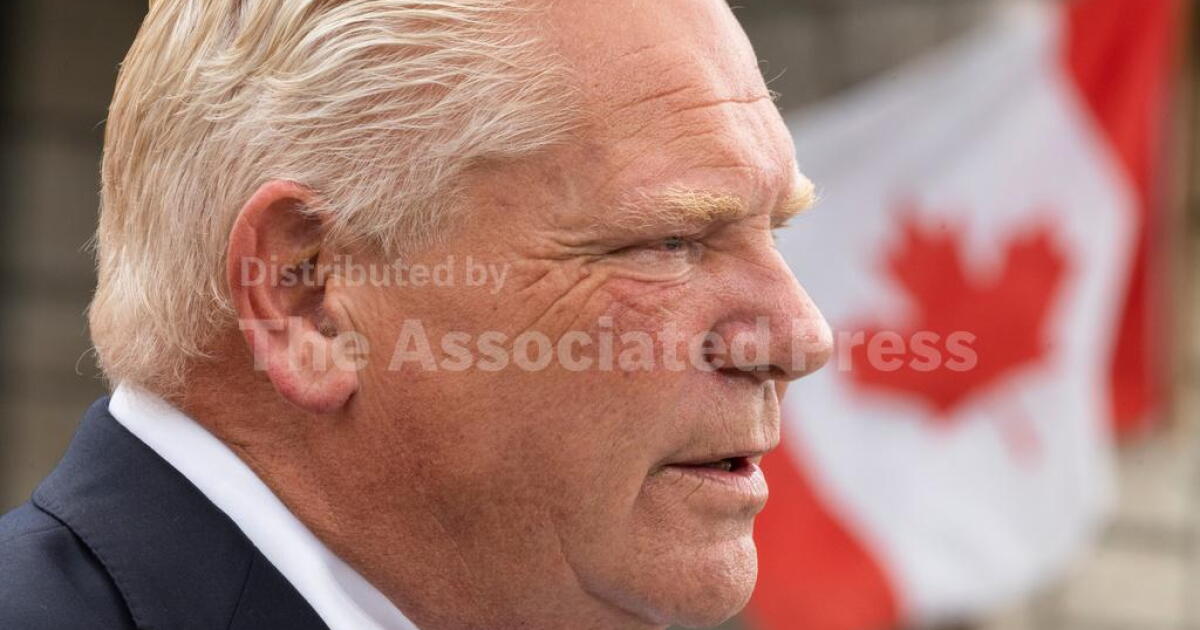
TORONTO — Ontario Premier Doug Ford said Thursday he hopes President Trump’s Republicans lose both the House and Senate in the midterm elections, saying voters should punish Trump politically for his escalating trade war with Canada.
“Hopefully he’s going to lose the Senate. He’s going to lose Congress. I hope so, and hold him accountable,” Ford said. “But we’ll see how that goes. We aren’t going to interfere in the U.S. election.”
Ford has emerged as one of Trump’s most outspoken Canadian critics, accusing him of trying to strip industry out of Ontario and move it south of the border as the two trade personal insults and threats.
Ford’s comments came two days after Washington escalated the dispute by banning some Canadian dairy products and motorcycles and most alcoholic beverages after Canadian retaliatory tariffs took effect on about $20 billion in U.S. goods. Trump also moved to shut Canadian products out of large, long-term U.S. government contracts.
“He’s not reliable at all,” Ford said. “He could make a deal today and then change his mind. And we’ve seen that over and over again.”
Still, Ford said he believes Trump wants an agreement before the midterms and that Canada should return to negotiations as soon as possible.
“I truly believe President Trump wants a deal before the midterms,” Ford said. “I could be wrong, but I think it’s best that we sit down and get a deal.”
Last year, Trump abruptly ended trade talks with Canada after Ford’s Ontario government aired an anti-tariff television ad in the United States using former President Ronald Reagan’s criticism of tariffs.
The feud repeatedly has turned personal. In an interview with the Associated Press last month, Ford mocked Trump for keeping a portrait of Reagan near his desk while pursuing tariffs the former president had criticized, saying Reagan would be “throwing up on him from the picture if he knew what was going on.”
Trump described him as “the less charismatic, intelligent, and overall unimpressive brother of the late, great, Rob Ford.”
Trump also signed an executive order directing the U.S. government to refer to Lake Ontario as “Lake America,” a name Canada does not recognize.
Ford said Thursday that Trump unintentionally strengthened Canada by forcing it to reduce its dependence on the United States.
“The only two good things Donald Trump has ever done for Canada,” Ford said, were that “he woke us up” and “he united the country like I’ve never seen before.”
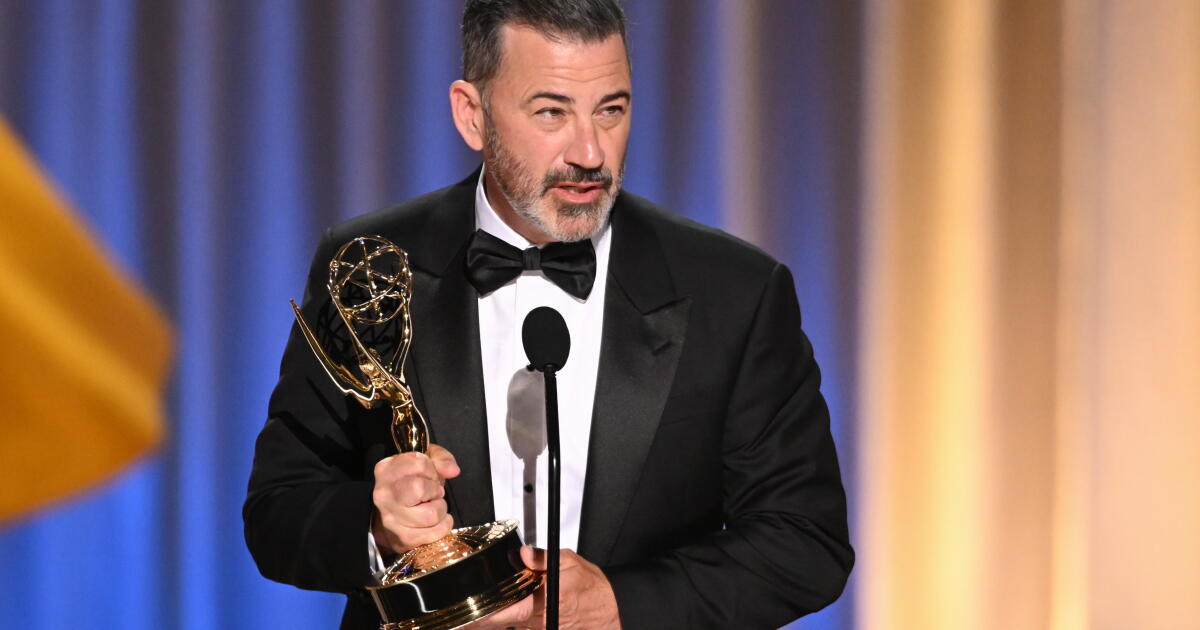
ABC comedian Jimmy Kimmel’s interview with Texas Senate candidate James Talarico won’t air on broadcast television amid the network’s high-stakes skirmish with the Federal Communications Commission.
Kimmel, during his Wednesday night monologue, said his talk with the 37-year-old Texas Democrat would instead stream on his show’s YouTube channel — depriving ABC viewers and TV stations of a potentially newsworthy interview with Talarico, who has been surging in the polls.
The Texas race is shaping up as a key contest in what could help decide control of the U.S. Senate in the mid-term elections.
Kimmel alluded to the Walt Disney Co. network’s ongoing dispute with FCC Chairman Brendan Carr as the reason for the switch. This spring, Carr’s Media Bureau ordered ABC to submit to an early review of its TV station licenses for Disney’s eight owned stations. The FCC launched the review a day after President Trump demanded Kimmel be fired after First Lady Melania Trump became upset over a joke the comedian told on his program, “Jimmy Kimmel Live!”
ABC has since sued the FCC, alleging Trump’s disdain for Kimmel and other ABC programs has fueled the FCC’s heavy-handed approach to the network, in violation of its 1st Amendment rights.
Kimmel pointed to the “unusual circumstances” in his monologue.
“For the whole 20-plus years of our show, in fact, I’ve been interviewing Americans who are running for office with no problem at all, just like [David] Letterman did, [Jay] Leno did, Arsenio [Hall], etc. etc.,” Kimmel said. “I’ve interviewed a lot of political candidates — from Hilary Clinton to Ted Cruz to Donald Trump.”
But, Kimmel said that in the current climate, airing the Talarico interview on the public airwaves carried too much risk.
“Out of consideration for our local stations, especially our ABC affiliates in Texas who would have to deal with this nonsense,” the ABC interview, which was scheduled for Thursday, would instead play on YouTube, he said.
ABC declined to comment. An FCC spokesperson did not immediately respond to a request for comment.
The issue surfaced nearly one year after a major dust-up when ABC temporarily benched Kimmel after comments he made on his show over the shooting of conservative activist Charlie Kirk. During that episode, Carr seemed to threaten Disney by saying that Kimmel should be punished.
“We can do this the easy way or the hard way,” Carr said. “These companies can find ways … to take action … on Kimmel or there is going to be additional work for the FCC.”
Two station groups removed Kimmel’s show, but ABC eventually stood by the comedian returning him to his perch the following week.
The Disney-owned station licenses were not set to expire for several years when the FCC demanded that Disney defend its stewardship of the outlets. The license for Disney’s KABC-TV Channel 7 in Los Angeles extends to 2030 but it is now being challenged.
The Burbank giant has asked a federal judge to issue a temporary restraining order and injunction to halt the FCC’s early station review.
ABC also is defending against an FCC probe into whether its daytime talk show, “The View,” should be entitled to an exemption from the so-called equal-time rule for political candidates who appear as guests.
Carr has challenged the status of “The View,” arguing that the topical chat show is not a bona fide news program and, thus, should not be entitled to the exemption.
The same issue tripped up former CBS late night comedian Stephen Colbert who interviewed Talarico in February — before his program, “The Late Show with Stephen Colbert, was canceled.
At the time, Colbert told viewers CBS lawyers forbid him from airing a Talarico interview on his program due to the FCC’s increased scrutiny of exemptions to the equal-time rule, an allegation that CBS disputed.
But Colbert’s interview played on the program’s YouTube channel — not the CBS network.
The FCC has said it was investigating ABC stations over whether the company’s diversity and inclusion policies are in violation of the Communications Act of 1934 and the agency’s rules, including its “prohibition on unlawful discrimination.”
Last week, the FCC asked a federal judge in Washington to dismiss ABC’s 1st Amendment lawsuit, calling Disney’s challenge to the early review “meritless” because the commission hasn’t made a decision on whether to escalate the matter or rescind Disney’s station licenses.
Kimmel ended his monologue, saying he was grateful for the YouTube channel “because in the America we live in right now, that is the best that we can do until November.”
On Sept. 11, 2001, there were no smartphones and no social media. What the country watched that morning — a jet airliner colliding with the south tower of the World Trade Center, the ash rolling through the streets, the paper still falling in the afternoon — was through a television set and the journalists who had to deliver the unfathomable details.
The jarring images shattered the peacefulness of a sunshine-filled late summer morning in New York.
“Everything seemed so perfect,” said MS NOW’s Chris Jansing, reflecting on the moments before anchoring her network’s continuous coverage. “It was another day of doing a job I loved, living in a city I loved.”
By nightfall, nearly 3,000 people were dead in lower Manhattan, at the Pentagon and in a field outside Shanksville, Pa. The experience of covering the terrorist attacks and their grim aftermath transformed Jansing and other journalists who were there. Twenty-five years later, it’s never far from their minds.
“It’s with me in ways large and small,” said NJ Burkett, a correspondent who covered the tragedy for New York station WABC. “When I look at my phone and it says 9:11, it takes me back.”
The Times asked five of the on-air personalities who are still working today to look back on the day they were called to cover the tragedy and its lasting impact.
Bret Baier: “I just said yes to everything.”
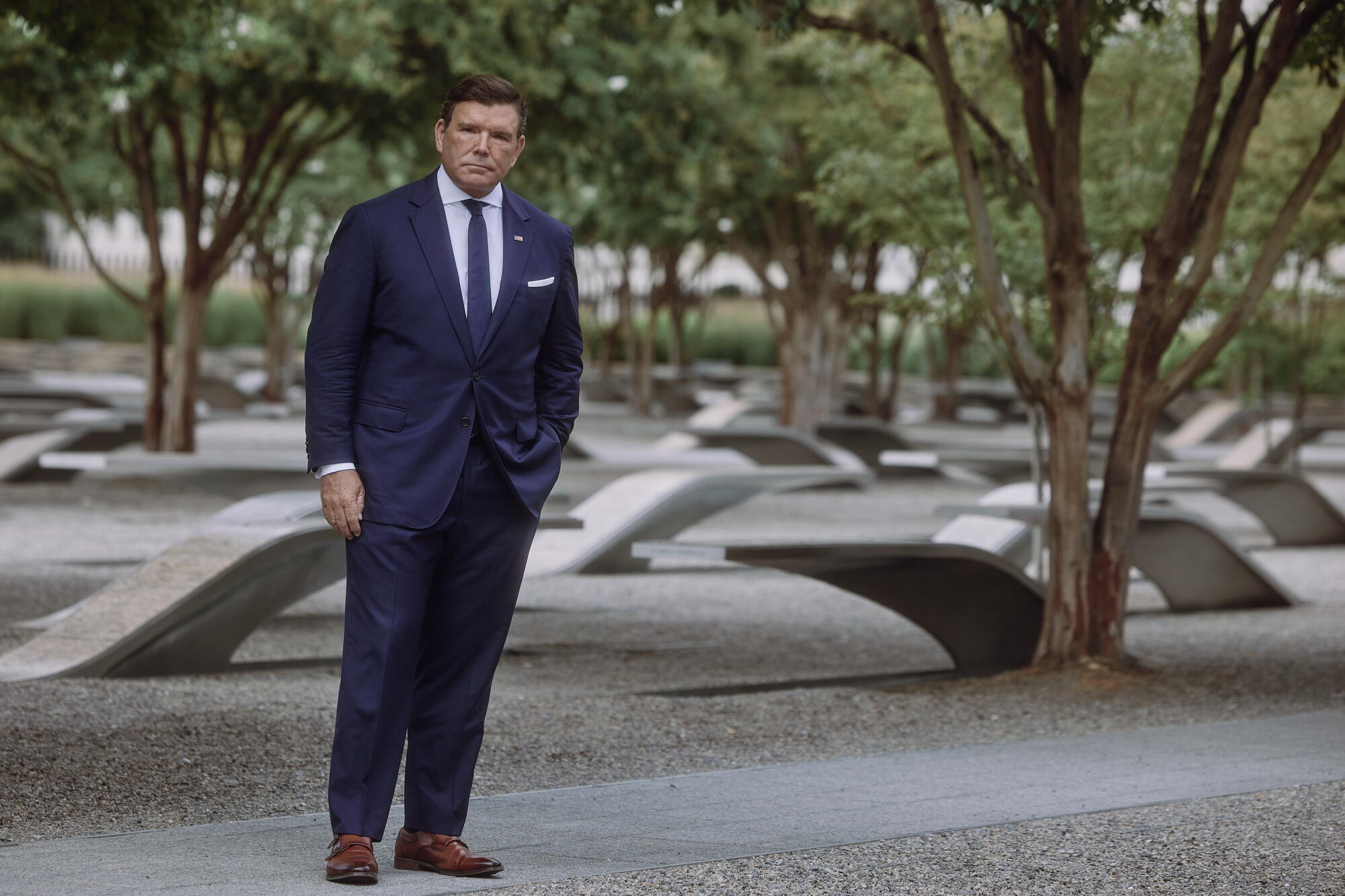
Fox News anchor Bret Baier at the National 9/11 Pentagon Memorial in Arlington, Va., on Aug. 25, 2026.
(Jared Soares/For The Times)
On every anniversary of Sept. 11, Fox News anchor Bret Baier uses the hashtag #NeverForget. He can recall every moment of that day.
Baier, 56, was driving to the Fox News bureau in Atlanta when he first heard on his car radio that a plane had hit the World Trade Center. He was a 31-year-old correspondent for the network, covering stories throughout the southeast U.S. and Latin America. When he arrived at the office, a call came from New York headquarters telling him to book a flight to the city so he could file reports from the World Trade Center site for Fox TV affiliates around the United States.
After a second plane hit the south tower of the World Trade Center 17 minutes later, all flights in the U.S. were halted. Baier and his producer were told to get a car and start driving.
“I just remember going really fast when I was driving,” Baier said. “I remember thinking what is happening with the world, and how big this story is. How big this moment is.”
By the time the duo reached northern Georgia, their plans changed again. A jetliner struck the Pentagon while a San Francisco-bound United Airlines flight crashed in Shanksville, Pa. Fox News executives told Baier and his producer to reroute to Arlington, Va.
After the 10-hour drive, Baier started the first of 10 straight days of reporting on the recovery efforts at the site. While the World Trade Center provided the most dramatic and enduring pictures of the stunning attack, the loss of life at the Pentagon was staggering as well, as 125 people died along with the 64 passengers and crew members on American Airlines Flight 77.
Baier was eventually pulled into the larger military story that followed 9/11. Fox News, just 5 years old, did not have a full-time Pentagon correspondent. Baier was offered the job while traveling overseas with Defense Secretary Donald Rumsfeld, who was making the case for war against Afghanistan.
“I called a buddy on a satellite phone to get me an apartment in Washington,” he said. “Fox packed up my stuff in Atlanta.”
But the unplanned move changed Baier’s life. In six years on the Pentagon beat, he traveled to 74 countries. He was embedded with the military in war zones. “I just said yes to everything,” said Baier, who has anchored Fox News’ Washington newscast “Special Report” since 2009.
Baier recalled it was in the weeks after Sept. 11 that he first wore an American flag pin on his lapel. He never felt conflicted about it, even though such displays were prohibited at other network news divisions. “I thought I could report on America, ask tough questions and still be an American, pulling for us to win,” he said. “I wanted to be tough but fair, but also show that as a country we were standing together against this horrible attack.”
Byron Pitts covering the terrorist attacks in lower Manhattan for CBS News on Sept. 11, 2001.
(CBS)
Byron Pitts: “It’s the only story I think about every day.”
A newcomer to New York 25 years ago, Byron Pitts, then a CBS News correspondent, admitted it took him a few moments to understand the massive scope of what happened the morning of Sept. 11, 2001. He arrived early at the network’s headquarters on the West Side of Manhattan to screen an interview he did with entertainer and civil rights icon Harry Belafonte. Shortly after he started, a producer knocked on his door and told him there was a plane crash at the World Trade Center.
Pitts, 65, acknowledged the producer but kept working. “I thought it was a novice pilot bumping into a building,” he recalled. “I thought it would be three hours out of my day and it won’t make television.”
The producer came back shortly and said, “You need to go down there.”
An irritated Pitts hailed a cab and headed down the West Side Highway. While in the car, he learned a second plane had hit the south tower. Traffic was stopped and he had to head downtown by foot.
As Pitts got closer to the site, he tried to use his past experiences covering fires and other disasters during his career to judge the severity of the situation.
But the horrible scenes that unfolded before him were incomparable. One was a lifeless body near the lobby of the north tower. He thought it was a homeless man until he saw a uniform. He later learned it was Father Mychal Judge, the chaplain of the New York Fire Department killed by fallen debris. Judge’s body was later carried away by a group of first responders. Pitts saw a woman and a man standing at a window of one of the towers holding hands, and then jumping.
“Gravity takes over and their hands split, and he moves a little faster than she does,” Pitts said. “And we see them on the ground. That was the moment I realized something significant was going on.”
Pitts crossed paths with Mika Brzezinski, then a CBS News correspondent, now the cohost of MS NOW’s “Morning Joe.” As debris came down and smoke filled the air, they headed into an elementary school that Pitts believes was a command post for the fire and police departments. They took turns calling into CBS News on a hard-line phone, one delivering accounts of the unfolding catastrophe while the other looked outside to gather details amid the blinding smoke and dust.
Pitts said from that day forward, he never went to a story assignment without a handkerchief.
Pitts was awed not just by the enormity of the event, but also by how despite the rigid hierarchy of CBS News, he was “the new kid on the block” who had to present the story on Dan Rather’s evening newscast that night.
“My approach became almost childlike, so I would not become overwhelmed,” he said. “I tried to make it as simple as possible. I said, ‘Dan, I’ve never heard New York City this quiet.’ I was thinking — what simple thing can I say that you would understand if you’ve never been in New York.”
A few weeks later, Pitts headed off to Afghanistan to cover the U.S. military action. His evening news report on Sept. 11 won an Emmy Award and his star rose at CBS News, leading to “60 Minutes” and then ABC News in 2014, where he is currently a co-anchor of “Nightline.”
Pitts knows the good fortune he’s had in TV journalism is linked to the tragedy that started with a producer’s knock on his door 25 years ago. “I feel some measure of guilt but mostly gratitude,” he said. “It’s the only story I think about every day.”
Pitts said he uses his 9/11 experience to provide perspective. “When we’re discussing politics, a mass shooting, or the latest awful day in Iran, I know for a fact there is one guy in the room who has seen worse and who can say, ‘we’ll be OK,’ ” he said.
Chris Jansing: “You had to balance the news response with the human response.”
Chris Jansing paid her dues as a local reporter in upstate New York before she joined MSNBC (now called MS NOW) as a daytime anchor in 1998. She loved living in Manhattan, and took friends from out of town to the World Trade Center observation decks and Windows on the World, the restaurant on the 106th floor of the north tower.
“It was so iconically New York,” she said. “And I was proud to live in the city.”
Jansing, 69, had little time to process her emotions when she was told to “get in the chair” before 9 a.m. that morning at MSNBC’s Secaucus, N.J., studios after the first plane hit.
“You had to balance the news response with the human response,” she recalled.
For several hours, Jansing co-anchored the network’s coverage alongside Gregg Jarrett. The look of 24-hour cable news evolved that day, as the tsunami of information led to Fox News, MSNBC and CNN all adding running tickers at the bottom of the screen.
Jansing went to the roof of the network’s building after Brian Williams took over the anchor chair. Trauma centers in the area had been alerted, and she was told to watch for ambulances. “There was still a hope and a prayer that there would be injured folks who would overwhelm the hospitals in New York and would need to be brought to New Jersey,” Jansing recalled. She saw none.
Jansing has never watched the coverage of that day, which is now on YouTube. She had real-life reminders every day in her Manhattan neighborhood when she walked by the Rescue Company 1 firehouse that lost half its battalion at the crash site. She adopted a dog left behind by a 9/11 victim, a Dachshund named Baron. She remains friends with every producer she worked with on the story. The experience also reinforced her purpose in a career approaching its 50th year.
“I will always think that those moments are what keep you going,” said Jansing, currently chief political reporter for MS NOW. “They were an affirmation that’s kept me in the job,”
NJ Burkett, a correspondent for WABC, on the 13th floor of the Walt Disney Co. offices in Manhattan on Aug. 31, 2026.
(Roshni Khatri/For The Times)
NJ Burkett: “I put myself in increasingly dangerous situations.”
Burkett, 64, recalls how pedestrians were gathered around WABC’s windowed street level studio on the Upper West Side of Manhattan when he arrived for work on 9/11. He presumed the crowd was there for a big name guest on “Live with Regis and Kelly.” They were actually watching monitors showing news reports of the first plane that hit the north tower.
As Burkett and his cameraman Marty Glembotzky headed downtown in a truck, he already knew it was a terror attack. He recalled covering the 1993 terrorist bombing of the World Trade Center and regretted not getting footage of the firefighters’ rescue efforts. This time around he wanted to go inside the buildings and document their heroism.
A police officer stopped Burkett and Glembotzky before they could get in, likely saving their lives. A short time later, they would escape death again.
Burkett was doing a second take for a taped report that would set the scene for viewers when he heard the rumbling that “sounded like Niagara Falls.” It was the south tower of the World Trade Center coming down behind him. “A huge explosion now raining debris on us — we better get out of the way,” he said in what may be the most terrifying video clip from that morning.
Burkett and Glembotzky took cover in an adjacent building. “We open up the door and in a weird way it’s sort of providential, right?” he said. “The door is a metaphor. It’s like the door into the rest of your life. If we had to run for half a block, we’d be dead.”
Glembotzky was so shaken by the experience, he stepped away from his career as a cameraman and became a wine seller before eventually returning. But Burkett took on more dangerous assignments in the Middle East, heading to Israel to cover the Palestinian uprising known as the Second Intifada. He later headed to Iraq to cover the run-up to the U.S. invasion in 2003.
Burkett won a George Foster Peabody Award for his work on 9/11. In retrospect, he believes he took on assignments in war zones to avoid dealing with the trauma of the day.
“I would put myself into increasingly dangerous situations,” he said. “Looking back, I was running from 9/11. That was my way of coping. Sometimes I wonder did I allow myself feel it enough. Or did I just run too far and too hard and it will all come down and crash on me one day?”
Occasionally he worries about 9/11-related illnesses. “If I start to cough — the slightest little cough — I’ll think ‘is this it?’” he said.
But as a New York TV fixture since 1989, Burkett still feels the appreciation from viewers for his efforts. “To this day, almost 25 years later, people will come up to me on the street and ask to hug me and say ‘NJ Burkett I’m glad you’re alive,’ ” he said.
Carson Daly at NBC’s “Today” show studio at Rockefeller Plaza in Manhattan on Sept. 3, 2026.
(Roshni Khatri/For The Times)
Carson Daly: “I remember how motionless the room was.”
As continuous news coverage of the Sept. 11 attacks saturated television for days, the makers of entertainment shows had to decide when it would be appropriate to go back to work. Carson Daly and the MTV executives mulled over the situation as their wildly popular program “Total Request Live” remained off the air for three days since the attacks.
“We had such a massive audience that the question was raised, ‘do we have a responsibility to simply show up?’ ” Daly, 53, recalled in a recent interview.
Daly, now a feature anchor on NBC’s “Today,” was not a journalist by trade. But he understood the trust that young viewers had in him and “TRL,” a live show that counted down the most popular music videos of the moment. The show had dealt with tragedy a few years before after the high school shooting in Columbine, Colo.
But 9/11 happened on the home turf of “TRL,” which aired from New York City’s Times Square. With the bridges and tunnels closed, getting a crew to the studio was a challenge.
“Everybody wore multiple hats,” said Daly, who also served as an executive producer.
By Sept. 14 of that week, the MTV studio on Broadway was filled with young “TRL” fans, but lacked the energy viewers were used to seeing on the screen. “They were frozen,” Daly recalled. “That was in such stark contrast to what the show was every day. I remember how motionless the room was and feeling like, ‘What am I doing on television?’ ”
Carson Daly shows a tattoo he got after the 9/11 attacks in New York.
(Roshni Khatri/For The Times)
Daly leaned on the MTV News team to update the audience on the 9/11 story developments. Music stars including Jay-Z, Justin Timberlake and Kid Rock called into the program to share their thoughts with Daly. Instead of music videos, the screen showed email messages from viewers expressing their feelings about the tragedy.
MTV News personality Sway delivered a music news report that noted how two new CD releases — “Party Music” by the American hip-hop group The Coup and Dream Theater’s “Live Scenes from New York” — were delayed because both used cover artwork that depicted the destruction of the World Trade Center.
Daly has a permanent remembrance of the week. When he arrived at the MTV offices the day before “TRL” returned, the building was evacuated after it received a bomb threat.
“I remember walking around Hell’s Kitchen,” he said. “I ended up getting a tattoo. A red, white and blue NYC on my right wrist.”
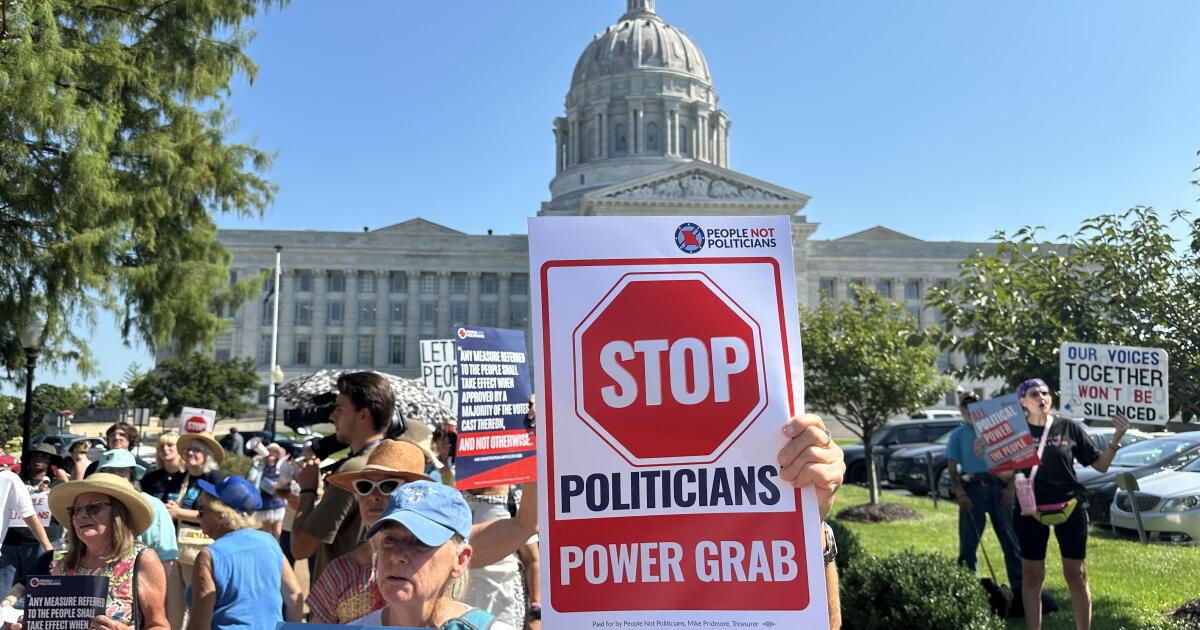
JEFFERSON CITY, Mo. — The U.S. Supreme Court again rejected a push to use Missouri congressional maps backed by President Donald Trump on Thursday, a loss for Republicans trying to maintain control of the House in the fast-approaching midterm elections.
The decision appears to clear the way for use of the old maps.
It comes after a pitched court battle shortly before ballots begin going out for the pivotal November elections. The maps were drawn to help Republicans gain an additional U.S. House seat.
It’s the second time the high court has refused to intervene to keep the Trump-backed maps in place.
A sweeping bipartisan bill that seeks to prevent catastrophic wildfires and restore fire-ravaged forests has revealed a schism in the nation’s environmental movement as some conservation advocates find themselves allied with a longtime foe: loggers.
The Fix Our Forests Act, which Congress is close to passing, aims to speed up forest management projects on public and tribal lands by reducing regulatory and legal hurdles.
The proposed legislation comes at a time of increasingly devastating wildfires and has garnered wide support among Republicans and the timber industry.
However, the traditional Democratic coalition of environmental groups is split over the role humanity has to play in forest management. Some argue ecosystems are best protected when humans leave them alone — a view that dominated during the timber wars of the ’80s and ’90s. Others argue that humans have a responsibility to intervene — an increasingly popular idea as climate change threatens ecosystems around the world.
Among the major environmental groups that oppose the legislation are the Sierra Club and Center for Biological Diversity. They worry that limiting environmental review and litigation will allow timber companies to heavily log these areas instead of gently thinning them. Meanwhile, some Southern California groups worry the bill would allow well-meaning land managers to approve misguided projects that ultimately harm local shrublands, which have a very different relationship with fire than the bill’s namesake, forests.
“It’s really handing the keys to the Trump administration to be able to push forward a lot of their timber agenda,” said Anna Medema, deputy legislative director for forests and public lands at the Sierra Club.
But the Nature Conservancy and other groups have voiced support for the bill, citing the constant and imminent threat that increasingly severe wildfires pose to communities and ecosystems.
“We do advocacy at a twofold level. We are doing defensive work to fight back against bad things, and we’re also trying to promote the good things that are happening on the ground,” said Morgan Cashwell, North America director of legislative affairs for the Nature Conservancy. Right now, that good work needs to “meet the moment in the current wildfire crisis.”
That sentiment appears to have motivated Western lawmakers in particular.
In the House of Representatives, roughly half of the Democrats from Western states voted for the bill, compared to about a quarter of Democrats from elsewhere in the country. Republicans voted overwhelmingly in favor. The legislation is now awaiting a final vote in the Senate. Congress has until Jan. 3, 2027, to pass it.
“Wildfires today are very different than wildfires from a generation ago,” said Sen. Alex Padilla (D-Calif.), who co-introduced the Senate version of the bill. “Oftentimes, they’re irreversibly devastating ecosystems and watersheds.”
“So,” he said, “ the status quo is clearly not working.”
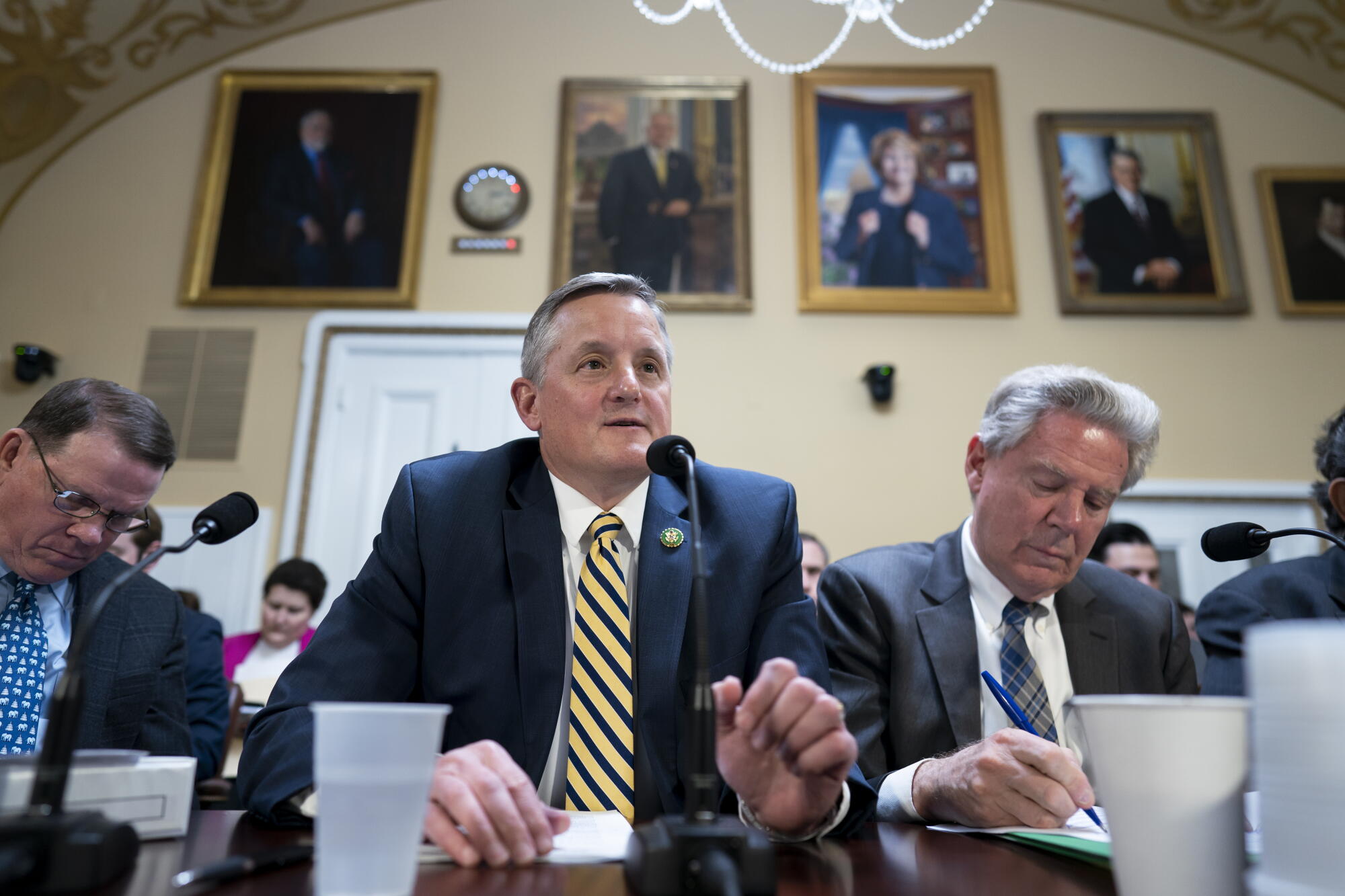
Rep. Bruce Westerman (R-Ark.), center, chairman of the House Committee on Natural Resources, delivers remarks at the Capitol in March 2023.
(J. Scott Applewhite / Associated Press)
The act was born when Rep. Bruce Westerman (R-Ark.), a former forester, stole a seat on a plane next to Rep. Scott Peters (D-San Diego). He used the opportunity to talk Peters’ ear off about a beloved species of tree that is under threat from worsening wildfires: the giant sequoia.
The two introduced a bill to protect them, called the Save Our Sequoias Act, and quickly saw an opportunity for something bigger.
“I knew right away that this could be a gateway to talking about permit reform,” Peters said. So, “we started working on a bigger, nationwide reform of forestry practices which have been really, really clogged up.”
While California grasslands, shrublands and woodlands are adapted to different frequencies and intensities of wildfire, research has found that high-severity fires — which kill the vast majority of trees in their path — are scorching 30 times more land area than in the 1980s.
The result: California is losing, on average, more than 200,000 acres of forest every year — or roughly 2.5% of all woodlands in the state every decade. U.S. Forest Service efforts to resuscitate these ecosystems have failed to keep pace. In recent years, the agency has reforested only about 1% of woodlands that are unlikely to recover on their own.
Californian supporters of the Fix Our Forests Act argue the problem has more to do with permitting delays than finances.
Marin County firefighters train during a prescribed burn in June in San Rafael.
(Heather Diehl / Getty Images)
Rep. George Whitesides (D-Santa Clarita), who co-sponsored the Fix Our Forests Act, pointed to nonpartisan research that found it takes the Forest Service more than five years on average to complete a full environmental review and begin work on forest thinning projects that use mechanical equipment like bulldozers and wood chippers. For prescribed burns, it takes more than seven years on average.
“That’s insane,” he said, that it “takes as long as a kid growing up to be a first grader to be able to move on this.”
The Fix Our Forests Act would exempt projects from the full permitting process if they were in areas with the most extreme fire risk and would expand existing exemptions for projects under 3,000 acres to cover projects up to 10,000 acres. It also would limit the window during which environmental groups can sue over project approvals.
These projects tend to employ a combination of harvesting timber and thinning smaller trees and plants with heavy machinery (often the favored tools of Republicans and the timber industry) and using prescribed fire to clear out the forest floor (often favored by environmental groups).
The “environmental left” has “made it endlessly time-consuming and ultimately cost prohibitive to maintain our forests, all with the promise that this would improve the forest environment,” said Rep. Tom McClintock (R-Elk Grove), a co-sponsor who authored some of the permitting exclusions. “Well, after 50 years, I think we’re entitled to ask, how’s the forest environment doing?”
In March 2025, President Trump issued an executive order that blamed “our inability to fully exploit our domestic timber supply” as a contributor to disastrous wildfires. In response, the U.S. Forest Service set a goal to increase the amount of timber open to logging by 25% nationwide over five years.
Scott Dane, executive director of the American Loggers Council, argued the nightmare scenarios of expansive clear-cutting from the timber wars are not on the table for America’s public lands.
“It’s a boogeyman position that they love to take from 100 years ago,” he said. “It’s not, in reality, in modern forest management at all.”
Watchdogs in Southern California have a different concern: While research shows forest thinning is an effective tool in overgrown Sierra Nevada woodlands, the state’s coastal shrublands are not denser than they historically have been. Consequently, the type of projects the Fix Our Forests Act would expedite are far more controversial and contested in shrublands. Local advocates fear the act would undermine their ability to push back on proposals with questionable scientific backing.
Goats and sheep graze on top of Kite Hill in May 2025 in Los Angeles for wildfire prevention.
(Juliana Yamada / Los Angeles Times)
In contrast to projects in conifer forests that aim to decrease the density of trees and vegetation across the landscape, shrubland projects are typically centered on creating a network of corridors hundreds of feet wide with no vegetation throughout the wildlands and clearing plants away from existing buildings.
While firefighters rely on these networks of fuel breaks to access the wildlands during fires and build containment lines, research has found that when firefighters cannot reach the fuel breaks — which is often the case during extreme winds — the lines only stop fires about 13% of the time. If they are not routinely maintained, they also risk supporting the growth of flammable invasive grasses.
In Los Padres National Forest, near Santa Barbara, officials proposed in 2022 creating roughly 187,000 acres of fuel breaks and structure defense zones. After organizations like Los Padres ForestWatch pushed back on the plan through the environmental review process, the national forest ultimately scaled the proposal down to about 22,000 acres this July.
“You had community input, and you had the federal government incorporating that input into a plan that is grossly improved,” said Benjamin Pitterle, director of advocacy and field operations at Los Padres ForestWatch. “It’s arguably a perfect example of how the process should work.”
Companies and special interest groups with some of the diciest issues expected to land on California’s next governor’s desk are among the top financial backers of Democrat Xavier Becerra, the gubernatorial front runner.
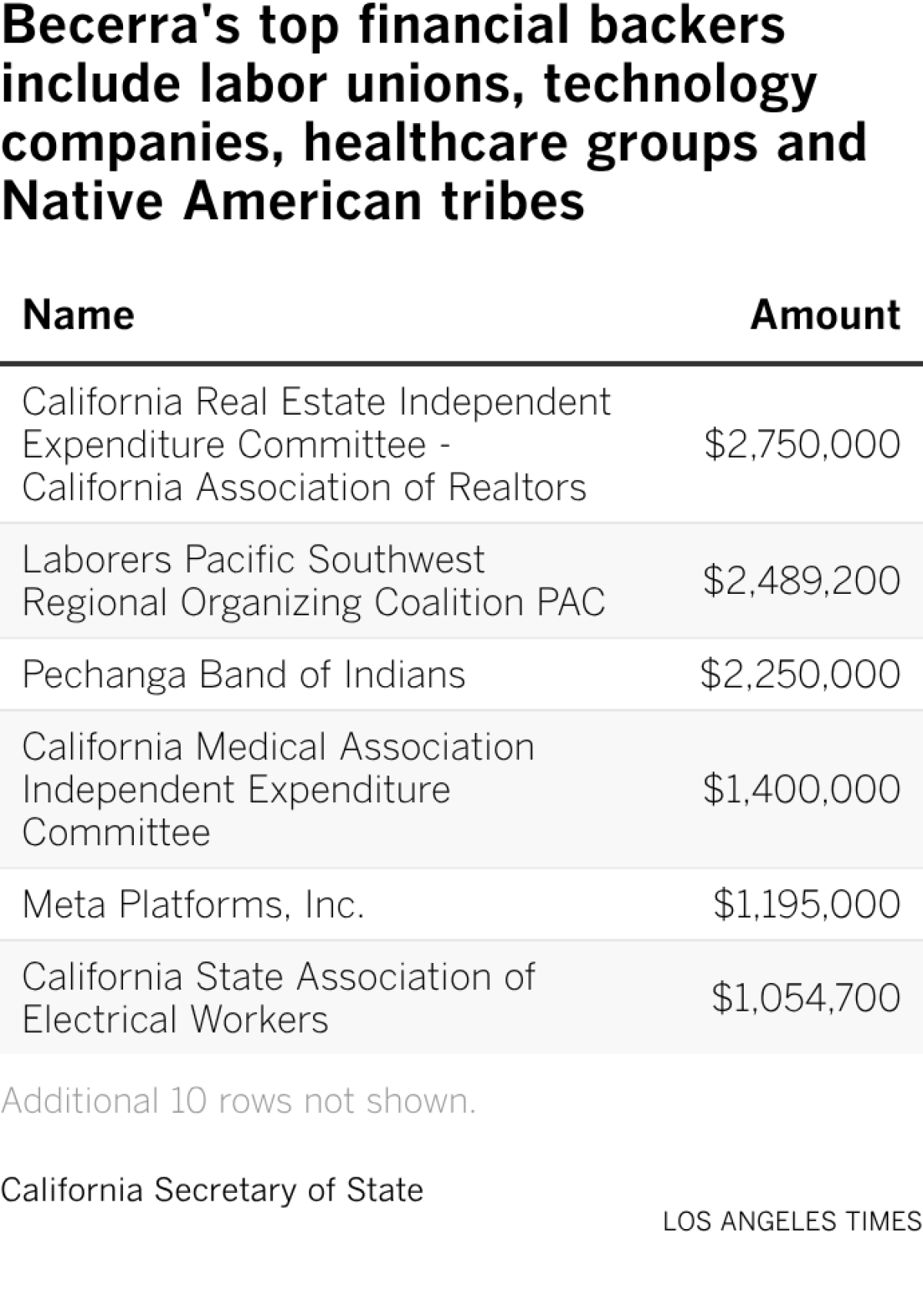
Money from Big Tech, the healthcare industry, labor unions and tribes helped propel Becerra’s bid for governor, which languished at the outset then took off just months before the June primary. All are major players in national and state politics and have a major financial stake on the policies of California’s next governor.
Meta, which has contributed nearly $1.2 million to groups backing Becerra’s campagin, has faced mounting scrutiny by lawmakers and the courts. The Menlo Park-based company, which operates social media and communication platforms such as Facebook, Instagram and WhatsApp, just agreed to a landmark $17.1 billion settlement to resolve multi-state claims that its apps endanger children.
The state Legislature in August also passed a measure to bar social media platforms from providing an “addictive feature” to lure children, as well as bills to shield Californians from threats posed by the boom in artificial intelligence and data centers. The fate of these measures is now in the hands of Gov. Gavin Newsom, and the next governor likely will have to decide whether approve even stricter controls on Big Tech.
Meta is among eight donors that wrote seven-figure checks supporting Becerra’s gubernatrial campaign, with most of he money funneled to independent committees backing the Democrat that are not allowed to legally coordinate with the candidate. Campaigns often find back doors to do so.
Former state Sen. Steve Glazer, a Democrat who ran Jerry Brown’s successful 2010 gubernatorial campaign, said such spending is not surprising.
“Look, millions and billions of dollars are at stake, and the governor is the central point for all of that in California,” Glazer said. “It’s not a gamble anymore. You’re not picking a winner or a loser, right? So the floodgates open up for a runaway winner like Xavier Becerra.”
Becerra, the former secretary of the U.S. Department of Health and Human Services and a longtime congressman, won one of the top two spots in the chaotic June primary. Republican Steve Hilton, a conservative media commentator and strategist who was endorsed by President Trump, won the other slot to advance to the Nov. 3 election. Becerra is considered a heavy favorite to win, given that Democratic voters in California outnumber Republicans nearly 2 to 1.
Becerra has the financial edge in the race, raising at least $30 million while also receiving significant support from the independent committees. Donors have contributed $48.8 million to Becerra’s campaign committee as well as outside efforts supporting his bid, according to a Times analysis of contributions through Sept. 3.
A Becerra spokesman said that although the campaign welcomed support from any donor, he would not weigh their contributions as he makes policy decisions if elected
“Xavier Becerra is laser-focused on making California work for working people — lowering costs, building housing, and making this state affordable again,” said Jonathan Underland, a spokesman for the Democrat. “Anyone willing to stand with us in that fight is welcome to join it, and we won’t hesitate to challenge anyone who gets in the way of that goal.”
His GOP rival raked in $18.8 million, including a $90,100 contribution from the candidate himself. Hilton’s top donors are billionaires and business executives including manufacturer Donald Friese and his wife Andrea, Silicon Valley billionaire Tim Draper, former Fox Corp. Chairman Rupert Murdoch, Google co-founder Sergey Brin, Los Angeles real estate magnate Geoffrey Palmer and the founder of defense contractor Anduril Industries, Palmer Luckey.
Executives and employees at Lighthouse Worldwide Solutions Inc., a company that makes contamination monitoring systems, contributed more than $474,000 to Hilton’s campaign.
A small handful of donors gave to both candidates. Uber and its employees gave nearly $42,000 to Hilton, while the company and an affiliated political action committee spent $1,039,200 supporting Becerra. Vlad Tenev, founder of the financial trading platform Robinhood, gave $289,000 to Becerra and $15,000 to Hilton.
A committee ostensibly established to oppose Hilton, an effort that effectively propped him up among Republican voters before the June primary, raised $2.5 million through large donations from the California Nurses Assn., the Service Employees International Union, the Democratic Governors Assn. and wealthy businessman Bill Bloomfield, an unsuccessful congressional candidate and Republican-turned-Democrat.
Hilton said Becerra’s financial backers are unsurprising and illustrate the “corruption” created by one-party rule in Sacramento.
“All these businesses and organizations assume he’s going to be the next governor, so they’re trying to bribe him,” Hilton said in an interview. “You can call it donations if you want, but it’s actually legalized bribery. … Big business and special interests are shoveling cash into his mouth in the hope that they can bribe him to do their bidding.”
Becerra, who served in public office for nearly 35 years, has a long history of support from powerful industries, labor unions and others with business before the government. During his 24 years in Congress, donors spent roughly $11 million supporting Becerra, according to the Times analysis and Open Secrets, a nonprofit, nonpartisan tracker of campaign fundraising. While he served as California attorney general for four years, contributors spent nearly $9.4 million backing him.
Among the former Biden Cabinet secretary’s top financial backers in the governor’s race are labor unions, healthcare groups, tech companies and Native American tribes that own some of the state’s splashiest casinos. All will probably be affected by decisions made by the next governor.
The Laborers’ International Union of North America and local affiliates and political arms, focused on infrastructure projects and the creation of union jobs, has contributed nearly $3.2 million. A committee associated with the California Assn. of Realtors that is focused on housing, real estate policy and property rights has spent nearly $2.8 million backing Becerra.
The Pechanga Band of Indians chipped in more than $2.3 million to efforts supporting Becerra at a time that gaming issues continue to be scrutinized.
A Pechanga representative said the tribe’s leader was unavailable due to travel but pointed to a statement he made before the primary.
“Secretary Becerra has stood with Indian Country for decades and understands Tribal sovereignty. When tribal healthcare was on the line, he was there,” said Tribal Chairman Mark Macarro. “This experience comes from a lifetime of public service, not a checkbook.”
The California Medical Assn. has spent nearly $1.5 million backing Becerra at a time of deep impending federal healthcare funding cuts and efforts by the state to backfill that lost financial support.
Dr. René Bravo, president of the California Medical Assn., which represents more than 50,000 physicians, said their spending was spurred by the their belief that Becerra is the best candidate to take on impending federal healthcare funding cuts that will harm millions of Californians access to care.
“Xavier Becerra understands healthcare and the challenges facing patients and physicians. The next governor will make critical decisions on MediCal, the physician workforce, affordability and access to care,” Bravo said. “We’re investing in this race because those decisions will directly affect California patients and physicians.”
Meta declined to comment on its contributions, and the Realtors and the Laborers did not respond to requests for comment.
Becerra, asked about the Realtors’ large donations supporting his campaign, noted that most of the money was contributed to committees outside his control. But he argued that his policy priorities have long been clear, including when he was an afterthought in the gubernatorial race.
“I was pretty clear in the primary, where I wasn’t getting as much support from a lot of different folks,” Becerra said Fridayat a news conference in north Long Beach supporting Proposition 1, a proposed $11.25-billion bond measure on the November ballot to boost affordable housing construction around the state.
“What I will tell you is this: Take a look at my record. Take a look at what I’ve said, and rather than look to inflated promises, look at what I’ve done in my record,” Becerra said, standing in front of Laborers’ International Union of North America members clad in orange safety vests. “And I will tell you, I have built, not just as a public servant, but when I was wearing myself that orange vest as a construction worker, as a laborer for Local 185, in my younger years, I was out there helping build. And so what we’re going to do is we’re going to do what we need to do, regardless what the voices say. We’re doing it because the people demand it.”
Fossil fuel and renewable energy firms have also supported Becerra, notably Chevron and affiliated groups and employees, spent more than $1.1 million boosting his bid — money that his Democratic rivals in the governor’s race and other critics, including climate activist Jane Fonda, pounced upon before the primary.
Billionaire hedge fund founder Tom Steyer deployed mobile billboards touting Becerra saying “You need Chevron, I need Chevron,” a clip from a longer comment about how every Californian doesn’t drive an electric car.
Chevron did not respond to a request for comment.
Earlier this year, Becerra was a single-digit polling afterthought in the crowded race to replace Newsom, who is termed-out. But after a dizzying primary that included a potential front-runner, then-Rep. Eric Swalwell (D-Dublin), dropping out amid allegations of rape and sexual assault, Becerra took the lead in the Democratic field and placed first in the June election.
Becerra, 68, has a long career in elected office, serving two years in the state Assembly, 24 years in Congress, four years as California’s attorney general, and four years in the Biden administration.
While he was in Congress, donations to his federal campaign committee grew dramatically, according to an analysis of Federal Election Commission documents provided by Open Secrets.
In the early 1990s, Becerra was receiving donations in the low six figures, but by the end of his time in Congress, he was receiving well over $1 million during each two-year electoral cycle.
Finance, insurance and real estate firms and trade groups, such as Charles Schwab, the National Assn. of Insurance and Financial Advisors, the New York Life Insurance Co., Merrill Lynch and Pacific Life Insurance, were major supporters of Becerra, who served on the powerful House Ways and Means Committee, which regulates taxation. Such donors contributed more than $2.6 million to his congressional bids, according to Open Secrets.
Healthcare interests came in a close second, contributing more than $2.4 million to his congressional campaigns in the years before he was nominated and confirmed as Biden’s secretary of Health and Human Services, according to Open Secrets. Among the groups that supported Becerra’s federal campaigns included organizations representing physical therapists, anesthesiologists, podiatrists, assisted living and long term care facilities, and dietitians. While in Congress, Becerra was a strong advocate and supporter of the Affordable Care Act, a landmark healthcare overhaul championed by former President Obama.
Labor donated more than $1.7 million to Becerra’s congressional bids, a trend that continued when he ran for attorney general. Unions representing laborers, electrical workers, pipe fitters and firefighters donated $1 million, according to the Times analysis. The number has spiked to $6.3 million for Becerra’s gubernatorial bid.
Lorena Gonzalez Fletcher, president of the powerful California Labor Federation, said Becerra’s personal and political resume are significant at a time when the next governor will need to tackle artificial intelligence and the potential resulting job losses, the state’s volatile budget and federal funding cuts to MediCal and Medicare.
“He comes from a union family,” she said. “He has a long history of being on the right side of working people in a lot of different roles — in Congress, as attorney general and as secretary of Health and Human Services.”
President Donald Trump pledged Wednesday to send every American adult $5,000 if Republicans retain control of the House and Senate in the midterm elections, an extraordinary gambit to reverse his party’s sagging fortunes in November.
The dubious promise would likely cost more than $1 trillion and require congressional approval, and would further exacerbate the country’s nearly $1.8 trillion annual budget deficit and concerns about inflation.
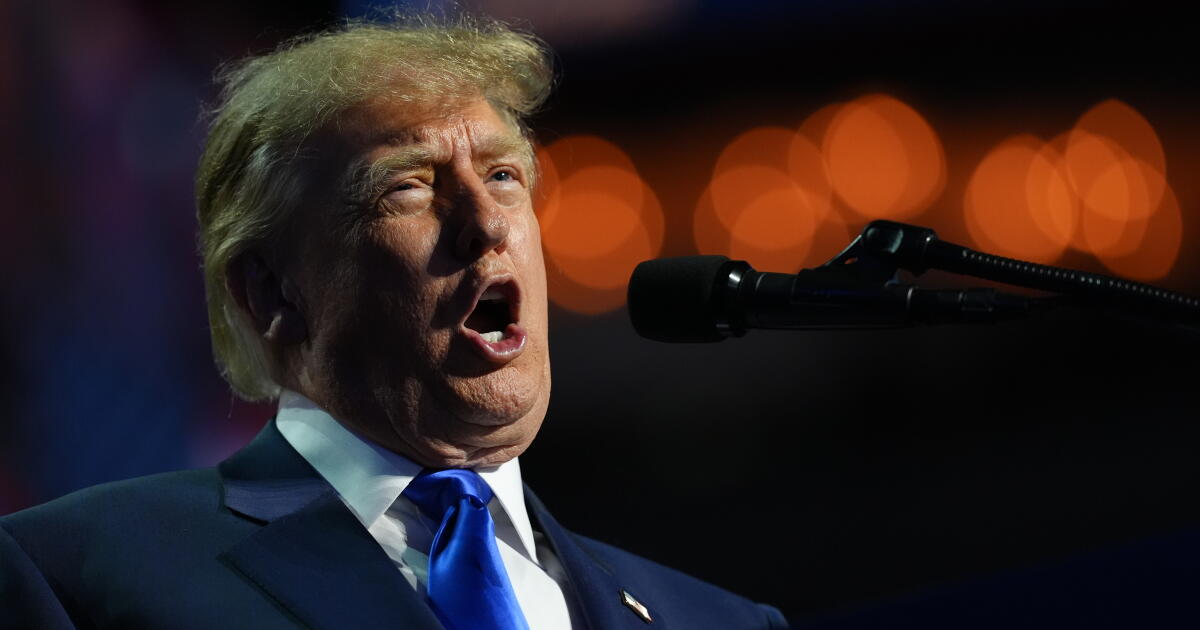
“If the Republicans win, you win with us and you get $5,000,” Trump said during the GOP’s midterm convention in Dallas. “It will be called the Trump Dividend.”
He likened the payments to a corporation’s distributions to shareholders, citing “our tremendous strength and success economically.”
Within an hour, Vice President JD Vance appeared to try to walk back Trump’s proposal — at least in part — by suggesting the dividend payments would not go to the wealthy. Vance suggested it could be paid for by U.S. tariff revenues, though the suggested payment dwarfs what the U.S. has taken in through the protectionist measures.
The White House did not respond to a message seeking details.
Congress would need to approve or otherwise acquiesce to the payment. The sum would far exceed U.S. tariff revenues even before the Supreme Court tossed much of the president’s tariff program last year.
The national debt last month topped $40 trillion for the first time.
Trump has frequently lamented that, during the modern era, the president’s party almost always loses seats in Congress during the midterms, and he has looked for unorthodox ways to defy the trend, including this week’s convention.
“We’re going to change that,” Trump said. “There’s no reason for it.”
Marc Goldwein, the senior policy director at the Committee for a Responsible Federal Budget, a think tank in Washington, said Trump has no authority send money to Americans without approval from Congress.
Goldwein added that dividends are something that companies pay when there’s a surplus, but the U.S. is running $2 trillion annual deficits and has $40 trillion in debt.
“The idea that we’ve had fiscal success is backwards and bordering on laughable,” he said. “We don’t have surpluses to give away.”
The move was reminiscent of billionaire Elon Musk’s efforts to buy votes in last year’s Wisconsin state Supreme Court race, where he handed out million-dollar checks to voters to try to boost a candidate who ultimately lost.
Trump has discussed the possibility before but has never tied it to his party’s electoral fortunes. Earlier this year, he proposed a $2,000 dividend and said he didn’t think he needed approval from Congress.
Get our L.A. Times Politics newsletter
The latest news, analysis and insights from our politics team.
By continuing, you agree to our Terms of Service, which include arbitration and a class action waiver. You agree that we and our third-party vendors may collect and use your information, including through cookies, pixels and similar technologies, for the purposes set forth in our Privacy Policy such as personalizing your experience and ads.
Last year, Trump gave members of the military a $1,776 check that he called a “warrior dividend.”
“I will get a bill ready so that we can get the Trump Dividend passed immediately after the November 3rd election,” Republican Sen. Bernie Moreno of Ohio wrote on X late Wednesday. “Because Republicans (and America) will win!”
A $5,000 check would give each American more money than they received in direct government payments from COVID-19 relief measures during Trump’s first term.
Trump’s proposal would be legal because the payment would go to everyone regardless of how they voted, or whether they voted at all, said New Mexico-based attorney John Day.
“This is a campaign promise,” Day said. “It’s not a payment to individuals to try to get them to vote in a particular way.”
Republicans are on defense as they look to defend their narrow House majority against strong headwinds. Trump is unpopular, and Americans overwhelmingly oppose the war in Iran. Even the Senate, which Republicans once were well-positioned to keep, is up for grabs.
Cooper writes for the Associated Press. Associated Press writers Lisa Mascaro and River Zhang contributed.
War in the Middle East. The hottest summer on record in the U.S. AI getting as scary as “Terminator 2: Judgment Day.” An eroding coastline. A president who spends more time posting pathetic memes than improving the lives of everyday Americans.
It sure seems like we’re living in the End Times, right?
Why, we haven’t even reached the most frightening part of 2026: Election Day, when false prophets will besmirch ballots as the Great Deceiver, also known as Donald J. Trump, does everything possible to maintain his reign.
While people should research candidates and ballot initiatives before deciding how to vote, I also suggest that they read up on some of the thousands of saints recognized by the Catholic Church. You don’t have to belong to the faith to find wisdom in the lives of people who dealt with trials and tribulations far harder than ours and are now considered worthy of emulation.
This campaign season contains all sorts of scenarios screaming for holy intervention. We should pray extra hard to these saints for the next two months:
St. Homobonus: The Catholic Church recognizes no patron saint for the wealthy, since Jesus preached that it was easier for a camel to go through the eye of a needle than for a rich man to enter heaven. Captains of industry instead venerate this 12th century Italian nepo baby, who ran a successful clothing business yet gave most of his earnings to the poor. If tech bros followed St. Homobonus’ example, that would be a far more convincing argument against Prop. 40, the California ballot initiative that would impose a (supposed) onetime tax on billionaires, than what they’re doing: whining about socialism, threatening to leave California and spending tens of millions of dollars on ads that voters are already tuning out or tossing in the trash.
Archangel Gabriel: His role in telling the Virgin Mary she would become the mother of Jesus makes my brother’s namesake the patron saint of mail carriers. With Trump doing everything possible to ban mail-in voting — and a compliant Postal Service leadership eager to do his bidding — here’s to hoping Archangel Gabriel calls up his winged homeboys Michael and Raphael, fights off all electoral Satans and ensures a fair election.
St. Benedict: Patron saint of exorcisms. Someone place his prayer card at all the city halls in southeast L.A. County to rid the area of civic corruption once and for all!
St. Peter Claver: Chapters of the Knights of Peter Claver — the oldest Black Catholic fraternal organization in the U.S. — exist in parishes across South L.A. Some in the area are fretting because, for the first time in 63 years, not all of its three City Council seats will be held by Black representatives. With Curren Price terming out, a Latino immigrant — either Jose Ugarte or Estuardo Mazariegos — will capture the District 9 seat. May the winner follow the example of Claver, who spent his life advocating for Black people in Colombia despite the fact he was a white Spaniard, and ensure that Black Angelenos — now only 8% of the city’s population — continue to have strong representation at City Hall.
St. Augustine: The founder of the Augustinian order to which Pope Leo belongs, he’s the patron saint of converts and preached against the haughty. “They uplift themselves,” Augustine wrote, “as though they were righteous or important but, as Paul writes, ‘Like smoke they will not last because their insanity will soon become obvious to everyone.’” Are your ears burning yet, JD Vance? Do you feel a tingle on your neck, Gavin Newsom?
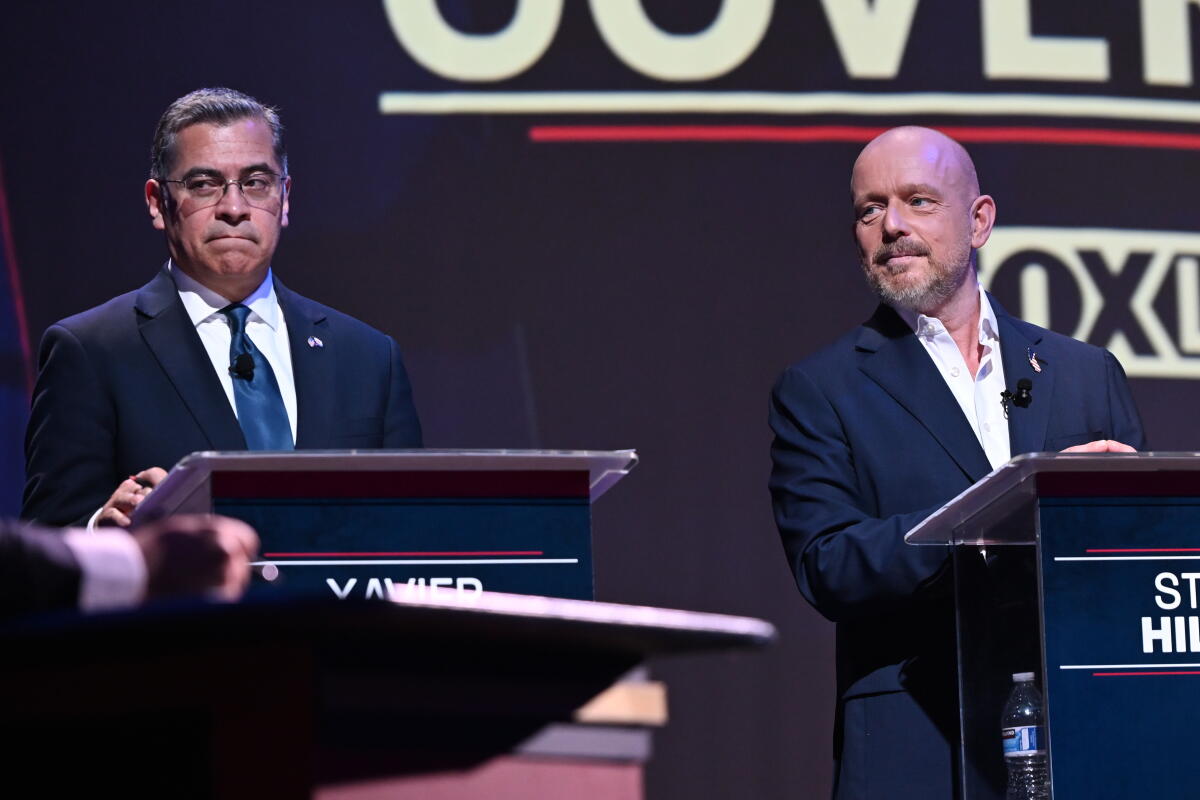
Xavier Becerra, left, and Steve Hilton during a California gubernatorial candidate debate Feb. 3 in San Francisco.
(Laure Andrillon / Associated Press)
St. Stephen and St. Francis Xavier: They share names and attributes with Steve Hilton and Xavier Becerra, who are running against each other to become California’s next governor. Becerra has spent his decades-long political career serving as missionary for California liberalism, just like Francis Xavier helped make the Jesuits a worldwide institution. Of the two St. Stephens, one was a former king who’s the patron saint of Hungary, birthplace of Hilton’s parents. Far more relevant is the St. Stephen who was the first Christian martyr. The way Hilton is sacrificing his political life in the name of Trump, he’d better ask that Stephen to tell God not to make his likely electoral demise too painful.
Our Lady of Refuge: Although St. Junípero Serra was the Apostle of California, this Marian apparition has been the patroness of the Golden State since the days when we were part of Mexico. Sinners ask her to beg God for forgiveness on their behalf — and isn’t that what we all will do when our chosen candidate inevitably messes up?
St. Thomas: He’s the patron saint of India, where Los Angeles city councilmember and mayoral candidate Nithya Raman was born. He’s also the patron saint of architects, too many of whom have sat around with their hands tied up in red tape while waiting to rebuild Pacific Palisades after last year’s inferno, a stasis that many residents will forever blame on Mayor Karen Bass. But history better remember the Apostle as Doubting Thomas, who refused to believe that Jesus had risen from the dead until feeling the holes in His crucified hands. Let’s hope Angelenos are as skeptical about the claims of both Bass and Raman that they, and only they, can revive L.A.
St. Clare of Assisi: She died in the 13th century, but the Italian nun was named the patron saint of television in 1958 because she could see a Mass held far away, despite being bedridden. May St. Clare convince God to short-circuit networks and streaming services every time another annoying political ad interrupts me while I’m watching the latest episode of “Project Runway.”
St. Thomas More: The patron saint of politicians famously stood up to England’s King Henry VIII and his philandering, unethical ways. May St. Thomas More’s witness inspire someone in Trump’s cabinet to do the same.
Eh, who am I kidding? Some things are beyond even God.
WASHINGTON — President Trump gave sizable holiday gifts to four White House aides, according to new financial disclosures released by the administration.
The gifts of $45,000 each to executive assistant Natalie Harp, communications advisor Margo Martin, and deputy director of Oval Office operations Chamberlain Harris as well as a $20,000 gift for director of Oval Office operations Walt Nauta were noted in the staffers’ annual financial disclosure forms that were published by the administration last week. Harp, Martin and Harris make $150,000 annually and Nauta is paid $175,000 a year, according to the White House’s salary disclosure report to Congress.
A White House official, who was not authorized to comment publicly and spoke on the condition of anonymity, said Trump “has a long-standing practice of giving Christmas gifts to people in his orbit, including at times employees and aides, both in government and in his time in the private sector.”
The official did not say if any other staffers were given similar gifts from the president but added that the cash gifts were not related to the “individuals’ official government duties, and therefore are entirely permissible under relevant legal and ethical standards.”
The disclosures of the gifts were first reported earlier on Tuesday by the Washington Post.
Harp is a constant presence by Trump’s side and is known for carrying a portable printer with her so she can print out favorable media coverage and social media posts for the president, who prefers reading important information on paper rather than on a screen.
Martin has been working for Trump since his first go-around in the White House. She started in the first term as a White House press assistant and followed the president to Palm Beach, Fla., to help run his media operations after he lost the 2020 election to Democrat Joe Biden. She returned to the White House with Trump after his 2024 victory.
Earlier this year, Trump appointed Harris to serve on the U.S. Commission of Fine Arts, which has oversight over the president’s White House ballroom project.
Nauta, who previously served as a valet to Trump, and Mar-a-Lago property manager Carlos De Oliveira were charged in 2023 with conspiring with Trump to obstruct an FBI investigation into classified documents that the Republican took with him when he left the White House after his first term.
JOINT BASE ANDREWS, Md. — President Trump had been eagerly awaiting his trip to Texas for Republicans’ unusual midterm convention. But his new Air Force One had other ideas, at least for a short time.
The president arrived at Joint Base Andrews via Marine One on Wednesday afternoon for his scheduled departure to Dallas. But he was held on the helicopter for about 15 minutes as U.S. Air Force personnel were seen attending to Air Force One and an inflatable emergency slide that was seen deployed from the front right exit, across the plane from the door that Trump typically uses.
As Trump arrived at the base, the old blue and white presidential aircraft was seen moving from its hangar onto the tarmac a few hundred yards behind the new plane that Trump accepted as a gift from the Qatari government and had refurbished and painted red, white, blue and gold. The older plane’s front and rear steps were put in place, signaling the possibility that it would have to be used for Trump’s Texas trip.
Eventually, Trump emerged from Marine One and said the slide on the new plane was being tested.
“They want to make sure everything works perfectly,” the president said of the jetliner that Trump accepted as a gift from the Qatari government and had refurbished.
It was not immediately clear whether the slide was intentionally inflated for testing or whether it was an error that had to be assessed and corrected. But Trump said he was not worried. Asked whether he was satisfied that the plane was safe, he said, “Yeah, I am — or I wouldn’t be on it.”
Trump boarded shortly after as the crew continued to work. They appeared eventually to deflate, detach and cart away the deployed slide.
Air Force One, the designation for whatever aircraft carries a sitting president, took off for Dallas shortly after.
Barrow and Martin write for the Associated Press. Barrow reported from Atlanta. AP reporter Collin Binkley contributed to this report from Washington.
SACRAMENTO — Fighting for reelection, Orange County Rep. Young Kim has removed several references to President Trump from her campaign website as she tries to broaden her appeal to voters in a race against fellow Republican Rep. Ken Calvert.
The two are locked in a brutal intra-party fight over one of the only safe districts left for Republicans in Southern California after voters approved a new congressional district boundaries last year.
Throughout the primary, both Republicans used campaign ads and mailers to play up their support for Trump and court GOP voters. But as the general election approaches, both candidates are diminishing the president’s presence in their messaging by varying degrees.
Until recently, a banner on the homepage of Kim’s website described her as a “Proven Fighter” who would “Stand with President Trump to deliver a bold America First Agenda,” according to archived versions of the site.
As of this week, the banner said the Congresswoman is “taking on Career Politicians to Restore the American Dream.” Previous references to Trump and “America First” have been removed from the website’s homepage and Kim’s biography. The changes were first reported by Politico.
An “Issues” page that highlighted her positions on red meat topics such as “Standing with President Trump to Save America,” “Protecting Election Integrity” and “Fixing Bidenflation” has been taken down.
Kim’s campaign pushed back on the notion that she is distancing herself from Trump, calling it “completely absurd.”
“Our campaign has consistently framed this race as a choice between an effective leader like Young Kim, who has delivered results in less than three terms in Congress, and Ken Calvert, whose career has been plagued by corruption controversies and FBI investigations,” said Kim campaign spokesman Chris Pack. “Calvert incessantly complains about Washington getting nothing done, seemingly oblivious to the fact that after nearly 40 years, he has become Washington.”
The new 40th congressional district, reconfigured under Proposition 50 approved by California voters in 2025, packs many of the region’s Republican voters into a district which includes inland Orange County and portions of San Bernardino and Riverside counties.
The new map carved the district held by Calvert, a Corona Republican and 33-year fixture in Congress, into three different pieces. Democrats redrew the map in an attempt to oust up to five Republicans and cancel out GOP-led gerrymandering in Texas. Kim, who is from Anaheim Hills, and Calvert advanced from the primary election over several Democrats and an independent candidate and will face off in the Nov. 3 general election.
Calvert continues to emphasize his close ties to Trump. His campaign homepage features a video with shots of him shaking Trump’s hand and interacting with him in the Oval Office.
Calvert’s campaign criticized Kim for scrubbing Trump from her website and at other times keeping the president at arm’s length.
“Young Kim can delete Trump from her website, but she’ll never be able to erase the fact that she is a complete and total fraud who will say anything if she thinks it will help her keep her job,” said Calvert campaign spokesman Calvin Moore.
“Young Kim has had every opinion on Trump imaginable from trying to censure him to claiming she’s 100% with him, to promising to kick his butt, then trying to lick his boots in the primary. It’s insulting to voters’ intelligence that she thinks voters won’t see right through it,” he said.
Calvert’s PAC, Americans 4 Security, has also changed messaging on its mailers. Before the primary, it sent over a dozen mailers attacking Kim for “blocking the Trump agenda” and “running from her anti-Trump record.”
Two recent mailers sent by the PAC contrast Calvert’s record with Kim’s and make no mention of Trump.
The post-primary messaging shifts weren’t a surprise to Matt Klink, a Republican political strategist.
“Through targeting, you look at Democrats and decline to state voters, and you soften your message to focus on things that they care about. That’s not changing their position, it’s just effective campaigning,” he said.
But personally, Calvert has continued to embrace the president. His campaign confirmed Calvert is attending an unconventional midterm Republican convention in Dallas, Texas. Trump is scheduled to give keynote speeches both nights.
Kim skipped the GOP convention in favor of meetings with constituents and a human trafficking task force, and to attend 9/11 events, according to her campaign.
“Calvert being with Trump, he’s helping to create that enthusiasm around his campaign,” Klink said. By skipping the convention, “Young Kim is signaling, ‘I may be a Republican, but I care about the district, too.’ It’s a good contrast.”
California and nearly two dozen other states warned the U.S. Supreme Court Wednesday that allowing the U.S. Postal Service to move forward with President Trump’s new rules for mail ballots in the November election would cause “chaos” and could disenfranchise millions of eligible voters.
“In some States … compliance with USPS’ rule would be impossible ahead of the midterms, meaning that millions of voters would be unable to vote by mail and some would not be able to vote at all,” the states argued. “In the remaining States, there would be chaos — and a significant risk that millions more voters would be denied the ability to vote.”
The Democrat-led coalition — which includes California, 23 other states and the District of Columbia — also cited objections from lower-ranking state and elections officials in conservative states that have not objected to the Postal Service’s position, including the lieutenant governor and other officials in Utah saying implementation of the new rules would “be an unmitigated disaster.”
Similar warnings have emanated from Florida, Ohio, Texas and Wisconsin.
“Whatever else may be said of USPS’ new rule, it would wreak havoc on States and their voters if it takes effect at this late point,” the Democrat-led states wrote, pointing out that some States, including North Carolina and Wisconsin, have already begun to mail out ballots.
The states’ arguments were in response to the Trump administration over the weekend filing an emergency appeal to the high court, asking it to overturn a lower-court ruling halting the plan from being implemented for the Nov. 3 election.
The new rules — developed in response to a March executive order from Trump — require states to submit their complete voter lists to the Postal Service, and to adopt new ballot envelopes with individualized voter bar codes designed by the Postal Service. They require the Postal Service to then reject any mail ballots that don’t match those lists.
Trump’s order also directed the Department of Homeland Security to develop its own list of eligible citizen voters, ostensibly to be compared against the state lists.
Trump and other supporters of the changes — including top officials from a dozen Republican-led states — argue they are necessary to prevent widespread voter fraud, including by non-citizens. Elections experts say there is no evidence of such widespread fraud, despite robust audits and other searches for it.
The Democrat-led states sued to block the changes on multiple grounds, including that neither Trump nor the Postal Service have any authority to regulate state-run elections, that the changes would illegally prevent eligible voters from casting ballots, and that the timeline imposed by the new rule — formally issued by the Postal Service on Aug. 21 — made compliance by November impossible.
Independent voting rights groups also sued, alleging the new rules threatened to disenfranchise voters and make their work educating voters on their options for casting a ballot impossible to carry out.
A Postal Service whistleblower recently added skepticism to the agency’s ability to implement the new rules on its end, alleging in a statement published by congressional Democrats that the agency’s online portal for verifying ballots was built in a “slapdash” manner, is “fundamentally flawed” and threatens as built to reject thousands of ballots if just a single one cannot be properly read.
Last week, U.S. District Judge Indira Talwani granted requests from the states and the independent groups to halt the plans from being implemented nationwide, issuing a preliminary injunction requiring the Postal Service to cease all work on them.
The Trump administration then bypassed the U.S. 1st Circuit Court of Appeals to ask the Supreme Court for relief from Talwani’s order.
Solicitor Gen. D. John Sauer, the administration’s top litigator, argued that the warnings from states that the changes are unworkable, represent an overreach of federal authority or would cause chaos in November are all baseless.
“The Rule ensures that States remain responsible for determining voter eligibility and eligibility to vote by mail, and it does not dictate ballot content, mailing or receipt deadlines, or ballot-counting procedures,” Sauer wrote. “The Rule thus plainly does not seize control of States’ administration of elections — it simply imposes reasonable preparation requirements for certain election-related mail.”
Sauer argued that if the court does not allow the changes to proceed, it would cause “serious irreparable harm on the federal government, the States themselves, and the voting public” by “nullifying the Postal Service’s efforts to address the risk that the federal mails will be used to perpetrate voter fraud.”
Experts have consistently rejected those claims — including in their own filings before the high court.
Rick Hasen, director of the Safeguarding Democracy Project at UCLA Law, joined three other election experts to argue to the lower court that the Trump administration’s claims of injury were “speculative and weak.” They noted that the administration had “offered no evidence” in court that the new rules would “stop any appreciable amount of voter fraud or even that voter fraud through the mails is a widespread problem that USPS should address.”
Meanwhile, they wrote, there was “undisputed evidence” presented to the lower court that the Postal Service is “still not prepared to implement its new rule or do so accurately and efficiently, even as states have begun mailing out their ballots,” and that the “harm to the states and to voters is enormous, as the rule threatens to disenfranchise millions of elderly voters, disabled voters, military voters and all others including the most vulnerable who depend on mail voting, in both red and blue states.”
The Democrat-led states also noted that the Trump administration hadn’t proven that widespread voter fraud is a legitimate threat, but had shown it is ill prepared itself to implement the changes without causing widespread disruption — as evidenced in part by the whistleblower’s claims.
It’s unclear when the Supreme Court will rule, though a relatively quick decision is expected given the emergency nature of the appeal.
As an astronomer who studies how stars develop over tens of millions of years, Ben Zuckerman instinctively takes the long view. What he sees in regard to future U.S. population numbers troubles his environmentalist’s heart: As many as a billion people on the American landscape by 2100, as many as 100 million in California, courtesy of liberal immigration policies.
Zuckerman, a 58-year-old UCLA professor given to running shoes and organic rice cakes, believes environmentalists should be loudly demanding curbs on legal immigration and an end to illegal immigration, which are fueling the country’s surging population growth. The influential Sierra Club, to which he has belonged for more than three decades, ought to be especially vocal on the matter, he thinks.
Zuckerman’s views conflict directly with the club’s official neutrality on immigration reform. Nonetheless, he recently was elected to the club’s board of directors with the most votes, 36,383, among the five successful candidates, despite not being anointed by the organization’s nominating committee.
His victory, he says, is a vindication of keen-eyed Sierrans who see that “the No. 1 environmental problem–and it’s not even close–is overpopulation. A billion Americans is a disaster. I don’t know how my colleagues in the Sierra Club can save species and wetlands and so on when there are a billion Americans.”
At the time of the first Earth Day celebration in 1970, with American fertility rates reaching replacement levels, environmentalists foresaw the U.S. population being stabilized within a single generation.
Then the immigration freight train came roaring down the track. By the time it barreled through the 1990s, it had quadrupled traditional figures for legal immigration, which has reached 1 million-plus per year. Illegal immigration is estimated to be an additional 200,000 to 500,000 annually. From 1990 to 2000, the U.S. population swelled by 13%, its largest 10-year increase ever (in the rest of the developed world, population grew by 2.5%). According to government demographers, immigration and immigrant fertility accounted for about 70% of the national increase, and 90% of California’s.
Throughout the 1970s and ‘80s, the Sierra Club supported immigration curbs. In the 1990s, however, the club’s leadership grew shy of the issue as it waxed in controversy. In 1998, Sierrans for U.S. Population Stabilization, a group co-founded by Zuckerman, forced a club referendum on the matter. The leadership pushed for neutrality, Zuckerman’s faction for support of immigration curbs. The leadership’s position won, but Zuckerman faction’s received 40% of the vote.
Now the club’s official posture is to focus on global, as opposed to U.S., population stabilization and to work for improved conditions in immigrant-producing countries.
What really motivates the club leadership, Zuckerman says, is fear. Fear of being called racist. Fear of losing minority-group members and fear of forfeiting financial support from big business and foundations.
Pro-immigration forces–including Latino politicians, the AFL-CIO and corporations, which covet both cheap labor and more consumers–are quick to swing the racism bludgeon. Zuckerman, a lifelong liberal and civil rights advocate, has borne such accusations painfully. “But the average person is overwhelmingly in favor of reduced legal immigration and an end to illegal immigration, and this cuts across every racial line,” he says. “How can it be racist to agree with a majority of every ethnic and racial group in the country?”
The Sierra Club’s timidity on the issue muddies its integrity. (How, he asks, can the club rail against polluters for breaking environmental laws but keep silent about immigrants who break immigration laws?) To save itself, he says, it must refocus on protecting the American environment and opposing growth for growth’s sake, which he calls “the ideology of a cancer cell.” Emboldened by Zuckerman’s victory, more Sierrans of his persuasion are certain to run in next year’s annual election for five of the 15 board seats.
The Sierra Club is headquartered in San Francisco. Presumedly, the people who run it have to commute every day through the congestion of the Bay Area. I have to wonder, do they ever ponder the discomfort of it? Do they really imagine, with residential development devouring space and wildlife habitat from San Diego to Sacramento, that natural California can survive the 50 million residents that demographers are projecting for 2025, much less the 100 million that could be living here by the end of the century if current patterns hold?
Bruce Hamilton, the Sierra Club’s national conservation director, says the organization remains committed to its long-standing goal of population stabilization. It just takes a global approach now rather than a national one. Immigration to the U.S. will dwindle, the club believes, when conditions in immigrant-producing countries no longer compel people to leave home.
Or, I might point out, when conditions here become equally bad, the swollen masses just as poor, the environment just as degraded.
Thousands of longtime immigrants from El Salvador and their loved ones are anxiously awaiting word from the Trump administration about whether they will face the possibility of deportation if their temporary legal protections expire as scheduled Wednesday.
The Department of Homeland Security has not yet announced whether it will end or extend Temporary Protected Status for some 170,000 Salvadorans, including 36,000 in California. But federal officials have targeted for arrest other immigrant groups whose TPS expired.
Since their status ended in July, many Haitians have been outfitted with ankle monitors and some have already been sent back to the politically unstable country plagued by gang violence.
As federal officials have whittled down the countries that still qualify for Temporary Protected Status, Salvadorans make up the largest population of remaining beneficiaries.
Just over 100,000 people from Sudan, Ukraine and Lebanon still have TPS protections until later this year, the vast majority of them Ukrainians.
Under TPS, recipients are able to obtain permits allowing them to work legally in the country. More than 150,000 U.S. citizen children nationwide have Salvadoran parents with TPS.
Asked by The Times on Tuesday about the administration’s plans regarding TPS for Salvadorans, border advisor Tom Homan said he does not know and that the decision is up to Homeland Security Secretary Markwayne Mullin.
Later Tuesday, Homeland Security released a statement that left the long-term outlook for Salvadorans with TPS uncertain: “An announcement on El Salvador’s TPS will be made at the appropriate time. Until such announcement is made, Salvadoran individuals present in the U.S. under TPS retain protection.”
Homan, for his part, noted that El Salvador is a “much safer country” now, perhaps suggesting the conditions that prompted people to leave El Salvador had improved.
Addressing the administration’s handling of TPS in general, he said, “I’m glad they’re finally sticking to what the statute says — temporary means temporary.”
The looming deadline set off a wave of alarm among communities in Los Angeles and beyond.
Lorena Zepeda of Los Angeles spent most of Friday with tears in her eyes as she waited for news about the fate of the program that has spared her, for nearly half her lifetime, from being deported back to El Salvador.
“Even though my work permit has been temporary, my life here is not temporary,” said Zepeda, 57. “From the second I stepped foot in the U.S., I have lived. And, I want to continue to live here. I’ve set down my roots here.”
California has the highest concentration of Salvadoran TPS holders in the nation, with smaller concentrations in Texas, Maryland and New York, according to the immigrant advocacy organization FWD.us. Most work in construction, groundskeeping and in transportation, the organization said, and they pay an estimated $1.5 billion in combined taxes.
About 1.3 million people from 17 countries were enrolled in the program when President Trump returned to office last year. The Supreme Court ruled in June that Trump can, without judicial review, end temporary legal protections for hundreds of thousands of immigrants from Haiti and Syria, a decision that also cleared the way for further TPS terminations.
The administration has now ended TPS for more than 1 million immigrants from 13 countries.
Some terminations were announced at or after the expiration date. For instance, the administration announced the terminations for Nicaragua and Honduras three days after they were set to expire on July 8, 2025, but provided a 60-day extension.
A termination for citizens of El Salvador in particular stands to upend the lives of people with deep roots in the U.S. because they have had TPS for 25 years — the longest of any country. Trump administration officials and other conservatives have argued that the program has gone far beyond its original intent as a temporary means of reprieve.
Originally established in 1990 under the George H.W. Bush administration, TPS has been used in the years since under Democratic and Republican administrations alike. Congress authorized the emergency relief for immigrants whose countries had been racked by armed conflict or natural disasters and who could not safely return home.
Trump tried to terminate TPS for Salvadorans during his first term, but an appeal kept the protections in place until President Biden took office and reversed the decision. Biden then substantially expanded the number of immigrants who qualified for protections under the program.
For Zepeda, who came to the U.S. in the early 1990s, saving TPS has been a years-long pursuit.
Zepeda works as a community coordinator for the Los Angeles-based Central American Resource Center, or CARECEN, the largest Central American organization in the country that provides low-cost immigration legal services and policy advocacy. She has gone to Sacramento and Washington to persuade lawmakers to keep the program alive.
She began receiving calls Tuesday morning from frantic TPS holders asking whether they should still attend medical appointments or how they will pay their rent without work permits. Aging Salvadorans fear losing their retirement benefits, she said.
“We’ve marched. We’ve led hunger strikes. We’ve done it all…No matter what happens, the fight does not end,” Zepeda said. “We will continue pushing to find legal stability in this country.”
Castillo reported from Washington and Luna from Los Angeles. Staff writer Ana Ceballos contributed to this report.
NEW YORK — Republicans are gathering in Dallas on Wednesday for a highly unusual midterm convention, a “Trump-a-Palooza” that will put President Trump at the center of this fall’s midterm elections — whether the candidates running like it or not.
Many party members, including those facing tight races, are skipping the two-day affair, citing conflicting obligations or balking at demands that they pony up for access. Others are hoping an appearance alongside Trump will put them in the national spotlight as they work to turn out his voters without him on the ballot.
The convention, which is part rally and part fundraiser, comes as Republicans try to boost enthusiasm heading into the midterms’ final stretch despite Trump’s low approval ratings. Organizers have cast it as “a primetime showcase for President Trump’s success, candidates, and causes that have propelled the 2026 midterms to unprecedented focus.” Much of the programming will focus on Democrats, trying to cast them as extremists by highlighting the party’s insurgent left wing.
The lineup features Trump and more Trump
Normal political conventions are held every four years and serve a purpose beyond pomp and circumstance, with parties formally nominating their presidential picks. In 2024, Trump used the opportunity to announce JD Vance as his running mate.
The schedule this week released by organizers makes clear that the convention will be the Trump Show, through and through.
“It’s gonna be a Trump-a-Palooza,” RNC Chairman Joe Gruters told Spectrum News.
The president will be speaking both nights, delivering a keynote address on Wednesday night and speaking again Thursday after Vance to close out the event. He had originally been scheduled for only one speaking slot.
Also addressing the convention will be members of the Republican congressional leadership and Cabinet members including Atty. Gen. Todd Blanche and Health Secretary Robert F. Kennedy Jr. The president’s oldest son, Donald Trump Jr., is on the roster, too.
Candidates who will speak include Michigan Senate nominee Mike Rogers, who is running a high-profile race against Abdul El-Sayed, and North Carolina Senate nominee Michael Whatley, who is up against former Gov. Roy Cooper.
Organizers have outlined 12 hours of programming over the two nights that will include more than 100 speakers and segments focused on subjects like tax cuts, fraud allegations, border security and a proposed ban on members of Congress trading stocks.
Missing from the public lineup: any mention of the unpopular war with Iran.
Republican House Speaker Mike Johnson said some members of his caucus plan to skip Dallas, preferring to stay home and campaign for reelection, but many of them will make an appearance.
“We’ll parade our stars across the stage,” he said.
Many will be skipping the event
An Associated Press survey of more than four dozen Republican candidates found a majority either planned not to attend, said their plans were to be determined, or ignored requests for comment.
“I had stuff already planned in my congressional district or I would be there,” Kentucky Rep. James Comer told NewsNation. “Got a lot going on back in Kentucky, so my time is needed there.”
“Well, unfortunately, I have a family obligation, so I won’t be able to be there,” Georgia Rep. Buddy Carter said on Fox Business.
Some members balked at high attendance fees. Republican House members were being asked to pay $25,000 for convention tickets and lodging, according to people familiar with the situation and granted anonymity to speak frankly about the private arrangement.
An additional 2,000 tickets were distributed by the House GOP’s campaign arm, largely to donors and others to attend the convention. Other tickets were allocated to state parties to distribute as they saw fit.
“Per the RNC, this is a ticketed fundraiser and rally, not a traditional national convention,” the Denton County Republican Party in Texas wrote in a Facebook post, which advertised packages from $5,000 to $20,000.
The Republican Party of Virginia was offering a relative discount of $1,000 to $1,500, not including accommodations, according to an email obtained by the AP.
Despite the many no-shows, more than 100 Republican House members and candidates are expected to be in Dallas, including almost all of the MAGA Majority class of candidates in the most targeted congressional districts, according to a person familiar with the event who requested anonymity before it begins.
“It’s like any political convention, it’s no different than the traditional RNC,” said Matt Beynon, a spokesperson for Pennsylvania Rep. Scott Perry, who won his district by barely 1 percentage point in 2024 with Trump on the ballot. “Obviously, you’re out of the district, but it’s a really good opportunity to get in front of people” and “talk to the press.”
It remains unclear what kind of air time the convention will receive. The two nights of programming will coincide with the launch of football season. The NFL season is set to kick off Wednesday with a game between the Seattle Seahawks and the New England Patriots. And on Thursday, the San Francisco 49ers and Los Angeles Rams will be playing an international game in Australia.
In a sign of the growing focus on the midterms, Trump’s political organization, which is sitting on a big war chest, is spending heavily to back a new group, the No Going Back PAC Inc., The New York Times reported Wednesday. The new group started reserving $47 million for six competitive Senate races and one competitive House race. That’s in addition to the $10 million the Trump-affiliated MAGA, Inc. political group is spending in the Texas Senate race.
Democrats say Republicans are out of touch
Democrats, meanwhile, are planning their own counterprogramming.
“The fact that these Republicans are planning a celebration in the middle of an economic crisis — where everyday Americans are drowning because of this high cost of living — is extraordinary,” Rep. Hakeem Jeffries, the House Democratic leader, said at the U.S. Capitol.
Democrats have held such midterm conventions in the past but are not doing so this year. Rep. Suzan DelBene of Washington, chair of the Democratic Congressional Campaign Committee, said she wasn’t worried that her party was missing an opportunity to make its case on a national stage like Republicans.
“They are not focused on the issues that people are struggling with right now, that they’ve created,” DelBene said. “Cost, housing, food, healthcare, childcare, energy costs, gas prices all going up. That’s what we’re talking about on the ground all across the country.”
Americans “are going to continue to see how much they don’t care,” she added. “And we’re gonna be on the ground all across the country with great candidates talking directly to the American people.”
Colvin writes for the Associated Press. AP writers Steven Sloan and Lisa Mascaro in Washington, Marc Levy in Harrisburg, Pennsylvania, Hannah Fingerhut in Des Moines, Iowa and Sarah Rankin in Richmond, Va., contributed to this report.
HARRISBURG, Pa. — Around this time two years ago, Sen. John Fetterman was in high demand on the campaign trail, going county-to-county in Pennsylvania to help Democrats up and down the ballot.
Now, after two years of crossing swords with Democrats and backing some of President Trump’s priorities, he’s nowhere on the stump.
No Democrat in the state wants to be seen with him. His approval ratings are better with Republicans — far better — than they are with Democrats. And a shadow primary of sorts is taking shape for Fetterman’s Senate seat in 2028, even if he runs again.
Fetterman has acknowledged his isolation in the party as he maintains staunch support of Israel’s war in Gaza and criticizes left-wing candidates who are members of the Democratic Socialists of America. He’s often gone his own way in the Senate, voting repeatedly with Republicans to end the shutdown last year while supporting multiple Trump nominations and opposing efforts to end the war in Iran.
Still, Fetterman has repeatedly said that he wouldn’t switch parties because of his support for labor unions, LGBT rights and other issues held dear by the left.
“I’m not going to be a Republican, but I’m going to be a Democrat that’s going to have a conversation with whoever is playing it straight,” Fetterman told Fox News host Sean Hannity.
Fetterman’s office and political adviser did not return messages seeking comment.
Fetterman has fallen out of favor with Pennsylvania Democrats
Fetterman has been silent about any plans to campaign in Pennsylvania this year, and Democrats say they aren’t asking him for help.
“I absolutely think that Fetterman would bring us more harm than good,” said Lori McFarland, the Democratic Party chair in Lehigh County, which is home to a congressional seat and a state Senate seat that Democrats are trying to flip. “Nobody’s asked to see him, nobody’s requested his presence, and people, quite honestly, they’re mad at him and they don’t want anything to do with him. The local feel here is they feel betrayed by him.”
Polling captures the shift. Only about 2 in 10 registered Democrats in Pennsylvania have a favorable view of Fetterman, according to a New York Times poll from August. That’s a sharp reversal from 2024, when 74% had a positive view. He’s now seen more favorably by Republican voters in the state, with 73% giving him a positive rating. That’s up from 25% a couple years ago.
A Quinnipiac poll from July similarly found most Republicans approve of how Fetterman is handling his job, while most Democrats do not.
Cindy Durian, a Democrat voting in May’s primary in suburban Harrisburg, said she would never vote for Fetterman again.
“I think he might as well change parties, he might as well change from a D to an R,” she said.
Frustration with Fetterman has been building
Fetterman had a stroke on the campaign trail before winning his Senate seat in 2022 and then was hospitalized for clinical depression in the first months of his term.
Progressive frustration with Fetterman began to emerge in late 2023 with his support for Israel’s war against Hamas. But it’s moved beyond that since Trump took office. Democrats have watched him belittle their attempts to push back on Trump while emerging as a conservative media darling.
“He is antagonizing Democrats, seemingly for pleasure,” said J.J. Abbott, a Democratic strategist.
Fetterman’s dedication to the job has also been called into question. Last year, he began racking up missed votes and missed hearings in the Senate. A meeting in Washington with representatives from a teachers union broke up after he began repeating himself, shouting and slamming his hands on a desk. And he has avoided other meetings and public events, including the funeral for three police officers killed in the line of duty.
Public officials around Pennsylvania say they haven’t seen him in several years. Some can’t remember when they last saw him.
“I couldn’t tell you,” said state Rep. Peter Schweyer of Allentown. “We assumed that when we got him there that we were going to get somebody who’s going to fight for us. And what we got instead was somebody who just disappeared.”
Pennsylvania Democrats have a lot on the line in November
The state has several marquee races this year. Democratic Gov. Josh Shapiro, seen as a likely presidential candidate in 2028, is running for reelection and leading the party’s efforts to hold a narrow state House majority, capture a state Senate majority for the first time in decades and flip four U.S. House seats.
In one of those competitive U.S. House races, Democrat Bob Harvie is trying to unseat Republican Rep. Brian Fitzpatrick. A campaign spokesperson said Harvie hasn’t asked Fetterman for help.
It’s unclear whether Fetterman will ever return to the campaign trail, or whether he even wants another term in 2028, given that he spends much of his time criticizing his party and the dysfunction of Congress. He often sits alone in the hallway during Senate votes, eschewing conversations with colleagues inside the chamber.
Talk of 2028 among Democrats often turns to several others — Reps. Chris Deluzio and Brendan Boyle and former U.S. Rep. Conor Lamb — who have become outspoken critics of Fetterman.
“I don’t think that Democrats want John Fetterman campaigning for them, and I say that as a guy who’s campaigning with Democrats in the most competitive and toughest districts across Pennsylvania,” Deluzio told The Associated Press.
Deluzio said he’ll decide after the November election whether to run for Senate in 2028. But, he said, “Pennsylvanians elected John Fetterman as a Democrat to the United States Senate. They expect him to be a Democrat in these two years he has left in this term.”
Fetterman says he has a ‘red line’ with his party
While Fetterman has insisted he won’t change parties, he hasn’t ruled it out, saying the Democratic Party becoming anti-Israel would be a “red line” that would force him out.
He’s also become close with Pennsylvania’s other senator, Republican David McCormick, appearing at events alongside him and launching a joint political fundraising committee, an unusual arrangement for senators from opposing parties.
Senate Majority Leader John Thune, R-S.D., in July said he and other Republicans had spoken with Fetterman about the “challenges” he has in the Democratic caucus. “If he ever comes to the conclusion that he’s ready to move, we’d certainly welcome him.”
Democrats hold 47 seats in the Senate. If they were to pick up four seats in the election, a Fetterman party-switch could reset the Senate back to a 50-50 split, giving Republicans the majority and putting Vice President JD Vance in a position to break ties.
Levy writes for the Associated Press. AP writer Mary Clare Jalonick in Washington contributed to this report.
WASHINGTON — In the real world, President Trump is struggling to stop inflation, rout the Iranian government and restore American manufacturing with tariffs.
However, it’s a different story in the fantastical vision that he shares with supporters on social media. Over Labor Day weekend, Trump and the White House unleashed an extraordinarily heavy torrent of memes that portrayed the president as singularly powerful.
One video depicted Trump as a superhero wielding Green Lantern’s ring to effortlessly build a wall to keep out migrants and erect a slew of busy factories. Another post showed him in a U.S. hockey uniform looming over Canadian Prime Minister Mark Carney as Carney cowered on the ice. And another had Trump on a military ship as it bombarded an enemy fleet.
Trump’s allure has always relied on a mythical version of himself, from “The Apprentice” to the White House, but the gap between meme and reality has become glaringly stark ahead of the midterm elections. Most U.S. adults are unhappy with Trump’s handling of the economy and say the Iran war hasn’t been worth it, but Trump has responded with outlandish images of himself as unstoppable and omnipotent.
Memes risk sidestepping reality
Some of the pictures are generated with artificial intelligence, and the administration has previously defended the memes as funny and their critics as humorless. Yet the stakes right now are serious for congressional Republicans who have tied their own fate to a president with low approval numbers. Trump’s party will put him center stage at an unusual midterm convention on Wednesday and Thursday in Dallas in hopes of stoking voters’ enthusiasm.
Kevin Madden, a Republican strategist, said that Trump’s social media posts can energize his base of “Make America Great Again” followers, although the tradeoff is that he’s not talking about how to fix inflation.
The voters who are likely to determine control of Congress in the midterms “are not going to be won over with memes,” Madden said. “The affordability voter is driving this election cycle and the issues they care about are anchored in the economy.”
The White House press office did not respond to a request for comment. Trump sometimes plucks memes from a sprawling ecosystem of online conservative supporters, and sometimes his government staff produces them as part of their official messaging. Recently they created a series of old-school video games, such as a “Tetris” knockoff called “Build the Wall.”
“The memes will continue,” Kaelan Dorr, a member of the White House communications team, recently posted on social media. “The winning will continue.”
Aging presidents promote vitality online
The problem for Trump is that voters have other images they’re using to define him. Drivers can spot through their windshields that gasoline is averaging $4.15 a gallon, up nearly 30% from a year ago because of the Iran war. And social media is inundated with questions about the 80-year-old president’s health and vitality, spurred by pictures of his bruised hands or video clips of him appearing to fall asleep in meetings.
White House officials have said the bruising is caused by “frequent handshaking” and Trump’s aspirin regimen, and they’ve denied that he’s dozed off.
Trump’s predecessor, Joe Biden, is three years older and faced relentless scrutiny about his age while in office. His White House came to embrace a meme version of Biden with lasers for eyes, suggesting that he was powerful and focused rather than infirm.
Andrew Bates, who was a deputy press secretary for Biden, said that Trump’s memes seem to be about avoiding the actual responsibilities of governing. He said they risk angering voters who see Trump as more focused on redecorating the White House than bringing the Iran war to a successful end.
“When a president who ran on bringing gas prices under $2 a gallon is now saying, ‘You’re at four dollars, it’s OK,’ it unfortunately makes sense that he’s also posting fever dreams,” Bates said.
Some memes have caused trouble
The memes have occasionally gotten Trump into trouble. He posted an image of himself as Jesus in April, which caused a degree of consternation among some supporters. The president later claimed he thought the image showed him as a medical doctor — albeit a doctor in Biblical robes with light emanating from his hands.
In February, his account posted a racist video of former President Barack Obama and his wife, Michelle, as primates, which he deleted after a backlash.
Last October, Trump shared a video of him in a fighter jet dumping feces on Americans who were protesting his policies.
What the memes have not done so far is boost his wider approval ratings. Only 33% of U.S. adults approve of how he is handling the job of being president, according to a July AP-NORC poll.
But the polling also hits at a reason why he might be sending the memes to rally his core supporters. Just 15% of U.S. adults strongly approve of his presidency, the poll found, a slight decline from 22% shortly after he took office.
There was also no small amount of political opportunism at play.
The recall gave Newsom’s critics, mainly on the right, a chance to try to chase the Democrat from an office that Republicans, under normal circumstances, stood little chance of winning.
In the end, the recall effort amounted to scarcely more than a partisan tantrum. The result — 61.9% voting no, 38.1% voting yes — matched the outcome of the 2018 gubernatorial race down to the decimal. All that money and effort wasted on an election in which voters said pretty much, yep, we meant what we said. Not too long after, they gave Newsom a second term.
The plebiscite, and its pointlessness, underscored the many flaws inherent in California’s recall system. In November, voters will get a chance to remedy at least one of them, eliminating the chance a candidate could take office with just marginal support from voters.
You’re reading the L.A. Times Politics newsletter
Expert columnists cover the insights, legislation, players and politics you need to know.
By continuing, you agree to our Terms of Service, which include arbitration and a class action waiver. You agree that we and our third-party vendors may collect and use your information, including through cookies, pixels and similar technologies, for the purposes set forth in our Privacy Policy such as personalizing your experience and ads.
Trigger warning: What follows is a somewhat wonky explanation of election rules and procedures.
One choice, not two
Currently, a recall election is conducted in two parts. Voters are asked whether a lawmaker should be removed and, if so, who their replacement should be. If the incumbent is ousted, whoever gets the most votes takes their place, even if they fall well shy of attaining majority support. (Which is not out of the question in a large multi-candidate field; in 2003, 135 people were on the ballot, vying to replace Gov. Gray Davis.)
Among its provisions, Proposition 5 would amend the state Constitution so that voters would be asked a simple yes-or-no question: Do you wish to recall the incumbent? If so, the lieutenant governor would serve as governor for the rest of the ousted executive’s term — unless the recall occurred during the first two years a governor was in office and before the filing deadline for the next statewide election.
In that case, a special election would be held on the same date as the next primary and a candidate receiving a majority of votes would serve out the governor’s term. If no candidate received a majority, the top-two finishers would face each other in a November runoff, with the winner taking over as governor.
Still there?
Proposition 5 has two benefits. It would save taxpayer dollars by consolidating elections and it would enhance the legitimacy and political standing of a replacement governor by ensuring he or she assumed office with at least 50% support.
California makes it way too easy to qualify a gubernatorial recall measure.
Of the 19 states that allow their governor to be booted, California is by far the most permissive. Forcing an election requires signatures reflecting just 12% of the ballots cast in the prior gubernatorial contest. In Newsom’s case, proponents needed just under 1.5 million signatures in a state with more than 22 million voters and nearly 40 million residents.
Not exactly a thundering roar.
The threshold should be higher and the reasons for kicking a governor out of office should be more serious, such as corruption, official malfeasance or conviction for a serious crime. Not just because a governor is a member of the opposite party, or people on the losing end of an election are unhappy with the result.
“The system in its current form offers bad actors an incentive to target an elected official with whom they disagree and to have the official replaced by someone who otherwise would not enjoy the support of a majority of voters,” Josh Newman of Fullerton and Isaac Bryan of Los Angeles said in advocating change. The two Democratic lawmakers authored the constitutional amendment, which was placed on November’s ballot by the Legislature.
If you think overhauling the process is simply about protecting partisan interests, consider: Should Republican Steve Hilton pull off an epic upset and become California’s next governor, is there any doubt a recall effort would be underway before he and Mrs. Hilton even had the chance to start boxing their belongings for the move to Sacramento?
The recall is a vestige of the Progressive-era good-government movement. But the process needs to be revamped to reflect today’s bad-faith political environment.
The Little Hoover Commission, California’s independent oversight agency, has recommended several changes, including raising the signature requirement and prohibiting recalls undertaken during the first 90 days and the last six months of an officeholder’s term.
Elections, it’s said, have consequences. They also have — or should have — end dates and final results that are respected, not re-litigated until the losing side gets its way.
Proposition 5 is a step in the right direction. More should follow.
MEXICO CITY — When the Trump administration announced this summer that illegal crossings into the U.S. from Mexico had reached historical lows, Homeland Security Secretary Markwayne Mullin declared, “Our border is CLOSED to lawbreakers.”
Even so, the administration continues to pressure both Mexico and U.S. officials serving there — publicly and behind the scenes — to curb illegal immigration further. The crackdown has prompted smugglers to become more creative, turning more often to tunnels once reserved for transporting drugs.
White House Deputy Chief of Staff Stephen Miller, in the White House on Sept. 4, has been the main architect of the Trump administration’s immigration policies.
(Jacquelyn Martin / Associated Press)
Stephen Miller, the main architect of President Trump’s immigration policies, has been in near-daily communication with senior U.S. law enforcement officials, including the U.S. ambassador to Mexico, Ronald Johnson, looking for new ways to stop migrants from entering the United States, according to people familiar with the conversations.
An average of 400 migrants were apprehended while crossing into the U.S. every day in July, according to data by U.S. Customs and Border Patrol. It’s a precipitous drop from the thousands who crossed daily at the peak of a migrant surge in 2022.
Sometimes the number of crossings has dropped to 200 a day. But for Miller, that reduction is still not enough, said sources not authorized to speak publicly about internal matters. Miller’s goal, they said, is to have zero migrants entering the U.S.
Miller has directed officials to increase investigations into migrant smuggling networks, people familiar with his directives said.
Mexican Foreign Minister Roberto Velasco Álvarez, left, and U.S. Secretary of State Marco Rubio in Washington, where they met Aug. 26 to discuss what the minister called “priority issues on the bilateral agenda.”
(Chip Somodevilla / Getty Images)
Since returning to the White House in 2025, Trump has often asked Mexican President Claudia Sheinbaum to crack down on immigration. On Aug. 26, Secretary of State Marco Rubio met with Mexico’s foreign minister, Roberto Velasco Álvarez, and urged him to take “decisive action on illegal immigration,” according to a statement from the State Department.
The Trump administration’s border crackdown has been so effective it’s forced some smugglers literally underground.
Mexican drug cartels are increasingly turning to tunnels built for drug smuggling to ferry migrants into the United States. They are linking into sewer drains, according to people familiar with the trend.
Though the number of migrants apprehended while using tunnels appears to be relatively small — there are no hard statistics — authorities believe it is increasing, given the crackdown on the border and financial incentive for the cartels to smuggle people and not just drugs.
“Enforcement along the border has become more robust and that has increased the demand for alternative methods of passage,” said David Shirk, director of the Justice in Mexico program at the University of San Diego.
The Trump administration has added extra miles of razor wire to border fences, has increased surveillance technology and uses autonomous Predator drones with surveillance and infrared technology to monitor swaths of the border for migrants crossing into the U.S.
1
2
1.A bulldozer sits near Santa Elena Canyon on Aug. 14 in Big Bend National Park, Texas, where contractors have begun construction of a border wall. (Brandon Bell/Getty Images)2.Protesters gather in San Antonio, Texas, on Aug. 28 to demonstrate against construction of a border wall in Big Bend National Park. (Alma E. Hernandez/San Antonio Express-News via Getty Images)
And, picking up on Trump’s “build the wall” pledge from his initial run for president, more border barriers are being built.
Trafficking through cross-border tunnels is not new. In 2023, Ken Salazar, then the U.S. ambassador to Mexico, said there were at least 200 tunnels that spanned the border. Many of them were found linking Tijuana and San Diego.
But in a twist, some tunnels now connect to drainage and sewer systems. This May, authorities captured 19 migrants, including three unaccompanied minors, in the San Diego storm water drainage system. A remote surveillance camera spotted the migrants emerging from the system.
The smugglers were two brothers who had previously been charged with methamphetamine trafficking in the Northern California town of Yreka in 2017.
Smugglers employ tunneling specialists whose work is getting more sophisticated, outfitting the tunnels with lights, ventilation systems and sometimes mini rail lines. Many tunnels are faster, safer and much more expensive for migrants who would otherwise face increasingly dangerous mountain and desert routes, experts said.
Last year, Customs and Border Protection and Homeland Security Investigations agents also found a tunnel that ran under the Rio Grande from Ciudad Juárez, Mexico into El Paso.
The passage tapped into the El Paso sewer system, where, according to U.S. authorities, migrants surfaced from a manhole. They climbed into a box truck outfitted with a trap door that was parked over the manhole.
Cartels charge migrants from Latin America up to $15,000 dollars each to use tunnels to El Paso, an official familiar with the dynamics said. For people from the Middle East or Southeast Asia, the price can be as high as $25,000.
The tunnel traffic continues to vex U.S. officials.
A Homeland Security Task Force drug investigation of a supposed retail store in Otay Mesa, Calif., resulted in the discovery of a sophisticated cross-border tunnel leading to Tijuana.
(U.S. attorney’s office)
In Tijuana, one tunnel discovered last year stretched from Tijuana to what appeared to be a Buy 4 Less store near the Otay Mesa port of entry. The store never had customer traffic, so U.S. law enforcement suspected it hid a tunnel and began monitoring the business.
Authorities raided the building and found the entrance to a tunnel controlled by the ruthless Jalisco New Generation Cartel. It was 55 feet deep and nearly half a mile long. It featured a hydraulic lift, ventilation and a rail and cart system. Authorities stopped a freezer truck after it left the location and seized more than a ton of cocaine, worth roughly $45 million.
In 2024, U.S. law enforcement found a tunnel in the border town of San Luis, Ariz. Authorities said it was used to smuggle migrants and drugs. Its exit was hidden in an abandoned KFC restaurant.
This article was co-published with Puente News Collaborative. Fisher is a special correspondent.
If elected governor in November, Republican Steve Hilton said Tuesday he would eliminate the state Department of Motor Vehicles and slash registration fees for car owners — expressing confidence that the Democratic-controlled Legislature would embrace the plan.
“My starting expectation would be, they would be with me on things to reduce the cost of living, so let’s work together,” he told The Times on Tuesday.
Hilton said that once state lawmakers met with him and realized he was not the “caricature” his critics portray, they would realize that he is “not a particularly tribal person. I’m just looking to solve problems, and we all agree about the cost of living.”
Eliminating a state agency would require approval from the state Legislature, where Democrats hold super majorities in both chambers. Assembly Speaker Robert Rivas (D-Hollister) and Senate President Pro Tem Monique Limón (D-Santa Barbara) have both endorsed Hilton’s Democratic rival in the governor’s race, former Biden cabinet member Xavier Becerra.
The Becerra campaign scoffed at Hilton’s confidence.
“You can’t spend a year calling Democrats a failure and then expect two-thirds of both chambers to take your calls,” said Becerra spokesperson Jonathan Underland. “Steve is in for a very rude awakening, and the fact that he can’t see it coming just shows how little he understands the job he’s asking for.“
Hilton announced his plan at a news conference outside of a DMV office in West Hollywood, where he touted proposals to eliminate the state agency, which has a $1.6-billion budget, and reduce the annual vehicle registration fee to $73 per year.
“We are going to shut down this bloated, nanny-state bureaucratic agency that treats Californians with complete contempt,” he said to cheers at the event. “We are done with it. Enough is enough with the DMV. Enough is enough with sky-high registration rates. We are done.”
Hilton said he could issue an executive order to reduce the vehicle licensing fees, as Gov. Arnold Schwarzenegger did less than an hour after being sworn into office upon winning the 2003 recall election. While the fee is set by state tax code, governors can waive it in specific circumstances, as Schwarzenegger did.
Californians currently register more than 36 million vehicles with the DMV each year, and the average annual fee paid for each is $329, according to the state Legislative Analyst’s Office. The registration fees, along with driver’s license costs and other fees related to the California Highway Patrol and identification cards collected by the DMV, are the primary funding sources of the CHP and DMV.
Hilton said the state currently reaps $11 billion to $12 billion per year from vehicle registration fees, and that his proposal would reduce the revenue to roughly $2.7 billion. He said he would make up for the revenue shortfall created by the proposal — and other plans, including eliminating state taxes on the first $150,000 of income — by reducing the state’s workforce by 10% and agency budgets by 5%.
To eliminate a state agency, Hilton would need legislative approval, although he says that if Sacramento lawmakers were to rebuff his efforts, he could use the budget to slash the DMV’s operations.
Hilton cited a discussion he had with Schwarzenegger at an August dinner at the movie star’s Brentwood estate.
“Arnold said the Democrats who led the Legislature when he was there much preferred” having a Republican governor to a Democratic one, Hilton said.
Hilton lacks Schwarzenegger’s worldwide fame, and the nation and Sacramento are far more polarized than when the Austrian bodybuilder turned action movie star took office. Still, Hilton’s vehicle registration proposal is reminiscent of a major plank of Schwarzenegger’s successful 2003 campaign to recall and replace Democratic Gov. Gray Davis.
Davis had tripled the state’s annual vehicle license fee shortly after being reelected in 2002 to help address a state budget shortfall. Schwarzenegger seized upon the issue during the recall campaign, at one point dropping a wrecking ball from a five-story crane onto a car spray-painted with the words “Davis Car Tax” in front of a cheering crowd in Costa Mesa.
“We had the biggest action star in the world. He’s going to show action,” said Rob Stutzman, who worked as one of Schwarzenegger’s top advisors. “Arnold demanded it. It was always a production to tell a story. He was genius at it.”
“Californians got a huge increase in their vehicle license fee and it was being done to backfill a deficit arguably revealed to them by surprise after the [2002] election,” Stutzman said.
Stutzman said the fee created a backlash that fueled the recall campaign against Davis, along with rolling blackouts during the energy crisis of 2000 to 2001.
Schwarzenegger’s executive order reducing the license fee to its former rate resulted in billions of dollars of losses to the state’s general fund. The Republican had to respond with spending cuts as well as issuing bonds to make up for the shortfall.
SACRAMENTO — Gov. Gavin Newsom’s pending defamation case against Fox News could go to trial in early 2028, around the same time the governor could be running a 2028 campaign for president.
Newsom sued the news network last year over its coverage of a phone call that took place between the governor and President Trump in June 2025, as unrest simmered over federal immigration raids in downtown Los Angeles. The governor accused the news outlet of intentionally manipulating its coverage to give the appearance that he lied about the call.
Despite an on-air apology from Fox News host Jesse Watters and attempts from the network to have the lawsuit thrown out, a Delaware Superior Court judge late last month set a trial date for March 6, 2028. Newsom filed the lawsuit in Delaware, where Fox News and its parent company, Fox Corp., are incorporated.
Newsom’s final term in office ends in early January and he is considering a run for president. The lawsuit seeks $787 million in damages, the same amount the network paid to settle a defamation suit brought by voting machine company Dominion. The company accused Fox News of airing false claims that voting machines were manipulated to help Joe Biden win the 2020 presidential election.
Lawyers for Fox News sought to have the case dismissed and Newsom ordered to pay attorneys’ fees. Judge Sean P. Lugg denied both motions this year, a ruling upheld by the Delaware Supreme Court.
“We will continue to vigorously defend against Governor Newsom’s meritless claims, which directly implicate core First Amendment protections for free speech, political commentary and a free press,” the network said in a statement to The Times.
“No media empire, no matter how rich and powerful, should get to lie to the American people with impunity,” said Michael Teter, the attorney representing Newsom in the case. “Governor Newsom is holding Fox accountable — and looks forward to proving this case in court. The truth matters.”
The case stems from a phone call between Trump and Newsom in early June 2025 as unrest brewed in Los Angeles over federal immigration raids and hours before the president took control of state National Guard troops, ordering them to protect federal buildings and immigration agents.
Newsom’s lawsuit accuses Fox hosts Watters and John Roberts, along with two senior news staffers, of misrepresenting Trump’s statements and asserting that Newsom lied about whether the call had happened.
The governor had previously publicly spoken about a late-night phone call he had with Trump on June 6 in California, which was early June 7 for Trump on the East Coast. He said that the National Guard was never discussed during that call and that the two did not speak about the immigration raids and protests again.
Trump told reporters on June 10 that he had spoken with Newsom “a day ago.”
“Called him up to tell him, got to do a better job, he’s doing a bad job,” Trump said.
Newsom disputed Trump’s timeline, writing on social media, “There was no call. Not even a voicemail.”
Roberts then said on social media and on air that Trump sent him evidence that the call took place. Newsom’s lawsuit accused Roberts of leaving out key details about the time of the call.
Roberts “did not provide the critical fact that on June 10, President Trump had stated that he had spoken to Governor Newsom ‘a day ago.’ Nor did Mr. Roberts note that June 6 — or June 7 at 1:23 am — is not ‘a day ago’ when one is speaking on June 10,” the complaint states.
The lawsuit also accused Watters’ show of playing a clip of Trump’s remarks that was edited to remove the president’s reference to “a day ago.”
“Newsom responded, and he said there wasn’t a phone call,” Watters said after showing the clip. “He said Trump never called him. Not even a voicemail, he said. But John Roberts got Trump’s call logs, and it shows Trump called him late Friday night and they talked for 16 minutes. Why would Newsom lie and claim Trump never called him? Why would he do that?”
A caption at the bottom of the screen during the report read, “Gavin lied about Trump’s call.”
Newsom declined to drop the suit and in court documents demanded a jury trial.
Getting a trial date doesn’t necessarily mean a trial will take place, Loyola Law School professor Jessica Levinson said.
Fox’s “motion to dismiss was denied. That means the case is continuing,” she said. “But what’s also happening throughout all of this is the sides are probably talking about some sort of settlement.”
The case now enters the discovery phase, where each side collects evidence to build their case.
Court records show Fox News lawyers last month sent subpoenas to Newsom’s political action committee and several top advisors, including his chief of staff, Nathan Barankin; communications director Bob Salladay; legal affairs secretary David Sapp; and political consultants Ace Smith, Lindsey Cobia, Jason Elliott and Nathan Click.
The subpoenas ordered them to produce documents related to the network’s coverage of Newsom, the phone call with Trump and the governor’s response strategy.
If a trial does happen, Levinson said, the timing could either help or hurt Newsom’s potential presidential campaign.
“He can use it as a talking point and say, ‘I don’t leave any stone unturned. I’m seeking to vindicate my reputation. I believe in the truth, and the other side does not believe in the truth. That’s why I’m bringing this case.’ So, he can use it as a part of his stump,” she said.
But if the trial proceeds and Newsom believes it would take time away from his campaign, he could ask for it to be moved to a different date.
“Trial dates get changed all the time for much less,” Levinson said.
It’s not your imagination. Political discourse on Twitter really has grown meaner in recent years, according to a new study.
The research, published Thursday in the journal Social Psychological and Personality Science, found that the level of incivility in tweets by members of Congress increased by 23% between 2009 and 2019 — a change the study’s authors attribute in part to how Twitter’s “like” and “retweet” buttons reinforce the spread of toxic content.
Its findings mark “the first robust evidence that incivility is rising among American politicians on Twitter,” wrote the study’s authors, hailing from several U.S. and Canadian universities.
Researchers examined 1.3 million tweets from official congressional accounts between 2009 and 2019. To quantify the levels of incivility, they used artificial intelligence to analyze the messages and assign a toxicity score from 0 to 100, reflecting the likelihood that someone would consider the text to be rude or disrespectful.
The analysis classified a 2009 tweet by then-Sen. Arlen Specter (D-Pa.) with a high incivility score of 45.1 for accusing a rival of “going AWOL” from his congressional post. And a 2019 tweet by Rep. Kevin Hern (R-Okla.) — which said another politician was “endorsing infanticide & proudly doing it!” — scored at 47.6.
To some degree, the increasingly antagonistic tone is due to more civil members of Congress being replaced by less civil ones, the study says. But the findings attribute more of the shift to members themselves changing over time and posting more provocative tweets.
The increase in incivility was most pronounced among liberal Democrats, especially in the first half of President Trump’s term.
“They were much more likely to be reacting negatively to Donald Trump — both his behaviors and his tweets,” said Robb Willer, a co-author and director of the Polarization and Social Change Lab at Stanford University.
The study analyzed tweets during President Obama’s two terms and the first two years of Trump’s presidency. (The sample did not include posts from the contentious 2020 election or the start of President Biden’s term.)
The analysis also evaluated Obama’s and Trump’s tweets. Obama’s posts had an average incivility score of 13.4, which remained fairly steady over his two terms. In Trump’s first year, his score was 18.8, and it climbed to 23.0 by 2019.
The study didn’t place any moral judgments on Twitter incivility, Willer said. People sending harshly worded tweets “might have all sorts of explanations that might be morally well-founded and valid for why they engaged in the speech they did.”
Whatever the motivation, the more toxic tweets stand out in Twitter’s crowded online platform. The average congressional tweets were not especially uncivil, with relatively low scores. But the tweets with higher toxicity scores tended to get much more attention, via retweets and likes, which increase the public’s exposures to such messages and make incivility seem more prominent than it actually is, according to the study.
The study’s results indicate “the people running these accounts are learning from these metrics they can see and doing more of whatever gets likes and retweets,” Willer said.
But, as the common Twitter disclaimer goes, retweets and likes don’t equal endorsement. People may retweet a message to draw attention to content they dislike, for example. Willer said their research indicated that users are largely not fond of toxic tweets, despite appearances to the contrary.
“There’s a possibility here that the Twitter platform, with its pretty spare metrics, may be misleading people that certain tweets are more popular with people … than they really are,” Willer said.
Just as congressional Twitter feeds have grown more toxic, so have the tweets of the general population, the authors said, based on a rough sample of civilian posts.
Rep. Ted Lieu (D-Torrance), one of the most prolific tweeters of California’s congressional delegation, said he wasn’t surprised to hear that incivility has grown on the platform — which he blamed partly on anonymous users and bots. His own feed has plenty of pointed messages to Republicans, often delivered with dry humor, as well as standard fare highlighting his work in Congress.
After 13 years on the platform, Lieu said it’s still hard to predict what will take off in the Twittersphere.
“Sometimes I’ll write what I think is an amazing tweet about a very important policy point and get only a few” likes or retweets, he said. But an evening observation that Scotch and peanut butter make a tasty combination will yield “astronomical” engagement.
One consistent factor for a viral tweet: Trump.
“What I’ve found is in the last five years, when the former president would say something stupid or say something false, and I responded to that, that would get higher engagement,” Lieu said. “If the former president is going to say 27 false things a week, I’m going to try to highlight all 27 false things he said.”
While Twitter has not been seen as a hub of civility for some time, some on the platform expressed fears this week that the tone may worsen now that Tesla Chief Executive Elon Musk is set to take the reins. Musk says Twitter’s current system of content moderation clamps down on speech. He has said he wants fewer restrictions on what can and cannot be posted, although he has not given many specifics; users have warned that loosening the rules could lead to upticks in harassment, abuse or pornographic images.
Republicans, meanwhile, have celebrated Musk’s takeover, anticipating he will lift moderation that they see as silencing their views. Among other issues, they object to Trump and other prominent right-wing politicians being blocked or suspended from the site. And Twitter’s fact-checking of false claims of election fraud and COVID-19 misinformation has had a disproportionate effect on right-leaning accounts.
“The most uncivil aspect of Twitter is the company’s transparent censoring of free speech and silencing of conservatives,” said Rep. Darrell Issa (R-Bonsall). “Additionally, the platform will not reach its potential or best serve its users until it demonstrates a commitment to fundamental fairness. I’m optimistic that may soon happen.”