POLITICS

Stay informed about the latest developments in politics with our comprehensive political news coverage. Get updates on elections, government policies, international relations, and the voices shaping the political landscape.

A second offering to Spencer Pratt, and 5 points about the L.A. mayor’s race

Well, I gave him a chance, offering my services.

I was willing to give the young novice a primer on what a mayor can and can’t do, and let him know City Hall is a reality show like no other he’s been on. But Spencer Pratt didn’t call me in response to my column last week.

I did, however, hear from a slew of his most ardent supporters.

Steven C. had this to say: “You’re a left-wing idiot, and … it’s time for you to retire. You’re a joke!!! You always have been!!! God bless Spencer Pratt and the 45th and 47th President of the United States Donald Trump!!!!!”

You may be onto something, Steven!!! I’ve been thinking about retiring!!!! But then a former reality TV star like Pratt comes along and tells Vanity Fair he had a chat with God, who told him He wants Pratt to be mayor of L.A!!!!! With people like this running for office, how can I retire?!!!!!

R.W. wrote to say: “You say Spencer has never done anything in his life…What credentials do you have? From what I’ve read about you, you are a lousy commie journalist who has never accomplished anything in your life!!”

Just recently, R.W., I replaced a broken toilet tank flush valve and I learned two Willie Nelson songs on the guitar. That’s not nothing.

Peter did not mince words: “Your piece on Pratt is a hit piece filled with bull— . You should go f— yourself before someone takes you out, which is the appropriate response to a s—bag like yourself. So please f— off and drop dead, which is exactly what you deserve.”

Peter, I did drop dead once. Cardiac arrest. While on the other side, I saw God, who told me to snap out of it because He was going to tell Spencer Pratt to run for mayor. Who knew God had a defibrillator?

All of these, by the way, were actual emails, and there were many more just like them. But it’s only fair to note that despite the fulminating knucklehead wing of Pratt’s posse, he’s tapped into a justifiable sense of frustration with City Hall, given homelessness, the Palisades inferno and budget issues that squeeze all manner of basic city services.

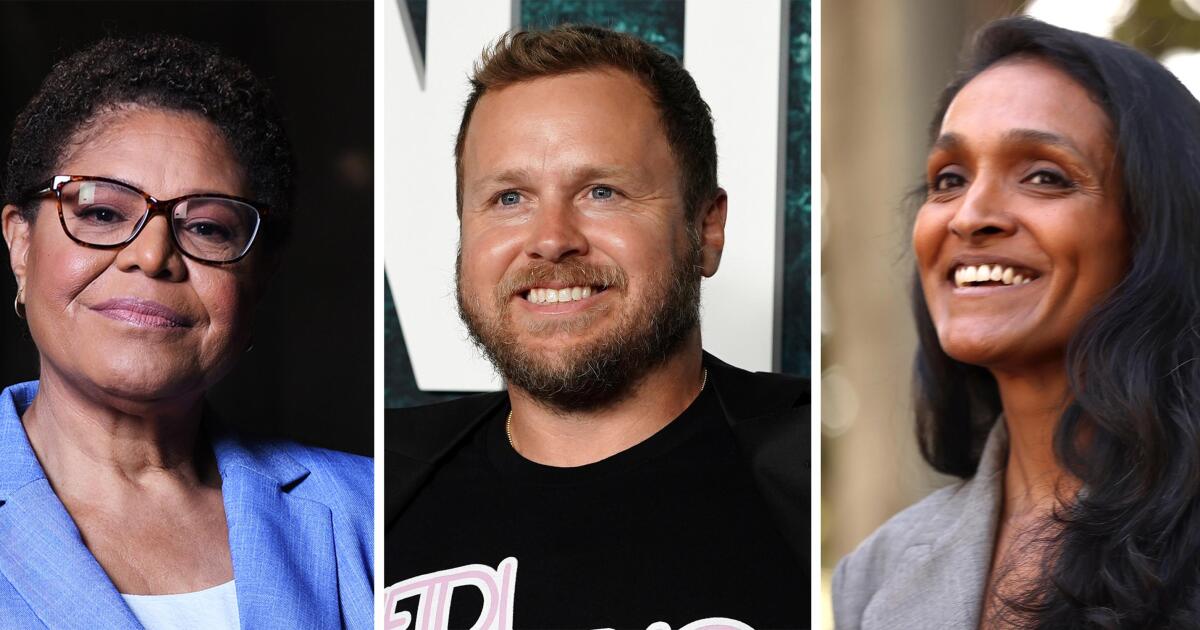
That’s why Mayor Karen Bass is paddling furiously, trying to keep her political career afloat. In the latest UC Berkeley-L.A. Times poll, Bass is at 26%, Nithya Raman at 25% and Pratt at 22%. That’s so tight, it appears that no one will get the 50% needed to win outright, and if we get a top-two runoff, it’s not clear who will go to the dance.

So as we close out the primary, with the election on Tuesday, five talking points come to mind.

Which candidate knows the city best?

Los Angeles has 114 distinct neighborhoods spread across 470 square miles (that’s 10 times the size of San Francisco), with an estimated 220 languages spoken. Diversity is a defining characteristic, and roughly half the population is Latino, which makes it a shame there’s no Latino candidate for mayor, especially given the raids and roundups by President Trump.

A mayor doesn’t have to speak six languages and know every corner of the city, but residents want to be seen and heard, and feel like they’re understood and represented.

Raman is well-versed on homelessness policy, and she’s spot-on about the need for greater urgency in problem-solving, but as my colleague Noah Goldberg reported, constituents in her district complain that they haven’t seen enough of her.

As I said, Pratt has wisely targeted municipal failure. But in the realm of outsider candidates with Republican credentials, Rick Caruso, who ran against Bass last time, was comfortable whether he was in the Valley, South L.A. or anywhere in between. And he easily connected with people. Would Pratt be a tourist in his own city?

By virtue of her job the last four years, Bass — who raised a blended Black and Latino family — knows the city best, although her unfavorability rating is a big problem.

What about the other candidates?

In the aforementioned poll, minister and housing activist Rae Huang had 9% and former educational technology businessman Adam Miller had 5%. Virtual unknowns, neither had a legit chance of winning, but they could be spoilers for one of the top three candidates.

I spoke to both, and if you’re undecided, you should read up on them before voting. On Huang’s website, the first words are “Homes are for people, not profit.” Miller wants to bring his success in the business world to City Hall, and when you consider his policy agenda along with his nonprofit work with veterans and homelessness, he’s a better candidate than Pratt.

But he wasn’t on a reality TV show.

Democrats ruined L.A. and California, right?

If only I had a nickel for every time a reader suggested that.

By 101 measures, Los Angeles is one of the great cities of the world and California has built the world’s fourth-largest economy while leading on climate change, so apocalyptic diagnoses are a bit off the mark.

Also, local elections are nonpartisan. You don’t run for mayor as a D or an R.

And yet it’s true that Democrats and their policies and sensibilities rule the day, and they have a lot to answer for in Los Angeles and in California.

But would the same critics suggest that in conservative cities like Fresno and Bakersfield, which have their own homelessness and other problems, Republicans are to blame?

When it comes to housing, poverty, healthcare and streets occupied by people who are addicted or mentally ill, the failures go back decades, touch all levels of government, and cross party lines.

Have I given up on Los Angeles?

When I pointed out that Pratt seemed unaware of these complexities, and of the structural limits of mayoral power, readers suggested he was rising to the challenge while I was giving up on L.A.

Not at all. I care about L.A. enough to hold its leaders to a higher accountability, and to scrutinize posers and pretenders who think they can do a better job.

My advice for the next mayor.

Fix what’s broken, celebrate what works and take responsibility for what doesn’t.

Now let me try one more time:

Spencer, give me a call.

You can’t tell us you had a conversation with God about running for mayor and not share more details.

Did God scold you for referring to the mayor as Karen “Basura,” which means trash in Spanish?

Did He say we should pull out of the ‘28 Olympics, or have any advice on how to fill potholes and fix sidewalks?

If you’re having regular conversations about City Hall with the Father, the Son and the Holy Spirit, we’re dying to know:

On homelessness, what would Jesus do?

steve.lopez@latimes.com
Source link

Pratt says Jesus is his role model. His take on homeless people isn’t Christ-like

Spencer Pratt is a showboat, a loudmouth, a troll and a self-proclaimed villain who seems willing to say anything in his quest to be the next mayor of Los Angeles.

Little wonder that his critics rolled their eyes when the former reality television star told CNN host Elex Michaelson a few weeks ago that his campaign role model is Jesus Christ, because “he was a politician.” How on earth did Pratt — a man who tosses insults with the ease of someone spitting loogies — come off boasting that his political hero was the Prince of Peace?

But anyone who ridicules the exchange as a blasphemous moment by a deluded wannabe isn’t paying attention — which is exactly the error that has allowed Pratt to storm L.A. politics. He isn’t running on an explicitly Christian message — that would be risky in a city with large Jewish, Catholic and secular constituencies. But the proud born-again evangelical is channeling the zeal of an old-fashioned tent revival, even if some of his rhetoric falls far outside the bounds of the Good Book.

In his recent memoir, Pratt recounted his conversion — actor Stephen Baldwin baptized him in a river during the 2009 season of the reality show “I’m a Celebrity, Get Me Out of Here.” Before that, his Christianity had consisted of wearing a black diamond cross necklace he described as “thirty grand of Jesus bling” bought from a Beverly Hills boutique. Pratt credits his faith with providing direction at a low moment in his life, as he embraced Jesus with such fervor that a pastor told him to stop joining altar calls so much during church services — once was enough.

“I needed the receipt stamped weekly,” Pratt wrote, “like a parking validation, just to make sure it stuck.”

Seventeen years later, he’s still seeking that affirmation.

The memoir comes off as a millennial version of “The Confessions of St. Augustine” — perhaps the most famous literary example of someone who saw their wreck of a life not as a series of mistakes to apologize for but as necessary failures on the road to grace. That’s why Pratt and his followers don’t see his sketchy past as a disqualifier, but rather his biggest strength. Only someone who says he was reborn in the inferno of the Palisades fire could possess the clarity and willpower needed to bring salvation to an accursed land, they argue.

In another era, Pratt would have been a welcome edition to the roster of bombastic Southern California preachers a la Aimee Semple McPherson, Chuck Smith and Gene Scott, as well as radio titans such as George Putnam and John Kobylt. His claims that only he can deliver us from damnation and that we need to repent of City Hall’s status quo at the ballot box are nothing less than a modern-day gospel to his followers. Pratt feels the pulse of L.A.’s civic malaise far better than Mayor Karen Bass or another of his opponents, City Councilmember Nithya Raman. Like any good pastor, he knows how to distill that discontent into soundbites and stories.

That’s why the self-designated “Pratt Daddy” has cast this moment in L.A. history as a modern-day Armageddon, urging voters to wage war against apostates and usher in a Second Coming, lest the city continue its supposed descent into hell. He admits in his memoir to holding “epiphanies and apocalyptic visions” in equal measure — no wonder he told a Canadian podcaster in March that life for him is a “spiritual battlefield” where “however I can be to stop evil at this point feels like a purpose.”

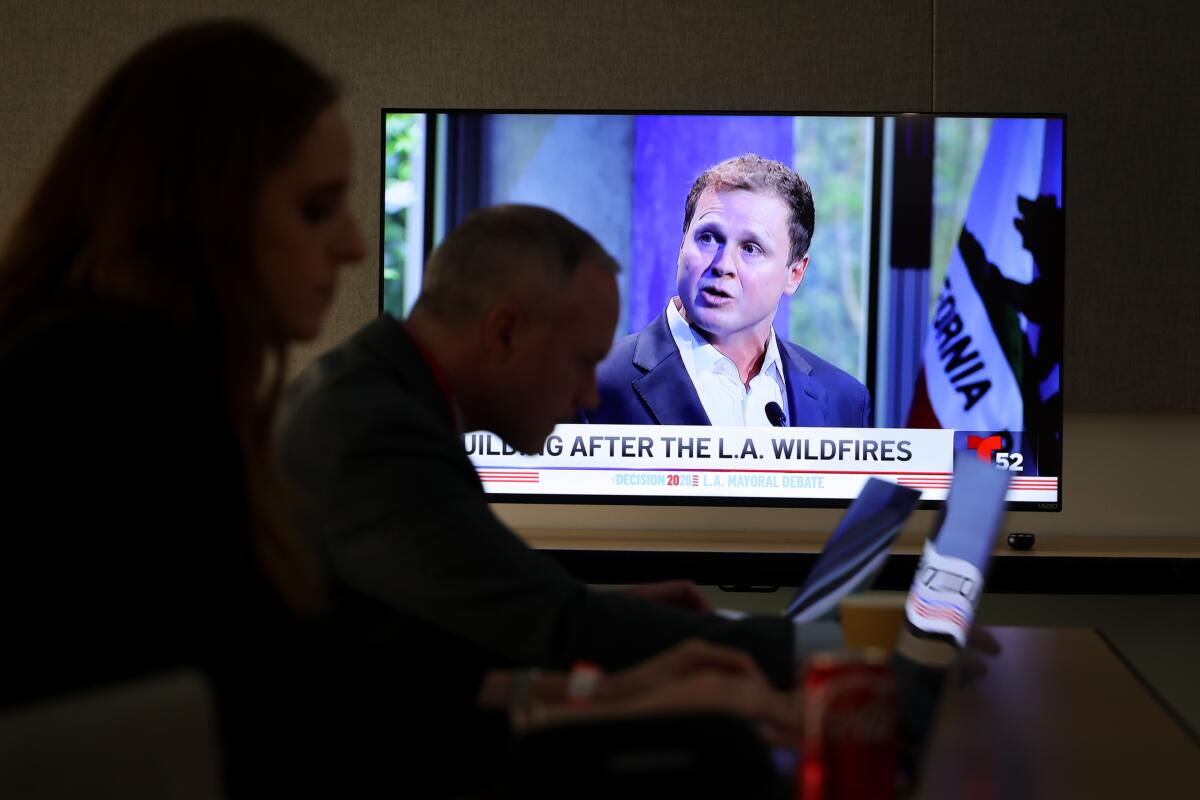
Spencer Pratt is shown on a television

Spencer Pratt is shown on a television while journalists work during the 2026 Los Angeles mayoral debate at Skirball Cultural Center on May 6.

(Jason Armond / Los Angeles Times)

Far from me to criticize someone’s faith. But I urge Pratt to reacquaint himself with the words of the messiah in whose path he professes to follow. Humility, frugality, turning the other cheek — it’s what Jesus taught and what Pratt has long rejected.

Nowhere does Pratt need more of refresher on Jesus’ lessons than when it comes to homeless people.

Instead of offering compassion or viable initiatives, Pratt consistently calls the unhoused “zombies,” “vagrants,” “drug addicts” and “bums,” with a particular fixation on the naked ones. He vowed to ABC 7 recently that he would push people off L.A.’s streets and onto federal land — like herding stray wildlife. The mayoral hopeful added that “scam homeless nonprofits” exacerbate homelessness, which must have been news to Scripture-based organizations such as the Los Angeles Catholic Worker, Union Rescue Mission and the Salvation Army, which have been trying to help homeless people since before Pratt was born.

Pratt also told ABC 7 reporter Josh Haskell that most of L.A.’s homeless are not locals.

“These people, when I unplug them … they’re all going to Seattle, where the mayor will welcome them,” Pratt proclaimed.

Jesus would not only roll out the welcome mat for homeless people — he would embrace them.

Spencer, what New Testament book says that your crude campaign against the most destitute among us is holy?

Christ never looked down on itinerants, famously saying, “The Son of man hath not where to lay his head.” In the Book of Mark, when Jesus sent his disciples out into the world, he told them to bring no food or money, because good people would take care of them.

“And if any place will not welcome you or listen to you, leave that place and shake the dust off your feet as a testimony against them,” Jesus said.

Christ did do some name calling, but his ire was directed at the powerful, the braggarts, the hypocrites — the Pratts of his time. The Nazarene saved his kindest words for the meek, the poor, the peacemakers — who are sorely lacking in Pratt’s caravan of disaffected liberals, Trumpers and the wealthy. Christ didn’t offer counsel to the comfortable but to outcasts — lepers, prostitutes, people possessed by demons or afflicted with disease — whose modern-day contemporaries live on our streets and whom Pratt World blames for all of L.A.’s ills.

Jesus especially embraced outsiders — the Canaanite woman he initially compared to a dog because she sought help for her daughter, the Samaritan lady at the well, the Roman centurion in the Book of Matthew of whom Jesus proclaimed, “I have not found so great faith” anywhere in Israel. Pratt would have rounded up all of them in donkey carts and dumped them in Babylon, if he had been around back then.

I understand how frustrating it is to see homeless encampments in neighborhoods and to deal with unhoused people who disrupt one’s day, as my wife does at her restaurant in Santa Ana. But whenever annoyance gets the better of me, I remember what Jesus told his followers: “Inasmuch as ye have done it unto one of the least of these my brethren, ye have done it unto me,” warning that he would keep this in mind on Judgment Day.

Those who didn’t take his advice? “Depart from me, ye cursed,” Christ thundered, “into everlasting fire, prepared for the devil and his angels.”

Christianity — and good society — calls for us to look to our better angels, not to demonize others, as Pratt regularly does. He knows this too.

“When the whole world hates you,” Pratt wrote, “it’s comforting to think at least the big guy upstairs has your back, so long as you repent.”

But repentance means admitting you’ve done wrong. Instead, Pratt is doubling down on his anti-homelessness nastiness as more and more people join his crusade.

Let’s see how many Angelenos embrace this false prophet on election day.


Source link

California’s wildfire prevention funding at risk of drying up

With California facing increasingly destructive wildfires, experts and officials have long urged the strategic removal of dense, flammable vegetation that can erupt into particularly destructive flames from a lightning bolt or the spark of a power line.

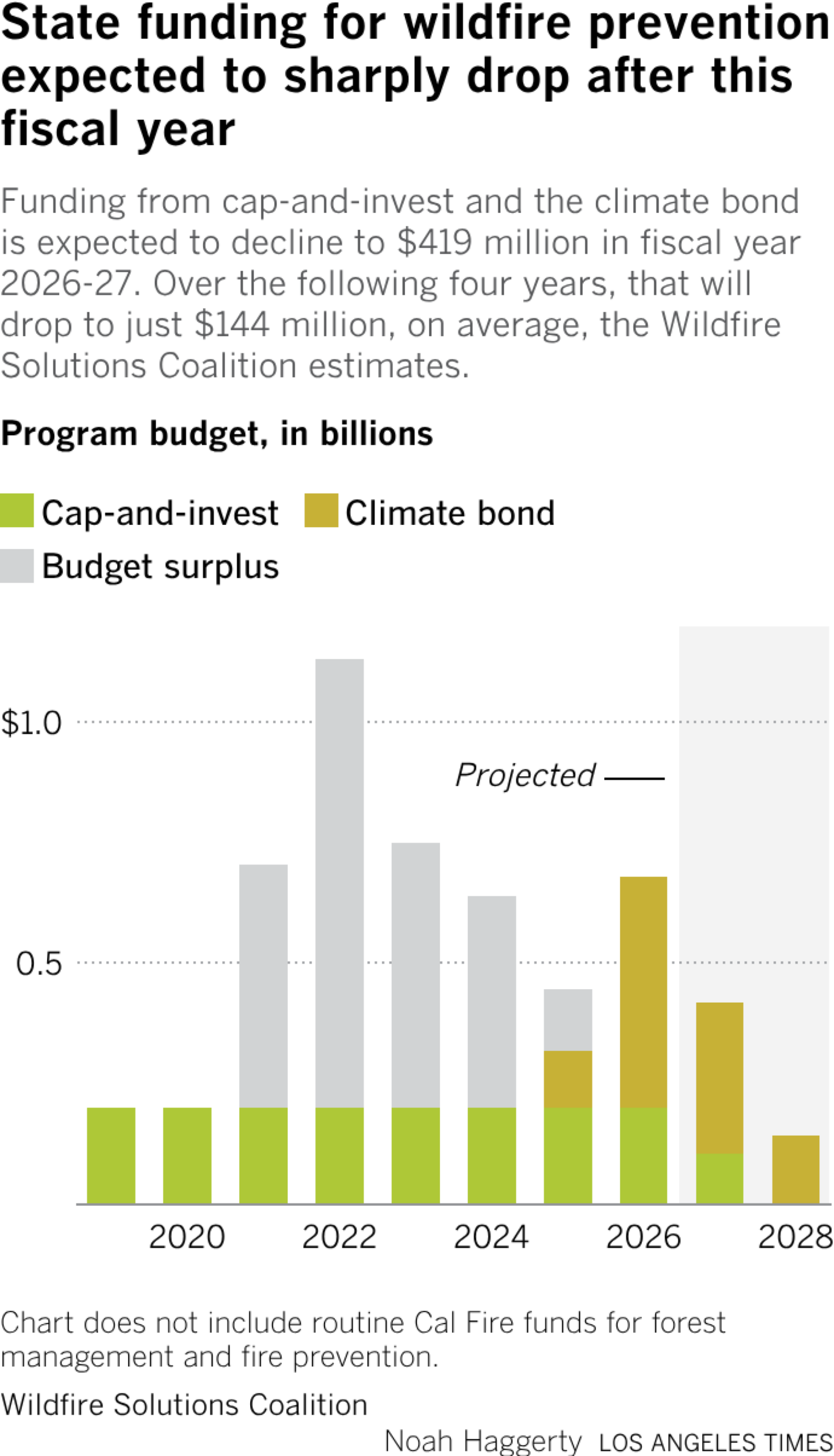
But after years of record investment by the state in such wildfire risk mitigation, two key money sources are drying up, potentially reducing the state’s annual budget for vegetation removal by hundreds of millions of dollars.

Wildfire resiliency advocates are warning that the loss of these funds will leave the state vulnerable to devastation, and are calling on California’s next governor to take that threat seriously.

Currently, California relies heavily on two funding sources for wildfire mitigation work: A state program that charges polluters for their emissions and a climate bond approved by voters in 2024.

Late Friday, however, state officials adopted a new structure for the emissions program, called cap-and-invest, that analysts say will likely reduce wildfire mitigation funding by $200 million per year. At the same time, the governor’s latest budget proposal puts the state on track to allocate the majority of the climate bond’s $1.5 billion in wildfire prevention money within just three years.

As a result, California could go from routinely pulling more than $600 million a year from these sources, to just $150 million, according to an estimate from the Wildfire Solutions Coalition — a group of more than 80 organizations representing conservationists, business owners, fire officials and tribal leaders.

The coalition is urging the state to find new sources of funding for the work.

“We have the scientists, we have the technicians, we have the advocates,” said Michelle Decker, who is on the coalition’s executive committee and serves as president and CEO of the Inland Empire Community Foundation. “We see this problem. We can get ahead of this problem. It is a revenue issue.”

California wildfires have become increasingly costly. The 2025 L.A. fires alone caused an estimated $250 billion in damage and economic loss. Insurance companies have already paid out $22.4 billion.

In attempt to reduce the risk of damage to communities and ecosystems, the state has employed a wide range of tactics. These includes fortifying homes against wildfires, replanting fire-ravaged forests and thinning out vegetation with prescribed burns, goat grazing and manual thinning with heavy machinery to reduce the intensity of potential fires.

Research suggests wildfire mitigation work pays off. A recent analysis of 285 fires in the western U.S. found that every dollar spent on landscape projects saved about $3.75 in wildfire damage.

But as funding from cap-and-invest and the climate bond dwindle, the state must increasingly turn to Cal Fire, which devotes only a small portion of its budget to mitigation work.

“This is not an issue that can be pushed off to a timeline based solely on politics,” said Steve Frisch, a founding member of the coalition and president of the Sierra Business Council. “Fire happens whether we want it to or not.”

After a series of destructive wildfires in Northern California and the 2017 Thomas fire in Southern California, the state legislature began to explicitly focus on funding wildfire mitigation.

In 2018, lawmakers directed $200 million per year of cap-and-invest funds to wildfire mitigation projects.

As the Woolsey fire in Southern California and the Camp fire in Paradise raged later that fall, Trump accused the state of “gross mismanagement” of forest lands and threatened to cut off federal funds unless it was corrected.

Gov. Gavin Newsom and the legislature, with a significant budget surplus, began earmarking even more funds, leading to a peak of $1.1 billion in wildfire mitigation investments during the 2021-2022 fiscal year.

After the surplus dwindled, the legislature opted in 2024 to put a $10-billion climate bond in front of voters — $1.5 billion of which was dedicated specifically for wildfire mitigation work.

Newsom has since pointed to this high state funding to call on the federal government to step up its own investments into forest management work.

The federal government manages 57% of all forests in the state. While the U.S. Forest Service spent $3.1 billion mitigating wildfire conditions in the state over the last few years, California spent $4.3 billion, according to the California Forest Resilience and Wildfire Task Force.

However, the state has already allocated about $600 million of the climate bond’s wildfire mitigation pot for the 2024-2025 and current fiscal years. The latest budget proposal would allocate more than $300 million for this upcoming fiscal year. While many advocates support allocating the money quickly, it leaves little for future years.

Once that money is spent, California has to pay off the $10 billion bond with interest. The result is an estimated price tag of $16 billion, paid in roughly $400 million increments every year, for 40 years, according to the state’s Legislative Analyst’s Office.

As for the cap-and-invest funds, a fraught months-long debate at the California Air Resources Board on how to extend the program beyond 2030 resulted in a compromise that will cut the revenue it generates in half, the Legislative Analyst’s Office estimates.

Since other projects get priority — including $1 billion every year for California’s high-speed rail project — the new proposal would “likely leave no funding” for the wildfire and forest resilience line item, the Legislative Analyst’s Office found.

Cal Fire still holds a modest annual budget for wildfire mitigation work. In the 2024-2025 fiscal year, the agency had $500 million for forest management and fire prevention that was not directly tied to cap-and-invest or the bond — up from about $65 million two decades prior.

As for the federal government, independent analyses by Grassroots Wildland Firefighters and NPR found that Forest Service wildfire mitigation work is on the decline amid federal staffing cuts. The Forest Service claims the decrease in work was primarily due to poor weather conditions for activities like prescribed burns and staff being occupied with firefighting.

Both the state and federal government’s investments pale in comparison to the spending of California’s investor-owned utilities. In 2025 alone, the utilities planned to spend more than $9.2 billion on preventing their equipment from sparking the next devastating wildfire, primarily funded by Californians’ electricity bills.

Record heat. Raging fires. What are the solutions?

Get Boiling Point, our newsletter about climate change, the environment and building a more sustainable California.

Times staff writer Hayley Smith contributed to this report.

Source link

California governor election guide: Immigration, homelessness, affordability

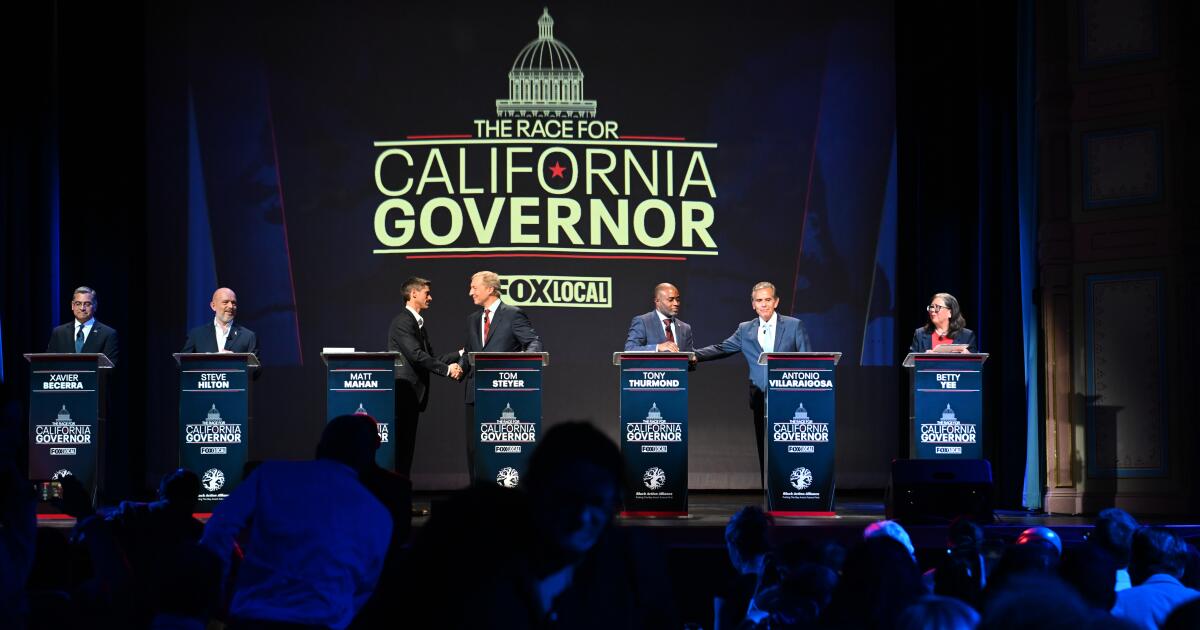
Democratic and Republican candidates vying to replace Democratic Gov. Gavin Newsom have been sparring on televised debates and exchanging campaign attacks since April to garner the attention of voters statewide.

The candidates include a Riverside County sheriff, a former senior advisor to British Prime Minister David Cameron, a former Los Angeles mayor, a billionaire hedge fund founder and two former members of the U.S. House of Representatives.

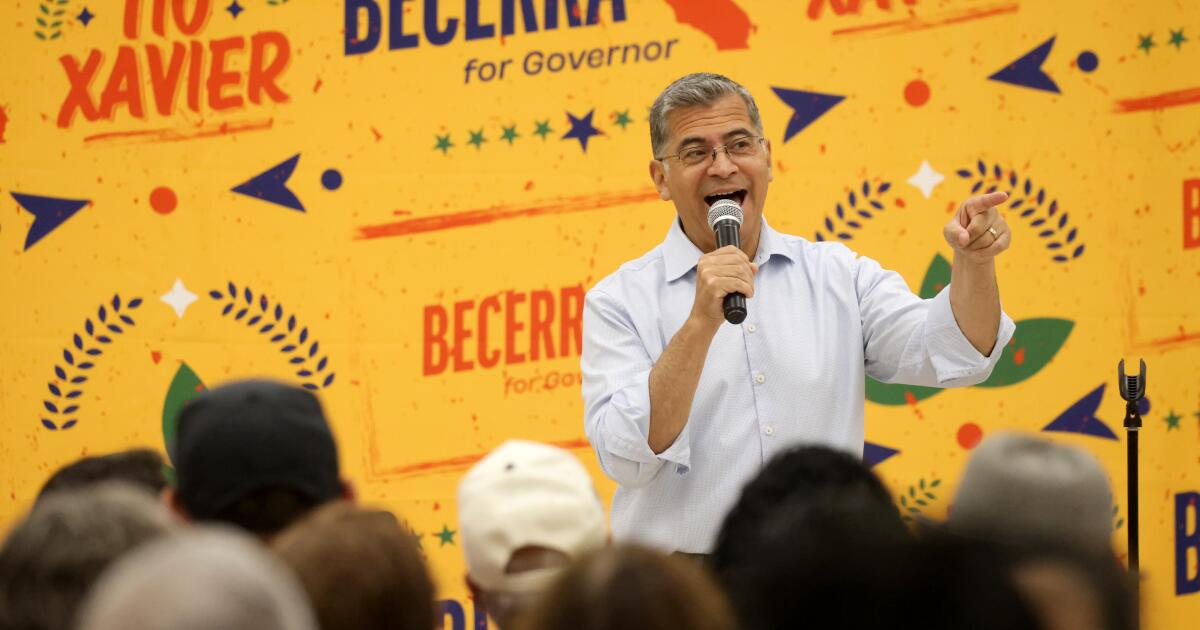
Recent polls showed that the leading Democratic candidate is Xavier Becerra, a former U.S. Secretary of Health and Human Services whose campaign is focusing on affordability and housing for what he calls “working Californians.” Vying for one of the top two spots in the June 2 primary are Republican contender Steve Hilton, a former Fox News commentator who was endorsed by President Trump, and Democratic billionaire Tom Steyer, a hedge fund founder turned environmental warrior.

Here is what the top candidates have said on important topics such as immigration, housing and homelessness, affordability and the entertainment industry.

Immigration and ICE

The U.S. Immigration and Customs Enforcement raids that began in California last summer have been hotly debated by Democratic and Republican candidates.

Here is what the candidates said during a debate in May or stated on their websites, as well as some criticism they have faced during the campaign.

  • Xavier Becerra vowed to protect and lead the state against the Trump administration’s attacks on immigrants and marginalized communities. Becerra’s rivals have accused him of failing to protect migrant children when he served as Health and Human Services secretary under the Biden administration.
  • Riverside County Sheriff Chad Bianco opposes “sanctuary city” laws that block local law enforcement from assisting federal immigration agents, calls for the deportation of criminal illegal immigrants and says the border must be secured. But he has also faced criticism from fellow Republicans for supporting a pathway to citizenship for lawful, working undocumented people and telling his constituents that his deputies were not taking part in Immigration and Customs Enforcement raids.
  • Former Fox News host Steve Hilton, who legally immigrated to the United States from the United Kingdom, opposes California’s state and local sanctuary policies, and said the state must cooperate with the federal government because the governor’s job is to enforce laws, whether the governor agrees with immigration enforcement activity or not.
  • San José Mayor Matt Mahan plans to demand ICE officers be unmasked, vows to go after agents and immigration agency leadership when they violate the constitution and shield communities from unwarranted harassment.
  • Former Congresswoman Katie Porter said California should enforce its sanctuary laws statewide, “so we don’t have crazy cowboys taking the law into their own hands.”
  • Billionaire hedge fund founder Tom Steyer wants to strengthen California’s laws to ensure law enforcement agents can’t profile Californians based on their race, ethnicity, language, occupation or location. He also wants legislation that will grant the state attorney general the authority to hold ICE agents accountable for violent and illegal acts on the job. He supports abolishing ICE. But he has faced heat on the campaign trail for his former hedge fund’s investment in the Corrections Corp. of America, now known as CoreCivic, which operates private prisons around the nation that are housing people picked up by federal immigration agents. Steyer has repeatedly expressed remorse about his former firm’s ties with the company and said he personally ordered the divestment from private prisons before he sold his stake in the hedge fund.
  • State Supt. of Public Instruction Tony Thurmond says he plans to levy a new tax on companies that operate ICE detention centers, fight to abolish ICE, protect California’s sanctuary laws and work with Congress to establish a pathway to citizenship.
  • Former L.A. Mayor Antonio Villaraigosa supports helping law-abiding immigrants and said violent criminals have been deported under the state’s sanctuary laws, despite claims to the contrary by Republican candidates.

Housing and homelessness

Here’s what each candidate said about the need to address the state’s housing shortage and its stubborn homeless problem:

  • Becerra said he plans to cut “unnecessary red tape” and speed up “approvals for projects that meet affordability and environmental standards.” On homelessness, Becerra said he wants to establish a $150-million annual homelessness prevention fund to pay rents and fight eviction or foreclosure.
  • Bianco said he wants to end “overregulation of our building industry” and eliminate the California Environmental Quality Act, the California Coastal Commission and the California Air Resources Board. On homelessness, he wants cities to clear encampments and prioritize mental health and substance abuse treatment. He wants to force people to accept drug treatment “when necessary.”
  • Hilton proposes to reform the California Environmental Quality Act so that only government prosecutors can sue, preventing private individuals and organizations from stopping or delaying new housing projects. He also said he believes rent control measures reduce the incentive to build housing and wants to restructure or eliminate them. On homelessness, Hilton wants to build more low-cost group shelters instead of permanent housing.
  • Mahan said he wants to lower developer fees and taxes for infill housing. Mahan also said more homes should be built off-site in California-based factories, making them cheaper than building them on site. On homelessness, Mahan wants to make the state’s Homeless Housing, Assistance and Prevention grant permanent and fund it at $1 billion a year.
  • Porter said she would “greenlight innovative building strategies, shred unnecessary red tape and create incentives” to build needed housing. On homelessness, Porter wants more interim housing, emergency rental assistance and rapid rehousing programs.
  • Steyer is pledging to make it harder for large corporations to buy up the state’s housing stock and wants to encourage cheaper methods of home construction. On homelessness, Steyer wants to expand interim housing options and homeless services.
  • Thurmond said he wants to build 2 million new homes for “working Californians,” on 75,000 acres of surplus land that local school districts own. On homelessness, Thurmond wants to increase the number of housing units that include mental health and substance abuse services.
  • Villaraigosa said he wants to cut development fees and reform CEQA to speed housing development, particularly for infill housing. On homelessness, Villaraigosa wants to double the state’s investment in Newsom’s Homekey program to build an additional 10,000 units of permanent supportive housing over five years.

A comprehensive guide on the candidate’s full views on housing and homelessness is here.

What the candidates have said about affordability

The candidates offered their ideas for making California more affordable during debates in April and May as well as on their websites.

  • Becerra said he will stand up to price gouging and unjustified rate hikes and use the power of the state to lower prices “where the market has failed.”
  • Bianco says he wants to cut taxes for working families and businesses, stop the “over-regulation on California’s economy,” support job growth and unleash the state’s energy resources to lower the price of gas and utilities.
  • Hilton said he wants to eliminate income taxes on people who earn less than $100,000 and on the first $100,000 for Californians who earn more than that. He also wants to end California’s current tax on tips to ensure tipped workers keep more of their earnings.
  • Mahan said he wants to enact a “Gas Tax Holiday” that ends or reduces the tax on gas. He also wants to remove barriers to building affordable housing by putting a cap on fees charged for new housing construction.
  • Porter supports single-payer healthcare, providing free child care and college tuition and making wealthy corporations pay their “fair share” in taxes. To pay for it, Porter would impose a progressive corporate tax, meaning more profitable businesses and corporations would pay a higher rate. She also supports ending income taxes for those who earn less than $100,000.
  • Steyer called himself the only candidate who is “willing to take on the corporate special interests” that drive up the cost of living in the state. He said he would like to lower gas prices as well as streamline permitting, reform zoning and enforce laws to build affordable homes faster. He also supports single-payer healthcare.
  • Thurmond wants to provide a tax credit to make it easier for Californians to pay for the rising cost of gas, groceries and housing. He plans to establish a universal childcare program and provide low-cost loans to help small businesses make improvements at their firms.
  • Villaraigosa plans to support a California Fuel Affordability Guarantee to cap gas prices for working families.

The entertainment industry

Here’s what some candidates have listed on their campaign websites about their ideas to support California’s entertainment industry.

  • Becerra supports state requirements that mandate productions disclose how AI is being used, cutting the “bureaucratic friction” of getting a filming location permit and vows to uphold the state requirement that ensures digital platforms share meaningful performance data with the cast, writers and directors.
  • Hilton wants to restore California’s competitive edge as a place for productions by creating financial incentives for film productions, cover the initial and technical costs associated with the development of a film or television project and reserve funding for independent and mid-budget projects.
  • Mahan said he plans to expand and modernize production incentives, make them more competitive and ensure the protections are for everyone who works on a film or television project from the technical crew to writers, directors and actors.
  • Steyer said he would like to block corporate mergers in entertainment, defend and expand film tax credits and eliminate the regulations and hurdles for permitting and logistics that “slow down productions.”

Times staff writers Seema Mehta, Nicole Nixon and Andrew Khouri contributed to this report.

Source link

Pleas and political attacks fill the home stretch of California governor’s race

The top candidates for California governor crisscrossed the state Friday, all venturing to friendly political territory to woo voters and undermine their rivals as the June 2 primary election fast approaches.

The top Republican in the race, former Fox News host Steve Hilton, spent the day railing against transgender athletes before a high school track event in the Central Valley, an event sure to appeal to his base of President Trump supporters.

The front-running Democrats, former Biden administration Cabinet member Xavier Becerra and billionaire environmentalist Tom Steyer, rallied one of their party’s most influential constituencies: union members.

While both stuck with mostly an upbeat message and reiterated promises to lift up Californians struggling to make ends meet, Steyer afterward accused Becerra of being “a corporate Democrat who’s taking money from all these big corporations” who “doesn’t want to change things.”

Steyer’s had good reason to go after Becerra.

A new poll from the UC Berkeley Institute of Governmental Studies and co-sponsored by the Los Angeles Times showed Becerra leading the race with 25% support from likely voters, followed by Hilton at 21% and Steyer within striking distance at 19%. The two candidates who finish in first and second place in the primary will advance to the November general election, leaving the third-place finisher on the sideline.

Though he told reporters Friday morning that “I don’t pay attention to polls,” Steyer was energetic at a Northern California campaign event, where he held a private meeting with leaders of a union representing long-term caregivers. In brief remarks at the offices of SEIU Local 2015, Steyer described the race as a choice between a billionaire champion of working people and the corporate-backed Becerra.

“Does California work for Californians or does California work for corporations? The corporations think it works for them. They want it to continue to work for them and they’re putting up tens of millions of dollars to make sure they continue to make record profits,” he told dozens of home-care workers, teachers, construction workers and nurses at the West Sacramento gathering.

Groups including PG&E, the California Assn. of Realtors and the California Chamber of Commerce have spent more than $34 million opposing Steyer’s candidacy. The former hedge fund manager has pledged to lower energy bills by breaking up large electric utility monopolies.

As a billionaire who has so far poured $216 million of his own money into his gubernatorial campaign, Steyer has faced skepticism from some left-wing and working-class voters. But he is endorsed by progressives, including Rep. Ro Khanna (D-San Jose), and unions including the California Nurses Assn. and both major teachers unions.

“I voted for Tom. I was looking for a change,” said Alvenia Scott, a union board member who works as an in-home caregiver to her disabled sister.

“He really has some good ideas,” she said, adding that she had more qualms about Steyer’s lack of government experience than his wealth. “He made his way in life, more power to him.”

Hundreds of miles south in the Inland Empire, Becerra pledged to be on the side of unions if he is elected governor and urged voters to turn in their ballots in what has so far been a remarkably low-turnout election.

“I am with you. When I become governor and I sit behind that desk, you’ll have a union man sitting at that desk,” Becerra told about 500 people at the United Food and Commercial Workers hall in Bloomington.

He asked the crowd if they had cast their ballots and noted that not everyone raised their hand.

“Less than one in five Californians have actually cast their vote so far. We got to get that number way, way up,” he said, arguing that the election is about “sending a message all across the country that California will be counted, that California cannot be neglected, and that California will not take a knee to anyone in Washington, D.C.”

Only 12% of the state’s registered voters have cast ballots as of Thursday evening, according to the election tracking firm Political Data Inc.

Community college counselor Diego Rodriguez, 32, said he decided to vote for Becerra in recent weeks after seeing the former U.S. Health and Human Services secretary’s momentum in the race and researching his record.

“Also just his story. As someone who works in higher education, and seeing how Xavier, being first-generation, has benefited from higher education, and how he advocates for higher education,” the Rialto resident said. “Additionally, today, him being here at a labor union and advocating for the working class and labor, I think, is very important.”

Rodriguez said he first started looking into Becerra after he was among the candidates excluded from a USC debate that was ultimately canceled.

“I think that people became aware of him more because of that,” Rodriguez said. “There was a lot of conversation online regarding that, but I think it allowed the spotlight to be brought onto him and it made people aware of his record.”

At a campaign stop in Clovis in the central part of the state, Hilton marveled that his campaign had spent only about $2 million in campaign advertising but was still polling above Steyer, according to the latest Berkeley IGS survey.

“We’re feeling confident,” said Hilton, standing in a suburban stretch of the city. Still, he warned that voters need to get out to support him and avoid a “complete disaster for California” of two Democrats advancing to the November election.

Hilton, who was endorsed by Trump in April, joined other politicians and leaders in Clovis in opposing trans athletes from competing at the 2026 CIF State Track & Field Championships.

The group met near where the championship events were scheduled to take place this weekend.

Asked why he was focusing on sports and gender in the final days of the race, Hilton said it’s “one of the main issues” that come up at town halls. If elected, he said he would seek to overturn the state’s 13-year-old law that allows students to participate in school activities and use facilities such as bathrooms based on their gender identity.

Hilton argues the law violates the state Constitution and will “suspend” it while he initiates legal proceedings to overturn it.

He also praised Spencer Pratt, a Republican and former reality TV star who is running for Los Angeles mayor, saying his candidacy has brought “excitement and energy” to the state’s primary election.

“For a long time in California, there’s been this sense that it’s all inevitable — there’s nothing you can do, Democrats run this place, just the way it is,” Hilton said. “I think that that’s changing. I think there’s this sense that something’s happening.”

Source link

Former head of Iowa school district sentenced to 2 years for falsely claiming to be a US citizen

The former superintendent of Iowa’s largest school district who was arrested last year in the Trump administration’s immigration crackdown was sentenced Friday to two years in prison.

Ian Roberts is likely to be deported to his native Guyana in South America once he serves the sentence. He pleaded guilty in January to falsely claiming to be a U.S. citizen and illegally possessing firearms, which together carry a maximum sentence of 20 years in prison. His lawyers had proposed that he be put on probation “to facilitate his removal from the United States,” but prosecutors had argued that his likely deportation should not be a factor.

Prosecutors alleged Roberts knowingly lacked employment authorization for nearly all of his two-decade career in urban education and submitted a counterfeit Social Security card when he was hired as superintendent of the Des Moines public school district, which serves 30,000 students.

Roberts’ stunning case bookended the school year. His September arrest occurred as President Trump’s administration was sending increased numbers of federal immigration officers into American cities to round up immigrants.

Des Moines Public Schools said last month that it revised its conflict-of-interest policy after an audit found Roberts awarded district business to a consulting firm he worked for, affirming findings first reported by the Associated Press in the weeks after federal immigration officers detained him.

Roberts was in his school-issued vehicle when officers stopped him on Sept. 26 in a targeted U.S. Immigration and Customs Enforcement operation. He allegedly fled before he was located with the help of state troopers. Authorities said a loaded handgun was wrapped in a towel under the seat and $3,000 in cash was in the car. Three other weapons were recovered during a search of his home.

In a court filing, attorneys for Roberts said he has dedicated his life in the U.S. to public service and has not been a threat to public safety. After Roberts married a U.S. citizen, his attorneys said, he was denied lawful permanent residency because he failed to disclose that he had been arrested. He said he did not think he needed to because the charges against him were dropped.

“While Dr. Roberts tried to adjust his status three more times, this initial mistake by Dr. Roberts sealed his fate,” his attorneys wrote. “In the background of his career for the next 24 years, this denial of his adjustment of status haunted Dr. Roberts like a ghost, eventually derailing his life and career.”

Dozens of people submitted letters on Roberts’ behalf to dispute how he has been portrayed and provide details of his positive impact. His lawyers wrote that he likely faces deportation to Guyana, where he will “be left without his career, without his wife, without his children, in a country where he has not lived for thirty years.”

In recommending a three-year sentence, prosecutors described a yearslong and deliberate misrepresentation of his legal status. Prosecutors said a reduced sentence is not appropriate just because Roberts is likely to be deported.

They said they do not know what documents Roberts presented to show eligibility for work dating back to 2008, years before he was approved for temporary status in 2018, but he “deliberately obtained employment without work authorization at school after school, within state after state.”

Fingerhut writes for the Associated Press.

Source link

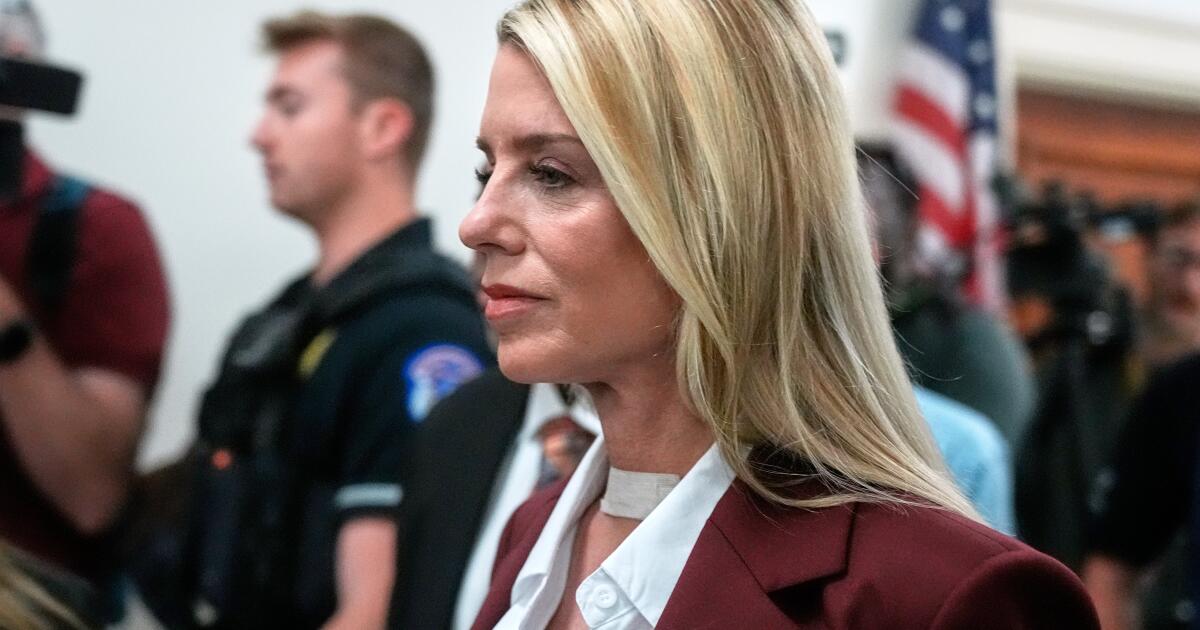
Democrats call Bondi’s Epstein files interview a ‘sham’

Democrats on Friday called former Atty. Gen. Pam Bondi’s interview with the House Oversight Committee about her handling of the Epstein files a “sham” and a “coverup,” and said she refused to answer numerous questions about President Trump in the closed-door session with lawmakers.

“It’s a sham in there. They’re not answering any questions,” Rep. Dave Min (D-Irvine) told reporters during a break from the interview.

Bondi was joined in her interview by attorneys from the Department of Justice, including Assistant Atty. Gen. Harmeet Dhillon, who intervened to prevent answers to some questions about Trump, Democrats said.

“The DOJ is in there right now stopping questions about President Trump and about what happened in the release of these files,” said Rep. Robert Garcia (D-Long Beach), the ranking Democrat on the committee.

He said Bondi, who was not under oath, declined to answer five questions he posed about the president.

The committee said it will release a transcript of the interview, which was not recorded on video.

The committee subpoenaed Bondi in March to appear for a deposition when she was still in office, but she didn’t initially comply, agreeing to the voluntary interview only after Democrats filed a resolution last month seeking to hold her in contempt.

Dhillon, a San Francisco attorney and longtime Republican activist who has been floated as a potential future attorney general, wouldn’t say whether she expressly prevented Bondi from answering questions about Bondi’s interactions with the president.

“There were ground rules laid with the committee before we walked in there and we simply wanted to stick to those,” Dhillon said.

Garcia said that Bondi blamed Acting Atty. Gen. Todd Blanche, then her deputy, for problems with the release of the files.

Bondi, who didn’t meet with reporters after her interview, disputed Garcia’s characterization.

“NOT TRUE. I praised Acting AG Blanche’s management of this Herculean task. I said his ethics are beyond reproach and that he is an incredible Attorney General,” Bondi wrote on X.

The department was criticized for not releasing the files as quickly as required under a law passed last year mandating release of all records from the department’s investigations into sex trafficker Jeffrey Epstein, who died in federal custody in 2019.

The department also came under fire for failing to redact the names of some of Epstein’s victims, while redacting the names of some of Epstein’s alleged co-conspirators, as well as for its removal of some of the files it initially posted.

A group of Epstein victims who spoke with reporters in front of the closed doors of the Bondi interview criticized the department’s rollout of the files and the department’s lack of communication with victims.

“Pam Bondi and Todd Blanche have derailed the lives of so many survivors,” said Dani Bensky, who said she was abused by Epstein when she was a 17-year-old high school student in New York City.

Rep. Melanie Stansbury (D-N.M) said that in the interview, Bondi acknowledged she had never met with any of Epstein’s victims.

In Bondi’s opening statement, reviewed by The Times, she acknowledged issues with the rollout of the files, but defended the administration’s handling of the release.

“There were redaction errors,” Bondi’s opening statement said. “But since day one of this process, this Department has been committed to accountability and transparency.”

Bondi was fired by Trump on April 2 and faced questions throughout her tenure about the department’s investigations into Epstein.

In February 2025, she claimed on Fox News that she had a copy of Epstein’s supposed client list, showing the names of the financier’s high-powered friends that he had directed girls to have sex with.

But in July 2025, as Trump faced questions about his relationship with Epstein, whom he knew socially, the Justice Department closed its investigation into Epstein’s alleged crimes and said no such client list existed.

Rep. Ro Khanna (D-Fremont) and Rep. Thomas Massie (R-Ky.) introduced the bipartisan Epstein Files Transparency Act soon after, requiring the Justice Department to release all of the records from its investigation into Epstein. Despite initially opposing it, Trump signed it into law on Nov. 19, 2025.

When asked about what Trump might have known about Epstein’s crimes, Bondi said she did not know, according to Rep. James Walkinshaw (D-Va.)

“I’m not certain of the extent of his knowledge,” Bondi said, according to Walkinshaw.

Bondi responded to Walkinshaw’s claims, writing on X: “MISREPRESENTATION by Walkinshaw. What the world knows to be true is President Trump banned Epstein from Mar a Lago decades ago bc Epstein was a despicable creep!!”

Garcia, the top Democrat on the committee, said Democrats would seek to speak with Blanche and FBI Director Kash Patel next about the handling of the Epstein files and the department’s investigations into Epstein and his alleged co-conspirators.

Rep. James Comer (R-Ky.) was the only Republican member of Congress to attend the interview and Democrats called out their Republican colleagues for not joining.

“I have an election in four days, a very important one,” said Min, the Democrat from Irvine. “But I’m here, rather than in my district, because this is important.”

Source link

Trump administration grants rare TPS reprieve, extending protections for 11,000 Lebanese

The Trump administration has extended protections shielding about 11,000 Lebanese from deportation, allowing them to stay and work in the United States for another six months.

The decision, announced Thursday by the Department of Homeland Security, marked a rare reprieve for people protected by temporary measures that have been harshly criticized by Republicans. The extension comes amid ongoing fighting in southern Lebanon between Israeli troops and Hezbollah fighters.

The decision was automatic, meaning that the administration missed the deadline by which it was supposed to decide on whether to extend the measure called Temporary Protected Status for Lebanese people living in the U.S. who are covered by the program. By statute, the status automatically extends for six months if the department misses the deadline.

It was an unusual outcome for an administration that has canceled the protections that had covered people from 13 countries, including Venezuela, Haiti, Nicaragua and Syria from deportation.

TPS was created by Congress in 1990 to prevent deportations to countries suffering from natural disasters or civil strife, giving people authorization to work in increments of up to 18 months. More than 1 million immigrants from 17 countries were protected by TPS at the beginning of the Trump administration, after the Biden administration greatly expanded its use.

The program has been at the center of a controversy.

Republicans and critics of TPS argue that the program and its protections deviate from their original temporary intent, taking on a quasi-permanent character when extended. Its defenders assert that it is a fundamental humanitarian program that prevents vulnerable individuals from being forced to return to dangerous conditions.

The DHS notice said that former DHS Secretary Kristi Noem and current Secretary Markwayne Mullin, who has led the department for the last two months, “were unable to make an informed determination on Lebanon’s TPS designation.”

The extension allows existing beneficiaries to keep their protections through Nov. 27, “if they still meet the eligibility requirements for TPS,” according to the notice. The work permits that were already issued for Lebanese TPS holders will be valid until the same day.

This is the second time the Trump administration has automatically extended a TPS designation. The first happened nearly a year ago with South Sudan, but the protections were terminated in November 2025, after the six-month extension period.

There are dozens of lawsuits challenging the termination of TPS at federal courts in different states. The Supreme Court is set to make a decision on TPS that protected Haitians and Syrians during the summer, and the result is expected to have an impact on all the other cases.

Advocates welcomed the extension.

“Extending Temporary Protected Status means Lebanese nationals in the United States will not be forced back into dangerous conditions but allowed to stay and continue supporting their families and contributing to their local communities,” said Kelly Razzouk, vice president of policy and advocacy at the International Rescue Committee.

José Palma, national coordinator of the National TPS Alliance — an advocacy group that has fought in federal courts against the cancellation of TPS for several countries—welcomed the extension of protections for the Lebanese.

“But we need to find a permanent solution for all TPS beneficiaries,” he warned.

Salomon writes for the Associated Press. AP writer Rebecca Santana contributed to this report.

Source link

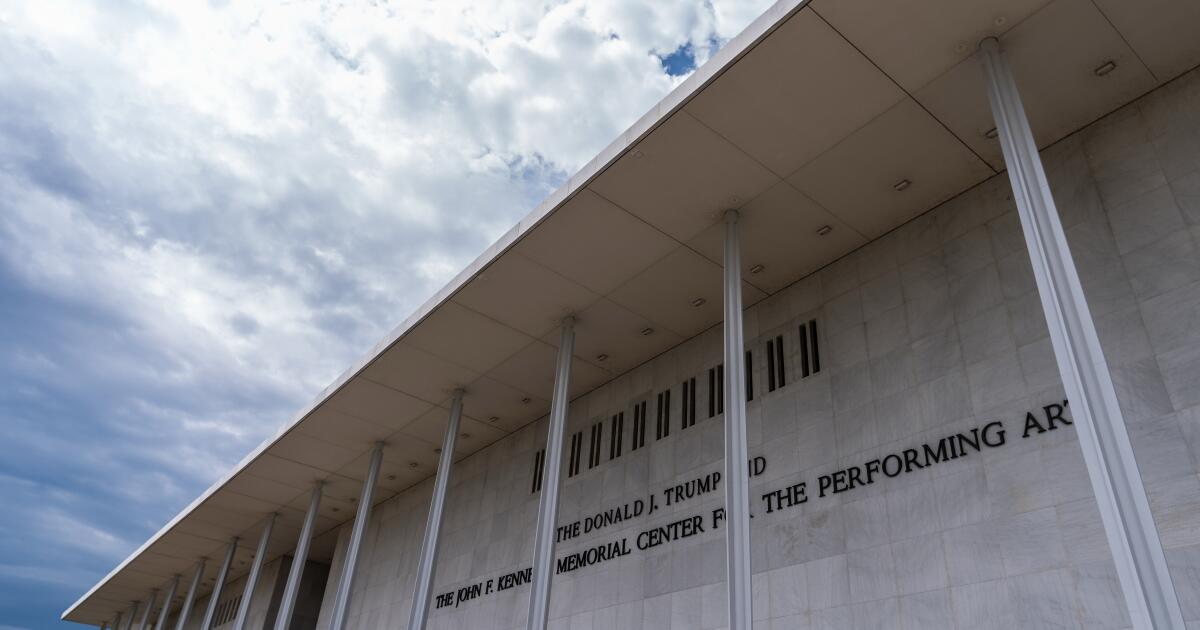
Judge says Kennedy Center board broke law putting Trump’s name on building, blocks closure

A federal judge ruled Friday that President Trump’s name was illegally added to the Kennedy Center and blocked the administration from closing the cultural and arts venue for major renovations.

U.S. District Judge Christopher Cooper in Washington, D.C., ruled that the Kennedy Center board’s March 16 vote to close the facility was “ill-informed and seemingly preordained” with no regard for its legal obligations.

“The trustees might have assessed the propriety of closure in a number of prudent ways. This was not one,” he wrote.

Cooper also concluded that the board “overstepped its statutory bounds” by unilaterally adding Trump’s name to the center. Congress gave the Kennedy Center its name, and only Congress can change it, he said.

Roma Daravi, the Kennedy Center’s vice president of public relations, said Friday the institution is “confident that on appeal the court will uphold the Board’s will to recognize President Trump’s historic contributions to our nation’s cultural center.” She said the decision would be reviewed “carefully.”

“Though the reality remains — the Center requires an urgent and significant restoration – a truth that even the plaintiff acknowledges,” Daravi said. “With $257 million secured by President Trump and approved by Congress, the resources are in place and we remain committed to pursuing every lawful avenue to ensure the Trump Kennedy Center is restored as a national cultural landmark for all Americans to enjoy.”

Cooper held hearings in late April for parallel lawsuits challenging the project. One was filed by a group of cultural and historic preservation organizations. The other was brought Rep. Joyce Beatty, an Ohio Democrat who serves as an ex-officio member of the Kennedy Center’s board. He ruled in favor of Beatty’s request but rejected the other challenge.

Justice Department attorneys said renovation plans for the building are limited in scope and well within the board’s authority to make without needing outside approvals.

The plaintiffs worry the president and his board allies will flout preservation rules designed to maintain the building’s historic fabric. In earlier statements in court hearings, attorneys for Beatty and the preservation groups raised doubts about the limited scope of the project, pointing to Trump’s statements that he would “fully expose” the building’s steel skeleton. Beatty has said she was “very fearful that we’ll see what happened with the East Wing and what happened with the Rose Garden” if the center is closed and the renovations allowed unsupervised, referring to major changes the president has made at the White House.

Trump, a Republican, has taken a keen interest in the Kennedy Center’s operations since he returned to White House last year. He installed a handpicked board that named him chairman. His name was added to the facade of a building that is considered a living monument to President John F. Kennedy.

The Kennedy Center has kept up performances ahead of the closure, though at a much slower pace than in previous years. Trump attended the premiere of the musical “Chicago” in March and other shows, including “Moulin Rouge” are slated for June.

Bill Maher, the comedian who has had an up and down relationship with Trump, is expected to be awarded the Mark Twain Prize for American Humor on June 28, an event that was anticipated to be one of the final big moments at the Kennedy Center before the closure.

Cooper was nominated to the bench by Democratic President Obama.

Kunzelman and Sloan write for the Associated Press.

Source link

ICE officer wanted for shooting a man during the Minneapolis crackdown is arrested in Texas

A federal immigration officer wanted for shooting a Venezuelan man during the Trump administration’s Minnesota crackdown was arrested Friday in Texas, authorities said.

Christian Castro, of the Immigration and Customs Enforcement agency, was taken into custody 11 days after Minneapolis prosecutors charged him with assault and falsely reporting a crime in the Jan. 14 nonfatal shooting of Julio Cesar Sosa-Celis.

Hennepin County, Minnesota prosecutors said the state’s Bureau of Criminal Apprehension located Castro, 52, in Texas and worked with agents from the Department of Homeland Security’s Inspector General’s Office and the Texas Rangers to arrest him.

“Today’s arrest is a critical step forward in our prosecution of Mr. Castro,” Hennepin County Attorney Mary Moriarty said.

Online court records do not list an attorney for Castro and it wasn’t immediately clear if he has one. Messages seeking comment were left with ICE, the Homeland Security Inspector General’s Office and the Texas Rangers.

Castro is the second federal agent to be charged over their conduct during the Minnesota crackdown, which was known as Operation Metro Surge. He is one of two agents that ICE Director Todd Lyons said lied about the circumstances of the incident.

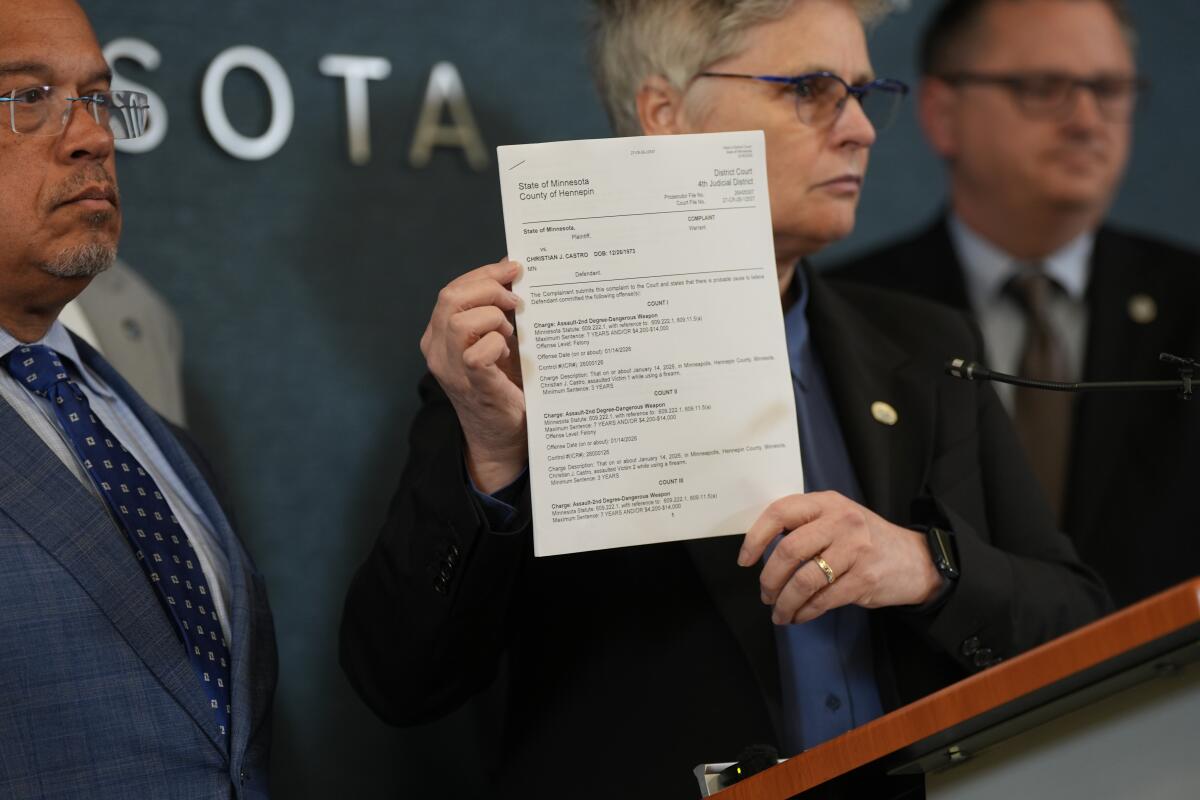
Hennepin County attorney Mary Moriarty holds up a document containing charges

Hennepin County attorney Mary Moriarty holds up a document containing charges against ICE agent Christian Castro during a news conference at the Hennepin County Government Center in Minneapolis, on Monday, May 18, 2026.

(Renée Jones Schneider/Minnesota Star Tribune Via Associated Press)

According to prosecutors, Castro fired through a home’s front door and shot Sosa-Celis in the thigh after Castro and another officer chased a different man, Alfredo Alejandro Aljorna, to the Minneapolis apartment duplex where he and Sosa-Celis lived. Sosa-Celis and Aljorna were legally in the U.S., Moriarty said.

Federal authorities initially accused Sosa-Celis and Aljorna of beating an officer with a broom handle and a snow shovel. A federal judge later dismissed the charges, and ICE and the Justice Department opened an investigation into whether officers lied about what happened.

In a statement after the charges were announced, ICE said the U.S. attorney’s office was investigating statements made by officers, who could face disciplinary action including being fired and prosecuted. ICE called the Hennepin County attorney’s action “unlawful and nothing more than a political stunt.” DHS’s Inspector General’s Office, which Moriarty credited with assisting in the arrest, is separate from ICE and is meant to serve as a watchdog for DHS agencies, including ICE.

Minneapolis last month released video showing the moments before Sosa-Celis’s shooting, captured from a distance by a city-owned security camera.

The video appears to show a person standing with a snow shovel outside the house, near the street, then retreating toward the house and tossing the shovel into the yard. This happens as a person being chased by another person runs up from the street, falls on the sidewalk, gets up, and keeps heading toward the house.

The three appear to scuffle near the front steps for about 10 seconds. The exact moment when Sosa-Celis is shot isn’t clear. A car with flashing lights pulls up, and another person walks up.

The Trump administration sent thousands of officers to the Minneapolis and St. Paul area as part of President Trump’s national deportation campaign and considered Operation Metro Surge a success.

But tensions mounted during the weekslong campaign, and the shooting deaths of U.S. citizens Renee Good and Alex Pretti by federal officers sparked mass unrest and raised questions about officers’ conduct.

Minnesota leaders and the Trump administration have clashed over who has the authority to investigate and prosecute federal officers for on-duty conduct.

Moriarty’s office last month charged immigration agent Gregory Donnell Morgan Jr. with assault for allegedly pointing his gun at people in a car on a highway. He turned himself in last week and his lawyer disputes the charges.

The county is also investigating Good’s and Pretti’s killings and sued the Trump administration in March to gain access to evidence in those cases and the Sosa-Celis shooting.

Source link

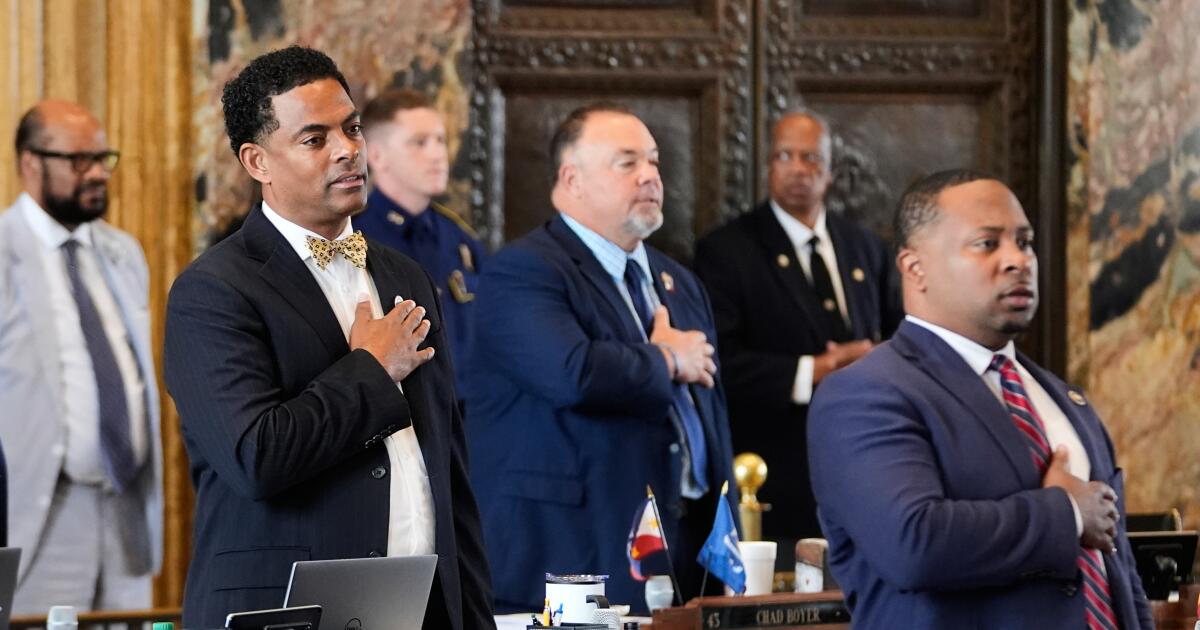
Louisiana’s Legislature has passed a new congressional map to give the GOP another seat

Louisiana lawmakers passed a new congressional map Friday designed to pick up a Republican seat while leaving the state with just one of its two majority-Black House districts represented by Democrats.

Approval of the new House map came a month after the U.S. Supreme Court struck down the state’s current map as an illegal racial gerrymander, weakening the landmark 1965 federal Voting Rights Act. That decision intensified a national redistricting battle fueled by President Trump’s efforts to protect the Republicans’ slim House majority in the midterm elections.

Louisiana Republicans had considered drawing a map giving the party a shot at winning all six of the state’s U.S. House seats. But that would have required adding more Black voters to Republican-held districts, potentially backfiring with losses. Some Republicans said a 5-1 map better protects U.S. House Speaker Mike Johnson from facing a difficult reelection.

Republican Gov. Jeff Landry is expected to sign the new map into law.

In the weeks following the Supreme Court’s decision, several other Republican-controlled Southern states have seized upon a weakened federal Voting Rights Act to try to redraw their own congressional districts. It’s the latest flare-up in a heated national redistricting battle heading into the November elections, spurred along by Trump.

So far, Republicans are winning the redistricting contest. But that doesn’t necessarily mean they will win a narrowly divided U.S. House in November. So far, Republicans think they could gain as many as 14 seats from their redistricting efforts, while Democrats think they could gain six seats from new districts in California and Utah.

In Louisiana, Republicans currently hold four of six congressional seats on a court-ordered map drawn in 2024 to comply with the Voting Rights Act by including a second district with a majority-Black population.

That map, however, was challenged in court, and the Supreme Court responded on April 30 by striking it down as an illegal racial gerrymander.

Landry postponed the state’s U.S. House primary, scheduled for May 16, until later this summer to allow time for Republican lawmakers to draw and pass a new map.

The proposed map redraws Democratic U.S. Rep. Cleo Fields’ district, clustering it around predominantly white communities in the Baton Rouge area and southern Louisiana. It also adds part of Baton Rouge to a heavily Democratic, majority-Black district based in New Orleans currently represented by Democratic U.S. Rep. Troy Carter.

More lawsuits were expected over the new map.

Democrats say the proposed map could still constitute a racial gerrymander because it packs Black voters into a single congressional district. Meanwhile, the plaintiffs in the U.S. Supreme Court’s decision criticized the Legislature’s map for leaving a majority-Black district in place.

Several other Southern states also have acted on redistricting since the Supreme Court’s decision.

Florida’s Legislature passed new congressional districts just hours after the ruling, completing a redrawing that was in the works in anticipation of the decision. It could yield Republicans as many as four additional seats in the midterm elections.

Tennessee adopted new U.S. House districts a week after the ruling, carving up a majority-Black district based in Memphis in a Republican attempt to win an additional seat.

In Alabama, Republicans are attempting to pick up another seat by redrawing two districts where Black residents compose a majority or close to it. Democrats hold both seats, and the proposal is mired in a court battle.

South Carolina’s Senate, meanwhile, decided against redistricting, despite pressure from Trump.

Brook and Levy write for the Associated Press.

Source link

About 8% of the country lacked health insurance in 2025, new data shows. That could rise next year

The proportion of Americans without health insurance held steady at around 8% of the population in 2025, according to new findings from the U.S. Centers for Disease Control and Prevention.

The national survey results, released Thursday, show the all-ages uninsured rate has stayed significantly down from where it was several years ago, but the ranks of the uninsured could soon expand as the Trump administration’s sweeping changes to the health landscape begin to take hold.

Massive changes to Medicaid, the government’s safety-net health program for low-income Americans, passed into law last year could result in 10 million more uninsured individuals over a decade, according to Congressional Budget Office estimates.

And the expiration this year of certain Affordable Care Act subsidies — which had offset premium costs — is also contributing to reduced participation in marketplace health programs. Around 5 million fewer people are expected to enroll in those plans in 2026 compared with 2025, according to the healthcare research nonprofit KFF.

The government has multiple programs for tracking Americans’ insurance status, which can give different numbers depending on factors like timing and question wording. Many researchers consider the U.S. Census Bureau to be “the official scorekeeper,” said David Howard, an Emory University health policy and management professor.

But the CDC survey results tracks closely with that, and they offer the first complete data for all of 2025 — the first year of President Trump’s second term in office.

The Trump administration has sought to expand access to low-premium catastrophic health insurance plans and lower drug prices for Americans who don’t have health insurance. It has also suggested that projected insurance enrollment declines indicate a drop-off of fraudulent and ineligible enrollees, rather than eligible Americans.

Although the share of insured and uninsured stayed roughly the same in 2025 as the year before, the number of uninsured grew by about 800,000 — 300,000 of them children. The growth of the overall U.S. population helps explain that.

The survey results also suggest a possible increased insured rate among Hispanic Americans. But that may in part reflect the effects of the Trump administration’s immigration crackdown, if uninsured members of that group left the country, Howard said.

Most Americans 65 and older have health insurance through the federal Medicare program. It’s different for younger Americans, many of whom are covered through a patchwork of public and private insurance programs.

The percentage of Americans under 65 who were uninsured rose in the 1980s, 1990s and early 2000s — from 12% in 1980 to more than 18% in 2010. It fell following passage of the Affordable Care Act in 2010, which expanded Medicaid programs and enacted measures to make affordable health insurance available to more people.

By 2016 it dropped nearly to 10%, before rising to 11 to 12% during Trump’s first administration, according to historical survey data from the CDC’s National Center for Health Statistics.

The COVID-19 pandemic saw the rate of uninsured fall again, as a result of government policies put in place to preserve coverage as people faced disruptions related to the pandemic. The rate hit an all-time low in 2023, falling below 9%.

It’s not clear yet how big the increase in uninsured Americans will be this year, but experts agree it will likely rise in the coming years as a result of changes to the Affordable Care Act and Medicaid.

“The decisions being made now — in Congress, state legislatures and state Medicaid agencies — will determine what happens next,” Nancy Brown, chief executive officer of the American Heart Association, said in a statement Thursday.

“Policymakers should act immediately to protect and expand access to affordable coverage, strengthen Medicaid and maintain pathways that make coverage and care accessible,” she said. “Without deliberate action, including reversing dramatic cuts to coverage, uninsured rates will continue to rise, putting quality health care further out of reach.”

Stobbe and Swenson write for the Associated Press.

Source link

Trump holds Situation Room meeting to decide on Iran deal

A framework agreement to end the U.S. war with Iran is all but settled, pending sign-off from the presidents of the two warring sides, President Trump said Friday, projecting optimism that a deal could finally be at hand.

Yet doubt cast a shadow over the diplomatic process entering the weekend as Trump faced a politically fraught decision to enter an agreement that would invariably require significant concessions to Tehran.

The negotiations have faced severe headwinds in recent days, with both sides accusing the other of violating a fragile ceasefire that has largely stopped the fighting since April.

On his Truth Social site, Trump said he had summoned his top aides to the White House Situation Room to decide on the deal.

The agreement would see an end to the U.S. naval blockade on Iranian ports and the removal of Iranian mines from the Strait of Hormuz, an international waterway through which 20% of the world’s energy supply passes each day. The strait, Trump wrote, will reopen with “no tolls” for “unrestricted shipping traffic, in both directions.”

And “Iran must agree that they will never have a Nuclear Weapon or Bomb,” Trump wrote, noting that Iran’s stockpile of highly enriched uranium, the key ingredient for nuclear weapons, “will be unearthed by the United States (which, it is agreed, is the only Country, along with China, with the mechanical capability of doing so!), in close coordination and conjunction with the Islamic Republic of Iran, plus the International Atomic Energy Agency, and DESTROYED.”

“No money will be exchanged, until further notice,” he added.

Treasury Secretary Scott Bessent also said the deal would require Iran to disavow the continuation of its domestic nuclear program — a diplomatic feat never before achieved throughout a quarter century of international negotiations over Iran’s nuclear work.

It is unclear whether Tehran would go that far. And Iran’s negotiators expressed defiance on Friday, stating that there was “no trust in guarantees or words” from the American side.

“No step will be taken before the other side acts first,” said Mohammad Bagher Ghalibaf, the speaker of Iran’s Parliament. “We do not gain concessions through dialogue, but through missiles.”

It remains unclear when the Trump administration would ease sanctions on Iran, how extensive that relief would be, or what form it would take — questions that fueled Republican criticism of the Obama-era nuclear deal more than a decade ago.

The working diplomatic document would formally extend the existing ceasefire for 60 days, allowing for a more detailed negotiation to take place over Iran’s nuclear program. But the truce as it currently stands is on perilous ground. Iran launched a ballistic missile on Thursday at Kuwait, a close U.S. ally, after American forces took “defensive” actions against Iranian missile launchers and mine laying boats it had launched in the strait.

The war has proven historically unpopular with the American public, and has seen oil prices soar since the U.S. military, in partnership with Israel, launched its first strikes against Iran in February.

Bessent said he is hopeful that oil prices would drop quickly once an agreement is signed. But industry analysts say the effects of the war on the oil market could last for months, if not years, with the stability of traffic through the Strait of Hormuz now in question for commercial shippers.

While oil has dropped to under $100 a barrel, markets appeared skittish on Friday over the prospects for a deal, with mixed messages appearing to emerge out of the region.

It is also unclear whether a U.S. agreement with Iran would in any way bind Israel’s hands in its military operations, either in Iran or in Lebanon, where an Iranian proxy militia, Hezbollah, has vowed to keep up the fight.

Israel has ramped up strikes against Hezbollah targets in recent days, jeopardizing a delicate ceasefire negotiated with the Lebanese government, a deal encouraged by the Trump administration in order to grease the wheels for its talks with Tehran.

Trump has been uncharacteristically silent on the prospects of an agreement in recent days, expressing cautious optimism in limited exchanges with reporters.

“It’s hard to say exactly when or if the president’s going to sign,” Vice President JD Vance, who has led the U.S. diplomatic team, told reporters, noting that “the nuclear stuff” is still subject to negotiation. “We’re going back and forth on a couple of language points.”

“I do think that we’ve made a lot of progress here,” Vance added. “Hopefully we’ll continue to make progress, and the president will be in a position where he can endorse the agreement. But obviously, that’s still TBD.”

Source link

Judge temporarily blocks payouts from Trump’s $1.8B ‘anti-weaponization’ settlement fund

A federal judge on Friday temporarily blocked President Trump’s administration from paying any claims through a new $1.776 billion settlement fund for the Republican president’s allies who believe they were victims of a weaponized government.

U.S. District Judge Leonie Brinkema in Alexandria, Va., also barred the government from moving forward with the fund’s creation while litigation is pending to challenge it.

The judge, who was nominated to the bench by President Clinton, a Democrat, scheduled a June 12 hearing for arguments on whether to extend the order blocking payouts from an “Anti-Weaponization Fund.” The government created the fund to resolve Trump’s lawsuit against the Internal Revenue Service over the leak of his tax returns.

The White House declined to comment on the judge’s ruling and referred all questions to the Justice Department, which didn’t immediately respond to a request for comment.

The fund has generated a fierce backlash since it was announced last week, with even Republicans pressing acting Atty. Gen. Todd Blanche over the eligibility considerations and the possibility that even violent rioters at the U.S. Capitol on Jan. 6, 2021, would be free to seek compensation.

The Justice Department hasn’t formed the five-member commission that will decide on payout criteria, so there has been no money paid out yet or claims accepted.

Plaintiffs’ attorneys from the legal advocacy group Democracy Forward are seeking a court order halting the fund’s implementation and preventing the Trump administration from disbursing any payouts from it. The federal suit claims there is no legal basis or accountability behind the fund.

The Virginia lawsuit’s plaintiffs include a fired prosecutor and a college professor acquitted of assaulting federal agents at a protest.

“The unlawfulness that has imbued the Anti-Weaponization Fund from its inception requires that it be wholly dismantled,” the suit says.

At least two other lawsuits, both filed separately in Washington, also are challenging the fund’s creation. A lawsuit filed by the advocacy group Citizens for Responsibility and Ethics in Washington refers to the fund as “a jaw-dropping act of presidential corruption.” Two police officers who helped defend the Capitol from a mob of Trump supporters sued last week.

During a congressional hearing, Blanche wouldn’t rule out the possibility that rioters who assaulted police on Jan. 6 could be eligible for fund payouts.

Nearly 1,600 people were charged with Capitol riot-related federal crimes. Over 1,200 were convicted and sentenced before Trump handed out mass pardons, commuted prison sentences and ordered the dismissal of every pending Jan. 6 criminal case last year.

Kunzelman writes for the Associated Press. AP writers Darlene Superville, Alanna Durkin Richer and Eric Tucker contributed to this report.

Source link

Race cars and cage fights — on National Park land?

President Trump plans to celebrate the nation’s 250th anniversary — and his own 80th birthday — next month by watching bare-chested and bloody UFC fighters kick, punch and choke each other on the storied South Lawn of the White House.

Later, during the administration’s summer-long festival to commemorate the signing of the Declaration of Independence, IndyCars will race in a fossil fuel-burning extravaganza around and around the National Mall — home to the U.S. Capitol and the Washington and Lincoln monuments.

Both venues are National Park Service land and are administered by the agency.

The planned spectacles — UFC Freedom 250 and the Freedom 250 Grand Prix — stray so far from the park service’s traditional mission and ethos that advocates and career employees are crying foul.

“These events are inappropriate and disrespectful to the history and importance of the White House and the National Mall,” said Jonathan Jarvis, who began his career as a park ranger on the Mall in 1976 and was named director of the National Park Service by President Obama in 2009.

White House officials insist that IndyCar and the UFC are extremely popular with everyday Americans: the race and the fights will be exuberant celebrations of patriotism and pride, they say.

The UFC event, in particular, “will be one of the greatest and most historic sports events in history, and President Trump hosting it at the White House is a testament to his vision to celebrate America’s monumental 250th anniversary,” said White House spokesperson Davis Ingle.

An aerial view of UFC construction outside the White House.

President Trump is hosting a UFC match on the White House grounds in honor of the 250th anniversary of the United States.

(Alex Wong / Getty Images)

To organize this summer’s events, the Trump administration asked the National Park Foundation — a congressionally chartered nonprofit that works closely with the park service and collects private donations to help maintain hiking trails and fund programs to get kids outdoors — to lend a hand.

Because of the scale of the planned celebrations, the foundation created a limited liability company, “Freedom 250,” to “execute events, activities, and celebrations in or around national parks,” according to the Freedom 250 website.

Freedom 250 has its own employees, but the foundation provides funds and the park service approves the events and reviews their budgets, according to the website.

Which is why advocates are appalled.

“Essentially, this is a hijacking of one of America’s oldest and most well-respected conservation organizations,” said Aaron Weiss, director of the Center for Western Priorities, an environmental nonprofit based in Denver. “There are so many very good people at the foundation, with so many years doing real work on behalf of America’s national parks, it’s heartbreaking to watch.”

When Jarvis was director of the park service — and therefore an ex-officio board member of the foundation — the two organizations worked hand in hand to ensure that the foundation’s work complemented that of the park service. They organized the annual Easter Egg Roll on the White House South Lawn and lit the Christmas tree on the Ellipse, Jarvis said.

Workers paint the bottom of the Lincoln Memorial Reflecting Pool.

Workers continue to paint the bottom of the Lincoln Memorial Reflecting Pool on the National Mall.

(Alex Wong / Getty Images)

Occasionally, the president made special requests, which were reviewed carefully to ensure they were consistent with park service principles. Michelle Obama’s famous “Kitchen Garden” passed the test, Jarvis said with a chuckle, providing fruits and vegetables for family meals — and the occasional state dinner — for years.

It’s hard to imagine any career parks employee, or the foundation board members he served with, coming up with the current agenda, Jarvis said.

In addition to the IndyCar race and cage fights, the National Park Foundation is sponsoring “Freedom Trucks” — six red, white and blue tractor trailers traveling the country as rolling museums — and Rededicate 250, a large Christian revival meeting held on the Mall earlier this month that raised objections about the mixing of church and state.

“I think the foundation is being told what to do,” Jarvis said. “And I think it’s hard to say no to the White House these days.”

Josh deBerge, a spokesperson for the National Park Foundation, insisted that no money from Freedom 250 is being spent on the IndyCar race or the UFC fights.

But the IndyCar race is listed as a “signature” event on the Freedom 250 website, and both IndyCar and the UFC are listed as Freedom 250 sponsors.

Danielle Alvarez, a former Trump campaign senior advisor, is a spokesperson for Freedom 250. She acknowledged that the race and the cage fights are happening on national park land and under the banner of Freedom 250, but said neither is receiving funds or logistical support from her organization.

“Many groups have adopted ‘Freedom 250’ branding as part of their festivities, even though it does not mean it is backed by Freedom 250 funding,” Alvarez said in a text message. “The shared terminology is a natural expression of collective pride in 250 years of American independence.”

Neither IndyCar nor the UFC responded to requests for comment.

All of this comes as the Trump administration has taken an ax to the National Park Service, cutting its staff by 25% through buyouts and layoffs since 2025, and proposing another 25% staff reduction this year.

An employee does restoration work on a statue of a general on a horse

A worker applies hot wax during the restoration process of the Gen. Nathanael Greene statue in Stanton Park on Capitol Hill.

(Tom Williams / CQ-Roll Call / Getty Images)

Trump has also proposed slashing nearly $800 million from the park system’s roughly $3-billion operating budget — potentially diminishing the ability to keep facilities clean and control crowds. Already this year, Yosemite National Park has ditched a reservation system, leading to enormous crowds in the valley and on nearby trails.

Parks advocates fear it’s part of a broader and deliberate strategy to marginalize an agency that has long been a sanctuary for environmentalists and progressives — most of whom presumably did not vote for Trump.

In addition to the staff and budget cuts, Trump last year instructed the National Park Service to scrub any language he would deem negative, unpatriotic or smacking of “improper partisan ideology” from signs and presentations visitors encounter at parks and historic sites.

Instead, he ordered the agency to ensure that its signs remind Americans of our “extraordinary heritage, consistent progress toward becoming a more perfect Union, and unmatched record of advancing liberty, prosperity and human flourishing.”

Those marching orders left opponents and free speech advocates in disbelief, wondering how park employees were supposed to put a sunny spin on monuments acknowledging slavery, Jim Crow laws and the incarceration of Japanese Americans during World War II.

Trump opponents also question the political wisdom of picking on an agency that’s routinely ranked among the most admired branches of the large and sprawling federal government. Even Americans who pay little attention to politics will probably never forget standing in Yosemite Valley and admiring a towering waterfall.

There were more than 323 million visits to America’s national parks in 2025, dwarfing attendance — 135 million — at professional football, baseball, basketball and hockey games combined.

That has not stopped the assault by the current administration.

A black granite walkway at the White House.

Black granite was installed last month as the new walkway for the West Wing Colonnade at the White House.

(Andrew Harnik / Getty Images)

“The ideologues in power now take a very dim view of the federal government in general, and the last thing they want is a highly popular and successful federal agency,” Jarvis said. “So if they can kill it, or diminish it through neglect, they win. They don’t really care about the public’s opinion.”

Chuck Sams, the last director of the National Park Service, stepped down the day Trump was inaugurated. Since then, the agency has not had a Senate-confirmed director.

Sams agreed that the Trump administration seems to have it in for the Park Service and worried that the guardrails that used to prevent the executive branch from doing whatever it wants with park land are disappearing.

Destroying the East Wing of the White House for Trump’s proposed ballroom and paving over portions of the White House Rose Garden lawn are prime examples, Sams said.

During his tenure, any proposed change to the White House or its grounds was approached in a “very concerted and deliberate manner with a lot of educated professionals weighing in,” Sams said. “Was it slow? Absolutely, but that was because everyone understood these places belong to the people.”

Asked what he thought of the IndyCar race and the cage fights, Sams said, “We are in uncharted territory, on uncharted ground.”

Source link

Compton educators are baffled by Rep. Maxine Waters’ snub of school bond

When Compton Unified School Board President Micah Ali checked his mailbox last week, he was in for a shock.

The school district has been making headlines as a state and national leader in student performance gains, and it has been upgrading and replacing its aging campuses to help advance that growth. Next week’s ballot includes a $360-million bond measure called CPT, which would keep that momentum going and replace badly dated Dominguez High School.

So when Ali opened a slate mailer titled “Congresswoman Maxine Waters’ Sample Ballot and Voter Recommendations,” he couldn’t believe her advice on Measure CPT.

Vote “no.”

Given Waters’ stature as a congressional representative for 35 years, Ali said, her slate mailers can swing outcomes.

“Yes, it does carry weight,” Ali said, and the thumbs-down recommendation “can literally cripple our ability to pass this bond.”

Ali was doubly surprised because the mailers went out to voters just a few weeks after Waters attended an unveiling ceremony for the new Compton High School campus. Compton High alums and hip-hop heavyweights Kendrick Lamar and Dr. Dre joined the celebration, and the latter was honored for his $10-million donation to the new performing arts center.

Lunch tables outdoors

Lunch tables and a temporary cafeteria are set up outdoors at Dominguez High School because of a fire three years ago.

(Eric Thayer / Los Angeles Times)

A second district high school, Centennial, is being replaced with a modern campus, and district officials are hoping Measure CPT passes so Dominguez students aren’t left behind, but also because the district’s other schools would get multiple upgrades and repairs, from infrastructure to classrooms to athletic fields.

I met with Ali on Wednesday afternoon at Dominguez, along with Principal Caleb Oliver. The school turned 70 this year, and it shows. The grounds are scruffy, wiring and plumbing are outdated, the gymnasium air conditioning hasn’t worked in years. To walk the campus is to step back in time — to the Eisenhower administration.

While we were talking, Oliver called out to a senior named Angelina Ramirez, referring to her as a superstar student. I asked Angelina what kind of upgrades the campus could use.

Dominguez High School Principal Caleb Oliver.

Dominguez High School Principal Caleb Oliver.

(Eric Thayer / Los Angeles Times)

“Well, I like to use the cafeteria as an example,” she said, pointing to where it used to be.

What happened to it?

“It burned down,” she said. An electrical problem was the suspected cause, her principal added.

That was more than three years ago, and since 2023, the cafeteria has been an outdoor plaza.

“I feel like that’s affected students a lot,” Angelina said.

The big question, of course, is why Waters’ campaign committee — Citizens for Waters — recommended a no vote.

I’d like to tell you why it is that a rapper has written a $10-million check in support of Compton’s students while a congresswoman has told them to go fly a kite. But I’ve asked by phone, text and email, and I still don’t have an answer.

After contacting Citizens for Waters, which referred me to the congresswoman, I called her office and emailed her press office, which sent me this response at 7:43 p.m. Thursday:

“Per US House Ethics rules, we are unable to respond to your request.”

I don’t know what rules those are, but the rulebook needs some rewriting if a congresswoman can’t answer a simple question about why her campaign mailer recommends a no vote on a school bond measure.

“We have no idea, and we’re baffled,” Ali said. “Who would oppose the construction of a new school in a community like Compton?”

In the working-class community, the student population is roughly 84% Latino and 14% Black.

I suggested that Ali consider having students march over to Waters’ district office and ask for an explanation.

“We’d rather have these children’s butts in seats and learning,” Ali said, adding that “we need … to continue driving up these test scores.”

Tana McCoy talks to school board President Micah Ali.

Compton school board candidate Tana McCoy talks to school board President Micah Ali about the mailer.

(Eric Thayer / Los Angeles Times)

It’s not as if there is no reasonable opposition to Measure CPT. These kinds of bonds cost taxpayers real money over the course of many years, and CPT would add about $60 per $100,000 of assessed property to annual tax bills.

That would hit working folks and retirees with an added tax burden of between a few hundred and several hundred dollars a year. And taxpayers have been paying off two previous school improvement bond issues, one passed in 2015 and one in 2022.

In addition to the financial burden, according to district parent Anthonia Limon, who wrote the statement against CPT for the L.A. County sample ballot, safety issues have undermined community trust in district leadership.

“Infrastructure alone does not create safe schools,” Limon wrote.

If Waters has similar concerns, that would be one thing. But to my knowledge, and to Ali’s, there has been no public explanation for recommending a no vote. And when you read the fine print on the slate mailer, which advises voters to “take Congresswoman Maxine Waters’ recommendations with you to vote,” it only raises more questions.

“This document was prepared by Citizens for Waters, not an official party organization. Appearance in this mailer does not necessarily imply endorsement of others appearing in this mailer nor does it imply endorsement of, or opposition to, any issues set forth in this mailer,” it says.

Huh?

Are they endorsements or aren’t they?

The Times reported in 2004 that the rep’s daughter, Karen Waters, “has charged candidates for spots on her mother’s ‘slate mailer,’ a sample ballot that many voters in South Los Angeles use to guide their choices.” Last year, the Waters campaign paid a $68,000 fine for campaign finance law violations following a Federal Election Commission investigation that involved Citizens for Waters.

Rep. Maxine Waters' slate mailer.

Rep. Maxine Waters’ slate mailer.

(Eric Thayer / Los Angeles Times)

Also in the fine print on the current mailer:

“Appearance is paid for and authorized by each candidate and ballot measure which is designated by” an asterisk.

So are these endorsements or paid advertisements? There’s an asterisk on nearly every endorsement in the mailer, from city council to governor to judgeships to Measure CPT. The way I read this is that various parties paid for endorsements, but the mailer does not reveal who paid, or how much they ponied up. Such mailers, by the way, are not uncommon in California, according to election law experts.

“I think this is misleading for voters,” said Erwin Chemerinsky, dean of the UC Berkeley law school. Although he thinks the endorsements are a form of protected free speech, he said this “reflects a very deep problem in our elections with dark money, when we don’t know where the money is coming from.”

On Thursday, I visited Tana McCoy, a Compton High grad and retired city employee who is running for Compton Unified school board. She showed me the slate mailer delivered to her home, but said she’s going to vote yes on CPT despite Waters’ recommendation.

“Children need to feel good about their environment, because that’s all part of their mental health,” McCoy said.

At Dominguez, where graduates have a 96% college acceptance rate, according to district officials, junior Zaiden Ross gave me a tour that included a stop at a gymnasium fountain that he said hasn’t worked in years. Some fountains are dirty, he added, “and some of the pipes on campus produce water that has, like, extremely high amounts of lead and magnesium.”

Student Zaiden Ross demonstrates a nonworking sink in a bathroom

Student Zaiden Ross demonstrates a nonworking sink in a bathroom on the campus of Dominguez High School in Compton.

(Eric Thayer / Los Angeles Times)

Zaiden took me to a classroom to show me water samples he’s still testing. Then we visited the robotics classroom, where he turned on a faucet, and the flow was closer to the color of apple juice than water. The air conditioner was rattling, and teacher G.C. Esiobu, who runs the engineering and robotics club, said there had been an “emergency” fix for a busted system. Zaiden gave me a quick rundown of dated computers and other equipment students use to design drones and robots.

And yet despite all that, a display case was filled with trophies. At competitive meets, Esiobu said, “we have been winning with little or nothing.” With equipment upgrades, she added, “just imagine the level we will go.”

There’s still time, before Tuesday’s election, for Waters to visit Dominguez High and maybe get a tour from Zaiden and Esiobu.

If she does, she might rethink that endorsement.

steve.lopez@latimes.com
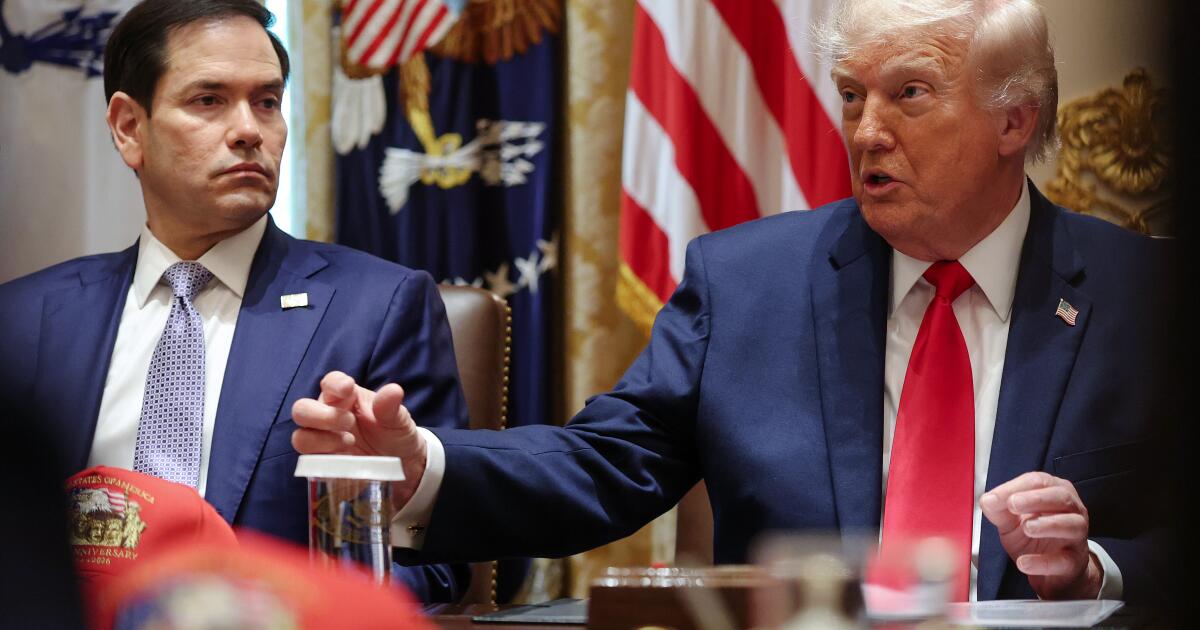
Source link

To combat copper thefts, L.A. city agency seeks its own armed police

For thieves looking to strip Los Angeles for parts, copper has become a fast-moving currency.

The problem has become so persistent that the Los Angeles Department of Water and Power is now asking for its own armed police force to protect vulnerable utility equipment, street lighting and critical infrastructure, insisting that the department’s contracted and unarmed security guards aren’t cutting it.

“They lack the authority to detain or arrest suspects, intervene in crimes in progress, conduct searches, or carry firearms for enforcement purposes,” according to a May 21 report from the city agency. “Delays hinder timely intervention, reduce investigative effectiveness, and contribute to repeat victimization of LADWP facilities.”

Under DWP’s current “observe and report” security model, an officer who sees someone cutting a fence or stripping copper from a transformer has little authority apart from yelling a warning or making a 911 call, according to the department report.

The proposal asks for 20 to 50 sworn officers to start, hired over a five-year period, along with support staff. If approved, the force would give the agency’s officers the authority to carry a firearm, make arrests and investigate thefts. The plan was scheduled to be discussed Thursday by the City Council.

The push comes as citywide service requests for streetlight repairs have surged over the last several years.

Dark streetlights.

L.A.’s historic streetlights outside the Bureau of Street Lighting near Virgil Avenue and Santa Monica Boulevard.

(Jason Armond/Los Angeles Times)

The city logged 14,328 electronic streetlight service requests in 2018, according to data from the Bureau of Street Lighting. Requests have tripled since then, reaching an all-time high of 46,079 in 2024, the last full year of available data.

Mayor Karen Bass’ office said in March that copper thefts are a leading cause of streetlight outages. Repairs have been backlogged for months.

Prices for the metal are at an all-time high, driven by major supply disruptions in Indonesia and Chile, and soaring demand from artificial intelligence data centers and electric grid infrastructure. Thieves typically exchange the metal for cash at recycling centers, where it can fetch up to $5.30 per pound. The City Council last year approved a program offering up to $5,000 for information in metal and wire theft cases.

Theft losses alone exceed $1 million annually, according to DWP.

Establishing a new police force would require changing the city charter, meaning voters will have a say come the November midterm elections. Authorities will also need to obtain state legislative approval for the plan.

Officials said rolling out the police department would cost $9.7 million over three years, plus up to $6 million annually to pay for staffing. They maintain those costs are less than the $46 million combined DWP spends each year on private security contractors and unarmed staff security.

A metal pole and base, with an opening in the base.

On Hill Street in downtown L.A., streetlights have been targeted by thieves and vandals.

(Jason Armond/Los Angeles Times)

Any cost overflows would be paid for by DWP customers.

Timothy O’Connor, executive director for the Los Angeles Office of Public Accountability, a spending watchdog, said his office is not convinced that the agency could minimize long-term cost creep, or that the new force would offset enough costs to justify the program. The proposed force of a few dozen officers, he said, would be too small to get the job done.

“Theft losses at DWP are real and are increasing. However, eliminating these losses is not enough to offset the proposed costs,” he said. “Furthermore, DWP will be unable to fully eliminate theft given the diffuse nature of the DWP system.”

But O’Connor also said the department is faced with real security risks like those posed by drone attacks or terrorism threats, which he said “appear to justify the proposal at some level.”

In February, a man shot himself after he drove his car through the perimeter fence of a power substation while carrying explosives and several firearms. Dubbing the incident an attempted terrorist attack, officials said the episode could have caused catastrophic infrastructure damage.

David Levitus, executive director of the advocacy group LA Forward, said he was surprised to learn of the proposal so late in Los Angeles’ ongoing charter reform process, which his organization has monitored closely.

“The fact that this is being dumped in late May — what’s the rush?” Levitus said. “I think we really need to be wary of creating new police departments in general, but especially without a clear case and clear constraints and accountability mechanisms.”

Source link

Contributor: In politics after Trump, nothing is disqualifying

After a decade of Trumpism, it should come as no surprise that President Trump’s ethos (presenting scandal as strength, outrage as authenticity and public disgrace as evidence you’re a “fighter”) has trickled down into congressional campaigns of both parties.

In Maine, for example, controversial oysterman and veteran Graham Platner, a Democrat, appears poised to face Republican Sen. Susan Collins, after incumbent Gov. Janet Mills’ failure to launch led her to drop out of the Senate primary.

Under old “pre-Trump” rules, Platner’s campaign would have withered instantly after revelations that he once had a Totenkopf SS tattoo, previously identified himself as a communist, said Black people were poor tippers, and wrote that white people “actually are” as racist and stupid as Trump thinks they are.

Instead, after all this surfaced, Platner actually rose in the polls. Considering the circumstances, there are several reasonable explanations for this.

Maybe Maine Dems have concluded that moral purity tests are politically suicidal after years of watching heterodox figures like Joe Rogan and Elon Musk drift away from the party.

Maybe Platner’s rough-edged outsider persona simply feels more authentic than another interchangeable politician in a pantsuit droning on about “working families.”

Perhaps the difference is that, unlike Trump or Texas’ scandal-plagued Republican Atty. Gen. Ken Paxton, Platner has at least attempted contrition.

Or maybe Maine Democrats have absorbed the same lesson Republicans adopted in 2016: Once voters stop treating scandal as disqualifying, policing your own side for off-the-field behavior starts to look like unilateral disarmament.

I mean, who could blame them for thinking you’ve got to fight fire with fire? America, after all, reelected Trump after 34 felony convictions.

At a certain point, continuing to insist that “character matters” starts sounding like advice Ward Cleaver might have offered Wally on “Leave It to Beaver.”

But Maine isn’t the only example of voters viewing scandalous behavior as a “keeping it real” feature, not a bug.

Another just took place in Texas, when the aforementioned Paxton crushed normie incumbent Sen. John Cornyn in a Republican primary runoff, garnering nearly 64% of the vote.

Paxton, it’s worth noting, was previously indicted on felony securities fraud charges, impeached by the Texas House on allegations including bribery, accused by senior aides of abusing his office to help a donor and real-estate developer and accused by his wife (a Texas Republican politician) of infidelity, just to name a few of his greatest hits.

Yet, not only did the scandals not doom Paxton, they probably helped him. They signaled a willingness to fight, casting him as both a victim and an outsider. There may be no purer expression of trickle-down Trumpism than Paxton, which probably explains why Trump endorsed him.

At this point, you might be thinking that all is lost. But there are counterexamples that lend to optimism.

Paxton’s Democratic opponent in Texas, for example, offers a stark contrast, as well as an opportunity to test the level of our societal decline in November.

Texas Democrats could easily have nominated their own chaos agent in Rep. Jasmine Crockett, a progressive firebrand whose flair for viral combat suggests she understands the incentives of modern politics perfectly well.

Instead, they chose James Talarico — a young state legislator, former middle-school teacher and Presbyterian seminarian — who projects the kind of earnest optimism that lands somewhere between Barack Obama and Pete Buttigieg.

If a Democrat like Talarico can win in deep-red Texas — against a scandal-plagued candidate who shouldn’t get within 10 miles of the U.S. Capitol — it will perhaps provide a modicum of hope that red lines still exist, and that some voters still believe character is destiny.

But regardless of who wins that matchup, the fact that both Paxton in Texas and Platner in Maine emerged as their party’s respective Senate candidates (Platner won’t technically be the Democratic nominee until after the Maine primary in June) still suggests something profound has shifted in American politics.

Not long ago, the scandals attached to either man would have ended a campaign overnight.

Today, they function more like résumé enhancements. Because the defining lesson of the Trump era may be this: Nothing is disqualifying anymore.

If a failed nepo baby and middling reality-TV star can become president, survive endless scandals (think “Access Hollywood”), rack up felony convictions, be found liable for sexual abuse, sit by and watch a Capitol riot, and then return to power anyway, traditional ideas about character and electability are simply no longer relevant.

The question now is whether Trumpism has become America’s permanent political operating system — or whether the new rules apply only to Trump himself.

November will offer some hints.

Matt K. Lewis is the author of “Filthy Rich Politicians” and “Too Dumb to Fail.”

Source link

Becerra leads governor’s race; Hilton, Steyer in tight contest for second spot

On the cusp of California’s gubernatorial June 2 primary, voters are closely divided among three candidates vying to succeed Gov. Gavin Newsom at a perilous moment in the state and nation’s history, according to a poll released Thursday.

Among likely California voters, 25% support Xavier Becerra, a Democrat and former Biden Cabinet secretary, according to the survey by UC Berkeley’s Institute of Governmental Studies that was co-sponsored by the Los Angeles Times. Republican Steve Hilton, a former Fox News commentator and British political strategist, has the backing of 21%, while 19% backed billionaire hedge fund founder turned environmental activist Tom Steyer, a Democrat.

California gubernatorial candidate Xavier Becerra takes a selfie at an event while campaigning

California gubernatorial candidate Xavier Becerra takes a selfie at an event while campaigning on May 26, 2026 in San Francisco, California. Becerra is the former United States Secretary of Health and Human Services and is running as a democratic candidate for governor. California’s statewide election is on June 2.

(Benjamin Fanjoy / Getty Images)

The survey provided the clearest indication yet that the three have separated themselves from the rest of the field. Support increased for Becerra, Hilton and Steyer since the last Berkeley IGS poll in March. Becerra leapfrogged everyone. In early March he wallowed near the bottom of the pack at just 5% support among likely voters, and now is the front-runner.

The other candidates floundered. Support for Riverside County Sheriff Chad Bianco, a Republican, dropped 5% and he now finds himself in a distant fourth place. Former Democratic Rep. Katie Porter of Irvine dropped by almost half to 7%. San Jose Mayor Matt Mahan, former Los Angeles Mayor Antonio Villaraigosa and state Supt. of Public Instruction Tony Thurmond — all Democrats — remained mired in the single digits.

Poll director Mark DiCamillo cautioned that it remains unclear which candidates will finish in first and second place in the June 2 primary, a pivotal question since only the top two finishers will advance to the November general election regardless of party affiliation. The low voter turnout thus far makes predicting the outcome especially difficult.

Although every registered voter in California was sent a mail-in ballot, many have not returned them or dropped them off at voting locations — a telltale sign of the uncertain nature of this year’s governor’s race. The survey, which included all 61 of the gubernatorial candidates on the ballot, found that Democratic turnout thus far is noticeably lower compared with past primary elections, DiCamillo said.

Steve Hilton, Republican gubernatorial candidate for California, arrives for a news conference

Steve Hilton, Republican gubernatorial candidate for California, arrives for a news conference at the San Jose Diridon Station in San Jose, California, US, on Tuesday, May 26, 2026. Republican gubernatorial candidate Steve Hilton is announcing his intention to halt future taxpayer-funded payments for California’s High-Speed Rail project, if elected in November.

(Jason Henry/Bloomberg via Getty Images)

“We’re assuming that … the Democrats will in fact turn out in the final week after we had concluded our poll and begin to make up ground on what looks like an early lead for Hilton, and those voters favor Becerra,” DiCamillo said.

The survey, conducted between May 19 and 24, found that likely Democratic voters favored Becerra over Steyer by 11 percentage points. Voters registered as “no party preference” were evenly divided between Becerra, Steyer and Hilton. Among likely Republican voters, Hilton led Bianco by almost 2 to 1.

Becerra also had a notable edge over Steyer among women and Latino voters, while Steyer had an advantage among Black voters. Hilton was favored over the two Democrats among self-identified libertarians and among voters in Orange County, the Central Valley and northern coast and Sierra region.

The poll found that 7% of voters remained undecided.

For the first time in more than a quarter of a century, the contest to lead the nation’s most populous state and the world’s fourth-largest economy has consistently lacked a front-runner despite a plethora of candidates.

Two of California’s best-known Democrats, former Vice President Kamala Harris and U.S. Sen. Alex Padilla, both toyed with a run for governor before deciding not to run, which contributed to the sluggishness of the race. The 2026 campaign for governor also languished in the shadow of the mayhem stirred up by President Trump, including his immigration raids throughout Southern California, and the devastation wrought by the 2025 Pacific Palisades and Altadena wildfires.

But a whirlwind of recent developments has drawn attention to the race.

Former Rep. Eric Swalwell (D-Dublin), once a front-runner in the contest, withdrew from the race and resigned from Congress in the aftermath of multiple allegations of sexual misconduct and assault that he denies.

Tom Steyer, Democratic gubernatorial candidate for California, during a campaign event

Tom Steyer, Democratic gubernatorial candidate for California, during a campaign event in Santa Rosa, California, US, on Wednesday, May 27, 2026. California is holding its primary election on June 2. Photographer: David Paul Morris/Bloomberg via Getty Images

(Bloomberg/Bloomberg via Getty Images)

Additionally, record-breaking amounts of money have flowed into the race. Steyer has smashed state self-funding records by contributing $212 million to his campaign as of Tuesday, according to the California secretary of state’s office. Nearly $85 million has been donated to independent expenditure committees by corporations, labor unions, tech titans, Native American tribes and other special interests, most of which will have policy interests that will be in front of the next governor.

Although the 2026 California governor’s race lacks the allure of recent contests that featured candidates such as global movie star Arnold Schwarzenegger, political scion Jerry Brown and former San Francisco mayor and likely 2028 presidential candidate Gavin Newsom, it is unfolding at a crucial time for Californians.

The state’s most vulnerable residents are facing severe reductions to medical care because of looming federal healthcare funding cuts, and California’s budget, already volatile because of its reliance on the state’s wealthiest residents, may grow more unpredictable. California’s highest-in-the-nation gas prices increased even more because of the U.S.-Iran war, adding to the state’s entrenched affordability crisis, which has driven many residents out of the state.

The cost of living, homelessness and public safety were among the top concerns expressed by voters, according to the poll. Protecting voting rights was also supported by most voters, though their underlying concerns could be starkly different based on their political views.

Democrats have been focused on the disenfranchisement of voters, a fear that has heightened in the aftermath of a recent Supreme Court decision that gutted a section of the Voting Rights Act that forced states to draw voting districts to help elect Black or Latino representatives to Congress. Republicans echo President Trump’s claims of elections being rigged.

Chad Bianco is interviewed after the California Gubernatorial debate

Los Angeles, CA – MAY 06, 2026: Chad Bianco is interviewed after the California Gubernatorial debate at Skirball Cultural Center on Wednesday, May 6, 2026 in Los Angeles, CA.

(Jason Armond/Los Angeles Times)

Voters split largely along party lines about issues such as Trump’s policies about climate change, immigration and taxes.

Voters’ uncertainty in the governor’s race is partly driven by California’s unique, voter-approved “jungle” primary system, in which the two candidates who win the most votes in the June 2 primary advance to the November general election, regardless of party affiliation.

Although the state’s voters are largely registered Democrats, the party’s leaders feared earlier this year that they would splinter among the multiple Democrats on the ballot, leading to Hilton and Bianco advancing to the November general election and ensuring that a Republican would be elected governor. Bianco had the backing of 11% in the new Berkeley survey.

The Republicans were once roughly tied in polls, until Trump endorsed Hilton in April. More than one-third of likely Republican voters said Trump’s endorsement of Hilton made them more likely to support him. Among voters who identified with the “Make America Great Again” movement, nearly two-thirds supported Hilton while less than 3 in 10 backed Bianco.

Though Bianco’s followers seem to be more passionate, “Hilton has got the much broader base of support, and then he got Trump’s endorsement,” DiCamillo said.

He added that Hilton’s rise is unusual in California, where statewide candidates typically spend enormous sums of money to raise their visibility among the state’s 23.1 million registered voters.

“What’s interesting about Hilton is that he hasn’t really done much of his campaigning in the traditional way. He hasn’t run huge amounts of television advertising, you don’t see his name out there in the traditional media, other than in free media,” DiCamillo said. “You can see that in the data, because almost a third of voters still have no opinion of Hilton … about what it was back in March, which is startling for a candidate who is among the leaders.”

Democrats’ fear of being locked out of the November general election led party leaders and allies to effectively urge low-polling candidates to drop out of the race in remarkable public statements in March.

The tables have since turned — the prospect of two Republicans winning the top spots in the June primary appear nonexistent, while polling shows a small possibility of two Democrats advancing to the general election.

“I’m not saying it’s likely, but it’s possible that two Democrats could emerge, and that would have huge implications on turnout in the [November] election,” DiCamillo said, pointing to California congressional races that could shape control of the U.S. House of Representatives. “If you don’t have a Republican at the top of the ticket, it would be dismal for the Republicans’ chances.”

The poll of 8,578 registered California voters was conducted online in English and Spanish and has a margin of error of about 2 percentage points in either direction.

Source link

Trump administration tells prosecutors to stand down on Venezuela leader, sources say

The Trump administration has quietly instructed federal prosecutors in Miami to avoid pursuing criminal investigations into Venezuela’s acting President Delcy Rodríguez, a longtime target of the U.S. Drug Enforcement Administration, according to current and former U.S. law enforcement officials, in the latest sign of warming relations between the White House and the oil-rich nation.

It’s unclear whether prosecutors had implicated Rodríguez in any crimes or whether investigators were moving toward an indictment. A Justice Department spokesperson said in an email “there was never an investigation into her to shut down.”

But DEA records obtained by the Associated Press earlier this year show she consistently surfaced on the radar of federal law enforcement dating to at least 2018, though she has never been criminally charged in the U.S. like several other senior Venezuelan officials.

The directive to pause scrutiny into Rodríguez was meant to avoid upsetting the administration’s efforts to stabilize Venezuela after the capture of her predecessor, Nicolás Maduro, among other reasons, a current official said. It was not clear whether the White House, which deferred comment to the Justice Department, was involved in the decision.

“Everybody has been told to stand down,” one of the former officials said.

The former officials, who had been briefed on the development, as well as the current official all spoke to the Associated Press on condition of anonymity because they were not authorized to publicly discuss internal deliberations.

Rodríguez, a U.S. attorney representing her and the Venezuelan Communications Ministry didn’t respond to requests for comment.

The move eases pressure on Rodriguez

Removing the threat of potential indictment, even temporarily, eases pressure on Rodríguez as the Trump administration seeks to work with the acting leader to stabilize Venezuela after Maduro’s ouster and open the country to U.S. investment.

President Trump praised Rodríguez as a “terrific person” shortly after the U.S. military took Maduro and his wife to New York to face federal narcotics charges. Both have pleaded not guilty.

In recent months, the U.S. has lifted sanctions against Rodríguez and recognized her as Venezuela’s sole head of state, allowing her to re-establish ties with western banks and more freely work with U.S. investors seeking to tap into the world’s largest petroleum reserves. As ties between the two governments have deepened, some have held out the Venezuelan playbook — characterized by oil blockades, indictments of top leaders and threats of military intervention — as a model to drive regime change from within as the U.S. pressures other longtime adversaries in Iran and Cuba.

Rodríguez and her brother, Jorge Rodríguez, the head of the National Assembly, were hit with U.S. sanctions during Trump’s first term for their role in undermining Venezuelan democracy and cementing Maduro’s authoritarian rule.

Rodríguez “is doing a great job,” Trump wrote on social media in early March. “The Oil is beginning to flow, and the professionalism and dedication between both Countries is a very nice thing to see!”

In recent months, Rodríguez has hosted ceremonies with a steady stream of American oilmen, some of them partaking in high-profile delegations led by U.S. Energy Secretary Chris Wright and Secretary of the Interior Doug Burgum.

Election talk deferred amid Trump’s praise

Missing in all the mutual backslapping is any talk of elections, even as Rodríguez last month blew through a 90-day limit set by Venezuela’s high court to fill Maduro’s position on a temporary basis.

“I don’t know,” she responded in English when a visiting U.S. journalist earlier this month shouted out a question about her time frame for holding elections. “Some time.”

Sen. Jeanne Shaheen of New Hampshire, the top Democrat on the Senate Foreign Relations Committee, has demanded the administration explain its favorable treatment of Rodríguez, calling her a “central figure in Nicolás Maduro’s repressive regime.”

“Sanctions have been lifted on Ms. Rodríguez without any indication that she has taken concrete and meaningful actions to restore democratic order,” Sheehan, joined by Sen. Elizabeth Warren of Massachusetts, wrote in a letter to Secretary of State Marco Rubio and Secretary of Treasury Scott Bessent last week.

Rick de la Torre, a former CIA chief of station in Caracas, said that the decision to shield Rodríguez fits well with the Trump administration’s foreign policy goals in Venezuela.

“She’s a lifelong Marxist and was a senior leader of one of the world’s most corrupt regimes but the U.S. is providing her with breathing space and carrots to lay the foundation for democracy and U.S. investment,” said de la Torre, the CEO of Tower Strategy, which advises companies on Venezuela.

“There’s a shelf life to her utility, however. At some point she will face justice,” he added.

Rodríguez has been on DEA’s radar since 2018

The DEA had amassed a detailed intelligence file on Rodríguez dating to at least 2018, and has received allegations about her ranging from drug trafficking to gold smuggling, the AP reported earlier this year. One confidential informant told the DEA in early 2021 that Rodríguez was using hotels in the Caribbean resort of Isla Margarita “as a front to launder money,” the records show.

Her name has surfaced in nearly a dozen DEA investigations — several of which remained ongoing as recently as this year — involving field offices from Paraguay and Ecuador to Phoenix and New York. She had even been linked to Maduro’s alleged bag man, Alex Saab, whom U.S. authorities first arrested in 2020 on money-laundering charges, the records show.

Rodríguez deported Saab this month as part of a purge of insider businessmen who are accused of having enriched themselves through corrupt dealings with Maduro.

It’s unclear in which Miami investigations Rodríguez’s name surfaced. Two of the former officials said Rodríguez has also come up in meetings with investigators in Tampa, Fla., tasked last year by former Atty. Gen. Pam Bondi with looking into financial crimes in Venezuela.

At the time, Rodríguez was serving as Maduro’s vice president. Justice Department policy requires the attorney general to personally approve the charging of any foreign head of state, who are normally immune from prosecution under international and U.S. law.

Halting high-profile criminal probes of foreign leaders

The pausing of the investigations into Rodríguez comes as the Trump administration has similarly tapped the brakes on ongoing federal investigations into another prominent Latin American leftist, Colombian President Gustavo Petro.

The DEA had also designated Petro a “priority target” over alleged ties to drug traffickers that had been probed for months by federal prosecutors. The New York Times reported in March that U.S. officials recently assured the Colombian government Petro does not face charges in those cases.

Duncan Levin, a former prosecutor who worked for the U.S. attorney’s office in Brooklyn, said it would be “deeply troubling” for law enforcement to be “told to stand down from a legitimate investigation for political or transactional reasons.”

“The White House cannot use criminal enforcement as a diplomatic light switch,” Levin told AP. “DOJ decisions are supposed to be based on law, evidence, policy and public safety — not on whether a foreign official is useful to the administration at a given moment.”

Goodman, Richer and Mustian write for the Associated Press. Richer reported from Washington and Mustian from New York. AP Writer Regina Garcia Cano in Mexico City contributed to this report.

Source link

6 protesters arrested after clash with ICE officers outside a New Jersey detention center

Protesters clashed with armed federal immigration officers in front of a New Jersey detention center where advocates have demonstrated for days while asserting that people detained there are staging a hunger strike over poor living conditions.

Groups of demonstrators, many wearing gas masks and other face coverings, linked arms in a human chain in front of Delaney Hall in Newark on Wednesday night, videos and photos posted on social media show.

Some used trash cans, old mattresses, umbrellas and other materials as makeshift shields and barricades as they confronted U.S. Immigration and Customs Enforcement officers. Others attempted to block people and vehicles from entering and exiting the building or threw orange traffic cones and other objects in the direction of the ICE officers lined at the entry gate.

The group chanted, “You will hang!” and, “Every cop, every fed, shoot yourself in the head,” and other taunts at the officers, many of whom wore helmets and tactical vests.

The ICE officers used pepper spray to try to disperse the protesters, according to videos posted to social media. Some used their batons to beat and push back protesters as the officers attempted to clear the roadway for vehicles.

At least one truck driver got out of his vehicle to vent his frustration when some protesters tried to block vehicles driving on the road in front of the detention center. People detained inside could at times be seen waving to protesters from Delaney Hall’s windows.

The U.S. Department of Homeland Security, which oversees ICE, said about six demonstrators were arrested for assaulting law enforcement officers.

“Assaulting and obstructing ICE law enforcement is a crime and felony,” the agency said in a statement. “Anyone who assaults law enforcement will be prosecuted to the fullest extent of the law.”

On Thursday, demonstrators again returned to Delaney Hall.

New Jersey Gov. Mikie Sherrill also said state health department officials were “denied full access” to the facility for a health inspection. The Democrat said the officials were only allowed to inspect a limited part of the facility as she called on ICE to “de-escalate” the situation.

“As I’ve said repeatedly, refusing to provide full access raises serious questions about what ICE is trying to hide from public view,” Sherrill said in a statement that also repeated her calls to shut down the facility outright.

Earlier Wednesday, Democratic members of Congress from New York City toured the facility as part of an oversight visit. A private prison company runs the detention center, which sits along an industrial stretch of Newark Bay.

Reps. Jerry Nadler, Daniel Goldman and Adriano Espaillat, who all represent Manhattan, described dire conditions where people held in the facility are fed small portions of often spoiled food and their varied medical needs are ignored.

Homeland Security spokespersons have denied any hunger strike, abuse or poor conditions inside the center and dismissed criticism from opponents as political posturing.

Source link

Democratic Convention – Los Angeles Times

* Re “Play Fair With the Protesters,” editorial, July 25: Once again, The Times has positioned itself so that no matter what happens during protests at the Democratic National Convention it can place the blame on the LAPD. First, you want the protesters to be allowed in areas which invite security problems. Then you issue the caveat that “the city should of course be prepared to act decisively and appropriately if things get out of hand.”

No doubt there are people planning to protest on behalf of positions in which they strongly believe. However, many of those who will take to the streets are simply professional “activists” who caused the chaos during the WTO meeting in Seattle. If the police, with due reason, rough up a few of these types, The Times stands ready to shout “brutality.”

ROSS BARRETT

Los Angeles

*

Re “Public Won’t Get Convention Party,” July 24: Ben Austin, LA Convention 2000’s communications director, says that he can’t find a site in Los Angeles ready, willing or able to host a celebration open to the public (read voters!). I can appreciate his problem, what with a budget of only $150,000, compared to the $1.5 million budgeted for a press party.

Still, I should think that several publicly owned venues would suffice. The first that comes to mind is Griffith Park. There are several locations just within the park, including Greek Theater. There is also the Los Angeles Memorial Coliseum. I know it’s not big enough for Al Davis or anyone else in the NFL, but Al Gore could use an extra 60,000 happy campers. But maybe the Democrats aren’t so much the party of the people anymore. Maybe it’s time to look more carefully at the Greens.

ANDREW CARRILLO

Venice

*

Mayor Richard Riordan and the LAPD are making false charges of violence against those of us who want to protest outside the Democratic National Convention next month. Why? Because they don’t want you to hear about the important issues that have compelled people to protest. Riordan doesn’t want me to march peacefully with thousands of my fellow teachers and ask, “Why does this city have $4 million to give to the bloated DNC budget when they haven’t built a new high school in the last 30 years?”

Riordan reported “sadly” that Al Gore will not have access to his choice of ritzy downtown hotels during the convention because people want to organize protests downtown. But millions of working Angelenos have no access to health care. When was the last time Riordan felt sad about that? He’s afraid of thousands of people marching peacefully and asking these questions, because neither he, nor the Democrats, nor the Republicans have any answers. But we will be there. We will ask those questions. And we will come up with our own answers.

RANDALL CHILDS

Inglewood

Source link