POLITICS

Stay informed about the latest developments in politics with our comprehensive political news coverage. Get updates on elections, government policies, international relations, and the voices shaping the political landscape.

As influencers rise in politics, some call for tighter regulations on payments

In the 2024 election, hundreds of social media influencers were credentialed for the first time to attend the Democratic and Republican conventions. They have been invited to holiday parties in the Pennsylvania governor’s mansion, to political rallies in Texas and to events at the White House by both the Biden and Trump administrations.

The role of influencers is surging as candidates and groups across the political spectrum see their social media feeds and personas as a pathway to younger audiences and harder-to-reach groups of voters.

“You have that sense of authenticity, like a friend is talking to you,” said Emma Briant, a professor at Notre Dame University’s Lucy Family Institute for Data & Society who studies propaganda.

That’s exactly what campaigns are hoping to harness when they partner with influencers, she said.

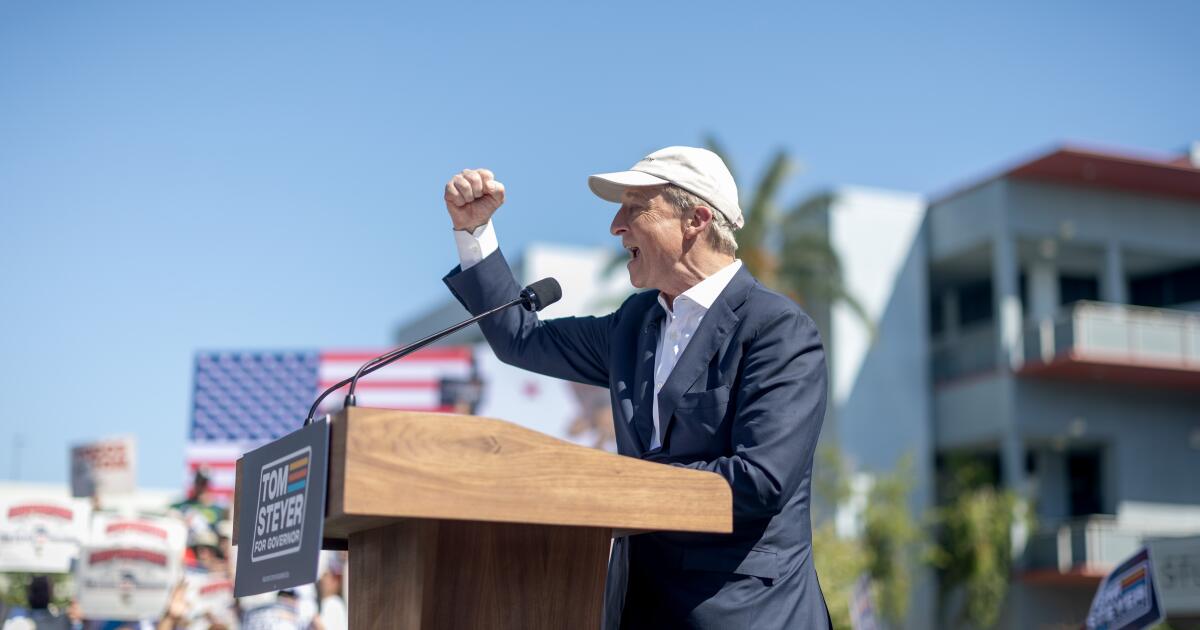
But the nature of that partnership has come into question in California’s hotly contested gubernatorial race after it emerged that a number of content creators — some with millions of followers, others with only a handful — had taken payments from the campaign of Democratic candidate Tom Steyer and not disclosed that they were paid to create those posts.

Some popular content creators have felt the need to explain themselves to their audience. Others have questioned how common such under-the-table payments might be, since there are no disclosure requirements for paid content at the federal level and few jurisdictions have any rules mandating it.

Some campaign finance advocates are concerned that voters could increasingly be influenced by social media posts that they don’t know are sponsored.

“The problem is that it doesn’t look like an ad,” said Saurav Ghosh, a former enforcement attorney at the Federal Election Commission. “It ends up really getting people at a place where they’re not skeptical and not able to tell the difference between what’s voluntary and where the influencer is acting as a paid spokesperson.”

Ghosh is now the director of campaign finance reform at the nonprofit Campaign Legal Center, which has filed a petition asking the FEC to require disclaimers on paid content created by influencers.

Roughly 1 in 5 Americans said they regularly got news from social media influencers in 2024, according to the Pew Research Center, and that number was nearly double for younger adults between the ages of 18 and 29.

Working with social media creators can be an easy way for candidates to try to boost their image, particularly with a younger audience.

“If they don’t have big personalities, maybe partnering with some influencers who seem cool and fun can make you seem cool and fun also through association,” said Link Lauren, a political influencer and podcaster who served as a communications advisor for Robert F. Kennedy Jr.’s presidential campaign in 2024.

California is one of the few places that requires disclosure of sponsored social media posts, but the 2023 law that created those rules hadn’t gotten much of a workout before the issue was raised in this contest through a series of dueling complaints with California’s Fair Political Practices Commission. The commission has yet to weigh in on the various accusations.

Under the law, influencers are required to provide disclosure that a post was sponsored and say who paid for it. Political groups are required to notify paid creators of the requirement.

Even if the commission finds that violations have occurred, the penalties are not especially harsh.

Violation of the law carries no civil, criminal or administrative penalties. The FPPC can take alleged violators to court and ask a judge to force compliance. And violations can be penalized with a fine of up to $5,000 per instance.

Influencers reporting influencers

In the gubernatorial race, the issue of compliance was raised, naturally, by a pair of influencers.

Beatrice Gomberg has built up a following of more than 180,000 followers on TikTok, where she posts under the handle antiplasticlady. Her side gig of creating nonplastic children’s cups and lunch boxes became her main gig after she lost her human resources job at Macy’s during the COVID-19 pandemic.

“I started doing social media because I didn’t want to hire a marketing company,” Gomberg said.

Gomberg’s posts were initially largely focused on research related to plastic, but have become increasingly political over time. When campaigns put out the call for influencers to meet with candidates, Gomberg answered.

She interviewed Katie Porter, she met with Xavier Becerra. And it was at a Becerra event in April when she met Kaitlyn Hennessy, another influencer focused on politics.

They found that the world of online influencers can be isolating. “We stare in front of our phones,” Hennessy said. “You don’t want to see our screen time.”

As they scrolled through social media posts about the governor’s race, they found a cause to unite them.

They kept seeing videos posted by social media accounts espousing similar messages in support of Tom Steyer. Hennessy wondered at first if they were actually created by artificial intelligence.

They found that the posts seemed to be created by a network of women who, in some cases, had created several different profiles to promote a variety of products.

They pored over Steyer’s campaign disclosures and saw that the campaign listed payments to several prominent influencers — including one with the handle Zay Dante, with 1.8 million followers on TikTok — who had not disclosed creating paid content for the campaign.

The pair filed a complaint laying out their allegations, which the Steyer campaign has called “baseless.”

In the wake of their complaint, Steyer defended his campaign’s use of paid influencers, writing on Substack that his campaign believed content creators should be paid for their work and that the campaign had been transparent about disclosing those payments.

In a separate post, influencer Carlos Eduardo Espina said he had been paid $400,000 for work he has done for the Steyer campaign. Espina, who has more than 14 million followers on TikTok, is an advisor to the campaign, which was publicly announced.

“You will never see anything on my channels that I don’t believe in, or that I think goes against the best interest of my community. No one buys my opinion. But I also think it’s fair to be compensated for my work,” he wrote on Substack.

Not everyone is ready to accept payment for posts.

Lauren, the influencer who advised Kennedy’s campaign, said that while he doesn’t begrudge other influencers accepting sponsorship, he chooses not to.

“A passive viewer might think you really believe this,” he said. “I have a strong connection with my audience. I really consider them my family.”

Lauren said he favors disclosure requirements.

Briant, the propaganda researcher, said she is concerned about the possibility of foreign actors trying to influence Americans through paid posts.

In 2024, for example, federal prosecutors filed an indictment alleging that Russian state media employees had paid nearly $10 million to a Tennessee company that paid popular right-wing social media influencers to unwittingly produce pro-Russia content.

Briant said she believes that the only way to counteract increased manipulation through social media influencers is to impose harsh penalties when paid content is not disclosed.

“Ultimately, it’s a wild west at the moment if there are no repercussions for not doing it,” she said.

Source link

Poll of judges, lawyers sees grave Trump threat to rule of law

Sometimes it seems as though the only thing that stands between a functioning democracy and a full-on Trump autocracy is a thin, black-robed line.

Although the Supreme Court, in general, and conservative appellate courts, in particular, have bowed and granted President Trump permission to do pretty much anything he wants, they haven’t thoroughly capitulated to his endless grasping for ever more power. (The way invertebrate congressional Republicans have.)

At the lower-court level, judges have repeatedly ruled in ways intended to check Trump, most notably when it comes to violating civil and constitutional rights in pursuit of his indiscriminate immigration dragnet.

The tendency to slow-walk his administration’s response to those rulings — and ignore others that Trump thinks he can safely snub — only contribute to the perception of presidential lawlessness and a sense that our judicial system is being strained to something approaching a breaking point.

Go ahead, if you’d like, and dismiss those concerns as just so much overwrought hand-wringing, or the mindless anti-Trump blathering of your friendly political columnist. A new survey of legal experts — including federal judges, top-tier lawyers and scores of professors from some of the country’s leading law schools — finds widespread concern about the brittle state of our legal system.

And it’s not just the fears of a lot of shaggy-thinking liberals.

“The nation is strong as is its commitment to the rule of law,” said one appellate judge, a Republican appointee. “The current president presents the greatest threat in decades.”

The survey was conducted by Bright Line Watch, a nonpartisan academic group that monitors the health and resilience of American democracy, in conjunction with the Safeguarding Democracy Project at UCLA’s School of Law.

Conducted between mid-February and early March, the poll anonymously surveyed 21 federal judges, 113 lawyers, 193 law professors, 652 political scientists and a nationally representative sample of 2,750 Americans.

What leapt out to UCLA’s Rick Hasen, director of the Safeguarding Democracy Project, was that “across the ideological spectrum and across judges, lawyers and law professors, there was considerable agreement that the rule of law in the U.S. is under tremendous stress.” That consensus, he said, suggests “a real risk to democracy.”

Most legal experts agreed that Trump is using executive power excessively, with a majority doubting the conservative-leaning Supreme Court would handle cases involving the Trump administration impartially. The experts also expressed concern about politicized law enforcement — Trump seeking to persecute his perceived enemies — executive branch overreach, and the failure of Congress or the Supreme Court to do more to rein in the rogue president.

Eight in 10 of those surveyed said federal officials fail to comply with court orders somewhat or very often, and nearly 9 in 10 said political appointees in Trump’s Justice Department mislead federal judges somewhat or very often.

Talk about contempt of court — not to mention our vital system of checks and balances.

There was, unsurprisingly, a split among conservatives and liberals who took part in the survey. (The study defined legal conservatives as those saying the Supreme Court should base rulings on its understanding of what the Constitution meant as originally written. Liberals, who made up most of the respondents, were defined as those saying the court should base its rulings on what the Constitution means in current times.)

Conservatives, for instance, were more likely than liberals to see former President Biden as a greater threat to the rule of law than Trump. Liberals were more likely than conservatives to see evidence of Trump politicizing the Justice Department.

There were also differences between legal experts — those most intimately involved in the judicial system — and the public at large. The experts were more concerned about Trump’s excesses and threats to the rule of law, which, Hasen said, stands to reason.

The legal system is not something most people encounter daily in the same way they do, say, gasoline prices or the cost of groceries. “Yet,” Hasen said, “it’s one of these background things that really matters.”

Why?

Hasen put it this way: “Imagine that a person had a dispute with their neighbor and it ended up in small claims court before a judge and the judge made the decision not based on the merits of the case but based on whether he was friends with one of the parties, or didn’t like people who were similar to one of the parties.”

Now imagine that kind of corrupted, perverted system of justice writ large.

If, for instance, “people know that the government can successfully seek retribution from people who criticize it, people will be less likely to criticize the government,” Hasen said, leaving the country worse off by muzzling those who would hold their elected leaders to account.

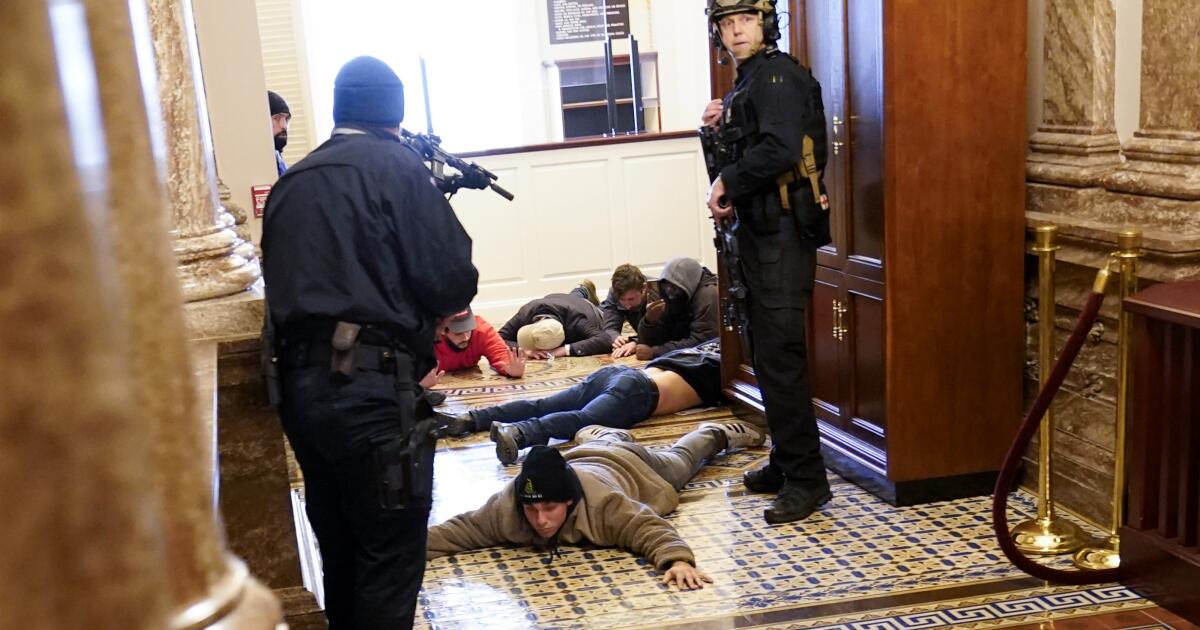
Or if, say, rioters overran the U.S. Capitol and tried to steal an election and, instead of being punished, received cash payouts from the federal government, what incentive would there be to follow the law?

Happily — and who couldn’t use a bit of good cheer right about now — all is not lost.

People “can demand that their elected representatives take steps to assure that the rule of law will be followed,” Hasen said, and can insist “that the government [not] play favorites or seek retribution against perceived enemies.”

That’s the power people have, come election time. That’s why voting matters.

There are lots of things riding on the outcome in November, not least the sanctity and integrity of our legal system.

Bear that in mind when you cast your ballot.

Source link

L.A. crime has plummeted — but it’s still a hot mayor’s race topic

Homicides in Los Angeles are down to levels not seen since the 1960s. Neighborhoods once awash in gang violence now sometimes go weeks, even months, without a shooting. And the follow-home robberies and street takeovers that captured the public’s attention in recent years have largely subsided.

By many measures, the city is safer than it has been in generations — and yet voters following L.A.’s hotly contested mayoral race might think the opposite.

The challengers to Mayor Karen Bass have zeroed in on homelessness and public drug use to argue she hasn’t delivered on public safety, while also criticizing how the Police Department has operated and been funded during her tenure.

Mike Bonin, a former L.A. City Council member, said the fact that Spencer Pratt — the former reality TV star who has been attacking Bass from the right — has gained so much traction in the race is proof of how Bass and other candidates to the left have failed to change “prevailing narratives that the city is unsafe.”

A man in a suit speaking to another man

Mayoral candidate Spencer Pratt hosts a campaign block party on 10th Avenue in Los Angeles on May 20, 2026.

(Robert Gauthier / Los Angeles Times)

Pratt has been particularly active on social media, where he has shared artificial-intelligence videos created by fans depicting him as various superheroes coming to the rescue of a city that, under Democratic rule, has turned into a dystopian hellscape.

In a March 26 post on Substack, Pratt railed against the thousands of drug-related calls that emergency officials respond to every month. He has said that if elected mayor, he would order the police and fire chiefs and the county health director to “treat every encampment as a grave-disability zone.”

“No new laws needed,” he wrote. “No endless task forces.”

Flanking Bass on the left is Nithya Raman, a progressive City Council member who was once the mayor’s political ally.

Raman has argued that Bass has thrown too much money at the LAPD, with raises for police officers coming at the expense of other basic services such as park maintenance and street paving. Raman said the LAPD pay increases have “bankrupted” the city, depriving other services of much-needed funding. In campaign ads, Raman has cast herself as a more sensible alternative to Bass. Raman has said she would work to reduce traffic deaths and prioritize safety on the city’s buses and trains.

When she first ran for office in 2020, Raman called for defunding the police, saying the Los Angeles Police Department should be a “much smaller, specialized armed force.” Since then, however, she has voted for some budgets that increased spending on law enforcement.

In response to questions from The Times, Raman said she would work to find ways to overhaul public safety.

“I’ll propose budgets that expand unarmed response, work with LAPD to improve 911 response to more quickly answer calls for help that don’t require armed officers, and will appoint leadership at the Police Commission who will actively partner with the City Council to work on reform,” she said.

Representatives for Pratt and Bass didn’t respond to requests for interviews with the candidates.

Bonin said Bass — who supported various police reform measures while Congress — has shocked some of her supporters with how “aggressively pro-police she has been.”

When she ran for mayor in 2022, Bass vowed to retool the recruitment and hiring process in order to restore LAPD staffing to 9,500 officers. That hasn’t happened. The number of sworn officers recently fell below 8,600, despite Bass striking a deal with the police union to offer higher starting salaries and new retention bonuses.

A woman with curly, short brown hair, wearing glasses and a mustard yellow jacket, speaks while holding a microphone

Mayor Karen Bass takes part in a candidate forum on May 5, 2026, in Sherman Oaks.

(Eric Thayer / Los Angeles Times)

On Thursday, the City Council approved a $15-billion budget for the upcoming fiscal year, which included funds to hire 510 new officers — just enough to offset turnover and maintain current staffing levels.

Raman has said the LAPD should not shrink any further because there aren’t enough officers to respond to 911 calls “in a timely fashion.”

Samantha Stevens, a Los Angeles political consultant and former legislative staffer, said people seem willing to back Pratt because he acknowledges that their sense of safety has been shaken — even if he has offered few concrete details about how to tackle crime beyond cracking down on homelessness.

Pratt’s critics say that his plan relies on funneling homeless people into a shelter system that doesn’t have the capacity to handle them all. Others have noted that the aggressive tactics he has proposed would probably face legal challenges.

A woman speaks at a lectern with a sign that says 'Nithya for Mayor' in a dirt lot

L.A. City Councilmember Nithya Raman, who is running for mayor, makes a campaign stop at the site of a home burned in the Palisades fire.

(Eric Thayer / Los Angeles Times)

“He’s kind of a case study in somebody who has a lot of opinions but has no idea of how the city is run,” Stevens said.

Fernando Guerra, a political science professor at Loyola Marymount University, said Pratt seems to have tapped into a deep well of discontent among Angelenos who believe that crime and homeless have spiraled out of control. The challenge for Bass, he added, is that although the numbers suggest that crime has decreased, many people associate the sight of encampments spilling onto public sidewalks as “a breakdown” that indicates the city is becoming less safe.

“You want to go back to the days of Daryl Gates, you’ve got Pratt,” he said, referencing the former LAPD chief whose controversial police sweeps in the late 1980s yielded thousands of arrests while alienating large segments of South L.A.

“If you want more of the same from the past 20 years, you’ve got Bass,” Guerra added. “And if you want something new, then you’ve got Raman, but she has to explain what exactly she wants to do.”

Although Pratt and Raman appear to be the strongest challengers to Bass, several long-shot candidates have also made public safety a key issue in their campaigns. Some have gone after Bass for her support of LAPD Chief Jim McDonnell. Hired by Bass in 2024, McDonnell has touted the impressive drop in crime under his leadership, but also faced criticism over an uptick in shootings by police and aggressive crowd control tactics during protests against the Trump administration’s immigration policies.

A man in dark police uniform holds his fingers together as he stands in front of another man

Police Chief Jim McDonnell attends a news conference at LAPD headquarters on May 21, 2026.

(Genaro Molina / Los Angeles Times)

Rae Huang, a minister and housing rights advocate, said if elected mayor she would immediately replace McDonnell with someone who has the “ability to really reimagine what public safety really looks like.”

“I’m the only one with the guts to say that out loud,” Huang told The Times during a recent campaign stop at a bookstore in the West Adams neighborhood.

In social media posts and interviews, Huang has frequently referred to the LAPD as “one of the biggest legal gangs in the world,” and said she would work on diverting money from the police budget to scale up programs that have shown promise in sending unarmed specialists to deal with emergencies that involve people experiencing mental health crises.

The city is already running two such pilot programs, but under Bass they have remained underfunded, Huang said. Last week, the City Council signed off on expanding one of the programs.

Huang said she would also invest more heavily in addressing the city’s lack of affordable housing, which she said is an underlying cause of crime and homelessness.

The Los Angeles Police Protective League has poured hundreds of thousands of dollars into attack ads against Huang and Raman.

Adam Miller, a tech entrepreneur, has tried to strike a balance in his mayoral campaign, advocating for changes while acknowledging that many people still feel unsafe despite the historic drop in violent crime.

He criticized a recent vote by the L.A. City Council to limit so-called pretextual stops, in which officers pull people over for minor traffic infractions in order to investigate more serious offenses. The stops have been blamed for enabling racial discrimination.

Miller said that “constraining the Police Department is the opposite of what we should be doing.” He called for “leveraging” AI and modernizing the department’s archaic computer systems, which he said could allow the LAPD to catch up to other agencies that have embraced new technology.

Miller told The Times that he recently went on a ride-along with officers from the Rampart Division, which he said was eye-opening.

“At the highest level I think Angelenos don’t feel safe anymore,” he said. “They don’t feel safe in their neighborhoods, but more recently they don’t feel safe even in their own homes.”

Statistically speaking, the city might be safer than it’s been in decades, he said — but that doesn’t necessarily matter to voters.

“I don’t think it’s just perception,” he said. “I think it’s reality that crime has spread.”

Source link

L.A. voters will cast ballots in eight City Council districts, two with open seats

Los Angeles voters will cast ballots in eight City Council district elections next week, including for two open seats where incumbents are leaving because of term limits.

The contests for the seats being vacated by Councilmembers Bob Blumenfield and Curren Price have drawn large fields of candidates, but the biggest spending has been in the Westside’s District 11, where incumbent Traci Park is facing challenger Faizah Malik, a public interest attorney and one of four council candidates backed by the local chapter of Democratic Socialists of America.

Park has raised $1.3 million, according to the latest campaign finance reports filed Friday, while challenger Faizah Malik reported about $520,000 in contributions. In addition, more than $3 million has been spent in the race by so-called independent expenditure committees that spend money to elect or defeat candidates but which are barred from coordinating their activities with the campaigns.

The district includes Venice, Mar Vista, Brentwood and Pacific Palisades, which was devastated by wildfire in January 2025.

Malik said Friday she is confident heading into the primary election, saying most of her donations are under $100 each, and that she hasn’t taken money from corporations.

Los Angeles City Council candidate for CD11 Faizah Malik attends a canvassing event.

Los Angeles City Council candidate Faizah Malik attends a canvassing event March 15 in Westchester.

(Eric Thayer / Los Angeles Times)

“This is what it means to be a grassroots candidate, and it is just more evidence that the people of CD11 believe in our vision for a Westside that is affordable for everyday people,” Malik said.

A Park campaign aide said Park’s haul is indicative of the councilmember’s record of getting results.

“But no one is taking anything for granted,” the aide said in a statement. “We’re working until the final vote is cast because this election will determine whether the Westside keeps moving forward or gets pulled backward into the same failed ideological politics Angelenos are exhausted by.”

Los Angeles City Councilmember Traci Park gives a pep talk to members of United Firefighters of Los Angeles City.

Los Angeles City Councilmember Traci Park, center, with members of United Firefighters of Los Angeles City on May 12.

(Genaro Molina / Los Angeles Times)

Park has emphasized her advocacy for fire recovery efforts, including pushing for permit fee waivers for residents wanting to rebuild. Malik has said Park has been too focused on single-family homeowners and said she would focus more energy on renters.

They have contrasting views on policing: Malik said she opposes expanding the size of the Los Angeles Police Department and instead supports shifting more resources to the city’s unarmed crisis response program. Park said the Police Department should have about 10,000 sworn officers, up from about 8,700 currently. She voted in favor of a 2023 LAPD contract that gave raises to officers and increased salaries to new hires.

They stand in contrast of each other on the Venice Dell housing development project, which would turn a city lot into 120 housing units for low-income and homeless people. Park opposed the completion and instead wants to turn it into a “mobility hub” and move the housing project to an adjacent lot. Malik, who represented the developer that filed a suit against the city claiming Park and others sought to kill the project, said the project was a motivating factor for her campaign.

District 9

Six candidates are vying to replace Councilman Curren Price, who hit the 12-year limit, in District 9. The district includes the Convention Center, USC and communities along the Harbor Freeway.

The candidates vary on key issues, including policing and housing. Estuardo Mazariegos, co-director of the Alliance of Californians for Community Empowerment Los Angeles, is backed by the Democratic Socialists of America. He has called for reducing the LAPD budget and redirecting funds to other city departments.

Two other candidates — Jorge Hernandez Rosas, an educator, and Jose Ugarte, who previously worked for Price — said they support hiring more police officers. Another hopeful, Elmer Roldan, executive director of Communities in Schools of Los Angeles, said he believes in keeping the LAPD at its current size.

Ugarte, Roldan, Rosas and Martha Sánchez, a therapist, all support enforcing Municipal Code 41.18, which bars homeless encampments near schools and daycare centers. Mazariegos and Jorge Nuño, an entrepreneur, say the code doesn’t solve homelessness and instead just moves people around.

Ugarte has raised the most in contributions of any candidate and has been endorsed by the Los Angeles County Democratic Party in the nonpartisan race.

District 3

Three candidates are competing for an open seat in District 3, where Councilmember Bob Blumenfield has termed out of office. The district encompasses Woodland Hills, Canoga Park, Reseda, Winnetka and Tarzana.

The candidates are Tim Gaspar, who founded an insurance company, Barri Worth Girvan, district director for Los Angeles County Supervisor Lindsey Horvath, and Christopher Robert “C.R.” Celona, a tech entrepreneur.

The three candidates are similarly positioned on public safety, backing Mayor Karen Bass’ long-term goal to increase the LAPD ranks to at least 9,500 officers. All three also support enforcing Municipal Code section 41.18.

Gaspar and Worth Girvan have both scored key endorsements. Gaspar is backed by Blumenfield, billionaire developer Rick Caruso and Councilmembers Monica Rodriguez, Tim McOsker and John Lee and billionaire developer Rick Caruso. Worth Girvan has endorsements from a long list of state Democratic lawmakers, the county Democratic Party, the Sierra Club and labor unions.

Gaspar leads in campaign contributions, followed by Worth Girvan. Celona, who has promised to resuscitate the city’s entertainment industry by fast-tracking film permits and cutting red tape, trails far behind.

District 1

Councilmember Eunisses Hernandez faces four challengers in District 1, which stretches from Highland Park on the northeast to University Park on the southwest. She is backed by the local Democratic Socialists of America, and her challengers claim the district has suffered under under her leadership, pointing to MacArthur Park as emblematic of the homelessness and drug addiction crisis plaguing the city.

Hernandez counters with a list of accomplishments, including helping secure a $6.3-million state grant to house homeless individuals near the Arroyo Seco riverbed and advocating for a citywide network of unarmed crisis response teams.

She faces challenges from Maria Lou Calanche, a former Los Angeles police commissioner and founder of the nonprofit Legacy LA; Nelson Grande, an executive consultant and former president of Avenida Entertainment Group; Raul Claros, founder of California Rising; and Sylvia Robledo, a small-business owner and former council aide.

Hernandez’s campaign has also faced an onslaught of accusations of “dark money” spending. A group called Neighbors First has sent mail pieces critical of Hernandez and other leftist City Council candidates.

District 5

Incumbent Katy Yaroslavsky faces two challengers for her District 5 seat, both of whom oppose her stance on housing and public safety spending. The district includes some of the city’s wealthiest neighborhoods, including Bel-Air, Westwood, Cheviot Hills and Hancock Park.

Challengers Henry Mantel, a tenants’ rights lawyer, and Morgan Oyler, an accountant, say Yaroslavsky hasn’t done enough to increase the district’s housing supply. Yaroslavsky, who holds a wide lead in fundraising, has said she supports increasing housing density near transit centers but cautioned against building more than the city can sustain.

District 13

Councilmember Hugo Soto-Martínez, who is also backed by the Democratic Socialists of America’s L.A. chapter, faces three challengers in District 13, which includes Atwater Village, Glassell Park, Elysian Valley, Echo Park, Silver Lake and East Hollywood.

The list of challengers includes Colter Carlisle, vice president of the East Hollywood Neighborhood Council, Dylan Kendall, who runs Grow Hollywood, and Rich Sarian, vice president of strategic initiatives for downtown’s South Park Social District.

While Soto-Martínez supports expanding the city’s unarmed personnel program, Carlisle and Kendall would like to expand the police force. Sarian has said he supports the unarmed personnel program and wants to examine the LAPD’s current size and resources.

District 15

Incumbent Tim McOsker is facing off against community organizer Jordan River in District 15, which covers Harbor City, Harbor Gateway, San Pedro, Watts and Wilmington. McOsker has decades of experience in the political world, having worked in the mayor’s office, and the city attorney’s office before joining the City Council in 2022. Rivers, who is unemployed, is a member of the Green Party.

District 7

Monica Rodriguez is running unopposed for the District 7 seat in the northeast San Fernando Valley.

Times staff writers David Zahniser, Noah Goldberg and Sandra McDonald contributed to this report.


Source link

California’s population growth to slow in coming decades

California’s population will grow more slowly in the next few decades than it has in the past — and that is good for the state’s still-struggling economy, according to a new USC report.

The study projects that the state’s population, now 37.3 million, will continue to increase at a healthy clip — about 1% annually — for years to come. But at least through 2050, we are unlikely to see the boom rates of recent decades, especially the 1980s.

“This is more manageable growth and that’s good news for California,” said Dowell Myers, a USC demography and urban planning professor who co-wrote the report with colleague John Pitkin. “We’re returning to a more normal rate of growth.”

The cooling pace means the state, city and county governments and other entities will have more time to prepare for a bigger population than they did in years past, allowing for more effective planning, Myers and other experts said. That could ensure that new roads and parks, for example, are put in areas where they are most needed and where growth is likely to be sustained, they said.

The researchers said the slowdown will mainly stem from a sharp drop in immigration to California, part of a nationwide trend detailed in other recent studies.

Although the slower pace of growth may be a net positive for California, it will require revisions to an array of public and private plans, including for schools, water projects, transportation, hospitals, highways and other infrastructure.

“Those of us who’ve been here for a while think of California as a place that’s grow, grow, grow — and go, go, go — but this shows that we’re not that anymore,” Hans Johnson, a demographer with the Public Policy Institute of California, said of the USC study released Tuesday. “We’re now more typical of the rest of the nation.”

Johnson noted that the brakes on California’s growth were evident in the 2010 census, after which, for the first time, the state failed to gain a new seat in Congress.

The report, the third in a series of projections by USC’s Population Dynamics Research Group, predicts that California’s population will grow at less than 10% per decade for the next several decades.

In the 1980s, the state’s population surged nearly 26%, adding about 6 million residents. The increases were fueled primarily by the booming aerospace industry and economic problems elsewhere in the country, which made the Golden State a powerful magnet for job seekers.

In the 1990s, the state’s growth rate fell to 14% but remained strong. It slowed further, to 10%, in the decade just ended, the USC report shows. Myers said the continuing falloff from 2000 to 2010 may have been partly due to the recession that began in 2008. Growth was slow even in 2005, when the economy was still strong.

The new predictions differ significantly from California’s official population projections. Those show that the state’s population by 2020 would reach 44 million, a level USC’s researchers now say will not be attained until 2028.

Bill Schooling, chief of demographics research for the state department of finance, praised the USC report and said his staff, too, is working on a new set of population figures, which he says will be lower than its previous estimates. Schooling’s office is racing to produce the new estimates ahead of its regularly scheduled report because demographic changes are so profound that state agencies urgently need fresh data to update their planning.

The USC analysis also predicts that as California’s growth slows, its population will change in various ways. The state in coming decades is expected to have more senior citizens, fewer children and more young adults. The state’s immigrant population will be more settled, with a larger share that has lived in the U.S. at least 20 years.

Each change has implications, the experts said.

The average age of the state’s population, as in the nation, is rising, partly driven by the aging of the huge baby boom generation, whose oldest members were born in 1946 and are of retirement age. The USC researchers say the number of Californians of retirement age compared with people of prime working age (25- to 64-year-olds) will rise to 36 seniors per 100 working-age adults in 2030. It stood at 22 to 100 in 2010.

As the boomers age, they will require more state services and that will create budget challenges, Johnson noted. Also significant is the loss of their workforce skills to the state, he said. Baby boomers are California’s most highly educated generation, he said, with a greater share having graduated from college than younger or older age groups.

A smaller population of children in years to come means savings for the state, mainly in education costs. It could lead to higher per capita spending for the education of those who remain, Johnson said.

The rising share of young adults age 25 to 34 in the next 20 years is good news for the state, which experienced negative growth for that age group from 1990 to 2010, Myers said. Young adults are crucial for the state’s economic growth. They are most likely to become new workers, rent their first apartment, buy a home, have children and be first-time voters, he said.

California’s increasingly settled immigrant population means that its members are more likely than before to have learned English, have children born in the U.S. and remain in the state, Johnson said.

“It’s important for us as a state to make sure immigrants and their families are integrated into our society and are successful, so it’s really important to look to their education,” he said. “The biggest challenge California faces long term is to ensure that enough of our residents go to college, and to make sure they graduate.”

rebecca.trounson@latimes.com

Source link

Army of Young Leftist Activists, Loyal Elderly Tenants Make Up W. Hollywood’s Coalition for Economic Survival : Fringe Group Takes Over Center Stage

In the trunk of his battered 10-year-old Ford sedan, Larry Gross stores half a dozen scarred yellow folding chairs. The chairs, strewn among volleyballs, softball equipment and long-discarded papers, are essential equipment for a man who spends much of his life arranging and attending meetings.

Gross is a professional organizer, a man whose career is measured in meetings. He sets up his chairs everywhere in the tiny city of West Hollywood, in the dingy church office where he works, in the clean, well-lighted offices of City Hall, in cramped apartment common rooms and in sparsely furnished election headquarters.

What he accomplishes at those meetings often has immediate impact on the fortunes of the 16-month-old city. With the aid of a small band of young leftist activists and a loyal army of elderly Jewish tenants, Gross has built a potent grass-roots version of a political machine and become the city’s most commanding power broker.

Formidable Power Bloc

In the process, his Coalition for Economic Survival has transformed itself from a Los Angeles-based fringe pressure group with limited successes in rent control and street demonstrations into West Hollywood’s most formidable power bloc. No other organized group in the city wields as much influence or inflames as much controversy.

The coalition and its supporters have elected two of the city’s five council members–both of whom face reelection on April 8–and are priming for a third. Some of its volunteer members have wangled key appointments to the city’s commissions. Others have been hired in policy-making posts in the city’s fledgling bureaucracy.

“West Hollywood is (the coalition’s) oil gusher,” said Ron Stone, who led the city’s incorporation movement. “They’ve dug holes all over Los Angeles, but they never struck deep until they came to West Hollywood. They worked hard here and they deserve the rewards.”

The coalition’s primacy has alienated many of those who are accustomed to holding power. Landlords are roused to fury by the mere mention of Larry Gross’ name. Businessmen worry that the coalition’s continuing dominance will cost them profits. Rival politicians are jealous of the group’s clout. Even some council members seethe privately at the coalition’s refusal to compromise on minor political issues.

“CES is run by a very small group of people,” said Tony Melia, an insurance man who chairs a faction of moderate businessmen challenging the coalition for political supremacy in the April election. “They are a mystery to us all.”

Grist for Criticism

Nearly every move that the 34-year-old Gross makes as director of his coalition becomes instant grist for criticism: Passing folded notes to Mayor John Heilman and Councilwoman Helen Albert (both coalition members), Gross is accused of controlling their votes. Taping a flag over his office desk, he is branded a Communist (Gross described the flag, which has been taken down, as a United Farm Workers banner; his enemies say it was a hammer and sickle). Shaving his wispy beard and wearing suits instead of flannel shirts, he is said to be cleaning up his act for public consumption.

“People set me up as the enemy all the time,” Gross said. “They do it out of fear and envy. They really don’t have the foggiest notion of what CES is all about.”

Gross’ Hold on Coalition

Their obsession with Gross is hardly unwarranted. About 13 years after he founded the coalition with a group of peace activists and leftist leaders, Gross is the only original member left. Organizers and volunteers have come and gone, leaving because of “activist burnout,” because they needed a better-paying job or because of personal or philosophical conflicts. But Gross remains.

Although ostensibly a democratic organization, the coalition has remained securely in Gross’ control. His partisans say he is central to CES because of his natural leadership abilities; former members and enemies attribute his endurance to Machiavellian political cunning. But in the end, many who have watched Gross say he remains in control of the coalition because he simply is the coalition.

“Our success all trickles down from Larry,” said Jacqueline Balogh, the coalition’s membership director. “Without him, CES wouldn’t exist.”

Gross is a lean, fox-faced man who has a closet athlete’s fascination with competitive sports and a weakness for interrupting his organizing activities to attend Dodger and Laker home games.

He tries to keep his private life shielded from public scrutiny. “I don’t like the focus on me,” he said in a recent interview. “It’s the organization and what it has accomplished that’s important.”

Friends and former acquaintances say Gross lives in a sparsely furnished rented duplex in Echo Park. Five years ago, he made barely $500 a month at his job. These days, he makes more, but declines to reveal a figure. He still drives his decade-old Ford despite its growing list of automotive maladies.

His voice bears traces of a Queens accent that becomes thicker when he excitedly addresses crowds. “The landlords are trying to say rent control is not an issue in dis campaign!” he roared to an enthusiastic hall filled with senior citizens early this month. “The reason is dey don’t stand for strong rent control!”

Odd Man Out

The accent is one of the few facets of Gross’ activist life style that he has not polished. His is a career that began at Forest Hills High School in New York, where Gross found himself odd man out among fellow students in the late 1960s. “I was the only radical on campus,” he said.

He is the son of divorced parents. His father, a trade school teacher, lives in Miami; his mother, a volunteer with the Simon Wiesenthal Center, lives in Los Angeles, not far from West Hollywood. Both were influences on his burgeoning activism, his father as an active union member, his mother as a Holocaust survivor.

“What she went through outraged me whenever I thought about it,” Gross said.

Often joining older college students in peace marches at Central Park and other anti-Vietnam War activities, Gross graduated from high school with few prospects. He took a job as a clothing store salesman, but in 1972, came to Los Angeles to visit his mother, who had moved here.

Extending his stay by taking political science classes at Los Angeles City College, he became active in local efforts to drum up support for the impeachment of President Richard Nixon. Drifting between activist groups, Gross in 1973 became involved in new union of peace and civil rights organizations which was protesting Nixon’s cuts in social service budgets.

The umbrella group became the Coalition for Economic Survival. “They had a little flat on Vermont Avenue with a small file cabinet in the back,” said Rosa Factor, an early coalition volunteer. “It was real small-scale. Larry was a lot different in those days. His hair was long and frizzy, hippie-style.”

Strong Points

The group’s forte was picket line protest and street theater. Demonstrating against high milk prices in 1974, coalition organizers toured inner-city shopping centers, urging a boycott. Gross and his fellow activists spoke from the back of a pickup truck, where they mounted a purple papier-mache cow named “C. Brunel Cow” after then-state Agriculture Secretary C. Brunel Christensen. At a later demonstration, protesting a Pico-Union expansion of a Pep Boys warehouse complex, Gross and his followers marched to the chant: “Manny, Moe and Jack! We want our buildings back!”

At first preoccupied with consumer issues such as rising bus fares and utility costs, the coalition managed to win favorable coverage in newspaper and television reports. They had little influence, however, on the commissions which made the decisions.

Skyrocketing rents that accompanied Los Angeles’ real estate speculation fever in the late 1970s gave the coalition a ready-made issue. “We cut our teeth on rent control,” said Norman Chramoff, a former coalition member who now works in West Hollywood’s rent control administration. “That’s when CES membership grew and grew.”

The new members were senior citizens, outraged that their rents were doubling and tripling, often in the span of a year. After learning to live on fixed incomes, many elderly tenants became afraid that they would be evicted from apartments where they had lived for years.

Remembering the horrors of the Depression, many seniors feared a return to poverty. “Anybody who lived through the Depression can’t imagine how scared we were,” said Martha Newman, a woman in her 60s who is an ardent coalition supporter. “CES saved us from that.”

Limited Victories

The coalition promised relief from the surging apartment rental rates. In a series of political confrontations with landlords, the coalition won limited victories. Although it did not get the strong rent protections it wanted, the coalition did help push a moderate rent control law (4% annual rent increase) through the Los Angeles City Council. In Los Angeles County, the coalition pressured supervisors, but was only able to help pass an even weaker rent law in 1979 (7% annual increase).

In November, 1983, a coalition-sponsored referendum failed to persuade county voters to adopt a tougher rent control law. Because of overwhelming support among senior renters, the referendum did well in West Hollywood–passing there by a 5-1 ratio–but it was not enough to keep rent control alive. That vote, which led to the expiration of county rent control in 1985, set the stage for West Hollywood’s incorporation battle.

By that time, the coalition had made deep inroads into the city’s elderly community (estimated at 40% of the area’s population). Those inroads proved crucial in the 1984 incorporation election.

Gross estimates that 2,000 of the coalition’s 5,000 members are in West Hollywood. Political observers of all stripes in West Hollywood agree that in an election year campaign, the coalition can command upwards of 2,000 votes–a significant block among West Hollywood’s 19,000 registered voters.

“West Hollywood is sort of our flagship,” Gross said. “We have a tremendous opportunity here.”

The city’s elderly tenants also provide the coalition with much of its financial support. At coalition meetings, organizers pass around empty fried chicken buckets, which are often returned brimming with cash and checks.

Several allegations of discrepancies in the coalition’s finances were reported to county officials last year. But Candace Beason, a prosecutor in the county district attorney’s investigative division, said her department has declined to investigate them. “They were relatively minor complaints,” she said last week. “The case is closed.”

Since its incorporation victory in November, 1984–in which two coalition members, Heilman and Albert, were elected to the council and the coalition aided the election victories of council members Alan Viterbi and Valerie Terrigno–the coalition has worked to consolidate its power.

New Headquarters

Late last year, the group moved its headquarters from a cluttered office on Pico Boulevard in Los Angeles to a cluttered office in the Crescent Heights Methodist Church in West Hollywood. Working at night, amid old metal desks and boxes sagging with files, coalition organizers quickly felt at home in the new city.

But, as with nearly everything they do, coalition organizers found themselves under attack, this time just for moving into West Hollywood. Landlords, Republicans and businessmen tried to pressure church leaders and city officials to evict them but the CES has stayed put.

The coalition–and Gross, in particular–are under constant fire. During the 1984 incorporation election, he was branded a Communist by Jewish Defense League activist Irv Rubin. Rubin claimed then–and maintains today–that he has “inside information” proving that Gross visited Cuba as a guest of Fidel Castro.

Gross labels the charges “the ravings of the far right.” Despite continued whisperings about “hidden agendas,” landlords and other political enemies of the coalition have never proved their claims.

But at least half a dozen former coalition members say they were invited by some coalition organizers to attend Marxist study meetings and similar functions. One former member, Mark Siegel, who is now chief deputy to Los Angeles Councilman Joel Wachs, said that he was asked several times to join a Marxist study group. He declined.

“The thing is, (CES) was such a loose group,” Siegel said. “There were all kinds of philosophies floating around there. We certainly weren’t being directed from Moscow.”

Both Gross and Heilman also admit that some members have been philosophical Marxists. “But we have Republicans among our steering committee people, too,” Gross said. “We even have one person who sells Amway products. Should we throw them out for that? I don’t think it really matters.”

‘I’m Scared’

“Of course it matters,” argues Tony Melia, who heads West Hollywood for Good Government, the group opposing the coalition in the April elections. “We want officials who choose for us, without any hidden agendas. If the rumors I hear are true, then I’m scared.”

Gross and his followers have also been portrayed as dogmatic and unwilling to take part in the compromises that are the basic components of small-town politics. “That is my one real gripe with them,” said Councilman Stephen Schulte. “There’s no middle ground to them.”

To that criticism, Heilman responds: “I don’t call that being dogmatic,” he said. “We stand for certain principles. Why should we deviate from them?”

Arguments over covert Marxism and political rigidity, however, mask the nature of the real power struggle in West Hollywood. Perceived as the most influential organization in the city, the coalition’s apparent clout is envied by groups that have had less sway with the City Council.

“At least until this election is over, they (the coalition) have the appearance of the most-organized political entity in town,” Schulte said. “One doesn’t confront them lightly.”

Those who do can expect to become enemies. When Melia unveiled his Good Government group earlier this year, he portrayed it as a rival of the coalition for political clout in West Hollywood. Gross immediately branded the group as a “front for the landlords.”

While it is indeed probable that the landlords would prefer victories by Good Government candidates in the April election, Gross immediately set into motion “an us-versus-them situation,” according to community activist Bob Conrich.

Black and White

“They have no gray areas,” Conrich said. “Larry’s convincing his elderly constituency that the landlords are waiting behind every corner to gouge them. It’s an effective political tactic, but it’s dishonest and it sets this city up for the same situation in every election. Larry will set someone up as a tool of the landlords and then try to knock them down.”

Such was the case earlier this month, when coalition organizers filled a hall at Plummer Park with senior citizens and raised the threat that the city’s rent control ordinance was in danger. “This election is going to be a big battle,” Gross said. “They have the money. They had it last time. But we have the people.”

It has been harder for the coalition to bring out their people when the heat of an election has cooled. During last year’s rent control battle, landlords far outnumbered tenants at public hearings on the proposed law.

Still, in rent control votes and in pressing for an affordable housing policy with the city’s interim growth ordinance, the coalition lived up to its reputation. On other votes, though, without obvious backing of its elderly constituents, the coalition has found itself sometimes limited in its influence over council decisions.

That became embarrassingly obvious to coalition organizers when the council refused to exact concessions from the Pacific Design Center in return for a planned major expansion. Heilman and Albert, backed by coalition lobbyists, pushed for fees that would have paid for a day-care center and provided seed money for a community development corporation. But in the end, the two council members gave up their fight.

Close Votes

The coalition has even had trouble getting some of its members appointed to city commissions. In close votes in recent months, the coalition’s candidates for posts on the city’s Transportation and Human Services commissions were defeated and the coalition even was unable to prevent landlord leader Grafton Tanquary from winning a spot on the Affordable Housing Task Force.

Schulte, Melia and a number of other political observers say such defeats indicate a lessening of the coalition’s clout. “I don’t think they loom as high on the horizon as they did six months ago,” Schulte said. “They haven’t kept up the pressure.”

But Gross and other coalition members say those defeats were minor ones, offset by gains achieved in a less obvious area–political organizing among the city’s 89% tenant population. The coalition is trying to win more allies among the apartment dwellers for future elections.

In recent months, Gross and his fellow organizers have shown up weekly at apartment buildings scattered throughout West Hollywood for “house meetings,” small receptions where they explain the new rent control law to tenants and answer questions about other concerns.

Last month, Gross showed up at one building to explain the details of the city’s new rent law to six tenants. As a radio faintly played “The Poet and Peasant Overture,” Gross set up his folding chairs and waited for his small audience to arrive.

The meeting lasted just over an hour. The conversation did not get beyond the level of after-dinner chat. But in the eyes of many West Hollywood political observers, the coalition’s dependence on such seemingly insignificant meetings may provide the key to its future influence.

“They do the groundwork that no one else in West Hollywood is willing to do,” said Councilman Viterbi. “They’re out there all the time, making new contacts, renewing old ones. No one else in this city has the patience or the manpower to do that. As long as they keep it up, they’ll be a force to reckon with.”

Comments on the Coalition

Incorporation leader Ron Stone: “West Hollywood is (CES’) oil gusher.”

Rival coalition leader Tony Melia: “CES is run by a very small group of people. They are a mystery to us all.”

Councilman Stephen Schulte: “At least until this election is over, they (CES) have the appearance of the most-organized political entity in town. One doesn’t confront them lightly.”

Councilman Alan Viterbi: “They do the groundwork that no one else in West Hollywood is willing to do.”

Source link

Nader Names Running Mate – Los Angeles Times

Green Party presidential hopeful Ralph Nader said that Native American activist Winona LaDuke will again be his vice presidential running mate.

LaDuke, 40, is a Harvard graduate from the White Earth Indian Reservation in Minnesota. A farmer and author, she started the White Earth Land Recovery Project 10 years ago and is known for her work recovering lands taken from Minnesota’s Objibway tribe.

Source link

Travel industry worries after Trump administration reiterates threat to ‘sanctuary city’ airports

The travel industry is on edge after Homeland Security Secretary Markwayne Mullin reiterated his threat to withdraw U.S. Customs and Border Protection officers from airports in so-called sanctuary cities in a move that could jeopardize international flights.

The U.S. Travel Assn. said that Mullin confirmed he is considering withdrawing the officers in a meeting where the trade group was pressing its concerns about other proposals the Trump administration is considering that could hamper travel. The travel association and major airlines quickly condemned the idea, and even Transportation Secretary Sean Duffy said it doesn’t make sense to him.

“U.S. Travel believes such a move would have devastating consequences for the travel industry and communities that depend on international visitation,” the industry group said Friday in a statement.

Details of the meeting were first reported by the Atlantic.

Duffy said at a congressional hearing this week that he wasn’t familiar with Mullin’s remarks, and he’d like to learn more about the context and maybe ask Mullin a question about what he meant. But Duffy said it would be a bad idea to start restricting travel based on political views. After all, he acknowledged, at some point Democrats will be in charge and “you will all switch spots at one point — hopefully not too soon, Mr. Chairman.”

“We have people from around the world and around the country that need to be able to fly into all different kinds of places. We shouldn’t shut down air travel in a state that doesn’t agree with our politics,” Duffy said.

So it’s not clear how much support this idea has within the administration, though President Trump has previously threatened to withhold funding from sanctuary cities.

There is no strict definition for sanctuary policies or sanctuary cities, but the terms generally refer to jurisdictions that limit cooperation with U.S. Immigration and Customs Enforcement. And courts have rejected the idea of pulling funding from them in the past.

In Trump’s first term in office, in 2017, courts struck down his effort to cut funding to the cities.

It’s not clear exactly which cities and airports Mullin might target, but the Justice Department last year published a list of three dozen states, cities and counties that it considers to be sanctuary jurisdictions. They include California, Los Angeles, San Francisco and San Diego County.

The Airlines for America trade group was quick to say the idea would hurt the economy and disrupt travel.

“Reducing CBP staffing at major airports would have a devastating effect on the airline and tourism industries, causing a significant operational disruption to carriers, travelers and the flow of international cargo.”

Funk and Yamat write for the Associated Press.

Source link

Secret Service shoots person near White House, bystander also shot

The U.S. Secret Service shot a person near the White House on Saturday, and a bystander also was shot, a law enforcement official said.

Both individuals were said to be in critical condition, according to the official, who spoke on condition of anonymity because they were not authorized to discuss the investigation.

Journalists working at the White House on Saturday reported hearing a series of gunshots and were told to seek shelter inside the press briefing room.

On X, the Secret Service said it was “aware of reports of shots fired near 17th Street and Pennsylvania Avenue NW” — one block from the White House — and was “working to corroborate the information with personnel on the ground.”

In a social media post, FBI Director Kash Patel said officers were responding to shots fired and said he would “update the public as we’re able.”

President Trump was inside the White House at the time.

Evidence of the shooting was visible on a sidewalk just outside the White House complex, where yellow crime scene tape snaked across the pavement and Secret Service officers placed dozens of orange evidence markers on the ground. Medical material, including what appeared to be purple surgical gloves and kits typically used by emergency medical personnel, were also seen.

In a post shared on X, Selina Wang, the senior White House correspondent for ABC News, shared video of the moment she said she heard what “sounded like dozens of gunshots” and ducked for cover. Writing that she had been performing an ordinary task that reporters at the White House do every day — filming themselves on a cellphone, for a social media post — Wang’s video shows her speaking for a few seconds about Trump’s statements earlier Saturday about a potential Iran deal.

As the sounds of gunfire are heard in the background, Wang’s eyes grow wider, and she ducks down in the media tent, which is among those situated in a line along the White House driveway where broadcasters film their reports. On X, Wang’s video had been shared thousands of times as of Saturday evening, and viewed at least 3 million times.

The Metropolitan Police Department said on its X account that the Secret Service was working the scene and cautioned people to avoid the area. The scene is near where a gunman ambushed two members of the West Virginia National Guard in November.

U.S. Army Spc. Sarah Beckstrom, 20, died from her wounds. Andrew Wolfe, then 24, was critically wounded. Rahmanullah Lakanwal has been charged in that incident.

The gunfire Saturday comes nearly a month after what law enforcement authorities said was an attempted assassination of the president on April 25 as he attended the annual White House Correspondents’ Assn. dinner at a Washington hotel. Cole Tomas Allen of Torrance recently pleaded not guilty to charges that he attempted to kill Trump and remains in federal custody.

Following that scare, Secret Service officers shot a suspect they said had fired at officers near the Washington Monument, also near the White House. Michael Marx, 45, of Midland, Texas, was charged in a complaint filed in U.S. District Court in connection with the May 4 shooting. A teenage bystander was wounded in that incident.

Superville and Durkin Richer write for the Associated Press. AP photojournalists Jose Luis Magana and Alex Brandon and writers Gary Fields, Meg Kinnard and Matthew Daly contributed to this report.

Source link

Trump says U.S., Iran are ‘getting a lot closer,’ but questions remain about concessions

President Trump said Saturday that the United States and Iran have agreed on the basic terms of an agreement to end the two countries’ nearly three-month-long war and reopen the Strait of Hormuz.

“An Agreement has been largely negotiated,” Trump wrote in a social media post. “Final aspects and details of the Deal are currently being discussed, and will be announced shortly. In addition to many other elements of the Agreement, the Strait of Hormuz will be opened.”

Iran’s state television network quoted Foreign Ministry spokesman Esmail Baghaei as saying the draft pact will be a “framework agreement” that defers talks toward limiting Iran’s nuclear program until later. Trump did not mention the nuclear issue in his statement.

If that is the form the deal takes, it would represent at least a short-term concession from the president, who initially demanded a definitive end to Iran’s nuclear program as the price of peace.

Trump has also relaxed an earlier U.S. demand that Iran give up its right to enrich uranium and says he would be satisfied with a deal to “suspend” enrichment for 20 years.

Those signs of U.S. flexibility have raised alarm from Iran hawks, reportedly including Israeli Prime Minister Benjamin Netanyahu. They say they fear Trump is so intent on restoring the flow of oil from the gulf that he might agree to a deal that falls far short of U.S. goals.

Mark Dubowitz, a leading critic of past agreements with Iran, said he worries that Trump might settle for “a foolish agreement” to reopen the Strait of Hormuz.

“I’m concerned that the administration is looking to cut some ‘Phase One’ deal” in which Iran is given “significant sanctions relief in exchange for agreement to reopen the strait,” he said in an interview Friday. “I think that would be a foolish agreement. Iran would get real money, but they could continue to close the strait any time they wanted simply by making threats.”

Robert Kagan, a conservative foreign policy scholar at the Brookings Institution, wrote that a deal to reopen the strait while deferring the nuclear issue would amount to a U.S. “surrender.”

“On the present trajectory, Iran will emerge from the conflict many times stronger and more influential than it was before the war,” Kagan wrote in the Atlantic.

When the war began in February, Trump said he wanted not only to end Iran’s nuclear activities and destroy its ballistic missile program, but bring about regime change as well.

Instead, the nuclear talks have focused on narrower, more achievable goals: a “suspension” of nuclear enrichment for 20 years or less and removal or destruction of Iran’s highly enriched uranium, the essential ingredient for a nuclear weapon.

“A basic agreement shouldn’t be impossible to achieve,” said John W. Limbert, who worked on Iran policy at the State Department for three decades, and was one of the American hostages seized by Iranian militants in 1979. “The deal would be some kind of verifiable limits on the nuclear program in return for economic relief.”

“The fact that we’re talking about a suspension of all enrichment, and the question is whether it will be five years, 20 years or halfway in between — that’s important,” said Nate Swanson, an Iran expert who worked at the National Security Council under President Biden and Trump. “That sounds like you really have the basis for an agreement. … But don’t fool yourself to think that completely addresses the situation.”

Swanson said other issues, including Iran’s nuclear research and its advanced ballistic missiles, haven’t been addressed.

Despite signs of progress toward an agreement, the gaps between the two countries remain large.

Part of the problem is that both sides appear to believe they have won the war, said Danny Citrinowicz, a former Iran analyst at Israel’s defense intelligence agency.

Trump and other U.S. officials frequently assert that the United States has gained the upper hand by destroying Iran’s navy, air force and many of its missiles.

But the Iranians use a different scoring system, Citrinowicz said.

“Iran does not measure success the same way Washington often does,” he wrote in an email. “From Tehran’s perspective, simply holding firm in the face of American pressure can be framed as a win.”

“Tehran believes time is working against Trump politically and strategically,” he added. “Iran is prepared for prolonged confrontation; the United States, far less so.”

And even if a negotiated agreement is reached, the deals under discussion now won’t resolve all the conflicts between the two countries.

“An interim deal to buy time [is] probably where we end up,” Swanson said. “Buying time is not a bad thing. Ending a war is not a bad thing. But it’s not a comprehensive solution.”

Source link

Trump’s Justice Department scrubs its website of news releases about Jan. 6 defendants

The U.S. Department of Justice has acknowledged removing from its website news releases about criminal cases related to the Jan. 6, 2021, riot and insurrection, calling the information about the prosecutions “partisan propaganda.”

The purge of news releases documenting criminal charges, convictions and sentencings is the latest step by the Trump administration to reimagine the history of the assault on the U.S. Capitol, when hundreds of supporters of President Trump stormed the building in an effort to halt the congressional certification of his 2020 election loss to Joe Biden.

Trump, on his first day back in office in January 2025, pardoned, commuted the prison sentences or vowed to dismiss the cases of all of the 1,500-plus people charged with crimes during the Capitol assault, including those convicted of sedition and of attacking officers with makeshift weapons such as flagpoles, a hockey stick and crutch. More than 100 police officers were injured, many of them seriously, and five died as a consequence.

On Monday, the Justice Department announced the creation of a $1.776-billion fund meant to compensate Trump allies who claim they were unjustly investigated and prosecuted. Acting Atty. Gen. Todd Blanche has not ruled out that Jan. 6 rioters convicted of violence will be eligible for payouts, prompting bipartisan anger in Congress.

After a journalist on Friday observed on the social media platform X that the Justice Department was “quietly” removing news releases on its website that were related to the Jan. 6 attack, including about a Texas man who pleaded guilty to assault and also faced separate state charges of soliciting a minor, the department responded through its “rapid response” account that there was “nothing ‘quiet’ about it.”

“We are proud to reverse the DOJ’s weaponization under the Biden administration. We will do everything in our power to make whole those who were persecuted for political purposes,” the post said. “This includes stripping DOJ’s website of partisan propaganda.”

Among the releases removed from the site were those concerning seditious conspiracy cases against members of the Proud Boys and Oath Keepers, far-right extremist groups, some of which resulted in convictions and long prison sentences.

The Justice Department, in an unopposed motion last month, asked a federal appeals court to vacate those seditious conspiracy convictions, a request that was granted Thursday. The department on Friday moved to dismiss the cases against the group members.

Trump was impeached for inciting an insurrection on Jan. 6 and was indicted on felony charges related to his actions. Those charges were dismissed after his 2024 election victory.

Tucker writes for the Associated Press.

Source link

Obama samples Seattle doughnuts but Secret Service takes the cupcakes

It’s more than an army that travels on its stomach. A presidential campaign is also carbohydrate-challenged as President Obama demonstrated in his Seattle stopover Thursday.

The president’s day began with Obama and entourage hitting a local coffee shop, the Top Pot Doughnuts.

“Hey guys,” Obama said, getting some cheers from the dozens of other customers. As Michael Jackson’s “Beat It,” played in the background, Obama stepped up to the counter, according to media pool reports.

“Let’s see what we got here,” he said, counting the Top Pot Doughnut group that included top staffers and Washington Sen. Patty Murray. “Are we buying a dozen?”

“A couple dozen?” he said after apparently being urged to get more than one.

“I think we’ve gotta sample everything right? So why don’t you just give us a sample,” he said to the clerk behind the counter. “Whatever you recommend.”

The president later took out a bunch of $20 bills, peeled off a couple and handed them to the cashier. After putting his change in the tip jar, he said, “One of the benefits of being president.”

Like a trail of crumbs, the sweet theme continued at Obama’s visit to a Seattle home where he met with a small group to tout his economic program.

One of the questioners was Jody Hall, owner of Cupcake Royal, a local chain built with the help of a government loan, another theme as Obama pushed helping small businesses. Responding to Obama, Hall said she had brought samples but noted that the Secret Service was very thorough and had taken them away.

“I suspect Secret Service confiscated them and are now eating them as we speak,” Obama said.

Obama joined in with the laughter as the group considered the future of those confections.

“I’m really looking forward to trying your cupcakes,” Obama said later.

Michael.muskal@latimes.com

Twitter.com/LATimesmuskal


Source link

GOP governor hopefuls give closing arguments to oft-forgotten Central Valley Republicans

In the waning days before California’s primary election, the two top Republicans running for California governor delivered closing arguments in front of a friendly Central Valley audience Friday evening.

Though Riverside County Sheriff Chad Bianco and former Fox News host Steve Hilton have attacked each other throughout the campaign, they abstained from feuding and instead focused on common enemies — Gov. Gavin Newsom and Democratic lawmakers who control the Legislature.

Hilton criticized Newsom’s new $20-million program to provide free diapers for families of newborn babies, referring to the outgoing governor as “the great loaded diaper of California himself.”

Earlier this year, Hilton and Bianco topped the governor’s race polls as a packed field of Democrats split many of the state’s liberal voters. Under California’s “jungle primary” system, where the top two candidates advance from the primary to the general election regardless of political affiliation, that led to fleeting hope among Republicans that the two candidates could shut Democratic candidates out of the November election.

“That idea was always a fantasy,” Hilton wrote in an op-ed published in the New York Post earlier this week in which he urged Bianco to drop out of the race “for the sake of the state we both love.”

“Steve, it is time for you to drop out,” Bianco retorted in a video posted to social media soon after. “In no world, no world does Steve Hilton beat a Democrat in November.”

After winning an endorsement from President Trump in early April, Hilton has steadily outpaced Bianco in polls. A poll commissioned by the California Democratic Party released last week showed Hilton leading the field with support from 22% of likely voters, followed by Democrat and former Biden Cabinet member Xavier Becerra with 21%. Bianco was at 10%, down from 15% in a previous poll conducted two weeks prior.

Still, Bianco, the two-term sheriff of California’s fourth most populous county, is a favorite of many Republicans in the state and won more support from delegates during the party’s recent endorsing convention than Hilton, though neither reached the necessary 60% to win the party backing.

While the two candidates have needled each other with personal digs and insults throughout much of the campaign, they appeared to set that energy aside during the Clovis forum and even traded some compliments. Hilton praised “sheriffs like Chad who actually understand what public safety looks like” while Bianco acknowledged that his opponent “should be very proud” to have Trump’s endorsement.

State Sen. Shannon Grove (R-Bakersfield), who moderated the more than 90-minute event, praised their “extraordinary civility” before she pressured each to commit to backing whichever Republican makes it through the June 2 primary — or if they both advance, continue to focus on policy debates over attacks.

The forum was hosted by the Fresno County & City Republican Women Federated as part of a fundraiser and dinner honoring the upcoming 250th anniversary of the nation’s founding. About 450 attendees were served dishes inspired by presidential favorites including sirloin steak for Theodore Roosevelt, a chopped salad from Chasen’s, a favorite Los Angeles eatery for Ronald Reagan, and a chocolate pie with cherry vanilla ice cream for Trump.

The Central Valley stretches from Bakersfield to Redding and is home to some of the nation’s most lucrative farmland. It also includes the heart of California oil country in Kern County. Yet residents feel largely neglected by statewide politicians who are more drawn to the ample votes and wealthy donors in Southern California and the Bay Area.

“We are the breadbasket of the world but we’ve been overlooked for too long,” said Andrea Shabaglian, a vice president of the Fresno Republican women’s group. “When gubernatorial candidates come here to sit down and listen to our communities, they realize that a stronger Valley means a stronger California.”

Though he lost California handily to former Vice President Kamala Harris in the 2024 election, Trump dominated in the state’s midsection. Even in Fresno County, where the Republican forum was held, Trump beat Harris by a four percentage point margin despite Democratic voters slightly outnumbering Republicans.

“We need a Republican in office because California is a mess. I mean, anybody with common sense can see that,” said LuAnne Pinedo-Madden, a retiree living in the Sierra foothill community of Coarsegold who listed transgender girls being allowed to compete in girls’ sports and government corruption as her top concerns.

Pinedo-Madden said she was “pretty sure” she had decided which of the Republican candidates to vote for but declined to say whom. “I feel that if we don’t get a Republican in office, we’re looking at moving” to Utah, Idaho or Nevada, she said. “We can’t take this anymore.”

Bianco and Hilton spoke about their plans to improve public safety, small businesses, homeowner’s insurance and water management, a crucial issue for the conservative-leaning owners of vast swaths of California’s agricultural heartland.

Signs along the major highways that straddle California’s Central Valley proclaim that “Food grows where water flows” and criticize Newsom for allowing water to flow into the ocean instead of capturing and storing more of it for farming.

Both of the GOP candidates described their visions for the state, which include building new dams and raising existing ones to store more water.

“We don’t have the water problem. We have a water management problem,” Bianco said before falsely arguing that “we get more water every single year than any other state in the country” and that California has “never, ever, ever been in a drought.”

“The water will be flowing to our farmers, the oil will be flowing to our refineries, the forests will be managed, the timber will be harvested” and used to build new single-family homes, Hilton said. “We’ve got the best weather, we’ve got the best people, we’ve got the best farmers, we’ve got everything we need to make this place amazing, except a good governor. Very soon we’ll have that as well.”

Though a Republican governor would likely face a hostile Legislature intent on blocking many priorities, Bianco and Hilton both promised sweeping cuts and cutbacks of state agencies. Both pledged on Friday to replace every member of the state’s parole review board, which drew criticism in February when it granted elderly parole to a man convicted of 16 counts of kidnapping and child molestation in 1999.

“California criminal justice is absolutely broken and it was forced upon us in the name of reform. What I’m going to do is make it a crime to hear the word reform again, because we lost track of what that word even means,” Bianco said.

He also pledged to eliminate laws and environmental regulators often blamed for slowing housing development: the California Environmental Quality Act, the California Coastal Commission and the state Air Resources Board.

Though his opponent has the coveted Trump endorsement, Bianco argued that it will hurt Hilton’s chances of winning the general election. The Republican president has never been popular in deep-blue California; just 25% of adults in the state approved of Trump’s performance according to a February survey by the Public Policy Institute of California.

“Steve should rightfully be proud of being endorsed by President Trump [but] we have to actually realize, is that a good thing in California? It’s a good thing in this room,” Bianco said as the crowd cheered at the mention of the president’s name. “We have to realize strategically that President Trump ran three elections in this state, and he lost 60-40 in all three of them.”

The Riverside sheriff argued he is “the only person that can actually sway Democrats to vote for a Republican across party lines on a public safety platform.”

Source link

Trump likes Pratt. Will that help, or hurt?

We’re really almost there.

There is just over one week remaining before the June 2 primary for Los Angeles mayor, city attorney, city controller and eight of the 15 City Council seats.

As of Friday morning, 333,000 mail-in ballots had been cast in the race, up from 321,000 at the same time in 2022, according to the L.A. County Registrar/Recorder.

The Trump card

Spencer Pratt’s foes in the Los Angeles mayor’s race like to say that the former reality television star lacks the experience needed to run a big city.

But Pratt might have an even bigger liability — any sense that he may be aligned with President Trump.

Cygnal, a national polling group that has worked for Republican candidates, found that tying Pratt to Trump and the MAGA movement is a bigger turnoff to Democrats than his reality television past.

According to its poll of 500 likely Los Angeles voters, Pratt’s reality TV resume made 59% of overall Democrats less likely to vote for him. By comparison, tying Pratt to MAGA and Trump made 65% of Democrats less likely to vote for him, Cygnal said.

Pratt is a registered Republican and on Wednesday, Trump signaled support for Pratt in the mayoral race. On Thursday, former Trump advisor Steve Bannon said the president didn’t formally endorse Pratt out of fears it would hurt Pratt’s chances in Democrat-dominant Los Angeles.

L.A. mayoral candidate Spencer Pratt hosts a campaign "block party" event.

Spencer Pratt at a recent campaign block party in South Los Angeles.

(Robert Gauthier / Los Angeles Times)

Overall, including Democrats and Republicans, 24% of voters said tying Pratt to Trump made them more likely to vote for him while 50% of voters were less likely to vote for him because of it.

“Karen Bass is a fairly reserved individual, but you have to believe that backstage she was doing a happy dance after she heard Donald Trump’s comments,” said Dan Schnur, a professor of politics at USC, UC Berkeley and Pepperdine University.

The strongest pro-Pratt argument is a public safety argument that Pratt will reject “defund the police” policies and hold repeat offenders accountable.

The poll showed Bass at 25% support, Pratt at 22% and Councilmember Nithya Raman at 18%.

You’re reading the L.A. on the Record newsletter

Sign up to make sense of the often unexplained world of L.A. politics.

Big money for Blumenfield seat

It hasn’t had the same sizzle as the mayor’s race, or been as pricey as the acrimonious campaign for city controller. But the battle to replace City Councilmember Bob Blumenfield in the west San Fernando Valley is turning into yet another high-stakes, big-money contest.

In that three-way race, a handful of special interests have now put more than $1 million into various efforts to elect businessman Tim Gaspar.

The Central City Assn., a downtown-based business group, has spent the most so far, pouring more than $400,000 into mail pieces, web videos and other campaign expenses, according to Ethics Commission filings. Most of its money has been coming from Airbnb, which is looking to loosen the city’s rules on homesharing platforms, by allowing second homes to be used as short-term rentals in the run-up to the 2028 Olympic Games.

Political aide Barri Worth Girvan, who is running to replace Blumenfield, criticized Gaspar over the influx of money, saying the “West Valley is not for sale.”

“Airbnb has destroyed countless neighborhoods around Los Angeles, and they clearly believe that my opponent will allow them to do that in the San Fernando Valley,” said Worth Girvan, who works for county Supervisor Lindsey Horvath. “Let me be clear — I will not allow that in our neighborhoods.”

Gaspar, in a statement, said he’s proud of the coalition supporting him.

“Like so many Angelenos, they are ready for change and new ideas that will actually get something done. Barri is offering nothing but the same tired excuses, empty promises, and failed ideas,” he said.

Under the city’s campaign finance rules, donors cannot give more than $1,000 to the campaign of a council candidate. However, independent expenditure groups can spend unlimited amounts, as long as they do not coordinate with the campaigns of their favored candidate.

Some of the other Gaspar backers who are spending large sums include the California Alliance of Family Owned Businesses, which represents McDonald’s franchisees, the California Apartment Assn. and Working Californians, a committee sponsored by International Brotherhood of Electrical Workers Local Union 18, which represents employees of the Department of Water and Power.

That committee is also partly funded by Airbnb, according to the Ethics Commission website.

Ethical supes

The Los Angeles County Board of Supervisors voted this week to establish its first ethics commission.

The creation of the new body aimed at preventing and eliminating corruption in county government was mandated by Measure G, which voters approved about 18 months ago.

That measure overhauled the county charter to create an elected county executive position and increase the number of supervisors from five to nine.

It also stipulated the establishment of an ethics commission and an office of ethics compliance, helmed by an ethics compliance officer.

Polling shows the effort has broad public support, according to Sara Sadhwani, a political science professor at Pomona College who served on a task force that made recommendations to the supervisors.

But there was still controversy before the Board of Supervisors voted 5-0 Tuesday to support to approve the plan.

Supervisor Janice Hahn said the ethics commission was intended to be an independent body whose members were not directly selected and appointed by elected officials.

She proposed an amendment that would have made it so commissioners were chosen from a list of qualified and interested people via a lottery system.

Hahn lost that battle and the county approved the plan without the change. The county assessor, the chair of the Board of Supervisors and starting in 2028, the newly minted county executive, will each appoint one ethics commissioner.

Those three commissioners will then select the other four members of the commission, who are subject to the approval of the supervisors.

State of play

— “THE HILLS” ARE ALIVE: The Times dived deep on Spencer Pratt’s history as well as his campaign, showing how he rose from reality television villain on “The Hills” to become a leading contender for L.A. mayor.

— TRUMP BUMP?: President Trump signaled support for Los Angeles mayoral candidate Spencer Pratt on Wednesday, wading into the local election less than two weeks before the primary.

— FRESH PRINCE: Spencer Pratt’s campaign for Los Angeles mayor has paid the Hotel Bel-Air more than $15,000 since April 7, according to Pratt’s latest campaign finance filings.

— PROGRESSIVE BLOCK: Three members of the L.A. City Council’s progressive bloc endorsed Mayor Bass for reelection, snubbing fellow progressive Nithya Raman in the June 2 primary. The endorsements from Eunisses Hernandez, Ysabel Jurado and Hugo Soto-Martínez underscore fractures on L.A.’s left. All three are members of the Democratic Socialists of America, as is Raman.

— HOLLYWOOD HOPEFULS: In campaign ads, interviews and the recent televised debate, the top three contenders: incumbent Mayor Bass, former reality TV villain Spencer Pratt and Raman, have made the ongoing production slump a pivotal topic, highlighting their plans to revitalize the industry while deploying the issue to undercut one another.

— WHITHER LATINOS?: Latinos make up nearly 37% of the L.A. electorate, making their votes crucial for anyone with mayoral ambitions. That has campaigns putting out ads and social media posts in Spanish, hitting the ground in Latino majority neighborhoods and rallying for key endorsements.

— HUNGRY FOR MORE: It’s the biggest slate of democratic socialists Los Angeles has ever seen. The L.A. chapter of Democratic Socialists of America is looking to push City Hall further left by backing candidates for city attorney and four City Council seats in the June 2 primary.

— OH, AND A BUDGET: The Los Angeles City Council signed off on a $15-billion budget for 2026-27 on Thursday, preserving Mayor Karen Bass’ police hiring plan while socking away more money for potential emergencies.

— AIRPORT DELAYS?: A $30 minimum wage for hotel and airport workers will be delayed after Los Angeles elected officials persuaded a group of business leaders to drop a ballot measure that would have devastated the city budget.

QUICK HITS

  • Where is Inside Safe? The mayor’s signature program moved 69 people indoors near Chinatown this week in Jurado and Hernandez’s council districts.
  • On the docket next week: The City Council will vote to approve a formal letter to remove the gross tax repeal from the November ballot.

Stay in touch

That’s it for this week! Send your questions, comments and gossip to LAontheRecord@latimes.com. Did a friend forward you this email? Sign up here to get it in your inbox every Saturday morning.

Source link

L.A. mayoral hopeful Spencer Pratt is making a big splash, but can he swim?

Spencer Pratt, please give me a call.

We should talk.

You say you want to be mayor of Los Angeles, but do you really?

I know that being a candidate has rescued you from anonymity after your career in reality TV went off a cliff. You’ve got CEOs backing you, and fans raving, and you’ve managed to milk social media attention.

But at some point you might have to answer questions from the reporters you’ve been avoiding.

And if you win, you’re going to have to drive to City Hall five, six, seven days a week, and I don’t know if you saw my column a few weeks ago, but the fountain on the south lawn hasn’t worked in about 60 years. If you get elected, you better put a wrench in your lunch box, because nobody has figured out how to fix it.

So that’s the reality, pretty much. And the unions will want what they want, and the socialists on the City Council will be lying in wait, especially after President Trump blew you a cross-country air kiss and certified your MAGA credentials.

More than 30,000 people are waiting for their broken sidewalks to get fixed (I’m not exaggerating) but there’s no money, and if you hire several thousand more police officers as you’ve pledged, the city would be bankrupt for the next decade or so and you’d need to take out a loan to buy a doughnut.

So call me, like I say, because I think there’s still time to change your mind.

If you choose to proceed, and if you actually win, it might feel like you’re in a sequel to that reality show you did called “I’m a Celebrity … Get Me Out of Here,” and you may end up praying the show gets canceled. The mayor’s hours are long, and everywhere you go, someone will want you to fix this problem or that, and as you wander the halls of power you’ll think back on your campaign pledges and hear the constant echo of a line from H.L. Mencken:

“For every complex problem there is an answer that is clear, simple, and wrong.”

Can I confess something?

I’m feeling guilty about all of this.

Not to sound presumptuous, but I feel partly responsible for the fact that you’re in contention for the job.

Like you, I’ve been calling out issues with the management of L.A., and I’ve been doing it for years. But I had the good sense not to run for mayor.

Why’s that?

Because unlike you, I know the fixes aren’t as easy as we’d like them to be.

When Karen Bass was running the first time, I had a long talk with her about her homelessness plan, among other things. At the end of the day, she asked for my input.

I reminded her that as much as people would like for the city’s top elected official to immediately clear the streets, a mayor is limited by shared power with the City Council.

By drug epidemics and untreated mental illness that are largely under county authority.

By uncertain funding from the nation’s capital.

By global forces that transformed the economy and created staggering levels of inequality that are made all the worse by the high cost of housing.

Bass was aware of all that, but said that having worked in Sacramento and D.C., and having built relationships with county supervisors, she’d be able to build better systems and get better outcomes.

So how has she done?

Not great. And then there’s the fire.

As I’ve said before, leaving the country despite forecasts of elevated wildfire risk was probably the worst mistake of her political career.

I don’t need to remind you of that. Having lost your house in the Palisades, you know that Bass badly underreacted, then stumbled on the rebuilding, and then had a hand in downplaying the Fire Department’s failure to adequately deploy and extinguish the fire that became an inferno.

To summarize, she’s left herself wide open to a challenge.

And she probably can’t believe how lucky she is that you might be her November competition, if the two of you bounce out Councilmember Nithya Raman and the other candidates in the June 2 primary.

I don’t hold it against you that you haven’t worked in government or politics before. These days, a lot of voters prefer outsiders. But it might have helped if you’d done something of purpose at some point in your life, like run a successful business or volunteer at a food bank. Were you junior high class president, or were you in the Boy Scouts? Anything could help.

Not that being the boyfriend and later the husband of someone on an MTV reality show called “The Hills,” which chronicled the work of a woman who went from “Laguna Beach: The Real Orange County” to an internship at Teen Vogue, can’t prepare a young man for statesmanship.

In this culture, you could ride that all the way to the White House.

But the flimsy resume could explain, Spencer, why you’ve been taking so many social media-fueled potshots at Bass without offering anything of substance.

Let’s arrest drug zombies.

OK, then what?

I’d advise you to study the primer by my colleagues Doug Smith and Andrew Khouri on what you can and can’t do about homelessness as a mayor in L.A. Clearly, you’ve got a lot of boning up to do. In fact, I’m reminded of a line by a Philadelphia columnist years ago, when he said of a politician who wasn’t up to the job: He’s been standing in shallow water for so long, he doesn’t realize he can’t swim.

If I were you, I’d consider the fact that President Trump made the mistake of promising easy fixes. He was going to deliver a massive infrastructure program. He was going to deliver healthcare reform that was better and cheaper for everyone. He was going to lower consumer prices on Day One, and here we are, with millions of people wondering how they’re going to pay their bills while Trump rigs it so he doesn’t have to pay the IRS.

All that being said, I’m glad you decided to run, because elected officials need constant reminders that their jobs are not secure, even when the challengers are way in over their heads. I’d almost like to see you win, because that’s one reality show I’d be sure to watch.

And I say this despite the fact that you once told your talk show buddy Alex Jones — who insisted that 9/11 was an inside job and that the Sandy Hook massacre of 20 children was a hoax — that melting ice caps are overrated. Or, as you explained it to Jones, “we’ve all seen footage of the polar bears swimming to new pieces of ice.”

When the general election rolls around, and the ice begins to break, will you know how to swim?

steve.lopez@latimes.com

Source link

Rep. Frank Admits Employing Male Prostitute as Aide : Says He Fired Him After Learning Sex Was Being Sold Out of His Capitol Apartment

Rep. Barney Frank (D-Mass.), one of two acknowledged homosexuals in the House of Representatives, admitted Friday that he had employed a male prostitute as a personal aide, but he said that he fired him after learning that the congressman’s Capitol Hill apartment was being used as a house of prostitution.

Frank said he met the man, whom he identified as Steve Gobie, through an ad in a Washington gay newspaper in 1985 and paid to have sex with him. The Massachusetts congressman, who at the time had not made his public acknowledgement that he was gay, said he later hired Gobie as a chauffeur and housekeeper with the hope of reforming a troubled young man with a history of petty crime and prostitution.

‘I Was Victimized’

“I hired him out of a charitable impulse. I thought I was going to be a liberal who got involved directly with an individual who needed help,” Frank told reporters in Boston on Friday. “ . . . I was victimized. I misjudged his character.”

Frank was responding to a front page story Friday in the Washington Times headlined, “Sex Sold Out of Congressman’s House,” that included the young man’s description of his former relationship with Frank.

Frank said he paid Gobie about $20,000 a year in his own funds. According to the newspaper, the congressman wrote letters on Gobie’s behalf to Virginia probation authorities. Gobie was on probation after being convicted in 1982 of four felonies, including cocaine possession and production of obscene items involving juveniles.

In August, 1987, Frank said he fired Gobie and ended their relationship after his landlady alerted him to the prostitution business being run out of his basement apartment several blocks from the Capitol.

House Democratic leaders were quick to come to Frank’s defense.

Foley Offers Backing

“There is no more able, articulate and effective member of the House of Representatives than Barney Frank,” House Speaker Thomas S. Foley (D-Wash.) said in a statement. “He has provided outstanding service to his constituency and the nation, and I’m absolutely confident he will continue to do so long after this matter has been forgotten.”

Despite Foley’s statement of support, several politicians raised the possibility that the House Ethics Committee may choose to investigate Frank’s conduct as unbecoming of a House member.

Just last month, Frank was one of three House members to ask the Ethics Committee to investigate sexual misconduct allegations against Rep. Gus Savage (D-Ill.). A Peace Corps worker has accused Savage of making sexual advances during an official trip to Zaire.

Frank said he intends to run for reelection next year and does not believe the Gobie incident would undermine his campaign. “I don’t believe it shows me as unethical,” he said. “I believe it shows me as gullible.”

Frank, who publicly acknowledged his homosexuality in 1987, has faced only token opposition in recent elections. Since 1980, he has represented a Massachusetts district that extends west from Boston’s Back Bay through the generally liberal, affluent suburbs of Brookline and Newton and then veers south to the blue collar, old textile towns such as Fall River.

In 1983, another Massachusetts Democratic congressman, Gerry E. Studds, admitted having sex with a male page employed by the House. His Cape Cod constituents also have continued to elect him overwhelmingly.

Dorothy Reichard, an aide to Frank in Boston, said the several dozen calls to his office have been overwhelmingly supportive. “I think people feel he’s an excellent congressman who’s done his job, even though he may have used poor judgment in this instance,” Reichard said.

Source link

Leaked files, ‘nuclear verdicts’: Inside the L.A. city attorney race

The Los Angeles city attorney is often described as the most powerful elected official almost no one’s ever heard of.

The office prosecutes most misdemeanor crimes, defends the city against costly lawsuits and serves as the public’s chief lawyer at a time when L.A. faces frequent attacks from a hostile White House. Races for the office tend to be sleepy affairs, but this year’s contest has featured last-minute entrants, a whopping influx of cash and defections among the incumbent’s key supporters.

City Atty. Hydee Feldstein Soto’s first term was marked by an explosion in costly litigation against the city and allegations of misconduct and mistreatment of employees. She has denied wrongdoing and defended her record, but now two well-funded opponents are flanking her from different sides of the political spectrum.

The race began to heat up last month after a data breach that saw a massive trove of LAPD records leaked onto the internet. That spurred the city’s police union to withdraw its endorsement of Feldstein Soto and tell its members to vote instead for John McKinney, a Los Angeles County prosecutor who has received a massive influx of corporate cash to support his campaign in recent weeks.

The progressive challenger is Marissa Roy, a deputy attorney general in the California Department of Justice. Roy, 34, has said she would run the office as a sprawling “public interest law firm” that sues to fight wage theft and renter harassment, champions a care-first approach to homelessness and stands as a legal bulwark against the Trump administration.

Roy Behr, a veteran political consultant in the city, said Roy and McKinney have clear brands and target audiences, whereas Feldstein Soto may now be a candidate without a constituency.

“It wouldn’t surprise me at all if she didn’t make the runoff. What she’s facing are two people with pretty clear critiques from different directions,” he said of the incumbent. “All she’s left with is ‘I did an OK job in an office that people don’t really understand.’”

Feldstein Soto, 67, says she’s the steady hand the city needs as it faces a budget crisis and gears up to host the Olympics in two years. She scoffed at her opponents’ lack of experience in a recent interview, dismissing Roy’s campaign promises as “insane,” and noting that McKinney’s history as a felony trial prosecutor has little overlap with the city attorney’s job.

“This is not the time for on-the-job training,” she said.

A former corporate lawyer, Feldstein Soto squeaked through the primary before sailing to victory in her bid for the position in 2022. She has since taken heat for defending aggressive LAPD crowd control tactics, and also for her refusal to prosecute hundreds involved in 2024 campus protests against the war in Gaza.

Although Feldstein Soto has received endorsements from Mayor Karen Bass and Sen. Adam Schiff (D-Calif.), critics say frequent personality clashes have alienated her from the city’s Democratic kingmakers. McKinney called her a “bully” in a recent interview and said her behavior has demoralized her staff.

Feldstein Soto pushed back on those criticisms, touting steps she has taken to modernize the office and enhance public safety. She argued many of the allegations against her stem from a 2024 lawsuit filed by a disgruntled employee, who claimed they were subjected to a “barrage of retaliatory actions” after reporting issues within the office, including mishandling of grant funds, discriminatory treatment of co-workers and “inappropriate alcohol consumption” in the workplace. The case remains pending. Feldstein Soto said the employee was fired for having improper outside employment.

Los Angeles City Atty. Hydee Feldstein Soto

Los Angeles City Atty. Hydee Feldstein Soto hosts a May 12 news conference to discuss the recent prosecution and conviction of a UCLA early childhood teacher charged with sexual abuse.

(Carlin Stiehl / Los Angeles Times)

Explaining her decision to drop most charges in the campus protest cases, Feldstein Soto pointed out many lacked enough evidence for prosecution.

The city’s legal payouts have exploded under her watch — jumping from $64 million in the mid-2010s to $294 million in the last fiscal year. Feldstein Soto said the rising costs reflect an increase in “nuclear verdicts” in civil courts nationwide.

Feldstein Soto noted the city’s payouts were inflated by a “cascade of horrible” cases that were pending when she took office. She said she could only mitigate the damages, citing as examples cases that involved the city’s misuse of federal housing grants and a massive sewage spill.

“I’ve protected the city at every turn,” she said. “I’m the only candidate in my race who has the receipts to prove that I can do this.”

Roy said the biggest challenge may be convincing Angelenos to cast a vote at all in what has historically been a low-turnout, down-ballot contest.

“It’s where we always start, to be honest,” she said. “It is one of the most important, least understood positions.”

In a city where 60% of residents are renters and many feel under siege by the Trump administration, Roy has campaigned as a civil rights avenger ready to spar with landlords or the White House on behalf of working-class Angelenos.

She recently hit the streets sporting a crisp purple blazer, violet chrome manicure and a battered pair of black Rothy’s flats, evidence of the shoe-leather she and her army of volunteers have already invested in the race.

Roy typically starts her pitch by explaining what the city attorney actually does, then delivers her vision for the post.

“Of course it’s the lawyer for the city, but what people don’t realize is it’s also the lawyer for the people,” she said to one would-be voter in Silver Lake.

John McKinney speaks during a news conference.

John McKinney, a county prosecutor running for L.A. city attorney, speaks at a May 5 news conference where he received endorsements from Dist. Atty. Nathan Hochman and the Los Angeles Police Protective League, the union for rank-and-file LAPD officers.

(Kayla Bartkowski / Los Angeles Times)

McKinney, 58, said he wants more “aggressive” prosecutions for misdemeanor gun crimes, and believes the city attorney has the power to “leverage” homeless people into mental health or addiction treatment after they’ve been arrested.

Despite having no experience as a civil litigator, the deputy L.A. County district attorney also thinks he can help drive down lawsuit costs for the city.

McKinney told The Times he envisions himself as “a protector, as the local prosecutor, and a defender, as the general counsel of the city.”

“I think public safety is the number one priority, or should be, of all elected officials,” he said.

While Feldstein Soto and Roy have raised considerable war chests, McKinney has received just $72,000 in direct contributions, according to campaign finance records. But independent expenditures supporting his bid have supercharged his finances in the last two weeks, pouring $1.7 million into the race.

The vast majority of those funds have come from a political action committee backed by Airbnb, which Feldstein Soto sued last year for violating price-gouging laws in the wake of the wildfires. The city attorney has aggressively prosecuted and sued those seeking to profit off wildfire victims, winning a $1.2-million settlement against another rental company in a price-gouging suit this week.

Feldstein Soto said both of her challengers are financially beholden to special interests, pointing to McKinney’s Airbnb windfall money Roy has taken from a political action committee bankrolled by an organization whose attorneys often sue the city.

“They’re not investing millions of dollars for fun and for free because they think these candidates are going to be great city attorneys … they are expecting a return on investment,” Feldstein Soto said.

McKinney said Airbnb simply believes in his campaign to clean up the city, which would improve tourism and the company’s profits in the city.

Roy said she has received broad support from across the legal profession and is committed to reducing lawsuit payouts that have “spiraled out of control.”

Dan Schnur, a USC professor and former advisor to Republican politicians in California, said Feldstein Soto’s biggest obstacle might not be her opponents, but voters themselves fed up with elected officials citywide.

“The challenges she faces are very similar to what Bass is going on in the mayor’s race,” he said. “This is a very impatient and angry electorate that wants change now.”

Source link

CBS News Radio signs off after nearly 100 years

As a radio professional who grew up aspiring to work at CBS News Radio, anchor Steve Kathan understood the weight of the words he wrote and recorded Friday on the final broadcast of “World News Roundup.”

“America’s longest running newscast signs off for the last time,” Kathan said in the small dimly lighted studio in the CBS Broadcast Center on Manhattan’s West Side. “It all began on March 13, 1938,” he said, referring to the iconic news program.

Kathan played a recording of Edward R. Morrow, the legendary CBS News journalist who delivered his first report on the debut of the program, saying “the best in radio reporting is yet to be — good night and good luck.”

“And goodbye,” Kathan added, ending the run of around 23,000 editions of the 10-minute signature broadcast, delivered from CBS’ radio network . A final news update was scheduled to run later Friday night.

CBS News Radio and its 26 employees became a victim of budget cuts across parent-company Paramount’s news division announced in March.

“A shift in radio station programming strategies, coupled with challenging economic realities, has made it impossible to continue the service,” the company said.

Privately, longtime insiders at CBS News say the division has struggled for years to find ways to financially turn around its radio business.

The unit was operating at a loss with monthly revenues recently falling as low as $67,000, according to a network executive not authorized to discuss the matter publicly. The service held on because it still had value in promoting CBS News and its journalism, reaching 20 million listeners a week.

Leadership over the years have put off the messy task of winding the radio business down due to its iconic status at the company. CBS News editor-in-chief Bari Weiss was reluctant to make the cuts as well, according to people inside the company familiar with her thinking. But with Paramount taking on substantial debt to acquire Warner Bros. Discovery, considerations of the division’s legacy are likely to matter less in ongoing efforts to reduce costs.

Kathan had heard rumblings about CBS getting out of radio going all the way back to its first ownership change in the 1980s when Larry Tisch acquired the company.

“Even though I’ve been here 39 years, the thought was someone’s going to decide to do it,” he said.

As television dominated the media landscape, CBS News Radio retained its role as what Kathan called “the background track of American history.”

As a child growing up in Connecticut, Kathan recalls watching Douglas Edwards, the “World News Roundup” evening anchor for two decades, doing TV news updates in between the soap operas his mother watched on CBS. After Kathan joined the network in 1987 as a writer and producer, he would see Edwards and other famous names from the division walking through the hallways of the broadcast center before doing his afternoon newscasts.

“Just the fact that you were working with them made you think and realize you had to up your game,” Kathan said. “You wanted the audience to trust you as much as it trusted them.”

“World News Roundup” rose to prominence during World War II, when Murrow and other CBS News correspondents delivered live reports from Europe.

Once TV supplanted radio as a source for scripted entertainment, news and information became the primary mission of CBS’ radio division that began in 1927. In 1967, the company converted its owned AM radio stations — including its Los Angeles outlet KNX — to an all-news format.

While the stations focused on local news, traffic, weather and sports, they also prominently featured CBS News Radio reports at the top of the hour and other features throughout the day.

Longtime listeners became familiar with Edwards, Dallas Townsend, Reid Collins, Richard C. Hottelet, Christopher Glenn and other CBS News veterans who brought national and world stories to listeners throughout the day, introduced by a five-note sounder that simulated a telegraph. Dan Rather and Walter Cronkite were heard daily with analysis.

The radio network developed a major star in Charles Osgood, who joined WCBS in New York as anchor. He went national in 1971 with a twice-daily segment called “The Osgood File.”

Osgood wrote two-minute reports in succinct prose delivered in his mellifluous tones. He occasionally offered commentary in verse, which earned him the title of poet-in-residence at CBS News.

Osgood’s popularity was rivaled only by ABC Radio personality Paul Harvey. CBS News even allowed him to read commercial copy to satisfy eager advertisers who wanted their product messages presented in his comforting voice. When Osgood became a host on the TV side in the 1990s on “CBS News Sunday Morning,” his sign-off remained “I’ll see you on the radio.” He filed his final “Osgood File” report in 2017.

Charles Osgood in the WCBS radio studio in New York on July 25, 1967.

Charles Osgood in the WCBS radio studio in New York on July 25, 1967.

(CBS Photo Archive/CBS)

CBS sold off its radio stations in 2017, but continued to produce and distribute its network programs as the business faced competition from digital media.

Dustin Gervais, technical operations manager for the network, said CBS News Radio struggled as more audio advertisers prefer digital content because of its effectiveness at targeting specific demographic groups. The shift is reflected in radio ad revenue, which dipped about 2% to $14.37 billion, according to media research firm Kagan. But the digital ad revenue portion of that pie continued to grow, topping $1.75 billion.

Charles Forelle, managing editor for CBS News, said the company plans to remain in the audio journalism business through podcasting and not straight newscasts.

“We have a whole bunch of different things in development that are less news reading and more other things,” he told The Times.

Not all of radio’s problems are related to digital.

Michael Socolow, a professor of communication and journalism at the University of Maine, notes that the industry troubles began in 1996 when deregulation loosened the limit on the number of stations a single entity can own. Buying sprees of outlets led to owners who became highly leveraged and less able to invest in programming, which put the squeeze on suppliers such as CBS News Radio.

“Radio was hollowed out by the corporations, before its utility to the American citizen ended,” Socolow said. “You can trace it to the Telecom Act of 1996.”

Some of the 26 employees at CBS News Radio who were severed from the company have found work at Worldwide News Network, a service launched by John Catsimatidis, the owner of New York’s top-rated talk station WABC. The company said the service, which begins Saturday, will deliver “hard news, breaking headlines, and fact-driven reporting to affiliates across the country.”

CBS News Radio’s biggest customer — the all-news stations owned by Audacy, including KNX — have already switched their network service to ABC News Audio.

Source link

Judge dismisses human smuggling charges against Kilmar Abrego Garcia, who was mistakenly deported

A federal judge on Friday dismissed a human smuggling case against Kilmar Abrego Garcia, finding that the Justice Department’s pursuit of criminal charges was designed to punish him for challenging his mistaken deportation to El Salvador last year.

The ruling amounted to an extraordinary rebuke of a Justice Department that under President Trump has repeatedly been accused of targeting defendants for political purposes. The Trump administration touted the charges against Abrego Garcia last year at a press conference in which then-Atty. Gen. Pam Bondi declared, “This is what American justice looks like.”

“The evidence before this court sadly reflects an abuse of prosecuting power,” U.S. District Judge Waverly Crenshaw, in Nashville, said in his ruling granting Abrego Garcia’s motion to dismiss for “selective or vindictive prosecution.” Without Abrego Garcia’s “successful lawsuit challenging his removal to El Salvador, the government would not have brought this prosecution.”

Abrego Garcia’s deportation became an embarrassment for Trump officials when they were ordered to return him to the U.S. In his motion to dismiss, Abrego Garcia claimed that the timing of the criminal charges and inflammatory statements about him by top Trump officials demonstrated that the prosecution was vindictive.

“Kilmar Abrego Garcia is a victim of a politicized, vindictive White House and its lawyers at what used to be an independent Justice Department,” his criminal defense attorneys said in a statement after Friday’s ruling. “We are so pleased that he is a free man.”

The Justice Department vowed to appeal, calling the judge’s order “wrong and dangerous.”

Crenshaw stopped short of finding the government acted with “actual vindictiveness,” a rarely met standard that usually requires evidence like a prosecutor admitting that charges were filed in retaliation against someone. But the judge did find there was enough evidence of “presumptive vindictiveness” — including the timing of the indictment, statements made by then-U.S. Deputy Aty. Gen. Todd Blanche, and the sustained oversight of the case by other top Justice Department officials — that the case against Abrego Garcia was thoroughly tainted.

The government’s own explanations weren’t convincing, Crenshaw wrote.

Abrego Garcia was charged with human smuggling and conspiracy to commit human smuggling, with prosecutors claiming that he accepted money to transport within the United States people who were in the country illegally.

The charges stem from a 2022 traffic stop in Tennessee for speeding. Body camera footage from a Tennessee Highway Patrol officer shows a calm exchange with Abrego Garcia. There were nine passengers in the car, and the officers discussed among themselves their suspicions of smuggling. However, Abrego Garcia was eventually allowed to continue driving with only a warning.

In the Friday ruling, Crenshaw wrote that the timing of the charges was central to the presumption of vindictiveness. Homeland Security had been aware of the traffic stop for two years and had closed the case against Abrego Garcia when it deported him. Once the U.S. Supreme Court ruled that he should be brought back to the U.S., they reopened the case. While the government bore the responsibility to rebut the presumption of vindictiveness, prosecutors did not call as a witness the person who reopened the case, to explain why. Instead they offered only “secondhand testimony.”

In a statement released by the group We are CASA, which has been supporting Abrego Garcia and his family, he thanked God for the dismissal of the criminal charges.

“Justice is a big word and an even bigger promise to fulfill; and I am grateful that today, justice has taken a step forward,” he said.

Abrego Garcia’s deportation violated a 2019 immigration court order granting him protection from deportation to his home country, after the judge found he faced danger there from a gang that targeted his family. Abrego Garcia is a Salvadoran citizen with an American wife and child who has lived in Maryland for years although he immigrated to the U.S. illegally as a teenager. The 2019 order allowed him to live and work in the U.S. under Immigration and Customs Enforcement supervision, but he was not given residency status.

Meanwhile, Trump administration officials have said Abrego Garcia cannot remain in the U.S. They have vowed to deport him to a third country, most recently Liberia.

Loller writes for the Associated Press.

Source link

Pro-Palestinian activist Mahmoud Khalil wants Supreme Court to weigh in on deportation fight

Former Columbia University graduate student Mahmoud Khalil will ask the U.S. Supreme Court to intervene after a federal appeals court on Friday declined to reconsider a decision that put the government a step closer to deporting him, the pro-Palestinian activist’s lawyers said.

Judges on the 3rd U.S. Circuit Court of Appeals in Philadelphia voted 6-5 against having the court’s full complement of judges review the ruling. In January, a three-judge 3rd Circuit panel found that a federal judge in New Jersey who had sided with Khalil and ordered his release last year from immigration detention didn’t have jurisdiction to decide the matter.

The American Civil Liberties Union, which is involved in representing Khalil, said his lawyers will ask the 3rd Circuit for an order preventing the decision from taking effect — and barring Khalil from being detained or deported — while it asks the Supreme Court to take up the case.

An appeal to the high court is expected in the coming months, possibly in late summer.

“Today’s decision is not the final word, and we still strongly believe in our arguments going forward,” ACLU senior counsel Brett Max Kaufman said in a statement.

In its January ruling, the 3rd Circuit found that Khalil’s lawsuit challenging his detention and U.S. District Judge Michael Farbiarz’s subsequent rulings in the case were premature because federal law requires that such challenges first move through the separate immigration court system. That system is part of the Justice Department, not the judicial branch.

The decision didn’t decide the key issue in Khalil’s case: whether the Trump administration’s effort to throw Khalil out of the U.S. over his campus activism and criticism of Israel is unconstitutional.

Judge Cheryl Ann Krause, who had voted for the 3rd Circuit to review the decision, wrote in a dissent that the court was “abdicating our duty to meaningfully review Khalil’s constitutional claims. The Judicial Branch, she wrote, cannot fulfill its role as a check on the other branches of government, “if we write ourselves out of relevance and leave the Executive Branch to check itself.”

Khalil, 31, has also appealed to the 5th U.S. Circuit Court of Appeals in Louisiana, where he was detained, after the Board of Immigration Appeals upheld his removal order.

Through his lawyers, Khalil argued that the immigration judge who issued the order failed to consider relevant evidence and wrongly upheld a charge that he had misrepresented information on his application for legal permanent resident status. That charge, Khalil’s lawyers said, was brought in retaliation for his protest activity.

The immigration judge suggested Khalil could be deported to Algeria, where he maintains citizenship through a distant relative, or Syria, where he was born in a refugee camp to a Palestinian family. Khalil’s lawyers have said he would face mortal danger if forced to return to either country.

An outspoken leader of the pro-Palestinian movement at Columbia, Khalil was arrested in March 2025. He then spent three months detained in a Louisiana immigration jail, missing the birth of his child.

Federal officials have accused Khalil of leading activities “aligned to Hamas,” though they have not presented evidence to support the claim and have not accused him of criminal conduct. They also accused Khalil of failing to disclose information on his green card application.

Khalil has dismissed the allegations as “baseless and ridiculous,” framing his arrest and detention as a “direct consequence of exercising my right to free speech as I advocated for a free Palestine and an end to the genocide in Gaza.”

The government justified the arrest under a seldom-used statute that allows for the expulsion of noncitizens whose beliefs are deemed to pose a threat to U.S. foreign policy interests. In June 2025, Farbiarz ruled that justification would likely be declared unconstitutional and ordered Khalil released.

President Trump’s administration appealed that ruling, arguing the deportation decision should fall to an immigration judge, rather than a federal court. The 3rd Circuit ruled 2-1 in the administration’s favor.

Judge Emil Bove, who was involved in investigating student protesters while a top Justice Department official, did not participate in the 3rd Circuit vote on whether to review the decision. He later issued an order denying a request by Khalil’s lawyers that he step aside from the matter, calling it moot.

Sisak writes for the Associated Press. AP writer Lindsay Whitehurst contributed to this report.

Source link

‘A bridge too far?’: As GOP senators revolt, Trump defends fund and attacks defectors

For much of President Trump’s second term, Republican senators have largely stayed in line, wary of the consequences of defying a president with a history of targeting those who cross him. This week, that dynamic noticeably shifted.

Senate Republicans blocked two of Trump’s legislative priorities, angered by the push to create a $1.8-billion federal fund to compensate people who claim to have been politically persecuted, including rioters who assaulted the Capitol on Jan. 6, 2021. The revolt forced Republican leaders to pull a planned vote on legislation to fund the president’s immigration crackdown and security features for the president’s White House ballroom project.

In response, the president defended the fund and lashed out at its critics.

“I gave up a lot of money in allowing the just announced Anti-Weaponization Fund to go forward,” Trump wrote in a post on Truth Social. “Instead, I am helping others, who were so badly abused by an evil, corrupt and weaponized Biden Administration, receive, at long last, JUSTICE”!

The president also called Republican senators who broke with him quitters who are “screwing the Republican Party.”

The friction, which has been building for weeks, is being watched as potential test to the limits of Trump’s grip on his party amid an already tense political environment heading into the midterm elections.

“This is kind of a perfect storm,” former Sen. Jeff Flake (R-Ariz.) said on NBC’s “Meet the Press.” “It may be that this time you can point to it and say this is when the great migration begins, away from some of the president’s policies and away from the fear that the president can target you.”

Whether this week marks the beginning of that moment — or simply another episode of political turbulence that fades — is the central question now handing over Trump’s second term.

Not the first break — but an escalation

This is not the first time Republicans have broken with the president. In November, Congress overwhelmingly voted to force the Justice Department to release of the Jeffrey Epstein files, an effort that Trump unsuccessfully tried to thwart for months.

The Epstein vote showed that on the right issue, under the right circumstances, Republicans could be moved to defy Trump. This week, the creation of the fund changed the circumstances again, and the number of Republican senators willing to act quickly grew.

This moment comes after months of rising costs during the war in Iran, efforts by the president to oust members of his own party and now a set of proposals that are proving hard to defend in an election year.

“What you have is basically a bunch of people who feel a bit under siege,” said Bob Olinksy, the senior vice president of Structural Reform and Governance at the Center for American Progress. “At the same time, they know that most of what the president is doing is unpopular, and they’re the ones who are going to be standing for reelection in November.”

Republicans push back

Senate Republicans leaders are now asking the Department of Justice to reconsider the terms of the fund, underscoring just how politically toxic the idea has become within the president’s own party.

Sen. Kevin Cramer (R-N.D.) told reporters that the politically speaking, the fund is “unexplainable.” Sen. Susan Collins (R-Maine) told the New York Times the fund should be in real trouble. Sen. Mitch McConnell (R-Ky) called the fund “utterly stupid” and “morally wrong.”

Sen. Thom Tillis, a North Carolina Republican whom Trump has singled out for going against him, was equally unsparing, saying he opposed “using billions of taxpayer dollars to compensate convicted felons and thugs who attacked police.” He also criticized the administration for pushing domestic and foreign policy issues that he says are bad for housing and the military.

“If opposing these things makes me a RINO [Republican In Name Only], then I gladly accept that nickname,” Tillis wrote on X. “We need Republicans to do well in November, but the stupid stuff is killing our chances!”

The Republican push back comes as the concern about self-dealing runs deep across the electorate.

A recent poll Economist/YouGov poll found that 59% of Americans believe Trump is using his office for personal gain, though that belief is sharply divided among partisan lines. A CNN poll found that 37% of Americans say Trump puts the good of the country above his personal gain, while 32% say he is in touch with the problems of ordinary Americans.

Asked if the political environment influenced the actions this week, Senate Majority Leader John Thune (R-S.D.) told reporters that there is a “political component to everything we do around here.”

Funds and tax immunity clauses

Senate Democrats are wondering if the fund will mark a watershed moment for Republicans.

“Have Republicans finally found a bridge too far?” Sen. Richard Durbin (D-Ill.) told reporters after Republicans left Washington without funding Trump’s priorities.

Democrats have called the fund an illegal abuse of power designed to line the pockets of Trump’s allies with taxpayer dollars. Sen. Chris Van Hollen (D-Md.) called it a “pure theft of public funds.”

The fund was created as part of a settlement resolving a $10-billion lawsuit Trump personally brought against the Internal Revenue Service over the leak of his tax returns. Alongside it, the deal says the IRS is “forever barred and precluded” from pursuing any tax claims against Trump and his businesses.

Under the tax immunity clause, Trump and his family could save more than $600 million, according to an analysis by Forbes.

The fund, however, has been the target of most of the bipartisan ire. Mostly because Trump and administration officials have not ruled out that it could stand to benefit people who carried out violence during the Jan. 6 riot.

The public funds, if disbursed, would come from the federal judgment fund, which is a Congress-approved ongoing appropriation that allows the Justice Department to settle cases and make payouts. In the past, Republicans have taken issue with the fund. The GOP-controlled House Judiciary Committee characterized it an abuse in 2017.

Several of the president’s allies have already talked about tapping into the fund.

Michael Cohen, Trump’s former attorney who served prison time in relation to campaign finance violations, said he plans to apply for compensation.

Former Proud Boys leader Enrique Tarrio, who was convicted of seditious conspiracy and later pardoned by Trump, told CBS News he would seek a payout from the fund.

“I was targeted,” Tarrio said. “And I do believe that this fund does apply to me.”

Source link

Trump won over more Latino voters in 2024. Can he keep them?

As Sandra Ramirez watched footage of immigration officers cracking down on migrants over the past year, she knew her 2024 vote for Donald Trump was a mistake.

“There are a lot of people who are being harassed for the color of their skin, and that’s not right,” said Ramirez, who broke from her Democrat-voting family to cast a ballot for Trump.

“I’ll never go Republican again,” she said.

Trump made inroads with Latino voters like Ramirez during the 2024 elections, earning support that helped propel him to a second term in the White House.

As Republicans gear up for midterms this fall and look ahead to presidential elections in 2028, all eyes are on whether they can hold on to that key support or whether the administration’s sweeping immigration crackdown and an economy beset by high prices may drive Latino voters away.

In a sign of looming danger, recent polling from the Pew Research Center shows support for Trump falling fast among that electorate.

Support among Latino Trump voters shows signs of softening

Latino voters have historically been largely aligned with the Democratic Party but during the 2024 election, they shifted significantly toward Trump. A majority still supported Democrat Kamala Harris for president, but Trump made big gains: 43% of Latino voters nationally voted for him, compared with 35% in the 2020 presidential election, a change attributed in part to their concerns about the economy.

Trump returned to office pledging to crack down on immigration, a promise that prompted arrest sweeps, often against Latino migrants, in homes, workplaces and schools, among others. According to an AP-NORC poll, more than half of Latino adults report knowing someone impacted by the Trump administration’s aggressive immigration enforcement.

More than a year into Trump’s second term, polling suggests a significant drop in support for the president among Latinos who voted for him in 2024, although a majority still supports him.

According to a Pew Research Center poll conducted in April, support for the president fell among non-Latino voters from 95% to 79% between February of last year and April of 2026. But among Latino voters who cast their ballot for Trump, the drop-off was more dramatic: 66% approved of his job performance in April compared with 93% at the beginning of his second term.

That national drop could prove crucial in a tight election in swing counties like Maricopa, the largest battleground county in the nation, which encompasses Phoenix and its suburbs. A third of Maricopa County residents are Latino, and one in four of them is an immigrant, according to the Latino Data Hub at UCLA.

Arizona, which also saw a slight increase in Latino support for Trump in 2024, has been a flashpoint in the immigration debate for years. Maricopa County Sheriff Joe Arpaio conducted high-profile raids in Latino communities and, later, the state saw large influxes of migrants during the Biden administration.

In outh Phoenix, opinions on Trump reflect deep divisions

On a warm afternoon in the predominantly Latino neighborhood of south Phoenix, a vendor at a street fair sold shirts imprinted with phrases like “Lowriders Sunday” while car club members polished their Chevrolets. The parking lot of the nearby Catholic church was full of parishioners attending Spanish-language Sunday Mass.

Albert Rodriguez, a Phoenix tattoo artist, said he once supported Trump. But then he saw how the administration was carrying out enforcement operations in Chicago, Minneapolis and Los Angeles.

He said the president promised to go after immigrants who were criminals, but instead Immigration and Customs Enforcement agents have been “hitting the paleta man,” referring to ordinary people trying to make a living from selling frozen treats.

“Big time, I regret it,” Rodriguez said of his 2024 vote for Trump.

Phoenix resident Ronnie Martinez, an Army veteran, backs Trump’s effort to stem crossings at the southern border.

“The border is only a hop, skip and a jump to our south. And I don’t want illegal alien criminals coming from Guatemala, Venezuela, Central America,” he said.

He didn’t like some of the images he’d seen of ICE arresting people in front of their children. But he was also sympathetic to ICE officers, who he said were doing the best they could in difficult situations, and he blamed Democratic officials who weren’t cooperating with immigration enforcement. He also cited economic initiatives as a reason for his continued support for the president, including the removal of taxes on tips and overtime.

Guadalupe Alaffa, another Phoenix resident, blamed President Biden’s policies for prompting Trump’s immigration crackdown.

“He left that damn border wide open,” said Alaffa.

Arizona battleground politics shaped by Latino voter influence

The growing influence of Latino voters is one of several factors that have eroded the GOP’s decades-long dominance in Arizona, putting the state at the center of congressional and presidential elections. Both of Arizona’s senators are now Democrats, along with the top three state officials.

Winning back some of the Latinos who shifted to Trump will be crucial to the reelection prospects of Gov. Katie Hobbs, Secretary of State Adrian Fontes and Atty. Gen. Kris Mayes, all Democrats first elected in 2022.

Democrats in Maricopa County have benefited from more than a decade of political organizing among Latinos mobilizing against hard-line immigration enforcement. The Republican-controlled Legislature in 2010 passed a state law known as SB1070, which required police to check the immigration status of anyone they suspected of being in the country illegally.

Around the same time, Arpaio was building a national profile on the right with immigration sweeps in largely Latino neighborhoods.

Some activists see the nationwide crackdown on immigrants as an extension of what Latinos in Arizona endured under Arpaio.

“We were the lab where they implemented a lot of this with Sheriff Joe and now it’s all over the United States,” said Salvador Reza, a longtime activist in Phoenix who advocates for the rights of day laborers.

For more than two decades, Arpaio was repeatedly elected while his department faced accusations of racially profiling Latino drivers and conducting sweeps in Latino neighborhoods and day labor areas. Deputies often stopped residents for traffic violations and turned noncitizens over to ICE, according to rights groups.

In 2013, a federal judge ruled his office had illegally profiled and detained Latinos, and a 2011 Justice Department report found widespread discrimination. After losing reelection in 2016, Arpaio was convicted of criminal contempt for defying court orders. He was later pardoned by Trump.

Rising prices and immigration enforcement erode Latino support

The GOP is at risk of losing some of the Latinos that Trump won over, said former Republican Gov. Jan Brewer, who signed the controversial 2010 bill. She cited economic concerns as a possible reason for the drop in support.

“With the inflation and the cost of living and the gasoline and the wars, I don’t know if they can afford to be a Trump Republican,” Brewer said.

Earl Wilcox, a longtime activist and restaurant owner in Phoenix, said between affordability issues and immigration enforcement, he believes Latino support for Trump is waning. Wilcox’s restaurant hosted Biden in 2024 when he launched an initiative meant to rally Latino support for the Democratic ticket.

“I don’t think the Republican Party will have the support it did the second time around,” Wilcox said, “and I think it started with the raids.”

Santana writes for the Associated Press. AP writers Jonathan J. Cooper and Amelia Thomson DeVeaux contributed to this report.

Source link