Stay informed about the latest developments in politics with our comprehensive political news coverage. Get updates on elections, government policies, international relations, and the voices shaping the political landscape.
Los Angeles County announced Monday that it had filed a lawsuit against State Farm General after hundreds of victims of last year’s devastating wildfires complained that their claims had been delayed, denied or underpaid.
The lawsuit alleges that State Farm engaged in illegal and deceptive business practices that kept victims of the Palisades and Eaton fires from receiving what they were entitled to under their policies.
County officials said their investigation into the complaints found unreasonable delays in processing claims, as well as “systematic underpayments.”
Officials said they also found that State Farm had illegally suppressed smoke damage claims.
“Survivors are just asking for what’s right,” L.A. County Supervisor Kathryn Barger, who represents Altadena, said at a Monday news conference.
Bob Devereux, a State Farm spokesman, said in a statement that the company would respond to the lawsuit through the legal process.
“State Farm General strongly disagrees with Los Angeles County’s characterization of our wildfire claims response,” he said.
Devereux said that State Farm has so far paid more than $6.2 billion on claims related to the two wildfires, including about $1 billion for smoke-related damage. About 78% of the claims have been closed, he said.
“We continue working directly with customers whose claims remain open and evaluating each claim based on the facts of the loss and the coverage provided by the customer’s policy,” he said.
“Our focus remains on helping customers recover,” he said.
Wildfire victims praised county officials for the lawsuit, which was filed in L.A. County Superior Court.
Joy Chen, executive director of Every Fire Survivor’s Network, said at the news conference that, in the months after the fires, it became apparent in talking to victims that those with State Farm policies were not getting the benefits they had paid for.
She said for those families, insurance had become “a barrier to recovery” rather than a safety net.
“Nineteen months after the fires, families are still suffering,” she said.
The county’s investigation included looking at complaints that Chen’s group and others had collected, as well as hundreds of other documents from State Farm policyholders.
County officials said that State Farm “failed to substantially comply” with their requests for documents and information during their investigation.
With more than 2.8 million residential and commercial policies, State Farm is California’s largest private insurer.
The county’s lawsuit includes dozens of complaints of L.A. County fire victims.
“After six decades of paying thousands a year for insurance, we expect them to honor their agreement,” said one family.
Many families say the insurer refused to test their homes for toxins left by smoke.
The lawsuit claims that State Farm “drastically lowballed” estimates of financial losses for destroyed or partially damaged homes.
“They offered us $11,000 to remediate our five-bedroom house,” complained one family. ”That’s only 13% of the actual cost.”
According to the California Department of Insurance, 11,300 State Farm policyholders filed homeowner claims arising from last year’s L.A. County fires.
The lawsuit asks the court to require State Farm to pay full restitution to policyholders, as well as civil penalties for violating state law.
California lawmakers have approved a bill that seeks to throw a lifeline to the state’s struggling journalism organizations.
Assembly Bill 2222, which would create refundable tax credits for California local news organizations based on the number of journalists they employ, joins a litany of bills on Gov. Gavin Newsom’s desk.
The state Senate passed the bill on Sunday and the Assembly narrowly approved its amendments on Monday to send the bill to the governor’s desk, with some Republican lawmakers pulling their previous “yes” votes.
The approval comes just as the Legislature is set to adjourn its two-year session early this week.
The bill, introduced by Assemblymember Christopher M. Ward (D-San Diego) would work by assigning a “job retention credit” of $20,000 per journalist for up to five positions, and after that $15,000 for every additional journalist. Part-time positions would be awarded half-credits. It also stacks an additional $15,000 credit for each new hire, to incentivize expanding journalist head counts.
“This measure is a safety net for news outlets on the verge of closure,” said former state Sen. Steve Glazer, who is a proponent of the bill and during his Senate term pushed similar legislation.
Proponents may face an uphill battle persuading Newsom to sign the bill, which creates a unique revenue stream to pay for the program. Newsom typically spurns laws that make changes to the state budget after those fiscal discussions conclude in the first half of the calendar year.
AB 2222 represents the latest attempt by California lawmakers to bolster the news business, with governments globally discussing similar efforts. Canada implemented newsroom payroll tax credits in 2019 amounting to about $13,750 per journalist in an eligible newsroom.
AB 2222 would create the largest relief plan in the U.S. to date, with the state tax board estimating it would make more than $40 million available to the state’s newsrooms annually.
The California Taxpayers Assn. and groups representing business interests such as the California Chamber of Commerce opposed the bill because it raises taxes on employers.
The governor’s finance office issued an analysis opposing the bill for failing to outline a cap on tax credits and for seeking to subsidize existing jobs rather than encouraging the creation of more journalism jobs.
The bill is supported by the California News Publishers Assn., of which the Los Angeles Times is a member.
SACRAMENTO — Long the epicenter of the global tech industry, California is taking more action to shield its children, communities and workers from the threats posed by the very industry that’s become central to the state’s identity and enviable economy.
State lawmakers on Monday passed new safeguards around social media and artificial intelligence — and are poised to approve restrictions on data centers — at a time when technology has become intertwined with people’s daily lives.
Efforts to rein in the power of Big Tech extend beyond concerns that TikTok, Instagram and other social media platforms are harming young children.
Unions and workers worry that AI will take their jobs, and lawmakers are trying to tackle privacy and safety issues as AI features get added into smart glasses and toys. Californians are concerned that the proliferation of data centers will increase their electricity bills and strain water supplies.
“There’s a heightened level of tech anxiety right now, and that manifests itself from social media to data centers to AI taking jobs,” said Assemblyman Josh Lowenthal (D-Long Beach). “People are coalescing and they’re demanding that policymakers make change.”
The Democratic governor has acknowledged the challenge of adopting regulations that protect the public without going too far and potentially stifling the technology industry’s growth, which brings critical revenue to the state budget.
“I think that’s the constant tension,” Newsom said in an interview earlier this summer. “We’re constantly sort of fighting that balance.”
The governor, who has close relationships in the technology industry from his time in San Francisco, said only a couple other states have attempted to regulate artificial intelligence like California. The state, he said, leads on regulation of social media.
“We’re not rolling over, certainly,” Newsom said. “We’re leaning forward, and we’re iterating. We will push the boundaries and litigate.”
The looming restrictions on social media follow a landmark Meta Platforms legal settlement aimed at making social media safer for young people. Parents, politicians and child advocacy groups are worried that social media is contributing to depression, anxiety, eating disorders and other issues.
The actions being pushed in the California legislature are more sweeping than that settlement, however. One of the bills passed by lawmakers on Monday, Assembly Bill 1709, would bar certain online platforms from providing an “addictive feature” to users under 16 years old and add ways to verify users’ ages.
Under the bill, prohibited addictive features include autoplay and feeds that display recommended content.
The addictive nature of autoplay and other features is “harmful, full stop, and that they’re not appropriate for the developing brain,” said Lowenthal, who authored the bill.
After watching technology “run free” in California for years, legislators are now seeking to “pump the brakes a little bit,” said Samantha Vigil, a UC Davis researcher who built a registry tracking social media legislation in states across the country.
“They want to reevaluate what is working,” said Vigil. “What is healthy and beneficial, and what is progress just for the sake of having a new iteration of something?”
All 50 states have introduced or passed some type of digital media or technology-related legislation, tackling smartphone use in schools, social media and chatbots, Vigil said.
Other countries have taken more stringent steps to limit social media use among young people. Australia banned social media use for those under 16, but enforcing the law has been challenging because young people have tried to get around the restrictions.
California isn’t trying to ban social media; instead, it’s trying to limit how platforms design their features.
Parents and state attorneys general have not waited for policy makers to act. They have sued Meta, Google and other tech companies over the alleged harms their products have done to young people.
In late August, Meta, which owns Facebook and Instagram, agreed to pay up to $17 billion and make child-safety changes to resolve a multi-state lawsuit alleging the tech company designed and deployed harmful features while misleading the public about potential harms. Meta and YouTube also lost a social media addiction lawsuit earlier this year in Los Angeles.
Assembly Bill 1709 goes further. For example, Meta’s settlement gives teens the option to pick a non-algorithmic feed and turn off autoplay but, unlike in the legislation, it’s not mandatory. The bill would also apply to other platforms outside of Meta. Meta declined to comment.
Tech industry and business group opposing the bill say it is too blunt and could cut off access to social media’s benefits, according to the bill’s analysis.
“The durable path is to enforce the targeted laws California already has and to strengthen parental tools rather than an overlapping framework whose scope can be redrawn by regulation,” said Robert Boykin, TechNet’s Executive Director for California and the Southwest.
California lawmakers passed another Lowenthal bill aimed at holding social media liable for harm caused to children. Under Assembly Bill 2, social media companies could face fines of up to $1 million per child for negligent harm.
California lawmakers this year also attempted to tackle two other perils of the technological world — the rapid development and implementation of artificial intelligence and the proliferation of the massive data centers that are essential to sustaining the AI universe.
National and state union leaders have urged California legislators and Newsom to protect workers from the threats of AI to replace workers, saying it posed an existential threat to the foundation of a healthy, productive democracy.
“AI must remain a tool controlled by humans, not the other way around,” said Sen. Jerry McNerney (D-Pleasanton).
The state Legislature on Monday approved McNerney’s bill, Senate Bill 947, which would bar employers from “solely” using automated decision-making systems to discipline or fire employees. If an employer primarily relies upon this system, a human must verify the decision.
Lawmakers also approved Senate Bill 951, introduced by Sen. Eloise Gomez Reyes (D-Colton), which would require employers to provide a 60-day advance notice to workers and local and state governments before AI-related layoffs. Lawmakers also approved Assembly Bill 1609, which requires large private businesses that serve customers to provide access to human customer service representatives and to disclose to use of chatbots.
They passed another bill by Sen. Steve Padilla (D-Chula Vista) that enacts a four-year moratorium on the sale and manufacturing of AI-chatbot powered toys over concerns that the technology can harm children.
On Friday, lawmakers agreed on a compromise on proposed legislation to regulate energy use by California’s growing data center industry, measures prompted by community fears about the massive complexes. Lawmakers say the legislation would help protect consumers from growing electricity costs driven upward by the sprawling facilities and to track the centers’ immense energy and water consumption.
At a June hearing on Senate Bill 886 to regulate data centers’ energy use, Assemblymember Pilar Schiavo (D-Chatsworth) said it’s just “a handful of companies that are gonna make trillions of dollars” from AI. They should pay for related utility infrastructure upgrades, she added.
“People, I would argue, are not even begging to use AI,” she said. “They’re struggling to figure it out to keep up with the times, but don’t even really want it.”
The California legislature is expected to vote on two of the bills to regulate the controversial industry within the next day.
Whether Newsom will embrace the legislature’s efforts to corral big Tech in California — in part of in whole — remains unclear.
Newsom last year vetoed a similar AI bill from McNerney to ban automated decision-making systems to discipline employees over worries that it could restrict companies’ ability to use customer ratings. That element was dropped in this year’s legislation.
Newsom last year signed Assembly Bill 56 that required social media platforms to display mental health warning labels to users under 18 starting in January 2027. But he also vetoed Senate Bill 771 that aimed to hold social media platforms liable if they amplified content that contributed to hate crimes and other violent acts, saying that the legislation was “premature” and current civil rights laws might be adequate.
Lowenthal said he’s heard from California families who are anxious about social media and seeking “relief” from their concerns about how the platforms are affecting their children.
“This is a kitchen-table topic,” he said. “I’ve yet to find a family with school-age children in the state of California, any corner of the state, that is not going through this right now.”
Times staff writer Taryn Luna contributed to this report.
WASHINGTON — Trump administration officials announced that they had invoked executive authority to shut down 110 commercial driving schools that they said are connected to more than 5,000 truck drivers who failed English language proficiency tests.
During a news conference Monday in Detroit, leaders of the departments of Transportation and Homeland Security singled out California as the biggest problem state.
The federal officials were joined by Marcus Coleman and his 7-year-old daughter Dalilah, who in 2024 was critically injured when the driver of an 18-wheeler — an immigrant from India — crashed into their vehicle in the Mojave Desert.
“By far, the worst abusers are in California under [Gov.] Gavin Newsom’s leadership,” said Homeland Security Secretary Markwayne Mullin.
“A lot of the licenses unlawfully issued come from California, New York, a lot from Illinois,” added Department of Transportation Secretary Sean Duffy. “We see a lot of the violations when trucks are pulled over in the Midwest because they travel through the Midwest, and so though a license might be issued unlawfully in California, that driver doesn’t stay in California.”
The emergency school closures were part of a federal partnership to crack down on fraud and illegal practices in the commercial trucking industry. Mullin and Duffy did not say how many of the closures are in California.
Federal officials are also launching a nationwide audit of third-party testers who are authorized by states to verify commercial driver’s license applicants’ skills.
Homeland Security investigators, meanwhile, were conducting a coordinated sweep Monday of more than 200 training schools in 23 states.
Investigators with the Federal Motor Carrier Safety Administration have also issued notices seeking to shut down another 160 training schools where they said they found unlicensed instructors, missing documentation and inadequate space for drivers to learn necessary maneuvers.
Federal officials said that drivers certified by those schools were linked to 239 commercial motor vehicle-related deaths.
The Trump administration has revoked the commercial licenses of more than 28,000 drivers over English language proficiency failures since June 2025.
On Monday, Derek Barrs, administrator of the Federal Motor Carrier Safety Administration, cited Platinum Plus Truck Driving School in Fresno, which certified 36 drivers who were later cited for English language proficiency violations.
“One of these trainees killed someone in Oklahoma that should have never been on the roadway,” he said.
At another school in California, Barrs said, operators said their classroom was the back end of an open semi-trailer, and their primary instructor was out of the country.
The Transportation Department didn’t respond to a request from The Times asking how many of the 110 trucker schools were in California. But the agency told Fox News that 11 are in California, 10 in Florida, 13 in Pennsylvania and 13 in Texas, with smaller numbers in other states.
The announcements follow a longstanding effort by the Trump administration to target immigrant commercial truck drivers — especially those from California.
Soon after returning to the White House, President Trump signed an executive order requiring commercial truck drivers to prove they are proficient in English. In early August, the Motor Carrier Safety Administration moved to codify those language requirements through the federal rulemaking process.
Deadly accidents in Florida and San Bernardino County last year brought scrutiny to Sikh Punjabi truck drivers, who make up an estimated 20% of the U.S. trucking workforce.
New federal guidelines this year began limiting commercial driver’s licenses to certain visa holders and requiring states to verify an applicant’s immigration status through a federal portal. Federal officials also ordered California’s Department of Motor Vehicles to cancel about 13,000 licenses due to a clerical error that allowed them to remain valid past a work permit’s expiration date.
The federal government withheld $160 million in transportation funding after California delayed revoking the licenses.
Most states have allowed immigrants who have legal work authorization — including visa holders, asylum seekers and recipients of Temporary Protected Status — to drive commercial vehicles.
Critics of the rule say the Trump administration hasn’t provided data to back up its claims that foreign commercial drivers pose a particular safety threat.
In 2024, about 5,200 large trucks were involved in fatal crashes, a 3% decrease from 2023 but a 30% increase in the last 10 years, according to the National Safety Council.
Immigrant rights groups say the new rules exacerbate a truck driver shortage and inflame anti-immigrant bias by perpetuating the myth that all such drivers are unqualified. They say many affected drivers are legally authorized to work and have strong safety records.
The Asian Law Caucus and Sikh Coalition sued California’s DMV on behalf of drivers who faced cancellation of their licenses.
In March, an Alameda County judge declined to halt the cancellations but required the DMV to establish a process so they could reapply. The DMV also found that some 7,000 cancellations had been issued in error.
Also Monday, U.S. Border Patrol announced that it had arrested 95 truck drivers who are in the country illegally and possessed state-issued commercial driver’s licenses, including 76 with California licenses.
WASHINGTON — The highest-ranking officer in the U.S. military says there are no plans to send troops to polling places during November’s midterm congressional elections, addressing concerns among Democrats that the Trump administration could use the military to interfere with the vote.
Gen. Dan Caine, chairman of the Joint Chiefs of Staff, made the statement in a letter to Michigan Democratic Sen. Elissa Slotkin, who recently asked Caine and Defense Secretary Pete Hegseth to confirm they won’t send troops to the polls.
“The Joint Force has no plans to send Federal military personnel or Federalized members of the National Guard to polling places during the 2026 elections,” Caine said in the letter to Slotkin, which was obtained Monday by the Associated Press. “Likewise, the Joint Force has no plans to use such personnel to seize ballots, voting machines, or other election-related material.”
Caine, who advises Hegseth and President Trump on military matters, also wrote: “I have neither received nor anticipate receiving any unlawful order concerning the role of the Joint Force in the upcoming November 2026 midterm elections.”
Anxiety among Democrats that the Trump administration could try to meddle in the midterm elections has grown, particularly after the president deployed federal agents in Democrat-led states over the objections of local leaders.
Slotkin told the AP earlier in August that Trump has been laying the groundwork to claim the elections were stolen. She noted that Trump contemplated using the military to seize voting machines after his loss in 2020 and has deployed the National Guard to cities against the wishes of Democratic leaders. He also deployed active-duty Marines to Los Angeles during his immigration crackdown in 2025.
Federal law prohibits the deployment of armed federal forces to election locations unless “necessary to repel armed enemies of the United States.” If any element of the military were to get involved, it would probably be the National Guard under state control.
White House Chief of Staff Susie Wiles denied in a Vanity Fair interview last year that Trump would use the military to suppress voting in the midterms.
Sonja Thrasher, Slotkin’s press secretary, said Hegseth has not replied to the letter asking him to confirm troops won’t be deployed to the polls in November. Slotkin had asked for a response by last Thursday.
The Pentagon did not immediately respond to an email from the AP asking for the status of Hegseth’s response to Slotkin. The Pentagon previously said it would respond directly to the senator.
Slotkin asked Hegseth during an April congressional hearing if he would follow orders to seize ballots. Hegseth called the question a “gotcha hypothetical,” but said, “I’ve never been ordered to do anything illegal, and I won’t.”
In 2020, Gen. Mark Milley, then-chairman of the Joint Chiefs of Staff, responded to a similar letter from Slotkin, then a congresswoman.
“I believe deeply in the principle of an apolitical U.S. military,” Milley wrote. “In the event of a dispute over some aspect of the elections, by law U.S. courts and the U.S. Congress are required to resolve any disputes, not the U.S. military.”
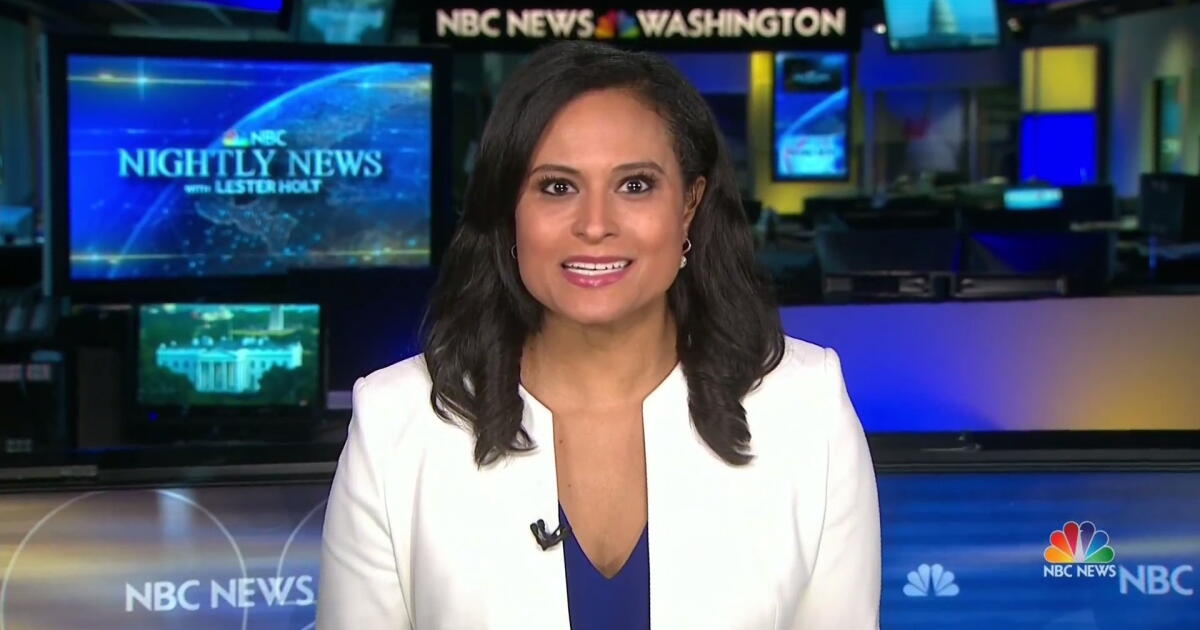
President Trump lashed out Sunday at NBC’s “Meet the Press” moderator Kristen Welker, calling on the Federal Communications Commission to punish her over comments she made about the president’s record in endorsing primary candidates.
“Kristen Welker, the Unpopular ‘Hostess’ of the once great Meet the Press, now considered Meet the Fake Press, just stated that Donald Trump has ‘mixed results’ on his Endorsements of Candidates, when the recent WINS of Darline Graham and Mike Mazzei, stand at 100% for the U.S. Senate, and 98% for the U.S. House, recently and over the longterm,” Trump wrote on Truth Social.
Trump actually endorsed Mazzei in the Oklahoma governor’s race, not a congressional seat.
“How can anyone be allowed to say this, working for freely given Public Airwaves?” Trump added. “Because of this purposeful inaccuracy, she will be reported to the FCC for rebuke or punishment.”
Welker was previewing Sunday’s edition of “Meet the Press” on NBC’s Washington station WRC when she made the remarks about Trump’s endorsements.
“He’s going to loom large over these midterms,” Welker said. “There’s no doubt about that. He, of course, has endorsed a slate of candidates in the primaries. He’s had some mixed results, but most recently, his pick of Senator Darline Graham, of course, the sister of the late Senator Lindsey Graham, was successful in her primary battle, so now she takes on Dr. Annie Andrews in South Carolina.”
In a statement, NBC News expressed its support for Welker. “Kristen is one of the best in the business and we stand by her,” a representative said in a statement.
FCC Chairman Brendan Carr has shown a willingness to use his agency’s levers to go after broadcast media outlets Trump deems unfriendly. In April, he called for an early review of the TV station licenses held by ABC, claiming the company’s diversity and inclusion policies are in violation of federal anti-discrimination laws.
ABC has filed a lawsuit against the FCC to block the review, saying it was motivated by Trump’s animus toward the late-night host Jimmy Kimmel.
Going after Welker for an anodyne analysis that did not match the president’s perception of his endorsement results would be a stretch, according to the FCC’s own guidelines.
“The FCC’s authority to take action on complaints about the accuracy or bias of news networks, stations, reporters or commentators in how they cover — or sometimes opt to not cover — events is narrow,” according to the FCC website. “The agency is prohibited by law from engaging in censorship or infringing on First Amendment rights of the press.”
Anna Gomez, the lone Democratic member of the FCC, said Trump’s comments are dangerous and also demonstrate a fundamental lack of understanding of the agency’s role.
“As I’ve said many times, the FCC has no authority to punish journalists this administration doesn’t like,” Gomez wrote on the social platform X. “These threats to press freedom are dangerous. They undermine the foundation of our democracy, and they have no place in it.”
Trump is clearly sensitive about critiques of his endorsement powers. On Friday, Bill Maher did a lengthy segment on his show “Real Time,” apologizing to the president for having said “almost none” of his endorsed candidates are winning their primaries. Maher noted that out of 260 candidates endorsed by Trump, only nine have lost. Maher noted that many of those candidates were heavy favorites to win but agreed that his statement was not accurate.
Maher also gave a strong indication that Trump had texted him to express his unhappiness over his comments.
But “Real Time” is on cable and streaming where the FCC has no say on programming content. The agency regulates broadcast channels that are delivered over the public airwaves.
WASHINGTON — A divided Supreme Court has cleared the way for President Trump to finish building his new White House ballroom with mostly private money and without approval from Congress.
By a 5-4 vote. the justices granted an emergency appeal from Trump and his lawyers on Monday and set aside a judge’s order that would stop the construction.
But Chief Justice John G. Roberts Jr. dissented, along with the court’s three liberals.
The outcome turned on standing.
The conservative majoritysaid the National Trust for Historic Preservation and its members were not personally injured by the White House ballroom project and therefore, did not have to standing to sue Trump or the National Park Service.
They also said Trump and his appointees had stressed the new ballroom was needed for national security and said the lower courts judges should not have interfered.
The decision in effect gives a green light to Trump’s go-it-alone approach which is in keeping with his history as a hotel builder. He believed the White House needed a grand ballroom that could seat hundreds of dignitaries. And he ordered the East Wing torn down in October to make room of his larger ballroom.
He also said most of the project would be paid for by $400 million in private donations.
But the Constitution gave Congress the power to manage property belonging to the United States. A 1912 law says new buildings “shall not erected…on public grounds within the District of Columbia without express authority of Congress.”
Trump chose to ignore the law and did not seek approval from Congress which is led by Republicans.
The National Trust for Historic Preservation sued in December, contending Trump was a “temporary tenant, not the owner” of the White House.
U.S. District Judge Richard Leon ruled Trump had no authority to build a new ballroom on the White House grounds without the approval of Congress, and he ordered a halt to the above-ground construction.
The D.C. Circuit Court affirmed his decision by a 2-1 vote. “Congress has not ceded unfettered authority to the Executive Branch to dramatically redesign, reshape, and reconstruct the White House—the People’s House—to fit a particular President’s desires,” wrote Judge Patricia Millett for the appeals court.
Trump’s lawyers sent a fast-track appeal to the Supreme Court on Aug. 14.
The court’s majority allowed Trump to fend off the legal challenge by concluding the historic preservationists could not show they were harmed by a huge new ballroom that may dwarf the historic Executive Mansion.
WASHINGTON — President Trump has frequently suggested he wants to seek a third term, posting about mounting another campaign, donning 2028 caps and discussing ways to make it happen — even as he’s acknowledged the Constitution prohibits it.
But lately, Trump has begun showing signs that even he doesn’t really believe another run will happen.
During recent speeches, the Republican president has begun describing life after the White House when his term ends in January 2029, predicting he’ll be at home and agonizing as his successor claims credit for his accomplishments.
“Your next president is going to say, ‘What a great job I did,’ ” Trump told an event on Long Island, N.Y., this month. “He’ll be sitting around, watching television. A real stiff. Unless you vote Republican, of course.”
A sitting president talking about becoming a former one is always politically fraught. But with midterm elections now just nine weeks away, Trump is approaching the point of his presidency where there will be more and more reminders that his power will soon wane.
Being willing to say he’s contemplating a White House without him marks a notable shift for Trump. Going back to his first term and from virtually the moment he won a second, he’s left the door open to staying put for more than eight years.
“He is all over the place,” said Brian Kalt, a Michigan State University constitutional law professor. “And what that does is, it allows him to point to his own words to support any number of mutually exclusive things.”
Trump can say, “ ’Oh, yeah, I made it clear that I wasn’t gonna run,’ ” Kalt said. “Or, if he decides that he will, he could say, ’Well, you know, I never said I wouldn’t.’ ”
Trump suggests his post-presidency may make him cry
The White House dismissed suggestions that Trump’s thoughts are increasingly turning to the clock running out on his presidency — and the legacy he’ll leave behind. Spokesperson Olivia Wales said he “is fighting every day” to deliver on promises to reduce violent crime, crack down on the U.S.-Mexico border and lower prescription drug prices.
“The only legacy President Trump is concerned with is making America greater than ever before,” Wales said.
Still, hinting at how he’ll be remembered is something Trump is suddenly talking about a lot.
During a recent Pennsylvania rally, he said, “Whoever the next president is, he’s going to be talking about what a brilliant president he is. And I’ll be home. And I’ll be saying, ’That son of a gun,’ because we did the job.”
A week later in Georgia, Trump was predicting that once his presidency was over, “I’ll be sitting home.”
“I may be crying,” the president added, arguing that Democrats could retake the Senate and scrap filibuster rules, making it easier to move their key legislation.
Then, in Michigan, Trump injected some doubt into whether he was ready to hand over the Oval Office and move back to Florida.
“In two and a half years, you may have a different president — may,” he said, emphasizing the “may.”
“I’ll be sitting home. I’ll be reading the papers. I’ll be watching television,” Trump said, before swiping at his predecessor, President Biden. “And I’ll be having some guy — like last time, a real idiot — stand up and say, ‘We are doing record business.’ ”
Mixed Trump signals are still most common
But even as he’s begun to suggest he’ll be leaving the presidency, Trump has also continued to tease a 2028 reelection run.
Addressing the rescheduled White House Correspondents’ Assn. dinner last month, Trump joked, “Just like my presidency, the second time is always better” and that “the third time will be better yet. I’m only kidding.” He later wore a 2028 campaign cap to finish the speech.
The Constitution’s 22nd Amendment says no one can be elected president more than twice. It was ratified in 1951, six years after President Franklin Delano Roosevelt died, months into his fourth term. Until Roosevelt, no other president had defied the tradition of stepping down after two terms that George Washington started.
Still, Trump had only been back in the White House for a couple of months when he told NBC News, “There are methods which you could” use to seek a third term.
He acknowledged that one method was to be the running mate to Vice President JD Vance in 2028 — then have Vance step aside if the pair won.
“There are others, too,” Trump said then, alluding to more options. He later told Time magazine, “There are some loopholes,” while also saying he didn’t believe in using them.
The president has since often used his social media posts to promote “Trump 2028” logos featuring his slogan “Make America Great Again.”
But Trump has also at times seemed definitive about the ban on him making another run, acknowledging recently to reporters: “I’d love to run, but the law is very strong.”
Kalt wrote about a two-term president possibly getting back to office by running for vice president in “constitutional Cliffhangers: A Legal Guide for Presidents and Their Enemies.”
“People do tend to find, in Trump’s words, whatever it is that they want to hear,” he said.
Trump may be fighting the ‘lame duck’ factor
Second-term presidents typically see their power and influence wane during their last two years, particularly if their party suffers big midterm defeats. But Trump’s comments could also be a sign he’s thinking about cementing his legacy, a stage that many of his predecessors also reached.
“They all, particularly as they cross the midpoint of their second term, start thinking about legacy,” said Paul Begala, a former adviser to President Clinton.
“They all banish the word. I know Clinton and Bush, they said, ’Can’t use the L-word.’ But they do,” Begala said, referring to his old boss Clinton and to President George W. Bush. “They all think about it. And the staff thinks about it and the Cabinet thinks about it.”
In his last two years of office, Clinton threw himself into trying to broker a Middle East peace agreement. Bush used the slogan “sprint to the finish” during his presidency’s final year in 2008, and Biden adopted a “run through the tape” ethos after abandoning his reelection bid.
Trump has leaned into molding the White House and Greater Washington in his own image, harkening back to his days as a real estate developer in 1970s and 1980s New York.
He’s ordered up a towering arch near the Lincoln Memorial and restored city fountains, while constructing a Rose Garden patio area and helipad on the White House lawn and adding scores of gilded touches to the building’s stately interior and exterior.
And then, there’s the massive ballroom that Trump has crews rushing to finish in the face of legal challenges — a project the president says will only be completed late in 2028, shortly before he leaves office.
“It’s not for me, ‘cause I’m going to be here a very short period of time” when the work is finished, Trump recently told reporters in the Oval Office. “I’ll be there for four, five, six months. This is for future presidents.”
WASHINGTON — House lawmakers return to Washington on Monday with a short to-do list after five weeks back in their home districts. The first order of business is likely a vote on a stopgap spending bill designed to keep the federal government fully funded through early December, removing the possibility of a shutdown before the midterm elections.
With election season getting underway, votes are also expected on measures designed to amplify the GOP’s messaging strategy going into November, most notably a resolution condemning socialism. Republicans are trying to tie the Democratic Party in general to the democratic socialist candidates who have succeeded this year in running for office.
Another item that could make its way onto the agenda is a Senate-passed bill that imposes sanctions on key segments of the Russian economy and allows President Donald Trump to impose steep tariffs on goods imported from countries that buy the vast majority of Russian oil and gas. The effort led by the late Sen. Lindsey Graham aims to deprive Russian President Vladimir Putin of revenue used to finance the war against Ukraine.
The bill passed 86-11 in the Senate. House passage would send the bill to Trump’s desk for his signature. However, some key House Democrats oppose the bill. The bill grants Trump sweeping new tariff authorities that some lawmakers fear could be used to punish allies rather than foes.
A vote on the bill is not scheduled this week, but proponents are working to have it taken up before lawmakers leave Washington to focus solely on their reelection campaigns.
The return to Washington also brings a renewed focus on improper behavior by lawmakers as the House will have its first chance to act on a recommendation from the House Ethics Committee to censure Rep. Chuck Edwards, R-N.C., for engaging in persistent unprofessional and inappropriate conduct toward two young female aides in his congressional office.
Edwards implores colleagues to reject censure vote
Edwards has disputed the committee’s conclusion that he failed to adhere to the spirit of the rules prohibiting sexual harassment and unwanted advances to House staffers. He points to the committee’s conclusion that found no evidence he “engaged in sexual activity or explicitly propositioned any individual under his employ.”
Edwards said he was not asking lawmakers to approve of every gift, compliment or social interaction, but to distinguish between conduct that someone might find unconventional and conduct that actually establishes sexual harassment.
“Individual acts that were not themselves prohibited were gathered together, assigned the most damaging possible interpretation, and then used collectively to support a conclusion far more serious than the underlying evidence,” Edwards wrote in a letter to colleagues first reported by NOTUS.
The committee said Edwards provided the two staffers with lavish and recurrent gifts, made comments regarding their dress and appearance, invited them to intimate dinners and vacations, sent notes regarding his effusive affection and invited them to other activities as a way to spend time together.
A vote to censure registers the House’s deep disapproval of a lawmaker’s conduct that does not meet the threshold for expulsion. Edwards dropped his reelection plans after the committee’s report came out.
Avoiding another shutdown
House Speaker Mike Johnson is expected to tee up the funding bill early in the week. The bill underwent some significant changes in the Senate, which made it more palatable for Democrats. It delays a proposed rule from the Office of Management and Budget that would give political appointees more power over the distribution of federal grants. It also includes language to ensure the administration can’t transfer funds to the Border Patrol.
But a provision that delays for one month a federal ban on intoxicating hemp THC products has prompted criticism from many GOP lawmakers. As a result, GOP leaders will likely place the bill on a fast-track process that avoids a separate procedural vote. Suspension bills require a two-thirds vote to pass, meaning a significant number from both parties need to support the measure for it to pass and advance to Trump’s desk.
Lawmakers are anxious to avoid the possibility of a shutdown as voters weigh their options going into November. The funding bill passed by a 90-6 vote in the Senate, showing that lawmakers from both political parties want to avoid a repeat of the two historic shutdowns that occurred this past year.
SACRAMENTO — California could have some zany theater this fall: county prosecutors charging federal postmasters with felonies for obeying President Trump’s order to withhold delivery of mail ballots to voters.
Does Trump then federalize the California National Guard to protect his postmasters from local sheriffs bent on hauling them off to the jailhouse?
Just wondering after reading legislation whipping through the state Capitol.
George Skelton and other analysts cover the insights, legislation, players and politics you need to know. In your inbox Monday and Thursday mornings.
By continuing, you agree to our Terms of Service, which include arbitration and a class action waiver. You agree that we and our third-party vendors may collect and use your information, including through cookies, pixels and similar technologies, for the purposes set forth in our Privacy Policy such as personalizing your experience and ads.
“Mail-in voting means mail-in cheating,” Trump asserted in March, while escalating his crusade against popular “absentee” voting. “Cheating on mail-in voting is legendary. It’s horrible what’s going on.”
It’s a big lie. There has never been any hard evidence produced by anyone, anywhere of significant mail-ballot cheating.
It’s also hypocritical because Trump routinely votes by mail himself in Florida elections.
Why is mail-voting OK for him but not for other Americans? “Because I’m president of the United States,” he told reporters. “I had a lot of different things” to do. As if the rest of us don’t. Voting apparently only needs to be convenient for him.
But Trump obsessively keeps trying to justify his false claim that Joe Biden’s 2020 election victory over him was rigged. It’s sick.
It may please his MAGA base, but Democrats and independents across America — especially in California — frown on Trump’s attack against their voting rights. They favor mail voting.
Overall, 58% of Americans support allowing ballots to be cast by mail, according to a recent survey by the Pew Research Center. But there’s a huge difference between the parties — 83% of Democrats and left-leaning independents favor mail voting while 68% of Republicans oppose it.
In California, 72% of all voters approve of balloting by mail, according to a recent poll by the UC Berkeley Institute of Governmental Studies. But there’s a big split ideologically: 93% of Democrats and 72% of independents approve, but 62% of Republicans disapprove.
Regardless of what GOP voters tell pollsters, they must be overwhelmingly voting by mail. That’s because 81% of all California ballots were cast by mail in the 2024 presidential election. In this year’s gubernatorial primary, it was up to 89%.
In March, Trump issued an executive order directing the Homeland Security Department to compile a list of eligible citizen voters in each state and commanding the U.S. Postal Service to handle only the ballots of people on the list.
Gosh? What could possibly go wrong with Trump’s Homeland Security agency — the overseer of divisive ICE — deciding who is entitled to vote in the pivotal midterm elections?
The nation’s Founders decreed in the Constitution that states could decide on “the times, places and manner” of federal elections — unless Congress wanted to alter the rules. Trump persuaded the House of Representatives to pass legislation restricting mail voting, but the bill died in the Senate, blocked by Democrats.
Trump’s executive order was an effort to bypass Congress and essentially enact a law by himself.
The Supreme Court decreed on a 6-3 vote last week that Trump could proceed with his planning. But since no precise regulations had yet been announced by the administration when the opposition lawsuit was filed, it was premature to rule on their constitutionality.
But now Trump’s draconian rules have been revealed. And California has joined other states in filing a new lawsuit.
“Donald Trump does not run elections. States do,” Gov. Gavin Newsom declared. “California will continue to lead the way in defending democracy.”
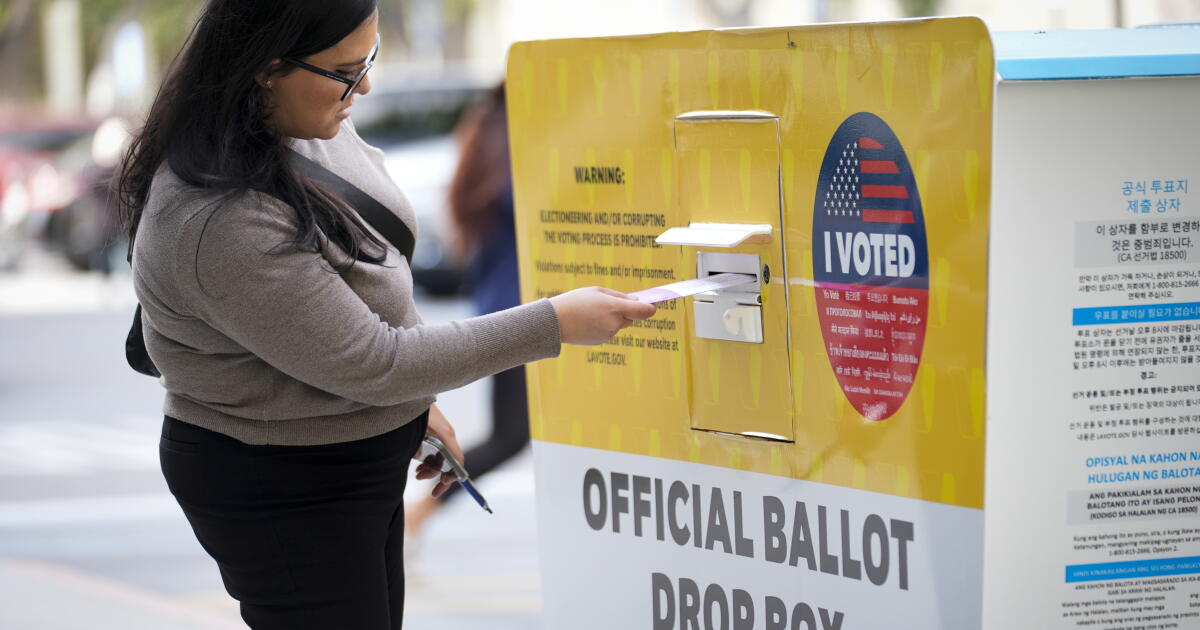
In the Legislature, a bill was introduced to make it a felony punishable by up to four years in prison for a person in authority to order the withholding of a ballot’s delivery to a voter or its return to a local election official.
A person like a postmaster? Who else could order mail carriers not to deliver ballots to some registered voters?
“That’s for law enforcement to decide,” says the bill’s author, Sen. Aisha Wahab (D-Hayward), who was just elected to finish the current term of resigned U.S. Rep. Eric Swalwell.
“My bill is trying to protect all voters. They may be on vacation, they may be ill. They may want to vote early or late. Whatever. They remain entitled to vote by mail.”
Her bill breezed through three Assembly committees in 24 hours — Democrats voting yes and Republicans no.
The measure is unlikely, however, to ever result in a postmaster being jailed for obeying the president.
For starters, it’s hard to envision the president’s executive order ever being ruled constitutional — even by this lackey court.
“Trump is trying to exercise control over elections when he has absolutely no authority to do so,” UC Berkeley Law School Dean Erwin Chemerinsky wrote in a Times opinion piece last week.
If the Supreme Court shockingly did rule that Trump has the authority, then could his postmasters be arrested under the new state law? Under the Constitution’s Supremacy Clause, the answer would seem to be “no.” Federal law generally supersedes conflicting state law.
“An executive order cannot supersede state law,” says UCLA law professor Rick Hasen, who specializes in election law. “But there are all kinds of immunity doctrines and other reasons why a state would have a hard time prosecuting a federal official for violating state law in the conduct of official duties.”
The real answer is for Trump to stop trying to concoct a solution to an election problem that only exists in his warped imagination.
WASHINGTON — In firing up a trade war with Canada, President Trump turned to a 96-year-old statute so obscure that many trade lawyers didn’t even know it was still on the books.
Trump invoked Section 338 of the Tariff Act of 1930 on Aug. 24 to slap a 50% tax on $20 billion worth of Canadian imports. The move prompted dollar-for-dollar retaliation from Ottawa and strained already-tense relations between the neighbors and longtime allies.
The president’s Section 338 tariff authority has never been used, let alone tested in court. “This law is literally a blank canvas because it’s never been litigated,’’ said Ryan Majerus, a partner at law firm King & Spalding and a former U.S. trade official.
So it’s unclear whether Trump’s latest Canada tariffs could survive a legal challenge, and some lawyers argue that the Depression-era law has been rendered obsolete by more recent trade laws.
Trump raises Section 338 from the dead
To sanction Canada allegedly for discriminating against U.S. dairy, auto and alcoholic beverage exports this summer, the Trump administration reached back to the Great Depression.
The 1930 tariff legislation is known as the Smoot-Hawley Tariff Act after its congressional sponsors. With the U.S. and world economies in collapse, Congress raised tariffs on hundreds of imports in an attempt to protect American farmers and manufacturers.
The tariffs are notorious among economists and historians for shutting down world commerce and making the Great Depression worse. (Trump, who proudly calls himself “Tariff Man,” has a different view, arguing that the Smoot-Hawley levies simply came too late to rescue the American economy.)
In addition to raising tariffs themselves, lawmakers in 1930 gave the president new power to impose them himself: Section 338 authorizes presidential tariffs of up to 50% on imports from countries that have discriminated against U.S. businesses.
Before Trump, no president had actually used the statute.
“Until Trump’s second term, few trade lawyers were aware that Section 338 remained on the books or understood what it did,” legal scholars Peter Harrell and Jennifer Hillman of Georgetown University wrote this month in the libertarian magazine Reason.
Harrell and Hillman cite State Department records to show that the U.S. considered using Section 338 in trade disputes — against Spain in 1932 and against newly communist China in 1949 — but never did. After the Depression, U.S. policy focused more on using negotiations — rather than sanctions — to open foreign markets.
So Section 338 sat moldering in the law books.
Other laws take hold
As the years went by, the United States passed new trade laws. Some of them ceded to the president tariff power, which the Constitution originally granted to Congress. But the new laws also limited the president’s authority to certain circumstances — including dealing with national security threats and foreign currency crises — and required the government to carry out investigations and meet other procedural requirements beforehand.
“There is a very strong argument that [Section 338] was superseded,” said Sara Albrecht, chief executive of the Liberty Justice Center, a libertarian advocacy group that represented businesses that successfully challenged the earlier Trump tariffs with the Supreme Court.
If Congress wanted the president to retain Section 338 power, Albrecht asks, why did lawmakers pass the Trade Expansion Act of 1962, which allowed for national security tariffs? And the Trade Act of 1974, which gives the president power to go after other countries’ unfair trade practices?
Battling over Canada’s dairy market
Legal experts see other weaknesses in the Section 338 tariffs.
Harrell and Hillman, for instance, write in Reason that Section 338 authorizes only tariffs that “offset” the harm that a foreign country’s trade practices do to American companies. But in targeting Canada, they note, the Trump administration made no attempt to calculate the dollar amount of damage arising from discrimination against U.S. farmers, automakers and marketers of alcoholic beverages. And the U.S. went after Canadian imports unconnected to those trouble spots, including hockey sticks and cement.
Harrell and Hillman also say that Canada’s protection of its dairy market does not single out U.S. farmers for discrimination; the rules apply to many other Canadian trading partners as well.
Moreover, the United States agreed to the Canadian system — in which Canada imposes stiff tariffs on dairy imports that exceed a quota — in a North America trade pact Trump himself negotiated with Canada and Mexico in his first term. Harrell and Hillman write that it is “incongruous, to say the least, for the United States to denounce as discriminatory the very terms it agreed to.”
But John Veroneau, former general counsel for the U.S. Trade Representative, said the Section 338 tariffs are straightforward: They are justified when another country discriminates against U.S. imports by taxing them more than it taxes imports from other countries.
And in a “perverse irony,” Veroneau said, Canada did just that when it responded to tariffs Trump imposed on Canadian products last year with its own retaliatory tariffs on U.S. imports. “Courts will rightly feel obliged in the face of any challenge [to decide]: Are the statutory requirements met or are they not met, however ludicrous the broader context might be,” said Veroneau, adjunct professor at the University of Maine School of Law.
Plaintiffs are so far hard to find
Trump’s other tools to impose his protectionist agenda already have floundered in court. The Supreme Court in February threw out his boldest gambit: invoking a 1977 national security law to hit almost every country on Earth last year with double-digit tariffs.
When Trump tried to replace the revenue lost to the Supreme Court defeat with a new set of tariffs, a specialized trade court in New York rejected those too — though the government was allowed to continue collecting the import taxes while the case works its way through the court system.
No one has filed a lawsuit challenging the Section 338 tariffs. The Liberty Justice Center has been looking for businesses willing to sue the government over the levies.
“I haven’t had a lot of response from plaintiffs,” Albrecht said. “Anytime you want to sue the government, it’s a hard proposition.” The Section 338 tariffs on Canada are also far smaller — just 5% of Canadian imports — than Trump’s 2025 worldwide tariffs, meaning that fewer companies have to pay them and can claim to have been injured by them.
There’s also a chance, Albrecht said, that the two countries will resume the talks they broke off Aug. 21 and reach a compromise to end a standoff neither country wants. “I’m hopeful that somebody blinks, that they come to some agreement and it all goes away,” she said.
SACRAMENTO — California lawmakers on Sunday approved bills aimed at preventing interference in this fall’s midterm elections and requiring more transparency from social media influencers who are paid by political campaigns.
They join a growing pile of bills on Gov. Gavin Newsom’s desk as the legislature nears the end of its two-year session, which adjourns early this week.
Social media influencers took on a more visible role in California’s 2026 gubernatorial primary. Candidates including Democratic billionaire Tom Steyer paid thousands of dollars to influencers who posted videos endorsing Steyer or talking about him in a positive light. These videos did not always disclose that influencers were paid by a candidate’s campaign.
Assemblymember Marc Berman (D-Menlo Park) said his bill would ensure “that voters are not misled by paid content” by requiring a disclosure on paid posts and videos. Campaigns will also be required to report funds spent on social media posts.
If Newsom signs the law, it could result in fines for influencers and campaigns that fail to disclose such payments.
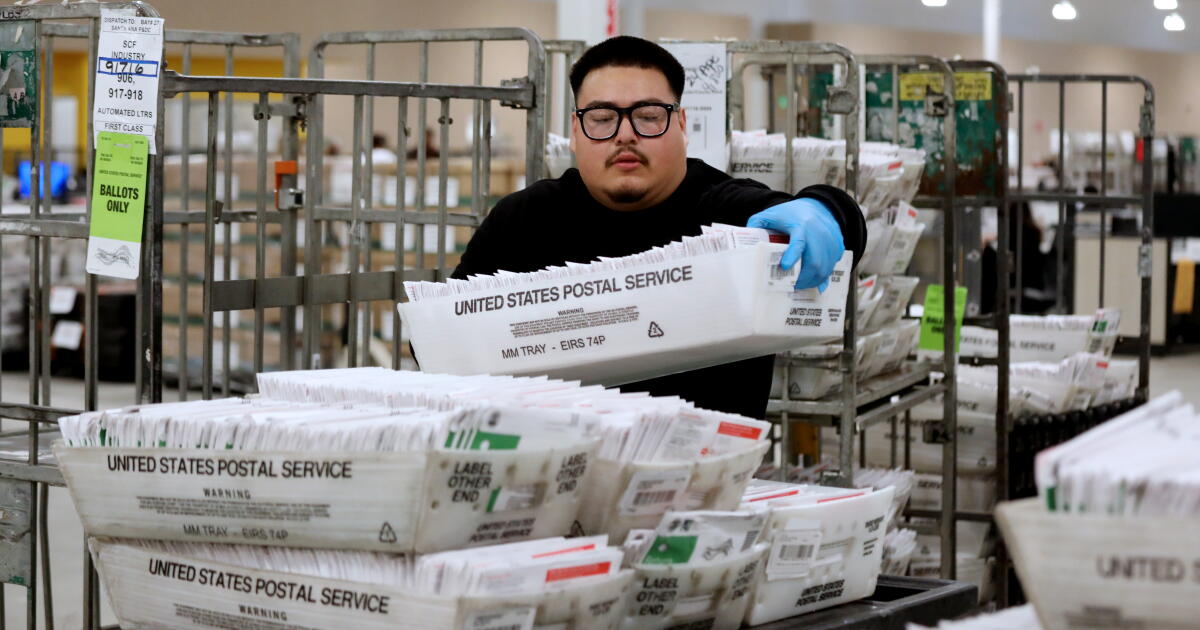
Two other bills sent to Newsom on Sunday would make it a felony to interfere with mail ballots or to seize ballots and other election materials before an election is certified. They come amid concern from Democratic lawmakers that President Trump or his supporters will seek to interfere with the casting and counting of ballots in the Nov. 3 election.
Riverside County Sheriff Chad Bianco drew outrage and legal challenges when he ordered his deputies to take more than 650,000 ballots from the county elections office over unproven claims of fraud. The case was argued before the California Supreme Court last week.
Newsom earlier this year signed a bill preventing local and federal law enforcement agencies from taking ballots without a warrant.
Legislation by Assemblymember Gail Pellerin (D-Santa Cruz) goes even further by making it a felony to take or order the seizure of ballots, election records or voting machines. Such actions would be punishable by up to four years in prison.
“The federal administration and those seeking to spread lies about our democracy continue to call for interference in elections in ways we have never seen before in this country,” Pellerin said Sunday. “AB 282 helps ensure that every lawfully cast vote can be counted, and that the will of the voters of every political party will be respected.”
Republican lawmakers argued in previous hearings that the bill is unnecessary because it is already a crime to steal ballots.
Another bill, SB 259, makes it a crime to interfere with a mail ballot on the way to or from a voter or order the seizure of ballots that are in transit to a local elections office.
SACRAMENTO — The California state Legislature voted Sunday to amend a 2019 law that extended the statute of limitations for childhood sexual abuse claims but was blamed for draining the coffers of municipalities and school districts.
Since the law was enacted, L.A. County has agreed to pay more than $5 billion to settle more than 12,000 claims stemming from alleged sexual abuse committed by government employees in foster homes and juvenile halls.
The bill passed by the Legislature on Sunday requires victims older than 40 to provide evidence that the public entity was aware of the misconduct that resulted in the assault and failed to take reasonable steps to avoid it.
It also states that attorneys who file fraudulent sex abuse lawsuits can be fined $25,000 per violation. The Times reported last year on nine plaintiffs who said they were paid to sue the county over sex abuse, some of whom said they were told to fabricate their claims.
Consumer attorneys, counties and victims rights groups jostled over the elements of the proposed bill over the last few months.
Lawmakers stopped short of capping payouts in the bill, a change sought by some local governments and school districts.
The legislation follows multiple attempts to change the law in recent years. Sen. Benjamin Allen (D-Santa Monica) tried last year to increase the burden of proof for sex abuse cases, but pulled the bill after outrage from victims rights groups.
Some of the groups blasted the bill on Sunday night, arguing it would shield rapists and deny justice to survivors.
Speaking on the floor of the state Senate, Laird said that he tried to balance the needs of all parties.
The bill now goes to Gov. Gavin Newsom for his consideration.
WASHINGTON — A former White House teleprompter operator accused of using inside knowledge to make bets on the prediction market Kalshi has been ordered to turn over more than $100,000 in profits and pay a $65,000 fine as part of a settlement with federal authorities.
The settlement with the Commodity Futures Trading Commission, announced Friday, also dealt Gabriel Perez a three-year trading ban. Perez was placed on unpaid leave from his job at the White House after reports emerged that he used his position to make bets on what President Trump would say in speeches.
The White House did not immediately comment on the settlement. A White House official said in July that Perez was no longer in his position but did not say if he had been fired or resigned.
The commission found that Perez made $107,500 on prediction markets by betting on words and phrases that would appear in Trump’s speeches between December 2025 and February 2026.
“In his position, Perez had access to presidential speeches prior to those speeches being delivered and Perez misappropriated that information — in breach of his duty of trust and confidence,” according to a release from the commission.
Perez was ordered to repay his profits in full, along with the $65,000 civil penalty, which the commission said was a reduction because of his “exemplary cooperation.”
As details emerged July 16, then White House press secretary Karoline Leavitt said it was “unfortunate” and “a disgrace.”
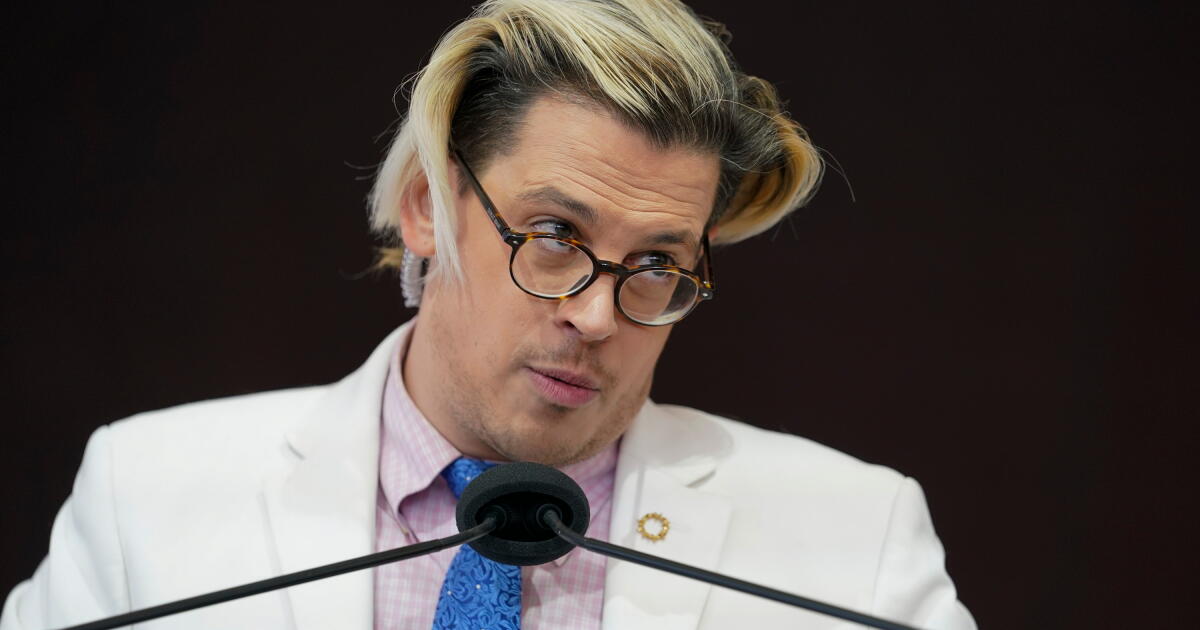
British far-right commentator Milo Yiannopoulos has been deported to the United Kingdom after his arrest by American immigration authorities.
The Department of Homeland Security said Saturday that Yiannopoulos was returned to his home country Friday after being accused of overstaying after entering the U.S. legally in May 2019. An immigration judge issued a final order of removal July 22 after he failed to show up for an immigration hearing, a Homeland Security spokesperson said.
Yiannopoulos was arrested Thursday at Louis Armstrong New Orleans International Airport in Louisiana and detained by Immigration and Customs Enforcement.
“He chose to overstay his welcome in violation of our nation’s laws,” a Homeland Security spokesperson said in a statement.
Yiannopoulos and his representatives did not respond to requests for comment, and he has not posted on the social platform X since Thursday.
Yiannopoulos is a well-known champion of conservative causes and has frequently taken provocative public positions criticizing feminism, Islam and immigrants. He has been especially supportive of President Trump’s aggressive immigration enforcement policy, aimed at people in the country illegally.
“Zero immigration for the next 20 years. No ifs, no buts,” Yiannopoulos said on X last year.
Yiannopoulos’ arrest and deportation come amid a nationwide uptick in detentions as part of Trump’s immigration crackdown.
In social media posts, the Department of Homeland Security touted Yiannopoulos’ arrest and posted a booking photo of him. It added that it encourages people in the country illegally to leave voluntarily, saying the U.S. offers “$3,000 and a free flight to self-deport.”
“We encourage every person here illegally to take advantage of this offer and reserve the chance to come back to the U.S. the right legal way to live the American dream. If not, you will be arrested and deported without a chance to return,” the department said.
WASHINGTON — Natalie Harp has never been in the spotlight quite like this.
Before the 35-year-old White House aide made headlines for her close access to President Trump, much of her early life was spent in Southern California, where she was home-schooled and attended a mega-church on Sundays — a quiet upbringing that, her brother says, was defined by conservative values and Christian teachings.
Their mother taught them at home using educational materials written from a biblical worldview. The family would attend services regularly at Shadow Mountain Church in El Cajon, where pastors would deliver sermons like the one from a recent Sunday, calling on God to use its thousands of congregants “in a way that turns this world upside down.”
“We were raised with the idea that America was God’s gift to the world and it’s the only place that people really live in freedom,” Preston Harp, her brother, told The Times.
Years later, in 2019, Harp’s ascent into Trump’s orbit began, when she went on Fox News to credit a healthcare bill Trump signed into law with saving her from a rare form of cancer — a story that later caught the president’s attention.
As that relationship took hold, the California family bubble she’d been raised in was bursting behind the scenes, culminating with her father’s suicide in July 2020. A month later, Harp emerged on the national stage, introducing herself as a “formerly forgotten American from California” at the Republican National Convention, where she declared her devotion to Trump.
“I wouldn’t be alive if it wasn’t for you,” she said.
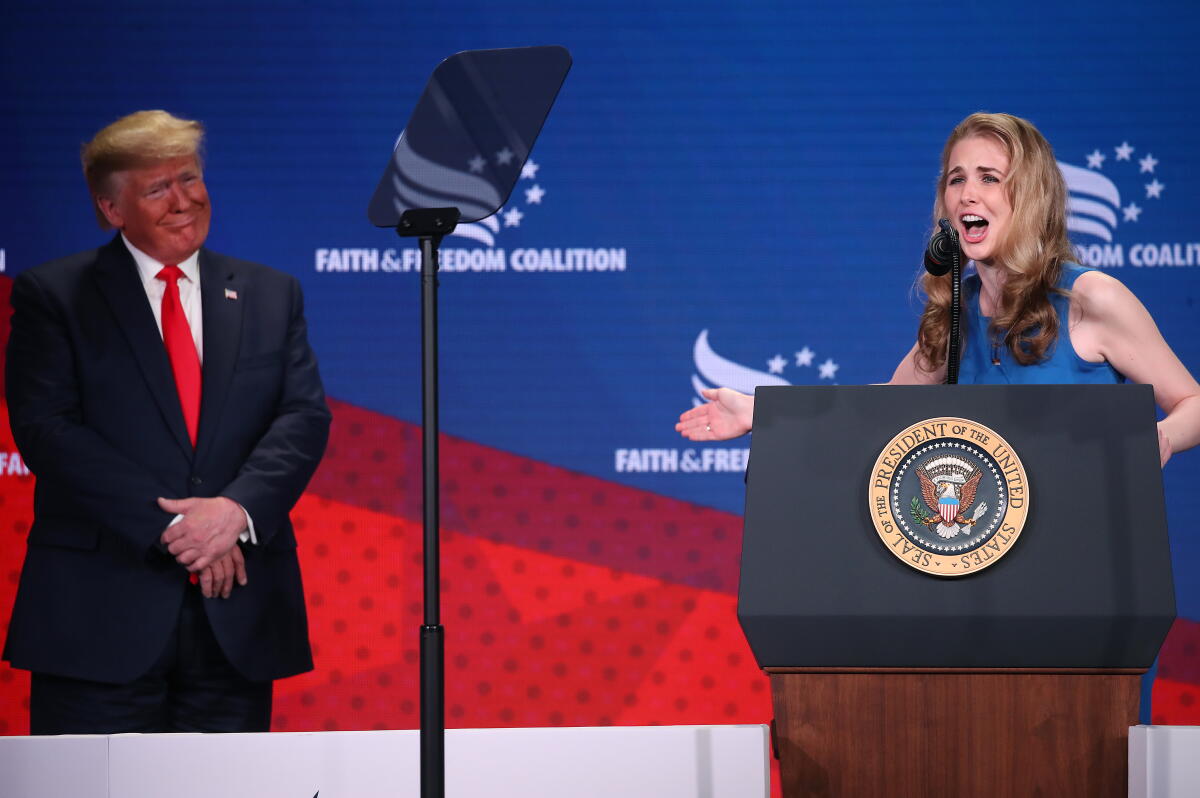
Natalie Harp speaks after being called onstage by President Trump during the Faith & Freedom Coalition 2019 Road To Majority Policy Conference in Washington on June 26, 2019.
(Mark Wilson / Getty Images)
Now, she spends her days working as a special assistant to Trump, a man she has described, in highly personal letters, as her “guardian and protector.” In those letters, published by the Daily Beast, she has thanked the president for “always being there” for her and alluded to a “promise” Trump made to her after she lost her dad.
Harp’s taxpayer-funded job, with its unmatched access to the president, mostly happens away from the public eye. She has been called the “human printer” because she follows Trump with a portable printer to provide Trump with hard copies of flattering news coverage or information the computer-averse president requires.
She also stays up late drafting social media posts with the president, the New York Times reported. Several of Trump’s Truth Social posts have generated controversy in recent months, including an AI-generated image showing him as Jesus in a white robe laying his hands on a sick man.
Those who know her describe her as detail-oriented and a “devoted staffer to the cause” whose tight-knit circle includes those closest to Trump, such as Susie Wiles, Trump’s chief of staff, and Karoline Leavitt, the White House’s former press secretary.
“Just like many of the administration officials, you become friends with your co-workers,” Rep. Anna Paulina Luna, a Florida Republican who talks to Harp on a weekly basis, said in an interview.
Harp is “almost always” with Wiles, Luna said. The congresswoman added that her relationship with the president is “100% professional,” and that any suggestion otherwise is an attempt to smear her.
“She’s been nothing but professional and an absolute killer when it comes to getting her job done,” Luna said. “I would kill to have someone like her on my team.”
To her brother, Harp’s integration in Trump’s inner circle is in line with her upbringing.
“My mom raised us as super conservative, and he’s everything that she taught us to respect,” he said.
The White House declined to comment.
A California native in Trump world
As a kid in the San Diego neighborhood of Carmel Valley, Harp played with old-fashioned dolls and spent a lot of time reading, her brother said. For school, their mother used a curriculum from Bob Jones University Press, whose material focused on “biblical worldview shaping,” according to its website.
The home in which Natalie Harp, an aide to President Trump, grew up in the Carmel Valley neighborhood of San Diego.
(Sandy Huffaker / For The Times)
“We start with God’s truth as the standard,” the website states. “Scripture serves as the blueprint for how we put together our textbooks so that every lesson begins with truth.”
Growing up, Harp spent most of her time with adults, especially her mother, and would rarely socialize with her peers, her brother recalled. Even at church, she would opt to sit with the adults instead of spending time with the youth group.
“There would be like skateboarding demos, there would be cool stuff going on, but my sister was just with all the grown-ups, and she preferred it,” he said.
Harp and her brother were close as young children but drifted apart as they got older. Preston Harp found an outlet skateboarding and surfing with friends, and Harp opted to stay close to home, he said.
At some point, their mother began policing their discussions, particularly as he started espousing more progressive beliefs, her brother recalled.
“I wasn’t really allowed to be in her life,” he said. “If we ever talked on the phone my mom was listening to everything we’d say, and they were talking on the phone together with me on speakerphone.”
Harp declined to comment for this story through a request sent to the White House. Her mother did not respond to a phone call seeking comment.
An aerial view of Natalie Harp’s family’s home in the private gated community of Woodbridge Cove, in Irvine.
(Allen J. Schaben / Los Angeles Times)
In her mid-20s, Harp moved with her parents to Irvine to be closer to their father’s work at Biola University, a private Christian institution in La Mirada, southeast of Los Angeles. He worked as a professor at the school of business and later served as the executive director of the Office of Innovation, according to the university.
The family lived in a home adjacent to a man-made lake in Irvine’s Woodbridge neighborhood, a master-planned community known for its peaceful, family-friendly atmosphere.
Both Irvine and Carmel Valley are silos from the problems of the outside world, places where everything might seem perfect, even when it isn’t, her brother said.
“My mom likes living in bubbles,” he said.
Within a few years of the family’s move, in July 2020, Harp’s father, 61, died by suicide at their home. When Preston Harp arrived at the house, he said his mother wanted him to go along with the story that their father had died in his sleep. Preston refused, he said, not wanting to downplay his dad’s pain to keep up appearances. It was the start of a massive rift in the family.
“That was the last time I ever talked to my sister,” he said.
Entering the national stage
Harp has shared little about her upbringing publicly. However, she has spoken at length about medical issues she experienced starting in her mid-20s.
In 2020, she said during remarks at the Republican National Convention that five years earlier she was “the victim of a notoriously deadly medical error.”
“I survived, but only to be diagnosed with a rare and terminal bone cancer,” she said.
She said she was diagnosed with Stage 2 bone cancer. It was that experience that sparked her interest in entering the political arena.
“I just wanted to get better,” she said on the program. “I started tuning in for the first time into politics because I had never had a representative before. All my representatives were Democrats, so I thought, why should I care about politics?”
Two rounds of chemotherapy did not help and she was rejected from clinical trials, she said. But in 2018 Trump signed the Right to Try Act, which allows terminally ill patients to access certain experimental drugs and immunotherapy treatments that have not received full approval from the Food and Drug Administration.
“I am not dying from cancer anymore thanks to President Trump, I am living with cancer,” Harp said on the program.
The White House did not respond to a request seeking comment on the treatment she received.
Natalie Harp follows former President Trump as he boards his airplane after speaking at an event in Manchester, N.H., on April 27, 2023.
(Jabin Botsford / The Washington Post via Getty Images)
During Trump’s 2020 reelection campaign, Harp’s role was to talk about the Right to Try Act, said Sarah Matthews, a former deputy press secretary for Trump.
“I remember we would correspond over Twitter DMs, and she just seemed very excited to be helpful in any way,” Matthews said. At the time, it seemed Harp was trying to make inroads with staffers, she said.
“My role would not necessarily interact with her, but … I could tell that she was trying to initiate a connection,” she said.
All of you will go off and make money. She’ll never leave me
— President Trump, on aide Natalie Harp
Although it’s not clear who on the team found Harp, Matthews said she was “very eager” to help the campaign.
“They found this woman who was eloquent and well-spoken and all the things, but it did just come off to me like she really wanted to be part of Trump world,” Matthews said.
In intimate letters, Harp has explained her devotion to the 80-year-old president.
Natalie Harp listens as former President Trump speaks outside the courtroom during his trial on charges of covering up hush money payments, on April 30, 2024 in New York City.
(Curtis Means / Pool Photo)
In one letter, she writes that she is “unworthy” of Trump and reminisces about the times Trump called during her “Talkshow days,” a reference to her stint in 2021 hosting “The Real Story with Natalie Harp” on the right-wing One America News channel.
“We’d talk about everything and nothing,” she writes. “I want to get back to that synergy. We shouldn’t have to talk about work all the time!!”
She adds: “I always felt like an in-betweener, somewhere between Staff and those you enjoy talking to on the Plane or at Dinner, because that’s who I used to be to you when I was a ‘Talkshow Host’ (as much as I hated that actual job!)”
Ossoff’s ‘Natalie’ reference brings attention
The public attention on Harp sharpened this month when Jon Ossoff, a Democratic senator from Georgia, told supporters in Atlanta that Trump wanted to “build his ballroom and travel with Natalie” rather than do the work of the presidency. The remarks came after it became public that Harp had been one of a select few who joined Trump on an alternate plane flying out of Turkey as a precaution amid a threat of attack by Iran.
President Trump and Natalie Harp, right, attend a dignified transfer for service members killed during operations in the Middle East, at Dover Air Force Base in Dover, Del., on July 22.
(Lau Loeb / AFP via Getty Images)
Ossoff’s comment drew the ire of Trump allies, from Capitol Hill lawmakers to conservative influencers, with many of them blasting the comment as sexist and inappropriate.
Although the White House and Trump allies have fiercely defended Harp in public forums, and dismissed suggestions of an improper relationship, Trump has sidestepped questions about his aide.
“People can be very mean to successful, pretty women,” Luna said. “And that is what is happening to Natalie.”
In their book “Regime Change,” New York Times reporters Maggie Haberman and Jonathan Swan write that Trump has told staff that Harp is the only one who loves him as much as his wife and kids.
“All of you will go off and make money,” Trump would say. “She’ll never leave me.”
Although Trump worked closely with other executive assistants during his first administration, Matthews said his relationship with Harp appears to be “a different level of closeness.”
President Trump,right, accompanied by Tiffany Trump’s husband, Michael Boulos, left, and aide Natalie Harp, center, looks out the window of Marine One as it lands on the South Lawn of the White House on Sept. 18, 2025.
(Andrew Harnik / Getty Images)
“I think it’s because of the way she fawns all over him and the love notes,” she said. “I think he just really trusts her. So she’s been able to, I think, develop an even closer bond.”
Despite the recent controversy, Harp remained by the president’s side during public appearances last week.
At the Freedom 250 Grand Prix in Washington on Aug. 23, Harp sat a few rows behind Trump and First Lady Melania Trump, chatting with the president’s son Eric. Days before that, she reportedly traveled with Trump to South Carolina for a campaign rally and to his northern Virginia golf club.
“She’s just all work,” Luna said. “She is one of the hardest workers and it is hard to find people who are like that.”
Natalie Harp looks on as President Trump visits the Mission Control Center at NASA Lyndon B. Johnson Space Center in Houston on Friday.
(Kent Nishimura / AFP via Getty Images)
Ceballos reported from Washington, Fry from Irvine.
If you or someone you know is struggling with suicidal thoughts, seek help from a professional or call 988. The nationwide three-digit mental health crisis hotline will connect callers with trained mental health counselors. Or text “HOME” to 741741 in the U.S. and Canada to reach the Crisis Text Line.
They need only flip three seats and, going back well over half a century, the average midterm gain for a party out of the White House is more than two dozen. Even with the advantage the GOP engineered through aggressive gerrymandering, the deadweight of a deeply unpopular president threatens to drag down a number of Republicans in competitive and some otherwise-not-so-competitive races.
There are 35 contests on the ballot in November. Of those, nearly two dozen are effectively over before they’ve even started, given the advantage one party holds over the other. Of the remainder, most are being held in states Trump won in 2024, which makes them, broadly speaking, much friendlier terrain for Republicans.
Democrats need to flip four Senate seats and until fairly recently that inhospitable political map made it seem like an all-but insurmountable challenge.
“Republicans still retain a structural advantage given the partisan challenges of the map, and Democrats still need almost every key race to break their way,” Jessica Taylor, who tracks Senate races for the Cook Report, wrote in a recent analysis. But, she went on, “in a wave election akin to 2006” — when Democrats gained six Senate seats — “even states that President Donald Trump won by double digits could move within Democrats’ reach.”
Not so fast. A toss-up means it’s just as likely Republicans will retain their Senate majority.
Understood. So break it down.
Let’s start with those things Democrats have going for them, with the usual caveats …
… There are no certainties but death and taxes. Got it. Go on.
At one time, Georgia looked to be a toss-up as Democrat Jon Ossoff sought reelection in one of those battleground states Trump carried. But Ossoff has raised a boatload of money and drawn a less-than-world-beating opponent in Republican Rep. Mike Collins. Lately, the buzz around Ossoff has been focused more on a potential 2028 run for president than his November reelection.
Meantime, in North Carolina, where former Democratic Gov. Roy Cooper is running against former national GOP Chairman Michael Whatley, a Cooper victory seems much more likely than not. A win there would give Democrats one of the four seats they need to flip.
Then there’s a handful of red-state seats that Republicans are fighting to hang on to, in Alaska, Iowa, Ohio and Texas.
Do tell.
In Alaska, former Rep. Mary Portola managed to win nearly 50% of the vote in the Aug. 18 primary, which is noteworthy given she ran on the same ballot as the GOP incumbent, Dan Sullivan, who finished second. (Another Dan Sullivan also appeared on the ballot; under Alaska’s top-four system both Sullivans will advance to a November runoff, along with Portola. The fourth slot is pending.
In Ohio, former Sen. Sherrod Brown, who was elected three times before losing his 2024 reelection bid amid a Trump landslide, faces Republican Jon Husted, who was appointed to fill the seat vacated when JD Vance became vice president. Husted has proved a less-than sure-footed candidate while Brown is waging a strong comeback campaign.
Supporters applaud as Democratic Ohio Senate candidate Sherrod Brown speaks at a campaign event in Akron
(Sue Ogrocki / Associated Press)
In Iowa, Rep. Ashley Hinson (a USC grad and former KABC-TV intern!) is running against state Rep. Josh Turek in a state that’s been hammered by Trump’s tariffs and the surging price of gas — especially the diesel fuel that sustains Iowa’s all-important agricultural economy. Turek could also benefit from the strong campaign being waged by gubernatorial front-runner Rob Sand, who tops the Democratic ticket.
Democrats haven’t won a statewide contest in Texas since 1994, despite no end of hype and hope. This time, they’re pinning their dreams on state Rep. James Talarico, a seminarian and viral sensation. But what’s made the race highly competitive is the singularly defective GOP nominee, Ken Paxton, whose splotchy resume includes indictment, impeachment and alleged adultery. On top of all that, he’s been a pretty lousy fundraiser and has yet to bind the wounds left by a savage GOP primary.
So everything is coming up Democratic roses?
Not necessarily.
Two states they’re counting on to flip the Senate, Maine and Michigan, have grown problematic.
Maine once looked to be Democrats’ best pickup opportunity. Incumbent Susan Collins is the lone Republican running in a state Kamala Harris carried in 2024. Then came Graham Platner, along with his inflammatory social media postings, Nazi tattoo and allegations of sexual assault. He stepped aside in July and was replaced by Troy Jackson, a former logger and state Senate president, who has considerable ground to make up after his late start.
Collins, who’s been reelected four times, has a history of winning tough races. The Platner debacle certainly hasn’t helped Jackson or Democrats.
Meanwhile, in Michigan, the progressive Abdul El-Sayed inched past a more centrist alternative to win the Democratic nomination. The question is whether he’s too far left (and, frankly, whether there’s too much anti-Muslim sentiment) for El-Sayed to prevail in that purple state. The Republican nominee, former Rep. Mike Rogers, ran two years ago and lost by less than half a percentage point.
Good to know. A lot can happen in the next 65 days.
Exactly.
Which is why we stick to columnizing. If you want predictions, ask a mystic or consult your Magic 8 Ball.
Reporting from ORANGE CITY, Iowa — They met decades ago, when they were first married, and the three sisters-in-law still gather each week at the Dutch Bakery to catch up amid the sweet smell of flour and sugar floating through the air.
Despite the cozy setting here on the state’s western edge, they can feel the country beneath their feet slipping away, eroding under the threats of immorality and terrorism.
“I never thought we would live in so much fear,” said Joanne Niezen, as her coffee sat cooling before her in a Styrofoam cup.
There’s fear on the other side of the state as well, though for different reasons.
In the college town of Iowa City, with its hip music scene and pita restaurant advertising “fresh thinking and healthy eating,” Veronica Tessler worries about the harsh rhetoric directed at immigrants and the economic inequality that lingers years after the Great Recession.
“I really fear for our country,” said Tessler, who left her job at a foreign policy foundation to open a frozen yogurt shop near the University of Iowa campus.
A sense of dread is about the only thing that unites Orange City, a bastion of religious conservatism, and Iowa City, known for its blue-sky liberalism. Together they bookend not only the state’s geography but its political spectrum as Iowa prepares to kick off the presidential selection process Monday night with its closely watched caucuses.
The two communities, located in the most lopsidedly partisan counties in the state, reflect the vast political chasm here and across the country, a divide that President Obama was unable to heal and which may prove insurmountable for whomever takes his place.
“Republicans see an America where the government is too big at home and too feeble abroad. Democrats see an America where the economy is out of whack,” said David Nagle, a Democratic attorney who used to represent Iowa City and surrounding Johnson County in Congress. “It’s like two trains in the night, passing in opposite directions.”
Republicans see an America where the government is too big at home and too feeble abroad. Democrats see an America where the economy is out of whack.
— David Nagle, a Democratic attorney who used to represent the Iowa City area in Congress
But the division goes far beyond a profound disagreement on issues. While partisan tensions are nothing new, they have deepened and intensified during the presidencies of George W. Bush and Barack Obama as the parties have splintered along the lines of age, race and culture. The result is a separation of America into mutually estranged and suspicious tribes.
Today, as conversations at opposite poles of Iowa show, voters on each side often get their news from different sources, worry about different problems and view political adversaries with mistrust and even contempt. One voter’s vision for America is nothing less than another’s nightmare; it’s common to hear candidates of the opposing party described as “concerning” or “scary” or “crazy.”
In 2014, a major study released by the nonpartisan Pew Research Center found that more than one-third of Republicans and just over a quarter of Democrats — especially those most engaged in politics — go as far seeing the other party as a “threat to the nation’s well-being.”
In Johnson County, known both affectionately and derisively as the “People’s Republic,” life in Iowa City revolves around the university, with young people constantly hustling between classes or hunkered down in coffee shops with headphones and homework.
Obama is largely viewed with gratitude or, at worst, disappointment for failing to deliver an even more liberal agenda.
The city’s leanings are evident at the Hamburg Inn, where jars labeled with the names of presidential candidates are lined up in the window. Diners drop in coffee beans to show their preferences; some of the Republican jars are nearly empty, while a second container was added for Bernie Sanders, a democratic socialist, because the first overflowed.
Tessler, 30, is volunteering with the Sanders campaign, and she’s been alarmed by what she hears coming from the mouths of Republican contenders.
In response to Donald Trump’s proposal to ban Muslims from entering the U.S., she helped make T-shirts to protest his Iowa City visit last Wednesday. “I stand with my Muslim neighbors,” they read.
She doesn’t dismiss the threat of terrorism — in fact, she was visiting family near San Bernardino on the day of the attack there that killed 14 people in December. But she’s also the daughter of a Soviet Jew who escaped to Los Angeles in 1973, and she thinks Republicans are scapegoating immigrants and refugees.
“They are not American ideals,” she said.
For many in Iowa City, issues like economic inequality and student debt feel most urgent, not fears of terrorist attack.
“ISIS could do something terrible anywhere,” said Chuck Michaelson, 61, a piano instructor who lives in nearby Coralville, using an acronym for the militant group Islamic State. He paused while flipping through a biography of writer Joan Didion at a bookstore near campus. “But the likelihood of it being personally affecting is slim. It’s like being struck by lightning.”
About 300 miles away in Orange City, across a vast expanse of fertile farmland, the fears of terrorism seem more immediate despite the area’s isolation and outward serenity.
“The whole thing of ISIS scares me,” said Bob Hulstein, 64, who publishes the Orange City newspaper and owns a printing business with his brother-in-law, Dave Pluim, 51.
After attacks in Paris and San Bernardino, Hulstein said, “I’m afraid we’re going to see that closer and closer. I guess I want that stopped before it comes to my front door.”
Pluim agreed. “In fact, it would be real easy to do something horrible in Orange City,” he said. “Come to a high school basketball game.”
Settled largely by Dutch immigrants, this region proudly promotes its heritage; Orange City, the seat of Sioux County, was named after a Dutch prince, and decorative windmills, wooden shoes and tulip-themed businesses abound.
The area was hardly touched by the Great Recession — strong commodity prices and a boom in farm values helped see to that — and now there is something close to full employment. “Help wanted” signs are everywhere: at the florist, the bakery, restaurants, the post office.
So it is not economics that drives the anxiety here so much as concerns about the country’s place in the world.
“Are we willing to back our allies?” said Tony Vande Brake, 25, a financial advisor and newly elected member of the Orange City Council. “Are we willing to stand behind our military prowess, show strength if we had to?”
Back at the Dutch Bakery, Niezen and her sisters-in-law describe the election as a chance to reclaim the moral authority and military strength that, in their opinion, has withered under Obama and fueled a rise in Islamic extremism.
“He’s taken our military way down,” said Niezen, who is in her 70s. “When they were cutting our people’s heads off, he should have gotten in there right then.”
Leona Noteboom, an 83-year-old retiree, agreed. “I don’t trust him for taking care of my country,” she said.
“We’re just losing all our Christian values,” piped in Carol Noteboom, 74, who lives on a nearby farm.
Amid all the anxieties, there were glimmers of optimism.
Morgan Brittain, a political science student, crosses the ideological fault line every time he travels from his family’s home in Winterset, a small town outside Des Moines, to school in Iowa City. When he last got his hair cut back home, the woman holding the shears confided she planned to support Trump.
“I was like, ‘Oh my gosh, Heidi, you’re killing me,’” Brittain said.
At the barbershop close to campus, everyone seems bewildered by Trump’s popularity.
Asked if any candidate could bridge the divide, Brittain laughed and said, “I’m going to say absolutely, anybody can unify us.”
But he’s just 22, Brittain said, and still an idealist.
Twitter: @ChrisMegerian
Twitter: @markzbarabak
Megerian reported from Iowa City and Barabak from Orange City.
Several times over the past many years, I’ve ended a column about California’s greatest natural asset with the same words:
The coast is never saved, it’s always being saved.
Today I’m beginning with that thought.
The words are not mine. The late Peter Douglas, former executive director of the California Coastal Commission, uttered them many years ago. He was pointing out that it would take constant vigilance to fend off repeated attempts to chip away at the protections he helped enshrine in the Coastal Act.
Odious, yes, but if you’re thinking of running for president one day, why not go for broke?
Coastal protection advocates held their breath late into the night Friday as the clock ticked at the end of the legislative session. But before I let you know how it played out, I’m going to back up a bit.
I’d just returned last week from a trip back east, where I’d taken photos of signs blocking my access to some beaches in Connecticut and New York. A typical under-handed tactic they use is to prohibit parking in beach lots unless you show proof of residence.
If you’re not a resident, goodbye. The parking lot could be nearly empty and they’ll send you away, and then you’ll discover there is nowhere else to park within easy or safe walking distance. It’s a surefire way to essentially privatize beaches.
So I came home eager to remind everyone that we have something special in California, and that we should all be lighting candles on the cake celebrating the 50th anniversary of the Coastal Act.
That’s the framework that established guidelines regarding public access, conservation and development. And it came about because more than half a century ago, when it appeared that the coast was becoming too privatized and industrialized, a citizen uprising led to the protections we enjoy today.
Now back to Gov. Newsom.
I’d barely unpacked my vacation bags when a gaggle of sources and news reports grabbed my attention, and the Calmatters story and headline neatly summed things up:
“Newsom pushes environmental carve-out for campaign donor’s Santa Monica project.”
The project, Calmatters reported, “belongs to Jeff Worthe, who, along with his wife, Kristin Worthe, has donated more than $274,000 to Newsom’s campaigns and inaugural fund between 2018 and 2022, according to state campaign finance records.”
“You don’t expect to have a governor do something so under-handed as this, and now that it’s out in the open, there’s no shame about it,” she told me. ”And he would be the first person to carve out an exemption in the Coastal Act, that has survived all these other attacks over the last 50 years.”
You’d like to see the California governor stand tall rather than come off like Trump’s caddy, kicking sand in the faces of those who have taken up stewardship of the coast.
Look, not everyone loves the Coastal Act or the Coastal Commission, which is seen by many as obstructionist and slow-footed. Sometimes, finding the right balance between sensible development and coastal conservation can be complicated.
But in essence, California is about the idea that the coast is not owned by anyone, it’s owned by everyone.
In the case of the Santa Monica project, Jordan asked the right question.
“Why the exemption?”
Is there something so odious about a reworked design that the only way to hustle it across the finish line is to give it a free pass?
“If you want to build in the coastal zone, you need to go through the Coastal Act,” Jordan told me. “That’s why we have the Coastal Act, and I don’t think it should be corrupted by this developer or by the governor.”
Newsom, when asked recently by a reporter to explain what he was up to, had this to say:
“I’m not going to comment about any pending bills.”
Why not? If you’re going to tear up the rule book on coastal development, doesn’t the public deserve an explanation, even if you’ve already got one foot out the door?
The Worthe project would sit just up from the beach in Santa Monica, and, in previous incarnations, it has included a luxury hotel, apartments and a Frank Gehry museum. The Coastal Commission signed off on it a few years ago after extended tussles and finally an agreement regarding low-cost housing provisions. After getting the green light, Worthe pulled back, and his permit expired.
But then Newsom came to the rescue with a trailer bill that aides were still pushing as of Thursday, sources tell me. It would have allowed for an unnamed project in that same location to be put forward again, this time without normal regulatory review in the event that Santa Monica failed to complete its own local coastal plan (LCP) by 2028
And since it could be difficult to meet that deadline, Newsom’s bill essentially provided a way to escape the kind of critical review demanded by the Coastal Act.
In anticipation of a Friday meeting between Newsom and the leaders of the Senate and Assembly, Assemblyman Rick Chavez Zbur (D-Santa Monica) rallied legislators to implore the governor to back off.
Zbur, who had been working on his own coastal development and public access bill and helping assemble Santa Monica’s LCP, was one of a dozen legislators who signed a salty missive that was sent Friday to Newsom, Senate President Pro Tem Monique Limon and Assembly Speaker Robert Rivas.
“We are frustrated that, once again, we must devote time and energy to working to defeat this harmful proposal that creates unprecedented exemptions from the Coastal Act,” the letter said.
It must have made an impact. Late Friday night, when the last whistle blew at the sausage factory, the Newsom exemption had been pulled back.
Victory for the coast.
Zbur told me Saturday morning that it was not clear how the matter had played out when the governor met with the two legislative leaders Friday, but Zbur was grateful to all three of them for letting the matter drop.
“This wasn’t about the project,” Zbur said. “It was about the precedent that would have been set on having people come in and exempting a certain project from the Coastal Act. It would have been a terrible precedent.”
Despite this threat and the recent big-footing by Trump, there’s a silver lining in all of this.
“As long as there are people who want to monetize the coast for their own benefit, you’re going to need people to rise up and say no,” said Kim Delfino, an environmental attorney and founder of Earth Advocacy.
And people did rise up.
Last week, dozens of organizations signed a letter to the governor opposing any “last-minute legislation to create dangerous exemptions to the Coastal Act.” Among them were Heal the Bay, Amigos de Bolsa Chica, L.A. Waterkeeper, Azul, the Surfrider Foundation and Orange County Coastkeeper.
I can think of several ways to end this column, but at the risk of repeating myself, I don’t think I can do better than to lean on this reminder:
The coast is never saved, it’s always being saved.
SACRAMENTO — After weeks of intense negotiation, state lawmakers on Friday reached a compromise on legislation to regulate energy use by California’s growing data center industry, action triggered by community anger over the facilities and fears of high utility bills in some communities.
The goal, according to legislators and advocates, is to protect consumers from growing electricity costs driven upward by the sprawling facilities and to track the centers’ immense energy and water consumption.
Business groups representing tech companies argued that some of the proposed restrictions and requirements, along with California’s high energy costs and lack of available land, would make it difficult for data centers to open in the state.
Municipalities risk missing out on tax revenues and jobs from the centers if the industry goes elsewhere, they said.
Two bills to regulate the controversial industry consumed the state Legislature in the final weeks of the 2026 session, drawing in Gov. Gavin Newsom and industry organizations and lobbyists representing some of the world’s most influential companies, including Google, Meta, Amazon and artificial intelligence firms such as Anthropic and OpenAI.
Proposed legislation by Sen. Steve Padilla (D-Chula Vista) and Assemblymember Rick Chavez Zbur (D-Los Angeles), finalized Friday, would establish special rules for data centers’ electrical use. The legislation requires the California Public Utilities Commission to create special rates and updated rules for data centers’ use of electricity, including the costs for new power for infrastructure upgrades.
The debate in Sacramento around the data centers centered on how much they should pay for power and infrastructure, and whether that should be mandated by the state Legislature or the California Public Utilities Commission, which regulates investor-owned utilities and is controlled by a board appointed by the governor.
An aerial view of a 49.5-megawatt data center under construction in Vernon last month.
(Myung J. Chun / Los Angeles Times)
Nevertheless, advocates focused on reforming the state’s utilities sought this year to seize the moment to enact tough regulations, including forcing data centers to pay for transmission upgrades and wildfire mitigation efforts.
Utility reform advocates and environmental leaders offered mixed reaction on Saturday.
Matthew Freedman, a senior staff attorney for The Utility Reform Network (TURN), praised the final language in the two bills, saying the legislation would prevent data center costs from “being foisted on other customers” while helping California meet its clean energy goals.
Monica Embrey, the founder of Affordable Energy Campaign, called the last-minute amendments “concerning.”
In particular, she pointed to a lack of clean energy requirements for data centers who use their own energy, and a provision that allows a utility to enter into its own agreement with a data center for energy in the interim period before the state finalizes its regulations.
A representative for the Data Center Coalition, whose members include Google and Microsoft, didn’t immediately respond to a request for comment.
Data centers have existed for decades but are rapidly expanding because of the rise of artificial intelligence, or AI. The centers help power everything from streaming services to videoconferencing calls.
Data centers in California are typically smaller than the mammoth, 500+-megawatt AI facilities making headlines in other parts of the country. Electricity costs and state regulations on gas-powered generators limit the vast majority of them to under 100 megawatts.
But as proposals increase in number, opposition has been fierce and growing.
A Public Policy Institute of California poll from July showed that 73% of residents oppose the construction of data centers in their communities.
Opposition centers on water use, air and noise pollution, and the potential for data centers to raise utility bills as they add strain to the grid requiring costly upgrades and new electricity supply.
The California Energy Commission expects data center electricity use, currently 2% of the state’s demand, to double in the next 10 years.
Monterey Park became the first city in the country in June to permanently ban data centers by a popular vote, and at least four other San Gabriel Valley cities have enacted moratoriums.
Southeast of L.A., Imperial County, Desert Hot Springs, and Palm Springs also voted on moratoriums, while Coachella permanently banned the facilities. In the Central Valley, Tulare County adopted a moratorium this month as residents voiced opposition to proposals to develop tiny data centers on local fairgrounds in the region.
And in San José, the state’s hot spot of data center development, residents flooded a recent public hearing to call for a moratorium while the city updates its data center standards.
Newsom last year vetoed legislation by Assemblymember Diane Papan (D-San Mateo) that would have required data centers to disclose and certify their water consumption. The governor said he was reluctant to impose “rigid” reporting requirements on the development of “this critically important digital infrastructure.”
Separate bills that would require the centers to disclose their energy and water use were recently approved by state lawmakers.
Like other state legislators, Papan said she wants to work with the centers, not ban them.
“I constantly say, ‘Help us help you.’ We will all get this right if we can just be transparent and methodical,” said Papan, whose district includes Silicon Valley.
Padilla’s district includes Imperial Valley, where a developer’s plans for a data center on 75 acres is sparking fierce backlash.
Advocates and lawmakers fought over two approaches on the issue of regulating data centers’ energy use.
A wider coalition of environmental groups supported the bill from Padilla, SB 886, sponsored by TURN, that would have required data centers to pay up front for broader power grid updates required to meet their demand. That approach made it into the final package.
TURN pointed to a recent transmission plan from California’s grid operator projecting that increased power demands from data centers in PG&E‘s service territory, where the majority of current and proposed data centers are concentrated, would create up to $1.8 billion in upgrade costs for the power grid, including transmission lines.
PG&E favored a less stringent approach. In an email earlier this week, a PG&E spokesperson argued SB 886 would “risk higher costs for customers and delay critical infrastructure needed to serve the state’s growing energy demand.”
The Data Center Coalition had opposed both bills for “singling out” one type of power user.
The high cost of land and power, as well as lack of available land, are just some of the reasons that California hasn’t seen a flood of data centers, said Khara Boender, a director of government affairs at the Data Center Coalition. She said dozens of states offer some type of exemption for data centers, but California does not.
Additional regulation in the Golden State, she said earlier this week, “would be another signal that the state is a more challenging place for data center development.”
In a late-night deal with lawmakers, Gov. Gavin Newsom agreed to drop his push for legislation that would have shifted more of the cost of utility-sparked wildfires to property insurers, sharply raising premiums across the state.
After weeks of closed-door negotiations with lawmakers and protests by wildfire survivors, the governor also backed away from a proposal that reduced amounts fire victims could receive and transferred more of the damage costs to local governments.
Wildfire victims and other critics had called the plan a corporate bailout.
According to a 96-page bill, published at 7:26 a.m. Saturday, Newsom and lawmakers agreed on some measures aimed at reducing the costs of future utility-sparked wildfires.
The bill would limit certain fees of attorneys representing insurance companies, while also stopping hedge funds and private equity firms from profiting on wildfire claims.
Last year, hedge funds were offering to buy claims that insurers had against Southern California Edison for the Eaton fire, leading to calls for reform.
The bill would also create a state program to get payments more quickly to wildfire victims.
“This is all real progress for future fire survivors,” Newsom said in a statement.
“Nonetheless, this system needs full structural reform — not a partial one,” he added. “I urge the Legislature to build on this progress next year and finish the work we started to secure the Wildfire Fund’s long-term durability, stabilize electricity rates, and ensure fire victims are never again turned into unsecured creditors in a bankruptcy proceeding.”
The complex legislation — added by gutting and amending a bill known as Senate Bill 492 — was introduced less than three days before the legislative session was to end Monday.
The session must now be extended until Tuesday because of a 2016 voter-approved proposition that requires bills or amendments to be in print at least 72 hours before the state Senate or Assembly can vote on them.
Eaton wildfire survivors and other groups had been calling on Newsom for weeks to unveil the legislation so that they could see the details.
More than 50 Eaton fire survivors showed up to protest in front of the governor’s mansion on Monday night in Sacramento, where Newsom was holding an event for legislators.
“Who should pay?” they chanted. “Shareholders should pay!”
On Saturday, wildfire victims praised lawmakers who had stood up to the governor’s push for legislation benefiting the utilities.
“Survivors from across California came to Sacramento and asked our elected representatives to stand with the people whose homes, communities and lives have been devastated,” Joy Chen, executive director of Every Fire Survivor’s Network, said. “They listened. And in the face of extraordinary pressure from some of the most powerful interests in our state, they centered on survivors and California families.”
Edison and the state’s two other big for-profit utilities had been lobbying Newsom and lawmakers to further shield them and their shareholders from wildfire liabilities ever since last year’s Eaton fire caused some investors to flee and the price of their stock to tumble.
Government fire investigators said the fire, which killed 19 people and destroyed thousands of homes, was caused by electrical arcing on Edison’s out-of-service transmission line in Eaton Canyon. Edison kept the line in place despite not using it since 1971.
More than 11,000 households have filed suit against the utility, claiming it acted negligently, which the company denies.
Utilities asked Newsom to strengthen a framework that he and lawmakers created in 2019 to protect utilities from bankruptcy after their equipment ignites a catastrophic fire. The law created a $21-billion wildfire fund, which is now reimbursing Edison for the settlements it is making to victims who agree not to sue.
According to a confidential document Newsom’s staff sent to lawmakers, the governor also wanted to cap the amount the fund would reimburse a utility for wildfire damages at $6 billion and require electric customers to pay for costs above that amount. That would have limited utilities’ liability for the fire but increased electric bills.
That measure was not in the legislation published Saturday morning.
Newsom said in his statement Saturday that the bill would strengthen accountability for utilities that spark fires by stopping executives from receiving bonuses after a fire.
The fine print in the bill states that the company must have a plan that prevents top executives from receiving “short-term” bonuses after a fire that results in 500 or more structures damaged.
The governor had touted in 2019 that his legislation had tied utility executive pay to the company’s safety performance. But the language allowed the companies to decide how to do that.
Despite the deadly Eaton fire, bonuses awarded to Pedro Pizarro, the chief executive of Edison International and other executives soared last year. Pizarro received $16.6 million in cash, stock and other compensation last year, up 20% from 2024.
The new legislation applies only to Edison, Pacific Gas & Electric and San Diego Gas & Electric. Those three for-profit utilities have caused at least seven of California’s 20 most destructive fires, according to the California Department of Forestry and Fire Protection.
Amid accusations that he is inciting racial tensions, Republican presidential hopeful Patrick J. Buchanan charged again Wednesday that illegal immigrants were responsible for much of the disorder that rocked Los Angeles earlier this month.
Citing U.S. Atty. Gen. William P. Barr’s estimate that one-third of the first 6,000 people arrested in the riots were illegal immigrants, Buchanan told reporters that “foreigners are coming into this country illegally and helping to burn down one of the greatest cities in America.”
Buchanan repeated the accusations in Orange County, one day after he made similar comments while touring the U.S.-Mexico border, when he called for the construction of new ditches and fences as well as a doubling of U.S. Border Patrol personnel.
“I can’t understand why this Administration fails to enforce the laws and close that border,” Buchanan told an audience of about 150 people, mostly senior citizens, at Leisure World in Seal Beach. “If I were President, I would have the (Army) Corps of Engineers build a double-barrier fence that would keep out 95% of the illegal traffic. I think it can be done.”
Buchanan continues his tour of Orange County today with a series of events that begin with a breakfast in Newport Beach followed by a visit to Taft Elementary School in Santa Ana and a speech to another Leisure World audience, this time in Laguna Hills.
At this point Buchanan’s campaign is little more than symbolic: President Bush already has more than enough delegates to guarantee a first-ballot victory at the GOP convention in August. But Buchanan said Wednesday that a strong showing in California would force his anti-immigration proposals onto the White House’s agenda.
“If I got a third of the vote in the Republican primary in California, Mr. Bush would be building that fence in July and August,” Buchanan told reporters after a brief tour of the Los Angeles County Central Jail.
For Buchanan, even such a modest showing would be a major improvement: On Tuesday he won just 14% of the vote in Nebraska and only 15% in West Virginia. Buchanan insisted that his comments about illegal immigrants were not meant to incite discrimination against Latinos. But some Latino leaders maintain that with Los Angeles still smoldering in the wake of the riots, Buchanan’s highly charged rhetoric amounts to putting out fires with gasoline.
“I think he’s scaring people,” said Richard Martinez, executive director of the Southwest Voter Registration Education Project. “He is appealing to literally a dark side of the soul, a fear of the other.”
Wednesday afternoon, when Buchanan addressed students at Whittier College, sophomore Lawrence Collins leveled similar accusations against the conservative columnist and asked him how he would defuse racial tensions. Buchanan responded with a brisk denunciation of affirmative action.
“How would I unite the American people? I would do away with this idiotic thing called group rights and get back to rights that inhere to individuals,” he said. “You’ve got to get back to judging people not by race and color but by consideration of excellence and ability.”
To some extent, Buchanan’s appearance at Whittier College was a sentimental journey: Richard M. Nixon, the school’s most famous alumnus, employed Buchanan in his White House. On the other hand, Nixon publicly called on Buchanan to quit the GOP race almost two months ago.
On other subjects, Buchanan said that he looks favorably on Gov. Pete Wilson’s state ballot initiative to eliminate further welfare payments for women who have additional children while on public relief.
Buchanan also praised most of the urban initiatives Bush has advanced in response to the Los Angeles riots, including a plan that would give government assistance to parents sending their children to private or parochial schools.
But Buchanan raised concerns about proposals to create urban enterprise zones that provide tax breaks and regulatory relief for companies locating in certain inner-city neighborhoods. “If cutting capital gains taxes and cutting regulations are a good idea and they encourage investment and stimulate the economy, why don’t we do it in the whole country and make it an enterprise zone for the world?” Buchanan said.
Times political writer Dave Lesher contributed to this report.